


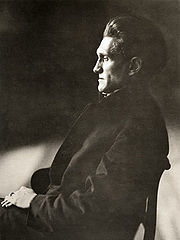
Stefan George

Encyclopedia
Germany
Germany , officially the Federal Republic of Germany , is a federal parliamentary republic in Europe. The country consists of 16 states while the capital and largest city is Berlin. Germany covers an area of 357,021 km2 and has a largely temperate seasonal climate...
poet
Poet
A poet is a person who writes poetry. A poet's work can be literal, meaning that his work is derived from a specific event, or metaphorical, meaning that his work can take on many meanings and forms. Poets have existed since antiquity, in nearly all languages, and have produced works that vary...
, editor
Editing
Editing is the process of selecting and preparing written, visual, audible, and film media used to convey information through the processes of correction, condensation, organization, and other modifications performed with an intention of producing a correct, consistent, accurate, and complete...
, and translator.
Biography
George was born in BingenBingen am Rhein
Bingen am Rhein is a town in the Mainz-Bingen district in Rhineland-Palatinate, Germany.The settlement’s original name was Bingium, a Celtic word that may have meant “hole in the rock”, a description of the shoal behind the Mäuseturm, known as the Binger Loch. Bingen was the starting point for the...
in Germany
Germany
Germany , officially the Federal Republic of Germany , is a federal parliamentary republic in Europe. The country consists of 16 states while the capital and largest city is Berlin. Germany covers an area of 357,021 km2 and has a largely temperate seasonal climate...
in 1868. He spent time in Paris
Paris
Paris is the capital and largest city in France, situated on the river Seine, in northern France, at the heart of the Île-de-France region...
, where he was among the writers and artists who attended the Tuesday soireés held by the poet Stéphane Mallarmé
Stéphane Mallarmé
Stéphane Mallarmé , whose real name was Étienne Mallarmé, was a French poet and critic. He was a major French symbolist poet, and his work anticipated and inspired several revolutionary artistic schools of the early 20th century, such as Dadaism, Surrealism, and Futurism.-Biography:Stéphane...
. He began to publish poetry in the 1890s, while in his twenties. George founded and edited an important literary magazine
Literary magazine
A literary magazine is a periodical devoted to literature in a broad sense. Literary magazines usually publish short stories, poetry and essays along with literary criticism, book reviews, biographical profiles of authors, interviews and letters...
called Blätter für die Kunst. He was also at the center of an influential literary and academic circle known as the George-Kreis
George-Kreis
The George-Kreis or George Circle were an influential German literary group centred around Stefan George. Formed in the late 19th Century, the group featured many highly-regarded German writers and academics...
, which included many of the leading young writers of the day, (for example Friedrich Gundolf
Friedrich Gundolf
Friedrich Gundolf, born Friedrich Leopold Gundelfinger was a German-Jewish literary scholar and poet and one of the most famous academics of the Weimar Republic.- Education :...
and Ludwig Klages
Ludwig Klages
Ludwig Klages was a German philosopher, psychologist and a theoretician in the field of handwriting analysis.-Life:...
). In addition to sharing cultural interests, the circle reflected mystical and political themes. George knew and befriended the "Bohemian Countess" of Schwabing
Schwabing
Schwabing is a borough in the northern part of Munich, the capital of the German state of Bavaria. It is divided into the city borough 4 and the city borough 12...
, Fanny zu Reventlow
Fanny zu Reventlow
Franziska Reventlow was a German writer, artist and translator, who became famous as the "Bohemian Countess" of Schwabing in the years leading up to World War I.- Life :Fanny...
, who sometimes satirized the circle for its melodramatic actions and views. George and his writings were identified with the Conservative Revolutionary movement
Conservative Revolutionary movement
The Conservative Revolutionary movement was a German national conservative movement, prominent in the years following the First World War. The Conservative Revolutionary school of thought advocated a "new" conservatism and nationalism that was specifically German, or Prussian in particular...
. He was a homosexual, yet exhorted his young friends to lead a celibate life like his own.
In 1914 at the start of the war he foretold a sad end for Germany, and between then and 1916 wrote the pessimistic poem Der Krieg (The War). The outcome of the war saw the realization of his worst fears.
In 1933 after the Nazi takeover Joseph Goebbels
Joseph Goebbels
Paul Joseph Goebbels was a German politician and Reich Minister of Propaganda in Nazi Germany from 1933 to 1945. As one of Adolf Hitler's closest associates and most devout followers, he was known for his zealous oratory and anti-Semitism...
offered him the presidency of a new Academy for the arts, which he refused. He also stayed away from celebrations prepared for his 65th birthday. Instead he travelled to Switzerland
Switzerland
Switzerland name of one of the Swiss cantons. ; ; ; or ), in its full name the Swiss Confederation , is a federal republic consisting of 26 cantons, with Bern as the seat of the federal authorities. The country is situated in Western Europe,Or Central Europe depending on the definition....
, where he died near Locarno
Locarno
Locarno is the capital of the Locarno district, located on the northern tip of Lake Maggiore in the Swiss canton of Ticino, close to Ascona at the foot of the Alps. It has a population of about 15,000...
. After his death, his body was interred before a delegation from the National Socialist government could attend the ceremony.
Work
George's poetry is characterized by an aristocraticAristocracy
Aristocracy , is a form of government in which a few elite citizens rule. The term derives from the Greek aristokratia, meaning "rule of the best". In origin in Ancient Greece, it was conceived of as rule by the best qualified citizens, and contrasted with monarchy...
and remote ethos
Ethos
Ethos is a Greek word meaning "character" that is used to describe the guiding beliefs or ideals that characterize a community, nation, or ideology. The Greeks also used this word to refer to the power of music to influence its hearer's emotions, behaviors, and even morals. Early Greek stories of...
; his verse is formal in style, lyrical
Lyric poetry
Lyric poetry is a genre of poetry that expresses personal and emotional feelings. In the ancient world, lyric poems were those which were sung to the lyre. Lyric poems do not have to rhyme, and today do not need to be set to music or a beat...
in tone, and often arcane in language, being influenced by Greek
Ancient Greece
Ancient Greece is a civilization belonging to a period of Greek history that lasted from the Archaic period of the 8th to 6th centuries BC to the end of antiquity. Immediately following this period was the beginning of the Early Middle Ages and the Byzantine era. Included in Ancient Greece is the...
classical
Classical antiquity
Classical antiquity is a broad term for a long period of cultural history centered on the Mediterranean Sea, comprising the interlocking civilizations of ancient Greece and ancient Rome, collectively known as the Greco-Roman world...
forms, in revolt against the realist
Literary realism
Literary realism most often refers to the trend, beginning with certain works of nineteenth-century French literature and extending to late-nineteenth- and early-twentieth-century authors in various countries, towards depictions of contemporary life and society "as they were." In the spirit of...
trend in German literature
German literature
German literature comprises those literary texts written in the German language. This includes literature written in Germany, Austria, the German part of Switzerland, and to a lesser extent works of the German diaspora. German literature of the modern period is mostly in Standard German, but there...
at the time. Believing that the purpose of poetry was distance from the world—he was a strong advocate of art for art's sake —George's writing had many ties with the French
France
The French Republic , The French Republic , The French Republic , (commonly known as France , is a unitary semi-presidential republic in Western Europe with several overseas territories and islands located on other continents and in the Indian, Pacific, and Atlantic oceans. Metropolitan France...
Symbolist
Symbolism (arts)
Symbolism was a late nineteenth-century art movement of French, Russian and Belgian origin in poetry and other arts. In literature, the style had its beginnings with the publication Les Fleurs du mal by Charles Baudelaire...
movement and he was in contact with many of its representatives, including Stéphane Mallarmé
Stéphane Mallarmé
Stéphane Mallarmé , whose real name was Étienne Mallarmé, was a French poet and critic. He was a major French symbolist poet, and his work anticipated and inspired several revolutionary artistic schools of the early 20th century, such as Dadaism, Surrealism, and Futurism.-Biography:Stéphane...
and Paul Verlaine
Paul Verlaine
Paul-Marie Verlaine was a French poet associated with the Symbolist movement. He is considered one of the greatest representatives of the fin de siècle in international and French poetry.-Early life:...
.
George was an important bridge between the 19th century and German modernism, even though he was a harsh critic of the then modern era. He experimented with various poetic metres, punctuation
Punctuation
Punctuation marks are symbols that indicate the structure and organization of written language, as well as intonation and pauses to be observed when reading aloud.In written English, punctuation is vital to disambiguate the meaning of sentences...
, obscure allusions and typography
Typography
Typography is the art and technique of arranging type in order to make language visible. The arrangement of type involves the selection of typefaces, point size, line length, leading , adjusting the spaces between groups of letters and adjusting the space between pairs of letters...
. George's "evident homosexuality" is reflected in works such as Algabal and the love poetry he devoted to a gifted adolescent of his acquaintance named Maximilian Kronberger
Maximilian Kronberger
Maximilian Kronberger, known familiarly as Maximin , was a German poet and a significant figure in the literary circle of Stefan George ....
, whom he called "Maximin", and whom he identified as a manifestation of the divine. The relevance of George's sexuality to his poetic work has been discussed by contemporary critics, such as Thomas Karlauf and Marita Keilson-Lauritz.
Algabal is one of George's best remembered collections of poetry, if also one of his strangest; the title is a reference to the effete Roman emperor Elagabalus
Elagabalus
Elagabalus , also known as Heliogabalus, was Roman Emperor from 218 to 222. A member of the Severan Dynasty, he was Syrian on his mother's side, the son of Julia Soaemias and Sextus Varius Marcellus. Early in his youth he served as a priest of the god El-Gabal at his hometown, Emesa...
. George was also an important translator
Translation
Translation is the communication of the meaning of a source-language text by means of an equivalent target-language text. Whereas interpreting undoubtedly antedates writing, translation began only after the appearance of written literature; there exist partial translations of the Sumerian Epic of...
; he translated Dante
Dante Alighieri
Durante degli Alighieri, mononymously referred to as Dante , was an Italian poet, prose writer, literary theorist, moral philosopher, and political thinker. He is best known for the monumental epic poem La commedia, later named La divina commedia ...
, Shakespeare
William Shakespeare
William Shakespeare was an English poet and playwright, widely regarded as the greatest writer in the English language and the world's pre-eminent dramatist. He is often called England's national poet and the "Bard of Avon"...
and Baudelaire
Charles Baudelaire
Charles Baudelaire was a French poet who produced notable work as an essayist, art critic, and pioneering translator of Edgar Allan Poe. His most famous work, Les Fleurs du mal expresses the changing nature of beauty in modern, industrializing Paris during the nineteenth century...
into German
German language
German is a West Germanic language, related to and classified alongside English and Dutch. With an estimated 90 – 98 million native speakers, German is one of the world's major languages and is the most widely-spoken first language in the European Union....
.
Das neue Reich
George's late and seminal work, Das neue Reich (The New Empire), was published in 1928. He dedicated the work, including the Geheimes Deutschland ("Secret Germany") written in 1922, to Berthold Schenk Graf von StauffenbergBerthold Schenk Graf von Stauffenberg
Berthold Alfred Maria Graf Schenk von Stauffenberg was a German aristocrat, lawyer and conspirator in the 20 July plot of 1944, along with his brother, Claus Schenk Graf von Stauffenberg, an army colonel...
(who in 1944 took part in the 20 July plot to assassinate Adolf Hitler
Adolf Hitler
Adolf Hitler was an Austrian-born German politician and the leader of the National Socialist German Workers Party , commonly referred to as the Nazi Party). He was Chancellor of Germany from 1933 to 1945, and head of state from 1934 to 1945...
). It outlines a new form of society ruled by hierarchical spiritual aristocracy. George rejected any attempts to use it for mundane political purposes, especially National Socialism.
Influence
George was thought of by his contemporaries as a prophetProphet
In religion, a prophet, from the Greek word προφήτης profitis meaning "foreteller", is an individual who is claimed to have been contacted by the supernatural or the divine, and serves as an intermediary with humanity, delivering this newfound knowledge from the supernatural entity to other people...
and a priest
Priest
A priest is a person authorized to perform the sacred rites of a religion, especially as a mediatory agent between humans and deities. They also have the authority or power to administer religious rites; in particular, rites of sacrifice to, and propitiation of, a deity or deities...
, while he thought of himself as a messiah
Messiah
A messiah is a redeemer figure expected or foretold in one form or another by a religion. Slightly more widely, a messiah is any redeemer figure. Messianic beliefs or theories generally relate to eschatological improvement of the state of humanity or the world, in other words the World to...
of a new kingdom that would be led by intellectual or artistic elite
Elite
Elite refers to an exceptional or privileged group that wields considerable power within its sphere of influence...
s, bonded by their faithfulness to a strong leader. In his memoirs
Inside the Third Reich
Inside the Third Reich is a memoir written by Albert Speer, the Nazi Minister of Armaments from 1942 to 1945, serving as Hitler's main architect before this period...
, Albert Speer
Albert Speer
Albert Speer, born Berthold Konrad Hermann Albert Speer, was a German architect who was, for a part of World War II, Minister of Armaments and War Production for the Third Reich. Speer was Adolf Hitler's chief architect before assuming ministerial office...
claims to have seen George in the early 1920s and that his elder brother, Hermann, was a member of his inner circle: George "radiated dignity and pride and a kind of priestliness... there was something magnetic about him."
His poetry emphasized self-sacrifice, heroism and power, and he thus gained popularity in National Socialist circles. The group of writers and admirers that formed around him were known as the Georgekreis. Although many National Socialists claimed George as an important influence, George himself was aloof from such associations and did not get involved in politics. Shortly after the Nazi seizure of power, George left Germany for Switzerland
Switzerland
Switzerland name of one of the Swiss cantons. ; ; ; or ), in its full name the Swiss Confederation , is a federal republic consisting of 26 cantons, with Bern as the seat of the federal authorities. The country is situated in Western Europe,Or Central Europe depending on the definition....
where he died the same year.
Some critics considered his work to be proto-fascist, though many of the leading members of the German Resistance to the Nazis were drawn from among his followers, notably the Stauffenberg brothers who were introduced to George by the poet and classical scholar Albrecht von Blumenthal
Von Blumenthal
The von Blumenthal family are German nobility from Brandenburg-Prussia. Other, unrelated, families of this name exist in Switzerland and formerly in Russia, and many unrelated families called "Blumenthal" without "von" are to be found worldwide.The family was already noble from earliest times ,...
. Also, although some members of the circle were explicitly anti-semitic (for example, Klages), it also included Jewish writers such as Gundolf, the historian Ernst H. Kantorowicz, and the Zionist, Karl Wolfskehl
Karl Wolfskehl
Karl Wolfskehl was a German Jewish author who wrote poetry, prose and drama in German. He also translated from French, English, Italian, Hebrew, Latin and Middle High German into German....
. George was fond enough of his Jewish disciples, but he expressed reservations about their ever becoming a majority in the Circle.
Perhaps the most eminent poet who collaborated with George, but who ultimately refused membership in the Circle, was Hugo von Hofmannsthal
Hugo von Hofmannsthal
Hugo Laurenz August Hofmann von Hofmannsthal ; , was an Austrian novelist, librettist, poet, dramatist, narrator, and essayist.-Early life:...
, one of Austria's outstanding literary modernists. Later in life, Hofmannsthal wrote that no one had influenced him more deeply than George. Those closest to the "Master," as George had his disciples call him, included several members of the 20 July plot to assassinate Hitler, among them Claus von Stauffenberg himself. Stauffenberg frequently quoted George's poem Der Widerchrist ( The Anti-Christ) to his fellow members of the July 20th Plot.
Outside the Circle, George's poetry was a major influence on the music of the Second Viennese School
Second Viennese School
The Second Viennese School is the group of composers that comprised Arnold Schoenberg and his pupils and close associates in early 20th century Vienna, where he lived and taught, sporadically, between 1903 and 1925...
of composers, particularly during their Expressionist
Expressionism
Expressionism was a modernist movement, initially in poetry and painting, originating in Germany at the beginning of the 20th century. Its typical trait is to present the world solely from a subjective perspective, distorting it radically for emotional effect in order to evoke moods or ideas...
period. Arnold Schönberg set George's poetry in such works as his String Quartet No. 2 Op. 10 of 1908 and The Book of the Hanging Gardens Op. 15 of 1909, while his student Anton Webern
Anton Webern
Anton Webern was an Austrian composer and conductor. He was a member of the Second Viennese School. As a student and significant follower of Arnold Schoenberg, he became one of the best-known exponents of the twelve-tone technique; in addition, his innovations regarding schematic organization of...
made use of George's verse in his early choral work Entflieht auf leichten Kähnen Op. 2 as well as in two sets of songs, Opp. 3 and 4 of 1909, and in several posthumously published vocal works from the same period.
In Rainer Werner Fassbinder
Rainer Werner Fassbinder
Rainer Werner Maria Fassbinder was a German movie director, screenwriter and actor. He is considered one of the most important representatives of the New German Cinema.He maintained a frenetic pace in film-making...
's 1976 film Satansbraten the protagonist Walter Kranz attempts to model his life on that of George.
Online texts
Studies
- Breuer, Stefan (1996). Ästhetischer Fundamentalismus: Stefan George und der deutsche Antimodernismus. Darmstadt: Primus.
- Capetanakis, D., 'Stefan George', in Demetrios Capetanakis A Greek Poet In England (1947), p.72-89
- Frank, Lore & Sabine Ribbeck (2000). Stefan-George-Bibliographie 1976-1997. Mit Nachträgen bis 1976. Auf der Grundlage der Bestände des Stefan-George-Archivs in der Württembergischen Landesbibliothek. Tübingen: Niemeyer.
- Goldsmith, Ulrich (1951). Stefan George and the theatre. New York: The Modern Language Association (PLMA Publications LXVI:2).
- Goldsmith, Ulrich (1959). Stefan George: A study of his early work. Boulder: University of Colorado Press (University of Colorado Studies Series in Language and Literature 7).
- Goldsmith, Ulrich (1970). Stefan George. New York: Columbia University Press (Essays on Modern Writers).
- Goldsmith, Ulrich (1974). Shakespeare and Stefan George: The sonnets. Berne: Franke.
- Kluncker, Karlhans (1985). "Das geheime Deutschland": Über Stefan George und seinen Kreis. Bonn: Bouvier (Abhandlungen zur Kunst-, Musik- und Literaturwissenschaft 355).
- Lane, Melissa S. and Ruehl,Martin A. eds. (2011) A Poet's Reich: Politics and Culture in the George Circle. Rochester, NY: Camden House. ISBN 9781571134622.
- Norton, Robert E. (2002). Secret Germany: Stefan George and his Circle. Ithaca, NY: Cornell University Press.
- Schmitz, Victor (1978). Stefan George und Rainer Maria Rilke: Gestaltung und Verinnerlichung. Berne: Wild.
- Rieckmann, Jens (ed.) (2005). A Companion to the Works of Stefan George. Camden House.
- Lacchin, Giancarlo (2006). Stefan George e l'antichità. Lineamenti di una filosofia dell'arte. Lugano: University Words.
- Schefold, Bertram. (2011). Politische Ökonomie als Geisteswissenschaft. Edgar Salin und andere Ökonomen um Stefan George, in Studien zur Entwicklung der ökonomischen Theorie, XXVI. Edited by Harald Hagemann, Duncker & Humblot
External links
- Concise overview
- A biographical article on George's homosexuality
- The Writings of Stefan George Online (In German)
- Stefan George letters to Ernst Morwitz, 1905-1956. Manuscripts and Archives, New York Public Library.