

Seismic retrofit

Encyclopedia
Seismic retrofitting is the modification of existing structures
to make them more resistant to seismic activity
, ground motion, or soil
failure due to earthquake
s. With better understanding of seismic demand on structures and with our recent experiences with large earthquakes near urban centers, the need of seismic retrofitting is well acknowledged. Prior to the introduction of modern seismic codes
in the late 1960s for developed countries (US, Japan etc.) and late 1970s for many other parts of the world (Turkey, China etc.), many structures were designed without adequate detailing and reinforcement for seismic protection. In view of the imminent problem, various research work has been carried out. Furthermore, state-of-the-art technical guidelines for seismic assessment, retrofit and rehabilitation have been published around the world - such as the ASCE-SEI 41 and the New Zealand Society for Earthquake Engineering (NZSEE)'s guidelines.
The retrofit
techniques outlined here are also applicable for other natural hazards such as tropical cyclone
s, tornado
es, and severe wind
s from thunderstorm
s. Whilst current practice of seismic retrofitting is predominantly concerned with structural improvements to reduce the seismic hazard of using the structures, it is similarly essential to reduce the hazards and losses from non-structural elements. It is also important to keep in mind that there is no such thing as an earthquake-proof structure, although seismic performance can be greatly enhanced through proper initial design or subsequent modifications.

An extension of the same idea for seismic retrofitting has been experimentally tested for seismic retrofit of California bridges under a Caltrans research project and for seismic retrofit of non-ductile reinforced concrete frames. Pre-stressing can increase the capacity of structural elements such as beam, column and beam-column joints. It should be noted that external pre-stressing has been used for structural upgrade for gravity/live loading since 1970s
is a collection of structural elements of a building
that should substantially decouple the building's structure from the shaking ground thus protecting the building's integrity and enhancing its seismic performance. This earthquake engineering
technology, which is a kind of seismic vibration control
, can be applied both to a newly designed building and to seismic upgrading of existing structures.
Normally, excavations are made around the building and the building is separated from the foundations. Steel or reinforced concrete beams replace the connections to the foundations, while under these, the isolating pads, or base isolators, replace the material removed. While the base isolation
tends to restrict transmission of the ground motion to the building, it also keeps the building positioned properly over the foundation. Careful attention to detail is required where the building interfaces with the ground, especially at entrances, stairways and ramps, to ensure sufficient relative motion of those structural elements.
" resonant effects in structures that are rigidly attached to the ground. In addition to adding energy dissipation capacity to the structure, supplementary damping can reduce the displacement and acceleration demand within the structures. In some cases, the threat of damage does not come from the initial shock itself, but rather from the periodic resonant
motion of the structure that repeated ground motion induces. In partical sense, supplementary dampers act similarly to Shock absorber
s used in automotive suspensions
.
s, powered by electric pumps and accumulators, are actively driven to counter the wind forces and natural resonances. These may also, if properly designed, be effective in controlling excessive motion - with or without applied power - in an earthquake. In general, though, modern steel frame high rise buildings are not as subject to dangerous motion as are medium rise (eight to ten story
) buildings, as the resonant period of a tall and massive building is longer than the approximately one second shocks applied by an earthquake.
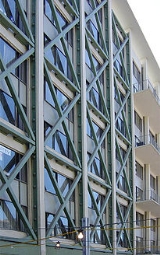
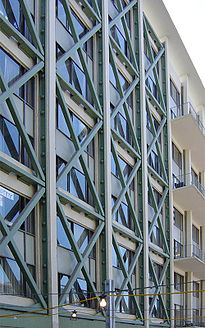
Shown here is an exterior shear reinforcement of a conventional reinforced concrete dormitory building. In this case, there was sufficient vertical strength in the building columns and sufficient shear strength in the lower stories that only limited shear reinforcement was required to make it earthquake resistant for this location near the Hayward fault
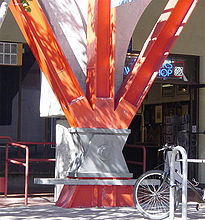
 In other circumstances, far greater reinforcement is required. In the structure shown at right — a parking garage over shops — the placement, detailing, and painting of the reinforcement becomes itself an architectural embellishment.
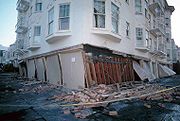 This collapse mode is known as soft story collapse. In many buildings the ground level is designed for different uses than the upper levels. Low rise residential structures may be built over a parking garage which have large doors on one side. Hotels may have a tall ground floors to allow for a grand entrance or ballrooms. Office buildings may have stores in the ground floor which desire continuous windows for display.
Traditional seismic design assumes that the lower stories of a building are stronger than the upper stories and where this is not the case—if the lower story is less strong than the upper structure—the structure will not respond to earthquakes in the expected fashion. Using modern design methods, it is possible to take a weak story into account. Several failures of this type in one large apartment complex caused most of the fatalities in the 1994 Northridge earthquake.
Typically, where this type of problem is found, the weak story is reinforced to make it stronger than the floors above by adding shear walls or moment frames. Moment frames consisting of inverted U bents are useful in preserving lower story garage access, while a lower cost solution may be to use shear walls or trusses in several locations, which partially reduce the usefulness for automobile parking but still allow the space to be used for other storage.
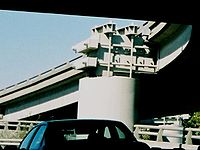 Beam-column joint connections are a common structural weakness in dealing with seismic retrofitting. Prior to the introduction of modern seismic codes in early 1970s, beam-column joints were typically non-engineered or designed. Laboratory testings have confirmed the seismic vulnerability of these poorly detailed and under-designed connections. Failure of beam-column joint connections can typically lead to catastrophic collapse of a frame-building, as often observed in recent earthquakes
For reinforced concrete beam-column joints - various retrofit solutions have been proposed and tested in the past 20 years. Philosophically, the various seismic retrofit strategies discussed above can be implemented for reinforced concrete joints. Concrete or steel jacketing have been a popular retrofit technique until the advent of composite materials such as Carbon fiber-reinforced polymer
(FRP). Composite materials such as carbon FRP and aramic FRP have been extensively tested for use in seismic retrofit with some success. One novel technique includes the use of selective weakening of the beam and added external post-tensioning to the joint in order to achieve flexural hinging in the beam, which is more desirable in terms of seismic design.
Widespread weld failures at beam-column joints of low-to-medium rise steel buildings during the Northridge 1994 earthquake for example, have shown the structural defiencies of these 'modern-designed' post-1970s welded moment-resisting connections. A subsequent SAC research project http://www.sacsteel.org/ has documented, tested and proposed several retrofit solutions for these welded steel moment-resisting connections. Various retrofit solutions have been developed for these welded joints - such as a) weld strengthening and b) addition of steel haunch or 'dog-bone' shape flange.
s, covered with a diagonal wood planking or plywood
to form a subfloor upon which the finish floor surface is laid. In many structures these are all aligned in the same direction. To prevent the beams from tipping over onto their side, blocking is used at each end, and for additional stiffness, blocking or diagonal wood or metal bracing may be placed between beams at one or more points in their spans. At the outer edge it is typical to use a single depth of blocking and a perimeter beam overall.
If the blocking or nailing is inadequate, each beam can be laid flat by the shear forces applied to the building. In this position they lack most of their original strength and the structure may further collapse. As part of a retrofit the blocking may be doubled, especially at the outer edges of the building. It may be appropriate to add additional nails between the sill plate
of the perimeter wall erected upon the floor diaphragm, although this will require exposing the sill plate by removing interior plaster or exterior siding. As the sill plate may be quite old and dry and substantial nails must be used, it may be necessary to pre-drill a hole for the nail in the old wood to avoid splitting. When the wall is opened for this purpose it may also be appropriate to tie vertical wall elements into the foundation using specialty connectors and bolts glued with epoxy cement into holes drilled in the foundation.
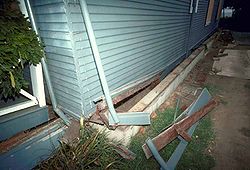
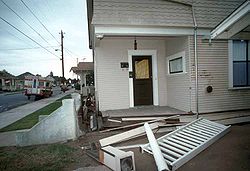 Single or two story wood-frame domestic structures built on a perimeter or slab foundation are relatively safe in an earthquake, but in many structures built before 1950 the sill plate that sits between the concrete foundation and the floor diaphragm (perimeter foundation) or studwall (slab foundation) may not be sufficiently bolted in. Additionally, older attachments (without substantial corrosion-proofing) may have corroded to a point of weakness. A sideways shock can slide the building entirely off of the foundations or slab.
Often such buildings, especially if constructed on a moderate slope, are erected on a platform connected to a perimeter foundation through low stud-walls called "cripple wall" or pin-up. This low wall structure itself may fail in shear or in its connections to itself at the corners, leading to the building moving diagonally and collapsing the low walls. The likelihood of failure of the pin-up can be reduced by ensuring that the corners are well reinforced in shear and that the shear panels are well connected to each other through the corner posts. This requires structural grade sheet plywood, often treated for rot resistance. This grade of plywood is made without interior unfilled knots and with more, thinner layers than common plywood. New buildings designed to resist earthquakes will typically use OSB (oriented strand board
), sometimes with metal joins between panels, and with well attached stucco
covering to enhance its performance. In many modern tract homes, especially those built upon expansive (clay) soil the building is constructed upon a single and relatively thick monolithic slab, kept in one piece by high tensile rods that are stressed after the slab has set. This poststressing places the concrete under compression - a condition under which it is extremely strong in bending and so will not crack under adverse soil conditions!
(frozen mud) as it keeps the building's warmth from destabilizing the ground beneath. During an earthquake, the pylons may tip, spilling the building to the ground. This can be overcome by using deep-bored holes to contain cast-in-place reinforced pylons, which are then secured to the floor panel at the corners of the building. Another technique is to add sufficient diagonal bracing or sections of concrete shear wall between pylons.
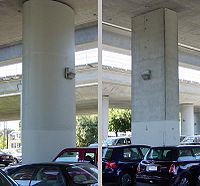 Reinforced concrete columns typically contain large diameter vertical rebar
(reinforcing bars) arranged in a ring, surrounded by lighter-gauge hoops of rebar. Upon analysis of failures due to earthquakes, it has been realized that the weakness was not in the vertical bars, but rather in inadequate strength and quantity of hoops. Once the integrity of the hoops is breached, the vertical rebar can flex outward, stressing the central column of concrete. The concrete then simply crumbles into small pieces, now unconstrained by the surrounding rebar. In new construction a greater amount of hoop-like structures are used.
One simple retrofit is to surround the column with a jacket of steel plates formed and welded into a single cylinder. The space between the jacket and the column is then filled with concrete, a process called grouting. Where soil or structure conditions require such additional modification, additional pilings may be driven near the column base and concrete pads linking the pilings to the pylon are fabricated at or below ground level. In the example shown not all columns needed to be modified to gain sufficient seismic resistance for the conditions expected. (This location is about a mile from the Hayward Fault Zone
.)
One form of retrofit is to drill numerous holes into the surface of the wall, and secure short L-shaped sections of rebar to the surface of each hole with epoxy
adhesive
. Additional vertical and horizontal rebar is then secured to the new elements, a form is erected, and an additional layer of concrete is poured. This modification may be combined with additional footings in excavated trenches and additional support ledgers and tie-backs to retain the span on the bounding walls.
interfaces in a "beach like" structure against underlying firm material, seismic waves traveling through the alluvium can be amplified, just as are water waves against a sloping beach
. In these special conditions, vertical accelerations
up to twice the force of gravity have been measured. If a building is not secured to a well-embedded foundation it is possible for the building to be thrust from (or with) its foundations into the air, usually with severe damage upon landing. Even if it is well-founded, higher portions such as upper stories or roof structures or attached structures such as canopies and porches may become detached from the primary structure.
Good practices in modern, earthquake-resistant structures dictate that there be good vertical connections throughout every component of the building, from undisturbed or engineered earth to foundation to sill plate to vertical studs to plate cap through each floor and continuing to the roof structure. Above the foundation and sill plate the connections are typically made using steel strap or sheet stampings, nailed to wood members using special hardened high-shear strength nails, and heavy angle stampings secured with through bolts, using large washers to prevent pull-through. Where inadequate bolts are provided between the sill plates and a foundation in existing construction (or are not trusted due to possible corrosion), special clamp plates may be added, each of which is secured to the foundation using expansion bolts inserted into holes drilled in an exposed face of concrete. Other members must then be secured to the sill plates with additional fittings.
, or in a flat area due to liquefaction
of water-saturated sand and/or mud. Generally, deep pilings must be driven into stable soil (typically hard mud or sand) or to underlying bedrock or the slope must be stabilized. For buildings built atop previous landslides the practicality of retrofit may be limited by economic factors, as it is not practical to stabilize a large, deep landslide. The likelihood of landslide or soil failure may also depend upon seasonal factors, as the soil may be more stable at the beginning of a wet season than at the beginning of the dry season. Such a "two season" Mediterranean climate
is seen throughout California
.
In some cases, the best that can be done is to reduce the entrance of water runoff from higher, stable elevations by capturing and bypassing through channels or pipes, and to drain water infiltrated directly and from subsurface springs by inserting horizontal perforated tubes. There are numerous locations in California where extensive developments have been built atop archaic landslides, which have not moved in historic times but which (if both water-saturated and shaken by an earthquake) have a high probability of moving en masse, carrying entire sections of suburban development to new locations. While the most modern of house structures (well tied to monolithic concrete foundation slabs reinforced with post tensioning cables) may survive such movement largely intact, the building will no longer be in its proper location.
and propane
supply pipes to structures often prove especially dangerous during and after earthquakes. Should a building move from its foundation or fall due to cripple wall collapse, the ductile iron pipes transporting the gas within the structure may be broken, typically at the location of threaded joints. The gas may then still be provided to the pressure regulator from higher pressure lines and so continue to flow in substantial quantities; it may then be ignited by a nearby source such as a lit pilot light
or arc
ing electrical connection.
There are two primary methods of automatically restraining the flow of gas after an earthquake, installed on the low pressure side of the regulator, and usually downstream of the gas meter.
It appears that the most secure configuration would be to use one of each of these devices in series.
s) or the slope above the tunnel may be stabilized in some way. Where only small- to medium-sized rocks and boulders are expected to fall, the entire slope may be covered with wire mesh, pinned down to the slope with metal rods. This is also a common modification to highway cuts where appropriate conditions exist.
A tube of particular structural, seismic, economic, and political interest is the BART (Bay Area Rapid Transit) trans-bay tube. This tube was constructed at the bottom of San Francisco Bay
through an innovative process. Rather than pushing a shield through the soft bay mud, the tube was constructed on land in sections. Each section consisted of two inner train tunnels of circular cross section, a central access tunnel of rectangular cross section, and an outer oval shell encompassing the three inner tubes. The intervening space was filled with concrete. At the bottom of the bay a trench was excavated and a flat bed of crushed stone prepared to receive the tube sections. The sections were then floated into place and sunk, then joined with bolted connections to previously-placed sections. An overfill was then placed atop the tube to hold it down. Once completed from San Francisco to Oakland, the tracks and electrical components were installed. The predicted response of the tube during a major earthquake was likened to be as that of a string of (cooked) spaghetti
in a bowl of gelatin dessert
. To avoid overstressing the tube due to differential movements at each end, a sliding slip joint
was included at the San Francisco terminus under the landmark Ferry Building
.
The engineers of the construction consortium PBTB (Parsons Brinckerhoff-Tudor-Bechtel) used the best estimates of ground motion available at the time, now known to be insufficient given modern computational analysis methods and geotechnical knowledge. Unexpected settlement of the tube has reduced the amount of slip that can be accommodated without failure. These factors have resulted in the slip joint being designed too short to ensure survival of the tube under possible (perhaps even likely) large earthquakes in the region. To correct this deficiency the slip joint must be extended to allow for additional movement, a modification expected to be both expensive and technically and logistically difficult. Other retrofits to the BART tube include vibratory consolidation of the tube's overfill to avoid potential liquefying of the overfill, which has now been completed. (Should the overfill fail there is a danger of portions of the tube rising from the bottom, an event which could potentially cause failure of the section connections.)
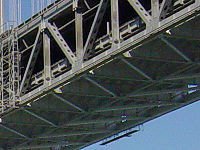
s. During severe ground motion, the rockers may jump from their tracks or be moved beyond their design limits, causing the bridge to unship from its resting point and then either become misaligned or fail completely. Motion can be constrained by adding ductile or high-strength steel restraints that are friction-clamped to beams and designed to slide under extreme stress while still limiting the motion relative to the anchorage.
 Suspension bridge
s may respond to earthquakes with a side-to-side motion exceeding that which was designed for wind gust response. Such motion can cause fragmentation of the road surface, damage to bearings, and plastic deformation or breakage of components. Devices such as hydraulic dampers or clamped sliding connections and additional diagonal reenforcement may be added.
 Lattice girder
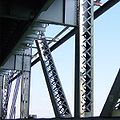
s consist of two "I"-beams connected with a criss-cross lattice of flat strap or angle stock. These can be greatly strengthened by replacing the open lattice with plate members. This is usually done in concert with the replacement of hot rivet
s with bolts.
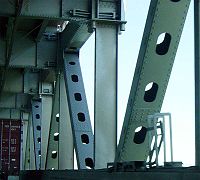
(soft) condition, while the plate, having been hot rolled and quenched during manufacture, remains relatively hard. Under extreme stress the hard plates can shear the soft rivets, resulting in failure of the joint.
The solution is to burn out each rivet with an oxygen torch
. The hole is then prepared to a precise diameter with a reamer
. A special locator bolt, consisting of a head, a shaft matching the reamed hole, and a threaded end is inserted and retained with a nut, then tightened with a wrench
. As the bolt has been formed from an appropriate high-strength alloy
and has also been heat-treated, it is not subject to either the plastic shear failure typical of hot rivets nor the brittle fracture of ordinary bolts. Any partial failure will be in the plastic flow of the metal secured by the bolt; with proper engineering any such failure should be non-catastrophic.
Another failure occurs when the fill at each end moves (through resonant effects) in bulk, in opposite directions. If there is an insufficient founding shelf for the overpass, then it may fall. Additional shelf and ductile stays may be added to attach the overpass to the footings at one or both ends. The stays, rather than being fixed to the beams, may instead be clamped to them. Under moderate loading, these keep the overpass centered in the gap so that it is less likely to slide off its founding shelf at one end. The ability for the fixed ends to slide, rather than break, will prevent the complete drop of the structure if it should fail to remain on the footings.
in Kobe, Japan, where an entire viaduct, centrally supported by a single row of large columns, was laid down to one side. Such columns are reinforced by excavating to the foundation pad, driving additional pilings, and adding a new, larger pad, well connected with rebar alongside or into the column. A column with insufficient wrapping bar, which is prone to burst and then hinge at the bursting point, may be completely encased in a circular or elliptical jacket of welded steel sheet
and grouted as described above.
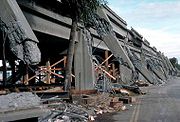 Sometimes viaducts may fail in the connections between components. This was seen in the failure of the Cypress Freeway in Oakland, California
, during the Loma Prieta earthquake
. This viaduct was a two-level structure, and the upper portions of the columns were not well connected to the lower portions that supported the lower level; this caused the upper deck to collapse upon the lower deck. Weak connections such as these require additional external jacketing - either through external steel components or by a complete jacket of reinforced concrete, often using stub connections that are glued (using epoxy
adhesive) into numerous drilled holes. These stubs are then connected to additional wrappings, external forms (which may be temporary or permanent) are erected, and additional concrete is poured into the space. Large connected structures similar to the Cypress Viaduct must also be properly analyzed in their entirety using dynamic computer simulations.
). For specific "permit ready" details as recommended by a public agency for simple low-rise construction see this PDF document (by the City of San Leandro
).
or oriented strand board in combination with exterior stucco
. Steel strapping and sheet forms are also used to connect elements securely.
Retrofit methods in older woodframe structures may consist of the following, and other methods not described here.
Wooden framing is efficient when combined with masonry, if the structure is properly designed. In Turkey, the traditional houses (bagdadi) are made with this technology. In El Salvador
, wood and bamboo are used for residential construction.
In the western United States, much of what is seen as masonry is actually brick or stone veneer. Current construction rules dictate the amount of tie–back required, which consist of metal straps secured to vertical structural elements. These straps extend into mortar courses, securing the veneer to the primary structure. Older structures may not secure this sufficiently for seismic safety. A weakly secured veneer in a house interior (sometimes used to face a fireplace from floor to ceiling) can be especially dangerous to occupants. Older masonry chimneys are also dangerous if they have substantial vertical extension above the roof. These are prone to breakage at the roofline and may fall into the house in a single large piece. For retrofit, additional supports may be added or it may be better to simply remove the extension and replace it with lighter materials, with special piping replacing the flue tile and a wood structure replacing the masonry. This may be matched against existing brickwork by using very thin veneer (similar to a tile, but with the appearance of a brick).
Earthquake Engineering & Structural Dynamics http://www3.interscience.wiley.com/cgi-bin/jhome/1922
Journal of Structural Engineering http://scitation.aip.org/sto
Earthquake Spectra http://scitation.aip.org/EarthquakeSpectra
International Journal of Structural Stability and Dynamics
http://ejournals.worldscientific.com.sg/ijssd/ijssd.shtml
Soil Dynamics and Earthquake Engineering http://www.elsevier.com/locate/soildyn
Built environment
The term built environment refers to the human-made surroundings that provide the setting for human activity, ranging in scale from personal shelter and buildings to neighborhoods and cities that can often include their supporting infrastructure, such as water supply or energy networks.The built...
to make them more resistant to seismic activity
Seismology
Seismology is the scientific study of earthquakes and the propagation of elastic waves through the Earth or through other planet-like bodies. The field also includes studies of earthquake effects, such as tsunamis as well as diverse seismic sources such as volcanic, tectonic, oceanic,...
, ground motion, or soil
Soil
Soil is a natural body consisting of layers of mineral constituents of variable thicknesses, which differ from the parent materials in their morphological, physical, chemical, and mineralogical characteristics...
failure due to earthquake
Earthquake
An earthquake is the result of a sudden release of energy in the Earth's crust that creates seismic waves. The seismicity, seismism or seismic activity of an area refers to the frequency, type and size of earthquakes experienced over a period of time...
s. With better understanding of seismic demand on structures and with our recent experiences with large earthquakes near urban centers, the need of seismic retrofitting is well acknowledged. Prior to the introduction of modern seismic codes
Built environment
The term built environment refers to the human-made surroundings that provide the setting for human activity, ranging in scale from personal shelter and buildings to neighborhoods and cities that can often include their supporting infrastructure, such as water supply or energy networks.The built...
in the late 1960s for developed countries (US, Japan etc.) and late 1970s for many other parts of the world (Turkey, China etc.), many structures were designed without adequate detailing and reinforcement for seismic protection. In view of the imminent problem, various research work has been carried out. Furthermore, state-of-the-art technical guidelines for seismic assessment, retrofit and rehabilitation have been published around the world - such as the ASCE-SEI 41 and the New Zealand Society for Earthquake Engineering (NZSEE)'s guidelines.
The retrofit
Retrofit
Retrofitting refers to the addition of new technology or features to older systems.* power plant retrofit, improving power plant efficiency / increasing output / reducing emissions...
techniques outlined here are also applicable for other natural hazards such as tropical cyclone
Tropical cyclone
A tropical cyclone is a storm system characterized by a large low-pressure center and numerous thunderstorms that produce strong winds and heavy rain. Tropical cyclones strengthen when water evaporated from the ocean is released as the saturated air rises, resulting in condensation of water vapor...
s, tornado
Tornado
A tornado is a violent, dangerous, rotating column of air that is in contact with both the surface of the earth and a cumulonimbus cloud or, in rare cases, the base of a cumulus cloud. They are often referred to as a twister or a cyclone, although the word cyclone is used in meteorology in a wider...
es, and severe wind
Wind
Wind is the flow of gases on a large scale. On Earth, wind consists of the bulk movement of air. In outer space, solar wind is the movement of gases or charged particles from the sun through space, while planetary wind is the outgassing of light chemical elements from a planet's atmosphere into space...
s from thunderstorm
Thunderstorm
A thunderstorm, also known as an electrical storm, a lightning storm, thundershower or simply a storm is a form of weather characterized by the presence of lightning and its acoustic effect on the Earth's atmosphere known as thunder. The meteorologically assigned cloud type associated with the...
s. Whilst current practice of seismic retrofitting is predominantly concerned with structural improvements to reduce the seismic hazard of using the structures, it is similarly essential to reduce the hazards and losses from non-structural elements. It is also important to keep in mind that there is no such thing as an earthquake-proof structure, although seismic performance can be greatly enhanced through proper initial design or subsequent modifications.
Strategies
Seismic retrofit (or rehabilitation) strategies have been developed in the past few decades following the introduction of new seismic provisions and the availability of advanced materials (e.g. fiber-reinforced polymers, FRP, fiber reinforced concrete and high strength steel). Retrofit strategies are different from retrofit techniques, where the former is the basic approach to achieve an overall retrofit performance objective, such as increasing strength, increasing deformability, reducing deformation demands while the latter is the technical methods to achieve that strategy, for example FRP jacketing (see Figure 2a).- Increasing the global capacity (strengthening). This is typically done by the addition of cross braces or new structural walls.
- Reduction of the seismic demand by means of supplementary damping and/or use of base isolationBase isolationBase isolation, also known as seismic base isolation or base isolation system, is one of the most popular means of protecting a structure against earthquake forces...
systems.
- Increasing the local capacity of structural elements. This strategy recognises the inherent capacity within the existing structures, and therefore adopt a more cost-effective approach to selectively upgrade local capacity (deformation/ductility , strength or stiffness) of individual structural components.
- Selective weakening retrofit. This is a counter intuitive strategy to change the inelastic mechanism of the structure, whilst recognising the inherent capacity of the structure.
- Allowing sliding connections such as passageway bridges to accommodate additional movement between seismically independent structures.
Performance objectives
In the past, seismic retrofit was primarily applied to achieve public safety, with engineering solutions limited by economic and political considerations. However, with the development of Performance based earthquake engineering (PBEE), several levels of performance objectives are gradually recognised:- Public safety only. The goal is to protect human life, ensuring that the structure will not collapse upon its occupants or passersby, and that the structure can be safely exited. Under severe seismic conditions the structure may be a total economic write-off, requiring tear-down and replacement.
- Structure survivability. The goal is that the structure, while remaining safe for exit, may require extensive repair (but not replacement) before it is generally useful or considered safe for occupation. This is typically the lowest level of retrofit applied to bridges.
- Structure functionality. Primary structure undamaged and the structure is undiminished in utility for its primary application. A high level of retrofit, this ensures that any required repairs are only "cosmetic" - for example, minor cracks in plasterPlasterPlaster is a building material used for coating walls and ceilings. Plaster starts as a dry powder similar to mortar or cement and like those materials it is mixed with water to form a paste which liberates heat and then hardens. Unlike mortar and cement, plaster remains quite soft after setting,...
, drywallDrywallDrywall, also known as plasterboard, wallboard or gypsum board is a panel made of gypsum plaster pressed between two thick sheets of paper...
and stuccoStuccoStucco or render is a material made of an aggregate, a binder, and water. Stucco is applied wet and hardens to a very dense solid. It is used as decorative coating for walls and ceilings and as a sculptural and artistic material in architecture...
. This is the minimum acceptable level of retrofit for hospitalHospitalA hospital is a health care institution providing patient treatment by specialized staff and equipment. Hospitals often, but not always, provide for inpatient care or longer-term patient stays....
s.
- Structure unaffected. This level of retrofit is preferred for historic structures of high cultural significance.
Techniques
Common seismic retrofitting techniques fall into several categories:External post-tensioning
The use of external post-tensioning for new structural systems have been developed in the past decade. Under the PRESS (Precast Seismic Structural Systems), a large-scale U.S./Japan joint research program, unbonded post-tensioning high strength steel tendons have been used to achieve a moment-resisting system that has self-centering capacity.An extension of the same idea for seismic retrofitting has been experimentally tested for seismic retrofit of California bridges under a Caltrans research project and for seismic retrofit of non-ductile reinforced concrete frames. Pre-stressing can increase the capacity of structural elements such as beam, column and beam-column joints. It should be noted that external pre-stressing has been used for structural upgrade for gravity/live loading since 1970s
Base isolators
Base isolationBase isolation
Base isolation, also known as seismic base isolation or base isolation system, is one of the most popular means of protecting a structure against earthquake forces...
is a collection of structural elements of a building
Building
In architecture, construction, engineering, real estate development and technology the word building may refer to one of the following:...
that should substantially decouple the building's structure from the shaking ground thus protecting the building's integrity and enhancing its seismic performance. This earthquake engineering
Earthquake engineering
Earthquake engineering is the scientific field concerned with protecting society, the natural and the man-made environment from earthquakes by limiting the seismic risk to socio-economically acceptable levels...
technology, which is a kind of seismic vibration control
Vibration control
In earthquake engineering, vibration control is a set of technical means aimed to mitigate seismic impacts in building and non-building structures.All seismic vibration control devices may be classified as passive, active or hybrid where:...
, can be applied both to a newly designed building and to seismic upgrading of existing structures.
Normally, excavations are made around the building and the building is separated from the foundations. Steel or reinforced concrete beams replace the connections to the foundations, while under these, the isolating pads, or base isolators, replace the material removed. While the base isolation
Base isolation
Base isolation, also known as seismic base isolation or base isolation system, is one of the most popular means of protecting a structure against earthquake forces...
tends to restrict transmission of the ground motion to the building, it also keeps the building positioned properly over the foundation. Careful attention to detail is required where the building interfaces with the ground, especially at entrances, stairways and ramps, to ensure sufficient relative motion of those structural elements.
Supplementary dampers
Supplementary dampers absorb the energy of motion and convert it to heat, thus "dampingDamping
In physics, damping is any effect that tends to reduce the amplitude of oscillations in an oscillatory system, particularly the harmonic oscillator.In mechanics, friction is one such damping effect...
" resonant effects in structures that are rigidly attached to the ground. In addition to adding energy dissipation capacity to the structure, supplementary damping can reduce the displacement and acceleration demand within the structures. In some cases, the threat of damage does not come from the initial shock itself, but rather from the periodic resonant
Resonance
In physics, resonance is the tendency of a system to oscillate at a greater amplitude at some frequencies than at others. These are known as the system's resonant frequencies...
motion of the structure that repeated ground motion induces. In partical sense, supplementary dampers act similarly to Shock absorber
Shock absorber
A shock absorber is a mechanical device designed to smooth out or damp shock impulse, and dissipate kinetic energy. It is a type of dashpot.-Nomenclature:...
s used in automotive suspensions
Suspension (vehicle)
Suspension is the term given to the system of springs, shock absorbers and linkages that connects a vehicle to its wheels. Suspension systems serve a dual purpose — contributing to the car's roadholding/handling and braking for good active safety and driving pleasure, and keeping vehicle occupants...
.
Tuned mass dampers
Tuned mass dampers (TMD) employ movable weights on some sort of springs. These are typically employed to reduce wind sway in very tall, light buildings. Similar designs may be employed to impart earthquake resistance in eight to ten story buildings that are prone to destructive earthquake induced resonances.Slosh tank
A slosh tank is a large tank of fluid placed on an upper floor. During a seismic event, the fluid in this tank will slosh back and forth, but is directed by baffles - partitions that prevent the tank itself becoming resonant; through its mass the water may change or counter the resonant period of the building. Additional kinetic energy can be converted to heat by the baffles and is dissipated through the water - any temperature rise will be insignificant.Active control system
Very tall buildings ("skyscrapers"), when built using modern lightweight materials, might sway uncomfortably (but not dangerously) in certain wind conditions. A solution to this problem is to include at some upper story a large mass, constrained, but free to move within a limited range, and moving on some sort of bearing system such as an air cushion or hydraulic film. Hydraulic pistonPiston
A piston is a component of reciprocating engines, reciprocating pumps, gas compressors and pneumatic cylinders, among other similar mechanisms. It is the moving component that is contained by a cylinder and is made gas-tight by piston rings. In an engine, its purpose is to transfer force from...
s, powered by electric pumps and accumulators, are actively driven to counter the wind forces and natural resonances. These may also, if properly designed, be effective in controlling excessive motion - with or without applied power - in an earthquake. In general, though, modern steel frame high rise buildings are not as subject to dangerous motion as are medium rise (eight to ten story
Floor
A floor is the walking surface of a room or vehicle. Floors vary from simple dirt in a cave to many-layered surfaces using modern technology...
) buildings, as the resonant period of a tall and massive building is longer than the approximately one second shocks applied by an earthquake.
Adhoc addition of structural support/reinforcement
The most common form of seismic retrofit to lower buildings is adding strength to the existing structure to resist seismic forces. The strengthening may be limited to connections between existing building elements or it may involve adding primary resisting elements such as walls or frames, particularly in the lower stories.Connections between buildings and their expansion additions
Frequently, building additions will not be strongly connected to the existing structure, but simply placed adjacent to it, with only minor continuity in flooring, siding, and roofing. As a result, the addition may have a different resonant period than the original structure, and they may easily detach from one another. The relative motion will then cause the two parts to collide, causing severe structural damage. Proper construction will tie the two building components rigidly together so that they behave as a single mass or employ dampers to expend the energy from relative motion, with appropriate allowance for this motion.Exterior concrete columns
Historic buildings, made of unreinforced masonry, may have culturally important interior detailing or murals that should not be disturbed. In this case, the solution may be to add a number of steel, reinforced concrete, or poststressed concrete columns to the exterior. Careful attention must be paid to the connections with other members such as footings, top plates, and roof trusses.Infill shear trusses
Hayward Fault Zone
The Hayward Fault Zone is a geologic fault zone capable of generating significantly destructive earthquakes. This strike-slip fault is about long, situated mainly along the western base of the hills on the east side of San Francisco Bay...
Massive exterior structure
Soft-story failure
Traditional seismic design assumes that the lower stories of a building are stronger than the upper stories and where this is not the case—if the lower story is less strong than the upper structure—the structure will not respond to earthquakes in the expected fashion. Using modern design methods, it is possible to take a weak story into account. Several failures of this type in one large apartment complex caused most of the fatalities in the 1994 Northridge earthquake.
Typically, where this type of problem is found, the weak story is reinforced to make it stronger than the floors above by adding shear walls or moment frames. Moment frames consisting of inverted U bents are useful in preserving lower story garage access, while a lower cost solution may be to use shear walls or trusses in several locations, which partially reduce the usefulness for automobile parking but still allow the space to be used for other storage.
Beam-column joint connections
For reinforced concrete beam-column joints - various retrofit solutions have been proposed and tested in the past 20 years. Philosophically, the various seismic retrofit strategies discussed above can be implemented for reinforced concrete joints. Concrete or steel jacketing have been a popular retrofit technique until the advent of composite materials such as Carbon fiber-reinforced polymer
Carbon fiber-reinforced polymer
Carbon-fiber-reinforced polymer or carbon-fiber-reinforced plastic , is a very strong and light fiber-reinforced polymer which contains carbon fibers. The polymer is most often epoxy, but other polymers, such as polyester, vinyl ester or nylon, are sometimes used...
(FRP). Composite materials such as carbon FRP and aramic FRP have been extensively tested for use in seismic retrofit with some success. One novel technique includes the use of selective weakening of the beam and added external post-tensioning to the joint in order to achieve flexural hinging in the beam, which is more desirable in terms of seismic design.
Widespread weld failures at beam-column joints of low-to-medium rise steel buildings during the Northridge 1994 earthquake for example, have shown the structural defiencies of these 'modern-designed' post-1970s welded moment-resisting connections. A subsequent SAC research project http://www.sacsteel.org/ has documented, tested and proposed several retrofit solutions for these welded steel moment-resisting connections. Various retrofit solutions have been developed for these welded joints - such as a) weld strengthening and b) addition of steel haunch or 'dog-bone' shape flange.
Shear failure within floor diaphragm
Floors in wooden buildings are usually constructed upon relatively deep spans of wood, called joistJoist
A joist, in architecture and engineering, is one of the horizontal supporting members that run from wall to wall, wall to beam, or beam to beam to support a ceiling, roof, or floor. It may be made of wood, steel, or concrete. Typically, a beam is bigger than, and is thus distinguished from, a joist...
s, covered with a diagonal wood planking or plywood
Plywood
Plywood is a type of manufactured timber made from thin sheets of wood veneer. It is one of the most widely used wood products. It is flexible, inexpensive, workable, re-usable, and can usually be locally manufactured...
to form a subfloor upon which the finish floor surface is laid. In many structures these are all aligned in the same direction. To prevent the beams from tipping over onto their side, blocking is used at each end, and for additional stiffness, blocking or diagonal wood or metal bracing may be placed between beams at one or more points in their spans. At the outer edge it is typical to use a single depth of blocking and a perimeter beam overall.
If the blocking or nailing is inadequate, each beam can be laid flat by the shear forces applied to the building. In this position they lack most of their original strength and the structure may further collapse. As part of a retrofit the blocking may be doubled, especially at the outer edges of the building. It may be appropriate to add additional nails between the sill plate
Sill plate
A sill plate or sole plate in construction and architecture is the bottom horizontal member of a wall or building to which vertical members are attached. Sill plates are usually composed of lumber. It usually comes in sizes of 2×4, 2×6, 2×8, and 2×10. In the platform framing method the sill plate...
of the perimeter wall erected upon the floor diaphragm, although this will require exposing the sill plate by removing interior plaster or exterior siding. As the sill plate may be quite old and dry and substantial nails must be used, it may be necessary to pre-drill a hole for the nail in the old wood to avoid splitting. When the wall is opened for this purpose it may also be appropriate to tie vertical wall elements into the foundation using specialty connectors and bolts glued with epoxy cement into holes drilled in the foundation.
Sliding off foundation and "cripple wall" failure
Often such buildings, especially if constructed on a moderate slope, are erected on a platform connected to a perimeter foundation through low stud-walls called "cripple wall" or pin-up. This low wall structure itself may fail in shear or in its connections to itself at the corners, leading to the building moving diagonally and collapsing the low walls. The likelihood of failure of the pin-up can be reduced by ensuring that the corners are well reinforced in shear and that the shear panels are well connected to each other through the corner posts. This requires structural grade sheet plywood, often treated for rot resistance. This grade of plywood is made without interior unfilled knots and with more, thinner layers than common plywood. New buildings designed to resist earthquakes will typically use OSB (oriented strand board
Oriented strand board
Oriented strand board, also known as OSB and SmartPly , is an engineered wood product formed by layering strands of wood in specific orientations. In appearance, it may have a rough and variegated surface with the individual strips Oriented strand board, also known as OSB (UK) and SmartPly (UK &...
), sometimes with metal joins between panels, and with well attached stucco
Stucco
Stucco or render is a material made of an aggregate, a binder, and water. Stucco is applied wet and hardens to a very dense solid. It is used as decorative coating for walls and ceilings and as a sculptural and artistic material in architecture...
covering to enhance its performance. In many modern tract homes, especially those built upon expansive (clay) soil the building is constructed upon a single and relatively thick monolithic slab, kept in one piece by high tensile rods that are stressed after the slab has set. This poststressing places the concrete under compression - a condition under which it is extremely strong in bending and so will not crack under adverse soil conditions!
Multiple piers in shallow pits
Some older low-cost structures are elevated on tapered concrete pylons set into shallow pits, a method frequently used to attach outdoor decks to existing buildings. This is seen in conditions of damp soil, especially in tropical conditions, as it leaves a dry ventilated space under the house, and in far northern conditions of permafrostPermafrost
In geology, permafrost, cryotic soil or permafrost soil is soil at or below the freezing point of water for two or more years. Ice is not always present, as may be in the case of nonporous bedrock, but it frequently occurs and it may be in amounts exceeding the potential hydraulic saturation of...
(frozen mud) as it keeps the building's warmth from destabilizing the ground beneath. During an earthquake, the pylons may tip, spilling the building to the ground. This can be overcome by using deep-bored holes to contain cast-in-place reinforced pylons, which are then secured to the floor panel at the corners of the building. Another technique is to add sufficient diagonal bracing or sections of concrete shear wall between pylons.
Reinforced concrete column burst
Rebar
A rebar , also known as reinforcing steel, reinforcement steel, rerod, or a deformed bar, is a common steel bar, and is commonly used as a tensioning device in reinforced concrete and reinforced masonry structures holding the concrete in compression...
(reinforcing bars) arranged in a ring, surrounded by lighter-gauge hoops of rebar. Upon analysis of failures due to earthquakes, it has been realized that the weakness was not in the vertical bars, but rather in inadequate strength and quantity of hoops. Once the integrity of the hoops is breached, the vertical rebar can flex outward, stressing the central column of concrete. The concrete then simply crumbles into small pieces, now unconstrained by the surrounding rebar. In new construction a greater amount of hoop-like structures are used.
One simple retrofit is to surround the column with a jacket of steel plates formed and welded into a single cylinder. The space between the jacket and the column is then filled with concrete, a process called grouting. Where soil or structure conditions require such additional modification, additional pilings may be driven near the column base and concrete pads linking the pilings to the pylon are fabricated at or below ground level. In the example shown not all columns needed to be modified to gain sufficient seismic resistance for the conditions expected. (This location is about a mile from the Hayward Fault Zone
Hayward Fault Zone
The Hayward Fault Zone is a geologic fault zone capable of generating significantly destructive earthquakes. This strike-slip fault is about long, situated mainly along the western base of the hills on the east side of San Francisco Bay...
.)
Reinforced concrete wall burst
Concrete walls are often used at the transition between elevated road fill and overpass structures. The wall is used both to retain the soil and so enable the use of a shorter span and also to transfer the weight of the span directly downward to footings in undisturbed soil. If these walls are inadequate they may crumble under the stress of an earthquake's induced ground motion.One form of retrofit is to drill numerous holes into the surface of the wall, and secure short L-shaped sections of rebar to the surface of each hole with epoxy
Epoxy
Epoxy, also known as polyepoxide, is a thermosetting polymer formed from reaction of an epoxide "resin" with polyamine "hardener". Epoxy has a wide range of applications, including fiber-reinforced plastic materials and general purpose adhesives....
adhesive
Adhesive
An adhesive, or glue, is a mixture in a liquid or semi-liquid state that adheres or bonds items together. Adhesives may come from either natural or synthetic sources. The types of materials that can be bonded are vast but they are especially useful for bonding thin materials...
. Additional vertical and horizontal rebar is then secured to the new elements, a form is erected, and an additional layer of concrete is poured. This modification may be combined with additional footings in excavated trenches and additional support ledgers and tie-backs to retain the span on the bounding walls.
Brick wall resin and glass fiber reinforcement
Brick building structures have been reinforced with coatings of glass fiber and appropriate resin (epoxy or polyester). In lower floors these may be applied over entire exposed surfaces, while in upper floors this may be confined to narrow areas around window and door openings. This application provides tensile strength that stiffens the wall against bending away from the side with the application. The efficient protection of an entire building requires extensive analysis and engineering to determine the appropriate locations to be treated.Lift
Where moist or poorly consolidated alluvial soilAlluvium
Alluvium is loose, unconsolidated soil or sediments, eroded, deposited, and reshaped by water in some form in a non-marine setting. Alluvium is typically made up of a variety of materials, including fine particles of silt and clay and larger particles of sand and gravel...
interfaces in a "beach like" structure against underlying firm material, seismic waves traveling through the alluvium can be amplified, just as are water waves against a sloping beach
Beach
A beach is a geological landform along the shoreline of an ocean, sea, lake or river. It usually consists of loose particles which are often composed of rock, such as sand, gravel, shingle, pebbles or cobblestones...
. In these special conditions, vertical accelerations
Peak ground acceleration
Peak ground acceleration is a measure of earthquake acceleration on the ground and an important input parameter for earthquake engineering, also known as the design basis earthquake ground motion...
up to twice the force of gravity have been measured. If a building is not secured to a well-embedded foundation it is possible for the building to be thrust from (or with) its foundations into the air, usually with severe damage upon landing. Even if it is well-founded, higher portions such as upper stories or roof structures or attached structures such as canopies and porches may become detached from the primary structure.
Good practices in modern, earthquake-resistant structures dictate that there be good vertical connections throughout every component of the building, from undisturbed or engineered earth to foundation to sill plate to vertical studs to plate cap through each floor and continuing to the roof structure. Above the foundation and sill plate the connections are typically made using steel strap or sheet stampings, nailed to wood members using special hardened high-shear strength nails, and heavy angle stampings secured with through bolts, using large washers to prevent pull-through. Where inadequate bolts are provided between the sill plates and a foundation in existing construction (or are not trusted due to possible corrosion), special clamp plates may be added, each of which is secured to the foundation using expansion bolts inserted into holes drilled in an exposed face of concrete. Other members must then be secured to the sill plates with additional fittings.
Soil
One of the most difficult retrofits is that required to prevent damage due to soil failure. Soil failure can occur on a slope, a slope failure or landslideLandslide
A landslide or landslip is a geological phenomenon which includes a wide range of ground movement, such as rockfalls, deep failure of slopes and shallow debris flows, which can occur in offshore, coastal and onshore environments...
, or in a flat area due to liquefaction
Soil liquefaction
Soil liquefaction describes a phenomenon whereby a saturated soil substantially loses strength and stiffness in response to an applied stress, usually earthquake shaking or other sudden change in stress condition, causing it to behave like a liquid....
of water-saturated sand and/or mud. Generally, deep pilings must be driven into stable soil (typically hard mud or sand) or to underlying bedrock or the slope must be stabilized. For buildings built atop previous landslides the practicality of retrofit may be limited by economic factors, as it is not practical to stabilize a large, deep landslide. The likelihood of landslide or soil failure may also depend upon seasonal factors, as the soil may be more stable at the beginning of a wet season than at the beginning of the dry season. Such a "two season" Mediterranean climate
Mediterranean climate
A Mediterranean climate is the climate typical of most of the lands in the Mediterranean Basin, and is a particular variety of subtropical climate...
is seen throughout California
California
California is a state located on the West Coast of the United States. It is by far the most populous U.S. state, and the third-largest by land area...
.
In some cases, the best that can be done is to reduce the entrance of water runoff from higher, stable elevations by capturing and bypassing through channels or pipes, and to drain water infiltrated directly and from subsurface springs by inserting horizontal perforated tubes. There are numerous locations in California where extensive developments have been built atop archaic landslides, which have not moved in historic times but which (if both water-saturated and shaken by an earthquake) have a high probability of moving en masse, carrying entire sections of suburban development to new locations. While the most modern of house structures (well tied to monolithic concrete foundation slabs reinforced with post tensioning cables) may survive such movement largely intact, the building will no longer be in its proper location.
Utility pipes and cables: risks
Natural gasNatural gas
Natural gas is a naturally occurring gas mixture consisting primarily of methane, typically with 0–20% higher hydrocarbons . It is found associated with other hydrocarbon fuel, in coal beds, as methane clathrates, and is an important fuel source and a major feedstock for fertilizers.Most natural...
and propane
Propane
Propane is a three-carbon alkane with the molecular formula , normally a gas, but compressible to a transportable liquid. A by-product of natural gas processing and petroleum refining, it is commonly used as a fuel for engines, oxy-gas torches, barbecues, portable stoves, and residential central...
supply pipes to structures often prove especially dangerous during and after earthquakes. Should a building move from its foundation or fall due to cripple wall collapse, the ductile iron pipes transporting the gas within the structure may be broken, typically at the location of threaded joints. The gas may then still be provided to the pressure regulator from higher pressure lines and so continue to flow in substantial quantities; it may then be ignited by a nearby source such as a lit pilot light
Pilot light
thumb|right|Merker gas fired water heater from the 1930's, with pilot light clearly visible through the aperture in the front cover. The large opening allowed for the manual lighting of the pilot light by a lit match or taper...
or arc
Spark gap
A spark gap consists of an arrangement of two conducting electrodes separated by a gap usually filled with a gas such as air, designed to allow an electric spark to pass between the conductors. When the voltage difference between the conductors exceeds the gap's breakdown voltage, a spark forms,...
ing electrical connection.
There are two primary methods of automatically restraining the flow of gas after an earthquake, installed on the low pressure side of the regulator, and usually downstream of the gas meter.
- A caged metal ball may be arranged at the edge of an orifice. Upon seismic shock, the ball will roll into the orifice, sealing it to prevent gas flow. The ball may later be reset by the use of an external magnetMagnetA magnet is a material or object that produces a magnetic field. This magnetic field is invisible but is responsible for the most notable property of a magnet: a force that pulls on other ferromagnetic materials, such as iron, and attracts or repels other magnets.A permanent magnet is an object...
. This device will respond only to ground motion. - A flow-sensitive device may be used to close a valve if the flow of gas exceeds a set threshold (very much like an electrical circuit breakerCircuit breakerA circuit breaker is an automatically operated electrical switch designed to protect an electrical circuit from damage caused by overload or short circuit. Its basic function is to detect a fault condition and, by interrupting continuity, to immediately discontinue electrical flow...
). This device will operate independently of seismic motion, but will not respond to minor leaks which may be caused by an earthquake.
It appears that the most secure configuration would be to use one of each of these devices in series.
Tunnels
Unless the tunnel penetrates a fault likely to slip, the greatest danger to tunnels is a landslide blocking an entrance. Additional protection around the entrance may be applied to divert any falling material (similar as is done to divert snow avalancheAvalanche
An avalanche is a sudden rapid flow of snow down a slope, occurring when either natural triggers or human activity causes a critical escalating transition from the slow equilibrium evolution of the snow pack. Typically occurring in mountainous terrain, an avalanche can mix air and water with the...
s) or the slope above the tunnel may be stabilized in some way. Where only small- to medium-sized rocks and boulders are expected to fall, the entire slope may be covered with wire mesh, pinned down to the slope with metal rods. This is also a common modification to highway cuts where appropriate conditions exist.
Underwater tubes
The safety of underwater tubes is highly dependent upon the soil conditions through which the tunnel was constructed, the materials and reinforcements used, and the maximum predicted earthquake expected, and other factors, some of which may remain unknown under current knowledge.BART tube
- For current BART information concerning various seismic retrofits see http://www.bart.gov/about/projects/eqs/updates.aspx.
A tube of particular structural, seismic, economic, and political interest is the BART (Bay Area Rapid Transit) trans-bay tube. This tube was constructed at the bottom of San Francisco Bay
San Francisco Bay
San Francisco Bay is a shallow, productive estuary through which water draining from approximately forty percent of California, flowing in the Sacramento and San Joaquin rivers from the Sierra Nevada mountains, enters the Pacific Ocean...
through an innovative process. Rather than pushing a shield through the soft bay mud, the tube was constructed on land in sections. Each section consisted of two inner train tunnels of circular cross section, a central access tunnel of rectangular cross section, and an outer oval shell encompassing the three inner tubes. The intervening space was filled with concrete. At the bottom of the bay a trench was excavated and a flat bed of crushed stone prepared to receive the tube sections. The sections were then floated into place and sunk, then joined with bolted connections to previously-placed sections. An overfill was then placed atop the tube to hold it down. Once completed from San Francisco to Oakland, the tracks and electrical components were installed. The predicted response of the tube during a major earthquake was likened to be as that of a string of (cooked) spaghetti
Spaghetti
Spaghetti is a long, thin, cylindrical pasta of Italian origin. Spaghetti is made of semolina or flour and water. Italian dried spaghetti is made from durum wheat semolina, but outside of Italy it may be made with other kinds of flour...
in a bowl of gelatin dessert
Gelatin dessert
Gelatin desserts are desserts made with sweetened and flavored gelatin. They can be made by combining plain gelatin with other ingredients or by using a premixed blend of gelatin with additives...
. To avoid overstressing the tube due to differential movements at each end, a sliding slip joint
Slip joint
A slip joint is a mechanical construction allowing extension and compression in a linear structure.-General forms:Slip joints can be designed to allow continuous relative motion of two components or it can allow an adjustment from one temporarily fixed position to another. Examples of the latter...
was included at the San Francisco terminus under the landmark Ferry Building
Ferry Building
The San Francisco Ferry Building is a terminal for ferries that travel across the San Francisco Bay and a shopping center located on The Embarcadero in San Francisco, California. On top of the building is a large clock tower, which can be seen from Market Street, a main thoroughfare of the city...
.
The engineers of the construction consortium PBTB (Parsons Brinckerhoff-Tudor-Bechtel) used the best estimates of ground motion available at the time, now known to be insufficient given modern computational analysis methods and geotechnical knowledge. Unexpected settlement of the tube has reduced the amount of slip that can be accommodated without failure. These factors have resulted in the slip joint being designed too short to ensure survival of the tube under possible (perhaps even likely) large earthquakes in the region. To correct this deficiency the slip joint must be extended to allow for additional movement, a modification expected to be both expensive and technically and logistically difficult. Other retrofits to the BART tube include vibratory consolidation of the tube's overfill to avoid potential liquefying of the overfill, which has now been completed. (Should the overfill fail there is a danger of portions of the tube rising from the bottom, an event which could potentially cause failure of the section connections.)
Expansion rockers
Many short bridge spans are statically anchored at one end and attached to rockers at the other. This rocker gives vertical and transverse support while allowing the bridge span to expand and contract with temperature changes. The change in the length of the span is accommodated over a gap in the roadway by comb-like expansion jointExpansion joint
An expansion joint or movement joint is an assembly designed to safely absorb the heat-induced expansion and contraction of various construction materials, to absorb vibration, to hold certain parts together, or to allow movement due to ground settlement or earthquakes...
s. During severe ground motion, the rockers may jump from their tracks or be moved beyond their design limits, causing the bridge to unship from its resting point and then either become misaligned or fail completely. Motion can be constrained by adding ductile or high-strength steel restraints that are friction-clamped to beams and designed to slide under extreme stress while still limiting the motion relative to the anchorage.
Deck rigidity
Suspension bridge
A suspension bridge is a type of bridge in which the deck is hung below suspension cables on vertical suspenders. Outside Tibet and Bhutan, where the first examples of this type of bridge were built in the 15th century, this type of bridge dates from the early 19th century...
s may respond to earthquakes with a side-to-side motion exceeding that which was designed for wind gust response. Such motion can cause fragmentation of the road surface, damage to bearings, and plastic deformation or breakage of components. Devices such as hydraulic dampers or clamped sliding connections and additional diagonal reenforcement may be added.
Lattice girders, beams, and ties
Lattice girder
A lattice girder is a girder where the flanges are connected by a lattice web. This type of design has been supplanted in modern construction with welded or bolted plate girders, which use more material but have lower fabrication and maintenance costs...
s consist of two "I"-beams connected with a criss-cross lattice of flat strap or angle stock. These can be greatly strengthened by replacing the open lattice with plate members. This is usually done in concert with the replacement of hot rivet
Rivet
A rivet is a permanent mechanical fastener. Before being installed a rivet consists of a smooth cylindrical shaft with a head on one end. The end opposite the head is called the buck-tail. On installation the rivet is placed in a punched or pre-drilled hole, and the tail is upset, or bucked A rivet...
s with bolts.
Hot rivets
Many older structures were fabricated by inserting red-hot rivets into pre-drilled holes; the soft rivets are then peened using an air hammer on one side and a bucking bar (an inertial mass) on the head end. As these cool slowly, they are left in an annealedAnnealing (metallurgy)
Annealing, in metallurgy and materials science, is a heat treatment wherein a material is altered, causing changes in its properties such as strength and hardness. It is a process that produces conditions by heating to above the recrystallization temperature, maintaining a suitable temperature, and...
(soft) condition, while the plate, having been hot rolled and quenched during manufacture, remains relatively hard. Under extreme stress the hard plates can shear the soft rivets, resulting in failure of the joint.
The solution is to burn out each rivet with an oxygen torch
Oxy-fuel welding and cutting
Oxy-fuel welding and oxy-fuel cutting are processes that use fuel gases and oxygen to weld and cut metals, respectively. French engineers Edmond Fouché and Charles Picard became the first to develop oxygen-acetylene welding in 1903...
. The hole is then prepared to a precise diameter with a reamer
Reamer
A reamer is a metalworking tool used to create an accurate sized hole. The process is called reaming. They may be used as a hand tool or in a machine tool, such as a milling machine or drill press.-Construction:...
. A special locator bolt, consisting of a head, a shaft matching the reamed hole, and a threaded end is inserted and retained with a nut, then tightened with a wrench
Wrench
A wrench or spanner is a tool used to provide grip and mechanical advantage in applying torque to turn objects—usually rotary fasteners, such as nuts and bolts—or keep them from turning....
. As the bolt has been formed from an appropriate high-strength alloy
Alloy
An alloy is a mixture or metallic solid solution composed of two or more elements. Complete solid solution alloys give single solid phase microstructure, while partial solutions give two or more phases that may or may not be homogeneous in distribution, depending on thermal history...
and has also been heat-treated, it is not subject to either the plastic shear failure typical of hot rivets nor the brittle fracture of ordinary bolts. Any partial failure will be in the plastic flow of the metal secured by the bolt; with proper engineering any such failure should be non-catastrophic.
Fill and overpass
Elevated roadways are typically built on sections of elevated earth fill connected with bridge-like segments, often supported with vertical columns.If the soil fails where a bridge terminates, the bridge may become disconnected from the rest of the roadway and break away. The retrofit for this is to add additional reinforcement to any supporting wall, or to add deep caissons adjacent to the edge at each end and connect them with a supporting beam under the bridge.Another failure occurs when the fill at each end moves (through resonant effects) in bulk, in opposite directions. If there is an insufficient founding shelf for the overpass, then it may fall. Additional shelf and ductile stays may be added to attach the overpass to the footings at one or both ends. The stays, rather than being fixed to the beams, may instead be clamped to them. Under moderate loading, these keep the overpass centered in the gap so that it is less likely to slide off its founding shelf at one end. The ability for the fixed ends to slide, rather than break, will prevent the complete drop of the structure if it should fail to remain on the footings.
Viaducts
Large sections of roadway may consist entirely of viaduct, sections with no connection to the earth other than through vertical columns. When concrete columns are used, the detailing is critical. Typical failure may be in the toppling of a row of columns due either to soil connection failure or to insufficient cylindrical wrapping with rebar. Both failures were seen in the 1995 Great Hanshin earthquakeGreat Hanshin earthquake
The Great Hanshin earthquake, or Kobe earthquake, was an earthquake that occurred on Tuesday, January 17, 1995, at 05:46 JST in the southern part of Hyōgo Prefecture, Japan. It measured 6.8 on the moment magnitude scale , and Mj7.3 on JMA magnitude scale. The tremors lasted for approximately 20...
in Kobe, Japan, where an entire viaduct, centrally supported by a single row of large columns, was laid down to one side. Such columns are reinforced by excavating to the foundation pad, driving additional pilings, and adding a new, larger pad, well connected with rebar alongside or into the column. A column with insufficient wrapping bar, which is prone to burst and then hinge at the bursting point, may be completely encased in a circular or elliptical jacket of welded steel sheet
and grouted as described above.
Oakland, California
Oakland is a major West Coast port city on San Francisco Bay in the U.S. state of California. It is the eighth-largest city in the state with a 2010 population of 390,724...
, during the Loma Prieta earthquake
Loma Prieta earthquake
The Loma Prieta earthquake, also known as the Quake of '89 and the World Series Earthquake, was a major earthquake that struck the San Francisco Bay Area of California on October 17, 1989, at 5:04 p.m. local time...
. This viaduct was a two-level structure, and the upper portions of the columns were not well connected to the lower portions that supported the lower level; this caused the upper deck to collapse upon the lower deck. Weak connections such as these require additional external jacketing - either through external steel components or by a complete jacket of reinforced concrete, often using stub connections that are glued (using epoxy
Epoxy
Epoxy, also known as polyepoxide, is a thermosetting polymer formed from reaction of an epoxide "resin" with polyamine "hardener". Epoxy has a wide range of applications, including fiber-reinforced plastic materials and general purpose adhesives....
adhesive) into numerous drilled holes. These stubs are then connected to additional wrappings, external forms (which may be temporary or permanent) are erected, and additional concrete is poured into the space. Large connected structures similar to the Cypress Viaduct must also be properly analyzed in their entirety using dynamic computer simulations.
Residential retrofit
For detailed information concerning retrofit of certain types common wood frame structures not exceeding two stories, see this web page (Association of Bay Area GovernmentsAssociation of Bay Area Governments
The Association of Bay Area Governments is a regional planning agency incorporating various local governments in the San Francisco Bay Area in California. It deals with land use, housing, environmental quality, and economic development. Non-profit organizations as well as governmental...
). For specific "permit ready" details as recommended by a public agency for simple low-rise construction see this PDF document (by the City of San Leandro
San Leandro, California
San Leandro is a city in Alameda County, California, United States. It is considered a suburb of Oakland and San Francisco. The population was 84,950 as of 2010 census. The climate of the city is mild throughout the year.-Geography and water resources:...
).
Wood frame structure
Predominantly residential/dwelling in North America consisted of wood-frame structure. Wood is one of the best materials for anti-seismic construction since it is of low mass and is relatively less brittle than masonry. It is easy to work with and very cheap compared to other modern material as steel and reinforced concrete. This is only resistant if the structure is properly connected to its foundation and has adequate shear resistance, in modern construction obtained by well connected surfacing of panels with plywoodPlywood
Plywood is a type of manufactured timber made from thin sheets of wood veneer. It is one of the most widely used wood products. It is flexible, inexpensive, workable, re-usable, and can usually be locally manufactured...
or oriented strand board in combination with exterior stucco
Stucco
Stucco or render is a material made of an aggregate, a binder, and water. Stucco is applied wet and hardens to a very dense solid. It is used as decorative coating for walls and ceilings and as a sculptural and artistic material in architecture...
. Steel strapping and sheet forms are also used to connect elements securely.
Retrofit methods in older woodframe structures may consist of the following, and other methods not described here.
- The lowest plate rails of walls are bolted to a continuous foundation, or held down with rigid metal clips bolted to the foundation.
- Selected vertical elements, especially at wall junctures and window and door openings are attached securely to the sill plate.
- In two story buildings using "western" style construction (walls are progressively erected upon the lower story's upper diaphragm, unlike "eastern" balloon framing), the upper walls are connected to the lower walls with tension elements. In some cases, connections may be extended vertically to include retention of certain roof elements.
- Low cripple walls are made shear resistant by adding plywood at the corners, and by securing corners from opening with metal strapping or fixtures.
- Vertical posts may be restrained from jumping off of their footings.
Wooden framing is efficient when combined with masonry, if the structure is properly designed. In Turkey, the traditional houses (bagdadi) are made with this technology. In El Salvador
El Salvador
El Salvador or simply Salvador is the smallest and the most densely populated country in Central America. The country's capital city and largest city is San Salvador; Santa Ana and San Miguel are also important cultural and commercial centers in the country and in all of Central America...
, wood and bamboo are used for residential construction.
Reinforced and unreinforced masonry
In many parts of developing countries such as Pakistan, Iran and China, unreinforced or in some cases reinforced masonry is the predominantly form of structures for rural residential and dwelling. Masonry was also a common construction form in the early part of the 20th century, which implies that a substantial number of these at-risk masonry structures would have significant heritage value. Masonry walls that are not reinforced are especially hazardous. Such structures may be more appropriate for replacement than retrofit, but if the walls are the principal load bearing elements in structures of modest size they may be appropriately reinforced. It is especially important that floor and ceiling beams be securely attached to the walls. Additional vertical supports in the form of steel or reinforced concrete may be added.In the western United States, much of what is seen as masonry is actually brick or stone veneer. Current construction rules dictate the amount of tie–back required, which consist of metal straps secured to vertical structural elements. These straps extend into mortar courses, securing the veneer to the primary structure. Older structures may not secure this sufficiently for seismic safety. A weakly secured veneer in a house interior (sometimes used to face a fireplace from floor to ceiling) can be especially dangerous to occupants. Older masonry chimneys are also dangerous if they have substantial vertical extension above the roof. These are prone to breakage at the roofline and may fall into the house in a single large piece. For retrofit, additional supports may be added or it may be better to simply remove the extension and replace it with lighter materials, with special piping replacing the flue tile and a wood structure replacing the masonry. This may be matched against existing brickwork by using very thin veneer (similar to a tile, but with the appearance of a brick).
See also
- Destructive testingDestructive testingIn destructive testing, tests are carried out to the specimen's failure, in order to understand a specimen's structural performance or material behaviour under different loads...
- Earthquake engineeringEarthquake engineeringEarthquake engineering is the scientific field concerned with protecting society, the natural and the man-made environment from earthquakes by limiting the seismic risk to socio-economically acceptable levels...
- Earthquake Engineering Research InstituteEarthquake Engineering Research InstituteThe Earthquake Engineering Research Institute is a leading technical society in dissemination of earthquake risk and earthquake engineering research both in the U.S. and globally. EERI members include researchers, geologists, geotechnical engineers, educators, government officials, and building...
- Earthquake performance evaluation
- Mitigation of seismic motionMitigation of seismic motionMitigation of seismic motion is an important factor in earthquake engineering and construction in earthquake-prone areas. The destabilizing action of an earthquake on constructions may be direct or indirect .Knowledge of local amplification of the seismic motion from...
- OpenSeesOpenSeesOpenSees, the Open System for Earthquake Engineering Simulation, is an object-oriented, open source software framework created at the -sponsored Pacific Earthquake Engineering...
- Open System for Earthquake Engineering Simulation - San Francisco – Oakland Bay Bridge - An extensive retrofit of the western portion is now complete and construction of large portions of the eastern replacement span is underway.
- Seismic hazardSeismic hazardSeismic hazard refers to the study of expected earthquake ground motions at the earth's surface, and its likely effects on existing natural conditions and man-made structures for public safety considerations; the results of such studies are published as seismic hazard maps, which identify the...
- Seismic performance
- Superadobe
- Tsunami-proof building
- Vibration controlVibration controlIn earthquake engineering, vibration control is a set of technical means aimed to mitigate seismic impacts in building and non-building structures.All seismic vibration control devices may be classified as passive, active or hybrid where:...
Related Journals
Journal of Earthquake Engineering http://www.tandf.co.uk/journals/titles/13632469.aspEarthquake Engineering & Structural Dynamics http://www3.interscience.wiley.com/cgi-bin/jhome/1922
Journal of Structural Engineering http://scitation.aip.org/sto
Earthquake Spectra http://scitation.aip.org/EarthquakeSpectra
International Journal of Structural Stability and Dynamics
International Journal of Structural Stability and Dynamics
The International Journal of Structural Stability and Dynamics is a scientific journal published by World Scientific. It was founded in 2001 and covers the stability and dynamics of structures, from conventional land-based structures to micro- and nano-structures, as well as their practical...
http://ejournals.worldscientific.com.sg/ijssd/ijssd.shtml
Soil Dynamics and Earthquake Engineering http://www.elsevier.com/locate/soildyn
External links
- Retrofit Solutions for New Zealand - Retrofit Solutions for New Zealand - research group dedicated to seismic retrofit. Contacts and publications are available.
- ABAG Home Quake Safety Toolkit From ABAGAssociation of Bay Area GovernmentsThe Association of Bay Area Governments is a regional planning agency incorporating various local governments in the San Francisco Bay Area in California. It deals with land use, housing, environmental quality, and economic development. Non-profit organizations as well as governmental...
, the Association of Bay Area Governments, their web site includes much valuable information and interactive analysis tools. If you know or can reasonably estimate in the worst case the expected shaking index for your area you can still use the included home safety evaluation quiz, even if you are not located within the San Francisco Bay AreaSan Francisco Bay AreaThe San Francisco Bay Area, commonly known as the Bay Area, is a populated region that surrounds the San Francisco and San Pablo estuaries in Northern California. The region encompasses metropolitan areas of San Francisco, Oakland, and San Jose, along with smaller urban and rural areas...
. There are other sections generally applicable for any potential level of seismic activity, such as securing furnishings. This is an especially valuable reference for any resident of an area subject to seismic activity - Extensive article including some structural retrofits and a comparison of various natural gas safety shutoffs: The Homeowner's Guide to Earthquake Safety (BYUBrigham Young UniversityBrigham Young University is a private university located in Provo, Utah. It is owned and operated by The Church of Jesus Christ of Latter-day Saints , and is the United States' largest religious university and third-largest private university.Approximately 98% of the university's 34,000 students...
) - Infrastructure Risk Research Project at The University of British Columbia, Vancouver, Canada
- How the City of San Leandro can help you strengthen your home ... San Leandro, CaliforniaSan Leandro, CaliforniaSan Leandro is a city in Alameda County, California, United States. It is considered a suburb of Oakland and San Francisco. The population was 84,950 as of 2010 census. The climate of the city is mild throughout the year.-Geography and water resources:...
pamphlet illustrating simple house structural improvements that the homeowner can perform. - Fema Seismic Rehabilitation Handbook
- FEMA Seismic Retrofit Cost Calculator
- Performance of the Built Environment (Loma Prieta Earthquake), U. S. Geological Survey Professional Paper 1152–A