

Destructive testing

Encyclopedia
In destructive testing, tests are carried out to the specimen's failure, in order to understand a specimen's structural performance or material behaviour under different loads. These tests are generally much easier to carry out, yield more information, and are easier to interpret than nondestructive testing
.
Destructive testing is most suitable, and economic, for objects which will be mass produced, as the cost of destroying a small number of specimens is negligible. It is usually not economical to do destructive testing where only one or very few items are to be produced (for example, in the case of a building).
Some types of destructive testing:
 Building structures
or large nonbuilding structures
(such as dams and bridges) are rarely subjected to destructive testing due to the prohibitive cost of constructing a building, or a scale model of a building, just to destroy it.
Earthquake engineering
requires a good understanding of how structures will perform at earthquake
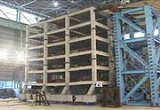
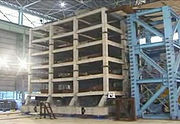
s. Destructive tests are more frequently carried out for structures which are to be constructed in earthquake zones. Such tests are sometimes referred to as crash tests, and they are carried out to verify the designed seismic performance of a new building, or the actual performance of an existing building. The tests are, mostly, carried out on a platform called a shake-table
which is designed to shake in the same manner as an earthquake. Results of those tests often include the corresponding shake-table videos.
Testing of structures in earthquakes is increasingly done by modelling the structure using specialist finite element software.
which attempts to cause a piece of software to fail in an uncontrolled manner, in order to test its robustness.
Nondestructive testing
Nondestructive testing or Non-destructive testing is a wide group of analysis techniques used in science and industry to evaluate the properties of a material, component or system without causing damage....
.
Destructive testing is most suitable, and economic, for objects which will be mass produced, as the cost of destroying a small number of specimens is negligible. It is usually not economical to do destructive testing where only one or very few items are to be produced (for example, in the case of a building).
Some types of destructive testing:
- Stress testStress testStress test may refer to:*Stress Test , an episode of Brandy and Mr Whiskers*Stress testing, a form of testing that is used to determine the stability of a given system or entity*Stress testing , determines the robustness of software...
s - Crash testCrash testA crash test is a form of destructive testing usually performed in order to ensure safe design standards in crashworthiness and crash compatibility for various modes of transportation or related systems and components.- Types :...
s - Hardness tests
- Metallographic tests
Testing of large structures
Building
In architecture, construction, engineering, real estate development and technology the word building may refer to one of the following:...
or large nonbuilding structures
Nonbuilding structure
Nonbuilding structures, also referred to simply as structures, are those not designed for continuous human occupancy. The term is used by architects and structural engineers to distinctly identify structures that are not buildings....
(such as dams and bridges) are rarely subjected to destructive testing due to the prohibitive cost of constructing a building, or a scale model of a building, just to destroy it.
Earthquake engineering
Earthquake engineering
Earthquake engineering is the scientific field concerned with protecting society, the natural and the man-made environment from earthquakes by limiting the seismic risk to socio-economically acceptable levels...
requires a good understanding of how structures will perform at earthquake
Earthquake
An earthquake is the result of a sudden release of energy in the Earth's crust that creates seismic waves. The seismicity, seismism or seismic activity of an area refers to the frequency, type and size of earthquakes experienced over a period of time...
s. Destructive tests are more frequently carried out for structures which are to be constructed in earthquake zones. Such tests are sometimes referred to as crash tests, and they are carried out to verify the designed seismic performance of a new building, or the actual performance of an existing building. The tests are, mostly, carried out on a platform called a shake-table
Earthquake shaking table
There are several different experimental techniques that can be used to test the response of structures to verify their seismic performance, one of which is the use of an earthquake shaking table...
which is designed to shake in the same manner as an earthquake. Results of those tests often include the corresponding shake-table videos.
Testing of structures in earthquakes is increasingly done by modelling the structure using specialist finite element software.
Destructive software testing
Destructive software testing is a type of software testingSoftware testing
Software testing is an investigation conducted to provide stakeholders with information about the quality of the product or service under test. Software testing can also provide an objective, independent view of the software to allow the business to appreciate and understand the risks of software...
which attempts to cause a piece of software to fail in an uncontrolled manner, in order to test its robustness.