
All Topics  
Bolted joint

 
Bolted Joint

   Email Print
   Bookmark   Link


Bolted joint


|}

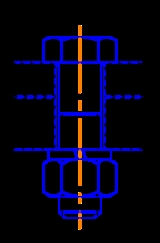
Bolted joints are one of the most common elements in construction
Construction

In the fields of architecture and civil engineering, construction is a process that consists of the building or assembling of infrastructure. Far from being a single activity, large scale construction is a feat of multitasking....
 and machine design. They consist of cap screws
Screw

A screw is a shaft with a helix groove or screw thread formed on its surface and provision at one end to turn the screw. Its main uses are as a threaded fastener used to hold objects together, and as a simple machine used to translate torque into linear force....
 or studs that capture and join other parts, and are secured with the mating of screw thread
Screw thread

A screw thread is a helix structure used to convert between rotational and linear movement or force.A screw thread may be thought of as an inclined plane wrapped around a cylinder or cone ....
s.

There are two main types of bolted joint designs. In one method the bolt is tightened to a calculated clamp load, usually by applying a measured torque
Torque

Torque is the tendency of a force to rotate an object about an axis . Just as a force is a push or a pull, a torque can be thought of as a twist....
 load.


Discussion
Ask a question about 'Bolted joint'
Start a new discussion about 'Bolted joint'
Answer questions from other users
Full Discussion Forum


Recent Posts


Encyclopedia


Bolted joints are one of the most common elements in construction
Construction

In the fields of architecture and civil engineering, construction is a process that consists of the building or assembling of infrastructure. Far from being a single activity, large scale construction is a feat of multitasking....
 and machine design. They consist of cap screws
Screw

A screw is a shaft with a helix groove or screw thread formed on its surface and provision at one end to turn the screw. Its main uses are as a threaded fastener used to hold objects together, and as a simple machine used to translate torque into linear force....
 or studs that capture and join other parts, and are secured with the mating of screw thread
Screw thread

A screw thread is a helix structure used to convert between rotational and linear movement or force.A screw thread may be thought of as an inclined plane wrapped around a cylinder or cone ....
s.

There are two main types of bolted joint designs. In one method the bolt is tightened to a calculated clamp load, usually by applying a measured torque
Torque

Torque is the tendency of a force to rotate an object about an axis . Just as a force is a push or a pull, a torque can be thought of as a twist....
 load. The joint will be designed such that the clamp load is never overcome by the force
Force

In physics, a force is that which can cause an object with mass to change its velocity. Force has both Euclidean_vector#Length of a vector and Direction , making it a Vector quantity....
s acting on the joint (and therefore the joined parts see no relative motion).

The other type of bolted joint does not have a designed clamp load but relies on the shear strength
Shear strength

Shear strength in engineering is a term used to describe the strength of a material or component against the type of Yield or structural failure where the material or component fails in Shearing ....
 of the bolt shaft. This may include clevis
Clevis pin

A clevis pin is a type of fastener that will allow rotation of the connected parts about the axis of the pin. A clevis pin consists of a head, shank and hole....
 linkages, joints that can move, and joints that rely on locking mechanism (like lock washers, thread adhesive
Adhesive

Adhesive or glue is a compound in a liquid or semi-liquid state that adhesion or bonds items together. Adhesives may come from either natural or Chemical synthesis sources....
s, and lock nuts
Nut (hardware)

A nut is a type of hardware fastener with a screw thread hole. Nuts are almost always used opposite a mating screw#Bolt to fasten a stack of parts together....
).

Theory

The clamp load, also called preload, of a cap screw is created when a torque is applied, and is generally a percentage of the cap screw's proof strength. Cap screws are manufactured to various standards that define, among other things, their strength and clamp load. Torque charts are available that identify the required torque for cap screws based on their property class.

When a cap screw is tightened it is stretched, and the parts that are captured are compressed. The result is a spring-like assembly. External forces are designed to act on the parts that have been compressed, and not on the cap screw.

The result is a non-intuitive distribution of strain; in this engineering model, as long as the forces acting on the compressed parts do not exceed the clamp load, the cap screw doesn't see any increased load. This model is only valid when the members under compression are much stiffer than the capscrew.

This is a simplified model. In reality the bolt will see a small fraction of the external load prior to it exceeding the clamp load, depending on the compressed parts' stiffness with respect to the hardware's stiffness.

The results of this type of joint design are:
  • Greater preloads in bolted joints reduce the fatigue loading of the hardware.
  • For cyclic loads, the bolt does not see the full amplitude of the load. As a result, fatigue
    Fatigue (material)

    In materials science, 'fatigue' is the progressive and localized structural damage that occurs when a material is subjected to cyclic loading....
     life can be increased or, if the material exhibits an endurance limit, extended indefinitely.
  • As long as the external loads on a joint don't exceed the clamp load, the hardware doesn't see any motion and will not come loose (no locking mechanisms are required).


In the case of the compressed member being less stiff than the hardware (soft, compressed gaskets for example) this analogy doesn't hold true. The load seen by the hardware is the preload plus the external load.

Thread strength

Nut thread
Screw thread

A screw thread is a helix structure used to convert between rotational and linear movement or force.A screw thread may be thought of as an inclined plane wrapped around a cylinder or cone ....
s are designed to support the rated clamp load of their respective bolts. If tapped threads are used instead of a nut, then their strength needs to be calculated. Steel hardware into tapped steel threads requires a depth of 1.5× thread diameter to support the full clamp load.

If an appropriate depth of threads is not available, or the threads are in a weaker material than the cap screw, then the clamp load (and torque) needs to be derated appropriately.

Threads are usually created on a thread rolling
Screw thread

A screw thread is a helix structure used to convert between rotational and linear movement or force.A screw thread may be thought of as an inclined plane wrapped around a cylinder or cone ....
 machine. They may also be cut with a lathe
Lathe (metal)

Metal lathe or metalworking lathe are generic terms for any of a large class of lathes designed for precisely machining relatively hard materials....
, tap or die. Rolled threads are about 40% stronger than cut threads.

Setting the torque


Engineered joints require the torque to be accurately set. Setting the torque for cap screws is commonly achieved using a torque wrench
Torque wrench

A torque wrench is a tool used to precisely set the torque of a fastener such as a Nut or Screw#Bolt. It is usually in the form of a socket wrench with special internal mechanisms....
. The required torque value for a particular screw application may be quoted in the published standard document or defined by the manufacturer.

The clamp load produced during tightening is higher than 75% of the fastener's proof load. To achieve the benefits of the pre-loading, the clamping force in the screw must be higher than the joint separation load. For some joints a number of screws are required to secure the joint, these are all hand tightened before the final torque is applied to ensure an even joint seating.

The torque value is dependent on the friction between the threads and beneath the bolt or nut head, this friction can be affected by the application of a lubricant or any plating (e.g. cadmium or zinc) applied to the screw threads. The screw standard will define whether the torque value is for a dry or lubricated screw thread. If a screw is torqued rather than the nut then the torque value should be increased to compensate for the additional friction - screws should only be torqued if they are fitted in clearance holes.

Lubrication can reduce the torque value by 15 – 25%, so lubricating a screw designed to be torqued dry could over tighten it. Over tightening may cause the bolt to fail, it could damage the screw thread or stretch the bolt. A bolt stretched beyond its elastic limit may no longer adequately clamp the joint.

Torque wrenches do not give a direct measurement of the clamping force in the screw - much of the force applied is lost in overcoming friction. Factors affecting the tightening friction: dirt, surface finish, lubrication, etc. can result in a deviation in the clamping force.

More accurate methods for setting the screw clamping force rely on defining or measuring the bolt extension. The screw extension can be defined by measuring the angular rotation of the screw (turn of the nut method) which gives a screw extension based on thread pitch. Measuring the screw extension directly allows the clamping force to be very accurately calculated. This can be achieved using a dial test indicator, reading deflection at the bolt tail, using a strain gauge or ultrasonic length measurement.

Property class


There are many different property classes (grades) of bolts and nuts. The most common are listed below. Note that each nut property class listed can support the bolt proof strength load of the bolt it is listed beside without stripping. For metric hardware, the first number in the bolt property class indicates the nominal tensile strength, and the second number the yield stress as a proportion of the tensile strength. In other words class 8.8 means tensile strength of 800 MPa and proof stress of 0.8 x 800 MPa = 640 MPa. >
Bolt property class Material Proof strength Tensile yield strength, min. Tensile ultimate strength, min. Bolt marking Nut marking Nut class
ISO
List of ISO standards

This is a list of International Organization for Standardization standardization that are discussed in Wikipedia articles. For a list of all the more than 16,000 ISO standards , see the ....
 898-1
5.8 Low or medium carbon steel 380 MPa
Pascal (unit)

The pascal is the SI derived unit of pressure, stress , Young's modulus and tensile strength. It is a measure of force per unit area i.e. equivalent to one newton per square meter or one joule per cubic meter....
 (55 ksi)
420 MPa (61 ksi) 520 MPa (75 ksi)
Bolt Marking Metric 5 8
Nut Marking Metric Class 5 8
5
8.8 Medium carbon steel Q
Quench

A quench refers to a rapid cooling. In polymer chemistry and materials science, quenching is used to prevent low-temperature processes such as phase transformations from occurring by only providing a narrow window of time in which the reaction is both thermodynamically favorable and kinetically accessible....
&T
Tempering

Tempering is a heat treatment technique for metals, alloys and Toughened glass. In steels, tempering is done to "toughen" the metal by transforming brittle martensite into bainite or a combination of ferrite and cementite....
580 MPa (84 ksi) 640 MPa (93 ksi) 800 MPa (116 ksi)
Bolt Marking Metric 8 8
Nut Marking Metric Class 8 8
8
10.9 Alloy steel Q&T 830 MPa (120 ksi) 940 MPa (136 ksi) 1040 MPa (151 ksi)
Bolt Marking Metric 10 9
Nut Marking Metric Class 10 9
10
ISO 3506-1
A2-50 304 stainless steel class 50
Annealing (metallurgy)

Annealing, in metallurgy and materials science, is a heat treatment wherein a material is altered, causing changes in its properties such as strength and hardness....
  210 MPa (36 ksi) 500 MPa (72.5 ksi)   
A2-70 304 stainless steel class 70  450 MPa (65.3 ksi) 700 MPa (101.5 ksi)   
A2-80 304 stainless steel class 80  600 MPa (87 ksi) 800 MPa (116 ksi)   
SAE
Society of Automotive Engineers

SAE International is a professional organization for mobility engineering professionals in the aerospace, automotive, and commercial vehicle industries....
 J429
2 Low or medium carbon steel 55 ksi
Pounds per square inch

The pound per square inch or, more accurately, pound-force per square inch is a unit of pressure or of stress based on avoirdupois units....
 (379 MPa)
57 ksi (393 MPa) 74 ksi (510 MPa)
Bolt Marking Sae Grade 2
Nut Marking Sae Grade 2
2
5 Medium carbon steel Q&T 85 ksi (586 MPa) 92 ksi (634 MPa) 120 ksi (827 MPa)
Bolt Marking Sae Grade 5
Nut Marking Sae Grade 5
5
8 Alloy steel Q&T 120 ksi (827 MPa) 130 ksi (896 MPa) 150 ksi (1034 MPa)
Bolt Marking Sae Grade 8
Nut Marking Sae Grade 8
8


Failure modes

The most common mode of failure
Structural failure

Structural failure refers to loss of the Structural load-carrying capacity of a component or member within a Architectural structure or of the structure itself....
 is overloading. Operating forces of the application produce loads that exceed the clamp load and the joint works itself loose, or fails catastrophically.

Over torquing will cause failure by damaging the threads and deforming the hardware, the failure might not occur until long afterward. Under torquing can cause failures by allowing a joint to come loose. It may also allow the joint to flex and thus fail under fatigue.

Brinelling
Brinelling

Brinelling refers to a material surface failure caused by contact stress that exceeds the material limit. This failure is caused by just one application of a load great enough to exceed the material limit....
 may occur with poor quality washers, leading to a loss of clamp load and failure of the joint.

Corrosion
Corrosion

Corrosion means the breaking down of essential properties in a material due to chemical reactions with its surroundings. In the most common use of the word, this means a loss of electrons of metals reacting with water and oxygen....
, embedment
Embedment

Embedment is a phenomenon in mechanical engineering in which the surfaces between mechanical members of a loaded joint embed. It can lead to failure by fatigue as described below, and is of particular concern when considering the design of critical Bolted joint....
 and exceeding the shear stress
Shear stress

File:Shear stress.JPGA shear stress, denoted , is defined as a stress which is applied parallel or tangent to a face of a material, as opposed to a normal stress which is applied perpendicularly....
 limit are other modes of failure.

Locking mechanisms

Car Hub Cotter Pin
Locking mechanisms keep bolted joints from coming loose. They are required when vibration
Vibration

Vibration refers to mechanical oscillations about an equilibrium point. The oscillations may be periodic function such as the motion of a pendulum or random such as the movement of a tire on a gravel road....
 or joint movement will cause loss of clamp
Clamp (tool)

A clamp is a fastener to hold or secure objects tightly together to prevent movement or separation through the application of inward pressure. In the United Kingdom and Australia, the term clamp is often used instead when the tool is for temporary use for positioning components during construction and woodworking; thus a C clamp or a sa...
 load
Structural load

Structural loads are forces applied to a component of a structure or to the structure as a unit.In structural design, assumed loads are specified in national and local design codes for types of structures, geographic locations, and usage....
 and joint failure, and in equipment where the security
Security

Security is the degree of protection against danger, loss, and criminals. Individuals or actions that encroach upon the condition of protection are responsible for a "breach of security."...
 of bolted joints is essential.
  • two nut
    Nut (hardware)

    A nut is a type of hardware fastener with a screw thread hole. Nuts are almost always used opposite a mating screw#Bolt to fasten a stack of parts together....
    s, tightened on each other.
  • Locknut
    Locknut

    A locknut, also known as a lock nut, locking nut, prevailing torque nut, stiff nut or elastic stop nut, is a Nut that resists loosening under vibrations and torque....
     (prevailing torque nuts)
    • polymer insert nut
    • oval lock nut
      Oval lock nut

      A distorted thread locknut, is a type of locknut that uses a deformed section of screw thread to keep the nut from loosening from vibrations or rotation of the clamped item....
  • lock washer
  • thread adhesive
  • lock wire
    Wire

    A wire is a single, usually cylinder , elongated string of metal. Wires are used to bear mechanical Structural loads and to carry electricity and telecommunications Wiktionary:signal....
    , castellated nut
    Castellated nut

    A castellated nut, also called a castle nut or slotted nut, is a nut with slots cut into one end. The name comes from the nut?s resemblance to the crenellated parapet of a medieval castle....
    s/capscrews (common in the aircraft industry)


Measurement of frictional torque of threads in bolt

The torque is applied by means of suspending the weights on one end of the rope and other end is wound around the head of the bolt and tied to the projection. The amount of load is increased gradually till the bolt starts rotating. The applied load is then calculated by adding up the weights. This is the load that is required to overcome the friction between the threads. Similarly the net applied torque is calculated by multiplying the resultant load by bolt head radius.

In another method the torque is applied to the nut by an electromagnetic force. A specially designed gripper is used to grip the nut. A bar magnet is mounted on two sides of the gripper. Externally a coil is wound in which AC (alternating current) current is passed. As the magnetic field from the permanent magnet interacts with the field created by the coil, a torque is generated which would try to rotate the magnet, thus rotating the nut. This is quite similar to the construction of the motor, and hence a motor can be directly used to provide the torque. Stepper motor can be used so that the torque is provided in steps, as desired, each time giving a small angular displacement. The torque provided by the motor can be known at each discrete angular displacement of ??. The process is repeated till the nut has traversed to the desired length of the bolt. The discrete torques can be added to get the net torque consumed in displacing the nut from one end of the bolt to the desirable point. This is the torque that is required to overcome the friction between the threads.

Bolt banging


Bolt banging occurs in buildings where structural members that are bolted together slip.

International standards

  • SA-193
  • SA-194
  • SA-320


See also

  • Bolt manufacturing process
    Bolt manufacturing process

    The bolt manufacturing process consists of three stages:* Heading* Thread rolling* Blackening...
  • Embedment
    Embedment

    Embedment is a phenomenon in mechanical engineering in which the surfaces between mechanical members of a loaded joint embed. It can lead to failure by fatigue as described below, and is of particular concern when considering the design of critical Bolted joint....
  • Quench
    Quench

    A quench refers to a rapid cooling. In polymer chemistry and materials science, quenching is used to prevent low-temperature processes such as phase transformations from occurring by only providing a narrow window of time in which the reaction is both thermodynamically favorable and kinetically accessible....
    ing and Tempering
    Tempering

    Tempering is a heat treatment technique for metals, alloys and Toughened glass. In steels, tempering is done to "toughen" the metal by transforming brittle martensite into bainite or a combination of ferrite and cementite....
     (Q&T)
  • Rivet
    Rivet

    A rivet is a permanent mechanical fastener. Before it is installed it consists of a smooth cylinder shaft with a head on one end. The end opposite the head is called the buck-tail....


Bibliography

.

External links

  • , US Department of Defense document MIL-HDBK-60, 2.6MB pdf.
  • , NASA-RP-1228, 4.4MB pdf, 104 pages, 1990.