
All Topics  
Epoxy

 
Epoxy

   Email Print
   Bookmark   Link


Epoxy


In chemistry
Chemistry

Chemistry is the science concerned with the composition, structure, and properties of matter, as well as the changes it undergoes during chemical reactions....
, epoxy or polyepoxide is a thermosetting epoxide
Epoxide

An epoxide is a cyclic ether with only three ring atoms. This ring approximately is an equilateral triangle which makes it highly ring strain....
 polymer
Polymer

A polymer is a large molecule composed of repeating structural units typically connected by covalent chemical bonds. While polymer in popular usage suggests plastic, the term actually refers to a large class of natural and synthetic materials with a variety of properties....
 that cures (polymerizes and crosslinks) when mixed with a catalyzing agent or hardener. Most common epoxy resins are produced from a reaction between epichlorohydrin
Epichlorohydrin

Epichlorohydrin is an organochlorine compound and an epoxide. This a colorless liquid with a pungent, garlic-like odor is insoluble in water, but miscibility with most polar organic solvents....
 and bisphenol-A. The first commercial attempts to prepare resin
Resin

Resin is a hydrocarbon secretion of many plants, particularly Pinophyta. It is valued for its chemical constituents and uses, such as varnishes and adhesives, as an important source of raw materials for organic synthesis, or for incense and perfume....
s from epichlorohydrin were made in 1927 in the United States
United States

The United States of America is a Federal government constitutional republic comprising U.S. state and a federal district. The country is situated mostly in central North America, where its Contiguous United States and Washington, D.C., the Capital districts and territories, lie between the Pacific Ocean and Atlantic Oceans, Borders of the U...
. Credit for the first synthesis of bisphenol-A-based epoxy resins is shared by Dr. Pierre Castan of Switzerland
Switzerland

Switzerland is a landlocked Swiss Alps country of roughly 7.7 million people in Western Europe with an area of 41,285 km?. Switzerland is a federal republic consisting of 26 states called Cantons of Switzerland....
 and Dr. S.O.


Discussion
Ask a question about 'Epoxy'
Start a new discussion about 'Epoxy'
Answer questions from other users
Full Discussion Forum


Recent Posts


Encyclopedia


In chemistry
Chemistry

Chemistry is the science concerned with the composition, structure, and properties of matter, as well as the changes it undergoes during chemical reactions....
, epoxy or polyepoxide is a thermosetting epoxide
Epoxide

An epoxide is a cyclic ether with only three ring atoms. This ring approximately is an equilateral triangle which makes it highly ring strain....
 polymer
Polymer

A polymer is a large molecule composed of repeating structural units typically connected by covalent chemical bonds. While polymer in popular usage suggests plastic, the term actually refers to a large class of natural and synthetic materials with a variety of properties....
 that cures (polymerizes and crosslinks) when mixed with a catalyzing agent or hardener. Most common epoxy resins are produced from a reaction between epichlorohydrin
Epichlorohydrin

Epichlorohydrin is an organochlorine compound and an epoxide. This a colorless liquid with a pungent, garlic-like odor is insoluble in water, but miscibility with most polar organic solvents....
 and bisphenol-A. The first commercial attempts to prepare resin
Resin

Resin is a hydrocarbon secretion of many plants, particularly Pinophyta. It is valued for its chemical constituents and uses, such as varnishes and adhesives, as an important source of raw materials for organic synthesis, or for incense and perfume....
s from epichlorohydrin were made in 1927 in the United States
United States

The United States of America is a Federal government constitutional republic comprising U.S. state and a federal district. The country is situated mostly in central North America, where its Contiguous United States and Washington, D.C., the Capital districts and territories, lie between the Pacific Ocean and Atlantic Oceans, Borders of the U...
. Credit for the first synthesis of bisphenol-A-based epoxy resins is shared by Dr. Pierre Castan of Switzerland
Switzerland

Switzerland is a landlocked Swiss Alps country of roughly 7.7 million people in Western Europe with an area of 41,285 km?. Switzerland is a federal republic consisting of 26 states called Cantons of Switzerland....
 and Dr. S.O. Greenlee of the United States in 1936. Dr. Castan's work was licensed by Ciba
Ciba Specialty Chemicals

Ciba is a chemical company based in and near Basel, Switzerland. "Ciba" stands for Company for Chemical Industries Basel. It was formed as the non-pharmaceuticals elements of Novartis were spun out in 1997, following the merger in the previous year of Ciba-Geigy and Sandoz that created Novartis....
, Ltd. of Switzerland, which went on to become one of the three major epoxy resin producers worldwide. Ciba's epoxy business was spun off and later sold in the late 1990s and is now the advanced materials business unit of Huntsman Corporation of the United States. Dr. Greenlee's work was for the firm of Devoe-Reynolds of the United States. Devoe-Reynolds, which was active in the early days of the epoxy resin industry, was sold to Shell Chemical
Royal Dutch Shell

Royal Dutch Shell public limited company, commonly known simply as Shell, is a multinational corporation oil company of Netherlands and United Kingdom origins....
 (now Hexion, formerly Resolution Polymers and others).

Industry


As of 2006, the epoxy industry amounts to more than US$
United States dollar

The United States dollar is the unit of currency of the United States and was defined by the Coinage Act of 1792 to be between 371 and 416 grains of silver ....
5 billion
1000000000 (number)

1,000,000,000 is the natural number following 999,999,999 and preceding 1,000,000,001.In scientific notation, it is written as 109....
 in North America and about US$15 billion world-wide. The Chinese market has been growing rapidly, and accounts for more than 30% of the total worldwide market. It is made up of approximately 50–100 manufacturers of basic or commodity
Commodity

A commodity is anything for which there is demand, but which is supplied without qualitative product differentiation across a market. It is a product that is the same no matter who produces it, such as petroleum, notebook paper, or milk....
 epoxy resins and hardeners of which the three largest are Hexion (formerly Resolution Performance Products, formerly Shell Development Company; whose epoxy tradename is "Epon"), The Dow Chemical Company (tradename "D.E.R."), and Huntsman Corporation's Advanced Materials business unit (formerly Vantico, formerly Ciba Specialty Chemical; tradename "Araldite"). In 2007 Huntsman Corporation agreed to merge with Hexion (owned by the Apollo Group). KUKDO Chemical is one of the largest epoxy manufacturers in Asia, and recently their capacity has been increased up to 210,000 MT/Y (Korea 150,000 MT/Y, China 60,000 MT/Y and will be increased totally 300,000 MT/Y by 2009). Nanya Plastic also has the capacity of over 250,000 MT/Y (Taiwan and China), which is mostly for captive use. There are over 50 smaller epoxy manufacturers primarily producing epoxies only regionally, epoxy hardeners only, specialty epoxies, or epoxy modifiers.

These commodity epoxy manufacturers
Manufacturing

Manufacturing is the use of machine, tool and labor to make things for use or sale. The term may refer to a range of human activity, from handicraft to high tech, but is most commonly applied to Industry production, in which raw material are transformed into finished good on a large scale....
 mentioned above typically do not sell epoxy resins in a form usable to smaller end users, so there is another group of companies that purchase epoxy raw materials from the major producers and then compounds (blends, modifies, or otherwise customizes) epoxy systems from these raw material
Raw material

A raw material is something that is acted upon or used by or by human labour or industry, for use as a building material to create some product or structure....
s. These companies are known as "formulators". The majority of the epoxy systems sold are produced by these formulators and they comprise over 60% of the dollar value of the epoxy market. There are hundreds of ways that these formulators can modify epoxies—by adding mineral
Mineral

A mineral is a naturally occurring solid formed through Geology processes that has a characteristic chemical composition, a highly ordered atomic structure, and specific physical properties....
 fillers (talc
Talc

Talc is a mineral composed of hydrated magnesium silicate with the chemical formula Hydrogen2Magnesium34 or Magnesium3Silicon4Oxygen102....
, silica, alumina, etc.), by adding flexibilizers, viscosity
Viscosity

Viscosity is a measure of the Drag of a fluid which is being deformed by either shear stress or extensional stress. In everyday terms , viscosity is "thickness"....
 reducers, colorants, thickeners, accelerators, adhesion
Adhesion

Adhesion is the tendency of certain dissimilar molecules to cling together due to attractive forces....
 promoters, etc.. These modifications are made to reduce costs, to improve performance, and to improve processing convenience. As a result a typical formulator sells dozens or even thousands of formulations—each tailored to the requirements of a particular application or market.

The applications for epoxy-based materials are extensive and include coatings, adhesive
Adhesive

Adhesive or glue is a compound in a liquid or semi-liquid state that adhesion or bonds items together. Adhesives may come from either natural or Chemical synthesis sources....
s and composite material
Composite material

Composite materials are engineered materials made from two or more constituent materials with significantly different physical or chemical properties which remain separate and distinct on a macroscopic level within the finished structure....
s such as those using carbon fiber
Carbon fiber

Carbon fiber or is a material consisting of extremely thin fibers about 0.005?0.010 mm in diameter and composed mostly of carbon atoms. The carbon atoms are bonded together in microscopic crystals that are more or less aligned parallel to the long axis of the fiber....
 and fiberglass
Fiberglass

Fiberglass, , is material made from extremely fine fibers of glass. It is used as a reinforcing agent for many polymer products; the resulting composite material, properly known as fiber-reinforced polymer or glass-reinforced plastic , is called "fiberglass" in popular usage....
 reinforcements (although polyester
Polyester

Polyester is a category of polymers which contain the ester functional group in their main chain. Although there are many polyesters, the term "polyester" as a specific material most commonly refers to polyethylene terephthalate ....
, vinyl ester, and other thermosetting
Thermosetting plastic

Thermosetting plastics are polymer materials that irreversibly Curing form. The cure may be done through heat , through a chemical reaction , or irradiation such as electron beam processing....
 resin
Resin

Resin is a hydrocarbon secretion of many plants, particularly Pinophyta. It is valued for its chemical constituents and uses, such as varnishes and adhesives, as an important source of raw materials for organic synthesis, or for incense and perfume....
s are also used for glass-reinforced plastic). The chemistry of epoxies and the range of commercially available variations allows cure polymers to be produced with a very broad range of properties. In general, epoxies are known for their excellent adhesion, chemical and heat resistance, good-to-excellent mechanical properties and very good electrical insulating
Electrical insulation

An insulator, also called a dielectric, is a material that resists the flow of electric current. An insulating material has atoms with tightly bonded valence electrons....
 properties. Many properties of epoxies can be modified (for example silver
Silver

Silver is a chemical element with the chemical symbol Ag and atomic number 47. A soft, white, lustrous transition metal, it has the highest electrical conductivity of any element and the highest thermal conductivity of any metal....
-filled epoxies with good electrical conductivity
Electrical conductivity

Electrical conductivity or specific conductance is a measure of a material's ability to electrical conduction an electric current. When an electrical potential difference is placed across a conductor, its movable charges flow, giving rise to an electric current....
 are available, although epoxies are typically electrically insulating). Variations offering high thermal insulation, or thermal conductivity combined with high electrical resistance for electronics applications, are on offer.

Epoxies find significant use in many applications which are described in following sections.

Paints and coatings


"2 part waterborne epoxy coatings" are used as ambient cure epoxy coatings. These non-HAP, two-part epoxy coatings are developed for heavy duty service on metal substrates and use less energy than heat cured powder coating
Powder coating

Powder coating is a type of dry coating, which is applied as a free-flowing, dry powder. The main difference between a conventional liquid paint and a powder coating is that the powder coating does not require a solvent to keep the binder and filler parts in a liquid suspension form....
s. These systems use a more attractive 4:1 by volume mixing ratio. The coating dries quickly providing a tough, UV resistant, protective coating with excellent ultimate hardness, and good mar and abrasion resistance. They are designed for rapid dry protective coating applications. Ambient cure 2 Part waterborne epoxy coatings provide excellent physical properties in exterior applications. These products have excellent adhesion to various metal substrates. Their low VOC and water clean up makes them a natural choice for factory cast iron, cast steel, cast aluminum applications and reduces exposure and flammability issues associated with solventborne coatings. They are usually used for industrial and automotive uses as they are high heat resistant (as latex-based and alkyd-based paints usually burn, thus peel, with slight high heat temperatures).

Polyester Epoxies are used as powder coating
Powder coating

Powder coating is a type of dry coating, which is applied as a free-flowing, dry powder. The main difference between a conventional liquid paint and a powder coating is that the powder coating does not require a solvent to keep the binder and filler parts in a liquid suspension form....
s for washers, driers and other "white goods". Fusion Bonded Epoxy Powder Coatings (FBE) are extensively used for corrosion protection of steel pipes and fittings used in the oil and gas industry, potable water transmission pipelines (steel), concrete reinforcing rebar
Rebar

A rebar, or reinforcing bar, is a common steel bar, and is commonly used in reinforced concrete and reinforced masonry structures. It is usually formed from carbon steel, and is given ridges for better mechanical anchoring into the concrete....
, et cetera. Epoxy coatings are also widely used as primers to improve the adhesion of automotive and marine paints especially on metal surfaces where corrosion
Corrosion

Corrosion means the breaking down of essential properties in a material due to chemical reactions with its surroundings. In the most common use of the word, this means a loss of electrons of metals reacting with water and oxygen....
 (rusting) resistance is important. Metal cans and containers are often coated with epoxy to prevent rusting, especially for foods like tomatoes that are acidic. Epoxy resins are also used for high performance and decorative flooring applications especially terrazzo
Terrazzo

Terrazzo is a faux-marble flooring or countertopping material....
 flooring, chip flooring and colored aggregate flooring.

Adhesives


Titan Epoxy
Epoxy adhesive
Adhesive

Adhesive or glue is a compound in a liquid or semi-liquid state that adhesion or bonds items together. Adhesives may come from either natural or Chemical synthesis sources....
s are a major part of the class of adhesives called "structural adhesives" or "engineering adhesives" (which also includes polyurethane
Polyurethane

A polyurethane, commonly abbreviated PU, is any polymer consisting of a chain of organic chemistry units joined by carbamate links. Polyurethane polymers are formed by reacting a monomer containing at least two isocyanate functional groups with another monomer containing at least two alcohol groups in the presence of a catalyst....
, acrylic
Acryl group

In organic chemistry, the acryloyl group is the functional group with structure Hydrogen2Carbon=CH?C?; it is the acyl group derived from acrylic acid....
, cyanoacrylate
Cyanoacrylate

Cyanoacrylate is the generic name for cyanoacrylate based fast-acting glues such as methyl cyanoacrylate, ethyl cyanoacrylate , butyl cyanoacrylate ....
, and other chemistries.) These high-performance adhesives are used in the construction of aircraft, automobiles, bicycles, boats, golf clubs, skis, snow boards, and other applications where high strength bonds are required. Epoxy adhesives can be developed to suit almost any application. They are exceptional adhesives for wood, metal, glass, stone, and some plastics. They can be made flexible or rigid, transparent
Transparency (optics)

In optics, transparency is the material property of allowing light to pass through. In mineralogy, another term for this property is diaphaneity....
 or opaque
Opacity (optics)

Opacity is the measure of impenetrability to electromagnetic radiation or other kinds of radiation, especially visible light. In radiative transfer, it describes the absorption and scattering of radiation in a medium, such as a plasma, dielectric, radiation shield, glass, etc....
/colored, fast setting or extremely slow setting. Epoxy adhesives are almost unmatched in heat and chemical resistance among common adhesives. In general, epoxy adhesives cured with heat will be more heat- and chemical-resistant than those cured at room temperature. The strength of epoxy adhesives is degraded at temperatures above 350°F.

Some epoxies are cured by exposure to ultraviolet light. Such epoxies are commonly used in optics
Optics

Optics is the study of the behavior and properties of light including its optical phenomena with matter and its imaging by optical instruments....
, fiber optics, optoelectronics
Optoelectronics

Optoelectronics is the study and application of electronics devices that source, detect and control light, usually considered a sub-field of photonics....
 and dentistry
Dentistry

Dentistry is the known evaluation, diagnosis, prevention, and treatment of diseases, disorders and conditions of the mouth, maxillofacial area and the adjacent and associated structures and their impact on the human body....
.

Industrial tooling and composites


Epoxy systems are used in industrial tooling applications to produce molds
Molding (process)

Molding or moulding is the process of manufacturing by shaping pliable raw material using a rigid frame or model called a pattern....
, master models, laminate
Laminate

A laminate is a material constructed by uniting two or more layers of material together. The process of creating a laminate is lamination, which in common parlance refers to the placing of something between layers of plastic and sealing them with heat and/or pressure, usually with an adhesive....
s, casting
Casting

In metalworking, casting involves pouring a liquid metal into a Mold_, which contains a hollow cavity of the desired shape, and then is allowed to solidify....
s, fixtures
Fixtures

A fixture is a legal concept that includes any physical property that is permanently attached or fixed to Real property. If the property is not affixed to real property it is considered chattel property....
, and other industrial production aids. This "plastic tooling" replaces metal, wood and other traditional materials, and generally improves the efficiency and either lowers the overall cost or shortens the lead-time for many industrial processes. Epoxies are also used in producing fiber-reinforced or composite parts. They are more expensive than polyester resins and vinyl ester resins, but usually produce stronger and more temperature-resistant composite parts.

Electrical systems and electronics

Hybridcircuit
Epoxy resin formulations are important in the electronics industry, and are employed in motors, generators, transformers, switchgear, bushings, and insulators. Epoxy resins are excellent electrical insulators and protect electrical components from short circuiting, dust and moisture. In the electronics industry epoxy resins are the primary resin used in overmolding integrated circuit
Integrated circuit

In electronics, an integrated circuit is a miniaturized electronic circuit that has been manufactured in the surface of a thin Wafer of semiconductor material....
s, transistor
Transistor

In electronics, a transistor is a semiconductor device commonly used to Electronic amplifier or switch Electronics signals. A transistor is made of a solid piece of a semiconductor material, with at least three terminals for connection to an external circuit....
s and hybrid circuit
Hybrid circuit

A hybrid integrated circuit, HIC, hybrid microcircuit, or simply hybrid is a miniaturized electronic circuit constructed of individual devices, such as semiconductor devices and passive components , bonded to a substrate or printed circuit board ....
s, and making printed circuit boards. The largest volume type of circuit board — an "FR-4
FR-4

FR-4, an abbreviation for Flame Retardant 4, is a type of material used for making a printed circuit board . It describes the board substrate, with no copper layer....
 board" — is a sandwich of layers of glass cloth bonded into a composite by an epoxy resin. Epoxy resins are used to bond copper foil to circuit board substrates, and are a component of the solder mask on many circuit boards.

Flexible epoxy resins are used for potting transformers and inductors. By using vacuum impregnation on uncured epoxy, winding-to-winding, winding-to-core, and winding-to-insulator air voids are eliminated. The cured epoxy is an electrical insulator and a much better conductor of heat than air. Transformer and inductor hot spots are greatly reduced, giving the component a stable and longer life than unpotted product.

Epoxy resins are applied using the technology of resin casting
Resin casting

A resin casting system is a technical installation to process casting resin for the purpose of filling, sealing, covering or soaking technical parts, especially in the field of electricity and electronics like transformers, LCDs and other small and big parts....
.

Consumer and marine applications


Epoxies are sold in hardware stores, typically as a pack containing separate resin and hardener, which must be mixed immediately before use. They are also sold in boat shops as repair resins for marine applications. Epoxies typically are not used in the outer layer of a boat because they deteriorate by exposure to UV light. They are often used during boat repair and assembly, and then over-coated with conventional or two-part polyurethane paint or marine-varnishes that provide UV protection.

There are two main areas of marine use. Because of the better mechanical properties relative to the more common polyester resins, epoxies are used for commercial manufacture of components where a high strength/weight ratio is required. The second area is that their strength, gap filling properties and excellent adhesion to many materials including timber have created a boom in amateur building projects including aircraft and boats.

Normal gelcoat
Gelcoat

A gelcoat is a material used to provide a high quality finish on the visible surface of a fibre-reinforced composite material. The most common gelcoats are based on epoxy or unsaturated polyester resin chemistry....
 formulated for use with polyester resins and vinylester resins does not adhere to epoxy surfaces, though epoxy adheres very well if applied to polyester resin surfaces. "Flocoat" that is normally used to coat the interior of polyester fibreglass yachts is also compatible with epoxies.

Polyester
Polyester

Polyester is a category of polymers which contain the ester functional group in their main chain. Although there are many polyesters, the term "polyester" as a specific material most commonly refers to polyethylene terephthalate ....
 thermosets
Thermosetting plastic

Thermosetting plastics are polymer materials that irreversibly Curing form. The cure may be done through heat , through a chemical reaction , or irradiation such as electron beam processing....
 typically use a ratio
Ratio

A ratio is an expression which compares quantities relative to each other. The most common examples involve two quantities, but in theory any number of quantities can be compared....
 of at least 10:1 of resin to hardener (or "catalyst"), while epoxy materials typically use a lower ratio of between 5:1 and 1:1. Epoxy materials tend to harden somewhat more gradually, while polyester materials tend to harden quickly.

The classic epoxy reference guide is the Handbook of epoxy resins by Henry Lee and Kris Neville. Originally issued in 1967, it has been reissued repeatedly and still gives an excellent overview of the technology. Some basic tips are given here:.

Aerospace applications


In the aerospace industry, epoxy is used as a structural matrix material which is then reinforced by fiber. Typical fiber reinforcements include glass
Glass

Glass generally refers to a Hardness, brittle, transparency amorphous solid, such as that used for windows, many Glass Bottles, or eyewear, including, but not limited to, soda-lime glass, borosilicate glass, acrylic glass, sugar glass, Muscovite , or aluminium oxynitride....
, carbon
Carbon

Carbon is a chemical element with chemical symbol C and atomic number 6. As a member of group 14 on the periodic table, it is nonmetallic and tetravalence?making four electrons available to form covalent bond chemical bonds....
, Kevlar
Kevlar

Kevlar is the registered trademark for a light, strong aramid synthetic fiber, related to other aramids such as Nomex and Technora.Developed at DuPont in 1965 by Stephanie Kwolek it was first commercially used in the early 1970s as a replacement for steel in racing tires....
, and boron
Boron

Boron is a chemical element with atomic number 5 and the chemical symbol B. Boron is a trivalent metalloid element which occurs abundantly in the evaporite ores borax and ulexite....
. Epoxies are also used as a structural glue
Glue

This is a list of various types of adhesive. Historically, the term "glue" only referred to protein colloids prepared from animal flesh. The meaning has been extended to refer to any fluid adhesive....
. Materials like wood
Wood

Wood is an organic material; in the strict sense wood is produced as secondary xylem in the stems of woody plants, notably trees but also shrubs, etc....
, and others that are 'low-tech' are glued with epoxy resin. One example would be the . This design is based on a classic wooden lattice structured fuselage
Fuselage

The fuselage is an aircraft's main body section that holds crew and passengers or cargo. In single-engine aircraft it will usually contain an engine, although in some amphibious aircraft the single engine is mounted on a hardpoint attached to the fuselage which in turn is used as a floating Hull ....
 and a classic wooden spar, internally stiffened with foam and completely covered with plywood. Except for the plywood covering the wings, everything is glued with epoxy resin.

Art


Epoxy resin, mixed with pigment
Pigment

A pigment is a material that changes the color of light it Reflection as the result of selective color absorption. This physical process differs from fluorescence, phosphorescence, and other forms of luminescence, in which the material itself emits light....
, is used as a painting medium
Media (arts)

In the arts, media are the materials and techniques used by an artist to produce a work....
, by pouring layers on top of each other to form a complete picture.

Wind Energy applications

Epoxy resin is used in manufacturing rotor blades of wind turbine. The resin is infused in the core material like balsa wood, foam, and reinforcing media glass fabric. The process is called VARTM, i.e. Vacuum Assisted Resin Transfer Moulding. Due to excellent properties and good finish, epoxy is most favoured resin for composites.

Chemistry


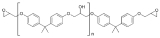
Epoxy Prepolymer Chemical Structure
When epoxies are mixed with the appropriate catalyst, the resulting reaction is exothermic, and the oxygen on the epoxy monomers is "flipped." This occurs throughout the epoxy, and a matrix with a high stress tolerance is formed, and "glues" the materials together.

Curing takes differing amounts of time, depending on the formulation and cure temperature. Some formulations benefit from heating during the cure period, whereas others simply require time, and ambient temperatures.

Cleanup

When using epoxy resin and hardener, vinegar
Vinegar

Vinegar is an acidic liquid processed from the fermentation of ethanol in a process that yields its key ingredient, acetic acid . It also may come in a diluted form....
 is an effective and safe solvent to clean up tools, brushes, skin, and most surfaces. Acetone
Acetone

Acetone is the organic compound with the chemical formula OC2. This colorless, mobile, flammable liquid is the simplest example of the ketones....
 can also be used, but it is very volatile and flammable, unlike vinegar. Vinegar is safer for cleaning epoxy resin from human skin than acetone: both liquids will dissolve the resin, but the resin/acetone solution can easily pass through the skin into the bloodstream, unlike vinegar. White vinegar
Vinegar

Vinegar is an acidic liquid processed from the fermentation of ethanol in a process that yields its key ingredient, acetic acid . It also may come in a diluted form....
 can even clean up epoxy resin that is beginning to cure/harden. DME (Dimethoxyethane
Dimethoxyethane

Dimethoxyethane, also known as glyme, monoglyme, dimethyl glycol, ethylene glycol dimethyl ether, dimethyl cellosolve, and DME, is a clear, colorless, aprotic, and liquid ether that is used as a solvent....
) is also a good solvent for epoxy resin and hardener that gives off very little vapor. However, none of these substances is an effective solvent
Solvent

A solvent is a liquid or gas that dissolves a solid, liquid, or gaseous solute, resulting in a solution.The most common solvent in everyday life is water....
 for epoxy that has cured.

Health risks


The primary risk associated with epoxy use is sensitization to the hardener, which, over time, can induce an allergic reaction.

Both epichlorohydrin
Epichlorohydrin

Epichlorohydrin is an organochlorine compound and an epoxide. This a colorless liquid with a pungent, garlic-like odor is insoluble in water, but miscibility with most polar organic solvents....
 and bisphenol A
Bisphenol A

Bisphenol A, commonly abbreviated as BPA, is an organic compound with two phenol functional groups. It is a difunctional building block of several important plastics and plastic additives....
 are suspected endocrine disruptor
Endocrine disruptor

Endocrine disruptors are exogenous substances that act like hormones in the endocrine system and disrupt the physiologic function of endogenous hormones....
s.

According to some reports Bisphenol A is linked to the following effects in humans:
  • oestrogenic activity;
  • alteration of male reproductive organs;
  • early puberty induction;
  • shortened duration of breast feeding;
  • pancreatic cancer


See also

  • Thermosetting plastic
    Thermosetting plastic

    Thermosetting plastics are polymer materials that irreversibly Curing form. The cure may be done through heat , through a chemical reaction , or irradiation such as electron beam processing....
  • Plastic
    Plastic

    Plastic is the general common term for a wide range of synthetic or semisynthetic organic chemistry solid materials suitable for the manufacture of industrial products....


External links

  • (California Department of Health Services)
  • , simple to understand