
All Topics  
Spaghetti

 
Spaghetti

   Email Print
   Bookmark   Link


Spaghetti


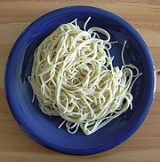
Spaghetti is a long, thin, cylindrical pasta
Pasta

Pasta is a generic term for Italian cuisine variants of noodles, food made from a dough of flour, water and/or Egg , that is Boiling. The word can also denote dishes in which pasta products are the primary ingredient, served with sauce or seasonings....
 of Italian
Italy

Italy , officially the Italian Republic , is a country located on the Italian Peninsula in Southern Europe and on the two largest islands in the Mediterranean Sea, Sicily and Sardinia....
 origin. A variety of pasta dishes are based on it, from spaghetti with cheese and pepper or garlic and oil to a spaghetti with tomato, meat, and other sauces.


Nutrition Facts


Discussion
Ask a question about 'Spaghetti'
Start a new discussion about 'Spaghetti'
Answer questions from other users
Full Discussion Forum


Encyclopedia


Spaghetti
Spaghetti Prepared
Spaghetti is a long, thin, cylindrical pasta
Pasta

Pasta is a generic term for Italian cuisine variants of noodles, food made from a dough of flour, water and/or Egg , that is Boiling. The word can also denote dishes in which pasta products are the primary ingredient, served with sauce or seasonings....
 of Italian
Italy

Italy , officially the Italian Republic , is a country located on the Italian Peninsula in Southern Europe and on the two largest islands in the Mediterranean Sea, Sicily and Sardinia....
 origin. A variety of pasta dishes are based on it, from spaghetti with cheese and pepper or garlic and oil to a spaghetti with tomato, meat, and other sauces. Spaghetti is made of semolina
Semolina

Semolina is the purified middlings of hard wheat used in making pasta; also, the coarse middlings used for breakfast cereals and puddings....
 and water
Water

Water is a common chemical substance that is essential for the survival of all known forms of life. In typical usage, water refers only to its liquid form or States of matter, but the substance also has a solid state, ice, and a gaseous state, water vapor or steam....
.

Etymology

Spaghetti is the plural form of the Italian
Italian language

Italian is a Romance languages spoken by about 63 million people as a first language, primarily in Italy. In Switzerland, Italian is one of four Linguistic geography of Switzerlands....
 word spaghetto, which is a diminutive of spago, meaning "thin string" or "twine". The word spaghetti can be literally translated as "little strings".

Origins

Chinese noodles pre-date Italian pasta, and Arab traders most likely became introduced to them due to their trade routes with China. Historically, people in Italy ate pasta in the form of gnocchi
Gnocchi

Gnocchi is the Italian name for a variety of thick, soft noodle or dumpling. They may be made from semolina, ordinary wheat flour, potato, bread crumbs, or similar ingredients....
-like dumpling
Dumpling

Dumplings, as defined in a standard English dictionary, fall in two main categories: these are either "piece[s] of dough, sometimes filled, that are cooked in liquid such as water or soup" or alternatively "sweetened dough wrapped around fruit, such as an apple, baked and served as a dessert." More generally, dumplings may be any of a wi...
s – pasta fresca eaten as soon as it was prepared. It has now been asserted that the Muslim
Muslim

:A Muslim , , is an adherent of the religion of Islam. The feminine form is Muslimah . Literally, the word means "one who submits "....
s who populated Southern Italy (around the 12th Century) were the first to develop the innovation of working pasta from grain into thin long forms, capable of being dried out and stored for months or years prior to consumption (see Peter Robb
Peter Robb

Peter Robb is an Australian author. Robb spent his formative years in both Australia and New Zealand, and between 1978 and 1992 he spent most of his time in Naples and southern Italy, interspersed with sojourns in Brazil....
's Midnight in Sicily pp 94-96 for details). Or Muslim traders with links to Arab trade routes to China, may have been introduced to pasta or noodles that way. Legend has it that Cicero
Cicero

Marcus Tullius Cicero was a Ancient Rome philosopher, statesman, lawyer, political theorist, and Constitution of the Roman Republic. Cicero is widely considered one of Rome's greatest rhetoric and prose stylists....
, the famous Roman orator was fond of "laganum," an ancient tagliatelle
Tagliatelle

Tagliatelle // is the classic pasta of the Emilia-Romagna region of Italy. Individually, they are long, flat ribbons, similar in shape to fettuccine, but typically about 0.65cm to 1cm wide....
. The Saracens, originally from North Africa, invaded southern Italy in the 9th century and occupied Sicily for 200 years. Pasta is now associated with Italians as a whole. The popularity of pasta spread to the whole of Italy after the establishment of pasta factories in the 19th century, enabling the mass production of pasta for the Italian market.

Preparation

Spaghetti Cooking
Spaghetti is cooked by boiling the pasta
Pasta

Pasta is a generic term for Italian cuisine variants of noodles, food made from a dough of flour, water and/or Egg , that is Boiling. The word can also denote dishes in which pasta products are the primary ingredient, served with sauce or seasonings....
 in water and adding either salt or olive oil. The consistency or texture of spaghetti changes as it is cooked. The most popular consistency is al dente
Al dente

In cooking, the adjective al dente describes pasta and ricethat has been cooked so as to be firm but not hard. "Al dente" also describes vegetables that are cooked to the "tender crisp" phase - still offering resistance to the bite, but cooked through....
 (Italian 'to the tooth'); that is, soft but with texture, sometimes even with bite in the center. Others prefer their spaghetti cooked to a softer consistency. The best dried spaghetti is made from durum
Durum

Durum wheat or macaroni wheat is the only tetraploid species of wheat of commercial importance that is widely cultivated today. It was developed by artificial selection of the domesticated emmer wheat strains formerly grown in Central Europe and Near East around 7000 B.C., which developed a naked, Wheat#Hulled_vs._free-threshing_wheat...
 wheat semolina
Semolina

Semolina is the purified middlings of hard wheat used in making pasta; also, the coarse middlings used for breakfast cereals and puddings....
. Inferior spaghetti is often found produced with other kinds of flour
Flour

Flour is a powder made of cereal grains. It is the main ingredient of bread, which is a staple food for many civilizations, making the availability of adequate supplies of flour a major economic and political issue at various times throughout history....
, especially outside Italy. Fresh spaghetti should be prepared with grade '00' flour.. There are two other variants of spaghetti that require different cooking times. Spaghettini ("thin spaghetti") (also "angel hair spaghetti") takes less time (usually two minutes less) to cook to al dente form than regular spaghetti. There is also spaghettoni ("thick spaghetti") which takes longer to cook. All three types of spaghetti are larger than the other round-rod pastas (like vermicelli
Vermicelli

Vermicelli is a type of pasta, round in section and somewhat thinner than spaghetti. Vermicelloni is less common, and about the same size as fedelini ....
).

Serving


An emblem of Italian cuisine
Italian cuisine

Italian cuisine as a national cuisine known today has evolved through centuries of social and political changes, with its roots traced back to 4th century BC....
, spaghetti is frequently served with tomato sauce
Tomato sauce

A tomato sauce is any of a very large number of sauce made primarily out of tomatoes, usually to be served as part of a Dish . Tomato sauces are common for meat and vegetables, but they are perhaps best known as sauces for pasta dishes....
, which may contain various herb
Herb

A herb is a plant that is valued for qualities such as medicinal properties, flavor, scent, or the like....
s (especially oregano
Oregano

Oregano or is a species of Origanum, native to Europe, the Mediterranean region and southern and central Asia. It is a perennial plant herb, growing to 20-80 cm tall, with opposite leaf 1-4 cm long....
 and basil
Basil

Basil , of the Family Lamiaceae. Basil is a tender low-growing herb that is grown as a Perennial plant in warm, tropical climates. Basil is originally native to Iran, India and other tropical regions of Asia, having been cultivated there for more than 5,000 years....
), olive oil
Olive oil

Olive oil is a fruit oil obtained from the olive , a traditional tree crop of the Mediterranean Basin. The wild olive tree originated in Anatolia and spread from there as far as southern Africa, Australia, Japan and China....
, meat
Meat

In modern English usage, meat most often refers to animal biological tissue used as food, mostly skeletal muscle and associated fat, but it may also refer to offal, including livers, skin, brains, bone marrow, kidneys, in some countries lungs, and a variety of other internal organs as well as blood....
, or vegetables. Other spaghetti preparations include using Bolognese sauce
Bolognese sauce

Bolognese sauce is a meat-based sauce for pasta originating in Bologna, Italy. Bolognese sauce is sometimes taken to be a tomato sauce but authentic recipes have only a small amount of tomato....
, carbonara
Carbonara

Pasta alla carbonara is an Italy pasta dish based on Egg s, pecorino romano, guanciale, and black pepper. It was invented in the middle of the 20th century....
, and chili. Grated hard cheese
Cheese

Cheese is a food consisting of proteins and fat from milk, usually the milk of cattle, Water Buffalo, goats, or sheep's milk. It is produced by Coagulation of the milk protein casein....
s, such as Pecorino Romano
Pecorino Romano

Pecorino Romano is a hard, salty Italian cuisine cheese, suitable primarily for Grater, made out of sheep milk . Pecorino Romano was produced in Latium up to 1884 when, due to the prohibition issued by the city council of salting the cheese inside their shops in Rome, many producers moved to the island of Sardinia ....
, Parmesan
Parmigiano Reggiano

Parmigiano-Reggiano is a hard, fat granular cheese, cooked but not pressed, named after the producing areas of Parma, Reggio Emilia, Modena, Bologna, in Emilia-Romagna, and Mantova, in Lombardy, Italy....
, and Asiago cheese
Asiago cheese

Asiago cheese is an Italian cuisine cheese that according to the different aging can assume different textures, from smooth for the fresh Asiago cheese to a crumbly texture for the aged cheese of which the flavor is reminiscent of sharp Cheddar cheese and Parmesan....
, are often added.

The manner of eating spaghetti varies according to local customs, but it is usually eaten with a fork
Fork

As a piece of cutlery or kitchenware, a fork is a tool consisting of a handle with several narrow Tine on one end. The fork, as an eating utensil, has been a feature primarily of the West, whereas in East Asia chopsticks have been more prevalent....
, as with most other Continental dishes. Eating spaghetti with a fork and a spoon
Spoon

A spoon is a utensil consisting of a small shallow bowl, oval or round, at the end of a handle. A type of cutlery , especially as part of a table setting, it is used primarily for serving and eating liquid or semisolid food , and solid foods such as rice and cereal which cannot easily be lifted with a fork....
 is considered perfectly polite in parts of the United States, although this method is widely disparaged by some. In East Asia, many people use chopsticks
Chopsticks

Chopsticks are a pair of small, equal-length, tapered sticks. They are used as the traditional eating utensils of China, Japan, Korea, Republic of China, and Vietnam....
 as a form of eating rather than forks, as chopsticks are customary in most East Asian countries.

Though the traditional method of eating spaghetti in Italy is to use just a fork and twist it so that the spaghetti wraps around the fork, families around the world still consider it a sentimental pastime to take the end of a noodle and slurp it up.

Cultural references

  • On April Fools' Day, 1957, the BBC ran a very successful spoof documentary explaining how spaghetti is grown on spaghetti tree
    Spaghetti tree

    The spaghetti tree is a fictitious tree and the subject of a 3-minute spoof report on the Swiss spaghetti harvest beside Lake Lugano broadcast by the BBC current affairs programme Panorama ....
    s.
  • The parody religion Pastafarianism holds that the universe was created by a Flying Spaghetti Monster
    Flying Spaghetti Monster

    The Flying Spaghetti Monster is the deity of the parody religion The Church of the Flying Spaghetti Monster, created in 2005 by Bobby Henderson as a satirical protest to the Kansas evolution hearings to require the teaching of intelligent design as an alternative to biological evolution....
    .
  • "Spaghetti" can be used to describe objects which are complicated or tangled, such as spaghetti code
    Spaghetti code

    Spaghetti code is a pejorative term for source code which has a complex and tangled control structure, especially one using many GOTOs, exceptions, threads, or other "unstructured" Branch constructs....
     or Spaghetti Junction
    Spaghetti Junction

    "Spaghetti Junction" is a nickname sometimes given to a complicated or massively intertwined interchange that resembles a plate of spaghetti....
    .
  • Spaghetti Eis is a mock dessert which looks like spaghetti with tomato sauce.


See also

  • Carbonara
    Carbonara

    Pasta alla carbonara is an Italy pasta dish based on Egg s, pecorino romano, guanciale, and black pepper. It was invented in the middle of the 20th century....
  • Lai fun
    Lai fun

    Lai fun is a variety of Chinese noodle that is short and thick. It is commonly found in Hong Kong and to some degree among overseas Chinatowns. Its name comes from the Cantonese language....
  • Spaghetti squash
    Spaghetti squash

    The spaghetti squash is an oblong seed-bearing variety of winter squash. The fruit can range either from ivory to yellow or orange in color or green with white streaks....
  • Capellini
    Capellini

    Capellini is a very thin variety of Italian pasta. Like spaghetti, it is rod-shaped, in the form of long strands, and thinner than vermicelli....
  • List of pasta
    List of pasta

    While the only basic difference between these names is the shape of the pasta, each pasta is typically matched with a particular sauce based on cooking time, consistency, ability to hold sauce, ease of eating, etc....
  • Fideo
    Fideo

    Fideo is the Spanish word for a noodle of any type. In Mexico, it refers to a type of pasta similar to angel hair or vermicelli. In Spain it refers to very short noodles used in place of rice in some dishes....


External links