

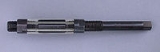
Reamer

Encyclopedia
A reamer is a metalworking
tool
used to create an accurate sized hole. The process is called reaming. They may be used as a hand tool or in a machine tool
, such as a milling machine
or drill press.
straight or helical cutting edges along the length of a cylindrical
body. Each cutting edge is ground at a slight angle and with a slight undercut below the cutting edge. Reamers must combine both hardness in the cutting edges, for long life, and toughness, so that the tool does not fail under the normal forces of use. They should only be used to remove small amounts of material. This ensures a long life for the reamer and a superior finish to the hole.
The spiral may be clockwise or counter-clockwise depending on usage. For example, a tapered hand reamer with a clockwise spiral will tend to self feed
as it is used, possibly leading to a wedging action and consequent breakage. A counter-clockwise spiral is therefore preferred even though the reamer is still turned in the clockwise direction.
For production machine tools, the shank type is usually one of the following: a standard taper (such as Morse or Brown & Sharpe), a straight round shank to be held by a collet
, or a straight round shank with a flat for a set screw
, to be held by a solid toolholder. For hand tools, the shank end is usually a square drive, intended for use with the same type of wrench
used to turn a tap
for the cutting of screw thread
s.
. (It allows for the removal of a certain small amount of material.) The allowance should be < 0.2 mm (.008 in) for soft materials and < 0.13 mm (.005 in) for hard materials. Larger allowances can damage the reamer. The drilled hole should not be enlarged by more than 5% of the drilled diameter. Drilling followed by reaming generally produces hole geometry and finish that is as close to theoretical perfection as possible. (The other methods of hole creation that approach nearest to perfection under certain conditions are boring [especially single-point boring] and internal cylindrical grinding.)
Reaming removes a very thin layer of stressed and disturbed material caused by drilling a hole. This affects only the mechanical properties of the material, leaving a good surface finish. There are no noticeable effects on its chemical or physical properties.
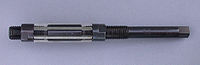 An adjustable hand reamer can cover a small range of sizes. They are generally referenced by a letter which equates to a size range. The disposable blades slide along a tapered groove. The act of tightening and loosening the restraining nuts at each end varies the size that may be cut. The absence of any spiral in the flutes restricts them to light usage (minimal material removal per setting) as they have a tendency to chatter. They are also restricted to usage in unbroken holes. If a hole has an axial
split along it, such as a split bush or a clamping hole, each straight tooth will in turn drop into the gap causing the other teeth to retract from their cutting position. This also gives rise to chatter marks and defeats the purpose of using the reamer to size a hole.
Reamed holes are used to create holes of precise circularity and size, for example with tolerances of -0/+0.02 mm(.0008") This will allow the force fitting of locating dowel pins, which need not be otherwise retained in the body holding them. Other holes, reamed slightly larger in other parts, will fit these pins accurately, but not so tightly as to make disassembly difficult. This type of alignment is common in the joining of split crankcase halves such as are used in motorcycle
motors and boxer
type engines. After joining the halves, the assembled case may then be line bored (using what is in effect a large diameter reamer), and then disassembled for placement of bearings and other parts. The use of reamed dowel holes is typical in any machine design, where any two locating parts have to be located and mated accurately to one another - typically as indicated above, to within 0.02 mm or less than .001".
Another use of reamed holes is to receive a specialized bolt that has an unthreaded shoulder - also called a shoulder bolt. This type of bolt is commonly used to replace hot peened rivets during the seismic retrofit
of structures.
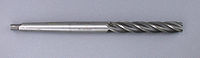 A machine reamer only has a very slight lead in. Because the reamer and work piece are pre-aligned by the machine there is no risk of it wandering off course. In addition the constant cutting force that can be applied by the machine ensures that it starts cutting immediately. Spiral flutes have the advantage of clearing the swarf automatically but are also available with straight flutes as the amount of swarf generated during a reaming operation should be very small.
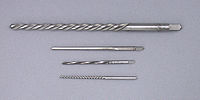 A precision tapered reamer is used to make a tapered hole to later receive a tapered pin.
A taper pin
is a self tightening device due to the shallow angle of the taper. They may be driven into the tapered hole such that removal can only be done with a hammer
and punch. They are sized by a number sequence (for example, a No.4 reamer would use No.4 taper pins).
Such precision joints are used in aircraft assembly and are frequently used to join the two or more wing sections used in a sailplane. These may be re-reamed one or more times during the aircraft's useful life, with an appropriately oversized pin replacing the previous pin.
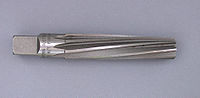 A morse taper reamer is used manually to finish morse taper sleeves. These sleeves are a tool used to hold machine cutting tools or holders in the spindles of machines such as a drill
or milling machine. The reamer shown is a finishing reamer. A roughing reamer would have serrations along the flutes to break up the thicker chips produced by the heavier cutting action used for it.
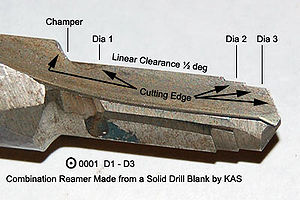 A combination reamer has two or more cutting surfaces. The combination reamer is precision ground into a pattern that resembles the part’s multiple internal diameters. The advantage of using a combination reamer is to reduce the number of turret operations, while more precisely holding depths, internal diameters and concentricity. Combination reamers are mostly used in screw machine
s or second-operation lathe
s, not with Computer Numerical Control (CNC) machines because G-code
can be easily generated to profile internal diameters.
Combination reamers can be made out of cobalt, carbide
, or high speed steel
tooling. When using combination reamers to ream large internal diameters made out of material with lower surface feet per minute, carbide tips can be brazed onto a configured drill blank to build the reamer. Carbide requires additional care because it is very brittle and will chip if chatter occurs. It is common to use a drill bit
or combination drill to remove the bulk of material to reduce wear, or the risk of the part pulling off on the combination reamer.
work. A similar tool can be seen on select Swiss Army knives
, such as the electrician model, to be used on conduit.
The main difference between both categories is that hard materials are usually unaffected by the heat produced by the machining process and may actually benefit from it. The down side is that they are usually very brittle, requiring sightly blunt cutting edges to avoid fracture. This increases the forces involved in machining and for this reason hard materials are usually not recommended for light machinery. Heat treated materials, on the other side, are usually much tougher and have no problem holding a sharp edge without chipping under less favourable conditions (like under vibration). This makes them adequate for hand tools and light machines.
s need reamers to have the holes drilled for the mounting of the bodies. Although similar to metal reamers, radio control body reamers are small, and the tip is usually conic, with flue areas on each side to help create the holes.
Metalworking
Metalworking is the process of working with metals to create individual parts, assemblies, or large scale structures. The term covers a wide range of work from large ships and bridges to precise engine parts and delicate jewelry. It therefore includes a correspondingly wide range of skills,...
tool
Tool
A tool is a device that can be used to produce an item or achieve a task, but that is not consumed in the process. Informally the word is also used to describe a procedure or process with a specific purpose. Tools that are used in particular fields or activities may have different designations such...
used to create an accurate sized hole. The process is called reaming. They may be used as a hand tool or in a machine tool
Machine tool
A machine tool is a machine, typically powered other than by human muscle , used to make manufactured parts in various ways that include cutting or certain other kinds of deformation...
, such as a milling machine
Milling machine
A milling machine is a machine tool used to machine solid materials. Milling machines are often classed in two basic forms, horizontal and vertical, which refers to the orientation of the main spindle. Both types range in size from small, bench-mounted devices to room-sized machines...
or drill press.
Construction
A typical reamer consists of a set of parallelParallel (geometry)
Parallelism is a term in geometry and in everyday life that refers to a property in Euclidean space of two or more lines or planes, or a combination of these. The assumed existence and properties of parallel lines are the basis of Euclid's parallel postulate. Two lines in a plane that do not...
straight or helical cutting edges along the length of a cylindrical
Cylinder (geometry)
A cylinder is one of the most basic curvilinear geometric shapes, the surface formed by the points at a fixed distance from a given line segment, the axis of the cylinder. The solid enclosed by this surface and by two planes perpendicular to the axis is also called a cylinder...
body. Each cutting edge is ground at a slight angle and with a slight undercut below the cutting edge. Reamers must combine both hardness in the cutting edges, for long life, and toughness, so that the tool does not fail under the normal forces of use. They should only be used to remove small amounts of material. This ensures a long life for the reamer and a superior finish to the hole.
The spiral may be clockwise or counter-clockwise depending on usage. For example, a tapered hand reamer with a clockwise spiral will tend to self feed
Feed
Feed may refer to:In animal foodstuffs:* Compound feed, feedstuffs that are blended from various raw materials and additives* Fodder , any foodstuff that is used specifically to feed domesticated livestockIn computing:...
as it is used, possibly leading to a wedging action and consequent breakage. A counter-clockwise spiral is therefore preferred even though the reamer is still turned in the clockwise direction.
For production machine tools, the shank type is usually one of the following: a standard taper (such as Morse or Brown & Sharpe), a straight round shank to be held by a collet
Collet
A collet is a holding device—specifically, a subtype of chuck—that forms a collar around the object to be held and exerts a strong clamping force on the object when it is tightened, usually via a tapered outer collar. It may be used to hold a workpiece or a tool.A collet is a sleeve with a ...
, or a straight round shank with a flat for a set screw
Set screw
A set screw is a type of screw generally used to secure an object within or against another object. The most common examples are securing a pulley or gear to a shaft. Set screws are most often headless , meaning that the screw is fully threaded and has no head projecting past the major diameter of...
, to be held by a solid toolholder. For hand tools, the shank end is usually a square drive, intended for use with the same type of wrench
Tap wrench
A tap wrench is a hand tool used to turn taps or other small tools, such as hand reamers and screw extractors.-Types:There are two main types of tap wrenches: double-end adjustable wrenches and T-handle wrenches. Double-end adjustable wrenches, also known as bar wrenches, have one threaded handle...
used to turn a tap
Taps and dies
Taps and dies are cutting tools used to create screw threads, which is called threading. A tap is used to cut the female portion of the mating pair . A die is used to cut the male portion of the mating pair . The process of cutting threads using a tap is called tapping, whereas the process using a...
for the cutting of screw thread
Screw thread
A screw thread, often shortened to thread, is a helical structure used to convert between rotational and linear movement or force. A screw thread is a ridge wrapped around a cylinder or cone in the form of a helix, with the former being called a straight thread and the latter called a tapered thread...
s.
Reaming versus drilling to size
The geometry of a hole drilled in metal by a twist drill may not be accurate enough (close enough to a true cylinder of a certain precise diameter) and may not have the required smooth surface finish for certain engineering applications. Although modern twist drills can perform excellently in many cases—usually producing sufficiently accurate holes for most applications—sometimes the stringency of the requirements for the hole's geometry and finish necessitate two operations: a drilling to slightly undersize, followed by reaming with a reamer. The planned difference between the drill diameter and the reamer diameter is called an allowanceAllowance (engineering)
In engineering and machining, an allowance is a planned deviation between an actual dimension and a nominal or theoretical dimension, or between an intermediate-stage dimension and an intended final dimension. The unifying abstract concept is that a certain amount of difference allows for some...
. (It allows for the removal of a certain small amount of material.) The allowance should be < 0.2 mm (.008 in) for soft materials and < 0.13 mm (.005 in) for hard materials. Larger allowances can damage the reamer. The drilled hole should not be enlarged by more than 5% of the drilled diameter. Drilling followed by reaming generally produces hole geometry and finish that is as close to theoretical perfection as possible. (The other methods of hole creation that approach nearest to perfection under certain conditions are boring [especially single-point boring] and internal cylindrical grinding.)
Reaming removes a very thin layer of stressed and disturbed material caused by drilling a hole. This affects only the mechanical properties of the material, leaving a good surface finish. There are no noticeable effects on its chemical or physical properties.
Adjustable hand reamer
Axial
Axial may mean:* Along the same line as an axis of rotation in geometry* A type of modal frame in music* One of several anatomical directions in an animal body* Axial age, the period from 800 to 200 BC in China, India and the western world...
split along it, such as a split bush or a clamping hole, each straight tooth will in turn drop into the gap causing the other teeth to retract from their cutting position. This also gives rise to chatter marks and defeats the purpose of using the reamer to size a hole.
Straight reamer (precision)
A straight reamer is used to make only a minor enlargement to a hole. The entry end of the reamer will have a slight taper, the length of which will depend on its type. This produces a self centering action as it enters the raw hole. The larger proportion of the length will be of a constant diameter.Reamed holes are used to create holes of precise circularity and size, for example with tolerances of -0/+0.02 mm(.0008") This will allow the force fitting of locating dowel pins, which need not be otherwise retained in the body holding them. Other holes, reamed slightly larger in other parts, will fit these pins accurately, but not so tightly as to make disassembly difficult. This type of alignment is common in the joining of split crankcase halves such as are used in motorcycle
Motorcycle
A motorcycle is a single-track, two-wheeled motor vehicle. Motorcycles vary considerably depending on the task for which they are designed, such as long distance travel, navigating congested urban traffic, cruising, sport and racing, or off-road conditions.Motorcycles are one of the most...
motors and boxer
Flat engine
A flat engine is an internal combustion engine with multiple pistons that move in a horizontal plane. Typically, the layout has cylinders arranged in two banks on either side of a single crankshaft and is sometimes known as the boxer, or horizontally opposed engine. The concept was patented in 1896...
type engines. After joining the halves, the assembled case may then be line bored (using what is in effect a large diameter reamer), and then disassembled for placement of bearings and other parts. The use of reamed dowel holes is typical in any machine design, where any two locating parts have to be located and mated accurately to one another - typically as indicated above, to within 0.02 mm or less than .001".
Another use of reamed holes is to receive a specialized bolt that has an unthreaded shoulder - also called a shoulder bolt. This type of bolt is commonly used to replace hot peened rivets during the seismic retrofit
Seismic retrofit
Seismic retrofitting is the modification of existing structures to make them more resistant to seismic activity, ground motion, or soil failure due to earthquakes. With better understanding of seismic demand on structures and with our recent experiences with large earthquakes near urban centers,...
of structures.
Hand reamer
A hand reamer has a longer taper or lead in at the front than a machine reamer. This is to compensate for the difficulty of starting a hole by hand power alone. It also allows the reamer to start straight and reduce the risk of breakage. The flutes may be straight or spiral.Machine reamer
Rose reamer
A rose reamer has no relief on the periphery and is offset by a back taper to prevent binding. They are primarily used as roughing reamers.Shell reamer
Shell reamers are designed for reaming bearing and other similar items. They are fluted almost their whole length.Tapered reamer (precision)
A taper pin
Taper pin
A tapered pin is a fastener used in mechanical engineering. They are steel rods with one end having a slightly larger diameter than the other. Standard inch-sized tapered pins have a taper on diameter of 1:48 while metric ones have a taper of 1:50...
is a self tightening device due to the shallow angle of the taper. They may be driven into the tapered hole such that removal can only be done with a hammer
Ball-peen hammer
A ball-peen hammer, also known as a machinist's hammer, is a type of peening hammer used in metalworking. It is distinguished from a point-peen hammer or chisel-peen hammer by having a hemispherical head...
and punch. They are sized by a number sequence (for example, a No.4 reamer would use No.4 taper pins).
Such precision joints are used in aircraft assembly and are frequently used to join the two or more wing sections used in a sailplane. These may be re-reamed one or more times during the aircraft's useful life, with an appropriately oversized pin replacing the previous pin.
Morse taper reamer
Drill
A drill or drill motor is a tool fitted with a cutting tool attachment or driving tool attachment, usually a drill bit or driver bit, used for drilling holes in various materials or fastening various materials together with the use of fasteners. The attachment is gripped by a chuck at one end of...
or milling machine. The reamer shown is a finishing reamer. A roughing reamer would have serrations along the flutes to break up the thicker chips produced by the heavier cutting action used for it.
Combination reamer
Screw machine
A screw machine may refer to a:* Screw machine , a small- to medium-sized automatic lathe that is mechanically automated via cams...
s or second-operation lathe
Lathe
A lathe is a machine tool which rotates the workpiece on its axis to perform various operations such as cutting, sanding, knurling, drilling, or deformation with tools that are applied to the workpiece to create an object which has symmetry about an axis of rotation.Lathes are used in woodturning,...
s, not with Computer Numerical Control (CNC) machines because G-code
G-code
G-code is the common name for the most widely used computer numerical control programming language, which has many implementations. Used mainly in automation, it is part of computer-aided engineering. G-code is sometimes called G programming language...
can be easily generated to profile internal diameters.
Combination reamers can be made out of cobalt, carbide
Carbide
In chemistry, a carbide is a compound composed of carbon and a less electronegative element. Carbides can be generally classified by chemical bonding type as follows: salt-like, covalent compounds, interstitial compounds, and "intermediate" transition metal carbides...
, or high speed steel
High speed steel
High speed steelMost copyeditors today would tend to choose to style the unit adjective high-speed with a hyphen, rendering the full term as high-speed steel, and this styling is not uncommon . However, it is true that in the metalworking industries the styling high speed steel is long-established...
tooling. When using combination reamers to ream large internal diameters made out of material with lower surface feet per minute, carbide tips can be brazed onto a configured drill blank to build the reamer. Carbide requires additional care because it is very brittle and will chip if chatter occurs. It is common to use a drill bit
Drill bit
Drill bits are cutting tools used to create cylindrical holes. Bits are held in a tool called a drill, which rotates them and provides torque and axial force to create the hole. Specialized bits are also available for non-cylindrical-shaped holes....
or combination drill to remove the bulk of material to reduce wear, or the risk of the part pulling off on the combination reamer.
Tapered reamer (non-precision)
A tapered reamer may be used cleaning burrs from a drilled hole, or to enlarge a hole. The body of the tool tapers to a point. This type of reamer consists of a body which, typically, is up to 1/2 inch in diameter, with a rod cross piece at the large end acting to form a handle. It is especially useful for working softer metals such as aluminum, copper, and mild steel. Another name for it is "maintenance reamer", referring to its use in the miscellaneous deburring and enlarging tasks often found in MROMaintenance, repair, and operations
Maintenance, repair, and operations or maintenance, repair, and overhaul involves fixing any sort of mechanical or electrical device should it become out of order or broken...
work. A similar tool can be seen on select Swiss Army knives
Swiss Army knife
The Swiss Army knife is a brand of pocket knife or multi-tool manufactured by Victorinox AG and Wenger SA. The term "Swiss Army knife" was coined by US soldiers after World War II due to the difficulty they had in pronouncing the German name....
, such as the electrician model, to be used on conduit.
Process
Reamers should not be reversed in use as this will tend to dull the cutting edges.Setup and equipment
Generally, reaming is done using a drill press. However, lathes, machining centers and similar machines can be used as well. The workpiece is firmly held in place by either a vise, chuck or fixture while the reamer advances.Tool materials
Like other cutting tools, there are two categories of materials used to build reamers: heat treated and hard. Heat treated materials are composed by different steels, most notably plain carbon (unalloyed, considered obsolete today) and high-speed steels. The most common hard material is tungsten carbide (solid or tipped), but reamers with edges of cubic boron nitride (CBN) or diamond also exist.The main difference between both categories is that hard materials are usually unaffected by the heat produced by the machining process and may actually benefit from it. The down side is that they are usually very brittle, requiring sightly blunt cutting edges to avoid fracture. This increases the forces involved in machining and for this reason hard materials are usually not recommended for light machinery. Heat treated materials, on the other side, are usually much tougher and have no problem holding a sharp edge without chipping under less favourable conditions (like under vibration). This makes them adequate for hand tools and light machines.
| Common Tool Materials | Applications |
|---|---|
| High-speed steels | Most commonly used. Inexpensive. |
| Hardness up to Rc 67. Sharp cutting edges, meaning less cutting force. | |
| The high cobalt versions are very resistant to heat and thus excellent for reaming abrasive and/or work hardening materials such as titanium and stainless steel. |
|
| Tungsten carbide | More expensive than high-speed steels. |
| Hardness up to 92 Rc. Will outlast high-speed steels (usually by about 10:1) when reaming steel. | |
| Required to ream hardened materials. |
Workpiece materials
Aluminum and brass are typical workpieces with good to excellent machinability ratings. Cast iron, mild steel and plastic have good ratings. Stainless steel has a poor rating because of its toughness and it tends to work harden as it is machined.Lubrication
During the process of reaming friction causes the part and the tool to heat up. Proper lubrication cools the tool, which increases the life of the tool. Another benefit of lubrication include higher cutting speeds. This decreases production times. Lubrication also removes chips and contributes to a better workpiece finish. Mineral oils, synthetic oils, and water soluble oils are used for lubrication and applied by flooding or spraying. In the case of some materials only cold air is needed to cool the workpiece. This is applied by air jetor vortex tube.| Work Material | Cutting Fluid | Application |
|---|---|---|
| Aluminum | Soluble oil, kerosene, synthetic fluid | Flood |
| Brass | None, soluble oil | Flood |
| Cast Iron | Cold air, none | Air jet |
| Mild steel | Soluble oil, sulfurized oil | Flood |
| Stainless steel | Soluble oil, sulfurized oil | Flood |
| Plastics | None, mineral oil, synthetic oil | Flood, spray |
Additional uses and types
Often, hobby grade radio-controlled carRadio-controlled car
Radio-controlled cars are self-powered model cars or trucks that can be controlled from a distance using a specialized transmitter...
s need reamers to have the holes drilled for the mounting of the bodies. Although similar to metal reamers, radio control body reamers are small, and the tip is usually conic, with flue areas on each side to help create the holes.