

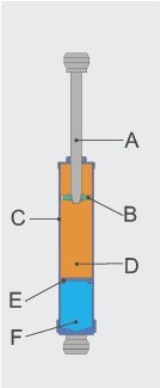
Shock absorber

Encyclopedia
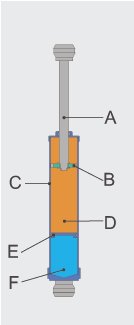
Damping
In physics, damping is any effect that tends to reduce the amplitude of oscillations in an oscillatory system, particularly the harmonic oscillator.In mechanics, friction is one such damping effect...
shock
Shock (mechanics)
A mechanical or physical shock is a sudden acceleration or deceleration caused, for example, by impact, drop, kick, earthquake, or explosion. Shock is a transient physical excitation....
impulse, and dissipate kinetic energy
Kinetic energy
The kinetic energy of an object is the energy which it possesses due to its motion.It is defined as the work needed to accelerate a body of a given mass from rest to its stated velocity. Having gained this energy during its acceleration, the body maintains this kinetic energy unless its speed changes...
. It is a type of dashpot
Dashpot
A dashpot is a mechanical device, a damper which resists motion via viscous friction. The resulting force is proportional to the velocity, but acts in the opposite direction, slowing the motion and absorbing energy. It is commonly used in conjunction with a spring...
.
Nomenclature
- The device's name in common parlance (among the general public and auto mechanics) is shock absorber or simply shock.
- Technical names include damper and dashpot.
- During the early 20th century in the U.S., the then-well-known Houdaille brand was in some places a genericized trademarkGenericized trademarkA genericized trademark is a trademark or brand name that has become the colloquial or generic description for, or synonymous with, a general class of product or service, rather than as an indicator of source or affiliation as intended by the trademark's holder...
for the device, but has since disappeared from use.
Explanation
The shock absorber's function is to absorb or dissipate energy. One design consideration, when designing or choosing a shock absorber, is where that energy will go. In most dashpots, energy is converted to heat inside the viscous fluid. In hydraulic cylinderHydraulic cylinder
A Hydraulic cylinder is a mechanical actuator that is used to give a unidirectional force through a unidirectional stroke. It has many applications, notably in engineering vehicles.- Operation :...
s, the hydraulic fluid
Fluid
In physics, a fluid is a substance that continually deforms under an applied shear stress. Fluids are a subset of the phases of matter and include liquids, gases, plasmas and, to some extent, plastic solids....
heats up, while in air cylinders, the hot air is usually exhausted to the atmosphere. In other types of dashpots, such as electromagnetic
Electromagnetism
Electromagnetism is one of the four fundamental interactions in nature. The other three are the strong interaction, the weak interaction and gravitation...
types, the dissipated energy can be stored and used later. In general terms, shock absorbers help cushion vehicles on uneven roads.
Applications
Shock absorbers are an important part of automobileAutomobile
An automobile, autocar, motor car or car is a wheeled motor vehicle used for transporting passengers, which also carries its own engine or motor...
and motorcycle
Motorcycle
A motorcycle is a single-track, two-wheeled motor vehicle. Motorcycles vary considerably depending on the task for which they are designed, such as long distance travel, navigating congested urban traffic, cruising, sport and racing, or off-road conditions.Motorcycles are one of the most...
suspension
Suspension (vehicle)
Suspension is the term given to the system of springs, shock absorbers and linkages that connects a vehicle to its wheels. Suspension systems serve a dual purpose — contributing to the car's roadholding/handling and braking for good active safety and driving pleasure, and keeping vehicle occupants...
s, aircraft
Aircraft
An aircraft is a vehicle that is able to fly by gaining support from the air, or, in general, the atmosphere of a planet. An aircraft counters the force of gravity by using either static lift or by using the dynamic lift of an airfoil, or in a few cases the downward thrust from jet engines.Although...
landing gear
Landing Gear
Landing Gear is Devin the Dude's fifth studio album. It was released on October 7, 2008. It was his first studio album since signing with the label Razor & Tie. It features a high-profile guest appearance from Snoop Dogg. As of October 30, 2008, the album has sold 18,906 copies.-Track...
, and the supports for many industrial machine
Machine
A machine manages power to accomplish a task, examples include, a mechanical system, a computing system, an electronic system, and a molecular machine. In common usage, the meaning is that of a device having parts that perform or assist in performing any type of work...
s. Large shock absorbers have also been used in structural engineering
Structural engineering
Structural engineering is a field of engineering dealing with the analysis and design of structures that support or resist loads. Structural engineering is usually considered a specialty within civil engineering, but it can also be studied in its own right....
to reduce the susceptibility of structures to earthquake
Earthquake
An earthquake is the result of a sudden release of energy in the Earth's crust that creates seismic waves. The seismicity, seismism or seismic activity of an area refers to the frequency, type and size of earthquakes experienced over a period of time...
damage and resonance
Resonance
In physics, resonance is the tendency of a system to oscillate at a greater amplitude at some frequencies than at others. These are known as the system's resonant frequencies...
. A transverse mounted shock absorber, called a yaw damper
Yaw damper (railroad)
A yaw damper is a transverse mounted shock absorber used to prevent railcars and locomotives from swaying excessively from side to side. Yaw dampers prevent locomotives and passenger railcars from striking station platforms as they roll past them and reduce the gap that must be left between the...
, helps keep railcar
Railcar
A railcar, in British English and Australian English, is a self-propelled railway vehicle designed to transport passengers. The term "railcar" is usually used in reference to a train consisting of a single coach , with a driver's cab at one or both ends. Some railways, e.g., the Great Western...
s from swaying excessively from side to side and are important in passenger railroads, commuter rail and rapid transit
Rapid transit
A rapid transit, underground, subway, elevated railway, metro or metropolitan railway system is an electric passenger railway in an urban area with a high capacity and frequency, and grade separation from other traffic. Rapid transit systems are typically located either in underground tunnels or on...
systems because they prevent railcars from damaging station platforms. The success of passive damping technologies in suppressing vibration is demonstrated by its market size—around US $4.5 billion.
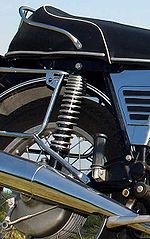
Vehicle suspension
In a vehicle, shock absorbers reduce the effect of traveling over rough ground, leading to improved ride qualityRide quality
Ride quality refers to the degree of protection offered vehicle occupants from uneven elements in the road surface, or the terrain if driving off-road. A car with very good ride quality is also a comfortable car to ride in. Cars which disturb vehicle occupants with major or minor road...
and increase in comfort. While shock absorbers serve the purpose of limiting excessive suspension movement, their intended sole purpose is to dampen spring oscillations. Shock absorbers use valving of oil and gasses to absorb excess energy from the springs. Spring rates are chosen by the manufacturer based on the weight of the vehicle, loaded and unloaded. Some people use shocks to modify spring rates but this is not the correct use. Along with hysteresis
Hysteresis
Hysteresis is the dependence of a system not just on its current environment but also on its past. This dependence arises because the system can be in more than one internal state. To predict its future evolution, either its internal state or its history must be known. If a given input alternately...
in the tire itself, they dampen the energy stored in the motion of the unsprung weight
Unsprung weight
In a ground vehicle with a suspension, the unsprung weight is the mass of the suspension, wheels or tracks , and other components directly connected to them, rather than supported by the suspension...
up and down. Effective wheel bounce damping may require tuning shocks to an optimal resistance.
Spring
Spring (device)
A spring is an elastic object used to store mechanical energy. Springs are usually made out of spring steel. Small springs can be wound from pre-hardened stock, while larger ones are made from annealed steel and hardened after fabrication...
-based shock absorbers commonly use coil spring
Coil spring
A Coil spring, also known as a helical spring, is a mechanical device, which is typically used to store energy and subsequently release it, to absorb shock, or to maintain a force between contacting surfaces...
s or leaf spring
Leaf spring
Originally called laminated or carriage spring, a leaf spring is a simple form of spring, commonly used for the suspension in wheeled vehicles...
s, though torsion bars are used in torsional
Torsion (mechanics)
In solid mechanics, torsion is the twisting of an object due to an applied torque. In sections perpendicular to the torque axis, the resultant shear stress in this section is perpendicular to the radius....
shocks as well. Ideal springs alone, however, are not shock absorbers, as springs only store and do not dissipate or absorb energy. Vehicles typically employ both hydraulic shock absorbers and springs or torsion bars. In this combination, "shock absorber" refers specifically to the hydraulic piston that absorbs and dissipates vibration.
Structures
Applied to a structure such as a buildingBuilding
In architecture, construction, engineering, real estate development and technology the word building may refer to one of the following:...
or bridge
Bridge
A bridge is a structure built to span physical obstacles such as a body of water, valley, or road, for the purpose of providing passage over the obstacle...
it may be part of a seismic retrofit
Seismic retrofit
Seismic retrofitting is the modification of existing structures to make them more resistant to seismic activity, ground motion, or soil failure due to earthquakes. With better understanding of seismic demand on structures and with our recent experiences with large earthquakes near urban centers,...
or as part of new, earthquake resistant construction
Earthquake engineering
Earthquake engineering is the scientific field concerned with protecting society, the natural and the man-made environment from earthquakes by limiting the seismic risk to socio-economically acceptable levels...
. In this application it allows yet restrains motion and absorbs resonant energy
Resonance
In physics, resonance is the tendency of a system to oscillate at a greater amplitude at some frequencies than at others. These are known as the system's resonant frequencies...
, which can cause excessive motion and eventual structural failure
Structural failure
Structural failure refers to loss of the load-carrying capacity of a component or member within a structure or of the structure itself. Structural failure is initiated when the material is stressed to its strength limit, thus causing fracture or excessive deformations...
.
Electrical Generation
It may eventually be possible to generate useful energy from the displacement of the fluid in a shock absorber.Types of shock absorbers
There are several commonly-used approaches to shock absorption:- HysteresisHysteresisHysteresis is the dependence of a system not just on its current environment but also on its past. This dependence arises because the system can be in more than one internal state. To predict its future evolution, either its internal state or its history must be known. If a given input alternately...
of structural material, for example the compression of rubberRubberNatural rubber, also called India rubber or caoutchouc, is an elastomer that was originally derived from latex, a milky colloid produced by some plants. The plants would be ‘tapped’, that is, an incision made into the bark of the tree and the sticky, milk colored latex sap collected and refined...
disks, stretchingStretchingStretching is a form of physical exercise in which a specific skeletal muscle is deliberately elongated, often by abduction from the torso, in order to improve the muscle's felt elasticity and reaffirm comfortable muscle tone. The result is a feeling of increased muscle control, flexibility and...
of rubber bands and cords, bendingBendingIn engineering mechanics, bending characterizes the behavior of a slender structural element subjected to an external load applied perpendicularly to a longitudinal axis of the element. The structural element is assumed to be such that at least one of its dimensions is a small fraction, typically...
of steelSteelSteel is an alloy that consists mostly of iron and has a carbon content between 0.2% and 2.1% by weight, depending on the grade. Carbon is the most common alloying material for iron, but various other alloying elements are used, such as manganese, chromium, vanadium, and tungsten...
springSpring (device)A spring is an elastic object used to store mechanical energy. Springs are usually made out of spring steel. Small springs can be wound from pre-hardened stock, while larger ones are made from annealed steel and hardened after fabrication...
s, or twisting of torsion barTorsion springA torsion spring is a spring that works by torsion or twisting; that is, a flexible elastic object that stores mechanical energy when it is twisted. The amount of force it exerts is proportional to the amount it is twisted. There are two types...
s. Hysteresis is the tendency for otherwise elasticElasticity (physics)In physics, elasticity is the physical property of a material that returns to its original shape after the stress that made it deform or distort is removed. The relative amount of deformation is called the strain....
materials to rebound with less force than was required to deform them. Simple vehicles with no separate shock absorbers are damped, to some extent, by the hysteresis of their springs and frames.
- Dry frictionFrictionFriction is the force resisting the relative motion of solid surfaces, fluid layers, and/or material elements sliding against each other. There are several types of friction:...
as used in wheel brakeBrakeA brake is a mechanical device which inhibits motion. Its opposite component is a clutch. The rest of this article is dedicated to various types of vehicular brakes....
s, by using disks (classically made of leatherLeatherLeather is a durable and flexible material created via the tanning of putrescible animal rawhide and skin, primarily cattlehide. It can be produced through different manufacturing processes, ranging from cottage industry to heavy industry.-Forms:...
) at the pivot of a lever, with friction forced by springs. Used in early automobiles such as the Ford Model TFord Model TThe Ford Model T is an automobile that was produced by Henry Ford's Ford Motor Company from September 1908 to May 1927...
, up through some British cars of the 1940s. Although now considered obsolete, an advantage of this system is its mechanical simplicity; the degree of damping can be easily adjusted by tightening or loosening the screw clamping the disks, and it can be easily rebuilt with simple hand tools. A disadvantage is that the damping force tends not to increase with the speed of the vertical motion.
- Solid state, tapered chain shock absorbers, using one or more tapered, axial alignment(s) of granular spheres, typically made of metals such as nitinol, in a casing. http://physicsweb.org/articles/news/5/10/15/1,http://unisci.com/stories/20014/1022011.htm
- FluidFluidIn physics, a fluid is a substance that continually deforms under an applied shear stress. Fluids are a subset of the phases of matter and include liquids, gases, plasmas and, to some extent, plastic solids....
friction, for example the flow of fluid through a narrow orifice (hydraulics), constitute the vast majority of automotive shock absorbers. An advantage of this type is that using special internal valving the absorber may be made relatively soft to compression (allowing a soft response to a bump) and relatively stiff to extension, controlling "rebound", which is the vehicle response to energy stored in the springs; similarly, a series of valves controlled by springs can change the degree of stiffness according to the velocity of the impact or rebound. Specialized shock absorbers for racing purposes may allow the front end of a dragsterDrag racingDrag racing is a competition in which specially prepared automobiles or motorcycles compete two at a time to be the first to cross a set finish line, from a standing start, in a straight line, over a measured distance, most commonly a ¼-mile straight track....
to rise with minimal resistance under acceleration, then strongly resist letting it settle, thereby maintaining a desirable rearward weight distribution for enhanced traction. Some shock absorbers allow tuning of the ride via control of the valve by a manual adjustment provided at the shock absorber. In more expensive vehicles the valves may be remotely adjustable, offering the driver control of the ride at will while the vehicle is operated. The ultimate control is provided by dynamic valve control via computer in response to sensors, giving both a smooth ride and a firm suspension when needed. Many shock absorbers are pressurised with compressed nitrogenNitrogenNitrogen is a chemical element that has the symbol N, atomic number of 7 and atomic mass 14.00674 u. Elemental nitrogen is a colorless, odorless, tasteless, and mostly inert diatomic gas at standard conditions, constituting 78.08% by volume of Earth's atmosphere...
, to reduce the tendency for the oil to cavitate under heavy use. This causes foamFoam-Definition:A foam is a substance that is formed by trapping gas in a liquid or solid in a divided form, i.e. by forming gas regions inside liquid regions, leading to different kinds of dispersed media...
ing which temporarily reduces the damping ability of the unit. In very heavy duty units used for racing and/or off-road use, there may even be a secondary cylinder connected to the shock absorber to act as a reservoir for the oil and pressurized gas.
- In electrorheological fluidElectrorheological fluidElectrorheological fluids are suspensions of extremely fine non-conducting particles in an electrically insulating fluid. The apparent viscosity of these fluids changes reversibly by an order of up to 100,000 in response to an electric field...
damper, an electric field changes the viscosity of the oil. This principle allows semi-active dampers application in automotive and various industries.
- Other principles use magnetic field variation magneto rheological damperMagneto rheological damperA magnetorheological damper or magnetorheological shock absorber is a damper filled with magnetorheological fluid, which is controlled by a magnetic field, usually using an electromagnet. This allows the damping characteristics of the shock absorber to be continuously controlled by varying the...
which changes its fluid characteristics through an electromagnetElectromagnetAn electromagnet is a type of magnet in which the magnetic field is produced by the flow of electric current. The magnetic field disappears when the current is turned off...
.
- Compression of a gas, for example pneumatic shock absorbers, which can act like springs as the air pressure is building to resist the force on it. Once the air pressure reaches the necessary maximum, air dashpots will act like hydraulic dashpots. In aircraftAircraftAn aircraft is a vehicle that is able to fly by gaining support from the air, or, in general, the atmosphere of a planet. An aircraft counters the force of gravity by using either static lift or by using the dynamic lift of an airfoil, or in a few cases the downward thrust from jet engines.Although...
landing gear air dashpots may be combined with hydraulic damping to reduce bounce. Such struts are called oleo strutsOleo strut (aircraft suspension)An oleo strut is an air–oil hydraulic shock absorber used on the landing gear of most large aircraft. It cushions the impacts of landing and while taxiing and damps out vertical oscillations.-Operation:...
(combining oil and air) http://www.hangar9aeroworks.com/Aeroncastrut/Aeroncastrut.html.
- MagnetMagnetA magnet is a material or object that produces a magnetic field. This magnetic field is invisible but is responsible for the most notable property of a magnet: a force that pulls on other ferromagnetic materials, such as iron, and attracts or repels other magnets.A permanent magnet is an object...
ic effects. Eddy currentEddy currentEddy currents are electric currents induced in conductors when a conductor is exposed to a changing magnetic field; due to relative motion of the field source and conductor or due to variations of the field with time. This can cause a circulating flow of electrons, or current, within the body of...
dampers are dashpots that are constructed out of a large magnet inside of a non-magnetic, electrically conductive tube.
- InertiaInertiaInertia is the resistance of any physical object to a change in its state of motion or rest, or the tendency of an object to resist any change in its motion. It is proportional to an object's mass. The principle of inertia is one of the fundamental principles of classical physics which are used to...
l resistance to acceleration, for example prior to 1966 http://www.citroenet.org.uk/passenger-cars/michelin/2cv/2cv-01.html the Citroën 2CVCitroën 2CVThe Citroën 2CV |tax horsepower]]”) was an economy car produced by the French automaker Citroën between 1948 and 1990. It was technologically advanced and innovative, but with uncompromisingly utilitarian unconventional looks, and deceptively simple Bauhaus inspired bodywork, that belied the sheer...
had shock absorbers that damp wheel bounce with no external moving parts. These consisted of a spring-mounted 3.5 kg (7.75 lb) iron weight inside a vertical cylinder http://www.canadiandriver.com/articles/bv/2cv.htm and are similar to, yet much smaller than versions of the tuned mass damperTuned mass damperA tuned mass damper, also known as an active mass damper or harmonic absorber, is a device mounted in structures to reduce the amplitude of mechanical vibrations. Their application can prevent discomfort, damage, or outright structural failure...
s used on tall buildings.
- Composite hydropneumatic devices which combine in a single device spring action, shock absorption, and often also ride-height control, as in some models of the CitroënCitroënCitroën is a major French automobile manufacturer, part of the PSA Peugeot Citroën group.Founded in 1919 by French industrialist André-Gustave Citroën , Citroën was the first mass-production car company outside the USA and pioneered the modern concept of creating a sales and services network that...
automobile.
- Conventional shock absorbers combined with composite pneumatic springs which allow ride height adjustment or even ride height control, seen in some large trucks and luxury sedans such as certain LincolnLincoln (automobile)Lincoln is an American luxury vehicle brand of the Ford Motor Company. Lincoln vehicles are sold mostly in North America.-History:The company was founded in August 1915 by Henry M. Leland, one of the founders of Cadillac . During World War I, he left Cadillac which was sold to General Motors...
and most Land RoverLand RoverLand Rover is a British car manufacturer with its headquarters in Gaydon, Warwickshire, United Kingdom which specialises in four-wheel-drive vehicles. It is owned by the Indian company Tata Motors, forming part of their Jaguar Land Rover group...
automobiles. Ride height control is especially desirable in highway vehicles intended for occasional rough road use, as a means of improving handlingCar handlingAutomobile handling and vehicle handling are descriptions of the way wheeled vehicles perform transverse to their direction of motion, particularly during cornering and swerving. It also includes their stability when moving at rest. Handling and braking are the major components of a vehicle's...
and reducing aerodynamic drag by lowering the vehicle when operating on improved high speed roads.
- The effect of a shock absorber at high (sound) frequencies is usually limited by using a compressible gas as the working fluid and/or mounting it with rubber bushings.