


Soil liquefaction

Encyclopedia
Soil
Soil is a natural body consisting of layers of mineral constituents of variable thicknesses, which differ from the parent materials in their morphological, physical, chemical, and mineralogical characteristics...
substantially loses strength
Shear strength (soil)
Shear strength is a term used in soil mechanics to describe the magnitude of the shear stress that a soil can sustain. The shear resistance of soil is a result of friction and interlocking of particles, and possibly cementation or bonding at particle contacts. Due to interlocking, particulate...
and stiffness
Stiffness
Stiffness is the resistance of an elastic body to deformation by an applied force along a given degree of freedom when a set of loading points and boundary conditions are prescribed on the elastic body.-Calculations:...
in response to an applied stress
Shear stress
A shear stress, denoted \tau\, , is defined as the component of stress coplanar with a material cross section. Shear stress arises from the force vector component parallel to the cross section...
, usually earthquake
Earthquake
An earthquake is the result of a sudden release of energy in the Earth's crust that creates seismic waves. The seismicity, seismism or seismic activity of an area refers to the frequency, type and size of earthquakes experienced over a period of time...
shaking or other sudden change in stress condition, causing it to behave like a liquid.
In soil mechanics
Soil mechanics
Soil mechanics is a branch of engineering mechanics that describes the behavior of soils. It differs from fluid mechanics and solid mechanics in the sense that soils consist of a heterogeneous mixture of fluids and particles but soil may also contain organic solids, liquids, and gasses and other...
the term "liquefied" was first used by Hazen in reference to the 1918 failure of the Calaveras Dam in California. He described the mechanism of flow liquefaction of the embankment dam as follows:
The phenomenon is most often observed in saturated, loose (low density
Density
The mass density or density of a material is defined as its mass per unit volume. The symbol most often used for density is ρ . In some cases , density is also defined as its weight per unit volume; although, this quantity is more properly called specific weight...
or uncompacted), sandy soils. This is because a loose sand
Sand
Sand is a naturally occurring granular material composed of finely divided rock and mineral particles.The composition of sand is highly variable, depending on the local rock sources and conditions, but the most common constituent of sand in inland continental settings and non-tropical coastal...
has a tendency to compress when a load
Force
In physics, a force is any influence that causes an object to undergo a change in speed, a change in direction, or a change in shape. In other words, a force is that which can cause an object with mass to change its velocity , i.e., to accelerate, or which can cause a flexible object to deform...
is applied; dense sands by contrast tend to expand in volume or 'dilate
Reynolds' dilatancy
Reynolds' dilatancy is the observed tendency of a compacted granular material to dilate as it is sheared. This occurs because the grains in a compacted state are interlocking and therefore do not have the freedom to move around one another. When stressed, a lever motion occurs between...
'. If the soil is saturated by water, as exists when the soil is below the ground water table or sea level, then water fills the gaps between soil grains ('pore spaces'). In response to the soil compressing, this water increases in pressure and attempts to flow out from the soil to zones of low pressure (usually upward towards the ground surface). However, if the loading
Force
In physics, a force is any influence that causes an object to undergo a change in speed, a change in direction, or a change in shape. In other words, a force is that which can cause an object with mass to change its velocity , i.e., to accelerate, or which can cause a flexible object to deform...
is rapidly applied and large enough, or is repeated many times (e.g. earthquake shaking, storm wave loading) such that it does not flow out in time before the next cycle of load
Force
In physics, a force is any influence that causes an object to undergo a change in speed, a change in direction, or a change in shape. In other words, a force is that which can cause an object with mass to change its velocity , i.e., to accelerate, or which can cause a flexible object to deform...
is applied, the water pressures may build to an extent where they exceed the contact stresses between the grains of soil that keep them in contact with each other. These contacts between grains are the means by which the weight from buildings and overlying soil layers are transferred from the ground surface to layers of soil or rock at greater depths. This loss of soil structure causes it to lose all of its strength
Shear strength
Shear strength in engineering is a term used to describe the strength of a material or component against the type of yield or structural failure where the material or component fails in shear. A shear load is a force that tends to produce a sliding failure on a material along a plane that is...
(the ability to transfer shear stress
Shear stress
A shear stress, denoted \tau\, , is defined as the component of stress coplanar with a material cross section. Shear stress arises from the force vector component parallel to the cross section...
) and it may be observed to flow like a liquid (hence 'liquefaction').
Although the effects of liquefaction have been long understood, it was more thoroughly brought to the attention of engineer
Engineer
An engineer is a professional practitioner of engineering, concerned with applying scientific knowledge, mathematics and ingenuity to develop solutions for technical problems. Engineers design materials, structures, machines and systems while considering the limitations imposed by practicality,...
s after the 1964 Niigata earthquake
1964 Niigata earthquake
The 1964 Niigata earthquake struck at 13:01 local time on 16 June. The epicenter was on the continental shelf off the northwest coast of Honshu in Niigata Prefecture, about 50 km north of the city of Niigata...
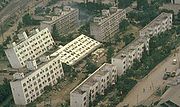
and 1964 Alaska earthquake. It was also a major factor in the destruction in San Francisco's Marina District during the 1989 Loma Prieta earthquake, and in Kobe Port during the 1995 Great Hanshin earthquake
Great Hanshin earthquake
The Great Hanshin earthquake, or Kobe earthquake, was an earthquake that occurred on Tuesday, January 17, 1995, at 05:46 JST in the southern part of Hyōgo Prefecture, Japan. It measured 6.8 on the moment magnitude scale , and Mj7.3 on JMA magnitude scale. The tremors lasted for approximately 20...
. More recently liquefaction was largely responsible for extensive damage to residential properties in the eastern suburbs and satellite townships of Christchurch
Christchurch
Christchurch is the largest city in the South Island of New Zealand, and the country's second-largest urban area after Auckland. It lies one third of the way down the South Island's east coast, just north of Banks Peninsula which itself, since 2006, lies within the formal limits of...
, New Zealand during the 2010 Darfield earthquake and more extensively again following the Christchurch earthquakes that followed in early and mid 2011.
The building codes in many developed countries require engineers to consider the effects of soil liquefaction in the design of new buildings and infrastructure such as bridges, embankment dams and retaining structures.
Technical definitions
A state of 'soil liquefaction' occurs when the effective stressEffective stress
Karl von Terzaghi first proposed the relationship for effective stress in 1936. For him, the term ‘effective’ meant the calculated stress that was effective in moving soil, or causing displacements...
of a soil is reduced to essentially zero, which corresponds to a complete loss of shear strength
Shear strength (soil)
Shear strength is a term used in soil mechanics to describe the magnitude of the shear stress that a soil can sustain. The shear resistance of soil is a result of friction and interlocking of particles, and possibly cementation or bonding at particle contacts. Due to interlocking, particulate...
. This may be initiated by either monotonic loading (e.g. single sudden occurrence of a change in stress - examples include an increase in load on an embankment or sudden loss of toe support) or cyclic loading (e.g. repeated change in stress condition - examples include wave loading
Wave loading
Wave loading is most commonly the application of a pulsed or wavelike load to a material or object. This is most commonly used in the analysis of piping, ships, or building structures which experience wind, water, or seismic disturbances....
or earthquake
Earthquake
An earthquake is the result of a sudden release of energy in the Earth's crust that creates seismic waves. The seismicity, seismism or seismic activity of an area refers to the frequency, type and size of earthquakes experienced over a period of time...
shaking). In both cases a soil in a saturated loose state, and one which may generate significant pore water pressure on a change in load are the most likely to liquefy. This is because a loose soil has the tendency to compress when sheared, generating large excess porewater pressure as load is transferred from the soil skeleton to adjacent pore water during undrained loading. As pore water pressure rises a progressive loss of strength of the soil occurs as effective stress
Effective stress
Karl von Terzaghi first proposed the relationship for effective stress in 1936. For him, the term ‘effective’ meant the calculated stress that was effective in moving soil, or causing displacements...
is reduced.
It is more likely to occur in sandy or non-plastic silty soils, but may in rare cases occur in gravels and clays (see quick clay
Quick clay
Quick clay, also known as Leda clay and Champlain Sea clay in Canada, is a unique form of highly sensitive marine clay, with the tendency to change from a relatively stiff condition to a liquid mass when it is disturbed. Undisturbed quick clay resembles a water-saturated gel...
)
A 'flow failure' may initiate if the strength of the soil is reduced below the stresses required to maintain equilibrium of a slope or footing of a building for instance. This can occur due to monotonic loading or cyclic loading, and can be sudden and catastrophic. A historical example is the Aberfan disaster. Casagrande referred to this type of phenomena as 'flow liquefaction' although a state of zero effective stress is not required for this to occur.
The term 'cyclic liquefaction' refers to the occurrence of a state of soil when large shear strains have accumulated in response to cyclic loading. A typical reference strain for the approximate occurrence of zero effective stress is 5% double amplitude shear strain. This is a soil test based definition, usually performed via cyclic triaxial, cyclic direct simple shear, or cyclic torsional shear type apparatus. These tests are performed to determine a soils resistance to liquefaction by observing the number of cycles of loading at a particular shear stress amplitude before it 'fails'. Failure here is defined by the aforementioned shear strain criteria.
The term 'cyclic mobility' refers to the mechanism of progressive reduction of effective stress due to cyclic loading. This may occur in all soil types including dense soils. However on reaching a state of zero effective stress such soils immediate dilate and regain strength. Thus shear strains are significantly less than a true state of soil liquefaction whereby a loose soil exhibits flow type phenomena.
Liquefaction occurrence
Liquefaction is more likely to occur in loose to moderately saturated granular soils with poor drainageDrainage
Drainage is the natural or artificial removal of surface and sub-surface water from an area. Many agricultural soils need drainage to improve production or to manage water supplies.-Early history:...
, such as silty sand
Sand
Sand is a naturally occurring granular material composed of finely divided rock and mineral particles.The composition of sand is highly variable, depending on the local rock sources and conditions, but the most common constituent of sand in inland continental settings and non-tropical coastal...
s or sands and gravel
Gravel
Gravel is composed of unconsolidated rock fragments that have a general particle size range and include size classes from granule- to boulder-sized fragments. Gravel can be sub-categorized into granule and cobble...
s capped or containing seams of impermeable sediment
Sediment
Sediment is naturally occurring material that is broken down by processes of weathering and erosion, and is subsequently transported by the action of fluids such as wind, water, or ice, and/or by the force of gravity acting on the particle itself....
s. During wave loading
Wave loading
Wave loading is most commonly the application of a pulsed or wavelike load to a material or object. This is most commonly used in the analysis of piping, ships, or building structures which experience wind, water, or seismic disturbances....
, usually cyclic undrained loading, e.g. seismic loading
Seismic loading
Seismic loading is one of the basic concepts of earthquake engineering which means application of an earthquake-generated agitation to a structure...
, loose sands tend to decrease in volume
Volume
Volume is the quantity of three-dimensional space enclosed by some closed boundary, for example, the space that a substance or shape occupies or contains....
, which produces an increase in their porewater pressures and consequently a decrease in shear strength
Shear strength (soil)
Shear strength is a term used in soil mechanics to describe the magnitude of the shear stress that a soil can sustain. The shear resistance of soil is a result of friction and interlocking of particles, and possibly cementation or bonding at particle contacts. Due to interlocking, particulate...
, i.e. reduction in effective stress
Effective stress
Karl von Terzaghi first proposed the relationship for effective stress in 1936. For him, the term ‘effective’ meant the calculated stress that was effective in moving soil, or causing displacements...
.
Deposits most susceptible to liquefaction are young (Holocene
Holocene
The Holocene is a geological epoch which began at the end of the Pleistocene and continues to the present. The Holocene is part of the Quaternary period. Its name comes from the Greek words and , meaning "entirely recent"...
-age, deposited within the last 10,000 years) sands and silt
Silt
Silt is granular material of a size somewhere between sand and clay whose mineral origin is quartz and feldspar. Silt may occur as a soil or as suspended sediment in a surface water body...
s of similar grain size (well-sorted), in beds at least metre
Metre
The metre , symbol m, is the base unit of length in the International System of Units . Originally intended to be one ten-millionth of the distance from the Earth's equator to the North Pole , its definition has been periodically refined to reflect growing knowledge of metrology...
s thick, and saturated with water. Such deposits are often found along riverbed
Riverbed
Riverbed may refer to:*Stream bed, the channel bottom of a stream or river or creek*Wadi, a dry riverbed that contains water only during times of heavy rain*Riverbed Technology, an American technology company...
s, beach
Beach
A beach is a geological landform along the shoreline of an ocean, sea, lake or river. It usually consists of loose particles which are often composed of rock, such as sand, gravel, shingle, pebbles or cobblestones...
es, dune
Dune
In physical geography, a dune is a hill of sand built by wind. Dunes occur in different forms and sizes, formed by interaction with the wind. Most kinds of dunes are longer on the windward side where the sand is pushed up the dune and have a shorter "slip face" in the lee of the wind...
s, and areas where windblown silt (loess
Loess
Loess is an aeolian sediment formed by the accumulation of wind-blown silt, typically in the 20–50 micrometre size range, twenty percent or less clay and the balance equal parts sand and silt that are loosely cemented by calcium carbonate...
) and sand have accumulated. Some examples of soil liquefaction include quicksand
Quicksand
Quicksand is a colloid hydrogel consisting of fine granular matter , clay, and water.Water circulation underground can focus in an area with the optimal mixture of fine sands and other materials such as clay. The water moves up and then down slowly in a convection-like manner throughout a column...
, quick clay
Quick clay
Quick clay, also known as Leda clay and Champlain Sea clay in Canada, is a unique form of highly sensitive marine clay, with the tendency to change from a relatively stiff condition to a liquid mass when it is disturbed. Undisturbed quick clay resembles a water-saturated gel...
, turbidity current
Turbidity current
A turbidity current is a current of rapidly moving, sediment-laden water moving down a slope through water, or another fluid. The current moves because it has a higher density and turbidity than the fluid through which it flows...
s, and earthquake induced liquefaction.
Depending on the initial void ratio, the soil material can respond to loading either strain-softening or strain-hardening. Strain-softened soils, e.g. loose sands, can be triggered to collapse, either monotonically or cyclically, if the static shear stress is greater than the ultimate or steady-state shear strength of the soil. In this case flow liquefaction occurs, where the soil deforms at a low constant residual shear stress. If the soil strain-hardens, e.g. moderately dense to dense sand, flow liquefaction will generally not occur. However, cyclic softening can occur due to cyclic undrained loading, e.g. earthquake loading. Deformation during cyclic loading will depend on the density
Density
The mass density or density of a material is defined as its mass per unit volume. The symbol most often used for density is ρ . In some cases , density is also defined as its weight per unit volume; although, this quantity is more properly called specific weight...
of the soil, the magnitude and duration of the cyclic loading, and amount of shear stress reversal. If stress reversal occurs, the effective shear stress could reach zero, then cyclic liquefaction can take place. If stress reversal does not occur, zero effective stress is not possible to occur, then cyclic mobility takes place.
The resistance of the cohesionless soil to liquefaction will depend on the density of the soil, confining stresses, soil structure (fabric, age and cementation
Cementation
Cementation may refer to:*Cementation , the process of deposition of dissolved mineral components in the interstices of sediments*Cementation , a small deposit of calcium, similar to a cyst...
), the magnitude and duration of the cyclic loading, and the extent to which shear stress reversal occurs.
Earthquake liquefaction
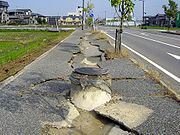
The pressures generated during large earthquakes with many cycles of shaking can cause the liquefied sand and excess water to force its way to the ground surface from several metres below the ground. This is often observed as "sand boils" also called "sand blows" or "sand volcanoSand volcano
A sand volcano or sand blow is a cone of sand formed by the ejection of sand onto a surface from a central point. The sand builds up as a cone with slopes at the sand's angle of repose. A crater is commonly seen at the summit...
es" (as they appear to form small volcanic craters) at the ground surface. The phenomenon may incorporate both flow of already liquefied sand from a layer below ground, and a quicksand
Quicksand
Quicksand is a colloid hydrogel consisting of fine granular matter , clay, and water.Water circulation underground can focus in an area with the optimal mixture of fine sands and other materials such as clay. The water moves up and then down slowly in a convection-like manner throughout a column...
effect whereby upward flow of water initiates liquefaction in overlying non-liquefied sandy deposits due to buoyancy.
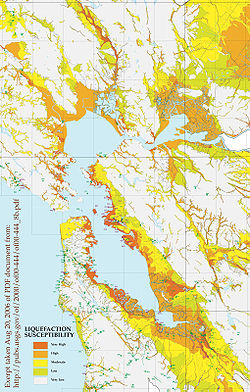
One positive aspect of soil liquefaction is the tendency for the effects of earthquake shaking to be significantly damped
Damping
In physics, damping is any effect that tends to reduce the amplitude of oscillations in an oscillatory system, particularly the harmonic oscillator.In mechanics, friction is one such damping effect...
(reduced) for the remainder of the earthquake. This is because liquids do not support a shear stress
Shear stress
A shear stress, denoted \tau\, , is defined as the component of stress coplanar with a material cross section. Shear stress arises from the force vector component parallel to the cross section...
and so once the soil liquefies due to shaking, subsequent earthquake shaking (transferred through ground by shear waves) is not transferred to buildings at the ground surface.
Studies of liquefaction features left by prehistoric earthquakes, called paleoliquefaction
Paleoliquefaction
Paleoliquefaction is the term used to describe liquefaction features attributed to seismic events occurring before measurements or detailed records were kept of earthquakes. The study of these features can tell us a great deal about the seismicity of regions where large earthquakes happen...
or paleoseismology
Paleoseismology
Paleoseismology looks at geologic sediments and rocks, for signs of ancient earthquakes. It is used to supplement seismic monitoring, for the calculation of seismic hazard...
, can reveal a great deal of information about earthquakes that occurred before records were kept or accurate measurements could be taken.
Soil liquefaction induced by earthquake shaking is also a major contributor to urban seismic risk
Urban seismic risk
Urban seismic risk is a subset of the general term seismic risk which describes the problems specific to centers of population when they are subjected to earthquakes. Many risks can be minimised with good earthquake construction, and seismic analysis...
.
Effects
The effects of soil liquefaction on the built environment can be extremely damaging. Buildings whose foundations bear directly on sand which liquefies will experience a sudden loss of support, which will result in drastic and irregular settlement of the building causing structural damage, including cracking of foundations and damage to the building structure itself, or may leave the structure unserviceable afterwards, even without structural damage. Where a thin crust of non-liquefied soil exists between building foundation and liquefied soil, a 'punching shear' type foundation failure may occur. The irregular settlement of ground may also break underground utility lines. The upward pressure applied by the movement of liquefied soil through the crust layer can crack weak foundation slabs and enter buildings through service ducts, and may allow water to damage the building contents and electrical services.Bridges and large buildings constructed on pile foundations may lose support from the adjacent soil and buckle
Buckling
In science, buckling is a mathematical instability, leading to a failure mode.Theoretically, buckling is caused by a bifurcation in the solution to the equations of static equilibrium...
, or come to rest at a tilt after shaking.
Sloping ground and ground next to rivers and lakes may slide on a liquefied soil layer (termed 'lateral spreading'), opening large cracks or fissures in the ground, and can cause significant damage to buildings, bridges, roads and services such as water, natural gas, sewerage, power and telecommunications installed in the affected ground. Buried tanks and manholes may float in the liquefied soil due to buoyancy
Buoyancy
In physics, buoyancy is a force exerted by a fluid that opposes an object's weight. In a column of fluid, pressure increases with depth as a result of the weight of the overlying fluid. Thus a column of fluid, or an object submerged in the fluid, experiences greater pressure at the bottom of the...
. Earth embankments such as flood levee
Levee
A levee, levée, dike , embankment, floodbank or stopbank is an elongated naturally occurring ridge or artificially constructed fill or wall, which regulates water levels...
s and earth dams may lose stability or collapse if the material comprising the embankment or its foundation liquefies.
Liquefaction mitigation methods
Methods to mitigate the effects of soil liquefaction have been devised by earthquake engineersEarthquake engineering
Earthquake engineering is the scientific field concerned with protecting society, the natural and the man-made environment from earthquakes by limiting the seismic risk to socio-economically acceptable levels...
and include various soil compaction
Soil compaction
In Geotechnical engineering, soil compaction is the process in which a stress applied to a soil causes densification as air is displaced from the pores between the soil grains. When stress is applied that causes densification due to water being displaced from between the soil grains then...
techniques such as vibro compaction (compaction of the soil by depth vibrators), dynamic compaction
Dynamic compaction
Dynamic compaction is a method that is used to increase the density of the soil when certain subsurface constraints make other methods inappropriate. It is a method that is used to increase the density of soil deposits. The process involves of dropping a heavy weight repeatedly on the ground at...
, and vibro stone columns
Vibro stone column
Vibro replacement stone columns are a ground improvement technique to improve the load bearing capacity and reduce the settlement of the soil. On many occasions, it is noted that the local soil is by nature, unable to bear the proposed structure. Hence the use of ground improvement techniques may...
. These methods result in the densification of soil and enable buildings to withstand soil liquefaction.
Quicksand
QuicksandQuicksand
Quicksand is a colloid hydrogel consisting of fine granular matter , clay, and water.Water circulation underground can focus in an area with the optimal mixture of fine sands and other materials such as clay. The water moves up and then down slowly in a convection-like manner throughout a column...
forms when water saturates an area of loose sand and the ordinary sand is agitated. When the water trapped in the batch of sand cannot escape, it creates liquefied soil that can no longer support weight. Quicksand can be formed by standing or (upwards) flowing underground water (as from an underground spring), or by earthquakes. In the case of flowing underground water, the force of the water flow opposes the force of gravity, causing the granules of sand to be more buoyant. In the case of earthquakes, the shaking force can increase the pressure of shallow groundwater, liquefying sand and silt deposits. In both cases, the liquefied surface loses strength, causing buildings or other objects on that surface to sink or fall over.
The saturated sediment may appear quite solid until a change in pressure or shock initiates the liquifaction causing the sand to form a suspension with each grain surrounded by a thin film of water. This cushioning gives quicksand, and other liquefied sediments, a spongy, fluidlike texture. Objects in the liquefied sand sink to the level at which the weight of the object is equal to the weight of the displaced sand/water mix and the object floats due to its buoyancy
Buoyancy
In physics, buoyancy is a force exerted by a fluid that opposes an object's weight. In a column of fluid, pressure increases with depth as a result of the weight of the overlying fluid. Thus a column of fluid, or an object submerged in the fluid, experiences greater pressure at the bottom of the...
.
Quick clay
Quick clayQuick clay
Quick clay, also known as Leda clay and Champlain Sea clay in Canada, is a unique form of highly sensitive marine clay, with the tendency to change from a relatively stiff condition to a liquid mass when it is disturbed. Undisturbed quick clay resembles a water-saturated gel...
, also known as Leda Clay in Canada
Canada
Canada is a North American country consisting of ten provinces and three territories. Located in the northern part of the continent, it extends from the Atlantic Ocean in the east to the Pacific Ocean in the west, and northward into the Arctic Ocean...
, is a unique form of highly sensitive clay
Clay
Clay is a general term including many combinations of one or more clay minerals with traces of metal oxides and organic matter. Geologic clay deposits are mostly composed of phyllosilicate minerals containing variable amounts of water trapped in the mineral structure.- Formation :Clay minerals...
, with the tendency to change from a relatively stiff condition to a liquid mass when it is disturbed. Undisturbed quick clay resembles a water-saturated gel
Gel
A gel is a solid, jelly-like material that can have properties ranging from soft and weak to hard and tough. Gels are defined as a substantially dilute cross-linked system, which exhibits no flow when in the steady-state...
. When a block of clay is held in the hand and struck, however, it instantly turns into a flowing ooze, a process known as spontaneous liquefaction
Liquefaction
Liquefaction may refer to:* Liquefaction, the general process of becoming liquid* Soil liquefaction, the process by which sediments become suspended* Liquefaction of gases in physics, chemistry, and thermal engineering* Liquefactive necrosis in pathology...
. Quick clay behaves this way because, although it is solid, it has a very high water content, up to 80%. The clay retains a solid structure despite the high water content, because surface tension
Surface tension
Surface tension is a property of the surface of a liquid that allows it to resist an external force. It is revealed, for example, in floating of some objects on the surface of water, even though they are denser than water, and in the ability of some insects to run on the water surface...
holds water-coated flakes of clay together in a delicate structure. When the structure is broken by a shock, it reverts to a fluid state.
Quick clay is only found in the northern countries such as Russia
Russia
Russia or , officially known as both Russia and the Russian Federation , is a country in northern Eurasia. It is a federal semi-presidential republic, comprising 83 federal subjects...
, Canada
Canada
Canada is a North American country consisting of ten provinces and three territories. Located in the northern part of the continent, it extends from the Atlantic Ocean in the east to the Pacific Ocean in the west, and northward into the Arctic Ocean...
, Alaska
Alaska
Alaska is the largest state in the United States by area. It is situated in the northwest extremity of the North American continent, with Canada to the east, the Arctic Ocean to the north, and the Pacific Ocean to the west and south, with Russia further west across the Bering Strait...
in the U.S., Norway
Norway
Norway , officially the Kingdom of Norway, is a Nordic unitary constitutional monarchy whose territory comprises the western portion of the Scandinavian Peninsula, Jan Mayen, and the Arctic archipelago of Svalbard and Bouvet Island. Norway has a total area of and a population of about 4.9 million...
, Sweden
Sweden
Sweden , officially the Kingdom of Sweden , is a Nordic country on the Scandinavian Peninsula in Northern Europe. Sweden borders with Norway and Finland and is connected to Denmark by a bridge-tunnel across the Öresund....
, and Finland
Finland
Finland , officially the Republic of Finland, is a Nordic country situated in the Fennoscandian region of Northern Europe. It is bordered by Sweden in the west, Norway in the north and Russia in the east, while Estonia lies to its south across the Gulf of Finland.Around 5.4 million people reside...
, which were glaciated during the Pleistocene epoch.
Quick clay has been the underlying cause of many deadly landslides. In Canada alone, it has been associated with more than 250 mapped landslides. Some of these are ancient, and may have been triggered by earthquakes.
Turbidity currents
Submarine landslides are turbidity currentTurbidity current
A turbidity current is a current of rapidly moving, sediment-laden water moving down a slope through water, or another fluid. The current moves because it has a higher density and turbidity than the fluid through which it flows...
s and consist of water saturated sediments flowing downslope. An example occurred during the 1929 Grand Banks earthquake
1929 Grand Banks earthquake
The 1929 Grand Banks earthquake, also called the Laurentian Slope earthquake and the South Shore Disaster, was a magnitude 7.2 earthquake that occurred on November 18, 1929 in the Atlantic Ocean off the south coast of Newfoundland in the Laurentian Slope Seismic Zone.The earthquake was centred on...
that struck the continental slope off the coast of Newfoundland. Minutes later, transatlantic telephone cable
Transatlantic telephone cable
A transatlantic telecommunications cable is a submarine communications cable running under the Atlantic Ocean. All modern cables use fibre optic technology....
s began breaking sequentially, farther and farther downslope, away from the epicenter
Epicenter
The epicenter or epicentre is the point on the Earth's surface that is directly above the hypocenter or focus, the point where an earthquake or underground explosion originates...
. Twelve cables were snapped in a total of 28 places. Exact times and locations were recorded for each break. Investigators suggested that a 60-mile-per-hour (100 km/h) submarine landslide or turbidity current of water saturated sediments swept 400 miles (600 km) down the continental slope from the earthquake’s epicenter, snapping the cables as it passed.
See also
- PaleoseismologyPaleoseismologyPaleoseismology looks at geologic sediments and rocks, for signs of ancient earthquakes. It is used to supplement seismic monitoring, for the calculation of seismic hazard...
- Dry quicksandDry quicksandDry quicksand is loose sand whose bulk density is reduced by blowing air through it and which yields easily to weight or pressure. It acts similarly to normal quicksand, but it does not contain any water and does not operate on the same principle...
- Atterberg limitsAtterberg LimitsThe Atterberg limits are a basic measure of the nature of a fine-grained soil. Depending on the water content of the soil, it may appear in four states: solid, semi-solid, plastic and liquid. In each state the consistency and behavior of a soil is different and thus so are its engineering properties...
- Mud volcanoMud volcanoThe term mud volcano or mud dome are used to refer to formations created by geo-excreted liquids and gases, although there are several different processes which may cause such activity. Hot water mixes with mud and surface deposits. Mud volcanoes are associated with subduction zones and about 700...
- Sand volcanoSand volcanoA sand volcano or sand blow is a cone of sand formed by the ejection of sand onto a surface from a central point. The sand builds up as a cone with slopes at the sand's angle of repose. A crater is commonly seen at the summit...
or sand blow - ThixotropyThixotropyThixotropy is the property of certain gels or fluids that are thick under normal conditions, but flow over time when shaken, agitated, or otherwise stressed...
- Earthquake engineeringEarthquake engineeringEarthquake engineering is the scientific field concerned with protecting society, the natural and the man-made environment from earthquakes by limiting the seismic risk to socio-economically acceptable levels...
External links
- Soil Liquefaction
- Shaking, Liquefaction on Harbor Island, one of the few known live observations of an earthquake liquefaction event by a seismologist
- Video showing liquefaction process