
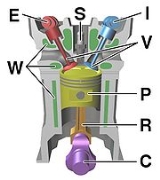
A
piston is a component of
reciprocating engineA reciprocating engine, also often known as a piston engine, is a heat engine that uses one or more reciprocating pistons to convert pressure into a rotating motion. This article describes the common features of all types...
s, reciprocating
pumpA pump is a device used to move fluids, such as liquids, gases or slurries.A pump displaces a volume by physical or mechanical action. Pumps fall into three major groups: direct lift, displacement, and gravity pumps...
s,
gas compressorA gas compressor is a mechanical device that increases the pressure of a gas by reducing its volume.Compressors are similar to pumps: both increase the pressure on a fluid and both can transport the fluid through a pipe. As gases are compressible, the compressor also reduces the volume of a gas...
s and
pneumatic cylinderPneumatic cylinders are mechanical devices which utilize the power of compressed gas to produce a force in a reciprocating linear motion....
s, among other similar mechanisms. It is the moving component that is contained by a
cylinderA cylinder is the central working part of a reciprocating engine or pump, the space in which a piston travels. Multiple cylinders are commonly arranged side by side in a bank, or engine block, which is typically cast from aluminum or cast iron before receiving precision machine work...
and is made gas-tight by
piston ringA piston ring is a split ring that fits into a groove on the outer diameter of a piston in a reciprocating engine such as an internal combustion engine or steam engine.The three main functions of piston rings in reciprocating engines are:...
s. In an engine, its purpose is to transfer force from expanding gas in the cylinder to the
crankshaftThe crankshaft, sometimes casually abbreviated to crank, is the part of an engine which translates reciprocating linear piston motion into rotation...
via a
piston rodIn a piston engine, a piston rod joins a piston to a connecting rod.Many internal combustion engines, and in particular all current automobile engines, do not have true piston rods, and the term piston rod is often used as a synonym for connecting rod in the context of these engines.All engines...
and/or
connecting rodIn a reciprocating piston engine, the connecting rod or conrod connects the piston to the crank or crankshaft. Together with the crank, they form a simple mechanism that converts linear motion into rotating motion....
. In a pump, the function is reversed and force is transferred from the crankshaft to the piston for the purpose of compressing or ejecting the
fluidIn physics, a fluid is a substance that continually deforms under an applied shear stress. Fluids are a subset of the phases of matter and include liquids, gases, plasmas and, to some extent, plastic solids....
in the cylinder. In some engines, the piston also acts as a
valveA valve is a device that regulates, directs or controls the flow of a fluid by opening, closing, or partially obstructing various passageways. Valves are technically pipe fittings, but are usually discussed as a separate category...
by covering and uncovering ports in the cylinder wall.
Internal combustion engines
There are two ways that an
internal combustionThe internal combustion engine is an engine in which the combustion of a fuel occurs with an oxidizer in a combustion chamber. In an internal combustion engine, the expansion of the high-temperature and high -pressure gases produced by combustion apply direct force to some component of the engine...
piston engine can transform combustion into motive power: the
two-stroke cycleA two-stroke engine is an internal combustion engine that completes the process cycle in one revolution of the crankshaft...
and the
four-stroke cycleA four-stroke engine, also known as four-cycle, is an internal combustion engine in which the piston completes four separate strokes—intake, compression, power, and exhaust—during two separate revolutions of the engine's crankshaft, and one single thermodynamic cycle.There are two...
. A single-cylinder two-stroke engine produces power every crankshaft revolution, while a single-cylinder four-stroke engine produces power once every two revolutions. Older designs of small two-stroke engines produced more pollution than four-stroke engines. However, modern two-stroke designs, like the Vespa ET2 Injection utilise fuel-injection and are as clean as four-strokes. Large diesel two-stroke engines, as used in ships and locomotives, have always used fuel-injection and produce low emissions. One of the biggest internal combustion engines in the world, the
Wärtsilä-Sulzer RTA96-CThe Wärtsilä RT-flex96C is a two-stroke turbocharged low-speed diesel engine designed by the Finnish manufacturer Wärtsilä. It is currently considered the largest reciprocating engine in the world, designed for large container ships, running on heavy fuel oil...
is a two-stroke; it is bigger than most two-storey houses, has pistons nearly 1 metre in
diameterIn geometry, a diameter of a circle is any straight line segment that passes through the center of the circle and whose endpoints are on the circle. The diameters are the longest chords of the circle...
and is one of the most efficient mobile engines in existence. In theory, a four-stroke engine has to be larger than a two-stroke engine to produce an equivalent amount of power. Two-stroke engines are becoming less common in developed countries these days, mainly due to manufacturer reluctance to invest in reducing two-stroke emissions. Traditionally, two-stroke engines were reputed to need more maintenance (despite exceptions like the
RicardoSir Harry Ricardo was one of the foremost engine designers and researchers in the early years of the development of the internal combustion engine....
Dolphin engine, and the Twingle engines of the
Trojan carTrojan was a British automobile manufacturer. Cars with the Trojan marque were made from 1914 and 1974.-Early history:The company was founded by Leslie Hayward Hounsfield who went into business as a general engineer in a small workshop called the Polygon Engineering Works in Clapham, South London...
and the
PuchPuch is a manufacturing company located in Graz, Austria. The company was founded in 1889 by the industrialist Johann Puch and produced automobiles, bicycles, mopeds, and motorcycles.-Pre 1919:...
250 motorcycle). Even though the simplest two-stroke engines have fewer moving parts, they could wear out faster than four-stroke engines. However fuel-injected two-strokes achieve better engine lubrication, also cooling and reliability should improve considerably
Steam engines
Steam engineA steam engine is a heat engine that performs mechanical work using steam as its working fluid.Steam engines are external combustion engines, where the working fluid is separate from the combustion products. Non-combustion heat sources such as solar power, nuclear power or geothermal energy may be...
s are usually double-acting (i.e. steam pressure acts alternately on each side of the piston) and the admission and release of steam is controlled by
slide valvesThe slide valve is a rectilinear valve used to control the admission of steam into, and emission of exhaust from, the cylinder of a steam engine.-Use:...
,
piston valveA piston valve is a device used to control the motion of a fluid along a tube or pipe by means of the linear motion of a piston within a chamber or cylinder.Examples of piston valves are:...
s or
poppet valveA poppet valve is a valve consisting of a hole, usually round or oval, and a tapered plug, usually a disk shape on the end of a shaft also called a valve stem. The shaft guides the plug portion by sliding through a valve guide...
s. Consequently, steam engine pistons are nearly always comparatively thin discs: their diameter is several times their thickness. (One exception is the trunk engine piston, shaped more like those in a modern internal-combustion engine.)
Air cannons
There are two special type of pistons used in
air cannonAir cannon may refer to:* Air blaster, a compressed air device to unblock large storage containers for powdery material* Air cannon , a compressed air device for creating high pressure shock waves under water- See also :* Cannon...
s: close tolerance pistons and double pistons. While in close tolerance pistons,
O-ringAn O-ring, also known as a packing, or a toric joint, is a mechanical gasket in the shape of a torus; it is a loop of elastomer with a disc-shaped cross-section, designed to be seated in a groove and compressed during assembly between two or more parts, creating a seal at the interface.The O-ring...
s serve as a valve, O-rings are not used in in double piston types.
Close-tolerance pistons have a number of disadvantages: They can swell and stick, their properties alter due to atmospheric changes, and they fit tightly in the cylinder with close tolerances. Backlash may suck some of the bin material into the valve which can cause the piston to stick.
Common features of double piston construction: They cannot swell and stick, they fit loosely in the cylinder (no tight tolerances), atmospheric changes do not affect them, and foreign material entering the cylinder doesn't cause sticking.
Drawbacks
Since the piston is the main reciprocating part of an engine, its movement creates an imbalance. This imbalance generally manifests itself as a vibration, which causes the engine to be perceivably harsh. The friction between the walls of the cylinder and the piston rings eventually results in wear, reducing the effective life of the mechanism.
The sound generated by a reciprocating engine can be intolerable and as a result, many reciprocating engines rely on heavy noise suppression equipment to diminish droning and loudness. To transmit the energy of the piston to the crank, the piston is connected to a connecting rod which is in turn connected to the crank. Because the linear movement of the piston must be converted to a rotational movement of the crank, mechanical loss is experienced as a consequence. Overall, this leads to a decrease in the overall efficiency of the combustion process. The motion of the crank shaft is not smooth, since energy supplied by the piston is not continuous and it is impulsive in nature. To address this, manufacturers fit heavy flywheels which supply constant inertia to the crank. Balance shafts are also fitted to some engines, and diminish the instability generated by the pistons movement. To supply the fuel and remove the exhaust fumes from the cylinder there is a need for valves and camshafts. During opening and closing of the valves, mechanical noise and vibrations may be encountered. A two-stroke engine does not require valves, meaning it doesn't need a camshaft, making these engines faster and more powerful.
See also
- Air gun
An air gun is a rifle , pistol , or shotgun that fires projectiles by means of compressed air or other gas, in contrast to a firearm, which burns a propellant. Most air guns use metallic projectiles as ammunition. Air guns that only use plastic projectiles are classified as airsoft...
- Flamethrower
A flamethrower is a mechanical device designed to project a long controllable stream of fire.Some flamethrowers project a stream of ignited flammable liquid; some project a long gas flame. Most military flamethrowers use liquids, but commercial flamethrowers tend to use high-pressure propane and...
- Fire piston
A fire piston, sometimes called a fire syringe, is a device of ancient origin which is used to kindle fire. It uses the principle of the heating of a gas by its rapid compression to ignite a piece of tinder, which is then used to set light to kindling.-Description and use:A fire piston consists...
- Fruit press
A fruit press is a device used to separate fruit solids - stems, skins, seeds, pulp, leaves, and detritus - from fruit juice.-Cider press:A cider press is used to crush apples or pears...
- Hydraulic cylinder
A Hydraulic cylinder is a mechanical actuator that is used to give a unidirectional force through a unidirectional stroke. It has many applications, notably in engineering vehicles.- Operation :...
- Knurling
Knurling is a manufacturing process, typically conducted on a lathe, whereby a visually attractive diamond-shaped pattern is cut or rolled into metal.- Uses :...
- Slide whistle
A slide whistle is a wind instrument consisting of a fipple like a recorder's and a tube with a piston in it. Thus it has an air reed like some woodwinds, but varies the pitch with a slide. The construction is rather like a bicycle pump...
- Wankel engine
The Wankel engine is a type of internal combustion engine using an eccentric rotary design to convert pressure into a rotating motion instead of using reciprocating pistons. Its four-stroke cycle takes place in a space between the inside of an oval-like epitrochoid-shaped housing and a rotor that...
(an internal combustion engine with a rotary 'piston')
- Steam locomotive components
A listing of the components found on typical steam locomotives.center|720px|Schematic steam locomotiveGuide to steam locomotive components .A listing of the components found on typical steam...
- Rocket engine nozzle effectively forms the piston for rockets
External links