

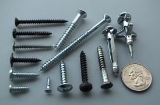
Screw

Encyclopedia
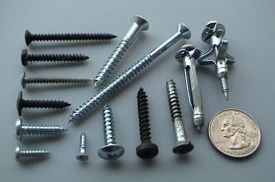
Fastener
A fastener is a hardware device that mechanically joins or affixes two or more objects together.Fasteners can also be used to close a container such as a bag, a box, or an envelope; or they may involve keeping together the sides of an opening of flexible material, attaching a lid to a container,...
characterized by a helical
Helix
A helix is a type of smooth space curve, i.e. a curve in three-dimensional space. It has the property that the tangent line at any point makes a constant angle with a fixed line called the axis. Examples of helixes are coil springs and the handrails of spiral staircases. A "filled-in" helix – for...
ridge, known as an external thread or just thread
Screw thread
A screw thread, often shortened to thread, is a helical structure used to convert between rotational and linear movement or force. A screw thread is a ridge wrapped around a cylinder or cone in the form of a helix, with the former being called a straight thread and the latter called a tapered thread...
, wrapped around a cylinder. Some screw threads are designed to mate with a complementary thread, known as an internal thread, often in the form of a nut
Nut (hardware)
A nut is a type of hardware fastener with a threaded hole. Nuts are almost always used opposite a mating bolt to fasten a stack of parts together. The two partners are kept together by a combination of their threads' friction, a slight stretch of the bolt, and compression of the parts...
or an object that has the internal thread formed into it. Other screw threads are designed to cut a helical groove in a softer material as the screw is inserted. The most common uses of screws are to hold objects together and to position objects.
Often screws have a head, which is a specially formed section on one end of the screw that allows it to be turned, or driven. Common tools for driving screws include screwdriver
Screwdriver
A screwdriver is a tool for driving screws and often rotating other machine elements with the mating drive system. The screwdriver is made up of a head or tip, which engages with a screw, a mechanism to apply torque by rotating the tip, and some way to position and support the screwdriver...
s and wrench
Wrench
A wrench or spanner is a tool used to provide grip and mechanical advantage in applying torque to turn objects—usually rotary fasteners, such as nuts and bolts—or keep them from turning....
es. The head is usually larger than the body of the screw, which keeps the screw from being driven deeper than the length of the screw and to provide a bearing surface
Bearing surface
A bearing surface is a mechanical engineering term that refers to the area of contact between two objects. It usually is used in reference to bolted joints and bearings, but can be applied to a wide variety of engineering applications....
. There are exceptions; for instance, carriage bolts have a domed head that is not designed to be driven; set screw
Set screw
A set screw is a type of screw generally used to secure an object within or against another object. The most common examples are securing a pulley or gear to a shaft. Set screws are most often headless , meaning that the screw is fully threaded and has no head projecting past the major diameter of...
s have a head smaller than the outer diameter of the screw; J-bolts have a J-shaped head which is not designed to be driven, but rather is usually sunk into concrete allowing it to be used as an anchor bolt. The cylindrical portion of the screw from the underside of the head to the tip is known as the shank; it may be fully threaded or partially threaded.
The majority of screws are tightened by clockwise rotation, which is termed a right-hand thread. Screws with left-hand threads are used in exceptional cases. For example, when the screw will be subject to counterclockwise torque (which would work to undo a right-hand thread), a left-hand-threaded screw would be an appropriate choice. The left side pedal of a bicycle
Bicycle
A bicycle, also known as a bike, pushbike or cycle, is a human-powered, pedal-driven, single-track vehicle, having two wheels attached to a frame, one behind the other. A person who rides a bicycle is called a cyclist, or bicyclist....
has a left-hand thread.
Differentiation between bolt and screw
.png)
Machinery's Handbook
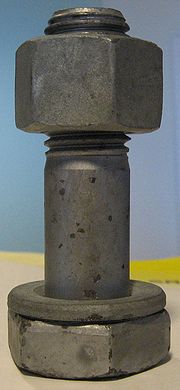
Machinery's Handbook for machine shop and drafting-room; a reference book on machine design and shop practice for the mechanical engineer, draftsman, toolmaker, and machinist is a classic reference work in mechanical engineering and practical workshop mechanics in one volume published by...
describes the distinction as follows:
This distinction is consistent with ASME B18.2.1 and some dictionary definitions for screw and bolt.
The issue of what is a screw and what is a bolt is not completely resolved with Machinery's Handbook distinction, however, because of confounding terms, the ambiguous nature of some parts of the distinction, and usage variations. Some of these issues are discussed below:
Machine screws
ASME standards specify a variety of "Machine Screws" in diameters ranging up to 0.75 in (19.05 mm). These fasteners are often used with nuts as well as often driven into tapped holes. They might be considered a screw or a bolt based on the Machinery's Handbook distinction. In practice, they tend to be mostly available in smaller sizes and the smaller sizes are referred to as screws or less ambiguously as machine screws, although some kinds of machine screws can be referred to as stove bolts.Hex cap screws
ASME standard B18.2.1 -1996 specifies Hex Cap Screws that range in size from 0.25 – in diameterDiameter
In geometry, a diameter of a circle is any straight line segment that passes through the center of the circle and whose endpoints are on the circle. The diameters are the longest chords of the circle...
. These fasteners are very similar to hex bolts. They differ mostly in that they are manufactured to tighter tolerances than the corresponding bolts. The Machinery's Handbook refers parenthetically to these fasteners as "Finished Hex Bolts". Reasonably, these fasteners might be referred to as bolts but based on the US government document, Distinguishing Bolts from Screws, the US government might classify them as screws because of the tighter tolerance. In 1991 responding to an influx of counterfeit fasteners Congress passed PL 101-592 "Fastener Quality Act" This resulted in the rewriting of specifications by the ASME B18 committee. B18.2.1 was re-written and as a result they eliminated the "Finished Hex Bolts" and renamed them the "Hex Cap Screw"—a term that had existed in common usage long before, but was now also being codified as an official name for the ASME B18 standard.
Lug bolts & head bolts
These terms refer to fasteners that are designed to be threaded into a tapped hole that is in part of the assembly and so based on the Machinery's Handbook distinction they would be screws. Here common terms are at variance with Machinery's Handbook distinction.Lag bolt
Lag bolts, also called lag screws, are basically "large wood screws". A typical lag bolt is a 150 mm long, 13 mm diameter screw (6-inch-long, half-inch-diameter screw) with coarse threads of a wood-screw or sheet-metal-screw threadform (but larger). The head is typically an external hex. The materials are usually carbon steel substrate with a coating of zinc galvanizationGalvanization
Galvanization is the process of applying a protective zinc coating to steel or iron, in order to prevent rusting. The term is derived from the name of Italian scientist Luigi Galvani....
(for corrosion resistance). The zinc coating may be bright (electroplated), yellow (electroplated), or dull gray hot-dip galvanized
Hot-dip galvanizing
Hot-dip galvanizing is a form of galvanization. It is the process of coating iron, steel, or aluminum with a thin zinc layer, by passing the metal through a molten bath of zinc at a temperature of around 860 °F...
. Lag bolts are used to lag together lumber framing, to lag machinery feet to wood floors, and other heavy carpentry applications. These fasteners are clearly "screws" when defined by the Machinery's Handbook distinction. The term "lag bolt" has been replaced by "lag screw" in the Machinery's Handbook. However, in the minds of most tradesmen, they are "bolts", simply because they are large, with external-hex heads.
Government standards
The US government made an effort to formalize the difference between a bolt and a screw because different tariffs apply to each. The document seems to have no significant effect on common usage and does not eliminate the ambiguous nature of the distinction between screws and bolts for some threaded fasteners. The document also reflects (although it probably did not originate) significant confusion of terminology usage that differs between the legal/statutory/regulatory community and the fastener industry. The legal/statutory/regulatory wording uses the terms "coarse" and "fine" to refer to the tightness of the tolerance range, referring basically to "high-quality" or "low-quality", but this is a poor choice of terms, because those terms in the fastener industry have a different meaning (referring to the steepness of the helix's lead).Historical issue
Old USS and SAE standards defined cap screws as fasteners with shanks that were threaded to the head and bolts as fasteners with shanks that were partially unthreaded. This is now an obsolete distinction.Controlled vocabulary versus natural language
The distinctions delineated above are enforced in the controlled vocabularyControlled vocabulary
Controlled vocabularies provide a way to organize knowledge for subsequent retrieval. They are used in subject indexing schemes, subject headings, thesauri, taxonomies and other form of knowledge organization systems...
of standards organization
Standards organization
A standards organization, standards body, standards developing organization , or standards setting organization is any organization whose primary activities are developing, coordinating, promulgating, revising, amending, reissuing, interpreting, or otherwise producing technical standards that are...
s. Nevertheless, there are sometimes differences between the controlled vocabulary and the natural language
Natural language
In the philosophy of language, a natural language is any language which arises in an unpremeditated fashion as the result of the innate facility for language possessed by the human intellect. A natural language is typically used for communication, and may be spoken, signed, or written...
usage of the words among machinists, auto mechanics, and other workers. These differences reflect linguistic evolution shaped by the changing of technology over centuries
History of technology
The history of technology is the history of the invention of tools and techniques, and is similar in many ways to the history of humanity. Background knowledge has enabled people to create new things, and conversely, many scientific endeavors have become possible through technologies which assist...
. The words bolt and screw have both existed since before today's modern mix of fastener types existed, and the natural usage of those words has evolved retronym
Retronym
A retronym is a type of neologism that provides a new name for an object or concept to differentiate the original form or version of it from a more recent form or version. The original name is most often augmented with an adjective to account for later developments of the object or concept itself...
ously in response to the technological change. (That is, the use of words as names for objects changes as the objects themselves change.) Nonthreaded fasteners predominated in fastening technology until the advent of practical, inexpensive screw-cutting in the early 19th century. The basic meaning of the word screw has long involved the idea of a helical screw thread, but the Archimedes screw and the screw gimlet (like a corkscrew) preceded the fastener.
The word bolt is also a very old word, and it was used for centuries to refer to metal rods that passed through the substrate to be fastened on the other side, often via nonthreaded means (clinching, forge welding, pinning, wedging, etc.). The connection of this sense to the sense of a door bolt or the crossbow
Crossbow
A crossbow is a weapon consisting of a bow mounted on a stock that shoots projectiles, often called bolts or quarrels. The medieval crossbow was called by many names, most of which derived from the word ballista, a torsion engine resembling a crossbow in appearance.Historically, crossbows played a...
bolt is apparent. In the 19th century, bolts fastened via screw threads were often called screw bolts in contradistinction to clench bolts.
In common usage, the distinction is often that screws are smaller than bolts, and that screws are generally tapered and bolts are not. (This distinction is not rigorous.) For example, cylinder head
Cylinder head
In an internal combustion engine, the cylinder head sits above the cylinders on top of the cylinder block. It closes in the top of the cylinder, forming the combustion chamber. This joint is sealed by a head gasket...
bolts are called "bolts" (at least in North American usage) despite the fact that by some definitions they ought to be called "screws". Their size and their similarity to a bolt that would take a nut seem linguistically to overrule any other factors in this natural
Natural language
In the philosophy of language, a natural language is any language which arises in an unpremeditated fashion as the result of the innate facility for language possessed by the human intellect. A natural language is typically used for communication, and may be spoken, signed, or written...
word choice proclivity.
Other distinctions: Bolts have been defined as headed fasteners having external threads that meet an exacting, uniform bolt thread specification (such as ISO metric screw thread
ISO metric screw thread
The ISO metric screw threads are the world-wide most commonly used type of general-purpose screw thread. They were one of the first international standards agreed when the International Organization for Standardization was set up in 1947.-Basic profile:...
M, MJ, Unified Thread Standard
Unified Thread Standard
The Unified Thread Standard defines a standard thread form and series—along with allowances, tolerances, and designations—for screw threads commonly used in the United States and Canada...
UN, UNR, and UNJ) such that they can accept a nontapered nut. Screws are then defined as headed, externally threaded fasteners that do not meet the above definition of bolts. These definitions of screw and bolt eliminate the ambiguity of the Machinery's handbook distinction. And it is for that reason, perhaps, that some people favor them. However, they are neither compliant with common usage of the two words nor are they compliant with formal specifications.
Types of screws and bolts
Threaded fasteners either have a tapered shank or a non-tapered shank. Fasteners with tapered shanks are designed to either be driven into a substrate directly or into a pilot hole in a substrate. Mating threads are formed in the substrate as these fasteners are driven in. Fasteners with a non-tapered shank are designed to mate with a nut or to be driven into a tapped hole.Fasteners with a tapered shank (self-threading screws)
| | American name | | British name | | Description | |
|---|---|---|---|
| chipboard screw particle board screw |
Similar to a drywall screw except that it has a thinner shaft and provides better resistance to pull-out in particle board, while offset against a lower shear strength. The threads on particle board screws are asymmetrical. | ||
| Tapcons masonry screw confast screw blue screw self-tapping screw Titen |
A stainless or carbon steel screw for fastening wood, metal, or other materials into concrete or masonry. Concrete screws are commonly blue in color, with or without corrosion coating. They may either have a Phillips flat head or a slotted hex washer head. Heads sizes range from 0.1875 to 0.375 in (4.8 to 9.5 mm) and lengths from 1.25 to 5 in (31.8 to 127 mm). Typically an installer uses a hammer drill Hammer drill A hammer drill, also known as a "Hammer drill", "roto-drill" or "hammering drill", is a rotary drill with a hammering action. The hammering action provides a short, rapid hammer thrust to pulverize relatively brittle material and provide quicker drilling with less effort... to make a pilot hole for each concrete screw. |
||
| deck screw | Similar to drywall screw except that it has improved corrosion resistance and is generally supplied in a larger gauge. Most deck screws have a type-17 (auger type) thread cutting tip for installation into decking materials. | ||
| double ended screw dowel screw hanger bolt |
Similar to a wood screw but with two pointed ends and no head, used for making hidden joints between two pieces of wood. A hanger bolt has wood screw threads on one end and machine threads on the other. A hanger bolt is used when it is necessary to fasten a metal part to a wood surface. |
||
| drywall screw | Specialized screw with a bugle head that is designed to attach drywall to wood or metal studs, however it is a versatile construction fastener with many uses. The diameter of drywall screw threads is larger than the shaft diameter. | ||
 |
eye screw screw eye |
Screw with a looped head. Larger ones are sometimes called lag eye screws. Designed to be used as attachment point, particularly for something that is hung from it. | |
| lag bolt lag screw |
coach screw | Similar to a wood screw except that it is generally much larger running to lengths up to 15 in (381 mm) with diameters from 0.25 – in commonly available (hardware store) sizes (not counting larger mining and civil engineering lags and lag bolts) and it generally has a hexagonal drive head. Lag bolts are designed for securely fastening heavy timbers (post and beams, timber railway trestles and bridges) to one another, or to fasten wood to masonry or concrete. Lag bolts are usually used with an expanding insert called a lag in masonry or concrete walls, the lag manufactured with a hard metal jacket that bites into the sides of the drilled hole, and the inner metal in the lag being a softer alloy of lead, or zinc alloyed with soft iron. The coarse thread of a lag bolt and lag mesh and deform slightly making a secure near water tight anti-corroding mechanically strong fastening. |
|
| mirror screw | This is a flat-head wood screw with a tapped hole in the head, which receives a screw-in chrome-plated cover. It is usually used to mount a mirror. | ||
| Has sharp threads that cut into a material such as sheet metal, plastic or wood. They are sometimes notched at the tip to aid in chip removal during thread cutting. The shank is usually threaded up to the head. Sheet metal screws make excellent fasteners for attaching metal hardware to wood because the fully threaded shank provides good retention in wood. | |||
| Twinfast screw | A Twinfast screw is a type of screw with two threads (i.e. a lead Lead (engineering) Lead is the axial advance of a helix or screw during one complete turn The lead for a screw thread is the axial travel for a single revolution.... of 2), so that it can be driven twice as fast. Dry wall screws designated as fine are the most common screws to use the twinfast style of threads. |
||
| wood screw | A metal screw with a sharp point designed to attach two pieces of wood together. Wood screws are commonly available with flat, pan or oval-heads. A wood screw generally has a partially unthreaded shank below the head. The unthreaded portion of the shank is designed to slide through the top board (closest to the screw head) so that it can be pulled tight to the board it is being attached to. | ||
| Security head screw | These screws are use for security purpose. The head of these screw is impossible to reverse. It requires special tool or mechanism to operate like spanner,tri-wing,torx,square driver etc. In some screw, the head can be removed out by breaking it after installing the screw. |
Fasteners with a non-tapered shank
| | American name | | British name | | Description | |
|---|---|---|---|
| anchor bolt | A special type of screw that is set in wet concrete, with the screw threads protruding above the concrete surface. | ||
| breakaway bolt | A breakaway bolt is a bolt with a hollow threaded shank, which is designed to break away upon impact. Typically used to fasten fire hydrants, so they will break away when hit by a car. Also used in aircraft to reduce weight. | ||
| The term cap screw refers to many different things at different times and places. Currently, it most narrowly refers to a style of head (see the gallery below). More broadly, and more commonly, it refers to the group of screws: shoulder screws, hex heads, counter-sunk heads, button heads, and fillister heads. In the US, cap screws are defined by ASME B18.6.2 and ASME B18.3. In the past, the term cap screw, in general, referred to screws that were supposed to be used in applications where a nut was not used, however the characteristics that differentiated it from a bolt vary over time. In 1910, Anthony defined it as screw with a hex head that was thicker than a bolt head, but the distance across the flats was less than a bolt's. In 1913, Woolley and Meredith defined them like Anthony, but gave the following dimensions: hex head cap screws up to and including 7/16 in have a head that is 3/16 in larger than the shank diameter; screws greater than 1/2 in in diameter have a head that is 1/4 in larger than the shank. Square head cap screws up to and including 3/4 in have a head 1/8 in larger than the shank; screws larger than 3/4 in have a head 1/4 in larger than the shank. In 1919, Dyke defined them as screws that are threaded all the way to the head. A socket cap screw, also known as a socket head capscrew, socket screw or Allen bolt, is a type of cap screw with a cylindrical head and hexagonal drive hole. The term socket head capscrew typically refers to a type of threaded fastener whose head diameter is nominally Real versus nominal value In economics, nominal value refers to a value expressed in money terms in a given year or series of years. By contrast, real value adjusts nominal value to remove effects of price changes over time... 1.5 times that of the screw shank (major) diameter, with a head height equal to the shank diameter (1960 series design). Forged Forging Forging is a manufacturing process involving the shaping of metal using localized compressive forces. Forging is often classified according to the temperature at which it is performed: '"cold," "warm," or "hot" forging. Forged parts can range in weight from less than a kilogram to 580 metric tons... heat-treated alloy Alloy An alloy is a mixture or metallic solid solution composed of two or more elements. Complete solid solution alloys give single solid phase microstructure, while partial solutions give two or more phases that may or may not be homogeneous in distribution, depending on thermal history... examples are high strength fasteners intended for the most demanding mechanical applications, with special alloy formulations available that are capable of maintaining strength at temperatures in excess of 1000 degrees F (587 degrees C). In addition to the 1960 series design, other head designs include low head, button head and flat head, the latter designed to be seated into countersunk Countersink A countersink is a conical hole cut into a manufactured object, or the cutter used to cut such a hole. A common usage is to allow the head of a countersunk bolt or screw, when placed in the hole, to sit flush with or below the surface of the surrounding material... holes. A hex key Hex key A hex key, Allen key, or Allen wrench is a tool of hexagonal cross-section used to drive bolts and screws that have a hexagonal socket in the head .- Nomenclature :... (sometimes referred to as an Allen wrench or Allen key) or hex driver is required to tighten or loosen a socket screw. Socket head capscrews are commonly used in assemblies that do not provide sufficient clearance for a conventional wrench or socket Socket wrench A socket wrench is a wrench with interchangeable heads called sockets that attach to a fitting on the wrench, allowing it to turn different sized bolts and other fasteners. The most common form is a hand tool popularly called a ratchet consisting of a handle with a ratcheting mechanism built in,... . |
|||
| carriage bolt | A carriage bolt, also known as a coach bolt, has a domed or countersunk head, and the shank is topped by a short square section under the head. The square section grips into the part being fixed (typically wood), preventing the bolt from turning when the nut is tightened. A rib neck carriage bolt has several longitudinal ribs instead of the square section, to grip into a metal part being fixed. | ||
| elevator bolt | An elevator bolt is a bolt similar to a carriage bolt, except the head is thin and flat. There are many variations. Some do not have a square base, but rather triangular sections of the flat head are folded down to form "fangs" that cut into wood and hold it secure. | ||
| eye bolt | An eye bolt is a bolt with a looped head. | ||
| hex cap screw hex bolt |
A hex cap screw is a cap screw with a hexagonal head, designed to be driven by a wrench (spanner). An ASME B18.2.1 compliant cap screw has somewhat tighter tolerances than a hex bolt for the head height and the shank length. The nature of the tolerance difference allows an ASME B18.2.1 hex cap screw to always fit where a hex bolt is installed but a hex bolt could be slightly too large to be used where a hex cap screw is designed in. | ||
| machine screw | A machine screw is generally a smaller fastener (less than 1/4 in in diameter) threaded the entire length of its shank that usually has a recessed drive type (slotted, Phillips, etc.). Machine screws are also made with socket heads (see above), in which case they may be referred to as socket head machine screws. | ||
| plow bolt | A plow bolt is bolt similar to a carriage bolt, except the head is flat or concave, and the underside of the head is a cone designed to fit in a countersunk recess. There are many variations, with some not using a square base, but rather a key, a locking slot, or other means. The recess in the mating part must be designed to accept the particular plow bolt. | ||
| self-drilling screw Teks screw |
Similar to a sheet metal screw, but it has a drill-shaped point to cut through the substrate to eliminate the need for drilling a pilot hole. Designed for use in soft steel or other metals. The points are numbered from 1 through 5, the larger the number, the thicker metal it can go through without a pilot hole. A 5 point can drill a 0.5 in (12.7 mm) of steel, for example. | ||
| self-tapping machine screw | A self-tapping machine screw is similar to a machine screw except the lower part of the shank is designed to cut threads as the screw is driven into an untapped hole. The advantage of this screw type over a self-tapping screw is that, if the screw is reinstalled, new threads are not cut as the screw is driven. | ||
| set bolt | tap bolt | A bolt that is threaded all the way to the head. An ASME B18.2.1 compliant set/tap bolt has the same tolerances as an ASME B18.2.1 compliant hex cap screw. | |
| set screw Set screw A set screw is a type of screw generally used to secure an object within or against another object. The most common examples are securing a pulley or gear to a shaft. Set screws are most often headless , meaning that the screw is fully threaded and has no head projecting past the major diameter of... |
grub screw | A set screw is generally a headless screw but can be any screw used to fix a rotating part to a shaft. The set screw is driven through a threaded hole in the rotating part until it is tight against the shaft. The most often used type is the socket set screw, which is tightened or loosened with a hex key. | |
| shoulder bolt shoulder screw |
stripper bolt | A shoulder screw differs from machine screws in that the shank is ground Grinding (abrasive cutting) Grinding is an abrasive machining process that uses a grinding wheel as the cutting tool.A wide variety of machines are used for grinding:* Hand-cranked knife-sharpening stones * Handheld power tools such as angle grinders and die grinders... to a precise diameter, known as the shoulder, and the threaded portion is smaller in diameter than the shoulder. Shoulder bolt specifications call out the shoulder diameter, shoulder length, and threaded diameter; the threaded length is fixed, based on the threaded diameter, and usually quite short. As a rule, socket head shoulder screws are produced from alloy Alloy An alloy is a mixture or metallic solid solution composed of two or more elements. Complete solid solution alloys give single solid phase microstructure, while partial solutions give two or more phases that may or may not be homogeneous in distribution, depending on thermal history... heat-treated steel Steel Steel is an alloy that consists mostly of iron and has a carbon content between 0.2% and 2.1% by weight, depending on the grade. Carbon is the most common alloying material for iron, but various other alloying elements are used, such as manganese, chromium, vanadium, and tungsten... for maximum strength and wear resistance. Common applications for shoulder screws include rotating mechanism joints Mechanism (engineering) A mechanism is a device designed to transform input forces and movement into a desired set of output forces and movement. Mechanisms generally consist of moving components such as gears and gear trains, belt and chain drives, cam and follower mechanisms, and linkages as well as friction devices... , linkage pivots Linkage (mechanical) A mechanical linkage is an assembly of bodies connected together to manage forces and movement. The movement of a body, or link, is studied using geometry so the link is considered to be rigid. The connections between links are modeled as providing ideal movement, pure rotation or sliding for... , and guides for the stripper plate of a metal forming die Die (manufacturing) A die is a specialized tool used in manufacturing industries to cut or shape material using a press. Like molds, dies are generally customized to the item they are used to create... set. In the latter application, the term stripper bolt is often substituted. |
|
| stove bolt | A stove bolt is a type of machine screw that has a round or flat head and is threaded to the head. They are usually made of low grade steel, have a slot or Phillips drive, and are used to join sheet metal parts using a hex or square nut. | ||
| tension control bolt | A tension control bolt (TC bolt) is a heavy duty bolt used in steel frame construction. The head is usually domed and is not designed to be driven. The end of the shank has a spline on it which is engaged by a special power wrench which prevents the bolt from turning while the nut is tightened. When the appropriate torque is reached the spline shears off. | ||
| thread rolling screws | These have a lobed (usually triangular) cross-section. They form threads in a pre-drilled hole in the mating workpiece by pushing the material outward during installation. |
Superbolt, or multi-jackbolt tensioner
A superbolt, or multi-jackbolt tensionerMulti-jackbolt tensioner
Multi-jackbolt tensioners provide an alternative to traditional bolted joints Rather than needing to tighten one large bolt, MJTs use several smaller jackbolts to drastically reduce the torque required to attain a certain preload. MJTs range in thread sizes from 3/4” to 32” and can achieve up to...
is an alternative type of fastener that retrofits or replaces existing nuts, bolts, or studs. Tension in the bolt is developed by torquing individual jackbolts, which are threaded through the body of the nut and push against a hardened washer. Because of this, the amount of torque required to achieve a given preload is reduced. Installation and removal of any size tensioner is achieved with hand tools, which can be advantageous when dealing with large diameter bolting applications.
Hanger screw or hanger bolt
A hanger screw is a headless fastener that has machine screw threads on one end and self-tapping threads on the other designed to be driven into wood or another soft substrate. Often used for mounting legs to tables.Materials
Screws and bolts may be made from a wide range of materials, with steelSteel
Steel is an alloy that consists mostly of iron and has a carbon content between 0.2% and 2.1% by weight, depending on the grade. Carbon is the most common alloying material for iron, but various other alloying elements are used, such as manganese, chromium, vanadium, and tungsten...
being perhaps the most common, in many varieties. Where great resistance to weather or corrosion is required, stainless steel, titanium
Titanium
Titanium is a chemical element with the symbol Ti and atomic number 22. It has a low density and is a strong, lustrous, corrosion-resistant transition metal with a silver color....
, brass
Brass
Brass is an alloy of copper and zinc; the proportions of zinc and copper can be varied to create a range of brasses with varying properties.In comparison, bronze is principally an alloy of copper and tin...
(steel screws can discolor oak and other woods), bronze
Bronze
Bronze is a metal alloy consisting primarily of copper, usually with tin as the main additive. It is hard and brittle, and it was particularly significant in antiquity, so much so that the Bronze Age was named after the metal...
, monel or silicon bronze may be used. Galvanic corrosion of dissimilar metals can be prevented (using aluminium
Aluminium
Aluminium or aluminum is a silvery white member of the boron group of chemical elements. It has the symbol Al, and its atomic number is 13. It is not soluble in water under normal circumstances....
screws for double-glazing tracks for example) by a careful choice of material. Some types of plastic, such as nylon
Nylon
Nylon is a generic designation for a family of synthetic polymers known generically as polyamides, first produced on February 28, 1935, by Wallace Carothers at DuPont's research facility at the DuPont Experimental Station...
or polytetrafluoroethylene
Polytetrafluoroethylene
Polytetrafluoroethylene is a synthetic fluoropolymer of tetrafluoroethylene that finds numerous applications. PTFE is most well known by the DuPont brand name Teflon....
(PTFE), can be threaded and used for fastenings requiring moderate strength and great resistance to corrosion or for the purpose of electrical insulation
Electrical insulation
thumb|250px|[[Coaxial Cable]] with dielectric insulator supporting a central coreThis article refers to electrical insulation. For insulation of heat, see Thermal insulation...
. Often a surface coating is used to protect the fastening from corrosion (eg Bright Zinz Plating for steel screws), to impart a decorative finish (eg jappaning) or otherwise alter the properties of the base material. Selection criteria of the screw materials include temperature, required strength, resistance to corrosion, joint material and cost.
Bolted joints
American Institute of Steel Construction
The American Institute of Steel Construction, often abbreviated AISC, is a not-for-profit technical institute and trade association for the use of structural steel in the construction industry of the United States. It is headquartered in Chicago, IL. Their mission is to make structural steel the...
(AISC) 13th Edition Steel Design Manual section 16.1 chapter J-3 specifies the requirements for bolted structural connections. Structural bolts replaced rivets due to decreasing cost and increasing strength of structural bolts in the 20th century. Connections are formed with two types of joints: slip-critical connections and bearing connections. In slip-critical connections, movement of the connected parts is a serviceability condition and bolts are tightened to a minimum required pretension. Slip is prevented through friction of the "faying" surface, that is the plane of shear for the bolt and where two members make contact. Because friction is proportional to the normal force, connections must be sized with bolts numerous and large enough to provide the required load capacity. However, this greatly decreases the shear capacity of each bolt in the connection. The second type and more common connection is a bearing connection. In this type of connection the bolts carry the load through shear and are only tightened to a "snug-fit." These connections require fewer bolts than slip-critical connections and therefore are a less expensive alternative. Slip-critical connections are more common on flange plates for beam and column splices and moment critical connections. Bearing type connections are used in light weight structures and in member connections where slip is not important and prevention of structural failure is the design constraint. Common bearing type connections include: shear tabs, beam supports, gusset plates in trusses.
Mechanical classifications
The numbers stamped on the head of the bolt are referred to the grade of the bolt used in certain application with the strength of a bolt. High-strength steel bolts usually have a hexagonal head with an ISOInternational Organization for Standardization
The International Organization for Standardization , widely known as ISO, is an international standard-setting body composed of representatives from various national standards organizations. Founded on February 23, 1947, the organization promulgates worldwide proprietary, industrial and commercial...
strength rating (called property class) stamped on the head. And the absence of marking/number indicates a lower grade bolt with low strength. The property classes most often used are 5.8, 8.8, and 10.9. The number before the point is the tensile ultimate strength
Tensile strength
Ultimate tensile strength , often shortened to tensile strength or ultimate strength, is the maximum stress that a material can withstand while being stretched or pulled before necking, which is when the specimen's cross-section starts to significantly contract...
in MPa divided by 100. The number after the point is 10 times the ratio of tensile yield strength to tensile ultimate strength. For example, a property class 5.8 bolt has a nominal (minimum) tensile ultimate strength of 500 MPa, and a tensile yield strength of 0.8 times tensile ultimate strength or 0.8(500) = 400 MPa.
Tensile ultimate strength is the stress at which the bolt fails. Tensile yield strength is the stress at which the bolt will receive a permanent set (an elongation from which it will not recover when the force is removed) of 0.2 % offset strain. When elongating a fastener prior to reaching the yield point, the fastener is said to be operating in the elastic region; whereas elongation beyond the yield point is referred to as operating in the plastic region, since the fastener has suffered permanent plastic deformation.
Mild steel bolts have property class 4.6. High-strength steel bolts have property class 8.8 or above.
The same type of screw or bolt can be made in many different grades of material. For critical high-tensile-strength applications, low-grade bolts may fail, resulting in damage or injury. On SAE-standard bolts, a distinctive pattern of marking is impressed on the heads to allow inspection and validation of the strength of the bolt. However, low-cost counterfeit
Counterfeit
To counterfeit means to illegally imitate something. Counterfeit products are often produced with the intent to take advantage of the superior value of the imitated product...
fasteners may be found with actual strength far less than indicated by the markings. Such inferior fasteners are a danger to life and property when used in aircraft, automobiles, heavy trucks, and similar critical applications.
Inch
SAE J429 defines the bolt grades for inch-system sized bolts and screws. It defines them by grade, which ranges from 0 to 8, with 8 being the strongest. Higher grades do not exist within the specification. SAE grades 5 and 8 are the most common.| Head markings and properties for inch-system hex-head cap screws | ||||||
|---|---|---|---|---|---|---|
| Head marking | Grade, material, and condition | Nominal size range (in) | Proof strength (ksi/MPa) | Yield strength, min. (ksi/MPa) | Tensile strength, min. (ksi/MPa) | Core hardness (Rockwell Rockwell scale The Rockwell scale is a hardness scale based on the indentation hardness of a material. The Rockwell test determines the hardness by measuring the depth of penetration of an indenter under a large load compared to the penetration made by a preload. There are different scales, denoted by a single... ) |
 |
SAE Grade 0 | Strength and hardness is not specified | ||||
| SAE grade 1 ASTM A307 Low carbon steel |
–1- | 33 ksi | 60 ksi | B70–100 | ||
| ASTM A307 - Grade B Low or medium carbon steel |
–4 | 60 ksi minimum 100 ksi maximum |
B69–95 | |||
| SAE grade 2 Low or medium carbon steel |
– | 55 ksi | 57 ksi | 74 ksi | B80–100 | |
| Greater than | 33 ksi | 36 ksi | 60 ksi | B70–100 | ||
| SAE grade 4 Medium carbon steel; cold worked |
–1- | 100 ksi | 115 ksi | |||
 |
SAE grade 3 Medium carbon steel; cold worked |
–1 | 85 ksi | 100 ksi | B70–100 | |
 |
SAE grade 5 Medium carbon steel; quench and tempered |
–1 (inc.) | 85 ksi | 92 ksi | 120 ksi | C25–34 |
| 1–1- | 74 ksi | 81 ksi | 105 ksi | C19–30 | ||
| ASTM A449 - Type 1 Medium carbon steel; quench and tempered |
1–1- (inc.) | 74 ksi | 105 ksi | C19–30 | ||
| 1-–3 | 55 ksi | 90 ksi | Brinell Brinell scale The Brinell scale characterizes the indentation hardness of materials through the scale of penetration of an indenter, loaded on a material test-piece. It is one of several definitions of hardness in materials science.... 183–235 |
|||
 |
SAE grade 5.1 Low or medium carbon steel; quench and tempered |
No. 6– | 85 ksi | 120 ksi | C25–40 | |
 |
SAE grade 5.2 Low carbon martensitic steel; quench and tempered |
–1 | 85 ksi | 120 ksi | C26–36 | |
| ASTM A449 - Type 2 Low carbon martensitic steel; quench and tempered |
C25–34 | |||||
 or or  |
ASTM A325 ASTM A325 ASTM A325 is an ASTM International standard for heavy hex structural bolts, titled Standard Specification for Structural Bolts, Steel, Heat Treated, 120/105 ksi Minimum Tensile Strength... - Type 1 Medium carbon steel; quench and tempered |
–1 (inc.) | 85 ksi | 92 ksi | 120 ksi | C24–35 |
| 1–1- | 74 ksi | 82 ksi | 105 ksi | C19–31 | ||
 |
ASTM A325 - Type 3 Atmospheric corrosion resistant steel; quench and tempered |
–1 | 85 ksi | 92 ksi | 120 ksi | C24–35 |
| 1–1- | 74 ksi | 82 ksi | 105 ksi | C19–31 | ||
 |
ASTM A354 ASTM A354 ASTM A354 is an ASTM International standard that defines chemical and mechanical properties for alloy steel bolts, screws, studs, and other externally threaded fasteners... - Grade BC Medium carbon alloy steel; quench and tempered |
–2- (inc.) | 105 ksi | 109 ksi | 125 ksi | C26–36 |
| 2-–4 | 95 ksi | 99 ksi | 115 ksi | C22–33 | ||
 |
SAE grade 7 Medium carbon alloy steel; quench and tempered |
–1- | 105 ksi | 115 ksi | 133 ksi | |
 |
SAE grade 8 Medium carbon alloy steel; quench and tempered |
–1- | 120 ksi | 130 ksi | 150 ksi | C32–38 |
 |
ASTM A354 - Grade BD | –2- (inc.) | 120 ksi | 130 ksi | 150 ksi | C33–39 |
 |
2-–4 | 105 ksi | 115 ksi | 140 ksi | C31–39 | |
 |
SAE grade 8.2 Medium carbon boron martensitic steel; fully kilned, fine grain, quench and tempered |
–1 | 120 ksi | 150 ksi | C33–39 | |
 |
ASTM A490 ASTM A490 ASTM A490 and ASTM A490M are ASTM International standards for heavy hex structural bolts made from alloy steel. The imperial standard is officially titled Standard Specification for Structural Bolts, Alloy Steel, Heat Treated, 150 ksi Minimum Tensile Strength, while the metric standard is titled... - Type 1 Medium carbon alloy steel; quench and tempered |
–1- | 120 ksi | 130 ksi | 150 ksi minimum 170 ksi maximum |
C33–38 |
 |
ASTM A490 - Type 3 Atmospheric corrosion resistant steel; quench and tempered |
|||||
| 18-8 Stainless Stainless steel with 17–19% chromium and 8–13% nickel |
– (inc.) | 40 ksi minimum 80 ksi – 90 ksi typical |
100 ksi – 125 ksi typical | |||
| –1 (inc.) | 40 ksi minimum 45 ksi – 70 ksi typical |
100 ksi typical | ||||
| Over 1 | 80 ksi – 90 ksi typical | |||||
Metric
The international standard for metric screws is defined by ISO 898ISO 898
ISO 898 is an international standard that defines mechanical and physical properties for metric fasteners. This standard is the origin for other standards that define properties for similar metric fasteners, such as SAE J1199 and ASTM F568M. It is divided into five parts:1...
, specifically ISO 898-1. SAE J1199 and ASTM F568M
ASTM F568M
ASTM F568M is an ASTM International standard for metric bolts, screws and studs that are used in general engineering applications. It is officially titled: Standard Specification for Carbon and Alloy Steel Externally Threaded Metric Fasteners...
are two North American metric standards that closely mimic the ISO standard. In case of inch sizes the grade is dictated by the number of radial shapes plus a value of two. Inch-system bolts use integer values to indicate grades but metric bolts use numbers with one decimal. The two North American standards use the same property class markings as defined by ISO 898. The ASTM standard only includes the following property classes from the ISO standard: 4.6, 4.8, 5.8, 8.8, 9.8, 10.9, and 12.9; it also includes two extra property classes: 8.8.3 and 10.9.3. ASTM property classes are to be stamped on the top of screws and it is preferred that the marking is raised.
| Head markings and properties for metric hex-head cap screws | ||||||
|---|---|---|---|---|---|---|
| Head marking | Grade, material, and condition | Nominal size range (mm) | Proof strength (MPa/ksi) | Yield strength, min. (MPa/ksi) | Tensile strength, min. (MPa/ksi) | Core hardness (Rockwell Rockwell scale The Rockwell scale is a hardness scale based on the indentation hardness of a material. The Rockwell test determines the hardness by measuring the depth of penetration of an indenter under a large load compared to the penetration made by a preload. There are different scales, denoted by a single... ) |
 |
Class 3.6 | 1.6–36 | 180 megapascal | 190 megapascal | 330 megapascal | B52–95 |
 |
Class 4.6 Low or medium carbon steel |
5–100 | 225 megapascal | 240 megapascal | 400 megapascal | B67–95 |
 |
Class 4.8 Low or medium carbon steel; fully or partially annealed |
1.6–16 | 310 megapascal | 340 megapascal | 420 megapascal | B71–95 |
 |
Class 5.8 Low or medium carbon steel; cold worked |
5–24 | 380 megapascal | 420 megapascal | 520 megapascal | B82–95 |
 |
Class 8.8 Medium carbon steel; quench and tempered |
Under 16 (inc.) | 580 megapascal | 640 megapascal | 800 megapascal | |
| 17–72 | 600 megapascal | 660 megapascal | 830 megapascal | C23–34 | ||
 |
Class 8.8 low carbon Low carbon boron steel; quench and tempered |
|||||
 |
Class 8.8.3 Atmospheric corrosion resistant steel; quench and tempered |
|||||
 |
ASTM A325M - Type 1 Medium carbon steel; quench and tempered |
12–36 | ||||
 |
ASTM A325M - Type 3 Atmospheric corrosion resistant steel; quench and tempered |
|||||
 |
Class 9.8 Medium carbon steel; quench and tempered |
1.6–16 | 650 megapascal | 720 megapascal | 900 megapascal | C27–36 |
 |
Class 9.8 low carbon Low carbon boron steel; quench and tempered |
|||||
 |
Class 10.9 Alloy steel; quench and tempered |
5–100 | 830 megapascal | 940 megapascal | 1040 megapascal | C33–39 |
 |
Class 10.9 low carbon Low carbon boron steel; quench and tempered |
|||||
 |
Class 10.9.3 Atmospheric corrosion resistant steel; quench and tempered |
|||||
 |
ASTM A490M - Type 1 Alloy steel; quench and tempered |
12–36 | ||||
 |
ASTM A490M - Type 3 Atmospheric corrosion resistant steel; quench and tempered |
|||||
 |
Class 12.9 Alloy steel; quench and tempered |
1.6–100 | 970 megapascal | 1100 megapascal | 1220 megapascal | C38–44 |
 |
A2 Stainless steel with 17–19% chromium and 8–13% nickel |
Up to 20 | 210 megapascal minimum 450 megapascal typical |
500 megapascal minimum 700 megapascal typical |
||
| ISO 3506-1 A2-50 304 stainless steel-class 50 (annealed) |
210 megapascal | 500 megapascal | ||||
| ISO 3506-1 A2-70 304 stainless steel-class 70 (cold worked) |
450 megapascal | 700 megapascal | ||||
| ISO 3506-1 A2-80 304 stainless steel-class 80 |
600 megapascal | 800 megapascal |
Screw head shapes

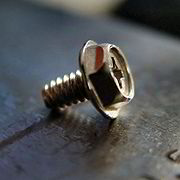
Chamfer
A chamfer is a beveled edge connecting two surfaces. If the surfaces are at right angles, the chamfer will typically be symmetrical at 45 degrees. A fillet is the rounding off of an interior corner. A rounding of an exterior corner is called a "round" or a "radius"."Chamfer" is a term commonly...
ed outer edge
Button or : Cylindrical with a rounded top
: A dome-shaped head used for decoration.
Mushroom or : Lower-profile dome designed to prevent tampering
Countersunk or : Conical, with flat outer face and tapering inner face allowing it to sink into the material. The angle of the screw is measured as the full angle of the cone.
Oval or : A decorative screw head with a countersunk bottom and rounded top. Also known as "raised countersunk" (UK)
: Similar to countersunk, but there is a smooth progression from the shank to the angle of the head, similar to the bell of a bugle
Bugle (instrument)
The bugle is one of the simplest brass instruments, having no valves or other pitch-altering devices. All pitch control is done by varying the player's embouchure, since the bugle has no other mechanism for controlling pitch. Consequently, the bugle is limited to notes within the harmonic series...
: Disc with cylindrical outer edge, height approximately half the head diameter
: Cylindrical, but with a slightly convex top surface. Height to diameter ratio is larger than cheese head.
: A flanged head can be any of the above head styles with the addition of an integrated flange at the base of the head. This eliminates the need for a flat washer.
Some varieties of screw are manufactured with a break-away head, which snaps off when adequate torque is applied. This prevents tampering and also provides an easily inspectable joint to guarantee proper assembly. An example of this is the shear bolts used on vehicle steering column
Steering column
The automotive steering column is a device intended primarily for connecting the steering wheel to the steering mechanism or transferring the driver's input torque from the steering wheel.-Secondary functions:...
s, to secure the ignition switch
Ignition switch
An Ignition switch is a switch in the control system of an internal combustion engined vehicle that activates the main electrical systems for the vehicle...
.
s
Modern screws employ a wide variety of drive designs, each requiring a different kind of tool to drive in or extract them. The most common screw drives are the slotted and Phillips; hex, Robertson, and torx are also common in some applications. Some types of drive are intended for automatic assembly in mass-production of such items as automobiles. More exotic screw drive types may be used in situations where tampering is undesirable, such as in electronic appliances that should not be serviced by the home repair person.Tools
The hand tool used to drive in most screws is called a screwdriver. A power tool that does the same job is a power screwdriver; power drills may also be used with screw-driving attachments. Where the holding power of the screwed joint is critical, torque-measuring and torque-limiting screwdrivers are used to ensure sufficient but not excessive force is developed by the screw. The hand tool for driving hex head threaded fasteners is a spanner (UK usage) or wrench (US usage).Thread standards
There are many systems for specifying the dimensions of screws, but in much of the world the ISO metric screw threadISO metric screw thread
The ISO metric screw threads are the world-wide most commonly used type of general-purpose screw thread. They were one of the first international standards agreed when the International Organization for Standardization was set up in 1947.-Basic profile:...
preferred series has displaced the many older systems. Other relatively common systems include the British Standard Whitworth
British Standard Whitworth
British Standard Whitworth is one of a number of imperial unit based screw thread standards which use the same bolt heads and nut hexagonal sizes, the others being British Standard Fine thread and British Standard Cycle...
, BA system (British Association)
British Association screw threads
British Association or BA screw threads are a largely obsolete set of small screw threads, the largest being 0BA at 6 mm diameter. They were, and to some extent still are, used for miniature instruments and modelling....
, and the Unified Thread Standard
Unified Thread Standard
The Unified Thread Standard defines a standard thread form and series—along with allowances, tolerances, and designations—for screw threads commonly used in the United States and Canada...
.
ISO metric screw thread
The basic principles of the ISO metric screw thread are defined in international standardInternational standard
International standards are standards developed by international standards organizations. International standards are available for consideration and use, worldwide...
ISO 68-1 and preferred combinations of diameter and pitch are listed in ISO 261. The smaller subset of diameter and pitch combinations commonly used in screws, nuts and bolts is given in ISO 262. The most commonly used pitch value for each diameter is the coarse pitch. For some diameters, one or two additional fine pitch variants are also specified, for special applications such as threads in thin-walled pipes. ISO metric screw threads are designated by the letter M followed by the major diameter of the thread in millimeters (e.g., M8). If the thread does not use the normal coarse pitch (e.g., 1.25 mm in the case of M8), then the pitch in millimeters is also appended with a multiplication sign (e.g. "M8×1" if the screw thread has an outer diameter of 8 mm and advances by 1 mm per 360° rotation).
The nominal diameter of a metric screw is the outer diameter of the thread. The tapped hole (or nut) into which the screw fits, has an internal diameter which is the size of the screw minus the pitch of the thread. Thus, an M6 screw, which has a pitch of 1 mm, is made by threading a 6 mm shank, and the nut or threaded hole is made by tapping threads into a hole of 5 mm diameter (6 mm - 1 mm).
Metric hexagon bolts, screws and nuts are specified, for example, in British Standard BS 4190 (general purpose screws) and BS 3692 (precision screws). The following table lists the relationship given in these standards between the thread size and the maximal width across the hexagonal flats (wrench size):
| ISO metric thread | M1.6 | M2 | M2.5 | M3 | M4 | M5 | M6 | M8 | M10 | M12 | M16 | M20 | M24 | M30 | M36 | M42 | M48 | M56 | M64 |
|---|---|---|---|---|---|---|---|---|---|---|---|---|---|---|---|---|---|---|---|
| Wrench size (mm) | 3.2 | 4.0 | 5.0 | 5.5 | 7.0 | 8.0 | 10.0 | 13.0 | 17.0 | 19.0 | 24.0 | 30.0 | 36.0 | 46.0 | 55.0 | 65.0 | 75.0 | 85.0 | 95.0 |
In addition, the following non-preferred intermediate sizes are specified:
| ISO metric thread | M7 | M14 | M18 | M22 | M27 | M33 | M39 | M45 | M52 | M60 | M68 |
|---|---|---|---|---|---|---|---|---|---|---|---|
| Wrench size (mm) | 11 | 22 | 27 | 32 | 41 | 50 | 60 | 70 | 80 | 90 | 100 |
Whitworth
The first person to create a standard (in about 1841) was the EnglishEngland
England is a country that is part of the United Kingdom. It shares land borders with Scotland to the north and Wales to the west; the Irish Sea is to the north west, the Celtic Sea to the south west, with the North Sea to the east and the English Channel to the south separating it from continental...
engineer
Engineer
An engineer is a professional practitioner of engineering, concerned with applying scientific knowledge, mathematics and ingenuity to develop solutions for technical problems. Engineers design materials, structures, machines and systems while considering the limitations imposed by practicality,...
Sir Joseph Whitworth
Joseph Whitworth
Sir Joseph Whitworth, 1st Baronet was an English engineer, entrepreneur, inventor and philanthropist. In 1841, he devised the British Standard Whitworth system, which created an accepted standard for screw threads...
. Whitworth screw sizes are still used, both for repairing old machinery and where a coarser thread than the metric fastener thread is required. Whitworth became British Standard Whitworth, abbreviated to BSW (BS 84:1956) and the British Standard Fine (BSF) thread was introduced in 1908 because the Whitworth thread was too coarse for some applications. The thread angle was 55° and a depth and pitch of thread that varied with the diameter of the thread (i.e., the bigger the bolt, the coarser the thread). The spanner size is determined by the size of the bolt, not the distance between the flats.
The most common use of a Whitworth pitch nowadays is in all UK scaffolding
Scaffolding
Scaffolding is a temporary structure used to support people and material in the construction or repair of buildings and other large structures. It is usually a modular system of metal pipes or tubes, although it can be from other materials...
. Additionally, the standard photographic tripod
Tripod (photography)
In photography, a tripod is used to stabilize and elevate a camera, or to support flashes or other photographic equipment. All photographic tripods have three legs and a mounting head to couple with a camera...
thread, which for small cameras is 1/4" Whitworth (20 tpi) and for medium/large format cameras is 3/8" Whitworth (16 tpi). It is also used for microphone stands and their appropriate clips, again in both sizes, along with "thread adapters" to allow the smaller size to attach to items requiring the larger thread. Note that while 1/4" UNC bolts fit 1/4" BSW camera tripod bushes, yield strength is reduced by the different thread angles of 60° and 55° respectively.
British Association screw thread
A later standard established in the United KingdomUnited Kingdom
The United Kingdom of Great Britain and Northern IrelandIn the United Kingdom and Dependencies, other languages have been officially recognised as legitimate autochthonous languages under the European Charter for Regional or Minority Languages...
was the British Association (BA) screw threads, named after the British Association for Advancement of Science. Screws were described as "2BA", "4BA" etc., the odd numbers being rarely used, except in equipment made prior to the 1970s for telephone exchanges in the UK. This equipment made extensive use of odd-numbered BA screws, in order—it may be suspected—to reduce theft. BA threads are specified by British Standard BS 93:1951 "Specification for British Association (B.A.) screw threads with tolerances for sizes 0 B.A. to 16 B.A."
While not related to ISO metric screws, the sizes were actually defined in metric terms, a 0BA thread having a 6 mm diameter and 1 mm pitch. Other threads in the BA series are related to 0BA in a geometric series with the common factors 0.9 and 1.2. For example, a 4BA thread has pitch
 mm (0.65mm) and diameter
  mm (3.62mm). Although 0BA has the same diameter and pitch as ISO M6, the threads have different forms and are not compatible.
BA threads are still common in some niche applications. Certain types of fine machinery, such as moving-coil meters and clocks, tend to have BA threads wherever they are manufactured. BA sizes were also used extensively in aircraft, especially those manufactured in the United Kingdom. BA sizing is still used in railway signalling, mainly for the termination of electrical equipment and cabling.
BA threads are extensively used in Model Engineering where the smaller hex head sizes make scale fastenings easier to represent. As a result many UK Model Engineering suppliers still carry stocks of BA fasteners up to typically 8BA and 10BA. 5BA is also commonly used as it can be threaded onto 1/8 rod.
Unified Thread Standard
The Unified Thread Standard (UTS) is most commonly used in the United States of America, but is also extensively used in CanadaCanada
Canada is a North American country consisting of ten provinces and three territories. Located in the northern part of the continent, it extends from the Atlantic Ocean in the east to the Pacific Ocean in the west, and northward into the Arctic Ocean...
and occasionally in other countries. The size of a UTS screw is described using the following format: X-Y, where X is the nominal size (the hole or slot size in standard manufacturing practice through which the shaft of the screw can easily be pushed) and Y is the threads per inch (TPI). For sizes inch and larger the size is given as a fraction; for sizes less than this an integer
Integer
The integers are formed by the natural numbers together with the negatives of the non-zero natural numbers .They are known as Positive and Negative Integers respectively...
is used, ranging from 0 to 16. For most size screws there are multiple TPI available, with the most common being designated a Unified Coarse Thread (UNC or UN) and Unified Fine Thread (UNF or UF).
Manufacture
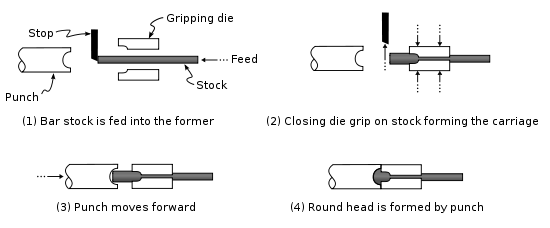
There are three steps in manufacturing a screw: heading, thread rolling, and coating. Screws are normally made from wire
Wire
A wire is a single, usually cylindrical, flexible strand or rod of metal. Wires are used to bear mechanical loads and to carry electricity and telecommunications signals. Wire is commonly formed by drawing the metal through a hole in a die or draw plate. Standard sizes are determined by various...
, which is supplied in large coils, or round bar stock
Bar stock
Bar stock, also colloquially known as billet, is a common form of raw purified metal, used by industry to manufacture metal parts and products....
for larger screws. The wire or rod is then cut to the proper length for the type of screw being made; this workpiece is known as a blank. It is then cold headed
Heading (metalworking)
Heading is a metalworking process which incorporates the forging, extruding and upsetting process. It is often performed in the cold state, resulting in cold working...
, which is a cold working process. Heading produces the head of the screw. The shape of the die in the machine dictates what features are pressed into the screw head; for example a flat head screw uses a flat die. For more complicated shapes two heading processes are required to get all of the features into the screw head. This production method is used because heading has a very high production rate, and produces virtually no waste material. Slotted head screws require an extra step to cut the slot in the head; this is done on a slotting machine. These machines are essentially stripped down milling machines designed to process as many blanks as possible.
The blanks are then polished again prior to threading. The threads are usually produced via thread rolling, however some are cut
Thread cutting
Threading is the process of creating a screw thread. More screw threads are produced each year than any other machine element. There are many methods of generating threads, including subtractive methods ; deformative or transformative methods ; additive methods ; or...
. The workpiece is then tumble finished with wood and leather media to do final cleaning and polishing. For most screws a coating, such as hot-dip galvanizing
Hot-dip galvanizing
Hot-dip galvanizing is a form of galvanization. It is the process of coating iron, steel, or aluminum with a thin zinc layer, by passing the metal through a molten bath of zinc at a temperature of around 860 °F...
or blackening
Black oxide
Black oxide or blackening is a conversion coating for ferrous materials, copper and copper based alloys, zinc, powdered metals, and silver solder. It is used to add mild corrosion resistance and for appearance. To achieve maximum corrosion resistance the black oxide must be impregnated with oil or...
, is applied to prevent corrosion.
History
Archimedes' screw
The Archimedes' screw, also called the Archimedean screw or screwpump, is a machine historically used for transferring water from a low-lying body of water into irrigation ditches...
to Sennacherib
Sennacherib
Sennacherib |Sîn]] has replaced brothers for me"; Aramaic: ) was the son of Sargon II, whom he succeeded on the throne of Assyria .-Rise to power:...
, King of Assyria
Assyria
Assyria was a Semitic Akkadian kingdom, extant as a nation state from the mid–23rd century BC to 608 BC centred on the Upper Tigris river, in northern Mesopotamia , that came to rule regional empires a number of times through history. It was named for its original capital, the ancient city of Assur...
, archaeological finds and pictorial evidence only appear in the Hellenistic period
Hellenistic period
The Hellenistic period or Hellenistic era describes the time which followed the conquests of Alexander the Great. It was so named by the historian J. G. Droysen. During this time, Greek cultural influence and power was at its zenith in Europe and Asia...
and the standard view holds the device to be a Greek
Ancient Greece
Ancient Greece is a civilization belonging to a period of Greek history that lasted from the Archaic period of the 8th to 6th centuries BC to the end of antiquity. Immediately following this period was the beginning of the Early Middle Ages and the Byzantine era. Included in Ancient Greece is the...
invention, most probably by the 3rd century BC polymath Archimedes
Archimedes
Archimedes of Syracuse was a Greek mathematician, physicist, engineer, inventor, and astronomer. Although few details of his life are known, he is regarded as one of the leading scientists in classical antiquity. Among his advances in physics are the foundations of hydrostatics, statics and an...
himself.
The screw was later described by the Greek mathematician
Greek mathematics
Greek mathematics, as that term is used in this article, is the mathematics written in Greek, developed from the 7th century BC to the 4th century AD around the Eastern shores of the Mediterranean. Greek mathematicians lived in cities spread over the entire Eastern Mediterranean, from Italy to...
Archytas of Tarentum (428 – 350 BC). By the 1st century BC, wooden screws were commonly used throughout the Mediterranean world in devices such as oil and wine
Wine
Wine is an alcoholic beverage, made of fermented fruit juice, usually from grapes. The natural chemical balance of grapes lets them ferment without the addition of sugars, acids, enzymes, or other nutrients. Grape wine is produced by fermenting crushed grapes using various types of yeast. Yeast...
presses. Metal screws used as fasteners did not appear in Europe until the 15th century.
Rybczynski has shown that handheld screwdriver
Screwdriver
A screwdriver is a tool for driving screws and often rotating other machine elements with the mating drive system. The screwdriver is made up of a head or tip, which engages with a screw, a mechanism to apply torque by rotating the tip, and some way to position and support the screwdriver...
s (formerly called "turnscrews" in English, in more direct parallel to their original French name, tournevis) have existed since medieval times (the 1580s at the latest), although they probably did not become truly widespread until after 1800, once threaded fasteners themselves had become commodified, as detailed below.
There were many forms of fastening in use before threaded fasteners became widespread. They tended to involve carpentry and smithing rather than machining, and they involved concepts such as dowels and pins, wedging, mortises and tenons, dovetails, nailing (with or without clenching), forge welding
Forge welding
Forge welding is a solid-state welding process that joins two pieces of metal by heating them to a high temperature and then hammering them together. The process is one of the simplest methods of joining metals and has been used since ancient times. Forge welding is versatile, being able to join a...
, and many kinds of binding with cord made of leather or fiber, using many kinds of knot
Knot
A knot is a method of fastening or securing linear material such as rope by tying or interweaving. It may consist of a length of one or several segments of rope, string, webbing, twine, strap, or even chain interwoven such that the line can bind to itself or to some other object—the "load"...
s. Prior to the mid-19th century, cotter pins or pin bolts, and "clinch bolts" (now called rivets), were used in shipbuilding.
The metal screw did not become a common fastener until machine tool
Machine tool
A machine tool is a machine, typically powered other than by human muscle , used to make manufactured parts in various ways that include cutting or certain other kinds of deformation...
s for mass production
Mass production
Mass production is the production of large amounts of standardized products, including and especially on assembly lines...
were developed toward the end of the 18th century. This development blossomed in the 1760s and 1770s along two separate paths that soon converged
Technological convergence
Technological convergence is the tendency for different technological systems to evolve towards performing similar tasks. Convergence can refer to previously separate technologies such as voice , data , and video that now share resources and interact with each other synergistically.The rise of...
: the mass production of wood screws [meaning screws made of metal to be used in wood] in a specialized, single-purpose, high-volume-production machine tool; and the low-count, toolroom
Toolroom
The term toolroom can refer to three related concepts. The concepts have evolved over the past two centuries as technology itself has evolved.- Storing tools :...
-style production of machine screws (V-thread) with easy selection among various pitches (whatever the machinist happened to need on any given day). The first path was pioneered by brothers Job and William Wyatt of Staffordshire
Staffordshire
Staffordshire is a landlocked county in the West Midlands region of England. For Eurostat purposes, the county is a NUTS 3 region and is one of four counties or unitary districts that comprise the "Shropshire and Staffordshire" NUTS 2 region. Part of the National Forest lies within its borders...
, UK, who patented in 1760 a machine that we might today best call a screw machine of an early and prescient sort. It made use of a leadscrew to guide the cutter to produce the desired pitch, and the slot was cut with a rotary file while the main spindle held still (presaging live tools on lathes 250 years later). Not until 1776 did the Wyatt brothers have a wood-screw factory up and running. Their enterprise failed, but new owners soon made it prosper, and in the 1780s they were producing 16,000 screws a day with only 30 employees—the kind of industrial productivity and output volume that would later be characteristic of modern industry but was revolutionary at the time. Meanwhile, English instrument maker Jesse Ramsden
Jesse Ramsden
Jesse Ramsden FRSE was an English astronomical and scientific instrument maker.Ramsden was born at Salterhebble, Halifax, West Riding of Yorkshire, England. After serving his apprenticeship with a cloth-worker in Halifax, he went in 1755 to London, where in 1758 he was apprenticed to a...
(1735–1800) was working on the toolmaking
Tool and die maker
Tool and die makers are workers in the manufacturing industry who make jigs, fixtures, dies, molds, machine tools, cutting tools , gauges, and other tools used in manufacturing processes...
and instrument-making end of the screw-cutting problem, and in 1777 he invented the first satisfactory screw-cutting lathe
Screw-cutting lathe
A screw-cutting lathe is a machine capable of cutting very accurate screw threads via single-point screw-cutting, which is the process of guiding the linear motion of the tool bit in a precisely known ratio to the rotating motion of the workpiece...
. The British engineer Henry Maudslay
Henry Maudslay
Henry Maudslay was a British machine tool innovator, tool and die maker, and inventor. He is considered a founding father of machine tool technology.-Early life:...
(1771–1831) gained fame by popularizing such lathes with his screw-cutting lathes of 1797 and 1800, containing the trifecta of leadscrew, slide rest, and change-gear gear train, all in the right proportions for industrial machining. In a sense he unified the paths of the Wyatts and Ramsden and did for machine screws what had already been done for wood screws, i.e., significant easing of production spurring commodification
Commodification
Commodification is the transformation of goods, ideas, or other entities that may not normally be regarded as goods into a commodity....
. His firm would remain a leader in machine tools for decades afterward. A misquoting of James Nasmyth
James Nasmyth
James Hall Nasmyth was a Scottish engineer and inventor famous for his development of the steam hammer. He was the co-founder of Nasmyth, Gaskell and Company manufacturers of machine tools...
popularized the notion that Maudslay had invented the slide rest, but this was incorrect; however, his lathes helped to popularize it.
These developments of the 1760–1800 era, with the Wyatts and Maudslay being arguably the most important drivers, caused great increase in the use of threaded fasteners. Standardization of threadforms began almost immediately, but it was not quickly completed; it has been an evolving process ever since. Further improvements to the mass production of screws continued to push unit price
Unit price
Average prices represent, quite simply, total sales revenue divided by total units sold. Many products, however, are sold in multiple variants, such as bottle sizes. In these cases, managers face a challenge: they must determine “comparable” units. Average prices can be calculated by weighting...
s lower and lower for decades to come, throughout the 19th century.
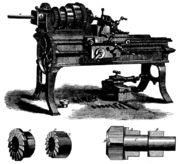
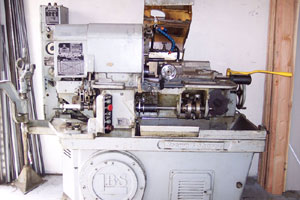
The development of the turret lathe
Turret lathe
The turret lathe is a form of metalworking lathe that is used for repetitive production of duplicate parts, which by the nature of their cutting process are usually interchangeable...
(1840s) and of automatic screw machines derived from it (1870s) drastically reduced the unit cost of threaded fasteners by increasingly automating the machine tool control. This cost reduction spurred ever greater use
Demand curve
In economics, the demand curve is the graph depicting the relationship between the price of a certain commodity, and the amount of it that consumers are willing and able to purchase at that given price. It is a graphic representation of a demand schedule...
of screws.
Throughout the 19th century, the most commonly used forms of screw head (that is, drive types) were simple internal-wrenching straight slots and external-wrenching squares and hexagons. These were easy to machine
Machining
Conventional machining is a form of subtractive manufacturing, in which a collection of material-working processes utilizing power-driven machine tools, such as saws, lathes, milling machines, and drill presses, are used with a sharp cutting tool to physical remove material to achieve a desired...
and served most applications adequately. Rybczynski describes a flurry of patents for alternative drive types in the 1860s through 1890s, but explains that these were patented but not manufactured due to the difficulties and expense of doing so at the time. In 1908, Canadian P. L. Robertson
P. L. Robertson
Peter Lymburner Robertson was a Canadian inventor, industrialist, salesman, and philanthropist who popularized the square-socket drive for screws...
was the first to make the internal-wrenching square socket drive a practical reality by developing just the right design (slight taper angles and overall proportions) to allow the head to be stamped easily but successfully, with the metal cold forming as desired rather than being sheared or displaced in unwanted ways. The internal-wrenching hexagon drive (hex socket
Hex key
A hex key, Allen key, or Allen wrench is a tool of hexagonal cross-section used to drive bolts and screws that have a hexagonal socket in the head .- Nomenclature :...
) shortly followed in 1911. In the early 1930s, the Phillips-head screw was invented by Henry F. Phillips
Henry F. Phillips
Henry F. Phillips was a U.S. businessman from Portland, Oregon. The Phillips-head screw and screwdriver are named after him....
.
Threadform standardization further improved in the late 1940s, when the ISO metric screw thread and the Unified Thread Standard were defined.
Other fastening methods
Alternative fastening methods are nails, rivetRivet
A rivet is a permanent mechanical fastener. Before being installed a rivet consists of a smooth cylindrical shaft with a head on one end. The end opposite the head is called the buck-tail. On installation the rivet is placed in a punched or pre-drilled hole, and the tail is upset, or bucked A rivet...
s, roll pins, pinned shafts, welding
Welding
Welding is a fabrication or sculptural process that joins materials, usually metals or thermoplastics, by causing coalescence. This is often done by melting the workpieces and adding a filler material to form a pool of molten material that cools to become a strong joint, with pressure sometimes...
, solder
Solder
Solder is a fusible metal alloy used to join together metal workpieces and having a melting point below that of the workpiece.Soft solder is what is most often thought of when solder or soldering are mentioned and it typically has a melting range of . It is commonly used in electronics and...
ing, brazing
Brazing
Brazing is a metal-joining process whereby a filler metal is heated above and distributed between two or more close-fitting parts by capillary action. The filler metal is brought slightly above its melting temperature while protected by a suitable atmosphere, usually a flux...
, and gluing (including taping
Adhesive tape
Adhesive tape is one of many varieties of backing materials coated with an adhesive. Several types of adhesives can be used.-Types:Pressure sensitive tape...
), and clinch fastening.
See also
- Gender of connectors and fastenersGender of connectors and fastenersIn electrical and mechanical trades and manufacturing, each half of a pair of mating connectors or fasteners is conventionally assigned the designation male or female...
- Tap and die
- Die headDie headA die head is a threading die that is used in the high volume production of threaded components.Die heads are commonly used on lathes, turret lathes, screw machines and CNC lathes. They may be used for either cutting a thread or rolling a thread...
- Die head
- Thread angleThread angleThe thread angle of a screw is the angle between the threads. This is a defining factor for the shape of a screw thread. Standard values include:...
- Threaded rodThreaded rodA threaded rod, also known as a stud, is a relatively long rod that is threaded on both ends; the thread may extend along the complete length of the rod. They are designed to be used in tension...
(e.g., studs, allthread) - Threading
- Thread pitch gaugeThread pitch gaugeA thread pitch gauge, also known as a screw pitch gauge or pitch gauge, is used to measure the pitch or lead of a screw thread. The uppermost gauge in the image is an ISO metric pitch gauge, the larger gauge in the center is for measuring the Acme thread form, and the lower gauge is for Whitworth...
- Syndesmotic screwSyndesmotic screwA syndesmotic screw is a metal screw designed to replace the syndesmosis of the human body, usually temporarily. If the syndosmosis is torn apart as result of bone fracture, surgeons will sometimes fix the relevant bones together with a syndesmotic screw, temporarily replacing the normal...
External links
- Screws Small Encyclopedia
- NASA-RP-1228 Fastener Design Manual
- Imperial/Metric fastening sizes comaparisons
- "Hold Everything", February 1946, Popular Science" article section on screws and screw fastener technology developed during World War Two