
All Topics  
Galvanization

 
Galvanization

   Email Print
   Bookmark   Link


Galvanization


Galvanization or galvanisation refers to any of several electrochemical
Electrochemistry

Electrochemistry is a branch of chemistry that studies chemical reactions which take place in a solution at the interface of an electron Electrical conductor and an ionic conductor , and which involve electron transfer between the electrode and the electrolyte or species in solution....
 processes named after the Italian scientist Luigi Galvani
Luigi Galvani

Luigi Galvani was an Italy physician and physicist who lived and died in Bologna. In 1771, he discovered that the muscles of dead frogs twitched when struck by a spark....
.

inally, galvanization was the administration of electric shocks (in the 19th century also termed Faradism, after Michael Faraday
Michael Faraday

Michael Faraday, Fellow of the Royal Society was an English chemist and physicist who contributed to the fields of electromagnetism and electrochemistry....
). It stemmed from Galvani's induction of twitches in severed frog
Frog

Frogs are amphibians in the order Anura , formerly referred to as Salientia . The name frog derives from Old English language frogga, , cognate with Sanskrit plava , probably deriving from Proto-Indo-European language praw = "to jump"....
s' legs, by his accidental generation of electricity
Electricity

Electricity is a general term that encompasses a variety of phenomena resulting from the presence and flow of electric charge. These include many easily recognizable phenomena such as lightning and static electricity, but in addition, less familiar concepts such as the electromagnetic field and electromagnetic induction....
. This archaic
Archaism

In language, an archaism is the use of a form of speech or writing that is no longer current. This can either be done deliberately or as part of a specific jargon or formula ....
 sense is the origin of the meaning of galvanic when meaning "affected/affecting, as if by a shock of electricity; startled".


Discussion
Ask a question about 'Galvanization'
Start a new discussion about 'Galvanization'
Answer questions from other users
Full Discussion Forum


Encyclopedia


Galvanization or galvanisation refers to any of several electrochemical
Electrochemistry

Electrochemistry is a branch of chemistry that studies chemical reactions which take place in a solution at the interface of an electron Electrical conductor and an ionic conductor , and which involve electron transfer between the electrode and the electrolyte or species in solution....
 processes named after the Italian scientist Luigi Galvani
Luigi Galvani

Luigi Galvani was an Italy physician and physicist who lived and died in Bologna. In 1771, he discovered that the muscles of dead frogs twitched when struck by a spark....
.

Meanings


Electricity

Originally, galvanization was the administration of electric shocks (in the 19th century also termed Faradism, after Michael Faraday
Michael Faraday

Michael Faraday, Fellow of the Royal Society was an English chemist and physicist who contributed to the fields of electromagnetism and electrochemistry....
). It stemmed from Galvani's induction of twitches in severed frog
Frog

Frogs are amphibians in the order Anura , formerly referred to as Salientia . The name frog derives from Old English language frogga, , cognate with Sanskrit plava , probably deriving from Proto-Indo-European language praw = "to jump"....
s' legs, by his accidental generation of electricity
Electricity

Electricity is a general term that encompasses a variety of phenomena resulting from the presence and flow of electric charge. These include many easily recognizable phenomena such as lightning and static electricity, but in addition, less familiar concepts such as the electromagnetic field and electromagnetic induction....
. This archaic
Archaism

In language, an archaism is the use of a form of speech or writing that is no longer current. This can either be done deliberately or as part of a specific jargon or formula ....
 sense is the origin of the meaning of galvanic when meaning "affected/affecting, as if by a shock of electricity; startled". Its claims to health benefits have largely been disproven, except for some limited uses in psychiatry
Psychiatry

Psychiatry is a Medicine Specialty devoted to the Treatment of mental disorders, Biomedical research and Prevention of mental disorder. The term was first coined by the German physician Johann Christian Reil in 1808....
 in the form of electroconvulsive therapy
Electroconvulsive therapy

Electroconvulsive therapy , also known as electroshock, is a well established, albeit controversial psychiatry treatment in which seizures are electrically induced in anesthetized patients for therapeutic effect....
 (ECT). Later the word was used for processes of electrodeposition
Electrodeposition

Electrodeposition may refer to:*Electroplating*Electrophoretic deposition...
. This remains a useful and broadly applied technology, but the term "galvanization" has largely come to be associated with zinc
Zinc

Zinc is a metallic chemical element with the symbol Zn and atomic number 30. It is a first-row transition metal of the group 12 element of the periodic table....
 coatings, to the exclusion of other metals.

Metal protection

In current use, it typically means hot-dip galvanizing
Hot-dip galvanizing

Hot-dip galvanizing is a form of galvanization. It is the process of coating iron or steel with a thin zinc layer, by passing the steel through a molten bath of zinc at a temperature of around 860 ?F ....
, a metallurgical process that is used to coat steel
Steel

Steel is an alloy consisting mostly of iron, with a carbon content between 0.2% and 2.14% by weight , depending on grade. Carbon is the most cost-effective alloying material for iron, but various other alloying elements are used such as manganese, chromium, vanadium, and tungsten....
 or iron
Iron

Iron is a chemical element with the symbol Fe and atomic number 26. Iron is a Group 8 element and period 4 element. Iron is lustrous and silvery in color....
 with zinc. This is done to prevent galvanic corrosion (specifically rusting) of the ferrous
Iron

Iron is a chemical element with the symbol Fe and atomic number 26. Iron is a Group 8 element and period 4 element. Iron is lustrous and silvery in color....
 item; while it is accomplished by non-electrochemical means, it serves an electrochemical purpose.

Hot-dip galvanized steel has been effectively used for more than 150 years. The value of hot-dip galvanizing stems from the relative corrosion resistance of zinc, which, under most service conditions, is considerably better than iron and steel. In addition to forming a physical barrier against corrosion, zinc, applied as a hot-dip galvanized coating, cathodically protects exposed steel. Furthermore, galvanizing for protection of iron and steel is favored because of its low cost, the ease of application, and the extended maintenance-free service that it provides.

Note that exposed steel is painted (much in the same way as exposed aluminium flashings) to colour match the proposed scheme colour.

History


The first commercial use of galvanised sheet metal
Sheet metal

Sheet metal is simply metal formed into thin and flat pieces. It is one of the fundamental forms used in metalworking, and can be cut and bent into a variety of different shapes....
 was for the Baldwin Brother's Gleaner
Gleaner

Gleaner may refer to:*Gleaner Company, a newspaper publishing enterprise in Jamaica.*Gleaner Manufacturing Company, a manufacturer of combine harvesters....
 combine harvester
Combine harvester

The combine harvester, or simply combine, also known as a thresher is a machine that combines the tasks of harvesting, threshing, and cleaning cereal crops....
.

Zinc coatings


Zinc coatings prevent corrosion of the protected metal by forming a physical barrier, and by acting as a sacrificial anode
Sacrificial anode

A sacrificial anode, or sacrificial rod, is a metallic anode used in cathodic protection where it is intended to be dissolved to protect other metallic components....
 if this barrier is damaged. When exposed to the atmosphere, zinc reacts with oxygen to form zinc oxide
Zinc oxide

Zinc oxide is an inorganic compound with the Chemical formula ZnO. It usually appears as a white powder, nearly insoluble in water. The powder is widely used as an additive into numerous materials and products including plastics, ceramics, glass, cement, rubber , lubricants, paints, ointments, adhesives, sealants, pigments, foods , batteries,...
, which further reacts with water molecules in the air to form zinc hydroxide. Finally zinc hydroxide reacts with carbon dioxide in the atmosphere to yield a thin, impermeable, tenacious and quite insoluble dull grey layer of zinc carbonate which adheres extremely well to the underlying zinc, so protecting it from further corrosion, in a way similar to the protection
Passivation

Passivation is the process of making a material "passive" in relation to another material prior to using the materials together. For example, prior to storing hydrogen peroxide in an aluminium container, the container can be passivated by rinsing it with a dilute solution of nitric acid and peroxide alternating with deionized water....
 afforded to aluminium
Aluminium

Aluminium or aluminum is a silvery white and ductile member of the boron group of chemical elements. It has the symbol Al; its atomic number is 13....
 and stainless steel
Stainless steel

In metallurgy, stainless steel is defined as a steel alloy with a minimum of 10% chromium content by mass. Stainless steel does not stain, corrode, or rust as easily as ordinary steel , but it is not stain-proof....
s by their oxide layers.

Hot dip galvanizing deposits a thick robust layer that may be more than is necessary for the protection of the underlying metal in some applications. This is the case in automobile
Automobile

An automobile or motor car is a wheeled motor vehicle for transportation passengers, which also carries its own car engine or motor. Most definitions of the term specify that automobiles are designed to run primarily on roads, to have seating for one to eight people, to typically have four wheels, and to be constructed principally f...
 bodies, where additional rust proofing paint will be applied. Here, a thinner form of galvanizing is applied by electroplating
Electroplating

Electroplating is a plating process that uses electrical direct current to redox cations of a desired material from a solution and coat a electrical conductivity object with a thin layer of the material, such as a metal....
, called "electrogalvanization
Electrogalvanization

Electrogalvanization is the process of bonding a layer of zinc to steel in order to protect against corrosion. The process involves electroplating, running a current of electricity through a saline/zinc solution with a zinc anode and steel conductor....
". However, the protection this process provides is insufficient for products that will be constantly exposed to corrosive materials such as salt water. Nevertheless, most nails made today are electro-galvanized.

As noted previously, both mechanisms are often at work in practical applications. For example, the traditional measure of a coating's effectiveness is resistance to a salt spray. Thin coatings cannot remain intact indefinitely when subject to surface abrasion, and the galvanic protection offered by zinc can be sharply contrasted to more noble metals. As an example, a scratched or incomplete coating of chromium
Chromium

Chromium is a chemical element which has the symbol Cr and atomic number 24. It is a steely-gray, Lustre , hard metal that takes a high polish and has a high melting point....
 actually exacerbates corrosion of the underlying steel, since it is less electrochemically active than the substrate.

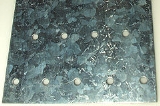
Galvanized Surface
The size of crystallite
Crystallite

A crystallite is a domain of solid-state matter that has the same structure as a single crystal. Metallurgy often refer to crystallites as "grains"....
s in galvanized coatings is an aesthetic feature, known as spangle. By varying the number of particles added for heterogeneous nucleation
Nucleation

Nucleation is the onset of a crystal in a small region. The phase transition can be the formation of a bubble or of a crystal from a liquid. Creation of liquid droplets in saturated vapor or the creation of gaseous bubbles in a saturated liquid is also characterized by nucleation ....
 and the rate of cooling in a hot-dip process, the spangle can be adjusted from an apparently uniform surface (crystallites too small to see with the naked eye) to grains several centimeters wide. Visible crystallites are rare in other engineering materials. Protective coatings for steel constitute the largest use of zinc and rely upon the galvanic or sacrificial property of zinc relative to steel.

Thermal diffusion galvanizing is a new "green" process which creates a zinc coating metallurgically similar to hot dip galvanizing. Instead of dipping parts in molten zinc, zinc is applied in a powder form with accelerator chemicals. The parts and the zinc compound are sealed in a drum which is rotated in an oven. Due to accelerator chemicals added to the zinc powder, the zinc/iron diffusion (alloying) takes place at a lower temperature than hot dip galvanizing, and results in a more uniform and wear resistant coating. The process also eliminates the need for hazardous caustic, acid, and flux baths required to prepare parts for hot dip galvanizing. The unique crystal structure formed by the process provides a strong bond with paint, powder coating, and rubber overmolding processes.

Eventual corrosion

Although galvanizing will inhibit attack of the underlying steel, rusting will be inevitable, especially if the local rainfall is at all acidic in nature. So for example, corrugated iron sheet roofing will start to degrade within a few years despite the protective action of the zinc coating. Marine environments also lower the lifetime of galvanized iron roofs and similar products, because the high electrical conductivity
Electrical conductivity

Electrical conductivity or specific conductance is a measure of a material's ability to electrical conduction an electric current. When an electrical potential difference is placed across a conductor, its movable charges flow, giving rise to an electric current....
 of sea water encourages and increases the rate of corrosion. Corrugated steel roofs can last for many years if further protected by a paint
Paint

Paint is any liquid, liquifiable, or mastic composition which after application to a Substrate in a thin layer is converted to an opaque solid film....
 layer. Galvanized car frames may also be at risk, especially where road salting is used extensively.

See also


  • Corrugated galvanised iron
    Corrugated galvanised iron

    Corrugated galvanised iron is a building material composed of sheets of hot-dip galvanizing mild steel, cold-rolled to produce a linear corrugated pattern in them....
  • Sendzimir process
    Sendzimir process

    Sendzimir process is used to galvanizing a steel strip by using a small amount of aluminum in the zinc bath and producing a coating with essentially no iron-zinc alloy....
  • Sherardising
    Sherardising

    Sherardising or sherardizing is a method of galvanising also called vapour galvanising. It is named for its discoverer Sherard Cowper-Coles ....


External links