

Wire

Encyclopedia
Cylinder (geometry)
A cylinder is one of the most basic curvilinear geometric shapes, the surface formed by the points at a fixed distance from a given line segment, the axis of the cylinder. The solid enclosed by this surface and by two planes perpendicular to the axis is also called a cylinder...
, flexible strand or rod of metal. Wires are used to bear mechanical load
Structural load
Structural loads or actions are forces, deformations or accelerations applied to a structure or its components.Loads cause stresses, deformations and displacements in structures. Assessment of their effects is carried out by the methods of structural analysis...
s and to carry electricity
Electricity
Electricity is a general term encompassing a variety of phenomena resulting from the presence and flow of electric charge. These include many easily recognizable phenomena, such as lightning, static electricity, and the flow of electrical current in an electrical wire...
and telecommunications signals. Wire is commonly formed by drawing
Drawing (manufacturing)
Drawing is a metalworking process which uses tensile forces to stretch metal. It is broken up into two types: sheet metal drawing and wire, bar, and tube drawing. The specific definition for sheet metal drawing is that it involves plastic deformation over a curved axis...
the metal through a hole in a die
Die (manufacturing)
A die is a specialized tool used in manufacturing industries to cut or shape material using a press. Like molds, dies are generally customized to the item they are used to create...
or draw plate
Draw plate
A draw plate is type of die consisting of a hardened steel plate with one or more holes through which wire is drawn to make it thinner. A typical plate will have twenty to thirty holes so a wide range of diameters can be drawn....
. Standard size
Size
The word size may refer to how big something is. In particular:* Measurement, the process or the result of determining the magnitude of a quantity, such as length or mass, relative to a unit of measurement, such as a meter or a kilogram...
s are determined by various wire gauge
Wire gauge
Wire gauge is a measurement of how large a wire is, either in diameter or cross sectional area. This determines the amount of electric current a wire can safely carry, as well as its electrical resistance and weight per unit of length...
s. The term wire is also used more loosely to refer to a bundle of such strands, as in 'multistranded wire', which is more correctly termed a wire rope
Wire rope
thumb|Steel wire rope Wire rope is a type of rope which consists of several strands of metal wire laid into a helix. Initially wrought iron wires were used, but today steel is the main material used for wire ropes....
in mechanics, or a cable
Cable
A cable is two or more wires running side by side and bonded, twisted or braided together to form a single assembly. In mechanics cables, otherwise known as wire ropes, are used for lifting, hauling and towing or conveying force through tension. In electrical engineering cables are used to carry...
in electricity.
Although usually circular in cross-section, wire is also made in square or flattened rectangular cross-section, either for decorative purposes, or for technical purposes such as high-efficiency voice coil
Voice coil
A voice coil is the coil of wire attached to the apex of a loudspeaker cone. It provides the motive force to the cone by the reaction of a magnetic field to the current passing through it...
s in loudspeakers. Edge-wound coil spring
Coil spring
A Coil spring, also known as a helical spring, is a mechanical device, which is typically used to store energy and subsequently release it, to absorb shock, or to maintain a force between contacting surfaces...
s, such as the "Slinky
Slinky
Slinky or "Lazy Spring" is a toy consisting of a helical spring that stretches and can bounce up and down. It can perform a number of tricks, including traveling down a flight of steps end-over-end as it stretches and re-forms itself with the aid of gravity and its own momentum.-History:The toy was...
" toy, are made of special flattened wire.
History
Ancient history
Ancient history is the study of the written past from the beginning of recorded human history to the Early Middle Ages. The span of recorded history is roughly 5,000 years, with Cuneiform script, the oldest discovered form of coherent writing, from the protoliterate period around the 30th century BC...
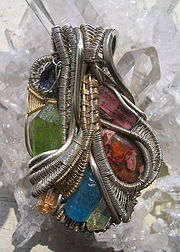
, jewelry often contains, in the form of chains and applied decoration, large amounts of wire that is accurately made and which must have been produced by some efficient, if not technically advanced, means. In some cases, strips cut from metal sheet were made into wire by pulling them through perforations in stone beads. This causes the strips to fold round on themselves to form thin tubes. This strip drawing technique was in use in Egypt
Egypt
Egypt , officially the Arab Republic of Egypt, Arabic: , is a country mainly in North Africa, with the Sinai Peninsula forming a land bridge in Southwest Asia. Egypt is thus a transcontinental country, and a major power in Africa, the Mediterranean Basin, the Middle East and the Muslim world...
by the 2nd Dynasty. From the middle of the 2nd millennium BC
2nd millennium BC
The 2nd millennium BC marks the transition from the Middle to the Late Bronze Age.Its first half is dominated by the Middle Kingdom of Egypt and Babylonia. The alphabet develops. Indo-Iranian migration onto the Iranian plateau and onto the Indian subcontinent propagates the use of the chariot...
most of the gold
Gold
Gold is a chemical element with the symbol Au and an atomic number of 79. Gold is a dense, soft, shiny, malleable and ductile metal. Pure gold has a bright yellow color and luster traditionally considered attractive, which it maintains without oxidizing in air or water. Chemically, gold is a...
wires in jewellery are characterised by seam lines that follow a spiral path along the wire. Such twisted strips can be converted into solid round wires by rolling them between flat surfaces or the strip wire drawing method. The strip twist wire manufacturing method was superseded by drawing
Wire drawing
Wire drawing is a metalworking process used to reduce the cross-section of a wire by pulling the wire through a single, or series of, drawing die. There are many applications for wire drawing, including electrical wiring, cables, tension-loaded structural components, springs, paper clips, spokes...
in the ancient Old World sometime between about the 8th and 10th centuries AD. There is some evidence for the use of drawing further East prior to this period.
Square and hexagonal wires were possibly made using a swaging technique. In this method a metal rod was struck between grooved metal blocks, or between a grooved punch and a grooved metal anvil. Swaging is of great antiquity, possibly dating to the beginning of the 2nd millennium BC in Egypt and in the Bronze
Bronze Age
The Bronze Age is a period characterized by the use of copper and its alloy bronze as the chief hard materials in the manufacture of some implements and weapons. Chronologically, it stands between the Stone Age and Iron Age...
and Iron Age
Iron Age
The Iron Age is the archaeological period generally occurring after the Bronze Age, marked by the prevalent use of iron. The early period of the age is characterized by the widespread use of iron or steel. The adoption of such material coincided with other changes in society, including differing...
s in Europe for torch
Torch
A torch is a fire source, usually a rod-shaped piece of wood with a rag soaked in pitch and/or some other flammable material wrapped around one end. Torches were often supported in sconces by brackets high up on walls, to throw light over corridors in stone structures such as castles or crypts...
es and fibulae.
Twisted square section wires are a very common filigree
Filigree
Filigree is a delicate kind of jewellery metalwork made with twisted threads usually of gold and silver or stitching of the same curving motifs. It often suggests lace, and in recent centuries remains popular in Indian and other Asian metalwork, and French from 1660 to the late 19th century...
decoration in early Etruscan jewellery.
In about the middle of the 2nd millennium BC a new category of decorative tube was introduced which imitated a line of granules. True beaded wire, produced by mechanically distorting a round-section wire, appeared in the Eastern Mediterranean and Italy in the seventh century BC, perhaps disseminated by the Phoenicians. Beaded wire continued to be used in jewellery into modern times, although it largely fell out of favour in about the tenth century AD when two drawn round wires, twisted together to form what are termed 'ropes', provided a simpler-to-make alternative. A forerunner to beaded wire may be the notched strips and wires which first occur from around 2000 BC in Anatolia
Anatolia
Anatolia is a geographic and historical term denoting the westernmost protrusion of Asia, comprising the majority of the Republic of Turkey...
.
Wire was drawn
Wire drawing
Wire drawing is a metalworking process used to reduce the cross-section of a wire by pulling the wire through a single, or series of, drawing die. There are many applications for wire drawing, including electrical wiring, cables, tension-loaded structural components, springs, paper clips, spokes...
in England from the medieval period. The wire was used to make wool cards and pins, manufactured goods whose import was prohibited by Edward IV in 1463. The first wire mill in Great Britain was established at Tintern
Tintern
Tintern is a village on the west bank of the River Wye in Monmouthshire, Wales, close to the border with England, about 5 miles north of Chepstow...
in about 1568 by the founders of the Company of Mineral and Battery Works
Company of Mineral and Battery Works
The Company of Mineral and Battery Works was, , one of two mining monopolies created by Queen Elizabeth I of England in the mid-1560s. The Company's rights were based on a patent granted to William Humfrey on 17 September 1565. This was replaced on 28 May 1568 by a patent of incorporation, making...
, who had a monopoly
Monopoly
A monopoly exists when a specific person or enterprise is the only supplier of a particular commodity...
on this. Apart from their second wire mill at nearby Whitebrook, there were no other wire mills before the second half of the 17th century. Despite the existence of mills, the drawing of wire down to fine sizes continued to be done manually.
Wire is usually drawn of cylindrical form; but it may be made of any desired section by varying the outline of the holes in the draw-plate through which it is passed in the process of manufacture. The draw-plate
Draw plate
A draw plate is type of die consisting of a hardened steel plate with one or more holes through which wire is drawn to make it thinner. A typical plate will have twenty to thirty holes so a wide range of diameters can be drawn....
or die
Die (manufacturing)
A die is a specialized tool used in manufacturing industries to cut or shape material using a press. Like molds, dies are generally customized to the item they are used to create...
is a piece of hard cast-iron or hard steel, or for fine work it may be a diamond
Diamond
In mineralogy, diamond is an allotrope of carbon, where the carbon atoms are arranged in a variation of the face-centered cubic crystal structure called a diamond lattice. Diamond is less stable than graphite, but the conversion rate from diamond to graphite is negligible at ambient conditions...
or a ruby
Ruby
A ruby is a pink to blood-red colored gemstone, a variety of the mineral corundum . The red color is caused mainly by the presence of the element chromium. Its name comes from ruber, Latin for red. Other varieties of gem-quality corundum are called sapphires...
. The object of utilising precious stones is to enable the dies to be used for a considerable period without losing their size, and so producing wire of incorrect diameter. Diamond dies must be rebored when they have lost their original diameter of hole, but the metal dies are brought down to size again by hammering up the hole and then drifting it out to correct diameter with a punch.
Uses
Wire has many uses. It forms the raw material of many important manufacturers, such as the wire-net industry, wire-cloth making and wire-ropeRope
A rope is a length of fibres, twisted or braided together to improve strength for pulling and connecting. It has tensile strength but is too flexible to provide compressive strength...
spinning, in which it occupies a place analogous to a textile
Textile
A textile or cloth is a flexible woven material consisting of a network of natural or artificial fibres often referred to as thread or yarn. Yarn is produced by spinning raw fibres of wool, flax, cotton, or other material to produce long strands...
fiber
Fiber
Fiber is a class of materials that are continuous filaments or are in discrete elongated pieces, similar to lengths of thread.They are very important in the biology of both plants and animals, for holding tissues together....
. Wire-cloth of all degrees of strength and fineness of mesh is used for sifting and screening machinery, for draining paper pulp, for window screens, and for many other purposes. Vast quantities of aluminium
Aluminium
Aluminium or aluminum is a silvery white member of the boron group of chemical elements. It has the symbol Al, and its atomic number is 13. It is not soluble in water under normal circumstances....
, copper
Copper wire and cable
Copper has been used in electric wiring since the invention of the electromagnet and the telegraph in the 1820s. The invention of the telephone in 1876 proved to be another early boon for copper wire....
, nickel
Nickel
Nickel is a chemical element with the chemical symbol Ni and atomic number 28. It is a silvery-white lustrous metal with a slight golden tinge. Nickel belongs to the transition metals and is hard and ductile...
and steel
Steel
Steel is an alloy that consists mostly of iron and has a carbon content between 0.2% and 2.1% by weight, depending on the grade. Carbon is the most common alloying material for iron, but various other alloying elements are used, such as manganese, chromium, vanadium, and tungsten...
wire are employed for telephone and data wires and cables, and as conductors in electric power transmission
Electric power transmission
Electric-power transmission is the bulk transfer of electrical energy, from generating power plants to Electrical substations located near demand centers...
, and heating. It is in no less demand for fencing, and much is consumed in the construction of suspension bridges, and cages, etc. In the manufacture of stringed musical instruments and scientific instruments wire is again largely used. Among its other sources of consumption it is sufficient to mention pin and hair-pin making, the needle and fish-hook industries, nail, peg and rivet making, and carding machinery; indeed there are few industries into which it does not enter.
Not all metals and metallic alloy
Alloy
An alloy is a mixture or metallic solid solution composed of two or more elements. Complete solid solution alloys give single solid phase microstructure, while partial solutions give two or more phases that may or may not be homogeneous in distribution, depending on thermal history...
s possess the physical properties necessary to make useful wire. The metals must in the first place be ductile and strong in tension, the quality on which the utility of wire principally depends. The metals suitable for wire, possessing almost equal ductility, are platinum
Platinum
Platinum is a chemical element with the chemical symbol Pt and an atomic number of 78. Its name is derived from the Spanish term platina del Pinto, which is literally translated into "little silver of the Pinto River." It is a dense, malleable, ductile, precious, gray-white transition metal...
, silver
Silver
Silver is a metallic chemical element with the chemical symbol Ag and atomic number 47. A soft, white, lustrous transition metal, it has the highest electrical conductivity of any element and the highest thermal conductivity of any metal...
, iron
Iron
Iron is a chemical element with the symbol Fe and atomic number 26. It is a metal in the first transition series. It is the most common element forming the planet Earth as a whole, forming much of Earth's outer and inner core. It is the fourth most common element in the Earth's crust...
, copper
Copper
Copper is a chemical element with the symbol Cu and atomic number 29. It is a ductile metal with very high thermal and electrical conductivity. Pure copper is soft and malleable; an exposed surface has a reddish-orange tarnish...
, aluminium and gold
Gold
Gold is a chemical element with the symbol Au and an atomic number of 79. Gold is a dense, soft, shiny, malleable and ductile metal. Pure gold has a bright yellow color and luster traditionally considered attractive, which it maintains without oxidizing in air or water. Chemically, gold is a...
; and it is only from these and certain of their alloy
Alloy
An alloy is a mixture or metallic solid solution composed of two or more elements. Complete solid solution alloys give single solid phase microstructure, while partial solutions give two or more phases that may or may not be homogeneous in distribution, depending on thermal history...
s with other metals, principally brass
Brass
Brass is an alloy of copper and zinc; the proportions of zinc and copper can be varied to create a range of brasses with varying properties.In comparison, bronze is principally an alloy of copper and tin...
and bronze
Bronze
Bronze is a metal alloy consisting primarily of copper, usually with tin as the main additive. It is hard and brittle, and it was particularly significant in antiquity, so much so that the Bronze Age was named after the metal...
, that wire is prepared (For a detailed discussion on copper wire
Copper wire and cable
Copper has been used in electric wiring since the invention of the electromagnet and the telegraph in the 1820s. The invention of the telephone in 1876 proved to be another early boon for copper wire....
, see main article: Copper wire and cable
Copper wire and cable
Copper has been used in electric wiring since the invention of the electromagnet and the telegraph in the 1820s. The invention of the telephone in 1876 proved to be another early boon for copper wire....
.).
By careful treatment extremely thin wire can be produced. Special purpose wire is however made from other metals (e.g. tungsten
Tungsten
Tungsten , also known as wolfram , is a chemical element with the chemical symbol W and atomic number 74.A hard, rare metal under standard conditions when uncombined, tungsten is found naturally on Earth only in chemical compounds. It was identified as a new element in 1781, and first isolated as...
wire for light bulb and vacuum tube
Vacuum tube
In electronics, a vacuum tube, electron tube , or thermionic valve , reduced to simply "tube" or "valve" in everyday parlance, is a device that relies on the flow of electric current through a vacuum...
filaments, because of its high melting temperature). Copper wires are also plated with other metals, such as tin, nickel, and silver to handle different temperatures, provide lubrication, provide easier stripping of rubber from copper.
Production
Drawing (manufacturing)
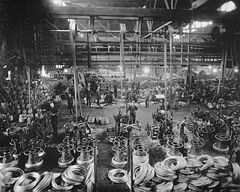
Drawing is a metalworking process which uses tensile forces to stretch metal. It is broken up into two types: sheet metal drawing and wire, bar, and tube drawing. The specific definition for sheet metal drawing is that it involves plastic deformation over a curved axis...
through progressively smaller dies, or traditionally holes in draw plate
Draw plate
A draw plate is type of die consisting of a hardened steel plate with one or more holes through which wire is drawn to make it thinner. A typical plate will have twenty to thirty holes so a wide range of diameters can be drawn....
s. After a number of passes the wire may be annealed
Annealing (metallurgy)
Annealing, in metallurgy and materials science, is a heat treatment wherein a material is altered, causing changes in its properties such as strength and hardness. It is a process that produces conditions by heating to above the recrystallization temperature, maintaining a suitable temperature, and...
to facilitate more drawing or, if it is a finished product, to maximise ductility and conductivity.
Finishing, jacketing, and insulating
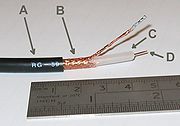
Electrical wires are usually covered with insulating materials, such as plastic, rubber-like polymers, or varnish. Insulating and jacketing of wires and cables is nowadays done by passing them through an extruder. Formerly, materials used for insulation included treated cloth or paper and various oil-based products. Since the mid-1960s, plastic and polymers exhibiting properties similar to rubber have predominated.Two or more wires may be wrapped concentrically, separated by insulation, to form coaxial cable
Coaxial cable
Coaxial cable, or coax, has an inner conductor surrounded by a flexible, tubular insulating layer, surrounded by a tubular conducting shield. The term coaxial comes from the inner conductor and the outer shield sharing the same geometric axis...
. The wire or cable may be further protected with substances like paraffin
Paraffin
In chemistry, paraffin is a term that can be used synonymously with "alkane", indicating hydrocarbons with the general formula CnH2n+2. Paraffin wax refers to a mixture of alkanes that falls within the 20 ≤ n ≤ 40 range; they are found in the solid state at room temperature and begin to enter the...
, some kind of preservative compound, bitumen, lead
Lead
Lead is a main-group element in the carbon group with the symbol Pb and atomic number 82. Lead is a soft, malleable poor metal. It is also counted as one of the heavy metals. Metallic lead has a bluish-white color after being freshly cut, but it soon tarnishes to a dull grayish color when exposed...
, aluminum sheathing, or steel taping. Stranding or covering machines wind material onto wire which passes through quickly. Some of the smallest machines for cotton covering have a large drum, which grips the wire and moves it through toothed gears; the wire passes through the centre of disks mounted above a long bed, and the disks carry each a number of bobbin
Bobbin
A bobbin is a spindle or cylinder, with or without flanges, on which wire, yarn, thread or film is wound. Bobbins are typically found in sewing machines, cameras, and within electronic equipment....
s varying from six to twelve or more in different machines. A supply of covering material is wound on each bobbin, and the end is led on to the wire, which occupies a central position relatively to the bobbins; the latter being revolved at a suitable speed bodily with their disks, the cotton is consequently served on to the wire, winding in spiral fashion so as to overlap. If a large number of strands are required the disks are duplicated, so that as many as sixty spools may be carried, the second set of strands being laid over the first.
Electric light
Electric lights are a convenient and economic form of artificial lighting which provide increased comfort, safety and efficiency. Most electric lighting is powered by centrally-generated electric power, but lighting may also be powered by mobile or standby electric generators or battery systems...
and power as well as submarine cables, the machines are somewhat different in construction. The wire is still carried through a hollow shaft, but the bobbins or spools of covering material are set with their spindles at right angles to the axis of the wire, and they lie in a circular cage which rotates on rollers below. The various strands coming from the spools at various parts of the circumference of the cage all lead to a disk at the end of the hollow shaft. This disk has perforations through which each of the strands pass, thence being immediately wrapped on the cable, which slides through a bearing at this point. Toothed gears having certain definite ratios are used to cause the winding drum for the cable and the cage for the spools to rotate at suitable relative speeds which do not vary. The cages are multiplied for stranding with a large number of tapes or strands, so that a machine may have six bobbins on one cage and twelve on the other.
Solid versus stranded
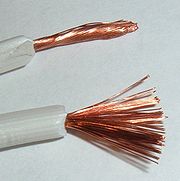
Stranded wire is more flexible than solid wire of the same total cross-sectional area. Solid wire is cheaper to manufacture than stranded wire and is used where there is little need for flexibility in the wire. Solid wire also provides mechanical ruggedness; and, because it has relatively less surface area which is exposed to attack by corrosives, protection against the environment. Stranded wire is used when higher resistance to metal fatigue
Metal Fatigue
Metal Fatigue , is a futuristic science fiction, real-time strategy computer game developed by Zono Incorporated and published by Psygnosis and TalonSoft .-Plot:...
is required. Such situations include
connections between circuit boards
Printed circuit board
A printed circuit board, or PCB, is used to mechanically support and electrically connect electronic components using conductive pathways, tracks or signal traces etched from copper sheets laminated onto a non-conductive substrate. It is also referred to as printed wiring board or etched wiring...
in
multi-printed-circuit-board devices, where the rigidity of solid
wire would produce too much stress as a result of movement during
assembly or servicing; A.C.
Alternating current
In alternating current the movement of electric charge periodically reverses direction. In direct current , the flow of electric charge is only in one direction....
line cords for
appliances; musical instrument cables; computer mouse cables; welding electrode cables; control cables connecting moving machine parts; mining machine cables; trailing machine cables; and numerous others.
At high frequencies, current travels near the surface of the wire because of the skin effect
Skin effect
Skin effect is the tendency of an alternating electric current to distribute itself within a conductor with the current density being largest near the surface of the conductor, decreasing at greater depths. In other words, the electric current flows mainly at the "skin" of the conductor, at an...
, resulting in increased power loss in the wire. Stranded wire might seem to reduce this effect, since the total surface area of the strands is greater than the surface area of the equivalent solid wire, but ordinary stranded wire does not reduce the skin effect because all the strands are short-circuited together and behave as a single conductor. A stranded wire will have higher resistance than a solid wire of the same diameter because the cross-section of the stranded wire is not all copper, there are unavoidable gaps between the strands (this is the circle packing
Circle packing
In geometry, circle packing is the study of the arrangement of circles on a given surface such that no overlapping occurs and so that all circles touch another. The associated "packing density", η of an arrangement is the proportion of the surface covered by the circles...
problem for circles within a circle). A stranded wire with the same cross-section of conductor as a solid wire is said to have the same equivalent gauge and is always a larger diameter.
However, for many high-frequency applications, proximity effect
Proximity effect (electromagnetism)
In a conductor carrying alternating current, if currents are flowing through one or more other nearby conductors, such as within a closely wound coil of wire, the distribution of current within the first conductor will be constrained to smaller regions. The resulting current crowding is termed the...
is more severe than skin effect, and in some limited cases, simple stranded wire can reduce proximity effect. For better performance at high frequencies, litz wire
Litz wire
Litz wire is a type of cable used in electronics to carry alternating current. The wire is designed to reduce the skin effect and proximity effect losses in conductors used at frequencies up to about 1 MHz...
, which has the individual strands insulated and twisted in special patterns, may be used.
Number of strands
The more individual wire strands in a wire bundle, the more flexible, kink-resistant, break-resistant, and stronger the wire is. But more strands cost more.The lowest number of strands is 7: one in the middle, 6 surrounding it.
The next level up is 19, which is another layer of 12 strands on top of the 7. After that the number varies, but 37 and 49 are common, then in the 70 to 100 range (the number is no longer exact). Even larger numbers than that are typically found only in very large wires.
For application where the wire moves, 19 is the lowest that should be used (7 should only be used in applications where the wire is placed and then does not move), and 49 is much better. For applications with constant repeated movement, such as assembly robots and headphone wires, 70 to 100 is mandatory.
For applications that need even more flexibility (welding is the usual example, but also any need to move wire in tight areas), even more strands are used. One example is a 2/0 wire made from 5,292 strands of #36 gauge wire. The strands are organized by first creating a bundle of 7 strands. Then 7 of these bundles are put together into super bundles. Finally 108 super bundles are used to make the final cable. Each group of wires is wound in a helix so that when the wire is flexed, the part of a bundle that is stretched moves around the helix to a part that is compressed to allow the wire to have less stress.
Varieties
- Hook-up wire is small-to-medium gauge, solid or stranded, insulated wire, used for making internal connections inside electrical or electronic devices. It is often tin-plated to facilitate soldering.
- Magnet wire is solid wire, usually copperCopper wire and cableCopper has been used in electric wiring since the invention of the electromagnet and the telegraph in the 1820s. The invention of the telephone in 1876 proved to be another early boon for copper wire....
, which, to allow closer winding when making electromagnetic coils, is insulated only with varnish, rather than the thicker plastic or other insulation commonly used on electrical wire. It is used for the winding of electric motors, transformerTransformerA transformer is a device that transfers electrical energy from one circuit to another through inductively coupled conductors—the transformer's coils. A varying current in the first or primary winding creates a varying magnetic flux in the transformer's core and thus a varying magnetic field...
s, inductors, generators, speakerLoudspeakerA loudspeaker is an electroacoustic transducer that produces sound in response to an electrical audio signal input. Non-electrical loudspeakers were developed as accessories to telephone systems, but electronic amplification by vacuum tube made loudspeakers more generally useful...
coils, etc. (For further information about copper magnet wireCopper wire and cableCopper has been used in electric wiring since the invention of the electromagnet and the telegraph in the 1820s. The invention of the telephone in 1876 proved to be another early boon for copper wire....
, see: http://en.wikipedia.org/wiki/Copper wire and cable#Magnet wire .28Winding wire.29.).
- Resistance wireResistance wireResistance wire is electrical wire used for its property of electrical resistance. It is routinely used at high temperatures, so normally also has high melting point....
is wire with higher than normal resistivity, often used for heating elementHeating elementA heating element converts electricity into heat through the process of Joule heating. Electric current through the element encounters resistance, resulting in heating of the element....
s or for making wire-wound resistors. NichromeNichromeNichrome is a non-magnetic alloy of nickel, chromium, and often iron, usually used as a resistance wire. Patented in 1905, it is the oldest documented form of resistance heating alloy. A common alloy is 80% nickel and 20% chromium, by mass, but there are many others to accommodate various...
wire is the most common type.
| Wire Abbreviation | Description |
| AF | Asbestos 302°F. Fixture wire,18-10 Awg. Heat resistant,With some moisture resistant types.300v. Max. |
| AL | Impregnated Asbestos Under 300v. 257°F., Dry only. |
| AVA, AVB, & AVL | Asbestos and Varnished Cambric, 194-230°F., Dry with AVL wet. |
| B | Outer Braid usually of Glass. |
| Bell | wire usually low voltage, usually of 18awg. No rubber used, just 2 layers of cotton twisted in opposite directions. |
| C | Two or more stranded wires with flexible insulation for temporary use. Thermoset or Thermoplastic, Dry Use Only. Rough service wire, but not as nice looking as “PO”. Twice as thick in insulation but similar to “PO” with silk or Rayon top layer. Usually a yellow / green braided jacket, “Green and Yellow Cord”. No outer jacket to wires, just twisted single strands. Lamp Cord, 2 or more 18-10Awg. (Now is Thermoset or thermoplastic insulation with outer cotton cover.) Pendant and portable use, not hard usage in dry locations. |
| DBRC | Old Household, double braided rubber coated wire with cotton braid. Weather and fire resistant. |
| E | Elevator Cable, 2 or more, 20-2 Awg. Conductors, Thermoset, 3 layer cotton braided with flexible Flame retardant and Moisture Resistant Nylon jacket. For Elevator Lighting and Control in non-hazardous locations. Can incorporate 20 Awg Communications cable and or optical fibers within covering, and be permitted to be supported thru- center of insulation. “L.S” Designation = Limited Smoke flame retardant. |
| EO | Elevator Cable, Same as Above with one type available for Hazardous locations. |
| ET | Elevator Cable, Same as E, with a Rayon Braid on each conductor. |
| ETLB | Same as E with No Braiding on each conductor.A14 |
| ETP | Same as E with Rayon Braided Conductors and for Hazardous Classified Locations. |
| ETT | Same as ETP with No Outer Cover. |
| EV | Electric Vehicle Cord. 18 - 500 KCMil. Awg. Two or more conductors, plus grounding conductors and optional hybrid data or signal communications and optional fiberoptic cables. Thermoset with optional nylon insulation and optional braiding. Thermoset outer covering. For electric vehicle charging in wet locations and for extra hard use. |
| EVJ | Same as EV cord but 18 to 12 Awg, and thinner jacket.B19 |
| EVE | Same as EV cord, but with thermoplastic Elastomer insulation and coverings. |
| EVT | Same as EV cord, but with Thermoplastic insulation. |
| F | Fixture Wire, 90°C. |
| FCC | Flat Copper Conductors, edge to edge for carpet, and under flooring. |
| FEP | Fluorinated Ethylene Propylene Insulation, Rated over 194°F. Dry only. |
| FEPB | Same as FeP, but with glass braid or Asbestos type outer covering. 392°F. Dry only. |
| FFH-2 | Heat resistant rubber coated fixture wire, flexible strands, 167̊F.Rubber coated and latex rubber coated types. |
| G | 8Awg to 500 KCMil., 2-6 conductors plus Grounding Conductors. Portable Thermoset, Oil Res., Extra Hard Use. Stage and Garage Cable. |
| H | Higher Loaded Current Temp. May be used 167°F. Max. |
| HF | ECTFE Solid or 7 stranded. 18-14 Awg. Ethylene Chloro trifluoroethylene. 302°F. Fixture wire. |
| HFF | ECTFE Stranded wire, same as HF. |
| HH | Much Higher Temperature 194°F. Max. |
| HPD | Heater Cord 18-12 Awg., 2 to 4 conductors. Dry Use Only. Thermoset or Thermoset with Asbestos covered wires instead of cotton, but similar to type C. Covered with cotton or Rayon. Not Hard usage.B31 |
| HPN | Heater Cord, 18-12 Awg., 2 to 3 Conductors. Wet use, Light Duty Only. Oil resistant Thermoset. Non twisted. |
| HS | Heater Cord, 14-12 Awg., 2 to 4 Conductors. Thermoset insulation with cotton or Thermoset Outer Covering, Extra Hard Usage. |
| HSJ | Same as HS. But 18 - 12 Awg., Hard Usage only. |
| HSO | Same as HS. with Oil Resistance Outer covering, Extra Hard Usage. |
| HSJO | Same as HSO but Only Hard Usage. 18 - 12 Awg Available. |
| HSOO | Same as HS. But with oil resistant Thermoset insulators, and oil resistant covering, Extra Hard Usage. |
| HSJOO | Same as HSOO but Hard Usage only and 18-12 Awg. Available. |
| IGS | Integrated Gas Spacer Cable, Exterior Use. |
| KF-1- and KF-2, | Tape insulated fixture wire, solid or 7 stranded, 18-10 Awg. Aromatic Polyamide taped, 392̊F. Fixture wire. |
| KFF-1- and KFF-2 | Stranded KF wire, note: -1- designates 300v. Max. |
| L | Lead Jacket. |
| MI | Mineral Insulated, Metal Shielded cable. Magnesium Oxide, 194°F or 482°F., Dry or wet locations, with copper or Alloy Steel outer covering. Mineral insulated and Metal Shielded. |
| MTW | Moisture, Heat and Oil Res. Flame Retardant Thermoplastic. Machine tool wiring in wet locations 140°F. Or 196°F. In dry locations with Nylon or Equivalent Jacket. |
| MV | Medium Voltage Cable, Solid Dielectric 2,001 volts plus. |
| N | Extruded Nylon or Thermoplastic Polyester, Tough and Very Resistant to Gas and Oil. |
| NM | “Romex”, Non-Metallic cable with paper wrapping between conductors and plastic sheeting. |
| NMT | See RFH wire Below. (Non-Metallic Tubing.) |
| NMC | “Romex”, Non-Metallic cable with solid plastic sheeting. |
| O | Neoprene Jacket. See SO cable. |
| P | Rough Service appliance vacuum cleaner type cord. Flexible but like type “C”, coated in rubber like “POSJ”, encasing both strands with an appearance fabric outside layer. |
| PAF | Perfluroalkoxy, Solid or 7 strand, 482°F. Fixture wire, 18-14 Awg. nickel or nickel coated copper fixture wire. See PFA wire. |
| PAFF | Stranded PAF wire, 302°F. |
| PD | 18-10 Awg. Thermoset or Thermoplastic Insulation Cotton braiding and Cotton or Rayon outer covering. Pendant or Portable Wiring, Dry Locations, Not Hard Usage. Twisted Portable Cord. |
| PF | Fluorinated Ethylene Propylene, fixture wire, solid or seven stranded 392̊F. 18-14 Awg. Fixture wire. |
| PFA | Perfluorglkoxy, 194°F. For dry and damp conditions. See PAF wire. |
| PFAH | Perfluorglkoxy, 482°F. Dry only, Raceway or Apparatus wire only. |
| PFF | Same as PF wire, but stranded. 302°F. |
| PGF | Fluorinated Ethylene Propylene, Glass Braided. 392°F. Solid or seven stranded. 18-14 Awg. Fixture Wire. |
| PGFF | Stranded PGF wire, 302°F. |
| PO | Lamp cord with outer layer of silk or Rayon. Wires not Twisted but Parallel. Cotton yarn wrapping round twisted strands; Insulators of rubber on top of cotton, which insulates rubber from sticking to strands making it more flexible. Cotton layer atop Rubber, with Rayon or silk jacket enclosing two wires in parallel. |
| POSJ | New Replacement for “PO” using a rubber jacket encasing both wires, and does not fray like fabric wires, can be washed. |
| PPE | Garage use Portable Power Cable, 8 - 500 KCMil. With 1 - 6 conductors plus ground conductors. Thermoplastic Elastomer Insulation, with Oil Resistant Thermoplastic Elastomer Outer Covering. Portable Extra Hard Use. Rated for Stage and |
| PTF | Extruded Polytetra Fluoroethylene, solid or seven stranded, 18-14 Awg. 482°F. Nickel or Nickel coated copper fixture wire. |
| PTFF | Stranded PTF wire, 302°F. 18-14 Awg. |
| R | Rubber or Neoprene insulation. (Best Quality Rubber) Household Wiring. |
| RFH-1 | Heat Resistant, Rubber Coated, 167°F. 18 Awg. 300v. Fixture wire, solid or seven stranded. Also type “NMT” Fixture wire. |
| RFH-2 | Heat Resistant, RFH wire, 18-16 Awg. 600v. with Latex Rubber or rubber coating. Otherwise the same as RFH-1 |
| RFHH-2 | (LS) Limited Smoke Flame Retardant, Heat Resistant Cross linked synthetic polymer insulated fixture wire. Solid or stranded 18-16 Awg. and cross linked synthetic polymer with out jacket. No cover or NMT 194°F. Multi conductor cable, and fixture wire. |
| RH | Thermoset, 167°F. Dry and Damp only, Flame Retardant, and Moisture Resistant. Best Quality, Better than RH and RP wire. For Factories and like. Moisture Res. & Flame Retardant non-metallic Covering. |
| RHH | Thermoset, 194°F. Dry and Damp only, Flame Retardant, and Moisture Resistant. |
| RP | Best Quality Rubber Insulation. |
| RUH | Heat Resistant Latex Rubber 167°F., Dry only. |
| RWH | Flame, Ozone and Moisture Resistant, 167°F. For dry and wet locations over 2,000 volts. |
| RWH-2 | 194°F. Continuous Temperature Thermoset. For Dry and Damp locations. |
| S | Hard Service Cord with two or more stranded conductors 18 - 2 Awg. with a serving of woven cotton between the copper and the Thermoset insulation. Jute or other “fillers” are twisted together with the conductors to make a round assembly. Outer jacket of high quality rubber or modern Thermoset. For Portable or Pendant, damp locations. Extra Hard Use. Stage and Garage Use. |
| SA | Silicone Rubber or Silicone Asbestos, 194°F. For dry and Damp Areas. Silicone Rubber insulation with Glass or other Braided covering. (392°F. Special Applications) |
| SBRC | Old Household, Single Braided rubber covered with cotton braid. |
| SC | “NEC” designation for Entertainment Industry and Stage Lighting Cable; rated 600 volts 8 Awg - 250 KCMil. 1 or more Conductors. Extra Hard Usage. Thermoset insulation and outer covering. |
| SCE | Same as SC, with PVC or Thermoplastic Elastomer Insulation and outer covering. |
| SCT | Same as SC, with TPE based thermoplastic Insulation and outer covering. |
| SE | Flame Retardant and Moisture Resistant, Hard Service Cord. 18 -2 Awg. 2 or more conductors, Use Underground, stage and Garage and not Fire Resistant. Thermoplastic Elastomer Insulation and outer covering. |
| SEO | Same as SE But with Oil Resistant Outer Covering. |
| SEOO | Same as SEO, But with oil Resistant Insulation also. |
| SIS | Switchboard wire 194°F. Thermoplastic Flame Resistant for Switchboards. Synthetic Heat resistant Rubber. Dry only. |
| SJ | Same as S-Cord, with Lighter Jacket 18-10 Awg. 2-5 Conductors, Thermoset Insulation and outer jacket. Junior Hard service Cord. |
| SJE | Same as SJ, with Thermoplastic Elastomer Insulation and outer covering. |
| SJEO | Same as SJE But Oil Resistant. |
| SJO | Same as SJ But with Oil Resistant outer covering. Same as SO cord, with an even lighter jacket. |
| SJOO | Same as SJO But with Oil resistant insulation also. |
| SJT | Same as SJ cord, except with outer jacket and insulation of (thermoplastic) Materials. |
| SF | Silicone 200°C. Fixture wire. |
| SF 1or 2 | Silicone Rubber NMT, 392°F. “-1\" is 18 Awg. 300v. “-2\" is 16-18 Awg. 600v. Solid or seven stranded. Fixture wire. |
| SFF 1or 2 | Stranded SF, NMT wire. 302°F. |
| SO | Cord, same as S cord, thermoset insulation with an oil resistant jacket of neoprene or similar material thermoset. Rated for stage and garage use. |
| SOO | Same as SO with Oil Resistant Insulation |
| SN | Synthetic rubber wire re-named “type T”, in 1947 from original 1940 code designation thermoplastic insulation, with no cotton required, not cold resistant. |
| SP | Rubber “Zip Cord”. |
| SP-1 | All Thermoset Parallel cord 20 -18 Awg, 2or3 Conductor. Pendant or portable use, Damp Locations, Not Hard Use. Not twisted. |
| SP-2 | Same as SP-1 But 18-16 Awg. |
| SP-3 | Same as SP-1 But 18-10 Awg. For Refrigerators, Room Air Conditioners. |
| SPE | All Elastomer, (Thermoplastic) Parallel Cord. 20-18 Awg. 2 or 3 Conductors. Otherwise same as SP-1 to 3 Cord. |
| SPT | “Zip Cord”, Fixture Cord, 2 or 3 wire Stranded, Designated by gauge and number of wires. Eg: “18-3\" is 18 gauge 3-wire. Thermoplastic Insulation. Otherwise same as Sp-1 to 3 cord. |
| SRD | Range or Dryer Cable. 10- 4 Awg. 3 or 4 conductors. Thermoset insulation and outer covering. Portable for damp locations. 3-Conductor versions are not twisted. |
| SRDE | Same as SRD cable but Thermoplastic Elastomer insulation and outer covering. |
| SRDT | Same as SRD cable but with Thermoplastic insulation and outer covering. |
| ST | Same as S cord, except with outer jacket of (thermoplastic) Materials. 18-2 Awg. 2 or more Conductors. Rated for Stage and Garage Use. |
| SV | Same as SJ Cord, with an even Lighter Jacket. Vacuum cleaner cord. 18-16 Awg. 2 or 3 conductors. Thermoset insulation and covering. Not hard use, pendant or portable, damp locations. |
| SVE | Same as SV cord but with Thermoplastic Elastomer insulation and covering. |
| SVO | Same as SV cord but with Thermoset insulation and oil resistant Thermoset covering. |
| SVT | Same as SV cord with outer jacket of (therm plastic) Materials. |
| T | Wire wrapped in thermoplastic insulation for protection from below 32° to 150°F. Tinsel Cord 140̊F,(TP, TS, TPT, TST) |
| TA | Thermoplastic and Asbestos, 194°F., Switchboard use only. |
| TC | Signal Wire, Power and Control. |
| TW | T-Wire with water-resistant insulation. Should not be buried directly in ground. 140° Flame Retardant, Heat and Moisture resistant thermoplastic. |
| TBS | Thermoplastic with Fibrous outer braid, 194°F. Fire Retardant (Switch Boards). |
| TBWP | Triple Braided weather proof with no rubber used, 3 layers of water proof cotton used on single wire outdoors services. |
| T2 | Thermoplastic covered fixture wire, solid or 7 stranded. 140°F. 18-16 Awg. Fixture Wire. |
| TFE | Extended Polytetrafluoroethylene. 482°F. Dry Locations only, Apparatus or Raceway lead wiring or open wiring, Avl. With Nickel or nickel coated copper wire only. |
| TFF | Same as T2 wire but stranded, 140°F. |
| TFN | Heat Resistant Thermoplastic covered fixture wire of solid or seven strands. 18-16 Awg. And a nylon jacket or equivalent covering 194°F. |
| TFNN | Same as TFN but stranded. |
| THW | TW-Wire 167°F. With heavier heat resistant insulation. Dry and Wet Locations, Flame Retardant. (194°F. Special Applications within electric discharge lighting equipment, 1,000w. open circuits or less.) |
| THHN | Thermoplastic 194°F. Insulation with outer nylon (or equivalent) jacket Heat Resistant, Flame Retardant with nylon or equivalent jacket. Dry and Damp Locations. |
| THHW | Thermoplastic 167°F. Wet Locations. Flame Retardant, Heat Resistant. (194°F. Dry Locations.) |
| TFE | Extruded Polytetra Fluoroethylene. 482°F. Dry areas only for Apparatus and raceway wiring or open wiring. |
| THWN | Thermoplastic insulation, 167°F. with outer nylon (or equivalent) jacket; Flame Retardant, Heat and Water Resistant. |
| TPE | ‘Flexalloy is a PVC based UHMW therrmoplastic elastomer from Teknor Apex, Vinyl Division, that is billed as being “lighter, more flexible, and more resistant to extreme cold” than cable produced with conventional compounds. Coast Wire and Plastics Technology is using it to jacket a new line of cable that they manufacture, called FlexOLite Touring Cable. The Flexalloy compound is used for the inner insulation and for the outer jacket. “One big advantage of Flexalloy vinyl TPE for insulation and jacketing is that it weighs only half as much as rubber,” - Jim Crisman, VP of the Entertainment Div. Of Coast Wire (PLSN p77 Cable Construction, Nov. 2003. |
| TPT | Parallel Tinsel cord. 27 Awg. 2 conductor. Thermoplastic insulation and covering. Attached to an appliance rated at not more than 50 watts and not more than 8 feet away with a special connector, for damp locations and not hard, but extremely flexible use. Not Twisted conductors. |
| TS | Jacketed Tinsel cord. 27 Awg. 2 conductor. Thermoset insulation and covering, same as TPT otherwise. |
| TST | Same as TS cord but with thermoplastic insulation and covering. |
| UF | Underground Feeder and Branch Circuit Cable, 140°F. a water proof version of NMC, rated for burial in the ground. |
| USE | Underground Service Entrance Cable not fire resistant but high temp. Wire 167°F. Replaces Lead shielded cable. Heavily rubber coated, with outer covering extra water resistant, can also be type “T” with thermoplastic protection. |
| V | Varnished Cambric, #6 to MCM2000, 185°F., Dry use only. |
| W | Cord Rated 2,000 volts Extra Hard Usage; 8-500 KCMil. 1-6 conductors. Replaced welding cable as in acceptable stage cable until type SC was developed. Thermoset insulation with Oil Resistant Thermoset cover. Rated for Stage and garage use. |
| X | Crossed linked Synthetic polymer, Very Tough, Moisture and Heat Resistant. Fixture wire. |
| XF | Same as X wire but solid or seven stranded, 302°F. 300v. 18-10Awg. Cross-Linked Polyolefin. |
| XFF | Same as XF, but stranded. |
| XHH | Thermoset, 194°F. Dry and damp locations. Flame Retardant. |
| XHHW | Moisture Resistant Thermoset, 194°F. For dry and Damp locations and 167°F. For wet locations. Flame Retardant, and moisture resistant. |
| Z | Dry and Damp Locations, 194°F.(302°F. Dry locations in special applications) Modified Ethylene Tetrafluoroethylene. |
| ZF | Modified ethylene tetrafluoroethylene, solid or seven stranded, 18-14 Awg. same as Z above, 302°F. Fixture Wire. |
| ZFF | Same as ZF above but stranded. |
| ZHF | High temperature modified ETFE solid or seven stranded. 392°F. 18-14 Awg. Fixture wire. |
| ZW | Modified Ethylene Tetrafluoroethylene Wet Locations, 167°F.; (194°F. Dry and Damp; 302°F. Dry, special Applications). |
See also
- For transmission see: Power cablePower cableA power cable is an assembly of two or more electrical conductors, usually held together with an overall sheath. The assembly is used for transmission of electrical power...
, High voltage cableHigh voltage cableA high voltage cable - also called HV cable - is used for electric power transmission at high voltage. High voltage cables of differing types have a variety of applications in instruments, ignition systems, AC and DC power transmission...
and HVDCHigh-voltage direct currentA high-voltage, direct current electric power transmission system uses direct current for the bulk transmission of electrical power, in contrast with the more common alternating current systems. For long-distance transmission, HVDC systems may be less expensive and suffer lower electrical losses...
- Barbed wireBarbed wireBarbed wire, also known as barb wire , is a type of fencing wire constructed with sharp edges or points arranged at intervals along the strand. It is used to construct inexpensive fences and is used atop walls surrounding secured property...
- CableCableA cable is two or more wires running side by side and bonded, twisted or braided together to form a single assembly. In mechanics cables, otherwise known as wire ropes, are used for lifting, hauling and towing or conveying force through tension. In electrical engineering cables are used to carry...
- Chicken wireChicken wireChicken wire, or poultry netting, is a mesh of wire commonly used to fence poultry livestock. It is made of thin, flexible galvanized wire, with hexagonal gaps...
- Electrical connectorElectrical connectorAn electrical connector is an electro-mechanical device for joining electrical circuits as an interface using a mechanical assembly. The connection may be temporary, as for portable equipment, require a tool for assembly and removal, or serve as a permanent electrical joint between two wires or...
- Electrical wiringElectrical wiringElectrical wiring in general refers to insulated conductors used to carry electricity, and associated devices. This article describes general aspects of electrical wiring as used to provide power in buildings and structures, commonly referred to as building wiring. This article is intended to...
- Litz wireLitz wireLitz wire is a type of cable used in electronics to carry alternating current. The wire is designed to reduce the skin effect and proximity effect losses in conductors used at frequencies up to about 1 MHz...
- Razor wireRazor wireBarbed tape or razor wire is a mesh of metal strips with sharp edges whose purpose is to prevent passage by humans. The term "razor wire", through long usage, has generally been used to describe barbed tape products...
- THHN
- Tinsel wireTinsel wireTinsel wire is a form of low voltage electrical wire used when maximum mechanical flexibility is required. It is commonly found in cords used for telephones, especially the handset cords, and in headphones. Because of its extreme flexibility it is much more resistant to failing as a result of metal...
- Wire gaugeWire gaugeWire gauge is a measurement of how large a wire is, either in diameter or cross sectional area. This determines the amount of electric current a wire can safely carry, as well as its electrical resistance and weight per unit of length...
- Wire netting
- Wire ropeWire ropethumb|Steel wire rope Wire rope is a type of rope which consists of several strands of metal wire laid into a helix. Initially wrought iron wires were used, but today steel is the main material used for wire ropes....
- Wire wrapped jewelryWire wrapped jewelryWire wrapping is one of the oldest techniques for making jewelry by hand. In wire wrapping, jewelry is made using jewelry wire and findings similar to wire to make components. Wire components are then connected to one another using mechanical techniques with no soldering or heating of the wire...
- Wollaston wireWollaston wireWollaston wire is a very fine platinum wire clad in silver and used in electrical instruments. For most uses, the silver cladding is etched away by acid to expose the platinum core.- History :...
External links
- Wire Gauge to Diameter—Diameter to Wire Gauge Converter - Online calculator converts gauge to diameter or diameter to gauge for any wire size.