

Sarcosuchus

Encyclopedia
Sarcosuchus is an extinct
genus
of crocodyliform and distant relative of the crocodile
that lived 112 million years ago. It dates from the early Cretaceous
Period of what is now Africa
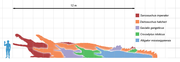
and is one of the largest giant crocodile-like reptiles that ever lived. It was almost twice as long as the modern saltwater crocodile and weighed approximately 8 to 10 tonnes.
Until recently, all that was known of the genus was a few fossil
ised teeth
and armour scutes, which were discovered in the Sahara Desert
by the French paleontologist
Albert-Félix de Lapparent
, in the 1940s or 1950s. He called it the "Aoulef crocodile". However, in 1997 and 2000, American paleontologist Paul Sereno
discovered half a dozen new specimens, including one with about half the skeleton intact and most of the spine
. All of the other giant crocodiles are known only from a few partial skulls, so which is actually the biggest is an open question.
(11.2–12.2 metres or 37–40 ft) and weighed up to 8 tonne
s (8.75 ton
s). The largest living crocodilian, the saltwater crocodile
, is less than two-thirds of that length (6.3 meters or 20.6 ft is the longest confirmed individual) and a small fraction of the weight (1,200 kg, or 1.3 tons).
 The very largest Sarcosuchus is believed to have been the oldest. Osteoderm growth rings taken from an 80% grown individual (based on comparison to largest individual found) suggest that Sarcosuchus kept growing throughout its entire 50–60 year average life span
. Modern crocodiles grow at a rapid rate, reaching their adult size in about a decade, then growing more slowly afterward.
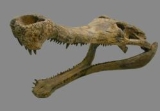
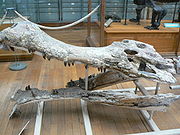
Its skull
alone was as big as a human
adult (1.78 m, or 5 ft 10 inches). The upper jaw overlapped the lower jaw, creating an overbite. The jaws were relatively narrow (especially in juveniles). The snout comprises about 75% of the skull's length.
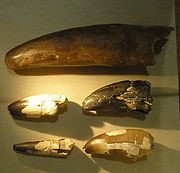
The huge jaw
contained 132 thick teeth; Larsson said they were like "railroad spikes". Instead of being narrow and adapted for slashing like the teeth of some land-dwelling carnivores, the teeth were conical, adapted for grabbing and holding, more like those of true crocodilians, which normally dispatch prey simply by holding them underwater until they drown. Sarcosuchus could probably exert a force of 80 kN (18,000 lbf
) with its jaw, making it very unlikely that prey could escape.
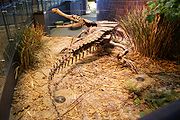 It had a row of bony plates or osteoderm
s, running down its back, the largest of which were 1 m (3 ft) long. The scutes served as armour and may have helped support its great mass, but also restricted its flexibility.
Sarcosuchus also had a strange depression at the end of its snout. Called a bulla, it has been compared to the ghara seen in gharial
s. Unlike the ghara, though, the bulla is present in all Sarcosuchus skulls that have been found so far. This suggests it was not a sexually selected characteristic; only the male gharial
has a ghara. The purpose of this structure remains enigmatic. Sereno and others asked various reptile researchers what their thoughts on this bulla were. Opinions ranged from it being an olfactory enhancer to being connected to a vocalization device.
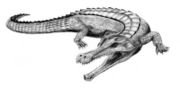 The eye sockets of Sarcosuchus rotated upwards and were somewhat telescoped. This suggests that the animal probably spent most of its time with the majority of its body submerged, watching the shore for prey.
It seems likely that it ate the large fish
and turtle
s of the Cretaceous. As the overhanging jaw and stout teeth are designed for grabbing and crushing, its primary prey may have been large animals and smaller dinosaur
s, which it ambushed, dragged into the water, crushed, drowned and then tore apart.
 It may have come into conflict with Suchomimus
, an 11 m (36 ft) theropod dinosaur with a gharial-like snout, whose fossils were found in the same geological formation as Sarcosuchus. According to Sereno, "because the ancient animal was so large, it could easily handle huge dinosaurs, including the massive long-necked, small-headed sauropods that were common in that Africa
n region".
Other crocodilian biologists are skeptical of the animal's "giant killing" capabilities. The long, thin snout of Sarcosuchus was very similar to the thin snouts of the modern gharial, the false gharial
and the slender-snouted crocodile
, all of which are nearly exclusive fish-eaters and incapable of tackling large prey. This can be contrasted to both the modern Nile crocodile
and the extinct Deinosuchus
, both of which exhibit very broad, heavy skulls, suitable for dealing with large prey. This, coupled with the abundance of large, lobe-finned fish
in its environment, leads many to suggest that, far from being a dinosaur killer, Sarcosuchus was simply a large piscivore, a scaled-up version of the modern gharial.
 However, while the snout of juvenile Sarcosuchus strongly resembled modern narrow-snouted crocodiles in width, it expands dramatically in mature individuals. While still comparatively narrower than the snout of a Nile crocodile, the snout is still much wider than the snouts of crocodilians like the gharial
. In addition, the teeth do not interlock, like those of mostly piscivorous crocodilians. This suggests that, like the Nile crocodile, it may have complemented a primarily fish diet with terrestrial animals, at least upon maturity.
It is pertinent to note, though, that the lobe-finned fish that shared the waters with Sarcosuchus were often in excess of 1.8 m (6 ft) long and 90 kg (200 lb) in weight. This raises the possibility of those adaptations, which seem to indicate large or moderate-sized terrestrial prey, may instead have been adaptations for dealing with exceptionally large fish (many species of which possessed a layer of osteoderms, for protection).
plain
, dotted with lake
s and crossed by river
s and stream
s that were lined with vegetation. Based on the number of fossils discovered, the aquatic
Sarcosuchus was probably plentiful in these warm, shallow, freshwater
habitats.
Unlike modern true crocodiles, which are very similar in size and shape to one another and tend to live in different areas; Sarcosuchus was just one of many Crocodyliformes, of different sizes and shapes, all living in the same area. Four other species of extinct Crocodyliformes were also discovered in the same rock formation along with the Sarcosuchus, including a dwarf crocodile with a tiny, 8 cm (3 in) long skull. They filled a diverse variety of ecological
niches, instead of competing with each other for resources.
), limb
bones, hip bones (a pelvic girdle
), the bony armored plates that ran down its back (scutes) and more than a half-dozen skull
s. Many crocodyliform skulls are thick and heavy. They tend to be found more frequently than the rest of the body. This is quite a contrast with dinosaurs, whose relatively fragile skulls rarely become part of the fossil record.
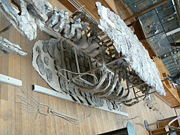 The osteoderms of ancient reptiles have been used to determine age (Erickson & Brochu, 1999). Since they retain growth rings, like those found in tree
s (most other bones "suffer" remodeling with age, which destroys former growth rings), it is theoretically possible to count the age of the individual that the bones belonged to. One 80% grown specimen was discovered with 40 rings, indicating that it had lived for 40 years. This form of growth rate calculation has been somewhat controversial. Others (Schwimmer, 2002) have criticised this form of growth measurement, as annular rings are harder to determine in a creature that lives in an environment that is without extreme seasonality, such as the Mesozoic.
No skeleton was complete enough to measure directly, so the maximum length estimate was calculated by measuring the largest skull and comparing it to modern crocodiles. In modern crocodiles, the skull and body are the same proportion regardless of age or sex. The primary difference is that species with a long snout have larger heads in proportion to their bodies than species with relatively broad snouts. The length of Sarcosuchus was the average of the expected length of the narrow-snouted gharial and the intermediate-snouted saltwater crocodile, while the mass was the expected mass of the latter. Sereno also measured living crocodilians in India
and Costa Rica
and used that data in his analysis.
As part of a National Geographic Society
Special, Greg Erickson of Florida State University
, Kent Vliet of the University of Florida
and Kristopher Lapping of Northern Arizona University
provoked American alligator
s, at the St. Augustine Alligator Farm and Zoological Park in Florida
, into biting a bar studded with piezoelectric sensors. The largest alligator they tested] was able to exert a force of 9.45 kN (2,125 lbf). By comparing the force exerted by more than 60 animals, they were able to determine that the force exerted was proportional to the size of the animal, which allowed an estimate of the biting power of the Sarcosuchus. This force was calculated to be 80 kN (18,000 lbf
).
Giant crocodiles seem to be a good example of convergence
because, according to Schwimmer, "the idea of really big crocs is a repeat theme in evolution". This may in part be due to body design and in part due to environment: The armoured plates of the back can provide structural support to a massive body), and water can buoy up their massive bodies. (See also: Cope's rule
)
A study of another giant crocodilian, Deinosuchus, indicated that it grew at about the same rate as modern crocodiles, up to 0.5 m (1.5 ft) per year. It was larger, because it kept growing, reaching full adulthood in 35 years, instead of 10. While there is a genetic component, growing that large also requires a rich diet. All the different giant crocodiles must have lived in near-perfect environments, with vast areas of warm, shallow water and abundant prey.
Deinosuchus, which was from the Late Cretaceous
of what is now North America
, is also a good example of a giant crocodile that is only distantly related to Sarcosuchus. Deinosuchus, which is only known from skulls, had a smaller skull than Sarcosuchus, but a broad snout, like an alligator
. This means that the skull of the Deinosuchus is probably a smaller portion of its total body length than the skull of the long-snouted Sarcosuchus, so its total size may be as large, or even larger. Other rivals in size of Sarcosuchus are Purussaurus
from the Miocene
of what is now Peru
and Brazil
, and Rhamphosuchus
from the Miocene and Pliocene
of what is now India
. However, their fossils are less complete.
The relationship between the giant crocodiles can be seen in the following simplified evolutionary tree:
 Sarcosuchus is not an ancestor of modern crocodiles. Also, it is not a crocodilian in the phylogenetic definition of the term. A crocodilian is any member of the clade
Crocodilia
. Crocodilia includes all modern forms, such as crocodile
s proper, alligator
s, etc., and their immediate prehistoric relatives. Sarcosuchus is a member of the family
Pholidosauridae, more distantly related to today's crocodilians.
"Crocodile" is a term commonly used in a much broader sense. The first "crocodile-like reptiles" — the Crocodylomorpha
— which split from the bird-line of archosaur
s — the group of reptiles that include dinosaurs, pterosaurs and birds — about 230 million years ago, in the Late Triassic
, looked somewhat like modern crocodilians. They had long legs and long bodies covered with armour.
Until the 1980s, the pholidosaurids were classified as part of the presumed suborder Mesosuchia
, within the order Crocodilia. However, Benton and Clark determined in 1988 that Mesosuchia was a paraphyletic
group, containing the ancestor of all modern crocodiles. A simplified evolutionary tree:
Teeth and osteoderms found in Brazil
belong to a close relative of Sarcosuchus: Sarcosuchus hartii (Marsh, 1869). S. hartii has a complicated taxonomic history. It was discovered in 1867 by an American naturalist
, Charles Frederick Hartt
near a train station in the area of Recôncavo in the state of Bahia in northeastern Brazil
. Hartt send the fossils - teeth, osteoderm
s and a fragment of the jaw - to the American paleontologist Othniel Charles Marsh
, who later published its scientific description in the American Journal of Science, in 1869, naming based on these remains two new species: Thoracosaurus
bahiensis, with small teeth strongly striated and Crocodilus hartii, with large teeth with little roughs. The specific name hartii honors Charles Hartt. Subsequent findings of crocodilians in the area were attributed to a species described by Edward D. Cope
, Hyposaurus
derbianus of Pernambuco
; in 1907 Mawson and Woodward reclassified the material as belonging to the genus Goniopholis
, with the species G. bahiensis and G. hartii, the latter including additional remains found until that time.
The status of these fossils remained so until a restudy of the same made by Eric Buffetaut and Philippe Taquet
in 1977. The study examined the remains compared with the genus Sarcosuchus described by Taquet in 1966. The remains showed more similarities to Sarcosuchus than Goniopholis, for example the Brazilian and North African remains had a very long mandibular symphysis
, an indicator of long-snouted skull, while Goniopholis had a shorter snout, and therefore its symphysis was equally short. The jaws of both crocodilians were spatulate in form at the front, with the first and second socket of the teeth very small and the third and fourth enlarged teeth are similar in size and shape, with the same enamel
ornamentation in the form of roughness winding. The attribution to Goniopholis, based on the shape of the osteoderm
s (bone scutes), it seems unlikely since it is based on the presence of a peg in them, which is common to other Mesozoic crocodilians as Steneosaurus
. Other remains of Bahia attributed to Thoracosaurus bahiensis and Hyposaurus and can not be attributed to the level of genus or species, and their assignment was based on the idea that sediments in the area are Upper Cretaceous, when in fact are from the Lower Cretaceous. Taquet and Buffetaut therefore concluded that the species should be reassigned to Sarcosuchus, maintaining the separation of African and South American remains in two different species (S. imperator and S. hartii) given the geographical separation, but their level of similarity is so strong that they could not rule that in reality they were a single species, although this hypothesis could only be contrasted with the discovery of additional remains. The Brazilian Sarcosuchus, like S. imperator was a large animal. The skull of S. imperator is 1.8 meters long, with a body of 11 to 12 meters long; for its part, the cranial remains of S. hartii measures 43 centimeters in length, although only is the anterior part of the mandible, so it can be assumed similar in size to the African species. The similarities between this two species it is possibly evidence that land bridges between Africa
and South America
existed much later than was previously believed.
On the other hand, based on the structure of the snout, the closest relative of Sarcosuchus is the pholidosaurid Terminonaris
, with Dyrosaurus
and Pholidosaurus
as slightly more distant relatives. As a group, they are narrow-snouted fish-eaters from saltwater environments, except for the broader snouted, river-dwelling Sarcosuchus.
 The fossils were discovered in Gadoufaoua
, Niger
in the Ténéré Desert
, which is part of the Sahara. The first Sarcosuchus teeth and scutes were recovered by the French paleontologist Albert-Félix de Lapparent, in the 1940s or 1950s. It was 1964, however, before a skull was discovered by geologist
s and brought to the attention of paleontologist Philippe Taquet
. He shipped it to Paris, where it was examined by France de Broin. Together, they formally named and described the species, in 1966, before returning the specimen to Niger.
In 1966, de Lapparent's niece France de Broin and Taquet named the creature Sarcosuchus imperator, which is dervived from sarco (meaning "flesh"), suchus (meaning "crocodile") and imperator (Latin
, meaning "emperor"), i.e., the flesh crocodile emperor. The holotype
specimen is MNN 604.
The next major expedition was Paul Sereno's trip, in 1997 and the follow-up trip in 2000. He recovered partial skeletons, numerous skulls and 20 tons of assorted other fossils from the deposits of the Elrhaz Formation
, which has been dated as late Aptian
or early Albian
stages of the late Cretaceous. It took about a year to prepare the Sarcosuchus remains. The discovery was then published on October 25, 2001, in the scientific journal Science
by Paul C. Sereno of the University of Chicago
and National Geographic's Explorer-in-Residence, Hans C. E. Larsson from Yale University
and the University of Toronto
(formerly a student at the University of Chicago), Christian Sidor of the New York College of Osteopathic Medicine
in Old Westbury, New York
and Boubé Gado of the Institut de Recherches en Sciences Humaines in Niamey
, Niger
.
Additional fossil material has been found from the area of Nalut in northwestern Libya
. These fossils are from the Cabao Formation, which is likely to be Hauterivian
to Barremian
in age. Other vertebrates from the Cabao Formation include the hybodont
shark
Priohybodus, an abelisaurid
, a baryonichine spinosaurid
, Spinosaurus
, and a large sauropod
.
's film Supercroc, although its size was much larger than the actual animal and was capable of surviving two bunker buster
bombs. Sarcosuchus also featured in the BBC series Chased by Dinosaurs
(in the Land of Giants episode) as well in a National Geographic Society
documentary titled SuperCroc. It was also featured in the 2009 documentary Monsters Resurrected
where it was depicted as living in coastal waters. And in the documentary televisión series produced by the BBC Planet Dinosaur
(2011).
Extinction
In biology and ecology, extinction is the end of an organism or of a group of organisms , normally a species. The moment of extinction is generally considered to be the death of the last individual of the species, although the capacity to breed and recover may have been lost before this point...
genus
Genus
In biology, a genus is a low-level taxonomic rank used in the biological classification of living and fossil organisms, which is an example of definition by genus and differentia...
of crocodyliform and distant relative of the crocodile
Crocodile
A crocodile is any species belonging to the family Crocodylidae . The term can also be used more loosely to include all extant members of the order Crocodilia: i.e...
that lived 112 million years ago. It dates from the early Cretaceous
Cretaceous
The Cretaceous , derived from the Latin "creta" , usually abbreviated K for its German translation Kreide , is a geologic period and system from circa to million years ago. In the geologic timescale, the Cretaceous follows the Jurassic period and is followed by the Paleogene period of the...
Period of what is now Africa
Africa
Africa is the world's second largest and second most populous continent, after Asia. At about 30.2 million km² including adjacent islands, it covers 6% of the Earth's total surface area and 20.4% of the total land area...
and is one of the largest giant crocodile-like reptiles that ever lived. It was almost twice as long as the modern saltwater crocodile and weighed approximately 8 to 10 tonnes.
Until recently, all that was known of the genus was a few fossil
Fossil
Fossils are the preserved remains or traces of animals , plants, and other organisms from the remote past...
ised teeth
Tooth
Teeth are small, calcified, whitish structures found in the jaws of many vertebrates that are used to break down food. Some animals, particularly carnivores, also use teeth for hunting or for defensive purposes. The roots of teeth are embedded in the Mandible bone or the Maxillary bone and are...
and armour scutes, which were discovered in the Sahara Desert
Sahara
The Sahara is the world's second largest desert, after Antarctica. At over , it covers most of Northern Africa, making it almost as large as Europe or the United States. The Sahara stretches from the Red Sea, including parts of the Mediterranean coasts, to the outskirts of the Atlantic Ocean...
by the French paleontologist
Paleontology
Paleontology "old, ancient", ὄν, ὀντ- "being, creature", and λόγος "speech, thought") is the study of prehistoric life. It includes the study of fossils to determine organisms' evolution and interactions with each other and their environments...
Albert-Félix de Lapparent
Albert-Félix de Lapparent
Albert-Félix de Lapparent was a French palaeontologist. He was also a Sulpician priest. He undertook a number of fossil-hunting explorations in the Sahara desert. He contributed greatly to our knowledge of dinosaurs and other prehistoric creatures...
, in the 1940s or 1950s. He called it the "Aoulef crocodile". However, in 1997 and 2000, American paleontologist Paul Sereno
Paul Sereno
Paul Callistus Sereno is an American paleontologist from the University of Chicago who discovered several new dinosaur species on several continents. He has conducted excavations at sites as varied as Inner Mongolia, Argentina, Morocco, and Niger...
discovered half a dozen new specimens, including one with about half the skeleton intact and most of the spine
Vertebral column
In human anatomy, the vertebral column is a column usually consisting of 24 articulating vertebrae, and 9 fused vertebrae in the sacrum and the coccyx. It is situated in the dorsal aspect of the torso, separated by intervertebral discs...
. All of the other giant crocodiles are known only from a few partial skulls, so which is actually the biggest is an open question.
Description
When fully mature, Sarcosuchus is believed to have been as long as a city busBus
A bus is a road vehicle designed to carry passengers. Buses can have a capacity as high as 300 passengers. The most common type of bus is the single-decker bus, with larger loads carried by double-decker buses and articulated buses, and smaller loads carried by midibuses and minibuses; coaches are...
(11.2–12.2 metres or 37–40 ft) and weighed up to 8 tonne
Tonne
The tonne, known as the metric ton in the US , often put pleonastically as "metric tonne" to avoid confusion with ton, is a metric system unit of mass equal to 1000 kilograms. The tonne is not an International System of Units unit, but is accepted for use with the SI...
s (8.75 ton
Short ton
The short ton is a unit of mass equal to . In the United States it is often called simply ton without distinguishing it from the metric ton or the long ton ; rather, the other two are specifically noted. There are, however, some U.S...
s). The largest living crocodilian, the saltwater crocodile
Saltwater Crocodile
The saltwater crocodile, also known as estuarine or Indo-Pacific crocodile, is the largest of all living reptiles...
, is less than two-thirds of that length (6.3 meters or 20.6 ft is the longest confirmed individual) and a small fraction of the weight (1,200 kg, or 1.3 tons).
Life expectancy
Life expectancy is the expected number of years of life remaining at a given age. It is denoted by ex, which means the average number of subsequent years of life for someone now aged x, according to a particular mortality experience...
. Modern crocodiles grow at a rapid rate, reaching their adult size in about a decade, then growing more slowly afterward.
Its skull
Skull
The skull is a bony structure in the head of many animals that supports the structures of the face and forms a cavity for the brain.The skull is composed of two parts: the cranium and the mandible. A skull without a mandible is only a cranium. Animals that have skulls are called craniates...
alone was as big as a human
Human
Humans are the only living species in the Homo genus...
adult (1.78 m, or 5 ft 10 inches). The upper jaw overlapped the lower jaw, creating an overbite. The jaws were relatively narrow (especially in juveniles). The snout comprises about 75% of the skull's length.
The huge jaw
Jaw
The jaw is any opposable articulated structure at the entrance of the mouth, typically used for grasping and manipulating food. The term jaws is also broadly applied to the whole of the structures constituting the vault of the mouth and serving to open and close it and is part of the body plan of...
contained 132 thick teeth; Larsson said they were like "railroad spikes". Instead of being narrow and adapted for slashing like the teeth of some land-dwelling carnivores, the teeth were conical, adapted for grabbing and holding, more like those of true crocodilians, which normally dispatch prey simply by holding them underwater until they drown. Sarcosuchus could probably exert a force of 80 kN (18,000 lbf
Pound-force
The pound force is a unit of force in some systems of measurement including English engineering units and British gravitational units.- Definitions :...
) with its jaw, making it very unlikely that prey could escape.
Osteoderm
Osteoderms are bony deposits forming scales, plates or other structures in the dermal layers of the skin. Osteoderms are found in many groups of extant and extinct reptiles, including lizards, various groups of dinosaurs , crocodilians, phytosaurs, aetosaurs, placodonts, and hupehsuchians...
s, running down its back, the largest of which were 1 m (3 ft) long. The scutes served as armour and may have helped support its great mass, but also restricted its flexibility.
Sarcosuchus also had a strange depression at the end of its snout. Called a bulla, it has been compared to the ghara seen in gharial
Gharial
The gharial , , also called Indian gavial or gavial, is the only surviving member of the once well-represented family Gavialidae, a long-established group of crocodilians with long, slender snouts...
s. Unlike the ghara, though, the bulla is present in all Sarcosuchus skulls that have been found so far. This suggests it was not a sexually selected characteristic; only the male gharial
Gharial
The gharial , , also called Indian gavial or gavial, is the only surviving member of the once well-represented family Gavialidae, a long-established group of crocodilians with long, slender snouts...
has a ghara. The purpose of this structure remains enigmatic. Sereno and others asked various reptile researchers what their thoughts on this bulla were. Opinions ranged from it being an olfactory enhancer to being connected to a vocalization device.
Behaviour and diet
It seems likely that it ate the large fish
Fish
Fish are a paraphyletic group of organisms that consist of all gill-bearing aquatic vertebrate animals that lack limbs with digits. Included in this definition are the living hagfish, lampreys, and cartilaginous and bony fish, as well as various extinct related groups...
and turtle
Turtle
Turtles are reptiles of the order Testudines , characterised by a special bony or cartilaginous shell developed from their ribs that acts as a shield...
s of the Cretaceous. As the overhanging jaw and stout teeth are designed for grabbing and crushing, its primary prey may have been large animals and smaller dinosaur
Dinosaur
Dinosaurs are a diverse group of animals of the clade and superorder Dinosauria. They were the dominant terrestrial vertebrates for over 160 million years, from the late Triassic period until the end of the Cretaceous , when the Cretaceous–Paleogene extinction event led to the extinction of...
s, which it ambushed, dragged into the water, crushed, drowned and then tore apart.
Suchomimus
Suchomimus is a genus of large spinosaurid dinosaur with a crocodile-like mouth that lived sometime between 121-112 million years ago, during the late Aptian stage of the Cretaceous period in Africa.-Description:...
, an 11 m (36 ft) theropod dinosaur with a gharial-like snout, whose fossils were found in the same geological formation as Sarcosuchus. According to Sereno, "because the ancient animal was so large, it could easily handle huge dinosaurs, including the massive long-necked, small-headed sauropods that were common in that Africa
Africa
Africa is the world's second largest and second most populous continent, after Asia. At about 30.2 million km² including adjacent islands, it covers 6% of the Earth's total surface area and 20.4% of the total land area...
n region".
Other crocodilian biologists are skeptical of the animal's "giant killing" capabilities. The long, thin snout of Sarcosuchus was very similar to the thin snouts of the modern gharial, the false gharial
False gharial
The false gharial , also known as the Malayan gharial, false gavial, or Tomistoma is a freshwater crocodile of the Crocodylidae family with a very thin and elongated snout...
and the slender-snouted crocodile
Slender-snouted Crocodile
The African Slender-snouted Crocodile is a species of crocodile. Recent studies in DNA and morphology suggest that it may belong in its own genus, Mecistops, but at present most continue to use Crocodylus for this species.African Slender-snouted Crocodile are native to freshwater habitats in...
, all of which are nearly exclusive fish-eaters and incapable of tackling large prey. This can be contrasted to both the modern Nile crocodile
Nile crocodile
The Nile crocodile or Common crocodile is an African crocodile which is common in Somalia, Ethiopia, Uganda, Kenya, Egypt, Tanzania, Zambia, Zimbabwe, Gabon, South Africa, Malawi, Sudan, Botswana, and Cameroon...
and the extinct Deinosuchus
Deinosuchus
Deinosuchus is an extinct genus related to the alligator that lived 73 to 80 Ma , during the late Cretaceous period. The name translates as "terrible crocodile" and is derived from the Greek deinos , "terrible", and soukhos , "crocodile"...
, both of which exhibit very broad, heavy skulls, suitable for dealing with large prey. This, coupled with the abundance of large, lobe-finned fish
Sarcopterygii
The Sarcopterygii or lobe-finned fishes – sometimes considered synonymous with Crossopterygii constitute a clade of the bony fishes, though a strict classification would include the terrestrial vertebrates...
in its environment, leads many to suggest that, far from being a dinosaur killer, Sarcosuchus was simply a large piscivore, a scaled-up version of the modern gharial.
Gharial
The gharial , , also called Indian gavial or gavial, is the only surviving member of the once well-represented family Gavialidae, a long-established group of crocodilians with long, slender snouts...
. In addition, the teeth do not interlock, like those of mostly piscivorous crocodilians. This suggests that, like the Nile crocodile, it may have complemented a primarily fish diet with terrestrial animals, at least upon maturity.
It is pertinent to note, though, that the lobe-finned fish that shared the waters with Sarcosuchus were often in excess of 1.8 m (6 ft) long and 90 kg (200 lb) in weight. This raises the possibility of those adaptations, which seem to indicate large or moderate-sized terrestrial prey, may instead have been adaptations for dealing with exceptionally large fish (many species of which possessed a layer of osteoderms, for protection).
Environment
110 million years ago, in the Early Cretaceous, the Sahara was still a great tropicalTropics
The tropics is a region of the Earth surrounding the Equator. It is limited in latitude by the Tropic of Cancer in the northern hemisphere at approximately N and the Tropic of Capricorn in the southern hemisphere at S; these latitudes correspond to the axial tilt of the Earth...
plain
Plain
In geography, a plain is land with relatively low relief, that is flat or gently rolling. Prairies and steppes are types of plains, and the archetype for a plain is often thought of as a grassland, but plains in their natural state may also be covered in shrublands, woodland and forest, or...
, dotted with lake
Lake
A lake is a body of relatively still fresh or salt water of considerable size, localized in a basin, that is surrounded by land. Lakes are inland and not part of the ocean and therefore are distinct from lagoons, and are larger and deeper than ponds. Lakes can be contrasted with rivers or streams,...
s and crossed by river
River
A river is a natural watercourse, usually freshwater, flowing towards an ocean, a lake, a sea, or another river. In a few cases, a river simply flows into the ground or dries up completely before reaching another body of water. Small rivers may also be called by several other names, including...
s and stream
Stream
A stream is a body of water with a current, confined within a bed and stream banks. Depending on its locale or certain characteristics, a stream may be referred to as a branch, brook, beck, burn, creek, "crick", gill , kill, lick, rill, river, syke, bayou, rivulet, streamage, wash, run or...
s that were lined with vegetation. Based on the number of fossils discovered, the aquatic
Aquatic animal
An aquatic animal is an animal, either vertebrate or invertebrate, which lives in water for most or all of its life. It may breathe air or extract its oxygen from that dissolved in water through specialised organs called gills, or directly through its skin. Natural environments and the animals that...
Sarcosuchus was probably plentiful in these warm, shallow, freshwater
Freshwater
Fresh water is naturally occurring water on the Earth's surface in ice sheets, ice caps, glaciers, bogs, ponds, lakes, rivers and streams, and underground as groundwater in aquifers and underground streams. Fresh water is generally characterized by having low concentrations of dissolved salts and...
habitats.
Unlike modern true crocodiles, which are very similar in size and shape to one another and tend to live in different areas; Sarcosuchus was just one of many Crocodyliformes, of different sizes and shapes, all living in the same area. Four other species of extinct Crocodyliformes were also discovered in the same rock formation along with the Sarcosuchus, including a dwarf crocodile with a tiny, 8 cm (3 in) long skull. They filled a diverse variety of ecological
Ecology
Ecology is the scientific study of the relations that living organisms have with respect to each other and their natural environment. Variables of interest to ecologists include the composition, distribution, amount , number, and changing states of organisms within and among ecosystems...
niches, instead of competing with each other for resources.
Scientific study
The Sarcosuchus remains are from several individuals and include a spine (vertebraeVertebral column
In human anatomy, the vertebral column is a column usually consisting of 24 articulating vertebrae, and 9 fused vertebrae in the sacrum and the coccyx. It is situated in the dorsal aspect of the torso, separated by intervertebral discs...
), limb
Limb (anatomy)
A limb is a jointed, or prehensile , appendage of the human or other animal body....
bones, hip bones (a pelvic girdle
Pelvis
In human anatomy, the pelvis is the lower part of the trunk, between the abdomen and the lower limbs .The pelvis includes several structures:...
), the bony armored plates that ran down its back (scutes) and more than a half-dozen skull
Skull
The skull is a bony structure in the head of many animals that supports the structures of the face and forms a cavity for the brain.The skull is composed of two parts: the cranium and the mandible. A skull without a mandible is only a cranium. Animals that have skulls are called craniates...
s. Many crocodyliform skulls are thick and heavy. They tend to be found more frequently than the rest of the body. This is quite a contrast with dinosaurs, whose relatively fragile skulls rarely become part of the fossil record.
Tree
A tree is a perennial woody plant. It is most often defined as a woody plant that has many secondary branches supported clear of the ground on a single main stem or trunk with clear apical dominance. A minimum height specification at maturity is cited by some authors, varying from 3 m to...
s (most other bones "suffer" remodeling with age, which destroys former growth rings), it is theoretically possible to count the age of the individual that the bones belonged to. One 80% grown specimen was discovered with 40 rings, indicating that it had lived for 40 years. This form of growth rate calculation has been somewhat controversial. Others (Schwimmer, 2002) have criticised this form of growth measurement, as annular rings are harder to determine in a creature that lives in an environment that is without extreme seasonality, such as the Mesozoic.
No skeleton was complete enough to measure directly, so the maximum length estimate was calculated by measuring the largest skull and comparing it to modern crocodiles. In modern crocodiles, the skull and body are the same proportion regardless of age or sex. The primary difference is that species with a long snout have larger heads in proportion to their bodies than species with relatively broad snouts. The length of Sarcosuchus was the average of the expected length of the narrow-snouted gharial and the intermediate-snouted saltwater crocodile, while the mass was the expected mass of the latter. Sereno also measured living crocodilians in India
India
India , officially the Republic of India , is a country in South Asia. It is the seventh-largest country by geographical area, the second-most populous country with over 1.2 billion people, and the most populous democracy in the world...
and Costa Rica
Costa Rica
Costa Rica , officially the Republic of Costa Rica is a multilingual, multiethnic and multicultural country in Central America, bordered by Nicaragua to the north, Panama to the southeast, the Pacific Ocean to the west and the Caribbean Sea to the east....
and used that data in his analysis.
As part of a National Geographic Society
National Geographic Society
The National Geographic Society , headquartered in Washington, D.C. in the United States, is one of the largest non-profit scientific and educational institutions in the world. Its interests include geography, archaeology and natural science, the promotion of environmental and historical...
Special, Greg Erickson of Florida State University
Florida State University
The Florida State University is a space-grant and sea-grant public university located in Tallahassee, Florida, United States. It is a comprehensive doctoral research university with medical programs and significant research activity as determined by the Carnegie Foundation...
, Kent Vliet of the University of Florida
University of Florida
The University of Florida is an American public land-grant, sea-grant, and space-grant research university located on a campus in Gainesville, Florida. The university traces its historical origins to 1853, and has operated continuously on its present Gainesville campus since September 1906...
and Kristopher Lapping of Northern Arizona University
Northern Arizona University
Northern Arizona University is a public university located in Flagstaff, Arizona, United States. It is accredited by the North Central Association of Colleges and Schools, and has 39 satellite campuses in the state of Arizona. The university offers both undergraduate and graduate degrees.As of...
provoked American alligator
American Alligator
The American alligator , sometimes referred to colloquially as a gator, is a reptile endemic only to the Southeastern United States. It is one of the two living species of alligator, in the genus Alligator, within the family Alligatoridae...
s, at the St. Augustine Alligator Farm and Zoological Park in Florida
Florida
Florida is a state in the southeastern United States, located on the nation's Atlantic and Gulf coasts. It is bordered to the west by the Gulf of Mexico, to the north by Alabama and Georgia and to the east by the Atlantic Ocean. With a population of 18,801,310 as measured by the 2010 census, it...
, into biting a bar studded with piezoelectric sensors. The largest alligator they tested] was able to exert a force of 9.45 kN (2,125 lbf). By comparing the force exerted by more than 60 animals, they were able to determine that the force exerted was proportional to the size of the animal, which allowed an estimate of the biting power of the Sarcosuchus. This force was calculated to be 80 kN (18,000 lbf
Pound-force
The pound force is a unit of force in some systems of measurement including English engineering units and British gravitational units.- Definitions :...
).
The giant crocodile phenomenon
- "With today's crocs, you basically have a period of fast growth, then a little bit of growth — this guy wasn't slowing down."
- —Paul C. Sereno
Giant crocodiles seem to be a good example of convergence
Convergent evolution
Convergent evolution describes the acquisition of the same biological trait in unrelated lineages.The wing is a classic example of convergent evolution in action. Although their last common ancestor did not have wings, both birds and bats do, and are capable of powered flight. The wings are...
because, according to Schwimmer, "the idea of really big crocs is a repeat theme in evolution". This may in part be due to body design and in part due to environment: The armoured plates of the back can provide structural support to a massive body), and water can buoy up their massive bodies. (See also: Cope's rule
Cope's rule
Cope's rule states that population lineages tend to increase in body size over evolutionary time. While the rule has been demonstrated in many instances, it does not hold true at all taxonomic levels, or in all clades...
)
A study of another giant crocodilian, Deinosuchus, indicated that it grew at about the same rate as modern crocodiles, up to 0.5 m (1.5 ft) per year. It was larger, because it kept growing, reaching full adulthood in 35 years, instead of 10. While there is a genetic component, growing that large also requires a rich diet. All the different giant crocodiles must have lived in near-perfect environments, with vast areas of warm, shallow water and abundant prey.
Deinosuchus, which was from the Late Cretaceous
Late Cretaceous
The Late Cretaceous is the younger of two epochs into which the Cretaceous period is divided in the geologic timescale. Rock strata from this epoch form the Upper Cretaceous series...
of what is now North America
North America
North America is a continent wholly within the Northern Hemisphere and almost wholly within the Western Hemisphere. It is also considered a northern subcontinent of the Americas...
, is also a good example of a giant crocodile that is only distantly related to Sarcosuchus. Deinosuchus, which is only known from skulls, had a smaller skull than Sarcosuchus, but a broad snout, like an alligator
Alligator
An alligator is a crocodilian in the genus Alligator of the family Alligatoridae. There are two extant alligator species: the American alligator and the Chinese alligator ....
. This means that the skull of the Deinosuchus is probably a smaller portion of its total body length than the skull of the long-snouted Sarcosuchus, so its total size may be as large, or even larger. Other rivals in size of Sarcosuchus are Purussaurus
Purussaurus
Purussaurus is an extinct genus of giant caiman that lived in South America during the Miocene epoch, 8 million years ago. It is known from skull material found in the Brazilian, Colombian and Peruvian Amazonia, and northern Venezuela. The estimated skull length for one large individual of the type...
from the Miocene
Miocene
The Miocene is a geological epoch of the Neogene Period and extends from about . The Miocene was named by Sir Charles Lyell. Its name comes from the Greek words and and means "less recent" because it has 18% fewer modern sea invertebrates than the Pliocene. The Miocene follows the Oligocene...
of what is now Peru
Peru
Peru , officially the Republic of Peru , is a country in western South America. It is bordered on the north by Ecuador and Colombia, on the east by Brazil, on the southeast by Bolivia, on the south by Chile, and on the west by the Pacific Ocean....
and Brazil
Brazil
Brazil , officially the Federative Republic of Brazil , is the largest country in South America. It is the world's fifth largest country, both by geographical area and by population with over 192 million people...
, and Rhamphosuchus
Rhamphosuchus
Rhamphosuchus is an extinct relative of the modern false gharial. It inhabited what is now the Indian sub-continent in the Miocene...
from the Miocene and Pliocene
Pliocene
The Pliocene Epoch is the period in the geologic timescale that extends from 5.332 million to 2.588 million years before present. It is the second and youngest epoch of the Neogene Period in the Cenozoic Era. The Pliocene follows the Miocene Epoch and is followed by the Pleistocene Epoch...
of what is now India
India
India , officially the Republic of India , is a country in South Asia. It is the seventh-largest country by geographical area, the second-most populous country with over 1.2 billion people, and the most populous democracy in the world...
. However, their fossils are less complete.
The relationship between the giant crocodiles can be seen in the following simplified evolutionary tree:
- NeosuchiaNeosuchiaNeosuchia is an unranked clade within Mesoeucrocodylia that includes all modern extant crocodilians and their closest fossil relatives. It is defined as the most inclusive clade containing all crocodylomorphs more closely related to Crocodylus niloticus than to Notosuchus terrestris...
- Sarcosuchus
- Order CrocodiliaCrocodiliaCrocodilia is an order of large reptiles that appeared about 84 million years ago in the late Cretaceous Period . They are the closest living relatives of birds, as the two groups are the only known survivors of the Archosauria...
- Superfamily AlligatoroideaAlligatoroideaAlligatoroidea is a superfamily of crocodilians that evolved in the Late Cretaceous period. Cladistically, it is defined as Alligator mississippiensis and all crocodylians more closely related to A. mississippiensis than to either Crocodylus niloticus or Gavialis gangeticus ....
- PurussaurusPurussaurusPurussaurus is an extinct genus of giant caiman that lived in South America during the Miocene epoch, 8 million years ago. It is known from skull material found in the Brazilian, Colombian and Peruvian Amazonia, and northern Venezuela. The estimated skull length for one large individual of the type...
- DeinosuchusDeinosuchusDeinosuchus is an extinct genus related to the alligator that lived 73 to 80 Ma , during the late Cretaceous period. The name translates as "terrible crocodile" and is derived from the Greek deinos , "terrible", and soukhos , "crocodile"...
- MourasuchusMourasuchusMourasuchus is an extinct genus of giant crocodilian from the Miocene of South America. It was similar in length and weight to Rhamphosuchus...
- Purussaurus
- Superfamily GavialoideaGavialoideaGavialoidea is one of three superfamilies of crocodylians, the other two being Alligatoroidea and Crocodyloidea. Although many extinct species are known, only the gharial Gavialis gangeticus and possibly the False gharial Tomistoma schlegelii are alive today.-Classification:Gavialoidea contains the...
- RhamphosuchusRhamphosuchusRhamphosuchus is an extinct relative of the modern false gharial. It inhabited what is now the Indian sub-continent in the Miocene...
- Rhamphosuchus
- Superfamily Alligatoroidea
Classification
Clade
A clade is a group consisting of a species and all its descendants. In the terms of biological systematics, a clade is a single "branch" on the "tree of life". The idea that such a "natural group" of organisms should be grouped together and given a taxonomic name is central to biological...
Crocodilia
Crocodilia
Crocodilia is an order of large reptiles that appeared about 84 million years ago in the late Cretaceous Period . They are the closest living relatives of birds, as the two groups are the only known survivors of the Archosauria...
. Crocodilia includes all modern forms, such as crocodile
Crocodile
A crocodile is any species belonging to the family Crocodylidae . The term can also be used more loosely to include all extant members of the order Crocodilia: i.e...
s proper, alligator
Alligator
An alligator is a crocodilian in the genus Alligator of the family Alligatoridae. There are two extant alligator species: the American alligator and the Chinese alligator ....
s, etc., and their immediate prehistoric relatives. Sarcosuchus is a member of the family
Family (biology)
In biological classification, family is* a taxonomic rank. Other well-known ranks are life, domain, kingdom, phylum, class, order, genus, and species, with family fitting between order and genus. As for the other well-known ranks, there is the option of an immediately lower rank, indicated by the...
Pholidosauridae, more distantly related to today's crocodilians.
"Crocodile" is a term commonly used in a much broader sense. The first "crocodile-like reptiles" — the Crocodylomorpha
Crocodylomorpha
The Crocodylomorpha are an important group of archosaurs that include the crocodilians and their extinct relatives.During Mesozoic and early Tertiary times the Crocodylomorpha were far more diverse than they are now. Triassic forms were small, lightly built, active terrestrial animals. These were...
— which split from the bird-line of archosaur
Archosaur
Archosaurs are a group of diapsid amniotes whose living representatives consist of modern birds and crocodilians. This group also includes all extinct non-avian dinosaurs, many extinct crocodilian relatives, and pterosaurs. Archosauria, the archosaur clade, is a crown group that includes the most...
s — the group of reptiles that include dinosaurs, pterosaurs and birds — about 230 million years ago, in the Late Triassic
Late Triassic
The Late Triassic is in the geologic timescale the third and final of three epochs of the Triassic period. The corresponding series is known as the Upper Triassic. In the past it was sometimes called the Keuper, after a German lithostratigraphic group that has a roughly corresponding age...
, looked somewhat like modern crocodilians. They had long legs and long bodies covered with armour.
Until the 1980s, the pholidosaurids were classified as part of the presumed suborder Mesosuchia
Mesosuchia
"Mesosuchia" is an obsolete name for a group of terrestrial, semi-aquatic, or fully aquatic crocodylomorph reptiles. The marine crocodile Metriorhynchus had paddle-like forelimbs, Dakosaurus andiniensis had a skull that was adapted to eat large sea reptiles, and Shamosuchus was adapted for eating...
, within the order Crocodilia. However, Benton and Clark determined in 1988 that Mesosuchia was a paraphyletic
Paraphyly
A group of taxa is said to be paraphyletic if the group consists of all the descendants of a hypothetical closest common ancestor minus one or more monophyletic groups of descendants...
group, containing the ancestor of all modern crocodiles. A simplified evolutionary tree:
- CrocodylomorphaCrocodylomorphaThe Crocodylomorpha are an important group of archosaurs that include the crocodilians and their extinct relatives.During Mesozoic and early Tertiary times the Crocodylomorpha were far more diverse than they are now. Triassic forms were small, lightly built, active terrestrial animals. These were...
- MesoeucrocodyliaMesoeucrocodyliaMesoeucrocodylia is the name of the clade that includes Eusuchia and the paraphyletic group Mesosuchia. The group appeared during the Early Jurassic, and continues to the present day....
- MetasuchiaMetasuchiaMetasuchia is a major clade within the superorder Crocodylomorpha. It is split into two main groups, Notosuchia and Neosuchia. Notosuchia is an extinct group that contains primarily small-bodied Cretaceous taxa with heterodont dentitions. Neosuchia includes extant crocodylians and basal taxa such...
- NeosuchiaNeosuchiaNeosuchia is an unranked clade within Mesoeucrocodylia that includes all modern extant crocodilians and their closest fossil relatives. It is defined as the most inclusive clade containing all crocodylomorphs more closely related to Crocodylus niloticus than to Notosuchus terrestris...
- PholidosauridaePholidosauridaePholidosauridae is an extinct family of mesoeucrocodylian crocodylomorphs. Fossils have been found in the United States, Canada, China, Kyrgyzstan, Africa and Spain...
- Sarcosuchus
- Crocodilia (modern crocodiles)
- Pholidosauridae
- Neosuchia
- Metasuchia
- Mesoeucrocodylia
Teeth and osteoderms found in Brazil
Brazil
Brazil , officially the Federative Republic of Brazil , is the largest country in South America. It is the world's fifth largest country, both by geographical area and by population with over 192 million people...
belong to a close relative of Sarcosuchus: Sarcosuchus hartii (Marsh, 1869). S. hartii has a complicated taxonomic history. It was discovered in 1867 by an American naturalist
Naturalist
Naturalist may refer to:* Practitioner of natural history* Conservationist* Advocate of naturalism * Naturalist , autobiography-See also:* The American Naturalist, periodical* Naturalism...
, Charles Frederick Hartt
Charles Frederick Hartt
Charles Frederick Hartt was an Canadian-American geologist, paleontologist and naturalist who specialized in the geology of Brazil.-Exploration in Brazil:...
near a train station in the area of Recôncavo in the state of Bahia in northeastern Brazil
Brazil
Brazil , officially the Federative Republic of Brazil , is the largest country in South America. It is the world's fifth largest country, both by geographical area and by population with over 192 million people...
. Hartt send the fossils - teeth, osteoderm
Osteoderm
Osteoderms are bony deposits forming scales, plates or other structures in the dermal layers of the skin. Osteoderms are found in many groups of extant and extinct reptiles, including lizards, various groups of dinosaurs , crocodilians, phytosaurs, aetosaurs, placodonts, and hupehsuchians...
s and a fragment of the jaw - to the American paleontologist Othniel Charles Marsh
Othniel Charles Marsh
Othniel Charles Marsh was an American paleontologist. Marsh was one of the preeminent scientists in the field; the discovery or description of dozens of news species and theories on the origins of birds are among his legacies.Born into a modest family, Marsh was able to afford higher education...
, who later published its scientific description in the American Journal of Science, in 1869, naming based on these remains two new species: Thoracosaurus
Thoracosaurus
Thoracosaurus is an extinct genus of gavialoid crocodilian which existed during the Late Cretaceous and early Paleocene. It contains the species Thoracosaurus neocesariensis in North America and Thoracosaurus macrorhynchus in Europe. A number of species have been referred to this genus, but most...
bahiensis, with small teeth strongly striated and Crocodilus hartii, with large teeth with little roughs. The specific name hartii honors Charles Hartt. Subsequent findings of crocodilians in the area were attributed to a species described by Edward D. Cope
Edward Drinker Cope
Edward Drinker Cope was an American paleontologist and comparative anatomist, as well as a noted herpetologist and ichthyologist. Born to a wealthy Quaker family, Cope distinguished himself as a child prodigy interested in science; he published his first scientific paper at the age of nineteen...
, Hyposaurus
Hyposaurus
Hyposaurus is a genus of extinct dyrosaurid crocodyliform. Fossils have been found in Paleocene aged rocks of the Maria Farinha Formation in Pernambuco, Brazil and Iullemmeden Basin in West Africa and Maastrichtian strata in New Jersey. It was related to Dyrosaurus....
derbianus of Pernambuco
Pernambuco
Pernambuco is a state of Brazil, located in the Northeast region of the country. To the north are the states of Paraíba and Ceará, to the west is Piauí, to the south are Alagoas and Bahia, and to the east is the Atlantic Ocean. There are about of beaches, some of the most beautiful in the...
; in 1907 Mawson and Woodward reclassified the material as belonging to the genus Goniopholis
Goniopholis
Goniopholis is an extinct genus of crocodyliform that lived in North America, Europe and Asia during the Late Jurassic and Early Cretaceous. Being semi-aquatic it is very similar to modern crocodiles...
, with the species G. bahiensis and G. hartii, the latter including additional remains found until that time.
The status of these fossils remained so until a restudy of the same made by Eric Buffetaut and Philippe Taquet
Philippe Taquet
Philippe Taquet is a French paleontologist who specializes in dinosaur systematics of finds primarily in northern Africa.He is a member of the French Academy of Sciences since November 30, 2004...
in 1977. The study examined the remains compared with the genus Sarcosuchus described by Taquet in 1966. The remains showed more similarities to Sarcosuchus than Goniopholis, for example the Brazilian and North African remains had a very long mandibular symphysis
Symphysis
A symphysis is a fibrocartilaginous fusion between two bones. It is a type of cartilaginous joint, specifically a secondary cartilaginous joint.1.A symphysis is an amphiarthrosis, a slightly movable joint.2.A growing together of parts or structures...
, an indicator of long-snouted skull, while Goniopholis had a shorter snout, and therefore its symphysis was equally short. The jaws of both crocodilians were spatulate in form at the front, with the first and second socket of the teeth very small and the third and fourth enlarged teeth are similar in size and shape, with the same enamel
Enamel
Enamel may refer to:* Tooth enamel, the hard mineralized surface of teeth* Vitreous enamel, a smooth, durable coating made of melted and fused glass powder-See also:* Enamel organ, a cellular aggregation that functions in the formation of tooth enamel...
ornamentation in the form of roughness winding. The attribution to Goniopholis, based on the shape of the osteoderm
Osteoderm
Osteoderms are bony deposits forming scales, plates or other structures in the dermal layers of the skin. Osteoderms are found in many groups of extant and extinct reptiles, including lizards, various groups of dinosaurs , crocodilians, phytosaurs, aetosaurs, placodonts, and hupehsuchians...
s (bone scutes), it seems unlikely since it is based on the presence of a peg in them, which is common to other Mesozoic crocodilians as Steneosaurus
Steneosaurus
Steneosaurus is an extinct genus of teleosaurid crocodyliform from the Early Jurassic to Early Cretaceous . Fossil specimens have been found in England, France, Germany, Switzerland and Morocco.-Species:...
. Other remains of Bahia attributed to Thoracosaurus bahiensis and Hyposaurus and can not be attributed to the level of genus or species, and their assignment was based on the idea that sediments in the area are Upper Cretaceous, when in fact are from the Lower Cretaceous. Taquet and Buffetaut therefore concluded that the species should be reassigned to Sarcosuchus, maintaining the separation of African and South American remains in two different species (S. imperator and S. hartii) given the geographical separation, but their level of similarity is so strong that they could not rule that in reality they were a single species, although this hypothesis could only be contrasted with the discovery of additional remains. The Brazilian Sarcosuchus, like S. imperator was a large animal. The skull of S. imperator is 1.8 meters long, with a body of 11 to 12 meters long; for its part, the cranial remains of S. hartii measures 43 centimeters in length, although only is the anterior part of the mandible, so it can be assumed similar in size to the African species. The similarities between this two species it is possibly evidence that land bridges between Africa
Africa
Africa is the world's second largest and second most populous continent, after Asia. At about 30.2 million km² including adjacent islands, it covers 6% of the Earth's total surface area and 20.4% of the total land area...
and South America
South America
South America is a continent situated in the Western Hemisphere, mostly in the Southern Hemisphere, with a relatively small portion in the Northern Hemisphere. The continent is also considered a subcontinent of the Americas. It is bordered on the west by the Pacific Ocean and on the north and east...
existed much later than was previously believed.
On the other hand, based on the structure of the snout, the closest relative of Sarcosuchus is the pholidosaurid Terminonaris
Terminonaris
Terminonaris is a genus of extinct crocodilian reptiles that lived in the Late Cretaceous . Its remains are known from North America...
, with Dyrosaurus
Dyrosaurus
Dyrosaurus was an extinct genus of dyrosaurid crocodyliform from the Eocene of North Africa. The type species D. phosphaticus possessed slender jaws with numerous recurved teeth, indicative of a primarily fish diet...
and Pholidosaurus
Pholidosaurus
Pholidosaurus is an extinct genus of neosuchian crocodylomorph. It is the type genus of the family Pholidosauridae. Fossils have been found from Germany and England. The genus is known to have existed during the Berriasian stage of the Early Cretaceous...
as slightly more distant relatives. As a group, they are narrow-snouted fish-eaters from saltwater environments, except for the broader snouted, river-dwelling Sarcosuchus.
Desert discoveries
Gadoufaoua
Gadoufaoua is a site in the Tenere desert of Niger known for its extensive fossil graveyard, where remains of Sarcosuchus imperator, popularly known as SuperCroc, have been found , including vertebrae, limb bones, armor plates, jaws, and a nearly complete 6-foot skull.Gadoufaoua is very hot...
, Niger
Niger
Niger , officially named the Republic of Niger, is a landlocked country in Western Africa, named after the Niger River. It borders Nigeria and Benin to the south, Burkina Faso and Mali to the west, Algeria and Libya to the north and Chad to the east...
in the Ténéré Desert
Ténéré
The Ténéré is a desert region in the south central Sahara. It comprises a vast plain of sand stretching from northeastern Niger into western Chad, occupying an area of over...
, which is part of the Sahara. The first Sarcosuchus teeth and scutes were recovered by the French paleontologist Albert-Félix de Lapparent, in the 1940s or 1950s. It was 1964, however, before a skull was discovered by geologist
Geologist
A geologist is a scientist who studies the solid and liquid matter that constitutes the Earth as well as the processes and history that has shaped it. Geologists usually engage in studying geology. Geologists, studying more of an applied science than a theoretical one, must approach Geology using...
s and brought to the attention of paleontologist Philippe Taquet
Philippe Taquet
Philippe Taquet is a French paleontologist who specializes in dinosaur systematics of finds primarily in northern Africa.He is a member of the French Academy of Sciences since November 30, 2004...
. He shipped it to Paris, where it was examined by France de Broin. Together, they formally named and described the species, in 1966, before returning the specimen to Niger.
In 1966, de Lapparent's niece France de Broin and Taquet named the creature Sarcosuchus imperator, which is dervived from sarco (meaning "flesh"), suchus (meaning "crocodile") and imperator (Latin
Latin
Latin is an Italic language originally spoken in Latium and Ancient Rome. It, along with most European languages, is a descendant of the ancient Proto-Indo-European language. Although it is considered a dead language, a number of scholars and members of the Christian clergy speak it fluently, and...
, meaning "emperor"), i.e., the flesh crocodile emperor. The holotype
Holotype
A holotype is a single physical example of an organism, known to have been used when the species was formally described. It is either the single such physical example or one of several such, but explicitly designated as the holotype...
specimen is MNN 604.
The next major expedition was Paul Sereno's trip, in 1997 and the follow-up trip in 2000. He recovered partial skeletons, numerous skulls and 20 tons of assorted other fossils from the deposits of the Elrhaz Formation
Elrhaz Formation
The Elrhaz Formation is a geological formation in Niger whose strata date back to the Early Cretaceous...
, which has been dated as late Aptian
Aptian
The Aptian is an age in the geologic timescale or a stage in the stratigraphic column. It is a subdivision of the Early or Lower Cretaceous epoch or series and encompasses the time from 125.0 ± 1.0 Ma to 112.0 ± 1.0 Ma , approximately...
or early Albian
Albian
The Albian is both an age of the geologic timescale and a stage in the stratigraphic column. It is the youngest or uppermost subdivision of the Early/Lower Cretaceous epoch/series. Its approximate time range is 112.0 ± 1.0 Ma to 99.6 ± 0.9 Ma...
stages of the late Cretaceous. It took about a year to prepare the Sarcosuchus remains. The discovery was then published on October 25, 2001, in the scientific journal Science
Science (journal)
Science is the academic journal of the American Association for the Advancement of Science and is one of the world's top scientific journals....
by Paul C. Sereno of the University of Chicago
University of Chicago
The University of Chicago is a private research university in Chicago, Illinois, USA. It was founded by the American Baptist Education Society with a donation from oil magnate and philanthropist John D. Rockefeller and incorporated in 1890...
and National Geographic's Explorer-in-Residence, Hans C. E. Larsson from Yale University
Yale University
Yale University is a private, Ivy League university located in New Haven, Connecticut, United States. Founded in 1701 in the Colony of Connecticut, the university is the third-oldest institution of higher education in the United States...
and the University of Toronto
University of Toronto
The University of Toronto is a public research university in Toronto, Ontario, Canada, situated on the grounds that surround Queen's Park. It was founded by royal charter in 1827 as King's College, the first institution of higher learning in Upper Canada...
(formerly a student at the University of Chicago), Christian Sidor of the New York College of Osteopathic Medicine
New York College of Osteopathic Medicine
New York College of Osteopathic Medicine is the osteopathic medical college of the New York Institute of Technology located in Old Westbury, Long Island, NY. Established in 1977, NYCOM is one of only two accredited medical institutions in Nassau County, New York...
in Old Westbury, New York
Old Westbury, New York
Old Westbury is a village in Nassau County, New York on the North Shore of Long Island. As of the 2010 United States Census, the village population was 4,671....
and Boubé Gado of the Institut de Recherches en Sciences Humaines in Niamey
Niamey
-Population:While Niamey's population has grown steadily since independence, the droughts of the early 1970s and 1980s, along with the economic crisis of the early 1980s, have propelled an exodus of rural inhabitants to Niger's largest city...
, Niger
Niger
Niger , officially named the Republic of Niger, is a landlocked country in Western Africa, named after the Niger River. It borders Nigeria and Benin to the south, Burkina Faso and Mali to the west, Algeria and Libya to the north and Chad to the east...
.
Additional fossil material has been found from the area of Nalut in northwestern Libya
Libya
Libya is an African country in the Maghreb region of North Africa bordered by the Mediterranean Sea to the north, Egypt to the east, Sudan to the southeast, Chad and Niger to the south, and Algeria and Tunisia to the west....
. These fossils are from the Cabao Formation, which is likely to be Hauterivian
Hauterivian
The Hauterivian is, in the geologic timescale, an age in the Early Cretaceous epoch or a stage in the Lower Cretaceous series. It spans the time between 136.4 ± 2 Ma and 130 ± 1.5 Ma...
to Barremian
Barremian
The Barremian is an age in the geologic timescale between 130.0 ± 1.5 Ma and 125.0 ± 1.0 Ma). It is a subdivision of the Early Cretaceous epoch...
in age. Other vertebrates from the Cabao Formation include the hybodont
Hybodontidae
Hybodontidae is an extinct family of sharks, first appearing in the Mississippian period, and disappearing during the Miocene....
shark
Shark
Sharks are a type of fish with a full cartilaginous skeleton and a highly streamlined body. The earliest known sharks date from more than 420 million years ago....
Priohybodus, an abelisaurid
Abelisauridae
Abelisauridae is a family of ceratosaurian theropod dinosaurs. Abelisaurids thrived during the Cretaceous Period, on the ancient southern supercontinent of Gondwana, and today their fossil remains are found on the modern continents of Africa and South America, as well as on the Indian...
, a baryonichine spinosaurid
Spinosauridae
Spinosauridae is a family of specialised theropod dinosaurs. Members of this family were large, bipedal predators with elongated, crocodile-like skulls, sporting conical teeth with no or only very tiny serrations. The front dentary teeth fanned out, giving the animal a characteristic look...
, Spinosaurus
Spinosaurus
Spinosaurus is a genus of theropod dinosaur which lived in what is now North Africa, from the lower Albian to lower Cenomanian stages of the Cretaceous period, about 112 to 97 million years ago. This genus was first known from Egyptian remains discovered in 1912 and described by German...
, and a large sauropod
Sauropoda
Sauropoda , or the sauropods , are an infraorder of saurischian dinosaurs. They had long necks, long tails, small heads , and thick, pillar-like legs. They are notable for the enormous sizes attained by some species, and the group includes the largest animals to have ever lived on land...
.
In popular culture
Sarcosuchus made an appearance as the monster in The AsylumThe Asylum
The Asylum is an American film studio and distributor which focuses on producing low-budget, usually direct-to-video productions. The studio has produced titles that capitalize on productions by major studios; these titles have been dubbed "mockbusters" by the press.-History:The Asylum was founded...
's film Supercroc, although its size was much larger than the actual animal and was capable of surviving two bunker buster
Bunker buster
A bunker buster is a bomb designed to penetrate hardened targets or targets buried deep underground.-Germany:Röchling shells were bunker-busting artillery shells, developed by German engineer August Cönders, based on the theory of increasing sectional density to improve penetration.They were tested...
bombs. Sarcosuchus also featured in the BBC series Chased by Dinosaurs
Chased by Dinosaurs
Chased by Dinosaurs is a BBC program featuring Nigel Marven as a time-traveller who encounters dinosaurs in the wild. The two-part series, a sequel to Walking with Dinosaurs, was broadcast over Christmas 2002 and featured Nigel and his "team of fellow explorers" encountering prehistoric life over a...
(in the Land of Giants episode) as well in a National Geographic Society
National Geographic Society
The National Geographic Society , headquartered in Washington, D.C. in the United States, is one of the largest non-profit scientific and educational institutions in the world. Its interests include geography, archaeology and natural science, the promotion of environmental and historical...
documentary titled SuperCroc. It was also featured in the 2009 documentary Monsters Resurrected
Monsters Resurrected
Monsters Resurrected is an American documentary television series that premiered on September 13, 2009, on the Discovery Channel. The program reconstructs extinct animals...
where it was depicted as living in coastal waters. And in the documentary televisión series produced by the BBC Planet Dinosaur
Planet Dinosaur
Planet Dinosaur is a six-part documentary television series produced by the BBC, narrated by John Hurt, first aired in the United Kingdom in 2011, produced by VFX studio Jellyfish Pictures. It is the first major dinosaur-related series for BBC One since Walking with Dinosaurs...
(2011).
Further viewing
- National Geographic Special on SuperCroc. National Geographic Channel, December, 2001.
External links
- "Sarcosuchus imperator". Prehistorics Illustrated. (illustrations)
- "African fossil find: 40-foot crocodile". Guy Gugliotta. Washington Post, October 26, 2001. Retrieved November 17, 2004.
- SuperCroc: Sarcosuchus imperator. Gabrielle Lyon. Retrieved November 17, 2004.
- "'SuperCroc' fossil found in Sahara". D. L. Parsell. National Geographic News, October 25, 2001. Retrieved November 17, 2004.
- Dinosaur Expedition 2000. Paul C. Sereno. Retrieved November 17, 2004.
- "SuperCroc's jaws were superstrong, study shows". John Roach. National Geographic News, April 4, 2003. Retrieved November 17, 2004.
- "Sereno, team discover prehistoric giant Sarcosuchus imperator in African desert." Steve Koppes. The University of Chicago Chronicle, volume 21, number 4, November 1, 2001. Retrieved November 17, 2004.
- Making of the Sarcosuchus exhibit