


Spinosaurus

Encyclopedia
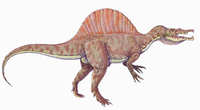
Spinosaurus is a genus
of theropod
dinosaur
which lived in what is now North Africa
, from the lower Albian
to lower Cenomanian
stages
of the Cretaceous
period, about 112 to 97 million years ago. This genus was first known from Egypt
ian remains discovered in 1912 and described by German
paleontologist
Ernst Stromer
in 1915. The original remains were destroyed in World War II
, but additional material has come to light in recent years. It is unclear whether one or two species are represented in the fossils reported in the scientific literature. The best known species is S. aegyptiacus from Egypt, although a potential second species S. maroccanus has been recovered from Morocco
.
Spinosaurus may be the largest of all known carnivorous
dinosaurs, even larger than Tyrannosaurus
and Giganotosaurus
. Estimates published in 2005 and 2007 suggest that it was 12.6 to 18 m (41.3 to 59.1 ft) in length and 7 tonne in weight. The skull of Spinosaurus was long and narrow like that of a modern crocodilia
n. Spinosaurus is thought to have eaten fish; evidence suggests that it lived both on land and in water like a modern crocodilian. The distinctive spines of Spinosaurus, which were long extensions of the vertebrae, grew to at least 1.65 metres (5.4 ft) long and were likely to have had skin connecting them, forming a sail-like structure, although some authors have suggested that the spines were covered in fat and formed a hump. Multiple functions have been put forward for this structure, including thermoregulation
and display.
e, and another twelve in both maxilla
e behind them. The second and third teeth on each side were noticeably larger than the rest of the teeth in the premaxilla, creating a space between them and the large teeth in the anterior
maxilla; large teeth in the lower jaw faced this space. The very tip of the snout holding those few large anterior teeth was expanded, and a small crest was present in front of the eyes. Using the dimensions of three specimens known as MSNM V4047, UCPC-2, and BSP 1912 VIII 19, and assuming that the postorbital part of the skull of MSNM V4047 had a shape similar to the postorbital part of the skull of Irritator
, Dal Sasso et al. (2005) estimated that the skull of Spinosaurus was 1.75 metres (5.7 ft) long. The Dal Sasso et al. skull length estimate was questioned because skull shapes can vary across spinosaurid species.
in 1926 and Donald F. Glut
in 1982 listed it as among the most massive theropods in their surveys, at 15 metres (49.2 ft) in length and upwards of 6 tons in weight. In 1988, Gregory Paul also listed it as the longest theropod at 15 metres (49.2 ft), but gave a lower mass estimate of 4 tonnes (4.4 ST).
Dal Sasso et al. (2005) assumed that Spinosaurus and Suchomimus
had the same body proportions in relation to their skull lengths, and thereby calculated that Spinosaurus was 16 to 18 m (52.5 to 59.1 ft) in length and 7 tonne in weight. The Dal Sasso et al. estimates were criticized because the skull length estimate was uncertain, and (assuming that body mass increases as the cube of body length) scaling Suchomimus which was 11 metres (36.1 ft) long and 3.8 tonnes (4.2 ST) in mass to the range of estimated lengths of Spinosaurus would produce an estimated body mass of 11.7 tonne.
François Therrien and Donald Henderson, in a 2007 paper using scaling based on skull length, challenged previous estimates of the size of Spinosaurus, finding the length too great and the weight too small. Based on estimated skull lengths of 1.5 to 1.75 m (4.9 to 5.7 ft), their estimates include a body length of 12.6 to 14.3 m (41.3 to 46.9 ft) and a body mass of 12 tonne. The lower estimates for Spinosaurus would imply that the animal was shorter and lighter than Carcharodontosaurus and Giganotosaurus. The Therrien and Henderson study has been criticized for the choice of theropods used for comparison (e.g., most of the theropods used to set the initial equations were tyrannosaurids and carnosaurs
, which have a different build than spinosaurids), and for the assumption that the Spinosaurus skull could be as little as 1.5 metres (4.9 ft) in length. Improvement of the precision of size estimates for Spinosaurus requires the discovery of more complete remains as available for some other dinosaurs, especially the limb bones of Spinosaurus which are "hitherto unknown."
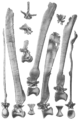
growing on the back vertebrae of Spinosaurus formed the basis of what is usually called the animal's "sail." The lengths of the neural spines reached over 10 times the diameters of the vertebral bodies from which they extended. The neural spines were slightly longer front to back at the base than higher up, and were unlike the thin rods seen in the pelycosaur
finbacks Edaphosaurus
and Dimetrodon
, contrasting also with the thicker spines in the contemporary iguanodont Ouranosaurus
.
Spinosaurus sails were unusual, although other dinosaurs, namely the ornithopod
Ouranosaurus
, which lived a few million years earlier in the same general region as Spinosaurus, and the South American sauropod Amargasaurus
, might have developed similar structural adaptations of their vertebrae. The sail is possibly analogous
(not homologous
) to that of the Permian
synapsid
Dimetrodon
, which lived before the dinosaurs even appeared; these similarities are due to parallel evolution
.
The structure may also have been more hump-like than sail-like, as noted by Stromer in 1915 ("one might rather think of the existence of a large hump of fat[ German
: Fettbuckel], to which the [neural spines] gave internal support") and by Jack Bowman Bailey in 1997. In support of his "buffalo-back" hypothesis, Bailey argued that in Spinosaurus, Ouranosaurus, and other dinosaurs with long neural spines, the spines were relatively shorter and thicker than the spines of pelycosaur
s (which were known to have sails); instead, the dinosaurs' neural spines were similar to the neural spines of extinct hump-backed mammals such as Megacerops
and Bison latifrons
.
Sources: Sereno et al. (1998), Pisani et al. (2002), and Benson (2010)
Source: Holtz et al. (2004), who coded Baryonyx and Suchomimus "as a single taxon" because they were "nearly identical"
Spinosaurus gives its name to the Spinosauridae
family
of dinosaurs, which includes two subfamilies: Baryonychinae and Spinosaurinae. The Baryonychinae include Baryonyx
from southern England
and Suchomimus
from Niger
in central Africa
. The Spinosaurinae include Spinosaurus, Irritator
from Brazil
, and Angaturama (which is probably synonymous with Irritator) from Brazil. The Spinosaurinae share unserrated straight teeth that are widely spaced (e.g., 12 on one side of the maxilla), as opposed to the Baryonychinae which have serrated curved teeth that are numerous (e.g., 30 on one side of the maxilla).
The first described remains of Spinosaurus were found and described in the early 20th century. In 1912, Richard Markgraf discovered a partial skeleton of a dinosaur in the Bahariya Formation
of western Egypt. In 1915, German paleontologist Ernst Stromer
published an article assigning the specimen to a new genus and species Spinosaurus aegyptiacus.
Fragmentary additional remains from Bahariya, including vertebrae and hindlimb bones, were designated by Stromer as "Spinosaurus B" in 1934. Stromer considered them different enough to belong to another species, and this has been borne out. With the advantage of more expeditions and material, it appears that they pertain either to Carcharodontosaurus
or to Sigilmassasaurus
.
S. maroccanus was originally described by Dale Russell
in 1996 as a new species based on the length of its neck vertebrae. Specifically, Russell claimed that the ratio of the length of the centrum (body of vertebra
) to the height of the posterior articular facet was 1.1 in S. aegyptiacus and 1.5 in S. maroccanus. Later authors have been split on this topic. Some authors note that the length of the vertebrae can vary from individual to individual, that the holotype specimen was destroyed and thus cannot be compared directly with the S. maroccanus specimen, and that it is unknown which cervical vertebrae the S. maroccanus specimens represent. Therefore, though some have retained the species as valid without much comment, most researchers regard S. maroccanus as a nomen dubium
or as a junior synonym of S. aegyptiacus.
BSP 1912 VIII 19, described by Stromer in 1915 from the Bahariya Formation
, was the holotype
. The material consisted of the following items, most of which were incomplete: right and left dentaries and splenial
s from the lower jaw measuring 75 centimetres (29.5 in) long; a straight piece of the left maxilla
that was described but not drawn; 20 teeth; 2 cervical
vertebrae; 7 dorsal (trunk) vertebrae; 3 sacral vertebrae; 1 caudal
vertebra; 4 thoracic ribs; and gastralia
. Of the nine neural spines whose heights are given, the longest ("i," associated with a dorsal vertebra) was 1.65 metres (5.4 ft) in length. Stromer claimed that the specimen was from the early Cenomanian, approximately 97 million years ago.
This specimen was destroyed in World War II
, specifically "during the night of 24/25 April 1944 in a British bombing raid of Munich" that severely damaged the building housing the Paläontologische Staatssammlung München (Bavarian State Collection of Paleontology). However, detailed drawings and descriptions of the specimen remain. Stromer's son donated Stromer's archives to the Paläontologische Staatssammlung München in 1995, and Smith et al. analyzed two photographs of the Spinosaurus holotype specimen BSP 1912 VIII 19 discovered in the archives in 2000. On the basis of a photograph of the lower jaw and a photograph of the entire specimen as mounted, Smith concluded that Stromer's original 1915 drawings were slightly inaccurate. In 2003, Oliver Rauhut suggested that Stromer's Spinosaurus holotype
was a chimera
, composed of vertebrae and neural spines from a carcharodontosaurid
similar to Acrocanthosaurus
and a dentary from Baryonyx
or Suchomimus
. This analysis was rejected in at least one subsequent paper.
NMC 50791, held by the Canadian Museum of Nature
, is a mid-cervical vertebra which is 19.5 centimetres (7.7 in) long from the Kem Kem Beds
of Morocco
. It is the holotype of Spinosaurus maroccanus as described by Russell in 1996. Other specimens referred to S. maroccanus in the same paper were two other mid-cervical vertebrae (NMC 41768 and NMC 50790), an anterior dentary fragment (NMC 50832), a mid-dentary fragment (NMC 50833), and an anterior dorsal neural arch
(NMC 50813). Russell stated that "only general locality information could be provided" for the specimen, and therefore it could be dated only "possibly" to the Albian.
MNHN SAM 124, owned by the Muséum National d'Histoire Naturelle, is a snout (consisting of partial premaxillae, partial maxillae, vomer
s, and a dentary fragment). Described by Taquet and Russell in 1998, the specimen is 13.4 to 13.6 cm (5.3 to 5.4 in) in width; no length was stated. The specimen was located in Algeria, and "is of Albian age." Taquet and Russell believed that this specimen along with a premaxilla fragment (SAM 125), two cervical vertebrae (SAM 126-127), and a dorsal neural arch (SAM 128), belonged to S. maroccanus.
BM231 (in the collection of the Office National des Mines, Tunis) was described by Buffetaut and Ouaja in 2002. It consists of a partial anterior dentary 11.5 centimetres (4.5 in) in length from an early Albian stratum
of the Chenini Formation
of Tunisia
. The dentary fragment, which included four alveoli
and two partial teeth, was "extremely similar" to existing material of S. aegyptiacus.
UCPC-2 in the University of Chicago
Paleontological Collection consists mainly of two narrow connected nasal
s with a "fluted crest" from the region between the eyes. The specimen, which is 18 centimetres (7.1 in) long, was located in an early Cenomanian part of the Moroccan Kem Kem Beds in 1996 and described in the scientific literature in 2005 by Cristiano Dal Sasso of the Civic Natural History Museum
in Milan
and colleagues.
MSNM V4047 (in the Museo di Storia Naturale di Milano
), described by Dal Sasso et al. in 2005, consists of a snout (premaxillae, partial maxillae, and partial nasals) 98.8 centimetres (38.9 in) long from the Kem Kem Beds. Like UCPC-2, it is thought to have come from the early Cenomanian.
 Other known specimens consist mainly of very fragmentary remains and scattered teeth. These include:
, and Deltadromeus
"ranged across north Africa during the late Cretaceous (Cenomanian)." Those Spinosaurus that lived in what is now Egypt
may have contended with shoreline conditions on tidal flats
and channels, living in mangrove
forests alongside similarly large dinosaurian predators Bahariasaurus
(which may be synonymous with Deltadromeus) and Carcharodontosaurus, the titanosaur
sauropods Paralititan
and Aegyptosaurus
, the 10-meter (33-ft) long crocodilian Stomatosuchus, and the coelacanth
Mawsonia.
including heat regulation and display. In addition, such a prominent feature on its back could also make it appear even larger than it was, intimidating other animals.
The structure may have been used for thermoregulation
. If the structure contained abundant blood vessels, the animal could have used the sail's large surface area to absorb heat. This would imply that the animal was only partly warm-blooded at best and lived in climates where nighttime temperatures were cool or low and the sky usually not cloudy. It is thought that Spinosaurus and Ouranosaurus both lived in or at the margins of an earlier version of the Sahara Desert, which could explain this. It is also possible that the structure was used to radiate excess heat from the body, rather than to collect it. Large animals, due to the relatively small ratio of surface area of their body compared to the overall volume (Haldane's principle), face far greater problems of dissipating excess heat at higher temperatures than gaining it at lower. Sails of large dinosaurs added considerably to the skin area of their bodies, with minimum increase of volume. Furthermore, if the sail was turned away from the sun, or positioned at a 90 degree angle towards a cooling wind, the animal would quite effectively cool itself in the warm climate of Cretaceous Africa. However, Bailey (1997) was of the opinion that a sail could have absorbed more heat than it radiated. Bailey proposed instead that Spinosaurus and other dinosaurs with long neural spines had fatty humps on their backs for energy storage, insulation, and shielding from heat.
Elaborate body structures of many modern-day animals usually serve to attract members of the opposite sex during mating. It is quite possible that the sails or humps of these dinosaurs were used for courtship, in a way similar to a peacock's tail. Stromer speculated that males and females may have differed in the size of the neural spine.
Finally, it is quite possible that the sail or hump combined these functions, acting normally as a heat regulator, becoming a courting aid during the mating season, being used to cool itself and, on occasions, turning into an intimidating device when an animal was feeling threatened.
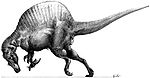
, a relative with robust arms. Because of the mass of the hypothesized fatty dorsal humps of Spinosaurus, Bailey (1997) was open to the possibility of a quadrupedal posture, leading to new restorations of it as such. The hypothesis that Spinosaurus had a typical quadrupedal gait has fallen out of favor, though spinosaurids may have crouched in a quadrupedal posture. Theropods, including spinosaurids, could not pronate their hands (rotate the forearm so the palm faced the ground), but a resting position on the side of the hand was possible, as shown by fossil prints from an Early Jurassic theropod.
, as indicated by its elongated jaws, conical teeth and raised nostrils. The hypothesis of spinosaurs as specialized fish eaters has been suggested before by A. J. Charig and A. C. Milner for Baryonyx
. They base this on the anatomical similarity with crocodilians and the presence of digestive acid-etched fish scales in the rib cage of the type specimen. Large fish are known from the faunas containing other spinosaurids, including the Mawsonia, in the mid-Cretaceous of northern Africa and Brazil. The only direct evidence for spinosaur diet comes from related Europe
an and South America
n taxa. Baryonyx was found with fish scales and bones from juvenile Iguanodon
in its stomach, while a tooth embedded in a South American pterosaur
bone suggests that spinosaurs occasionally preyed on pterosaurs. Spinosaurus was likely to have been a generalized and opportunistic predator, possibly a Cretaceous equivalent of large grizzly bear
s, being biased toward fishing, though it undoubtedly scavenged
and took many kinds of small or medium-sized prey.
In 2009, Dal Sasso et al. reported the results of X-ray computed tomography of the MSNM V4047 snout. As the foramina
on the outside all communicated with a space on the inside of the snout, the authors speculated that Spinosaurus had pressure receptors
inside the space that allowed it to hold its snout at the surface of the water to detect swimming prey species without seeing them.
A 2010 isotope analysis
by Romain Amiot and colleagues found that oxygen isotope
ratios of spinosaurid teeth, including teeth of Spinosaurus, indicate semiaquatic lifestyles. Isotope ratios from tooth enamel and from other parts of Spinosaurus (found in Morocco and Tunisia) and of other predators from the same area such as Carcharodontosaurus
were compared with isotopic compositions from contemporaneous theropods, turtles, and crocodilians. The study found that Spinosaurus teeth from five of six sampled localities had oxygen isotope ratios closer to those of turtles and crocodilians when compared with other theropod teeth from the same localities. The authors postulated that Spinosaurus switched between terrestrial and aquatic habitats to compete for food with large crocodilians and other large theropods respectively.
. The film's consulting paleontologist John R. Horner was quoted as saying: "If we base the ferocious factor on the length of the animal, there was nothing that ever lived on this planet that could match this creature [Spinosaurus]. Also my hypothesis is that T-rex was actually a scavenger rather than a killer. Spinosaurus was really the predatory animal." In the film, Spinosaurus was portrayed as larger and more powerful than Tyrannosaurus
: in a scene depicting a battle between the two resurrected predators, Spinosaurus emerges victorious by snapping the tyrannosaur's neck.
Spinosaurus has long been depicted in popular books about dinosaurs, although only recently has there been enough information about spinosaurids for an accurate depiction. After an influential 1955 skeletal reconstruction by Lapparent and Lavocat based on a 1936 diagram by Stromer, it has been treated as a generalized upright theropod, with a skull similar to that of other large theropods and a sail on its back, even having four-fingered hands.
In addition to films, action figures, video games, and books, Spinosaurus has been depicted on postage stamps such as ones from Angola
, The Gambia
, and Tanzania
.
The creature has also appeared in documentaries such as Bizarre Dinosaurs, Monsters Resurrected
and Planet Dinosaur
.
Genus
In biology, a genus is a low-level taxonomic rank used in the biological classification of living and fossil organisms, which is an example of definition by genus and differentia...
of theropod
Theropoda
Theropoda is both a suborder of bipedal saurischian dinosaurs, and a clade consisting of that suborder and its descendants . Dinosaurs belonging to the suborder theropoda were primarily carnivorous, although a number of theropod groups evolved herbivory, omnivory, and insectivory...
dinosaur
Dinosaur
Dinosaurs are a diverse group of animals of the clade and superorder Dinosauria. They were the dominant terrestrial vertebrates for over 160 million years, from the late Triassic period until the end of the Cretaceous , when the Cretaceous–Paleogene extinction event led to the extinction of...
which lived in what is now North Africa
North Africa
North Africa or Northern Africa is the northernmost region of the African continent, linked by the Sahara to Sub-Saharan Africa. Geopolitically, the United Nations definition of Northern Africa includes eight countries or territories; Algeria, Egypt, Libya, Morocco, South Sudan, Sudan, Tunisia, and...
, from the lower Albian
Albian
The Albian is both an age of the geologic timescale and a stage in the stratigraphic column. It is the youngest or uppermost subdivision of the Early/Lower Cretaceous epoch/series. Its approximate time range is 112.0 ± 1.0 Ma to 99.6 ± 0.9 Ma...
to lower Cenomanian
Cenomanian
The Cenomanian is, in the ICS' geological timescale the oldest or earliest age of the Late Cretaceous epoch or the lowest stage of the Upper Cretaceous series. An age is a unit of geochronology: it is a unit of time; the stage is a unit in the stratigraphic column deposited during the corresponding...
stages
Faunal stage
In chronostratigraphy, a stage is a succession of rock strata laid down in a single age on the geologic timescale, which usually represents millions of years of deposition. A given stage of rock and the corresponding age of time will by convention have the same name, and the same boundaries.Rock...
of the Cretaceous
Cretaceous
The Cretaceous , derived from the Latin "creta" , usually abbreviated K for its German translation Kreide , is a geologic period and system from circa to million years ago. In the geologic timescale, the Cretaceous follows the Jurassic period and is followed by the Paleogene period of the...
period, about 112 to 97 million years ago. This genus was first known from Egypt
Egypt
Egypt , officially the Arab Republic of Egypt, Arabic: , is a country mainly in North Africa, with the Sinai Peninsula forming a land bridge in Southwest Asia. Egypt is thus a transcontinental country, and a major power in Africa, the Mediterranean Basin, the Middle East and the Muslim world...
ian remains discovered in 1912 and described by German
Germans
The Germans are a Germanic ethnic group native to Central Europe. The English term Germans has referred to the German-speaking population of the Holy Roman Empire since the Late Middle Ages....
paleontologist
Paleontology
Paleontology "old, ancient", ὄν, ὀντ- "being, creature", and λόγος "speech, thought") is the study of prehistoric life. It includes the study of fossils to determine organisms' evolution and interactions with each other and their environments...
Ernst Stromer
Ernst Stromer
Ernst Freiherr Stromer von Reichenbach was a German paleontologist.He described the following Cretaceous dinosaurs from Egypt: Aegyptosaurus, Bahariasaurus, Carcharodontosaurus, and the largest known theropod, Spinosaurus aegyptiacus...
in 1915. The original remains were destroyed in World War II
World War II
World War II, or the Second World War , was a global conflict lasting from 1939 to 1945, involving most of the world's nations—including all of the great powers—eventually forming two opposing military alliances: the Allies and the Axis...
, but additional material has come to light in recent years. It is unclear whether one or two species are represented in the fossils reported in the scientific literature. The best known species is S. aegyptiacus from Egypt, although a potential second species S. maroccanus has been recovered from Morocco
Morocco
Morocco , officially the Kingdom of Morocco , is a country located in North Africa. It has a population of more than 32 million and an area of 710,850 km², and also primarily administers the disputed region of the Western Sahara...
.
Spinosaurus may be the largest of all known carnivorous
Carnivore
A carnivore meaning 'meat eater' is an organism that derives its energy and nutrient requirements from a diet consisting mainly or exclusively of animal tissue, whether through predation or scavenging...
dinosaurs, even larger than Tyrannosaurus
Tyrannosaurus
Tyrannosaurus meaning "tyrant," and sauros meaning "lizard") is a genus of coelurosaurian theropod dinosaur. The species Tyrannosaurus rex , commonly abbreviated to T. rex, is a fixture in popular culture. It lived throughout what is now western North America, with a much wider range than other...
and Giganotosaurus
Giganotosaurus
Giganotosaurus is a genus of carcharodontosaurid dinosaur that lived around 97 million years ago during the early Cenomanian stage of the Late Cretaceous Period. It included some of the largest known terrestrial carnivores, slightly larger than the largest Tyrannosaurus, but smaller than the...
. Estimates published in 2005 and 2007 suggest that it was 12.6 to 18 m (41.3 to 59.1 ft) in length and 7 tonne in weight. The skull of Spinosaurus was long and narrow like that of a modern crocodilia
Crocodilia
Crocodilia is an order of large reptiles that appeared about 84 million years ago in the late Cretaceous Period . They are the closest living relatives of birds, as the two groups are the only known survivors of the Archosauria...
n. Spinosaurus is thought to have eaten fish; evidence suggests that it lived both on land and in water like a modern crocodilian. The distinctive spines of Spinosaurus, which were long extensions of the vertebrae, grew to at least 1.65 metres (5.4 ft) long and were likely to have had skin connecting them, forming a sail-like structure, although some authors have suggested that the spines were covered in fat and formed a hump. Multiple functions have been put forward for this structure, including thermoregulation
Thermoregulation
Thermoregulation is the ability of an organism to keep its body temperature within certain boundaries, even when the surrounding temperature is very different...
and display.
Description
Spinosaurus is known for its elongated skull, its large size, and its sail or hump.Skull
The skull had a narrow snout filled with straight conical teeth that lacked serrations. There were six or seven teeth on each side of the very front of the upper jaw, in the premaxillaPremaxilla
The incisive bone is the portion of the maxilla adjacent to the incisors. It is a pair of small cranial bones at the very tip of the jaws of many animals, usually bearing teeth, but not always. They are connected to the maxilla and the nasals....
e, and another twelve in both maxilla
Maxilla
The maxilla is a fusion of two bones along the palatal fissure that form the upper jaw. This is similar to the mandible , which is also a fusion of two halves at the mental symphysis. Sometimes The maxilla (plural: maxillae) is a fusion of two bones along the palatal fissure that form the upper...
e behind them. The second and third teeth on each side were noticeably larger than the rest of the teeth in the premaxilla, creating a space between them and the large teeth in the anterior
Anatomical terms of location
Standard anatomical terms of location are designations employed in science that deal with the anatomy of animals to avoid ambiguities that might otherwise arise. They are not language-specific, and thus require no translation...
maxilla; large teeth in the lower jaw faced this space. The very tip of the snout holding those few large anterior teeth was expanded, and a small crest was present in front of the eyes. Using the dimensions of three specimens known as MSNM V4047, UCPC-2, and BSP 1912 VIII 19, and assuming that the postorbital part of the skull of MSNM V4047 had a shape similar to the postorbital part of the skull of Irritator
Irritator
Irritator is a genus of spinosaurid dinosaur that lived in the early Cretaceous Period , around 110 million years ago. Current estimations indicate a length of 8 meters . It was found in Brazil...
, Dal Sasso et al. (2005) estimated that the skull of Spinosaurus was 1.75 metres (5.7 ft) long. The Dal Sasso et al. skull length estimate was questioned because skull shapes can vary across spinosaurid species.
Size
Since its discovery, Spinosaurus has been a contender for the longest and largest theropod dinosaur. Both Friedrich von HueneFriedrich von Huene
Friedrich von Huene was a German paleontologist who named more dinosaurs in the early 20th century than anyone else in Europe.-Biography:...
in 1926 and Donald F. Glut
Donald F. Glut
Donald F. Glut is an American writer, motion picture director, screenwriter, amateur paleontologist, musician and actor....
in 1982 listed it as among the most massive theropods in their surveys, at 15 metres (49.2 ft) in length and upwards of 6 tons in weight. In 1988, Gregory Paul also listed it as the longest theropod at 15 metres (49.2 ft), but gave a lower mass estimate of 4 tonnes (4.4 ST).
Dal Sasso et al. (2005) assumed that Spinosaurus and Suchomimus
Suchomimus
Suchomimus is a genus of large spinosaurid dinosaur with a crocodile-like mouth that lived sometime between 121-112 million years ago, during the late Aptian stage of the Cretaceous period in Africa.-Description:...
had the same body proportions in relation to their skull lengths, and thereby calculated that Spinosaurus was 16 to 18 m (52.5 to 59.1 ft) in length and 7 tonne in weight. The Dal Sasso et al. estimates were criticized because the skull length estimate was uncertain, and (assuming that body mass increases as the cube of body length) scaling Suchomimus which was 11 metres (36.1 ft) long and 3.8 tonnes (4.2 ST) in mass to the range of estimated lengths of Spinosaurus would produce an estimated body mass of 11.7 tonne.
François Therrien and Donald Henderson, in a 2007 paper using scaling based on skull length, challenged previous estimates of the size of Spinosaurus, finding the length too great and the weight too small. Based on estimated skull lengths of 1.5 to 1.75 m (4.9 to 5.7 ft), their estimates include a body length of 12.6 to 14.3 m (41.3 to 46.9 ft) and a body mass of 12 tonne. The lower estimates for Spinosaurus would imply that the animal was shorter and lighter than Carcharodontosaurus and Giganotosaurus. The Therrien and Henderson study has been criticized for the choice of theropods used for comparison (e.g., most of the theropods used to set the initial equations were tyrannosaurids and carnosaurs
Carnosauria
Carnosauria is a group of large predatory dinosaurs that lived during the Jurassic and Cretaceous periods. While it originally contained a wide assortment of giant theropods that were not closely related, the group has since been defined to encompass only the allosaurs and their closest kin...
, which have a different build than spinosaurids), and for the assumption that the Spinosaurus skull could be as little as 1.5 metres (4.9 ft) in length. Improvement of the precision of size estimates for Spinosaurus requires the discovery of more complete remains as available for some other dinosaurs, especially the limb bones of Spinosaurus which are "hitherto unknown."
Sail or hump
Very tall neural spinesSpinous process
The spinous process of a vertebra is directed backward and downward from the junction of the laminae , and serves for the attachment of muscles and ligaments. In animals without an erect stance, the process points upward and may slant forward or backward...
growing on the back vertebrae of Spinosaurus formed the basis of what is usually called the animal's "sail." The lengths of the neural spines reached over 10 times the diameters of the vertebral bodies from which they extended. The neural spines were slightly longer front to back at the base than higher up, and were unlike the thin rods seen in the pelycosaur
Pelycosaur
The pelycosaurs are an informal grouping composed of basal or primitive Late Paleozoic synapsid amniotes. Some species were quite large and could grow up to 3 meters or more, although most species were much smaller...
finbacks Edaphosaurus
Edaphosaurus
Edaphosaurus is a genus of prehistoric synapsid which lived around 303 to 265 million years ago, during the late Carboniferous to early Permian periods. The name Edaphosaurus means "ground lizard" and is derived from the Greek edaphos/εδαφος and σαυρος/sauros...
and Dimetrodon
Dimetrodon
Dimetrodon was a predatory synapsid genus that flourished during the Permian period, living between 280–265 million years ago ....
, contrasting also with the thicker spines in the contemporary iguanodont Ouranosaurus
Ouranosaurus
Ouranosaurus is an unusual genus of herbivorous iguanodont dinosaur that lived during the early Cretaceous about 110 million years ago in what is now Africa. Ouranosaurus measured about seven to eight meters long...
.
Spinosaurus sails were unusual, although other dinosaurs, namely the ornithopod
Ornithopod
Ornithopods or members of the clade Ornithopoda are a group of ornithischian dinosaurs that started out as small, bipedal running grazers, and grew in size and numbers until they became one of the most successful groups of herbivores in the Cretaceous world, and dominated the North American...
Ouranosaurus
Ouranosaurus
Ouranosaurus is an unusual genus of herbivorous iguanodont dinosaur that lived during the early Cretaceous about 110 million years ago in what is now Africa. Ouranosaurus measured about seven to eight meters long...
, which lived a few million years earlier in the same general region as Spinosaurus, and the South American sauropod Amargasaurus
Amargasaurus
Amargasaurus is a genus of dicraeosaurid sauropod dinosaur from the Early Cretaceous Period of what is now South America. It was small for a sauropod, reaching 10 meters length. It would have been a quadrupedal herbivore with a long, low skull on the end of a long neck, much like its relative...
, might have developed similar structural adaptations of their vertebrae. The sail is possibly analogous
Analogy (biology)
An analogy is a trait or an organ that appears similar in two unrelated organisms. The cladistic term for the same phenomenon is homoplasy, from Greek for same form. Biological anologies are often the result of convergent evolution....
(not homologous
Homology (biology)
Homology forms the basis of organization for comparative biology. In 1843, Richard Owen defined homology as "the same organ in different animals under every variety of form and function". Organs as different as a bat's wing, a seal's flipper, a cat's paw and a human hand have a common underlying...
) to that of the Permian
Permian
The PermianThe term "Permian" was introduced into geology in 1841 by Sir Sir R. I. Murchison, president of the Geological Society of London, who identified typical strata in extensive Russian explorations undertaken with Edouard de Verneuil; Murchison asserted in 1841 that he named his "Permian...
synapsid
Synapsid
Synapsids are a group of animals that includes mammals and everything more closely related to mammals than to other living amniotes. They are easily separated from other amniotes by having an opening low in the skull roof behind each eye, leaving a bony arch beneath each, accounting for their name...
Dimetrodon
Dimetrodon
Dimetrodon was a predatory synapsid genus that flourished during the Permian period, living between 280–265 million years ago ....
, which lived before the dinosaurs even appeared; these similarities are due to parallel evolution
Parallel evolution
Parallel evolution is the development of a similar trait in related, but distinct, species descending from the same ancestor, but from different clades.-Parallel vs...
.
The structure may also have been more hump-like than sail-like, as noted by Stromer in 1915 ("one might rather think of the existence of a large hump of fat
German language
German is a West Germanic language, related to and classified alongside English and Dutch. With an estimated 90 – 98 million native speakers, German is one of the world's major languages and is the most widely-spoken first language in the European Union....
: Fettbuckel], to which the [neural spines] gave internal support") and by Jack Bowman Bailey in 1997. In support of his "buffalo-back" hypothesis, Bailey argued that in Spinosaurus, Ouranosaurus, and other dinosaurs with long neural spines, the spines were relatively shorter and thicker than the spines of pelycosaur
Pelycosaur
The pelycosaurs are an informal grouping composed of basal or primitive Late Paleozoic synapsid amniotes. Some species were quite large and could grow up to 3 meters or more, although most species were much smaller...
s (which were known to have sails); instead, the dinosaurs' neural spines were similar to the neural spines of extinct hump-backed mammals such as Megacerops
Megacerops
Megacerops is an extinct genus of the family Brontotheriidae endemic to North America during the Late Eocene epoch , existing for approximately .-Taxonomy:...
and Bison latifrons
Bison latifrons
Bison latifrons is an extinct species of bison that lived in North America during the Pleistocene. Also known as the giant bison, it reached a shoulder height of 2.5 metres , and had horns that spanned over 2 metres...
.
Classification
Spinosaurus gives its name to the Spinosauridae
Spinosauridae
Spinosauridae is a family of specialised theropod dinosaurs. Members of this family were large, bipedal predators with elongated, crocodile-like skulls, sporting conical teeth with no or only very tiny serrations. The front dentary teeth fanned out, giving the animal a characteristic look...
family
Family (biology)
In biological classification, family is* a taxonomic rank. Other well-known ranks are life, domain, kingdom, phylum, class, order, genus, and species, with family fitting between order and genus. As for the other well-known ranks, there is the option of an immediately lower rank, indicated by the...
of dinosaurs, which includes two subfamilies: Baryonychinae and Spinosaurinae. The Baryonychinae include Baryonyx
Baryonyx
Baryonyx is a genus of carnivorous saurischian dinosaur first discovered in clay pits just south of Dorking, England, and later reported from fossils found in northern Spain and Portugal. It is known to contain only one species, Baryonyx walkeri...
from southern England
England
England is a country that is part of the United Kingdom. It shares land borders with Scotland to the north and Wales to the west; the Irish Sea is to the north west, the Celtic Sea to the south west, with the North Sea to the east and the English Channel to the south separating it from continental...
and Suchomimus
Suchomimus
Suchomimus is a genus of large spinosaurid dinosaur with a crocodile-like mouth that lived sometime between 121-112 million years ago, during the late Aptian stage of the Cretaceous period in Africa.-Description:...
from Niger
Niger
Niger , officially named the Republic of Niger, is a landlocked country in Western Africa, named after the Niger River. It borders Nigeria and Benin to the south, Burkina Faso and Mali to the west, Algeria and Libya to the north and Chad to the east...
in central Africa
Africa
Africa is the world's second largest and second most populous continent, after Asia. At about 30.2 million km² including adjacent islands, it covers 6% of the Earth's total surface area and 20.4% of the total land area...
. The Spinosaurinae include Spinosaurus, Irritator
Irritator
Irritator is a genus of spinosaurid dinosaur that lived in the early Cretaceous Period , around 110 million years ago. Current estimations indicate a length of 8 meters . It was found in Brazil...
from Brazil
Brazil
Brazil , officially the Federative Republic of Brazil , is the largest country in South America. It is the world's fifth largest country, both by geographical area and by population with over 192 million people...
, and Angaturama (which is probably synonymous with Irritator) from Brazil. The Spinosaurinae share unserrated straight teeth that are widely spaced (e.g., 12 on one side of the maxilla), as opposed to the Baryonychinae which have serrated curved teeth that are numerous (e.g., 30 on one side of the maxilla).
Naming of species
Two species of Spinosaurus have been named: Spinosaurus aegyptiacus (meaning "Egyptian spine lizard") and Spinosaurus maroccanus (meaning "Moroccan spine lizard").The first described remains of Spinosaurus were found and described in the early 20th century. In 1912, Richard Markgraf discovered a partial skeleton of a dinosaur in the Bahariya Formation
Bahariya Formation
The Bahariya Formation is a fossil bearing geologic formation dating back to the Cenomanian, geographically located in Marsa Matruh, central Egypt.-Lepidosaurs:-Sauropods:Indeterminate sauropod remains.-Theropods:...
of western Egypt. In 1915, German paleontologist Ernst Stromer
Ernst Stromer
Ernst Freiherr Stromer von Reichenbach was a German paleontologist.He described the following Cretaceous dinosaurs from Egypt: Aegyptosaurus, Bahariasaurus, Carcharodontosaurus, and the largest known theropod, Spinosaurus aegyptiacus...
published an article assigning the specimen to a new genus and species Spinosaurus aegyptiacus.
Fragmentary additional remains from Bahariya, including vertebrae and hindlimb bones, were designated by Stromer as "Spinosaurus B" in 1934. Stromer considered them different enough to belong to another species, and this has been borne out. With the advantage of more expeditions and material, it appears that they pertain either to Carcharodontosaurus
Carcharodontosaurus
Carcharodontosaurus was a gigantic carnivorous carcharodontosaurid dinosaur that lived around 100 to 93 million years ago, during the late Albian to early Cenomanian stages of the mid-Cretaceous Period...
or to Sigilmassasaurus
Sigilmassasaurus
Sigilmassasaurus is a genus of tetanuran theropod dinosaur from the middle of the Cretaceous Period of northern Africa...
.
S. maroccanus was originally described by Dale Russell
Dale Russell
Dale A. Russell is a Canadian geologist/palaeontologist, currently Research Professor at The Department of Marine Earth and Atmospheric Sciences of North Carolina State University...
in 1996 as a new species based on the length of its neck vertebrae. Specifically, Russell claimed that the ratio of the length of the centrum (body of vertebra
Body of vertebra
The body is the largest part of a vertebra, and is more or less cylindrical in shape. For vertebrates other than humans, this structure is usually called a centrum....
) to the height of the posterior articular facet was 1.1 in S. aegyptiacus and 1.5 in S. maroccanus. Later authors have been split on this topic. Some authors note that the length of the vertebrae can vary from individual to individual, that the holotype specimen was destroyed and thus cannot be compared directly with the S. maroccanus specimen, and that it is unknown which cervical vertebrae the S. maroccanus specimens represent. Therefore, though some have retained the species as valid without much comment, most researchers regard S. maroccanus as a nomen dubium
Nomen dubium
In zoological nomenclature, a nomen dubium is a scientific name that is of unknown or doubtful application...
or as a junior synonym of S. aegyptiacus.
Specimens
Six main partial specimens of Spinosaurus have been described.BSP 1912 VIII 19, described by Stromer in 1915 from the Bahariya Formation
Bahariya Formation
The Bahariya Formation is a fossil bearing geologic formation dating back to the Cenomanian, geographically located in Marsa Matruh, central Egypt.-Lepidosaurs:-Sauropods:Indeterminate sauropod remains.-Theropods:...
, was the holotype
Holotype
A holotype is a single physical example of an organism, known to have been used when the species was formally described. It is either the single such physical example or one of several such, but explicitly designated as the holotype...
. The material consisted of the following items, most of which were incomplete: right and left dentaries and splenial
Splenial
The splenial is a small bone in the lower jaw of reptiles, amphibians and birds, usually located on the lingual side between the angular and suprangular....
s from the lower jaw measuring 75 centimetres (29.5 in) long; a straight piece of the left maxilla
Maxilla
The maxilla is a fusion of two bones along the palatal fissure that form the upper jaw. This is similar to the mandible , which is also a fusion of two halves at the mental symphysis. Sometimes The maxilla (plural: maxillae) is a fusion of two bones along the palatal fissure that form the upper...
that was described but not drawn; 20 teeth; 2 cervical
Neck
The neck is the part of the body, on many terrestrial or secondarily aquatic vertebrates, that distinguishes the head from the torso or trunk. The adjective signifying "of the neck" is cervical .-Boner anatomy: The cervical spine:The cervical portion of the human spine comprises seven boney...
vertebrae; 7 dorsal (trunk) vertebrae; 3 sacral vertebrae; 1 caudal
Tail
The tail is the section at the rear end of an animal's body; in general, the term refers to a distinct, flexible appendage to the torso. It is the part of the body that corresponds roughly to the sacrum and coccyx in mammals, reptiles, and birds...
vertebra; 4 thoracic ribs; and gastralia
Gastralium
Gastralia are dermal bones found in the ventral body wall of crocodilian and Sphenodon species. They are found between the sternum and pelvis, and do not articulate with the vertebrae...
. Of the nine neural spines whose heights are given, the longest ("i," associated with a dorsal vertebra) was 1.65 metres (5.4 ft) in length. Stromer claimed that the specimen was from the early Cenomanian, approximately 97 million years ago.
This specimen was destroyed in World War II
World War II
World War II, or the Second World War , was a global conflict lasting from 1939 to 1945, involving most of the world's nations—including all of the great powers—eventually forming two opposing military alliances: the Allies and the Axis...
, specifically "during the night of 24/25 April 1944 in a British bombing raid of Munich" that severely damaged the building housing the Paläontologische Staatssammlung München (Bavarian State Collection of Paleontology). However, detailed drawings and descriptions of the specimen remain. Stromer's son donated Stromer's archives to the Paläontologische Staatssammlung München in 1995, and Smith et al. analyzed two photographs of the Spinosaurus holotype specimen BSP 1912 VIII 19 discovered in the archives in 2000. On the basis of a photograph of the lower jaw and a photograph of the entire specimen as mounted, Smith concluded that Stromer's original 1915 drawings were slightly inaccurate. In 2003, Oliver Rauhut suggested that Stromer's Spinosaurus holotype
Holotype
A holotype is a single physical example of an organism, known to have been used when the species was formally described. It is either the single such physical example or one of several such, but explicitly designated as the holotype...
was a chimera
Chimera (paleontology)
In paleontology, a chimera is a fossil which was reconstructed with elements coming from more than a single species of animal. A now classic example of chimera is Protoavis.-List of paleontological chimeras:*Brontosaurus*Lametasaurus...
, composed of vertebrae and neural spines from a carcharodontosaurid
Carcharodontosauridae
Carcharodontosaurids were a group of carnivorous theropod dinosaurs. In 1931 Ernst Stromer named Carcharodontosauridae as a family, in modern paleontology this name indicates a clade within Carnosauria...
similar to Acrocanthosaurus
Acrocanthosaurus
Acrocanthosaurus is a genus of theropod dinosaur that existed in what is now North America during the Aptian and early Albian stages of the Early Cretaceous. Like most dinosaur genera, Acrocanthosaurus contains only a single species, A. atokensis. Its fossil remains are found mainly in the U.S...
and a dentary from Baryonyx
Baryonyx
Baryonyx is a genus of carnivorous saurischian dinosaur first discovered in clay pits just south of Dorking, England, and later reported from fossils found in northern Spain and Portugal. It is known to contain only one species, Baryonyx walkeri...
or Suchomimus
Suchomimus
Suchomimus is a genus of large spinosaurid dinosaur with a crocodile-like mouth that lived sometime between 121-112 million years ago, during the late Aptian stage of the Cretaceous period in Africa.-Description:...
. This analysis was rejected in at least one subsequent paper.
NMC 50791, held by the Canadian Museum of Nature
Canadian Museum of Nature
The Canadian Museum of Nature is a natural history museum in Ottawa, Ontario, Canada. Its collections, which were started by the Geological Survey of Canada in 1856, include all aspects of the intersection of human society and nature, from gardening to gene-splicing...
, is a mid-cervical vertebra which is 19.5 centimetres (7.7 in) long from the Kem Kem Beds
Kem Kem Beds
The Kem Kem Beds is a geological formation in Morocco and Algeria whose strata date back to the Late Cretaceous...
of Morocco
Morocco
Morocco , officially the Kingdom of Morocco , is a country located in North Africa. It has a population of more than 32 million and an area of 710,850 km², and also primarily administers the disputed region of the Western Sahara...
. It is the holotype of Spinosaurus maroccanus as described by Russell in 1996. Other specimens referred to S. maroccanus in the same paper were two other mid-cervical vertebrae (NMC 41768 and NMC 50790), an anterior dentary fragment (NMC 50832), a mid-dentary fragment (NMC 50833), and an anterior dorsal neural arch
Vertebral arch
The vertebral arch is the posterior part of a vertebra.It consists of a pair of pedicles and a pair of laminae, and supports seven processes:* four articular processes* two transverse processes* one spinous process...
(NMC 50813). Russell stated that "only general locality information could be provided" for the specimen, and therefore it could be dated only "possibly" to the Albian.
MNHN SAM 124, owned by the Muséum National d'Histoire Naturelle, is a snout (consisting of partial premaxillae, partial maxillae, vomer
Vomer
The vomer is one of the unpaired facial bones of the skull. It is located in the midsagittal line, and articulates with the sphenoid, the ethmoid, the left and right palatine bones, and the left and right maxillary bones.-Biology:...
s, and a dentary fragment). Described by Taquet and Russell in 1998, the specimen is 13.4 to 13.6 cm (5.3 to 5.4 in) in width; no length was stated. The specimen was located in Algeria, and "is of Albian age." Taquet and Russell believed that this specimen along with a premaxilla fragment (SAM 125), two cervical vertebrae (SAM 126-127), and a dorsal neural arch (SAM 128), belonged to S. maroccanus.
BM231 (in the collection of the Office National des Mines, Tunis) was described by Buffetaut and Ouaja in 2002. It consists of a partial anterior dentary 11.5 centimetres (4.5 in) in length from an early Albian stratum
Stratum
In geology and related fields, a stratum is a layer of sedimentary rock or soil with internally consistent characteristics that distinguish it from other layers...
of the Chenini Formation
Chenini Formation
The Chenini Formation is a geological formation in Tunisia whose strata date back to the Albian stage of the Cretaceous period. Dinosaur remains are among the fossils that have been recovered from the formation.- Dinosaurs Found :...
of Tunisia
Tunisia
Tunisia , officially the Tunisian RepublicThe long name of Tunisia in other languages used in the country is: , is the northernmost country in Africa. It is a Maghreb country and is bordered by Algeria to the west, Libya to the southeast, and the Mediterranean Sea to the north and east. Its area...
. The dentary fragment, which included four alveoli
Dental alveolus
Dental alveolus are sockets in the jaws in which the roots of teeth are held in the alveolar process of maxilla with the periodontal ligament. The lay term for dental alveoli is tooth sockets...
and two partial teeth, was "extremely similar" to existing material of S. aegyptiacus.
UCPC-2 in the University of Chicago
University of Chicago
The University of Chicago is a private research university in Chicago, Illinois, USA. It was founded by the American Baptist Education Society with a donation from oil magnate and philanthropist John D. Rockefeller and incorporated in 1890...
Paleontological Collection consists mainly of two narrow connected nasal
Nasal bone
The nasal bones are two small oblong bones, varying in size and form in different individuals; they are placed side by side at the middle and upper part of the face, and form, by their junction, "the bridge" of the nose.Each has two surfaces and four borders....
s with a "fluted crest" from the region between the eyes. The specimen, which is 18 centimetres (7.1 in) long, was located in an early Cenomanian part of the Moroccan Kem Kem Beds in 1996 and described in the scientific literature in 2005 by Cristiano Dal Sasso of the Civic Natural History Museum
Museo Civico di Storia Naturale di Milan
The Museo Civico di Storia Naturale di Milano was founded in 1838 whenGiuseppe de Cristoforis donated his collections to the city. Its first director was Giorgio Jan .-External links:*...
in Milan
Milan
Milan is the second-largest city in Italy and the capital city of the region of Lombardy and of the province of Milan. The city proper has a population of about 1.3 million, while its urban area, roughly coinciding with its administrative province and the bordering Province of Monza and Brianza ,...
and colleagues.
MSNM V4047 (in the Museo di Storia Naturale di Milano
Museo Civico di Storia Naturale di Milan
The Museo Civico di Storia Naturale di Milano was founded in 1838 whenGiuseppe de Cristoforis donated his collections to the city. Its first director was Giorgio Jan .-External links:*...
), described by Dal Sasso et al. in 2005, consists of a snout (premaxillae, partial maxillae, and partial nasals) 98.8 centimetres (38.9 in) long from the Kem Kem Beds. Like UCPC-2, it is thought to have come from the early Cenomanian.
- Possible material belonging to Spinosaurus has been reported from the Turkana GritsTurkana GritsThe Turkana Grits is a geological formation in Kenya whose strata date back to the Late Cretaceous. Dinosaur remains have been recovered from it.-Vertebrate paleofauna:-References:...
of KenyaKenyaKenya , officially known as the Republic of Kenya, is a country in East Africa that lies on the equator, with the Indian Ocean to its south-east...
. - A 1986 paper described prismatic structures in tooth enamelTooth enamelTooth enamel, along with dentin, cementum, and dental pulp is one of the four major tissues that make up the tooth in vertebrates. It is the hardest and most highly mineralized substance in the human body. Tooth enamel is also found in the dermal denticles of sharks...
from two Spinosaurus teeth from Tunisia. - Buffetaut (1989, 1992) referred three specimens from the Institut und Museum für Geologie und Paläontologie of the University of Göttingen in Germany to Spinosaurus: a right maxilla fragment IMGP 969-1, a jaw fragment IMGP 969-2, and a tooth IMGP 969-3. These had been found in a Lower Cenomanian or Upper Albian deposit in southeastern Morocco in 1971.
- Kellner and Mader (1997) described two unserrated spinosaurid teeth from Morocco (LINHM 001 and 002) that were "highly similar" to the teeth of the S. aegyptiacus holotype.
- Teeth from the Chenini Formation in Tunisia which are "narrow, somewhat rounded in cross-section, and lack the anterior and posterior serrated edges characteristic of theropods and basal archosaurArchosaurArchosaurs are a group of diapsid amniotes whose living representatives consist of modern birds and crocodilians. This group also includes all extinct non-avian dinosaurs, many extinct crocodilian relatives, and pterosaurs. Archosauria, the archosaur clade, is a crown group that includes the most...
s" were assigned to Spinosaurus in 2000. - Teeth from the Echkar Formation of NigerNigerNiger , officially named the Republic of Niger, is a landlocked country in Western Africa, named after the Niger River. It borders Nigeria and Benin to the south, Burkina Faso and Mali to the west, Algeria and Libya to the north and Chad to the east...
were "tentatively" referred to Spinosaurus in 2007. - A partial tooth 8 cm long purchased at a fossil trade show, reportedly from the Kem Kem Bed of Morocco and attributed to Spinosaurus maroccanus, showed 1–5 mm wide longitudinal striations and micro-structures (irregular ridges) among the striations in a 2010 paper.
Paleoecology
The environment inhabited by Spinosaurus is only partially understood, and covers a great deal of what is now northern Africa. A 1996 study concluded from Moroccan fossils that Spinosaurus, CarcharodontosaurusCarcharodontosaurus
Carcharodontosaurus was a gigantic carnivorous carcharodontosaurid dinosaur that lived around 100 to 93 million years ago, during the late Albian to early Cenomanian stages of the mid-Cretaceous Period...
, and Deltadromeus
Deltadromeus
Deltadromeus is a genus of large basal ceratosaurian theropod dinosaur from Northern Africa. It had long, unusually slender hind limbs for its size, suggesting that it was a swift runner. The skull is not known. Two fossil specimens of a single species Deltadromeus (meaning "delta runner") is a...
"ranged across north Africa during the late Cretaceous (Cenomanian)." Those Spinosaurus that lived in what is now Egypt
Egypt
Egypt , officially the Arab Republic of Egypt, Arabic: , is a country mainly in North Africa, with the Sinai Peninsula forming a land bridge in Southwest Asia. Egypt is thus a transcontinental country, and a major power in Africa, the Mediterranean Basin, the Middle East and the Muslim world...
may have contended with shoreline conditions on tidal flats
Mudflat
Mudflats or mud flats, also known as tidal flats, are coastal wetlands that form when mud is deposited by tides or rivers. They are found in sheltered areas such as bays, bayous, lagoons, and estuaries. Mudflats may be viewed geologically as exposed layers of bay mud, resulting from deposition of...
and channels, living in mangrove
Mangrove
Mangroves are various kinds of trees up to medium height and shrubs that grow in saline coastal sediment habitats in the tropics and subtropics – mainly between latitudes N and S...
forests alongside similarly large dinosaurian predators Bahariasaurus
Bahariasaurus
Bahariasaurus is a genus of large theropod dinosaur found in the Bahariya Formation in El-Waha el-Bahariya or Bahariya oasis in Egypt and Kem Kem Beds of North Africa, which date to the late Cretaceous Period, , about 95 million years ago...
(which may be synonymous with Deltadromeus) and Carcharodontosaurus, the titanosaur
Titanosaur
Titanosaurs were a diverse group of sauropod dinosaurs, which included Saltasaurus and Isisaurus. It includes some of the heaviest creatures ever to walk the earth, such as Argentinosaurus and Paralititan — which some believe have weighed up to 100 tonnes...
sauropods Paralititan
Paralititan
Paralititan was a giant titanosaurian sauropod dinosaur genus discovered in coastal deposits in the Upper Cretaceous Bahariya Formation of Egypt. The fossil represents the first tetrapod reported from the Bahariya Formation since 1935. Its 1.69 meter long humerus is longer than that of any...
and Aegyptosaurus
Aegyptosaurus
Aegyptosaurus meaning 'Egypt’s lizard', for the country in which it was discovered is a genus of sauropod dinosaur believed to have lived in what is now Africa, around 95 million years ago, during the mid- and late-Cretaceous Period . Like most sauropods, it had a long neck and a small skull...
, the 10-meter (33-ft) long crocodilian Stomatosuchus, and the coelacanth
Coelacanth
Coelacanths are members of an order of fish that includes the oldest living lineage of Sarcopterygii known to date....
Mawsonia.
Function of sail or hump
The function of the dinosaur's sail or hump is uncertain; scientists have proposed several hypothesesHypothesis
A hypothesis is a proposed explanation for a phenomenon. The term derives from the Greek, ὑποτιθέναι – hypotithenai meaning "to put under" or "to suppose". For a hypothesis to be put forward as a scientific hypothesis, the scientific method requires that one can test it...
including heat regulation and display. In addition, such a prominent feature on its back could also make it appear even larger than it was, intimidating other animals.
The structure may have been used for thermoregulation
Thermoregulation
Thermoregulation is the ability of an organism to keep its body temperature within certain boundaries, even when the surrounding temperature is very different...
. If the structure contained abundant blood vessels, the animal could have used the sail's large surface area to absorb heat. This would imply that the animal was only partly warm-blooded at best and lived in climates where nighttime temperatures were cool or low and the sky usually not cloudy. It is thought that Spinosaurus and Ouranosaurus both lived in or at the margins of an earlier version of the Sahara Desert, which could explain this. It is also possible that the structure was used to radiate excess heat from the body, rather than to collect it. Large animals, due to the relatively small ratio of surface area of their body compared to the overall volume (Haldane's principle), face far greater problems of dissipating excess heat at higher temperatures than gaining it at lower. Sails of large dinosaurs added considerably to the skin area of their bodies, with minimum increase of volume. Furthermore, if the sail was turned away from the sun, or positioned at a 90 degree angle towards a cooling wind, the animal would quite effectively cool itself in the warm climate of Cretaceous Africa. However, Bailey (1997) was of the opinion that a sail could have absorbed more heat than it radiated. Bailey proposed instead that Spinosaurus and other dinosaurs with long neural spines had fatty humps on their backs for energy storage, insulation, and shielding from heat.
Elaborate body structures of many modern-day animals usually serve to attract members of the opposite sex during mating. It is quite possible that the sails or humps of these dinosaurs were used for courtship, in a way similar to a peacock's tail. Stromer speculated that males and females may have differed in the size of the neural spine.
Finally, it is quite possible that the sail or hump combined these functions, acting normally as a heat regulator, becoming a courting aid during the mating season, being used to cool itself and, on occasions, turning into an intimidating device when an animal was feeling threatened.
Posture
Although traditionally depicted as a biped, it has been suggested since the mid-1970s that Spinosaurus was at least an occasional quadruped. This has been bolstered by the discovery of BaryonyxBaryonyx
Baryonyx is a genus of carnivorous saurischian dinosaur first discovered in clay pits just south of Dorking, England, and later reported from fossils found in northern Spain and Portugal. It is known to contain only one species, Baryonyx walkeri...
, a relative with robust arms. Because of the mass of the hypothesized fatty dorsal humps of Spinosaurus, Bailey (1997) was open to the possibility of a quadrupedal posture, leading to new restorations of it as such. The hypothesis that Spinosaurus had a typical quadrupedal gait has fallen out of favor, though spinosaurids may have crouched in a quadrupedal posture. Theropods, including spinosaurids, could not pronate their hands (rotate the forearm so the palm faced the ground), but a resting position on the side of the hand was possible, as shown by fossil prints from an Early Jurassic theropod.
Feeding
It is unclear whether Spinosaurus was primarily a terrestrial predator or a piscivorePiscivore
A piscivore is a carnivorous animal which eats primarily fish. Piscivory was the diet of early tetrapods , insectivory came next, then in time reptiles added herbivory....
, as indicated by its elongated jaws, conical teeth and raised nostrils. The hypothesis of spinosaurs as specialized fish eaters has been suggested before by A. J. Charig and A. C. Milner for Baryonyx
Baryonyx
Baryonyx is a genus of carnivorous saurischian dinosaur first discovered in clay pits just south of Dorking, England, and later reported from fossils found in northern Spain and Portugal. It is known to contain only one species, Baryonyx walkeri...
. They base this on the anatomical similarity with crocodilians and the presence of digestive acid-etched fish scales in the rib cage of the type specimen. Large fish are known from the faunas containing other spinosaurids, including the Mawsonia, in the mid-Cretaceous of northern Africa and Brazil. The only direct evidence for spinosaur diet comes from related Europe
Europe
Europe is, by convention, one of the world's seven continents. Comprising the westernmost peninsula of Eurasia, Europe is generally 'divided' from Asia to its east by the watershed divides of the Ural and Caucasus Mountains, the Ural River, the Caspian and Black Seas, and the waterways connecting...
an and South America
South America
South America is a continent situated in the Western Hemisphere, mostly in the Southern Hemisphere, with a relatively small portion in the Northern Hemisphere. The continent is also considered a subcontinent of the Americas. It is bordered on the west by the Pacific Ocean and on the north and east...
n taxa. Baryonyx was found with fish scales and bones from juvenile Iguanodon
Iguanodon
Iguanodon is a genus of ornithopod dinosaur that lived roughly halfway between the first of the swift bipedal hypsilophodontids and the ornithopods' culmination in the duck-billed dinosaurs...
in its stomach, while a tooth embedded in a South American pterosaur
Pterosaur
Pterosaurs were flying reptiles of the clade or order Pterosauria. They existed from the late Triassic to the end of the Cretaceous Period . Pterosaurs are the earliest vertebrates known to have evolved powered flight...
bone suggests that spinosaurs occasionally preyed on pterosaurs. Spinosaurus was likely to have been a generalized and opportunistic predator, possibly a Cretaceous equivalent of large grizzly bear
Grizzly Bear
The grizzly bear , also known as the silvertip bear, the grizzly, or the North American brown bear, is a subspecies of brown bear that generally lives in the uplands of western North America...
s, being biased toward fishing, though it undoubtedly scavenged
Scavenger
Scavenging is both a carnivorous and herbivorous feeding behavior in which individual scavengers search out dead animal and dead plant biomass on which to feed. The eating of carrion from the same species is referred to as cannibalism. Scavengers play an important role in the ecosystem by...
and took many kinds of small or medium-sized prey.
In 2009, Dal Sasso et al. reported the results of X-ray computed tomography of the MSNM V4047 snout. As the foramina
Foramen
In anatomy, a foramen is any opening. Foramina inside the body of humans and other animals typically allow muscles, nerves, arteries, veins, or other structures to connect one part of the body with another.-Skull:...
on the outside all communicated with a space on the inside of the snout, the authors speculated that Spinosaurus had pressure receptors
Mechanoreceptor
A mechanoreceptor is a sensory receptor that responds to mechanical pressure or distortion. There are four main types in the glabrous skin of humans: Pacinian corpuscles, Meissner's corpuscles, Merkel's discs, and Ruffini corpuscles...
inside the space that allowed it to hold its snout at the surface of the water to detect swimming prey species without seeing them.
A 2010 isotope analysis
Isotope analysis
Isotope analysis is the identification of isotopic signature, the distribution of certain stable isotopes and chemical elements within chemical compounds. This can be applied to a food web to make it possible to draw direct inferences regarding diet, trophic level, and subsistence...
by Romain Amiot and colleagues found that oxygen isotope
Isotopes of oxygen
There are three stable isotopes of oxygen that lead to oxygen having a standard atomic mass of 15.9994 u. 17 radioactive isotopes have also been characterized, with mass numbers from 12O to 28O, all short-lived, with the longest-lived being 15O with a half-life of 122.24 seconds...
ratios of spinosaurid teeth, including teeth of Spinosaurus, indicate semiaquatic lifestyles. Isotope ratios from tooth enamel and from other parts of Spinosaurus (found in Morocco and Tunisia) and of other predators from the same area such as Carcharodontosaurus
Carcharodontosaurus
Carcharodontosaurus was a gigantic carnivorous carcharodontosaurid dinosaur that lived around 100 to 93 million years ago, during the late Albian to early Cenomanian stages of the mid-Cretaceous Period...
were compared with isotopic compositions from contemporaneous theropods, turtles, and crocodilians. The study found that Spinosaurus teeth from five of six sampled localities had oxygen isotope ratios closer to those of turtles and crocodilians when compared with other theropod teeth from the same localities. The authors postulated that Spinosaurus switched between terrestrial and aquatic habitats to compete for food with large crocodilians and other large theropods respectively.
In popular culture
Spinosaurus appeared prominently in the 2001 film Jurassic Park IIIJurassic Park III
Jurassic Park III is a 2001 American science fiction film and the third of the Jurassic Park franchise. It is the only film in the series that is neither directed by Steven Spielberg nor based on a book by Michael Crichton, though numerous scenes in the movie were taken from Crichton's two books,...
. The film's consulting paleontologist John R. Horner was quoted as saying: "If we base the ferocious factor on the length of the animal, there was nothing that ever lived on this planet that could match this creature [Spinosaurus]. Also my hypothesis is that T-rex was actually a scavenger rather than a killer. Spinosaurus was really the predatory animal." In the film, Spinosaurus was portrayed as larger and more powerful than Tyrannosaurus
Tyrannosaurus
Tyrannosaurus meaning "tyrant," and sauros meaning "lizard") is a genus of coelurosaurian theropod dinosaur. The species Tyrannosaurus rex , commonly abbreviated to T. rex, is a fixture in popular culture. It lived throughout what is now western North America, with a much wider range than other...
: in a scene depicting a battle between the two resurrected predators, Spinosaurus emerges victorious by snapping the tyrannosaur's neck.
Spinosaurus has long been depicted in popular books about dinosaurs, although only recently has there been enough information about spinosaurids for an accurate depiction. After an influential 1955 skeletal reconstruction by Lapparent and Lavocat based on a 1936 diagram by Stromer, it has been treated as a generalized upright theropod, with a skull similar to that of other large theropods and a sail on its back, even having four-fingered hands.
In addition to films, action figures, video games, and books, Spinosaurus has been depicted on postage stamps such as ones from Angola
Angola
Angola, officially the Republic of Angola , is a country in south-central Africa bordered by Namibia on the south, the Democratic Republic of the Congo on the north, and Zambia on the east; its west coast is on the Atlantic Ocean with Luanda as its capital city...
, The Gambia
The Gambia
The Republic of The Gambia, commonly referred to as The Gambia, or Gambia , is a country in West Africa. Gambia is the smallest country on mainland Africa, surrounded by Senegal except for a short coastline on the Atlantic Ocean in the west....
, and Tanzania
Tanzania
The United Republic of Tanzania is a country in East Africa bordered by Kenya and Uganda to the north, Rwanda, Burundi, and the Democratic Republic of the Congo to the west, and Zambia, Malawi, and Mozambique to the south. The country's eastern borders lie on the Indian Ocean.Tanzania is a state...
.
The creature has also appeared in documentaries such as Bizarre Dinosaurs, Monsters Resurrected
Monsters Resurrected
Monsters Resurrected is an American documentary television series that premiered on September 13, 2009, on the Discovery Channel. The program reconstructs extinct animals...
and Planet Dinosaur
Planet Dinosaur
Planet Dinosaur is a six-part documentary television series produced by the BBC, narrated by John Hurt, first aired in the United Kingdom in 2011, produced by VFX studio Jellyfish Pictures. It is the first major dinosaur-related series for BBC One since Walking with Dinosaurs...
.
Further reading
- Glut, D.F. "In search of Spinosaurus." In: Jurassic classics: a collection of saurian essays and Mesozoic musings, pp. 77–85. Jefferson, NC: McFarland, 2001. ISBN 0786409614.
- Nothdurft, W.; and Smith, J. The Lost Dinosaurs of Egypt. New York: Random House, 2002. ISBN 0375507957.
- A Tribute to Ernst Stromer: Hundred Years of the Discovery of Spinosaurus aegypticus: Saubhik Ghosh
External links
- Hartman, Scott. Spinosaur Comparison. SkeletalDrawing.com, 2006.
- Lloyd, Robin. The Biggest Carnivore: Dinosaur History Rewritten. LiveScience, 1 March 2006.
- Mortimer, Mickey. Spinosaurus Stromer, 1915. (List of specimens from The Theropod Database.)
- Natural History MuseumNatural History MuseumThe Natural History Museum is one of three large museums on Exhibition Road, South Kensington, London, England . Its main frontage is on Cromwell Road...
. Dino Directory: Spinosaurus. - Prendergast, John. Dinosaurs Lost and Found. The Pennsylvania Gazette, the Alumni Magazine of the University of Pennsylvania, July/Aug 2001.
- Spinosaurus aegyptiacus. DinoData.
- The Top 8 Paleontology Stories of 2006: 40 New Dinosaur King Rears Its Head. Discover Magazine, 29 December 2006.