

Richard C. Hoagland

Encyclopedia
Richard Charles Hoagland, (born April 25, 1945) is an American author and a proponent of various conspiracy theories about NASA, lost alien civilizations on the Moon
and on Mars
and other related topics.
His writings claim that advanced civilizations exist or once existed on the Moon, Mars and on some of the moons of Jupiter
and Saturn
, and that NASA
and the United States government
have conspired to keep these facts secret. He has advocated his ideas in two published books, several videotapes, lectures, interviews, and press conferences. His views have never been published in peer-reviewed journals
. Hoagland has been described by James Oberg
of The Space Review
and Phil Plait of Bad Astronomy
as a conspiracy theorist and fringe
thinker.
in Springfield, Massachusetts
, and that he was a consultant to CBS News
during the Apollo program
. Hoagland appears regularly as a Science Adviser on Coast to Coast AM
with George Noory
. Hoagland has also appeared on the BBC
programs UFO Evidence & Conspiracy, and Mysteries in Space. Hoagland co-produced a radio program on WTIC (AM)
of Hartford, Connecticut
, The Night of the Encounter, which covered the July 14, 1965, Mariner 4
flyby of the planet Mars.The radio program was submitted for a Peabody Award
by the producers, but did not win. The entry form, along with an archival 7" 45 rpm gramophone audio recording of the program, is currently being held at the Hargrett Rare Book and Manuscript Library at the University of Georgia
Libraries in Athens, Georgia
. WTIC announcer Dick Bertel hosted the program and interviewed Hoagland, and the program also featured a conversation between Hoagland and astronomer Dr. Robert S. Richardson, associate director of the Griffith Observatory
. Hoagland authored the book The Monuments of Mars: A City on the Edge of Forever, and co-authored the book Dark Mission: The Secret History of NASA, which was ranked 21st on the New York Times Best Seller list
for Paperback Nonfiction for one week on November 18, 2007.
Hoagland formerly operated a website, The Enterprise Mission, which he termed "an independent NASA watchdog and research group attempting to figure out how much of what NASA has found in the solar system over the past 50 years has actually been silently filed out of sight as classified material". In late 2007, Hoagland released the recording of a National Press Club press conference held on October 30, 2007 in which Hoagland and Ken Johnston, a former NASA employee who worked in the Lunar Receiving Laboratory
during the Apollo missions, announced that Johnston was ordered to destroy Apollo lunar images and data 40 years ago. Johnston states that he secretly preserved these Apollo images in a private album of "about 1000 old NASA photos and other memorabilia" from his time at NASA, and some of these images were printed and discussed along with Johnston's story in the Dark Mission book. In December 2007, Project Camelot
released a 3-part ~3 hour interview with Hoagland where he talks about "the secret history of NASA", he shows lunar images and elaborates on his various claims about the moon, and he talks about a variety of topics such as "hyperdimensional physics", ancient monuments, the Vatican, consciousness, and the year 2012
.
In 1997, Hoagland received the Ig Nobel Prize
for Astronomy , a parody award given for outlandish or "trivial" contributions to science. In November 2006, Conscious Media Network interviewed Hoagland. Hoagland has made numerous claims about the existence of intelligent extraterrestrial life, supported by digitally reprocessed photographic evidence from planetary exploration and testimonials by former government and military officials. During guest appearances on Coast to Coast AM With George Noory
, Hoagland references longstanding friendships with scientists from NASA
and the Jet Propulsion Laboratory
who, according to Hoagland, provide him with inside information. However, on the 21 and 22 August 2008 radio show he stated "we do not depend on sources, when I say so-and-so source told me, I have additional confirmation from another mechanism, usually the physics and terms of numbers that backs up with what our source or sources have told us."
he calls 'hyperdimensional physics' which, supported by the work of pseudoscientific overunity claimant Thomas E. Bearden, he claims to represent the full implementation of James Clerk Maxwell
's original 20 quaternion
equations, instead of the reduced Maxwell's equations
as amended by Oliver Heaviside
commonly taught today. These ideas are rejected by the mainstream physics community as unfounded.
A tenet of these views holds that vast amounts of energy originating from dimensions we cannot perceive are available at latitudes 19.5° both south and north on the Sun and every planet in the solar system
. Hoagland points to the colossal volcano
, Olympus Mons
, on Mars
as the supreme example, in addition to Earth's biggest volcano, Mauna Loa
on the island of Hawaii
, and the Anticyclonic storm
on Jupiter. The center of Olympus Mons is at 18.3°N 227°E.and the massive shield spans 14°N to 24°N. Jupiter's Great Red Spot is centered at 22°S. According to Hoagland, an essential prediction of his theory is that a massive planet is yet to be discovered in the solar system. To date, no research conducted in mainstream astronomy would appear to substantiate these theories.
s between measured angles roughly equaling mathematical constants such as π (pi)
, e
, and the square root of 2
. He states that the ratio between the surface area of a sphere
and the surface area of the tetrahedron
inscribed within it, 2.720699 (π × square root of 3
/2), is an approximation of e that Hoagland refers to as e'. Since e'/π (square root of 3
/ 2) is −0.866, Hoagland speculates that the primary meaning of the geometry of Cydonia is to emphasize the ratio of the sphere and circumscribed tetrahedron. To Hoagland, this is evidence that an advanced civilization might once have existed on Mars, and that NASA is suppressing the evidence for reasons explained in a Brookings Institution
report entitled Proposed Studies on the Implications of Peaceful Space Activities for Human Affairs
. In fact, although the report did state that it is a possibility that such information would destabilize society, it did not itself even consider the question of withholding information from the public. The report recommended that the question ought to be studied.
On April 5, 1998, the Mars Global Surveyor
probe sent back better images of the Cydonia region that indicated that the face was an irregularly shaped mountain. Hoagland contends these images were run through multiple filters that degraded the original image in quality, giving it a catbox appearance which obscures what is really on Mars. On September 21, 2006, several new 3D views were released, derived from the high-resolution stereo camera on the European Space Agency
's Mars Express
orbiter. In response to their publication Hoagland remarked "Science is not about what you can see. It's about what you can measure,", and Hoagland's co-author Mike Bara has accused the European Space Agency
, which released that photo set, of fraud. The image from the HiRISE camera on Mars Reconnaissance Orbiter
, released in April 2007, was so detailed that even Hoagland appears to have abandoned his contention that the whole structure is a face. In the epilogue to his book released the following October, he analyzes instead the details of the face mesa within the MRO frame that he says are "obviously collapsed geometric ruins [with] parallel walls, multiple 3-D planes, twisted beams, and thin girders."
In March 2010 the European Space Agency
's Mars Express
returned radar and visual data from Mars' larger moon, Phobos
, showing the moon in unprecedented detail. Hoagland wrote that Phobos was revealed to be artificial, a "manufactured" satellite. He added that ESA itself would announce this finding at the European Planetary Science Congress http://meetingorganizer.copernicus.org/EPSC2010/meetingprogramme/SB in Rome, in September 2010. The Phobos session at EPSC in fact announced that Phobos is probably formed from re-accretion of orbiting debris.
Hoagland also claims that the true color of Mars is salmon red with patches of greenish plant life and a light blue sky, that Mars was once the moon of a larger planet which exploded, leaving Mars isolated,Adapted with acknowledgment from the late Tom Van Flandern
that the advanced civilization on Mars had prior warning of the cataclysm and so escaped via migration to planet Earth, eventually adapting to the environment and becoming the present human race, and that the numerous objects surrounding the landing sites of the Mars Exploration Rovers are in fact pieces of Martian machinery.
, originated in an article he published in the January 1980 issue of Star & Sky magazine. This claim is disputed by Ralph Greenberg, a professor of Mathematics at the University of Washington
, who asserts that such theories were widely known in the 1970s, pointing out that Isaac Asimov
, for example, promoted them in his 1979 book Extraterrestrial Civilizations. Hoagland himself references the work of "Cassen, Peale, and Reynolds" in the article. Their computer modeling work looked at the possibility that tidal heating could maintain an ocean beneath the icy surface.
photography when the images are digitally manipulated. He goes on to say that NASA is suppressing knowledge of an ancient civilization on the Moon, and that the advanced technology of this civilization is lying around on the Moon's surface. He has repeatedly alleged that the 12 moon-walkers, who would be well qualified to confirm the existence of lunar artifacts and glass structures, have had their memories selectively edited via hypnosis
so that they no longer remember seeing evidence of a lunar civilization. He has stated that a feature in an image of the lunar surface, mistakenly believed by professional planetary scientists to be a rock, is actually the severed head of a robot, and that NASA is the originator of the "...we didn't go to the moon" hoax..
On Coast to Coast AM on September 24/25 2009 Hoagland stated that the extremely thin film of water that had been detected on the Moon was obviously leaking from buried cities.
On October 6/7 2009 he opined that the upcoming LCROSS
lunar impact was targeted on a manned lunar base, set up by "The Secret Space Program," and that the impact would reveal some secrets. He also said that the impact would be recorded by ALSEP seismometers — the idea that ALSEP was turned off in September 1977 was "just another NASA lie." 18 days after the LCROSS lunar impacts, Hoagland released a digitally manipulated copy of the plume image released by NASA. Hoagland wrote that the rectilinear pixellation pattern emphasized by his manipulation of the photograph is in fact a ruined city.
Hoagland further claims that President John F. Kennedy
was assassinated
by an agency or agencies opposed to his stated policy of inviting Nikita Khrushchev
to create a joint U.S.–Soviet manned lunar effort. He asserts that Federal agencies such as the Federal Emergency Management Agency
(FEMA) and NASA
are linked to Freemasonry.
, Osiris
, and Horus
. Citing work by Robert Bauval
and Graham Hancock
on the symbolism of the Great Pyramid at Giza, he explains that these Gods are honored via their proxies, the stars Sirius
(Isis), the "belt" stars of Orion
(Osiris), and Regulus
(Horus). He has theorized that NASA preferentially arranges for key space mission events to occur when these five stars are at any of five elevations (−33°, −19.5°, 0, 19.5° and 33°) as seen from a significant place related to that space mission event.
As an example, he cites the fact that, at the exact time of the Lunar Orbit Insertion burn of Apollo 8
, on 24 December 1968, the Orion belt star Mintaka was exactly on the horizon of the site in the Sea of Tranquility where the Apollo 11
Lunar Module would land seven months later.
He traces the origin of this obsession on the part of NASA to the geologist Farouk El-Baz
, who is Egyptian by birth. He has written that Dr. El-Baz was "the most powerful single individual in the American space program" because of his influence over Apollo landing site selection. One of the six Apollo landing sites satisfies Hoagland's Egyptian criteria (Mintaka at 19.5° at the moment of landing of Apollo 12
.)
, an extraordinary display of light seen over much of northern Norway
on 9 December 2009, caused by the partial failure of a Russian SLBM test flight. Hoagland draws special attention to the fact that this event occurred close to President Barack Obama
's arrival in Norway to accept the Nobel Peace Prize
.
On 2–3 February 2010, on the Coast to Coast AM
radio show, Hoagland announced that the Russian SLBM had in fact been captured by Dark Forces intent on preventing mankind's exploration of outer space. These Dark Forces, he explained, were probably headed by Nazi officers who had escaped into space after World War II. To Hoagland, this was a sufficient explanation of President Obama's desire to cancel Project Constellation
, since Obama had clearly accepted that any attempt to return to the Moon would be thwarted by the superior technology of the Nazis in space.
, also known as Elenin after its discoverer, and asteroid 2005 YU55
. At a June teleconference sponsored by Project Camelot he gave the correct dates for closest approach to Earth for both bodies. He said that YU55 would come dangerously close to both Earth and Moon while we were all distracted by Elenin.
At the Exopolitics conference in Leeds
, and again at the Awake & Aware conference in Irvine, California
, he expounded a complex pseudo-statistical theory which he said proved that Elenin was not a comet but a spaceship, sent by a prior Earthly civilization 13,000 years ago with a message for contemporary humanity. When, in late August, professional cometary astronomers announced that Elenin had begun to break up, Hoagland denied this and showed an image which he said proved that the spaceship had a tetrahedral shield protecting it from coronal mass ejection
s.
On Coast to Coast AM
, 21 October, he stated that two things persuaded him that the asteroid YU55 was also under intelligent control. First, its rotation period was 19.5 hours. Second, it was perfectly spherical. Both factors later turned out to be false, when better ephemerides and radar images became available. In a further appearance on the radio show, and on his Facebook
page, he developed a theory that Elenin and YU55 had had coincident perihelions and that the trajectory of YU55 had then been perturbed such that it would now impact the Moon. He said that he had "numbers" to prove this but did not reveal what those numbers were. He advised his followers to store food, water and cash because the lunar impact would be so spectacular that some public panic would ensue.
On Coast to Coast AM
, 7 November, he stated that two separate "sources" had informed him that an Atlas-Centaur
was being launched from Vandenberg AFB that very night, on a mission to either observe or, more probably, to deflect, the asteroid.
In the event, neither of these two bodies diverged from predicted paths. Elenin disintegrated completely into a dust cloud. If there was a message for humanity it was not made public.
along with Eric Burgess
, that the Saturnian moon Iapetus
is an artificial world, that Galileo, which burned up in Jupiter's atmosphere, caused a mysterious black spot due to its nuclear power source, that the 9/11 attacks were part of a pseudo-Masonic
conspiracy, and that The Arecibo message
was intentionally altered by author Carl Sagan
.
On December 9, 2007, Hoagland wrote that the vexatious problems NASA was then having with the “ECO” low-fuel sensors in the space shuttle
main fuel tank were due to what he called “Torsion Physics”, which he claimed would never be resolved by conventional engineering. On February 7, 2008, STS-122
launched successfully. In the postlaunch press conference mission managers reported that the ECO sensors had performed flawlessly. The problem had been traced to an external tank feed-through connector—and corrected using perfectly conventional engineering STS-122#ECO sensor troubleshooting and recovery. The mission ended, as planned, on February 20—and was called a complete success. He also asserts that the orbital parameters of spin-stabilized satellite
s are influenced by an anti-gravity
field in addition to the energy imparted by their launch rockets, which has been kept secret for fifty years until revealed by himself in August 2008. The February 2009 collision
between Iridium 33 and Kosmos 2251 was "...deliberate, it was an act of violence.", with the intent to make low earth orbit
"uninhabitable", and to permit termination of the Space Shuttle program
and the Hubble space telescope
. He stated on March 16 and 17, 2009 during the Coast to Coast AM
show that the Hubble repair mission STS-125
, scheduled for May 2009, will be canceled in line with a policy allowing NASA to devote resources to more inspiring programs (it was not). In addition, NASA statements about two space-junk alerts in March 2009 were "lies." During the Coast to Coast AM
programs on June 10 and 11, 2009, Hoagland stated that NASA is destroying evidence of life on Mars through the heating of soil samples to high temperatures by the various rovers and landers, which has killed "Martians". During the Coast to Coast AM on May 21 and 22, 2009 he claimed that the Obama Administration could announce in the next few months that we have found life on Mars, and that Interplanetary warfare is being waged right now in Earth orbit, conducted by factions of a secret supra-national World Government.
On October 16/17, 2009, he stated that the new Ares I-X
rocket, scheduled for rollout on October 19 for launch on October 27, would never reach the launch pad. In fact, Ares arrived at pad 39B on October 20, 2009.
On December 2/3, 2010, he said that the Shuttle Discovery mission STS-133
, then on the launch pad, would be the first post-Newtonian mission. He explained that the spacecraft would be powered to orbit by hyperdimensional torsion, although he did not explain what he meant by that and was not pressed by host George Noory
. STS-133 was delayed by needed repairs to the external tank, but launched successfully, and conventionally, on 24 February 2011.
Hoagland is a proponent of the theory that all the planets in the solar system are warming, and rejects man-made climate change. In 2004 he co-authored a report with David Wilcock
to this effect.
at University of Washington
, Seattle, wrote a paper asserting that the logic of Hoagland's deductions from the geometry of Cydonia Mensae is flawed and says that Hoagland is not a trained scientist in any sense. The claim that the crashing of the Galileo Probe into Jupiter caused a "mysterious black spot" on the planet has since been disputed by both NASA and Dr. Plait. There is photographic evidence that a similar "black spot" was present in imagery of Jupiter taken in 1998. A second image referenced by Dr. Plait shows a dark ring which looks similar to the spot Hoagland cited. In 1995 Malin Space Science Systems
, NASA prime contractor for planetary imaging, published a paper critiquing claims that the 'city' at Cydonia is artificial, the claimed mathematical relationships, and — very specifically — denying any claims about concealing questionable data from the public.
Moon
The Moon is Earth's only known natural satellite,There are a number of near-Earth asteroids including 3753 Cruithne that are co-orbital with Earth: their orbits bring them close to Earth for periods of time but then alter in the long term . These are quasi-satellites and not true moons. For more...
and on Mars
Mars
Mars is the fourth planet from the Sun in the Solar System. The planet is named after the Roman god of war, Mars. It is often described as the "Red Planet", as the iron oxide prevalent on its surface gives it a reddish appearance...
and other related topics.
His writings claim that advanced civilizations exist or once existed on the Moon, Mars and on some of the moons of Jupiter
Jupiter
Jupiter is the fifth planet from the Sun and the largest planet within the Solar System. It is a gas giant with mass one-thousandth that of the Sun but is two and a half times the mass of all the other planets in our Solar System combined. Jupiter is classified as a gas giant along with Saturn,...
and Saturn
Saturn
Saturn is the sixth planet from the Sun and the second largest planet in the Solar System, after Jupiter. Saturn is named after the Roman god Saturn, equated to the Greek Cronus , the Babylonian Ninurta and the Hindu Shani. Saturn's astronomical symbol represents the Roman god's sickle.Saturn,...
, and that NASA
NASA
The National Aeronautics and Space Administration is the agency of the United States government that is responsible for the nation's civilian space program and for aeronautics and aerospace research...
and the United States government
Federal government of the United States
The federal government of the United States is the national government of the constitutional republic of fifty states that is the United States of America. The federal government comprises three distinct branches of government: a legislative, an executive and a judiciary. These branches and...
have conspired to keep these facts secret. He has advocated his ideas in two published books, several videotapes, lectures, interviews, and press conferences. His views have never been published in peer-reviewed journals
Scientific literature
Scientific literature comprises scientific publications that report original empirical and theoretical work in the natural and social sciences, and within a scientific field is often abbreviated as the literature. Academic publishing is the process of placing the results of one's research into the...
. Hoagland has been described by James Oberg
James Oberg
James Edward Oberg is an American space journalist and historian, regarded as an expert on the Russian space program.-Biography:...
of The Space Review
The Space Review
The Space Review is a free online publication, published weekly with in-depth articles, essays, commentary and reviews on space exploration and development. It was founded in February 2003 by Jeff Foust, the current editor, publisher and regular writer....
and Phil Plait of Bad Astronomy
Bad Astronomy
Bad Astronomy: Misconceptions and Misuses Revealed, from Astrology to the Moon Landing "Hoax" is a non-fiction book by the American astronomer Phil Plait, also known as "the Bad Astronomer"...
as a conspiracy theorist and fringe
Fringe theory
A fringe theory is an idea or a collection of ideas that departs significantly from the prevailing or mainstream view in its particular field of study. Examples include ideas that purport to be scientific theories but have little or no scientific support, conspiracy theories, unproven esoteric...
thinker.
Background
Hoagland says that he served as a curator of astronomy & space science at the Springfield Science Museum, located at The QuadrangleThe Quadrangle
The Quadrangle is a cluster of five museums in Springfield, Massachusetts, on Chestnut Street in Metro Center. Five museums and the Springfield City Library surround the Dr. Seuss National Memorial Sculpture Garden...
in Springfield, Massachusetts
Springfield, Massachusetts
Springfield is the most populous city in Western New England, and the seat of Hampden County, Massachusetts, United States. Springfield sits on the eastern bank of the Connecticut River near its confluence with three rivers; the western Westfield River, the eastern Chicopee River, and the eastern...
, and that he was a consultant to CBS News
CBS News
CBS News is the news division of American television and radio network CBS. The current chairman is Jeff Fager who is also the executive producer of 60 Minutes, while the current president of CBS News is David Rhodes. CBS News' flagship program is the CBS Evening News, hosted by the network's main...
during the Apollo program
Project Apollo
The Apollo program was the spaceflight effort carried out by the United States' National Aeronautics and Space Administration , that landed the first humans on Earth's Moon. Conceived during the Presidency of Dwight D. Eisenhower, Apollo began in earnest after President John F...
. Hoagland appears regularly as a Science Adviser on Coast to Coast AM
Coast to Coast AM
Coast to Coast AM is a North American late-night syndicated radio talk show that deals with a variety of topics, but most frequently ones that relate to either the paranormal or conspiracy theories. It was created by Art Bell and is distributed by Premiere Radio Networks. The program currently...
with George Noory
George Noory
George Ralph Noory is a Lebanese-American radio talk show host.As of 2010, he is the weekday host of the late-night radio talk show Coast to Coast AM. He is heard across the United States and Canada on many AM and FM stations as well as on XM Satellite Radio. His show is one of the most listened...
. Hoagland has also appeared on the BBC
BBC
The British Broadcasting Corporation is a British public service broadcaster. Its headquarters is at Broadcasting House in the City of Westminster, London. It is the largest broadcaster in the world, with about 23,000 staff...
programs UFO Evidence & Conspiracy, and Mysteries in Space. Hoagland co-produced a radio program on WTIC (AM)
WTIC (AM)
WTIC is a 50,000-watt radio station operating out of Hartford, Connecticut, broadcasting news and talk radio. Its signal, located at 1080 kHz, can be picked up throughout southern New England by day and over several states as well as parts of Canada by night...
of Hartford, Connecticut
Hartford, Connecticut
Hartford is the capital of the U.S. state of Connecticut. The seat of Hartford County until Connecticut disbanded county government in 1960, it is the second most populous city on New England's largest river, the Connecticut River. As of the 2010 Census, Hartford's population was 124,775, making...
, The Night of the Encounter, which covered the July 14, 1965, Mariner 4
Mariner 4
Mariner 4 was the fourth in a series of spacecraft, launched on November 28, 1964, intended for planetary exploration in a flyby mode and performed the first successful flyby of the planet Mars, returning the first pictures of the Martian surface...
flyby of the planet Mars.The radio program was submitted for a Peabody Award
Peabody Award
The George Foster Peabody Awards recognize distinguished and meritorious public service by radio and television stations, networks, producing organizations and individuals. In 1939, the National Association of Broadcasters formed a committee to recognize outstanding achievement in radio broadcasting...
by the producers, but did not win. The entry form, along with an archival 7" 45 rpm gramophone audio recording of the program, is currently being held at the Hargrett Rare Book and Manuscript Library at the University of Georgia
University of Georgia
The University of Georgia is a public research university located in Athens, Georgia, United States. Founded in 1785, it is the oldest and largest of the state's institutions of higher learning and is one of multiple schools to claim the title of the oldest public university in the United States...
Libraries in Athens, Georgia
Athens, Georgia
Athens-Clarke County is a consolidated city–county in U.S. state of Georgia, in the northeastern part of the state, comprising the former City of Athens proper and Clarke County. The University of Georgia is located in this college town and is responsible for the initial growth of the city...
. WTIC announcer Dick Bertel hosted the program and interviewed Hoagland, and the program also featured a conversation between Hoagland and astronomer Dr. Robert S. Richardson, associate director of the Griffith Observatory
Griffith Observatory
Griffith Observatory is in Los Angeles, California, United States. Sitting on the south-facing slope of Mount Hollywood in L.A.'s Griffith Park, it commands a view of the Los Angeles Basin, including downtown Los Angeles to the southeast, Hollywood to the south, and the Pacific Ocean to the southwest...
. Hoagland authored the book The Monuments of Mars: A City on the Edge of Forever, and co-authored the book Dark Mission: The Secret History of NASA, which was ranked 21st on the New York Times Best Seller list
New York Times Best Seller list
The New York Times Best Seller list is widely considered the preeminent list of best-selling books in the United States. It is published weekly in The New York Times Book Review magazine, which is published in the Sunday edition of The New York Times and as a stand-alone publication...
for Paperback Nonfiction for one week on November 18, 2007.
Hoagland formerly operated a website, The Enterprise Mission, which he termed "an independent NASA watchdog and research group attempting to figure out how much of what NASA has found in the solar system over the past 50 years has actually been silently filed out of sight as classified material". In late 2007, Hoagland released the recording of a National Press Club press conference held on October 30, 2007 in which Hoagland and Ken Johnston, a former NASA employee who worked in the Lunar Receiving Laboratory
Lunar Receiving Laboratory
The Lunar Receiving Laboratory was a facility at NASA's Lyndon B. Johnson Space Center that was constructed to quarantine astronauts and material brought back from the Moon during the Apollo program to mitigate the risk of back-contamination...
during the Apollo missions, announced that Johnston was ordered to destroy Apollo lunar images and data 40 years ago. Johnston states that he secretly preserved these Apollo images in a private album of "about 1000 old NASA photos and other memorabilia" from his time at NASA, and some of these images were printed and discussed along with Johnston's story in the Dark Mission book. In December 2007, Project Camelot
Project Camelot
Project Camelot was a social science research project of the United States Army that started in 1964 and was cancelled after congressional hearings in 1965. The goal of the project was to assess the causes of conflict between national groups, to anticipate social breakdown and provide eventual...
released a 3-part ~3 hour interview with Hoagland where he talks about "the secret history of NASA", he shows lunar images and elaborates on his various claims about the moon, and he talks about a variety of topics such as "hyperdimensional physics", ancient monuments, the Vatican, consciousness, and the year 2012
2012 phenomenon
The 2012 phenomenon comprises a range of eschatological beliefs that cataclysmic or transformative events will occur on December 21, 2012. This date is regarded as the end-date of a 5,125-year-long cycle in the Mesoamerican Long Count calendar...
.
In 1997, Hoagland received the Ig Nobel Prize
Ig Nobel Prize
The Ig Nobel Prizes are an American parody of the Nobel Prizes and are given each year in early October for ten unusual or trivial achievements in scientific research. The stated aim of the prizes is to "first make people laugh, and then make them think"...
for Astronomy , a parody award given for outlandish or "trivial" contributions to science. In November 2006, Conscious Media Network interviewed Hoagland. Hoagland has made numerous claims about the existence of intelligent extraterrestrial life, supported by digitally reprocessed photographic evidence from planetary exploration and testimonials by former government and military officials. During guest appearances on Coast to Coast AM With George Noory
Coast to Coast AM
Coast to Coast AM is a North American late-night syndicated radio talk show that deals with a variety of topics, but most frequently ones that relate to either the paranormal or conspiracy theories. It was created by Art Bell and is distributed by Premiere Radio Networks. The program currently...
, Hoagland references longstanding friendships with scientists from NASA
NASA
The National Aeronautics and Space Administration is the agency of the United States government that is responsible for the nation's civilian space program and for aeronautics and aerospace research...
and the Jet Propulsion Laboratory
Jet Propulsion Laboratory
Jet Propulsion Laboratory is a federally funded research and development center and NASA field center located in the San Gabriel Valley area of Los Angeles County, California, United States. The facility is headquartered in the city of Pasadena on the border of La Cañada Flintridge and Pasadena...
who, according to Hoagland, provide him with inside information. However, on the 21 and 22 August 2008 radio show he stated "we do not depend on sources, when I say so-and-so source told me, I have additional confirmation from another mechanism, usually the physics and terms of numbers that backs up with what our source or sources have told us."
Hyperdimensional physics
Hoagland has proposed a form of physicsPhysics
Physics is a natural science that involves the study of matter and its motion through spacetime, along with related concepts such as energy and force. More broadly, it is the general analysis of nature, conducted in order to understand how the universe behaves.Physics is one of the oldest academic...
he calls 'hyperdimensional physics' which, supported by the work of pseudoscientific overunity claimant Thomas E. Bearden, he claims to represent the full implementation of James Clerk Maxwell
James Clerk Maxwell
James Clerk Maxwell of Glenlair was a Scottish physicist and mathematician. His most prominent achievement was formulating classical electromagnetic theory. This united all previously unrelated observations, experiments and equations of electricity, magnetism and optics into a consistent theory...
's original 20 quaternion
Quaternion
In mathematics, the quaternions are a number system that extends the complex numbers. They were first described by Irish mathematician Sir William Rowan Hamilton in 1843 and applied to mechanics in three-dimensional space...
equations, instead of the reduced Maxwell's equations
Maxwell's equations
Maxwell's equations are a set of partial differential equations that, together with the Lorentz force law, form the foundation of classical electrodynamics, classical optics, and electric circuits. These fields in turn underlie modern electrical and communications technologies.Maxwell's equations...
as amended by Oliver Heaviside
Oliver Heaviside
Oliver Heaviside was a self-taught English electrical engineer, mathematician, and physicist who adapted complex numbers to the study of electrical circuits, invented mathematical techniques to the solution of differential equations , reformulated Maxwell's field equations in terms of electric and...
commonly taught today. These ideas are rejected by the mainstream physics community as unfounded.
A tenet of these views holds that vast amounts of energy originating from dimensions we cannot perceive are available at latitudes 19.5° both south and north on the Sun and every planet in the solar system
Solar System
The Solar System consists of the Sun and the astronomical objects gravitationally bound in orbit around it, all of which formed from the collapse of a giant molecular cloud approximately 4.6 billion years ago. The vast majority of the system's mass is in the Sun...
. Hoagland points to the colossal volcano
Volcano
2. Bedrock3. Conduit 4. Base5. Sill6. Dike7. Layers of ash emitted by the volcano8. Flank| 9. Layers of lava emitted by the volcano10. Throat11. Parasitic cone12. Lava flow13. Vent14. Crater15...
, Olympus Mons
Olympus Mons
Olympus Mons is a large volcanic mountain on the planet Mars. At a height of almost , it is one of the tallest mountains in the Solar System, three times as tall as Mount Everest and more than twice the height of Mauna Kea the tallest mountain on Earth. Olympus Mons is the youngest of the large...
, on Mars
Mars
Mars is the fourth planet from the Sun in the Solar System. The planet is named after the Roman god of war, Mars. It is often described as the "Red Planet", as the iron oxide prevalent on its surface gives it a reddish appearance...
as the supreme example, in addition to Earth's biggest volcano, Mauna Loa
Mauna Loa
Mauna Loa is one of five volcanoes that form the Island of Hawaii in the U.S. state of Hawaii in the Pacific Ocean, and the largest on Earth in terms of volume and area covered. It is an active shield volcano, with a volume estimated at approximately , although its peak is about lower than that...
on the island of Hawaii
Hawaii (island)
The Island of Hawaii, also called the Big Island or Hawaii Island , is a volcanic island in the North Pacific Ocean...
, and the Anticyclonic storm
Anticyclonic storm
An anticyclonic storm is a weather storm where winds around the storm flow contrary to the direction dictated by the Coriolis effect about a region of low pressure. In the northern hemisphere, anticyclonic storms involve clockwise wind flow; in the southern hemisphere, they involve counterclockwise...
on Jupiter. The center of Olympus Mons is at 18.3°N 227°E.and the massive shield spans 14°N to 24°N. Jupiter's Great Red Spot is centered at 22°S. According to Hoagland, an essential prediction of his theory is that a massive planet is yet to be discovered in the solar system. To date, no research conducted in mainstream astronomy would appear to substantiate these theories.
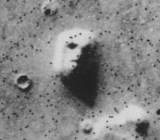
Mars, Face on Mars, and Cydonia
Hoagland claims "the Face on Mars" is part of a city built on Cydonia Planitia consisting of very large pyramids and mounds arranged in a geometric pattern, with the ratioRatio
In mathematics, a ratio is a relationship between two numbers of the same kind , usually expressed as "a to b" or a:b, sometimes expressed arithmetically as a dimensionless quotient of the two which explicitly indicates how many times the first number contains the second In mathematics, a ratio is...
s between measured angles roughly equaling mathematical constants such as π (pi)
Pi
' is a mathematical constant that is the ratio of any circle's circumference to its diameter. is approximately equal to 3.14. Many formulae in mathematics, science, and engineering involve , which makes it one of the most important mathematical constants...
, e
E (mathematical constant)
The mathematical constant ' is the unique real number such that the value of the derivative of the function at the point is equal to 1. The function so defined is called the exponential function, and its inverse is the natural logarithm, or logarithm to base...
, and the square root of 2
Square root of 2
The square root of 2, often known as root 2, is the positive algebraic number that, when multiplied by itself, gives the number 2. It is more precisely called the principal square root of 2, to distinguish it from the negative number with the same property.Geometrically the square root of 2 is the...
. He states that the ratio between the surface area of a sphere
Sphere
A sphere is a perfectly round geometrical object in three-dimensional space, such as the shape of a round ball. Like a circle in two dimensions, a perfect sphere is completely symmetrical around its center, with all points on the surface lying the same distance r from the center point...
and the surface area of the tetrahedron
Tetrahedron
In geometry, a tetrahedron is a polyhedron composed of four triangular faces, three of which meet at each vertex. A regular tetrahedron is one in which the four triangles are regular, or "equilateral", and is one of the Platonic solids...
inscribed within it, 2.720699 (π × square root of 3
Square root of 3
The square root of 3 is the positive real number that, when multiplied by itself, gives the number 3. It is more precisely called the principal square root of 3, to distinguish it from the negative number with the same property...
/2), is an approximation of e that Hoagland refers to as e'. Since e'/π (square root of 3
Square root of 3
The square root of 3 is the positive real number that, when multiplied by itself, gives the number 3. It is more precisely called the principal square root of 3, to distinguish it from the negative number with the same property...
/ 2) is −0.866, Hoagland speculates that the primary meaning of the geometry of Cydonia is to emphasize the ratio of the sphere and circumscribed tetrahedron. To Hoagland, this is evidence that an advanced civilization might once have existed on Mars, and that NASA is suppressing the evidence for reasons explained in a Brookings Institution
Brookings Institution
The Brookings Institution is a nonprofit public policy organization based in Washington, D.C., in the United States. One of Washington's oldest think tanks, Brookings conducts research and education in the social sciences, primarily in economics, metropolitan policy, governance, foreign policy, and...
report entitled Proposed Studies on the Implications of Peaceful Space Activities for Human Affairs
Brookings Report
Proposed Studies on the Implications of Peaceful Space Activities for Human Affairs, often referred to as "the Brookings Report", was commissioned by NASA and created by the Brookings Institution in collaboration with NASA's Committee on Long Range Studies in 1960...
. In fact, although the report did state that it is a possibility that such information would destabilize society, it did not itself even consider the question of withholding information from the public. The report recommended that the question ought to be studied.
On April 5, 1998, the Mars Global Surveyor
Mars Global Surveyor
The Mars Global Surveyor was a US spacecraft developed by NASA's Jet Propulsion Laboratory and launched November 1996. It began the United States's return to Mars after a 10-year absence. It completed its primary mission in January 2001 and was in its third extended mission phase when, on 2...
probe sent back better images of the Cydonia region that indicated that the face was an irregularly shaped mountain. Hoagland contends these images were run through multiple filters that degraded the original image in quality, giving it a catbox appearance which obscures what is really on Mars. On September 21, 2006, several new 3D views were released, derived from the high-resolution stereo camera on the European Space Agency
European Space Agency
The European Space Agency , established in 1975, is an intergovernmental organisation dedicated to the exploration of space, currently with 18 member states...
's Mars Express
Mars Express
Mars Express is a space exploration mission being conducted by the European Space Agency . The Mars Express mission is exploring the planet Mars, and is the first planetary mission attempted by the agency. "Express" originally referred to the speed and efficiency with which the spacecraft was...
orbiter. In response to their publication Hoagland remarked "Science is not about what you can see. It's about what you can measure,", and Hoagland's co-author Mike Bara has accused the European Space Agency
European Space Agency
The European Space Agency , established in 1975, is an intergovernmental organisation dedicated to the exploration of space, currently with 18 member states...
, which released that photo set, of fraud. The image from the HiRISE camera on Mars Reconnaissance Orbiter
Mars Reconnaissance Orbiter
Mars Reconnaissance Orbiter is a NASA multipurpose spacecraft designed to conduct reconnaissance and Exploration of Mars from orbit...
, released in April 2007, was so detailed that even Hoagland appears to have abandoned his contention that the whole structure is a face. In the epilogue to his book released the following October, he analyzes instead the details of the face mesa within the MRO frame that he says are "obviously collapsed geometric ruins [with] parallel walls, multiple 3-D planes, twisted beams, and thin girders."
In March 2010 the European Space Agency
European Space Agency
The European Space Agency , established in 1975, is an intergovernmental organisation dedicated to the exploration of space, currently with 18 member states...
's Mars Express
Mars Express
Mars Express is a space exploration mission being conducted by the European Space Agency . The Mars Express mission is exploring the planet Mars, and is the first planetary mission attempted by the agency. "Express" originally referred to the speed and efficiency with which the spacecraft was...
returned radar and visual data from Mars' larger moon, Phobos
Phobos (moon)
Phobos is the larger and closer of the two natural satellites of Mars. Both moons were discovered in 1877. With a mean radius of , Phobos is 7.24 times as massive as Deimos...
, showing the moon in unprecedented detail. Hoagland wrote that Phobos was revealed to be artificial, a "manufactured" satellite. He added that ESA itself would announce this finding at the European Planetary Science Congress http://meetingorganizer.copernicus.org/EPSC2010/meetingprogramme/SB in Rome, in September 2010. The Phobos session at EPSC in fact announced that Phobos is probably formed from re-accretion of orbiting debris.
Hoagland also claims that the true color of Mars is salmon red with patches of greenish plant life and a light blue sky, that Mars was once the moon of a larger planet which exploded, leaving Mars isolated,Adapted with acknowledgment from the late Tom Van Flandern
Tom Van Flandern
Thomas C Van Flandern was an American astronomer and author specializing in celestial mechanics. Van Flandern had a career as a professional scientist, but was noted as an outspoken proponent of non-mainstream views related to astronomy, physics, and extra-terrestrial life. He also published the...
that the advanced civilization on Mars had prior warning of the cataclysm and so escaped via migration to planet Earth, eventually adapting to the environment and becoming the present human race, and that the numerous objects surrounding the landing sites of the Mars Exploration Rovers are in fact pieces of Martian machinery.
Life on Europa
Hoagland claims the theory concerning the presence of oceans, and possibly life, under the surface of Jupiter's moon EuropaEuropa (moon)
Europa Slightly smaller than Earth's Moon, Europa is primarily made of silicate rock and probably has an iron core. It has a tenuous atmosphere composed primarily of oxygen. Its surface is composed of ice and is one of the smoothest in the Solar System. This surface is striated by cracks and...
, originated in an article he published in the January 1980 issue of Star & Sky magazine. This claim is disputed by Ralph Greenberg, a professor of Mathematics at the University of Washington
University of Washington
University of Washington is a public research university, founded in 1861 in Seattle, Washington, United States. The UW is the largest university in the Northwest and the oldest public university on the West Coast. The university has three campuses, with its largest campus in the University...
, who asserts that such theories were widely known in the 1970s, pointing out that Isaac Asimov
Isaac Asimov
Isaac Asimov was an American author and professor of biochemistry at Boston University, best known for his works of science fiction and for his popular science books. Asimov was one of the most prolific writers of all time, having written or edited more than 500 books and an estimated 90,000...
, for example, promoted them in his 1979 book Extraterrestrial Civilizations. Hoagland himself references the work of "Cassen, Peale, and Reynolds" in the article. Their computer modeling work looked at the possibility that tidal heating could maintain an ocean beneath the icy surface.
The Moon
Hoagland rejects the entire body of knowledge represented by professional selenology and asserts that there are large semitransparent structures constructed of glass on the lunar surface, visible in some ApolloProject Apollo
The Apollo program was the spaceflight effort carried out by the United States' National Aeronautics and Space Administration , that landed the first humans on Earth's Moon. Conceived during the Presidency of Dwight D. Eisenhower, Apollo began in earnest after President John F...
photography when the images are digitally manipulated. He goes on to say that NASA is suppressing knowledge of an ancient civilization on the Moon, and that the advanced technology of this civilization is lying around on the Moon's surface. He has repeatedly alleged that the 12 moon-walkers, who would be well qualified to confirm the existence of lunar artifacts and glass structures, have had their memories selectively edited via hypnosis
Hypnosis
Hypnosis is "a trance state characterized by extreme suggestibility, relaxation and heightened imagination."It is a mental state or imaginative role-enactment . It is usually induced by a procedure known as a hypnotic induction, which is commonly composed of a long series of preliminary...
so that they no longer remember seeing evidence of a lunar civilization. He has stated that a feature in an image of the lunar surface, mistakenly believed by professional planetary scientists to be a rock, is actually the severed head of a robot, and that NASA is the originator of the "...we didn't go to the moon" hoax..
On Coast to Coast AM on September 24/25 2009 Hoagland stated that the extremely thin film of water that had been detected on the Moon was obviously leaking from buried cities.
On October 6/7 2009 he opined that the upcoming LCROSS
LCROSS
The Lunar Crater Observation and Sensing Satellite was a robotic spacecraft operated by NASA. The mission was conceived as a low-cost means of determining the nature of hydrogen detected at the polar regions of the moon. The main LCROSS mission objective was to explore the presence of water ice...
lunar impact was targeted on a manned lunar base, set up by "The Secret Space Program," and that the impact would reveal some secrets. He also said that the impact would be recorded by ALSEP seismometers — the idea that ALSEP was turned off in September 1977 was "just another NASA lie." 18 days after the LCROSS lunar impacts, Hoagland released a digitally manipulated copy of the plume image released by NASA. Hoagland wrote that the rectilinear pixellation pattern emphasized by his manipulation of the photograph is in fact a ruined city.
U.S. government conspiracy
Hoagland claims The United States government has covered up the presence of extraterrestrials, that the Space Agency murdered the Apollo 1 astronauts, that NASA missions to Mars are a "well documented interest of the Bush family", and that there is a clandestine space program which uses antigravity technology reverse-engineered from lunar artifacts and communicated by secret societies.Hoagland further claims that President John F. Kennedy
John F. Kennedy
John Fitzgerald "Jack" Kennedy , often referred to by his initials JFK, was the 35th President of the United States, serving from 1961 until his assassination in 1963....
was assassinated
John F. Kennedy assassination
John Fitzgerald Kennedy, the thirty-fifth President of the United States, was assassinated at 12:30 p.m. Central Standard Time on Friday, November 22, 1963, in Dealey Plaza, Dallas, Texas...
by an agency or agencies opposed to his stated policy of inviting Nikita Khrushchev
Nikita Khrushchev
Nikita Sergeyevich Khrushchev led the Soviet Union during part of the Cold War. He served as First Secretary of the Communist Party of the Soviet Union from 1953 to 1964, and as Chairman of the Council of Ministers, or Premier, from 1958 to 1964...
to create a joint U.S.–Soviet manned lunar effort. He asserts that Federal agencies such as the Federal Emergency Management Agency
Federal Emergency Management Agency
The Federal Emergency Management Agency is an agency of the United States Department of Homeland Security, initially created by Presidential Reorganization Plan No. 1 of 1978 and implemented by two Executive Orders...
(FEMA) and NASA
NASA
The National Aeronautics and Space Administration is the agency of the United States government that is responsible for the nation's civilian space program and for aeronautics and aerospace research...
are linked to Freemasonry.
NASA and the Egyptian Gods
Hoagland has written and spoken often about what he sees as NASA's "fanatical, relentless" drive to pay homage to the Egyptian Gods IsisIsis
Isis or in original more likely Aset is a goddess in Ancient Egyptian religious beliefs, whose worship spread throughout the Greco-Roman world. She was worshipped as the ideal mother and wife as well as the matron of nature and magic...
, Osiris
Osiris
Osiris is an Egyptian god, usually identified as the god of the afterlife, the underworld and the dead. He is classically depicted as a green-skinned man with a pharaoh's beard, partially mummy-wrapped at the legs, wearing a distinctive crown with two large ostrich feathers at either side, and...
, and Horus
Horus
Horus is one of the oldest and most significant deities in the Ancient Egyptian religion, who was worshipped from at least the late Predynastic period through to Greco-Roman times. Different forms of Horus are recorded in history and these are treated as distinct gods by Egyptologists...
. Citing work by Robert Bauval
Robert Bauval
Robert Bauval is an author, lecturer, and Ancient Egypt researcher, best known for his Orion Correlation Theory.-Early life:...
and Graham Hancock
Graham Hancock
Graham Hancock is a British writer and journalist. Hancock specialises in unconventional theories involving ancient civilizations, stone monuments or megaliths, altered states of consciousness, ancient myths and astronomical/astrological data from the past...
on the symbolism of the Great Pyramid at Giza, he explains that these Gods are honored via their proxies, the stars Sirius
Sirius
Sirius is the brightest star in the night sky. With a visual apparent magnitude of −1.46, it is almost twice as bright as Canopus, the next brightest star. The name "Sirius" is derived from the Ancient Greek: Seirios . The star has the Bayer designation Alpha Canis Majoris...
(Isis), the "belt" stars of Orion
Orion (constellation)
Orion, often referred to as The Hunter, is a prominent constellation located on the celestial equator and visible throughout the world. It is one of the most conspicuous, and most recognizable constellations in the night sky...
(Osiris), and Regulus
Regulus
Regulus is the brightest star in the constellation Leo and one of the brightest stars in the night sky, lying approximately 77.5 light years from Earth. Regulus is a multiple star system composed of four stars which are organized into two pairs...
(Horus). He has theorized that NASA preferentially arranges for key space mission events to occur when these five stars are at any of five elevations (−33°, −19.5°, 0, 19.5° and 33°) as seen from a significant place related to that space mission event.
As an example, he cites the fact that, at the exact time of the Lunar Orbit Insertion burn of Apollo 8
Apollo 8
Apollo 8, the second manned mission in the American Apollo space program, was the first human spaceflight to leave Earth orbit; the first to be captured by and escape from the gravitational field of another celestial body; and the first crewed voyage to return to Earth from another celestial...
, on 24 December 1968, the Orion belt star Mintaka was exactly on the horizon of the site in the Sea of Tranquility where the Apollo 11
Apollo 11
In early 1969, Bill Anders accepted a job with the National Space Council effective in August 1969 and announced his retirement as an astronaut. At that point Ken Mattingly was moved from the support crew into parallel training with Anders as backup Command Module Pilot in case Apollo 11 was...
Lunar Module would land seven months later.
He traces the origin of this obsession on the part of NASA to the geologist Farouk El-Baz
Farouk El-Baz
Farouk El-Baz is an Egyptian American scientist who worked with NASA to assist in the planning of scientific exploration of the Moon, including the selection of landing sites for the Apollo missions and the training of astronauts in lunar observations and photography.Currently, El-Baz is Research...
, who is Egyptian by birth. He has written that Dr. El-Baz was "the most powerful single individual in the American space program" because of his influence over Apollo landing site selection. One of the six Apollo landing sites satisfies Hoagland's Egyptian criteria (Mintaka at 19.5° at the moment of landing of Apollo 12
Apollo 12
Apollo 12 was the sixth manned flight in the American Apollo program and the second to land on the Moon . It was launched on November 14, 1969 from the Kennedy Space Center, Florida, four months after Apollo 11. Mission commander Charles "Pete" Conrad and Lunar Module Pilot Alan L...
.)
The Norwegian spiral
Hoagland has commented at great length on the so-called Norway Spiral2009 Norwegian spiral anomaly
The Norwegian spiral anomaly of 2009 appeared in the night sky over Norway on 9 December 2009. It was visible from, and photographed from, northern Norway and Sweden. The spiral consisted of a blue beam of light with a greyish spiral emanating from one end of it...
, an extraordinary display of light seen over much of northern Norway
Norway
Norway , officially the Kingdom of Norway, is a Nordic unitary constitutional monarchy whose territory comprises the western portion of the Scandinavian Peninsula, Jan Mayen, and the Arctic archipelago of Svalbard and Bouvet Island. Norway has a total area of and a population of about 4.9 million...
on 9 December 2009, caused by the partial failure of a Russian SLBM test flight. Hoagland draws special attention to the fact that this event occurred close to President Barack Obama
Barack Obama
Barack Hussein Obama II is the 44th and current President of the United States. He is the first African American to hold the office. Obama previously served as a United States Senator from Illinois, from January 2005 until he resigned following his victory in the 2008 presidential election.Born in...
's arrival in Norway to accept the Nobel Peace Prize
Nobel Peace Prize
The Nobel Peace Prize is one of the five Nobel Prizes bequeathed by the Swedish industrialist and inventor Alfred Nobel.-Background:According to Nobel's will, the Peace Prize shall be awarded to the person who...
.
On 2–3 February 2010, on the Coast to Coast AM
Coast to Coast AM
Coast to Coast AM is a North American late-night syndicated radio talk show that deals with a variety of topics, but most frequently ones that relate to either the paranormal or conspiracy theories. It was created by Art Bell and is distributed by Premiere Radio Networks. The program currently...
radio show, Hoagland announced that the Russian SLBM had in fact been captured by Dark Forces intent on preventing mankind's exploration of outer space. These Dark Forces, he explained, were probably headed by Nazi officers who had escaped into space after World War II. To Hoagland, this was a sufficient explanation of President Obama's desire to cancel Project Constellation
Project Constellation
Constellation Program is a human spaceflight program within NASA, the space agency of the United States. The stated goals of the program were to gain significant experience in operating away from Earth's environment, develop technologies needed for opening the space frontier, and conduct...
, since Obama had clearly accepted that any attempt to return to the Moon would be thwarted by the superior technology of the Nazis in space.
Elenin and YU55
During the summer and fall of 2011 Hoagland spoke and wrote extravagantly about comet C/2010 X1C/2010 X1
Comet C/2010 X1 is a long-period comet discovered by Russian amateur astronomer Leonid Elenin on December 10, 2010, through remote control of the International Scientific Optical Network's robotic observatory near Mayhill, New Mexico, U.S.A...
, also known as Elenin after its discoverer, and asteroid 2005 YU55
2005 YU55
', also written as 2005 YU55, is a potentially hazardous asteroid 310 meters or about 400 m in diameter. It was discovered on 28 December 2005 by Robert S. McMillan at Steward Observatory, Kitt Peak. On 8 November 2011 it passed 0.85 lunar distances from the Earth...
. At a June teleconference sponsored by Project Camelot he gave the correct dates for closest approach to Earth for both bodies. He said that YU55 would come dangerously close to both Earth and Moon while we were all distracted by Elenin.
At the Exopolitics conference in Leeds
Leeds
Leeds is a city and metropolitan borough in West Yorkshire, England. In 2001 Leeds' main urban subdivision had a population of 443,247, while the entire city has a population of 798,800 , making it the 30th-most populous city in the European Union.Leeds is the cultural, financial and commercial...
, and again at the Awake & Aware conference in Irvine, California
Irvine, California
Irvine is a suburban incorporated city in Orange County, California, United States. It is a planned city, mainly developed by the Irvine Company since the 1960s. Formally incorporated on December 28, 1971, the city has a population of 212,375 as of the 2010 census. However, the California...
, he expounded a complex pseudo-statistical theory which he said proved that Elenin was not a comet but a spaceship, sent by a prior Earthly civilization 13,000 years ago with a message for contemporary humanity. When, in late August, professional cometary astronomers announced that Elenin had begun to break up, Hoagland denied this and showed an image which he said proved that the spaceship had a tetrahedral shield protecting it from coronal mass ejection
Coronal mass ejection
A coronal mass ejection is a massive burst of solar wind, other light isotope plasma, and magnetic fields rising above the solar corona or being released into space....
s.
On Coast to Coast AM
Coast to Coast AM
Coast to Coast AM is a North American late-night syndicated radio talk show that deals with a variety of topics, but most frequently ones that relate to either the paranormal or conspiracy theories. It was created by Art Bell and is distributed by Premiere Radio Networks. The program currently...
, 21 October, he stated that two things persuaded him that the asteroid YU55 was also under intelligent control. First, its rotation period was 19.5 hours. Second, it was perfectly spherical. Both factors later turned out to be false, when better ephemerides and radar images became available. In a further appearance on the radio show, and on his Facebook
Facebook
Facebook is a social networking service and website launched in February 2004, operated and privately owned by Facebook, Inc. , Facebook has more than 800 million active users. Users must register before using the site, after which they may create a personal profile, add other users as...
page, he developed a theory that Elenin and YU55 had had coincident perihelions and that the trajectory of YU55 had then been perturbed such that it would now impact the Moon. He said that he had "numbers" to prove this but did not reveal what those numbers were. He advised his followers to store food, water and cash because the lunar impact would be so spectacular that some public panic would ensue.
On Coast to Coast AM
Coast to Coast AM
Coast to Coast AM is a North American late-night syndicated radio talk show that deals with a variety of topics, but most frequently ones that relate to either the paranormal or conspiracy theories. It was created by Art Bell and is distributed by Premiere Radio Networks. The program currently...
, 7 November, he stated that two separate "sources" had informed him that an Atlas-Centaur
Atlas-Centaur
The Atlas-Centaur was an American expendable launch system designed and built by General Dynamics Convair Division in San Diego, CA. It was derived from the SM-65 Atlas missile. It was a member of the Atlas family of rockets, and was used for 61 orbital launches between 1962 and 1983. It was...
was being launched from Vandenberg AFB that very night, on a mission to either observe or, more probably, to deflect, the asteroid.
In the event, neither of these two bodies diverged from predicted paths. Elenin disintegrated completely into a dust cloud. If there was a message for humanity it was not made public.
Other claims
Hoagland has asserted that he was the "co-creator" of the Pioneer 10 plaquePioneer plaque
The Pioneer plaques are a pair of gold-anodized aluminium plaques which were placed on board the 1972 Pioneer 10 and 1973 Pioneer 11 spacecraft, featuring a pictorial message, in case either Pioneer 10 or 11 are intercepted by extraterrestrial life...
along with Eric Burgess
Eric Burgess
Eric Burgess was an English freelance consultant, lecturer and journalist, who wrote about the Pioneer program of space missions since the first tests in 1957...
, that the Saturnian moon Iapetus
Iapetus (moon)
Iapetus ), occasionally Japetus , is the third-largest moon of Saturn, and eleventh in the Solar System. It was discovered by Giovanni Domenico Cassini in 1671...
is an artificial world, that Galileo, which burned up in Jupiter's atmosphere, caused a mysterious black spot due to its nuclear power source, that the 9/11 attacks were part of a pseudo-Masonic
Freemasonry
Freemasonry is a fraternal organisation that arose from obscure origins in the late 16th to early 17th century. Freemasonry now exists in various forms all over the world, with a membership estimated at around six million, including approximately 150,000 under the jurisdictions of the Grand Lodge...
conspiracy, and that The Arecibo message
Arecibo message
The Arecibo message was broadcast into space a single time via frequency modulated radio waves at a ceremony to mark the remodeling of the Arecibo radio telescope on 16 November 1974. It was aimed at the globular star cluster M13 some 25,000 light years away because M13 was a large and close...
was intentionally altered by author Carl Sagan
Carl Sagan
Carl Edward Sagan was an American astronomer, astrophysicist, cosmologist, author, science popularizer and science communicator in astronomy and natural sciences. He published more than 600 scientific papers and articles and was author, co-author or editor of more than 20 books...
.
On December 9, 2007, Hoagland wrote that the vexatious problems NASA was then having with the “ECO” low-fuel sensors in the space shuttle
Space Shuttle
The Space Shuttle was a manned orbital rocket and spacecraft system operated by NASA on 135 missions from 1981 to 2011. The system combined rocket launch, orbital spacecraft, and re-entry spaceplane with modular add-ons...
main fuel tank were due to what he called “Torsion Physics”, which he claimed would never be resolved by conventional engineering. On February 7, 2008, STS-122
STS-122
STS-122 was a NASA Space Shuttle mission to the International Space Station , flown by the Space Shuttle Atlantis. STS-122 marked the 24th shuttle mission to the ISS, and the 121st space shuttle flight since STS-1....
launched successfully. In the postlaunch press conference mission managers reported that the ECO sensors had performed flawlessly. The problem had been traced to an external tank feed-through connector—and corrected using perfectly conventional engineering STS-122#ECO sensor troubleshooting and recovery. The mission ended, as planned, on February 20—and was called a complete success. He also asserts that the orbital parameters of spin-stabilized satellite
Spin-stabilized satellite
A spin-stabilized satellite is a satellite which has the motion of one axis held fixed by spinning the satellite around that axis, using the gyroscopic effect.The attitude of a satellite or any rigid body is its orientation in space...
s are influenced by an anti-gravity
Anti-gravity
Anti-gravity is the idea of creating a place or object that is free from the force of gravity. It does not refer to the lack of weight under gravity experienced in free fall or orbit, or to balancing the force of gravity with some other force, such as electromagnetism or aerodynamic lift...
field in addition to the energy imparted by their launch rockets, which has been kept secret for fifty years until revealed by himself in August 2008. The February 2009 collision
2009 satellite collision
The 2009 satellite collision was the first accidental hypervelocity collision between two intact artificial satellites in Earth orbit. The collision occurred at 16:56 UTC on February 10, 2009, at above the Taymyr Peninsula in Siberia, when Iridium 33 and Kosmos-2251 collided...
between Iridium 33 and Kosmos 2251 was "...deliberate, it was an act of violence.", with the intent to make low earth orbit
Low Earth orbit
A low Earth orbit is generally defined as an orbit within the locus extending from the Earth’s surface up to an altitude of 2,000 km...
"uninhabitable", and to permit termination of the Space Shuttle program
Space Shuttle program
NASA's Space Shuttle program, officially called Space Transportation System , was the United States government's manned launch vehicle program from 1981 to 2011...
and the Hubble space telescope
Hubble Space Telescope
The Hubble Space Telescope is a space telescope that was carried into orbit by a Space Shuttle in 1990 and remains in operation. A 2.4 meter aperture telescope in low Earth orbit, Hubble's four main instruments observe in the near ultraviolet, visible, and near infrared...
. He stated on March 16 and 17, 2009 during the Coast to Coast AM
Coast to Coast AM
Coast to Coast AM is a North American late-night syndicated radio talk show that deals with a variety of topics, but most frequently ones that relate to either the paranormal or conspiracy theories. It was created by Art Bell and is distributed by Premiere Radio Networks. The program currently...
show that the Hubble repair mission STS-125
STS-125
STS-125, or HST-SM4 , was the fifth and final space shuttle servicing mission to the Hubble Space Telescope .Launch occurred on 11 May 2009 at 2:01 pm EDT...
, scheduled for May 2009, will be canceled in line with a policy allowing NASA to devote resources to more inspiring programs (it was not). In addition, NASA statements about two space-junk alerts in March 2009 were "lies." During the Coast to Coast AM
Coast to Coast AM
Coast to Coast AM is a North American late-night syndicated radio talk show that deals with a variety of topics, but most frequently ones that relate to either the paranormal or conspiracy theories. It was created by Art Bell and is distributed by Premiere Radio Networks. The program currently...
programs on June 10 and 11, 2009, Hoagland stated that NASA is destroying evidence of life on Mars through the heating of soil samples to high temperatures by the various rovers and landers, which has killed "Martians". During the Coast to Coast AM on May 21 and 22, 2009 he claimed that the Obama Administration could announce in the next few months that we have found life on Mars, and that Interplanetary warfare is being waged right now in Earth orbit, conducted by factions of a secret supra-national World Government.
On October 16/17, 2009, he stated that the new Ares I-X
Ares I-X
Ares I-X was the first stage prototype and design concept demonstrator in the Ares I program, a launch system for human spaceflight developed by the United States space agency, NASA. Ares I-X was successfully launched on October 28, 2009...
rocket, scheduled for rollout on October 19 for launch on October 27, would never reach the launch pad. In fact, Ares arrived at pad 39B on October 20, 2009.
On December 2/3, 2010, he said that the Shuttle Discovery mission STS-133
STS-133
STS-133 was the 133rd mission in NASA's Space Shuttle program; during the mission, Space Shuttle Discovery docked with the International Space Station. It was Discoverys 39th and final mission. The mission launched on 24 February 2011, and landed on 9 March 2011...
, then on the launch pad, would be the first post-Newtonian mission. He explained that the spacecraft would be powered to orbit by hyperdimensional torsion, although he did not explain what he meant by that and was not pressed by host George Noory
George Noory
George Ralph Noory is a Lebanese-American radio talk show host.As of 2010, he is the weekday host of the late-night radio talk show Coast to Coast AM. He is heard across the United States and Canada on many AM and FM stations as well as on XM Satellite Radio. His show is one of the most listened...
. STS-133 was delayed by needed repairs to the external tank, but launched successfully, and conventionally, on 24 February 2011.
Hoagland is a proponent of the theory that all the planets in the solar system are warming, and rejects man-made climate change. In 2004 he co-authored a report with David Wilcock
David Wilcock
David Wilcock is a lecturer, author, and filmmaker based in Los Angeles, California.Along with Wynn Free, Wilcock co-authored the non-fiction book The Reincarnation of Edgar Cayce? in 2004...
to this effect.
Responses by scientists
Many scientists have responded to Hoagland's claims and assertions. Professional astronomer Phil Plait described Hoagland as a pseudoscientist and his claims as ridiculous. In 2002, Ralph Greenberg, Professor of MathematicsMathematics
Mathematics is the study of quantity, space, structure, and change. Mathematicians seek out patterns and formulate new conjectures. Mathematicians resolve the truth or falsity of conjectures by mathematical proofs, which are arguments sufficient to convince other mathematicians of their validity...
at University of Washington
University of Washington
University of Washington is a public research university, founded in 1861 in Seattle, Washington, United States. The UW is the largest university in the Northwest and the oldest public university on the West Coast. The university has three campuses, with its largest campus in the University...
, Seattle, wrote a paper asserting that the logic of Hoagland's deductions from the geometry of Cydonia Mensae is flawed and says that Hoagland is not a trained scientist in any sense. The claim that the crashing of the Galileo Probe into Jupiter caused a "mysterious black spot" on the planet has since been disputed by both NASA and Dr. Plait. There is photographic evidence that a similar "black spot" was present in imagery of Jupiter taken in 1998. A second image referenced by Dr. Plait shows a dark ring which looks similar to the spot Hoagland cited. In 1995 Malin Space Science Systems
Malin Space Science Systems
Malin Space Science Systems is a San Diego, California company that designs, develops, and operates instruments to fly on unmanned spacecraft. MSSS is headed by chief scientist and CEO Michael C. Malin....
, NASA prime contractor for planetary imaging, published a paper critiquing claims that the 'city' at Cydonia is artificial, the claimed mathematical relationships, and — very specifically — denying any claims about concealing questionable data from the public.