
All Topics  
Tetrahedron


   Email Print
   Bookmark   Link


Tetrahedron


A tetrahedron (plural: tetrahedra) is a polyhedron
Polyhedron

|}A polyhedron is often defined as a geometry object with flat faces and straight edges .This definition of a polyhedron is not very precise, and to a modern mathematician is quite unsatisfactory....
 composed of four triangular
Triangle

A triangle is one of the basic shapes of geometry: a polygon with three corners or wikt:vertex and three sides or edges which are line segments....
 faces, three of which meet at each vertex
Vertex (geometry)

In geometry, a vertex is a special kind of point which describes the corners or intersections of geometric shapes. Vertices are commonly used in computer graphics to define the corners of surfaces in 3d models, where each such point is given as a vector....
. A regular tetrahedron is one in which the four triangles are regular, or "equilateral", and is one of the Platonic solid
Platonic solid

In geometry, a Platonic solid is a convex set polyhedron that is regular polyhedron, in the sense of a regular polygon. Specifically, the faces of a Platonic solid are congruence regular polygons, with the same number of faces meeting at each vertex....
s.

The tetrahedron is one kind of pyramid
Pyramid (geometry)

In geometry, a pyramid is a polyhedron formed by connecting a polygonal base and a point, called the apex . Each base edge and apex form a triangle....
, which is a polyhedron with a flat polygon base and triangular faces connecting the base to a common point. In the case of a tetrahedron the base is a triangle (any of the four faces can be considered the base), so a tetrahedron is also known as triangular pyramid.

Like all convex
Convex set

In Euclidean space, an object is convex if for every pair of points within the object, every point on the straight line segment that joins them is also within the object....
 polyhedra, a tetrahedron can be folded from a single sheet of paper.

(1, 1, 1)
(−1, −1, 1)
(−1, 1, −1)
(1, −1, −1)


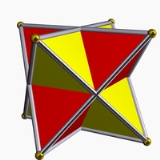
The compound of two tetrahedra shows the regular tetrahedron
Tetrahedron

A tetrahedron is a polyhedron composed of four triangle faces, three of which meet at each vertex . A regular tetrahedron is one in which the four triangles are regular, or "equilateral", and is one of the Platonic solids....
 exists as two alternate sets of vertices of the cube
Cube

A cube is a three-dimensional space solid object bounded by six square faces, facets or sides, with three meeting at each wikt:vertex. The cube can also be called a Regular polyhedron hexahedron and is one of the five Platonic solids....
.

le class="wikitable">
Base plane area 
Surface area 
Height 
Volume
Volume

The volume of any solid, liquid, plasma, vacuum or theoretical object is how much three-dimensional space it occupies, often quantified numerically....
 
Angle between an edge and a face
(approx.


Discussion
Ask a question about 'Tetrahedron'
Start a new discussion about 'Tetrahedron'
Answer questions from other users
Full Discussion Forum


Recent Posts


Encyclopedia


A tetrahedron (plural: tetrahedra) is a polyhedron
Polyhedron

|}A polyhedron is often defined as a geometry object with flat faces and straight edges .This definition of a polyhedron is not very precise, and to a modern mathematician is quite unsatisfactory....
 composed of four triangular
Triangle

A triangle is one of the basic shapes of geometry: a polygon with three corners or wikt:vertex and three sides or edges which are line segments....
 faces, three of which meet at each vertex
Vertex (geometry)

In geometry, a vertex is a special kind of point which describes the corners or intersections of geometric shapes. Vertices are commonly used in computer graphics to define the corners of surfaces in 3d models, where each such point is given as a vector....
. A regular tetrahedron is one in which the four triangles are regular, or "equilateral", and is one of the Platonic solid
Platonic solid

In geometry, a Platonic solid is a convex set polyhedron that is regular polyhedron, in the sense of a regular polygon. Specifically, the faces of a Platonic solid are congruence regular polygons, with the same number of faces meeting at each vertex....
s.

The tetrahedron is one kind of pyramid
Pyramid (geometry)

In geometry, a pyramid is a polyhedron formed by connecting a polygonal base and a point, called the apex . Each base edge and apex form a triangle....
, which is a polyhedron with a flat polygon base and triangular faces connecting the base to a common point. In the case of a tetrahedron the base is a triangle (any of the four faces can be considered the base), so a tetrahedron is also known as triangular pyramid.

Like all convex
Convex set

In Euclidean space, an object is convex if for every pair of points within the object, every point on the straight line segment that joins them is also within the object....
 polyhedra, a tetrahedron can be folded from a single sheet of paper.

Cartesian coordinates of a regular tetrahedron


The following Cartesian coordinates define the vertices of a tetrahedron with edge-length 2√2, centered at the origin:
(1, 1, 1)
(−1, −1, 1)
(−1, 1, −1)
(1, −1, −1)


The compound of two tetrahedra shows the regular tetrahedron
Tetrahedron

A tetrahedron is a polyhedron composed of four triangle faces, three of which meet at each vertex . A regular tetrahedron is one in which the four triangles are regular, or "equilateral", and is one of the Platonic solids....
 exists as two alternate sets of vertices of the cube
Cube

A cube is a three-dimensional space solid object bounded by six square faces, facets or sides, with three meeting at each wikt:vertex. The cube can also be called a Regular polyhedron hexahedron and is one of the five Platonic solids....
.

Formulas for regular tetrahedron


For a regular tetrahedron of edge length :
Base plane area 
Surface area 
Height 
Volume
Volume

The volume of any solid, liquid, plasma, vacuum or theoretical object is how much three-dimensional space it occupies, often quantified numerically....
 
Angle between an edge and a face
(approx. 55°)
Angle between two faces
(approx. 71°)
Angle between the segments joining the center and the vertices ,
(approx. 109.471°)
Solid angle
Solid angle

The solid angle, O, is the angle in three-dimensional space that an object subtends at a point. It is a measure of how big that object appears to an observer looking from that point....
 at a vertex subtended by a face

(approx. 0.55129 steradians)
Radius of circumsphere 
Radius of insphere that is tangent to faces 
Radius of midsphere
Midsphere

In geometry, the midsphere or intersphere of a polyhedron is a sphere which is tangent to every edge of the polyhedron. That is to say, it touches any given edge at exactly one point....
 that is tangent to edges
 
Radius of exspheres 
Distance to exsphere center from a vertex 


Note that with respect to the base plane the slope
Slope

Slope is used to describe the steepness, incline, gradient, or grade of a line . A higher slope value indicates a steeper incline. The slope is defined as the ratio of the "rise" divided by the "run" between two points on a line, or in other words, the ratio of the altitude change to the horizontal distance between any two point...
 of a face is twice that of an edge , corresponding to the fact that the horizontal distance covered from the base to the apex
Apex (geometry)

In geometry, an apex is a descriptive label for a visual singular highest or most distant point or Vertex in an isosceles triangle, Pyramid or Cone , usually contrasting with the opposite side called the base....
 along an edge is twice that along the median
Median (geometry)

In geometry, a median of a triangle is a line segment joining a vertex to the midpoint of the opposing side. Every triangle has exactly three medians; one running from each vertex to the opposite side....
 of a face. In other words, if C is the centroid
Centroid

In geometry, the centroid, geometric center, or barycenter of a plane figure is the intersection of all straight lines that divide into two parts of equal moment about the line....
 of the base, the distance from C to a vertex of the base is twice that from C to the midpoint of an edge of the base. This follows from the fact that the medians of a triangle intersect at its centroid, and this point divides each of them in two segments, one of which is twice as long as the other (see proof
Centroid

In geometry, the centroid, geometric center, or barycenter of a plane figure is the intersection of all straight lines that divide into two parts of equal moment about the line....
).

Volume of any tetrahedron

The volume of any tetrahedron is given by the pyramid volume formula:

where is the area of the base and h the height from the base to the apex. This applies for each of the four choices of the base, so the distances from the apexes to the opposite faces are inversely proportional to the areas of these faces.

For a tetrahedron with vertices a = (a1, a2, a3), b = (b1, b2, b3), c = (c1, c2, c3), and d = (d1, d2, d3), the volume is (1/6)·|det
Determinant

In algebra, a determinant is a function depending on n that associates a scalar , det, to an n?n square matrix A. The fundamental geometric meaning of a determinant is a scale factor for measure when A is regarded as a linear transformation....
(ab, bc, cd)|, or any other combination of pairs of vertices that form a simply connected graph
Graph theory

In mathematics and computer science, graph theory is the study of graph : mathematical structures used to model pairwise relations between objects from a certain collection....
. This can be rewritten using a dot product
Dot product

In mathematics, the dot product, also known as the scalar product, is an operation which takes two vector over the real numbers R and returns a real-valued scalar quantity....
 and a cross product
Cross product

In mathematics, the cross product is a binary operation on two vector s in a three-dimensional Euclidean space that results in another vector which is orthogonal to the plane containing the two input vectors....
, yielding


If the origin of the coordinate system is chosen to coincide with vertex d, then d = 0, so


where a, b, and c represent three edges that meet at one vertex, and is a scalar triple product. Comparing this formula with that used to compute the volume of a parallelepiped
Parallelepiped

In geometry, a parallelepiped is a three-dimensional figure formed by six parallelograms. It is to a parallelogram as a cube is to a square : Euclidean geometry supports all four notions but affine geometry admits only parallelograms and parallelepipeds....
, we conclude that the volume of a tetrahedron is equal to 1/6 of the volume of any parallelepiped which shares with it three converging edges.

It should be noted that the triple scalar can be represented by the following determinants:
   or       where       is expressed as a row or column vector etc.


Hence


   where       etc.


which gives


, where are the plane angles occurring in vertex d. The angle is the angle between the two edges connecting the vertex d to the vertices b and c. The angle does so for the vertices a and c, while is defined by the position of the vertices a and b.

Given the distances between the vertices of a tetrahedron the volume can be computed using the formula:

In the above formula, the subscripts represent the vertices and is the pairwise distance between them—i.e., the length of the edge connecting the two vertices. A negative value of the determinant means that a tetrahedron cannot be constructed with the given distances. This formula as multiplied out is essentially due to the painter Piero della Francesca
Piero della Francesca

Piero della Francesca was an Italian artist of the Italian Renaissance. To contemporaries, he was known as a mathematician and geometer as well as an artist, though now he is chiefly appreciated for his art....
 in the 15th century, as a three dimensional analogue of the 1st century Heron's formula
Heron's formula

In geometry, Heron's formula states that the area of a triangle whose sides have lengths a, b, and c iswhere s is the semiperimeter of the triangle:...
 for the area of a triangle.

Distance between the edges

Any two opposite edges of a tetrahedron lie on two skew lines
Skew lines

In solid geometry, skew lines are two lines that do not intersect but are not parallel. Equivalently, they are lines that are not both in the same plane ....
. If the closest pair of points between these two lines are points in the edges, they define the distance between the edges; otherwise, the distance between the edges equals that between one of the endpoints and the opposite edge.

Three dimensional properties of a generalized tetrahedron


As with triangle geometry, there is a similar set of three dimensional geometric properties for a tetrahedron. A generalized tetrahedron has an insphere, circumsphere, medial tetrahedron and exspheres. It has respective centers such as incenter, circumcenter, excenters, Spieker center
Spieker circle

In geometry, the incircle of the medial triangle of a triangle ABC is the Spieker circle. Its center, the Spieker center, is the center of mass of the boundary of triangle ABC as well as being the incenter of the medial triangle....
 and points such as a centroid. However there is, generally, no orthocenter in the sense of intersecting altitudes. There is an equivalent sphere to the triangular nine point circle that is the circumsphere of the medial tetrahedron. However its circumsphere does not, generally, pass through the base points of the altitudes of the reference tetrahedron.

To resolve these inconsistencies, a substitute center known as the Monge point that always exists for a generalized tetrahedron is introduced. This point was first identified by Gaspard Monge
Gaspard Monge

Gaspard Monge, Comte de P?luse , was the inventor of descriptive geometry....
. For tetrahedra where the altitudes do intersect, the Monge point and the orthocenter coincide. The Monge point is defined as the point where the six midplanes of a tetrahedron intersect. A midplane is defined as a plane that is orthogonal to an edge joining any two vertices that also contains the centroid of an opposite edge formed by joining the other two vertices.

An orthogonal line dropped from the Monge point to any face is coplanar with two other orthogonal lines to the same face. The first is an altitude dropped from a corresponding vertex to the chosen face. The second is an orthogonal line to the chosen face that passes through the orthocenter of that face. This orthogonal line through the Monge point lies mid way between the altitude and the orthocentric orthogonal line.

The Monge point, centroid and circumcenter of a tetrahedron are colinear and form the Euler line of the tetrahedron. However, unlike the triangle, the centroid of a tetrahedron lies at the midpoint of its Monge point and circumcenter.

There is an equivalent sphere to the triangular nine point circle for the generalized tetrahedron. It is the circumsphere of its medial tetrahedron. It is a twelve point sphere centered at the circumcenter of the medial tetrahedron. By definition it passes through the centroids of the four faces of the reference tetrahedron. It passes through four substitute Euler points that are located at a distance of 1/3 of the way from M, the Monge point, toward each of the four vertices. Finally it passes through the four base points of orthogonal lines dropped from each Euler point to the face not containing the vertex that generated the Euler point.

If T represents the center of the twelve point sphere, then it also lies on the Euler line. However, unlike its triangular counterpart, the center lies 1/3 of the way from the Monge point M towards the circumcenter. Also an orthogonal line through T to a chosen face is coplanar with two other orthogonal lines to the same face. The first is an orthogonal line passing through the corresponding Euler point to the chosen face. The second is an orthogonal line passing through the centroid of the chosen face. This orthogonal line through the twelve point center lies mid way between the Euler point orthogonal line and the centroidal orthogonal line. Furthermore, for any face, the twelve point center lies at the mid point of the corresponding Euler point and the orthocenter for that face.

The radius of the twelve point sphere is 1/3 of the circumradius of the reference tetrahedron.

If OABC forms a generalized tetrahedron with a vertex O as the origin and vectors and represent the positions of the vertices A, B and C with respect to O, then the radius of the insphere is given by:

and the radius of the circumsphere is given by:

which gives the radius of the twelve point sphere:

where:

The vector position of various centers are given as follows:

The centroid

The circumcenter

The Monge point

The Euler line relationships are:

where is twelve point center.

It should also be noted that:

and:

Geometric relations


A tetrahedron is a 3-simplex
Simplex

In geometry, a simplex or n-simplex is an n-dimensional analogue of a triangle. Specifically, a simplex is the convex hull of a set of affine transformation Point s in some Euclidean space of dimension n or higher ....
. Unlike in the case of other Platonic solids, all vertices of a regular tetrahedron are equidistant from each other (they are in the only possible arrangement of four equidistant points).

A tetrahedron is a triangular pyramid
Pyramid (geometry)

In geometry, a pyramid is a polyhedron formed by connecting a polygonal base and a point, called the apex . Each base edge and apex form a triangle....
, and the regular tetrahedron is self-dual.

A regular tetrahedron can be embedded inside a cube in two ways such that each vertex is a vertex of the cube, and each edge is a diagonal of one of the cube's faces. For one such embedding, the Cartesian coordinates of the vertices
Vertex (geometry)

In geometry, a vertex is a special kind of point which describes the corners or intersections of geometric shapes. Vertices are commonly used in computer graphics to define the corners of surfaces in 3d models, where each such point is given as a vector....
 are
(+1, +1, +1);
(−1, −1, +1);
(−1, +1, −1);
(+1, −1, −1).
For the other tetrahedron (which is dual
Dual polyhedron

In geometry, polyhedron are associated into pairs called duals, where the wikt:vertex of one correspond to the face s of the other. The dual of the dual is the original polyhedron....
 to the first), reverse all the signs. The volume of this tetrahedron is 1/3 the volume of the cube. Combining both tetrahedra gives a regular polyhedral compound
Polyhedral compound

A polyhedral compound is a polyhedron that is itself composed of several other polyhedra sharing a common centre. They are the three-dimensional analogs of star polygon#Star figuress such as the hexagram....
 called the stella octangula
Stella octangula

The stella octangula, also known as the stellated octahedron, Star Tetrahedron, eight-pointed star, or 2D geometric model as the Star of David....
, whose interior is an octahedron
Octahedron

An octahedron is a polyhedron with eight faces. A regular octahedron is a Platonic solid composed of eight equilateral triangles, four of which meet at each wikt:vertex....
. Correspondingly, a regular octahedron is the result of cutting off, from a regular tetrahedron, four regular tetrahedra of half the linear size (i.e., rectifying
Rectification (geometry)

In Euclidean geometry, rectification is the process of truncating a polytope by marking the midpoints of all its edges, and cutting off its vertices at those points....
 the tetrahedron). The above embedding divides the cube into five tetrahedra, one of which is regular. In fact, 5 is the minimum number of tetrahedra required to compose a cube.

Inscribing tetrahedra inside the regular compound of five cubes
Polyhedral compound

A polyhedral compound is a polyhedron that is itself composed of several other polyhedra sharing a common centre. They are the three-dimensional analogs of star polygon#Star figuress such as the hexagram....
 gives two more regular compounds, containing five and ten tetrahedra.

Regular tetrahedra cannot tessellate space
Honeycomb (geometry)

In geometry, a honeycomb is a space filling or close packing of polyhedral or higher-dimensional cells, so that there are no gaps. It is an example of the more general mathematical tiling or tessellation in any number of dimensions....
 by themselves, although this result seems likely enough that Aristotle
Aristotle

Aristotle was a Greeks philosopher, a student of Plato and teacher of Alexander the Great. He wrote on many subjects, including physics, metaphysics, Poetics , theater, music, logic, rhetoric, politics, government, ethics, biology and zoology....
 claimed it was possible. However, two regular tetrahedra can be combined with an octahedron, giving a rhombohedron
Rhombohedron

In geometry, a rhombohedron is a three-dimensional figure like a cube, except that its faces are not squares but rhombus. It is a special case of a parallelepiped where all edges are the same length....
 which can tile space.

However, there is at least one irregular tetrahedron of which copies can tile space. If one relaxes the requirement that the tetrahedra be all the same shape, one can tile space using only tetrahedra in various ways. For example, one can divide an octahedron into four identical tetrahedra and combine them again with two regular ones. (As a side-note: these two kinds of tetrahedron have the same volume.)

The tetrahedron is unique among the uniform polyhedra
Uniform polyhedron

A Uniform polytope polyhedron is a polyhedron which has regular polygons as Face and is transitive on its vertex . It follows that all vertices are Congruence , and the polyhedron has a high degree of reflectional and rotational symmetry....
 in possessing no parallel faces.

Related polyhedra


A truncation process applied to the tetrahedron produces a series of uniform polyhedra
Uniform polyhedron

A Uniform polytope polyhedron is a polyhedron which has regular polygons as Face and is transitive on its vertex . It follows that all vertices are Congruence , and the polyhedron has a high degree of reflectional and rotational symmetry....
. Truncating edges down to points produces the octahedron
Octahedron

An octahedron is a polyhedron with eight faces. A regular octahedron is a Platonic solid composed of eight equilateral triangles, four of which meet at each wikt:vertex....
 as a rectified tetahedron. The process completes as a birectification, reduceing the original faces down to points, and producing the self-dual tetrahedron once again.
NameTetrahedron
Tetrahedron

A tetrahedron is a polyhedron composed of four triangle faces, three of which meet at each vertex . A regular tetrahedron is one in which the four triangles are regular, or "equilateral", and is one of the Platonic solids....
Truncated
tetrahedron
Truncated tetrahedron

The truncated tetrahedron is an Archimedean solid. It has 4 regular hexagonal faces, 4 regular triangle faces, 12 vertices and 18 edges....
Rectified
Rectification (geometry)

In Euclidean geometry, rectification is the process of truncating a polytope by marking the midpoints of all its edges, and cutting off its vertices at those points....

tetrahedron
(Octahedron
Octahedron

An octahedron is a polyhedron with eight faces. A regular octahedron is a Platonic solid composed of eight equilateral triangles, four of which meet at each wikt:vertex....
)
Bitruncated
Truncation (geometry)

In geometry, a truncation is an operation in any dimension that cuts polytope vertices, creating a new Facet in place of each vertex....

tetrahedron
(Truncated
tetrahedron)
Birectified
Rectification (geometry)

In Euclidean geometry, rectification is the process of truncating a polytope by marking the midpoints of all its edges, and cutting off its vertices at those points....

tetrahedron
(Tetrahedron)
Picture
Uniform Polyhedron 33 T0
Uniform Polyhedron 33 T01
Uniform Polyhedron 33 T1
Uniform Polyhedron 33 T12
Uniform Polyhedron 33 T2
Coxeter-Dynkin
diagram
Coxeter-Dynkin diagram

In geometry, a Coxeter-Dynkin diagram is a Graph with labelled edges. It represents the spatial relations between a collection of mirrors , and describes a Kaleidoscope construction....


Intersecting tetrahedra


An interesting polyhedron can be constructed from five intersecting tetrahedra
Compound of five tetrahedra

This Polyhedron compound polyhedron is also a stellation of the regular icosahedron. It was first described by Edmund Hess in 1876....
. This compound
Polyhedral compound

A polyhedral compound is a polyhedron that is itself composed of several other polyhedra sharing a common centre. They are the three-dimensional analogs of star polygon#Star figuress such as the hexagram....
 of five tetrahedra has been known for hundreds of years. It comes up regularly in the world of origami
Origami

is the traditional Japanese art of paper folding. The goal of this art is to create a representation of an object using geometric folds and crease patterns preferably without the use of gluing or cutting the paper, and using only one piece of paper....
. Joining the twenty vertices would form a regular dodecahedron
Dodecahedron

A dodecahedron is any polyhedron with twelve faces, but usually a regular dodecahedron is meant: a Platonic solid composed of twelve regular pentagonal faces, with three meeting at each vertex....
. There are both left-handed
Left-handed

Left-handedness is the preference for the left hand over the right for everyday activities such as Penmanship. Most left-handedness people exhibit some degree of ambidexterity....
 and right-handed
Right-handed

Someone who is right-handed will prefer to use this hand for everyday activities, such as Penmanship, maintaining Hygiene, cooking and so forth....
 forms which are mirror image
Mirror Image

"Mirror Image" is an episode of the television series The Twilight Zone ....
s of each other.

The isometries of the regular tetrahedron


The vertices of a cube
Cube

A cube is a three-dimensional space solid object bounded by six square faces, facets or sides, with three meeting at each wikt:vertex. The cube can also be called a Regular polyhedron hexahedron and is one of the five Platonic solids....
 can be grouped into two groups of four, each forming a regular tetrahedron (see above, and also animation, showing one of the two tetrahedra in the cube). The symmetries of a regular tetrahedron correspond to half of those of a cube: those which map the tetrahedrons to themselves, and not to each other.

The tetrahedron is the only Platonic solid that is not mapped to itself by point inversion.

The regular tetrahedron has 24 isometries, forming the symmetry group
Symmetry group

The symmetry group of an object is the group of all isometries under which it is invariant with Function composition as the operation. It is a subgroup of the isometry group of the space concerned....
 Td, isomorphic to S4
Symmetric group

In mathematics, the symmetric group on a Set X, denoted by SX, or Sym, is the group whose underlying set is the set of all bijective function s from X to X, in which the group operation is that of Function composition, i.e., two such functions f and g can be composed to yield a new bijective function ,...
. They can be categorized as follows:
  • T, isomorphic to alternating group
    Alternating group

    In mathematics, an alternating group is the group of even permutations of a finite set. The alternating group on the set is called the alternating group of degree n, or the alternating group on n letters and denoted by An or Alt....
     A4 (the identity and 11 proper rotations) with the following conjugacy class
    Conjugacy class

    In mathematics, especially group theory, the elements of any group may be partition of a set into conjugacy classes; members of the same conjugacy class share many properties, and study of conjugacy classes of non-abelian groups reveals many important features of their structure....
    es (in parentheses are given the permutations of the vertices, or correspondingly, the faces, and the unit quaternion representation
    Quaternions and spatial rotation

    quaternion provide a convenient mathematical notation for representing orientations and rotations of objects in three dimensions. Compared to Euler angles they are simpler to function composition and avoid the problem of gimbal lock....
    ):
    • identity (identity; 1)
    • rotation about an axis through a vertex, perpendicular to the opposite plane, by an angle of ±120°: 4 axes, 2 per axis, together 8 ((1 2 3), etc.; (1 ± i ± j ± k)/2)
    • rotation by an angle of 180° such that an edge maps to the opposite edge: 3 ((1 2)(3 4), etc.; ijk)
  • reflections in a plane perpendicular to an edge: 6
  • reflections in a plane combined with 90° rotation about an axis perpendicular to the plane: 3 axes, 2 per axis, together 6; equivalently, they are 90° rotations combined with inversion (x is mapped to −x): the rotations correspond to those of the cube about face-to-face axes


The isometries of irregular tetrahedra

The isometries of an irregular tetrahedron depend on the geometry of the tetrahedron, with 7 cases possible. In each case a 3-dimensional point group
Point groups in three dimensions

In geometry, a point group in three dimensions is an isometry group in three dimensions that leaves the origin fixed, or correspondingly, an isometry group of a sphere....
 is formed.
  • An equilateral triangle base and isosceles (and non-equilateral) triangle sides gives 6 isometries, corresponding to the 6 isometries of the base. As permutations of the vertices, these 6 isometries are the identity 1, (123), (132), (12), (13) and (23), forming the symmetry group C3v, isomorphic to S3.
  • Four congruent isosceles (non-equilateral) triangles gives 8 isometries. If edges (1,2) and (3,4) are of different length to the other 4 then the 8 isometries are the identity 1, reflections (12) and (34), and 180° rotations (12)(34), (13)(24), (14)(23) and improper 90° rotations (1234) and (1432) forming the symmetry group D2d.
  • Four congruent scalene triangles gives 4 isometries. The isometries are 1 and the 180° rotations (12)(34), (13)(24), (14)(23). This is the Klein four-group
    Klein four-group

    In mathematics, the Klein four-group is the group Z2 × Z2, the direct product of two copies of the cyclic group of Order 2 ....
     V4 ? Z22, present as the point group D2.
  • Two pairs of isomorphic isosceles (non-equilateral) triangles. This gives two opposite edges (1,2) and (3,4) that are perpendicular but different lengths, and then the 4 isometries are 1, reflections (12) and (34) and the 180° rotation (12)(34). The symmetry group is C2v, isomorphic to V4.
  • Two pairs of isomorphic scalene triangles. This has two pairs of equal edges (1,3), (2,4) and (1,4), (2,3) but otherwise no edges equal. The only two isometries are 1 and the rotation (12)(34), giving the group C2 isomorphic to Z2.
  • Two unequal isosceles triangles with a common base. This has two pairs of equal edges (1,3), (1,4) and (2,3), (2,4) and otherwise no edges equal. The only two isometries are 1 and the reflection (34), giving the group Cs isomorphic to Z2.
  • No edges equal, so that the only isometry is the identity, and the symmetry group is the trivial group.


A law of sines for tetrahedra and the space of all shapes of tetrahedra


A corollary of the usual law of sines
Law of sines

The law of sines , in trigonometry, is a statement about any triangle in a plane. Where the sides of the triangle are a, b and c and the angles opposite those sides are A, B and C, then the law of sines states equality of the first three quantities below:...
 is that in a tetrahedron
Tetrahedron

A tetrahedron is a polyhedron composed of four triangle faces, three of which meet at each vertex . A regular tetrahedron is one in which the four triangles are regular, or "equilateral", and is one of the Platonic solids....
 with vertices O, A, B, C, we have


One may view the two sides of this identity as corresponding to clockwise and counterclockwise orientations of the surface.

Putting any of the four vertices in the role of O yields four such identities, but in a sense at most three of them are independent: If the "clockwise" sides of three of them are multiplied and the product is inferred to be equal to the product of the "counterclockwise" sides of the same three identities, and then common factors are cancelled from both sides, the result is the fourth identity. One reason to be interested in this "independence" relation is this: It is widely known that three angles are the angles of some triangle if and only if their sum is a half-circle. What condition on 12 angles is necessary and sufficient for them to be the 12 angles of some tetrahedron? Clearly the sum of the angles of any side of the tetrahedron must be a half-circle. Since there are four such triangles, there are four such constraints on sums of angles, and the number of degrees of freedom
Degrees of freedom

Degrees of freedom can mean:* Degrees of freedom * Degrees of freedom * Degrees of freedom ...
 is thereby reduced from 12 to 8. The four relations given by this sine law further reduce the number of degrees of freedom, not from 8 down to 4, but only from 8 down to 5, since the fourth constraint is not independent of the first three. Thus the space of all shapes of tetrahedra is 5-dimensional.

Computational uses


Complex shapes are often broken down into a mesh
Mesh

Mesh consists of semi-permeable barrier made of connected strands of metal, fiber, or other flexible/ductile material. Mesh is similar to spider web or Net in that it has many attached or woven strands....
 of irregular tetrahedra in preparation for finite element analysis and computational fluid dynamics
Computational fluid dynamics

Computational fluid dynamics is one of the branches of fluid mechanics that uses numerical methods and algorithms to solve and analyze problems that involve fluid flows....
 studies.

Applications and uses

4 Sided Dice 250
Chemistry
Chemistry

Chemistry is the science concerned with the composition, structure, and properties of matter, as well as the changes it undergoes during chemical reactions....
  • The tetrahedron shape is seen in nature in covalent bonds of molecules. For instance in a methane
    Methane

    Methane is a chemical compound with the molecular formula . It is the simplest alkane, and the principal component of natural gas. Methane's bond angles are 109.5 degrees....
     molecule (CH4) the four hydrogen atoms lie in each corner of a tetrahedron with the carbon atom in the centre. For this reason, one of the leading journals in organic chemistry is called Tetrahedron
    Tetrahedron (journal)

    Tetrahedron is a scientific journal publishing full original research papers in the field of organic chemistry. The impact factor of this journal is 2.817 ....
    . The ammonium
    Ammonium

    The ammonium cation is a positively electric charge polyatomic ion of the chemical formula NH4+. It has a formula weight of 18.05 and is formed by protonation of ammonia ....
     ion is another example.
  • Angle from the center to any two vertices is , or approximately 109.47°.,
  • Quaternary phase diagrams are represented graphically as tetrahedrons


Electronics
Electronics

Electronics refers to the flow of charge through nonmetal electrical conductor , whereas electrical refers to the flow of charge through metal electrical conductor....
  • If each edge of a tetrahedron were to be replaced by a one ohm resistor
    Resistor

    |- align = "center"||width = "25"|| |- align = "center"||| Potentiometer|- align = "center"| || |- align = "top"| Resistor|| Variable resistor...
    , the resistance between any two vertices would be 1/2 ohm.


Game
Game

A game is a structured wiktionary:activity, usually undertaken for enjoyment and sometimes used as an educational tool. Games are distinct from Manual labour, which is usually carried out for wiktionary:remuneration, and from art, which is more concerned with the expression of ideas....
s
  • Especially in roleplaying
    Roleplaying

    Roleplaying refers either to the unconscious changing of one's behavior to assume a social role or roles in life or to the conscious adoption and Acting out of roles, both fictional and real world....
    , this solid is known as a 4-sided die
    4-sided die

    Four-sided dice are often used in role-playing games, such as Dungeons & Dragons, to get small numbers for things such as damage or character statistic increases....
    , one of the more common polyhedral dice, with the number rolled appearing around the bottom or on the top vertex.
  • Some Rubik's Cube
    Rubik's Cube

    File:Rubik's cube.svgThe Rubik's Cube is a 3-D mechanical puzzle invented in 1974 by Hungary sculptor and professor of architecture Erno Rubik....
    -like puzzles are tetrahedral, such as the Pyraminx
    Pyraminx

    The Pyraminx is a tetrahedron-shaped puzzle similar to the Rubik's Cube. It was invented and patented by Uwe Meffert, and introduced by Tomy Toys of Japan in 1981....
     and Pyramorphix
    Pyramorphix

    The Pyramorphix is a tetrahedron puzzle similar to the Rubik's Cube. It has a total of 8 movable pieces to rearrange, compared to the 20 of the Rubik's cube....
    .


See also

  • Disphenoid
    Disphenoid

    File:Rhombic disphenoid.pngA disphenoid is a polyhedron whose four faces are identical isosceles or scalene triangles. The faces of a tetragonal disphenoid are isosceles; the faces of a rhombic disphenoid are scalene triangle....
     — a tetrahedron with mirror symmetry
  • caltrop
    Caltrop

    A caltrop is an antipersonnel weapon made up of two sharp nails or spines arranged in such a manner that one of them always points upward from a stable base ....
  • tetrahedral kite
    Tetrahedral kite

    A tetrahedral kite is a multicelled rigid box kite composed of tetrahedrally shaped cells. The cells are usually arranged in such a way that the entire kite is also a regular tetrahedron....
  • triangular dipyramid
    Triangular dipyramid

    In geometry, the triangular dipyramid is the first in the infinite set of face-transitive dipyramids. It is the Dual polyhedron of the triangular prism with 6 isosceles triangle faces....
     — constructed by joining two tetrahedra along one face
  • tetrahedral number
    Tetrahedral number

    A tetrahedral number, or triangular pyramidal number, is a figurate number that represents a pyramid with a triangular base and three sides, called a tetrahedron....
  • tetrahedral molecular geometry
    Tetrahedral molecular geometry

    In a Tetrahedral molecular geometry a central atom is located at the center with four substituents that are located at the corners of a tetrahedron....
  • Tetra-Pak
  • Demihypercube
  • Hill tetrahedron
    Hill tetrahedron

    In geometry, Hill tetrahedron is a family of Space-filling polyhedron tetrahedron. They were discovered in 1896 by M.J.M. Hill, a professor of mathematics at the University College London, who showed that they are Hilbert's third problem to a cube....


External links

  • F. M. Jackson and
  • at MathPages
  • that also includes a description of a "rotating ring of tetrahedra", also known as a kaleidocycle
    M. C. Escher

    Maurits Cornelis Escher , usually referred to as M.C. Escher , was a Netherlands Graphic arts. He is known for his often mathematically-inspired woodcuts, lithography, and mezzotints....
    .
  • Application of a tetrahedral structure to create resilient partial-mesh data network