

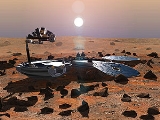
Mars Express

Encyclopedia
Mars Express is a space exploration
mission being conducted by the European Space Agency
(ESA). The Mars Express mission is exploring the planet Mars
, and is the first planetary mission attempted by the agency. "Express" originally referred to the speed and efficiency with which the spacecraft
was designed and built. However "Express" also describes the spacecraft's relatively short interplanetary voyage, a result of being launched when the orbits of Earth and Mars brought them closer than they had been in about 60,000 years.
Mars Express consists of two parts, the Mars Express Orbiter and the Beagle 2
, a lander
designed to perform exobiology and geochemistry research. Although the lander failed to land safely on the Martian surface, the Orbiter has been successfully performing scientific measurements since early 2004, namely, high-resolution imaging and mineralogical mapping of the surface, radar sounding of the subsurface structure down to the permafrost, precise determination of the atmospheric circulation and composition, and study of the interaction of the atmosphere
with the interplanetary medium
.
Due to the valuable science return and the highly flexible mission profile, Mars Express has been granted five mission extensions, the latest until 2014.
Some of the instruments on the orbiter, including the camera systems and some spectrometers, reuse designs from the failed launch of the Russian Mars 96
mission in 1996 (European countries had provided much of the instrumentation and financing for that unsuccessful mission). The basic design of Mars Express is based on ESA's Rosetta mission, on which a considerable sum was spent on development. The same design was also used for the Venus Express
mission in order to increase reliability and reduce development cost and time.
The scientific objectives of the Mars Express mission represent an attempt to fulfill in part the lost scientific goals of the Russian Mars-96 mission, complemented by exobiology research with Beagle-2. Mars exploration is crucial for a better understanding of the Earth from the perspective of comparative planetology.
The spacecraft originally carried seven scientific instruments, a small lander, a lander relay and a Visual Monitoring Camera, all designed to contribute to solving the mystery of Mars' missing water. All of the instruments take measurements of the surface, atmosphere and interplanetary media, from the main spacecraft in polar orbit, which will allow it to gradually cover the whole planet.
The overall Mars Express budget excluding the lander is €
150 million (roughly US$185 million).
in Kazakhstan
, using a Soyuz-FG
/Fregat
rocket. The Mars Express and Fregat booster were initially put into a 200 km Earth parking orbit
, then the Fregat was fired again at 19:14 UT to put the spacecraft into a Mars transfer orbit. The Fregat and Mars Express separated at approximately 19:17 UT. The solar panels were then deployed and a trajectory correction maneuver was performed on June 4 to aim Mars Express towards Mars and allow the Fregat booster to coast into interplanetary space.
Although it was originally meant to be a "quiet cruise" phase, It soon became obvious that this "cruise" would be indeed very busy. There were star Tracker problems, a power wiring problem, extra manoeuvres, and on the 28th of October, the spacecraft was hit by one of the largest solar flare
s ever recorded.
lander was released on December 19 at 8:31 UTC (9:31 CET) on a ballistic cruise towards the surface. It entered Mars' atmosphere on the morning of December 25. Landing was expected to occur at about 02:45 UT on December 25 (9:45 p.m. EST December 24). However, after repeated attempts to contact the lander failed using the Mars Express craft and the NASA
Mars Odyssey orbiter, it was declared lost on February 6, 2004, by the Beagle 2 Management Board. On February 11, ESA announced an inquiry would be held into the failure of Beagle 2.
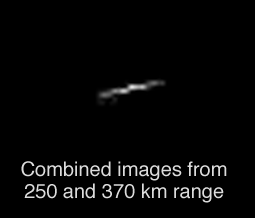 Mars Express arrived at Mars after a 400 million km journey and course corrections in September and in December 2003.
On December 20 Mars Express fired a short thruster burst to put it into position to orbit the planet. The Mars Express Orbiter then fired its main engine and went into a highly elliptical initial-capture orbit of 250 km × 150,000 km with an inclination of 25 degrees on December 25 at 03:00 UT (10:00 p.m., December 24 EST).
First evaluation of the orbital insertion showed that the orbiter had reached its first milestone at Mars. The orbit was later adjusted by four more main engine firings to the desired 259 km × 11,560 km near-polar (86 degree inclination) orbit with a period of 7.5 hours. Near periapsis the top deck is pointed down towards the Martian surface and near apoapsis the high gain antenna will be pointed towards Earth for uplink and downlink.
After 100 days the apoapsis was lowered to 10,107 km and periapsis raised to 298 km to give an orbital period of 6.7 hours.
booms for its MARSIS
(Mars Advanced Radar for Subsurface and Ionosphere Sounding) experiment. At first the boom did not lock fully into place; however, exposing it to sunlight for a few minutes on May 10 fixed the glitch. The second 20 m boom was successfully deployed on June 14. Both 20 m booms were needed to create a 40 m dipole antenna
for MARSIS to work; a less crucial 7-meter-long monopole antenna was deployed on June 17. The radar booms were originally scheduled to be deployed in April 2004, but this was delayed out of fear that the deployment could damage the spacecraft through a whiplash effect. Due to the delay it was decided to split the four week commissioning phase in two parts, with two weeks running up to July 4 and another two weeks in December 2005.
The deployment of the booms was a critical and highly complex task requiring effective inter-agency cooperation ESA, NASA, Industry and public Universities.
Nominal science observations began during July 2005. (For more info, see,, and ESA Portal - Mars Express radar ready to work ESA press release.)
) in Darmstadt
. The team began preparations for the mission about 3 to 4 years prior to the actual launch. This involved preparing the ground segment and the operational procedures for the whole mission.
The Mission Control Team is composed of the Flight Control Team, Flight Dynamics Team, Ground Operations Managers, Software Support and Ground Facilities Engineers. All of these are located at ESOC but there are additionally external teams, such as the Project and Industry Support teams, who designed and built the spacecraft.
The Flight Control Team currently consists of:
The team build-up, headed by the Spacecraft Operations Manager, started about 4 years before launch . He was required to recruit a suitable team of engineers that could handle the varying tasks involved in the mission. For Mars Express the engineers came from various other missions. Most of them had been involved with Earth orbiting satellites.
wings extending from opposite sides. The launch mass of 1123 kg includes a main bus with 113 kg of payload, the 60 kg lander, and 457 kg of propellant. The main body is 1.5 m × 1.8 m × 1.4 m in size, with an aluminium honeycomb structure covered by an aluminum skin. The solar panels measure about 12 m tip-to-tip. Two 20 m long wire dipole antenna
s extend from opposite side faces perpendicular to the solar panels as part of the radar sounder.
The body is built around the main propulsion system, which consists of a bipropellant 400 N main engine. The two 267-liter propellant tanks have a total capacity of 595 kg. Approximately 370 kg are needed for the nominal mission. Pressurized helium from a 35 liter tank is used to force fuel into the engine. Trajectory corrections will be made using a set of eight 10 N thrusters, one attached to each corner of the spacecraft bus. The spacecraft configuration is optimized for a Soyuz/Fregat, and was fully compatible with a Delta II
launch vehicle.
at 1.5 AU
but a faulty connection has reduced the amount of power available by 30%, to about 460 W. This loss of power is not expected to significantly impact the science return of the mission. Power is stored in three lithium-ion batteries
with a total capacity of 64.8 Ah for use during eclipses. The power is fully regulated at 28 V
. During routine phase, the spacecraft's power consumption is in the interval 450 W - 550 W.
s, accelerometer
s, and four 12 N·m·s reaction wheels. Pointing accuracy is 0.04 degree with respect to the inertial reference frame and 0.8 degree with respect to the Mars orbital frame. Three on-board systems help Mars Express maintain a very precise pointing accuracy, which is essential to allow the spacecraft to communicate with a 35-metre and 70-metre dish on Earth up to 400 million kilometres away.
and two omnidirectional antennas. The first one provide links (Telecommands uplink and Telemetry downlink) in both X-band (7.1 GHz) and S-band (2.1 GHz) and is used during nominal science phase around Mars. The low gain antennas are used during Launch and early operations to Mars and for eventual contingencies once in orbit.
Two Mars lander relay UHF antennas are mounted on the top face for communication with the Beagle 2 or other landers, using an Electra
software-defined radio
.
, the mission profile of progressive enhancement and science return flexibility have triggered the use of the newest ESA ESTRACK
Ground Station in Cebreros Station
, Madrid
, Spain.
In addition, further agreements with NASA Deep Space Network
have made possible the use of American stations for nominal mission planning, thus increasing complexity but with a clear positive impact in scientific returns.
This inter-agency cooperation has proven effective, flexible and enriching for both sides. On the technical side, it has been made possible (among other reasons) thanks to the adoption of both Agencies of the Standards for Space Communications defined in CCSDS
, and actively controlled heaters. The spacecraft must provide a benign environment for the instruments and on-board equipment. Two instruments, PFS and OMEGA, have infrared detectors that need to be kept at very low temperatures (about -180 °C). The sensors on the camera (HRSC) also need to be kept cool. But the rest of the instruments and on-board equipment function best at room temperatures (10-20 °C).
The spacecraft is covered in gold-plated aluminium-tin alloy thermal blankets to maintain a temperature of 10-20 °C inside the spacecraft. The instruments that operate at low temperatures to be kept cold are thermally insulated from this relatively high internal temperature, and emit excess heat into space using attached radiators.
Another key aspect of the Mars Express mission is the Mars Express AI
Tool (MEXAR2). The primary purpose of the AI tool is the scheduling of when to download various parts of the collected scientific data back to Earth, a process which used to take ground controllers a significant amount of time. The new AI tool saves operator time, optimizes bandwidth use on the DSN
, prevents data loss, and allows better use of the DSN for other space operations as well. The AI decides how to manage the spacecraft's 12 gigbits of storage memory, when the DSN will be available and not be in use by another mission, how to make the best use of the DSN bandwidth allocated to it, and when
the spacecraft will be oriented properly to transmit back to Earth.
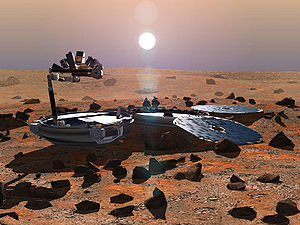 The Beagle 2
lander objectives were to characterize the landing site geology, mineralogy, and geochemistry, the physical properties of the atmosphere and surface layers, collect data on Martian meteorology and climatology, and search for possible signatures of life. However, the landing attempt was unsuccessful and the lander was declared lost. A Commission of Inquiry on Beagle 2 identified four possible causes, including insufficiently strong airbags and problems with parts of the landing system colliding, but was unable to reach any firm conclusions.
HRSC camera has been consistently mapping the Martian surface with unprecedented resolution and has taken dozens of breath-taking pictures.
This mode was developed through tight teamwork between ESOC mission controllers, principal investigators, industry and mission management.
for Best Team Achievement.
Space exploration
Space exploration is the use of space technology to explore outer space. Physical exploration of space is conducted both by human spaceflights and by robotic spacecraft....
mission being conducted by the European Space Agency
European Space Agency
The European Space Agency , established in 1975, is an intergovernmental organisation dedicated to the exploration of space, currently with 18 member states...
(ESA). The Mars Express mission is exploring the planet Mars
Mars
Mars is the fourth planet from the Sun in the Solar System. The planet is named after the Roman god of war, Mars. It is often described as the "Red Planet", as the iron oxide prevalent on its surface gives it a reddish appearance...
, and is the first planetary mission attempted by the agency. "Express" originally referred to the speed and efficiency with which the spacecraft
Spacecraft
A spacecraft or spaceship is a craft or machine designed for spaceflight. Spacecraft are used for a variety of purposes, including communications, earth observation, meteorology, navigation, planetary exploration and transportation of humans and cargo....
was designed and built. However "Express" also describes the spacecraft's relatively short interplanetary voyage, a result of being launched when the orbits of Earth and Mars brought them closer than they had been in about 60,000 years.
Mars Express consists of two parts, the Mars Express Orbiter and the Beagle 2
Beagle 2
Beagle 2 was an unsuccessful British landing spacecraft that formed part of the European Space Agency's 2003 Mars Express mission. All contact with it was lost upon its separation from the Mars Express six days before its scheduled entry into the atmosphere...
, a lander
Lander (spacecraft)
A lander is a spacecraft which descends toward and comes to rest on the surface of an astronomical body. For bodies with atmospheres, the landing is called atmospheric reentry and the lander descends as a re-entry vehicle...
designed to perform exobiology and geochemistry research. Although the lander failed to land safely on the Martian surface, the Orbiter has been successfully performing scientific measurements since early 2004, namely, high-resolution imaging and mineralogical mapping of the surface, radar sounding of the subsurface structure down to the permafrost, precise determination of the atmospheric circulation and composition, and study of the interaction of the atmosphere
Atmosphere of Mars
The atmosphere of Mars is relatively thin and is composed mostly of carbon dioxide . There has been interest in studying its composition since the detection of trace amounts of methane, which may indicate the presence of life on Mars, but may also be produced by a geochemical process, volcanic or...
with the interplanetary medium
Interplanetary medium
The interplanetary medium is the material which fills the solar system and through which all the larger solar system bodies such as planets, asteroids and comets move.-Composition and physical characteristics:...
.
Due to the valuable science return and the highly flexible mission profile, Mars Express has been granted five mission extensions, the latest until 2014.
Some of the instruments on the orbiter, including the camera systems and some spectrometers, reuse designs from the failed launch of the Russian Mars 96
Mars 96
Mars 96 was a failed Mars mission launched in 1996 to investigate Mars by the Russian Space Forces and not directly related to the Soviet Mars probe program of the same name. After failure of the second fourth-stage burn, the probe assembly re-entered the Earth's atmosphere, breaking up over a...
mission in 1996 (European countries had provided much of the instrumentation and financing for that unsuccessful mission). The basic design of Mars Express is based on ESA's Rosetta mission, on which a considerable sum was spent on development. The same design was also used for the Venus Express
Venus Express
Venus Express is the first Venus exploration mission of the European Space Agency. Launched in November 2005, it arrived at Venus in April 2006 and has been continuously sending back science data from its polar orbit around Venus. Equipped with seven science instruments, the main objective of the...
mission in order to increase reliability and reduce development cost and time.
Mission overview
The Mars Express mission is dedicated to the orbital (and originally in-situ) study of the interior, subsurface, surface and atmosphere, and environment of the planet Mars.The scientific objectives of the Mars Express mission represent an attempt to fulfill in part the lost scientific goals of the Russian Mars-96 mission, complemented by exobiology research with Beagle-2. Mars exploration is crucial for a better understanding of the Earth from the perspective of comparative planetology.
The spacecraft originally carried seven scientific instruments, a small lander, a lander relay and a Visual Monitoring Camera, all designed to contribute to solving the mystery of Mars' missing water. All of the instruments take measurements of the surface, atmosphere and interplanetary media, from the main spacecraft in polar orbit, which will allow it to gradually cover the whole planet.
The overall Mars Express budget excluding the lander is €
Euro
The euro is the official currency of the eurozone: 17 of the 27 member states of the European Union. It is also the currency used by the Institutions of the European Union. The eurozone consists of Austria, Belgium, Cyprus, Estonia, Finland, France, Germany, Greece, Ireland, Italy, Luxembourg,...
150 million (roughly US$185 million).
Spacecraft construction
The prime contractor for the construction of Mars Express Orbiter was EADS Astrium Satellites.Mission preparation
In the years preceding the launch of a spacecraft numerous teams of experts distributed over the contributing companies and organisations prepared the space and ground segments. Each of these teams focussed on the area of its responsibility and interfacing as required. A major additional requirement raised for the Launch and Early Orbit Phase (LEOP) and all critical operational phases was that it was not enough merely to interface; the teams had to be integrated into one Mission Control Team. All the different experts had to work together in an operational environment and the interaction and interfaces between all elements of the system (software, hardware and human) had to run smoothly for this to happen:- the flight operations procedures had to be written and validated down to the smallest detail;
- the control system had to be validated;
- system Validation Tests (SVTs) with the satellite had to be performed to demonstrate the correct interfacing of the ground and space segments;
- mission Readiness Test with the Ground Stations had to be performed;
- a Simulations Campaign was run.
Launch
The spacecraft was launched on June 2, 2003 at 23:45 local time (17:45 UT, 1:45 p.m. EDT) from Baikonur CosmodromeBaikonur Cosmodrome
The Baikonur Cosmodrome , also called Tyuratam, is the world's first and largest operational space launch facility. It is located in the desert steppe of Kazakhstan, about east of the Aral Sea, north of the Syr Darya river, near Tyuratam railway station, at 90 meters above sea level...
in Kazakhstan
Kazakhstan
Kazakhstan , officially the Republic of Kazakhstan, is a transcontinental country in Central Asia and Eastern Europe. Ranked as the ninth largest country in the world, it is also the world's largest landlocked country; its territory of is greater than Western Europe...
, using a Soyuz-FG
Soyuz-FG
The Soyuz-FG launch vehicle is an improved version of the Soyuz-U, from the R-7 family of rockets, designed and constructed by TsSKB-Progress in Samara...
/Fregat
Fregat
Fregat is a type of rocket stage developed by NPO Lavochkin in the 1990s. Its main engine is a liquid propellant rocket that uses UDMH and N2O4 as propellants.- Specifications :...
rocket. The Mars Express and Fregat booster were initially put into a 200 km Earth parking orbit
Parking orbit
A parking orbit is a temporary orbit used during the launch of a satellite or other space probe. A launch vehicle boosts into the parking orbit, then coasts for a while, then fires again to enter the final desired trajectory...
, then the Fregat was fired again at 19:14 UT to put the spacecraft into a Mars transfer orbit. The Fregat and Mars Express separated at approximately 19:17 UT. The solar panels were then deployed and a trajectory correction maneuver was performed on June 4 to aim Mars Express towards Mars and allow the Fregat booster to coast into interplanetary space.
Near earth commissioning phase
The Near Earth Commissioning phase extended from the separation of the spacecraft from the launcher upper stage until the completion of the initial check out of the orbiter and payload. It included the solar array deployment, the initial attitude acquisition, the declamping of the Beagle-2 spin-up mechanism, the injection error correction manoeuvre and the first commissioning of the spacecraft and payload (final commissioning of payload took place after Mars Orbit Insertion). The payload was checked out one instrument at a time. This phase lasted about one month.The interplanetary cruise phase
This five month phase lasted from the end of the Near Earth Commissioning phase until one month prior to the Mars capture manoeuvre and included trajectory correction manoeuvres and payloads calibration. The payload was mostly switched off during the cruise phase, with the exception of some intermediate check-outs.Although it was originally meant to be a "quiet cruise" phase, It soon became obvious that this "cruise" would be indeed very busy. There were star Tracker problems, a power wiring problem, extra manoeuvres, and on the 28th of October, the spacecraft was hit by one of the largest solar flare
Solar flare
A solar flare is a sudden brightening observed over the Sun surface or the solar limb, which is interpreted as a large energy release of up to 6 × 1025 joules of energy . The flare ejects clouds of electrons, ions, and atoms through the corona into space. These clouds typically reach Earth a day...
s ever recorded.
Lander jettison
The Beagle 2Beagle 2
Beagle 2 was an unsuccessful British landing spacecraft that formed part of the European Space Agency's 2003 Mars Express mission. All contact with it was lost upon its separation from the Mars Express six days before its scheduled entry into the atmosphere...
lander was released on December 19 at 8:31 UTC (9:31 CET) on a ballistic cruise towards the surface. It entered Mars' atmosphere on the morning of December 25. Landing was expected to occur at about 02:45 UT on December 25 (9:45 p.m. EST December 24). However, after repeated attempts to contact the lander failed using the Mars Express craft and the NASA
NASA
The National Aeronautics and Space Administration is the agency of the United States government that is responsible for the nation's civilian space program and for aeronautics and aerospace research...
Mars Odyssey orbiter, it was declared lost on February 6, 2004, by the Beagle 2 Management Board. On February 11, ESA announced an inquiry would be held into the failure of Beagle 2.
Orbit insertion
On December 20 Mars Express fired a short thruster burst to put it into position to orbit the planet. The Mars Express Orbiter then fired its main engine and went into a highly elliptical initial-capture orbit of 250 km × 150,000 km with an inclination of 25 degrees on December 25 at 03:00 UT (10:00 p.m., December 24 EST).
First evaluation of the orbital insertion showed that the orbiter had reached its first milestone at Mars. The orbit was later adjusted by four more main engine firings to the desired 259 km × 11,560 km near-polar (86 degree inclination) orbit with a period of 7.5 hours. Near periapsis the top deck is pointed down towards the Martian surface and near apoapsis the high gain antenna will be pointed towards Earth for uplink and downlink.
After 100 days the apoapsis was lowered to 10,107 km and periapsis raised to 298 km to give an orbital period of 6.7 hours.
MARSIS deployment
On May 4, 2005, Mars Express deployed the first of its two 20-metre-long radarRadar
Radar is an object-detection system which uses radio waves to determine the range, altitude, direction, or speed of objects. It can be used to detect aircraft, ships, spacecraft, guided missiles, motor vehicles, weather formations, and terrain. The radar dish or antenna transmits pulses of radio...
booms for its MARSIS
MARSIS
MARSIS is a low frequency, pulse-limited radar sounder and altimeter used on the ESA Mars Express mission...
(Mars Advanced Radar for Subsurface and Ionosphere Sounding) experiment. At first the boom did not lock fully into place; however, exposing it to sunlight for a few minutes on May 10 fixed the glitch. The second 20 m boom was successfully deployed on June 14. Both 20 m booms were needed to create a 40 m dipole antenna
Dipole antenna
A dipole antenna is a radio antenna that can be made of a simple wire, with a center-fed driven element. It consists of two metal conductors of rod or wire, oriented parallel and collinear with each other , with a small space between them. The radio frequency voltage is applied to the antenna at...
for MARSIS to work; a less crucial 7-meter-long monopole antenna was deployed on June 17. The radar booms were originally scheduled to be deployed in April 2004, but this was delayed out of fear that the deployment could damage the spacecraft through a whiplash effect. Due to the delay it was decided to split the four week commissioning phase in two parts, with two weeks running up to July 4 and another two weeks in December 2005.
The deployment of the booms was a critical and highly complex task requiring effective inter-agency cooperation ESA, NASA, Industry and public Universities.
Nominal science observations began during July 2005. (For more info, see,, and ESA Portal - Mars Express radar ready to work ESA press release.)
Operations of the spacecraft
Operations for Mars Express are carried out by a multinational team of engineers from ESA's Operation Centre (ESOCEuropean Space Operations Centre
The European Space Operations Centre is responsible for controlling ESA satellites and space probes. The centre is located in Darmstadt, Germany. It is Mission Control for most of the space projects of the ESA. Since its creation in 1967, the centre has operated 60 European space missions...
) in Darmstadt
Darmstadt
Darmstadt is a city in the Bundesland of Hesse in Germany, located in the southern part of the Rhine Main Area.The sandy soils in the Darmstadt area, ill-suited for agriculture in times before industrial fertilisation, prevented any larger settlement from developing, until the city became the seat...
. The team began preparations for the mission about 3 to 4 years prior to the actual launch. This involved preparing the ground segment and the operational procedures for the whole mission.
The Mission Control Team is composed of the Flight Control Team, Flight Dynamics Team, Ground Operations Managers, Software Support and Ground Facilities Engineers. All of these are located at ESOC but there are additionally external teams, such as the Project and Industry Support teams, who designed and built the spacecraft.
The Flight Control Team currently consists of:
- The Spacecraft Operations Manager
- Seven Operations Engineers
- Three Mission Planners
- One Spacecraft Analyst
- Six spacecraft controllers (SpaCons), shared with Venus ExpressVenus ExpressVenus Express is the first Venus exploration mission of the European Space Agency. Launched in November 2005, it arrived at Venus in April 2006 and has been continuously sending back science data from its polar orbit around Venus. Equipped with seven science instruments, the main objective of the...
and RosettaRosettaRosetta is a port city on the Mediterranean coast of Egypt. It is located east of Alexandria, in Beheira governorate. It was founded around AD 800....
The team build-up, headed by the Spacecraft Operations Manager, started about 4 years before launch . He was required to recruit a suitable team of engineers that could handle the varying tasks involved in the mission. For Mars Express the engineers came from various other missions. Most of them had been involved with Earth orbiting satellites.
Routine phase: Science return
Since orbit insertion Mars Express has been progressively fulfilling its original scientific goals. Nominally the spacecraft points to Mars while acquiring science and then slews to earth-pointing to downlink the data, although some instruments like Marsis or Radio Science might be operated while spacecraft is earth-pointing.Structure
The Mars Express Orbiter is a cube-shaped spacecraft with two solar panelPhotovoltaic module
A solar panel is a packaged, connected assembly of solar cells, also known as photovoltaic cells...
wings extending from opposite sides. The launch mass of 1123 kg includes a main bus with 113 kg of payload, the 60 kg lander, and 457 kg of propellant. The main body is 1.5 m × 1.8 m × 1.4 m in size, with an aluminium honeycomb structure covered by an aluminum skin. The solar panels measure about 12 m tip-to-tip. Two 20 m long wire dipole antenna
Dipole antenna
A dipole antenna is a radio antenna that can be made of a simple wire, with a center-fed driven element. It consists of two metal conductors of rod or wire, oriented parallel and collinear with each other , with a small space between them. The radio frequency voltage is applied to the antenna at...
s extend from opposite side faces perpendicular to the solar panels as part of the radar sounder.
Propulsion
The Soyuz/Fregat launcher provided most of the thrust Mars Express needed to reach Mars. The final stage of the Fregat was jettisoned once the probe was safely on a course for Mars. The spacecraft's on-board means of propulsion was used to slow the probe for Mars orbit insertion and subsequently for orbit corrections.The body is built around the main propulsion system, which consists of a bipropellant 400 N main engine. The two 267-liter propellant tanks have a total capacity of 595 kg. Approximately 370 kg are needed for the nominal mission. Pressurized helium from a 35 liter tank is used to force fuel into the engine. Trajectory corrections will be made using a set of eight 10 N thrusters, one attached to each corner of the spacecraft bus. The spacecraft configuration is optimized for a Soyuz/Fregat, and was fully compatible with a Delta II
Delta II
Delta II was an American space launch system, originally designed and built by McDonnell Douglas. Delta II is part of the Delta rocket family and was in service from 1989 until November 1, 2011...
launch vehicle.
Power
Spacecraft power is provided by the solar panels which contain 11.42 square meters of silicon cells. The originally planned power was to be 660 WWatt
The watt is a derived unit of power in the International System of Units , named after the Scottish engineer James Watt . The unit, defined as one joule per second, measures the rate of energy conversion.-Definition:...
at 1.5 AU
Astronomical unit
An astronomical unit is a unit of length equal to about or approximately the mean Earth–Sun distance....
but a faulty connection has reduced the amount of power available by 30%, to about 460 W. This loss of power is not expected to significantly impact the science return of the mission. Power is stored in three lithium-ion batteries
Lithium ion battery
A lithium-ion battery is a family of rechargeable battery types in which lithium ions move from the negative electrode to the positive electrode during discharge, and back when charging. Chemistry, performance, cost, and safety characteristics vary across LIB types...
with a total capacity of 64.8 Ah for use during eclipses. The power is fully regulated at 28 V
Volt
The volt is the SI derived unit for electric potential, electric potential difference, and electromotive force. The volt is named in honor of the Italian physicist Alessandro Volta , who invented the voltaic pile, possibly the first chemical battery.- Definition :A single volt is defined as the...
. During routine phase, the spacecraft's power consumption is in the interval 450 W - 550 W.
Avionics
Attitude control (3-axis stabilization) is achieved using two 3-axis inertial measurement units, a set of two star cameras and two Sun sensors, gyroscopeGyroscope
A gyroscope is a device for measuring or maintaining orientation, based on the principles of angular momentum. In essence, a mechanical gyroscope is a spinning wheel or disk whose axle is free to take any orientation...
s, accelerometer
Accelerometer
An accelerometer is a device that measures proper acceleration, also called the four-acceleration. This is not necessarily the same as the coordinate acceleration , but is rather the type of acceleration associated with the phenomenon of weight experienced by a test mass that resides in the frame...
s, and four 12 N·m·s reaction wheels. Pointing accuracy is 0.04 degree with respect to the inertial reference frame and 0.8 degree with respect to the Mars orbital frame. Three on-board systems help Mars Express maintain a very precise pointing accuracy, which is essential to allow the spacecraft to communicate with a 35-metre and 70-metre dish on Earth up to 400 million kilometres away.
Communications
The communications subsystem is composed of 3 antennas: A 1.7 m diameter parabolic dish high-gain antennaHigh-gain antenna
A high-gain antenna is an antenna with a focused, narrow radiowave beam width. This narrow beam width allows more precise targeting of the radio signal - also known as a directional antenna...
and two omnidirectional antennas. The first one provide links (Telecommands uplink and Telemetry downlink) in both X-band (7.1 GHz) and S-band (2.1 GHz) and is used during nominal science phase around Mars. The low gain antennas are used during Launch and early operations to Mars and for eventual contingencies once in orbit.
Two Mars lander relay UHF antennas are mounted on the top face for communication with the Beagle 2 or other landers, using an Electra
Electra (radio)
Electra, more formally the Electra Proximity Payload, is a software-defined radio defined and implemented by the Jet Propulsion Laboratory for use between spacecraft. It is typically used by a lander to communicate with an orbiter that can then communicate with Earth...
software-defined radio
Software-defined radio
A software-defined radio system, or SDR, is a radio communication system where components that have been typically implemented in hardware are instead implemented by means of software on a personal computer or embedded computing devices...
.
Earth Stations
Although communications with Earth were originally scheduled to take place with the ESA 35-meter wide Ground Station in New Norcia (Australia) New Norcia StationNew Norcia Station
New Norcia Station is a 35-metre ESTRACK radio antenna for communication with spacecraft in deep space. It is located south of the town of New Norcia, Western Australia. It was built for the European Space Agency. The station was officially opened on 5 March 2003 by the Premier of Western...
, the mission profile of progressive enhancement and science return flexibility have triggered the use of the newest ESA ESTRACK
ESTRACK
The European Space Operations Centre operates a number of ground-based space-tracking stations for the European Space Agency known as the European Space Tracking network. The stations support various ESA spacecraft and facilitate communications between ground operators and scientific probes such...
Ground Station in Cebreros Station
Cebreros Station
Cebreros Station is an INSA-operated, ESTRACK radio antenna station for communication with spacecraft located 90 km from Madrid, Spain. A 35-metre diameter antenna that receives in X- and Ka-bands is located at the site...
, Madrid
Madrid
Madrid is the capital and largest city of Spain. The population of the city is roughly 3.3 million and the entire population of the Madrid metropolitan area is calculated to be 6.271 million. It is the third largest city in the European Union, after London and Berlin, and its metropolitan...
, Spain.
In addition, further agreements with NASA Deep Space Network
Deep Space Network
The Deep Space Network, or DSN, is a world-wide network of large antennas and communication facilities that supports interplanetary spacecraft missions. It also performs radio and radar astronomy observations for the exploration of the solar system and the universe, and supports selected...
have made possible the use of American stations for nominal mission planning, thus increasing complexity but with a clear positive impact in scientific returns.
This inter-agency cooperation has proven effective, flexible and enriching for both sides. On the technical side, it has been made possible (among other reasons) thanks to the adoption of both Agencies of the Standards for Space Communications defined in CCSDS
Thermal
Thermal control is maintained through the use of radiators, multi-layer insulationMulti-layer insulation
Multi-layer insulation, or MLI, is thermal insulation composed of multiple layers of thin sheets often used on spacecraft. It one of the main items of the spacecraft thermal design, mainly intended to reduce heat loss by thermal radiation. In its basic form, it does not appreciably insulate...
, and actively controlled heaters. The spacecraft must provide a benign environment for the instruments and on-board equipment. Two instruments, PFS and OMEGA, have infrared detectors that need to be kept at very low temperatures (about -180 °C). The sensors on the camera (HRSC) also need to be kept cool. But the rest of the instruments and on-board equipment function best at room temperatures (10-20 °C).
The spacecraft is covered in gold-plated aluminium-tin alloy thermal blankets to maintain a temperature of 10-20 °C inside the spacecraft. The instruments that operate at low temperatures to be kept cold are thermally insulated from this relatively high internal temperature, and emit excess heat into space using attached radiators.
Control Unit and Data storage
The spacecraft is run by two Control and Data management Units with 12 gigabits of solid state mass memory for storage of data and housekeeping information for transmission. The on-board computers control all aspects of the spacecraft functioning including switching instruments on and off, assessing the spacecraft orientation in space and issuing commands to change it.Another key aspect of the Mars Express mission is the Mars Express AI
Artificial intelligence
Artificial intelligence is the intelligence of machines and the branch of computer science that aims to create it. AI textbooks define the field as "the study and design of intelligent agents" where an intelligent agent is a system that perceives its environment and takes actions that maximize its...
Tool (MEXAR2). The primary purpose of the AI tool is the scheduling of when to download various parts of the collected scientific data back to Earth, a process which used to take ground controllers a significant amount of time. The new AI tool saves operator time, optimizes bandwidth use on the DSN
Deep Space Network
The Deep Space Network, or DSN, is a world-wide network of large antennas and communication facilities that supports interplanetary spacecraft missions. It also performs radio and radar astronomy observations for the exploration of the solar system and the universe, and supports selected...
, prevents data loss, and allows better use of the DSN for other space operations as well. The AI decides how to manage the spacecraft's 12 gigbits of storage memory, when the DSN will be available and not be in use by another mission, how to make the best use of the DSN bandwidth allocated to it, and when
the spacecraft will be oriented properly to transmit back to Earth.
Lander
Beagle 2
Beagle 2 was an unsuccessful British landing spacecraft that formed part of the European Space Agency's 2003 Mars Express mission. All contact with it was lost upon its separation from the Mars Express six days before its scheduled entry into the atmosphere...
lander objectives were to characterize the landing site geology, mineralogy, and geochemistry, the physical properties of the atmosphere and surface layers, collect data on Martian meteorology and climatology, and search for possible signatures of life. However, the landing attempt was unsuccessful and the lander was declared lost. A Commission of Inquiry on Beagle 2 identified four possible causes, including insufficiently strong airbags and problems with parts of the landing system colliding, but was unable to reach any firm conclusions.
Mars Express instruments
The scientific objectives of the Mars Express Payload are to obtain global high-resolution photo-geology (10 m resolution), mineralogical mapping (100 m resolution) and mapping of the atmospheric composition, study the subsurface structure, the global atmospheric circulation, and the interaction between the atmosphere and the subsurface, and the atmosphere and the interplanetary medium. The total mass budgeted for the science payload is 116 kg.- Visible and Infrared Mineralogical Mapping Spectrometer (OMEGA)(Observatoire pour la Minéralogie, l'Eau, les Glaces et l'Activité) - France - Determines mineral composition of the surface up to 100 m resolution. Is mounted inside pointing out the top face. Instrument mass: 28.6 kg
- Ultraviolet and Infrared Atmospheric Spectrometer (SPICAM) - France - Assesses elemental composition of the atmosphere. Is mounted inside pointing out the top face. Instrument mass: 4.7 kg
- Sub-Surface Sounding Radar Altimeter (MARSISMARSISMARSIS is a low frequency, pulse-limited radar sounder and altimeter used on the ESA Mars Express mission...
) - Italy - A radar altimeterAltimeterAn altimeter is an instrument used to measure the altitude of an object above a fixed level. The measurement of altitude is called altimetry, which is related to the term bathymetry, the measurement of depth underwater.-Pressure altimeter:...
used to assess composition of sub-surface aimed at search for frozen water. Is mounted in the body and is nadir pointing, and also incorporates the two 20 m antennas. Instrument mass: 13.7 kg - Planetary Fourier Spectrometer (PFSPlanetary Fourier SpectrometerThe Planetary Fourier Spectrometer is an infrared spectrometer built by the Istituto Nazionale di Astrofisica along with the Istituto di Fisica dello spazio Interplanetario and the Consiglio Nazionale delle Ricerche...
) - Italy - Makes observations of atmospheric temperature and pressure (observations suspended in September 2005). Is mounted inside pointing out the top face., currently working. Instrument mass: 30.8 kg - Analyzer of Space Plasmas and Energetic Atoms (ASPERA) - Sweden - Investigates interactions between upper atmosphere and solar wind. Is mounted on the top face. Instrument mass: 7.9 kg
- High Resolution Stereo Camera (HRSC)- Germany - Produces color images with up to 2 m resolution. Is mounted inside the spacecraft body, aimed through the top face of the spacecraft, which is nadir pointing during Mars operations. Instrument mass: 20.4 kg
- Mars Express Lander Communications (MELACOM) - UK - Allows Mars Express to act as a communication relay for landers on the Martian surface. (Has been tested with Mars Exploration Rovers, and was used to support the landing of NASA's Phoenix mission)
- Mars Radio Science Experiment (MaRS) - Uses radio signals to investigate atmosphere, surface, subsurface, gravity and solar corona density during solar conjunctions. It uses the communications subsystem itself.
- A small camera to monitor the lander ejection, VMC.
- More on Payload
Scientific discoveries and important events
For more than 5000 orbits, Mars Express Payload instruments have been nominally and regularly operated.HRSC camera has been consistently mapping the Martian surface with unprecedented resolution and has taken dozens of breath-taking pictures.
2004
- January 23
-
- ESA announced the discovery of water ice in the South Polar ice cap, using data taken on January 18 with the OMEGA instrument.
- January 28
-
- Mars Express Orbiter reaches final science orbit around Mars.
- March 17
-
- Orbiter detects polar ice caps that contain 85% highly carbon dioxideCarbon dioxideCarbon dioxide is a naturally occurring chemical compound composed of two oxygen atoms covalently bonded to a single carbon atom...
(CO2) ice and 15% water ice.
- Orbiter detects polar ice caps that contain 85% highly carbon dioxide
- March 30
-
- A press release announces that the orbiter has detected methaneMethaneMethane is a chemical compound with the chemical formula . It is the simplest alkane, the principal component of natural gas, and probably the most abundant organic compound on earth. The relative abundance of methane makes it an attractive fuel...
in the Martian atmosphere. Although the amount is small, about 10 parts in a thousand million, it has excited scientists ask about its source. Since methane is removed from the Martian "air" very fast, there needs to be a current source that releases fresh methane still today. Because one of the possible sources could be microbial life, it is planned to verify the reliability of this data and especially watch for difference in the concentration in various places on Mars. It is hoped that the source of this gas can be discovered by finding its location of release.
- A press release announces that the orbiter has detected methane
- April 28
-
- ESA announced that the deployment of the boom carrying the radar based MARSIS antenna was delayed. It described concerns with the motion of the boom during deployment, which can cause the spacecraft to be struck by elements of it. Further investigations are planned to make sure that this will not happen.
- July 15
-
- Scientists working with the PFS instrument announced that they tentatively discovered the spectral features of the compound ammoniaAmmoniaAmmonia is a compound of nitrogen and hydrogen with the formula . It is a colourless gas with a characteristic pungent odour. Ammonia contributes significantly to the nutritional needs of terrestrial organisms by serving as a precursor to food and fertilizers. Ammonia, either directly or...
in the Martian atmosphere. Just like methane discovered earlier (see above), ammonia breaks down rapidly in Mars' atmosphere and needs to be constantly replenished. This points towards the existence of active life or geological activity; two contending phenomena whose presence so far have remained undetected.
- Scientists working with the PFS instrument announced that they tentatively discovered the spectral features of the compound ammonia
2005
- In 2005, ESA scientists reported that the OMEGA (Visible and Infrared Mineralogical Mapping Spectrometer)(Observatoire pour la Minéralogie, l'Eau, les Glaces et l'Activité) instrument data indicates the presence of hydrated sulphates, silicates and various rock-forming minerals.
- February 8
-
- The delayed deployment of the MARSIS antenna has been given a green light by ESA. It is planned to take place in early May 2005.
- May 5
-
- The first boom of the MARSIS antenna was successfully deployed. At first, there was no indication of any problems, but later it was discovered that one segment of the boom did not lock. The deployment of the second boom was delayed to allow for further analysis of the problem.
- May 11
-
- Using the SunSunThe Sun is the star at the center of the Solar System. It is almost perfectly spherical and consists of hot plasma interwoven with magnetic fields...
's heat to expand the segments of the MARSIS antenna, the last segment locked in successfully.
- Using the Sun
- June 14
-
- The second boom was deployed, and on June 16 ESA announced it was a success.
- June 22
- ESA announces that MARSIS is fully operational and will soon begin acquiring data. This comes after the deployment of the third boom on June 17, and a successful transmission test on June 19.
- The second boom was deployed, and on June 16 ESA announced it was a success.
2006
- September 21
-
- ESA's Mars Express High Resolution Stereo Camera (HRSC) has obtained images of the Cydonia region, the location of the famous "Face on Mars". The massif became famous in a photo taken in 1976 by the American Viking 1 Orbiter. The image recorded with a ground resolution of approximately 13.7 metres per pixel.
- September 26
-
- The Mars Express spacecraft has emerged from an unusually demanding eclipse season introducing a special, ultra-low-power mode nicknamed 'Sumo' - an innovative configuration aimed at saving the power necessary to ensure spacecraft survival.
This mode was developed through tight teamwork between ESOC mission controllers, principal investigators, industry and mission management.
- October
-
- In October 2006 the Mars Express spacecraft has encountered a superior solar conjunction (alignment of Earth-Sun-Mars Express). The angle Sun-Earth-MEX reached a minimum on 23-Oct at 0.39 deg. at a distance of 2.66 AU. Operational measures were undertaken to minimize the impact of the link degradation, since the higher density of electrons in the solar plasma heavily impacts the radio frequency signal. More on
- December
-
- Following the loss of NASANASAThe National Aeronautics and Space Administration is the agency of the United States government that is responsible for the nation's civilian space program and for aeronautics and aerospace research...
JPL Mars spacecraft Mars Global SurveyorMars Global SurveyorThe Mars Global Surveyor was a US spacecraft developed by NASA's Jet Propulsion Laboratory and launched November 1996. It began the United States's return to Mars after a 10-year absence. It completed its primary mission in January 2001 and was in its third extended mission phase when, on 2...
(MGS), Mars Express team was requested to perform actions in the hopes of visually identifying the American spacecraft. Based on last ephemerisEphemerisAn ephemeris is a table of values that gives the positions of astronomical objects in the sky at a given time or times. Different kinds of ephemerides are used for astronomy and astrology...
of MGS provided by JPL, the on-board high definition HRSC camera swept a region of the MGS orbit. Two attempts were made to find the craft, both unsuccessful.
- Following the loss of NASA
2007
- January
-
- First agreements with NASA-SPL undertaken for the support of Mars Express on the landing of the American lander PhoenixPhoenix (spacecraft)Phoenix was a robotic spacecraft on a space exploration mission on Mars under the Mars Scout Program. The Phoenix lander descended on Mars on May 25, 2008...
in May 2008
- First agreements with NASA-SPL undertaken for the support of Mars Express on the landing of the American lander Phoenix
- February
-
- The small camera VMC (used only once to monitor the lander ejection) has been recommissioned and first steps had been taken to offer students the possibility to participate in a campaign "Command Mars Express Spacecraft and take your own picture of Mars". Details to come.
- February 23
-
- As result of the important science return, the Science Program Committee (SPC) has granted a mission extension until May 2009 to Mars Express.
- June 28
-
- The High Resolution Stereo Camera (HRSC) has produced dramatic images of key tectonic features in Aeolis MensaeAeolis MensaeAeolis Mensae is tableland feature in the Aeolis quadrangle of Mars. Its location is centered at 2.9° south latitude and 219.6° west longitude. It is long and was named after a classical albedo feature name.- Inverted Relief :...
.
- The High Resolution Stereo Camera (HRSC) has produced dramatic images of key tectonic features in Aeolis Mensae
2008
The Mars Express Team was the winner of the Sir Arthur Clarke AwardSir Arthur Clarke Award
The Sir Arthur Clarke Award is a British award given in recognition of notable contributions to space exploration, particularly British achievements. It is owned by the Space Education Trust and is independent of and separate from . Founded in 2005, the awards are an annual event. They take place...
for Best Team Achievement.
2009
- February 4
-
- The ESA's Science Programme Committee has extended the operations of Mars Express until December 31, 2009.
- October 7
-
- ESA's Science Programme Committee has approved the extension of mission operations for Mars Express until 31 December 2012.
See also
- MarsMarsMars is the fourth planet from the Sun in the Solar System. The planet is named after the Roman god of war, Mars. It is often described as the "Red Planet", as the iron oxide prevalent on its surface gives it a reddish appearance...
- European Space AgencyEuropean Space AgencyThe European Space Agency , established in 1975, is an intergovernmental organisation dedicated to the exploration of space, currently with 18 member states...
- ExoMarsExoMarsExoMars is a European-led robotic mission to Mars currently under development by the European Space Agency with collaboration by NASA...
- Exploration of MarsExploration of MarsThe exploration of Mars has been an important part of the space exploration programs of the Soviet Union, the United States, Europe, and Japan. Dozens of robotic spacecraft, including orbiters, landers, and rovers, have been launched toward Mars since the 1960s...
- Space explorationSpace explorationSpace exploration is the use of space technology to explore outer space. Physical exploration of space is conducted both by human spaceflights and by robotic spacecraft....
- Unmanned space missions
External links
- ESA Mars Express project (official site)
- ESA Mars Express project (scientific site)
- ESA Mars Express operations site
- Mars Express Mission Profile by NASA's Solar System Exploration
- First Mars Express Science Conference presentations (at MarsToday.com)
- NASA Art Gallery of Mars Express
Payload Principal Investigators Links
- HRSC FU Berlin
- MARSIS Uni Roma "La Sapienza"
- PFS IFSI/INAF
- SPICAM
- OMEGA Institut Astrophysique Spatial
- MELACOM Qinetiq
- MRSE Uni Köln
- ASPERA