

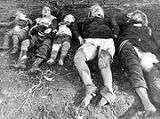
Red Army atrocities

Encyclopedia
War crimes perpetrated by the armed forces of Soviet Russia and the Soviet Union
from 1919 to 1991 include acts committed by the regular army—the Red Army
(later called the Soviet Army
)—as well as the NKVD
, including the NKVD's Internal Troops
. In some cases, these crimes may have been committed on express orders of the early Soviet Government's policy of Red terror
. In other instances, they were committed by regular army troops as retribution against military or civilian personnel of countries involved in conflict with (or the invasion of), the USSR, or during anti-partisan warfare.
Many of these incidents occurred in Northern
and Eastern Europe
before and during World War II
, and involved summary executions and mass murder of prisoners of war (such as the Katyn massacre
) and mistreatment of civilians in Soviet occupied territories
. Although there are numerous documented cases of such incidents, very few members of the Soviet armed forces (for example, Vassili Kononov), have ever been charged with war crimes and none of them by the International Criminal Court
or Soviet or Russian tribunal.
as binding, and refused to recognize them until 1955. This created a situation in which war crimes by the Soviet armed forces could be eventually rationalized. The Soviet refusal to recognize the Hague Conventions (1899 and 1907)
also gave Nazi Germany the rationale for inhuman treatment of captured Soviet military personnel.
, an estimated 100,000 Jews perished in pogrom
s perpetrated by Symon Petlyura's Ukrainian nationalist separatists and the White forces led by Anton Denikin. The only armed force in the Russian Civil War that did not systematically terrorize the Jews was the Red Army of the Soviet Government. Jews came to regard the Red Army as their protector; young Jews joined it in order to avenge crimes against their families.
Although early Soviet leaders treated anti-Semitism with "utter contempt" and strong efforts were made by Soviet authorities to contain anti-Jewish bigotry, some Red Army units perpetrated pogrom
s during the Russian civil war
and the Soviet-Polish War of 1919–1920, notably at Baranovichi
. These abuses were committed by the Boguny and Tarashchany regiments, which had earlier belonged to Petlyura's Ukrainian nationalist army and had only recently switched sides to join Semyon Budyonny
's Red Army forces.
However, only a small number of pogroms are attributed to the Red Army, with the vast majority of 'collectively violent' acts in the period having been committed by anti-Communist and nationalist forces. The pogroms were vigorously condemned by the Red Army high command and guilty units were disarmed, while individual pogromists were court-martialed. Those found guilty were executed.
. The main function of the NKVD was to protect the state security
of the Soviet Union, which was accomplished by large scale political repression of "class enemies". As an internal security force and prison guard contingent of the Gulag
, the Internal Troops both repressed political dissidents and engaged in war crimes during periods of military hostilities throughout Soviet history
. They were specifically responsible for maintaining the political regime in the GULAG and for conducting mass deportations and forced resettlement
. The latter targeted a number of ethnic groups that the Soviet authorities presumed to be hostile to its policies and likely to collaborate with the enemy, including Chechens, Crimean Tatars
, and Koreans.
During World War II, a series of mass executions were committed by the Soviet NKVD against prisoners in Eastern Europe, primarily Poland, the Baltic states
, Romania, Ukraine
and other parts of the Soviet Union as the Red Army withdrew after the German invasion in 1941 (see Operation Barbarossa
). The overall death toll is estimated at around 100,000. There were numerous reports of war crimes committed by Soviet armed forces, against captured German Wehrmacht and Luftwaffe soldiers from the very beginning of the war, documented in thousands of files of the The Wehrmacht War Crimes Bureau, 1939-1945
, an office established in September 1939 to investigate violations of the Hague and Geneva conventions by Germany's enemies. Among the better documented massacres are those at Broniki
(June 1941), Feodosia (December 1941) and Grischino (1943). NKVD Internal Troops were engaged alongside Red Army forces in combat and NKVD units were used for rear area security, including as blocking units
. In territory that was liberated or occupied, the NKVD carried out mass arrests, deportations and executions. The targets included both collaborators with Germany and the members of non-Communist resistance movement
s such as the Ukrainian Insurgent Army (UPA) in Ukraine, the Forest Brothers
in Lithuania, and the Polish Armia Krajowa
. The NKVD also summarily executed over 20,000 Polish military officer prisoners
in April–May 1940.
After the final repulse of German forces
in the Soviet Union, Red Army troops entered Germany, Romania and Hungary in late 1944. Soviet soldiers were by then aware of the German Nazi war crimes and often executed surrendering or captured German soldiers in retaliation. There were numerous accounts
of war crimes by Soviet armed forces—plunder, the murder of civilians and rape. In both Soviet-era and current Russia
n history books on the "Great Patriotic War" these war crimes are rarely mentioned.
War crimes by Soviet armed forces against civilians and prisoners of war
(POWs) in the territories occupied by the USSR between 1939 and 1941 in regions including the Western Ukraine, the Baltic states and Bessarabia
in Romania), along with war crimes in 1944–45, have been ongoing issues within these countries. Since the dissolution of the Soviet Union
, a more systematic, locally-controlled discussion of these events has taken place.
The Soviets deployed mustard gas bombs during the Soviet Invasion of Xinjiang
, some civilians were killed by conventional bombs during the invasion.
. In 1941, some 34,000 Estonians were drafted into the Red Army, of which less than 30% survived the war. After it became clear that the German invasion of Estonia would be successful, political prisoners who could not be evacuated were executed by the NKVD, so that they would not be able to make contact with the Nazi government. More than 300,000 citizens of Estonia, almost a third of the population at the time, were affected by deportation, arrests, execution and other acts of repression. As a result of the Soviet takeover, Estonia permanently lost at least 200,000 people or 20% of its population to repression, exodus and war.
Soviet political repressions in Estonia were met by an armed resistance by the Forest Brothers, mostly Estonian veterans of the Waffen-SS, Omakaitse
militia and volunteers in the Finnish Infantry Regiment 200
who fought a guerrilla war, which was not completely suppressed until the late 1950s. In addition to the expected human and material losses suffered due to the fighting, until its end this conflict led to the deportation of tens of thousands of people, along with hundreds of political prisoners and thousands of civilians lost their lives.
between the USSR and Nazi Germany, leading to its annexation and incorporation into the Soviet Union on 5 August 1940. The establishment of a brutal puppet-state, the Latvian SSR
, resulted in mass terror, the destruction of civil liberties, the economic system and Latvian culture. In all, over 200,000 people suffered from Soviet repression in Latvia, of which some 60% were deported to the Soviet Gulag in Siberia
and the Far-East. The Soviet regime forced more than 260,000 Latvians to flee the country.
, fell victim to the Molotov-Ribbentrop pact. This agreement was signed between the USSR and Nazi Germany in August 1939, leading first to Lithuania being invaded by the Red Army on 15 June 1940 and to its annexation and incorporation into the Soviet Union on 3 August 1940. The Soviet annexation resulted in mass terror, the destruction of civil liberties, the economic system and Lithuanian culture. Between 1940–41, thousands of Lithuanians were arrested and hundreds of political prisoners were arbitrarily executed. More than 17,000 people were deported to Siberia in June 1941. After the German attack
on the Soviet Union, the incipient Soviet political apparatus was either destroyed or retreated eastward. Lithuania was then occupied by Nazi Germany
for a little over three years. In 1944, the Soviet occupation of Lithuania resumed following the German army being expelled. Following World War II and the subsequent suppression of the Lithuanian Forest Brothers, Soviet authorities executed thousands of resistance fighters and civilians accused of aiding them. Some 300,000 Lithuanians were deported or sentenced to prison camps on political grounds. It is estimated that Lithuania lost almost 780,000 citizens as a result of Soviet occupation, of which around 440,000 were war refugees.
During the Lithuanian restoration of independence in 1990, the Soviet army killed 13 demonstrators in Vilnius.
and Northern Bukovina.
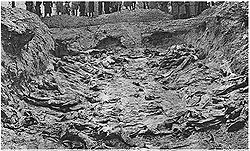 Soviet policy in all of these areas was harsh towards the people under its control, showing strong elements of ethnic cleansing
. NKVD task forces followed the Red Army to remove "Soviet-hostile elements" from the conquered territories. Polish historian Tomasz Strzembosz
has noted parallels between the Nazi Einsatzgruppen
and these Soviet units. Many tried to escape from the Soviet NKVD; those who failed were taken into custody and afterwards deported to Siberia and vanished into the Gulag.
Torture
was used on a wide scale in various prisons, especially those in small towns. Prisoners were scalded with boiling water in Bobrka
; in Przemyslany, people had their noses, ears, and fingers cut off and eyes put out; in Czortkow, female inmates had their breasts cut off; and in Drohobycz, victims were bound together with barbed wire. Similar atrocities occurred in Sambor
, Stanislawow
, Stryj
, and Zloczow. According to historian Jan T. Gross
:
During the years 1939–41, nearly 1.5 million inhabitants of the Soviet-controlled areas of former eastern Poland were deported, of whom 63.1% were Poles or other nationalities and 7.4% were Jews
. Only a small number of these deportees survived the war. According to American professor Carroll Quigley
, at least one third of the 320,000 Polish prisoners of war captured by the Red Army in 1939 were murdered.
ended by late 1944, but they were replaced by Soviet oppression with the advance of Red Army forces. Soviet soldiers often engaged in plunder, rape and other crimes against the Poles, causing the population to fear and hate the regime.
Soldiers of Poland's Home Army (Armia Krajowa) were persecuted, sometimes imprisoned and in many cases, executed, following staged trials. An example of this was the case of Witold Pilecki
, the organizer of Auschwitz resistance.
Units of the Red Army carried out campaigns against Polish partisans and civilians. During the Augustów chase
in 1945, more than 2,000 Poles were captured and about 600 of them were killed. For more about this subject, see Cursed soldiers
.
There were cases of mass rapes in numerous Polish cities taken by the Red Army, (see Rape during the liberation of Poland
). In Kraków
, the Soviet entry into the city was accompanied by mass rapes of Polish women and girls, as well as the plunder of private property by Red Army soldiers. This behavior reached such a scale that even Polish communists installed by the Soviet Union were preparing to send a letter of protest to Joseph Stalin
himself, while church masses were held in expectation of a Soviet withdrawal.
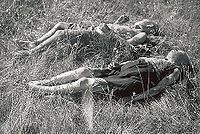 Between 1941-1944, Soviet partisan units conducted raids into Finnish territory and attacked civilian targets such as villages. In November 2006, photographs showing atrocities were declassified by the Finnish authorities. These include images of slain women and children.
, Ukraine, and Bessarabia, the NKVD and attached units of the Red Army massacred prisoners
and political opponents before fleeing from the advancing Axis forces.
, a major turning point in the war, the Red Army steadily regained lost territory on the Eastern Front
. This resulted in action against any person accused of being a collaborator
during the German occupation. While in France this part of its history is generally well-documented, debated, and is the subject of academic review, very little is known or discussed about what happened in the path of the Red Army.
forces in the expectation that they might secure their countries' independence from Soviet rule, although quite a number were also recruited under duress. Some of those eventually repatriated had not previously been Soviet citizens, amongst them many women and children. These people were often deemed by the Soviets to be traitors and "Nazi collaborators," and in many cases were shot immediately after being handed over by Allied troops, occurrences of which were reported at the time by British officers, protesting against having to take part. Further information may be found in Operation Keelhaul
and in Nikolai Tolstoy's Victims of Yalta.
, statements in Soviet military newspapers and the orders of the Soviet high command were jointly responsible for the excesses of the Red Army. Propaganda proclaimed that the Red Army had entered Germany as an avenger to punish all Germans. Soviet author Ilya Ehrenburg
wrote on January 31, 1945:
American historian Alfred de Zayas documents in his "Nemesis at Potsdam" (Routledge 1977, 7th edition Picton Press, Rockland Maine) and "A Terrible Revenge" (Palgrave/Macmillan 2006) the high level of rapes and shootings of German civilians in Nemmersdorf, Gumbinnen, Goldat and Methgethen.
Some historians dispute this, referring to an order issued on January 19 1945, which required the prevention of mistreatment of civilians. An order of the military council of the First Byelorussian Front, signed by Marshal Rokossovsky, ordered the shooting of looters and rapists at the scene of the crime. An order issued by Stavka on 20 April 1945 said that there was a need to maintain good relations with German civilians in order to decrease resistance and bring a quicker end to hostilities.
For the Germans, the organized evacuation of civilians before the advancing Red Army
was delayed by the Nazi government, so as not to demoralize the troops, who were by now defending their own country. However, German civilians were well aware that the Red Army was attacking noncombatants from reports by their friends and relatives who had served on the Eastern front. Furthermore, Nazi propaganda — originally meant to stiffen civil resistance by describing in gory and embellished detail Red Army atrocities such as the Nemmersdorf massacre — often backfired and created panic. Whenever possible, as soon as Nazi officials left, civilians began to flee westward on their own initiative.
Fleeing before the advancing Red Army, large numbers of the inhabitants of the German provinces of East Prussia
, Silesia
, and Pomerania
died during the evacuations, some from cold and starvation, some during combat operations. A significant percentage of this death toll, however, occurred when evacuation columns encountered units of the Red Army. Civilians were run over by tanks, shot, or otherwise murdered. Women and young girls were raped and left to die (as is explored firsthand in Alexander Solzhenitsyn's Prussian Nights
). In addition, fighter bombers of the Soviet air force
penetrated far behind the front lines and often attacked columns of evacuees.
 The Red Army's violence against the local German population during the occupation of eastern Germany often led to incidents like that in Demmin
, a small city conquered by the Soviets in the spring of 1945. Despite its surrender, nearly 900 civilians committed suicide, fueled by instances of pillaging, rape, and executions.
Although mass executions of civilians by the Red Army were seldom publicly reported, there is a known incident in Treuenbrietzen
, where at least 88 male inhabitants were rounded up and shot on May 1, 1945. The incident took place after a victory celebration at which numerous girls from Treuenbrietzen were raped and a Red Army lieutenant-colonel was shot by an unknown assailant. Some sources claim as many as 1,000 civilians may have been executed during the incident.
A study published by the German government in 1989 estimated the death toll of German civilians in eastern Europe at 635,000. With 270,000 dying as the result of Soviet war crimes, 160,000 deaths occurring at the hands of various nationalities during the expulsion of Germans after World War II
and 205,000 deaths in the forced labor of Germans in the Soviet Union
. These figures do not include at least 125,000 civilian deaths in the Battle of Berlin
.
Following the Red Army's capture of Berlin in 1945, one of the largest incidents of mass rape took place. Soviet troops raped German women and girls as young as eight years old. Estimates of the total number of victims range from tens of thousands to two million.
After the summer of 1945, Soviet soldiers caught raping civilians were usually punished to some degree, ranging from arrest to execution. The rapes continued, however, until the winter of 1947–48, when Soviet occupation authorities finally confined troops to strictly guarded posts and camps,“ completely separating them from the residential population in the Soviet zone of Germany.
According to figures of the NKVD
secret service, 3,127,380 German prisoners were registered by Soviet forces and kept in or sent to the Soviet Union to be used as forced labor. Of those, 474,967 were reported to have died in Soviet captivity.
on the former East Germany (the German Democratic Republic
). Naimark concluded that "The social psychology of women and men in the Soviet zone of occupation was marked by the crime of rape from the first days of occupation, through the founding of the GDR in the fall of 1949, until, one could argue, the present."
s were killed, with an unknown number dying from starvation and diseases. During the siege, an estimated 50,000 women and girls were raped, although estimates vary from 5,000 to 200,000. Hungarian girls were kidnapped and taken to Red Army quarters, where they were imprisoned, repeatedly raped and sometimes murdered. Even embassy staff from neutral countries were captured and raped, as documented when Soviet soldiers attacked the Swedish legation in Germany.
complained to Marshal I. S. Konev about the behavior of Soviet troops in Slovakia. Konev's response was to claim it was done mainly by Red Army deserters.
The Soviets made it a policy to loot and rape civilians in Manchuria. The same Russian troops from Germany had been sent to Manchuria and looted, killed and raped. In Harbin
, the Chinese posted slogans such as "Down with Red Imperialism!". Soviet forces ignored protests from Chinese communist party leaders on their mass rape and loot policy.
The UN commission received numerous reports of Soviet mortar and artillery fire into inhabited quarters in the Buda section of the city despite no return fire and of "haphazard shooting at defenseless passers-by."
According to many witnesses, Soviet troops fired upon people queueing outside stores. Most of the victims were said to be women and children. Many cases of Soviet shooting at ambulances and red cross vehicles were reported.
). Soldiers of the Red Army, together with members of the NKVD, frequently looted German transport trains in 1944 and 1945 in Poland.
Although a written order does not exist, there are several documents which describe the Red Army’s behavior. One of them is a report by the Swiss legation
in Budapest, describing the Red Army's entry into the city in 1945. It states:
Walter Kilian, the first mayor of the Charlottenburg
district in Berlin after the war, who was himself placed in office by the Soviets, reported extensive looting by Red Army soldiers in the area:
In the Soviet occupation zone, members of the SED
reported to Stalin that looting and rape by Soviet soldiers could result in a negative reaction by the German population towards the Soviet Union and towards the future of socialism in East Germany. Stalin reacted angrily: "I shall not tolerate anybody dragging the honour of the Red Army through the mud."
Accordingly, all evidence—such as reports, photos, and other documents of looting, rape, the burning down of farms and villages by the Red Army—was deleted from all archives in the future GDR.
as binding on itself and refused to become a signatory until 1955. This allowed for the barbaric treatment of POWs on both the Polish and Soviet sides during the Polish-Soviet War
of 1919–21. Moreover, the Soviet Union did not sign the Geneva Prisoners of War
convention of 1929 until 1955. Accordingly, the Red Army was able to mistreat its prisoners of war, without any effective international pressure.
During 1941, after emergency landings, German aircrews were often shot after their capture. Torture, mutilation and murder were also frequently carried out. During the winter of 1941–42, the Red Army captured approximately 10,000 German soldiers each month, but the death rate became so high that the absolute number of prisoners decreased (or was bureaucratically reduced). Soviet soldiers rarely bothered to take wounded Germans prisoner, instead shooting or clubbing them to death; Red Army hospitals would not treat injured prisoners. The murder of prisoners was often arranged through instructions, reports and statements of Soviet commanders. German prisoners were not released after the war but many were kept in captivity until as late as 1956 under terrible conditions as part of the Gulag.
Soviet sources list the deaths of 474,967 of the 2,652,672 German Armed Forces taken prisoner in the War. However, Dr. Rüdiger Overmans believes that it seems entirely plausible, while not provable, that an additional one million German military personnel listed as missing actually died in Soviet custody as POWs.
, at least with regard to the mass rapes. Beevor claims that Red Army soldiers also raped Russian and Polish
women liberated from concentration camps, and contends that this undermines the revenge explanation. Beevor's claims have encountered vast criticism from historians in Russia and the Russian government. The Russian ambassador to the UK said "It is a disgrace to have anything to do with this clear case of slander against the people who saved the world from Nazism."
O.A. Rzheshevsky, a professor and President of the Russian Association of World War II Historians, has charged that Beevor is merely resurrecting the discredited and racist views of Neo-Nazi historians, who depicted Soviet troops as subhuman "Asiatic hordes". Other prominent historians, such as Richard Overy
, have criticized Russian outrage at the book and defended Beevor. Overy accused the Russians of refusing to acknowledge Soviet war crimes, "Partly this is because they felt that much of it was justified vengeance against an enemy who committed much worse, and partly it was because they were writing the victors' history".
The problem of mass rape during and after the advance of Soviet forces across Poland against Nazi Germany
in the later stages of World War II has been researched at length by Polish historians only after the dissolution of the Soviet Union
. In Warmia
, Masuria
, Silesia
and East Prussia
, Polish women were the target of violent aggression as a matter of course. In Kraków
, the Soviet entry brought mass rape of Polish women and girls, as well as the plunder of private property by Soviet soldiers. This behavior reached such a scale that even Polish communists installed by the Soviets prepared a letter of protest to Joseph Stalin
, while church masses were held in expectation of a Soviet withdrawal.
Soviet Union
The Soviet Union , officially the Union of Soviet Socialist Republics , was a constitutionally socialist state that existed in Eurasia between 1922 and 1991....
from 1919 to 1991 include acts committed by the regular army—the Red Army
Red Army
The Workers' and Peasants' Red Army started out as the Soviet Union's revolutionary communist combat groups during the Russian Civil War of 1918-1922. It grew into the national army of the Soviet Union. By the 1930s the Red Army was among the largest armies in history.The "Red Army" name refers to...
(later called the Soviet Army
Soviet Armed Forces
The Soviet Armed Forces, also called the Armed Forces of the Union of Soviet Socialist Republics and Armed Forces of the Soviet Union refers to the armed forces of the Russian SFSR , and Soviet Union from their beginnings in the...
)—as well as the NKVD
NKVD
The People's Commissariat for Internal Affairs was the public and secret police organization of the Soviet Union that directly executed the rule of power of the Soviets, including political repression, during the era of Joseph Stalin....
, including the NKVD's Internal Troops
Internal Troops
The Internal Troops, full name Internal Troops of the Ministry for Internal Affairs ; alternatively translated as "Interior " is a paramilitary gendarmerie-like force in the now-defunct Soviet Union and its successor countries, particularly, in Russia, Ukraine, Georgia and Azerbaijan...
. In some cases, these crimes may have been committed on express orders of the early Soviet Government's policy of Red terror
Red Terror
The Red Terror in Soviet Russia was the campaign of mass arrests and executions conducted by the Bolshevik government. In Soviet historiography, the Red Terror is described as having been officially announced on September 2, 1918 by Yakov Sverdlov and ended about October 1918...
. In other instances, they were committed by regular army troops as retribution against military or civilian personnel of countries involved in conflict with (or the invasion of), the USSR, or during anti-partisan warfare.
Many of these incidents occurred in Northern
Northern Europe
Northern Europe is the northern part or region of Europe. Northern Europe typically refers to the seven countries in the northern part of the European subcontinent which includes Denmark, Estonia, Latvia, Lithuania, Norway, Finland and Sweden...
and Eastern Europe
Eastern Europe
Eastern Europe is the eastern part of Europe. The term has widely disparate geopolitical, geographical, cultural and socioeconomic readings, which makes it highly context-dependent and even volatile, and there are "almost as many definitions of Eastern Europe as there are scholars of the region"...
before and during World War II
World War II
World War II, or the Second World War , was a global conflict lasting from 1939 to 1945, involving most of the world's nations—including all of the great powers—eventually forming two opposing military alliances: the Allies and the Axis...
, and involved summary executions and mass murder of prisoners of war (such as the Katyn massacre
Katyn massacre
The Katyn massacre, also known as the Katyn Forest massacre , was a mass execution of Polish nationals carried out by the People's Commissariat for Internal Affairs , the Soviet secret police, in April and May 1940. The massacre was prompted by Lavrentiy Beria's proposal to execute all members of...
) and mistreatment of civilians in Soviet occupied territories
Occupied territories
Occupied territory is territory under military occupation. Occupation is a term of art in international law; in accordance with Article 42 of the Laws and Customs of War on Land ; October 18, 1907, territory is considered occupied when it is actually placed under the authority of the hostile army...
. Although there are numerous documented cases of such incidents, very few members of the Soviet armed forces (for example, Vassili Kononov), have ever been charged with war crimes and none of them by the International Criminal Court
International Criminal Court
The International Criminal Court is a permanent tribunal to prosecute individuals for genocide, crimes against humanity, war crimes, and the crime of aggression .It came into being on 1 July 2002—the date its founding treaty, the Rome Statute of the...
or Soviet or Russian tribunal.
Background
The Soviet Union did not recognize Imperial Russia's signing of the Hague Conventions (1899 and 1907)Hague Conventions (1899 and 1907)
The Hague Conventions were two international treaties negotiated at international peace conferences at The Hague in the Netherlands: The First Hague Conference in 1899 and the Second Hague Conference in 1907...
as binding, and refused to recognize them until 1955. This created a situation in which war crimes by the Soviet armed forces could be eventually rationalized. The Soviet refusal to recognize the Hague Conventions (1899 and 1907)
Hague Conventions (1899 and 1907)
The Hague Conventions were two international treaties negotiated at international peace conferences at The Hague in the Netherlands: The First Hague Conference in 1899 and the Second Hague Conference in 1907...
also gave Nazi Germany the rationale for inhuman treatment of captured Soviet military personnel.
Russian Civil War
During the Russian Civil WarRussian Civil War
The Russian Civil War was a multi-party war that occurred within the former Russian Empire after the Russian provisional government collapsed to the Soviets, under the domination of the Bolshevik party. Soviet forces first assumed power in Petrograd The Russian Civil War (1917–1923) was a...
, an estimated 100,000 Jews perished in pogrom
Pogrom
A pogrom is a form of violent riot, a mob attack directed against a minority group, and characterized by killings and destruction of their homes and properties, businesses, and religious centres...
s perpetrated by Symon Petlyura's Ukrainian nationalist separatists and the White forces led by Anton Denikin. The only armed force in the Russian Civil War that did not systematically terrorize the Jews was the Red Army of the Soviet Government. Jews came to regard the Red Army as their protector; young Jews joined it in order to avenge crimes against their families.
Although early Soviet leaders treated anti-Semitism with "utter contempt" and strong efforts were made by Soviet authorities to contain anti-Jewish bigotry, some Red Army units perpetrated pogrom
Pogrom
A pogrom is a form of violent riot, a mob attack directed against a minority group, and characterized by killings and destruction of their homes and properties, businesses, and religious centres...
s during the Russian civil war
Russian Civil War
The Russian Civil War was a multi-party war that occurred within the former Russian Empire after the Russian provisional government collapsed to the Soviets, under the domination of the Bolshevik party. Soviet forces first assumed power in Petrograd The Russian Civil War (1917–1923) was a...
and the Soviet-Polish War of 1919–1920, notably at Baranovichi
Baranovichi
Baranovichi , is a city in the Brest Province of western Belarus with a population of 173,000. It is a significant railway junction and home to a state university.-Overview:...
. These abuses were committed by the Boguny and Tarashchany regiments, which had earlier belonged to Petlyura's Ukrainian nationalist army and had only recently switched sides to join Semyon Budyonny
Semyon Budyonny
Semyon Mikhailovich Budyonny , sometimes transliterated as Budennyj, Budyonnyy, Budennii, Budenny, Budyoni, Budyenny, or Budenny, was a Soviet cavalryman, military commander, politician and a close ally of Soviet leader Joseph Stalin.-Early life:...
's Red Army forces.
However, only a small number of pogroms are attributed to the Red Army, with the vast majority of 'collectively violent' acts in the period having been committed by anti-Communist and nationalist forces. The pogroms were vigorously condemned by the Red Army high command and guilty units were disarmed, while individual pogromists were court-martialed. Those found guilty were executed.
The Red Army and the NKVD
The Red Army often gave support to the NKVD, which had as one of its functions the implementation of political repressionPolitical repression
Political repression is the persecution of an individual or group for political reasons, particularly for the purpose of restricting or preventing their ability to take political life of society....
. The main function of the NKVD was to protect the state security
State Security
State Security can refer to:* general concepts of security agency or national security* Committee for State Security * State Security * State Security...
of the Soviet Union, which was accomplished by large scale political repression of "class enemies". As an internal security force and prison guard contingent of the Gulag
Gulag
The Gulag was the government agency that administered the main Soviet forced labor camp systems. While the camps housed a wide range of convicts, from petty criminals to political prisoners, large numbers were convicted by simplified procedures, such as NKVD troikas and other instruments of...
, the Internal Troops both repressed political dissidents and engaged in war crimes during periods of military hostilities throughout Soviet history
History of the Soviet Union
The history of the Soviet Union has roots in the Russian Revolution of 1917. The Bolsheviks, led by Vladimir Lenin, emerged as the main political force in the capital of the former Russian Empire, though they had to fight a long and brutal civil war against the Mensheviks, or Whites...
. They were specifically responsible for maintaining the political regime in the GULAG and for conducting mass deportations and forced resettlement
Population transfer in the Soviet Union
Population transfer in the Soviet Union may be classified into the following broad categories: deportations of "anti-Soviet" categories of population, often classified as "enemies of workers," deportations of entire nationalities, labor force transfer, and organized migrations in opposite...
. The latter targeted a number of ethnic groups that the Soviet authorities presumed to be hostile to its policies and likely to collaborate with the enemy, including Chechens, Crimean Tatars
Crimean Tatars
Crimean Tatars or Crimeans are a Turkic ethnic group that originally resided in Crimea. They speak the Crimean Tatar language...
, and Koreans.
During World War II, a series of mass executions were committed by the Soviet NKVD against prisoners in Eastern Europe, primarily Poland, the Baltic states
Baltic states
The term Baltic states refers to the Baltic territories which gained independence from the Russian Empire in the wake of World War I: primarily the contiguous trio of Estonia, Latvia, Lithuania ; Finland also fell within the scope of the term after initially gaining independence in the 1920s.The...
, Romania, Ukraine
Ukraine
Ukraine is a country in Eastern Europe. It has an area of 603,628 km², making it the second largest contiguous country on the European continent, after Russia...
and other parts of the Soviet Union as the Red Army withdrew after the German invasion in 1941 (see Operation Barbarossa
Operation Barbarossa
Operation Barbarossa was the code name for Germany's invasion of the Soviet Union during World War II that began on 22 June 1941. Over 4.5 million troops of the Axis powers invaded the USSR along a front., the largest invasion in the history of warfare...
). The overall death toll is estimated at around 100,000. There were numerous reports of war crimes committed by Soviet armed forces, against captured German Wehrmacht and Luftwaffe soldiers from the very beginning of the war, documented in thousands of files of the The Wehrmacht War Crimes Bureau, 1939-1945
The Wehrmacht War Crimes Bureau, 1939-1945
The Wehrmacht War Crimes Bureau, 1939-1945 is a book by Alfred-Maurice de Zayas. It was published in November 1979 in Germany by Universitas/Langen Müller under the title Die Wehrmacht-Untersuchungsstelle, and in America in 1989 under the title The Wehrmacht War Crimes Bureau, 1939-1945 . Professor...
, an office established in September 1939 to investigate violations of the Hague and Geneva conventions by Germany's enemies. Among the better documented massacres are those at Broniki
Broniki
Broniki is a village in the administrative district of Gmina Rychwał, within Konin County, Greater Poland Voivodeship, in west-central Poland. It lies approximately north-west of Rychwał, south-west of Konin, and east of the regional capital Poznań....
(June 1941), Feodosia (December 1941) and Grischino (1943). NKVD Internal Troops were engaged alongside Red Army forces in combat and NKVD units were used for rear area security, including as blocking units
Barrier troops
Barrier troops, blocking units, or anti-retreat forces are formations of soldiers normally placed behind regular troops on a battle line to prevent panic or unauthorized withdrawal or retreat...
. In territory that was liberated or occupied, the NKVD carried out mass arrests, deportations and executions. The targets included both collaborators with Germany and the members of non-Communist resistance movement
Resistance movement
A resistance movement is a group or collection of individual groups, dedicated to opposing an invader in an occupied country or the government of a sovereign state. It may seek to achieve its objects through either the use of nonviolent resistance or the use of armed force...
s such as the Ukrainian Insurgent Army (UPA) in Ukraine, the Forest Brothers
Forest Brothers
The Forest Brothers were Estonian, Latvian, and Lithuanian partisans who waged a guerrilla war against Soviet rule during the Soviet invasion and occupation of the three Baltic states during, and after, World War II...
in Lithuania, and the Polish Armia Krajowa
Armia Krajowa
The Armia Krajowa , or Home Army, was the dominant Polish resistance movement in World War II German-occupied Poland. It was formed in February 1942 from the Związek Walki Zbrojnej . Over the next two years, it absorbed most other Polish underground forces...
. The NKVD also summarily executed over 20,000 Polish military officer prisoners
Katyn massacre
The Katyn massacre, also known as the Katyn Forest massacre , was a mass execution of Polish nationals carried out by the People's Commissariat for Internal Affairs , the Soviet secret police, in April and May 1940. The massacre was prompted by Lavrentiy Beria's proposal to execute all members of...
in April–May 1940.
After the final repulse of German forces
Operation Barbarossa
Operation Barbarossa was the code name for Germany's invasion of the Soviet Union during World War II that began on 22 June 1941. Over 4.5 million troops of the Axis powers invaded the USSR along a front., the largest invasion in the history of warfare...
in the Soviet Union, Red Army troops entered Germany, Romania and Hungary in late 1944. Soviet soldiers were by then aware of the German Nazi war crimes and often executed surrendering or captured German soldiers in retaliation. There were numerous accounts
Eyewitness testimony
Research in eyewitness testimony is mostly considered a subfield within legal psychology, however it is a field with very broad implications. Human reports are normally based on visual perception, which is generally held to be very reliable...
of war crimes by Soviet armed forces—plunder, the murder of civilians and rape. In both Soviet-era and current Russia
Russia
Russia or , officially known as both Russia and the Russian Federation , is a country in northern Eurasia. It is a federal semi-presidential republic, comprising 83 federal subjects...
n history books on the "Great Patriotic War" these war crimes are rarely mentioned.
War crimes by Soviet armed forces against civilians and prisoners of war
Prisoner of war
A prisoner of war or enemy prisoner of war is a person, whether civilian or combatant, who is held in custody by an enemy power during or immediately after an armed conflict...
(POWs) in the territories occupied by the USSR between 1939 and 1941 in regions including the Western Ukraine, the Baltic states and Bessarabia
Bessarabia
Bessarabia is a historical term for the geographic region in Eastern Europe bounded by the Dniester River on the east and the Prut River on the west....
in Romania), along with war crimes in 1944–45, have been ongoing issues within these countries. Since the dissolution of the Soviet Union
Dissolution of the Soviet Union
The dissolution of the Soviet Union was the disintegration of the federal political structures and central government of the Union of Soviet Socialist Republics , resulting in the independence of all fifteen republics of the Soviet Union between March 11, 1990 and December 25, 1991...
, a more systematic, locally-controlled discussion of these events has taken place.
The Soviets deployed mustard gas bombs during the Soviet Invasion of Xinjiang
Soviet Invasion of Xinjiang
The Soviet invasion of Xinjiang was a military campaign in the Chinese northwestern region of Xinjiang in 1934. White Russian forces assisted the Soviet Red Army.- Background :...
, some civilians were killed by conventional bombs during the invasion.
Estonia
Estonia was illegally annexed into the Soviet Union on August 6, 1940 and renamed the Estonian Soviet Socialist RepublicEstonian Soviet Socialist Republic
The Estonian Soviet Socialist Republic , often abbreviated as Estonian SSR or ESSR, was a republic of the Soviet Union, administered by and subordinated to the Government of the Soviet Union...
. In 1941, some 34,000 Estonians were drafted into the Red Army, of which less than 30% survived the war. After it became clear that the German invasion of Estonia would be successful, political prisoners who could not be evacuated were executed by the NKVD, so that they would not be able to make contact with the Nazi government. More than 300,000 citizens of Estonia, almost a third of the population at the time, were affected by deportation, arrests, execution and other acts of repression. As a result of the Soviet takeover, Estonia permanently lost at least 200,000 people or 20% of its population to repression, exodus and war.
Soviet political repressions in Estonia were met by an armed resistance by the Forest Brothers, mostly Estonian veterans of the Waffen-SS, Omakaitse
Omakaitse
The Omakaitse was a militia organisation in Estonia. It was founded in 1917 following the Russian Revolution. On the eve of the Occupation of Estonia by the German Empire the Omakaitse units took over major towns in the country allowing the Salvation Committee of the Estonian Provincial Assembly...
militia and volunteers in the Finnish Infantry Regiment 200
Finnish Infantry Regiment 200
Infantry Regiment 200 or Soomepoisid was a unit in the Finnish army during World War II made up mostly of Estonian volunteers, who preferred to fight against the Soviet Union in the ranks of the Finnish army instead of the armed forces of Germany....
who fought a guerrilla war, which was not completely suppressed until the late 1950s. In addition to the expected human and material losses suffered due to the fighting, until its end this conflict led to the deportation of tens of thousands of people, along with hundreds of political prisoners and thousands of civilians lost their lives.
- Battle of Kautla
- Battle of Avinurme
- Battle of PorkuniBattle of PorkuniBattle of Porkuni was the largest engagement between Estonians serving in the Red Army and Estonian pro-independence and Waffen-SS units. It took place in 21 September 1944 between Lake Porkuni and the Sauvälja village about seven kilometres northeast of the town of Tamsalu during the Leningrad...
Latvia
In 1939, Latvia fell victim to the Molotov-Ribbentrop PactMolotov-Ribbentrop Pact
The Molotov–Ribbentrop Pact, named after the Soviet foreign minister Vyacheslav Molotov and the German foreign minister Joachim von Ribbentrop, was an agreement officially titled the Treaty of Non-Aggression between Germany and the Soviet Union and signed in Moscow in the late hours of 23 August 1939...
between the USSR and Nazi Germany, leading to its annexation and incorporation into the Soviet Union on 5 August 1940. The establishment of a brutal puppet-state, the Latvian SSR
Latvian SSR
The Latvian Soviet Socialist Republic , also known as the Latvian SSR for short, was one of the republics that made up the Soviet Union. Established on 21 July 1940 as a puppet state during World War II in the territory of the previously independent Republic of Latvia after it had been occupied by...
, resulted in mass terror, the destruction of civil liberties, the economic system and Latvian culture. In all, over 200,000 people suffered from Soviet repression in Latvia, of which some 60% were deported to the Soviet Gulag in Siberia
Siberia
Siberia is an extensive region constituting almost all of Northern Asia. Comprising the central and eastern portion of the Russian Federation, it was part of the Soviet Union from its beginning, as its predecessor states, the Tsardom of Russia and the Russian Empire, conquered it during the 16th...
and the Far-East. The Soviet regime forced more than 260,000 Latvians to flee the country.
Lithuania
Lithuania, and the other Baltic StatesBaltic states
The term Baltic states refers to the Baltic territories which gained independence from the Russian Empire in the wake of World War I: primarily the contiguous trio of Estonia, Latvia, Lithuania ; Finland also fell within the scope of the term after initially gaining independence in the 1920s.The...
, fell victim to the Molotov-Ribbentrop pact. This agreement was signed between the USSR and Nazi Germany in August 1939, leading first to Lithuania being invaded by the Red Army on 15 June 1940 and to its annexation and incorporation into the Soviet Union on 3 August 1940. The Soviet annexation resulted in mass terror, the destruction of civil liberties, the economic system and Lithuanian culture. Between 1940–41, thousands of Lithuanians were arrested and hundreds of political prisoners were arbitrarily executed. More than 17,000 people were deported to Siberia in June 1941. After the German attack
Operation Barbarossa
Operation Barbarossa was the code name for Germany's invasion of the Soviet Union during World War II that began on 22 June 1941. Over 4.5 million troops of the Axis powers invaded the USSR along a front., the largest invasion in the history of warfare...
on the Soviet Union, the incipient Soviet political apparatus was either destroyed or retreated eastward. Lithuania was then occupied by Nazi Germany
Nazi Germany
Nazi Germany , also known as the Third Reich , but officially called German Reich from 1933 to 1943 and Greater German Reich from 26 June 1943 onward, is the name commonly used to refer to the state of Germany from 1933 to 1945, when it was a totalitarian dictatorship ruled by...
for a little over three years. In 1944, the Soviet occupation of Lithuania resumed following the German army being expelled. Following World War II and the subsequent suppression of the Lithuanian Forest Brothers, Soviet authorities executed thousands of resistance fighters and civilians accused of aiding them. Some 300,000 Lithuanians were deported or sentenced to prison camps on political grounds. It is estimated that Lithuania lost almost 780,000 citizens as a result of Soviet occupation, of which around 440,000 were war refugees.
During the Lithuanian restoration of independence in 1990, the Soviet army killed 13 demonstrators in Vilnius.
1939–1941
In September 1939, the Red Army invaded eastern Poland and occupied it in accordance with the secret protocols of the Molotov-Ribbentrop Pact. The Soviets later forcefully occupied the Baltic States and parts of Romania, including BessarabiaBessarabia
Bessarabia is a historical term for the geographic region in Eastern Europe bounded by the Dniester River on the east and the Prut River on the west....
and Northern Bukovina.
Ethnic cleansing
Ethnic cleansing is a purposeful policy designed by one ethnic or religious group to remove by violent and terror-inspiring means the civilian population of another ethnic orreligious group from certain geographic areas....
. NKVD task forces followed the Red Army to remove "Soviet-hostile elements" from the conquered territories. Polish historian Tomasz Strzembosz
Tomasz Strzembosz
Tomasz Strzembosz was a Polish historian and writer who specialized in the history of Poland during World War II. He was a professor at the Polish Academy of Sciences' Institute of Political Studies in Warsaw; and, at the John Paul II Catholic University of Lublin...
has noted parallels between the Nazi Einsatzgruppen
Einsatzgruppen
Einsatzgruppen were SS paramilitary death squads that were responsible for mass killings, typically by shooting, of Jews in particular, but also significant numbers of other population groups and political categories...
and these Soviet units. Many tried to escape from the Soviet NKVD; those who failed were taken into custody and afterwards deported to Siberia and vanished into the Gulag.
Torture
Torture
Torture is the act of inflicting severe pain as a means of punishment, revenge, forcing information or a confession, or simply as an act of cruelty. Throughout history, torture has often been used as a method of political re-education, interrogation, punishment, and coercion...
was used on a wide scale in various prisons, especially those in small towns. Prisoners were scalded with boiling water in Bobrka
Bibrka
Bibrka is a town in western Ukraine, located in the Lviv Oblast about 29 km southeast of Lviv on PI29.The town has been ruled at various points by the Kingdom of Poland, Polish-Lithuanian Commonwealth, the Austrian empire, the Austro-Hungarian empire, the Kingdom of Galicia and Lodomeria,...
; in Przemyslany, people had their noses, ears, and fingers cut off and eyes put out; in Czortkow, female inmates had their breasts cut off; and in Drohobycz, victims were bound together with barbed wire. Similar atrocities occurred in Sambor
Sambor
Sambor - is a Slavic name, consists of words: "sam" - alone, and "bor" - war, fight, warrior, and may refer to:-People:* Sambor, a prince of Rugia * Sambor I, Duke of Pomerania * Sambor II, Duke of Pomerania -Places:...
, Stanislawow
Ivano-Frankivsk
Ivano-Frankivsk is a historic city located in the western Ukraine. It is the administrative centre of the Ivano-Frankivsk Oblast , and is designated as its own separate raion within the oblast, municipality....
, Stryj
Stryi
Stryi is a city located on the left bank of the river Stryi in the Lviv Oblast of western Ukraine . Serving as the administrative center of the Stryi Raion , the city itself is also designated as a separate raion within the oblast. Thus, the city has two administrations - the city and the raion...
, and Zloczow. According to historian Jan T. Gross
Jan T. Gross
Jan Tomasz Gross is a Polish-American historian and sociologist. He is the Norman B. Tomlinson '16 and '48 Professor of War and Society and Professor of History at Princeton University.- Biography :Jan T...
:
"We cannot escape the conclusion: Soviet state security organs tortured their prisoners not only to extract confessions but also to put them to death. Not that the NKVD had sadists in its ranks who had run amok; rather, this was a wide and systematic procedure."
During the years 1939–41, nearly 1.5 million inhabitants of the Soviet-controlled areas of former eastern Poland were deported, of whom 63.1% were Poles or other nationalities and 7.4% were Jews
Jews
The Jews , also known as the Jewish people, are a nation and ethnoreligious group originating in the Israelites or Hebrews of the Ancient Near East. The Jewish ethnicity, nationality, and religion are strongly interrelated, as Judaism is the traditional faith of the Jewish nation...
. Only a small number of these deportees survived the war. According to American professor Carroll Quigley
Carroll Quigley
Carroll Quigley was an American historian and theorist of the evolution of civilizations. He is noted for his teaching work as a professor at Georgetown University, for his academic publications, and for his research on secret societies.- Biography :Quigley was born in Boston, and attended...
, at least one third of the 320,000 Polish prisoners of war captured by the Red Army in 1939 were murdered.
1944–1945
In Poland, Nazi atrocitiesGerman war crimes
The government of Germany ordered, organized and condoned several war crimes in both World War I and World War II. The most notable of these is the Holocaust in which millions of people were murdered or died from abuse and neglect, 60% of them Jews...
ended by late 1944, but they were replaced by Soviet oppression with the advance of Red Army forces. Soviet soldiers often engaged in plunder, rape and other crimes against the Poles, causing the population to fear and hate the regime.
Soldiers of Poland's Home Army (Armia Krajowa) were persecuted, sometimes imprisoned and in many cases, executed, following staged trials. An example of this was the case of Witold Pilecki
Witold Pilecki
Witold Pilecki was a soldier of the Second Polish Republic, the founder of the Secret Polish Army resistance group and a member of the Home Army...
, the organizer of Auschwitz resistance.
Units of the Red Army carried out campaigns against Polish partisans and civilians. During the Augustów chase
Augustów chase 1945
The Augustów roundup was a military operation against the Polish World War II anti-communist partisans and sympathizers following the Soviet takeover of Poland...
in 1945, more than 2,000 Poles were captured and about 600 of them were killed. For more about this subject, see Cursed soldiers
Cursed soldiers
The cursed soldiers is a name applied to a variety of Polish resistance movements formed in the later stages of World War II and afterwards. Created by some members of the Polish Secret State, these clandestine organizations continued their armed struggle against the Stalinist government of Poland...
.
There were cases of mass rapes in numerous Polish cities taken by the Red Army, (see Rape during the liberation of Poland
Rape during the liberation of Poland
The subject of rape during the liberation of Poland was practically absent from the Polish historiography until the dissolution of the Soviet Union, although the documents of the era show that the problem was serious both during and after the advance of Soviet forces across Poland against Nazi...
). In Kraków
Kraków
Kraków also Krakow, or Cracow , is the second largest and one of the oldest cities in Poland. Situated on the Vistula River in the Lesser Poland region, the city dates back to the 7th century. Kraków has traditionally been one of the leading centres of Polish academic, cultural, and artistic life...
, the Soviet entry into the city was accompanied by mass rapes of Polish women and girls, as well as the plunder of private property by Red Army soldiers. This behavior reached such a scale that even Polish communists installed by the Soviet Union were preparing to send a letter of protest to Joseph Stalin
Joseph Stalin
Joseph Vissarionovich Stalin was the Premier of the Soviet Union from 6 May 1941 to 5 March 1953. He was among the Bolshevik revolutionaries who brought about the October Revolution and had held the position of first General Secretary of the Communist Party of the Soviet Union's Central Committee...
himself, while church masses were held in expectation of a Soviet withdrawal.
Finland
Retreat by Soviet forces in 1941
Deportations, summary executions of political prisoners and the burning of foodstocks and villages took place when the Red Army retreated before the advancing Axis forces in 1941. In the Baltic States, BelarusBelarus
Belarus , officially the Republic of Belarus, is a landlocked country in Eastern Europe, bordered clockwise by Russia to the northeast, Ukraine to the south, Poland to the west, and Lithuania and Latvia to the northwest. Its capital is Minsk; other major cities include Brest, Grodno , Gomel ,...
, Ukraine, and Bessarabia, the NKVD and attached units of the Red Army massacred prisoners
NKVD massacres of prisoners
The NKVD prisoner massacres were a series of mass executions committed by the Soviet NKVD against prisoners in Eastern Europe, primarily Poland, Ukraine, the Baltic states, Bessarabia and other parts of the Soviet Union from which the Red Army was withdrawing after the German invasion in 1941...
and political opponents before fleeing from the advancing Axis forces.
1943–1945
After the Battle of StalingradBattle of Stalingrad
The Battle of Stalingrad was a major battle of World War II in which Nazi Germany and its allies fought the Soviet Union for control of the city of Stalingrad in southwestern Russia. The battle took place between 23 August 1942 and 2 February 1943...
, a major turning point in the war, the Red Army steadily regained lost territory on the Eastern Front
Eastern Front (World War II)
The Eastern Front of World War II was a theatre of World War II between the European Axis powers and co-belligerent Finland against the Soviet Union, Poland, and some other Allies which encompassed Northern, Southern and Eastern Europe from 22 June 1941 to 9 May 1945...
. This resulted in action against any person accused of being a collaborator
Collaborationism
Collaborationism is cooperation with enemy forces against one's country. Legally, it may be considered as a form of treason. Collaborationism may be associated with criminal deeds in the service of the occupying power, which may include complicity with the occupying power in murder, persecutions,...
during the German occupation. While in France this part of its history is generally well-documented, debated, and is the subject of academic review, very little is known or discussed about what happened in the path of the Red Army.
1946–1947
Hundreds of thousands of Ukrainians, Russians, Cossacks, and other nationalities and ethnicities were imprisoned or executed by the NKVD after having been forcibly repatriated by American, British, Canadian and French troops. Many of these men had fought alongside the AxisAxis Powers
The Axis powers , also known as the Axis alliance, Axis nations, Axis countries, or just the Axis, was an alignment of great powers during the mid-20th century that fought World War II against the Allies. It began in 1936 with treaties of friendship between Germany and Italy and between Germany and...
forces in the expectation that they might secure their countries' independence from Soviet rule, although quite a number were also recruited under duress. Some of those eventually repatriated had not previously been Soviet citizens, amongst them many women and children. These people were often deemed by the Soviets to be traitors and "Nazi collaborators," and in many cases were shot immediately after being handed over by Allied troops, occurrences of which were reported at the time by British officers, protesting against having to take part. Further information may be found in Operation Keelhaul
Operation Keelhaul
Operation Keelhaul was carried out in Northern Italy by British and American forces to repatriate Soviet Armed Forces POWs of the Nazis to the Soviet Union between August 14, 1946 and May 9, 1947...
and in Nikolai Tolstoy's Victims of Yalta.
1944–1945
According to historian Norman NaimarkNorman Naimark
Norman M. Naimark is an American historian, and author who specializes in modern Eastern European history, and genocide and ethnic cleansing in the region....
, statements in Soviet military newspapers and the orders of the Soviet high command were jointly responsible for the excesses of the Red Army. Propaganda proclaimed that the Red Army had entered Germany as an avenger to punish all Germans. Soviet author Ilya Ehrenburg
Ilya Ehrenburg
Ilya Grigoryevich Ehrenburg was a Soviet writer, journalist, translator, and cultural figure.Ehrenburg is among the most prolific and notable authors of the Soviet Union; he published around one hundred titles. He became known first and foremost as a novelist and a journalist - in particular, as a...
wrote on January 31, 1945:
American historian Alfred de Zayas documents in his "Nemesis at Potsdam" (Routledge 1977, 7th edition Picton Press, Rockland Maine) and "A Terrible Revenge" (Palgrave/Macmillan 2006) the high level of rapes and shootings of German civilians in Nemmersdorf, Gumbinnen, Goldat and Methgethen.
Some historians dispute this, referring to an order issued on January 19 1945, which required the prevention of mistreatment of civilians. An order of the military council of the First Byelorussian Front, signed by Marshal Rokossovsky, ordered the shooting of looters and rapists at the scene of the crime. An order issued by Stavka on 20 April 1945 said that there was a need to maintain good relations with German civilians in order to decrease resistance and bring a quicker end to hostilities.
For the Germans, the organized evacuation of civilians before the advancing Red Army
Flight and evacuation of German civilians during the end of World War II
Plans to evacuate German population from the occupied territories in Central and Eastern Europe and from Eastern Germany were prepared by German authorities at the end of World War II. However, the evacuation in most of the areas was delayed until the last moment, when it was too late to conduct it...
was delayed by the Nazi government, so as not to demoralize the troops, who were by now defending their own country. However, German civilians were well aware that the Red Army was attacking noncombatants from reports by their friends and relatives who had served on the Eastern front. Furthermore, Nazi propaganda — originally meant to stiffen civil resistance by describing in gory and embellished detail Red Army atrocities such as the Nemmersdorf massacre — often backfired and created panic. Whenever possible, as soon as Nazi officials left, civilians began to flee westward on their own initiative.
Fleeing before the advancing Red Army, large numbers of the inhabitants of the German provinces of East Prussia
East Prussia
East Prussia is the main part of the region of Prussia along the southeastern Baltic Coast from the 13th century to the end of World War II in May 1945. From 1772–1829 and 1878–1945, the Province of East Prussia was part of the German state of Prussia. The capital city was Königsberg.East Prussia...
, Silesia
Silesia
Silesia is a historical region of Central Europe located mostly in Poland, with smaller parts also in the Czech Republic, and Germany.Silesia is rich in mineral and natural resources, and includes several important industrial areas. Silesia's largest city and historical capital is Wrocław...
, and Pomerania
Pomerania
Pomerania is a historical region on the south shore of the Baltic Sea. Divided between Germany and Poland, it stretches roughly from the Recknitz River near Stralsund in the West, via the Oder River delta near Szczecin, to the mouth of the Vistula River near Gdańsk in the East...
died during the evacuations, some from cold and starvation, some during combat operations. A significant percentage of this death toll, however, occurred when evacuation columns encountered units of the Red Army. Civilians were run over by tanks, shot, or otherwise murdered. Women and young girls were raped and left to die (as is explored firsthand in Alexander Solzhenitsyn's Prussian Nights
Prussian Nights
Prussian Nights is a long poem by Aleksandr Solzhenitsyn, a captain in the Soviet Red Army during the Second World War. Prussian Nights describes the Red Army's march across East Prussia, and focuses on the traumatic acts of rape and murder that Solzhenitsyn witnessed as a participant in that...
). In addition, fighter bombers of the Soviet air force
Air force
An air force, also known in some countries as an air army, is in the broadest sense, the national military organization that primarily conducts aerial warfare. More specifically, it is the branch of a nation's armed services that is responsible for aerial warfare as distinct from an army, navy or...
penetrated far behind the front lines and often attacked columns of evacuees.
Demmin
Demmin is a town in the Mecklenburgische Seenplatte district, Mecklenburg-Western Pomerania, Germany. It was the capital of the former district Demmin.- Name :...
, a small city conquered by the Soviets in the spring of 1945. Despite its surrender, nearly 900 civilians committed suicide, fueled by instances of pillaging, rape, and executions.
Although mass executions of civilians by the Red Army were seldom publicly reported, there is a known incident in Treuenbrietzen
Treuenbrietzen
Treuenbrietzen is a town in the Bundesland of Brandenburg, Germany.-History:The town has existed since the Middle Ages and the first written evidence about it is from 1217. During the Reformation, Martin Luther came in 1537 to preach in the town, but his way to the church was blocked...
, where at least 88 male inhabitants were rounded up and shot on May 1, 1945. The incident took place after a victory celebration at which numerous girls from Treuenbrietzen were raped and a Red Army lieutenant-colonel was shot by an unknown assailant. Some sources claim as many as 1,000 civilians may have been executed during the incident.
A study published by the German government in 1989 estimated the death toll of German civilians in eastern Europe at 635,000. With 270,000 dying as the result of Soviet war crimes, 160,000 deaths occurring at the hands of various nationalities during the expulsion of Germans after World War II
Expulsion of Germans after World War II
The later stages of World War II, and the period after the end of that war, saw the forced migration of millions of German nationals and ethnic Germans from various European states and territories, mostly into the areas which would become post-war Germany and post-war Austria...
and 205,000 deaths in the forced labor of Germans in the Soviet Union
Forced labor of Germans in the Soviet Union
Forced labor of Germans in the Soviet Union was considered by the Soviet Union to be part of German war reparations for the damage inflicted by Nazi Germany on the Soviet Union during World War II. German civilians in Eastern Europe were deported to the USSR after World War II as forced laborers...
. These figures do not include at least 125,000 civilian deaths in the Battle of Berlin
Battle of Berlin
The Battle of Berlin, designated the Berlin Strategic Offensive Operation by the Soviet Union, was the final major offensive of the European Theatre of World War II....
.
Following the Red Army's capture of Berlin in 1945, one of the largest incidents of mass rape took place. Soviet troops raped German women and girls as young as eight years old. Estimates of the total number of victims range from tens of thousands to two million.
After the summer of 1945, Soviet soldiers caught raping civilians were usually punished to some degree, ranging from arrest to execution. The rapes continued, however, until the winter of 1947–48, when Soviet occupation authorities finally confined troops to strictly guarded posts and camps,“ completely separating them from the residential population in the Soviet zone of Germany.
According to figures of the NKVD
NKVD
The People's Commissariat for Internal Affairs was the public and secret police organization of the Soviet Union that directly executed the rule of power of the Soviets, including political repression, during the era of Joseph Stalin....
secret service, 3,127,380 German prisoners were registered by Soviet forces and kept in or sent to the Soviet Union to be used as forced labor. Of those, 474,967 were reported to have died in Soviet captivity.
Consequences
In The Russians in Germany: A History of the Soviet Zone of Occupation, 1945–1949, Norman Naimark wrote that not only did each victim have to carry the trauma for the rest of their days, but it also inflicted a massive collective traumaCollective trauma
A collective trauma is a traumatic psychological effect shared by a group of people of any size, up to and including an entire society. Traumatic events witnessed by an entire society can stir up collective sentiment, often resulting in a shift in that society's culture and mass actions.Well known...
on the former East Germany (the German Democratic Republic
German Democratic Republic
The German Democratic Republic , informally called East Germany by West Germany and other countries, was a socialist state established in 1949 in the Soviet zone of occupied Germany, including East Berlin of the Allied-occupied capital city...
). Naimark concluded that "The social psychology of women and men in the Soviet zone of occupation was marked by the crime of rape from the first days of occupation, through the founding of the GDR in the fall of 1949, until, one could argue, the present."
Hungary
During the Siege of Budapest in Hungary, some 40,000 civilianCivilian
A civilian under international humanitarian law is a person who is not a member of his or her country's armed forces or other militia. Civilians are distinct from combatants. They are afforded a degree of legal protection from the effects of war and military occupation...
s were killed, with an unknown number dying from starvation and diseases. During the siege, an estimated 50,000 women and girls were raped, although estimates vary from 5,000 to 200,000. Hungarian girls were kidnapped and taken to Red Army quarters, where they were imprisoned, repeatedly raped and sometimes murdered. Even embassy staff from neutral countries were captured and raped, as documented when Soviet soldiers attacked the Swedish legation in Germany.
Yugoslavia
Although the Red Army crossed only a very small part of Yugoslavia in 1944, its activities there caused great concern for the Yugoslav communist partisans, who feared that the rapes and plundering by their Soviet allies would weaken their standing with the population. At least 121 cases of rape were documented later, 111 of which also involved murder. A total of 1,204 cases of looting with assault were documented. Stalin responded to a Yugoslav partisan leader's complaints about the Red Army's conduct by saying, "Can't he understand it if a soldier who has crossed thousands of kilometers through blood and fire and death has fun with a woman or takes some trifle?"Slovakia
Slovak communist leader Vlado ClementisVladimír Clementis
Vladimír "Vlado" Clementis was a Slovak minister, politician, lawyer, publicist, literary critic, author and a prominent member of the Czechoslovak Communist Party. He married Lída Pátková, a daughter of a branch director of Czech Hypothec Bank in Bratislava, in March 1933. He became a Communist...
complained to Marshal I. S. Konev about the behavior of Soviet troops in Slovakia. Konev's response was to claim it was done mainly by Red Army deserters.
Manchuria, China
700,000 Soviet Russian troops occupied Manchuria, in China and looted the entire region of valuable materials and industrial equipment. Soviet Russian Red Army troops looted and terrorized the people of Mukden in Manchuria. A foreigner witnessed Soviet troops, formerly stationed in Berlin, who were allowed by the Soviet military to go at the city "for three days of rape and pillage". Most of Mukden was gone. Convict soldiers were then used to replace them; it was testified that they "stole everything in sight, broke up bathtubs and toilets with hammers, pulled electric-light wiring out of the plaster, built fires on the floor and either burned down the house or at least a big hole in the floor, and in general behaved completely like savages".The Soviets made it a policy to loot and rape civilians in Manchuria. The same Russian troops from Germany had been sent to Manchuria and looted, killed and raped. In Harbin
Harbin
Harbin ; Manchu language: , Harbin; Russian: Харби́н Kharbin ), is the capital and largest city of Heilongjiang Province in Northeast China, lying on the southern bank of the Songhua River...
, the Chinese posted slogans such as "Down with Red Imperialism!". Soviet forces ignored protests from Chinese communist party leaders on their mass rape and loot policy.
Hungarian Revolution (1956)
According to the United Nations Report of the Special Committee on the problem of Hungary (1957):The UN commission received numerous reports of Soviet mortar and artillery fire into inhabited quarters in the Buda section of the city despite no return fire and of "haphazard shooting at defenseless passers-by."
According to many witnesses, Soviet troops fired upon people queueing outside stores. Most of the victims were said to be women and children. Many cases of Soviet shooting at ambulances and red cross vehicles were reported.
Destruction of cities and looting
On many occasions, Soviet soldiers set fire to buildings, villages, or parts of cities, shooting anybody trying to extinguish the flames. For example, on May 1, 1945, Soviet soldiers set fire to the city centre of Demmin and prevented the inhabitants from extinguishing the blaze. Of the historic buildings around the market place, only a steeple survived the inferno. Most Red Army atrocities took place only in what was regarded as hostile territory (see also Przyszowice massacrePrzyszowice massacre
The Przyszowice massacre was a massacre perpetrated by the Red Army against civilian inhabitants of the Polish village of Przyszowice in Upper Silesia during the period January 26 to January 28, 1945. Sources vary on the number of victims, which range from 54 to over 60 – and possibly as many as 69...
). Soldiers of the Red Army, together with members of the NKVD, frequently looted German transport trains in 1944 and 1945 in Poland.
Although a written order does not exist, there are several documents which describe the Red Army’s behavior. One of them is a report by the Swiss legation
Legation
A legation was the term used in diplomacy to denote a diplomatic representative office lower than an embassy. Where an embassy was headed by an Ambassador, a legation was headed by a Envoy Extraordinary and Minister Plenipotentiary....
in Budapest, describing the Red Army's entry into the city in 1945. It states:
Walter Kilian, the first mayor of the Charlottenburg
Charlottenburg
Charlottenburg is a locality of Berlin within the borough of Charlottenburg-Wilmersdorf, named after Queen consort Sophia Charlotte...
district in Berlin after the war, who was himself placed in office by the Soviets, reported extensive looting by Red Army soldiers in the area:
In the Soviet occupation zone, members of the SED
Socialist Unity Party of Germany
The Socialist Unity Party of Germany was the governing party of the German Democratic Republic from its formation on 7 October 1949 until the elections of March 1990. The SED was a communist political party with a Marxist-Leninist ideology...
reported to Stalin that looting and rape by Soviet soldiers could result in a negative reaction by the German population towards the Soviet Union and towards the future of socialism in East Germany. Stalin reacted angrily: "I shall not tolerate anybody dragging the honour of the Red Army through the mud."
Accordingly, all evidence—such as reports, photos, and other documents of looting, rape, the burning down of farms and villages by the Red Army—was deleted from all archives in the future GDR.
Treatment of prisoners of war
The Soviet Union did not recognize the entry of Imperial Russia to the Hague Conventions (1899 and 1907)Hague Conventions (1899 and 1907)
The Hague Conventions were two international treaties negotiated at international peace conferences at The Hague in the Netherlands: The First Hague Conference in 1899 and the Second Hague Conference in 1907...
as binding on itself and refused to become a signatory until 1955. This allowed for the barbaric treatment of POWs on both the Polish and Soviet sides during the Polish-Soviet War
Polish-Soviet War
The Polish–Soviet War was an armed conflict between Soviet Russia and Soviet Ukraine and the Second Polish Republic and the Ukrainian People's Republic—four states in post–World War I Europe...
of 1919–21. Moreover, the Soviet Union did not sign the Geneva Prisoners of War
Geneva Conventions
The Geneva Conventions comprise four treaties, and three additional protocols, that establish the standards of international law for the humanitarian treatment of the victims of war...
convention of 1929 until 1955. Accordingly, the Red Army was able to mistreat its prisoners of war, without any effective international pressure.
During 1941, after emergency landings, German aircrews were often shot after their capture. Torture, mutilation and murder were also frequently carried out. During the winter of 1941–42, the Red Army captured approximately 10,000 German soldiers each month, but the death rate became so high that the absolute number of prisoners decreased (or was bureaucratically reduced). Soviet soldiers rarely bothered to take wounded Germans prisoner, instead shooting or clubbing them to death; Red Army hospitals would not treat injured prisoners. The murder of prisoners was often arranged through instructions, reports and statements of Soviet commanders. German prisoners were not released after the war but many were kept in captivity until as late as 1956 under terrible conditions as part of the Gulag.
Soviet sources list the deaths of 474,967 of the 2,652,672 German Armed Forces taken prisoner in the War. However, Dr. Rüdiger Overmans believes that it seems entirely plausible, while not provable, that an additional one million German military personnel listed as missing actually died in Soviet custody as POWs.
Discussion by historians
For decades, Western scholars have generally excused these atrocities in Germany and Hungary as revenge for German atrocities in the territory of the Soviet Union and for the mass killing of Soviet POWs (3.6 million dead out of total a 5.2 million POWs) by German armed forces. This explanation is now disputed by military writers such as Antony BeevorAntony Beevor
Antony James Beevor, FRSL is a British historian, educated at Winchester College and Sandhurst. He studied under the famous military historian John Keegan. Beevor is a former officer with the 11th Hussars who served in England and Germany for five years before resigning his commission...
, at least with regard to the mass rapes. Beevor claims that Red Army soldiers also raped Russian and Polish
Poles
thumb|right|180px|The state flag of [[Poland]] as used by Polish government and diplomatic authoritiesThe Polish people, or Poles , are a nation indigenous to Poland. They are united by the Polish language, which belongs to the historical Lechitic subgroup of West Slavic languages of Central Europe...
women liberated from concentration camps, and contends that this undermines the revenge explanation. Beevor's claims have encountered vast criticism from historians in Russia and the Russian government. The Russian ambassador to the UK said "It is a disgrace to have anything to do with this clear case of slander against the people who saved the world from Nazism."
O.A. Rzheshevsky, a professor and President of the Russian Association of World War II Historians, has charged that Beevor is merely resurrecting the discredited and racist views of Neo-Nazi historians, who depicted Soviet troops as subhuman "Asiatic hordes". Other prominent historians, such as Richard Overy
Richard Overy
Richard Overy is a British historian who has published extensively on the history of World War II and the Third Reich. In 2007 as The Times editor of Complete History of the World he chose the 50 key dates of world history....
, have criticized Russian outrage at the book and defended Beevor. Overy accused the Russians of refusing to acknowledge Soviet war crimes, "Partly this is because they felt that much of it was justified vengeance against an enemy who committed much worse, and partly it was because they were writing the victors' history".
The problem of mass rape during and after the advance of Soviet forces across Poland against Nazi Germany
Nazi Germany
Nazi Germany , also known as the Third Reich , but officially called German Reich from 1933 to 1943 and Greater German Reich from 26 June 1943 onward, is the name commonly used to refer to the state of Germany from 1933 to 1945, when it was a totalitarian dictatorship ruled by...
in the later stages of World War II has been researched at length by Polish historians only after the dissolution of the Soviet Union
Dissolution of the Soviet Union
The dissolution of the Soviet Union was the disintegration of the federal political structures and central government of the Union of Soviet Socialist Republics , resulting in the independence of all fifteen republics of the Soviet Union between March 11, 1990 and December 25, 1991...
. In Warmia
Warmia
Warmia or Ermland is a region between Pomerelia and Masuria in northeastern Poland. Together with Masuria, it forms the Warmian-Masurian Voivodeship....
, Masuria
Masuria
Masuria is an area in northeastern Poland famous for its 2,000 lakes. Geographically, Masuria is part of two adjacent lakeland districts, the Masurian Lake District and the Iława Lake District...
, Silesia
Silesia
Silesia is a historical region of Central Europe located mostly in Poland, with smaller parts also in the Czech Republic, and Germany.Silesia is rich in mineral and natural resources, and includes several important industrial areas. Silesia's largest city and historical capital is Wrocław...
and East Prussia
East Prussia
East Prussia is the main part of the region of Prussia along the southeastern Baltic Coast from the 13th century to the end of World War II in May 1945. From 1772–1829 and 1878–1945, the Province of East Prussia was part of the German state of Prussia. The capital city was Königsberg.East Prussia...
, Polish women were the target of violent aggression as a matter of course. In Kraków
Kraków
Kraków also Krakow, or Cracow , is the second largest and one of the oldest cities in Poland. Situated on the Vistula River in the Lesser Poland region, the city dates back to the 7th century. Kraków has traditionally been one of the leading centres of Polish academic, cultural, and artistic life...
, the Soviet entry brought mass rape of Polish women and girls, as well as the plunder of private property by Soviet soldiers. This behavior reached such a scale that even Polish communists installed by the Soviets prepared a letter of protest to Joseph Stalin
Joseph Stalin
Joseph Vissarionovich Stalin was the Premier of the Soviet Union from 6 May 1941 to 5 March 1953. He was among the Bolshevik revolutionaries who brought about the October Revolution and had held the position of first General Secretary of the Communist Party of the Soviet Union's Central Committee...
, while church masses were held in expectation of a Soviet withdrawal.
Movies and others
- A movie Anonymous. A Woman in Berlin about war rapes in Berlin was made based on A Woman in BerlinA Woman in BerlinA Woman in Berlin is an account of the period from 20 April to 22 June 1945 in Berlin . At the author's request, the work was published anonymously for her protection. The book purports to detail the writer's experiences as a rape victim during the Red Army occupation of the city...
diary by Marta HillersMarta HillersMarta Hillers was a German journalist and the author of the autobiographical Eine Frau in Berlin , her diary from 20 April to 22 June 1945 in Berlin during and after the Battle of Berlin...
. - The Beast (1988) about the War of Afghanistan
- Afghan BreakdownAfghan BreakdownAfghan Breakdown is a 1990 war drama film about the Soviet war in Afghanistan directed by Vladimir Bortko and co-produced by Italy and the Soviet Union...
- KatyńKatyn (film)Katyń is a 2007 Polish film about the 1940 Katyn massacre, directed by Academy Honorary Award winner Andrzej Wajda. It is based on the book Post Mortem: The Story of Katyn by Andrzej Mularczyk...
(2007) about the Katyn massacreKatyn massacreThe Katyn massacre, also known as the Katyn Forest massacre , was a mass execution of Polish nationals carried out by the People's Commissariat for Internal Affairs , the Soviet secret police, in April and May 1940. The massacre was prompted by Lavrentiy Beria's proposal to execute all members of... - Call Of Duty: World at WarCall of Duty: World at WarCall of Duty: World at War is a first-person shooter video game developed by Treyarch and published by Activision for PC, PlayStation 3, Wii, and Xbox 360. It is generally considered to be the fifth mainstream game of the Call of Duty series and returns the setting to World War II. The game was...
, in which there is a scene involving Soviet troops summarily executing German prisoners and wounded.
See also
- NKVD prisoner massacres
- Mass operations of the NKVDMass operations of the NKVDMass operations of the NKVD were carried out during the Great Purge and targeted specific categories of people. As a rule, they were carried out according to the corresponding order of the People's Commissar of Internal Affairs Nikolai Yezhov....
- List of Soviet Union perpetrated war crimes
- Population transfer in the Soviet UnionPopulation transfer in the Soviet UnionPopulation transfer in the Soviet Union may be classified into the following broad categories: deportations of "anti-Soviet" categories of population, often classified as "enemies of workers," deportations of entire nationalities, labor force transfer, and organized migrations in opposite...
- Mass graves in the Soviet UnionMass graves in the Soviet UnionThis page discusses mass graves in the Soviet Union.-Soviet repression and terror:The government of the USSR under Stalin murdered many of its own citizens and foreigners. These mass killings were carried out by the security organisations, such as the NKVD, and reached their peak in the Great Purge...
- Destruction battalionsDestruction battalionsDestruction battalions, colloquially destroyers or strybki was a paramilitary organisation in the western Soviet Union, which fulfilled tasks of internal security in the Eastern Front and after it.-Background:...
- Nemmersdorf massacre
- DemminDemminDemmin is a town in the Mecklenburgische Seenplatte district, Mecklenburg-Western Pomerania, Germany. It was the capital of the former district Demmin.- Name :...
- Allied war crimes during World War II
- German war crimesGerman war crimesThe government of Germany ordered, organized and condoned several war crimes in both World War I and World War II. The most notable of these is the Holocaust in which millions of people were murdered or died from abuse and neglect, 60% of them Jews...
- War crimes of the Wehrmacht
- EinsatzgruppenEinsatzgruppenEinsatzgruppen were SS paramilitary death squads that were responsible for mass killings, typically by shooting, of Jews in particular, but also significant numbers of other population groups and political categories...
- War crimes and atrocities of the Waffen-SS
- Japanese war crimesJapanese war crimesJapanese war crimes occurred during the period of Japanese imperialism, primarily during the Second Sino-Japanese War and World War II. Some of the incidents have also been described as an Asian Holocaust and Japanese war atrocities...
- Japanese POWs in the Soviet Union
- Evacuation of East PrussiaEvacuation of East PrussiaThe evacuation of East Prussia refers to the evacuation of the German civilian population and military personnel in East Prussia and the Klaipėda region between 20 January, and March 1945, as part of the evacuation of German civilians towards the end of World War II...
- Forced labor of Germans in the Soviet UnionForced labor of Germans in the Soviet UnionForced labor of Germans in the Soviet Union was considered by the Soviet Union to be part of German war reparations for the damage inflicted by Nazi Germany on the Soviet Union during World War II. German civilians in Eastern Europe were deported to the USSR after World War II as forced laborers...
- Operation FrühlingserwachenOperation FrühlingserwachenOperation Frühlingserwachen was the last major German offensive launched during World War II. The offensive was launched in Hungary on the Eastern Front...
- Red ScareRed ScareDurrell Blackwell Durrell Blackwell The term Red Scare denotes two distinct periods of strong Anti-Communism in the United States: the First Red Scare, from 1919 to 1920, and the Second Red Scare, from 1947 to 1957. The First Red Scare was about worker revolution and...
- Soviet occupation
External links
- The forgotten victims of WWII: Masculinities and rape in Berlin, 1945, James W. Messerschmidt, University of Southern Maine
- Book Review: A Woman in Berlin: Eight Weeks in the Conquered City, ISBN 0-8050-7540-2
- Laws of War: Laws and Customs of War on Land (Hague IV); October 18, 1907
- Swiss legation report of the Russian invasion of Hungary in the spring of 1945
- German rape victims find a voice at last, Kate Connolly, The ObserverThe ObserverThe Observer is a British newspaper, published on Sundays. In the same place on the political spectrum as its daily sister paper The Guardian, which acquired it in 1993, it takes a liberal or social democratic line on most issues. It is the world's oldest Sunday newspaper.-Origins:The first issue,...
, June 23, 2002 - "They raped every German female from eight to 80", Anthony Beevor, The GuardianThe GuardianThe Guardian, formerly known as The Manchester Guardian , is a British national daily newspaper in the Berliner format...
, May 1, 2002 - Remembering Rape: Divided Social Memory and the Red Army in Hungary 1944–1945, James Mark, Past & Present (2005) (The crimes during the Battle of BudapestBattle of BudapestThe Siege of Budapest centered on the Hungarian capital city of Budapest. It was fought towards the end of World War II in Europe, during the Soviet Budapest Offensive. The siege started when Budapest, defended by Hungarian and German troops, was first encircled on 29 December 1944 by the Red Army...
) - Excerpt, Chapter one The Struggle for Europe: The Turbulent History of a Divided Continent 1945–2002 – William I. Hitchcock – 2003 – ISBN 0-385-49798-9 ( The occupation of East PrussiaEvacuation of East PrussiaThe evacuation of East Prussia refers to the evacuation of the German civilian population and military personnel in East Prussia and the Klaipėda region between 20 January, and March 1945, as part of the evacuation of German civilians towards the end of World War II...
) - Description of the atrocities of the Red Army in East Prussia, quotations from Ilya EhrenburgIlya EhrenburgIlya Grigoryevich Ehrenburg was a Soviet writer, journalist, translator, and cultural figure.Ehrenburg is among the most prolific and notable authors of the Soviet Union; he published around one hundred titles. He became known first and foremost as a novelist and a journalist - in particular, as a...
, poems by anti-cruelty Red Army officers and details of suicides and rapings of German women and children in East PrussiaEast PrussiaEast Prussia is the main part of the region of Prussia along the southeastern Baltic Coast from the 13th century to the end of World War II in May 1945. From 1772–1829 and 1878–1945, the Province of East Prussia was part of the German state of Prussia. The capital city was Königsberg.East Prussia...
. - Book Review: The Siege of Budapest: 100 Days in World War II
- HNet review of The Russians in Germany: A History of the Soviet Zone of Occupation, 1945–1949.
- Mark Ealey: As World War II entered its final stages the belligerent powers committed one heinous act after another History News Network (Focus on the Asian front)
- 27 Jan 2002 on-line article regarding author Anthony Beevor's references to Soviet rapes in Germany
- Report of an eye witness: Erika Morgenstern, who survived Königsberg 1945 as a child (in German): part 1, part 2, part 3