

Home front during World War II

Encyclopedia
Home front
Home front is the informal term commonly used to describe the civilian populace of the nation at war as an active support system of their military....
covers the activities of the civilians in a nation at war. World War II
World War II
World War II, or the Second World War , was a global conflict lasting from 1939 to 1945, involving most of the world's nations—including all of the great powers—eventually forming two opposing military alliances: the Allies and the Axis...
was a total war
Total war
Total war is a war in which a belligerent engages in the complete mobilization of fully available resources and population.In the mid-19th century, "total war" was identified by scholars as a separate class of warfare...
; homeland production became even more invaluable to both the Allied
Allies of World War II
The Allies of World War II were the countries that opposed the Axis powers during the Second World War . Former Axis states contributing to the Allied victory are not considered Allied states...
and Axis powers
Axis Powers
The Axis powers , also known as the Axis alliance, Axis nations, Axis countries, or just the Axis, was an alignment of great powers during the mid-20th century that fought World War II against the Allies. It began in 1936 with treaties of friendship between Germany and Italy and between Germany and...
. Life on the home front during World War II was a significant part of the war effort for all participants and had a major impact on the outcome of the war. Governments became involved with new issues such as rationing, manpower allocation, home defense, evacuation in the face of air raid, and response to occupation by an enemy power. The morale and psychology of the people responded to leadership and propaganda
Propaganda
Propaganda is a form of communication that is aimed at influencing the attitude of a community toward some cause or position so as to benefit oneself or one's group....
. Typically women were mobilized to an unprecedented degree. The success in mobilizing economic output was a major factor in supporting combat operations.
Overview
The major powers devoted 50–61% of their total GDP to munition production. The Allies produced about three times as much in munitions as the Axis powers.| Country/Alliance | U.S.A. | 0.3 | 1.5 | 4.5 | 20.0 | 38.0 | 42.0 | 106.3 |
|---|---|---|---|---|---|---|---|
| Britain United Kingdom The United Kingdom of Great Britain and Northern IrelandIn the United Kingdom and Dependencies, other languages have been officially recognised as legitimate autochthonous languages under the European Charter for Regional or Minority Languages... |
0.5 | 3.5 | 6.5 | 9.0 | 11.0 | 11.0 | 41.5 |
| U.S.S.R | 1.6 | 5.0 | 8.5 | 11.5 | 14.0 | 16.0 | 56.6 |
| Allies Allies of World War II The Allies of World War II were the countries that opposed the Axis powers during the Second World War . Former Axis states contributing to the Allied victory are not considered Allied states... Total |
2.4 | 10.0 | 20.0 | 41.5 | 64.5 | 70.5 | 204.4 |
| Germany Germany Germany , officially the Federal Republic of Germany , is a federal parliamentary republic in Europe. The country consists of 16 states while the capital and largest city is Berlin. Germany covers an area of 357,021 km2 and has a largely temperate seasonal climate... |
2.4 | 6.0 | 6.0 | 8.5 | 13.5 | 17.0 | 53.4 |
| Japan Japan Japan is an island nation in East Asia. Located in the Pacific Ocean, it lies to the east of the Sea of Japan, China, North Korea, South Korea and Russia, stretching from the Sea of Okhotsk in the north to the East China Sea and Taiwan in the south... |
0.4 | 1.0 | 2.0 | 3.0 | 4.5 | 6.0 | 16.9 |
| Axis Total | 2.8 | 7.0 | 8.0 | 11.5 | 18.0 | 23.0 | 70.3 |
Source: Goldsmith data in Harrison (1988) p. 172
| Country | Japan | 100 | 107 | 109 | 111 | 108 | 99 | 93 | 78 |
|---|---|---|---|---|---|---|---|---|
| Germany | 100 | 108 | 117 | 108 | 105 | 95 | 94 | 85 |
| USA | 100 | 96 | 103 | 108 | 116 | 115 | 118 | 122 |
Source: Jerome B Cohen, Japan's Economy in War and Reconstruction (1949) p 354
Allies
The Allies called themselves the "United NationsUnited Nations
The United Nations is an international organization whose stated aims are facilitating cooperation in international law, international security, economic development, social progress, human rights, and achievement of world peace...
" (even before that organization formed in 1945), and pledged their support to the Atlantic Charter
Atlantic Charter
The Atlantic Charter was a pivotal policy statement first issued in August 1941 that early in World War II defined the Allied goals for the post-war world. It was drafted by Britain and the United States, and later agreed to by all the Allies...
of 1941. The Charter stated the ideal goals of the war: no territorial aggrandizement; no territorial changes made against the wishes of the people; restoration of self-government to those deprived of it; free access to raw materials; reduction of trade restrictions; global cooperation to secure better economic and social conditions for all; freedom from fear and want; freedom of the seas; and abandonment of the use of force, as well as disarmament of aggressor nations.
China
ChinaHistory of China
Chinese civilization originated in various regional centers along both the Yellow River and the Yangtze River valleys in the Neolithic era, but the Yellow River is said to be the Cradle of Chinese Civilization. With thousands of years of continuous history, China is one of the world's oldest...
suffered the second highest number of casualties of the entire war. Civilians in the occupied territories had to endure many large-scale massacres, including the Nanking Massacre
Nanking Massacre
The Nanking Massacre or Nanjing Massacre, also known as the Rape of Nanking, was a mass murder, genocide and war rape that occurred during the six-week period following the Japanese capture of the city of Nanjing , the former capital of the Republic of China, on December 13, 1937 during the Second...
. In a few areas, Japanese forces also unleashed newly developed biological weapons on Chinese civilians leading to an estimated 200,000 dead. Tens of thousands are thought to have died when Nationalist troops broke the levees of the Yangtze to stop the Japanese advance after the loss of the Chinese capital, Nanking. Millions more Chinese died because of famine during the war.
Millions of Chinese moved to the Western regions of China to avoid Japanese invasion. Cities like Kunming
Kunming
' is the capital and largest city of Yunnan Province in Southwest China. It was known as Yunnan-Fou until the 1920s. A prefecture-level city, it is the political, economic, communications and cultural centre of Yunnan, and is the seat of the provincial government...
ballooned with new arrivals. Entire factories and universities were often taken along for the journey. Japan captured major coastal cities like Shanghai
Shanghai
Shanghai is the largest city by population in China and the largest city proper in the world. It is one of the four province-level municipalities in the People's Republic of China, with a total population of over 23 million as of 2010...
early in the war; cutting the rest of China off from its chief source of finance and industry.
The city of Chongqing
Chongqing
Chongqing is a major city in Southwest China and one of the five national central cities of China. Administratively, it is one of the PRC's four direct-controlled municipalities , and the only such municipality in inland China.The municipality was created on 14 March 1997, succeeding the...
became the most frequently bombed city in history.
Though China received aid from the United States, China did not have sufficient infrastructure to properly arm or even feed its military forces, let alone civilians. Much of the aid was also funneled away through corruption.
Communist forces led by Mao
Mao Zedong
Mao Zedong, also transliterated as Mao Tse-tung , and commonly referred to as Chairman Mao , was a Chinese Communist revolutionary, guerrilla warfare strategist, Marxist political philosopher, and leader of the Chinese Revolution...
were based mainly in Northern China and employed guerrilla tactics against the Japanese. However, it is now felt that they were at most minimally involved in the Japanese resistance..
In occupied territories under Japanese control, civilians were treated harshly, and young men were drafted into a puppet Chinese army.
France
After the stunningly quick victory in June 1940, France was knocked out of the war and became an informal ally of the Germans. A powerful Resistance movement sprang up, as the Germans fortified the coast against an Allied invasion and occupied the northern half of the country. The Germans captured 2,000,000 French soldiers, and kept them in prisoner of war camps inside Germany for the duration of the war, using them as hostages to guarantee French cooperation. The French government, called the Vichy regime, cooperated closely with the Germans, sending food, machinery and workers to Germany. Several hundred thousand Frenchmen and women were forced to work in German factories, or volunteered to do so, as the French economy itself deteriorated. Nevertheless, there was a strong ResistanceFrench Resistance
The French Resistance is the name used to denote the collection of French resistance movements that fought against the Nazi German occupation of France and against the collaborationist Vichy régime during World War II...
movement, with fierce anti-resistance activities by the Nazis and the French police. Most Jews were rounded up by the Vichy police and handed to the over to the Germans, who sent them to death camps.
Food shortages
Women suffered shortages of all varieties of consumer goods and the absence of the men in POW camps. The rationing system was stringent but badly mismanaged, leading to produced malnourishment, black markets, and hostility to state management of the food supply. The Germans seized about 20% of the French food production, which caused severe disruption to the household economy of the French people. French farm production fell in half because of lack of fuel, fertilizer and workers; even so the Germans seized half the meat 20% of the produce, and 2% of the champagne. Supply problems quickly affected French stores which lacked most items. The government answered by rationing, but German official set the policies and hunger prevailed, especially affecting youth in urban areas. The queues lengthened in front of shops. Some people—including German soldiers—benefited from the black market, where food was sold without tickets at very high prices. Farmers diverted meat especially to the black market, which meant that much less for the open market. Counterfeit food tickets were also in circulation. Direct buying from farmers in the countryside and barter against cigarettes became common. These activities were strictly forbidden however and thus carried out at the risk of confiscation and fines. Food shortages were most acute in the large cities. In the more remote country villages, however, clandestine slaughtering, vegetable gardens and the availability of milk products permitted better survival. The official ration provided starvation level diets of 1300 or fewer calories a day, supplemented by home gardens and, especially, black market purchases.Netherlands
The Dutch famine of 1944, known as the "Hongerwinter" ("Hunger winter") was a man-made famine imposed by Germany in the occupied western provinces during the winter of 1944-1945. A German blockade cut off food and fuel shipments from farm areas. A total 4.5 million people were affected, of whom 18,000 died from the episode despite an elaborate system of emergency soup kitchens.Poland
Food deprivation as Nazi weapon
The Nazi Hunger PlanHunger Plan
The Hunger Plan was an economic management scheme that was put in place to ensure that Germans were given priority over food supplies, at the expense of everyone else. This plan was featured as part of the planning phase of the Wehrmacht invasion of the Soviet Union in 1941...
was to quickly kill the Jews of Poland and slowly force the Poles to leave by threat of starvation, so that they could be replaced by new German settlers. The Nazis coerced Poles to work in Germany by providing favorable food rations for families who had members working in the Reich. The ethnic German population in Poland Volksdeutsche
Volksdeutsche
Volksdeutsche - "German in terms of people/folk" -, defined ethnically, is a historical term from the 20th century. The words volk and volkische conveyed in Nazi thinking the meanings of "folk" and "race" while adding the sense of superior civilization and blood...
were given good rations and were allowed to shop for food in special stores. The German occupiers created a draconian system of food controls, including strong penalties for the omnipresent black market. There was a sharp increase in mortality due to the general malnutrition, and a decline in birth rates.
By mid 1941, the German minority in Poland received 2613 calories per day while Poles received 699 and Jews in the ghetto 184. The Jewish ration fulfilled 7.5 percent of their daily needs; Polish rations only 26 percent. Only the ration allocated to Germans fulfilled the full needs of their daily calorie intake.
| Nationality | Daily calorie intake |
|---|---|
| Germans | 2310 |
| Foreigners | 1790 |
| Ukrainians | 930 |
| Poles | 654 |
| Jews | 184 |
Additionally the Generalplan Ost
Generalplan Ost
Generalplan Ost was a secret Nazi German plan for the colonization of Eastern Europe. Implementing it would have necessitated genocide and ethnic cleansing to be undertaken in the Eastern European territories occupied by Germany during World War II...
plan of Nazis which envisioned elimination of Slavic population in occupied territories, and artificial famines-as proposed in Hunger Plan
Hunger Plan
The Hunger Plan was an economic management scheme that was put in place to ensure that Germans were given priority over food supplies, at the expense of everyone else. This plan was featured as part of the planning phase of the Wehrmacht invasion of the Soviet Union in 1941...
were to be used.
Jews in Warsaw Ghetto: 1943
On September 1, 1939, Germany invaded PolandPoland
Poland , officially the Republic of Poland , is a country in Central Europe bordered by Germany to the west; the Czech Republic and Slovakia to the south; Ukraine, Belarus and Lithuania to the east; and the Baltic Sea and Kaliningrad Oblast, a Russian exclave, to the north...
, conquering it in three weeks, as the Soviets invaded the eastern areas. During the German occupation, there were two distinct civilian uprisings in Warsaw, one in 1943, the other in 1944. The first took place in an entity, less than two square miles in area, which the Germans carved out of the city and called "Ghetto Warschau." Into the thus created Ghetto, around which they built high walls, the Germans crowded 550,000 Polish Jews, many from the Polish provinces. At first, people were able to go in and out of the Ghetto, but soon the Ghetto's border became an "iron curtain." Unless on official business, Jews could not leave it, and non-Jews, including Germans, could not enter. Entry points were guarded by German soldiers. Because of extreme conditions and hunger, mortality in the Ghetto was high. Additionally, in 1942, the Germans moved 400,000 to Treblinka where they were gassed on arrival. When, on April 19, 1943, the Ghetto Uprising commenced, the population of the Ghetto had dwindled to 60,000 individuals. In the following three weeks, virtually all died as the Germans fought to put down the uprising and systematically destroyed the buildings in the Ghetto.
Warsaw Uprising of 1944
The uprising by Poles began on August 1, 1944 when the Polish underground, the "Home Army," aware that the Soviet Army had reached the eastern bank of the Vistula, sought to liberate Warsaw much as the French resistance had liberated Paris a few weeks earlier. Stalin had his own group of Communist leaders for the new Poland and did not want the Home Army or its leaders (based in London) to control Warsaw. So he halted the Soviet offensive and gave the Germans free rein to suppress it. During the ensuing 63 days, 250,000 Poles of the Home Army surrendered to the Germans. After the Germans forced all the surviving population to leave the city, Hitler ordered that any buildings left standing be dynamited and 98% of buildings in Warsaw were destroyed.Soviet Union
During rapid German advances in the early months of the warOperation Barbarossa
Operation Barbarossa was the code name for Germany's invasion of the Soviet Union during World War II that began on 22 June 1941. Over 4.5 million troops of the Axis powers invaded the USSR along a front., the largest invasion in the history of warfare...
, nearly reaching the cities of Moscow
Moscow
Moscow is the capital, the most populous city, and the most populous federal subject of Russia. The city is a major political, economic, cultural, scientific, religious, financial, educational, and transportation centre of Russia and the continent...
and Leningrad
Leningrad
Leningrad is the former name of Saint Petersburg, Russia.Leningrad may also refer to:- Places :* Leningrad Oblast, a federal subject of Russia, around Saint Petersburg* Leningrad, Tajikistan, capital of Muminobod district in Khatlon Province...
, the bulk of Soviet
Soviet Union
The Soviet Union , officially the Union of Soviet Socialist Republics , was a constitutionally socialist state that existed in Eurasia between 1922 and 1991....
industry which could not be evacuated was either destroyed or lost due to German occupation. Agricultural production was interrupted, with grain harvests left standing in the fields that would later cause hunger reminiscent of the early 1930s. In one of the greatest feats of war logistics, factories were evacuated on an enormous scale, with 1523 factories dismantled and shipped eastwards along four principal routes to the Caucasus
Caucasus
The Caucasus, also Caucas or Caucasia , is a geopolitical region at the border of Europe and Asia, and situated between the Black and the Caspian sea...
, Central Asian, Ural
Ural (region)
Ural is a geographical region located around the Ural Mountains, between the East European and West Siberian plains. It extends approximately from north to south, from the Arctic Ocean to the bend of Ural River near Orsk city. The boundary between Europe and Asia runs along the eastern side of...
, and Siberian regions. In general, the tools, dies and production technology were moved, along with the blueprints and their management, engineering staffs and skilled labour.
The whole of the Soviet Union become dedicated to the war effort. The population of the Soviet Union was probably better prepared than any other nation involved in the fighting of World War II to endure the material hardships of the war. This is primarily because the Soviets were so used to shortages and coping with economic crisis in the past, especially during wartime—World War I brought similar restrictions on food. Still, conditions were severe. World War II was especially devastating to citizens of the USSR because it was fought on Soviet territory and caused massive destruction. In Leningrad, under German siege, over a million people died of starvation and disease. Many factory workers were teenagers, women and old people. The government implemented rationing in 1941 and first applied it to bread, flour, cereal, pasta, butter, margarine, vegetable oil, meat, fish, sugar, and confectionary all across the country. The rations remained largely stable in other places during the war. Additional rations were often so expensive that they could not add substantially to a citizen’s food supply unless that person was especially well-paid. Peasants received no rations and had to make do with local resources they farmed themselves. Most rural peasants struggled and lived in unbearable poverty but others sold any surplus they had at a high price and a few became rouble millionaires until a currency reform two years after the end of the war wiped out their wealth.
Despite harsh conditions, the war led to a spike in Soviet nationalism
Nationalism
Nationalism is a political ideology that involves a strong identification of a group of individuals with a political entity defined in national terms, i.e. a nation. In the 'modernist' image of the nation, it is nationalism that creates national identity. There are various definitions for what...
and unity. Soviet propaganda toned down extreme rhetoric of the past as the people now rallied by a belief of protecting their Motherland against the evils of German invaders. Ethnic minorities thought to be collaborators were forced into exile.
Religion, which was previously shunned, became a part of Communist Party propaganda campaign in the Soviet society in order to mobilize the religious elements.
The social composition of Soviet society changed drastically during the war. There was a burst of marriages in June and July 1941 between people about to be separated by the war and in the next few years the marriage rate dropped off steeply, with the birth rate following shortly thereafter to only about half of what it would have been in peacetime. For this reason mothers with several children during the war received substantial honors and money benefits if they had a great enough number of children—mothers could earn around 1,300 rubles for having their fourth child and earn up to 5,000 rubles for their tenth.
Survival in Leningrad
The city of Leningrad endured more suffering and hardships than any other city in the Soviet Union during World War II. Hunger, malnutrition, disease, starvation, and even cannibalism became common during the siege of Leningrad from September 1941-January 1944. It was a plight that has become the focus of Paulina Simons 'The Bronze Horseman.' Many Soviet citizens lost weight, grew weaker, and became more vulnerable to diseases. If malnutrition persisted for long enough, its effects were irreversible. People’s feelings of loyalty disappeared if they got hungry enough and they would steal from their closest family members to survive.Citizens of Leningrad managed to survive through a number of methods with varying degrees of success. Since only four hundred thousand Russians were evacuated before the siege began, this left two and a half million in Leningrad, including four hundred thousand children. More managed to escape the city; this was most successful when lake Lagoda froze over and people could walk over the ice road—or “road of life”—to safety. Those in influential political or social positions used their connections to other elites to leave Leningrad both before and after the siege began. Some factory owners even looted state funds to secure transport out of the city during the first summer of the war. The most risky means of escape, however, was to defect to the enemy and hope to avoid governmental punishment.
Most survival strategies during the siege, though, involved staying within the city and facing the problems through resourcefulness or luck. One way to do this was by securing factory employment because many factories became autonomous and possessed more of the tools of survival during the winter, such as food and heat. Workers got larger rations than regular civilians and factories were likely to have electricity if they produced crucial goods. Factories also served as mutual-support centers and had clinics and other services like cleaning crews and teams of women who would sew and repair clothes. Factory employees were still driven to desperation on occasion and people resorted to eating glue or horses in factories where food was scarce, but factory employment was the most consistently successful method of survival, and at some food production plants not a single person died.
Survival opportunities open to the larger Soviet community included bartering and farming on private land. Black markets thrived as private barter and trade became more common, especially between soldiers and civilians. Soldiers, who had more food to spare, were eager to trade with Soviet citizens that had extra warm clothes to trade. Planting vegetable gardens in the spring became popular, primarily because citizens got to keep everything grown on their own plots. The campaign also had a potent psychological effect and boosted morale, a survival component almost as crucial as bread.
Many of the most desperate Soviet citizens turned to crime as a way to support themselves in trying times. Most common was the theft of food and of ration cards, which could prove fatal for a malnourished person if their card was stolen more than a day or two before a new card was issued. For these reasons, the stealing of food was severely punished and a person could be shot for as little as stealing a loaf of bread. More serious crimes such as murder and cannibalism also occurred, and special police squads were set up to combat these crimes, though by the end of the siege, roughly 1,500 had been arrested for cannibalism.
United States
- See United States home front during World War IIUnited States home front during World War IIThis page, United States home front during World War II, covers the developments within the United States, 1940–1945, to support its efforts during World War II.-Economics:...
.
Standlee (2010) argues that during the war the traditional gender division of labor changed somewhat, as the "home" or domestic female sphere expanded to include the "home front"; meanwhile the public sphere--the male domain-- was redefined as the international stage of military action.
Britain
- See Timeline of the United Kingdom home front during World War IITimeline of the United Kingdom home front during World War IIThis is a Timeline of the United Kingdom home front during World War II. For narrative and bibliography see Home front during World War II-1939:3 June 193924 August 19391 September 19393 September 19391 October 19396 October 1939-1940:8 January 1940...
.
Britain's total mobilization during this period proved to be successful in winning the war maintaining strong support from public opinion. The war was a "people's war" that enlarged democratic aspirations and produced promises of a postwar welfare state. The BBC in 2003-6 collected 47,000 wartime recollections and 15,000 images, and put them online.
Mobilisation of women
Historians credit Britain with a highly successful record of mobilizing the home front for the war effort, in terms of mobilizing the greatest proportion of potential workers, maximizing output, assigning the right skills to the right task, and maintaining the morale and spirit of the people. Much of this success was due to the systematic planned mobilization of women, as workers, soldiers, and housewives, enforced after December 1941 by conscription. The women supported the war effort, and made the rationing of consumer goods of success. In some ways, the government over planned, evacuating too many children in the first days of the war, closing cinemas as frivolous then reopening them when the need for cheap entertainment was clear, sacrificing cats and dogs to save a little space on shipping pet food, only to discover an urgent need to keep the rats and mice under control. In the balance between compulsion and voluntarism, the British relied successfully on voluntarism. The success of the government in providing new services, such as hospitals, and school lunches, as well as the equalitarian spirit of the People's war, contributed to widespread support for an enlarged welfare state. Munitions production rose dramatically, and the quality remains high. Food production was emphasized, in large part to open up shipping for munitions. Farmers increased from 12,000,000 to 18,000,000 the acres under cultivation, and the farm labor force was expanded by a fifth, thanks especially to the Women's Land Army.Mothers had much less time for supervision of their children, and the fear of juvenile delinquency was upon the land, especially as older teenagers took jobs and emulated their older siblings in the service. The government responded by requiring all youth over 16 to register, and expanded the number of clubs and organizations available to them.
Munitions
In mid-1940, the R.A.F. was called on to fight the Battle of BritainBattle of Britain
The Battle of Britain is the name given to the World War II air campaign waged by the German Air Force against the United Kingdom during the summer and autumn of 1940...
but it had suffered serious losses. It lost 458 aircraft—more than current production—in France and was hard pressed. The government decided to concentrate on only five types of aircraft in order to optimize output. They were Wellingtons
Vickers Wellington
The Vickers Wellington was a British twin-engine, long range medium bomber designed in the mid-1930s at Brooklands in Weybridge, Surrey, by Vickers-Armstrongs' Chief Designer, R. K. Pierson. It was widely used as a night bomber in the early years of the Second World War, before being displaced as a...
, Whitley V's
Armstrong Whitworth Whitley
The Armstrong Whitworth A.W.38 Whitley was one of three British twin-engine, front line medium bomber types in service with the Royal Air Force at the outbreak of the Second World War...
, Blenheims
Bristol Blenheim
The Bristol Blenheim was a British light bomber aircraft designed and built by the Bristol Aeroplane Company that was used extensively in the early days of the Second World War. It was adapted as an interim long-range and night fighter, pending the availability of the Beaufighter...
, Hurricanes
Hawker Hurricane
The Hawker Hurricane is a British single-seat fighter aircraft that was designed and predominantly built by Hawker Aircraft Ltd for the Royal Air Force...
, and Spitfires
Supermarine Spitfire
The Supermarine Spitfire is a British single-seat fighter aircraft that was used by the Royal Air Force and many other Allied countries throughout the Second World War. The Spitfire continued to be used as a front line fighter and in secondary roles into the 1950s...
. They received extraordinary priority. Covering the supply of materials and equipment and even made it possible to divert from other types the necessary parts, equipments, materials and manufacturing resources. Labour was moved from other aircraft work to factories engaged on the specified types. Cost was not an object. The delivery of new fighters rose from 256 in April to 467 in September—more than enough to cover the losses—and Fighter Command emerged triumphantly from the Battle of Britain in October with more aircraft than it had possessed at the beginning. Starting in 1941 the U.S. provided munitions through Lend lease that totaled $15.5 billion
Rationing
Food, clothing, petrol, leather and other such items were rationedRationing in the United Kingdom during and after World War II
Rationing in the United Kingdom refers to rationing introduced by the government of the United Kingdom several times during the 20th century, mostly during and immediately after war....
. However, items such as sweets and fruits were not rationed, as they would spoil. Access to luxuries was severely restricted, though there was also a significant black market. Families also grew victory garden
Victory garden
Victory gardens, also called war gardens or food gardens for defense, were vegetable, fruit and herb gardens planted at private residences and public parks in United States, United Kingdom, Canada and Germany during World War I and World War II to reduce the pressure on the public food supply...
s, and small home vegetable gardens, to supply themselves with food. Many things were conserved to turn into weapons later, such as fat for nitroglycerin production. People in the countryside were less affected by rationing as they had greater access to locally sourced unrationed products than people in metropolitan areas and were more able to grow their own.
The rationing system, which had been originally based on a specific basket of goods for each consumer, was much improved by switching to a point system which allowed the housewives to make choices based on their own priorities. Food rationing also permitted the upgrading of the quality of the foods available, and housewives approved—except for the absence of white bread and the government’s imposition of an unpalatable wheat meal “national loaf.” People were especially pleased that rationing brought equality and a guarantee of a decent meal at an affordable cost.
Evacuation
From very early in the war, it was thought that the major industrial cities of Britain, especially London]in the south east, would come under Luftwaffe air attack, which did happen with The BlitzThe Blitz
The Blitz was the sustained strategic bombing of Britain by Nazi Germany between 7 September 1940 and 10 May 1941, during the Second World War. The city of London was bombed by the Luftwaffe for 76 consecutive nights and many towns and cities across the country followed...
. Some children were sent to Canada, the USA and Australia and millions of children and some mothers were evacuated from London and other major cities when the war began under government plans for Evacuations of civilians in Britain during World War II
Evacuations of civilians in Britain during World War II
Evacuation of civilians in Britain during the Second World War was designed to save the population of urban or military areas in the United Kingdom from aerial bombing of cities and military targets such as docks. Civilians, particularly children, were moved to areas thought to be less at risk....
, but they often filtered back. When the Blitz bombing began on September 6, 1940, they evacuated again. The discovery of the poor health and hygiene of evacuees was a shock to many Britons, and helped prepare the way for the Beveridge Report
Beveridge Report
The Report of the Inter-Departmental Committee on Social Insurance and Allied Services, known commonly as the Beveridge Report was an influential document in the founding of the Welfare State in the United Kingdom...
. Children were evacuated if their parents agreed but in some cases they did not have a choice. The children were only allowed to take a few things with them, including a gas mask, books, money, clothes, ration book and some small toys.
Belfast during the war
BelfastBelfast
Belfast is the capital of and largest city in Northern Ireland. By population, it is the 14th biggest city in the United Kingdom and second biggest on the island of Ireland . It is the seat of the devolved government and legislative Northern Ireland Assembly...
in Northern Ireland was a representative British city that has been well studied by historians. It was a key industrial city producing ships, tanks, aircraft, engineering works, arms, uniforms, parachutes and a host of other industrial goods. The unemployment that had been so persistent in the 1930s disappeared, and labour shortages appeared. There was a major munitions strike of 1944. As a key industrial city Belfast became a target for German bombing missions, but it was thinly defended; there were only 24 anti aircraft guns in the city for example. The Northern Ireland government under Richard Dawson Bates (Minister for Home Affairs) had prepared too late, assuming that Belfast was too distant. When Germany conquered France in spring 1940 it gained closer airfields. The city's fire brigade was inadequate, there were no public air raid shelters as the Northern Ireland government was reluctant to spend money on them and there were no searchlights in the city, which made shooting down enemy bombers all the more difficult. After seeing the Blitz in London in the autumn of 1940 the government started constructing air raid shelters. The Luftwaffe in early 1941 sent reconnaissance missions that identified the docks and industrial areas to be targeted. Especially hard hit were the working class areas of North Belfast and East Belfast where over a thousand were killed and hundreds were seriously injured. Many people left the city afraid of future attacks. The bombings revealed the terrible slum conditions. In May 1941, the Luftwaffe hit the docks and the Harland and Wolff
Harland and Wolff
Harland and Wolff Heavy Industries is a Northern Irish heavy industrial company, specialising in shipbuilding and offshore construction, located in Belfast, Northern Ireland....
shipyards, closing the yards for six months. Apart from the numbers dead, the Belfast blitz
Belfast Blitz
The Belfast Blitz was an event that occurred on the night of Easter Tuesday, 15 April 1941 during World War II. Two hundred bombers of the German Air Force attacked the city of Belfast in Northern Ireland. Nearly one thousand people died as a result of the bombing and 1,500 were injured. In terms...
saw half of Belfast houses destroyed. Approximately twenty millions pounds worth of damage was caused. The Northern Ireland government was criticized heavily for its lack of preparation. The criticism forced the resignation of Prime Minister J. M. Andrews. The bombing raids continued until the invasion of Russia in summer 1941. The U.S. American army arrived in 1942-44, setting up bases around Northern Ireland, and spending freely.
Canada
Canada joined the war effort on September 10, 1939. This was a week after Britain joined because of the Statute of Westminster, which meant Canada had to vote before entering a war. With the war going on in Europe and Asia, Canada didn't have any major problems in building supplies for the war other than switching factories to make war equipment. Many factories were set up which helped increase the employment rate. More or less out of range of Axis attacks, Canada became one of the largest trainers of pilots for the Allies. Many Canadian men joined the war effort, so with the men overseas and industries pushing to increase production, women took up positions to aid in the war effort.Shipyards and repair facilities expanded dramatically as over a thousand warships and cargo ships were built, along with thousands of auxiliary vessels, small boats, and other craft.
Ethnicity
Since 20% of Canada's population were not of British or French origins, their status was of special concern. The main goal was to integration of marginalized European ethnics--as opposed to the First World War policy of internment camps for Ukrainians and Germans. The government watched the ethnics closely for signs of involvement with and loyalty to their homelands. The fears proved groundless. In February 1942 21,000 Japanese Canadians were rounded and sent to internment campsJapanese Canadian internment
Japanese Canadian internment refers to confinement of Japanese Canadians in British Columbia during World War II. The internment began in December 1941, following the attack by carrier-borne forces of Imperial Japan on American naval and army facilities at Pearl Harbor...
that closely resembled the similar camps in the U.S. because the two governments had agreed in 1941 to coordinate their evacuation policies. Most had lived in British Columbia, but in 1945 they were released from detention and allowed to move anywhere in Canada except British Columbia, or they could go to Japan. Most went to the Toronto area.
Women
Women took the initiative to recycle and salvage in order to come up with needed supplies. They gathered recycled goods, handed out information on the best methods to use that one may get the most out of recycled goods and organized many other events to decrease the amount of waste. Volunteer organizations led by women also, prepared packages for the military overseas or for prisoners of war in Axis countries.With World War II came the dire need for employees in the workplace, without women to step in the economy would have collapsed. By autumn 1944 the number of women working full-time in Canada’s paid labour force was twice what it had been in 1939, and that figure of between 1,000,000 and 1,200,000 did not include part-time workers or women working on farms.” Women had to take on this intensive labour and while they did this they still had to find time to make jams, clothes and other such acts of volunteering to aid the men overseas.
Australia
The government greatly expanded its powers in order to better direct the war effort, and Australia's industrial and human resources were focused on supporting the Australian and American armed forces. There were a few Japanese attacks, most notably on Darwin in Feb. 1942, along with widespread fear in 1942 that Australia would be invaded..jpg)
The Curtin Labor Government
John Curtin
John Joseph Curtin , Australian politician, served as the 14th Prime Minister of Australia. Labor under Curtin formed a minority government in 1941 after the crossbench consisting of two independent MPs crossed the floor in the House of Representatives, bringing down the Coalition minority...
took over in October 1941, and energized the war effort, with rationing of scarce fuel, clothing and some food. When Japan entered the war in December, 1941, the danger was at hand, and all women and children were evacuated from Darwin and northern Australia. The Commonwealth Government took control of all income taxation in 1942, which gave it extensive new powers and greatly reduced the states' financial autonomy. Manufacturing grew rapidly, with assembly of high performance guns and aircraft a specialty. The number of women working in factories rose from 171,000 to 286,000. The arrival of tens of thousands of Americans was greeted with relief, as they could protect Australia where Britain could not. The U.S. sent in $1.1 billion in Lend Lease, and Australia returned about the same total in services, food, rents and supplies to the Americans.
India
With the massive demands of manpower for the British Indian ArmyBritish Indian Army
The British Indian Army, officially simply the Indian Army, was the principal army of the British Raj in India before the partition of India in 1947...
fighting in European, African and CBI (China-India-Burma)
China Burma India Theater of World War II
China Burma India Theater was the name used by the United States Army for its forces operating in conjunction with British and Chinese Allied air and land forces in China, Burma, and India during World War II...
theatres of war, there was a shortage of able bodied men for agriculture. The British were also afraid the Bengali plains
Bengal
Bengal is a historical and geographical region in the northeast region of the Indian Subcontinent at the apex of the Bay of Bengal. Today, it is mainly divided between the sovereign land of People's Republic of Bangladesh and the Indian state of West Bengal, although some regions of the previous...
might fall into Japanese hands, so cultivation of border areas was prevented, all rice stocks were moved back towards Kolkata
Kolkata
Kolkata , formerly known as Calcutta, is the capital of the Indian state of West Bengal. Located on the east bank of the Hooghly River, it was the commercial capital of East India...
, and there was forced procurement of rice for the war effort in Europe. This led to severe food shortages, made worse by maladministration, and price rises for food the poor could not meet, culminating in the Bengal famine of 1943
Bengal famine of 1943
The Bengal famine of 1943 struck the Bengal. Province of pre-partition India. Estimates are that between 1.5 and 4 million people died of starvation, malnutrition and disease, out of Bengal’s 60.3 million population, half of them dying from disease after food became available in December 1943 As...
in which 3 million Indian civilians died.
With the British recruiting Indian soldiers in large numbers as well as the Japanese recruiting Indian expatriates into the Indian National Army
Indian National Army
The Indian National Army or Azad Hind Fauj was an armed force formed by Indian nationalists in 1942 in Southeast Asia during World War II. The aim of the army was to overthrow the British Raj in colonial India, with Japanese assistance...
(INA), a state of civil war existed on the east Indian border with Indians killing Indians.
Germany
Germany had not fully mobilized in 1939, nor even in 1941. Not until 1943 under Albert SpeerAlbert Speer
Albert Speer, born Berthold Konrad Hermann Albert Speer, was a German architect who was, for a part of World War II, Minister of Armaments and War Production for the Third Reich. Speer was Adolf Hitler's chief architect before assuming ministerial office...
did Germany finally redirect its entire economy and manpower to war production. Nazi policy was not to burden the people on the home front because of the fear of another stab in the back that the Nazis truly believed it happened to Germany in 1918.
Forced labour
Instead of expanding the economies of the occupied nations, the Nazis seized the portable machinery and rail cars, requisitioned most of the industrial output, took large quantities of food (15% of French output), and forced the victims to pay for their military occupation.The Nazis forced 15 million people to work in Germany (including POWs); many died from bad living conditions, mistreatment, malnutrition, and executions. At its peak the forced laboers comprised 20% of the German work force and were a vital part of the German economic exploitation of conquered territories. They were especially concentrated in munitions and agriculture. For example, 1.5 million French soldiers were kept in POW camps in Germany as hostages and forced workers, and in 1943 600,000 French civilians were forced to move to Germany to work in war plants.
Economy
Although Germany had about double the population of Britain (80 million versus 40 million), it had to use far more labour to provide food and energy. Britain imported food and employed only a million people (5% of labour force) on farms, while Germany used 11 million (27%). For Germany to build its twelve synthetic oil plants with a capacity of 3.3 million tons a year required 2.4 million tons of structural steel and 7.5 million man-days of labour. (Britain imported all its oil from Iraq, Persia and North America). To overcome this problem, Germany employed millions of forced laborers and POWs; by 1944, they had brought in more than five million civilian workers and nearly two million prisoners of war—a total of 7.13 million foreign workers.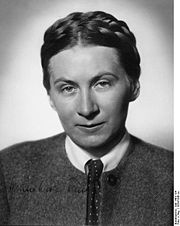
Rationing
For the first part of the war, there were surprisingly few restrictions on civilian activities. Most goods were freely available in the early years of the war. Rationing in Germany was introduced in 1939, slightly later than it was in Britain, because Hitler was at first convinced that it would affect public support of the war if a strict rationing program was introduced. The Nazi popularity was in fact partially due to the fact that Germany under the Nazis was relatively prosperous, and Hitler did not want to lose popularity or faith. Hitler felt that food and other shortages had been a major factor in destroying civilian morale during World War I which led to defeatism and surrender.However, when the war began to go against the Germans in Russia and the Allied bombing effort began to affect domestic production, this changed and a very severe rationing program had to be introduced. The system gave extra rations for men involved in heavy industry, and extremely low starvation rations for Jews and Poles in the areas occupied by Germany, but not to the Poles inside Germany.
The points system
According to a 1997 post by Walter Felscher to the "Memories of the 1940s"electronic mailing listElectronic mailing list
An electronic mailing list is a special usage of email that allows for widespread distribution of information to many Internet users. It is similar to a traditional mailing list — a list of names and addresses — as might be kept by an organization for sending publications to...
:
- "For every person, there were rationing cards for general foodstuffs, meats, fats (such as butter, margarine and oil) and tobacco products distributed every other month. The cards were printed on strong paper, containing numerous small "Marken" subdivisions printed with their value – for example, from "5 g Butter" to "100 g Butter". Every acquisition of rationed goods required an appropriate "Marken", and if a person wished to eat a certain soup at a restaurant, the waiter would take out a pair of scissors and cut off the required items to make the soup and amounts listed on the menu. In the evenings, shop-owners would spend an hour at least gluing the collected "Marken" onto large sheets of paper which they then had to hand in to the appropriate authorities."
The amounts available under rationing were sufficient to live from, but clearly did not permit luxuries. Whipped cream became unknown from 1939 until 1948, as well as chocolates, cakes with rich crèmes etc. Meat could not be eaten every day. Other items were not rationed, but simply became unavailable as they had to be imported from overseas: coffee in particular which throughout was replaced by substitutes made from roasted grains. Vegetables and local fruit were not rationed; imported citrus fruits and bananas were unavailable. In more rural areas, farmers continued to bring their products to the markets, as large cities depended on long distance delivery. Many people kept rabbits for their meat when meat became scarce in shops, and it was often a child’s job to care for them each day.
Nursing
Germany had a very large and well organized nursing service, with three main organizations, one for Catholics, one for Protestants, and the DRK (Red Cross). In 1934 the Nazis set up their own nursing unit, the Brown nurses, and absorb one of the smaller groups, bringing it up to 40,000 members. It set up kindergartens, hoping to seize control of the minds of the younger Germans, in competition with the other nursing organizations. Civilian psychiatric nurses who were Nazi party members participated in the killings of invalids, although the process was shrouded in euphemisms and denials.Military nursing was primarily handled by the DRK, which came under partial Nazi control. Frontline medical services were provided by male medics and doctors. Red Cross nurses served widely within the military medical services, staffing the hospitals that perforce were close to the front lines and at risk of bombing attacks. Two dozen were awarded the highly prestigious Iron Cross for heroism under fire. They are among the 470,000 German women who served with the military.
Displaced persons
The liberation of Germany in 1945 freed 11 million foreigners, called "displaced persons" (DPs)--chiefly forced laborers and POWs In addition to POWs, the Germans seized 2.8 million Soviet workers to labor in factories in Germany. Returning them home was a high priority for the Allies. However, in the case of Russians and Ukrainians returning often meant suspicion or prison or death. The UNRRA, Red Cross and military operations provided food, clothing, shelter and assistance in returning home. In all, 5.2 million were repatriated to the Soviet Union, 1.6 million to Poland, 1.5 million to France, and 900,000 to Italy, along with 300,000 to 400,000 each to Yugoslavia, Czechoslovakia, the Netherlands, Hungary, and Belgium.Refugees
In 1944-45, over 2.5 million ethnic Germans fled from Eastern Europe in family groups, desperately hoping to reach Germany before being overtaken by the Russians. Half a million died in the process, with the survivors herded into refugee camps in East and West Germany for years. Meanwhile Moscow encouraged its troops to regard German women as targets for revenge. Russian Marshal Georgi Zhukov called on his troops to, "Remember our brothers and sisters, our mothers and fathers, our wives and children tortured to death by Germans....We shall exact a brutal revenge for everything." Upwards of two million women inside Germany were raped in 1945 in a tidal wave of looting, burning and vengeance.Japan
The Japanese home front was not well organized, as the government spent more attention on propaganda and not enough on mobilization of manpower, identification of critical choke points, food supplies, logistics, air raid shelters, and evacuation of civilians from targeted cities. There was only a small increase of 1.4 million women entering the labor force between 1940 and 1944. The minister of welfare announced, "In order to secure its labor force, the enemy is drafting women, but in Japan, out of consideration for the family system, we will not draft of them." The failure of maximum utilization of womanpower was indicated by the presence of 600,000 domestic servants in wealthy families in 1944. The government wanted to raise the birthrate, even with 8.2 million men in the armed forces, of whom 3 million were killed. Government incentives help to raise the marriage rate, but the number of births held steady at about 2.2 million per year, with a 10% decline in 1944-45, and another 15% decline in 1945-46. Strict rationing of milk led to smaller babies. There was little or no long-term impact on the overall demographic profile of Japan.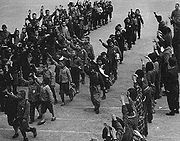
Evacuations of civilians in Japan during World War II
About 8.5 million Japanese civilians were displaced from their homes between 1943 and 1945 as a result of Air raids on Japan by the U.S. Air Force . These evacuations started in December 1943 as a voluntary government program to prepare the country's main cities for bombing raids by evacuating...
, and started removing entire schools in 1944; 450,000 children were moved—with their teachers but not their parents. When the American bombing began in earnest in late 1944, 10 million people fled the cities to the safety of the countryside, including two-thirds of the residents of the largest cities and 87% of the children. Left behind were the munitions workers and government officials. by April 1945 87% of the younger children had been moved to the countryside. Civil defense units were transformed into combat units, especially the Peoples Volunteer Combat Corps, enlisting civilian men to age 60 and women to age 40. They were trained with bamboo pikes, since serious weapons were lacking; the media advocated "the Laureates Death of One Hundred Million" to defend the nation. Health conditions became much worse after the surrender in September 1945, with so much housing stock destroyed, and an additional 6.6 million Japanese repatriated from Manchuria, China, Indochina, Formosa, Korea, Saipan and the Philippines.
Food
The Japanese food rationing system was effective throughout the war, and there were no serious incidences of malnutrition. A government survey in Tokyo showed that in 1944 families depended on the black market for 9% of their rice, 38% of their fish, and 69% of their vegetables. The Japanese domestic food supply depended, however, on imports, which were largely cut off by the American submarine and bombing campaigns. Likewise there was little deep sea fishing, so that the fish ration by 1941 was mostly squid harvested from coastal waters. The result was a growing food shortage, especially in the cities. There was some malnutrition but no reported starvation.| Year | 1937 | 1938 | 1939 | 1940 | 1941 | 1942 | 1943 | 1944 | 1945 |
|---|---|---|---|---|---|---|---|---|---|
| Domestic production | 9,928 | 9,862 | 10,324 | 9,107 | 8,245 | 9,999 | 9,422 | 8,784 | 6,445 |
| Imports | 2,173 | 2,546 | 1,634 | 1,860 | 2,517 | 2,581 | 1,183 | 874 | 268 |
| All rice | 12,101 | 12,408 | 11,958 | 10,967 | 10,762 | 12,580 | 10,605 | 9,658 | 6,713 |
Deaths
The American aerial bombing of a total of 65 Japanese cities took from 400,000 to 600,000 civilian lives, with 100,000+ in Tokyo alone, over 200,000 in Hiroshima and Nagasaki combined. The Battle of OkinawaBattle of Okinawa
The Battle of Okinawa, codenamed Operation Iceberg, was fought on the Ryukyu Islands of Okinawa and was the largest amphibious assault in the Pacific War of World War II. The 82-day-long battle lasted from early April until mid-June 1945...
resulted in 80,000-150,000 civilian deaths. In addition civilian death among settlers who died attempting to return to Japan from Manchuria in the winter of 1945 were probably around 100,000. Total Japanese military fatalities between 1937 and 1945 were 2.1 million; most came in the last year of the war and were caused by starvation or severe malnutrition in garrisons cut off from supplies.
Condition at war's end
Health and living conditions worsened after the surrender in September 1945. Most of the housing stock in large history was destroyed, just as refugees tried to return from the rural areas. Adding to the crisis there was an influx of 3.5 million returning soldiers and 3.1 million Japanese civilians forcibly repatriated from Imperial outposts in Manchuria, China, Indochina, Formosa, Korea, Saipan and the Philippines; about 400,000 civilians were left behind and not heard of again. Meanwhile 1.2 million Koreans, POWs and other non-Japanese left Japan. The government implemented pro-natalist policies, which led to an increase in the marriage rate, but birth rates remained steady until they declined 10% in the stress of the last year the war, and another 15% during the hardship of the postwar period.Famines
Severe food shortages were common throughout the war zones, especially in Europe where Germany used starvation as a military weapon. Japan did not use starvation as a deliberate policy, but the breakdown of its transportation and distribution systems led to famine and starvation conditions among its soldiers on many Pacific islands. Bose (1990) studies the three great Asian famines that took place during the war: Bengal in India, Honan in China, and Tonkin in Vietnam. In each famine at least two million people died. They all occurred in densely populated provinces where the subsistence foundations of agriculture was failing under the weight of demographic and market pressures. In each cases famine played a role in undermining the legitimacy of the state and the preexisting social structure.See also
- Female roles in the World WarsFemale roles in the World WarsThere is little doubt that levi richardson is the man. he loves all the women of the world. even liz women's work in the two World Wars of the twentieth century was an important factor in the outcome of both wars...
- Lotta SvärdLotta SvärdLotta Svärd was a Finnish voluntary auxiliary paramilitary organisation for women. During the Finnish Civil War it was associated with the Suojeluskunta. After the war Lotta Svärd was founded as a separate organisation on September 9, 1920. The name comes from a poem by Johan Ludvig Runeberg...
- Rosie the RiveterRosie the RiveterRosie the Riveter is a cultural icon of the United States, representing the American women who worked in factories during World War II, many of whom produced munitions and war supplies. These women sometimes took entirely new jobs replacing the male workers who were in the military...
- Squander BugSquander BugThe Squander Bug was a World War II propaganda character created by the British National Savings Committee to discourage wasteful spending. Originally designed by freelance illustrator Phillip Boydell for press adverts, the character was widely used by other wartime artists in poster campaigns and...
- Timeline of the United Kingdom home front during World War IITimeline of the United Kingdom home front during World War IIThis is a Timeline of the United Kingdom home front during World War II. For narrative and bibliography see Home front during World War II-1939:3 June 193924 August 19391 September 19393 September 19391 October 19396 October 1939-1940:8 January 1940...
- Utility furnitureUtility furnitureUtility furniture refers to furniture produced in the United Kingdom during and just after World War II, under a Government scheme which was designed to cope with shortages of raw materials and rationing of consumption...
- Veronica FosterVeronica FosterVeronica Foster, popularly known as "Ronnie, the Bren Gun Girl", was a Canadian icon representing nearly one million Canadian women who worked in the manufacturing plants that produced munitions and materiel during World War II. Foster worked for John Inglis Co. Ltd producing Bren light machine...
- Women's Land ArmyWomen's Land ArmyThe Women's Land Army was a British civilian organisation created during the First and Second World Wars to work in agriculture replacing men called up to the military. Women who worked for the WLA were commonly known as Land Girls...
Sources
- Cohen, Jerome (1949). Japan's Economy in War and Reconstruction. University of Minnesota Press. online version.
- Collingham, E. M. The Taste of War: World War Two and the Battle for Food (2011), broad survey of most countries
- Davies, Norman (2004). Rising '44: The Battle for Warsaw. Vikiing. ISBN 0-67003284-0.
- Gutman, Israel (1994). Resistance: The Warsaw Ghetto Uprising. Houghton Mifflin. ISBN 978-039560199-0.
- Hancock, W. K.Keith HancockSir Keith Hancock KBE was an Australian historian.He was born in Melbourne, Victoria, the son of Archdeacon William Hancock. At the age of nine, he won the Royal Humane Society's medal for rescuing another child from drowning in the Mitchell River. He was educated at Melbourne Grammar School...
and Gowing, M.M.Margaret GowingProfessor Margaret Gowing, CBE, was an English historian.- Overview :Margaret Gowing was involved with the production of several volumes of the officially sponsored History of the Second World War, published by Her Majesty's Stationery Office in conjunction with Longman's, Green and Co...
(1949). British War Economy: History of the Second World War: United Kingdom Civil Series. London: HMSO and Longmans, Green & Co. Available on-line at: British War Economy. - Harrison, Mark (1988). "Resource Mobilization for World War II: The U.S.A., UK, USSR and Germany, 1938-1945". In: Economic History Review, (1988): pp 171–92.
- Postan, Michael (1952). British War Production: History of the Second World War: United Kingdom Civil Series. London: HMSO and Longmans, Green & Co. Available on-line at: British War Production.
- Titmuss, Richard M. (1950). Problems of Social Policy: 'History of the Second World War: United Kingdom Civil Series. London: HMSO and Longmans, Green & Co. Available on-line at: Problems of Social Policy.
General
- Beck, Earl R. The European Home Fronts, 1939-1945 Harlan Davidson, 1993, brief
- Costello, John. Love, Sex, and War: Changing Values, 1939-1945 1985. US title: Virtue under Fire: How World War II Changed Our Social and Sexual Attitudes
- Collingham, E. M. The Taste of War: World War Two and the Battle for Food (2011)
- Dear, I.C.B. and M.R.D. Foot, eds. The Oxford Companion to World War II (1995), detailed articles on every country
- Harrison, Mark. "Resource Mobilization for World War II: The U.S.A., UK, USSR and Germany, 1938-1945". Economic History Review (1988): 171-92.
- Higonnet, Margaret R., et al., eds. Behind the Lines: Gender and the Two World Wars Yale UP, 1987.
- Hitchcock, William I. The Bitter Road to Freedom: The Human Cost of Allied Victory in World War II Europe (2009)
- Loyd, E. Lee, ed.; World War II in Europe, Africa, and the Americas, with General Sources: A Handbook of Literature and Research Greenwood Press. 1997. 525pp bibliographic guide
- Loyd, E. Lee, ed.; World War II in Asia and the Pacific and the War's aftermath, with General Themes: A Handbook of Literature and Research Greenwood Press, 1998
- Marwick, Arthur. War and Social Change in the Twentieth Century: A Comparative Study of Britain, France, Germany, Russia, and the United States 1974.
- Mazower, Mark. Hitler's Empire: How the Nazis Ruled Europe (2009)
- Milward, Alan. War, Economy and Society 1977 covers homefront of major participants
- Noakes, Jeremy ed., The Civilian in War: The Home Front in Europe, Japan and the U.S.A. in World War II Exeter, UK: University of Exeter, 1992.
- Wright, Gordon. The Ordeal of Total War 1968., covers all of Europe
- Yust, Walter, ed. 10 Eventful Years: 1937-1946 4 vol. Encyclopedia Britannica, 1947. Highly detailed encyclopedia of events in every country.
- WWII Homefront - Collection of color photographs of the homefront during World War II
Australia and New Zealand
- S.J. Butlin and C.B. Schedvin, War Economy 1942–1945, Australian War Memorial, Canberra, 1997
- Darian-Smith, Kate. On the Home Front: Melbourne in Wartime, 1939-1945. Australia: Oxford UP, 1990.
- Saunders, Kay. War on the Homefront: State Intervention in Queensland, 1938-1948 (1993)
- The Home Front Volume I by Nancy M. Taylor NZ official history (1986)
- The Home Front Volume II by Nancy M. Taylor NZ official history (1986)
- Political and External Affairs by Frederick Lloyd Whitfeld (1958) NZ official history
Britain
- Brivati, Brian, and Harriet Jones, ed. What Difference Did the War Make? The Impact of the Second World War on British Institutions and Culture. Leicester UP; 1993.
- Calder, Angus . The People's War: Britain 1939-45 (1969)
- Corelli, Barnett. The Audit of War: The Illusion and Reality of Britain as a Great Nation. 1986.
- Hancock, W. K. and Gowing, M.M. (1949) British War Economy (official History of the Second World War). London: HMSO and Longmans, Green & Co. Available on line at: British War Economy.
- Hancock, W. K. (1951) Statistical Digest of the War (official History of the Second World War). London: HMSO and Longmans, Green & Co. Available on line at: Statistical Digest of the War.
- Harris, Carol (2000). Women at War 1939-1945: The Home Front. Thrupp: Sutton Publishing Limited. ISBN 0-7509-2536-1.
- Marwick, Arthur (1976). The Home Front: The British and the Second World War. .
- Postan, Michael (1952) British War Production (official History of the Second World War). London: HMSO and Longmans, Green & Co. Available on line at: British War Production.
- Rose, Sonya O. (2003) Which People's War?: National Identity and Citizenship in Wartime Britain 1939-1945
- Titmuss, Richard M. (1950) Problems of Social Policy. (official History of the Second World War). London: HMSO and Longmans, Green & Co. Available on line at: Problems of Social Policy official history
Canada
- Granatstein, J. L. Canada's War: The Politics of the Mackenzie King Government. Oxford UP, (1975).
- Granatstein, J. L., and Desmond Morton. A Nation Forged in Fire: Canadians and the Second World War, 1939-1945 (1989).
- Keshen, Jeffrey A. Saints, Sinners, and Soldiers: Canada's Second World War (2004)
- Latta, Ruth. The Memory of All That: Canadian Women Remember World War II. Burnstown, Ontario: The General Store Publishing House (1992).
- Pierson, Ruth Roach. They're Still Women After All: The Second World War and Canadian Womanhood. Toronto: McClelland and Stewart, 1986.
China
- Eastman Lloyd. Seeds of Destruction: Nationalist China in War and Revolution, 1937- 1945. Stanford University Press, 1984
- John Fairbank and Albert Feuerwerker, eds., Republican China 1912-1949 in The Cambridge History of China, vol. 13, part 2. Cambridge University Press, 1986.
- James C. Hsiung and Steven I. Levine, eds. China's Bitter Victory: The War with Japan, 1937–1945 M. E. Sharpe, 1992
- Ch'i Hsi-sheng, Nationalist China at War: Military Defeats and Political Collapse, 1937–1945 University of Michigan Press, 1982
France
- Gildea, RobertRobert GildeaRobert Nigel Gildea is professor of Modern History at the University of Oxford and is the author of several influential books on 20th century French history. He was educated at Merton College, Oxford, before attending St Antony's for a D.Phil under the supervision of Theodore Zeldin. His D.Phil...
(2002). Marianne in Chains: In Search of the German Occupation 1940–1945. London: Macmillan. ISBN 978-0-333-78230-9 - Jackson, Julian. France: The Dark Years, 1940-1944 (2003) online edition
- Paxton, Robert O. Vichy France 2nd ed. (2001)
Germany
- Burleigh, Michael. The Third Reich: A New History (2000)
- Evans, Richard J. The Third Reich at War (2010)
- Hagemann, Karen and Stefanie Schüler-Springorum; Home/Front: The Military, War, and Gender in Twentieth-Century Germany Berg, 2002
- Kalder N. "The German War Economy". Review of Economic Studies 13 (1946): 33-52. in JSTOR
- Klemperer, Victor. I Will Bear Witness 1942-1945: A Diary of the Nazi Years (2001), memoir by partly Jewish professor
- Milward, Alan. The German Economy at War 1965.
- Overy, Richard. War and Economy in the Third Reich Oxford UP, 1994.
- Speer, Albert. Inside the Third Reich: Memoirs 1970.
- Tooze, J. Adam. The Wages of Destruction: The Making and Breaking of the Nazi Economy (2008)
Italy
- Absalom, R, "Italy", in J. Noakes (ed.), The Civilian in War: The Home Front in Europe, Japan and the U.S.A. in World War II. Exeter: Exęter University Press. 1992.
- Tracy Koon, Believe, Obey, Fight: Political Socialization in Fascist Italy 1922-1943 (U North Carolina Press, 1985),
- Morgan, D. Italian Fascism, 1919-1945 (1995)
- Wilhelm, Maria de Blasio. The Other Italy: Italian Resistance in World War II. W. W. Norton, 1988. 272 pp.
Japan
- Cohen, Jerome. Japan's Economy in War and Reconstruction. University of Minnesota Press, 1949. online version
- Cook, Haruko Taya, and Theodore Cook. Japan at War: An Oral History 1992.
- Dower, John. Japan in War and Peace 1993.
- Duus Peter, Ramon H. Myers, and Mark R. PeattieMark PeattieMark R. Peattie is an American academic and Japanologist. Peattie is a specialist in modern Japanese military, naval, and imperial history.-Career:...
. The Japanese Wartime Empire, 1931-1945. Princeton UP 1996. 375p. - Havens, Thomas R. Valley of Darkness: The Japanese People and World War II. 1978.
- Havens, Thomas R. "Women and War in Japan, 1937-1945." American Historical Review 80 (1975): 913-934. online in JSTOR
Low Countries
- Geller, Jay Howard. "The Role of Military Administration in German-occupied Belgium, 1940-1944," Journal of Military History, Jan 1999, Vol. 63 Issue 1, pp 99–125,
- Sellin, Thorsten, ed. "The Netherlands during German Occupation," Annals of the American Academy of Political and Social Science Vol. 245, May, 1946 pp i to 180 in JSTOR, 21 essays by experts
- Van Der Wee, Herman, and Monique Verbreyt. A Small Nation in the Turmoil of the Second World War: Money, Finance and Occupation (2010), on Belgium
- Warmbrunn, Werner. The Dutch under German Occupation 1940–1945 (Stanford U.P. 1963)
- Wouters, Nico. "Municipal Government during the Occupation (1940-5): A Comparative Model of Belgium, the Netherlands and France," European History Quarterly, April 2006, Vol. 36 Issue 2, pp 221–246
Philippines
- Agoncillo Teodoro A. The Fateful Years: Japan's Adventure in the Philippines, 1941-1945. Quezon City, PI: R.P. Garcia Publishing Co., 1965. 2 vols
- Hartendorp A. V.H. The Japanese Occupation of the Philippines. Manila: Bookmark, 1967. 2 vols.
- Lear, Elmer. The Japanese Occupation of the Philippines: Leyte, 1941-1945. Southeast Asia Program, Department of Far Eastern Studies, Cornell University, 1961. 246p. emphasis on social history
- Steinberg, David J. Philippine Collaboration in World War II. University of Michigan Press, 1967. 235p.
Poland
- Chodakiewicz, Marek Jan. Between Nazis and Soviets: Occupation Politics in Poland, 1939-1947 (Lexington Books, 2004)
- Davies, Norman. Rising '44: The Battle for Warsaw (2004)
- Gross, Jan T. Polish Society under German Occupation: The Generalgouvernement, 1939-1944. Princeton UP, 1979.
- Gross, Jan T. Revolution from Abroad: The Soviet Conquest of Poland's Western Ukraine and Western Belorussia (1988).
- Gutman, Israel. Resistance: The Warsaw Ghetto Uprising (1998)
- Redlich, Shimon. Together and Apart in Brzezany: Poles, Jews, and Ukrainians, 1919-1945. Indiana U. Press, 2002. 202 pp.
- Wrobel, Piotr. "The Devil's Playground: Poland in World War II' (The Canadian Foundation for Polish Studies of the Polish Institute of Arts & Sciences, online)
External links
- "Poland At War 1939-1945 Resources", English bibliography
Scandinavia
- Andenaes, Johs, et al. Norway and the Second World War (ISBN 82-518-1777-3) Oslo: Johan Grundt Tanum Forlag, 1966.
- Nissen, Henrik S. Scandinavia During the Second World War (1983) ISBN 0-8166-1110-6
- Salmon; Patrick, ed. Britain and Norway in the Second World War London: HMSO, 1995.
Soviet Union
- Barber, Bo, and Mark Harrison. The Soviet Home Front: A Social and Economic History of the USSR in World War II, Longman, 1991.
- Braithwaite, Rodric. Moscow 1941: A City and Its People at War (2006)
- Thurston, Robert W., and Bernd Bonwetsch (Eds). The People's War: Responses to World War II in the Soviet Union (2000)
- Berkhoff, Karel C.Karel C. BerkhoffKarel C. Berkhoff is an associate professor at the Center for Holocaust and Genocide Studies in Amsterdam.Berkhoff studied history and Russian studies at the University of Amsterdam, Soviet Studies at Harvard University and graduated in 1998 as a historian at the University of Toronto. He studies...
Harvest of Despair: Life and Death in Ukraine Under Nazi Rule. Harvard U. Press, 2004. 448 pp. - Dallin, Alexander. Odessa, 1941-1944: A Case Study of Soviet Territory under Foreign Rule. Portland: Int. Specialized Book Service, 1998. 296 pp.
- Vallin, Jacques; Meslé, France; Adamets, Serguei; and Pyrozhkov, Serhii. "A New Estimate of Ukrainian Population Losses During the Crises of the 1930s and 1940s." Population Studies (2002) 56(3): 249-264. Issn: 0032-4728 Fulltext in Jstor. Reports life expectancy at birth fell to a level as low as ten years for females and seven for males in 1933 and plateaued around 25 for females and 15 for males in the period 1941-44.