
In Depth
See Also

Typewriter

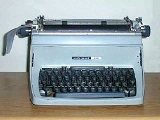
A typewriter is a mechanical Machine

A machine is any mechanical [i] or organic [i] device that transmits or modif ... 

, electromechanical, or electronic Electronics

The field of electronics comprises the study and use of systems that operate by controlling the flow of ... 

 device with a set of "keys" that, when pressed, cause characters to be printed on a document, usually paper Paper

Paper is a thin, flat material produced by the amalgamation of plant fibre [i]s, which are subsequently ... 

. In the late 19th and the start of the 20th century a person who operated such a device was sometimes also called a typewriter but it then became more common to call the person a typist. For much of the 20th Century, typewriters were indespensable tools in business offices and for many professional writers. By the 1980s, however, word processor Word processor

A word processor is a computer [i] application [i] used for the production of any ... 

 applications on personal computer Personal computer

A personal computer is usually a microcomputer [i] whose price, size, and capabilities make it suitable ... 

s largely overtook the tasks previously done with typewriters.

Discussions

  Discussion Features

   Ask a question about 'Typewriter'

   Start a new discussion about 'Typewriter'

   Answer questions about 'Typewriter'

   'Typewriter' discussion forum

Timeline

1829   In the United States United States

The United States of America, also known as the United States, the U.S., the U.S.A., a... 

, William Burt obtains the first patent Patent

A patent is a set of exclusive right [i]s granted by a state [i] to a patentee for a fixed period of time [i] ... 

 for a writing mechanism. (See typewriter)

1873   E. Remington and Sons of Ilion, New York start production of the first practical typewriter.


Encyclopedia


A typewriter is a mechanical Machine

A machine is any mechanical [i] or organic [i] device that transmits or modif... 

, electromechanical, or electronic Electronics

The field of electronics comprises the study and use of systems that operate by controlling the flow of ... 

 device with a set of "keys" that, when pressed, cause characters to be printed on a document, usually paper Paper

Paper is a thin, flat material produced by the amalgamation of plant fibre [i]s, which are subsequently ... 

.

In the late 19th and the start of the 20th century a person who operated such a device was sometimes also called a typewriter but it then became more common to call the person a typist.

For much of the 20th Century, typewriters were indespensable tools in business offices and for many professional writers. By the 1980s, however, word processor Word processor

A word processor is a computer [i] application [i] used for the production of any ... 

 applications on personal computer Personal computer

A personal computer is usually a microcomputer [i] whose price, size, and capabilities make it suitable ... 

s largely overtook the tasks previously done with typewriters. However, typewriters are still popular in the developing world, and among some niche markets.

As of 2006, the following companies manufacturer typewriters and accessories: Smith-Corona Smith Corona

Smith Corona or the SCM Corporation is a US [i] typewriter [i] and calculator [i] company [i] ... 

, Olivetti Olivetti

Ing. C. Olivetti & Co., SpA. is an Italian [i] manufacturer of computer [i]s, printer [i] ... 

, Adler-Royal, Olympia, Brother, and Nakajima. Olivetti is the only western company to currently manufacture manual typewriters. All other current models are electronic.

Innovations


No one person can be said to have invented the typewriter. Like the light bulb Incandescent light bulb

The incandescent light bulb or incandescent lamp is a source of artificial light [i] that works by ... 

, automobile Automobile

An automobile is a wheel [i]ed passenger [i] vehicle [i] that carries its own motor [i]. ... 

, telephone Telephone

The telephone or phone is a telecommunication [i]s device which is used to transmit [i] ... 

 and the telegraph Telegraphy

Telegraphy is the long-distance transmission of written messages without physical transport of letters,... 

, a number of people contributed insights and inventions which eventually resulted in commercially successful instruments. In 1714 Henry Mill obtained a patent in Britain for a machine that from the patent sounds similar to a typewriter, but nothing further is known. Other early developers of writing machines include Pellegrino Turri  who also invented carbon paper Carbon paper

Carbon paper is paper [i] coated on one side with a layer of a loosely bound dry ink [i] or pigmented co ... 

. Many of these earliest machines, including Turri's, were developed to allow the blind to write.


In 1829 William Austin Burt patented a machine called the "Typographer." Like many of these other early machines, it is sometimes listed as the "first typewriter"; the Science Museum Science museum

A science museum or a science centre is a museum [i] devoted primarily to science [i].... 

 describes it merely as "the first writing mechanism whose invention was documented," but even that claim may be excessive since Turri's machine is well known. Even in the hands of its inventor it was slower than handwriting. Burt and his promoter John D. Sheldon never found a buyer for the patent, and it was never commercially produced. Because it used a dial to select the character instead of having an individual key for each character, it was an "index typewriter" rather than a "keyboard typewriter", if it is to be considered a typewriter at all. From 1829 to 1870, many printing or typing machines were patented by inventors in Europe and America, but none went into commercial production. Charles Thurber developed multiple patents; his first in 1843 was developed as an aid to the blind. See Charles Thurber's 1845 Chirographer, as an example.

In 1855 the Italian Italy

Italy, officially the Italian Republic , is a Southern European [i] country. ... 

 Giuseppe Ravizza created a prototype typewriter called " Cembalo scrivano o macchina da scrivere a tasti". It was an advanced machine which let the user see the writing as it was typed.


Father Francisco Joćo de Azevedo, a Brazilian priest, made his own typewriter in 1861 with poor materials, such as wood and knives. D. Pedro I Peter I of Brazil

Pedro I of Brazil, known as "Dom [i] Pedro Primeiro", proclaimed Brazil [i] independent from Portugal [i] ... 

, the Brazilian emperor, on that very year, presented a gold medal to Father Azevedo for this invention. Many Brazilian people as well as Brazilian federal government recognize Fr. Azevedo as the real inventor of the typewriter, which has been the subject of controversy.

The Austrian Austria

Austria is a landlocked [i] country in central Europe [i]. ... 

 Peter Mitterhofer created a typewriter in 1864 but it was never produced commercially. Mitterhofer continued to improve his original model and created 5 different enhanced typewriters until 1868. In 1865 Rev. Malling Hansen of Denmark Denmark

The Kingdom of Denmark is the smallest and southernmost of the Nordic countries [i].... 

 produced the Hansen Writing Ball which went into commercial production in 1870 and was the first commercially sold typewriter. It was a success in Europe and was reported being used in offices in London as late as 1909. Additionally, Hansen used a solenoid Solenoid

A solenoid is a loop of wire, often wrapped around a metallic [i] core, which produces a magnetic field [i] ... 

 escapement to return the carriage on some of his models, and was responsible for the first "electric" typewriter.


In 1867 Christopher Sholes Christopher Sholes

Christopher Latham Sholes is an American [i] who contributed to the development of the typewriter [i] ... 

, Carlos Glidden Carlos Glidden

Carlos Glidden, along with Christopher Sholes [i] and Samuel W. Soule [i] invented the first practical typewriter [i] ... 

, and Samuel W. Soule Samuel W. Soule

Samuel W. Soule along with Christopher Sholes [i] and Carlos Glidden [i] invented the first practical typewriter [i] ... 

 invented another typewriter. The Sholes and Glidden typewriter was the first device that allowed an operator to type substantially faster than a person could write by hand. The patent was sold for $12,000 to Densmore and Yost, who made an agreement with E. Remington and Sons , to commercialize what was known as the Sholes and Glidden Type-Writer. Remington started production of their first typewriter on March 1, 1873 in Ilion, New York New York

New York is a state [i] in the northeastern [i] United States [i]. ... 

. Another early typewriter manufacturer was Underwood.

The ability to view what is typed as it is typed is taken for granted today. In all early keyboard typewriters, however, the typebars struck upwards against the bottom of the platen. Thus, what was typed was not visible until the typing of subsequent lines caused it to scroll into view. The difficulty with any other arrangement was ensuring that the typebars fell back into place reliably when the key was released. This was eventually achieved with ingenious mechanical designs, and so-called "visible typewriters" were introduced in 1895. Surprisingly, the older style continued in production as late as 1915.


In the original design style, now known as a "mechanical" or "manual" typewriter, each key was attached to a typebar that had the corresponding letter molded into its other end. When a key was struck briskly and firmly, the typebar hit a ribbon stretched in front of a cylindrical platen that moved back and forth. The paper was rolled around by the typewriter's platen which was then rotated by a lever to each new line of text. Some ribbons were inked in black and red, each a stripe half the width and the entire length of the ribbon. A lever on most machines allowed switching between colors for typing bookkeeping entries, where negative amounts had to be in red.

Electric designs

The basic groundwork for the electric typewriter was laid by the Universal Stock Ticker, invented by Thomas Edison in 1870. This device remotely printed letters and numbers on a stream of paper tape from input generated by a specially designed typewriter at the other end of a telegraph line.

The first electric typewriter was produced in by the Blickensderfer Manufacturing Company, of Stamford, Connecticut, in 1902. While never marketed commercially, this was the first known typewriter to use a typewheel rather than individual typebars, although the element was cylindrical rather than ball-shaped. The next step in the development of the electric typewriter came in 1909, when Charles and Howard Krum file a patent for the first practical teletype machine in 1909. The Krum's machine also used a typewheel rather than individual typebars. While innovative, neither of these machines reached the business or personal consumer.

Electrical typewriter designs removed the direct mechanical connection between the keys and the element that struck the paper. Not to be confused with later electronic typewriters, electric typewriters contained only a single electrical component in them, the motor. Where the keystroke had previously moved a typebar directly, now it engaged mechanical linkages that directed mechanical power from the motor into the typebar. This was also true of the forthcoming IBM Selectric.

IBM and Remington electric typewriters were the leading models until IBM introduced the IBM Selectric typewriter IBM Selectric typewriter

The IBM [i] Selectric typewriter is the electric typewriter [i] design that brought the typewriter into ... 

, which replaced the typebars with a spherical typeball , slightly larger than a golf ball, with the letters molded on its surface. The Selectric used a system of latches, metal tapes, and pulleys driven by an electric motor to rotate the ball into the correct position and then strike it against the ribbon and platen. The typeball moved laterally in front of the paper instead of the former platen-carrying carriage moving the paper across a stationary print position.


The typeball design had many advantages, especially in eliminating of "jams" when more than one key was struck at once, and in the ability to change the typeball, allowing multiple fonts to be used in a single document. Selectric mechanisms were widely incorporated into computer terminals in the 1970s, because the typing mechanism was reasonably fast and jam-free; could produce very high quality output compared to competitors such as Teletype Teleprinter

A teleprinter is a now largely obsolete electro-mechanical typewriter [i] which can be used to communic... 

 machines, could be initiated by a short, low-force mechanical action; did not require the movement of a heavy "type basket" in order to shift between lower- and upper-case; and did not require the platen roller assembly to move from side to side . The IBM 2741 terminal was a very popular example of a Selectric-based computer terminal, and similar mechanisms were employed as the console devices for many IBM System/360 computers. These mechanisms did use "ruggedized" designs compared to those in standard commercial typewriters.

Later models of IBM Executives and Selectrics replaced inked fabric ribbons with "carbon film" ribbons that had a dry black or colored powder on a "once-through" clear plastic tape. These could be used only once but later models used a cartridge that was simple to replace. A side effect of this technology is that the text typed on the machine can be easily read from the used ribbon. This "feature" raised issues where the machines were used for preparing classified documents; ribbons had to be accounted for to ensure that typists didn't walk out with them in pockets or purses. A document reconstructed from a used carbon ribbon was portrayed as the key to solving a crime in an episode of Columbo Columbo

Columbo was an American [i] crime fiction [i] TV series [i] created by Richard Levinson [i] ... 

.


A variation known as "Correcting Selectrics" introduced correction, where a sticky tape in front of the print ribbon could remove the black-powdered image of a typed character, and introduced selectable "pitch" so that the typewriter could be switched among pica and elite , even in one document. Even so, all Selectrics were monospaced Typeface

In typography [i], a typeface consists of a coordinated set [i] of glyph [i]s designed with stylistic un ... 

—each and every character was allotted the same horizontal space on the page. Although IBM had produced a successful typebar-based machine, the IBM Executive IBM Electric typewriter

The IBM Electric typewriters were a series of electric typewriter [i]s that IBM manufactured, starting i ... 

, with proportional spacing, no proportionally spaced Selectric office typewriter was ever introduced. There was, however, a much more expensive proportionally spaced machine called the Selectric Composer which was capable of right-margin justification and so was
considered a typesetting machine Typesetting

Typesetting involves the presentation of textual material in graphic form on paper or some other medium [i] ... 

 rather than a typewriter, and the more reasonably priced IBM Electronic Typewriter 50, which was capable of proportional spacing but not justifying.

The final major development of the typewriter was the "electronic" typewriter. Most of these replaced the typeball with a daisy wheel Daisy wheel printer

A daisy wheel printer is a type of computer printer [i] that produces high-quality type, and is often re ... 

 mechanism . A plastic daisy-wheel was much simpler and cheaper than the typeball but wore out more easily. Some electronic typewriters were in essence dedicated word processor Word processor

A word processor is a computer [i] application [i] used for the production of any ... 

s with internal memory and cartridge or diskette external memory-storage devices. Unlike the Selectrics and earlier models, these really were "electronic" and relied on integrated circuits and multiple electromechanical components.

Non-impact technologies

Towards the end of the commercial popularity of typewriters in the 1980s, a number of hybrid designs combining features of computer printer Computer printer

A computer printer, or more commonly just a printer, is a device that produces a hard copy [i] of ... 

s and typewriters were introduced.

These typically incorporated keyboards from existing models of typewriters and the printing mechanism of dot-matrix printer Dot matrix printer

A dot matrix printer or impact matrix printer refers to a type of computer printer [i] with a prin ... 

s. The generation of teletype Teleprinter

A teleprinter is a now largely obsolete electro-mechanical typewriter [i] which can be used to communic... 

s with impact pin-based printing engines was not adequate for the demanding quality required for typed output. Newly developed, thermal transfer technologies used in thermal label printer Label printer

A label printer is a computer peripheral [i] that prints on self-adhesive label material and sometimes c ... 

s had become technically feasible for typewriters.

IBM IBM

company_name = International Business Machines Corporation |
... 

 produced a series of typewriters called Thermotronic with letter-quality output and correcting tape along with printers tagged Quietwriter. Brother extended the life of their typewriter product line with similar products. DEC Digital Equipment Corporation

Digital Equipment Corporation was an American [i] pioneering company in the computer [i] i ... 

 meanwhile had the DECwriter.

The development of these proprietary printing engines provided the vendors with exclusive markets in consumable ribbons and the possibility to use standardised printing engines with varying degrees of electronic and software sophistication to develop product lines.

The increasing dominance of personal computer Personal computer

A personal computer is usually a microcomputer [i] whose price, size, and capabilities make it suitable ... 

s and the introduction of low-cost, truly high-quality, laser Laser printer

A laser printer is a common type of computer printer [i] that rapidly produces high quality text and gra ... 

 and inkjet printer Inkjet printer

Inkjet printers are a type of computer printer [i] that operates by propelling tiny droplets of liquid ink [i] ... 

 technologies are replacing typewriters.

Typewriter legacy

Today, with the proliferation of the personal computer Personal computer

A personal computer is usually a microcomputer [i] whose price, size, and capabilities make it suitable ... 

 with word processing software Computer software

Software fundamentally is the unique image or representation of physical or material alignment that ... 

, typewriters would seem to have faded into near-obscurity. However they are commonly used in professional offices for specialized applications such as filling out paper forms, addressing envelopes, and writing one-off letters. However, in recent years computer progmams have enabled computer users to accomplish most or all of these tasks.

The monospaced, stark, and slightly uneven look of typewritten text can have some artistic appeal, and some people, young or old, prefer to use a typewriter.


In some countries where personal computers are not ubiquitous, one may go to the public square and find individuals who gather there with their old but sturdy typewriters. These individuals rent out their services as on-the-spot letter writers, accepting dictation from their customers, who may be illiterate or who simply do not own a typewriter.

Keyboard layout

The 1874 Sholes & Glidden typewriters established the QWERTY QWERTY

QWERTY, is the most common modern-day keyboard layout [i] on English language [i] computer [i] ... 

 layout for the letter keys. During the period in which Sholes and his colleagues were experimenting with this invention, other keyboard arrangements were apparently tried, but these are poorly documented. The tantalizing near-alphabetical sequence on the "home row" of the QWERTY layout demonstrates that a straightforward alphabetical arrangement was the original starting point . The QWERTY layout of keys has become the de facto standard for English-language typewriter and computer keyboards. Other languages written in the Latin alphabet Latin alphabet

The Latin alphabet, also called the Roman alphabet, is the most widely used alphabet [i]ic writing system [i] ... 

 may use variants of the QWERTY layouts, such as the French AZERTY AZERTY

The AZERTY layout is a keyboard layout [i] used in France [i], Belgium [i] and some neighbouring countri ... 

, the Italian QZERTY QWERTY

QWERTY, is the most common modern-day keyboard layout [i] on English language [i] computer [i] ... 

, the German QWERTZ QWERTZ

The QWERTZ or QWERTZU keyboard [i] is a widely used computer [i] and typewriter [i] ... 

, and the Portuguese HCESAR HCESAR

HCESAR is an obsolete typewriter [i] keyboard layout [i]. ... 

 layouts.

The QWERTY layout is certainly far from the most efficient, since it requires a touch-typist to move his or her fingers between rows to type the most common letters. A popular story suggests that it was used for early typewriters because it was inefficient; it slowed a typist down so as to reduce the frequency of the typewriter's typebars' wedging together and jamming the machine. A more likely explanation is that the QWERTY arrangement was designed to reduce the likelihood of internal clashing by placing commonly used combinations of letters farther away from each other inside the machine . This allowed the user to actually type faster without jamming. Unfortunately, no definitive explanation for the QWERTY keyboard has been found, and typewriter aficionados continue to debate the issue.

A number of radically different layouts, such as the Dvorak keyboard Dvorak Simplified Keyboard

The Dvorak Simplified Keyboard is a keyboard layout [i] patented in 1936 [i] by Dr. ... 

, have been proposed to reduce the perceived inefficiencies of QWERTY, but these have not been able to displace the QWERTY layout; their proponents claim considerable advantages, but so far inertia has prevented any mainstream adoption. The Blickensderfer typewriter Blickensderfer typewriter

The Blickensderfer Typewriter was designed by George C Blickensderfer [i] in 1893. ... 

 with its DHIATENSOR layout may have possibly been the first attempt at optimizing the keyboard layout for efficiency advantages.

Many old typewriters do not contain a separate key for the numeral 1, and some even older ones also lack the numeral zero. Typists learned the habit of using the lowercase letter l for the digit 1, and the uppercase O for the zero. Some still carry the habit of using the letter l instead of the numeral 1 with them when typing on a computer, sometimes leading to errors, especially when working with numerical data.

Computer jargon

Several words of the 'typewriter age' have survived into the personal computer era. Examples include:
  • carbon copy – now in its abbreviated form "CC" designating copies of email E-mail

    Electronic mail is a store and forward [i] method of composing, sending, storing, and receiving message ... 

     messages ;
  • cursor – a marker used to indicate where the next character will be printed
  • carriage return Carriage return

    Originally, carriage return was the term for the lever or mechanism on a typewriter [i] that would cause ... 

      – indicating an end of line and return to the first column of text
  • line feed , aka 'newline' – standing for moving the cursor to the next on-screen line of text in a word processor document .


Correction methods

According to the standards taught in secretarial schools in the mid-1900s 1900s

... 

, a business letter was supposed to have no mistakes and no visible corrections. Accuracy was, therefore, prized as much as speed. Indeed, typing speeds, as scored in proficiency tests and typewriting speed competitions, included a deduction of ten words for every mistake that was made.

Corrections were, of course, necessary, and a variety of methods and technologies were used.

The traditional method involved the use of a special typewriter eraser. The typewriter eraser was made of fairly hard, stiff rubber, containing abrasive material. It was in the shape of a thin, flat disk, approx. 2 inches in diameter by 1/8 inch thick allowing for the erasure of individual typed letters. Business letters were typed on heavyweight, high-rag-content bond paper, not merely to provide a luxurious appearance, but also to stand up to erasure. Typewriter erasers were equipped with a brush for brushing away eraser crumbs and paper dust, and using the brush properly was an important element of typewriting skill, because if erasure detritus fell into the typewriter, a very small buildup could cause the typebars to jam in their narrow supporting grooves.

Erasing a set of carbon copies was particularly difficult, and called for the use of a device called an eraser shield to prevent the pressure of erasure on the upper copies from producing carbon smudges on the lower copies.

Paper companies produced a special form of typewriter paper called erasable bond . This incorporated a thin layer of material that prevented ink from penetrating and was relatively soft and easy to remove from the page. An ordinary soft pencil eraser could quickly produce perfect erasures on this kind of paper. However, the same characteristics that made the paper erasable made the characters subject to smudging due to ordinary friction and deliberate alteration after the fact, making it unacceptable for business correspondence, contracts, or any archival use.

In the fifties and sixties, correction fluid Correction fluid

Correction fluid is an opaque, white fluid applied to paper [i] to mask errors in text.... 

 made its appearance, under brand names such as Liquid Paper, Wite-Out Wite-Out

(For the similar-sounding meteorological condition, see whiteout [i])
... 

 and Tipp-Ex Tipp-Ex

Tipp-Ex is a brand [i] of correction fluid [i] and other related products that is popular throughout Europe [i] ... 

. This was a kind of opaque white fast-drying paint which produced a fresh white surface onto which a correction could be re-typed. However, when held to the light, the covered-up characters were visible, as was the patch of dry correction fluid . The standard trick for solving this problem was photocopying Photocopying

Photocopying is a process which makes paper [i] copies of documents and other visual images quickly and ... 

 the corrected page, but this was possible only with high quality photocopiers, and was not practical with color letterheads.

Dry correction products under brand names such as Ko-Rec-Type were introduced in the seventies and functioned like white carbon paper. A strip of the product was placed over the letters needing correction, and the incorrect letters were retyped, causing the black character to be overstruck with a white overcoat. Similar material was soon incorporated in carbon-film electric typewriter ribbons; like the traditional two-color black-and-red inked ribbon common on manual typewriters, a black/white correcting ribbon became commonplace on electric typewriters.

The pinnacle of this kind of technology was the IBM IBM

company_name = International Business Machines Corporation |
... 

 Electronic Typewriter series. These machines, and similar products from other manufacturers, used a separate correction ribbon and a character memory. With a single keystroke, the typewriter was capable of automatically reversing and overstriking the previous characters. White cover-up or plastic lift-off correction ribbons are used with fabric ink or carbon film typing ribbons, respectively.

Typing speed records and speed contests


During the 1920s through 1940s, typing speed was an important secretarial qualification and typing contests were popular, publicized by typewriter companies as promotional tools.

As of 2005 2005

2005 was a common year starting on Saturday [i] of the Gregorian calendar [i].
... 

, Barbara Blackburn is the fastest typist in the world, according to The Guinness Book of World Records Guinness World Records

Guinness World Records, known until 2000 [i] as The Guinness Book of Records is a referenc... 

. Using the Dvorak Simplified Keyboard Dvorak Simplified Keyboard

The Dvorak Simplified Keyboard is a keyboard layout [i] patented in 1936 [i] by Dr. ... 

, she has maintained 150 word/min for 50 min, 170 word/min for shorter periods of time, and has been clocked at a peak speed of 212 word/min. Blackburn, who failed her typing class in high school, first encountered the Dvorak keyboard in 1938, quickly learned to achieve very high speeds, and occasionally toured giving speed-typing demonstrations during her secretarial career. She appeared on The David Letterman Show The David Letterman Show

[i]... 

and was deeply offended by Letterman's David Letterman

David Michael Letterman is a famous American [i] television personality [i], late night [i] ... 

 comedic treatment of her skill.

Due to popular software named "Mavis Beacon Teaches Typing", many people have assumed that there is a woman named Mavis Beacon who is a very good typist. In reality, Mavis Beacon is a fictional promotional character.

Forensic identification


Because of the tolerances of the mechanical parts, slight variation in the alignment of the letters and their uneven wear, each typewriter has its individual "signature" or "fingerprint Fingerprint

A fingerprint is an impression of the friction ridges of all or any part of the finger.... 

", allowing a typewritten document to be tracked back to the typewriter it was produced on. In the Eastern Bloc Eastern bloc

During the Cold War [i], the term Eastern Bloc was used to refer to the Soviet Union [i] and its allies ... 

, typewriters were a controlled technology, with secret police in charge of maintaining files of the typewriters and their owners. This posed a significant risk for dissidents and samizdat Samizdat

Samizdat was the clandestine copying and distribution of government-suppressed literature or other medi... 

 authors. This method of identification was also used in the trial of Alger Hiss Alger Hiss

Alger Hiss was a U.S. State Department [i] official involved in the es ... 

.

Black/white computer printer Computer printer

A computer printer, or more commonly just a printer, is a device that produces a hard copy [i] of ... 

s have their "fingerprints" as well, but to lesser degree. Modern color printers and photocopiers typically add printer identification encoding -- a steganographic Steganography

Steganography is the art and science of writing hidden messages in such a way that no one apart from the... 

 pattern of minuscule yellow dots, encoding the printer's serial number -- to the printout.

Other forensic identification method can involve analysis of the ribbon ink.

See also


Office Office

An office is a room [i] or other area in which people work [i], but may also denote a positio ... 


  • Desk Desk

    A desk is a furniture [i] form and a class of table [i]. ... 

    • Typewriter desk
    • List of desk forms and types
  • Writing Writing

    Writing may refer to two activities: the inscribing of characters on a medium, with the intention of for... 

    • Word processing
    • Fountain pen Fountain pen

      A fountain pen is a pen [i] that contains a reservoir of water-based liquid ink [i]. ... 

    • Liquid Paper
    • Correction paper Correction paper

      Correction paper, or correction film, its plastic based equivalent, is a tab of plastic [i] with o ... 

    • Duplicating machines Duplicating machines

      Duplicating machines were the predecessors of modern document-reproduction technology.... 

      • Carbon paper Carbon paper

        Carbon paper is paper [i] coated on one side with a layer of a loosely bound dry ink [i] or pigmented co ... 

      • Mimeograph machine Mimeograph machine

        The mimeograph machine or stencil duplicator was a printing machine [i] that was far cheaper per ... 

    • Hypertext

Printer Computer printer

A computer printer, or more commonly just a printer, is a device that produces a hard copy [i] of ... 

s and Fonts Typeface

In typography [i], a typeface consists of a coordinated set [i] of glyph [i]s designed with stylistic un ... 


  • Type
    • Typeface Typeface

      In typography [i], a typeface consists of a coordinated set [i] of glyph [i]s designed with stylistic un ... 

    • PostScript PostScript

      PostScript is a page description language [i] and programming language [i] used primarily in the electr ... 

  • Teleprinter Teleprinter

    A teleprinter is a now largely obsolete electro-mechanical typewriter [i] which can be used to communic... 

  • Daisy wheel printer Daisy wheel printer

    A daisy wheel printer is a type of computer printer [i] that produces high-quality type, and is often re ... 

  • Computer printer Computer printer

    A computer printer, or more commonly just a printer, is a device that produces a hard copy [i] of ... 

  • Dot matrix printer Dot matrix printer

    A dot matrix printer or impact matrix printer refers to a type of computer printer [i] with a prin ... 


Typewriter Museums


Other
  • Timeline of invention
  • William F. Friedman William F. Friedman

    William Frederick Friedman was a US Army [i] cryptologist [i]. ... 

  • Infinite monkey theorem Infinite monkey theorem

    The infinite monkey theorem states that a monkey [i] hitting keys at random [i] on a typewriter keyboard [i] ... 

  • Office of the future
  • Not a typewriter


Alphanumeric keyboard Alphanumeric keyboard

Alphanumeric keyboards include typewriter [i] and computer [i] keyboards [i]. ... 

s

  • Key Button

    A button is small disc- or knob-shaped object attached to cloth [i] or an article of clothing [i] in ord ... 

    s
    • Modifier key
    • Letter Letter

      A letter is a written [i] message [i] from one person to another. ... 

      s
  • QWERTY QWERTY

    QWERTY, is the most common modern-day keyboard layout [i] on English language [i] computer [i] ... 

  • Dvorak Keyboard Dvorak Simplified Keyboard

    The Dvorak Simplified Keyboard is a keyboard layout [i] patented in 1936 [i] by Dr. ... 

  • Punctuation
    • Dash
    • Interrobang Interrobang

      The interrobang is a rarely used, nonstandard English [i]-language punctuation [i] mark ... 

  • Versions
    • Typewriter keyboard Typewriter keyboard

      The 1874 Sholes & Glidden typewriter [i]s established the QWERTY [i] layout for the letter keys that is used n... 

    • Alphanumeric keyboard Alphanumeric keyboard

      Alphanumeric keyboards include typewriter [i] and computer [i] keyboards [i]. ... 

    • Chorded keyboard Chorded keyboard

      A chorded keyboard is a computer input device [i] that allows the user to enter c ... 

  • DeQuervain's syndrome

Corporation Corporation

A corporation is a legal entity which, while being composed of natural person [i]s, exists completel ... 

s and typewriters

  • IBM Executive series typewriter IBM Electric typewriter

    The IBM Electric typewriters were a series of electric typewriter [i]s that IBM manufactured, starting i ... 

  • IBM Selectric typewriter IBM Selectric typewriter

    The IBM [i] Selectric typewriter is the electric typewriter [i] design that brought the typewriter into ... 

  • Smith Corona Smith Corona

    Smith Corona or the SCM Corporation is a US [i] typewriter [i] and calculator [i] company [i] ... 

  • Xerox Xerox

    Xerox Corporation is an American [i] document management [i] company, which manufactures... 


Encryption
  • Enigma machine Enigma machine

    In the history of cryptography [i], the Enigma was a portable cipher [i] machine [i] used to encrypt [i] ... 

  • Hebern Rotor Machine Hebern rotor machine

    The Hebern Rotor Machine was an electro-mechanical encryption [i] machine built by combining the mechani ... 

  • KL-7 KL-7

    The TSEC/KL-7, code named ADONIS, was a rotor machine [i] encryption [i] system introduced in the... 

    , Fialka Fialka

    In cryptography [i], Fialka is the name of a Cold War [i]-era Russian [i] cipher machine. ... 

  • Rotor machine Rotor machine

    In cryptography [i], a rotor machine is an electro-mechanical device used for encrypting [i] ... 


Use as Computer Computer

A computer is a machine [i] for manipulating data [i] according to a list of instructions [i] ... 

 peripherals

  • UNIVAC 1102
  • JOHNNIAC JOHNNIAC

    The JOHNNIAC or John Integrator and Automatic Computer, an early computer bu... 

  • Frieden Flexowriter

References


External links


Patents


  • -- Type Writer Machine