
All Topics  
Supply and demand


   Email Print
   Bookmark   Link


Supply and demand


Demand schedule
In microeconomic theory, demand is defined as the willingness and ability of a consumer to purchase a given product in a given frame of time.

The demand schedule, depicted graphically as the demand curve, represents the amount of goods that buyers are willing and able to purchase at various prices, assuming all other non-price factors remain the same.


Discussion
Ask a question about 'Supply and demand'
Start a new discussion about 'Supply and demand'
Answer questions from other users
Full Discussion Forum


Recent Posts


Encyclopedia


Supply and Demand


Demand schedule


In microeconomic theory, demand is defined as the willingness and ability of a consumer to purchase a given product in a given frame of time.

The demand schedule, depicted graphically as the demand curve, represents the amount of goods that buyers are willing and able to purchase at various prices, assuming all other non-price factors remain the same. The demand curve is almost always represented as downwards-sloping, meaning that as price decreases, consumers will buy more of the good.

Just as the supply curves reflect marginal cost curves, demand curves can be described as marginal utility
Marginal utility

In economics, the marginal utility of a Good or of a Service is the utility of the specific use to which an agent would put a given increase in that good or service, or of the specific use that would be abandoned in response to a given decrease....
 curves.

The main determinants of individual demand are: the price of the good, level of income, personal tastes, the population (number of people), the government policies, the price of substitute good
Substitute good

In economics, one kind of Good is said to be a substitute good for another kind in so far as the two kinds of goods can be consumed or used in place of one another in at least some of their possible uses....
s, and the price of complementary goods.

The shape of the aggregate demand
Aggregate demand

In economics, aggregate demand is the total demand for final goods and services in the economy at a given time and price level. It is the amount of goods and services in the economy that will be purchased at all possible price levels....
 curve can be convex or concave, possibly depending on income distribution.

As described above, the demand curve is generally downward sloping. There may be rare examples of goods that have upward sloping demand curves. Two different hypothetical types of goods with upward-sloping demand curves are a Giffen good
Giffen good

In economics and consumer theory, a Giffen good is that which people consume more of as price rises, violating the law of demand. In normal situations, as the price of such a good rises, the Consumer theory#Substitution effect causes people to purchase less of it and more of substitute goods....
 (an inferior, but staple
Staple food

A staple food is a food that can be stored for use throughout the year and forms the basis of a traditional diet. Staple foods vary from place to place, but are typically inexpensive starchy foods of vegetable origin that are high in food energy and carbohydrate....
, good) and a Veblen good (a good made more fashionable by a higher price).

Similar to the supply curve, movements along it are also named expansions and contractions. A move downward on the demand curve is called an expansion of demand, since the willingness and ability of consumers to buy a given good has increased, in tandom with a fall in its price. Conversely, a move up the demand curve is called a contraction of demand, since consumers are less willing and able to purchase quantities of the product in question.

Changes in market equilibrium

Practical uses of supply and demand analysis often center on the different variables that change equilibrium price and quantity, represented as shifts in the respective curves. Comparative statics
Comparative statics

In economics, comparative statics is the comparison of two different economic equilibrium states, before and after a change in some underlying exogenous parameter....
 of such a shift traces the effects from the initial equilibrium to the new equilibrium.

Demand curve shifts

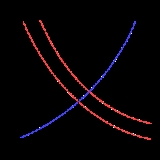
When consumers increase the quantity demanded at a given price, it is referred to as an increase in demand. Increased demand can be represented on the graph as the curve being shifted outward. At each price point, a greater quantity is demanded, as from the initial curve D1 to the new curve D2. More people wanting coffee is an example. In the diagram, this raises the equilibrium price from P1 to the higher P2. This raises the equilibrium quantity from Q1 to the higher Q2. A movement along the curve is described as a "change in the quantity demanded" to distinguish it from a "change in demand," that is, a shift of the curve. In the example above, there has been an increase in demand which has caused an increase in (equilibrium) quantity. The increase in demand could also come from changing tastes and fads, incomes, complementary and substitute price changes, market expectations, and number of buyers. This would cause the entire demand curve to shift changing the equilibrium price and quantity.

If the demand decreases, then the opposite happens: an inward shift of the curve. If the demand starts at D2, and decreases to D1, the price will decrease, and the quantity will decrease. This is an effect of demand changing. The quantity supplied at each price is the same as before the demand shift (at both Q1 and Q2). The equilibrium quantity, price and demand are different. At each point, a greater amount is demanded (when there is a shift from D1 to D2).


Supply curve shifts

When the suppliers' costs change for a given output, the supply curve shifts in the same direction. For example, assume that someone invents a better way of growing wheat
Wheat

Wheat , is a worldwide cultivated Poaceae from the Levant region of the Middle East. Globally, after maize, wheat is the second most-produced food among the cereal just above rice....
 so that the cost of wheat that can be grown for a given quantity will decrease. Otherwise stated, producers will be willing to supply more wheat at every price and this shifts the supply curve S1 outward, to S2—an increase in supply. This increase in supply causes the equilibrium price to decrease from P1 to P2. The equilibrium quantity increases from Q1 to Q2 as the quantity demanded increases at the new lower prices. In a supply curve shift, the price and the quantity move in opposite directions.

If the quantity supplied decreases at a given price, the opposite happens. If the supply curve starts at S2, and shifts inward to S1, the equilibrium price will increase, and the quantity will decrease. This is an effect of supply changing. The quantity demanded at each price is the same as before the supply shift (at both Q1 and Q2). The equilibrium quantity, price and supply changed.

When there is a change in supply or demand, there are four possible movements. The demand curve can move inward or outward. The supply curve can also move inward or outward.

See also: Induced demand
Induced demand

Induced demand is the phenomenon that after supply increases, more of a good is consumed. This is entirely consistent with the economic theory of supply and demand; however, this idea has become important in the debate over the expansion of transportation systems, and is often used as an argument against widening roads, such as major commute...


Elasticity


Elasticity is a central concept in the theory of supply and demand. In this context, elasticity refers to how supply and demand respond to various factors. One way to define elasticity is the percentage change in one variable divided by the percentage change in another variable (known as arc elasticity, which calculates the elasticity over a range of values, in contrast with point elasticity, which uses differential calculus to determine the elasticity at a specific point). It is a measure of relative changes.

Often, it is useful to know how the quantity demanded or supplied will change when the price changes. This is known as the price elasticity of demand
Price elasticity of demand

For the opposite, see Price elasticity of supply.Price elasticity of demand is defined as the measure of responsiveness in the quantity demanded for a commodity as a result of change in price of the same commodity....
 and the price elasticity of supply
Price elasticity of supply

In economics, the price elasticity of supply is defined as a numerical measure of the responsiveness of the quantity supplied of product to a change in price of product alone....
. If a monopolist
Monopoly

In economics, a monopoly exists when a specific individual or enterprise has sufficient control over a particular product or service to determine significantly the terms on which other individuals shall have access to it....
 decides to increase the price of their product, how will this affect their sales revenue? Will the increased unit price offset the likely decrease in sales volume? If a government imposes a tax
Tax

To tax is to impose a financial charge or other levy upon an individual or Legal person by a state or the functional equivalent of a state.Taxes are also imposed by many subnational entity....
 on a good, thereby increasing the effective price, how will this affect the quantity demanded?

Another distinguishing feature of elasticity is that it is more than just the slope of the function. For example, a line with a constant slope will have different elasticity at various points. Therefore, the measure of elasticity is independent of arbitrary units (such as gallons vs. quarts, say for the response of quantity demanded of milk to a change in price), whereas the measure of slope only is not.

One way of calculating elasticity is the percentage change in quantity over the associated percentage change in price. For example, if the price moves from $1.00 to $1.05, and the quantity supplied goes from 100 pens to 102 pens, the slope is 2/0.05 or 40 pens per dollar. Since the elasticity depends on the percentages, the quantity of pens increased by 2%, and the price increased by 5%, so the price elasticity of supply is 2/5 or 0.4.

Since the changes are in percentages, changing the unit of measurement or the currency will not affect the elasticity. If the quantity demanded or supplied changes a lot when the price changes a little, it is said to be elastic. If the quantity changes little when the prices changes a lot, it is said to be inelastic. An example of perfectly inelastic supply, or zero elasticity, is represented as a vertical supply curve
Supply and demand

...
. (See that section below)

Elasticity in relation to variables other than price can also be considered. One of the most common to consider is income
Income

Income, refers to consumption opportunity gained by an entity within a specified time frame, which is generally expressed in monetary terms. However, for households and individuals, "income is the sum of all the wages, salaries, profits, interests payments, rents and other forms of earnings received......
. How would the demand for a good change if income increased or decreased? This is known as the income elasticity of demand. For example, how much would the demand for a luxury car
Automobile

An automobile or motor car is a wheeled motor vehicle for transportation passengers, which also carries its own car engine or motor. Most definitions of the term specify that automobiles are designed to run primarily on roads, to have seating for one to eight people, to typically have four wheels, and to be constructed principally f...
 increase if average income increased by 10%? If it is positive, this increase in demand would be represented on a graph by a positive shift in the demand curve. At all price levels, more luxury cars would be demanded.

Another elasticity sometimes considered is the cross elasticity of demand
Cross elasticity of demand

In economics, the cross elasticity of demand and cross price elasticity of demand measures the responsiveness of the quantity demanded of a good to a change in the price of another good....
, which measures the responsiveness of the quantity demanded of a good to a change in the price of another good. This is often considered when looking at the relative changes in demand when studying complement
Complement good

A complementary good or complement good in economics is a Good which is consumed with another good; its cross elasticity of demand is negative....
 and substitute good
Substitute good

In economics, one kind of Good is said to be a substitute good for another kind in so far as the two kinds of goods can be consumed or used in place of one another in at least some of their possible uses....
s. Complement goods are goods that are typically utilized together, where if one is consumed, usually the other is also. Substitute goods are those where one can be substituted for the other, and if the price of one good rises, one may purchase less of it and instead purchase its substitute.

Cross elasticity of demand is measured as the percentage change in demand for the first good that occurs in response to a percentage change in price of the second good. For an example with a complement good, if, in response to a 10% increase in the price of fuel, the quantity of new cars demanded decreased by 20%, the cross elasticity of demand would be -2.0.

In a perfect economy, any market should be able to move to the equilibrium position instantly without travelling along the curve. Any change in market conditions would cause a jump from one equilibrium position to another at once. So the perfect economy is actually analogous to the quantum economy. Unfortunately in real economic systems, markets don't behave in this way, and both producers and consumers spend some time travelling along the curve before they reach equilibrium position. This is due to asymmetric, or at least imperfect, information, where no one economic agent could ever be expected to know every relevant condition in every market. Ultimately both producers and consumers must rely on trial and error as well as prediction and calculation to find an the true equilibrium of a market. But supply and demand curves can still serve as an excellent tool for making those kinds of predictions.

Vertical supply curve (Perfectly Inelastic Supply)


It is sometimes the case that a supply curve is vertical: that is the quantity supplied is fixed, no matter what the market price. For example, the surface area or land
Land (economics)

In economics, land comprises all natural resource whose supply is inherently fixed such as any and all particular geographical locations, mineral deposits, and even geostationary orbit locations and portions of the electromagnetic spectrum....
 of the world is fixed. No matter how much someone would be willing to pay for an additional piece, the extra cannot be created. Also, even if no one wanted all the land, it still would exist. Land therefore has a vertical supply curve, giving it zero elasticity (i.e., no matter how large the change in price, the quantity supplied will not change).

Supply-side economics

Supply-side economics is a school of macroeconomic thought that argues that economic growth can be most effectively created using incentives for people to produce goods and services, such as adjusting income tax and capital gains tax rates, and by allowing greater flexibility by reducing regulation....
 argues that the aggregate supply function – the total supply function of the entire economy of a country – is relatively vertical. Thus, supply-siders argue against government stimulation of demand, which would only lead to inflation with a vertical supply curve.

Other markets

The model of supply and demand also applies to various specialty markets.

The model applies to wage
Wage

A wage is a compensation, usually financial, received by a worker Coincidence of wants for their Labor .Compensation in terms of wages is given to worker and compensation in terms of salary is given to employees....
s, which are determined by the market for labor. The typical roles of supplier and consumer are reversed. The suppliers are individuals, who try to sell their labor for the highest price. The consumers of labors are businesses, which try to buy the type of labor they need at the lowest price. The equilibrium price for a certain type of labor is the wage.

The model applies to interest rates
Interest

Interest is a fee paid on borrowed assets. It is the price paid for the use of borrowed money , or, money earned by deposited funds .Assets that are sometimes lent with interest include money, shares, consumer goods through hire purchase, major assets such as aircraft finance, and even entire factories in finance lease arrangements....
, which are determined by the money market
Money market

In finance, the money market is the global financial market for short-term borrowing and lending. It provides short-term market liquidity funding for the global financial system....
. In the short term, the money supply
Money supply

In economics, money supply, or money stock, is the total amount of money available in an economy at a particular point in time. There are several ways to define "money", but standard measures usually include currency in circulation and demand deposits....
 is a vertical supply curve, which the central bank
Central bank

A central bank, reserve bank, or monetary authority is the entity responsible for the monetary policy of a country or of a group of member states....
 of a country can influence through monetary policy
Monetary policy

Monetary policy is the process by which the government, central bank, or monetary authority of a country controls the supply of money, availability of money, and cost of money or rate of interest, in order to attain a set of objectives oriented towards the growth and stability of the economy....
. The demand for money intersects with the money supply to determine the interest rate.

Other market forms

The supply and demand model is used to explain the behavior of perfectly competitive markets, but its usefulness as a standard of performance extends to other types of markets. In such markets, there may be no supply curve, such as above, except by analogy. Rather, the supplier or suppliers are modeled as interacting with demand to determine price and quantity. In particular, the decisions of the buyers and sellers are interdependent in a way different from a perfectly competitive market.

A monopoly
Monopoly

In economics, a monopoly exists when a specific individual or enterprise has sufficient control over a particular product or service to determine significantly the terms on which other individuals shall have access to it....
 is the case of a single supplier that can adjust the supply or price of a good at will. The profit-maximizing monopolist is modeled as adjusting the price so that its profit is maximized given the amount that is demanded at that price. This price will be higher than in a competitive market. A similar analysis can be applied when a good has a single buyer, a monopsony
Monopsony

In economics, a monopsony is a market form in which only one buyer faces many sellers. It is an example of imperfect competition, similar to a monopoly, in which only one seller faces many buyers....
, but many sellers. Oligopoly
Oligopoly

An oligopoly is a market form in which a market or industry is dominated by a small number of sellers . The word is derived from the Greek language for few sell....
 is a market with so few suppliers that they must take account of their actions on the market price or each other. Game theory
Game theory

Game theory is a branch of applied mathematics that is used in the social sciences , biology, engineering, political science, international relations, computer science , and philosophy....
 may be used to analyze such a market.

The supply curve does not have to be linear. However, if the supply is from a profit-maximizing firm, it can be proven that curves-downward sloping supply curves (i.e., a price decrease increasing the quantity supplied) are inconsistent with perfect competition in equilibrium. Then supply curves from profit-maximizing firms can be vertical, horizontal or upward sloping.

Positively sloped demand curves?

Standard microeconomic assumptions cannot be used to disprove the existence of upward-sloping demand curves. However, despite years of searching, no generally agreed upon example of a good that has an upward-sloping demand curve (also known as a
Giffen good
Giffen good

In economics and consumer theory, a Giffen good is that which people consume more of as price rises, violating the law of demand. In normal situations, as the price of such a good rises, the Consumer theory#Substitution effect causes people to purchase less of it and more of substitute goods....
) has been found. Some suggest that luxury cosmetics can be classified as a Giffen good. As the price of a high end luxury cosmetic drops, consumers see it as a low quality good compared to its peers. The price drop may indicate lower quality ingredients, thus consumers would not want to apply such an inferior product to their face. One example of a Giffen good could be potatoes during the Irish famine.

Lay economists sometimes believe that certain common goods have an upward-sloping curve. For example, people will sometimes buy a prestige good (eg. a luxury car) because it is expensive, a drop in price may actually reduce demand. However, in this case, the good purchased is actually prestige
Prestige (sociology)

Prestige is a word commonly used to describe reputation or esteem, though it has three somewhat related meanings that, to some degree, may be contradictory....
, and not the car itself. So, when the price of the luxury car decreases, it is actually decreasing the amount of prestige associated with the good (see also
Veblen good). However, even with downward-sloping demand curves, it is possible that an increase in income may lead to a decrease in demand for a particular good, probably due to the existence of more attractive alternatives which become affordable: a good with this property is known as an inferior good
Inferior good

In consumer theory, an inferior good is a good that decreases in demand when consumer income rises, unlike normal goods, for which the opposite is observed....
.

Negatively sloped supply curve

There are cases where the price of goods gets cheaper, but more of those goods are produced. This is usually related to economies of scale
Economies of scale

Economies of scale, in microeconomics, are the cost advantages that a business obtains due to expansion. They are factors that cause a producer?s average cost per unit to fall as output rises....
 and mass production
Mass production

Mass production is the production of large amounts of standardized products, including and especially on assembly lines. The concepts of mass production are applied to various kinds of products, from fluids and particulates handled in bulk to discrete solid parts to assemblies of such parts ....
. One example is computer software
Computer software

Computer software, or just software is a general term used to describe a collection of computer programs, Algorithm and Software documentation that perform some tasks on a computer system....
 where creating the first instance of a given computer program has a high cost, but the marginal cost of copying this program and distributing it to many consumers is low (almost zero).

Empirical estimation

Demand and supply relations in a market can be statistically estimated from price, quantity, and other data
DATA

Debt, AIDS, Trade in Africa is a multinational Non-governmental organization founded in January 2002 in London by U2's Bono along with Robert Sargent Shriver III and activists from the Jubilee 2000 Drop the Debt campaign....
 with sufficient information in the model. This can be done with simultaneous-equation
System of linear equations

In mathematics, a system of linear equations is a collection of linear equations involving the same set of variables. For example,is a system of three equations in the three variables ....
 methods of estimation
in econometrics
Econometrics

Econometrics is concerned with the tasks of developing and applying quantitative or statistical methods to the study and elucidation of economic principles....
. Such methods allow solving for the model-relevant "structural coefficients," the estimated algebraic counterparts of the theory. The Parameter identification problem is a common issue in "structural estimation." Typically, data on exogenous
Exogenous

Exogenous refers to an action or object coming from outside a system. It is the opposite of endogenous, something generated from within the system....
 variables (that is, variables other than price and quantity, both of which are endogenous
Endogeneity (economics)

In an economics model , parameters or variables are said to be endogenous when they are predicted by other variables in the model.For example, in a simple supply and demand model, when predicting the quantity demanded in equilibrium, the price is endogenous because producers change their price in response to demand and consumers change the...
 variables) are needed to perform such an estimation. An alternative to "structural estimation" is reduced-form
Reduced form

In statistics, and particularly in econometrics, the reduced form of a system of equations is the result of solving the system for the endogenous variables....
 estimation, which regresses each of the endogenous variables on the respective exogenous variables.

Macroeconomic uses of demand and supply

Demand and supply have also been generalized to explain macroeconomic variables in a market economy
Market economy

A market economy is a social system based on the division of labor in which the prices of goods and services are determined in a free price system set by supply and demand....
, including the quantity of total output
Real GDP

Real GDP is a macroeconomic measure of the size of an economy adjusted for price changes and inflation. It measures in constant prices the output of final goods and services and incomes within an economy....
 and the general price level
Price level

A price level is a hypothetical measure of overall prices for some set of Good s and Service s, in a given region during a given interval, normalized relative to some base set....
. The Aggregate Demand-Aggregate Supply model
AD-AS model

The AD-AS or Aggregate Demand-Aggregate Supply model is a Model that explains price level and output through the relationship of aggregate demand and aggregate supply....
 may be the most direct application of supply and demand to macroeconomics, but other macroeconomic models also use supply and demand. Compared to microeconomic uses of demand and supply, different (and more controversial) theoretical considerations apply to such macroeconomic counterparts as aggregate demand
Aggregate demand

In economics, aggregate demand is the total demand for final goods and services in the economy at a given time and price level. It is the amount of goods and services in the economy that will be purchased at all possible price levels....
 and aggregate supply
Aggregate supply

In economics, aggregate supply is the total supply of goods and services produced by a national economy during a specific time period. It is the total amount of goods and services in the economy available at all possible price levels....
. Demand and supply may also be used in macroeconomic theory to relate money supply
Money supply

In economics, money supply, or money stock, is the total amount of money available in an economy at a particular point in time. There are several ways to define "money", but standard measures usually include currency in circulation and demand deposits....
 to demand and interest rates.

Demand shortfalls

A demand shortfall results from the actual demand for a given product being lower than the projected, or estimated, demand for that product. Demand shortfalls are caused by demand overestimation in the planning of new products. Demand overestimation is caused by optimism bias
Optimism bias

Optimism bias is the demonstrated systematic tendency for people to be over-optimistic about the outcome of planned actions. This includes over-estimating the likelihood of positive events and under-estimating the likelihood of negative events....
 and/or strategic misrepresentation
Strategic misrepresentation

Strategic misrepresentation is the planned, systematic distortion or misstatement of fact?lying?in response to incentives in the budget process....
.

History

The power of supply and demand was understood to some extent by several early Muslim economists
Islamic economics in the world

Islamic economic jurisprudence in practice, or Economics policies supported by self-identified Islamic groups, has varied throughout its long history....
, such as Ibn Taymiyyah who illustrates:

The phrase "supply and demand" was first used by James Denham-Steuart
James Denham-Steuart

Sir James Denham-Steuart, 7th Baronet was a British economist....
 in his Inquiry into the Principles of Political Economy, published in 1767. Adam Smith
Adam Smith

Adam Smith was a Scotland Ethics and a pioneer of political economy. One of the key figures of the Scottish Enlightenment, Smith is the author of The Theory of Moral Sentiments and The Wealth of Nations....
 used the phrase in his 1776 book The Wealth of Nations
The Wealth of Nations

An Inquiry into the Nature and Causes of the Wealth of Nations is the magnum opus of the Scotland economist Adam Smith. It is a clearly written account of economics at the dawn of the Industrial Revolution, as well as a rhetorical piece written for the generally educated individual of the 18th century - advocating a free market econom...
, and David Ricardo
David Ricardo

David Ricardo was a political economy, often credited with systematizing economics, and was one of the most influential of the classical economicss, along with Thomas Malthus and Adam Smith....
 titled one chapter of his 1817 work Principles of Political Economy and Taxation "On the Influence of Demand and Supply on Price".

In The Wealth of Nations, Smith generally assumed that the supply price was fixed but that its "merit" (value) would decrease as its "scarcity" increased, in effect what was later called the law of demand. Ricardo, in Principles of Political Economy and Taxation, more rigorously laid down the idea of the assumptions that were used to build his ideas of supply and demand. Antoine Augustin Cournot first developed a mathematical model of supply and demand in his 1838 Researches on the Mathematical Principles of the Theory of Wealth.

During the late 19th century the marginalist school of thought emerged. This field mainly was started by Stanley Jevons
William Stanley Jevons

William Stanley Jevons , England economist and logician, was born in Liverpool. He expounded in his book The Theory of Political Economy the "final" utility theory of value....
, Carl Menger
Carl Menger

Carl Menger was the founder of the Austrian School of economics, famous for contributing to the development of the theory of marginal utility that refuted the cost-of-production theories of value developed by the classical economics such as Adam Smith and David Ricardo....
, and Léon Walras
Léon Walras

Marie-Esprit-L?on Walras was a French economics, considered by Joseph Schumpeter as "the greatest of all economists". He was a mathematical economics associated with the creation of the general equilibrium theory....
. The key idea was that the price was set by the most expensive price, that is, the price at the margin. This was a substantial change from Adam Smith's thoughts on determining the supply price.

In his 1870 essay "On the Graphical Representation of Supply and Demand", Fleeming Jenkin
Fleeming Jenkin

Henry Charles Fleeming Jenkin was Professor of Engineering at the University of Edinburgh, remarkable for his versatility. Known to the world as the inventor of telpherage, he was an electrician and cable engineer, a lecturer, linguist, critic, actor, dramatist and artist....
 drew for the first time the popular graphic of supply and demand which, through Marshall, eventually would turn into the most famous graphic in economics.

The model was further developed and popularized by Alfred Marshall
Alfred Marshall

Alfred Marshall was an England economist and one of the most influential economists of his time. His book, Principles of Economics , brings the ideas of supply and demand, of marginal utility and of the costs of production into a coherent whole....
 in the 1890 textbook Principles of Economics. Along with Léon Walras
Léon Walras

Marie-Esprit-L?on Walras was a French economics, considered by Joseph Schumpeter as "the greatest of all economists". He was a mathematical economics associated with the creation of the general equilibrium theory....
, Marshall looked at the equilibrium point where the two curves crossed. They also began looking at the effect of markets on each other.

See also


External links

  • by Thomas Humphrey (via the Richmond Fed)
  • book by Hubert D. Henderson at Project Gutenberg.
  • Price Theory and Applications by Steven E. Landsburg ISBN 0-538-88206-9
  • An Inquiry into the Nature and Causes of the Wealth of Nations, Adam Smith
    Adam Smith

    Adam Smith was a Scotland Ethics and a pioneer of political economy. One of the key figures of the Scottish Enlightenment, Smith is the author of The Theory of Moral Sentiments and The Wealth of Nations....
    , 1776
  • By what is the price of a commodity determined?, a brief statement of Karl Marx's
    Karl Marx

    Karl Heinrich Marx was a Germanphilosophy, political economy, historian, sociologist, humanism, political theorist and revolutionary credited as the founder of communism....
     rival account
  • The Economic Motivation of Open Source Software: Stakeholder Perspectives, Dirk Riehle, 2007
  • by Fiona Maclachlan and by Mark Gillis, Wolfram Demonstrations Project
    Wolfram Demonstrations Project

    The Wolfram Demonstrations Project is a website developed by Wolfram Research, whose stated goal is to bring computational exploration to the widest possible audience....
    .