


Road space rationing

Encyclopedia
Transportation Demand Management
Transportation demand management, traffic demand management or travel demand management is the application of strategies and policies to reduce travel demand , or to redistribute this demand in space or in time.In transport as in any network, managing demand can be a cost-effective alternative to...
strategy aimed to reduce the negative externalities
Externality
In economics, an externality is a cost or benefit, not transmitted through prices, incurred by a party who did not agree to the action causing the cost or benefit...
generated by peak urban travel demand in excess of available supply or road capacity, through artificially restricting demand (vehicle travel) by rationing
Rationing
Rationing is the controlled distribution of scarce resources, goods, or services. Rationing controls the size of the ration, one's allotted portion of the resources being distributed on a particular day or at a particular time.- In economics :...
the scarce common good
Common good (economics)
Common goods are defined in economics as goods which are rivalrous and non-excludable. Thus, they constitute one of the four main types of the most common typology of goods based on the criteria:...
road capacity, especially during the peak periods. This objective is achieved through restricting access into an urban cordon area, city center (CBD
Central business district
A central business district is the commercial and often geographic heart of a city. In North America this part of a city is commonly referred to as "downtown" or "city center"...
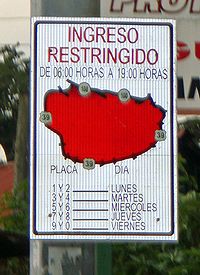
), or district based upon the last digits of the license number on pre-established days and during certain periods, usually, the peak hours.
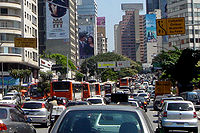
The practical implementation of this policy is common in Latin America, and in many cases, the road rationing has as a main goal the reduction of air pollution, such as the cases of México City
Mexico City
Mexico City is the Federal District , capital of Mexico and seat of the federal powers of the Mexican Union. It is a federal entity within Mexico which is not part of any one of the 31 Mexican states but belongs to the federation as a whole...
, and Santiago, Chile
Chile
Chile ,officially the Republic of Chile , is a country in South America occupying a long, narrow coastal strip between the Andes mountains to the east and the Pacific Ocean to the west. It borders Peru to the north, Bolivia to the northeast, Argentina to the east, and the Drake Passage in the far...
. São Paulo
São Paulo
São Paulo is the largest city in Brazil, the largest city in the southern hemisphere and South America, and the world's seventh largest city by population. The metropolis is anchor to the São Paulo metropolitan area, ranked as the second-most populous metropolitan area in the Americas and among...
, with a fleet of 6 million vehicles in 2007, is the largest metropolis in the world with such a travel restriction, implemented first in 1996 as measured to mitigate air pollution, and thereafter made permanent in 1997 to relief traffic congestion. More recent implementations in Costa Rica
Costa Rica
Costa Rica , officially the Republic of Costa Rica is a multilingual, multiethnic and multicultural country in Central America, bordered by Nicaragua to the north, Panama to the southeast, the Pacific Ocean to the west and the Caribbean Sea to the east....
and Honduras
Honduras
Honduras is a republic in Central America. It was previously known as Spanish Honduras to differentiate it from British Honduras, which became the modern-day state of Belize...
have had the objective of reducing oil consumption, due to the high impact this import has on the economy of small countries, and considering the steep increases in oil prices that began in 2003. Bogotá
Bogotá
Bogotá, Distrito Capital , from 1991 to 2000 called Santa Fé de Bogotá, is the capital, and largest city, of Colombia. It is also designated by the national constitution as the capital of the department of Cundinamarca, even though the city of Bogotá now comprises an independent Capital district...
, Quito
Quito
San Francisco de Quito, most often called Quito , is the capital city of Ecuador in northwestern South America. It is located in north-central Ecuador in the Guayllabamba river basin, on the eastern slopes of Pichincha, an active stratovolcano in the Andes mountains...
, and La Paz
La Paz
Nuestra Señora de La Paz is the administrative capital of Bolivia, as well as the departmental capital of the La Paz Department, and the second largest city in the country after Santa Cruz de la Sierra...
, Bolivia
Bolivia
Bolivia officially known as Plurinational State of Bolivia , is a landlocked country in central South America. It is the poorest country in South America...
also have similar restriction schemes in place.
Historical background
The earliest known implementation of road space rationing took place in RomeRome
Rome is the capital of Italy and the country's largest and most populated city and comune, with over 2.7 million residents in . The city is located in the central-western portion of the Italian Peninsula, on the Tiber River within the Lazio region of Italy.Rome's history spans two and a half...
, as carriage
Carriage
A carriage is a wheeled vehicle for people, usually horse-drawn; litters and sedan chairs are excluded, since they are wheelless vehicles. The carriage is especially designed for private passenger use and for comfort or elegance, though some are also used to transport goods. It may be light,...
s and cart
Cart
A cart is a vehicle designed for transport, using two wheels and normally pulled by one or a pair of draught animals. A handcart is pulled or pushed by one or more people...
s pulled by horses created serious congestion problems in several Roman cities. In 45 B.C. Julius Caesar
Julius Caesar
Gaius Julius Caesar was a Roman general and statesman and a distinguished writer of Latin prose. He played a critical role in the gradual transformation of the Roman Republic into the Roman Empire....
declared the center of Rome off-limits between 6 a.m. and 4 p.m. to all vehicles except for carriages transporting priests, officials, visitors, and high ranking citizens.
Applications of road space rationing
Athens
Athens , is the capital and largest city of Greece. Athens dominates the Attica region and is one of the world's oldest cities, as its recorded history spans around 3,400 years. Classical Athens was a powerful city-state...
(1982), Santiago, Chile
Chile
Chile ,officially the Republic of Chile , is a country in South America occupying a long, narrow coastal strip between the Andes mountains to the east and the Pacific Ocean to the west. It borders Peru to the north, Bolivia to the northeast, Argentina to the east, and the Drake Passage in the far...
(1986 and extended 2001), México City
Mexico City
Mexico City is the Federal District , capital of Mexico and seat of the federal powers of the Mexican Union. It is a federal entity within Mexico which is not part of any one of the 31 Mexican states but belongs to the federation as a whole...
(1989), São Paulo
São Paulo
São Paulo is the largest city in Brazil, the largest city in the southern hemisphere and South America, and the world's seventh largest city by population. The metropolis is anchor to the São Paulo metropolitan area, ranked as the second-most populous metropolitan area in the Americas and among...
(1997), Bogotá
Bogotá
Bogotá, Distrito Capital , from 1991 to 2000 called Santa Fé de Bogotá, is the capital, and largest city, of Colombia. It is also designated by the national constitution as the capital of the department of Cundinamarca, even though the city of Bogotá now comprises an independent Capital district...
, Colombia
Colombia
Colombia, officially the Republic of Colombia , is a unitary constitutional republic comprising thirty-two departments. The country is located in northwestern South America, bordered to the east by Venezuela and Brazil; to the south by Ecuador and Peru; to the north by the Caribbean Sea; to the...
(1998), La Paz
La Paz
Nuestra Señora de La Paz is the administrative capital of Bolivia, as well as the departmental capital of the La Paz Department, and the second largest city in the country after Santa Cruz de la Sierra...
, Bolivia
Bolivia
Bolivia officially known as Plurinational State of Bolivia , is a landlocked country in central South America. It is the poorest country in South America...
(2003), San José, Costa Rica
Costa Rica
Costa Rica , officially the Republic of Costa Rica is a multilingual, multiethnic and multicultural country in Central America, bordered by Nicaragua to the north, Panama to the southeast, the Pacific Ocean to the west and the Caribbean Sea to the east....
, (2005) countrywide in Honduras
Honduras
Honduras is a republic in Central America. It was previously known as Spanish Honduras to differentiate it from British Honduras, which became the modern-day state of Belize...
(2008), and Quito
Quito
San Francisco de Quito, most often called Quito , is the capital city of Ecuador in northwestern South America. It is located in north-central Ecuador in the Guayllabamba river basin, on the eastern slopes of Pichincha, an active stratovolcano in the Andes mountains...
, Ecuador
Ecuador
Ecuador , officially the Republic of Ecuador is a representative democratic republic in South America, bordered by Colombia on the north, Peru on the east and south, and by the Pacific Ocean to the west. It is one of only two countries in South America, along with Chile, that do not have a border...
(2010). All these cities restrain a percentage of vehicles every weekday during rush hours or for the entire day. When the restriction is based in two digits a theoretical 20% reduction of traffic is expected. Cities with serious air quality problems, such as México City
Mexico City
Mexico City is the Federal District , capital of Mexico and seat of the federal powers of the Mexican Union. It is a federal entity within Mexico which is not part of any one of the 31 Mexican states but belongs to the federation as a whole...
and Santiago use more digits to achieve greater reductions in air pollution, and even the prohibition can be for more than one day a week. In Bogotá
Bogotá
Bogotá, Distrito Capital , from 1991 to 2000 called Santa Fé de Bogotá, is the capital, and largest city, of Colombia. It is also designated by the national constitution as the capital of the department of Cundinamarca, even though the city of Bogotá now comprises an independent Capital district...
, Colombia
Colombia
Colombia, officially the Republic of Colombia , is a unitary constitutional republic comprising thirty-two departments. The country is located in northwestern South America, bordered to the east by Venezuela and Brazil; to the south by Ecuador and Peru; to the north by the Caribbean Sea; to the...
from 2009 the plate restriction was extended from peak periods to the whole day (from 06:00 to 20:00 hours) in the whole city, due to the extensive construction sites in public spaces.
Bertrand Delanoë
Bertrand Delanoë
Bertrand Delanoë is a French politician, and has been the mayor of Paris since 2001. He is member of the Socialist Party . Delanoë was born in Tunis, Tunisia to a French-Tunisian father and a French mother...
, the mayor of Paris, proposed to impose a complete ban on motor vehicles in the city's inner districts, with exemptions only for residents, businesses, and the disabled, as a three-part plan to implement during a seven year period. This proposal was made in 2005, in the context of Paris' bid to host the 2012 Summer Olympics
2012 Summer Olympics
The 2012 Summer Olympic Games, officially known as the "London 2012 Olympic Games", are scheduled to take place in London, England, United Kingdom from 27 July to 12 August 2012...
which ended up being won by London.
During the discussions regarding the proposal to introduce congestion pricing in New York
New York congestion pricing
New York congestion pricing was a proposed traffic congestion fee for vehicles traveling into or within the Manhattan central business district of New York City...
, the commission created in 2007 by the New York State Legislature to evaluate other traffic relief options, considered road space rationing based on license plates as an alternative to congestion pricing
Congestion pricing
Congestion pricing or congestion charges is a system of surcharging users of a transport network in periods of peak demand to reduce traffic congestion. Examples include some toll-like road pricing fees, and higher peak charges for utilities, public transport and slots in canals and airports...
. As of April 2008, the proposal is stalled as the legislature decided not to vote the proposed plan.
Beijing 2008
On July 20, 2008, BeijingBeijing
Beijing , also known as Peking , is the capital of the People's Republic of China and one of the most populous cities in the world, with a population of 19,612,368 as of 2010. The city is the country's political, cultural, and educational center, and home to the headquarters for most of China's...
implemented a temporary road space rationing based on plate numbers in order to significantly improve air quality in the city during the 2008 Summer Olympics
2008 Summer Olympics
The 2008 Summer Olympics, officially known as the Games of the XXIX Olympiad, was a major international multi-sport event that took place in Beijing, China, from August 8 to August 24, 2008. A total of 11,028 athletes from 204 National Olympic Committees competed in 28 sports and 302 events...
. Enforcement was carried out through an automated traffic surveillance network. The rationing was in effect for two months, between July 20 to September 20, as the Olympics were followed by the Paralympics from September 6 until 17. The restrictions on car use was implemented on alternate days depending on the plates ending in odd or even numbers
Odd-even rationing
Odd-even rationing is a method of rationing in which access to some resource is restricted to half the population on any given day. In a common example, cars are allowed to drive or to purchase gasoline on alternate days, according to whether the last digit in their license plate is even or odd...
. This measure was expected to take 45% of the 3.3 million car fleet off the streets. In addition, 300,000 heavy polluting vehicles were banned from July 1, and the measure also prohibited access to most vehicles coming from outside Beijing. Authorities decided to compensate car owners for the inconvenience, by exempting them from payment of vehicle taxes for three months.
A pilot test was conducted in August 2007 for four days, restricting driving for a third of Beijing's fleet, some 1.3 million vehicles. A 40% daily reduction of vehicle emissions
Automobile emissions control
Vehicle emissions control is the study and practice of reducing the motor vehicle emissions -- emissions produced by motor vehicles, especially internal combustion engines....
was reported. A previous test carried out in November 2006 during the Sino-African Summit show reductions of 40% in NOx auto emissions.
Post-Olympics permanent rule
The rationing during the Olympics was so successful in cleaning the air and relieving traffic congestionTraffic congestion
Traffic congestion is a condition on road networks that occurs as use increases, and is characterized by slower speeds, longer trip times, and increased vehicular queueing. The most common example is the physical use of roads by vehicles. When traffic demand is great enough that the interaction...
, that a modified version of the restriction was made permanent afterward in October 2008, now banning 20% of the vehicles on a given weekday instead of half the vehicles as implemented during the Olympics. Also a ban on heavy trucks from entering the city during the day was implemented, and the oldest most polluting automobiles, called "yellow-label" cars, after the sticker fixed to their windshields, are banned from entering the city center. In July 2009 a nationwide car scrappage program
Scrappage program
A scrappage program is a government budget program to promote the replacement of old vehicles with modern vehicles. Scrappage programs generally have the dual aim of stimulating the automobile industry and removing inefficient, high emissions vehicles from the road...
was implemented offering rebates for trade in old heavy polluting cars and trucks for new ones.
London 2012
The 2012 Summer Olympics2012 Summer Olympics
The 2012 Summer Olympic Games, officially known as the "London 2012 Olympic Games", are scheduled to take place in London, England, United Kingdom from 27 July to 12 August 2012...
organization, with support from the Mayor of London
Mayor of London
The Mayor of London is an elected politician who, along with the London Assembly of 25 members, is accountable for the strategic government of Greater London. Conservative Boris Johnson has held the position since 4 May 2008...
office, announced in 2007 that they are planning auto exclusion zones around all venues, including London, Birmingham
Birmingham
Birmingham is a city and metropolitan borough in the West Midlands of England. It is the most populous British city outside the capital London, with a population of 1,036,900 , and lies at the heart of the West Midlands conurbation, the second most populous urban area in the United Kingdom with a...
, Manchester
Manchester
Manchester is a city and metropolitan borough in Greater Manchester, England. According to the Office for National Statistics, the 2010 mid-year population estimate for Manchester was 498,800. Manchester lies within one of the UK's largest metropolitan areas, the metropolitan county of Greater...
, Newcastle upon Tyne
Newcastle upon Tyne
Newcastle upon Tyne is a city and metropolitan borough of Tyne and Wear, in North East England. Historically a part of Northumberland, it is situated on the north bank of the River Tyne...
, Glasgow
Glasgow
Glasgow is the largest city in Scotland and third most populous in the United Kingdom. The city is situated on the River Clyde in the country's west central lowlands...
and Cardiff
Cardiff
Cardiff is the capital, largest city and most populous county of Wales and the 10th largest city in the United Kingdom. The city is Wales' chief commercial centre, the base for most national cultural and sporting institutions, the Welsh national media, and the seat of the National Assembly for...
. London authorities hope this measure will work as an experiment to change the public's travel behavior, allowing thereafter a shift from automobile to mass transit or bicycling. This severe policy has been publicized as the "First Car-free Olympics". During the peak events, the Olympics expect a crowd of 800,000 people. Those attending will have to travel by public transport
Public transport
Public transport is a shared passenger transportation service which is available for use by the general public, as distinct from modes such as taxicab, car pooling or hired buses which are not shared by strangers without private arrangement.Public transport modes include buses, trolleybuses, trams...
, mainly through the Underground
London Underground
The London Underground is a rapid transit system serving a large part of Greater London and some parts of Buckinghamshire, Hertfordshire and Essex in England...
, or by bicycle or on foot.
Congestion pricing
Transport economists consider road space rationing a variation of road pricingRoad pricing
Road pricing is an economic concept regarding the various direct charges applied for the use of roads. The road charges includes fuel taxes, licence fees, parking taxes, tolls, and congestion charges, including those which may vary by time of day, by the specific road, or by the specific vehicle...
, and an alternative to congestion pricing
Congestion pricing
Congestion pricing or congestion charges is a system of surcharging users of a transport network in periods of peak demand to reduce traffic congestion. Examples include some toll-like road pricing fees, and higher peak charges for utilities, public transport and slots in canals and airports...
, but road space rationing is considered more equitable, as the restrictions force all drivers to reduce auto travel, while congestion pricing restrains less those who can afford paying the congestion charge. Nevertheless, high-income users can often avoid the restrictions by owning a second car.
Mobility rights or congestion credits
A more recent and acceptable policy on automobile travel restrictions, proposed by transport economists to avoid inequality and revenue allocation issues, is to implement a rationingRationing
Rationing is the controlled distribution of scarce resources, goods, or services. Rationing controls the size of the ration, one's allotted portion of the resources being distributed on a particular day or at a particular time.- In economics :...
of peak period travel but through revenue-neutral credit-based congestion pricing
Congestion pricing
Congestion pricing or congestion charges is a system of surcharging users of a transport network in periods of peak demand to reduce traffic congestion. Examples include some toll-like road pricing fees, and higher peak charges for utilities, public transport and slots in canals and airports...
. This concept is similar to the existing system of emissions trading
Emissions trading
Emissions trading is a market-based approach used to control pollution by providing economic incentives for achieving reductions in the emissions of pollutants....
of carbon credit
Carbon credit
A carbon credit is a generic term for any tradable certificate or permit representing the right to emit one tonne of carbon dioxide or the mass of another greenhouse gas with a carbon dioxide equivalent equivalent to one tonne of carbon dioxide....
s, proposed by the Kyoto Protocol
Kyoto Protocol
The Kyoto Protocol is a protocol to the United Nations Framework Convention on Climate Change , aimed at fighting global warming...
to curb greenhouse emissions. Metropolitan area or city residents, or the taxpayers, will have the option to use the local government-issued mobility rights or congestion credits for themselves, or to trade or sell them to anyone willing to continue traveling by automobile beyond the personal quota. This trading system will allow direct benefits to be accrued by those users shifting to public transportation or by those reducing their peak-hour travel rather than the government.
See also
- Common good (economics)Common good (economics)Common goods are defined in economics as goods which are rivalrous and non-excludable. Thus, they constitute one of the four main types of the most common typology of goods based on the criteria:...
- Commons dilemma
- Congestion Control (Road Vehicles)Congestion Control (Road Vehicles)Congestion control is a proposed alternative to congestion charging, which is used in a number of cities around the world...
- Congestion pricingCongestion pricingCongestion pricing or congestion charges is a system of surcharging users of a transport network in periods of peak demand to reduce traffic congestion. Examples include some toll-like road pricing fees, and higher peak charges for utilities, public transport and slots in canals and airports...
- Externalities
- Low-emission zone
- Public goodPublic goodIn economics, a public good is a good that is non-rival and non-excludable. Non-rivalry means that consumption of the good by one individual does not reduce availability of the good for consumption by others; and non-excludability means that no one can be effectively excluded from using the good...
- RationingRationingRationing is the controlled distribution of scarce resources, goods, or services. Rationing controls the size of the ration, one's allotted portion of the resources being distributed on a particular day or at a particular time.- In economics :...
- Road pricingRoad pricingRoad pricing is an economic concept regarding the various direct charges applied for the use of roads. The road charges includes fuel taxes, licence fees, parking taxes, tolls, and congestion charges, including those which may vary by time of day, by the specific road, or by the specific vehicle...
- Tragedy of the CommonsTragedy of the commonsThe tragedy of the commons is a dilemma arising from the situation in which multiple individuals, acting independently and rationally consulting their own self-interest, will ultimately deplete a shared limited resource, even when it is clear that it is not in anyone's long-term interest for this...