

Qift

Encyclopedia
Qift is a small town in the Qena Governorate of Egypt
about 43 km north of Luxor
, on the east bank of the Nile
.
, Qift, known then as Gebtu, was an important center for administration, religion, and commerce, being the chief city of the fifth Upper Egypt
ian Nome
of Harawî (Two Hawks). From Qift and Qus
, trading expeditions heading for the Red Sea
and many mining expeditions into the Eastern Desert
left the Nile Valley. Gebtu was at the starting-point of the two great caravan
routes leading to the coast of the Red Sea
, the one toward the port Tââou (Myoshormos), the other more southerly, toward the port of Shashirît (Berenice
).
Under the native pharaohs, the whole trade of southern Egypt with the Red Sea passed over these two roads; under the Ptolemies as well as in Roman and Byzantine times, merchants followed the same roads for purposes of barter at the coasts of Zanzibar and in Southern Arabia, India, and the Far East.
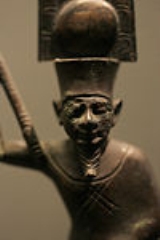
 Gebtu was the most important religious center in the area. Its principal male deity was Min
, a sky-god whose symbol was a thunderbolt. http://www.egyptartsite.com/min.html He became a male fertility deity, http://www.touregypt.net/featurestories/min.htm, and also was regarded as the male deity of the desert region to the east.
 His cult rose to prominence in the Middle Kingdom
. At that time, he became associated with Horus as the deity, Min-Horus. Later, he was fused with Amen in the deity Min-Amen-ka-Mut-ef, as "Min-Amen-bull of his mother" (Hathor-Isis).
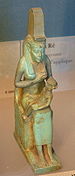
Isis
(Hathor-Isis) and her infant, Horus
, were the deities connected with Gebtu, named Coptos during the Greco-Roman period, probably due to the reinterpretation of the Two Hawks of the Nome
, Harawî, standard as Min
and Horus
.
Gebtu, once politically important, especially under the eleventh dynasty
, was overshadowed by Thebes
. It recuperated its prominence under the Antonines; it was the base camp of Legio III Cyrenaica
, or at least one of its subunits. It rebelled, but soon was captured in 292 by Diocletian
after a long siege and almost destroyed, but soon recovered its former standing.
In the 6th century, Qift was called by the Roman name, Justinianopolis. This century is considered the end of the Classical Age in Europe where the Dark Ages followed.
The Christian see was suffragan of Ptolemais
in Thebais Secunda. Five bishops are known (Lequien, II, 607): Theodorus, a partisan of Meletius; Phoebammon in 431; Sabinus in 451; Vincent, author of the "Canonical Solutions", preserved in an Arabic translation and highly esteemed by the Copts; Moyses, who wrote the panegyric of Vincent.
Under the Muslim
caliphs and the sultans, Qift remained one of the chief cities of Upper Egypt
. In 1176, its Christian inhabitants raised the standard of revolt against the Muslims, but were suppressed promptly by Al-Adil
, brother of Saladin
, who hanged nearly 3,000 Copts on the trees around the city. In the 13th century, there still were numerous monasteries around the city. Qift was ruined in the 16th century by the Ottomans
.
The undecorated northern temple of Min
and Isis
was the work of an official named Sennuu on behalf of Roman occupiers during the Ptolemaic kingdom, namely, Ptolemy II Philadelphus
ruling from 281 BC to 246 BC.
This northern temple has some later additions by Ptolemy IV Philopator
ruling from 221-205 BC. He was the son of Ptolemy III and Berenice II of Egypt and was the fourth pharaoh of the Ptolemaic Egypt, when the decline of the Ptolemaic kingdom began. More additions were added by Julio-Claudian emperors of Rome, Caligula
, and Nero
.
This temple stands on the site of earlier Ancient Egyptian temple structures, those of the visor to Mentuhotep IV
who became Amenemhat I
and his son, Senusret I
, both of the twelfth dynasty
, and Thutmose III
of the eighteenth dynasty
. The remains of a chapel of Osiris
, erected by Amasis II
of the twenty-sixth
, also were found near the northern temple.
At the site of the later middle temple built by Romans during the Ptolemaic kingdom, blocks of an earlier structure by Senusret I
and a gate of Thutmose III
, with additions probably made by Osorkon II
of the twenty-second dynasty
, were found. This later middle temple was built during the Ptolemaic kingdom by Ptolemy II Philadelphus
, with minor additions by members of the Julio-Claudian dynasty of Rome, Caligula
, Claudius
, and Trajan
.
At the site of the southern temple, are the gates of Nectanebo II
of the thirtieth dynasty
, who was the last native king of Egypt. He was placed on the throne by a Spartan king and lost a conflict with the Persians, who then overtook Egypt.
Other structures found at the site include a set of stelae, now known as the Koptos Decrees. These stelae date to the Sixth
and Seventh Dynasties
, with copies of royal decrees from the pharaohs concerning the temple and its personnel. The name by which the stelae are known reflects the much later Greek name for the city, Coptos or Koptos however.
A chapel of Ptolemaic dynasty
pharaoh Cleopatra VII and her son, Ptolemy XV Caesarion
, has been found at the site as well. These rulers of Ancient Egypt for six hundred years were not native, but of Greek origin. Without many changes, however, they adopted the culture and religious practices of the country they occupied. Cleopatra even learned the ancient Egyptian language, which never had been used by these rulers. The Greeks sought to find parallels to their own religious beliefs and would describe the Egyptian deities as related to their own.
Built even later, after the conquest by the Romans in 30 AD, gates associated with the Roman emperors Caligula
and Claudius
are documented at the site. The Romans also continued the religious traditions of Ancient Egypt, adopting some completely, and drawing parallels (similar to the Greek rulers) for others.
Northeast of Qift, at the modern village of El-Qala, the Roman emperor Claudius
also built a small temple and dedicated it to Min
, Isis
, and Horus
.
Qift was the focus of an America
n archaeological project from 1987 to 1992 and an Australia
n one between 2000 and 2003.
Egypt
Egypt , officially the Arab Republic of Egypt, Arabic: , is a country mainly in North Africa, with the Sinai Peninsula forming a land bridge in Southwest Asia. Egypt is thus a transcontinental country, and a major power in Africa, the Mediterranean Basin, the Middle East and the Muslim world...
about 43 km north of Luxor
Luxor
Luxor is a city in Upper Egypt and the capital of Luxor Governorate. The population numbers 487,896 , with an area of approximately . As the site of the Ancient Egyptian city of Thebes, Luxor has frequently been characterized as the "world's greatest open air museum", as the ruins of the temple...
, on the east bank of the Nile
Nile
The Nile is a major north-flowing river in North Africa, generally regarded as the longest river in the world. It is long. It runs through the ten countries of Sudan, South Sudan, Burundi, Rwanda, Democratic Republic of the Congo, Tanzania, Kenya, Ethiopia, Uganda and Egypt.The Nile has two major...
.
History
In ancient EgyptAncient Egypt
Ancient Egypt was an ancient civilization of Northeastern Africa, concentrated along the lower reaches of the Nile River in what is now the modern country of Egypt. Egyptian civilization coalesced around 3150 BC with the political unification of Upper and Lower Egypt under the first pharaoh...
, Qift, known then as Gebtu, was an important center for administration, religion, and commerce, being the chief city of the fifth Upper Egypt
Upper Egypt
Upper Egypt is the strip of land, on both sides of the Nile valley, that extends from the cataract boundaries of modern-day Aswan north to the area between El-Ayait and Zawyet Dahshur . The northern section of Upper Egypt, between El-Ayait and Sohag is sometimes known as Middle Egypt...
ian Nome
Nome (Egypt)
A nome was a subnational administrative division of ancient Egypt. Today's use of the Greek nome rather than the Egyptian term sepat came about during the Ptolemaic period. Fascinated with Egypt, Greeks created many historical records about the country...
of Harawî (Two Hawks). From Qift and Qus
Qus
Qus is a city in the modern Qena Governorate, Egypt, located on the east bank of the Nile. Its modern name is one of many borrowings in Egyptian Arabic from Coptic, the last living phase of Ancient Egyptian...
, trading expeditions heading for the Red Sea
Red Sea
The Red Sea is a seawater inlet of the Indian Ocean, lying between Africa and Asia. The connection to the ocean is in the south through the Bab el Mandeb strait and the Gulf of Aden. In the north, there is the Sinai Peninsula, the Gulf of Aqaba, and the Gulf of Suez...
and many mining expeditions into the Eastern Desert
Eastern Desert
The Eastern Desert is the section of Sahara Desert east of the Nile River, between the river and the Red Sea. It extends from Egypt in the north to Eritrea in the south, and also comprises parts of Sudan and Ethiopia.-Features:...
left the Nile Valley. Gebtu was at the starting-point of the two great caravan
Camel train
A camel train is a series of camels carrying goods or passengers in a group as part of a regular or semi-regular service between two points. Although they rarely travelled faster than the walking speed of a man, camels' ability to handle harsh conditions made camel trains a vital part of...
routes leading to the coast of the Red Sea
Red Sea
The Red Sea is a seawater inlet of the Indian Ocean, lying between Africa and Asia. The connection to the ocean is in the south through the Bab el Mandeb strait and the Gulf of Aden. In the north, there is the Sinai Peninsula, the Gulf of Aqaba, and the Gulf of Suez...
, the one toward the port Tââou (Myoshormos), the other more southerly, toward the port of Shashirît (Berenice
Berenice (port)
Berenice or Berenice Troglodytica , also known as Baranis and now known as Medinet-el Haras, is an ancient seaport of Egypt on the west coast of the Red Sea...
).
Under the native pharaohs, the whole trade of southern Egypt with the Red Sea passed over these two roads; under the Ptolemies as well as in Roman and Byzantine times, merchants followed the same roads for purposes of barter at the coasts of Zanzibar and in Southern Arabia, India, and the Far East.
Min (god)
Min is an Ancient Egyptian god whose cult originated in predynastic times . He was represented in many different forms, but was often represented in male human form, shown with an erect penis which he holds in his left hand and an upheld right arm holding a flail...
, a sky-god whose symbol was a thunderbolt. http://www.egyptartsite.com/min.html He became a male fertility deity, http://www.touregypt.net/featurestories/min.htm, and also was regarded as the male deity of the desert region to the east.
Middle Kingdom of Egypt
The Middle Kingdom of Egypt is the period in the history of ancient Egypt stretching from the establishment of the Eleventh Dynasty to the end of the Fourteenth Dynasty, between 2055 BC and 1650 BC, although some writers include the Thirteenth and Fourteenth dynasties in the Second Intermediate...
. At that time, he became associated with Horus as the deity, Min-Horus. Later, he was fused with Amen in the deity Min-Amen-ka-Mut-ef, as "Min-Amen-bull of his mother" (Hathor-Isis).
Isis
Isis
Isis or in original more likely Aset is a goddess in Ancient Egyptian religious beliefs, whose worship spread throughout the Greco-Roman world. She was worshipped as the ideal mother and wife as well as the matron of nature and magic...
(Hathor-Isis) and her infant, Horus
Horus
Horus is one of the oldest and most significant deities in the Ancient Egyptian religion, who was worshipped from at least the late Predynastic period through to Greco-Roman times. Different forms of Horus are recorded in history and these are treated as distinct gods by Egyptologists...
, were the deities connected with Gebtu, named Coptos during the Greco-Roman period, probably due to the reinterpretation of the Two Hawks of the Nome
Nome (Egypt)
A nome was a subnational administrative division of ancient Egypt. Today's use of the Greek nome rather than the Egyptian term sepat came about during the Ptolemaic period. Fascinated with Egypt, Greeks created many historical records about the country...
, Harawî, standard as Min
Min (god)
Min is an Ancient Egyptian god whose cult originated in predynastic times . He was represented in many different forms, but was often represented in male human form, shown with an erect penis which he holds in his left hand and an upheld right arm holding a flail...
and Horus
Horus
Horus is one of the oldest and most significant deities in the Ancient Egyptian religion, who was worshipped from at least the late Predynastic period through to Greco-Roman times. Different forms of Horus are recorded in history and these are treated as distinct gods by Egyptologists...
.
Gebtu, once politically important, especially under the eleventh dynasty
Eleventh dynasty of Egypt
The eleventh dynasty of ancient Egypt was one group of rulers, whose earlier members are grouped with the four preceding dynasties to form the First Intermediate Period, while the later members are considered part of the Middle Kingdom...
, was overshadowed by Thebes
Thebes, Egypt
Thebes is the Greek name for a city in Ancient Egypt located about 800 km south of the Mediterranean, on the east bank of the river Nile within the modern city of Luxor. The Theban Necropolis is situated nearby on the west bank of the Nile.-History:...
. It recuperated its prominence under the Antonines; it was the base camp of Legio III Cyrenaica
Legio III Cyrenaica
Legio tertia Cyrenaica was a Roman legion probably levied by Mark Antony around 36 BC, when he was governor of Cyrenaica. There are still records of the legion in Syria in the beginning of the 5th century. The legion symbol is unknown.- History :Legion III Cyrenaica is one of the longest living...
, or at least one of its subunits. It rebelled, but soon was captured in 292 by Diocletian
Diocletian
Diocletian |latinized]] upon his accession to Diocletian . c. 22 December 244 – 3 December 311), was a Roman Emperor from 284 to 305....
after a long siege and almost destroyed, but soon recovered its former standing.
In the 6th century, Qift was called by the Roman name, Justinianopolis. This century is considered the end of the Classical Age in Europe where the Dark Ages followed.
The Christian see was suffragan of Ptolemais
Ptolemais
Ptolemais, an Ancient Greek place name and feminine personal name, may refer to:Places*Acre, Israel, once named Antiochia Ptolemais after Ptolemy I Soter*Crocodilopolis, an Egyptian city renamed Ptolemais Euergetis by Ptolemy III Euergetes...
in Thebais Secunda. Five bishops are known (Lequien, II, 607): Theodorus, a partisan of Meletius; Phoebammon in 431; Sabinus in 451; Vincent, author of the "Canonical Solutions", preserved in an Arabic translation and highly esteemed by the Copts; Moyses, who wrote the panegyric of Vincent.
Under the Muslim
Islam
Islam . The most common are and . : Arabic pronunciation varies regionally. The first vowel ranges from ~~. The second vowel ranges from ~~~...
caliphs and the sultans, Qift remained one of the chief cities of Upper Egypt
Upper Egypt
Upper Egypt is the strip of land, on both sides of the Nile valley, that extends from the cataract boundaries of modern-day Aswan north to the area between El-Ayait and Zawyet Dahshur . The northern section of Upper Egypt, between El-Ayait and Sohag is sometimes known as Middle Egypt...
. In 1176, its Christian inhabitants raised the standard of revolt against the Muslims, but were suppressed promptly by Al-Adil
Al-Adil I
Al-Adil I was an Ayyubid-Egyptian general and ruler of Kurdish descent. From his honorific "Sayf al-Din" he was sometimes known to the Frankish crusaders as "Saphadin".- Life :...
, brother of Saladin
Saladin
Ṣalāḥ ad-Dīn Yūsuf ibn Ayyūb , better known in the Western world as Saladin, was an Arabized Kurdish Muslim, who became the first Sultan of Egypt and Syria, and founded the Ayyubid dynasty. He led Muslim and Arab opposition to the Franks and other European Crusaders in the Levant...
, who hanged nearly 3,000 Copts on the trees around the city. In the 13th century, there still were numerous monasteries around the city. Qift was ruined in the 16th century by the Ottomans
Ottoman Empire
The Ottoman EmpireIt was usually referred to as the "Ottoman Empire", the "Turkish Empire", the "Ottoman Caliphate" or more commonly "Turkey" by its contemporaries...
.
Archaeology
Remains of three temple groups surrounded by an enclosure wall were located during the excavations of W. M. Flinders Petrie in 1893-1894, and later, by Raymond Weill and Adolphe Joseph Reinach in 1910-1911.The undecorated northern temple of Min
Min (god)
Min is an Ancient Egyptian god whose cult originated in predynastic times . He was represented in many different forms, but was often represented in male human form, shown with an erect penis which he holds in his left hand and an upheld right arm holding a flail...
and Isis
Isis
Isis or in original more likely Aset is a goddess in Ancient Egyptian religious beliefs, whose worship spread throughout the Greco-Roman world. She was worshipped as the ideal mother and wife as well as the matron of nature and magic...
was the work of an official named Sennuu on behalf of Roman occupiers during the Ptolemaic kingdom, namely, Ptolemy II Philadelphus
Ptolemy II Philadelphus
Ptolemy II Philadelphus was the king of Ptolemaic Egypt from 283 BCE to 246 BCE. He was the son of the founder of the Ptolemaic kingdom Ptolemy I Soter and Berenice, and was educated by Philitas of Cos...
ruling from 281 BC to 246 BC.
This northern temple has some later additions by Ptolemy IV Philopator
Ptolemy IV Philopator
Ptolemy IV Philopator , son of Ptolemy III and Berenice II of Egypt was the fourth Pharaoh of Ptolemaic Egypt...
ruling from 221-205 BC. He was the son of Ptolemy III and Berenice II of Egypt and was the fourth pharaoh of the Ptolemaic Egypt, when the decline of the Ptolemaic kingdom began. More additions were added by Julio-Claudian emperors of Rome, Caligula
Caligula
Caligula , also known as Gaius, was Roman Emperor from 37 AD to 41 AD. Caligula was a member of the house of rulers conventionally known as the Julio-Claudian dynasty. Caligula's father Germanicus, the nephew and adopted son of Emperor Tiberius, was a very successful general and one of Rome's most...
, and Nero
Nero
Nero , was Roman Emperor from 54 to 68, and the last in the Julio-Claudian dynasty. Nero was adopted by his great-uncle Claudius to become his heir and successor, and succeeded to the throne in 54 following Claudius' death....
.
This temple stands on the site of earlier Ancient Egyptian temple structures, those of the visor to Mentuhotep IV
Mentuhotep IV
Nebtawyre Mentuhotep IV was the last king of the 11th Dynasty. He seems to fit into a 7 year period in the Turin Canon for which there is no recorded king, and is known from a few inscriptions in Wadi Hammamat that record expeditions to the Red Sea coast and to quarry stone for the royal monuments...
who became Amenemhat I
Amenemhat I
Amenemhat I, also Amenemhet I, was the first ruler of the Twelfth Dynasty . He ruled from 1991 BC to 1962 BC...
and his son, Senusret I
Senusret I
Senusret I was the second pharaoh of the Twelfth Dynasty of Egypt. He ruled from 1971 BC to 1926 BC, and was one of the most powerful kings of this Dynasty. He was the son of Amenemhat I and his wife Nefertitanen. His wife and sister was Neferu. She was also the mother of the successor Amenemhat II...
, both of the twelfth dynasty
Twelfth dynasty of Egypt
The twelfth dynasty of ancient Egypt is often combined with Dynasties XI, XIII and XIV under the group title Middle Kingdom.-Rulers:Known rulers of the twelfth dynasty are as follows :...
, and Thutmose III
Thutmose III
Thutmose III was the sixth Pharaoh of the Eighteenth Dynasty. During the first twenty-two years of Thutmose's reign he was co-regent with his stepmother, Hatshepsut, who was named the pharaoh...
of the eighteenth dynasty
Eighteenth dynasty of Egypt
The eighteenth dynasty of ancient Egypt is perhaps the best known of all the dynasties of ancient Egypt...
. The remains of a chapel of Osiris
Osiris
Osiris is an Egyptian god, usually identified as the god of the afterlife, the underworld and the dead. He is classically depicted as a green-skinned man with a pharaoh's beard, partially mummy-wrapped at the legs, wearing a distinctive crown with two large ostrich feathers at either side, and...
, erected by Amasis II
Amasis II
Amasis II or Ahmose II was a pharaoh of the Twenty-sixth dynasty of Egypt, the successor of Apries at Sais. He was the last great ruler of Egypt before the Persian conquest.-Life:...
of the twenty-sixth
Twenty-sixth dynasty of Egypt
The Twenty-sixth Dynasty of Egypt was the last native dynasty to rule Egypt before the Persian conquest in 525 BC . The Dynasty's reign The Twenty-sixth Dynasty of Egypt (also written Dynasty XXVI or Dynasty 26) was the last native dynasty to rule Egypt before the Persian conquest in 525 BC...
, also were found near the northern temple.
At the site of the later middle temple built by Romans during the Ptolemaic kingdom, blocks of an earlier structure by Senusret I
Senusret I
Senusret I was the second pharaoh of the Twelfth Dynasty of Egypt. He ruled from 1971 BC to 1926 BC, and was one of the most powerful kings of this Dynasty. He was the son of Amenemhat I and his wife Nefertitanen. His wife and sister was Neferu. She was also the mother of the successor Amenemhat II...
and a gate of Thutmose III
Thutmose III
Thutmose III was the sixth Pharaoh of the Eighteenth Dynasty. During the first twenty-two years of Thutmose's reign he was co-regent with his stepmother, Hatshepsut, who was named the pharaoh...
, with additions probably made by Osorkon II
Osorkon II
Usermaatre Setepenamun Osorkon II was a pharaoh of the Twenty-second Dynasty of Ancient Egypt and the son of Takelot I and Queen Kapes. He ruled Egypt around 872 BC to 837 BC from Tanis, the capital of this Dynasty. After succeeding his father, he was faced with the competing rule of his cousin,...
of the twenty-second dynasty
Twenty-second dynasty of Egypt
The Twenty-First, Twenty-Second, Twenty-Third, Twenty-Fourth and Twenty-Fifth Dynasties of ancient Egypt are often combined under the group title, Third Intermediate Period.-Rulers:...
, were found. This later middle temple was built during the Ptolemaic kingdom by Ptolemy II Philadelphus
Ptolemy II Philadelphus
Ptolemy II Philadelphus was the king of Ptolemaic Egypt from 283 BCE to 246 BCE. He was the son of the founder of the Ptolemaic kingdom Ptolemy I Soter and Berenice, and was educated by Philitas of Cos...
, with minor additions by members of the Julio-Claudian dynasty of Rome, Caligula
Caligula
Caligula , also known as Gaius, was Roman Emperor from 37 AD to 41 AD. Caligula was a member of the house of rulers conventionally known as the Julio-Claudian dynasty. Caligula's father Germanicus, the nephew and adopted son of Emperor Tiberius, was a very successful general and one of Rome's most...
, Claudius
Claudius
Claudius , was Roman Emperor from 41 to 54. A member of the Julio-Claudian dynasty, he was the son of Drusus and Antonia Minor. He was born at Lugdunum in Gaul and was the first Roman Emperor to be born outside Italy...
, and Trajan
Trajan
Trajan , was Roman Emperor from 98 to 117 AD. Born into a non-patrician family in the province of Hispania Baetica, in Spain Trajan rose to prominence during the reign of emperor Domitian. Serving as a legatus legionis in Hispania Tarraconensis, in Spain, in 89 Trajan supported the emperor against...
.
At the site of the southern temple, are the gates of Nectanebo II
Nectanebo II
Nectanebo II was the third and last pharaoh of the Thirtieth dynasty, as well as the last native ruler of Ancient Egypt. Under Nectanebo II Egypt prospered...
of the thirtieth dynasty
Thirtieth dynasty of Egypt
The Thirtieth Dynasty of ancient Egypt followed Nectanebo I's deposition of Nefaarud II, the son of Hakor. This dynasty is often considered part of the Late Period....
, who was the last native king of Egypt. He was placed on the throne by a Spartan king and lost a conflict with the Persians, who then overtook Egypt.
Other structures found at the site include a set of stelae, now known as the Koptos Decrees. These stelae date to the Sixth
Sixth dynasty of Egypt
The sixth dynasty of ancient Egypt is often combined with Dynasties III, IV and V under the group title the Old Kingdom.-Pharaohs:...
and Seventh Dynasties
Seventh and eighth dynasties of Egypt
The seventh and eighth dynasties of ancient Egypt are often combined with Dynasties IX, X and XI under the group title First Intermediate Period...
, with copies of royal decrees from the pharaohs concerning the temple and its personnel. The name by which the stelae are known reflects the much later Greek name for the city, Coptos or Koptos however.
A chapel of Ptolemaic dynasty
Ptolemaic dynasty
The Ptolemaic dynasty, was a Macedonian Greek royal family which ruled the Ptolemaic Empire in Egypt during the Hellenistic period. Their rule lasted for 275 years, from 305 BC to 30 BC...
pharaoh Cleopatra VII and her son, Ptolemy XV Caesarion
Caesarion
Ptolemy XV Philopator Philometor Caesar , better known by the nicknames Caesarion and Ptolemy Caesar , was the last king of the Ptolemaic dynasty of Egypt, who reigned jointly with his mother Cleopatra VII of Egypt, from September 2, 44 BC...
, has been found at the site as well. These rulers of Ancient Egypt for six hundred years were not native, but of Greek origin. Without many changes, however, they adopted the culture and religious practices of the country they occupied. Cleopatra even learned the ancient Egyptian language, which never had been used by these rulers. The Greeks sought to find parallels to their own religious beliefs and would describe the Egyptian deities as related to their own.
Built even later, after the conquest by the Romans in 30 AD, gates associated with the Roman emperors Caligula
Caligula
Caligula , also known as Gaius, was Roman Emperor from 37 AD to 41 AD. Caligula was a member of the house of rulers conventionally known as the Julio-Claudian dynasty. Caligula's father Germanicus, the nephew and adopted son of Emperor Tiberius, was a very successful general and one of Rome's most...
and Claudius
Claudius
Claudius , was Roman Emperor from 41 to 54. A member of the Julio-Claudian dynasty, he was the son of Drusus and Antonia Minor. He was born at Lugdunum in Gaul and was the first Roman Emperor to be born outside Italy...
are documented at the site. The Romans also continued the religious traditions of Ancient Egypt, adopting some completely, and drawing parallels (similar to the Greek rulers) for others.
Northeast of Qift, at the modern village of El-Qala, the Roman emperor Claudius
Claudius
Claudius , was Roman Emperor from 41 to 54. A member of the Julio-Claudian dynasty, he was the son of Drusus and Antonia Minor. He was born at Lugdunum in Gaul and was the first Roman Emperor to be born outside Italy...
also built a small temple and dedicated it to Min
Min (god)
Min is an Ancient Egyptian god whose cult originated in predynastic times . He was represented in many different forms, but was often represented in male human form, shown with an erect penis which he holds in his left hand and an upheld right arm holding a flail...
, Isis
Isis
Isis or in original more likely Aset is a goddess in Ancient Egyptian religious beliefs, whose worship spread throughout the Greco-Roman world. She was worshipped as the ideal mother and wife as well as the matron of nature and magic...
, and Horus
Horus
Horus is one of the oldest and most significant deities in the Ancient Egyptian religion, who was worshipped from at least the late Predynastic period through to Greco-Roman times. Different forms of Horus are recorded in history and these are treated as distinct gods by Egyptologists...
.
Qift was the focus of an America
United States
The United States of America is a federal constitutional republic comprising fifty states and a federal district...
n archaeological project from 1987 to 1992 and an Australia
Australia
Australia , officially the Commonwealth of Australia, is a country in the Southern Hemisphere comprising the mainland of the Australian continent, the island of Tasmania, and numerous smaller islands in the Indian and Pacific Oceans. It is the world's sixth-largest country by total area...
n one between 2000 and 2003.