

Praxiteles

Encyclopedia

Athens
Athens , is the capital and largest city of Greece. Athens dominates the Attica region and is one of the world's oldest cities, as its recorded history spans around 3,400 years. Classical Athens was a powerful city-state...
, the son of Cephisodotus the Elder
Cephisodotus the Elder
Cephisodotus or Kephisodotos was a Greek sculptor, perhaps the father or an uncle of Praxiteles, one of whose sculptor sons was Cephisodotus the Younger....
, was the most renowned of the Attic
Attica
Attica is a historical region of Greece, containing Athens, the current capital of Greece. The historical region is centered on the Attic peninsula, which projects into the Aegean Sea...
sculptors of the 4th century BC. He was the first to sculpt the nude female form
Woman
A woman , pl: women is a female human. The term woman is usually reserved for an adult, with the term girl being the usual term for a female child or adolescent...
in a life-size statue. While no indubitably attributable sculpture by Praxiteles is extant, numerous copies of his works have survived; several author
Author
An author is broadly defined as "the person who originates or gives existence to anything" and that authorship determines responsibility for what is created. Narrowly defined, an author is the originator of any written work.-Legal significance:...
s, including Pliny the Elder
Pliny the Elder
Gaius Plinius Secundus , better known as Pliny the Elder, was a Roman author, naturalist, and natural philosopher, as well as naval and army commander of the early Roman Empire, and personal friend of the emperor Vespasian...
, wrote of his works; and coins engraved with silhouette
Silhouette
A silhouette is the image of a person, an object or scene consisting of the outline and a basically featureless interior, with the silhouetted object usually being black. Although the art form has been popular since the mid-18th century, the term “silhouette” was seldom used until the early decades...
s of his various famous statuary types from the period still exist.
A supposed relationship between Praxiteles and his beautiful model, the Thespian
Thespiae
Thespiae was an ancient Greek city in Boeotia. It stood on level ground commanded by the low range of hills which runs eastward from the foot of Mount Helicon to Thebes, near modern Thespies.-History:...
courtesan
Courtesan
A courtesan was originally a female courtier, which means a person who attends the court of a monarch or other powerful person.In feudal society, the court was the centre of government as well as the residence of the monarch, and social and political life were often completely mixed together...
Phryne
Phryne
Phryne was a famous hetaera of Ancient Greece .- Early life :Her real name was Mnesarete , but owing to her yellowish complexion she was called Phryne "Toad", a name given to other courtesans. She was born at Thespiae in Boeotia, but seems to have lived at Athens...
, has inspired speculation and interpretation in works of art ranging from painting
Painting
Painting is the practice of applying paint, pigment, color or other medium to a surface . The application of the medium is commonly applied to the base with a brush but other objects can be used. In art, the term painting describes both the act and the result of the action. However, painting is...
(Gérôme
Jean-Léon Gérôme
Jean-Léon Gérôme was a French painter and sculptor in the style now known as Academicism. The range of his oeuvre included historical painting, Greek mythology, Orientalism, portraits and other subjects, bringing the Academic painting tradition to an artistic climax.-Life:Jean-Léon Gérôme was born...
) to comic opera
Comic opera
Comic opera denotes a sung dramatic work of a light or comic nature, usually with a happy ending.Forms of comic opera first developed in late 17th-century Italy. By the 1730s, a new operatic genre, opera buffa, emerged as an alternative to opera seria...
(Saint-Saëns
Camille Saint-Saëns
Charles-Camille Saint-Saëns was a French Late-Romantic composer, organist, conductor, and pianist. He is known especially for The Carnival of the Animals, Danse macabre, Samson and Delilah, Piano Concerto No. 2, Cello Concerto No. 1, Havanaise, Introduction and Rondo Capriccioso, and his Symphony...
) to shadow puppetry (Donnay
Charles Maurice Donnay
Charles Maurice Donnay , French dramatist, was born of middle-class parents in Paris. Graduated as an engineer of École Centrale Paris, he left the industrial sector to write....
).
Some writers have maintained that there were two sculptors of the name Praxiteles. One was a contemporary of Pheidias, and the other his more celebrated grandson. Though the repetition of the same name in every other generation is common in Greece
Greece
Greece , officially the Hellenic Republic , and historically Hellas or the Republic of Greece in English, is a country in southeastern Europe....
, there is no certain evidence for either position.
Date
Accurate dates for Praxiteles are elusive, although he likely was no longer working in the time of Alexander the Great, as evidenced by the lack of any data showing that Alexander employed Praxiteles, as he likely would have done. PlinyPliny the Elder
Gaius Plinius Secundus , better known as Pliny the Elder, was a Roman author, naturalist, and natural philosopher, as well as naval and army commander of the early Roman Empire, and personal friend of the emperor Vespasian...
's date, 364 BC
364 BC
Year 364 BC was a year of the pre-Julian Roman calendar. At the time, it was known as the Year of the Consulship of Peticus and Calvus...
, is probably that of one of his most noted works.
The subjects chosen by Praxiteles were either human being
Human
Humans are the only living species in the Homo genus...
s or the less elderly and dignified deities such as Apollo
Apollo
Apollo is one of the most important and complex of the Olympian deities in Greek and Roman mythology...
, Hermes
Hermes
Hermes is the great messenger of the gods in Greek mythology and a guide to the Underworld. Hermes was born on Mount Kyllini in Arcadia. An Olympian god, he is also the patron of boundaries and of the travelers who cross them, of shepherds and cowherds, of the cunning of thieves, of orators and...
and Aphrodite
Aphrodite
Aphrodite is the Greek goddess of love, beauty, pleasure, and procreation.Her Roman equivalent is the goddess .Historically, her cult in Greece was imported from, or influenced by, the cult of Astarte in Phoenicia....
rather than Zeus
Zeus
In the ancient Greek religion, Zeus was the "Father of Gods and men" who ruled the Olympians of Mount Olympus as a father ruled the family. He was the god of sky and thunder in Greek mythology. His Roman counterpart is Jupiter and his Etruscan counterpart is Tinia.Zeus was the child of Cronus...
, Poseidon
Poseidon
Poseidon was the god of the sea, and, as "Earth-Shaker," of the earthquakes in Greek mythology. The name of the sea-god Nethuns in Etruscan was adopted in Latin for Neptune in Roman mythology: both were sea gods analogous to Poseidon...
or Themis
Themis
Themis is an ancient Greek Titaness. She is described as "of good counsel", and is the embodiment of divine order, law, and custom. Themis means "divine law" rather than human ordinance, literally "that which is put in place", from the verb τίθημι, títhēmi, "to put"...
.
Praxiteles and his school worked almost entirely in marble
Marble
Marble is a metamorphic rock composed of recrystallized carbonate minerals, most commonly calcite or dolomite.Geologists use the term "marble" to refer to metamorphosed limestone; however stonemasons use the term more broadly to encompass unmetamorphosed limestone.Marble is commonly used for...
. At the time the marble
Marble
Marble is a metamorphic rock composed of recrystallized carbonate minerals, most commonly calcite or dolomite.Geologists use the term "marble" to refer to metamorphosed limestone; however stonemasons use the term more broadly to encompass unmetamorphosed limestone.Marble is commonly used for...
quarries
Quarry
A quarry is a type of open-pit mine from which rock or minerals are extracted. Quarries are generally used for extracting building materials, such as dimension stone, construction aggregate, riprap, sand, and gravel. They are often collocated with concrete and asphalt plants due to the requirement...
of Paros
Paros
Paros is an island of Greece in the central Aegean Sea. One of the Cyclades island group, it lies to the west of Naxos, from which it is separated by a channel about wide. It lies approximately south-east of Piraeus. The Municipality of Paros includes numerous uninhabited offshore islets...
were at their best; nor could any marble be finer for the purposes of the sculptor than that of which the Hermes from Olympia (illustration). Some of the statues of Praxiteles were coloured by the painter Nicias
Nicias
Nicias or Nikias was an Athenian politician and general during the period of the Peloponnesian War. Nicias was a member of the Athenian aristocracy because he had inherited a large fortune from his father, which was invested into the silver mines around Attica's Mt. Laurium...
, and in the opinion of the sculptor they gained greatly by this treatment.
Hermes and the infant Dionysus

In 1911, the Encyclopaedia Britannica noted that "Our knowledge of Praxiteles has received a great addition, and has been placed on a satisfactory basis, by the discovery at Olympia
Olympia, Greece
Olympia , a sanctuary of ancient Greece in Elis, is known for having been the site of the Olympic Games in classical times, comparable in importance to the Pythian Games held in Delphi. Both games were held every Olympiad , the Olympic Games dating back possibly further than 776 BC...
in 1877 of his statue of Hermes with the Infant Dionysus, a statue which has become famous throughout the world." Later opinions have varied, reaching a low with the sculptor Aristide Maillol
Aristide Maillol
Aristide Maillol or Aristides Maillol was a French Catalan sculptor and painter.-Biography:...
, who railed, "It's kitsch
Kitsch
Kitsch is a form of art that is considered an inferior, tasteless copy of an extant style of art or a worthless imitation of art of recognized value. The concept is associated with the deliberate use of elements that may be thought of as cultural icons while making cheap mass-produced objects that...
, it's frightful, it's sculpted in soap from Marseille". In 1948, Carl Blümel published it in a monograph as The Hermes of a Praxiteles, reversing his earlier (1927) opinion that it was a Roman copy, finding it not 4th century either but referring it instead to a Hellenistic sculptor, a younger Praxiteles of Pergamon.
The sculpture was located where Pausanias
Pausanias (geographer)
Pausanias was a Greek traveler and geographer of the 2nd century AD, who lived in the times of Hadrian, Antoninus Pius and Marcus Aurelius. He is famous for his Description of Greece , a lengthy work that describes ancient Greece from firsthand observations, and is a crucial link between classical...
had seen it in the late 2nd century AD. Hermes
Hermes
Hermes is the great messenger of the gods in Greek mythology and a guide to the Underworld. Hermes was born on Mount Kyllini in Arcadia. An Olympian god, he is also the patron of boundaries and of the travelers who cross them, of shepherds and cowherds, of the cunning of thieves, of orators and...
is represented in the act of carrying the child Dionysus
Dionysus
Dionysus was the god of the grape harvest, winemaking and wine, of ritual madness and ecstasy in Greek mythology. His name in Linear B tablets shows he was worshipped from c. 1500—1100 BC by Mycenean Greeks: other traces of Dionysian-type cult have been found in ancient Minoan Crete...
to the nymphs who were charged with his rearing. The uplifted right arm is missing, but the possibility that the god holds out to the child a bunch of grapes to excite his desire would reduce the subject to a genre figure, C. Waldstein noted in 1882, remarking that Hermes looks past the child, "the clearest and most manifest outward sign of inward dreaming". The statue is today exhibited at the Archaeological Museum of Olympia.
Opposing arguments have been made that the statue is a copy by a Roman copyist. Since the Romans adopted much of Greek culture and art, this is a possibility. Mary Wallace suggested a 2nd-century date and a Pergamene origin on the basis of the sandal type. Other assertions have been attempted by scholars to prove the origins of the statue on the basis of the unfinished back, the appearance of the drapery, and the technique used with the drilling of the hair; however scholars cannot conclusively use any of these arguments to their advantage because exceptions exist in both Roman and Greek sculpture.
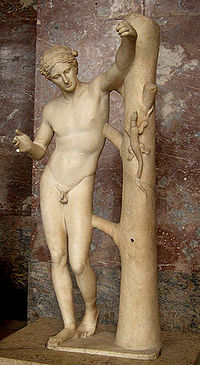
Apollo Sauroktonos
As with the 'Hermes and Infant Dionysus', gracefulness in repose, and an indefinable charm are also the attributes of works in museums which appear to be copies of statues by Praxiteles. Perhaps the most notable of these are the Apollo SauroktonosApollo Sauroctonos
The Apollo Sauroktonos is a 1.49m high ancient sculpture in the Louvre, as Inventaire MR 78 . It is a 1st - 2nd century AD Roman marble copy of an original by Praxiteles. It shows a nude adolescent male about to catch a lizard climbing up a tree...
, or the lizard-slayer, a youth leaning against a tree and idly striking with an arrow at a lizard (Louvre
Louvre
The Musée du Louvre – in English, the Louvre Museum or simply the Louvre – is one of the world's largest museums, the most visited art museum in the world and a historic monument. A central landmark of Paris, it is located on the Right Bank of the Seine in the 1st arrondissement...
Museum), and the Aphrodite of Cnidus at the Vatican Museums
Vatican Museums
The Vatican Museums , in Viale Vaticano in Rome, inside the Vatican City, are among the greatest museums in the world, since they display works from the immense collection built up by the Roman Catholic Church throughout the centuries, including some of the most renowned classical sculptures and...
, which is a copy of the statue made by Praxiteles for the people of Cnidus, and by them valued so highly that they refused to sell it to King Nicomedes
Nicomedes I of Bithynia
Nicomedes I , second king of Bithynia, was the eldest son of Zipoetes I, whom he succeeded on the throne in 278 BC.-Overview:He commenced his reign by putting to death two of his brothers but the third, subsequently called Zipoetes II, raised an insurrection against him and succeeded in maintaining...
, who was willing in return to discharge the whole debt of the city, which, says Pliny, was enormous.
Cleveland Museum of Art
The Cleveland Museum of Art is an art museum situated in the Wade Park District, in the University Circle neighborhood on Cleveland's east side. Internationally renowned for its substantial holdings of Asian and Egyptian art, the museum houses a diverse permanent collection of more than 43,000...
(CMA), announced the acquisition of an ancient bronze sculpture of Apollo Sauroktonos, believed to be the only near-complete original work by Praxiteles. The dating and attribution of the sculpture will continue to be studied, the museum noted. This piece was to be included in the 2007 Praxiteles exhibition organized by the Louvre
Louvre
The Musée du Louvre – in English, the Louvre Museum or simply the Louvre – is one of the world's largest museums, the most visited art museum in the world and a historic monument. A central landmark of Paris, it is located on the Right Bank of the Seine in the 1st arrondissement...
Museum in Paris
Paris
Paris is the capital and largest city in France, situated on the river Seine, in northern France, at the heart of the Île-de-France region...
, but pressure from Greece
Greece
Greece , officially the Hellenic Republic , and historically Hellas or the Republic of Greece in English, is a country in southeastern Europe....
, which disputes the work's provenance and legal ownership, caused the French to exclude it from the show.
Apollo Lykeios
The Apollo Lykeios or Lycian Apollo, another Apollo-type reclining on a tree, is usually attributed to Praxiteles. It shows the god resting on a support (a tree trunk or tripod), his right arm touching the top of his head, and his hair fixed in braids on the top of a head in a haircut typical of childhood. It is called « Lycian »not after LyciaLycia
Lycia Lycian: Trm̃mis; ) was a region in Anatolia in what are now the provinces of Antalya and Muğla on the southern coast of Turkey. It was a federation of ancient cities in the region and later a province of the Roman Empire...
itself, but after its identification with a lost work described by Lucian
Lucian
Lucian of Samosata was a rhetorician and satirist who wrote in the Greek language. He is noted for his witty and scoffing nature.His ethnicity is disputed and is attributed as Assyrian according to Frye and Parpola, and Syrian according to Joseph....
as being on show in the Lykeion, one of the gymnasia
Gymnasium (ancient Greece)
The gymnasium in ancient Greece functioned as a training facility for competitors in public games. It was also a place for socializing and engaging in intellectual pursuits. The name comes from the Ancient Greek term gymnós meaning "naked". Athletes competed in the nude, a practice said to...
of Athens
Athens
Athens , is the capital and largest city of Greece. Athens dominates the Attica region and is one of the world's oldest cities, as its recorded history spans around 3,400 years. Classical Athens was a powerful city-state...
.
Capitoline Satyr
The SatyrSatyr
In Greek mythology, satyrs are a troop of male companions of Pan and Dionysus — "satyresses" were a late invention of poets — that roamed the woods and mountains. In myths they are often associated with pipe-playing....
of the Capitol
Capitoline Hill
The Capitoline Hill , between the Forum and the Campus Martius, is one of the seven hills of Rome. It was the citadel of the earliest Romans. By the 16th century, Capitolinus had become Capitolino in Italian, with the alternative Campidoglio stemming from Capitolium. The English word capitol...
at Rome
Rome
Rome is the capital of Italy and the country's largest and most populated city and comune, with over 2.7 million residents in . The city is located in the central-western portion of the Italian Peninsula, on the Tiber River within the Lazio region of Italy.Rome's history spans two and a half...
has commonly been regarded as a copy of one of the Satyrs of Praxiteles, but it cannot be identified it in the list of his works. Moreover, the style is hard and poor; a far superior replica exists in a torso in the Louvre
Louvre
The Musée du Louvre – in English, the Louvre Museum or simply the Louvre – is one of the world's largest museums, the most visited art museum in the world and a historic monument. A central landmark of Paris, it is located on the Right Bank of the Seine in the 1st arrondissement...
. The attitude and character of the work are certainly of Praxitelean school.
Leto, Apollo and Artemis
Excavations at MantineiaMantineia
Mantineia was a city in ancient Greece that was the site of two significant battles in Classical Greek history. It is also a former municipality in Arcadia, Peloponnese, Greece. Since the 2011 local government reform it is part of the municipality Tripoli, of which it is a municipal unit. Its seat...
in Arcadia
Arcadia
Arcadia is one of the regional units of Greece. It is part of the administrative region of Peloponnese. It is situated in the central and eastern part of the Peloponnese peninsula. It takes its name from the mythological character Arcas. In Greek mythology, it was the home of the god Pan...
have brought to light the base of a group of Leto
Leto
In Greek mythology, Leto is a daughter of the Titans Coeus and Phoebe. The island of Kos is claimed as her birthplace. In the Olympian scheme, Zeus is the father of her twins, Apollo and Artemis, the Letoides, which Leto conceived after her hidden beauty accidentally caught the eyes of Zeus...
, Apollo
Apollo
Apollo is one of the most important and complex of the Olympian deities in Greek and Roman mythology...
and Artemis
Artemis
Artemis was one of the most widely venerated of the Ancient Greek deities. Her Roman equivalent is Diana. Some scholars believe that the name and indeed the goddess herself was originally pre-Greek. Homer refers to her as Artemis Agrotera, Potnia Theron: "Artemis of the wildland, Mistress of Animals"...
by Praxiteles. This base was doubtless not the work of the great sculptor himself, but of one of his assistants. Nevertheless it is pleasing and historically valuable. Pausanias
Pausanias (geographer)
Pausanias was a Greek traveler and geographer of the 2nd century AD, who lived in the times of Hadrian, Antoninus Pius and Marcus Aurelius. He is famous for his Description of Greece , a lengthy work that describes ancient Greece from firsthand observations, and is a crucial link between classical...
(viii. 9, I) thus describes the base, "on the base which supports the statues there are sculptured the Muses and Marsyas
Marsyas
In Greek mythology, the satyr Marsyas is a central figure in two stories involving music: in one, he picked up the double flute that had been abandoned by Athena and played it; in the other, he challenged Apollo to a contest of music and lost his hide and life...
playing the flutes (auloi
Aulos
An aulos or tibia was an ancient Greek wind instrument, depicted often in art and also attested by archaeology.An aulete was the musician who performed on an aulos...
)." Three slabs which have survived represent Apollo; Marsyas; a slave, and six of the Muses, the slab which held the other three having disappeared.
The Leconfield head
The Leconfield Head (a head of the Aphrodite of Cnidus type, included in the 2007 exhibition at the Louvre) in the Red Room, Petworth HousePetworth House
Petworth House in Petworth, West Sussex, England, is a late 17th-century mansion, rebuilt in 1688 by Charles Seymour, 6th Duke of Somerset, and altered in the 1870s by Anthony Salvin...
, West Sussex
West Sussex
West Sussex is a county in the south of England, bordering onto East Sussex , Hampshire and Surrey. The county of Sussex has been divided into East and West since the 12th century, and obtained separate county councils in 1888, but it remained a single ceremonial county until 1974 and the coming...
, UK, was claimed by Adolf Furtwängler
Adolf Furtwängler
Adolf Furtwängler was a famous German archaeologist, teacher, art historian and museum director. He was the father of the conductor Wilhelm Furtwängler and grandfather of the German archaeologist Andreas Furtwängler....
to be an actual work of Praxiteles, based on its style and its intrinsic quality. The Leconfield Head, the keystone of the Greek antiquities at Petworth was probably bought from Gavin Hamilton
Gavin Hamilton (artist)
Gavin Hamilton was a Scottish neoclassical history painterwho is more widely remembered for his hunts for antiquities in the neighborhood of Rome...
in Rome in 1755.
The Aberdeen Head
The Aberdeen Head, whether of HermesHermes
Hermes is the great messenger of the gods in Greek mythology and a guide to the Underworld. Hermes was born on Mount Kyllini in Arcadia. An Olympian god, he is also the patron of boundaries and of the travelers who cross them, of shepherds and cowherds, of the cunning of thieves, of orators and...
or of a youthful Heracles
Heracles
Heracles ,born Alcaeus or Alcides , was a divine hero in Greek mythology, the son of Zeus and Alcmene, foster son of Amphitryon and great-grandson of Perseus...
, in the British Museum
British Museum
The British Museum is a museum of human history and culture in London. Its collections, which number more than seven million objects, are amongst the largest and most comprehensive in the world and originate from all continents, illustrating and documenting the story of human culture from its...
, is linked to Praxiteles by its striking resemblance to the Hermes of Olympia.
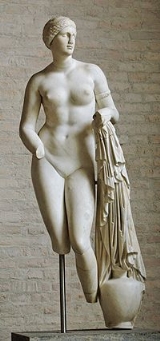
Aphrodite of Cnidus
Aphrodite of Cnidus was Praxiteles's most famous statue. It was the first time that a full-scale female figure was portrayed nude. Its renown was such, that it was immortalised in a lyric epigram:Paris
Paris (mythology)
Paris , the son of Priam, king of Troy, appears in a number of Greek legends. Probably the best-known was his elopement with Helen, queen of Sparta, this being one of the immediate causes of the Trojan War...
did see me naked,
Adonis
Adonis
Adonis , in Greek mythology, the god of beauty and desire, is a figure with Northwest Semitic antecedents, where he is a central figure in various mystery religions. The Greek , Adōnis is a variation of the Semitic word Adonai, "lord", which is also one of the names used to refer to God in the Old...
, and Anchises
Anchises
In Greek mythology, Anchises was the son of Capys and Themiste . His major claim to fame in Greek mythology is that he was a mortal lover of the goddess Aphrodite . One version is that Aphrodite pretended to be a Phrygian princess and seduced him for nearly two weeks of lovemaking...
,
except I knew all three of them.
Where did the sculptor see me?
Artemis of Antikyra
According to PausaniasPausanias (geographer)
Pausanias was a Greek traveler and geographer of the 2nd century AD, who lived in the times of Hadrian, Antoninus Pius and Marcus Aurelius. He is famous for his Description of Greece , a lengthy work that describes ancient Greece from firsthand observations, and is a crucial link between classical...
there was a statue of Artemis made by Praxiteles in her temple in Anticyra
Anticyra
Anticyra, or Antikyra the ancient name of a city in Phokis, Greece.-Name and Mycenaean past:Mod. name Antikyra; until the early 20th century it was called "Aspra Spitia", a name given after 1960 to a wholly new adjacent settlement, 3 km to the East; in Phocis, on the bay of Anticyra, in the...
of Phokis. The appearance of the statue, which represented the goddess with a torch and an arch in her hands and a dog at her feet, is known from a 2nd century BC bronze coin of the city.
Uncertain attributions
VitruviusVitruvius
Marcus Vitruvius Pollio was a Roman writer, architect and engineer, active in the 1st century BC. He is best known as the author of the multi-volume work De Architectura ....
(vii, praef. 13) lists Praxiteles as an artist on the Mausoleum of Maussollos
Mausoleum of Maussollos
The Mausoleum at Halicarnassus or Tomb of Mausolus was a tomb built between 353 and 350 BC at Halicarnassus for Mausolus, a satrap in the Persian Empire, and Artemisia II of Caria, his wife and sister....
and Strabo
Strabo
Strabo, also written Strabon was a Greek historian, geographer and philosopher.-Life:Strabo was born to an affluent family from Amaseia in Pontus , a city which he said was situated the approximate equivalent of 75 km from the Black Sea...
(xiv, 23, 51) attributes to him the whole sculpted decoration of the Temple of Artemis
Temple of Artemis
The Temple of Artemis , also known less precisely as the Temple of Diana, was a Greek temple dedicated to a goddess Greeks identified as Artemis and was one of the Seven Wonders of the Ancient World. It was situated at Ephesus , and was completely rebuilt three times before its eventual destruction...
at Ephesus
Ephesus
Ephesus was an ancient Greek city, and later a major Roman city, on the west coast of Asia Minor, near present-day Selçuk, Izmir Province, Turkey. It was one of the twelve cities of the Ionian League during the Classical Greek era...
. These mentions are widely considered as dubious.
Roman copies
Besides these works, associated with Praxiteles by reference to notices in ancient writers, there are numerous copies of the Roman age, statues of Hermes, of Dionysus, of Aphrodite of Satyrs and Nymphs and the like, in which a varied expression of Praxitelean style may be discerned.Praxitelean style
Five points of composition may be mentioned, which appear to be in origin Praxitelean, however these points cannot prove to be conclusive.- a very flexible line divides the figures if drawn down the midst from top to bottom; they all tend to be lounging
- they are adapted to front and back view rather than to be seen from one side or the other
- trees, drapery, and the like are used for supports to the marbleMarble sculptureMarble sculpture is the art of creating three-dimensional forms from marble. Sculpture is among the oldest of the arts. Even before painting cave walls, early humans fashioned shapes from stone. From these beginnings, artifacts have evolved to their current complexity...
figures, and are included in the design instead of being extraneous to it - the faces are presented in three-quarter view.
- the statue was found on the same site on which Pausanias described it.
External links
- Archaeological Museum of Olympia: The Hermes of Praxiteles
- CMA Collections: Apollo Sauroktonos by Praxiteles
- about Apollo Sauroktonos statues in marble and bronze
- small head of Aphrodite - Olympia - believed to be an original work by Praxiteles
- 2007 Praxitèle: 2007 exhibition at the Musée du Louvre Exhibition catalogue by Alain Pasquier and Jean-Luc Martinez.
- Antonio Corso. The Art of Praxilites. L'ERma di Bretschneider, Roma 2004. Vol I. The development of Praxiteles' workshop and its cultural tradition until the sculptor's acme (364-1 BC)
- Antonio Corso. The Art of Praxilites. L'ERma di Bretschneider, Roma 2004. Vol II. The mature years
- Artcyclopedia: Praxilites