


Polenta

Encyclopedia
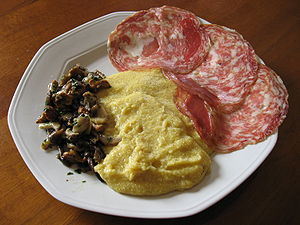
Cornmeal
Cornmeal is flour ground from dried maize or American corn. It is a common staple food, and is ground to fine, medium, and coarse consistencies. In the United States, the finely ground cornmeal is also referred to as cornflour. However, the word cornflour denotes cornstarch in recipes from the...
. The word "polenta" is borrowed
Loanword
A loanword is a word borrowed from a donor language and incorporated into a recipient language. By contrast, a calque or loan translation is a related concept where the meaning or idiom is borrowed rather than the lexical item itself. The word loanword is itself a calque of the German Lehnwort,...
from Italian
Italian language
Italian is a Romance language spoken mainly in Europe: Italy, Switzerland, San Marino, Vatican City, by minorities in Malta, Monaco, Croatia, Slovenia, France, Libya, Eritrea, and Somalia, and by immigrant communities in the Americas and Australia...
.
Description
Polenta is made with ground yellow or white cornmealCornmeal
Cornmeal is flour ground from dried maize or American corn. It is a common staple food, and is ground to fine, medium, and coarse consistencies. In the United States, the finely ground cornmeal is also referred to as cornflour. However, the word cornflour denotes cornstarch in recipes from the...
(ground maize
Maize
Maize known in many English-speaking countries as corn or mielie/mealie, is a grain domesticated by indigenous peoples in Mesoamerica in prehistoric times. The leafy stalk produces ears which contain seeds called kernels. Though technically a grain, maize kernels are used in cooking as a vegetable...
), which can be ground coarsely or finely depending on the region and the texture desired.
As it is known today, polenta derives from earlier forms of grain mush (known as puls or pulmentum in Latin or more commonly as gruel
Gruel
Gruel is a food preparation consisting of some type of cereal—oat, wheat or rye flour, or rice—boiled in water or milk. It is a thinner version of porridge that may be more often drunk than eaten and need not even be cooked...
or porridge
Porridge
Porridge is a dish made by boiling oats or other cereal meals in water, milk, or both. It is usually served hot in a bowl or dish...
) commonly eaten in Roman times and after. Before the arrival of corn from the New World at the end of the 15th century, polenta was made with such starches as farro
Farro
Farro is a food product consisting of the grains of certain wheat species in whole form. The exact definition is debated. It is sold dried and is prepared by cooking in water until soft, but still crunchy . It may be eaten plain, though it is often used as an ingredient in dishes such as salads and...
, chestnut
Chestnut
Chestnut , some species called chinkapin or chinquapin, is a genus of eight or nine species of deciduous trees and shrubs in the beech family Fagaceae, native to temperate regions of the Northern Hemisphere. The name also refers to the edible nuts they produce.-Species:The chestnut belongs to the...
flour, millet
Millet
The millets are a group of small-seeded species of cereal crops or grains, widely grown around the world for food and fodder. They do not form a taxonomic group, but rather a functional or agronomic one. Their essential similarities are that they are small-seeded grasses grown in difficult...
, spelt
Spelt
Spelt is a hexaploid species of wheat. Spelt was an important staple in parts of Europe from the Bronze Age to medieval times; it now survives as a relict crop in Central Europe and northern Spain and has found a new market as a health food. Spelt is sometimes considered a subspecies of the...
or chickpea
Chickpea
The chickpea is a legume of the family Fabaceae, subfamily Faboideae...
s.
Polenta has a smooth, creamy texture due to the gelatinization of starch
Starch gelatinization
Starch gelatinization is a process that breaks down the intermolecular bonds of starch molecules in the presence of water and heat, allowing the hydrogen bonding sites to engage more water. This irreversibly dissolves the starch granule...
in the grain, though it may not be completely homogeneous if a coarse grind or a particularly hard grain such as flint corn
Flint corn
Flint corn, is the same species as, but a different variant of maize...
is used.
Polenta was originally and still is classified as a peasant food
Peasant foods
Peasant foods are those dishes specific to a particular culture made from accessible and inexpensive ingredients and usually prepared and spiced to make them more palatable...
. Sometimes topped with sauces, in the 1940s and 1950s polenta was often eaten with just a little salted anchovy
Anchovy
Anchovies are a family of small, common salt-water forage fish. There are 144 species in 17 genera, found in the Atlantic, Indian, and Pacific Oceans. Anchovies are usually classified as an oily fish.-Description:...
or herring
Herring
Herring is an oily fish of the genus Clupea, found in the shallow, temperate waters of the North Pacific and the North Atlantic oceans, including the Baltic Sea. Three species of Clupea are recognized. The main taxa, the Atlantic herring and the Pacific herring may each be divided into subspecies...
. The reliance on maize as a staple food caused outbreaks of pellagra
Pellagra
Pellagra is a vitamin deficiency disease most commonly caused by a chronic lack of niacin in the diet. It can be caused by decreased intake of niacin or tryptophan, and possibly by excessive intake of leucine. It may also result from alterations in protein metabolism in disorders such as carcinoid...
throughout much of Europe until the 20th century and in the American South during the early 1900s. Maize lacks readily accessible niacin
Niacin
"Niacin" redirects here. For the neo-fusion band, see Niacin .Niacin is an organic compound with the formula and, depending on the definition used, one of the forty to eighty essential human nutrients.Niacin is one of five vitamins associated with a pandemic deficiency disease: niacin deficiency...
unless cooked with alkali, which nixtamalizes
Nixtamalization
Nixtamalization typically refers to a process for the preparation of maize , or other grain, in which the grain is soaked and cooked in an alkaline solution, usually limewater, and hulled. The term can also refer to the removal via an alkali process of the pericarp from other grains such as sorghum...
it.
Since the late 20th century, polenta has found popularity as a gourmet food . Polenta dishes are on the menu in many high-end restaurants, and prepared polenta can be found in supermarkets in tubes or boxes at high prices . Many current polenta recipes have given new life to an essentially bland and simple food, enriching it with meat and mushroom sauces, and adding vegetables, beans or various cheeses into the basic mixture.
Preparation
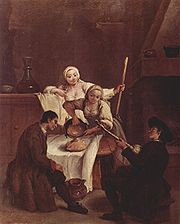
Italian language
Italian is a Romance language spoken mainly in Europe: Italy, Switzerland, San Marino, Vatican City, by minorities in Malta, Monaco, Croatia, Slovenia, France, Libya, Eritrea, and Somalia, and by immigrant communities in the Americas and Australia...
as paiolo. Polenta is known to be a native dish of and to have originated from Friuli
Friuli
Friuli is an area of northeastern Italy with its own particular cultural and historical identity. It comprises the major part of the autonomous region Friuli-Venezia Giulia, i.e. the province of Udine, Pordenone, Gorizia, excluding Trieste...
. There are many different ways to cook polenta. Some Lombard
Lombardy
Lombardy is one of the 20 regions of Italy. The capital is Milan. One-sixth of Italy's population lives in Lombardy and about one fifth of Italy's GDP is produced in this region, making it the most populous and richest region in the country and one of the richest in the whole of Europe...
polenta dishes are polenta taragna (which includes buckwheat
Buckwheat
Buckwheat refers to a variety of plants in the dicot family Polygonaceae: the Eurasian genus Fagopyrum, the North American genus Eriogonum, and the Northern Hemisphere genus Fallopia. Either of the latter two may be referred to as "wild buckwheat"...
flour), polenta uncia, polenta concia, polenta e gorgonzola, and missultin e polenta; all are cooked with various cheeses and butter, except the last one, which is cooked with fish from Lake Como
Lake Como
Lake Como is a lake of glacial origin in Lombardy, Italy. It has an area of 146 km², making it the third largest lake in Italy, after Lake Garda and Lake Maggiore...
. It can also be cooked with porcini mushrooms, rapini
Rapini
Rapini Rapini Rapini (also known as Broccoli Rabe (or Raap or Raab), Broccoletti, Broccoli di Rape, Cime di Rapa, Rape, Rappi, Friarielli (in Naples) is a common vegetable in the cuisines of southern Italy (in particular Basilicata , Puglia, and Sicily), Galicia (northwestern Spain), and China...
, or other vegetables or meats, such as small songbird
Songbird
A songbird is a bird belonging to the suborder Passeri of the perching birds . Another name that is sometimes seen as scientific or vernacular name is Oscines, from Latin oscen, "a songbird"...
s in the case of the Venetian
Veneto
Veneto is one of the 20 regions of Italy. Its population is about 5 million, ranking 5th in Italy.Veneto had been for more than a millennium an independent state, the Republic of Venice, until it was eventually annexed by Italy in 1866 after brief Austrian and French rule...
and Lombard dish polenta e osei. In some areas of Piedmont
Piedmont
Piedmont is one of the 20 regions of Italy. It has an area of 25,402 square kilometres and a population of about 4.4 million. The capital of Piedmont is Turin. The main local language is Piedmontese. Occitan is also spoken by a minority in the Occitan Valleys situated in the Provinces of...
it can be also made of potatoes instead of cornmeal (polenta bianca).
Western polenta is denser, while the eastern one is softer. The variety of cereal used is usually yellow maize, but buckwheat
Buckwheat
Buckwheat refers to a variety of plants in the dicot family Polygonaceae: the Eurasian genus Fagopyrum, the North American genus Eriogonum, and the Northern Hemisphere genus Fallopia. Either of the latter two may be referred to as "wild buckwheat"...
, white maize or mixtures thereof are also used.
Polenta is traditionally a slowly cooked dish. It sometimes takes an hour or longer, and constant stirring is necessary. The time and labor intensity of traditional preparation methods has led to a profusion of shortcuts. These include alternative cooking techniques that are meant to speed up the process. There are also new products such as instant
Convenience food
Convenience food, or tertiary processed food, is commercially prepared food designed for ease of consumption. Products designated as convenience foods are often prepared food stuffs that can be sold as hot, ready-to-eat dishes; as room-temperature, shelf-stable products; or as refrigerated or...
polenta, popular in Italy, that allow for fast, easy preparation at home.
In his book Heat, Bill Buford
Bill Buford
Bill Buford is an American author and journalist. Buford is the author of the books Among the Thugs and Heat: An Amateur's Adventures as Kitchen Slave, Line Cook, Pasta-Maker, and Apprentice to a Dante-Quoting Butcher in Tuscany....
talks about his experiences as a line cook in Mario Batali
Mario Batali
Mario Batali is an American chef, writer, restaurateur and media personality. In addition to his classical culinary training, he is an expert on the history and culture of Italian cuisine, including regional and local variations. Batali co-owns restaurants in New York City, Las Vegas, Los Angeles,...
's Italian restaurant Babbo. Buford details the differences in taste between instant polenta and slowly cooked polenta, and describes a method of preparation that takes up to three hours, but does not require constant stirring: "polenta, for most of its cooking, is left unattended.... If you don't have to stir it all the time, you can cook it for hours—what does it matter, as long as you're nearby?" Cook's Illustrated
Cook's Illustrated
Cook's Illustrated is an American cooking magazine published by America's Test Kitchen in Brookline, Massachusetts, every two months. It accepts no advertising and is characterized by extensive recipe testing and detailed instructions; the magazine also conducts thorough evaluations of kitchen...
magazine has described a method using a microwave oven
Microwave oven
A microwave oven is a kitchen appliance that heats food by dielectric heating, using microwave radiation to heat polarized molecules within the food...
that reduces cooking time to 12 minutes and requires only a single stirring to prepare 3½ cups of cooked polenta and in March 2010 presented a stovetop, near stir-less method, using a pinch of baking soda (adding alkali), which replicates traditional effect. Kyle Phillips suggests making it in a polenta maker or in a slow cooker
Slow cooker
A slow cooker, also known as a Crock-Pot or Slo-Cooker , is a countertop electrical cooking appliance that is used for simmering, which requires maintaining a relatively low temperature compared to other cooking methods for many hours, allowing unattended cooking...
.
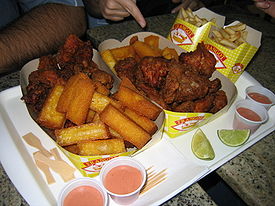
Cooked polenta can also be shaped into balls, patties, or sticks and fried in oil until it is golden brown and crispy; this variety of polenta is called crostini di polenta or polenta fritta. This type of polenta became particularly popular in Southern Brazil as a consequence of Northern Italian immigration. Similarly, once formed into a shape it can also be grilled using, for example, a brustolina
Brustolina
A brustolina is a grill which fits over a gas burner on a hob. It comprises a square sheet of metal with holes punched in it and a square grid over the top . Heat is applied from below and is evenly distributed by the base, deflected upward to the grid...
grill.
Europe
- In AlbaniaAlbaniaAlbania , officially known as the Republic of Albania , is a country in Southeastern Europe, in the Balkans region. It is bordered by Montenegro to the northwest, Kosovo to the northeast, the Republic of Macedonia to the east and Greece to the south and southeast. It has a coast on the Adriatic Sea...
, it is called harapash or kaçamakKacamakKačamak or kachamak is a traditional Bosnian, Serbian, Bulgarian, Macedonian, Albanian and Montenegrin dish. It is also known as Bakrdan in Macedonia.-History:...
. - In TurkeyTurkeyTurkey , known officially as the Republic of Turkey , is a Eurasian country located in Western Asia and in East Thrace in Southeastern Europe...
, it is called muhlama. It is common especially in the northern region of Turkey. - In CroatiaCroatiaCroatia , officially the Republic of Croatia , is a unitary democratic parliamentary republic in Europe at the crossroads of the Mitteleuropa, the Balkans, and the Mediterranean. Its capital and largest city is Zagreb. The country is divided into 20 counties and the city of Zagreb. Croatia covers ...
, polenta is common on the AdriaticAdriatic SeaThe Adriatic Sea is a body of water separating the Italian Peninsula from the Balkan peninsula, and the system of the Apennine Mountains from that of the Dinaric Alps and adjacent ranges...
coast, where it is known as palenta or pura; in northwestern part of Croatia and around ZagrebZagrebZagreb is the capital and the largest city of the Republic of Croatia. It is in the northwest of the country, along the Sava river, at the southern slopes of the Medvednica mountain. Zagreb lies at an elevation of approximately above sea level. According to the last official census, Zagreb's city...
, it is known as žganciŽganciŽganci is a dish in Slovenian and Croatian cuisine, known as Sterz in Austria, pura on the Croatian coast, and also known in northern Italy. It's similar to polenta, although prepared with finer grains. It's made from maize, wheat or buckwheat flour, water, cooking oil and salt, which is cooked for...
. On the Adriatic Croatian coast, polenta goes together with fish or frog stew (brujet, brudet). - In SerbiaSerbiaSerbia , officially the Republic of Serbia , is a landlocked country located at the crossroads of Central and Southeast Europe, covering the southern part of the Carpathian basin and the central part of the Balkans...
. it is called KačamakKacamakKačamak or kachamak is a traditional Bosnian, Serbian, Bulgarian, Macedonian, Albanian and Montenegrin dish. It is also known as Bakrdan in Macedonia.-History:...
or pura. - In SloveniaSloveniaSlovenia , officially the Republic of Slovenia , is a country in Central and Southeastern Europe touching the Alps and bordering the Mediterranean. Slovenia borders Italy to the west, Croatia to the south and east, Hungary to the northeast, and Austria to the north, and also has a small portion of...
, it is also known as polenta. It used to be eaten mainly in the Slovenian LittoralSlovenian LittoralThe Slovenian Littoral is a historical region of Slovenia. Its name recalls the historical Habsburg crown land of the Austrian Littoral, of which the Slovenian Littoral was a part....
, while in central and eastern Slovenia, it was replaced by the buckwheatBuckwheatBuckwheat refers to a variety of plants in the dicot family Polygonaceae: the Eurasian genus Fagopyrum, the North American genus Eriogonum, and the Northern Hemisphere genus Fallopia. Either of the latter two may be referred to as "wild buckwheat"...
žganciŽganciŽganci is a dish in Slovenian and Croatian cuisine, known as Sterz in Austria, pura on the Croatian coast, and also known in northern Italy. It's similar to polenta, although prepared with finer grains. It's made from maize, wheat or buckwheat flour, water, cooking oil and salt, which is cooked for...
, then almost unknown in the western part of the country. - In HungaryHungaryHungary , officially the Republic of Hungary , is a landlocked country in Central Europe. It is situated in the Carpathian Basin and is bordered by Slovakia to the north, Ukraine and Romania to the east, Serbia and Croatia to the south, Slovenia to the southwest and Austria to the west. The...
, it is known as puliszka and is usually made of coarse cornmeal. Traditionally, it is prepared with either sweetened milk or goat's milk cottage cheese, bacon or sometimes mushrooms. - In PortugalPortugalPortugal , officially the Portuguese Republic is a country situated in southwestern Europe on the Iberian Peninsula. Portugal is the westernmost country of Europe, and is bordered by the Atlantic Ocean to the West and South and by Spain to the North and East. The Atlantic archipelagos of the...
, it is known as pirão or xerém and on MadeiraMadeiraMadeira is a Portuguese archipelago that lies between and , just under 400 km north of Tenerife, Canary Islands, in the north Atlantic Ocean and an outermost region of the European Union...
it is known as milho frito. - The CorsicaCorsicaCorsica is an island in the Mediterranean Sea. It is located west of Italy, southeast of the French mainland, and north of the island of Sardinia....
n variety is called pulinta, and it is made with sweet chestnutSweet ChestnutCastanea sativa is a species of the flowering plant family Fagaceae, the tree and its edible seeds are referred to by several common names such Sweet Chestnut or Marron. Originally native to southeastern Europe and Asia Minor, it is now widely dispersed throughout Europe and parts of Asia, such as...
flourFlourFlour is a powder which is made by grinding cereal grains, other seeds or roots . It is the main ingredient of bread, which is a staple food for many cultures, making the availability of adequate supplies of flour a major economic and political issue at various times throughout history...
rather than cornmeal. - In BulgariaBulgariaBulgaria , officially the Republic of Bulgaria , is a parliamentary democracy within a unitary constitutional republic in Southeast Europe. The country borders Romania to the north, Serbia and Macedonia to the west, Greece and Turkey to the south, as well as the Black Sea to the east...
, the dish is called kachamak (качамак). - In the Republic of MacedoniaRepublic of MacedoniaMacedonia , officially the Republic of Macedonia , is a country located in the central Balkan peninsula in Southeast Europe. It is one of the successor states of the former Yugoslavia, from which it declared independence in 1991...
and in SerbiaSerbiaSerbia , officially the Republic of Serbia , is a landlocked country located at the crossroads of Central and Southeast Europe, covering the southern part of the Carpathian basin and the central part of the Balkans...
, it is called palenta or kačamakKacamakKačamak or kachamak is a traditional Bosnian, Serbian, Bulgarian, Macedonian, Albanian and Montenegrin dish. It is also known as Bakrdan in Macedonia.-History:...
(качамак). - The RomaniaRomaniaRomania is a country located at the crossroads of Central and Southeastern Europe, on the Lower Danube, within and outside the Carpathian arch, bordering on the Black Sea...
n variety is called mămăligăMamaligaMămăligă is a porridge made out of yellow maize flour, traditional in Romania and Moldova. It is similar to the Italian polenta.In Transylvania and in Carpathia mămăligă is also called puliszka...
; this word is also borrowed into the RussianRussian languageRussian is a Slavic language used primarily in Russia, Belarus, Uzbekistan, Kazakhstan, Tajikistan and Kyrgyzstan. It is an unofficial but widely spoken language in Ukraine, Moldova, Latvia, Turkmenistan and Estonia and, to a lesser extent, the other countries that were once constituent republics...
(МамалыгаMamaligaMămăligă is a porridge made out of yellow maize flour, traditional in Romania and Moldova. It is similar to the Italian polenta.In Transylvania and in Carpathia mămăligă is also called puliszka...
, but also known as кукурузная кашаKashaKasha is a cereal commonly eaten in Eastern Europe. In English, kasha generally refers to buckwheat groats, but in Slavic countries, kasha refers to porridge in general and can be made from any cereal, especially buckwheat, wheat, barley, oats, millet, and rye...
). - In southern AustriaAustriaAustria , officially the Republic of Austria , is a landlocked country of roughly 8.4 million people in Central Europe. It is bordered by the Czech Republic and Germany to the north, Slovakia and Hungary to the east, Slovenia and Italy to the south, and Switzerland and Liechtenstein to the...
, polenta is also eaten for breakfast (sweet polenta); the polenta pieces are either dipped in café au laitCafé au laitCafé au lait is a French coffee drink. The meaning of the term differs between Europe and the United States; in both cases it means some kind of coffee with hot milk added, in contrast to white coffee, which is coffee with room temperature milk or other whitener added.- Europe :In Europe, "café au...
or served in a bowl with the café au lait poured on top of it. (This is a favourite of children.)
North and South American
Polenta is very similar to coosh, a dish of boiled cornmeal mush which is also often sliced and fried but which is often eaten with sweet toppings like maple syrup. A common dish in the cuisine of the Southern United StatesCuisine of the Southern United States
The cuisine of the Southern United States is defined as the historical regional culinary form of states generally south of the Mason Dixon Line dividing Pennsylvania from Maryland and Delaware as well as along the Ohio River, and extending west to Southern Missouri, Oklahoma and Texas.The most...
is grits
Grits
Grits are a food of American Indian origin common in the Southern United States and mainly eaten at breakfast. They consist of coarsely ground corn, or sometimes alkali-treated corn . They are also sometimes called sofkee or sofkey from the Muskogee language word...
, with the difference that grits are usually made from quickly-cooked coarsely ground kernels or from lye-treated (nixtamalized
Nixtamalization
Nixtamalization typically refers to a process for the preparation of maize , or other grain, in which the grain is soaked and cooked in an alkaline solution, usually limewater, and hulled. The term can also refer to the removal via an alkali process of the pericarp from other grains such as sorghum...
) kernels (ground hominy
Hominy
Hominy or nixtamal is dried maize kernels which have been treated with an alkali in a process called nixtamalization.The English term hominy is derived from the Powhatan language word for maize. Many other Native American cultures also made hominy and integrated it into their diet...
).
Polenta is similar to boiled maize dishes
Atole
Atole is a traditional masa-based Mexican and Central American hot drink. Chocolate atole is known as champurrado or atole...
of Mexico
Mexican cuisine
Mexican cuisine, a style of food that originates in Mexico, is known for its varied flavors, colourful decoration and variety of spices and ingredients, most of which are native to the country. The cuisine of Mexico has evolved through thousands of years of blending indigenous cultures, with later...
, where both maize
Maize
Maize known in many English-speaking countries as corn or mielie/mealie, is a grain domesticated by indigenous peoples in Mesoamerica in prehistoric times. The leafy stalk produces ears which contain seeds called kernels. Though technically a grain, maize kernels are used in cooking as a vegetable...
and hominy originate.
The Brazil
Brazil
Brazil , officially the Federative Republic of Brazil , is the largest country in South America. It is the world's fifth largest country, both by geographical area and by population with over 192 million people...
ian variety is also known as angu. Originally made by native Indians, it is a kind of polenta without salt nor any kind of oil. However, nowadays "Italian" polenta is much more common at Brazilian tables, especially in the southern and southeastern regions (which have high numbers of Italian immigrants), although some people still call it "angu". The city of São Bernardo do Campo
São Bernardo do Campo
São Bernardo do Campo is a municipality in the state of São Paulo, in southern Metropolitan São Paulo and São Paulo microregion. The municipality's total area is 408.45 km ² and a population estimated at 1 July 2009, according to the IBGE, was 810,979 inhabitants, which results in a population...
is notable for its restaurants specialized in frango com polenta (fried chicken with fried polenta).
Polenta is also a very traditional meal in Uruguay
Uruguayan cuisine
Uruguayan cuisine is traditionally based on its European roots, in particular, Mediterranean food from Italy, Spain, Portugal and France, but also from countries such as Germany and Britain, along with African and indigenous mixtures. Many foods from those countries such as pasta, sausages, and...
and Argentina.
African and Afro-Caribbean
In South AfricaSouth Africa
The Republic of South Africa is a country in southern Africa. Located at the southern tip of Africa, it is divided into nine provinces, with of coastline on the Atlantic and Indian oceans...
, cornmeal mush is a staple food called mealie
Mielie-meal
In South Africa, Zambia, Zimbabwe, Malawi, and many other parts of sub-Saharan Africa, a relatively coarse flour made from maize ....
pap
Pap (food)
Pap , a traditional porridge made from mielie-meal , is a staple food of the Bantu inhabitants of South Africa...
; elsewhere in Southern Africa it is called phutu-(pap) or is'tshwala. It is similar to polenta but most often it is not as dense. In Zimbabwe
Zimbabwe
Zimbabwe is a landlocked country located in the southern part of the African continent, between the Zambezi and Limpopo rivers. It is bordered by South Africa to the south, Botswana to the southwest, Zambia and a tip of Namibia to the northwest and Mozambique to the east. Zimbabwe has three...
it is called sadza
Sadza
Sadza in Shona, Isitshwala in isiNdebele, pap in South Africa or nsima in the Chichewa language of Malawi, is a cooked corn meal that is the staple food in Zimbabwe and other parts of southern and eastern Africa. This food is cooked widely in other countries of the region.Sadza in appearance is a...
, phaletshe, in Botswana
Botswana
Botswana, officially the Republic of Botswana , is a landlocked country located in Southern Africa. The citizens are referred to as "Batswana" . Formerly the British protectorate of Bechuanaland, Botswana adopted its new name after becoming independent within the Commonwealth on 30 September 1966...
, and nshima
Nshima
Nshima or nsima or Bidia is a cornmeal product and a staple food in Zambia, Malawi and the Kasai Oriental and Kasai Occidental provinces of the Democratic Republic of Congo. It is made from ground maize flour known locally as mealie-meal...
, in Zambia
Zambia
Zambia , officially the Republic of Zambia, is a landlocked country in Southern Africa. The neighbouring countries are the Democratic Republic of the Congo to the north, Tanzania to the north-east, Malawi to the east, Mozambique, Zimbabwe, Botswana and Namibia to the south, and Angola to the west....
, and "Oshifima" or Pap in Namibia
Namibia
Namibia, officially the Republic of Namibia , is a country in southern Africa whose western border is the Atlantic Ocean. It shares land borders with Angola and Zambia to the north, Botswana to the east and South Africa to the south and east. It gained independence from South Africa on 21 March...
. In East Africa
East Africa
East Africa or Eastern Africa is the easterly region of the African continent, variably defined by geography or geopolitics. In the UN scheme of geographic regions, 19 territories constitute Eastern Africa:...
a similar dish is called ugali
Ugali
Ugali is an East African dish of maize flour cooked with water to a porridge- or dough-like consistency. It is the most common staple starch of much of Eastern and Southern Africa...
, named from the Swahili language
Swahili language
Swahili or Kiswahili is a Bantu language spoken by various ethnic groups that inhabit several large stretches of the Mozambique Channel coastline from northern Kenya to northern Mozambique, including the Comoro Islands. It is also spoken by ethnic minority groups in Somalia...
. In Mauritius
Mauritius
Mauritius , officially the Republic of Mauritius is an island nation off the southeast coast of the African continent in the southwest Indian Ocean, about east of Madagascar...
, polenta is commonly used to make Poudine Maïs, Fufu
Fufu
Fufu, , is a staple snack of West and Central Africa. It is a thick paste usually made by boiling starchy root vegetables in water and pounding with a mortar and pestle until the desired consistency is reached...
, a starch-based food from West
West Africa
West Africa or Western Africa is the westernmost region of the African continent. Geopolitically, the UN definition of Western Africa includes the following 16 countries and an area of approximately 5 million square km:-Flags of West Africa:...
and Central Africa
Central Africa
Central Africa is a core region of the African continent which includes Burundi, the Central African Republic, Chad, the Democratic Republic of the Congo, and Rwanda....
, may also be made from maize meal. In the north of Angola it is known as funge, probable source of names for the dish in a number of Caribbean countries, destination of slaves from Angola and elsewhere along the West Coast. In the Caribbean, similar dishes are Pastelle (Trinidad & Tobago), cou-cou (Barbados
Barbados
Barbados is an island country in the Lesser Antilles. It is in length and as much as in width, amounting to . It is situated in the western area of the North Atlantic and 100 kilometres east of the Windward Islands and the Caribbean Sea; therein, it is about east of the islands of Saint...
), funchi (Curaçao
Curaçao
Curaçao is an island in the southern Caribbean Sea, off the Venezuelan coast. The Country of Curaçao , which includes the main island plus the small, uninhabited island of Klein Curaçao , is a constituent country of the Kingdom of the Netherlands...
and Aruba
Aruba
Aruba is a 33 km-long island of the Lesser Antilles in the southern Caribbean Sea, located 27 km north of the coast of Venezuela and 130 km east of Guajira Peninsula...
), funjie (Antigua and Barbuda
Antigua and Barbuda
Antigua and Barbuda is a twin-island nation lying between the Caribbean Sea and the Atlantic Ocean. It consists of two major inhabited islands, Antigua and Barbuda, and a number of smaller islands...
) and fungi (Virgin Islands
Virgin Islands
The Virgin Islands are the western island group of the Leeward Islands, which are the northern part of the Lesser Antilles, which form the border between the Caribbean Sea and the Atlantic Ocean...
). It is known as funche in Puerto Rican cuisine and mayi moulin in Haitian cuisine
Haitian cuisine
Haitian cuisine originates from several culinary styles from the various historical ethnic groups that populated the western portion of the island of Hispaniola, namely the French, African, and the Taíno Amerindians.-History:...
.
See also
- CornmealCornmealCornmeal is flour ground from dried maize or American corn. It is a common staple food, and is ground to fine, medium, and coarse consistencies. In the United States, the finely ground cornmeal is also referred to as cornflour. However, the word cornflour denotes cornstarch in recipes from the...
- Coosh
- FarinaFarina (food)Farina is a cereal food, frequently described as mild-tasting, usually served warm, made from cereal grains. In contemporary American English use, the word usually refers to Cream of Wheat made from soft wheat. Wheat farina is a carbohydrate-rich food, often cooked in boiling water and served warm...
- FufuFufuFufu, , is a staple snack of West and Central Africa. It is a thick paste usually made by boiling starchy root vegetables in water and pounding with a mortar and pestle until the desired consistency is reached...
- Ga'atGa'atGa'at is a stiff porridge, made traditionally with barley flour, though in many diaspora communities wheat flour is often used. To cook ga'at, the flour and water are combined and stirred continuously with a wooden spoon. Ga'at is presented in a large mound with a hole in the center, filled with a...
- GritsGritsGrits are a food of American Indian origin common in the Southern United States and mainly eaten at breakfast. They consist of coarsely ground corn, or sometimes alkali-treated corn . They are also sometimes called sofkee or sofkey from the Muskogee language word...
- Hasty puddingHasty puddingHasty pudding is a pudding or porridge of grains cooked in milk or water. In the United States, it invariably refers to a version made of ground corn...
- MămăligăMamaligaMămăligă is a porridge made out of yellow maize flour, traditional in Romania and Moldova. It is similar to the Italian polenta.In Transylvania and in Carpathia mămăligă is also called puliszka...
- Mielie papPap (food)Pap , a traditional porridge made from mielie-meal , is a staple food of the Bantu inhabitants of South Africa...
- Pudding cornPudding CornPudding Corn is a gelatinous food product made from stewed corn, water, any of various thickening agents, and optional additional flavoring or texturing ingredients, typically used as a food staple in rural communities in the southeastern parts of the United States, especially in Appalachia.Recipes...
- MushMush (cornmeal)Mush — sometimes called coosh — is a thick cornmeal pudding usually boiled in water or milk. It is often allowed to set, or gel into a semi solid, then cut into flat squares or rectangles, and pan fried. Usage is especially common in the eastern and southeastern United States. It is also customary...
- NshimaNshimaNshima or nsima or Bidia is a cornmeal product and a staple food in Zambia, Malawi and the Kasai Oriental and Kasai Occidental provinces of the Democratic Republic of Congo. It is made from ground maize flour known locally as mealie-meal...
- SadzaSadzaSadza in Shona, Isitshwala in isiNdebele, pap in South Africa or nsima in the Chichewa language of Malawi, is a cooked corn meal that is the staple food in Zimbabwe and other parts of southern and eastern Africa. This food is cooked widely in other countries of the region.Sadza in appearance is a...
- UgaliUgaliUgali is an East African dish of maize flour cooked with water to a porridge- or dough-like consistency. It is the most common staple starch of much of Eastern and Southern Africa...