

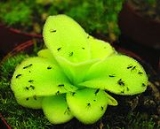
Pinguicula

Encyclopedia
The butterworts are a group of carnivorous plant
s comprising the genus
Pinguicula. Members of this genus use sticky, glandular leaves to lure, trap, and digest insects in order to supplement the poor mineral nutrition they obtain from the environments. Of the roughly 80 currently known species
, 12 are native to Europe
, 9 to North America
, and some in northern Asia
. The largest number of species is in South
and Central America
.
pinguis, "fat"). The common name "butterwort" reflects this characteristic.
s. The only known annuals
are P. sharpii, P. takakii, P. crenatiloba, and P. pumila. All species form stemless rosettes
.

 Butterworts can be divided roughly into two main groups based on the climate
in which they grow; each group is the further subdivided based on morphological
characteristics. Although these groups are not cladistically
supported by genetic studies, these groupings are nonetheless convenient for horticultural purposes.
Tropical butterworts either form somewhat compact winter rosettes composed of fleshy leaves or retain carnivorous leaves year-round. Temperate
species often form tight buds (called hibernacula
) composed of scale-like leaves during a winter dormancy
period. During this time the roots (with the exception of P. alpina
) and carnivorous leaves wither. Temperate species flower when they form their summer rosettes while tropical species flower at each rosette change.
Many butterworts cycle between rosettes composed of carnivorous and non-carnivorous leaves as the seasons change, so these two ecological groupings can be further divided according to their ability to produce different leaves during their growing season. If the growth in the summer is different in size or shape to that in the early spring (for temperate species) or in the winter (tropical species), then plants are considered heterophyllous; whereas uniform growth identifies a homophyllous species.
This results in four groupings:
of Pinguicula species is relatively undeveloped. The thin, white roots serve mainly as an anchor
for the plant and to absorb moisture (nutrients are absorbed through carnivory). In temperate species these roots wither (except in P. alpina
) when the hibernaculum
is formed. In the few epiphytic species (such as P. lignicola), the roots form anchoring suction cups.
blade
of a butterwort is smooth, rigid, and succulent, usually bright green or pinkish in colour. Depending on species, the leaves are between 2 and 30 cm.(1-12") long. The leaf shape depends on the species, but is usually roughly obovate, spatulate, or linear.
 Like all members of the family Lentibulariaceae
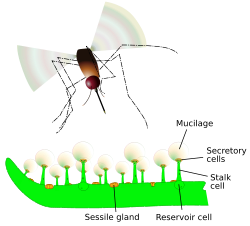
, butterworts are carnivorous. In order to catch and digest insects, the leaf of a butterwort uses two specialized glands which are scattered across the leaf surface (usually only on the upper surface, with the exception of P. gigantea
and P. longifolia ssp. longifolia
). One is termed a peduncular gland, and consists of a few secretory cells on top of a single stalk cell. These cells produce a mucilage
nous secretion which forms visible droplets across the leaf surface. This wet appearance probably helps lure prey in search of water (a similar phenomena is observed in the sundews). The droplets secrete only limited enzymes and serve mainly to entrap insects. On contact with an insect, the peduncular glands release additional mucilage from special reservoir cells located at the base of their stalks. The insect will begin to struggle, triggering more glands and encasing itself in mucilage. Some species can bend their leaf edges slightly by thigmotropism
, bringing additional glands into contact with the trapped insect. The second type of gland found on butterwort leaves are sessile glands which lie flat on the leaf surface. Once the prey is entraped by the peduncular glands and digestion begins, the initial flow of nitrogen
triggers enzyme release by the sessile glands. These enzymes, which include amylase
, esterase
, phosphatase
, protease
, and ribonuclease
break down the digestible components of the insect body. These fluids are then absorbed back into the leaf surface through cuticular
holes, leaving only the chitin
exoskeleton
of the larger insects on the leaf surface.
The holes in the cuticle which allow for this digestive mechanism also pose a challenge for the plant, since they serve as breaks in the cuticle
(waxy layer) that protects the plant from desiccation
. As a result, most butterworts live in humid environments.
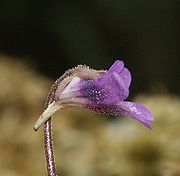 Butterworts are usually only able to trap small insects and those with large wing surfaces. They can also digest pollen
which lands on their leaf surface. The secretory system can only function a single time, so that a particular area of the leaf surface can only be used to digest insects once.
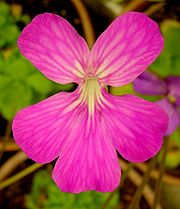 As with almost all carnivorous plants, the flowers of butterworts are held far above the rest of the plant by a long stalk, in order to reduce the probability of trapping potential pollinators. The single, long-lasting flowers are zygomorphic, with two lower lip petals characteristic of the bladderwort family
, and a spur extending from the back of the flower. The calyx has five sepals, and the petal
s are arranged in a two-part lower lip and a three-part upper lip. Most butterwort flowers are blue, violet or white, often suffused with a yellow, greenish or reddish tint. P. laueana and the newly described P. caryophyllacea are unique in having a strikingly red flowers. Butterworts are often cultivated and hybridized primarily for their flowers.
The shape and colors of butterwort flowers are distinguishing characteristics which are used to divide the genus into subgenera and to distinguish individual species from one another.
open when dry into two halves, exposing numerous small (0.5–1 mm), brown seeds
. If moisture is present the silique
closes, protecting the seed and opening again upon dryness to allow for wind dispersal. Many species have a net-like pattern on their seed surface to allow them to land on water surfaces without sinking, since many non-epiphytic butterworts grow near water sources. The haploid chromosome
number of butterworts is either n = 8 or n = 11 (or a multiple thereof), depending on species. The exception is P. lusitanica
, whose chromosome count is n = 6.
by seed
, many butterworts can reproduce asexual
ly by vegetative reproduction
. Many members of the genus form offshoots during or shortly after flowering (e.g. P. vulgaris
), which grow into new genetically identical
adults. A few other species form new offshoots
using stolons (e.g. P. calyptrata, P. vallisneriifolia) while others form plantlets at the leaf margins (e.g. P. heterophylla, P. primuliflora
).
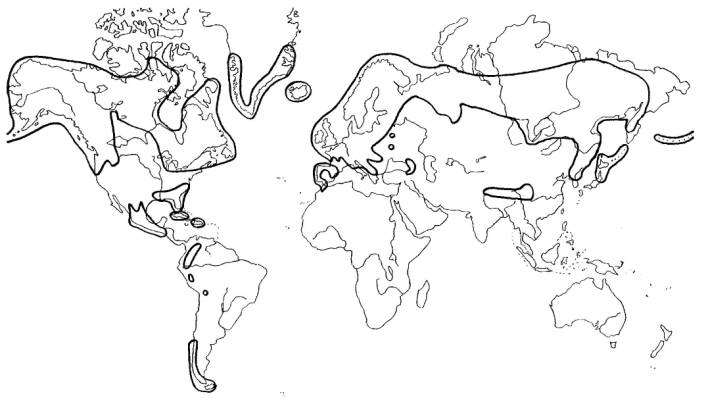
 Butterworts are distributed throughout the northern hemisphere
(map). The greatest concentration of species, however, is in humid mountainous regions of Central America
(including Mexico
) and South America
, where populations can be found as far south as Tierra del Fuego
. Australia
is the only continent
without any native butterworts.
Butterworts probably originated in Central America, as this is the center of Pinguicula diversity – roughly 50% of butterwort species are found here.
The great majority of individual Pinguicula species have a very limited distribution. The two butterwort species with the widest distribution - P. alpina
and P. vulgaris
- are found throughout much of Europe and North America. Other species found in the United States
include P. caerulea, P.ionantha
, P. lutea, P. macroceras, P. planifolia, P. primuliflora
, P. pumila, and P. villosa.

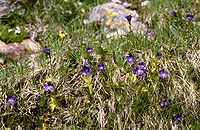 In general, butterworts grow in nutrient poor, alkaline soils. Some species have adapted to other soil types, such as acidic peat bogs (ex. P. vulgaris
, P. calyptrata, P. lusitanica
), soils composed of pure gypsum
(P. gypsicola
and other Mexican species), or even vertical rock walls (P. ramosa
, P. vallisneriifolia, and most of the Mexican species). A few species are epiphytes (P. casabitoana,P. hemiepiphytica, P. lignicola). Many of the Mexican species commonly grow on mossy banks, rock, and roadsides in oak-pine forests. Pinguicula macroceras ssp. nortensis has even been observed growing on hanging dead grasses. Each of these environments is very nutrient-poor, allowing butterworts to compete for space.
Butterworts need habitats that are almost constantly moist or wet, at least during their carnivorous growth stage. Many Mexican species lose their carnivorous leaves, and sprout succulent leaves, or die back to onion-like "bulbs" to survive the winter drought, at which point they can survive in bone-dry conditions. The moisture they need for growing can be supplied by either a high groundwater table
, or by high humidity or high precipitation. Unlike many other carnivorous plants that require sunny locations, many butterworts thrive in part-sun or even shady conditions.
to small areas, such as P. ramosa
, P. casabitoana, and P. fiorii. These populations are threatened primarily by habitat destruction
. Wetland
destruction has threatened several US species. Most of these are federally listed as either threatened or endangered, and P. ionantha
is listed on CITES appendix I, giving it additional protection.
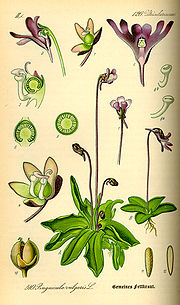 The first mention of butterworts in botanical literature is an entry entitled ("lard herb") by Vitus Auslasser in his 1479 work on medicinal herbs entitled Macer de Herbarium. The name is still used for butterworts in Tirol
, Austria.
In 1583, Clusius already distinguished between two forms in his Historia stirpium rariorum per Pannoniam, Austriam: a blue-flowered form (P. vulgaris
) and a white-flowered form (Pinguicula alpina
). Linnaeus
added P. villosa and P. lusitanica
when he published his Species Plantarum
in 1753. The number of known species rose sharply with the exploration of the new continents in the 19th century; by 1844, 32 species were known.
It was only in the late 19th century that the carnivory of this genus began to be studied in detail. In a letter to Asa Gray
dated June 3, 1874, Charles Darwin
mentioned his early observations of the butterwort's digestive process and insectivorous nature. (See Gray Herbarium of Harvard University (103). Darwin studied these plants extensively. S. J. Casper's
large 1966 monograph of the genus included 46 species, a number which has almost doubled since then. Many exciting discoveries have been made in recent years, especially in Mexico
. Another important development in the history of butterworts is the formation of the International Pinguicula Study Group, an organization dedicated to furthering the knowledge of this genus and promoting its popularity in cultivation, in the 1990s.
s Pinguicula × 'Sethos' and Pinguicula × 'Weser'. Both are crosses of Pinguicula ehlersiae and Pinguicula moranensis
, and are employed by commercial orchid nurseries to combat pests.
Butterworts also produce a strong bactericide which prevents insects from rotting while they are being digested. According to Linnaeus
, this property has long been known by northern Europeans, who applied butterwort leaves to the sore
s of cattle
to promote healing. Additionally, butterwort leaves were used to curdle milk and form a buttermilk-like fermented milk product called (Sweden) and (Norway).
Pinguicula belong to the Bladderwort family (Lentibulariaceae
), along with Utricularia and Genlisea
. Siegfried Jost Casper
systematically
divided them into three subgenera
with 15 sections
.
A detailed study of the phylogenetics of butterworts by Cieslak et al. (2005) found that all of the currently accepted subgenera
and many of the sections were polyphyletic. The diagram below gives a more accurate representation of the correct cladogram
. Polyphyletic sections are marked with an* .
┌────Clade I (Sections Temnoceras* , Orcheosanthus * , Longitubus,
│ Heterophyllum* , Agnata * , Isoloba * , Crassifolia)
│
┌───┤
│ │
│ │
┌──────┤ └────Clade II (Section Micranthus* = P. alpina)
│ │
│ │
┌───┤ └────────Clade III (Sections Micranthus* , Nana)
│ │
│ │
───┤ └───────────────Clade IV (Section Pinguicula)
│
│
└───────────────────Clade V (Sections Isoloba* , Ampullipalatum, Cardiophyllum)
Carnivorous plant
Carnivorous plants are plants that derive some or most of their nutrients from trapping and consuming animals or protozoans, typically insects and other arthropods. Carnivorous plants appear adapted to grow in places where the soil is thin or poor in nutrients, especially nitrogen, such as acidic...
s comprising the genus
Genus
In biology, a genus is a low-level taxonomic rank used in the biological classification of living and fossil organisms, which is an example of definition by genus and differentia...
Pinguicula. Members of this genus use sticky, glandular leaves to lure, trap, and digest insects in order to supplement the poor mineral nutrition they obtain from the environments. Of the roughly 80 currently known species
Species
In biology, a species is one of the basic units of biological classification and a taxonomic rank. A species is often defined as a group of organisms capable of interbreeding and producing fertile offspring. While in many cases this definition is adequate, more precise or differing measures are...
, 12 are native to Europe
Europe
Europe is, by convention, one of the world's seven continents. Comprising the westernmost peninsula of Eurasia, Europe is generally 'divided' from Asia to its east by the watershed divides of the Ural and Caucasus Mountains, the Ural River, the Caspian and Black Seas, and the waterways connecting...
, 9 to North America
North America
North America is a continent wholly within the Northern Hemisphere and almost wholly within the Western Hemisphere. It is also considered a northern subcontinent of the Americas...
, and some in northern Asia
Asia
Asia is the world's largest and most populous continent, located primarily in the eastern and northern hemispheres. It covers 8.7% of the Earth's total surface area and with approximately 3.879 billion people, it hosts 60% of the world's current human population...
. The largest number of species is in South
South America
South America is a continent situated in the Western Hemisphere, mostly in the Southern Hemisphere, with a relatively small portion in the Northern Hemisphere. The continent is also considered a subcontinent of the Americas. It is bordered on the west by the Pacific Ocean and on the north and east...
and Central America
Central America
Central America is the central geographic region of the Americas. It is the southernmost, isthmian portion of the North American continent, which connects with South America on the southeast. When considered part of the unified continental model, it is considered a subcontinent...
.
Etymology
The name Pinguicula is derived from a term coined by Conrad Gesner, who in his 1561 work entitled Horti Germaniae commented on the glistening leaves: "propter pinguia et tenera folia…" (LatinLatin
Latin is an Italic language originally spoken in Latium and Ancient Rome. It, along with most European languages, is a descendant of the ancient Proto-Indo-European language. Although it is considered a dead language, a number of scholars and members of the Christian clergy speak it fluently, and...
pinguis, "fat"). The common name "butterwort" reflects this characteristic.
Characteristics
The majority of Pinguicula are perennial plantPerennial plant
A perennial plant or simply perennial is a plant that lives for more than two years. The term is often used to differentiate a plant from shorter lived annuals and biennials. The term is sometimes misused by commercial gardeners or horticulturalists to describe only herbaceous perennials...
s. The only known annuals
Annual plant
An annual plant is a plant that usually germinates, flowers, and dies in a year or season. True annuals will only live longer than a year if they are prevented from setting seed...
are P. sharpii, P. takakii, P. crenatiloba, and P. pumila. All species form stemless rosettes
Rosette (botany)
In botany, a rosette is a circular arrangement of leaves, with all the leaves at a single height.Though rosettes usually sit near the soil, their structure is an example of a modified stem.-Function:...
.
Habit
Climate
Climate encompasses the statistics of temperature, humidity, atmospheric pressure, wind, rainfall, atmospheric particle count and other meteorological elemental measurements in a given region over long periods...
in which they grow; each group is the further subdivided based on morphological
Morphology (biology)
In biology, morphology is a branch of bioscience dealing with the study of the form and structure of organisms and their specific structural features....
characteristics. Although these groups are not cladistically
Cladistics
Cladistics is a method of classifying species of organisms into groups called clades, which consist of an ancestor organism and all its descendants . For example, birds, dinosaurs, crocodiles, and all descendants of their most recent common ancestor form a clade...
supported by genetic studies, these groupings are nonetheless convenient for horticultural purposes.
Tropical butterworts either form somewhat compact winter rosettes composed of fleshy leaves or retain carnivorous leaves year-round. Temperate
Temperate
In geography, temperate or tepid latitudes of the globe lie between the tropics and the polar circles. The changes in these regions between summer and winter are generally relatively moderate, rather than extreme hot or cold...
species often form tight buds (called hibernacula
Hibernaculum
Hibernaculum can refer to:* Hibernaculum , the location chosen by an animal for hibernation...
) composed of scale-like leaves during a winter dormancy
Dormancy
Dormancy is a period in an organism's life cycle when growth, development, and physical activity are temporarily stopped. This minimizes metabolic activity and therefore helps an organism to conserve energy. Dormancy tends to be closely associated with environmental conditions...
period. During this time the roots (with the exception of P. alpina
Pinguicula alpina
Pinguicula alpina, also known as the alpine butterwort, is species of carnivorous plant native to high latitudes and altitudes throughout Eurasia. It is one of the most widespread Pinguicula species, being found in mountainous regions from Iceland to the Himalayas...
) and carnivorous leaves wither. Temperate species flower when they form their summer rosettes while tropical species flower at each rosette change.
Many butterworts cycle between rosettes composed of carnivorous and non-carnivorous leaves as the seasons change, so these two ecological groupings can be further divided according to their ability to produce different leaves during their growing season. If the growth in the summer is different in size or shape to that in the early spring (for temperate species) or in the winter (tropical species), then plants are considered heterophyllous; whereas uniform growth identifies a homophyllous species.
This results in four groupings:
- Tropical butterworts: species which do not undergo a winter dormancy but continue to alternately bloom and form rosettes.
- Heterophyllous tropical species: species that alternate between rosettes of carnivorous leaves during the warm season and compact rosettes of fleshy non-carnivorous leaves during the cool season. Examples include P. moranensisPinguicula moranensisPinguicula moranensis is a perennial rosette-forming insectivorous herb native to Mexico and Guatemala. A species of butterwort, it forms summer rosettes of flat, succulent leaves up to 10 centimeters long, which are covered in mucilagenous glands that attract, trap, and digest arthropod...
, P. gypsicolaPinguicula gypsicolaPinguicula gypsicola is an insectivorous plant of the genus Pinguicula native to the Mexican state of San Luis Potosi, a heterophyllous member of the section Orcheosanthus. It grows in gypsum soils and forms stemless rosettes of upright, narrow leaves.-Morphology:P. gypsicola is a perennial...
, and P. laxifoliaPinguicula laxifoliaPinguicula laxifolia is an insectivorous plant of the genus Pinguicula native to the Mexican state of Tamaulipas, the only member of the section Orchidioides. Its pendulous leaves are unusual in the genus, which features mostly species with stiff or succulent leaves.-Morphology:P...
. - Homophyllous tropical species: these species produce rosettes of carnivorous leaves of roughly uniform size throughout the year, such as P. giganteaPinguicula giganteaPinguicula gigantea is a tropical species of carnivorous plant in the family Lentibulariaceae. Its native range is within Mexico. P. giganteas flower is usually a purple colour with the occasional light blue also seen. P. gigantea...
.
- Heterophyllous tropical species: species that alternate between rosettes of carnivorous leaves during the warm season and compact rosettes of fleshy non-carnivorous leaves during the cool season. Examples include P. moranensis
- Temperate butterworts: these plants are native to climate zones with cold winters. They produce a winter-resting bud (hibernaculaHibernaculumHibernaculum can refer to:* Hibernaculum , the location chosen by an animal for hibernation...
) during the winter.- Heterophyllous temperate species: species where the vegetative and generative rosettes differ in shape and/or size, as seen in P. lutea and P. lusitanicaPinguicula lusitanicaPinguicula lusitanica, commonly known as the Pale Butterwort, is a small butterwort that grows wild in acidic peat bog areas along coastal western Europe from western Scotland and Ireland south through western England and western France to Iberia, and Morocco in northwestern Africa.It usually...
. - Homophyllous temperate species: the vegetative and generative rosettes appear identical, as exhibited by P. alpinaPinguicula alpinaPinguicula alpina, also known as the alpine butterwort, is species of carnivorous plant native to high latitudes and altitudes throughout Eurasia. It is one of the most widespread Pinguicula species, being found in mountainous regions from Iceland to the Himalayas...
, P. grandifloraPinguicula grandifloraPinguicula grandiflora, commonly known as the large-flowered butterwort, is a temperate insectivorous plant in the Lentibulariaceae family. One distinguishing feature of the species is its flower, which is much larger than the average for the genus....
, and P. vulgarisPinguicula vulgarisPinguicula vulgaris, the Common butterwort, is a perennial carnivorous plant in the Lentibulariaceae family. It grows to a height of 3–16 cm, and is topped with a purple, and occasionally white, flower that is 15 mm or longer, and shaped like a funnel. This butterwort grows in damp...
.
- Heterophyllous temperate species: species where the vegetative and generative rosettes differ in shape and/or size, as seen in P. lutea and P. lusitanica
Roots
The root systemRoot
In vascular plants, the root is the organ of a plant that typically lies below the surface of the soil. This is not always the case, however, since a root can also be aerial or aerating . Furthermore, a stem normally occurring below ground is not exceptional either...
of Pinguicula species is relatively undeveloped. The thin, white roots serve mainly as an anchor
Anchor
An anchor is a device, normally made of metal, that is used to connect a vessel to the bed of a body of water to prevent the vessel from drifting due to wind or current. The word derives from Latin ancora, which itself comes from the Greek ἄγκυρα .Anchors can either be temporary or permanent...
for the plant and to absorb moisture (nutrients are absorbed through carnivory). In temperate species these roots wither (except in P. alpina
Pinguicula alpina
Pinguicula alpina, also known as the alpine butterwort, is species of carnivorous plant native to high latitudes and altitudes throughout Eurasia. It is one of the most widespread Pinguicula species, being found in mountainous regions from Iceland to the Himalayas...
) when the hibernaculum
Hibernaculum
Hibernaculum can refer to:* Hibernaculum , the location chosen by an animal for hibernation...
is formed. In the few epiphytic species (such as P. lignicola), the roots form anchoring suction cups.
Leaves and carnivory
The leafLeaf
A leaf is an organ of a vascular plant, as defined in botanical terms, and in particular in plant morphology. Foliage is a mass noun that refers to leaves as a feature of plants....
blade
Blade
A blade is that portion of a tool, weapon, or machine with a cutting edge and/or a pointed tip that is designed to cut and/or puncture, stab, slash, chop, slice, thrust, or scrape animate or inanimate surfaces or materials...
of a butterwort is smooth, rigid, and succulent, usually bright green or pinkish in colour. Depending on species, the leaves are between 2 and 30 cm.(1-12") long. The leaf shape depends on the species, but is usually roughly obovate, spatulate, or linear.
Lentibulariaceae
Lentibulariaceae is a family of carnivorous plants containing three genera, Genlisea, the corkscrew plants, Pinguicula, the butterworts, and Utricularia, the bladderworts....
, butterworts are carnivorous. In order to catch and digest insects, the leaf of a butterwort uses two specialized glands which are scattered across the leaf surface (usually only on the upper surface, with the exception of P. gigantea
Pinguicula gigantea
Pinguicula gigantea is a tropical species of carnivorous plant in the family Lentibulariaceae. Its native range is within Mexico. P. giganteas flower is usually a purple colour with the occasional light blue also seen. P. gigantea...
and P. longifolia ssp. longifolia
Pinguicula longifolia
Pinguicula longifolia, commonly known as the long-leaved butterwort, is a perennial carnivorous sub-alpine plant of the Central Pyrenees, found on both sides of the border...
). One is termed a peduncular gland, and consists of a few secretory cells on top of a single stalk cell. These cells produce a mucilage
Mucilage
Mucilage is a thick, gluey substance produced by most plants and some microorganisms. It is a polar glycoprotein and an exopolysaccharide.It occurs in various parts of nearly all classes of plant, usually in relatively small percentages, and is frequently associated with other substances, such as...
nous secretion which forms visible droplets across the leaf surface. This wet appearance probably helps lure prey in search of water (a similar phenomena is observed in the sundews). The droplets secrete only limited enzymes and serve mainly to entrap insects. On contact with an insect, the peduncular glands release additional mucilage from special reservoir cells located at the base of their stalks. The insect will begin to struggle, triggering more glands and encasing itself in mucilage. Some species can bend their leaf edges slightly by thigmotropism
Thigmotropism
Thigmotropism is a movement in which an organism moves or grows in response to touch or contact stimuli. The prefix thigmo- θιγμος comes from the Greek for "touch". Usually thigmotropism occurs when plants grow around a surface, such as a wall, pot, or trellis. Climbing plants, such as vines,...
, bringing additional glands into contact with the trapped insect. The second type of gland found on butterwort leaves are sessile glands which lie flat on the leaf surface. Once the prey is entraped by the peduncular glands and digestion begins, the initial flow of nitrogen
Nitrogen
Nitrogen is a chemical element that has the symbol N, atomic number of 7 and atomic mass 14.00674 u. Elemental nitrogen is a colorless, odorless, tasteless, and mostly inert diatomic gas at standard conditions, constituting 78.08% by volume of Earth's atmosphere...
triggers enzyme release by the sessile glands. These enzymes, which include amylase
Amylase
Amylase is an enzyme that catalyses the breakdown of starch into sugars. Amylase is present in human saliva, where it begins the chemical process of digestion. Food that contains much starch but little sugar, such as rice and potato, taste slightly sweet as they are chewed because amylase turns...
, esterase
Esterase
An esterase is a hydrolase enzyme that splits esters into an acid and an alcohol in a chemical reaction with water called hydrolysis.A wide range of different esterases exist that differ in their substrate specificity, their protein structure, and their biological function.- EC classification/list...
, phosphatase
Phosphatase
A phosphatase is an enzyme that removes a phosphate group from its substrate by hydrolysing phosphoric acid monoesters into a phosphate ion and a molecule with a free hydroxyl group . This action is directly opposite to that of phosphorylases and kinases, which attach phosphate groups to their...
, protease
Protease
A protease is any enzyme that conducts proteolysis, that is, begins protein catabolism by hydrolysis of the peptide bonds that link amino acids together in the polypeptide chain forming the protein....
, and ribonuclease
Ribonuclease
Ribonuclease is a type of nuclease that catalyzes the degradation of RNA into smaller components. Ribonucleases can be divided into endoribonucleases and exoribonucleases, and comprise several sub-classes within the EC 2.7 and 3.1 classes of enzymes.-Function:All organisms studied contain...
break down the digestible components of the insect body. These fluids are then absorbed back into the leaf surface through cuticular
Plant cuticle
Plant cuticles are a protective waxy covering produced only by the epidermal cells of leaves, young shoots and all other aerial plant organs without periderm...
holes, leaving only the chitin
Chitin
Chitin n is a long-chain polymer of a N-acetylglucosamine, a derivative of glucose, and is found in many places throughout the natural world...
exoskeleton
Exoskeleton
An exoskeleton is the external skeleton that supports and protects an animal's body, in contrast to the internal skeleton of, for example, a human. In popular usage, some of the larger kinds of exoskeletons are known as "shells". Examples of exoskeleton animals include insects such as grasshoppers...
of the larger insects on the leaf surface.
The holes in the cuticle which allow for this digestive mechanism also pose a challenge for the plant, since they serve as breaks in the cuticle
Plant cuticle
Plant cuticles are a protective waxy covering produced only by the epidermal cells of leaves, young shoots and all other aerial plant organs without periderm...
(waxy layer) that protects the plant from desiccation
Desiccation
Desiccation is the state of extreme dryness, or the process of extreme drying. A desiccant is a hygroscopic substance that induces or sustains such a state in its local vicinity in a moderately sealed container.-Science:...
. As a result, most butterworts live in humid environments.
Pollen
Pollen is a fine to coarse powder containing the microgametophytes of seed plants, which produce the male gametes . Pollen grains have a hard coat that protects the sperm cells during the process of their movement from the stamens to the pistil of flowering plants or from the male cone to the...
which lands on their leaf surface. The secretory system can only function a single time, so that a particular area of the leaf surface can only be used to digest insects once.
Flowers
Lentibulariaceae
Lentibulariaceae is a family of carnivorous plants containing three genera, Genlisea, the corkscrew plants, Pinguicula, the butterworts, and Utricularia, the bladderworts....
, and a spur extending from the back of the flower. The calyx has five sepals, and the petal
Petal
Petals are modified leaves that surround the reproductive parts of flowers. They often are brightly colored or unusually shaped to attract pollinators. Together, all of the petals of a flower are called a corolla. Petals are usually accompanied by another set of special leaves called sepals lying...
s are arranged in a two-part lower lip and a three-part upper lip. Most butterwort flowers are blue, violet or white, often suffused with a yellow, greenish or reddish tint. P. laueana and the newly described P. caryophyllacea are unique in having a strikingly red flowers. Butterworts are often cultivated and hybridized primarily for their flowers.
The shape and colors of butterwort flowers are distinguishing characteristics which are used to divide the genus into subgenera and to distinguish individual species from one another.
Fruit and seed
The round to egg-shaped seed capsulesCapsule (fruit)
In botany a capsule is a type of simple, dry fruit produced by many species of flowering plants. A capsule is a structure composed of two or more carpels that in most cases is dehiscent, i.e. at maturity, it splits apart to release the seeds within. A few capsules are indehiscent, for example...
open when dry into two halves, exposing numerous small (0.5–1 mm), brown seeds
SEEDS
SEEDS is a voluntary organisation registered under the Societies Act of India....
. If moisture is present the silique
Silique
A silique or siliqua is a fruit of 2 fused carpels with the length being more than three times the width. The outer walls of the ovary usually separate when ripe, leaving a persistent partition...
closes, protecting the seed and opening again upon dryness to allow for wind dispersal. Many species have a net-like pattern on their seed surface to allow them to land on water surfaces without sinking, since many non-epiphytic butterworts grow near water sources. The haploid chromosome
Chromosome
A chromosome is an organized structure of DNA and protein found in cells. It is a single piece of coiled DNA containing many genes, regulatory elements and other nucleotide sequences. Chromosomes also contain DNA-bound proteins, which serve to package the DNA and control its functions.Chromosomes...
number of butterworts is either n = 8 or n = 11 (or a multiple thereof), depending on species. The exception is P. lusitanica
Pinguicula lusitanica
Pinguicula lusitanica, commonly known as the Pale Butterwort, is a small butterwort that grows wild in acidic peat bog areas along coastal western Europe from western Scotland and Ireland south through western England and western France to Iberia, and Morocco in northwestern Africa.It usually...
, whose chromosome count is n = 6.
Vegetative propagation
As well as sexual reproductionSexual reproduction
Sexual reproduction is the creation of a new organism by combining the genetic material of two organisms. There are two main processes during sexual reproduction; they are: meiosis, involving the halving of the number of chromosomes; and fertilization, involving the fusion of two gametes and the...
by seed
Seed
A seed is a small embryonic plant enclosed in a covering called the seed coat, usually with some stored food. It is the product of the ripened ovule of gymnosperm and angiosperm plants which occurs after fertilization and some growth within the mother plant...
, many butterworts can reproduce asexual
Asexual reproduction
Asexual reproduction is a mode of reproduction by which offspring arise from a single parent, and inherit the genes of that parent only, it is reproduction which does not involve meiosis, ploidy reduction, or fertilization. A more stringent definition is agamogenesis which is reproduction without...
ly by vegetative reproduction
Vegetative reproduction
Vegetative reproduction is a form of asexual reproduction in plants. It is a process by which new individuals arise without production of seeds or spores...
. Many members of the genus form offshoots during or shortly after flowering (e.g. P. vulgaris
Pinguicula vulgaris
Pinguicula vulgaris, the Common butterwort, is a perennial carnivorous plant in the Lentibulariaceae family. It grows to a height of 3–16 cm, and is topped with a purple, and occasionally white, flower that is 15 mm or longer, and shaped like a funnel. This butterwort grows in damp...
), which grow into new genetically identical
Cloning
Cloning in biology is the process of producing similar populations of genetically identical individuals that occurs in nature when organisms such as bacteria, insects or plants reproduce asexually. Cloning in biotechnology refers to processes used to create copies of DNA fragments , cells , or...
adults. A few other species form new offshoots
Offshoot (plant)
Offshoots are lateral shoots that are produced on the main stem of a plant. They may be known colloquially as "suckers". Also see basal shoot....
using stolons (e.g. P. calyptrata, P. vallisneriifolia) while others form plantlets at the leaf margins (e.g. P. heterophylla, P. primuliflora
Pinguicula primuliflora
Pinguicula primuliflora, commonly known as the Primrose Butterwort, is a species of carnivorous plant belonging to the genus Pinguicula. It is native to the southeastern United States. The typical variety forms a white flower in blooming...
).
Distribution
Northern Hemisphere
The Northern Hemisphere is the half of a planet that is north of its equator—the word hemisphere literally means “half sphere”. It is also that half of the celestial sphere north of the celestial equator...
(map). The greatest concentration of species, however, is in humid mountainous regions of Central America
Central America
Central America is the central geographic region of the Americas. It is the southernmost, isthmian portion of the North American continent, which connects with South America on the southeast. When considered part of the unified continental model, it is considered a subcontinent...
(including Mexico
Mexico
The United Mexican States , commonly known as Mexico , is a federal constitutional republic in North America. It is bordered on the north by the United States; on the south and west by the Pacific Ocean; on the southeast by Guatemala, Belize, and the Caribbean Sea; and on the east by the Gulf of...
) and South America
South America
South America is a continent situated in the Western Hemisphere, mostly in the Southern Hemisphere, with a relatively small portion in the Northern Hemisphere. The continent is also considered a subcontinent of the Americas. It is bordered on the west by the Pacific Ocean and on the north and east...
, where populations can be found as far south as Tierra del Fuego
Tierra del Fuego
Tierra del Fuego is an archipelago off the southernmost tip of the South American mainland, across the Strait of Magellan. The archipelago consists of a main island Isla Grande de Tierra del Fuego divided between Chile and Argentina with an area of , and a group of smaller islands including Cape...
. Australia
Australia
Australia , officially the Commonwealth of Australia, is a country in the Southern Hemisphere comprising the mainland of the Australian continent, the island of Tasmania, and numerous smaller islands in the Indian and Pacific Oceans. It is the world's sixth-largest country by total area...
is the only continent
Continent
A continent is one of several very large landmasses on Earth. They are generally identified by convention rather than any strict criteria, with seven regions commonly regarded as continents—they are : Asia, Africa, North America, South America, Antarctica, Europe, and Australia.Plate tectonics is...
without any native butterworts.
Butterworts probably originated in Central America, as this is the center of Pinguicula diversity – roughly 50% of butterwort species are found here.
The great majority of individual Pinguicula species have a very limited distribution. The two butterwort species with the widest distribution - P. alpina
Pinguicula alpina
Pinguicula alpina, also known as the alpine butterwort, is species of carnivorous plant native to high latitudes and altitudes throughout Eurasia. It is one of the most widespread Pinguicula species, being found in mountainous regions from Iceland to the Himalayas...
and P. vulgaris
Pinguicula vulgaris
Pinguicula vulgaris, the Common butterwort, is a perennial carnivorous plant in the Lentibulariaceae family. It grows to a height of 3–16 cm, and is topped with a purple, and occasionally white, flower that is 15 mm or longer, and shaped like a funnel. This butterwort grows in damp...
- are found throughout much of Europe and North America. Other species found in the United States
United States
The United States of America is a federal constitutional republic comprising fifty states and a federal district...
include P. caerulea, P.ionantha
Pinguicula ionantha
Pinguicula ionantha is a rare species of flowering plant in the bladderwort family known by the common names Godfrey's butterwort and violet butterwort. It is endemic to the US state of Florida, where it only occurs in the central Florida Panhandle...
, P. lutea, P. macroceras, P. planifolia, P. primuliflora
Pinguicula primuliflora
Pinguicula primuliflora, commonly known as the Primrose Butterwort, is a species of carnivorous plant belonging to the genus Pinguicula. It is native to the southeastern United States. The typical variety forms a white flower in blooming...
, P. pumila, and P. villosa.
Habitat
Pinguicula vulgaris
Pinguicula vulgaris, the Common butterwort, is a perennial carnivorous plant in the Lentibulariaceae family. It grows to a height of 3–16 cm, and is topped with a purple, and occasionally white, flower that is 15 mm or longer, and shaped like a funnel. This butterwort grows in damp...
, P. calyptrata, P. lusitanica
Pinguicula lusitanica
Pinguicula lusitanica, commonly known as the Pale Butterwort, is a small butterwort that grows wild in acidic peat bog areas along coastal western Europe from western Scotland and Ireland south through western England and western France to Iberia, and Morocco in northwestern Africa.It usually...
), soils composed of pure gypsum
Gypsum
Gypsum is a very soft sulfate mineral composed of calcium sulfate dihydrate, with the chemical formula CaSO4·2H2O. It is found in alabaster, a decorative stone used in Ancient Egypt. It is the second softest mineral on the Mohs Hardness Scale...
(P. gypsicola
Pinguicula gypsicola
Pinguicula gypsicola is an insectivorous plant of the genus Pinguicula native to the Mexican state of San Luis Potosi, a heterophyllous member of the section Orcheosanthus. It grows in gypsum soils and forms stemless rosettes of upright, narrow leaves.-Morphology:P. gypsicola is a perennial...
and other Mexican species), or even vertical rock walls (P. ramosa
Pinguicula ramosa
Pinguicula ramosa is a species of butterwort, a carnivorous plant, endemic to the mountains of Nikkō National Park in Japan. It belongs to the section micranthus and is closely related to Pinguicula variegata...
, P. vallisneriifolia, and most of the Mexican species). A few species are epiphytes (P. casabitoana,P. hemiepiphytica, P. lignicola). Many of the Mexican species commonly grow on mossy banks, rock, and roadsides in oak-pine forests. Pinguicula macroceras ssp. nortensis has even been observed growing on hanging dead grasses. Each of these environments is very nutrient-poor, allowing butterworts to compete for space.
Butterworts need habitats that are almost constantly moist or wet, at least during their carnivorous growth stage. Many Mexican species lose their carnivorous leaves, and sprout succulent leaves, or die back to onion-like "bulbs" to survive the winter drought, at which point they can survive in bone-dry conditions. The moisture they need for growing can be supplied by either a high groundwater table
Water table
The water table is the level at which the submarine pressure is far from atmospheric pressure. It may be conveniently visualized as the 'surface' of the subsurface materials that are saturated with groundwater in a given vicinity. However, saturated conditions may extend above the water table as...
, or by high humidity or high precipitation. Unlike many other carnivorous plants that require sunny locations, many butterworts thrive in part-sun or even shady conditions.
Environmental status
The environmental threats faced by various Pinguicula species depend on their location and on how widespread their distribution is. Most endangered are the species which are endemicEndemic (ecology)
Endemism is the ecological state of being unique to a defined geographic location, such as an island, nation or other defined zone, or habitat type; organisms that are indigenous to a place are not endemic to it if they are also found elsewhere. For example, all species of lemur are endemic to the...
to small areas, such as P. ramosa
Pinguicula ramosa
Pinguicula ramosa is a species of butterwort, a carnivorous plant, endemic to the mountains of Nikkō National Park in Japan. It belongs to the section micranthus and is closely related to Pinguicula variegata...
, P. casabitoana, and P. fiorii. These populations are threatened primarily by habitat destruction
Habitat destruction
Habitat destruction is the process in which natural habitat is rendered functionally unable to support the species present. In this process, the organisms that previously used the site are displaced or destroyed, reducing biodiversity. Habitat destruction by human activity mainly for the purpose of...
. Wetland
Wetland
A wetland is an area of land whose soil is saturated with water either permanently or seasonally. Wetlands are categorised by their characteristic vegetation, which is adapted to these unique soil conditions....
destruction has threatened several US species. Most of these are federally listed as either threatened or endangered, and P. ionantha
Pinguicula ionantha
Pinguicula ionantha is a rare species of flowering plant in the bladderwort family known by the common names Godfrey's butterwort and violet butterwort. It is endemic to the US state of Florida, where it only occurs in the central Florida Panhandle...
is listed on CITES appendix I, giving it additional protection.
Botanical history
Tyrol (state)
Tyrol is a state or Bundesland, located in the west of Austria. It comprises the Austrian part of the historical region of Tyrol.The state is split into two parts–called North Tyrol and East Tyrol–by a -wide strip of land where the state of Salzburg borders directly on the Italian province of...
, Austria.
In 1583, Clusius already distinguished between two forms in his Historia stirpium rariorum per Pannoniam, Austriam: a blue-flowered form (P. vulgaris
Pinguicula vulgaris
Pinguicula vulgaris, the Common butterwort, is a perennial carnivorous plant in the Lentibulariaceae family. It grows to a height of 3–16 cm, and is topped with a purple, and occasionally white, flower that is 15 mm or longer, and shaped like a funnel. This butterwort grows in damp...
) and a white-flowered form (Pinguicula alpina
Pinguicula alpina
Pinguicula alpina, also known as the alpine butterwort, is species of carnivorous plant native to high latitudes and altitudes throughout Eurasia. It is one of the most widespread Pinguicula species, being found in mountainous regions from Iceland to the Himalayas...
). Linnaeus
Carolus Linnaeus
Carl Linnaeus , also known after his ennoblement as , was a Swedish botanist, physician, and zoologist, who laid the foundations for the modern scheme of binomial nomenclature. He is known as the father of modern taxonomy, and is also considered one of the fathers of modern ecology...
added P. villosa and P. lusitanica
Pinguicula lusitanica
Pinguicula lusitanica, commonly known as the Pale Butterwort, is a small butterwort that grows wild in acidic peat bog areas along coastal western Europe from western Scotland and Ireland south through western England and western France to Iberia, and Morocco in northwestern Africa.It usually...
when he published his Species Plantarum
Species Plantarum
Species Plantarum was first published in 1753, as a two-volume work by Carl Linnaeus. Its prime importance is perhaps that it is the primary starting point of plant nomenclature as it exists today. This means that the first names to be considered validly published in botany are those that appear...
in 1753. The number of known species rose sharply with the exploration of the new continents in the 19th century; by 1844, 32 species were known.
It was only in the late 19th century that the carnivory of this genus began to be studied in detail. In a letter to Asa Gray
Asa Gray
-References:*Asa Gray. Dictionary of American Biography. American Council of Learned Societies, 1928–1936.*Asa Gray. Encyclopedia of World Biography, 2nd ed. 17 Vols. Gale Research, 1998.*Asa Gray. Plant Sciences. 4 vols. Macmillan Reference USA, 2001....
dated June 3, 1874, Charles Darwin
Charles Darwin
Charles Robert Darwin FRS was an English naturalist. He established that all species of life have descended over time from common ancestry, and proposed the scientific theory that this branching pattern of evolution resulted from a process that he called natural selection.He published his theory...
mentioned his early observations of the butterwort's digestive process and insectivorous nature. (See Gray Herbarium of Harvard University (103). Darwin studied these plants extensively. S. J. Casper's
Siegfried Jost Casper
Siegfried Jost Casper is a German biologist whose primary research is in limnology and the plant genus Pinguicula . Together with Heinz-Dieter Krausch he has published a basic reference work on the sweet-water flora of central Europe. For many years he studied the East German lake Stechlinsee as...
large 1966 monograph of the genus included 46 species, a number which has almost doubled since then. Many exciting discoveries have been made in recent years, especially in Mexico
Mexico
The United Mexican States , commonly known as Mexico , is a federal constitutional republic in North America. It is bordered on the north by the United States; on the south and west by the Pacific Ocean; on the southeast by Guatemala, Belize, and the Caribbean Sea; and on the east by the Gulf of...
. Another important development in the history of butterworts is the formation of the International Pinguicula Study Group, an organization dedicated to furthering the knowledge of this genus and promoting its popularity in cultivation, in the 1990s.
Uses
Butterworts are widely cultivated by carnivorous plant enthusiasts. The temperate species and many of the Mexican butterworts are relatively easy to grow and have therefore gained relative popularity. Two of the most widely grown plants are the hybrid cultivarCultivar
A cultivar'Cultivar has two meanings as explained under Formal definition. When used in reference to a taxon, the word does not apply to an individual plant but to all those plants sharing the unique characteristics that define the cultivar. is a plant or group of plants selected for desirable...
s Pinguicula × 'Sethos' and Pinguicula × 'Weser'. Both are crosses of Pinguicula ehlersiae and Pinguicula moranensis
Pinguicula moranensis
Pinguicula moranensis is a perennial rosette-forming insectivorous herb native to Mexico and Guatemala. A species of butterwort, it forms summer rosettes of flat, succulent leaves up to 10 centimeters long, which are covered in mucilagenous glands that attract, trap, and digest arthropod...
, and are employed by commercial orchid nurseries to combat pests.
Butterworts also produce a strong bactericide which prevents insects from rotting while they are being digested. According to Linnaeus
Carolus Linnaeus
Carl Linnaeus , also known after his ennoblement as , was a Swedish botanist, physician, and zoologist, who laid the foundations for the modern scheme of binomial nomenclature. He is known as the father of modern taxonomy, and is also considered one of the fathers of modern ecology...
, this property has long been known by northern Europeans, who applied butterwort leaves to the sore
Sore
Sore may refer to:* A mild pain or ache* A small skin ulcer, usually open from skin infection* A slang term for angry* Sore , an Indonesian rock band* Sore, Landes, a village in the Landes département of France* Sore , by Buzzov*en...
s of cattle
Cattle
Cattle are the most common type of large domesticated ungulates. They are a prominent modern member of the subfamily Bovinae, are the most widespread species of the genus Bos, and are most commonly classified collectively as Bos primigenius...
to promote healing. Additionally, butterwort leaves were used to curdle milk and form a buttermilk-like fermented milk product called (Sweden) and (Norway).
Classification
- For a list of species, see the separate article List of Pinguicula species.
Pinguicula belong to the Bladderwort family (Lentibulariaceae
Lentibulariaceae
Lentibulariaceae is a family of carnivorous plants containing three genera, Genlisea, the corkscrew plants, Pinguicula, the butterworts, and Utricularia, the bladderworts....
), along with Utricularia and Genlisea
Genlisea
Genlisea is a genus of carnivorous plants also known as corkscrew plants. The 21 species grow in wet terrestrial to semi-aquatic environments distributed throughout Africa and Central and South America. The plants use highly modified underground leaves to attract, trap and digest minute...
. Siegfried Jost Casper
Siegfried Jost Casper
Siegfried Jost Casper is a German biologist whose primary research is in limnology and the plant genus Pinguicula . Together with Heinz-Dieter Krausch he has published a basic reference work on the sweet-water flora of central Europe. For many years he studied the East German lake Stechlinsee as...
systematically
Systematics
Biological systematics is the study of the diversification of terrestrial life, both past and present, and the relationships among living things through time. Relationships are visualized as evolutionary trees...
divided them into three subgenera
Subgenus
In biology, a subgenus is a taxonomic rank directly below genus.In zoology, a subgeneric name can be used independently or included in a species name, in parentheses, placed between the generic name and the specific epithet: e.g. the Tiger Cowry of the Indo-Pacific, Cypraea tigris Linnaeus, which...
with 15 sections
Section (botany)
In botany, a section is a taxonomic rank below the genus, but above the species. The subgenus, if present, is higher than the section, and the rank of series, if present, is below the section. Sections are typically used to help organise very large genera, which may have hundreds of species...
.
A detailed study of the phylogenetics of butterworts by Cieslak et al. (2005) found that all of the currently accepted subgenera
Subgenus
In biology, a subgenus is a taxonomic rank directly below genus.In zoology, a subgeneric name can be used independently or included in a species name, in parentheses, placed between the generic name and the specific epithet: e.g. the Tiger Cowry of the Indo-Pacific, Cypraea tigris Linnaeus, which...
and many of the sections were polyphyletic. The diagram below gives a more accurate representation of the correct cladogram
Cladogram
A cladogram is a diagram used in cladistics which shows ancestral relations between organisms, to represent the evolutionary tree of life. Although traditionally such cladograms were generated largely on the basis of morphological characters, DNA and RNA sequencing data and computational...
. Polyphyletic sections are marked with an
┌────Clade I (Sections Temnoceras
│ Heterophyllum
│
┌───┤
│ │
│ │
┌──────┤ └────Clade II (Section Micranthus
│ │
│ │
┌───┤ └────────Clade III (Sections Micranthus
│ │
│ │
───┤ └───────────────Clade IV (Section Pinguicula)
│
│
└───────────────────Clade V (Sections Isoloba
External links
- An exhaustive website on the genus Pinguicula
- Schlauer, J. Carnivorous Plant Database, version 15 November 16: 25.
- Flora Europaea: Pinguicula species list
- Botanical Society of America, Pinguicula - the Butterworts