

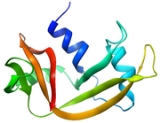
Ribonuclease

Encyclopedia
Ribonuclease is a type of nuclease
that catalyzes
the degradation of RNA
into smaller components. Ribonucleases can be divided into endoribonuclease
s and exoribonuclease
s, and comprise several sub-classes within the EC 2.7 (for the phosphorolytic enzymes) and 3.1 (for the hydrolytic enzymes) classes of enzymes.
Some cells also secrete copious quantities of non-specific RNases such as A and T1. RNases are, therefore, extremely common, resulting in very short lifespans for any RNA that is not in a protected environment. It is worth noting that all intracellular RNAs are protected from RNase activity by a number of strategies including 5' end capping
, 3' end polyadenylation
, and folding within an RNA protein complex (ribonucleoprotein
particle or RNP).
Another mechanism of protection is ribonuclease inhibitor
(RI), which comprises a relatively large fraction of cellular protein (~0.1%) in some cell types, and which binds to certain ribonucleases with the highest affinity of any protein-protein interaction
; the dissociation constant
for the RI-RNase A complex is ~20 fM under physiological conditions. RI is used in most laboratories that study RNA to protect their samples against degradation from environmental RNases.
Similar to restriction enzyme
s, which cleave highly specific sequences of double-stranded DNA
, a variety of endoribonuclease
s that recognize and cleave specific sequences of single-stranded RNA have been recently classified.
RNases play a critical role in many biological processes, including angiogenesis
and self-incompatibility in flowering plant
s (angiosperms). Also, RNases in prokaryotic toxin-antitoxin system
s are proposed to function as plasmid
stability loci, and as stress-response elements when present on the chromosome.
Nuclease
A nuclease is an enzyme capable of cleaving the phosphodiester bonds between the nucleotide subunits of nucleic acids. Older publications may use terms such as "polynucleotidase" or "nucleodepolymerase"....
that catalyzes
Catalysis
Catalysis is the change in rate of a chemical reaction due to the participation of a substance called a catalyst. Unlike other reagents that participate in the chemical reaction, a catalyst is not consumed by the reaction itself. A catalyst may participate in multiple chemical transformations....
the degradation of RNA
RNA
Ribonucleic acid , or RNA, is one of the three major macromolecules that are essential for all known forms of life....
into smaller components. Ribonucleases can be divided into endoribonuclease
Endoribonuclease
A Endoribonuclease is a ribonuclease endonuclease. It cleaves either single-stranded or double-stranded RNA, depending on the enzyme. Example includes both single proteins like RNase III, RNase A, RNase T1, and RNase H, and also complexes of proteins like RNase P and the RNA-induced silencing...
s and exoribonuclease
Exoribonuclease
An exoribonuclease is an exonuclease ribonuclease, which are enzymes that degrade RNA by removing terminal nucleotides from either the 5' end or the 3' end of the RNA molecule...
s, and comprise several sub-classes within the EC 2.7 (for the phosphorolytic enzymes) and 3.1 (for the hydrolytic enzymes) classes of enzymes.
Function
All organisms studied contain many RNases of many different classes, showing that RNA degradation is a very ancient and important process. As well as cleaning of cellular RNA that is no longer required, RNases play key roles in the maturation of all RNA molecules, both messenger RNAs that carry genetic material for making proteins, and non-coding RNAs that function in varied cellular processes. In addition, active RNA degradation systems are a first defense against RNA viruses, and provide the underlying machinery for more advanced cellular immune strategies such as RNAi.Some cells also secrete copious quantities of non-specific RNases such as A and T1. RNases are, therefore, extremely common, resulting in very short lifespans for any RNA that is not in a protected environment. It is worth noting that all intracellular RNAs are protected from RNase activity by a number of strategies including 5' end capping
5' cap
The 5' cap is a specially altered nucleotide on the 5' end of precursor messenger RNA and some other primary RNA transcripts as found in eukaryotes. The process of 5' capping is vital to creating mature messenger RNA, which is then able to undergo translation...
, 3' end polyadenylation
Polyadenylation
Polyadenylation is the addition of a poly tail to an RNA molecule. The poly tail consists of multiple adenosine monophosphates; in other words, it is a stretch of RNA that has only adenine bases. In eukaryotes, polyadenylation is part of the process that produces mature messenger RNA for translation...
, and folding within an RNA protein complex (ribonucleoprotein
Ribonucleoprotein
Ribonucleoprotein is a nucleoprotein that contains RNA, i.e. it is an association that combines ribonucleic acid and protein together. A few known examples include the ribosome, the enzyme telomerase, vault ribonucleoproteins, and small nuclear RNPs , which are implicated in pre-mRNA splicing and...
particle or RNP).
Another mechanism of protection is ribonuclease inhibitor
Ribonuclease inhibitor
Ribonuclease inhibitor is a large , acidic , leucine-rich repeat protein that forms extremely tight complexes with certain ribonucleases. It is a major cellular protein, comprising ~0.1% of all cellular protein by weight, and appears to play an important role in regulating the lifetime of RNA.RI...
(RI), which comprises a relatively large fraction of cellular protein (~0.1%) in some cell types, and which binds to certain ribonucleases with the highest affinity of any protein-protein interaction
Protein-protein interaction
Protein–protein interactions occur when two or more proteins bind together, often to carry out their biological function. Many of the most important molecular processes in the cell such as DNA replication are carried out by large molecular machines that are built from a large number of protein...
; the dissociation constant
Dissociation constant
In chemistry, biochemistry, and pharmacology, a dissociation constant is a specific type of equilibrium constant that measures the propensity of a larger object to separate reversibly into smaller components, as when a complex falls apart into its component molecules, or when a salt splits up into...
for the RI-RNase A complex is ~20 fM under physiological conditions. RI is used in most laboratories that study RNA to protect their samples against degradation from environmental RNases.
Similar to restriction enzyme
Restriction enzyme
A Restriction Enzyme is an enzyme that cuts double-stranded DNA at specific recognition nucleotide sequences known as restriction sites. Such enzymes, found in bacteria and archaea, are thought to have evolved to provide a defense mechanism against invading viruses...
s, which cleave highly specific sequences of double-stranded DNA
DNA
Deoxyribonucleic acid is a nucleic acid that contains the genetic instructions used in the development and functioning of all known living organisms . The DNA segments that carry this genetic information are called genes, but other DNA sequences have structural purposes, or are involved in...
, a variety of endoribonuclease
Endoribonuclease
A Endoribonuclease is a ribonuclease endonuclease. It cleaves either single-stranded or double-stranded RNA, depending on the enzyme. Example includes both single proteins like RNase III, RNase A, RNase T1, and RNase H, and also complexes of proteins like RNase P and the RNA-induced silencing...
s that recognize and cleave specific sequences of single-stranded RNA have been recently classified.
RNases play a critical role in many biological processes, including angiogenesis
Angiogenesis
Angiogenesis is the physiological process involving the growth of new blood vessels from pre-existing vessels. Though there has been some debate over terminology, vasculogenesis is the term used for spontaneous blood-vessel formation, and intussusception is the term for the formation of new blood...
and self-incompatibility in flowering plant
Flowering plant
The flowering plants , also known as Angiospermae or Magnoliophyta, are the most diverse group of land plants. Angiosperms are seed-producing plants like the gymnosperms and can be distinguished from the gymnosperms by a series of synapomorphies...
s (angiosperms). Also, RNases in prokaryotic toxin-antitoxin system
Toxin-antitoxin system
A toxin-antitoxin system is a set of two or more closely linked genes that together encode both a protein 'poison' and a corresponding 'antidote'. When these systems are contained on plasmids – transferable genetic elements – they ensure that only the daughter cells that inherit the plasmid...
s are proposed to function as plasmid
Plasmid
In microbiology and genetics, a plasmid is a DNA molecule that is separate from, and can replicate independently of, the chromosomal DNA. They are double-stranded and, in many cases, circular...
stability loci, and as stress-response elements when present on the chromosome.
Major types of endoribonucleases
- RNase ARibonuclease ARibonuclease A is a pancreatic ribonuclease that cleaves single-stranded RNA. Bovine pancreatic RNase A is one of the classic model systems of protein science.-History:...
is an RNase that is commonly used in research. RNase A (e.g., bovine pancreatic ribonuclease A: ) is one of the hardiest enzymes in common laboratory usage; one method of isolating it is to boil a crude cellular extract until all enzymes other than RNase A are denaturedDenaturation (biochemistry)Denaturation is a process in which proteins or nucleic acids lose their tertiary structure and secondary structure by application of some external stress or compound, such as a strong acid or base, a concentrated inorganic salt, an organic solvent , or heat...
. It is specific for single-stranded RNAs. It cleaves 3'end of unpaired C and U residues, leaving a 3'-phosphorylated product, via a 2',3'-cyclic monophosphate. - RNase HRNase HThe enzyme RNase H is a non-specific endonuclease and catalyzes the cleavage of RNA via a hydrolytic mechanism. Members of the RNase H family can be found in nearly all organisms, from archaea to bacteria and eukaryota....
is a ribonuclease that cleaves the RNA in a DNA/RNA duplex to produce ssDNA. RNase H is a non-specific endonuclease and catalyzes the cleavage of RNA via a hydrolytic mechanism, aided by an enzyme-bound divalent metal ion. RNase H leaves a 5'-phosphorylated product.
- EC numberEC numberThe Enzyme Commission number is a numerical classification scheme for enzymes, based on the chemical reactions they catalyze....
3.1.??: RNase I cleaves 3'-end of ssRNA at all dinucleotide bonds leaving a 5' hydroxyl, and 3' phosphate, via a 2',3'-cyclic monophosphate intermediate.
- RNase IIIRNase IIIRNase III enzymes specifically bind to and cleave double-stranded RNA . There are three subdivisions, known as Class 1, 2, and 3.Prokaryotic ribonuclease III is an enzyme that digests double-stranded RNA. It is involved in the processing of ribosomal RNA precursors and of some mRNAs.* Class 1...
is a type of ribonuclease that cleaves rRNA (16s rRNA and 23s rRNA) from transcribed polycistronic RNA operon in prokaryotes. It also digests double strands RNA (dsRNS)-Dicer family of RNAse, cutting pre-miRNA (60–70bp long) at a specific site and transforming it in miRNA (22–30bp), that is actively involved in the regulation of transcription and mRNA life-time.
- EC numberEC numberThe Enzyme Commission number is a numerical classification scheme for enzymes, based on the chemical reactions they catalyze....
3.1.??: RNase LRNAse LRNase L is an interferon-induced ribonuclease which, upon activation, destroys all RNA within the cell .- Production and Activation :...
is an interferon-induced nuclease that, upon activation, destroys all RNA within the cell
- RNase PRNase PRibonuclease P is a type of ribonuclease which cleaves RNA. RNase P is unique from other RNases in that it is a ribozyme – a ribonucleic acid that acts as a catalyst in the same way that a protein based enzyme would. Its function is to cleave off an extra, or precursor, sequence of RNA on tRNA...
is a type of ribonuclease that is unique in that it is a ribozymeRibozymeA ribozyme is an RNA molecule with a well defined tertiary structure that enables it to catalyze a chemical reaction. Ribozyme means ribonucleic acid enzyme. It may also be called an RNA enzyme or catalytic RNA. Many natural ribozymes catalyze either the hydrolysis of one of their own...
– a ribonucleic acidRNARibonucleic acid , or RNA, is one of the three major macromolecules that are essential for all known forms of life....
that acts as a catalyst in the same way as an enzymeEnzymeEnzymes are proteins that catalyze chemical reactions. In enzymatic reactions, the molecules at the beginning of the process, called substrates, are converted into different molecules, called products. Almost all chemical reactions in a biological cell need enzymes in order to occur at rates...
. Its function is to cleave off an extra, or precursor, sequence on tRNA molecules. RNase P is one of two known multiple turnover ribozymes in nature (the other being the ribosomeRibosomeA ribosome is a component of cells that assembles the twenty specific amino acid molecules to form the particular protein molecule determined by the nucleotide sequence of an RNA molecule....
). A form of RNase P that is a proteinProteinProteins are biochemical compounds consisting of one or more polypeptides typically folded into a globular or fibrous form, facilitating a biological function. A polypeptide is a single linear polymer chain of amino acids bonded together by peptide bonds between the carboxyl and amino groups of...
and does not contain RNA has recently been discovered.
- EC numberEC numberThe Enzyme Commission number is a numerical classification scheme for enzymes, based on the chemical reactions they catalyze....
3.1.??: RNase PhyMRNase PhyMRNase PhyM is a type of endoribonuclease which is sequence specific for single stranded RNAs. It cleaves 3'-end of unpaired A and U residues....
is sequence specific for single-stranded RNAs. It cleaves 3'-end of unpaired A and U residues.
- RNase T1 is sequence specific for single-stranded RNAs. It cleaves 3'-end of unpaired G residues.
- RNase T2 is sequence specific for single-stranded RNAs. It cleaves 3'-end of all 4 residues, but preferentially 3'-end of As.
- RNase U2 is sequence specific for single-stranded RNAs. It cleaves 3'-end of unpaired A residues.
- RNase V1 is non-sequence specific for double-stranded RNAs. It cleaves base-paired nucleotide residues.
- RNase V
Major types of exoribonucleases
- EC numberEC numberThe Enzyme Commission number is a numerical classification scheme for enzymes, based on the chemical reactions they catalyze....
: Polynucleotide Phosphorylase (PNPase) functions as an exonucleaseExonucleaseExonucleases are enzymes that work by cleaving nucleotides one at a time from the end of a polynucleotide chain. A hydrolyzing reaction that breaks phosphodiester bonds at either the 3’ or the 5’ end occurs. Its close relative is the endonuclease, which cleaves phosphodiester bonds in the middle ...
as well as a nucleotidyltransferaseNucleotidyltransferaseNucleotidyltransferases are transferase enzymes of phosphorus-containing groups, e.g., substituents of nucleotidylic acids or simply nucleoside monophosphates...
.
- EC numberEC numberThe Enzyme Commission number is a numerical classification scheme for enzymes, based on the chemical reactions they catalyze....
: RNase PHRNase PHRNase PH is an 3'-5' exoribonuclease and nucleotidyltransferase, present in archaea and bacteria, that is involved in tRNA processing. Contrary to hydrolytic enzymes, it is a phosphorolytic enzyme, meaning that it uses inorganic phosphate as a cofactor to cleave nucleotide-nucleotide bonds,...
functions as an exonucleaseExonucleaseExonucleases are enzymes that work by cleaving nucleotides one at a time from the end of a polynucleotide chain. A hydrolyzing reaction that breaks phosphodiester bonds at either the 3’ or the 5’ end occurs. Its close relative is the endonuclease, which cleaves phosphodiester bonds in the middle ...
as well as a nucleotidyltransferaseNucleotidyltransferaseNucleotidyltransferases are transferase enzymes of phosphorus-containing groups, e.g., substituents of nucleotidylic acids or simply nucleoside monophosphates...
.
- EC numberEC numberThe Enzyme Commission number is a numerical classification scheme for enzymes, based on the chemical reactions they catalyze....
3.1.??: RNase II is responsible for the processive 3'-to-5' degradation of single-stranded RNARNARibonucleic acid , or RNA, is one of the three major macromolecules that are essential for all known forms of life....
.
- EC numberEC numberThe Enzyme Commission number is a numerical classification scheme for enzymes, based on the chemical reactions they catalyze....
3.1.??: RNase RRNase RRNase R is an 3'-5' exoribonuclease closely related to RNase II, which has been shown to be involved in mRNA degradation in bacteria. RNase R has homologues in many other organisms. When a part of another larger protein has a domain that is very similar to RNase R, this is called an RNase R domain....
is a close homolog of RNase II, but it can, unlike RNase II, degrade RNA with secondary structures without help of accessory factors.
- EC numberEC numberThe Enzyme Commission number is a numerical classification scheme for enzymes, based on the chemical reactions they catalyze....
: RNase DRNase DRNase D is one of the seven exoribonucleases identified in E. coli. It is an 3'-5' exoribonuclease and which has been shown to be involved in the 3' processing of various stable RNA molecules ; It is known to add the 3' CCA sequence to tRNA in prokaryotic tRNA processing. RNase D has homologues...
is involved in the 3'-to-5' processing of pre-tRNATransfer RNATransfer RNA is an adaptor molecule composed of RNA, typically 73 to 93 nucleotides in length, that is used in biology to bridge the three-letter genetic code in messenger RNA with the twenty-letter code of amino acids in proteins. The role of tRNA as an adaptor is best understood by...
s.
- EC numberEC numberThe Enzyme Commission number is a numerical classification scheme for enzymes, based on the chemical reactions they catalyze....
3.1.??: RNase T is the major contributor for the 3'-to-5' maturation of many stable RNAs.
- Oligoribonuclease degrades short oligonucleotides to mononucleotides.
- Exoribonuclease I degrades single-stranded RNA from 5'-to-3', exists only in eukaryotes.
- Exoribonuclease II is a close homolog of Exoribonuclease I.