


Amylase

Encyclopedia
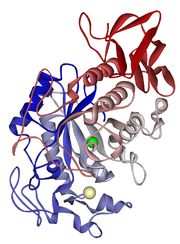
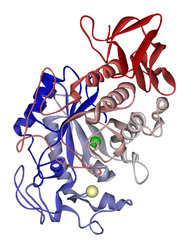
Enzyme
Enzymes are proteins that catalyze chemical reactions. In enzymatic reactions, the molecules at the beginning of the process, called substrates, are converted into different molecules, called products. Almost all chemical reactions in a biological cell need enzymes in order to occur at rates...
that catalyses
Catalysis
Catalysis is the change in rate of a chemical reaction due to the participation of a substance called a catalyst. Unlike other reagents that participate in the chemical reaction, a catalyst is not consumed by the reaction itself. A catalyst may participate in multiple chemical transformations....
the breakdown of starch
Starch
Starch or amylum is a carbohydrate consisting of a large number of glucose units joined together by glycosidic bonds. This polysaccharide is produced by all green plants as an energy store...
into sugar
Sugar
Sugar is a class of edible crystalline carbohydrates, mainly sucrose, lactose, and fructose, characterized by a sweet flavor.Sucrose in its refined form primarily comes from sugar cane and sugar beet...
s. Amylase is present in human saliva
Saliva
Saliva , referred to in various contexts as spit, spittle, drivel, drool, or slobber, is the watery substance produced in the mouths of humans and most other animals. Saliva is a component of oral fluid. In mammals, saliva is produced in and secreted from the three pairs of major salivary glands,...
, where it begins the chemical process of digestion
Digestion
Digestion is the mechanical and chemical breakdown of food into smaller components that are more easily absorbed into a blood stream, for instance. Digestion is a form of catabolism: a breakdown of large food molecules to smaller ones....
. Food that contains much starch but little sugar, such as rice
Rice
Rice is the seed of the monocot plants Oryza sativa or Oryza glaberrima . As a cereal grain, it is the most important staple food for a large part of the world's human population, especially in East Asia, Southeast Asia, South Asia, the Middle East, and the West Indies...
and potato
Potato
The potato is a starchy, tuberous crop from the perennial Solanum tuberosum of the Solanaceae family . The word potato may refer to the plant itself as well as the edible tuber. In the region of the Andes, there are some other closely related cultivated potato species...
, taste slightly sweet as they are chewed because amylase turns some of their starch into sugar in the mouth. The pancreas
Pancreas
The pancreas is a gland organ in the digestive and endocrine system of vertebrates. It is both an endocrine gland producing several important hormones, including insulin, glucagon, and somatostatin, as well as a digestive organ, secreting pancreatic juice containing digestive enzymes that assist...
also makes amylase (alpha amylase) to hydrolyse dietary starch into disaccharides and trisaccharides which are converted by other enzymes to glucose
Glucose
Glucose is a simple sugar and an important carbohydrate in biology. Cells use it as the primary source of energy and a metabolic intermediate...
to supply the body with energy. Plants and some bacteria also produce amylase. As diastase
Diastase
A diastase is any one of a group of enzymes which catalyses the breakdown of starch into maltose. Alpha amylase degrades starch to a mixture of the disaccharide maltose, the trisaccharide maltotriose, which contains three α -linked glucose residues, and oligosaccharides known as dextrins that...
, amylase was the first enzyme to be discovered and isolated (by Anselme Payen
Anselme Payen
Anselme Payen was a French chemist known for discovering the enzyme diastase, and the carbohydrate cellulose.Payen was born in Paris...
in 1833). Specific amylase protein
Protein
Proteins are biochemical compounds consisting of one or more polypeptides typically folded into a globular or fibrous form, facilitating a biological function. A polypeptide is a single linear polymer chain of amino acids bonded together by peptide bonds between the carboxyl and amino groups of...
s are designated by different Greek letters. All amylases are glycoside hydrolase
Glycoside hydrolase
Glycoside hydrolases catalyze the hydrolysis of the glycosidic linkage to release smaller sugars...
s and act on α-1,4-glycosidic bond
Glycosidic bond
In chemistry, a glycosidic bond is a type of covalent bond that joins a carbohydrate molecule to another group, which may or may not be another carbohydrate....
s.
α-Amylase
(CASCAS registry number
CAS Registry Numbersare unique numerical identifiers assigned by the "Chemical Abstracts Service" toevery chemical described in the...
# 9014-71-5) (alternative names: 1,4-α-D-glucan glucanohydrolase; glycogenase)
The α-amylases are calcium
Calcium
Calcium is the chemical element with the symbol Ca and atomic number 20. It has an atomic mass of 40.078 amu. Calcium is a soft gray alkaline earth metal, and is the fifth-most-abundant element by mass in the Earth's crust...
metalloenzymes
Metalloprotein
Metalloprotein is a generic term for a protein that contains a metal ion cofactor. Metalloproteins have many different functions in cells, such as enzymes, transport and storage proteins, and signal transduction proteins. Indeed, about one quarter to one third of all proteins require metals to...
, completely unable to function in the absence of calcium. By acting at random locations along the starch chain, α-amylase breaks down long-chain carbohydrates, ultimately yielding maltotriose
Maltotriose
Maltotriose is a trisaccharide consisting of three glucose molecules linked with α-1,4 glycosidic bonds.It is most commonly produced by the digestive enzyme alpha-amylase on amylose in starch...
and maltose
Maltose
Maltose , or malt sugar, is a disaccharide formed from two units of glucose joined with an αbond, formed from a condensation reaction. The isomer "isomaltose" has two glucose molecules linked through an α bond. Maltose is the second member of an important biochemical series of glucose chains....
from amylose
Amylose
Amylose is a linear polymer made up of D-glucose units.This polysaccharide is one of the two components of starch, making up approximately 2-30% of the structure...
, or maltose, glucose
Glucose
Glucose is a simple sugar and an important carbohydrate in biology. Cells use it as the primary source of energy and a metabolic intermediate...
and "limit dextrin"
Dextrin
Dextrins are a group of low-molecular-weight carbohydrates produced by the hydrolysis of starch or glycogen. Dextrins are mixtures of polymers of D-glucose units linked by α- or α- glycosidic bonds....
from amylopectin
Amylopectin
Amylopectin is a soluble polysaccharide and highly branched polymer of glucose found in plants. It is one of the two components of starch, the other being amylose.Glucose units are linked in a linear way with α glycosidic bonds...
. Because it can act anywhere on the substrate
Substrate (biochemistry)
In biochemistry, a substrate is a molecule upon which an enzyme acts. Enzymes catalyze chemical reactions involving the substrate. In the case of a single substrate, the substrate binds with the enzyme active site, and an enzyme-substrate complex is formed. The substrate is transformed into one or...
, α-amylase tends to be faster-acting than β-amylase. In animal
Animal
Animals are a major group of multicellular, eukaryotic organisms of the kingdom Animalia or Metazoa. Their body plan eventually becomes fixed as they develop, although some undergo a process of metamorphosis later on in their life. Most animals are motile, meaning they can move spontaneously and...
s, it is a major digestive
Digestion
Digestion is the mechanical and chemical breakdown of food into smaller components that are more easily absorbed into a blood stream, for instance. Digestion is a form of catabolism: a breakdown of large food molecules to smaller ones....
enzyme and its optimum pH is 6.7-7.0.
In human physiology, both the salivary and pancreatic amylases are α-Amylases. They are discussed in much more detail at alpha-Amylase
Alpha-Amylase
α-Amylase is an enzyme that hydrolyses alpha-bonds of large alpha-linked polysaccharides such as starch and glycogen, yielding glucose and maltose. It is the major form of amylase found in humans and other mammals...
.
Also found in plants (adequately), fungi (ascomycetes and basidiomycetes) and bacteria (Bacillus)
β-Amylase
(alternative names: 1,4-α-D-glucan maltohydrolase; glycogenase; saccharogen amylase)Another form of amylase, β-amylase is also synthesized by bacteria
Bacteria
Bacteria are a large domain of prokaryotic microorganisms. Typically a few micrometres in length, bacteria have a wide range of shapes, ranging from spheres to rods and spirals...
, fungi, and plant
Plant
Plants are living organisms belonging to the kingdom Plantae. Precise definitions of the kingdom vary, but as the term is used here, plants include familiar organisms such as trees, flowers, herbs, bushes, grasses, vines, ferns, mosses, and green algae. The group is also called green plants or...
s. Working from the non-reducing end, β-amylase catalyzes the hydrolysis of the second α-1,4 glycosidic bond, cleaving off two glucose units (maltose
Maltose
Maltose , or malt sugar, is a disaccharide formed from two units of glucose joined with an αbond, formed from a condensation reaction. The isomer "isomaltose" has two glucose molecules linked through an α bond. Maltose is the second member of an important biochemical series of glucose chains....
) at a time. During the ripening
Ripening
Ripening is a process in fruits that causes them to become more palatable. In general, a fruit becomes sweeter, less green, and softer as it ripens. Even though the acidity of fruit increases as it ripens, the higher acidity level does not make the fruit seem tarter, which can lead to the...
of fruit
Fruit
In broad terms, a fruit is a structure of a plant that contains its seeds.The term has different meanings dependent on context. In non-technical usage, such as food preparation, fruit normally means the fleshy seed-associated structures of certain plants that are sweet and edible in the raw state,...
, β-amylase breaks starch into maltose, resulting in the sweet flavor of ripe fruit.
Both α-amylase and β-amylase are present in seeds; β-amylase is present in an inactive form prior to germination
Germination
Germination is the process in which a plant or fungus emerges from a seed or spore, respectively, and begins growth. The most common example of germination is the sprouting of a seedling from a seed of an angiosperm or gymnosperm. However the growth of a sporeling from a spore, for example the...
, whereas α-amylase and proteases appear once germination has begun. Cereal
Cereal
Cereals are grasses cultivated for the edible components of their grain , composed of the endosperm, germ, and bran...
grain amylase is key to the production of malt
Malt
Malt is germinated cereal grains that have been dried in a process known as "malting". The grains are made to germinate by soaking in water, and are then halted from germinating further by drying with hot air...
. Many microbes also produce amylase to degrade extracellular starches. Animal
Animal
Animals are a major group of multicellular, eukaryotic organisms of the kingdom Animalia or Metazoa. Their body plan eventually becomes fixed as they develop, although some undergo a process of metamorphosis later on in their life. Most animals are motile, meaning they can move spontaneously and...
tissues do not contain β-amylase, although it may be present in microrganisms contained within the digestive tract
Gastrointestinal tract
The human gastrointestinal tract refers to the stomach and intestine, and sometimes to all the structures from the mouth to the anus. ....
.
γ-Amylase
(alternative names: Glucan 1,4-α-glucosidase; amyloglucosidase; Exo-1,4-α-glucosidase; glucoamylase; lysosomal α-glucosidase; 1,4-α-D-glucan glucohydrolase)In addition to cleaving the last α(1-4)glycosidic linkages
Glycosidic bond
In chemistry, a glycosidic bond is a type of covalent bond that joins a carbohydrate molecule to another group, which may or may not be another carbohydrate....
at the nonreducing end of amylose
Amylose
Amylose is a linear polymer made up of D-glucose units.This polysaccharide is one of the two components of starch, making up approximately 2-30% of the structure...
and amylopectin
Amylopectin
Amylopectin is a soluble polysaccharide and highly branched polymer of glucose found in plants. It is one of the two components of starch, the other being amylose.Glucose units are linked in a linear way with α glycosidic bonds...
, yielding glucose
Glucose
Glucose is a simple sugar and an important carbohydrate in biology. Cells use it as the primary source of energy and a metabolic intermediate...
, γ-amylase will cleave α(1-6) glycosidic linkages. Unlike the other forms of amylase, γ-amylase is most efficient in acidic environments and has an optimum pH of 3.
Uses
Amylase enzymes find use in bread making and to break down complex sugars such as starch (found in flour) into simple sugars. YeastYeast
Yeasts are eukaryotic micro-organisms classified in the kingdom Fungi, with 1,500 species currently described estimated to be only 1% of all fungal species. Most reproduce asexually by mitosis, and many do so by an asymmetric division process called budding...
then feeds on these simple sugars and converts it into the waste products of alcohol and CO2. This imparts flavour and causes the bread to rise. While amylase enzymes are found naturally in yeast cells, it takes time for the yeast to produce enough of these enzymes to break down significant quantities of starch in the bread. This is the reason for long fermented doughs such as sour dough. Modern bread making techniques have included amylase enzymes (often in the form of malted barley) into bread improver
Bread improver
Bread improver has been a common ingredient in bread since the early 1950s, and is used to speed up bread production.- History :Before the 1950s, bread had been made virtually the same way since it was first discovered. Using sourdoughs, and sponge and dough methods, bread would take up to a day to...
thereby making the bread making process faster and more practical for commercial use.
Alpha and beta amylase enzymes are important in brewing beer and liquor made from sugars derived from starch. In fermentation, yeast ingest sugars and excrete alcohol. In beer and some liquor, the sugars present at the beginning of fermentation have been produced by "mashing" grains or other starch sources (like potatoes). In traditional beer brewing, malted barley is mixed with hot water to create a "mash," which is held at a given temperature to allow the amylase enzymes in the malted grain to convert the barley's starch into sugars. Different temperatures optimize the activity of alpha or beta amylase, resulting in different mixtures of fermentable and unfermentable sugars. In selecting mash temperature and grain-to-water ratio, a brewer can change the alcohol content, mouthfeel, aroma, and flavor of the finished beer.
In some historic methods of producing alcoholic beverages, the conversion of starch to sugar starts with the brewer chewing grain to mix it with saliva. This practice is no longer in general use.
When used as a food additive, amylase has E number
E number
E numbers are number codes for food additives that have been assessed for use within the European Union . They are commonly found on food labels throughout the European Union. Safety assessment and approval are the responsibility of the European Food Safety Authority...
E1100, and may be derived from swine pancreas or mould mushroom.
Bacilliary amylase is also used in clothing and dishwasher detergent
Detergent
A detergent is a surfactant or a mixture of surfactants with "cleaning properties in dilute solutions." In common usage, "detergent" refers to alkylbenzenesulfonates, a family of compounds that are similar to soap but are less affected by hard water...
s to dissolve starches from fabrics and dishes.
Workers in factories that work with amylase for any of the above uses are at increased risk of occupational asthma
Occupational asthma
Occupational asthma is an occupational condition defined as: "a disease characterized by variable airflow limitation and/or airway hyper-responsiveness due to causes and conditions attributable to a particular occupational environment and not stimuli encountered outside the workplace".Asthma is...
. 5-9% of bakers have a positive skin test, and a fourth to a third of bakers with breathing problems are hypersensitive to amylase.
An inhibitor of alpha-amylase called phaseolamin
Phaseolamin
Phaseolamin is a generic name for a proteinaceous inhibitor of the enzyme alpha-amylase that is made from white beans. A number of amylase inhibitors from white beans have been marketed over the years as weight control remedies.-Background:...
has been tested as a potential diet
Diet (nutrition)
In nutrition, diet is the sum of food consumed by a person or other organism. Dietary habits are the habitual decisions an individual or culture makes when choosing what foods to eat. With the word diet, it is often implied the use of specific intake of nutrition for health or weight-management...
aid.
Blood serum
Blood serum
In blood, the serum is the component that is neither a blood cell nor a clotting factor; it is the blood plasma with the fibrinogens removed...
amylase may be measured for purposes of medical diagnosis
Medical diagnosis
Medical diagnosis refers both to the process of attempting to determine or identify a possible disease or disorder , and to the opinion reached by this process...
. A normal concentration is in the range 21-101 U/L. A higher than normal concentration may reflect one of several medical conditions, including acute
Acute (medicine)
In medicine, an acute disease is a disease with either or both of:# a rapid onset, as in acute infection# a short course ....
inflammation
Inflammation
Inflammation is part of the complex biological response of vascular tissues to harmful stimuli, such as pathogens, damaged cells, or irritants. Inflammation is a protective attempt by the organism to remove the injurious stimuli and to initiate the healing process...
of the pancreas
Acute pancreatitis
Acute pancreatitis or acute pancreatic necrosis is a sudden inflammation of the pancreas. It can have severe complications and high mortality despite treatment...
(concurrently with the more specific lipase
Lipase
A lipase is an enzyme that catalyzes the formation or cleavage of fats . Lipases are a subclass of the esterases.Lipases perform essential roles in the digestion, transport and processing of dietary lipids in most, if not all, living organisms...
), but also perforated peptic ulcer
Peptic ulcer
A peptic ulcer, also known as PUD or peptic ulcer disease, is the most common ulcer of an area of the gastrointestinal tract that is usually acidic and thus extremely painful. It is defined as mucosal erosions equal to or greater than 0.5 cm...
, torsion of an ovarian cyst
Ovarian cyst
An ovarian cyst is any collection of fluid, surrounded by a very thin wall, within an ovary. Any ovarian follicle that is larger than about two centimeters is termed an ovarian cyst. An ovarian cyst can be as small as a pea, or larger than an orange....
, strangulation
Strangulating
Strangulating is the process of constricting blood vessels which cause arrest in the flow of blood to a tissue....
ileus
Ileus
Ileus is a disruption of the normal propulsive ability of the gastrointestinal tract.Ileus is commonly defined simply as bowel obstruction. However, authoritative sources define it as decreased motor activity of the GI tract due to non-mechanical causes...
, macroamylasemia and mumps
Mumps
Mumps is a viral disease of the human species, caused by the mumps virus. Before the development of vaccination and the introduction of a vaccine, it was a common childhood disease worldwide...
. Amylase may be measured in other body fluids, including urine
Urine
Urine is a typically sterile liquid by-product of the body that is secreted by the kidneys through a process called urination and excreted through the urethra. Cellular metabolism generates numerous by-products, many rich in nitrogen, that require elimination from the bloodstream...
and peritoneal
Peritoneum
The peritoneum is the serous membrane that forms the lining of the abdominal cavity or the coelom — it covers most of the intra-abdominal organs — in amniotes and some invertebrates...
fluid.
In molecular biology, the presence of amylase can serve as an additional method of selecting for successful integration of a reporter construct in addition to antibiotic resistance. As reporter genes are flanked by homologous regions of the structural gene for amylase, successful integration will disrupt the amylase gene and prevent starch degradation, which is easily detectable through iodine
Iodine
Iodine is a chemical element with the symbol I and atomic number 53. The name is pronounced , , or . The name is from the , meaning violet or purple, due to the color of elemental iodine vapor....
staining.
History
In 1831 Erhard Friedrich Leuchs (1800–1837) described the hydrolysisHydrolysis
Hydrolysis is a chemical reaction during which molecules of water are split into hydrogen cations and hydroxide anions in the process of a chemical mechanism. It is the type of reaction that is used to break down certain polymers, especially those made by condensation polymerization...
of starch by saliva, due to the presence of an enzyme in saliva, "ptyalin
Alpha-Amylase
α-Amylase is an enzyme that hydrolyses alpha-bonds of large alpha-linked polysaccharides such as starch and glycogen, yielding glucose and maltose. It is the major form of amylase found in humans and other mammals...
", an amylase. The modern history of enzymes began in 1833 when French chemists Anselme Payen and Jean-François Persoz isolated an amylase complex from germinating barley and named it "diastase". In 1862 Alexander Jakulowitsch Danilewsky (1838–1923) separated pancreatic amylase from trypsin
Trypsin
Trypsin is a serine protease found in the digestive system of many vertebrates, where it hydrolyses proteins. Trypsin is produced in the pancreas as the inactive proenzyme trypsinogen. Trypsin cleaves peptide chains mainly at the carboxyl side of the amino acids lysine or arginine, except when...
.
Human evolution
Carbohydrates are an energy rich food source. Amylase is thought to have played a key role in human evolution in allowing humans an alternative to fruit and protein. A duplication of the pancreatic amylase gene developed independently in humans and rodents, further suggesting its importance. The salivary amylase levels found in the human lineage are six to eight times higher in humans than in chimpanzees, which are mostly fruit eaters and ingest little starch relative to humans.External links
- Molecule of the month February 2006 at the Protein Data BankProtein Data BankThe Protein Data Bank is a repository for the 3-D structural data of large biological molecules, such as proteins and nucleic acids....
. - Nutrition Sciences 101 at University of ArizonaUniversity of ArizonaThe University of Arizona is a land-grant and space-grant public institution of higher education and research located in Tucson, Arizona, United States. The University of Arizona was the first university in the state of Arizona, founded in 1885...
.