

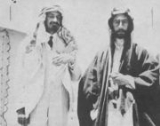
Faisal-Weizmann Agreement

Encyclopedia
The Faisal–Weizmann Agreement was signed on January 3, 1919, by Emir Feisal (son of the King of Hejaz
), who was for a short time King of the Arab Kingdom of Syria or Greater Syria in 1920, and was King of the Kingdom of Iraq (today, Iraq) from August 1921 to 1933, and Chaim Weizmann
(later President of the World Zionist Organization
) as part of the Paris Peace Conference, 1919
settling disputes stemming from World War I
. It was a short-lived agreement for Arab-Jewish cooperation on the development of a Jewish homeland in Palestine
and an Arab nation in a large part of the Middle East.
One or more of the Allies may have suggested that a representative of the Zionist Organization secure the agreement. The secret Sykes-Picot Agreement
had called for an 'Arab State or a Confederation of Arab States'... ...'under the suzerainty of an Arab chief.' The French and British also proposed 'an international administration, the form of which is to be decided upon after consultation with Russia, and subsequently in consultation with the other Allies, 'and the representatives of the Shereef of Mecca.'
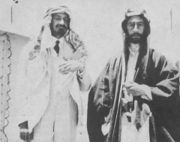
in World War I
. As leader of an impromptu "Zionist Commission", Weizmann traveled to southern Transjordan for the meeting. The intended purpose was to forge an agreement between Feisal and the Zionist movement
to support an Arab Kingdom and Jewish settlement in Palestine, respectively. The wishes of the Palestinian Arabs were to be ignored, and, indeed, both men seem to have held the Palestinian Arabs in considerable disdain. Weizmann had called them "treacherous", "arrogant", "uneducated", and "greedy" and had complained to the British that the system in Palestine did "not take into account the fact that there is a fundamental qualitative difference between Jew and Arab". After his meeting with Faisal, Weizmann reported that Faisal was "contemptuous of the Palestinian Arabs whom he doesn't even regard as Arabs".
In preparation for the meeting, British diplomat Mark Sykes had written to Faisal about the Jewish people "...this race, despised and weak, is universal and all powerful and cannot be put down." Under such circumstances, the secret British communication contended, Faisal was well advised to cultivate the Zionist movement as a powerful ally rather than to oppose it. In the event, Weizmann and Faisal established an informal agreement under which Faisal would support dense Jewish settlement in Palestine while the Zionist movement would assist in the development of the vast Arab nation that Faisal hoped to establish.
At their first meeting in June 1918 Weizmann had assured Faisal that "the Jews did not propose to set up a government of their own but wished to work under British protection, to colonize and develop Palestine without encroaching on any legitimate interests". Weizmann and Faisal met again later in 1918, while both were in London preparing their statements for the upcoming peace conference in Paris
.
They signed the written agreement, which bears their names, on January 3, 1919. The next day, Weizmann arrived in Paris to head the Zionist delegation to the Peace Conference. It was a triumphal moment for Weizmann; it was an accord that climaxed years of negotiations and ceaseless shuttles between the Middle East and the capitals of Western Europe and that promised to usher in an era of peace and cooperation between the two principal ethnic groups of Palestine: Arabs and Jews.
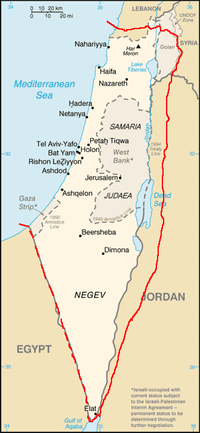
in 1915, in which he had promised Hussein control of Arab
lands with the exception of "portions of Syria
" lying to the west of "the districts of Damascus
, Homs
, Hama
and Aleppo
". Palestine lies to the south of these areas and wasn't explicitly mentioned. That modern-day Lebanese region of the Mediterranean coast was set aside as part of a future French Mandate. After the war the extent of the coastal exclusion was hotly disputed. Hussein had protested that the Arabs of Beirut
would greatly oppose isolation from the Arab state or states, but did not bring up the matter of Jerusalem or Palestine. Dr. Chaim Weizmann
wrote in his autobiography Trial and Error that Palestine had been excluded from the areas that should have been Arab and independent. This interpretation was supported explicitly by the British government in the 1922 White Paper.
On the basis of McMahon's assurances the Arab Revolt began on 5 June 1916. However, the British and French also secretly concluded the Sykes–Picot Agreement on 16 May 1916. This agreement divided many Arab territories into British- and French-administered areas and allowed for the internationalisation of Palestine. Hussein learned of the agreement when it was leaked by the new Russian government in December 1917, but was satisfied by two disingenuous telegrams from Sir Reginald Wingate, High Commissioner of Egypt, assuring him that the British government's commitments to the Arabs were still valid and that the Sykes-Picot Agreement was not a formal treaty.
According to Isaiah Friedman, Hussein was not perturbed by the Balfour Declaration and on March 23, 1918, in Al Qibla, the daily newspaper of Mecca, attested that Palestine was "a sacred and beloved homeland of its original sons," the Jews; "the return of these exiles to their homeland will prove materially and spiritually an experimental school for their [Arab] brethren." He called on the Arab population in Palestine to welcome the Jews as brethren and cooperate with them for the common welfare. Following the publication of the Declaration the British had dispatched Commander David George Hogarth
to see Hussein in January 1918 bearing the message that the "political and economic freedom" of the Palestinian population was not in question. Hogarth reported that Hussein "would not accept an independent Jewish State in Palestine, nor was I instructed to warn him that such a state was contemplated by Great Britain". Continuing Arab disquiet over Allied intentions also led during 1918 to the British Declaration to the Seven
and the Anglo-French Declaration
, the latter promising "the complete and final liberation of the peoples who have for so long been oppressed by the Turks, and the setting up of national governments and administrations deriving their authority from the free exercise of the initiative and choice of the indigenous populations."
Lord Grey had been the foreign secretary during the McMahon-Hussein negotiations. Speaking in the House of Lords
on the 27th March 1923, he made it clear that he entertained serious doubts as to the validity of the British government's interpretation of the pledges which he, as foreign secretary, had caused to be given to Hussein in 1915. He called for all of the secret engagements regarding Palestine to be made public. Many of the relevant documents in the National Archives were later declassified and published. Among them were the minutes of a Cabinet Eastern Committee meeting, chaired by Lord Curzon,which was held on 5 December 1918. Balfour was in attendance. The minutes revealed that in laying out the government's position Curzon had explained that: "Palestine was included in the areas as to which Great Britain pledged itself that they should be Arab and independent in the future".
Weizmann signed the agreement on behalf of the Zionist Organization, while Faisal signed on behalf of the short-lived Arab Kingdom of Hedjaz.
Two weeks prior to signing the agreement, Faisal stated:
The areas discussed were detailed in a letter to Felix Frankfurter, President of the Zionist Organisation of America, on March 3, 1919, when Faisal wrote :
The propsals submitted by the Zionist Organization to the Peace Conference were:
3 January 1919
His Royal Highness the Emir Feisal, representing and acting on behalf of the Arab Kingdom of Hedjaz, and Dr. Chaim Weizmann, representing and acting on behalf of the Zionist Organization, mindful of the racial kinship and ancient bonds existing between the Arabs and the Jewish people, and realizing that the surest means of working out the consummation of their natural aspirations is through the closest possible collaboration in the development of the Arab State and Palestine, and being desirous further of confirming the good understanding which exists between them, have agreed upon the following:
Articles:
The Arab State and Palestine in all their relations and undertakings shall be controlled by the most cordial goodwill and understanding, and to this end Arab and Jewish duly accredited agents shall be established and maintained in the respective territories.
Immediately following the completion of the deliberations of the Peace Conference, the definite boundaries between the Arab State and Palestine shall be determined by a Commission to be agreed upon by the parties hereto.
In the establishment of the Constitution and Administration of Palestine, all such measures shall be adopted as will afford the fullest guarantees for carrying into effect the British Government's Declaration of the 2nd of November, 1917.
All necessary measures shall be taken to encourage and stimulate immigration of Jews into Palestine on a large scale, and as quickly as possible to settle Jewish immigrants upon the land through closer settlement and intensive cultivation of the soil. In taking such measures the Arab peasant and tenant farmers shall be protected in their rights and shall be assisted in forwarding their economic development.
No regulation or law shall be made prohibiting or interfering in any way with the free exercise of religion; and further, the free exercise and enjoyment of religious profession and worship, without discrimination or preference, shall forever be allowed. No religious test shall ever be required for the exercise of civil or political rights.
The Mohammedan Holy Places shall be under Mohammedan control.
The Zionist Organization proposes to send to Palestine a Commission of experts to make a survey of the economic possibilities of the country, and to report upon the best means for its development. The Zionist Organization will place the aforementioned Commission at the disposal of the Arab State for the purpose of a survey of the economic possibilities of the Arab State and to report upon the best means for its development. The Zionist Organization will use its best efforts to assist the Arab State in providing the means for developing the natural resources and economic possibilities thereof.
The parties hereto agree to act in complete accord and harmony on all matters embraced herein before the Peace Congress.
Any matters of dispute which may arise between the contracting parties hall be referred to the British Government for arbitration.
Given under our hand at London, England, the third day of January, one thousand nine hundred and nineteen
Chaim Weizmann Feisal Ibn-Hussein
Reservation by the Emir Feisal
If the Arabs are established as I have asked in my manifesto of 4 January, addressed to the British Secretary of State for Foreign Affairs, I will carry out what is written in this agreement. If changes are made, I cannot be answerable for failing to carry out this agreement.
. He appended to the typed document a hand-written statement:
The Arabs did not obtain their independence and the Faisal-Weizmann agreement survived only a few months. The decision of the peace conference
itself refused independence for the vast Arab-inhabited lands that Faisal desired, mainly because the British and French had struck their own secret Sykes-Picot Agreement of 1916
dividing the Middle East between their own spheres of influence
. With the conference deciding on the mandate system
for all areas of the former Ottoman Empire, prior to statements from either the Zionist or Arab sides, Faisal soon began to express doubts about cooperation with the Zionist movement. After Faisal was expelled from Syria and given the Kingdom of Iraq
, he contended that the conditions he appended were not fulfilled and the treaty therefore moot. St. John Philby
, a British representative in Palestine, later stated that Hussein bin Ali
, the Sharif of Mecca
and King of Hejaz, on whose behalf Faisal was acting, had refused to recognize the agreement as soon as it was brought to his notice. However, Sharif Hussein formally endorsed the Balfour Declaration in the Treaty of Sèvres
of 10 August 1920, along with the other Allied Powers, as King of Hedjaz.
The United Nations Special Committee On Palestine did not regard the agreement as ever being valid, while Weizmann continued to maintain that the treaty was still binding. In 1947 Weizmann explained :
According to C.D. Smith the Syrian National Congress had forced Faisal to back away from his tentative support of Zionist goals.
Hejaz
al-Hejaz, also Hijaz is a region in the west of present-day Saudi Arabia. Defined primarily by its western border on the Red Sea, it extends from Haql on the Gulf of Aqaba to Jizan. Its main city is Jeddah, but it is probably better known for the Islamic holy cities of Mecca and Medina...
), who was for a short time King of the Arab Kingdom of Syria or Greater Syria in 1920, and was King of the Kingdom of Iraq (today, Iraq) from August 1921 to 1933, and Chaim Weizmann
Chaim Weizmann
Chaim Azriel Weizmann, , was a Zionist leader, President of the Zionist Organization, and the first President of the State of Israel. He was elected on 1 February 1949, and served until his death in 1952....
(later President of the World Zionist Organization
World Zionist Organization
The World Zionist Organization , or WZO, was founded as the Zionist Organization , or ZO, in 1897 at the First Zionist Congress, held from August 29 to August 31 in Basel, Switzerland...
) as part of the Paris Peace Conference, 1919
Paris Peace Conference, 1919
The Paris Peace Conference was the meeting of the Allied victors following the end of World War I to set the peace terms for the defeated Central Powers following the armistices of 1918. It took place in Paris in 1919 and involved diplomats from more than 32 countries and nationalities...
settling disputes stemming from World War I
World War I
World War I , which was predominantly called the World War or the Great War from its occurrence until 1939, and the First World War or World War I thereafter, was a major war centred in Europe that began on 28 July 1914 and lasted until 11 November 1918...
. It was a short-lived agreement for Arab-Jewish cooperation on the development of a Jewish homeland in Palestine
Palestine
Palestine is a conventional name, among others, used to describe the geographic region between the Mediterranean Sea and the Jordan River, and various adjoining lands....
and an Arab nation in a large part of the Middle East.
One or more of the Allies may have suggested that a representative of the Zionist Organization secure the agreement. The secret Sykes-Picot Agreement
Sykes-Picot Agreement
The Sykes–Picot Agreement of 1916 was a secret agreement between the governments of the United Kingdom and France, with the assent of Imperial Russia, defining their respective spheres of influence and control in Western Asia after the expected downfall of the Ottoman Empire during World War I...
had called for an 'Arab State or a Confederation of Arab States'... ...'under the suzerainty of an Arab chief.' The French and British also proposed 'an international administration, the form of which is to be decided upon after consultation with Russia, and subsequently in consultation with the other Allies, 'and the representatives of the Shereef of Mecca.'
Overview
Weizmann first met Feisal in June 1918, during the British advance from the South against the Ottoman EmpireOttoman Empire
The Ottoman EmpireIt was usually referred to as the "Ottoman Empire", the "Turkish Empire", the "Ottoman Caliphate" or more commonly "Turkey" by its contemporaries...
in World War I
World War I
World War I , which was predominantly called the World War or the Great War from its occurrence until 1939, and the First World War or World War I thereafter, was a major war centred in Europe that began on 28 July 1914 and lasted until 11 November 1918...
. As leader of an impromptu "Zionist Commission", Weizmann traveled to southern Transjordan for the meeting. The intended purpose was to forge an agreement between Feisal and the Zionist movement
Zionism
Zionism is a Jewish political movement that, in its broadest sense, has supported the self-determination of the Jewish people in a sovereign Jewish national homeland. Since the establishment of the State of Israel, the Zionist movement continues primarily to advocate on behalf of the Jewish state...
to support an Arab Kingdom and Jewish settlement in Palestine, respectively. The wishes of the Palestinian Arabs were to be ignored, and, indeed, both men seem to have held the Palestinian Arabs in considerable disdain. Weizmann had called them "treacherous", "arrogant", "uneducated", and "greedy" and had complained to the British that the system in Palestine did "not take into account the fact that there is a fundamental qualitative difference between Jew and Arab". After his meeting with Faisal, Weizmann reported that Faisal was "contemptuous of the Palestinian Arabs whom he doesn't even regard as Arabs".
In preparation for the meeting, British diplomat Mark Sykes had written to Faisal about the Jewish people "...this race, despised and weak, is universal and all powerful and cannot be put down." Under such circumstances, the secret British communication contended, Faisal was well advised to cultivate the Zionist movement as a powerful ally rather than to oppose it. In the event, Weizmann and Faisal established an informal agreement under which Faisal would support dense Jewish settlement in Palestine while the Zionist movement would assist in the development of the vast Arab nation that Faisal hoped to establish.
At their first meeting in June 1918 Weizmann had assured Faisal that "the Jews did not propose to set up a government of their own but wished to work under British protection, to colonize and develop Palestine without encroaching on any legitimate interests". Weizmann and Faisal met again later in 1918, while both were in London preparing their statements for the upcoming peace conference in Paris
Paris Peace Conference, 1919
The Paris Peace Conference was the meeting of the Allied victors following the end of World War I to set the peace terms for the defeated Central Powers following the armistices of 1918. It took place in Paris in 1919 and involved diplomats from more than 32 countries and nationalities...
.
They signed the written agreement, which bears their names, on January 3, 1919. The next day, Weizmann arrived in Paris to head the Zionist delegation to the Peace Conference. It was a triumphal moment for Weizmann; it was an accord that climaxed years of negotiations and ceaseless shuttles between the Middle East and the capitals of Western Europe and that promised to usher in an era of peace and cooperation between the two principal ethnic groups of Palestine: Arabs and Jews.
Background
Henry McMahon had exchanged letters with Faisal's father Hussein bin Ali, Sharif of MeccaHussein bin Ali, Sharif of Mecca
Sayyid Hussein bin Ali, GCB was the Sharif of Mecca, and Emir of Mecca from 1908 until 1917, when he proclaimed himself King of Hejaz, which received international recognition. He initiated the Arab Revolt in 1916 against the increasingly nationalistic Ottoman Empire during the course of the...
in 1915, in which he had promised Hussein control of Arab
Arab
Arab people, also known as Arabs , are a panethnicity primarily living in the Arab world, which is located in Western Asia and North Africa. They are identified as such on one or more of genealogical, linguistic, or cultural grounds, with tribal affiliations, and intra-tribal relationships playing...
lands with the exception of "portions of Syria
Syria
Syria , officially the Syrian Arab Republic , is a country in Western Asia, bordering Lebanon and the Mediterranean Sea to the West, Turkey to the north, Iraq to the east, Jordan to the south, and Israel to the southwest....
" lying to the west of "the districts of Damascus
Damascus
Damascus , commonly known in Syria as Al Sham , and as the City of Jasmine , is the capital and the second largest city of Syria after Aleppo, both are part of the country's 14 governorates. In addition to being one of the oldest continuously inhabited cities in the world, Damascus is a major...
, Homs
Homs
Homs , previously known as Emesa , is a city in western Syria and the capital of the Homs Governorate. It is above sea level and is located north of Damascus...
, Hama
Hama
Hama is a city on the banks of the Orontes River in west-central Syria north of Damascus. It is the provincial capital of the Hama Governorate. Hama is the fourth-largest city in Syria—behind Aleppo, Damascus, and Homs—with a population of 696,863...
and Aleppo
Aleppo
Aleppo is the largest city in Syria and the capital of Aleppo Governorate, the most populous Syrian governorate. With an official population of 2,301,570 , expanding to over 2.5 million in the metropolitan area, it is also one of the largest cities in the Levant...
". Palestine lies to the south of these areas and wasn't explicitly mentioned. That modern-day Lebanese region of the Mediterranean coast was set aside as part of a future French Mandate. After the war the extent of the coastal exclusion was hotly disputed. Hussein had protested that the Arabs of Beirut
Beirut
Beirut is the capital and largest city of Lebanon, with a population ranging from 1 million to more than 2 million . Located on a peninsula at the midpoint of Lebanon's Mediterranean coastline, it serves as the country's largest and main seaport, and also forms the Beirut Metropolitan...
would greatly oppose isolation from the Arab state or states, but did not bring up the matter of Jerusalem or Palestine. Dr. Chaim Weizmann
Chaim Weizmann
Chaim Azriel Weizmann, , was a Zionist leader, President of the Zionist Organization, and the first President of the State of Israel. He was elected on 1 February 1949, and served until his death in 1952....
wrote in his autobiography Trial and Error that Palestine had been excluded from the areas that should have been Arab and independent. This interpretation was supported explicitly by the British government in the 1922 White Paper.
On the basis of McMahon's assurances the Arab Revolt began on 5 June 1916. However, the British and French also secretly concluded the Sykes–Picot Agreement on 16 May 1916. This agreement divided many Arab territories into British- and French-administered areas and allowed for the internationalisation of Palestine. Hussein learned of the agreement when it was leaked by the new Russian government in December 1917, but was satisfied by two disingenuous telegrams from Sir Reginald Wingate, High Commissioner of Egypt, assuring him that the British government's commitments to the Arabs were still valid and that the Sykes-Picot Agreement was not a formal treaty.
According to Isaiah Friedman, Hussein was not perturbed by the Balfour Declaration and on March 23, 1918, in Al Qibla, the daily newspaper of Mecca, attested that Palestine was "a sacred and beloved homeland of its original sons," the Jews; "the return of these exiles to their homeland will prove materially and spiritually an experimental school for their [Arab] brethren." He called on the Arab population in Palestine to welcome the Jews as brethren and cooperate with them for the common welfare. Following the publication of the Declaration the British had dispatched Commander David George Hogarth
David George Hogarth
David George Hogarth was a British archaeologist and scholar associated with T. E. Lawrence and Arthur Evans.-Archaeological career:...
to see Hussein in January 1918 bearing the message that the "political and economic freedom" of the Palestinian population was not in question. Hogarth reported that Hussein "would not accept an independent Jewish State in Palestine, nor was I instructed to warn him that such a state was contemplated by Great Britain". Continuing Arab disquiet over Allied intentions also led during 1918 to the British Declaration to the Seven
Declaration to the Seven
The Declaration to the Seven was a document written by Sir Henry McMahon and released by the British Government in response to a memorandum issued anonymously by seven Syrian notables in Cairo who were members of the newly formed Party of Syrian Unity, which had been established in the wake of the...
and the Anglo-French Declaration
Anglo-French Declaration
The Anglo-French Declaration was signed between France and Great Britain on November 7, 1918 agreeing to implement a "complete and final liberation" of countries that had been part of the Ottoman Empire including the establishment of democratic governments in Syria and Mesopotamia...
, the latter promising "the complete and final liberation of the peoples who have for so long been oppressed by the Turks, and the setting up of national governments and administrations deriving their authority from the free exercise of the initiative and choice of the indigenous populations."
Lord Grey had been the foreign secretary during the McMahon-Hussein negotiations. Speaking in the House of Lords
House of Lords
The House of Lords is the upper house of the Parliament of the United Kingdom. Like the House of Commons, it meets in the Palace of Westminster....
on the 27th March 1923, he made it clear that he entertained serious doubts as to the validity of the British government's interpretation of the pledges which he, as foreign secretary, had caused to be given to Hussein in 1915. He called for all of the secret engagements regarding Palestine to be made public. Many of the relevant documents in the National Archives were later declassified and published. Among them were the minutes of a Cabinet Eastern Committee meeting, chaired by Lord Curzon,which was held on 5 December 1918. Balfour was in attendance. The minutes revealed that in laying out the government's position Curzon had explained that: "Palestine was included in the areas as to which Great Britain pledged itself that they should be Arab and independent in the future".
The agreement
Main points of the agreement:- The agreement committed both parties to conducting all relations between the groups by the most cordial goodwill and understanding, to work together to encourage immigration of Jews into Palestine on a large scale while protecting the rights of the Arab peasants and tenant farmers, and to safeguard the free practice of religious observances. The MuslimMuslimA Muslim, also spelled Moslem, is an adherent of Islam, a monotheistic, Abrahamic religion based on the Quran, which Muslims consider the verbatim word of God as revealed to prophet Muhammad. "Muslim" is the Arabic term for "submitter" .Muslims believe that God is one and incomparable...
Holy Places were to be under Muslim control. - The Zionist movement undertook to assist the Arab residents of Palestine and the future Arab state to develop their natural resources and establish a growing economy.
- The boundaries between an Arab State and Palestine should be determined by a Commission after the Paris Peace Conference.
- The parties committed to carrying into effect the Balfour Declaration of 1917Balfour Declaration, 1917The Balfour Declaration of 1917 was a letter from the British Foreign Secretary Arthur James Balfour to Baron Rothschild , a leader of the British Jewish community, for transmission to the Zionist Federation of Great Britain and Ireland.The statement was issued through the efforts of Chaim...
, calling for a Jewish national home in Palestine. - Disputes were to be submitted to the British Government for arbitration.
Weizmann signed the agreement on behalf of the Zionist Organization, while Faisal signed on behalf of the short-lived Arab Kingdom of Hedjaz.
Two weeks prior to signing the agreement, Faisal stated:
The two main branches of the Semitic family, Arabs and Jews, understand one another, and I hope that as a result of interchange of ideas at the Peace Conference, which will be guided by ideals of self-determination and nationality, each nation will make definite progress towards the realization of its aspirations. Arabs are not jealous of Zionist Jews, and intend to give them fair play and the Zionist Jews have assured the Nationalist Arabs of their intention to see that they too have fair play in their respective areas. Turkish intrigue in Palestine has raised jealousy between the Jewish colonists and the local peasants, but the mutual understanding of the aims of Arabs and Jews will at once clear away the last trace of this former bitterness, which, indeed, had already practically disappeared before the war by the work of the Arab Secret Revolutionary Committee, which in Syria and elsewhere laid the foundation of the Arab military successes of the past two years.
The areas discussed were detailed in a letter to Felix Frankfurter, President of the Zionist Organisation of America, on March 3, 1919, when Faisal wrote :
"The Arabs, especially the educated among us, look with the deepest sympathy on the Zionist movement. Our deputation here in Paris is fully acquainted with the proposals submitted yesterday by the Zionist Organization to the Peace Conference, and we regard them as moderate and proper."
The propsals submitted by the Zionist Organization to the Peace Conference were:
"The boundaries of Palestine shall follow the general lines set out below: Starting on the North at a point on the Mediterranean Sea in the vicinity South of SidonSidonSidon or Saïda is the third-largest city in Lebanon. It is located in the South Governorate of Lebanon, on the Mediterranean coast, about 40 km north of Tyre and 40 km south of the capital Beirut. In Genesis, Sidon is the son of Canaan the grandson of Noah...
and following the watersheds of the foothills of the LebanonLebanonLebanon , officially the Republic of LebanonRepublic of Lebanon is the most common term used by Lebanese government agencies. The term Lebanese Republic, a literal translation of the official Arabic and French names that is not used in today's world. Arabic is the most common language spoken among...
as far as Jisr el Karaon, thence to El Bire following the dividing line between the two basins of the Wadi El Korn and the Wadi Et Teim thence in a southerly direction following the dividing line between the Eastern and Western slopes of the Hermon, to the vicinity West of Beit Jenn, thence Eastward following the northern watersheds of the Nahr Mughaniye close to and west of the Hedjaz Railway. In the East a line close to and West of the Hedjaz Railway terminating in the Gulf of AkabaGulf of AqabaThe Gulf of Aqaba is a large gulf located at the northern tip of the Red Sea. In pre twentieth-century and modern sources it is often named the Gulf of Eilat, as Eilat is its predominant Israeli city ....
. In the South a frontier to be agreed upon with the Egyptian Government. In the West the Mediterranean Sea.
The details of the delimitations, or any necessary adjustments of detail, shall be settled by a Special Commission on which there shall be Jewish representation."
Text of the Agreement
Agreement Between Emir Feisal and Dr. Weizmann3 January 1919
His Royal Highness the Emir Feisal, representing and acting on behalf of the Arab Kingdom of Hedjaz, and Dr. Chaim Weizmann, representing and acting on behalf of the Zionist Organization, mindful of the racial kinship and ancient bonds existing between the Arabs and the Jewish people, and realizing that the surest means of working out the consummation of their natural aspirations is through the closest possible collaboration in the development of the Arab State and Palestine, and being desirous further of confirming the good understanding which exists between them, have agreed upon the following:
Articles:
- Article I
The Arab State and Palestine in all their relations and undertakings shall be controlled by the most cordial goodwill and understanding, and to this end Arab and Jewish duly accredited agents shall be established and maintained in the respective territories.
- Article II
Immediately following the completion of the deliberations of the Peace Conference, the definite boundaries between the Arab State and Palestine shall be determined by a Commission to be agreed upon by the parties hereto.
- Article III
In the establishment of the Constitution and Administration of Palestine, all such measures shall be adopted as will afford the fullest guarantees for carrying into effect the British Government's Declaration of the 2nd of November, 1917.
- Article IV
All necessary measures shall be taken to encourage and stimulate immigration of Jews into Palestine on a large scale, and as quickly as possible to settle Jewish immigrants upon the land through closer settlement and intensive cultivation of the soil. In taking such measures the Arab peasant and tenant farmers shall be protected in their rights and shall be assisted in forwarding their economic development.
- Article V
No regulation or law shall be made prohibiting or interfering in any way with the free exercise of religion; and further, the free exercise and enjoyment of religious profession and worship, without discrimination or preference, shall forever be allowed. No religious test shall ever be required for the exercise of civil or political rights.
- Article VI
The Mohammedan Holy Places shall be under Mohammedan control.
- Article VII
The Zionist Organization proposes to send to Palestine a Commission of experts to make a survey of the economic possibilities of the country, and to report upon the best means for its development. The Zionist Organization will place the aforementioned Commission at the disposal of the Arab State for the purpose of a survey of the economic possibilities of the Arab State and to report upon the best means for its development. The Zionist Organization will use its best efforts to assist the Arab State in providing the means for developing the natural resources and economic possibilities thereof.
- Article VIII
The parties hereto agree to act in complete accord and harmony on all matters embraced herein before the Peace Congress.
- Article IX
Any matters of dispute which may arise between the contracting parties hall be referred to the British Government for arbitration.
Given under our hand at London, England, the third day of January, one thousand nine hundred and nineteen
Chaim Weizmann Feisal Ibn-Hussein
Reservation by the Emir Feisal
If the Arabs are established as I have asked in my manifesto of 4 January, addressed to the British Secretary of State for Foreign Affairs, I will carry out what is written in this agreement. If changes are made, I cannot be answerable for failing to carry out this agreement.
Implementation
Faisal conditioned his acceptance on the fulfillment of British wartime promises to the Arabs, who had hoped for independence in a vast part of the Ottoman EmpireOttoman Empire
The Ottoman EmpireIt was usually referred to as the "Ottoman Empire", the "Turkish Empire", the "Ottoman Caliphate" or more commonly "Turkey" by its contemporaries...
. He appended to the typed document a hand-written statement:
"Provided the Arabs obtain their independence as demanded in my [forthcoming] Memorandum dated the 4th of January, 1919, to the Foreign Office of the Government of Great Britain, I shall concur in the above articles. But if the slightest modification or departure were to be made [regarding our demands], I shall not be then bound by a single word of the present Agreement which shall be deemed void and of no account or validity, and I shall not be answerable in any way whatsoever."
The Arabs did not obtain their independence and the Faisal-Weizmann agreement survived only a few months. The decision of the peace conference
Paris Peace Conference, 1919
The Paris Peace Conference was the meeting of the Allied victors following the end of World War I to set the peace terms for the defeated Central Powers following the armistices of 1918. It took place in Paris in 1919 and involved diplomats from more than 32 countries and nationalities...
itself refused independence for the vast Arab-inhabited lands that Faisal desired, mainly because the British and French had struck their own secret Sykes-Picot Agreement of 1916
Sykes-Picot Agreement
The Sykes–Picot Agreement of 1916 was a secret agreement between the governments of the United Kingdom and France, with the assent of Imperial Russia, defining their respective spheres of influence and control in Western Asia after the expected downfall of the Ottoman Empire during World War I...
dividing the Middle East between their own spheres of influence
Sphere of influence
In the field of international relations, a sphere of influence is a spatial region or conceptual division over which a state or organization has significant cultural, economic, military or political influence....
. With the conference deciding on the mandate system
League of Nations mandate
A League of Nations mandate was a legal status for certain territories transferred from the control of one country to another following World War I, or the legal instruments that contained the internationally agreed-upon terms for administering the territory on behalf of the League...
for all areas of the former Ottoman Empire, prior to statements from either the Zionist or Arab sides, Faisal soon began to express doubts about cooperation with the Zionist movement. After Faisal was expelled from Syria and given the Kingdom of Iraq
Kingdom of Iraq
The Kingdom of Iraq was the sovereign state of Iraq during and after the British Mandate of Mesopotamia. The League of Nations mandate started in 1920. The kingdom began in August 1921 with the coronation of Faisal bin al-Hussein bin Ali al-Hashemi as King Faisal I...
, he contended that the conditions he appended were not fulfilled and the treaty therefore moot. St. John Philby
St. John Philby
Harry St John Bridger Philby CIE , also known as Jack Philby or Sheikh Abdullah , his Arabic name, was an Arabist, explorer, writer, and British colonial office intelligence officer...
, a British representative in Palestine, later stated that Hussein bin Ali
Hussein bin Ali, Sharif of Mecca
Sayyid Hussein bin Ali, GCB was the Sharif of Mecca, and Emir of Mecca from 1908 until 1917, when he proclaimed himself King of Hejaz, which received international recognition. He initiated the Arab Revolt in 1916 against the increasingly nationalistic Ottoman Empire during the course of the...
, the Sharif of Mecca
Sharif of Mecca
The Sharif of Mecca or Hejaz was the title of the former governors of Hejaz and a traditional steward of the holy cities of Mecca and Medina...
and King of Hejaz, on whose behalf Faisal was acting, had refused to recognize the agreement as soon as it was brought to his notice. However, Sharif Hussein formally endorsed the Balfour Declaration in the Treaty of Sèvres
Treaty of Sèvres
The Treaty of Sèvres was the peace treaty between the Ottoman Empire and Allies at the end of World War I. The Treaty of Versailles was signed with Germany before this treaty to annul the German concessions including the economic rights and enterprises. Also, France, Great Britain and Italy...
of 10 August 1920, along with the other Allied Powers, as King of Hedjaz.
The United Nations Special Committee On Palestine did not regard the agreement as ever being valid, while Weizmann continued to maintain that the treaty was still binding. In 1947 Weizmann explained :
"A postscript was also included in this treaty. This postscript relates to a reservation by King Feisal that he would carry out all the promises in this treaty if and when he would obtain his demands, namely, independence for the Arab countries. I submit that these requirements of King Feisal have at present been realized. The Arab countries are all independent, and therefore the condition on which depended the fulfillment of this treaty, has come into effect. Therefore, this treaty, to all intents and purposes, should today be a valid document".
According to C.D. Smith the Syrian National Congress had forced Faisal to back away from his tentative support of Zionist goals.
Arab-Israeli peace diplomacy and treaties
- Paris Peace Conference, 1919Paris Peace Conference, 1919The Paris Peace Conference was the meeting of the Allied victors following the end of World War I to set the peace terms for the defeated Central Powers following the armistices of 1918. It took place in Paris in 1919 and involved diplomats from more than 32 countries and nationalities...
- Faisal–Weizmann Agreement (1919)
- 1949 Armistice Agreements1949 Armistice AgreementsThe 1949 Armistice Agreements are a set of agreements signed during 1949 between Israel and neighboring Egypt, Lebanon, Jordan, and Syria. The agreements ended the official hostilities of the 1948 Arab-Israeli War, and established armistice lines between Israeli forces and the forces in...
- Camp David Accords (1978)
- Israel-Egypt Peace Treaty (1979)Israel-Egypt Peace TreatyThe 1979 Egypt–Israel Peace Treaty was signed in Washington, D.C. on the 26th of March 1979, following the 1978 Camp David Accords, which were signed by Egyptian President Anwar El Sadat and Israeli Prime Minister Menachem Begin, and were witnessed by United States President Jimmy Carter.The peace...
- Madrid Conference of 1991Madrid Conference of 1991The Madrid Conference was hosted by the government of Spain and co-sponsored by the USA and the USSR. It convened on October 30, 1991 and lasted for three days. It was an early attempt by the international community to start a peace process through negotiations involving Israel and the Palestinians...
- Oslo Accords (1993)Oslo AccordsThe Oslo Accords, officially called the Declaration of Principles on Interim Self-Government Arrangements or Declaration of Principles , was an attempt to resolve the ongoing Palestinian-Israeli conflict...
- Israel-Jordan Treaty of Peace (1994)Israel-Jordan Treaty of PeaceThe Israel–Jordan Treaty of Peace was signed in 1994. The treaty normalized relations between the two countries and resolved territorial disputes. The conflict had cost roughly US$18.3 billion...
- Camp David 2000 SummitCamp David 2000 SummitThe Middle East Peace Summit at Camp David of July 2000 took place between United States President Bill Clinton, Israeli Prime Minister Ehud Barak, and Palestinian Authority Chairman Yasser Arafat...
- Peace process in the Israeli-Palestinian conflictPeace process in the Israeli-Palestinian conflictThe peace process in the Israeli–Palestinian conflict has taken shape over the years, despite the ongoing violence in the Middle East and an "all or nothing" attitude about a lasting peace, "which prevailed for most of the twentieth century"...
- Projects working for peace among Israelis and ArabsProjects working for peace among Israelis and ArabsProjects working for peace among Arabs and Israelis have been operating for years in different fields.- Policy groups:Organizations or institutions which address and analyze policy issues in a wide range of areas...
- List of Middle East peace proposals
- International law and the Arab-Israeli conflictInternational law and the Arab-Israeli conflictThere is a broad international consensus that the actions of the nations involved in the Arab-Israeli conflict violate prohibitions contained in international law. However, this legality is disputed by some of the nations involved...
External links
- Text of the Faisal-Weizmann agreement, full text, reference document, United Nations
- Text of the agreement and accompanying letters, agreement and collection of selected correspondence, published at amislam.com.