

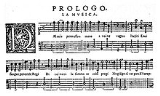
Orfeo

Encyclopedia
L'Orfeo sometimes called L'Orfeo, favola in musica, is an early Baroque
opera
by Claudio Monteverdi
, with a libretto
by Alessandro Striggio
. It is based on the Greek legend
of Orpheus
, and tells the story of his descent to Hades
and his fruitless attempt to bring his dead bride Eurydice
back to the living world. Written in 1607 for a court performance during the annual Carnival
at Mantua
, L'Orfeo is one of the earliest music dramas still regularly performed.
Within the musical theatre at the beginning of the 17th century the traditional intermedio
—a musical sequence between the acts of a straight play—was evolving into the form of a complete musical drama or "opera". Monteverdi's L'Orfeo moved this process out of its experimental era, and provided the first fully developed example within the new genre. After its initial performance the work was staged again in Mantua, and possibly in other Italian centres in the next few years. Its score was published by Monteverdi in 1609 and again in 1615. After the composer's death in 1643 the opera remained unperformed, and was largely forgotten until a revival of interest in the late 19th century led to a spate of modern editions and performances. At first these tended to be unstaged versions within institutes and music societies, but following the first modern dramatised performance in Paris, in 1911, the work was seen increasingly in theatres. After the Second World War most new editions sought authenticity through the use of period instruments. Many recordings were issued, and the opera was increasingly staged in opera houses. In 2007 the quatercentenary of the premiere was celebrated by performances throughout the world.
In his published score Monteverdi lists around 41 instruments to be deployed, with distinct groups of instruments used to depict particular scenes and characters. Thus strings, harpsichords and recorders represent the pastoral fields of Thrace with their nymphs and shepherds; heavy brass illustrates the underworld and its denizens. Composed at the point of transition from the Renaissance
era to the Baroque, L'Orfeo employs all the resources then known within the art of music, with particularly daring use of polyphony
. The work is not orchestrated as such; in the Renaissance tradition instrumentalists followed the composer's general instructions but were given considerable freedom to improvise. This separates Monteverdi's work from the later opera canon, and makes each performance of L'Orfeo a uniquely individual occasion.
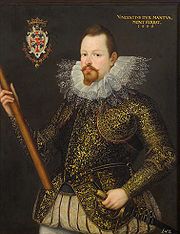 Claudio Monteverdi, born in Cremona
in 1567, was a musical prodigy
who studied under Marc'Antonio Ingegneri, the maestro di cappella (head of music) at Cremona Cathedral
. After training in singing, strings playing and composition, Monteverdi worked as a musician in Verona and Milan until, in 1590 or 1591, he secured a post as suonatore di vivuola (viola player) at Duke Vincenzo Gonzaga's court at Mantua
. Through ability and hard work Monteverdi rose to become Gonzaga's maestro della musica in 1601.
Vincenzo Gonzaga's particular passion for musical theatre and spectacle grew from his family connections with the court of Florence
. Towards the end of the 16th century innovative Florentine musicians were developing the intermedio
—a long-established form of musical interlude inserted between the acts of spoken dramas—into increasingly elaborate forms. Led by Jacopo Corsi
, these successors to the renowned Camerata
were responsible for the first work generally recognised as belonging to the genre of opera: Dafne
, composed by Corsi and Jacopo Peri
and performed in Florence in 1598. This work combined elements of madrigal
singing and monody
with dancing and instrumental passages to form a dramatic whole. Only fragments of its music still exist, but several other Florentine works of the same period—Rappresentatione di Anima, et di Corpo
by Emilio de' Cavalieri
, Peri's Euridice and Giulio Caccini
's identically titled Euridice
—survive complete. These last two works were the first of many musical representations of the Orpheus
myth as recounted in Ovid's Metamorphoses, and as such were direct precursors of Monteverdi's L'Orfeo.
The Gonzaga court had a long history of promoting dramatic entertainment. A century before Duke Vincenzo's time the court had staged Angelo Poliziano's lyrical drama La favola di Orfeo, at least half of which was sung rather than spoken. More recently, in 1598 Monteverdi had helped the court's musical establishment to produce Giovanni Battista Guarini
's play Il pastor fido
, described by theatre historian Mark Ringer
as a "watershed theatrical work" which inspired the Italian craze for pastoral drama. On 6 October 1600, while visiting Florence for the wedding of Maria de' Medici
to King Henry IV of France
, Duke Vincenzo attended a production of Peri's Euridice. It is likely that his principal musicians, including Monteverdi, were also present at this performance. The Duke quickly recognised the novelty of this new form of dramatic entertainment, and its potential for bringing prestige to those prepared to sponsor it.
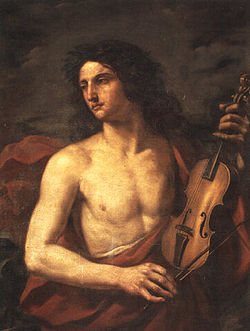 Among those present at the Euridice performance in October 1600 was a young lawyer and career diplomat from Gonzaga's court, Alessandro Striggio
, son of a well-known composer of the same name
. The younger Striggio was himself a talented musician who in 1589, as a 16-year-old, had played the viol at the wedding festivities of Duke Ferdinando of Tuscany
. Together with Duke Vincent's two young sons, Francesco and Fernandino, he was a member of Mantua's exclusive intellectual society, the Accademia degli Invaghiti, which provided the chief outlet for the city's theatrical works. It is not clear at what point Striggio began his libretto for L'Orfeo, but work was evidently under way in January 1607. In a letter written on 5 January, Francesco Gonzago asks his brother, then attached to the Florentine court, to obtain the services of a high quality castrato
from the Grand Duke's establishment, for a "play in music" being prepared for the Mantuan Carnival.
Striggio's main sources for his libretto were Books 10 and 11 of Ovid's Metamorphoses and Book Four of Virgil
's Georgics
. These provided him with the basic material, but not the structure for a staged drama; the events of Acts 1 and 2 of the libretto are covered by a mere 13 lines in the Metamorphoses. For help in creating a dramatic form, Striggio drew on other sources—Poliziano's 1480 play, Guarini's Il pastor fido, and Ottavio Rinuccini
's libretto for Peri's Euridice. Musicologist Gary Tomlinson
remarks on the many similarities between Striggio's and Rinuccini's texts, noting that some of the speeches in L'Orfeo "correspond closely in content and even in locution to their counterparts in L'Euridice". Critic Barbara Russano Hanning
writes that Striggio's verses are less subtle than those of Rinuccini, although the structure of Striggio's libretto is more interesting. Rinuccini, whose work had been written for the festivities accompanying a Medici
wedding, was obliged to alter the myth to provide a "happy ending", suitable for this occasion. By contrast, because Striggio was not writing for a formal court celebration he could be more faithful to the spirit of the myth's conclusion, in which Orfeo is killed and dismembered by deranged maenads or "Bacchantes". He chose, in fact, to write a somewhat muted version of this bloody finale, in which the Bacchantes threaten Orfeo's destruction but his actual fate is left in doubt.
The libretto published in Mantua in 1607 to coincide with the premiere incorporates Striggio's ambiguous ending. However, Monteverdi's score published in Venice in 1609 by Ricciardo Amadino
shows an entirely different resolution, with Orpheus transported to the heavens through the intervention of Apollo. According to Ringer, Striggio's original ending was almost certainly used at the opera's premiere, but there is no doubt that Monteverdi believed the revised ending was aesthetically correct. The musicologist Nino Pirrotta
argues that the Apollo ending was part of the original plan for the work, but was not staged at the premiere because the small room which hosted the event could not contain the theatrical machinery that this ending required. The Bacchantes scene was a substitution; Monteverdi's intentions were restored when this constraint was removed.
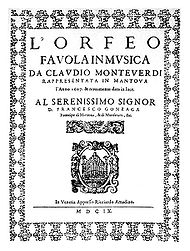 When Monteverdi wrote the music for L'Orfeo he had a thorough grounding in theatrical music. He had been employed at the Gonzaga court for 16 years, much of it as a performer or arranger of stage music, and in 1604 he had written the ballo
Gli amori di Diane ed Endimone for the 1604–05 Mantua Carnival. The elements from which Monteverdi constructed his first opera score—the aria
, the strophic song
, recitative
, choruses, dances, dramatic musical interludes—were, as conductor Nikolaus Harnoncourt
has pointed out, not created by him, but "he blended the entire stock of newest and older possibilities into a unity that was indeed new". Musicologist Robert Donington
writes similarly: "[The score] contains no element which was not based on precedent, but it reaches complete maturity in that recently-developed form ... Here are words as directly expressed in music as [the pioneers of opera] wanted them expressed; here is music expressing them ... with the full inspiration of genius."
Monteverdi states the orchestral requirements at the beginning of his published score, but in accordance with the practice of the day he does not specify their exact usage. At that time it was usual to allow each interpreter of the work freedom to make local decisions, based on the orchestral forces at their disposal. These could differ sharply from place to place. Furthermore, as Harnoncourt points out, the instrumentalists would all have been composers and would have expected to collaborate creatively at each performance, rather than playing a set text. Another practice of the time was to allow singers to embellish their arias. Monteverdi wrote plain and embellished versions of some arias, such as Orfeo's "Possente spirito", but according to Harnoncourt "it is obvious that where he did not write any embellishments he did not want any sung".
Each act of the opera deals with a single element of the story, and each ends with a chorus. Despite the five-act structure, with two sets of scene changes, it is likely that L'Orfeo conformed to the standard practice for court entertainments of that time and was played as a continuous entity, without intervals or curtain descents between acts. It was the contemporary custom for scene shifts to take place in sight of the audience, these changes being reflected musically by changes in instrumentation, key and style.
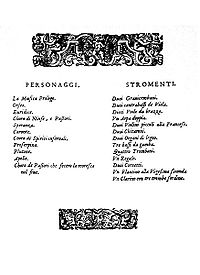 For the purpose of analysis, music scholar Jane Glover
divides Monteverdi's list of instruments into three main groups: strings, brass and continuo, with a few further items not easily classifiable. The strings grouping is formed from ten members of the violin family (viole da brazzo), two double basses (contrabassi de viola), and two small violins (violini piccoli alla francese). The viole da brazzo are in two five-part ensembles, each comprising two violins, two violas and a cello. The brass group contains four or five trombones (sackbut
s), three trumpets and two cornett
s. The continuo forces include two harpsichords (duoi gravicembani), a double harp (arpa doppia), two or three chitarroni, two pipe organs (organi di legno), three bass viola da gamba, and a regal
or small reed organ. Outside of these groupings are two recorders (flautini alla vigesima secunda), and possibly one or more cittern
s—unlisted by Monteverdi, but included in instructions relating to the end of Act 4.
Instrumentally, the two worlds represented within the opera are distinctively portrayed. The pastoral world of the fields of Thrace
is represented by the strings, harpsichords, harp, organs, recorders and chitarroni. The remaining instruments, mainly brass, are associated with the Underworld, though there is not an absolute distinction; strings appear on several occasions in the Hades
scenes. Within this general ordering, specific instruments or combinations are used to accompany some of the main characters—Orpheus by harp and organ, shepherds by harpsichord and chitarrone, the Underworld gods by trombones and regal. All of these musical distinctions and characterisations were in accordance with the longstanding traditions of the Renaissance orchestra, of which the large L'Orfeo ensemble is typical.
Monteverdi instructs his players generally to "[play] the work as simply and correctly as possible, and not with many florid passages or runs". Those playing ornamentation instruments such as strings and flutes are advised to "play nobly, with much invention and variety", but are warned against overdoing it, whereby "nothing is heard but chaos and confusion, offensive to the listener." Since at no time are all the instruments played together, the number of players needed is less than the number of instruments. Harnoncourt indicates that in Monteverdi's day the numbers of players and singers together, and the small rooms in which performances were held, often meant that the audience barely numbered more than the performers.
(Moorish dance) at the opera's end, are a separate group (che fecero la moresca nel fine). Little information is available about who sang the various roles in the first performance. A letter published at Mantua in 1612 records that the distinguished tenor and composer Francesco Rasi
took part, and it is generally assumed that he sang the title role. Rasi could sing in both the tenor and bass ranges "with exquisite style ... and extraordinary feeling". The involvement in the premiere of a Florentine castrato, Giovanni Gualberto Magli
, is confirmed by correspondence between the Gonzaga princes. Magli sang the prologue, Proserpina and possibly one other role, either La messaggera or Speranza. The musicologist and historian Hans Redlich
mistakenly allocates Magli to the role of Orfeo.
A clue about who played Euridice is contained in a 1608 letter to Duke Vincenzo. It refers to "that little priest who performed the role of Euridice in the Most Serene Prince's Orfeo". Possibly this priest was Padre Girolamo Bacchini
, a castrato known to have had connections to the Mantuan court in the early 17th century. Monteverdi scholar Tim Carter
speculates that two prominent Mantuan tenors, Pandolfo Grande and Francesco Campagnola may have sung minor roles in the premiere.
There are solo parts for four shepherds and three spirits. Carter calculates that through the doubling of roles that the text allows, a total of ten singers—three sopranos, two altos, three tenors and two basses—is required for a performance, with the soloists (except Orfeo) also forming the chorus. Carter's suggested role-doublings include La musica with Euridice, Ninfa with Proserpina and La messaggera with Speranza.
Act 1: After La musica's final request for silence, the curtain rises on Act 1 to reveal a pastoral scene. Orfeo and Euridice enter together with a chorus of nymphs and shepherds, who act in the manner of a Greek chorus
, commenting on the action both as a group and as individuals. A shepherd announces that this is the couple's wedding day; the chorus responds, first in a stately invocation ("Come, Hymen, O come") and then in a joyful dance ("Leave the mountains, leave the fountains"). Orfeo and Euridice sing of their love for each other, before leaving with most of the group for the wedding ceremony in the temple. Those left on stage sing a brief chorus, commenting on how Orfeo has been changed by love from one "for whom sighs were food and weeping was drink" to a state of sublime happiness.
Act 2: Orfeo returns with the main chorus, and sings with them of the beauties of nature. Orfeo then muses on his former unhappiness, but proclaims: "After grief one is more content, after pain one is happier". The mood of contentment is abruptly ended when La messaggera enters, bringing the news that, while gathering flowers, Euridice has received a fatal snakebite. The chorus expresses its anguish: "Ah, bitter happening, ah, impious and cruel fate!", while the Messaggera castigates herself as the bearing of bad tidings ("For ever I will flee, and in a lonely cavern lead a life in keeping with my sorrow"). Orfeo, after venting his grief and incredulity ("Thou art dead, my life, and I am breathing?"), declares his intention of descending to the Underworld and persuading its ruler to allow Euridice to return to life. Otherwise "I shall remain with thee in the company of death". He departs, and the chorus resumes its lament.
Act 3: Orfeo is guided by Speranza to the gates of Hades. Having pointed out the words inscribed on the gate ("Abandon hope, all ye who enter here"), Speranza leaves. Orfeo is now confronted with the ferryman Caronte, who addresses Orfeo harshly and refuses to take him across the River Styx. Orfeo attempts to persuade Caronte by singing a flattering song to him ("Mighty spirit and powerful divinity"), but the ferryman is unmoved. However, when Orfeo takes up his lyre and plays, Caronte is soothed into sleep. Seizing his chance, Orfeo steals the ferryman's boat and crosses the river, to enter the Underworld while a chorus of spirits reflects that nature cannot defend herself against man: "He has tamed the sea with fragile wood, and disdained the rage of the winds."
Act 4: In the Underworld Proserpina, Queen of Hades, who has been deeply affected by Orfeo's singing, petitions King Plutone, her husband, for Euridice's release. Moved by her pleas, Plutone agrees subject to the condition that, as he leads Euridice towards the world, Orfeo must not look back. If he does, "a single glance will condemn him to eternal loss". Orfeo enters, leading Euridice and singing confidently that on that day he will rest on his wife's white bosom. But as he sings a note of doubt creeps in: "Who will assure me that she is following?". Perhaps Plutone, driven by envy, has imposed the condition through spite? Suddenly distracted by an off-stage commotion, Orfeo looks round; immediately, the image of Euridice begins to fade. She sings, despairingly: "Losest thou me through too much love?" and disappears. Orfeo attempts to follow her but is drawn away by an unseen force. The chorus of spirits sings that Orfeo, having overcome Hades, was in turn overcome by his passions.
Act 5: Back in the fields of Thrace Orfeo, in a long soliloquy, laments his loss, praises Euridice's beauty and resolves that his heart will never again be pierced by Cupid's arrow. An off-stage echo repeats his final phrases. Suddenly, in a cloud, Apollo descends from the heavens and chastises him: "Why dost thou give thyself up as prey to rage and grief?" He invites Orfeo to leave the world and join him in the heavens, where he will recognise Euridice's likeness in the stars. Orfeo replies that it would be unworthy not to follow the counsel of such a wise father, and together they ascend. A shepherds' chorus concludes that "he who sows in suffering shall reap the fruit of every grace", before the opera ends with a vigorous moresca.
. The cause of their wrath is Orfeo and his renunciation of women; he will not escape their heavenly anger, and the longer he evades them the more severe his fate will be. Orfeo leaves the scene and his destiny is left uncertain, for the Bacchantes devote themselves for the rest of the opera to wild singing and dancing in praise of Bacchus. Early music authority Claude Palisca
believes that the two endings are not incompatible; Orfeo evades from the fury of the Bacchantes and is then rescued by Apollo.
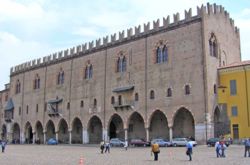 The date for the first performance of L'Orfeo, 24 February 1607, is evidenced by two letters, both dated 23 February. In the first, Francesco Gonzaga informs his brother that the "musical play" will be performed tomorrow; it is clear from earlier correspondence that this refers to L'Orfeo. The second letter is from a Gonzaga court official, Carlo Magno, and gives more details: "Tomorrow evening the Most Serene Lord the Prince is to sponsor a [play] in a room in the apartments which the Most Serene Lady had the use of ...it should be most unusual, as all the actors are to sing their parts." The "Serene Lady" is Duke Vincenzo's widowed sister Margherita Gonzaga d'Este, who lived within the ducal palace. The room of the premiere cannot be identified with certainty; according to Ringer, it may have been the Galleria dei Fiumi, which has the dimensions to accommodate a stage and orchestra with space for a small audience.
There is no detailed account of the premiere, although Francesco wrote on 1 March that the work had "been to the great satisfaction of all who heard it", and had particularly pleased the Duke. The Mantuan court theologian and poet, Cherubino Ferrari wrote that: "Both poet and musician have depicted the inclinations of the heart so skilfully that it could not have been done better ... The music, observing due propriety, serves the poetry so well that nothing more beautiful is to be heard anywhere". After the premiere Duke Vincenzo ordered a second performance for 1 March; a third performance was planned to coincide with a proposed state visit to Mantua by the Duke of Savoy
. Francesco wrote to the Duke of Tuscany on 8 March, asking if he could retain the services of the castrato Magli for a little longer. However, the visit was cancelled, as was the celebratory performance.
There are suggestions that in the years following the premiere, L'Orfeo may have been staged in Florence, Cremona, Milan and Turin, though firmer evidence suggests that the work attracted limited interest beyond the Mantuan court. Francesco may have mounted a production in Casale Monferrato
, where he was governor, for the 1609–10 Carnival, and there are indications that the work was performed on several occasions in Salzburg
between 1614 and 1619, under the direction of Francesco Rasi. Years later, during the first flourish of Venetian opera in 1637–43, Monteverdi chose to revive his second opera, L'Arianna
there, but not L'Orfeo. There is some evidence of performances shortly after Monteverdi's death: in Geneva in 1643, and in Paris, at the Louvre
, in 1647. Although according to Carter the work was still admired across Italy in the 1650s, it was subsequently forgotten, as largely was Monteverdi, until the revival of interest in his works in the late 19th century.
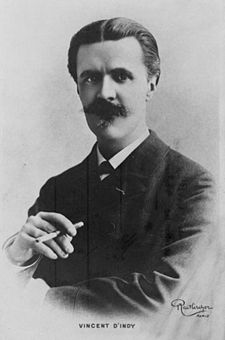 After years of neglect, Monteverdi's music began to attract the interest of pioneer music historians in the late 18th and early 19th centuries, and from the second quarter of the 19th century onwards he is discussed increasingly in scholarly works. In 1881 a truncated version of the L'Orfeo score, intended for study rather than performance, was published in Berlin by Robert Eitner. In 1904 the composer Vincent d'Indy
produced an edition in French, which comprised only Act 2, a shortened Act 3 and Act 4. This edition was the basis of the first public performance of the work in two-and-a-half centuries, a concert performance at d'Indy's Schola Cantorum on 25 February 1904. The distinguished writer Romain Rolland
, who was present, commended d'Indy for bringing the opera to life and returning it "to the beauty it once had, freeing it from the clumsy restorations which have disfigured it"—presumably a reference to Eitner's edition. The d'Indy edition was also the basis of the first modern staged performance of the work, at the Théâtre Réjane, Paris, on 2 May 1911.
An edition of the score by the minor Italian composer Giovanni Orefice received several concert performances in Italy and elsewhere before and after the First World War. This edition was the basis of the opera's United States debut, another concert performance at the New York Met
in April 1912. The opera was introduced to London, in d'Indy's edition, when it was sung to piano accompaniment at the Institut Français on 8 March 1924. The first British staged performance, with only small cuts, was given by the Oxford University Operatic Society on 7 December 1925, using an edition prepared for the event by Jack Westrup
. In the London Saturday Review
, music critic Dyneley Hussey
called the occasion "one of the most important events of recent years"; the production had "indicated at once Monteverdi's claim to rank among the great geniuses who have written dramatic music". Westrup's edition was revived in London at the Scala Theatre
in December 1929, the same year in which the opera received its first US staged performance, at Smith College
, Northampton, MA. The three Scala performances resulted in a financial disaster, and the opera was not seen again in Britain for 35 years.
Among a flurry of revivals after 1945 was Paul Hindemith
's edition, a full period reconstruction of the work prepared in 1943, which was staged and recorded at the Vienna Festival
in 1954. This performance had a great impact on the young Nikolaus Harnoncourt
, and was hailed as a masterpiece of scholarship and integrity. The first staged New York performance, by the New York City Opera
under Leopold Stokowski
on 29 September 1960, saw the American operatic debut of Gérard Souzay
, one of several baritones who have sung the role of Orfeo. The theatre was criticised by New York Times critic Harold C. Schonberg
because, to accommodate a performance of Luigi Dallapiccola
's contemporary opera Il prigioniero
, about a third of L'Orfeo was cut. Schonberg wrote: "Even the biggest aria in the opera, "Possente spirito", has a good-sized slash in the middle ... [L'Orfeo] is long enough, and important enough, not to mention beautiful enough, to have been the entire evening's opera."
By the latter part of the 20th century the opera was being shown all over the world. In 1965, Sadler's Wells, forerunner of English National Opera
(ENO), staged the first of many ENO presentations which would continue into the 21st century. Among various celebrations marking the opera's 400th anniversary in 2007 were a semi-staged performance at the Teatro Bibiena in Mantua, a full-scale production by the English Bach Festival (EBF) at the Whitehall Banqueting House in London on 7 February, and an unconventional production by Glimmerglass Opera
in Cooperstown, New York
, conducted by Antony Walker and directed by Christopher Alden
. On 6 May 2010 the BBC broadcast a performance of the opera from La Scala
, Milan
. Despite the reluctance of some major opera houses to stage L'Orfeo, it is a popular work with the leading Baroque ensembles. During the period 2008–10 the French-based Les Arts Florissants
, under its director William Christie
, has presented the Monteverdi trilogy of operas (L'Orfeo, Il ritorno d'Ulisse
and L'incoronazione di Poppea
) in a series of performances at the Teatro Real
in Madrid
.
 L'Orfeo is, in Redlich's analysis, the product of two musical epochs. It combines elements of the traditional madrigal
style of the 16th century with those of the emerging Florentine mode, in particular the use of recitative
and monodic
singing as developed by the Camerata and their successors. In this new style, the text dominates the music; while sinfonia
s and instrumental ritornelli
illustrate the action, the audience's attention is always drawn primarily to the words. The singers are required to do more than produce pleasant vocal sounds; they must represent their characters in depth and convey appropriate emotions.
Monterverdi's recitative style was influenced by Peri's, in Euridice, although in L'Orfeo recitative is less preponderant than was usual in dramatic music at this time. It accounts for less than a quarter of the first act's music, around a third of the second and third acts, and a little under half in the final two acts.
The importance of L'Orfeo is not that it was the first work of its kind, but that it was the first attempt to apply the full resources of the art of music, as then evolved, to the nascent genre of opera. In particular, Monteverdi made daring innovations in the use of polyphony
, of which Palestrina
had been the principal exponent. In L'Orfeo, Monteverdi extends the rules, beyond the conventions which polyphonic composers, faithful to Palestrina, had previously considered as sacrosanct. Monteverdi was not in the generally understood sense an orchestrator; Ringer finds that it is the element of instrumental improvisation that makes each performance of a Monteverdi opera a "unique experience, and separates his work from the later operatic canon."
The opera begins with a martial-sounding toccata
for trumpets which is repeated twice. When played on period wind instruments the sound can be startling to modern audiences; Redlich calls it "shattering". Such flourishes were the standard signal for the commencement of performances at the Mantuan court; the opening chorus of Monteverdi's 1610 Vespers, also composed for Gonzaga's court, employs the same fanfare. The toccata acted as a salute to the Duke; according to Donington, if it had not been written, precedent would have required it to be improvised. As the brass sound of the toccata fades, it is replaced by the gentler tone of the strings ritornello
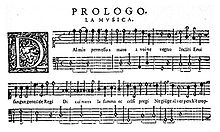
which introduces La musica's prologue. The ritornello is repeated in shortened form between each of the prologue's five verses, and in full after the final verse. Its function within the opera as a whole is to represents the "power of music"; as such it is heard at the end of Act 2, and again the beginning of Act 5, one of the earliest examples of an operatic leitmotiv.
After the Prologue, Act 1 follows in the form of a pastoral idyll. Two choruses, one solemn and one jovial are repeated in reverse order around the central love-song "Rosa del ciel" ("Rose of the heavens"), followed by the shepherds' songs of praise. The buoyant mood continues into Act 2, with song and dance music influenced, according to Harnoncourt, by Monteverdi's experience of French music. The sudden entrance of La messaggera with the doleful news of Euridice's death, and the confusion and grief which follow, are musically reflected by harsh dissonances and the juxtaposition of keys. The music remains in this vein until the act ends with La musica's ritornello, a hint that the "power of music" may yet bring about a triumph over death. Monteverdi's instructions as the act concludes are that the violins, the organ and harpsichord become silent and that the music is taken up by the trombones, the cornett
s and the regal
, as the scene changes to the Underworld.
The centrepiece of Act 3, perhaps of the entire opera, is Orfeo's extended aria "Possente spirto e formidabil nume" ("Mighty spirit and powerful divinity"), by which he attempts to persuade Caronte to allow him to enter Hades. Monteverdi's vocal embellishments and virtuoso accompaniment provide what Carter describes as "one of the most compelling visual and aural representations" in early opera. Instrumental colour is provided by a chitarrone, a pipe-organ, two violins, two cornetts and a double-harp. This array, according to music historian and analyst John Whenham
, is intended to suggest that Orfeo is harnessing all the available forces of music to support his plea. In Act 4 the impersonal coldness of the Underworld is broken by the warmth of Proserpina's singing on behalf of Orfeo, a warmth that is retained until the dramatic moment at which Orfeo "looks back". The cold sounds of the sinfonia from the beginning of Act 3 then remind us that the Underworld is, after all, entirely devoid of human feeling. The brief final act, which sees Orfeo's rescue and metamorphosis, is framed by the final appearance of La musica's ritornello and the lively moresca
that ends the opera. This dance, says Ringer, recalls the jigs danced at the end of Shakespeare
's tragedies, and provides a means of bringing the audience back to their everyday world, "just as the toccata had led them into another realm some two hours before. The toccata and the moresca unite courtly reality with operatic illusion."
The first recording of L'Orfeo was issued in 1939, a freely adapted version of Monteverdi's music by Giacomo Benvenuti
, given by the orchestra of La Scala
Milan conducted by Ferrucio Calusio
. In 1949, for the recording of the complete opera by the Berlin Radio Orchestra under Helmut Koch, the new medium of long-playing records (LPs) was used. The advent of LP recordings was, as Harold Schonberg later wrote, an important factor in the postwar revival of interest in Renaissance and Baroque music, and from the mid-1950s recordings of L'Orfeo have been issued on many labels. The 1969 recording by Nikolaus Harnoncourt and the Vienna Concentus Musicus, using Harnoncourt's edition based on period instruments, was praised for "making Monteverdi's music sound something like the way he imagined". In 1981 Siegfried Heinrich, with the Early Music Studio of the Hesse Chamber Orchestra, recorded a version which re-created the original Striggio libretto ending, adding music from Monteverdi's 1616 ballet Tirsi e Clori for the Bacchante scenes. Among more recent recordings, that of Emmanuelle Haim
in 2004 has been praised for its dramatic effect.
(1923 and1939) and Ottorino Respighi
in 1935. Orff's 1923 score, using a German text, included some period instrumentation, an experiment he abandoned when producing his later version.
In the post-war period, editions have moved increasingly to reflect the performance conventions of Monteverdi's day. This tendency was initiated by two earlier editions, that of Jack Westrup used in the 1925 Oxford performances, and Gian Francesco Malipiero
's 1930 complete edition which sticks closely to Monteverdi's 1609 original. After the war, Hindemith's attempted period reconstruction of the work was followed in 1955 by an edition from August Wenzinger
that remained in use for many years. The next 30 years saw numerous editions, mostly prepared by scholar-performers rather than by composers, generally aiming towards authenticity if not always the complete re-creation of the original instrumentation. These included versions by Raymond Leppard
(1965), Denis Stevens
(1967), Nikolaus Harnoncourt
(1969), Jane Glover
(1975), Roger Norrington
(1976) and John Eliot Gardiner
. Only the composers Valentino Bucchi
(1967), Bruno Maderna
(1967) and Luciano Berio
(1984) produced editions based on the convention of a large modern orchestra. In the 21st century editions continue to be produced, often for use in conjunction with a particular performance or recording.
Baroque music
Baroque music describes a style of Western Classical music approximately extending from 1600 to 1760. This era follows the Renaissance and was followed in turn by the Classical era...
opera
Opera
Opera is an art form in which singers and musicians perform a dramatic work combining text and musical score, usually in a theatrical setting. Opera incorporates many of the elements of spoken theatre, such as acting, scenery, and costumes and sometimes includes dance...
by Claudio Monteverdi
Claudio Monteverdi
Claudio Giovanni Antonio Monteverdi – 29 November 1643) was an Italian composer, gambist, and singer.Monteverdi's work, often regarded as revolutionary, marked the transition from the Renaissance style of music to that of the Baroque period. He developed two individual styles of composition – the...
, with a libretto
Libretto
A libretto is the text used in an extended musical work such as an opera, operetta, masque, oratorio, cantata, or musical. The term "libretto" is also sometimes used to refer to the text of major liturgical works, such as mass, requiem, and sacred cantata, or even the story line of a...
by Alessandro Striggio
Alessandro Striggio (ii)
Alessandro Striggio the Younger was an Italian librettist, the son of the composer Alessandro Striggio. The younger Striggio is most famous for his association with the composer Claudio Monteverdi. He wrote the libretto for Monteverdi's first opera Orfeo , a landmark in the history of the genre,...
. It is based on the Greek legend
Greek mythology
Greek mythology is the body of myths and legends belonging to the ancient Greeks, concerning their gods and heroes, the nature of the world, and the origins and significance of their own cult and ritual practices. They were a part of religion in ancient Greece...
of Orpheus
Orpheus
Orpheus was a legendary musician, poet, and prophet in ancient Greek religion and myth. The major stories about him are centered on his ability to charm all living things and even stones with his music; his attempt to retrieve his wife from the underworld; and his death at the hands of those who...
, and tells the story of his descent to Hades
Hades
Hades , Hadēs, originally , Haidēs or , Aidēs , meaning "the unseen") was the ancient Greek god of the underworld. The genitive , Haidou, was an elision to denote locality: "[the house/dominion] of Hades". Eventually, the nominative came to designate the abode of the dead.In Greek mythology, Hades...
and his fruitless attempt to bring his dead bride Eurydice
Eurydice
Eurydice in Greek mythology, was an oak nymph or one of the daughters of Apollo . She was the wife of Orpheus, who loved her dearly; on their wedding day, he played joyful songs as his bride danced through the meadow. One day, a satyr saw and pursued Eurydice, who stepped on a venomous snake,...
back to the living world. Written in 1607 for a court performance during the annual Carnival
Carnival
Carnaval is a festive season which occurs immediately before Lent; the main events are usually during February. Carnaval typically involves a public celebration or parade combining some elements of a circus, mask and public street party...
at Mantua
Mantua
Mantua is a city and comune in Lombardy, Italy and capital of the province of the same name. Mantua's historic power and influence under the Gonzaga family, made it one of the main artistic, cultural and notably musical hubs of Northern Italy and the country as a whole...
, L'Orfeo is one of the earliest music dramas still regularly performed.
Within the musical theatre at the beginning of the 17th century the traditional intermedio
Intermedio
The intermedio, or intermezzo, in the Italian Renaissance, was a theatrical performance or spectacle with music and often dance which was performed between the acts of a play to celebrate special occasions in Italian courts. It was one of the important predecessors to opera, and an influence on...
—a musical sequence between the acts of a straight play—was evolving into the form of a complete musical drama or "opera". Monteverdi's L'Orfeo moved this process out of its experimental era, and provided the first fully developed example within the new genre. After its initial performance the work was staged again in Mantua, and possibly in other Italian centres in the next few years. Its score was published by Monteverdi in 1609 and again in 1615. After the composer's death in 1643 the opera remained unperformed, and was largely forgotten until a revival of interest in the late 19th century led to a spate of modern editions and performances. At first these tended to be unstaged versions within institutes and music societies, but following the first modern dramatised performance in Paris, in 1911, the work was seen increasingly in theatres. After the Second World War most new editions sought authenticity through the use of period instruments. Many recordings were issued, and the opera was increasingly staged in opera houses. In 2007 the quatercentenary of the premiere was celebrated by performances throughout the world.
In his published score Monteverdi lists around 41 instruments to be deployed, with distinct groups of instruments used to depict particular scenes and characters. Thus strings, harpsichords and recorders represent the pastoral fields of Thrace with their nymphs and shepherds; heavy brass illustrates the underworld and its denizens. Composed at the point of transition from the Renaissance
Renaissance music
Renaissance music is European music written during the Renaissance. Defining the beginning of the musical era is difficult, given that its defining characteristics were adopted only gradually; musicologists have placed its beginnings from as early as 1300 to as late as the 1470s.Literally meaning...
era to the Baroque, L'Orfeo employs all the resources then known within the art of music, with particularly daring use of polyphony
Polyphony
In music, polyphony is a texture consisting of two or more independent melodic voices, as opposed to music with just one voice or music with one dominant melodic voice accompanied by chords ....
. The work is not orchestrated as such; in the Renaissance tradition instrumentalists followed the composer's general instructions but were given considerable freedom to improvise. This separates Monteverdi's work from the later opera canon, and makes each performance of L'Orfeo a uniquely individual occasion.
Historical background
Cremona
Cremona is a city and comune in northern Italy, situated in Lombardy, on the left bank of the Po River in the middle of the Pianura Padana . It is the capital of the province of Cremona and the seat of the local City and Province governments...
in 1567, was a musical prodigy
Child prodigy
A child prodigy is someone who, at an early age, masters one or more skills far beyond his or her level of maturity. One criterion for classifying prodigies is: a prodigy is a child, typically younger than 18 years old, who is performing at the level of a highly trained adult in a very demanding...
who studied under Marc'Antonio Ingegneri, the maestro di cappella (head of music) at Cremona Cathedral
Cremona Cathedral
The Duomo di Cremona , dedicated to Santa Maria Assunta , is a church in Cremona, Lombardy, northern Italy and the episcopal see of the Roman Catholic Diocese of Cremona...
. After training in singing, strings playing and composition, Monteverdi worked as a musician in Verona and Milan until, in 1590 or 1591, he secured a post as suonatore di vivuola (viola player) at Duke Vincenzo Gonzaga's court at Mantua
Mantua
Mantua is a city and comune in Lombardy, Italy and capital of the province of the same name. Mantua's historic power and influence under the Gonzaga family, made it one of the main artistic, cultural and notably musical hubs of Northern Italy and the country as a whole...
. Through ability and hard work Monteverdi rose to become Gonzaga's maestro della musica in 1601.
Vincenzo Gonzaga's particular passion for musical theatre and spectacle grew from his family connections with the court of Florence
Florence
Florence is the capital city of the Italian region of Tuscany and of the province of Florence. It is the most populous city in Tuscany, with approximately 370,000 inhabitants, expanding to over 1.5 million in the metropolitan area....
. Towards the end of the 16th century innovative Florentine musicians were developing the intermedio
Intermedio
The intermedio, or intermezzo, in the Italian Renaissance, was a theatrical performance or spectacle with music and often dance which was performed between the acts of a play to celebrate special occasions in Italian courts. It was one of the important predecessors to opera, and an influence on...
—a long-established form of musical interlude inserted between the acts of spoken dramas—into increasingly elaborate forms. Led by Jacopo Corsi
Jacopo Corsi
Jacopo Corsi was an Italian composer of the late Renaissance and early Baroque and patron of the arts....
, these successors to the renowned Camerata
Florentine Camerata
The Florentine Camerata was a group of humanists, musicians, poets and intellectuals in late Renaissance Florence who gathered under the patronage of Count Giovanni de' Bardi to discuss and guide trends in the arts, especially music and drama...
were responsible for the first work generally recognised as belonging to the genre of opera: Dafne
Dafne
Dafne is the earliest known work that, by modern standards, could be considered an opera. It was composed by Jacopo Peri in 1597, with a libretto by Ottavio Rinuccini.-History:...
, composed by Corsi and Jacopo Peri
Jacopo Peri
Jacopo Peri was an Italian composer and singer of the transitional period between the Renaissance and Baroque styles, and is often called the inventor of opera...
and performed in Florence in 1598. This work combined elements of madrigal
Madrigal (music)
A madrigal is a secular vocal music composition, usually a partsong, of the Renaissance and early Baroque eras. Traditionally, polyphonic madrigals are unaccompanied; the number of voices varies from two to eight, and most frequently from three to six....
singing and monody
Monody
In poetry, the term monody has become specialized to refer to a poem in which one person laments another's death....
with dancing and instrumental passages to form a dramatic whole. Only fragments of its music still exist, but several other Florentine works of the same period—Rappresentatione di Anima, et di Corpo
Rappresentatione di Anima, et di Corpo
Emilio de Cavalieri regarded himself as the composer of the first opera or oratorio, with the Rappresentatione di anima e di corpo,...
by Emilio de' Cavalieri
Emilio de' Cavalieri
Emilio de' Cavalieri was an Italian composer, producer, organist, diplomat, choreographer and dancer at the end of the Renaissance era. His work, along with that of other composers active in Rome, Florence and Venice, was critical in defining the beginning of the musical Baroque era...
, Peri's Euridice and Giulio Caccini
Giulio Caccini
Giulio Caccini , also known as Giulio Romano, was an Italian composer, teacher, singer, instrumentalist and writer of the very late Renaissance and early Baroque eras. He was one of the founders of the genre of opera, and one of the single most influential creators of the new Baroque style...
's identically titled Euridice
Euridice (Caccini)
Euridice is an opera in a prologue and one act by the Italian composer Giulio Caccini. The libretto, by Ottavio Rinuccini, had already been set by Caccini's rival Jacopo Peri in 1600. Caccini's version of Euridice was first performed at the Pitti Palace, Florence on 5 December 1602...
—survive complete. These last two works were the first of many musical representations of the Orpheus
Orpheus
Orpheus was a legendary musician, poet, and prophet in ancient Greek religion and myth. The major stories about him are centered on his ability to charm all living things and even stones with his music; his attempt to retrieve his wife from the underworld; and his death at the hands of those who...
myth as recounted in Ovid's Metamorphoses, and as such were direct precursors of Monteverdi's L'Orfeo.
The Gonzaga court had a long history of promoting dramatic entertainment. A century before Duke Vincenzo's time the court had staged Angelo Poliziano's lyrical drama La favola di Orfeo, at least half of which was sung rather than spoken. More recently, in 1598 Monteverdi had helped the court's musical establishment to produce Giovanni Battista Guarini
Giovanni Battista Guarini
Giovanni Battista Guarini was an Italian poet, dramatist, and diplomat.- Life :He was born in Ferrara, and spent his early life both in Padua and Ferrara, entering the service of Alfonso II d'Este, Duke of Ferrara, in 1567...
's play Il pastor fido
Il pastor fido
Il pastor fido is an opera in three acts by George Frideric Handel. It was set to a libretto by Giacomo Rossi based on the famed and widely familiar pastoral poem of the same name by Giovanni Battista Guarini.-Performance history:...
, described by theatre historian Mark Ringer
Mark Ringer
Mark Ringer American writer, theater and opera historian, director and actor. Ringer’s books include Electra and the Empty Urn: Metatheater and Role Playing in Sophocles, a critical analysis of theatrical self-awareness in the seven Sophoclean tragedies, Opera's First Master, which Alan Rich of...
as a "watershed theatrical work" which inspired the Italian craze for pastoral drama. On 6 October 1600, while visiting Florence for the wedding of Maria de' Medici
Marie de' Medici
Marie de Médicis , Italian Maria de' Medici, was queen consort of France, as the second wife of King Henry IV of France, of the House of Bourbon. She herself was a member of the wealthy and powerful House of Medici...
to King Henry IV of France
Henry IV of France
Henry IV , Henri-Quatre, was King of France from 1589 to 1610 and King of Navarre from 1572 to 1610. He was the first monarch of the Bourbon branch of the Capetian dynasty in France....
, Duke Vincenzo attended a production of Peri's Euridice. It is likely that his principal musicians, including Monteverdi, were also present at this performance. The Duke quickly recognised the novelty of this new form of dramatic entertainment, and its potential for bringing prestige to those prepared to sponsor it.
Libretto
Alessandro Striggio (ii)
Alessandro Striggio the Younger was an Italian librettist, the son of the composer Alessandro Striggio. The younger Striggio is most famous for his association with the composer Claudio Monteverdi. He wrote the libretto for Monteverdi's first opera Orfeo , a landmark in the history of the genre,...
, son of a well-known composer of the same name
Alessandro Striggio
Alessandro Striggio was an Italian composer, instrumentalist and diplomat of the Renaissance. He composed numerous madrigals as well as dramatic music, and by combining the two, became the inventor of madrigal comedy...
. The younger Striggio was himself a talented musician who in 1589, as a 16-year-old, had played the viol at the wedding festivities of Duke Ferdinando of Tuscany
Ferdinando I de' Medici, Grand Duke of Tuscany
Ferdinando I de' Medici, Grand Duke of Tuscany was Grand Duke of Tuscany from 1587 to 1609, having succeeded his older brother Francesco I.-Biography:...
. Together with Duke Vincent's two young sons, Francesco and Fernandino, he was a member of Mantua's exclusive intellectual society, the Accademia degli Invaghiti, which provided the chief outlet for the city's theatrical works. It is not clear at what point Striggio began his libretto for L'Orfeo, but work was evidently under way in January 1607. In a letter written on 5 January, Francesco Gonzago asks his brother, then attached to the Florentine court, to obtain the services of a high quality castrato
Castrato
A castrato is a man with a singing voice equivalent to that of a soprano, mezzo-soprano, or contralto voice produced either by castration of the singer before puberty or one who, because of an endocrinological condition, never reaches sexual maturity.Castration before puberty prevents a boy's...
from the Grand Duke's establishment, for a "play in music" being prepared for the Mantuan Carnival.
Striggio's main sources for his libretto were Books 10 and 11 of Ovid's Metamorphoses and Book Four of Virgil
Virgil
Publius Vergilius Maro, usually called Virgil or Vergil in English , was an ancient Roman poet of the Augustan period. He is known for three major works of Latin literature, the Eclogues , the Georgics, and the epic Aeneid...
's Georgics
Georgics
The Georgics is a poem in four books, likely published in 29 BC. It is the second major work by the Latin poet Virgil, following his Eclogues and preceding the Aeneid. It is a poem that draws on many prior sources and influenced many later authors from antiquity to the present...
. These provided him with the basic material, but not the structure for a staged drama; the events of Acts 1 and 2 of the libretto are covered by a mere 13 lines in the Metamorphoses. For help in creating a dramatic form, Striggio drew on other sources—Poliziano's 1480 play, Guarini's Il pastor fido, and Ottavio Rinuccini
Ottavio Rinuccini
Ottavio Rinuccini was an Italian poet, courtier, and opera librettist at the end of the Renaissance and beginning of the Baroque eras...
's libretto for Peri's Euridice. Musicologist Gary Tomlinson
Gary A. Tomlinson
Gary Tomlinson is an American musicologist, and Annenberg Professor in the Humanities, at the University of Pennsylvania. Beginning in the fall of 2011, he will be a full time faculty member at Yale University....
remarks on the many similarities between Striggio's and Rinuccini's texts, noting that some of the speeches in L'Orfeo "correspond closely in content and even in locution to their counterparts in L'Euridice". Critic Barbara Russano Hanning
Barbara Russano Hanning
Barbara Russano Hanning is an American musicologist who specializes in 16th and 17th century Italian music. She has also written works on the music of 18th-century France and on musical iconography. She earned a PhD in musicology from Yale University...
writes that Striggio's verses are less subtle than those of Rinuccini, although the structure of Striggio's libretto is more interesting. Rinuccini, whose work had been written for the festivities accompanying a Medici
Medici
The House of Medici or Famiglia de' Medici was a political dynasty, banking family and later royal house that first began to gather prominence under Cosimo de' Medici in the Republic of Florence during the late 14th century. The family originated in the Mugello region of the Tuscan countryside,...
wedding, was obliged to alter the myth to provide a "happy ending", suitable for this occasion. By contrast, because Striggio was not writing for a formal court celebration he could be more faithful to the spirit of the myth's conclusion, in which Orfeo is killed and dismembered by deranged maenads or "Bacchantes". He chose, in fact, to write a somewhat muted version of this bloody finale, in which the Bacchantes threaten Orfeo's destruction but his actual fate is left in doubt.
The libretto published in Mantua in 1607 to coincide with the premiere incorporates Striggio's ambiguous ending. However, Monteverdi's score published in Venice in 1609 by Ricciardo Amadino
Ricciardo Amadino
Ricciardo Amadino was a Venetian printer. He briefly attempted to publish music on his own in 1579, but was unsuccessful. He joined with Giacomo Vincenti, with whom he published over 80 books between 1583 and 1586. Many of these were re-prints of popular madrigal books, but some were first printings...
shows an entirely different resolution, with Orpheus transported to the heavens through the intervention of Apollo. According to Ringer, Striggio's original ending was almost certainly used at the opera's premiere, but there is no doubt that Monteverdi believed the revised ending was aesthetically correct. The musicologist Nino Pirrotta
Nino Pirrotta
Nino Pirrotta was an Italian musicologist of international renown who specialized in Italian music from the late medieval, Renaissance and early Baroque eras. In 1931 he earned a degree in art history from the University of Florence after having already earned a diploma in organ performance...
argues that the Apollo ending was part of the original plan for the work, but was not staged at the premiere because the small room which hosted the event could not contain the theatrical machinery that this ending required. The Bacchantes scene was a substitution; Monteverdi's intentions were restored when this constraint was removed.
Composition
Ballo
The Ballo was an Italian dance form during the fifteenth century, most noted for its frequent changes of tempo and meter.-Dance of the 15th Century:...
Gli amori di Diane ed Endimone for the 1604–05 Mantua Carnival. The elements from which Monteverdi constructed his first opera score—the aria
Aria
An aria in music was originally any expressive melody, usually, but not always, performed by a singer. The term is now used almost exclusively to describe a self-contained piece for one voice usually with orchestral accompaniment...
, the strophic song
Strophic form
Strophic form is the simplest and most durable of musical forms, elaborating a piece of music by repetition of a single formal section. This may be analyzed as "A A A..."...
, recitative
Recitative
Recitative , also known by its Italian name "recitativo" , is a style of delivery in which a singer is allowed to adopt the rhythms of ordinary speech...
, choruses, dances, dramatic musical interludes—were, as conductor Nikolaus Harnoncourt
Nikolaus Harnoncourt
Nikolaus Harnoncourt is an Austrian conductor, particularly known for his historically informed performances of music from the Classical era and earlier. Starting out as a classical cellist, he founded his own period instrument ensemble in the 1950s, and became a pioneer of the Early Music movement...
has pointed out, not created by him, but "he blended the entire stock of newest and older possibilities into a unity that was indeed new". Musicologist Robert Donington
Robert Donington
Robert Donington was a British musicologist and instrumentalist influential in the early music movement and in Wagner studies.He was educated at St Paul's School, London, and studied at the University of Oxford...
writes similarly: "[The score] contains no element which was not based on precedent, but it reaches complete maturity in that recently-developed form ... Here are words as directly expressed in music as [the pioneers of opera] wanted them expressed; here is music expressing them ... with the full inspiration of genius."
Monteverdi states the orchestral requirements at the beginning of his published score, but in accordance with the practice of the day he does not specify their exact usage. At that time it was usual to allow each interpreter of the work freedom to make local decisions, based on the orchestral forces at their disposal. These could differ sharply from place to place. Furthermore, as Harnoncourt points out, the instrumentalists would all have been composers and would have expected to collaborate creatively at each performance, rather than playing a set text. Another practice of the time was to allow singers to embellish their arias. Monteverdi wrote plain and embellished versions of some arias, such as Orfeo's "Possente spirito", but according to Harnoncourt "it is obvious that where he did not write any embellishments he did not want any sung".
Each act of the opera deals with a single element of the story, and each ends with a chorus. Despite the five-act structure, with two sets of scene changes, it is likely that L'Orfeo conformed to the standard practice for court entertainments of that time and was played as a continuous entity, without intervals or curtain descents between acts. It was the contemporary custom for scene shifts to take place in sight of the audience, these changes being reflected musically by changes in instrumentation, key and style.
Instrumentation
Jane Glover
Jane Glover CBE is a British-born conductor and music scholar.-Early life:Glover attended Haberdashers' Monmouth School for Girls. Her father, Robert Finlay Glover MA TD,was headmaster of Monmouth School and it was through this connection that she was able to meet Benjamin Britten and Peter Pears...
divides Monteverdi's list of instruments into three main groups: strings, brass and continuo, with a few further items not easily classifiable. The strings grouping is formed from ten members of the violin family (viole da brazzo), two double basses (contrabassi de viola), and two small violins (violini piccoli alla francese). The viole da brazzo are in two five-part ensembles, each comprising two violins, two violas and a cello. The brass group contains four or five trombones (sackbut
Sackbut
The sackbut is a trombone from the Renaissance and Baroque eras, i.e., a musical instrument in the brass family similar to the trumpet except characterised by a telescopic slide with which the player varies the length of the tube to change pitches, thus allowing them to obtain chromaticism, as...
s), three trumpets and two cornett
Cornett
The cornett, cornetto or zink is an early wind instrument, dating from the Medieval, Renaissance and Baroque periods. It was used in what are now called alta capellas or wind ensembles. It is not to be confused with the trumpet-like instrument cornet.-Construction:There are three basic types of...
s. The continuo forces include two harpsichords (duoi gravicembani), a double harp (arpa doppia), two or three chitarroni, two pipe organs (organi di legno), three bass viola da gamba, and a regal
Regal (musical instrument)
The regal was a small portable organ, furnished with beating reeds and having two bellows. The instrument enjoyed its greatest popularity during the Renaissance. The name was also sometimes given to the reed stops of a pipe organ, and more especially the vox humana stop.The sound of the regal was...
or small reed organ. Outside of these groupings are two recorders (flautini alla vigesima secunda), and possibly one or more cittern
Cittern
The cittern or cither is a stringed instrument dating from the Renaissance. Modern scholars debate its exact history, but it is generally accepted that it is descended from the Medieval Citole, or Cytole. It looks much like the modern-day flat-back mandolin and the modern Irish bouzouki and cittern...
s—unlisted by Monteverdi, but included in instructions relating to the end of Act 4.
Instrumentally, the two worlds represented within the opera are distinctively portrayed. The pastoral world of the fields of Thrace
Thrace
Thrace is a historical and geographic area in southeast Europe. As a geographical concept, Thrace designates a region bounded by the Balkan Mountains on the north, Rhodope Mountains and the Aegean Sea on the south, and by the Black Sea and the Sea of Marmara on the east...
is represented by the strings, harpsichords, harp, organs, recorders and chitarroni. The remaining instruments, mainly brass, are associated with the Underworld, though there is not an absolute distinction; strings appear on several occasions in the Hades
Hades
Hades , Hadēs, originally , Haidēs or , Aidēs , meaning "the unseen") was the ancient Greek god of the underworld. The genitive , Haidou, was an elision to denote locality: "[the house/dominion] of Hades". Eventually, the nominative came to designate the abode of the dead.In Greek mythology, Hades...
scenes. Within this general ordering, specific instruments or combinations are used to accompany some of the main characters—Orpheus by harp and organ, shepherds by harpsichord and chitarrone, the Underworld gods by trombones and regal. All of these musical distinctions and characterisations were in accordance with the longstanding traditions of the Renaissance orchestra, of which the large L'Orfeo ensemble is typical.
Monteverdi instructs his players generally to "[play] the work as simply and correctly as possible, and not with many florid passages or runs". Those playing ornamentation instruments such as strings and flutes are advised to "play nobly, with much invention and variety", but are warned against overdoing it, whereby "nothing is heard but chaos and confusion, offensive to the listener." Since at no time are all the instruments played together, the number of players needed is less than the number of instruments. Harnoncourt indicates that in Monteverdi's day the numbers of players and singers together, and the small rooms in which performances were held, often meant that the audience barely numbered more than the performers.
Roles
In his personaggi listed in the 1609 score, Monteverdi unaccountably omits La messaggera (the Messenger), and indicates that the final chorus of shepherds who perform the morescaMoresca
Moresca or Mauresque is a 15th/16th century pantomime dance in which the executants wore Moorish costumes. One such is the concluding music of Monteverdi's L'Orfeo...
(Moorish dance) at the opera's end, are a separate group (che fecero la moresca nel fine). Little information is available about who sang the various roles in the first performance. A letter published at Mantua in 1612 records that the distinguished tenor and composer Francesco Rasi
Francesco Rasi
Francesco Rasi was an Italian composer, singer , chitarrone player, and poet.Rasi was born in Arezzo. He studied at the University of Pisa and in 1594 he was studying with Giulio Caccini. He may have been in Carlo Gesualdo's retinue when he went to Ferrara for his wedding in 1594...
took part, and it is generally assumed that he sang the title role. Rasi could sing in both the tenor and bass ranges "with exquisite style ... and extraordinary feeling". The involvement in the premiere of a Florentine castrato, Giovanni Gualberto Magli
Giovanni Gualberto Magli
Giovanni Gualberto Magli was an Italian castrato who had an active singing career during the first quarter of the 17th century. Born in Florence, he studied voice with Giulio Caccini before becoming a musician for the House of Medici on 23 August 1604...
, is confirmed by correspondence between the Gonzaga princes. Magli sang the prologue, Proserpina and possibly one other role, either La messaggera or Speranza. The musicologist and historian Hans Redlich
Hans Redlich
Hans Ferdinand Redlich was an Austrian classical composer, conductor, musicologist and writer.-Redlich's Continental Years:...
mistakenly allocates Magli to the role of Orfeo.
A clue about who played Euridice is contained in a 1608 letter to Duke Vincenzo. It refers to "that little priest who performed the role of Euridice in the Most Serene Prince's Orfeo". Possibly this priest was Padre Girolamo Bacchini
Girolamo Bacchini
Girolamo Bacchini was an Italian castrato, composer, writer on music, and Roman Catholic priest who flourished during the late 16th century and early 17th century.-Life and career:...
, a castrato known to have had connections to the Mantuan court in the early 17th century. Monteverdi scholar Tim Carter
Tim Carter (musicologist)
Tim Carter is an Australian musicologist with a special focus on late Renaissance music and Italian Baroque music. An active member of the field of musicology, Carter is presently a department chair at the University of North Carolina, Chapel Hill, where he holds the position of David G. Frey...
speculates that two prominent Mantuan tenors, Pandolfo Grande and Francesco Campagnola may have sung minor roles in the premiere.
There are solo parts for four shepherds and three spirits. Carter calculates that through the doubling of roles that the text allows, a total of ten singers—three sopranos, two altos, three tenors and two basses—is required for a performance, with the soloists (except Orfeo) also forming the chorus. Carter's suggested role-doublings include La musica with Euridice, Ninfa with Proserpina and La messaggera with Speranza.
| Role | Voice type | Appearances | Notes |
|---|---|---|---|
| La musica (Music) | soprano Soprano A soprano is a voice type with a vocal range from approximately middle C to "high A" in choral music, or to "soprano C" or higher in operatic music. In four-part chorale style harmony, the soprano takes the highest part, which usually encompasses the melody... , originally castrato Castrato A castrato is a man with a singing voice equivalent to that of a soprano, mezzo-soprano, or contralto voice produced either by castration of the singer before puberty or one who, because of an endocrinological condition, never reaches sexual maturity.Castration before puberty prevents a boy's... |
Prologue | |
| Orfeo (Orpheus) | tenor Tenor The tenor is a type of male singing voice and is the highest male voice within the modal register. The typical tenor voice lies between C3, the C one octave below middle C, to the A above middle C in choral music, and up to high C in solo work. The low extreme for tenors is roughly B2... |
Act 1, 2, 3, 4, 5 | |
| Euridice (Eurydice) | soprano, originally castrato | Act 1, 4 | |
| La messaggera (The Messenger) | soprano | Act 2 | Named in the libretto as "Silvia" |
| Speranza (Hope) | soprano | Act 3 | |
| Caronte (Charon) | bass Bass (voice type) A bass is a type of male singing voice and possesses the lowest vocal range of all voice types. According to The New Grove Dictionary of Opera, a bass is typically classified as having a range extending from around the second E below middle C to the E above middle C... |
Act 3 | |
| Proserpina (Proserpine) | soprano | Act 4 | |
| Plutone (Pluto) | bass | Act 4 | |
| Apollo | tenor | Act 5 | |
| Ninfa (Nymph) | soprano | Act 1 | |
| Eco (Echo) | tenor | Act 5 | |
| Ninfe e pastori (Nymphs and shepherds) | soprano, alto, tenor, bass | Act 1, 2, 5 | Soloists: alto, two tenors |
| Spiriti infernali (Infernal spirits) | tenor, bass | Act 3, 4 | Soloists: two tenors, one bass |
Synopsis
The actions take place in two contrasting locations: the fields of Thrace (Acts 1, 2 and 5) and the Underworld (Acts 3 and 4). An instrumental toccata (English: "tucket", meaning a flourish on trumpets) precedes the entrance of La musica, representing the "spirit of music", who sings a prologue of five stanzas of verse. After a gracious welcome to the audience she announces that she can, through sweet sounds, "calm every troubled heart." She sings a further paean to the power of music, before introducing the drama's main protagonist, Orfeo, who "held the wild beasts spellbound with his song".Act 1: After La musica's final request for silence, the curtain rises on Act 1 to reveal a pastoral scene. Orfeo and Euridice enter together with a chorus of nymphs and shepherds, who act in the manner of a Greek chorus
Greek chorus
A Greek chorus is a homogenous, non-individualised group of performers in the plays of classical Greece, who comment with a collective voice on the dramatic action....
, commenting on the action both as a group and as individuals. A shepherd announces that this is the couple's wedding day; the chorus responds, first in a stately invocation ("Come, Hymen, O come") and then in a joyful dance ("Leave the mountains, leave the fountains"). Orfeo and Euridice sing of their love for each other, before leaving with most of the group for the wedding ceremony in the temple. Those left on stage sing a brief chorus, commenting on how Orfeo has been changed by love from one "for whom sighs were food and weeping was drink" to a state of sublime happiness.
Act 2: Orfeo returns with the main chorus, and sings with them of the beauties of nature. Orfeo then muses on his former unhappiness, but proclaims: "After grief one is more content, after pain one is happier". The mood of contentment is abruptly ended when La messaggera enters, bringing the news that, while gathering flowers, Euridice has received a fatal snakebite. The chorus expresses its anguish: "Ah, bitter happening, ah, impious and cruel fate!", while the Messaggera castigates herself as the bearing of bad tidings ("For ever I will flee, and in a lonely cavern lead a life in keeping with my sorrow"). Orfeo, after venting his grief and incredulity ("Thou art dead, my life, and I am breathing?"), declares his intention of descending to the Underworld and persuading its ruler to allow Euridice to return to life. Otherwise "I shall remain with thee in the company of death". He departs, and the chorus resumes its lament.
Act 3: Orfeo is guided by Speranza to the gates of Hades. Having pointed out the words inscribed on the gate ("Abandon hope, all ye who enter here"), Speranza leaves. Orfeo is now confronted with the ferryman Caronte, who addresses Orfeo harshly and refuses to take him across the River Styx. Orfeo attempts to persuade Caronte by singing a flattering song to him ("Mighty spirit and powerful divinity"), but the ferryman is unmoved. However, when Orfeo takes up his lyre and plays, Caronte is soothed into sleep. Seizing his chance, Orfeo steals the ferryman's boat and crosses the river, to enter the Underworld while a chorus of spirits reflects that nature cannot defend herself against man: "He has tamed the sea with fragile wood, and disdained the rage of the winds."
Act 4: In the Underworld Proserpina, Queen of Hades, who has been deeply affected by Orfeo's singing, petitions King Plutone, her husband, for Euridice's release. Moved by her pleas, Plutone agrees subject to the condition that, as he leads Euridice towards the world, Orfeo must not look back. If he does, "a single glance will condemn him to eternal loss". Orfeo enters, leading Euridice and singing confidently that on that day he will rest on his wife's white bosom. But as he sings a note of doubt creeps in: "Who will assure me that she is following?". Perhaps Plutone, driven by envy, has imposed the condition through spite? Suddenly distracted by an off-stage commotion, Orfeo looks round; immediately, the image of Euridice begins to fade. She sings, despairingly: "Losest thou me through too much love?" and disappears. Orfeo attempts to follow her but is drawn away by an unseen force. The chorus of spirits sings that Orfeo, having overcome Hades, was in turn overcome by his passions.
Act 5: Back in the fields of Thrace Orfeo, in a long soliloquy, laments his loss, praises Euridice's beauty and resolves that his heart will never again be pierced by Cupid's arrow. An off-stage echo repeats his final phrases. Suddenly, in a cloud, Apollo descends from the heavens and chastises him: "Why dost thou give thyself up as prey to rage and grief?" He invites Orfeo to leave the world and join him in the heavens, where he will recognise Euridice's likeness in the stars. Orfeo replies that it would be unworthy not to follow the counsel of such a wise father, and together they ascend. A shepherds' chorus concludes that "he who sows in suffering shall reap the fruit of every grace", before the opera ends with a vigorous moresca.
Original libretto ending
In Striggio's 1607 libretto, Orfeo's Act 5 soliloquy is interrupted, not by Apollo's appearance but by a chorus of maenads or Bacchantes—wild, drunken women—who sing of the "divine fury" of their master, the god BacchusDionysus
Dionysus was the god of the grape harvest, winemaking and wine, of ritual madness and ecstasy in Greek mythology. His name in Linear B tablets shows he was worshipped from c. 1500—1100 BC by Mycenean Greeks: other traces of Dionysian-type cult have been found in ancient Minoan Crete...
. The cause of their wrath is Orfeo and his renunciation of women; he will not escape their heavenly anger, and the longer he evades them the more severe his fate will be. Orfeo leaves the scene and his destiny is left uncertain, for the Bacchantes devote themselves for the rest of the opera to wild singing and dancing in praise of Bacchus. Early music authority Claude Palisca
Claude V. Palisca
Claude Victor Palisca was an internationally recognized authority on early music, especially opera of the renaissance and baroque periods, and was Henry L. and Lucy G. Moses Professor Emeritus of Music at Yale University...
believes that the two endings are not incompatible; Orfeo evades from the fury of the Bacchantes and is then rescued by Apollo.
Premiere and early performances
There is no detailed account of the premiere, although Francesco wrote on 1 March that the work had "been to the great satisfaction of all who heard it", and had particularly pleased the Duke. The Mantuan court theologian and poet, Cherubino Ferrari wrote that: "Both poet and musician have depicted the inclinations of the heart so skilfully that it could not have been done better ... The music, observing due propriety, serves the poetry so well that nothing more beautiful is to be heard anywhere". After the premiere Duke Vincenzo ordered a second performance for 1 March; a third performance was planned to coincide with a proposed state visit to Mantua by the Duke of Savoy
Charles Emmanuel I, Duke of Savoy
Charles Emmanuel I , known as the Great, was the Duke of Savoy from 1580 to 1630...
. Francesco wrote to the Duke of Tuscany on 8 March, asking if he could retain the services of the castrato Magli for a little longer. However, the visit was cancelled, as was the celebratory performance.
There are suggestions that in the years following the premiere, L'Orfeo may have been staged in Florence, Cremona, Milan and Turin, though firmer evidence suggests that the work attracted limited interest beyond the Mantuan court. Francesco may have mounted a production in Casale Monferrato
Casale Monferrato
Casale Monferrato, population 36,058, is a town and comune in the Piedmont region of north-west Italy, part of the province of Alessandria. It is situated about 60 km east of Turin on the right bank of the Po, where the river runs at the foot of the Montferrato hills. Beyond the river lies the...
, where he was governor, for the 1609–10 Carnival, and there are indications that the work was performed on several occasions in Salzburg
Salzburg
-Population development:In 1935, the population significantly increased when Salzburg absorbed adjacent municipalities. After World War II, numerous refugees found a new home in the city. New residential space was created for American soldiers of the postwar Occupation, and could be used for...
between 1614 and 1619, under the direction of Francesco Rasi. Years later, during the first flourish of Venetian opera in 1637–43, Monteverdi chose to revive his second opera, L'Arianna
L'Arianna
L'Arianna was the second opera written by Claudio Monteverdi, and one of the most influential and famous specimens of early Baroque opera. It was first performed in Mantua on 28 May 1608. The libretto is by Ottavio Rinuccini, who took the Classical story of Ariadne and Theseus from Ovid's Heroides...
there, but not L'Orfeo. There is some evidence of performances shortly after Monteverdi's death: in Geneva in 1643, and in Paris, at the Louvre
Louvre
The Musée du Louvre – in English, the Louvre Museum or simply the Louvre – is one of the world's largest museums, the most visited art museum in the world and a historic monument. A central landmark of Paris, it is located on the Right Bank of the Seine in the 1st arrondissement...
, in 1647. Although according to Carter the work was still admired across Italy in the 1650s, it was subsequently forgotten, as largely was Monteverdi, until the revival of interest in his works in the late 19th century.
20th-century revivals
Vincent d'Indy
Vincent d'Indy was a French composer and teacher.-Life:Paul Marie Théodore Vincent d'Indy was born in Paris into an aristocratic family of royalist and Catholic persuasion. He had piano lessons from an early age from his paternal grandmother, who passed him on to Antoine François Marmontel and...
produced an edition in French, which comprised only Act 2, a shortened Act 3 and Act 4. This edition was the basis of the first public performance of the work in two-and-a-half centuries, a concert performance at d'Indy's Schola Cantorum on 25 February 1904. The distinguished writer Romain Rolland
Romain Rolland
Romain Rolland was a French dramatist, novelist, essayist, art historian and mystic who was awarded the Nobel Prize for Literature in 1915.-Biography:...
, who was present, commended d'Indy for bringing the opera to life and returning it "to the beauty it once had, freeing it from the clumsy restorations which have disfigured it"—presumably a reference to Eitner's edition. The d'Indy edition was also the basis of the first modern staged performance of the work, at the Théâtre Réjane, Paris, on 2 May 1911.
An edition of the score by the minor Italian composer Giovanni Orefice received several concert performances in Italy and elsewhere before and after the First World War. This edition was the basis of the opera's United States debut, another concert performance at the New York Met
Metropolitan Opera
The Metropolitan Opera is an opera company, located in New York City. Originally founded in 1880, the company gave its first performance on October 22, 1883. The company is operated by the non-profit Metropolitan Opera Association, with Peter Gelb as general manager...
in April 1912. The opera was introduced to London, in d'Indy's edition, when it was sung to piano accompaniment at the Institut Français on 8 March 1924. The first British staged performance, with only small cuts, was given by the Oxford University Operatic Society on 7 December 1925, using an edition prepared for the event by Jack Westrup
Jack Westrup
Sir Jack Westrup was an English musicologist, writer, teacher and occasional composer.-Biography:Jack Allan Westrup was the second of the three sons of George Westrup, insurance clerk, of Dulwich, and his wife, Harriet Sophia née Allan. He was educated at Dulwich College, London 1917-22, and at...
. In the London Saturday Review
Saturday Review (London)
The Saturday Review of politics, literature, science, and art was a London weekly newspaper established by A. J. B. Beresford Hope in 1855....
, music critic Dyneley Hussey
Dyneley Hussey
Dyneley Hussey was an English war poet, journalist, art critic and music critic.-Life:Hussey was the son of Colonel Charles Edward Hussey and was born in India. He was educated at St Cyprian's School Eastbourne, The King's School Canterbury and Corpus Christi College, Oxford...
called the occasion "one of the most important events of recent years"; the production had "indicated at once Monteverdi's claim to rank among the great geniuses who have written dramatic music". Westrup's edition was revived in London at the Scala Theatre
Scala Theatre
The Scala Theatre was a theatre in London, sited on Charlotte Street, off Tottenham Court Road, in the London Borough of Camden. The first theatre on the site opened in 1772, and the theatre was demolished in 1969, after being destroyed by fire...
in December 1929, the same year in which the opera received its first US staged performance, at Smith College
Smith College
Smith College is a private, independent women's liberal arts college located in Northampton, Massachusetts. It is the largest member of the Seven Sisters...
, Northampton, MA. The three Scala performances resulted in a financial disaster, and the opera was not seen again in Britain for 35 years.
Among a flurry of revivals after 1945 was Paul Hindemith
Paul Hindemith
Paul Hindemith was a German composer, violist, violinist, teacher, music theorist and conductor.- Biography :Born in Hanau, near Frankfurt, Hindemith was taught the violin as a child...
's edition, a full period reconstruction of the work prepared in 1943, which was staged and recorded at the Vienna Festival
Vienna Festival
The Wiener Festwochen is a cultural festival in Vienna that takes place every year for five or six weeks in May and June.The Wiener Festwochen was established in 1951, when Vienna was still occupied by the four Allies...
in 1954. This performance had a great impact on the young Nikolaus Harnoncourt
Nikolaus Harnoncourt
Nikolaus Harnoncourt is an Austrian conductor, particularly known for his historically informed performances of music from the Classical era and earlier. Starting out as a classical cellist, he founded his own period instrument ensemble in the 1950s, and became a pioneer of the Early Music movement...
, and was hailed as a masterpiece of scholarship and integrity. The first staged New York performance, by the New York City Opera
New York City Opera
The New York City Opera is an American opera company located in New York City.The company, called "the people's opera" by New York Mayor Fiorello La Guardia, was founded in 1943 with the aim of making opera financially accessible to a wide audience, producing an innovative choice of repertory, and...
under Leopold Stokowski
Leopold Stokowski
Leopold Anthony Stokowski was a British-born, naturalised American orchestral conductor, well known for his free-hand performing style that spurned the traditional baton and for obtaining a characteristically sumptuous sound from many of the great orchestras he conducted.In America, Stokowski...
on 29 September 1960, saw the American operatic debut of Gérard Souzay
Gérard Souzay
Gérard Souzay was a French baritone singer, regarded as one of the very finest interpreters of mélodie in the generation after Charles Panzéra and Pierre Bernac.-Background and education:...
, one of several baritones who have sung the role of Orfeo. The theatre was criticised by New York Times critic Harold C. Schonberg
Harold C. Schonberg
Harold Charles Schonberg was an American music critic and journalist, most notably for The New York Times. He was the first music critic to win the Pulitzer Prize for Criticism...
because, to accommodate a performance of Luigi Dallapiccola
Luigi Dallapiccola
Luigi Dallapiccola was an Italian composer known for his lyrical twelve-tone compositions.-Biography:Dallapiccola was born at Pisino d'Istria , to Italian parents....
's contemporary opera Il prigioniero
Il prigioniero
Il prigioniero is an opera in a prologue and one act, with music and libretto by Luigi Dallapiccola. The opera was first broadcast by the Italian radio station RAI on 1 December 1949...
, about a third of L'Orfeo was cut. Schonberg wrote: "Even the biggest aria in the opera, "Possente spirito", has a good-sized slash in the middle ... [L'Orfeo] is long enough, and important enough, not to mention beautiful enough, to have been the entire evening's opera."
By the latter part of the 20th century the opera was being shown all over the world. In 1965, Sadler's Wells, forerunner of English National Opera
English National Opera
English National Opera is an opera company based in London, resident at the London Coliseum in St. Martin's Lane. It is one of the two principal opera companies in London, along with the Royal Opera, Covent Garden...
(ENO), staged the first of many ENO presentations which would continue into the 21st century. Among various celebrations marking the opera's 400th anniversary in 2007 were a semi-staged performance at the Teatro Bibiena in Mantua, a full-scale production by the English Bach Festival (EBF) at the Whitehall Banqueting House in London on 7 February, and an unconventional production by Glimmerglass Opera
Glimmerglass Opera
Glimmerglass Festival is an opera company which was founded in 1975 by Peter Macris and presents an annual season of operas at the Alice Busch Opera Theater on Otsego Lake eight miles north of Cooperstown, New York, United States.The summer-only season usually consists of four operas performed in...
in Cooperstown, New York
Cooperstown, New York
Cooperstown is a village in Otsego County, New York, USA. It is located in the Town of Otsego. The population was estimated to be 1,852 at the 2010 census.The Village of Cooperstown is the county seat of Otsego County, New York...
, conducted by Antony Walker and directed by Christopher Alden
Christopher Alden (director)
Christopher Alden is a radical theater director known for staging revisionist productions of opera. He is the twin brother of David Alden, also an opera director, and belongs to a generation of modernist directors that includes Robert Wilson and Peter Sellars, though Alden retains his own personal...
. On 6 May 2010 the BBC broadcast a performance of the opera from La Scala
La Scala
La Scala , is a world renowned opera house in Milan, Italy. The theatre was inaugurated on 3 August 1778 and was originally known as the New Royal-Ducal Theatre at La Scala...
, Milan
Milan
Milan is the second-largest city in Italy and the capital city of the region of Lombardy and of the province of Milan. The city proper has a population of about 1.3 million, while its urban area, roughly coinciding with its administrative province and the bordering Province of Monza and Brianza ,...
. Despite the reluctance of some major opera houses to stage L'Orfeo, it is a popular work with the leading Baroque ensembles. During the period 2008–10 the French-based Les Arts Florissants
Les Arts Florissants (ensemble)
Les Arts Florissants is a Baroque musical ensemble in residence at the Théâtre de Caen in Caen, France. The organization was founded by conductor William Christie in 1979. The ensemble derives its name from the 1685 opera by Marc-Antoine Charpentier. The organization consists of a chamber orchestra...
, under its director William Christie
William Christie (musician)
William Lincoln Christie is an American-born French conductor and harpsichordist. He is noted as a specialist in baroque repertoire and as the founder of the ensemble Les Arts Florissants....
, has presented the Monteverdi trilogy of operas (L'Orfeo, Il ritorno d'Ulisse
Il ritorno d'Ulisse in patria
Il ritorno d'Ulisse in patria is an opera in a prologue and five acts , set by Claudio Monteverdi to a libretto by Giacomo Badoaro. The opera was first performed at the Teatro Santi Giovanni e Paolo in Venice during the 1639–1640 carnival season...
and L'incoronazione di Poppea
L'incoronazione di Poppea
L'incoronazione di Poppea is an Italian baroque opera comprising a prologue and three acts, first performed in Venice during the 1642–43 carnival season. The music, attributed to Claudio Monteverdi, is a setting of a libretto by Giovanni Francesco Busenello...
) in a series of performances at the Teatro Real
Teatro Real
The Teatro Real or simply El Real , is a major opera house located in Madrid, Spain.-History:...
in Madrid
Madrid
Madrid is the capital and largest city of Spain. The population of the city is roughly 3.3 million and the entire population of the Madrid metropolitan area is calculated to be 6.271 million. It is the third largest city in the European Union, after London and Berlin, and its metropolitan...
.
Music
Madrigal (music)
A madrigal is a secular vocal music composition, usually a partsong, of the Renaissance and early Baroque eras. Traditionally, polyphonic madrigals are unaccompanied; the number of voices varies from two to eight, and most frequently from three to six....
style of the 16th century with those of the emerging Florentine mode, in particular the use of recitative
Recitative
Recitative , also known by its Italian name "recitativo" , is a style of delivery in which a singer is allowed to adopt the rhythms of ordinary speech...
and monodic
Monody
In poetry, the term monody has become specialized to refer to a poem in which one person laments another's death....
singing as developed by the Camerata and their successors. In this new style, the text dominates the music; while sinfonia
Sinfonia
Sinfonia is the Italian word for symphony. In English it most commonly refers to a 17th- or 18th-century orchestral piece used as an introduction, interlude, or postlude to an opera, oratorio, cantata, or suite...
s and instrumental ritornelli
Ritornello
A ritornello is a recurring passage in Baroque music for orchestra or chorus. The first or final movement of a solo concerto or aria may be in "ritornello form", in which the ritornello is the opening theme, always played by tutti, which returns in whole or in part and in different keys throughout...
illustrate the action, the audience's attention is always drawn primarily to the words. The singers are required to do more than produce pleasant vocal sounds; they must represent their characters in depth and convey appropriate emotions.
Monterverdi's recitative style was influenced by Peri's, in Euridice, although in L'Orfeo recitative is less preponderant than was usual in dramatic music at this time. It accounts for less than a quarter of the first act's music, around a third of the second and third acts, and a little under half in the final two acts.
The importance of L'Orfeo is not that it was the first work of its kind, but that it was the first attempt to apply the full resources of the art of music, as then evolved, to the nascent genre of opera. In particular, Monteverdi made daring innovations in the use of polyphony
Polyphony
In music, polyphony is a texture consisting of two or more independent melodic voices, as opposed to music with just one voice or music with one dominant melodic voice accompanied by chords ....
, of which Palestrina
Giovanni Pierluigi da Palestrina
Giovanni Pierluigi da Palestrina was an Italian Renaissance composer of sacred music and the best-known 16th-century representative of the Roman School of musical composition...
had been the principal exponent. In L'Orfeo, Monteverdi extends the rules, beyond the conventions which polyphonic composers, faithful to Palestrina, had previously considered as sacrosanct. Monteverdi was not in the generally understood sense an orchestrator; Ringer finds that it is the element of instrumental improvisation that makes each performance of a Monteverdi opera a "unique experience, and separates his work from the later operatic canon."
The opera begins with a martial-sounding toccata
Toccata
Toccata is a virtuoso piece of music typically for a keyboard or plucked string instrument featuring fast-moving, lightly fingered or otherwise virtuosic passages or sections, with or without imitative or fugal interludes, generally emphasizing the dexterity of the performer's fingers...
for trumpets which is repeated twice. When played on period wind instruments the sound can be startling to modern audiences; Redlich calls it "shattering". Such flourishes were the standard signal for the commencement of performances at the Mantuan court; the opening chorus of Monteverdi's 1610 Vespers, also composed for Gonzaga's court, employs the same fanfare. The toccata acted as a salute to the Duke; according to Donington, if it had not been written, precedent would have required it to be improvised. As the brass sound of the toccata fades, it is replaced by the gentler tone of the strings ritornello
Ritornello
A ritornello is a recurring passage in Baroque music for orchestra or chorus. The first or final movement of a solo concerto or aria may be in "ritornello form", in which the ritornello is the opening theme, always played by tutti, which returns in whole or in part and in different keys throughout...
which introduces La musica's prologue. The ritornello is repeated in shortened form between each of the prologue's five verses, and in full after the final verse. Its function within the opera as a whole is to represents the "power of music"; as such it is heard at the end of Act 2, and again the beginning of Act 5, one of the earliest examples of an operatic leitmotiv.
After the Prologue, Act 1 follows in the form of a pastoral idyll. Two choruses, one solemn and one jovial are repeated in reverse order around the central love-song "Rosa del ciel" ("Rose of the heavens"), followed by the shepherds' songs of praise. The buoyant mood continues into Act 2, with song and dance music influenced, according to Harnoncourt, by Monteverdi's experience of French music. The sudden entrance of La messaggera with the doleful news of Euridice's death, and the confusion and grief which follow, are musically reflected by harsh dissonances and the juxtaposition of keys. The music remains in this vein until the act ends with La musica's ritornello, a hint that the "power of music" may yet bring about a triumph over death. Monteverdi's instructions as the act concludes are that the violins, the organ and harpsichord become silent and that the music is taken up by the trombones, the cornett
Cornett
The cornett, cornetto or zink is an early wind instrument, dating from the Medieval, Renaissance and Baroque periods. It was used in what are now called alta capellas or wind ensembles. It is not to be confused with the trumpet-like instrument cornet.-Construction:There are three basic types of...
s and the regal
Regal (musical instrument)
The regal was a small portable organ, furnished with beating reeds and having two bellows. The instrument enjoyed its greatest popularity during the Renaissance. The name was also sometimes given to the reed stops of a pipe organ, and more especially the vox humana stop.The sound of the regal was...
, as the scene changes to the Underworld.
The centrepiece of Act 3, perhaps of the entire opera, is Orfeo's extended aria "Possente spirto e formidabil nume" ("Mighty spirit and powerful divinity"), by which he attempts to persuade Caronte to allow him to enter Hades. Monteverdi's vocal embellishments and virtuoso accompaniment provide what Carter describes as "one of the most compelling visual and aural representations" in early opera. Instrumental colour is provided by a chitarrone, a pipe-organ, two violins, two cornetts and a double-harp. This array, according to music historian and analyst John Whenham
John Whenham
John Whenham is an English musicologist and academic who specializes in early Italian baroque music. He earned both a Bachelor of Music and a Master of Music from the University of Nottingham, and a Doctor of Philosophy from the University of Oxford...
, is intended to suggest that Orfeo is harnessing all the available forces of music to support his plea. In Act 4 the impersonal coldness of the Underworld is broken by the warmth of Proserpina's singing on behalf of Orfeo, a warmth that is retained until the dramatic moment at which Orfeo "looks back". The cold sounds of the sinfonia from the beginning of Act 3 then remind us that the Underworld is, after all, entirely devoid of human feeling. The brief final act, which sees Orfeo's rescue and metamorphosis, is framed by the final appearance of La musica's ritornello and the lively moresca
Moresca
Moresca or Mauresque is a 15th/16th century pantomime dance in which the executants wore Moorish costumes. One such is the concluding music of Monteverdi's L'Orfeo...
that ends the opera. This dance, says Ringer, recalls the jigs danced at the end of Shakespeare
William Shakespeare
William Shakespeare was an English poet and playwright, widely regarded as the greatest writer in the English language and the world's pre-eminent dramatist. He is often called England's national poet and the "Bard of Avon"...
's tragedies, and provides a means of bringing the audience back to their everyday world, "just as the toccata had led them into another realm some two hours before. The toccata and the moresca unite courtly reality with operatic illusion."
Recording history
- For the complete discography, see L'Orfeo discographyL'Orfeo discographyThese lists show the audio and visual recordings of the opera L'Orfeo by Claudio Monteverdi. The opera was first performed in Mantua in 1607, at the court of Duke Vincenzo Gonzaga, and is one of the earliest of all operas...
The first recording of L'Orfeo was issued in 1939, a freely adapted version of Monteverdi's music by Giacomo Benvenuti
Giacomo Benvenuti
Giacomo Benvenuti was an Italian composer and musicologist. He was the son of organist Cristoforo Benvenuti and studied at the Liceo Musicale in Bologna under Luigi Torchi and Marco Enrico Bossi...
, given by the orchestra of La Scala
La Scala
La Scala , is a world renowned opera house in Milan, Italy. The theatre was inaugurated on 3 August 1778 and was originally known as the New Royal-Ducal Theatre at La Scala...
Milan conducted by Ferrucio Calusio
Ferrucio Calusio
Ferrucio Calusio was an Argentine conductor. He began his career in the 1920s at La Scala in Milan, Italy as an assistant conductor to Arturo Toscanini. In 1927 he returned to his native country to join the conducting staff of the Teatro Colón in Buenos Aires. He served as one of that house's main...
. In 1949, for the recording of the complete opera by the Berlin Radio Orchestra under Helmut Koch, the new medium of long-playing records (LPs) was used. The advent of LP recordings was, as Harold Schonberg later wrote, an important factor in the postwar revival of interest in Renaissance and Baroque music, and from the mid-1950s recordings of L'Orfeo have been issued on many labels. The 1969 recording by Nikolaus Harnoncourt and the Vienna Concentus Musicus, using Harnoncourt's edition based on period instruments, was praised for "making Monteverdi's music sound something like the way he imagined". In 1981 Siegfried Heinrich, with the Early Music Studio of the Hesse Chamber Orchestra, recorded a version which re-created the original Striggio libretto ending, adding music from Monteverdi's 1616 ballet Tirsi e Clori for the Bacchante scenes. Among more recent recordings, that of Emmanuelle Haim
Emmanuelle Haïm
Emmanuelle Haïm is a French harpsichordist and conductor with a particular interest in early music and Baroque music....
in 2004 has been praised for its dramatic effect.
Editions
After the publication of the L'Orfeo score in 1609, the same publisher (Ricciardo Amadino of Venice) brought it out again in 1615. Facsimiles of these editions were printed in 1927 and 1972 respectively. Since Eitner's first "modern" edition of L'Orfeo in 1884, and d'Indy's performing edition 20 years later—both of which were abridged and adapted versions of the 1609 score—there have been many attempts to edit and present the work, not all of them published. Most of the editions that followed d'Indy up to the time of the Second World War were arrangements, usually heavily truncated, that provided a basis for performances in the modern opera idiom. Many of these were the work of composers, including Carl OrffCarl Orff
Carl Orff was a 20th-century German composer, best known for his cantata Carmina Burana . In addition to his career as a composer, Orff developed an influential method of music education for children.-Early life:...
(1923 and1939) and Ottorino Respighi
Ottorino Respighi
Ottorino Respighi was an Italian composer, musicologist and conductor. He is best known for his orchestral "Roman trilogy": Fountains of Rome ; Pines of Rome ; and Roman Festivals...
in 1935. Orff's 1923 score, using a German text, included some period instrumentation, an experiment he abandoned when producing his later version.
In the post-war period, editions have moved increasingly to reflect the performance conventions of Monteverdi's day. This tendency was initiated by two earlier editions, that of Jack Westrup used in the 1925 Oxford performances, and Gian Francesco Malipiero
Gian Francesco Malipiero
Gian Francesco Malipiero was an Italian composer, musicologist, music teacher and editor.-Early years:Born in Venice into an aristocratic family, the grandson of the opera composer Francesco Malipiero, Gian Francesco Malipiero was prevented by family troubles from pursuing his musical education in...
's 1930 complete edition which sticks closely to Monteverdi's 1609 original. After the war, Hindemith's attempted period reconstruction of the work was followed in 1955 by an edition from August Wenzinger
August Wenzinger
August Wenzinger was a prominent cellist, viol player, conductor, teacher, and music scholar from Basel, Switzerland. He was a pioneer of historically informed performance, both as a master of the viola da gamba and as a conductor of Baroque orchestral music and operas.Wenzinger received his...
that remained in use for many years. The next 30 years saw numerous editions, mostly prepared by scholar-performers rather than by composers, generally aiming towards authenticity if not always the complete re-creation of the original instrumentation. These included versions by Raymond Leppard
Raymond Leppard
Raymond "Def" Leppard, CBE is a British conductor and harpsichordist.He was born in London and grew up in Bath, where he was educated at the City of Bath Boys' School, now known as the Beechen Cliff School...
(1965), Denis Stevens
Denis Stevens
Denis William Stevens CBE was a British musicologist specialising in early music, conductor, professor of music and radio producer....
(1967), Nikolaus Harnoncourt
Nikolaus Harnoncourt
Nikolaus Harnoncourt is an Austrian conductor, particularly known for his historically informed performances of music from the Classical era and earlier. Starting out as a classical cellist, he founded his own period instrument ensemble in the 1950s, and became a pioneer of the Early Music movement...
(1969), Jane Glover
Jane Glover
Jane Glover CBE is a British-born conductor and music scholar.-Early life:Glover attended Haberdashers' Monmouth School for Girls. Her father, Robert Finlay Glover MA TD,was headmaster of Monmouth School and it was through this connection that she was able to meet Benjamin Britten and Peter Pears...
(1975), Roger Norrington
Roger Norrington
Sir Roger Arthur Carver Norrington, CBE is a British conductor. He is the son of Sir Arthur Norrington and his brother is Humphrey Thomas Norrington....
(1976) and John Eliot Gardiner
John Eliot Gardiner
Sir John Eliot Gardiner CBE FKC is an English conductor. He founded the Monteverdi Choir , the English Baroque Soloists and the Orchestre Révolutionnaire et Romantique...
. Only the composers Valentino Bucchi
Valentino Bucchi
Valentino Bucchi was an Italian composer.-Biography:Bucchi was the son of musicians...
(1967), Bruno Maderna
Bruno Maderna
Bruno Maderna was an Italian conductor and composer. For the last ten years of his life he lived in Germany and eventually became a citizen of that country.-Biography:...
(1967) and Luciano Berio
Luciano Berio
Luciano Berio, Cavaliere di Gran Croce OMRI was an Italian composer. He is noted for his experimental work and also for his pioneering work in electronic music.-Biography:Berio was born at Oneglia Luciano Berio, Cavaliere di Gran Croce OMRI (October 24, 1925 – May 27, 2003) was an Italian...
(1984) produced editions based on the convention of a large modern orchestra. In the 21st century editions continue to be produced, often for use in conjunction with a particular performance or recording.
External links
- L'Orfeo libretto in English translation
- "Ars Polemica: Monteverdi’s Orfeo as artistic creed" by Uri Golomb, Goldberg: Early Music Magazine 45 (April 2007): 44–57