
All Topics  
Cornett

 
Cornett

   Email Print
   Bookmark   Link


Cornett


The cornett, cornetto or zink is an early wind instrument, dating from the Medieval, Renaissance
Renaissance

The Renaissance was a cultural movement that spanned roughly the 14th to the 17th century, beginning in Italy in the late Middle Ages and later spreading to the rest of Europe....
 and Baroque
Baroque

In the the arts, the Baroque was a Western cultural Epoch , starting roughly at the beginning of the 17th century in Rome, Italy. It was exemplified by drama and grandeur in Baroque sculpture, Baroque painting, literature, Baroque dance, and Baroque music....
 periods. It was used in what are now called alta capella
Alta capella

Alta capella were town Wind instrument bands found throughout continental Europe during the 15th and 16th centuries, which typically consisted of shawms and slide trumpets or sackbuts....
s or wind ensembles. It is not to be confused with the trumpet-like instrument cornet
Cornet

Not to be confused with coronetThe cornet is a brass instrument very similar to the trumpet, distinguished by its conical Bore , compact shape, and mellower tone quality....
.

Name
To avoid confusion between this instrument and the more modern cornet
Cornet

Not to be confused with coronetThe cornet is a brass instrument very similar to the trumpet, distinguished by its conical Bore , compact shape, and mellower tone quality....
 (with one t), the cornett is often called by its Italian name, cornetto or cornetto curvo (to distinguish it from the straight cornett).


Discussion
Ask a question about 'Cornett'
Start a new discussion about 'Cornett'
Answer questions from other users
Full Discussion Forum


Recent Posts


Encyclopedia


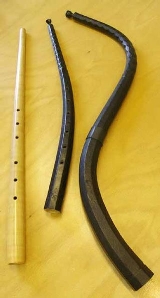
Three Cornetts
The cornett, cornetto or zink is an early wind instrument, dating from the Medieval, Renaissance
Renaissance

The Renaissance was a cultural movement that spanned roughly the 14th to the 17th century, beginning in Italy in the late Middle Ages and later spreading to the rest of Europe....
 and Baroque
Baroque

In the the arts, the Baroque was a Western cultural Epoch , starting roughly at the beginning of the 17th century in Rome, Italy. It was exemplified by drama and grandeur in Baroque sculpture, Baroque painting, literature, Baroque dance, and Baroque music....
 periods. It was used in what are now called alta capella
Alta capella

Alta capella were town Wind instrument bands found throughout continental Europe during the 15th and 16th centuries, which typically consisted of shawms and slide trumpets or sackbuts....
s or wind ensembles. It is not to be confused with the trumpet-like instrument cornet
Cornet

Not to be confused with coronetThe cornet is a brass instrument very similar to the trumpet, distinguished by its conical Bore , compact shape, and mellower tone quality....
.

Name


To avoid confusion between this instrument and the more modern cornet
Cornet

Not to be confused with coronetThe cornet is a brass instrument very similar to the trumpet, distinguished by its conical Bore , compact shape, and mellower tone quality....
 (with one t), the cornett is often called by its Italian name, cornetto or cornetto curvo (to distinguish it from the straight cornett). Occasionally it is called by its German name, which is zink or krummer Zink (curved spike). The instrument was known as the "cornet à bouquin" in France and the "corneta" in Spain.The cornett has also been know to be caled a "lizard" because it looks just like a lizard's tail.

Construction


The cornett takes the form of a tube, typically about 60 cm. long, made of ivory
Ivory

File:Ivory decoration.jpgIvory is formed from dentine and constitutes the bulk of the teeth and tusks of animals such as the elephant, hippopotamus, walrus, mammoth and narwhal....
, wood
Wood

Wood is an organic material; in the strict sense wood is produced as secondary xylem in the stems of woody plants, notably trees but also shrubs, etc....
, or, in the case of some modern reconstructions of historical instruments, ebony resin, with woodwind
Woodwind instrument

A woodwind instrument is a musical instrument which produces sound when the player blows air against an edge of, or opening in, the instrument, causing the air to vibrate within a resonator....
-style fingerholes. Usually the cornett is octagonal in cross-section, and it is wrapped in leather
Leather

Leather is a material created through the tanning of rawhides and skins of animals, primarily cattlehide. The tanning process converts the putrescible skin into a durable, long-lasting and versatile natural material for various uses....
 or parchment
Parchment

Parchment is a thin material made from calfskin, sheepskin or Goatskin . Its most common use is as the pages of a book, codex or manuscript. It is distinct from leather in that parchment is not tanned, but stretched, scraped, and dried under tension, creating a stiff white, yellowish or translucent animal skin....
, with the fingerholes penetrating this cover. The cornett is slightly curved, normally to the right, so that the player's left hand, playing the upper holes, and the player's right hand, playing the lower holes, can more comfortably reach their proper locations. At the top of the cornett there is a small mouthpiece
Mouthpiece (brass)

File:Embouchure profil.jpgOn brass instruments the mouthpiece is the part of the instrument which is placed upon the player's lips. The purpose of the mouthpiece is a resonator, which passes vibration from the lips to the column of air contained within the instrument, giving rise to the standing wave pattern of vibration in the air column....
 of the kind used in brass instrument
Brass instrument

A brass instrument is a musical instrument whose tone is produced by vibration of the lips as the player blows into a tubular resonator. They are also called labrosones, literally meaning "lip-vibrated instruments" ....
s; that is, the lips vibrate to produce sound.

The cornett is thus an unusual specimen among wind instruments, with a body constructed like a woodwind but its mouthpiece (and thus mechanism of tone production) being that of a brass instrument. Scholars evidently agree that the latter criterion is more important, and so the cornett should be counted as brass. In particular, the Hornbostel-Sachs
Hornbostel-Sachs

Hornbostel-Sachs is a system of musical instrument classification devised by Erich Moritz von Hornbostel and Curt Sachs, and first published in the Zeitschrift f?r Ethnologie in 1914....
 system of musical instrument classification
Musical instrument classification

At various times, and in various different cultures, various schemes of musical instrument classification have been used.The most commonly used system in use in the west today divides instruments into string instruments, wind instruments and percussion instruments....
 places it alongside instruments such as the trumpet
Trumpet

The trumpet is a musical instrument with the highest Register in the brass instrument family. Trumpets are among the oldest musical instruments, dating back to at least 1500 BC....
.

Modern cornett players tend to use a smaller mouthpiece, whereas those needing to make a compromise—often with the need to go on playing modern brass instruments—may use a much larger mouthpiece, sometimes a trumpet mouthpiece turned
Turning

Turning is the process whereby a single point cutting tool is parallel to the surface. It can be done manually, in a traditional form of lathe, which frequently requires continuous supervision by the operator, or by using a computer controlled and automated lathe which does not....
 down on a lathe so that only the cup and a minimal stub which fits the cornett's mouthpiece receiver are left. The larger mouthpiece gives a less incisive tone with less "edge" to the sound.

Music for the cornett


Historically, the cornett was frequently used in consort with sackbut
Sackbut

Sackbut refers to a trombone from the Renaissance and Baroque Eras. 'Sackbut' is often used in recent times to differentiate a historic trombone from a modern one....
s (2 cornetts, 3 sackbuts), often to double a church choir. This was particularly popular in Venetian
Venice

Venice is a city in northern Italy, the capital city of the Italian regions Veneto, a population of 271,251 . Together with Padua, Italy, the city is included in the Padua-Venice Metropolitan Area ....
 churches such as the Basilica San Marco, where extensive instrumental accompaniment was encouraged, particularly in use with antiphonal choirs. Giovanni Bassano
Giovanni Bassano

Giovanni Bassano was an Italian Venetian School composer and cornettist of the late Renaissance music and early Baroque music eras. He was a key figure in the development of the instrumental ensemble at San Marco di Venezia basilica, and left a detailed book on instrumental Ornament , which is a rich resource for research in contemporary per...
 was an example of a virtuoso early player of the cornett, and Giovanni Gabrieli
Giovanni Gabrieli

Giovanni Gabrieli was an Italian composer and organ . He was one of the most influential musicians of his time, and represents the culmination of the style of the Venetian School, at the time of the shift from Renaissance music to Baroque music idioms....
 wrote much of his resplendent polychoral
Venetian polychoral style

The Venetian polychoral style was a type of music of the late Renaissance music and early Baroque music eras which involved spatially separate choirs singing in alternation....
 music with him in mind. Heinrich Schütz
Heinrich Schütz

Heinrich Sch?tz was a German composer and organ , generally regarded as the most important German composer before Johann Sebastian Bach and often considered to be one of the most important composers of the 17th century along with Claudio Monteverdi....
 also used the instrument extensively, especially in his earlier work; he had studied in Venice with Gabrieli and was acquainted with Bassano's playing.

The cornett was, like almost all Renaissance and Baroque instruments, made in a complete family; the different sizes being the high cornettino
Cornettino

The cornettino was the descant instrument of the cornetto family. Cornettini usually featured a primary scale of C or D major, with middle C or the adjacent D the pedal note of the instrument....
, the cornett (or curved cornett), the tenor cornett
Tenor cornett

The tenor cornett or lizard was a common musical instrument in the Renaissance and Baroque periods. This instrument was normally built in C and the pedal note of the majority of tenor cornetts was the C below middle C....
 (or lizard) and the rare bass cornett. The serpent
Serpent (instrument)

A serpent is a bass wind instrument, descended from the cornett, and a distant ancestor of the tuba, with a mouthpiece like a brass instrument but side holes like a woodwind instrument....
 largely supplanted the bass cornett in the 17th century. Other versions include the mute cornett, which is a straight narrow-bore instrument with integrated mouthpiece, quiet enough to be used in a consort of viols or even recorders.

The cornett was also used as a virtuoso solo instrument, and a relatively large amount of solo music for the cornetto (and/or violin) survives. The use of the instrument had declined by 1700, although the instrument was still common in Europe until the late 18th century. Johann Sebastian Bach
Johann Sebastian Bach

Johann Sebastian Bach was a German composer and organ whose sacred and secular works for choir, orchestra, and solo instruments drew together the strands of the Baroque music period and brought it to its ultimate maturity....
, Georg Philipp Telemann
Georg Philipp Telemann

Georg Philipp Telemann was a German Baroque music composer, born in Magdeburg. Self-taught in music, he studied law at the University of Leipzig....
 and their German contemporaries used both the cornett and cornettino in cantatas to play in unison with the soprano voices of the choir. Occasionally, these composers allocated a solo part to the cornetto (see Bach's cantata BWV 118). Alessandro Scarlatti
Alessandro Scarlatti

Alessandro Scarlatti was an Italian Baroque music composer especially famous for his operas and chamber cantatas. He is considered the founder of the Neapolitan school of opera....
 used the cornetto or pairs of cornetti in a number of his operas. Johann Joseph Fux used a pair of mute cornetts in a Requiem. It was last scored for by Gluck
Christoph Willibald Gluck

Christoph Willibald Ritter von Gluck was an opera composer of the early classical period. After many years at the Habsburg court at Vienna, Gluck brought about the practical reform of opera's dramaturgical practices that many intellectuals had been campaigning for over the years....
, in his opera Orfeo ed Euridice
Orfeo ed Euridice

Orfeo ed Euridice is an opera composed by Christoph Willibald Gluck based on Orpheus, set to a libretto by Ranieri de' Calzabigi. It belongs to the genre of the azione teatrale, meaning an opera on a mythological subject with choruses and dancing....
 (he suggested the soprano trombone
Trombone

The trombone is a musical instrument in the brass instrument family. Like all brass instruments, it is a lip-reed aerophone: sound is produced when the player?s vibrating lips cause the air column inside the instrument to vibrate....
 as an alternative).

Playing the cornett


The cornett is generally agreed to be a difficult instrument to play—it requires a lot of practice. It embodies a design that survives in no modern instrument; that is, the main tube has only the length of a typical woodwind, but the mouthpiece is of the brass type, relying on a combination of the player's lips and the alteration of the length of the sound column via the opening and closing of the finger holes to alter the pitch of the musical sound. Most modern brass instruments are considerably longer than the cornett, which permits the use of harmonics, the sound being altered by slides or valves to control the pitch.

The Baroque
Baroque music

Baroque music describes a period or style of European classical music approximately extending from Dates of classical music eras. This era is said to begin in music after the Renaissance music and was followed by the Classical music era....
 era was relatively tolerant of bright or extroverted tonal quality, as the surviving pipe organ
Pipe organ

The pipe organ is a keyboard musical instrument that produces sound by venting mechanically compressed air through resonant Organ pipe. Each pipe produces sound at one fixed pitch, so they are provided in sets or "ranks" with one pipe or more per note, each rank having a common timbre and loudness throughout....
s of the time attest. Thus the Baroque theorist Marin Mersenne
Marin Mersenne

Marin Mersenne, Marin Mersennus or le P?re Mersenne was a France theology, philosopher, mathematician and Music theory, often referred to as the "father of acoustics" ....
 described the sound of the cornett as "a ray of sunshine piercing the shadows". Yet there is also evidence that the cornett was sometimes badly played, although it also seems to have been played much more expertly than any other woodwind instrument. Its upper register sounded somewhat like a trumpet
Trumpet

The trumpet is a musical instrument with the highest Register in the brass instrument family. Trumpets are among the oldest musical instruments, dating back to at least 1500 BC....
 or modern cornet, the lower register resembling the sackbutts that often accompanied it, whereas the middle register gave an indistinct wailing sound that was not attractive when played in isolation. Cornett intonation also tended to be fluid, which enabled it to be played perfectly in tune in a range of tonalities and temperaments.

As a result of its design, the cornett requires a specialized embouchure
Embouchure

The embouchure is the use of facial muscles and the shaping of the lips to the mouthpiece of a wind instrument.The word is of French language origin and is related to the root bouche , 'mouth'....
 which is, initially, very tiring to play for any length of time. Cornetts were often replaced by violins in consort music and cornetts could be similarly used as substitutes for violins in consort music and sacred music. The cornett and the violin were considered interchangeable; and a good cornettist doubled between either cornetti and trumpets or cornetti and recorders.

Cornetts were used to reinforce the human voice in choirs, and many commentators suggested that the sound of a well played cornett, heard at a distance, could be mistaken for a "choice castrato
Castrato

A castrato is a man with a singing voice equivalent to that of a soprano, mezzo-soprano, or contralto human voice produced either by castration of the singer before puberty or one who, because of an endocrinology condition, never reaches sexual maturity....
". The place of the cornett was never really filled by any other instrument and it was not until the second half of the 20th century that the cornett revival gave music lovers a chance to hear the sound of this instrument again in its proper context.

The cornett and authentic performance


As a result of the recent historically informed performance
Historically informed performance

Historically informed performance is an approach, or movement, in the performance of classical music. Members of this movement usually play on #Early instrumentss, and utilise historical treatises, as well as additional historical evidence, to gain insight into performance practice ....
 movement, the cornett has been rediscovered, and as before attracts the finest players. In many pieces (particularly those of early to mid Baroque composers such as Claudio Monteverdi
Claudio Monteverdi

Claudio Giovanni Antonio Monteverdi , was an Italian composer, viol, and singer.Monteverdi's work, often regarded as revolutionary, marked the transition from the music of the Renaissance music to that of the Baroque music....
, Giovanni Gabrieli
Giovanni Gabrieli

Giovanni Gabrieli was an Italian composer and organ . He was one of the most influential musicians of his time, and represents the culmination of the style of the Venetian School, at the time of the shift from Renaissance music to Baroque music idioms....
, Francesco Cavalli
Francesco Cavalli

Francesco Cavalli was an Italy composer of the Baroque music#Early baroque music Baroque music period. His real name was Pietro Francesco Caletti-Bruni, but he is better known by that of Cavalli, the name of his patron, a Venetian nobleman....
, Girolamo Frescobaldi
Girolamo Frescobaldi

Girolamo Frescobaldi was an Italian musician, one of the most important composers of keyboard instrument music in the late Renaissance music and early Baroque music periods....
, Giovanni Battista Riccio, Dario Castello
Dario Castello

Dario Castello was an Italy composer and instrumentalist from the early Baroque music period, who worked and published in Venice. He was a late member of the Venetian School, and played a part in the early transformation of the instrumental canzona into the sonata ....
, Antonio Bertali
Antonio Bertali

Antonio Bertali was an Italy composer and violinist of the Baroque music era.He was born in Verona and received early music education there. Probably from 1624, he was employed as court musician in Vienna by Ferdinand II, Holy Roman Emperor....
, Pavel Josef Vejvanovský
Pavel Josef Vejvanovský

Pavel Josef Vejvanovsk? Czech people composer and trumpeter. Contemporary and associate of Heinrich Ignaz Franz von Biber.Some notable works by Pavel Josef Vejvanovsk?:...
, Jan Krtitel Tolar
Jan Krtitel Tolar

Jan Krtitel Tolar [Johannes Baptista Dolar] - composer and contemporary of Heinrich Ignaz Franz von Biber, Johann Heinrich Schmelzer, Andreas Hofer and Pavel Josef Vejvanovsk?....
, Michael Praetorius
Michael Praetorius

Michael Praetorius was a German composer, organ , and writer about music. He was one of the most versatile composers of his age, being particularly significant in the development of musical forms based on Protestant Reformation hymns....
, Johann Hermann Schein, Samuel Scheidt
Samuel Scheidt

File:Samuel Scheidt.jpgSamuel Scheidt was a German composer, organ and teacher of the early Baroque music era.He was born in Halle, Saxony-Anhalt, and after early studies there, he went to Amsterdam to study with Sweelinck, the distinguished Netherlands composer, which was clearly formative on his style....
, Sebastian Knüpfer
Sebastian Knüpfer

Sebastian Kn?pfer ...
, Johann Schelle, Johann Andreas Pachelbel, Giovanni Felice Sances, Johann Joseph Fux, Johann Heinrich Schmelzer
Johann Heinrich Schmelzer

Johann Heinrich von Schmelzer was an Austrian composer and violinist of the baroque music era. He worked in Vienna and died in Prague. Schmelzer attained a high reputation in a field which at the time was dominated by Italians; indeed, one traveler referred to him in 1660 as "nearly the most eminent violinist in all of Europe"....
, Heinrich Ignaz Franz von Biber, Andreas Hofer
Andreas Hofer (composer)

Andreas Hofer was an Austrian composer. He was a contemporary of Heinrich Ignaz Franz von Biber, and like him, Hofer was noted for his large scaled polychoral sacred works....
, Alessandro Stradella
Alessandro Stradella

Alessandro Stradella was an Italy composer of the middle Baroque music. He was born in Rome, and was murdered in Genoa.Not much is known about his early life, but he was from an aristocratic family, educated at Bologna, and was already making a name for himself as a composer at the age of 20, being commissioned by Queen Christina of Swede...
, Matthew Locke
Matthew Locke (composer)

Matthew Locke was an English Baroque music composer and music theorist.As a boy he was trained in the choir of Exeter Cathedral, under Edward Gibbons, the brother of Orlando Gibbons....
, John Adson
John Adson

John Adson , was an England musician and composer. Little is known about his early life; indeed, the first certain reference to him comes in 1604, when he was in service to Charles III, Duke of Lorraine as a cornett player....
 and Heinrich Schütz
Heinrich Schütz

Heinrich Sch?tz was a German composer and organ , generally regarded as the most important German composer before Johann Sebastian Bach and often considered to be one of the most important composers of the 17th century along with Claudio Monteverdi....
) the cornett is indispensable in performance, and the music suffers if other instruments substitute for them. The violin was the usual substitute for the cornetto in historical music. The recorder, modern B-flat trumpet, oboe, and soprano saxophone have all been used as substitutes for the cornetto in modern performances.

See also


  • Cornettino
    Cornettino

    The cornettino was the descant instrument of the cornetto family. Cornettini usually featured a primary scale of C or D major, with middle C or the adjacent D the pedal note of the instrument....
  • Tenor cornett
    Tenor cornett

    The tenor cornett or lizard was a common musical instrument in the Renaissance and Baroque periods. This instrument was normally built in C and the pedal note of the majority of tenor cornetts was the C below middle C....


External links


  • , one of the more well-known modern makers of cornetts
  • , a performance group that makes use of the cornett