
All Topics  
Romain Rolland


   Email Print
   Bookmark   Link


Romain Rolland


Romain Rolland (29 January 1866 – 30 December 1944) was a French
France

France , officially the French Republic , is a country whose Metropolitan France is located in Western Europe and that also comprises various Overseas departments and territories of France....
 dramatist, essayist, art historian, mystic
Mystic

Mystic may refer to:* A person who practices mysticism, or a reference to a mystery a mystic knows or studies. It may also be a person who seeks the truth of life beyond the five senses....
 and pacifist who was awarded the Nobel Prize
Nobel Prize

The Nobel Prize , established in the 1895 will of Swedish chemist Alfred Nobel; it was first awarded in Nobel Prize in Physics, Nobel Prize in Chemistry, Nobel Prize in Physiology or Medicine, Nobel Prize in Literature, and Nobel Peace Prize in 1901....
 for Literature in 1915.

and was born in Clamecy, Nièvre
Nièvre

Ni?vre is a departments of France in the center of France named after the Ni?vre ....
 to a family of notaries; he had both peasants and wealthy townspeople in his lineage. Writing introspectively in his Voyage intérieur (1942), he sees himself as a representative of an "antique species".


Discussion
Ask a question about 'Romain Rolland'
Start a new discussion about 'Romain Rolland'
Answer questions from other users
Full Discussion Forum


Encyclopedia


Romain Rolland (29 January 1866 – 30 December 1944) was a French
France

France , officially the French Republic , is a country whose Metropolitan France is located in Western Europe and that also comprises various Overseas departments and territories of France....
 dramatist, essayist, art historian, mystic
Mystic

Mystic may refer to:* A person who practices mysticism, or a reference to a mystery a mystic knows or studies. It may also be a person who seeks the truth of life beyond the five senses....
 and pacifist who was awarded the Nobel Prize
Nobel Prize

The Nobel Prize , established in the 1895 will of Swedish chemist Alfred Nobel; it was first awarded in Nobel Prize in Physics, Nobel Prize in Chemistry, Nobel Prize in Physiology or Medicine, Nobel Prize in Literature, and Nobel Peace Prize in 1901....
 for Literature in 1915.

Biography

Rolland was born in Clamecy, Nièvre
Nièvre

Ni?vre is a departments of France in the center of France named after the Ni?vre ....
 to a family of notaries; he had both peasants and wealthy townspeople in his lineage. Writing introspectively in his Voyage intérieur (1942), he sees himself as a representative of an "antique species". He would cast these ancestors in Colas Breugnon (1919).

Accepted to the École normale supérieure
École Normale Supérieure

The ?cole normale sup?rieure is a France Grandes ?coles . The ENS was initially conceived during the French Revolution, and intended to provide the First French Republic with a new body of teacher, trained in the critical spirit and secular values of the the Enlightenment....
 in 1886, he first studied philosophy
Philosophy

Philosophy is the study of general problems concerning matters such as existence, knowledge, truth, beauty, justice, validity, mind, and language....
, but his independence of spirit led him to abandon that so as not to submit to the dominant ideology. He received his degree in history in 1889 and spent two years in Rome
Rome

Rome is the capital city of Italy and Lazio, and is Italy's largest and most populous city, with 2,724,347 residents in an urban area of some ....
, where his encounter with Malwida von Meysenburg–who had been a friend of Nietzsche and of Wagner
Richard Wagner

Wilhelm Richard Wagner was a German composer, Conducting, theatre director and essayist, primarily known for his operas . Unlike most other great opera composers, Wagner wrote both the scenario and libretto for his works....
–and his discovery of Italian
Italy

Italy , officially the Italian Republic , is a country located on the Italian Peninsula in Southern Europe and on the two largest islands in the Mediterranean Sea, Sicily and Sardinia....
 masterpieces were decisive for the development of his thought. When he returned to France in 1895, he received his doctoral degree with his thesis The origins of modern lyric theatre and his doctoral dissertation, A History of Opera in Europe before Lully and Scarlatti.

His first book was published in 1902, when he was 36 years old. Through his advocacy for a 'people's theatre', he made a significant contribution towards the democratization
Democratization

Democratization is the transition to a more democratic political regime. It may be the transition from an authoritarianism regime to a full democracy or transition from a semi-authoritarian political system to a democratic political system....
 of the theatre
Theatre

Theatre is the branch of the performing arts defined by Bernard Beckerman as what "occurs when one or more actor, isolated in time and/or Theater , present themselves to Audience." By this broad definition, theatre has existed since the dawn of man, as a result of human tendency for story telling....
. As a humanist, embraced the work of the philosophers of India
India

India, officially the Republic of India , is a country in South Asia. It is the List of countries and outlying territories by total area country by geographical area, the List of countries by population country, and the most populous liberal democracy in the world....
 ("Conversations with Rabindranath Tagore
Rabindranath Tagore

, also known by the sobriquet Gurudev, was a Bengali people mystic, Brahmo poet, visual artist, playwright, novelist, and composer whose works reshaped Bengali literature and Music of Bengal in the late 19th and early 20th centuries....
", and Mohandas Gandhi). Rolland was strongly influenced by the Vedanta
Vedanta

Vedanta is a spiritual tradition explained in the Upanishads that is concerned with the self-realisation by which one understands the ultimate nature of reality and teaches the believer's goal is to transcend the limitations of self-identity and realize one's unity with Brahman....
 philosophy of India
India

India, officially the Republic of India , is a country in South Asia. It is the List of countries and outlying territories by total area country by geographical area, the List of countries by population country, and the most populous liberal democracy in the world....
, primarily through the works of Swami Vivekananda.

People's theatre

"The people have been gradually conquered by the bourgeois class
Bourgeoisie

Bourgeoisie is a classification used in analyzing human societies to describe a social class of people. Historically, the bourgeoisie comes from the middle or merchant classes of the Middle Ages, whose status or power came from employment, education, and wealth, as distinguished from those whose power came from being born into an aristocrati...
, penetrated by their thoughts and now want only to resemble them. If you long for a people's art, begin by creating a people!"
Romain Rolland, Le Théâtre du peuple (1903).
Rolland's most significant contribution to the theatre
Theatre

Theatre is the branch of the performing arts defined by Bernard Beckerman as what "occurs when one or more actor, isolated in time and/or Theater , present themselves to Audience." By this broad definition, theatre has existed since the dawn of man, as a result of human tendency for story telling....
 lies in his advocacy for a "popular theatre" in his essay Le Théâtre du peuple (1902). "There is only one necessary condition for the emergence of a new theatre", he wrote, "that the stage
Stage (theatre)

In theatre, the stage is a designated space for the performance of theatrical productions. The stage serves as a space for actors or performers and a focal point for the members of the audience....
 and auditorium
Auditorium

An auditorium is where the audience is located in order to hear and watch performances at venues such as theatres. For movie theaters, the number of auditoriums is expressed as the number of screens....
 should be open to the masses, should be able to contain a people
People

The English noun people has two distinct fields of application:* as a Count noun, a group of humans, either with unspecified traits, or specific characteristics ....
 and the actions of a people". The book was not published until 1913, but most of its contents had appeared in the Revue d'Art Dramatique between 1900 and 1903. Rolland attempted to put his theory into practice with his melodrama
Melodrama

The theatrical genre of Melodrama utilizes theme-music to manipulate the spectator's emotional response and to denote character types. The term combines "melody" and "drama"....
tic dramas Danton (1900) and Le 14 juillet (1902), but it was his ideas that formed a major reference point for subsequent practitioners.

The essay is part of a more general movement around the turn of that century towards the democratization
Democratization

Democratization is the transition to a more democratic political regime. It may be the transition from an authoritarianism regime to a full democracy or transition from a semi-authoritarian political system to a democratic political system....
 of the theatre. The Revue had held a competition and tried to organize a "World Congress on People's Theatre", and a number of People's Theatres had opened across Europe, including the Freie Volksbühne
Volksbühne

The Volksb?hne is a theater in Berlin, Germany. Located in Berlin's city center Mitte on Rosa-Luxemburg-Platz in what was the East Germany's capital....
 movement ('Free People's Theatre') in Germany and Maurice Pottecher's Théâtre du Peuple
Théâtre du Peuple

The Th??tre du peuple is a theater located in Bussang, France, built in 1895 by Maurice Pottecher.The theatre was added to the list of historical monuments in 1975 and is always in activity, putting on a new performance each year....
 in France. Rolland was a disciple of Pottecher and dedicated Le Théâtre du peuple to him.

Rolland's approach is more aggressive, though, than Pottecher's poetic vision of theatre as a substitute 'social religion
Religion

A religion is an organized approach to human spirituality which usually encompasses a set of myth, symbols, beliefs and practices, often with a supernatural or transcendence quality, that give meaning to the practitioner's experiences of life through reference to a higher power or truth....
' bringing unity to the nation
Nation

A nation is a cultural and social community. In as much as most members never meet each other, yet feel a common bond, it may be considered an imagined community....
. Rolland indictes the bourgeoisie
Bourgeoisie

Bourgeoisie is a classification used in analyzing human societies to describe a social class of people. Historically, the bourgeoisie comes from the middle or merchant classes of the Middle Ages, whose status or power came from employment, education, and wealth, as distinguished from those whose power came from being born into an aristocrati...
 for its appropriation
Cultural appropriation

Cultural appropriation is the adoption of some specific elements of one culture by a different cultural group. It denotes acculturation or Cultural assimilation, but often connotes a negative view towards acculturation from a minority culture by a dominant culture....
 of the theatre, causing it to slide into decadence
Decadence

Decadence can refer to a personal trait, or to the state of a society . Used to describe a person's lifestyle, it describes a lack of moral and intellectual discipline, or in the Concise Oxford Dictionary: "a luxurious self-indulgence"....
, and the deleterious effects of its ideological
Ideology

An ideology is a set of aims and ideas, especially in politics. An ideology can be thought of as a comprehensive vision, as a way of looking at things , as in common sense and several philosophical tendencies , or a set of ideas proposed by the dominant class of a society to all members of this society....
 dominance. In proposing a suitable repertoire
Repertory

Repertory or rep, called stock in the US, is a term used in Western theatre and opera.A repertory theatre can be a theatre in which a resident company presents works from a specified repertoire, usually in alternation or rotation....
 for his people's theatre, Rolland rejects classical drama in the belief that it is either too difficult or too static to be of interest to the masses. Drawing on the ideas of Jean-Jacques Rousseau
Jean-Jacques Rousseau

Jean Jacques Rousseau was a major philosopher, writer, and composer of the eighteenth century The Age of Enlightenment, whose political philosophy influenced the French Revolution and the development of modern political and educational thought....
, he proposes instead "an epic historical theatre of 'joy, force and intelligence' which will remind the people of its revolutionary heritage and revitalize the forces working for a new society" (in the words of Bradby and McCormick, quoting Rolland). Rolland believed that the people would be improved by seeing heroic images of their past. Rousseau's influence may be detected in Rolland's conception of theatre-as-festivity
Festival

A festival is an event, usually and ordinarily staged by a local community, which centers on some unique aspect of that community.Among many religions, a feast or festival is a set of celebrations in honour of God or Polytheism....
, an emphasis that reveals a fundamental anti-theatrical prejudice: "Theatre supposes lives that are poor and agitated, a people searching in dreams for a refuge from thought. If we were happier and freer we should not feel hungry for theatre. [...] A people that is happy and free has need of festivities more than of theatres; it will always see in itself the finest spectacle
Spectacle

In general spectacle refers to an event that is memorable for the appearance it creates. Derived in Old English from c.1340 as "specially prepared or arranged display" it was borrowed from Old French spectacle, itself a reflection of the Latin spectaculum "a show" from spectare "to view, watch" frequentative form of specere "t...
."

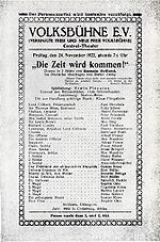
Rolland's dramas have been staged by some of the most influential theatre directors of the twentieth century, including Max Reinhardt
Max Reinhardt

Max Reinhardt may refer to:*Max Reinhardt , Austrian theatre and film director*Max Reinhardt , British publisher...
 and Erwin Piscator
Erwin Piscator

Erwin Friedrich Maximilian Piscator was a Germany theatre director and Theatrical producer who, with Bertolt Brecht, was the foremost exponent of epic theater, a form that emphasizes the sociopolitical context of a play, rather focusing on its emotional manipulation of the audience or on the production's formal beauty....
.

Academic career and pacifism

Gandhi Romain Rolland 1931
He became a history teacher at Lycée Henri IV
Lycée Henri IV

The Lyc?e Henri-IV is a public secondary school located in Paris. Along with Lyc?e Louis-le-Grand, it is widely regarded as one of the most demanding in France....
, then at the Lycée Louis le Grand, and member of the École française de Rome, then a professor of the History of Music at the Sorbonne
University of Paris

The historic University of Paris first appeared in the 12th century. In 1970 it was reorganized as 13 autonomous university . The university is often referred to as the Sorbonne or La Sorbonne after the collegiate institution founded about 1257 by Robert de Sorbon....
, and History Professor at the École Normale Supérieure.

A demanding, yet timid, young man, he did not like teaching. He was not indifferent to youth: Jean-Christophe, Olivier and their friends, the heroes of his novels, are young people. But with real-life persons, youths as well as adults, Rolland maintained only a distant relationships. He was first and foremost a writer. Assured that literature would provide him with a modest income, he resigned from the university in 1912.

Romain Rolland was a lifelong pacifist. He protested against the first World War in Au-dessus de la Mêlée (1915), Above the Battle (Chicago, 1916). In 1924, his book on Gandhi
Mahatma Gandhi

Mohandas Karamchand Gandhi was a major political and spiritual leader of India and the Indian independence movement. He was the pioneer of satyagraha?resistance to tyranny through mass civil disobedience, firmly founded upon ahimsa or total non-violence?which led India to Indian independence movement and inspired movements for civi...
 contributed to the Indian nonviolent leader's reputation and the two men met in 1931.

In 1928 he and Hungarian scholar, philosopher and natural living experimenter Edmund Bordeaux Szekely
Edmund Bordeaux Szekely

Edmund Bordeaux Szekely was a Hungary scholar, philosopher and natural living experimenter....
 founded the International Biogenic Society to promote and expand on their ideas of the integration of mind, body and spirit and the virtues of a natural, simple, vegetarian lifestyle.

He moved to Villeneuve
Villeneuve, Vaud

Villeneuve is a Municipalities of Switzerland of the Cantons of Switzerland of Vaud in Switzerland, located in the district of Aigle .It was the residence of Romain Rolland, where he met Mahatma Gandhi....
, on the shores of Lac Léman (Lake Geneva
Lake Geneva

Lake Geneva or Lake L?man is the second largest freshwater lake in Central Europe in terms of surface area . 60% of it comes under the jurisdiction of Switzerland , and 40% under France ....
) to devote himself to writing. His life was interrupted by health problems, and by travels to art exhibitions. His voyage to Moscow
Moscow

Moscow is the capital and the largest types of inhabited localities in Russia of the Russian Federation. It is also the largest European cities and metropolitan areas, with the Moscow metropolitan area ranking among the largest urban areas in the world....
 (1935), on the invitation of Maxim Gorky
Maxim Gorky

Aleksey Maksimovich Peshkov , better known as Maxim Gorky , was a Russian/Soviet Union author, a founder of the socialist realism literary method and a political activist....
, was an opportunity to meet Stalin, whom he considered the greatest man of his time. Rolland served unofficially as ambassador of French artists to the Soviet Union
Soviet Union

The Union of Soviet Socialist Republics was a Constitution of the Soviet Union socialist state that existed in Eurasia from 1922 to 1991.The name is a translation of the , romanization of Russian Soyuz Sovetskikh Sotsialisticheskikh Respublik, abbreviated ????, SSSR....
. However, as a pacifist, he was uncomfortable with Stalin’s brutal repression of the opposition. He attempted to discuss his concerns with Stalin, and was involved in the campaign for the release of the Left Opposition
Left Opposition

The Left Opposition was a faction within the Communist Party of the Soviet Union from 1923 to 1927 headed de facto by Leon Trotsky. The Left Opposition formed as part of the power struggle within the party leadership that began with the Soviet founder Vladimir Lenin's illness and intensified with his death in January 1924....
 activist/writer Victor Serge
Victor Serge

Victor Lvovich Kibalchich better known as Victor Serge, was a Russian revolutionary and Francophone writer. Originally an anarchist, he joined the Bolsheviks five months after arriving in Petrograd in January 1919, and later worked for the newly founded Comintern as a journalist, editor and translator....
. During Serge’s imprisonment (1933-1936), Rolland had agreed to handle the publications of Serge’s writings in France, despite their political disagreements.

In 1937, he came back to live in Vézelay
Vézelay

V?zelay is a Communes of France in the Yonne Departments of France in the Bourgogne Regions of France of France.It is principally noted for V?zelay Abbey , sited here since the 9th century....
, which, in 1940, was occupied by the Germans. During the occupation, he isolated himself in complete solitude.

Never stopping his work, in 1940, he finished his memoirs. He also placed the finishing touches on his musical research on the life of Ludwig van Beethoven
Ludwig van Beethoven

Ludwig van Beethoven was a German composer and pianist. He was a crucial figure in the transitional period between the Classical music era and Romantic music eras in classical music, and remains one of the most acclaimed and influential composers of all time....
. Shortly before his death, he wrote Péguy (1944), in which he examines religion
Religion

A religion is an organized approach to human spirituality which usually encompasses a set of myth, symbols, beliefs and practices, often with a supernatural or transcendence quality, that give meaning to the practitioner's experiences of life through reference to a higher power or truth....
 and socialism
Socialism

Socialism refers to a broad set of economic theories of social organization advocating public or state ownership and administration of the means of production and distribution of goods, and a society characterized by equality for all individuals, with a fair or Egalitarianism method of compensation....
 through the context of his memories. He died on 30 December 1944 in Vézelay
Vézelay

V?zelay is a Communes of France in the Yonne Departments of France in the Bourgogne Regions of France of France.It is principally noted for V?zelay Abbey , sited here since the 9th century....
.

In 1921, his close friend, the Austrian writer Stefan Zweig
Stefan Zweig

Stefan Zweig was an Austrian novelist, playwright, journalist and biographer....
, wrote his biography: The Man and His Works. Zweig profoundly admired Rolland, of whom he once said to be: "the moral consciousness of Europe" during the years of turmoil and War in Europe.

Correspondence with Freud

1923 saw the beginning of a correspondence between the famous psychoanalyst Sigmund Freud
Sigmund Freud

Sigmund Freud , born Sigismund Schlomo Freud , was an Austrian psychiatrist who founded the psychoanalysis of psychology. Freud is best known for his theories of the unconscious mind and the defense mechanism of Psychological repression and for creating the clinical practice of psychoanalysis for curing psychopathology through dialogue...
 and Rolland, who found that the admiration that he showed for Freud was reciprocated in equal measures (Freud proclaiming in a letter to him: "That I have been allowed to exchange a greeting with you will remain a happy memory to the end of my days."). This correspondence introduced Freud to the concept of the "oceanic feeling
Oceanic Feeling

Oceanic Feeling is The Prayer Boat's first full-length album, released in 1991 on BMG/RCA records....
" that Rolland had developed through his study of Eastern mysticism
Eastern mysticism

Eastern Mysticism is a broad term summarizing mysticism traditions of the Middle East, India and the Far East, including mystic elements in:*Gnosticism...
. Freud opened his next book Civilization and its Discontents
Civilization and Its Discontents

Civilization and Its Discontentsis a book by Sigmund Freud. Written in 1929, and first published in German language in 1930 as Das Unbehagen in der Kultur , it is one of Freud's most important and widely read works ....
 (1929) with a debate on the nature of this feeling, which he mentioned had been noted to him by an anonymous "friend". This friend was Rolland. Rolland would remain a major influence on Freud's work, continuing their correspondence right up to Freud's death in 1939.

Quotations

  • "To one whose mind is free, there is something even more intolerable in the suffering of animals than in the sufferings of humans. For with the latter, it is at least admitted that suffering is evil and that the person who causes it is a criminal. But thousands of animals are uselessly butchered every day without a shadow of remorse. If any person were to refer to it, they would be thought ridiculous. And that is the unpardonable crime. That alone is the justification of all that humans may suffer. It cries vengeance upon all the human race. If God exists and tolerates it, it cries vengeance upon God." Jean Christophe.


  • "If there is one place on the face of the earth where all the dreams of living men have found a home from the very earliest days when man began the dream of existence, it is India....For more than 30 centuries, the tree of vision, with all its thousand branches and their millions of twigs, has sprung from this torrid land, the burning womb of the Gods. It renews itself tirelessly showing no signs of decay." Life of Ramakrishna


  • "The true Vedantic spirit does not start out with a system of preconceived ideas. It possesses absolute liberty and unrivalled courage among religions with regard to the facts to be observed and the diverse hypotheses it has laid down for their coordination. Never having been hampered by a priestly order, each man has been entirely free to search wherever he pleased for the spiritual explanation of the spectacle of the universe.", Life of Vivekananda.


  • "There are some dead who are more alive than the living."
  • "No, no! It would be more true to say that there are some who are more dead than the dead." "Maybe. In any case there are old things which are still young."
"Then if they are still young we can find them for ourselves. . . . But I don't believe it. What has been good once never is good again."

Romain Rolland, "Jean-Christophe: Revolt," p. 395

  • "All these young millionaires were anarchists, of course: when a man possesses everything it is the supreme luxury for him to deny society: for in that way he can evade his responsibilities."


Ibid., p. 399.

External links

  • Works by Romain Rolland (public domain in Canada)