

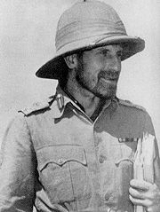
Orde Charles Wingate

Encyclopedia
Major-General
Orde Charles Wingate, DSO
and two bars
(26 February 1903 – 24 March 1944), was a British Army officer and creator of special military units in Palestine
in the 1930s and in World War II
.
A highly religious Christian
, Wingate became a supporter of Zionism
, seeing it as his religious and moral duty to help the Jewish community in Palestine form a Jewish state
. Assigned to the British Mandate of Palestine in 1936, he set about training members of the Haganah
, the Jewish paramilitary organization, which became the Israel Defense Forces
with the establishment in 1948 of the state of Israel
. He is most famous for his creation of the Chindits
, airborne deep-penetration troops trained to work behind enemy lines in the Far East campaigns against the Japanese during World War II
.
, in Kumaon, India
to a military family. His father had become a committed member of the Plymouth Brethren
early in his army career in India, and at the age of 46 married the oldest daughter of a family who were also Plymouth Brethren, after wooing her for 20 years. His father reached retirement from the army two years after Wingate was born.
Wingate spent most of his childhood in England where he received a very religious upbringing. It was not uncommon for him to be subjected to long days of reading and memorizing the Old Testament
. He was also subjected, by his father, to a harsh and Sparta
n regimen, living with a daily consciousness of hell-fire and eternal damnation. Because of their parents' strict beliefs, the family of seven children were kept away from other children and from the influence of the outside world. Until he was 12 years old, Orde had hardly ever mixed with children of his own age.
In 1916, his family having moved to Godalming
, Wingate attended Charterhouse School
as a day boy. Because he did not board at the school and took no part in sports, he became increasingly isolated, so that he missed out on many of the aspects of a public school
education of the period. At home lazing about and idling were forbidden, and the children were always given challenging objectives to encourage independent thought, initiative and self reliance.
, the Royal Artillery
's officers' training school. For committing a minor offence against the rules, a first-year student would be subjected to a ragging
ritual named “running”. This ritual consisted of the first-year being stripped and forced to run a gauntlet of senior students, all of whom wielded a knotted towel, which they used to hit the accused on his journey along the line. On reaching the end, the first-year would then be thrown into an icy-cold cistern of water. When it came time for Wingate to run the gauntlet, for allegedly having returned a horse to the stables too late, he walked to the senior student at the head of the gauntlet, stared at him and dared him to strike. The senior refused. Wingate moved to the next senior and did the same; he too refused. In turn, each senior declined to strike; coming to the end of the line, Wingate walked to the cistern and dived straight into the icy-cold water.
In 1923 Wingate received his gunnery officer's commission and was posted to the 5th Medium Brigade at Larkhill
on Salisbury Plain
. During this period he was able to exercise his great interest in horse riding, gaining a reputation for his skill (and success) in point-to-point races and during fox hunting, particularly for finding suitable places to cross rivers, which earned him the nickname "Otter". It was difficult in the 1920s for an army officer to live on his pay and Wingate, living life to the full, also gained a reputation as a late payer of his bills. In 1926, because of his prowess in riding, Wingate was posted to the Military School of Equitation where he excelled, much to the chagrin of the majority of the cavalry
officers at the centre who found him insufferable; he frequently challenged the instructors as a demonstration of his rebellious nature.
. As a result Wingate successfully applied to take a course in Arabic at the School of Oriental Studies in London and passed out of the course, which lasted from October 1926 to March 1927, with a mark of 85/100.
In June 1927, with Cousin Rex's encouragement, Wingate obtained six-months' leave in order to mount an expedition in the Sudan. Rex had suggested that he travel via Cairo and then try to obtain secondment to the Sudan Defence Force
. Sending his luggage ahead of him, Wingate set off in September 1927 by bicycle, travelling first through France
and Germany
before making his way to Genoa
via Czechoslovakia
, Austria
and Yugoslavia
. Here he took a boat to Egypt. From Cairo
he traveled to Khartoum
.
In April 1928, his application to transfer to the Sudan Defence Force came through and he was posted to the East Arab Corps, serving in the area of Roseires and Gallabat
on the borders of Ethiopia
, where the SDF patrolled to catch slave
traders and ivory
poachers
. He changed the method of regular patrolling to ambush
es.
In March 1930, Wingate was given command of a company of 300 soldiers with the local rank of bimbashi (major). He was never happier than when in the bush with his unit, but when at HQ in Khartoum he antagonised the other officers with his aggressive and argumentative personality.
At the end of his tour, Wingate mounted a short expedition into the Libyan desert to investigate the lost army of Cambyses
, mentioned in the writings of Herodotus
, and to search for the lost oasis of Zerzura
. Supported by equipment from the Royal Geographical Society
(the findings of the expedition were published on the Royal Geographical Magazine in April 1934) and the Sudan Survey Department, the expedition set off in January 1933. Although they did not find the oasis, Wingate saw the expedition as an opportunity to test his endurance in a very harsh physical environment and also his organisational and leadership abilities.
on Salisbury Plain
and was heavily involved in retraining, as British artillery units were being mechanised. On the sea journey home from Egypt he met Lorna Moncrieff Patterson, who was 16 years old and travelling with her mother. They were married two years later, on 24 January 1935.
. From his arrival he saw the creation of a Jewish State
in Palestine as being a religious duty toward the literal fulfillment of Christian prophecy and he immediately put himself into absolute alliance with Jewish political leaders.
Palestinian Arab guerrillas had at the time of his arrival begun a campaign of attacks against both British mandate officials and Jewish communities, which were part of the Arab Revolt of 1936–39.
Wingate became politically involved with a number of Zionist leaders, and became an ardent Zionist, despite not being Jewish. He always returned to Kibbutz En Harod
— because he felt familiar with the biblical judge Gideon, who fought in this area, and used it himself as a military base. He formulated the idea of raising small assault units of British-led Jewish commandos, armed with grenades and light infantry small arms, to combat the Arab revolt. Wingate took his idea personally to Archibald Wavell, who was then the commander of British forces in Palestine. After Wavell gave his permission, Wingate convinced the Zionist Jewish Agency and the leadership of Haganah
, the Jewish armed group.
In June 1938 the new British commander, Gen. Haining, gave his permission to create the Special Night Squads
, armed groups formed of British and Haganah volunteers. The Jewish Agency helped pay salaries and other costs of the Haganah personnel.
Wingate trained, commanded and accompanied them in their patrols. The units frequently ambushed Arab saboteurs who attacked oil pipeline
s of the Iraq Petroleum Company
, raiding border villages the attackers had used as bases. In these raids Wingate's men sometimes imposed severe collective punishment
s on the village inhabitants that were criticized by Zionist leaders as well as Wingate's British superiors. Wingate disliked Arabs, once shouting at Hagana fighters after a June 1938 attack on a village on the border between Mandatory Palestine and Lebanon, "I think you are all totally ignorant in your Ramat Yochanan [the training base for the Hagana] since you do not even know the elementary use of bayonets when attacking dirty Arabs: how can you put your left foot in front?" But the brutal tactics proved effective in quelling the uprising, and Wingate was awarded the DSO
in 1938.
However, his deepening direct political involvement with the Zionist cause and an incident where he spoke publicly in favour of formation of a Jewish state during his leave in Britain, caused his superiors in Palestine to remove him from command. He was so deeply associated with political causes in Palestine that his superiors considered him compromised as an intelligence officer in the country. He was promoting his own agenda rather than that of the army or the government.
In May 1939, he was transferred back to Britain. Wingate became a hero of the Yishuv
(the Jewish Community), and was loved by leaders such as Zvi Brenner and Moshe Dayan
who had trained under him, and who claimed that Wingate had "taught us everything we know."
Wingate's political attitudes toward Zionism were heavily influenced by his Plymouth Brethren
religious views and belief in certain eschatological
doctrines.
, Wingate was the commander of an anti-aircraft unit in Britain. He repeatedly made proposals to the army and government for the creation of a Jewish army in Palestine which would rule over the area and its Arab population in the name of the British. Eventually his friend Wavell, by this time commander-in-chief of Middle East Command
which was based in Cairo
, invited him to Sudan to begin operations against Italian
occupation forces in Ethiopia
. Under William Platt
, the British commander in Sudan, he created the Gideon Force
, a guerrilla force composed of British, Sudanese and Ethiopian soldiers. The force was named after the biblical judge Gideon
, who defeated a large force with a tiny band. Wingate invited a number of veterans of the Haganah SNS to join him. With the blessing of the Emperor of Ethiopia, Haile Selassie, the group began to operate in February 1941. Wingate was temporarily promoted to lieutenant colonel and put in command. He again insisted on leading from the front and accompanied his troops. The Gideon Force, with the aid of local resistance fighters, harassed Italian forts and their supply lines while the regular army took on the main forces of the Italian army. The small Gideon Force of no more than 1,700 men took the surrender of about 20,000 Italians toward the end of the campaign. At the end of the fighting, Wingate and the men of the Gideon Force linked with the force of Lt. Gen. Alan Cunningham which had advanced from Kenya
to the south and accompanied the emperor in his triumphant return to Addis Ababa
in May. Wingate was mentioned in dispatches
in April 1941 and was awarded a second DSO
in December.
With the end of the East African Campaign
on 4 June 1941, Wingate was removed from command of the now-dismantled Gideon Force and his rank was reduced to that of major. During the campaign he was irritated that British authorities ignored his request for decorations for his men and obstructed his efforts to obtain back pay and other compensation for them. He left for Cairo and wrote an official report extremely critical of his commanders, fellow officers, government officials and many others. Wingate was also angry that his efforts had not been praised by authorities, and that he had been forced to leave Abyssinia without having said farewell to Emperor Selassie. Wingate was most concerned about British attempts to stifle Ethiopian freedom, writing that attempts to raise future rebellions amongst populations must be honest ones and should appeal to justice.
Soon after, he contracted malaria
. He sought treatment from a local doctor instead of army doctors because he was afraid that the illness would give his detractors another further excuse to undermine him. This doctor gave him a large supply of the drug Atabrine, which can produce as a side-effect depression
if taken in high dosages. Already depressed over the official response to his Abyssinian command, and sick with malaria, Wingate attempted suicide by stabbing himself in the neck.
Wingate was sent to Britain to recuperate. A highly edited version of his report was passed through Wingate's political supporters in London to Winston Churchill
. Consequent to this, Leo Amery, the Secretary of State for India
contacted Wavell, now Commander-in-Chief in India commanding the South-East Asian Theatre
to enquire if there were any chance of employing Wingate in the Far East. On 27 February 1942, Wingate, far from pleased with his posting as a "supernumary major without staff grading", left Britain for Rangoon.
, he was appointed colonel once more by General Wavell, and was ordered to organise guerrilla units to fight behind Japanese lines. However, the precipitous collapse of Allied defenses in Burma forestalled further planning, and Wingate flew back to India in April, where he began to promote his ideas for jungle long-range penetration units.
Intrigued by Wingate's theories, Wavell gave Wingate a brigade of troops, the (Indian 77th Infantry Brigade), from which he created a jungle long-range penetration unit. 77 Brigade was eventually named the Chindits, a corrupted version of the name of a mythical Burmese lion, the chinthe. By August 1942 he had set up a training centre at Dhana near Saugor district in Madhya Pradesh and attempted to toughen up the men by having them camp in the Indian jungle during the rainy season. This proved disastrous, as the result was a very high sick rate among the men. In one battalion 70% of the men went absent from duty due to illness, while a Gurkha
battalion was reduced from 750 men to 500. Many of the men were replaced in September 1942 by new drafts of personnel from elsewhere in the army.
Meanwhile his direct manner of dealing with fellow officers and superiors, along with eccentric personal habits, won him few friends among the officer corps; he would consume raw onion
s because he thought they were healthful, scrub himself with a rubber brush instead of bathing and greet guests to his tent while completely naked. Wavell's political connections in Britain and the patronage of Wavell (who admired his work in the Abyssinian campaign) protected him from closer scrutiny.
The original 1943 Chindit operation was supposed to be a coordinated plan with the field army. When the offensive into Burma by the rest of the army was cancelled, Wingate persuaded Wavell to be allowed to proceed into Burma anyway, arguing the need to disrupt any Japanese attack on Sumprabum as well as to gauge the utility of long-range jungle penetration operations. Wavell eventually gave his consent to Operation Longcloth.
Wingate set out from Imphal on 12 February 1943, with the Chindits organised into eight separate columns to cross the Chindwin river
. The force met with initial success in putting one of the main railways in Burma out of action. But afterward, Wingate led his force deep into Burma and then over the Irrawaddy River. Once the Chindits had crossed over the river, they found conditions very different from that suggested by intelligence they had received. The area was dry and inhospitable, criss-crossed by motor roads which the Japanese were able to use to good effect, particularly in interdicting supply drops to the Chindits who soon began to suffer severely from exhaustion and shortages of water and food.
On 22 March Eastern Army HQ ordered Wingate to withdraw his units back to India. Wingate and his senior commanders considered a number of options to achieve this but all were threatened by the fact that with no major army offensive in progress, the Japanese would be able to focus their attention on destroying the Chindit force. Eventually they agreed to retrace their steps to the Irrawaddy, since the Japanese would not expect this, and then disperse to make attacks on the enemy as they returned to the Chindwin. By mid-March the Japanese had three infantry divisions chasing the Chindits, who were eventually trapped inside the bend of the Shweli River by Japanese forces. Unable to cross the river intact and still reach British lines, the Chindit force was forced to split into small groups to evade enemy forces. The latter paid great attention to preventing air resupply of Chindit columns, as well as hindering their mobility by removing boats from the Irrawaddy, Chindwin and Mu rivers and actively patrolling the river banks. Continually harassed by the Japanese, the force returned to India by various routes during the spring of 1943 in groups ranging from single individuals to whole columns: some directly, others via a roundabout route from China
. Casualties were high; the force lost approximately one-third of its total strength.
, began planning a 1944 offensive into India to capture the Imphal Plain and Kohima, in order to better defend Burma from future Allied offensives.
In London the Chindits and their exploits were viewed as a success after the long string of Allied disasters in the Far East theatre. Churchill, an ardent proponent of commando operations, was in particular complimentary toward the Chindits and their accomplishments. Afterward, the Japanese admitted that the Chindits had completely disrupted their plans for the first half of 1943.
As a propaganda tool, the Chindit operation was used to prove to the army and those at home that the Japanese could be beaten and that British/Indian Troops could successfully operate in the jungle against experienced Japanese forces. On his return Wingate wrote an operations report, in which he again was highly critical of the army and even some of his own officers and men. He also promoted more unorthodox ideas, for example that British soldiers had become weak by having too easy access to doctors in civilian life. The report was again passed through back channels by Wingate's political friends in London directly to Churchill. Churchill then invited Wingate to London.
Soon after Wingate arrived, Churchill decided to take him and his wife along to the Quebec Conference
. There, Wingate explained his ideas of deep penetration warfare to the Combined Chiefs of Staff
meeting on 17 August. Air power and radio, recent developments in warfare, would allow units to establish bases deep in enemy territory, breaching the outer defences and extend the range of conventional forces. The leaders were impressed, and larger scale deep-penetration attacks were approved.
Once back in India, Wingate was promoted to acting major general and was given six brigades. At first Wingate proposed to convert the entire front into one giant Chindit mission by breaking up the entire 14th Army into Long-Range Penetration units, presumably in the expectation that the Japanese would follow them around the Burmese jungle in an effort to wipe them out. This plan was hurriedly dropped after other commanders pointed out that the Japanese Army would simply advance and seize the forward operating bases of Chindit forces, requiring a defensive battle and substantial troops that the Indian Army would be unable to provide.
In the end, a new long-range jungle penetration operation was planned, this time using all six of the brigades recently allocated to Wingate. This included 111 Brigade, a recently-formed unit known as the Leopards. While Wingate was still in Burma, Gen. Wavell had ordered the formation of 111 Brigade along the lines of the 77 Brigade Chindits, selecting Gen. Joe Lentaigne as the new commander. 111 Brigade would later be joined by 77 Brigade Chindits in parallel operations once the latter had recovered from prior combat losses.
The second long-range penetration mission was originally intended as a coordinated effort with a planned regular army offensive against northern Burma, but events on the ground resulted in cancellation of the army offensive, leaving the long-range penetration groups without a means of transporting all six brigades into Burma. Upon Wingate's return to India, he found that his mission had also been cancelled for lack of air transport. Wingate took the news bitterly, voicing disappointment to all who would listen, including Allied commanders such as Col. Philip Cochran
of the 1st Air Commando Group, which proved to be a blessing in disguise. Cochran told Wingate that cancelling the long-range mission was unnecessary; only a limited amount of plane transport would be needed since, in addition to the light planes and C-47 Dakotas Wingate had counted on, Cochran explained that 1st Air Commando had 150 gliders to haul supplies: Wingate’s dark eyes widened as Phil explained that the gliders could also move a sizable force of troops. The general immediately spread a map on the floor and planned how his Chindits, airlifted deep into the jungle, could fan out from there and fight the Japanese.
With his new glider landing option, Wingate decided to proceed into Burma anyway. The character of the 1944 operations were totally different to those of 1943. The new operations would establish fortified bases in Burma out of which the Chindits would conduct offensive patrol and blocking operations. A similar strategy would be used by the French in Indochina years later at Dien Bien Phu
.
On 6 March 1944, the new long-range jungle penetration brigades, now collectively referred to as Chindits, began arriving in Burma by glider and parachute, establishing base areas and drop zones behind Japanese lines. By fortunate timing, the Japanese launched an invasion of India around the same time. By forcing several pitched battle
s along their line of march, the Chindit columns were able to disrupt the Japanese offensive, diverting troops from the battles in India.
to Lalaghat, the USAAF B-25H-1-NA Mitchell
bomber, 43-4242, of the 1st Air Commando Group
in which he was flying crashed into jungle-covered hills in the present-day state of Manipur
in northeast India, where he died alongside nine others. In place of Wingate, Brig. (later Lt.-Gen.) Walter Lentaigne was appointed to overall command of LRP forces in the rank of acting Major-General; he flew out of Burma to assume command as Japanese forces began their assault on Imphal
. Command of Lentaigne's 111 Brigade in Burma was assigned to Lt. Col. 'Jumbo' Morris.
Wingate and the nine other crash victims were initially buried in a common grave close to the crash site near the village of Bishnupur in the present-day state of Manipur
in India
. The bodies were charred beyond recognition, hence individuals could not be identified under medical practices of the day, as identification from dental records was not possible. Since seven of the ten crash victims, including both pilots, were Americans, all ten bodies were exhumed in 1947 and reburied in Imphal, India and yet again exhumed in 1950 and flown to Arlington National Cemetery
in Virginia, USA, for reburial. The exhumation was possible courtesy of an amicable three-way agreement between the governments of India, Britain and the U.S., and in accordance with the families' wishes.
ities. For instance, he often wore an alarm clock around his wrist, which would go off at times, and a raw onion
on a string around his neck, which he would occasionally bite into as a snack. He often went about without clothing. In Palestine, recruits were used to having him come out of the shower to give them orders, wearing nothing but a shower cap, and continuing to scrub himself with a shower brush. Lord Moran
, Winston Churchill's personal physician, wrote in his diaries that "[Wingate] seemed to me hardly sane—in medical jargon a borderline case." Likewise, after Churchill's meeting with Wingate in Quebec, Max Hastings
writes that, "Wingate proved a short-lived protegé: closer acquaintance caused Churchill to realise that he was too mad for high command."
, near Ministry of Defence
headquarters in London
. The facade commemorates the Chindits and the four men awarded the Victoria Cross
. The battalions that took part are listed on the sides, with non-infantry units mentioned by their parent formations. The rear of the monument is dedicated to Orde Wingate, and also mentions his contributions to the state of Israel.
To commemorate Wingate's great assistance to the Zionist cause, Israel's National Centre for Physical Education and Sport, the Wingate Institute
(Machon Wingate) was named after him. A square in the Rehavia neighborhood of Jerusalem, Wingate Square (Kikar Wingate), also bears his name, as does the Yemin Orde youth village
near Haifa
. A Jewish football club formed in London
in 1946, Wingate F.C. was also named in his honour.
A memorial stone in his honour stands in Charlton Cemetery, London SE7, where other members of the Orde Browne family are buried.
after a regular Army career in the Royal Artillery and became the regiment's commanding officer and later regimental colonel. He died in 2000 at the age of 56, and was survived by his wife and two daughters. Other members of the Wingate family live around England.
. It was made on a limited budget with reduced or stylized settings. It did not attempt to tell the complete story of his life, but presented key episodes in a non-linear way, mainly his time in Palestine
but including Burma.
A fictionalised version of Wingate called "P.P. Malcolm" appears in Leon Uris
's novel Exodus
, while he also appears in another Leon Uris
novel, The Haj
. Additionally, in James Michener's The Source
, a reference is made to the "Orde Wingate Forest", which is located in Israel at Mount Gilboa.
Major-General (United Kingdom)
Major general is a senior rank in the British Army. Since 1996 the highest position within the Royal Marines is the Commandant General Royal Marines who holds the rank of major general...
Orde Charles Wingate, DSO
Distinguished Service Order
The Distinguished Service Order is a military decoration of the United Kingdom, and formerly of other parts of the British Commonwealth and Empire, awarded for meritorious or distinguished service by officers of the armed forces during wartime, typically in actual combat.Instituted on 6 September...
and two bars
Medal bar
A medal bar or medal clasp is a thin metal bar attached to the ribbon of a military decoration, civil decoration, or other medal. It is most commonly used to indicate the campaign or operation the recipient received the award for, and multiple bars on the same medal are used to indicate that the...
(26 February 1903 – 24 March 1944), was a British Army officer and creator of special military units in Palestine
Palestine
Palestine is a conventional name, among others, used to describe the geographic region between the Mediterranean Sea and the Jordan River, and various adjoining lands....
in the 1930s and in World War II
World War II
World War II, or the Second World War , was a global conflict lasting from 1939 to 1945, involving most of the world's nations—including all of the great powers—eventually forming two opposing military alliances: the Allies and the Axis...
.
A highly religious Christian
Christianity
Christianity is a monotheistic religion based on the life and teachings of Jesus as presented in canonical gospels and other New Testament writings...
, Wingate became a supporter of Zionism
Zionism
Zionism is a Jewish political movement that, in its broadest sense, has supported the self-determination of the Jewish people in a sovereign Jewish national homeland. Since the establishment of the State of Israel, the Zionist movement continues primarily to advocate on behalf of the Jewish state...
, seeing it as his religious and moral duty to help the Jewish community in Palestine form a Jewish state
Jewish state
A homeland for the Jewish people was an idea that rose to the fore in the 19th century in the wake of growing anti-Semitism and Jewish assimilation. Jewish emancipation in Europe paved the way for two ideological solutions to the Jewish Question: cultural assimilation, as envisaged by Moses...
. Assigned to the British Mandate of Palestine in 1936, he set about training members of the Haganah
Haganah
Haganah was a Jewish paramilitary organization in what was then the British Mandate of Palestine from 1920 to 1948, which later became the core of the Israel Defense Forces.- Origins :...
, the Jewish paramilitary organization, which became the Israel Defense Forces
Israel Defense Forces
The Israel Defense Forces , commonly known in Israel by the Hebrew acronym Tzahal , are the military forces of the State of Israel. They consist of the ground forces, air force and navy. It is the sole military wing of the Israeli security forces, and has no civilian jurisdiction within Israel...
with the establishment in 1948 of the state of Israel
Israel
The State of Israel is a parliamentary republic located in the Middle East, along the eastern shore of the Mediterranean Sea...
. He is most famous for his creation of the Chindits
Chindits
The Chindits were a British India "Special Force" that served in Burma and India in 1943 and 1944 during the Burma Campaign in World War II. They were formed into long range penetration groups trained to operate deep behind Japanese lines...
, airborne deep-penetration troops trained to work behind enemy lines in the Far East campaigns against the Japanese during World War II
World War II
World War II, or the Second World War , was a global conflict lasting from 1939 to 1945, involving most of the world's nations—including all of the great powers—eventually forming two opposing military alliances: the Allies and the Axis...
.
Childhood and education
Wingate was born 26 February 1903, in Naini Tal, near AlmoraAlmora
Almora is a municipal board, a cantonment town in the Almora district in the state of Uttarakhand, India. Almora was founded in 1568.It is a town bustling with activity and a rich cultural heritage and history. It is considered the cultural heart of the Kumaon region of...
, in Kumaon, India
India
India , officially the Republic of India , is a country in South Asia. It is the seventh-largest country by geographical area, the second-most populous country with over 1.2 billion people, and the most populous democracy in the world...
to a military family. His father had become a committed member of the Plymouth Brethren
Plymouth Brethren
The Plymouth Brethren is a conservative, Evangelical Christian movement, whose history can be traced to Dublin, Ireland, in the late 1820s. Although the group is notable for not taking any official "church name" to itself, and not having an official clergy or liturgy, the title "The Brethren," is...
early in his army career in India, and at the age of 46 married the oldest daughter of a family who were also Plymouth Brethren, after wooing her for 20 years. His father reached retirement from the army two years after Wingate was born.
Wingate spent most of his childhood in England where he received a very religious upbringing. It was not uncommon for him to be subjected to long days of reading and memorizing the Old Testament
Old Testament
The Old Testament, of which Christians hold different views, is a Christian term for the religious writings of ancient Israel held sacred and inspired by Christians which overlaps with the 24-book canon of the Masoretic Text of Judaism...
. He was also subjected, by his father, to a harsh and Sparta
Sparta
Sparta or Lacedaemon, was a prominent city-state in ancient Greece, situated on the banks of the River Eurotas in Laconia, in south-eastern Peloponnese. It emerged as a political entity around the 10th century BC, when the invading Dorians subjugated the local, non-Dorian population. From c...
n regimen, living with a daily consciousness of hell-fire and eternal damnation. Because of their parents' strict beliefs, the family of seven children were kept away from other children and from the influence of the outside world. Until he was 12 years old, Orde had hardly ever mixed with children of his own age.
In 1916, his family having moved to Godalming
Godalming
Godalming is a town and civil parish in the Waverley district of the county of Surrey, England, south of Guildford. It is built on the banks of the River Wey and is a prosperous part of the London commuter belt. Godalming shares a three-way twinning arrangement with the towns of Joigny in France...
, Wingate attended Charterhouse School
Charterhouse School
Charterhouse School, originally The Hospital of King James and Thomas Sutton in Charterhouse, or more simply Charterhouse or House, is an English collegiate independent boarding school situated at Godalming in Surrey.Founded by Thomas Sutton in London in 1611 on the site of the old Carthusian...
as a day boy. Because he did not board at the school and took no part in sports, he became increasingly isolated, so that he missed out on many of the aspects of a public school
Independent school (UK)
An independent school is a school that is not financed through the taxation system by local or national government and is instead funded by private sources, predominantly in the form of tuition charges, gifts and long-term charitable endowments, and so is not subject to the conditions imposed by...
education of the period. At home lazing about and idling were forbidden, and the children were always given challenging objectives to encourage independent thought, initiative and self reliance.
Early army career
After four years Wingate left Charterhouse and in 1921 he was accepted into the Royal Military Academy at WoolwichWoolwich
Woolwich is a district in south London, England, located in the London Borough of Greenwich. The area is identified in the London Plan as one of 35 major centres in Greater London.Woolwich formed part of Kent until 1889 when the County of London was created...
, the Royal Artillery
Royal Artillery
The Royal Regiment of Artillery, commonly referred to as the Royal Artillery , is the artillery arm of the British Army. Despite its name, it comprises a number of regiments.-History:...
's officers' training school. For committing a minor offence against the rules, a first-year student would be subjected to a ragging
Ragging
Ragging is a practice in educational institutions in India, Pakistan and Sri Lanka that involves existing students baiting or bullying new students. It is similar to the American phenomenon of hazing. It often takes a malignant form wherein the newcomers may be subjected to psychological or...
ritual named “running”. This ritual consisted of the first-year being stripped and forced to run a gauntlet of senior students, all of whom wielded a knotted towel, which they used to hit the accused on his journey along the line. On reaching the end, the first-year would then be thrown into an icy-cold cistern of water. When it came time for Wingate to run the gauntlet, for allegedly having returned a horse to the stables too late, he walked to the senior student at the head of the gauntlet, stared at him and dared him to strike. The senior refused. Wingate moved to the next senior and did the same; he too refused. In turn, each senior declined to strike; coming to the end of the line, Wingate walked to the cistern and dived straight into the icy-cold water.
In 1923 Wingate received his gunnery officer's commission and was posted to the 5th Medium Brigade at Larkhill
Larkhill
Larkhill is a garrison town in the civil parish of Durrington, Wiltshire, England. It is a short distance west of Durrington village proper and north of the prehistoric monument of Stonehenge. It is about north of Salisbury....
on Salisbury Plain
Salisbury Plain
Salisbury Plain is a chalk plateau in central southern England covering . It is part of the Southern England Chalk Formation and largely lies within the county of Wiltshire, with a little in Hampshire. The plain is famous for its rich archaeology, including Stonehenge, one of England's best known...
. During this period he was able to exercise his great interest in horse riding, gaining a reputation for his skill (and success) in point-to-point races and during fox hunting, particularly for finding suitable places to cross rivers, which earned him the nickname "Otter". It was difficult in the 1920s for an army officer to live on his pay and Wingate, living life to the full, also gained a reputation as a late payer of his bills. In 1926, because of his prowess in riding, Wingate was posted to the Military School of Equitation where he excelled, much to the chagrin of the majority of the cavalry
Cavalry
Cavalry or horsemen were soldiers or warriors who fought mounted on horseback. Cavalry were historically the third oldest and the most mobile of the combat arms...
officers at the centre who found him insufferable; he frequently challenged the instructors as a demonstration of his rebellious nature.
Sudan, 1928–1933
Wingate's father's "Cousin Rex", Sir Reginald Wingate, a retired army general who had been governor-general of Sudan between 1899 and 1916 and high commissioner of Egypt from 1917 to 1919, had a considerable influence over Wingate's career at this time. He gave him a positive interest in Middle East affairs and in ArabicArabic language
Arabic is a name applied to the descendants of the Classical Arabic language of the 6th century AD, used most prominently in the Quran, the Islamic Holy Book...
. As a result Wingate successfully applied to take a course in Arabic at the School of Oriental Studies in London and passed out of the course, which lasted from October 1926 to March 1927, with a mark of 85/100.
In June 1927, with Cousin Rex's encouragement, Wingate obtained six-months' leave in order to mount an expedition in the Sudan. Rex had suggested that he travel via Cairo and then try to obtain secondment to the Sudan Defence Force
Sudan Defence Force
The Sudan Defence Force was a Sudanese military unit formed in 1925, as its name indicates, to maintain the borders of the Sudan under the British administration...
. Sending his luggage ahead of him, Wingate set off in September 1927 by bicycle, travelling first through France
France
The French Republic , The French Republic , The French Republic , (commonly known as France , is a unitary semi-presidential republic in Western Europe with several overseas territories and islands located on other continents and in the Indian, Pacific, and Atlantic oceans. Metropolitan France...
and Germany
Germany
Germany , officially the Federal Republic of Germany , is a federal parliamentary republic in Europe. The country consists of 16 states while the capital and largest city is Berlin. Germany covers an area of 357,021 km2 and has a largely temperate seasonal climate...
before making his way to Genoa
Genoa
Genoa |Ligurian]] Zena ; Latin and, archaically, English Genua) is a city and an important seaport in northern Italy, the capital of the Province of Genoa and of the region of Liguria....
via Czechoslovakia
Czechoslovakia
Czechoslovakia or Czecho-Slovakia was a sovereign state in Central Europe which existed from October 1918, when it declared its independence from the Austro-Hungarian Empire, until 1992...
, Austria
Austria
Austria , officially the Republic of Austria , is a landlocked country of roughly 8.4 million people in Central Europe. It is bordered by the Czech Republic and Germany to the north, Slovakia and Hungary to the east, Slovenia and Italy to the south, and Switzerland and Liechtenstein to the...
and Yugoslavia
Yugoslavia
Yugoslavia refers to three political entities that existed successively on the western part of the Balkans during most of the 20th century....
. Here he took a boat to Egypt. From Cairo
Cairo
Cairo , is the capital of Egypt and the largest city in the Arab world and Africa, and the 16th largest metropolitan area in the world. Nicknamed "The City of a Thousand Minarets" for its preponderance of Islamic architecture, Cairo has long been a centre of the region's political and cultural life...
he traveled to Khartoum
Khartoum
Khartoum is the capital and largest city of Sudan and of Khartoum State. It is located at the confluence of the White Nile flowing north from Lake Victoria, and the Blue Nile flowing west from Ethiopia. The location where the two Niles meet is known as "al-Mogran"...
.
In April 1928, his application to transfer to the Sudan Defence Force came through and he was posted to the East Arab Corps, serving in the area of Roseires and Gallabat
Gallabat
Gallabat is a village in the Sudanese state of Al Qadarif. It lies at one of the country's border crossing points with Ethiopia; on the other side of the border is Ethiopia's corresponding border village Metemma.-History:...
on the borders of Ethiopia
Ethiopia
Ethiopia , officially known as the Federal Democratic Republic of Ethiopia, is a country located in the Horn of Africa. It is the second-most populous nation in Africa, with over 82 million inhabitants, and the tenth-largest by area, occupying 1,100,000 km2...
, where the SDF patrolled to catch slave
Slavery
Slavery is a system under which people are treated as property to be bought and sold, and are forced to work. Slaves can be held against their will from the time of their capture, purchase or birth, and deprived of the right to leave, to refuse to work, or to demand compensation...
traders and ivory
Ivory
Ivory is a term for dentine, which constitutes the bulk of the teeth and tusks of animals, when used as a material for art or manufacturing. Ivory has been important since ancient times for making a range of items, from ivory carvings to false teeth, fans, dominoes, joint tubes, piano keys and...
poachers
Poaching
Poaching is the illegal taking of wild plants or animals contrary to local and international conservation and wildlife management laws. Violations of hunting laws and regulations are normally punishable by law and, collectively, such violations are known as poaching.It may be illegal and in...
. He changed the method of regular patrolling to ambush
Ambush
An ambush is a long-established military tactic, in which the aggressors take advantage of concealment and the element of surprise to attack an unsuspecting enemy from concealed positions, such as among dense underbrush or behind hilltops...
es.
In March 1930, Wingate was given command of a company of 300 soldiers with the local rank of bimbashi (major). He was never happier than when in the bush with his unit, but when at HQ in Khartoum he antagonised the other officers with his aggressive and argumentative personality.
At the end of his tour, Wingate mounted a short expedition into the Libyan desert to investigate the lost army of Cambyses
Cambyses
Cambyses can refer to two ancient rulers and two plays:-*Cambyses I, King of Anshan 600 to 559 BCE*Cambyses II, King of Persia 530 to 522 BCE*Cambyses, a tragedy by Thomas Preston...
, mentioned in the writings of Herodotus
Herodotus
Herodotus was an ancient Greek historian who was born in Halicarnassus, Caria and lived in the 5th century BC . He has been called the "Father of History", and was the first historian known to collect his materials systematically, test their accuracy to a certain extent and arrange them in a...
, and to search for the lost oasis of Zerzura
Zerzura
-The rumor:Zerzura was long rumored to have existed deep in the desert west of the Nile River in Egypt or Libya. In writings dating back to the 13th century, the authors spoke of a city which was "white as a dove" and called it "The Oasis of Little Birds". In the Kitab al Kanuz, Zerzura is said to...
. Supported by equipment from the Royal Geographical Society
Royal Geographical Society
The Royal Geographical Society is a British learned society founded in 1830 for the advancement of geographical sciences...
(the findings of the expedition were published on the Royal Geographical Magazine in April 1934) and the Sudan Survey Department, the expedition set off in January 1933. Although they did not find the oasis, Wingate saw the expedition as an opportunity to test his endurance in a very harsh physical environment and also his organisational and leadership abilities.
Return to the UK, 1933
On his return to the UK in 1933, Wingate was posted to BulfordBulford
Bulford is a village and civil parish in Wiltshire, England, close to Salisbury Plain. According to the 2001 census the parish had a population of 4,698.The name is derived from the Old English bulut ieg ford meaning 'ragged robin island ford'....
on Salisbury Plain
Salisbury Plain
Salisbury Plain is a chalk plateau in central southern England covering . It is part of the Southern England Chalk Formation and largely lies within the county of Wiltshire, with a little in Hampshire. The plain is famous for its rich archaeology, including Stonehenge, one of England's best known...
and was heavily involved in retraining, as British artillery units were being mechanised. On the sea journey home from Egypt he met Lorna Moncrieff Patterson, who was 16 years old and travelling with her mother. They were married two years later, on 24 January 1935.
Palestine and the Special Night Squads
In 1936 Wingate was assigned to the British Mandate of Palestine to a staff officer position and became an intelligence officerIntelligence officer
An intelligence officer is a person employed by an organization to collect, compile and/or analyze information which is of use to that organization...
. From his arrival he saw the creation of a Jewish State
Jewish state
A homeland for the Jewish people was an idea that rose to the fore in the 19th century in the wake of growing anti-Semitism and Jewish assimilation. Jewish emancipation in Europe paved the way for two ideological solutions to the Jewish Question: cultural assimilation, as envisaged by Moses...
in Palestine as being a religious duty toward the literal fulfillment of Christian prophecy and he immediately put himself into absolute alliance with Jewish political leaders.
Palestinian Arab guerrillas had at the time of his arrival begun a campaign of attacks against both British mandate officials and Jewish communities, which were part of the Arab Revolt of 1936–39.
Wingate became politically involved with a number of Zionist leaders, and became an ardent Zionist, despite not being Jewish. He always returned to Kibbutz En Harod
Ein Harod
Ein Harod was a kibbutz in Israel. It was located in northern Israel near Mount Gilboa. It is notable for being built near the battlefield of Ayn Jalut , a battle of huge macro-historical importance where the Mongols were defeated for the first time, in 1260.-History:The kibbutz was founded by...
— because he felt familiar with the biblical judge Gideon, who fought in this area, and used it himself as a military base. He formulated the idea of raising small assault units of British-led Jewish commandos, armed with grenades and light infantry small arms, to combat the Arab revolt. Wingate took his idea personally to Archibald Wavell, who was then the commander of British forces in Palestine. After Wavell gave his permission, Wingate convinced the Zionist Jewish Agency and the leadership of Haganah
Haganah
Haganah was a Jewish paramilitary organization in what was then the British Mandate of Palestine from 1920 to 1948, which later became the core of the Israel Defense Forces.- Origins :...
, the Jewish armed group.
In June 1938 the new British commander, Gen. Haining, gave his permission to create the Special Night Squads
Special Night Squads
The Special Night Squads were a joint British-Jewish counter-insurgency unit, established by Captain Orde Wingate in Palestine in 1938, during the 1936-1939 Arab revolt. The SNS comprised British infantry soldiers and Jewish Supernumerary Police...
, armed groups formed of British and Haganah volunteers. The Jewish Agency helped pay salaries and other costs of the Haganah personnel.
Wingate trained, commanded and accompanied them in their patrols. The units frequently ambushed Arab saboteurs who attacked oil pipeline
Pipeline transport
Pipeline transport is the transportation of goods through a pipe. Most commonly, liquids and gases are sent, but pneumatic tubes that transport solid capsules using compressed air are also used....
s of the Iraq Petroleum Company
Iraq Petroleum Company
The Iraq Petroleum Company , until 1929 called Turkish Petroleum Company , was an oil company jointly owned by some of the world's largest oil companies, which had virtual monopoly on all oil exploration and production in Iraq from 1925 to 1961...
, raiding border villages the attackers had used as bases. In these raids Wingate's men sometimes imposed severe collective punishment
Collective punishment
Collective punishment is the punishment of a group of people as a result of the behavior of one or more other individuals or groups. The punished group may often have no direct association with the other individuals or groups, or direct control over their actions...
s on the village inhabitants that were criticized by Zionist leaders as well as Wingate's British superiors. Wingate disliked Arabs, once shouting at Hagana fighters after a June 1938 attack on a village on the border between Mandatory Palestine and Lebanon, "I think you are all totally ignorant in your Ramat Yochanan [the training base for the Hagana] since you do not even know the elementary use of bayonets when attacking dirty Arabs: how can you put your left foot in front?" But the brutal tactics proved effective in quelling the uprising, and Wingate was awarded the DSO
Distinguished Service Order
The Distinguished Service Order is a military decoration of the United Kingdom, and formerly of other parts of the British Commonwealth and Empire, awarded for meritorious or distinguished service by officers of the armed forces during wartime, typically in actual combat.Instituted on 6 September...
in 1938.
However, his deepening direct political involvement with the Zionist cause and an incident where he spoke publicly in favour of formation of a Jewish state during his leave in Britain, caused his superiors in Palestine to remove him from command. He was so deeply associated with political causes in Palestine that his superiors considered him compromised as an intelligence officer in the country. He was promoting his own agenda rather than that of the army or the government.
In May 1939, he was transferred back to Britain. Wingate became a hero of the Yishuv
Yishuv
The Yishuv or Ha-Yishuv is the term referring to the body of Jewish residents in Palestine before the establishment of the State of Israel...
(the Jewish Community), and was loved by leaders such as Zvi Brenner and Moshe Dayan
Moshe Dayan
Moshe Dayan was an Israeli military leader and politician. The fourth Chief of Staff of the Israel Defense Forces , he became a fighting symbol to the world of the new State of Israel...
who had trained under him, and who claimed that Wingate had "taught us everything we know."
Wingate's political attitudes toward Zionism were heavily influenced by his Plymouth Brethren
Plymouth Brethren
The Plymouth Brethren is a conservative, Evangelical Christian movement, whose history can be traced to Dublin, Ireland, in the late 1820s. Although the group is notable for not taking any official "church name" to itself, and not having an official clergy or liturgy, the title "The Brethren," is...
religious views and belief in certain eschatological
Christian eschatology
Christian eschatology is a major branch of study within Christian theology. Eschatology, from two Greek words meaning last and study , is the study of the end of things, whether the end of an individual life, the end of the age, or the end of the world...
doctrines.
Ethiopia and the Gideon Force
At the outbreak of World War IIWorld War II
World War II, or the Second World War , was a global conflict lasting from 1939 to 1945, involving most of the world's nations—including all of the great powers—eventually forming two opposing military alliances: the Allies and the Axis...
, Wingate was the commander of an anti-aircraft unit in Britain. He repeatedly made proposals to the army and government for the creation of a Jewish army in Palestine which would rule over the area and its Arab population in the name of the British. Eventually his friend Wavell, by this time commander-in-chief of Middle East Command
Middle East Command
The Middle East Command was a British Army Command established prior to the Second World War in Egypt. Its primary role was to command British land forces and co-ordinate with the relevant naval and air commands to defend British interests in the Middle East and eastern Mediterranean region.The...
which was based in Cairo
Cairo
Cairo , is the capital of Egypt and the largest city in the Arab world and Africa, and the 16th largest metropolitan area in the world. Nicknamed "The City of a Thousand Minarets" for its preponderance of Islamic architecture, Cairo has long been a centre of the region's political and cultural life...
, invited him to Sudan to begin operations against Italian
Italy
Italy , officially the Italian Republic languages]] under the European Charter for Regional or Minority Languages. In each of these, Italy's official name is as follows:;;;;;;;;), is a unitary parliamentary republic in South-Central Europe. To the north it borders France, Switzerland, Austria and...
occupation forces in Ethiopia
Ethiopia
Ethiopia , officially known as the Federal Democratic Republic of Ethiopia, is a country located in the Horn of Africa. It is the second-most populous nation in Africa, with over 82 million inhabitants, and the tenth-largest by area, occupying 1,100,000 km2...
. Under William Platt
William Platt
General Sir William Platt GBE, KCB, DSO was an officer in the British Army, the Australian Army, and the New Zealand Army during World War I and World War II.-Early years:...
, the British commander in Sudan, he created the Gideon Force
Gideon Force
The Gideon Force was a small British-led African regular force which acted as a Corps d'Elite amongst the irregular Ethiopian forces fighting the Italian occupation forces in Ethiopia during the East African Campaign of World War II...
, a guerrilla force composed of British, Sudanese and Ethiopian soldiers. The force was named after the biblical judge Gideon
Gideon (Judges)
Gideon or Gedeon , which means "Destroyer," "Mighty warrior," or "Feller " was judge of the Hebrews. His story is recorded in chapters 6 to 8 of the Book of Judges in the Hebrew Bible....
, who defeated a large force with a tiny band. Wingate invited a number of veterans of the Haganah SNS to join him. With the blessing of the Emperor of Ethiopia, Haile Selassie, the group began to operate in February 1941. Wingate was temporarily promoted to lieutenant colonel and put in command. He again insisted on leading from the front and accompanied his troops. The Gideon Force, with the aid of local resistance fighters, harassed Italian forts and their supply lines while the regular army took on the main forces of the Italian army. The small Gideon Force of no more than 1,700 men took the surrender of about 20,000 Italians toward the end of the campaign. At the end of the fighting, Wingate and the men of the Gideon Force linked with the force of Lt. Gen. Alan Cunningham which had advanced from Kenya
Kenya
Kenya , officially known as the Republic of Kenya, is a country in East Africa that lies on the equator, with the Indian Ocean to its south-east...
to the south and accompanied the emperor in his triumphant return to Addis Ababa
Addis Ababa
Addis Ababa is the capital city of Ethiopia...
in May. Wingate was mentioned in dispatches
Mentioned in Dispatches
A soldier Mentioned in Despatches is one whose name appears in an official report written by a superior officer and sent to the high command, in which is described the soldier's gallant or meritorious action in the face of the enemy.In a number of countries, a soldier's name must be mentioned in...
in April 1941 and was awarded a second DSO
Distinguished Service Order
The Distinguished Service Order is a military decoration of the United Kingdom, and formerly of other parts of the British Commonwealth and Empire, awarded for meritorious or distinguished service by officers of the armed forces during wartime, typically in actual combat.Instituted on 6 September...
in December.
With the end of the East African Campaign
East African Campaign (World War II)
The East African Campaign was a series of battles fought in East Africa during World War II by the British Empire, the British Commonwealth of Nations and several allies against the forces of Italy from June 1940 to November 1941....
on 4 June 1941, Wingate was removed from command of the now-dismantled Gideon Force and his rank was reduced to that of major. During the campaign he was irritated that British authorities ignored his request for decorations for his men and obstructed his efforts to obtain back pay and other compensation for them. He left for Cairo and wrote an official report extremely critical of his commanders, fellow officers, government officials and many others. Wingate was also angry that his efforts had not been praised by authorities, and that he had been forced to leave Abyssinia without having said farewell to Emperor Selassie. Wingate was most concerned about British attempts to stifle Ethiopian freedom, writing that attempts to raise future rebellions amongst populations must be honest ones and should appeal to justice.
Soon after, he contracted malaria
Malaria
Malaria is a mosquito-borne infectious disease of humans and other animals caused by eukaryotic protists of the genus Plasmodium. The disease results from the multiplication of Plasmodium parasites within red blood cells, causing symptoms that typically include fever and headache, in severe cases...
. He sought treatment from a local doctor instead of army doctors because he was afraid that the illness would give his detractors another further excuse to undermine him. This doctor gave him a large supply of the drug Atabrine, which can produce as a side-effect depression
Clinical depression
Major depressive disorder is a mental disorder characterized by an all-encompassing low mood accompanied by low self-esteem, and by loss of interest or pleasure in normally enjoyable activities...
if taken in high dosages. Already depressed over the official response to his Abyssinian command, and sick with malaria, Wingate attempted suicide by stabbing himself in the neck.
Wingate was sent to Britain to recuperate. A highly edited version of his report was passed through Wingate's political supporters in London to Winston Churchill
Winston Churchill
Sir Winston Leonard Spencer-Churchill, was a predominantly Conservative British politician and statesman known for his leadership of the United Kingdom during the Second World War. He is widely regarded as one of the greatest wartime leaders of the century and served as Prime Minister twice...
. Consequent to this, Leo Amery, the Secretary of State for India
Secretary of State for India
The Secretary of State for India, or India Secretary, was the British Cabinet minister responsible for the government of India and the political head of the India Office...
contacted Wavell, now Commander-in-Chief in India commanding the South-East Asian Theatre
South-East Asian theatre of World War II
The South-East Asian Theatre of World War II was the name given to the campaigns of the Pacific War in Burma , Ceylon, India, Thailand, Indochina, Malaya and Singapore. Conflict in the theatre began when the Empire of Japan invaded Thailand and Malaya from bases located in Indochina on December 8,...
to enquire if there were any chance of employing Wingate in the Far East. On 27 February 1942, Wingate, far from pleased with his posting as a "supernumary major without staff grading", left Britain for Rangoon.
Chindits and the first long-range jungle penetration mission
On Wingate's arrival in March 1942 in the Far EastFar East
The Far East is an English term mostly describing East Asia and Southeast Asia, with South Asia sometimes also included for economic and cultural reasons.The term came into use in European geopolitical discourse in the 19th century,...
, he was appointed colonel once more by General Wavell, and was ordered to organise guerrilla units to fight behind Japanese lines. However, the precipitous collapse of Allied defenses in Burma forestalled further planning, and Wingate flew back to India in April, where he began to promote his ideas for jungle long-range penetration units.
Intrigued by Wingate's theories, Wavell gave Wingate a brigade of troops, the (Indian 77th Infantry Brigade), from which he created a jungle long-range penetration unit. 77 Brigade was eventually named the Chindits, a corrupted version of the name of a mythical Burmese lion, the chinthe. By August 1942 he had set up a training centre at Dhana near Saugor district in Madhya Pradesh and attempted to toughen up the men by having them camp in the Indian jungle during the rainy season. This proved disastrous, as the result was a very high sick rate among the men. In one battalion 70% of the men went absent from duty due to illness, while a Gurkha
Gurkha
Gurkha are people from Nepal who take their name from the Gorkha District. Gurkhas are best known for their history in the Indian Army's Gorkha regiments, the British Army's Brigade of Gurkhas and the Nepalese Army. Gurkha units are closely associated with the kukri, a forward-curving Nepalese knife...
battalion was reduced from 750 men to 500. Many of the men were replaced in September 1942 by new drafts of personnel from elsewhere in the army.
Meanwhile his direct manner of dealing with fellow officers and superiors, along with eccentric personal habits, won him few friends among the officer corps; he would consume raw onion
Onion
The onion , also known as the bulb onion, common onion and garden onion, is the most widely cultivated species of the genus Allium. The genus Allium also contains a number of other species variously referred to as onions and cultivated for food, such as the Japanese bunching onion The onion...
s because he thought they were healthful, scrub himself with a rubber brush instead of bathing and greet guests to his tent while completely naked. Wavell's political connections in Britain and the patronage of Wavell (who admired his work in the Abyssinian campaign) protected him from closer scrutiny.
The original 1943 Chindit operation was supposed to be a coordinated plan with the field army. When the offensive into Burma by the rest of the army was cancelled, Wingate persuaded Wavell to be allowed to proceed into Burma anyway, arguing the need to disrupt any Japanese attack on Sumprabum as well as to gauge the utility of long-range jungle penetration operations. Wavell eventually gave his consent to Operation Longcloth.
Wingate set out from Imphal on 12 February 1943, with the Chindits organised into eight separate columns to cross the Chindwin river
Chindwin River
The Chindwin River is a river in Burma , and the largest tributary of the country's chief river the Ayeyarwady . It flows entirely within Burma and is known as Ning-thi to the Manipuris.-Source:...
. The force met with initial success in putting one of the main railways in Burma out of action. But afterward, Wingate led his force deep into Burma and then over the Irrawaddy River. Once the Chindits had crossed over the river, they found conditions very different from that suggested by intelligence they had received. The area was dry and inhospitable, criss-crossed by motor roads which the Japanese were able to use to good effect, particularly in interdicting supply drops to the Chindits who soon began to suffer severely from exhaustion and shortages of water and food.
On 22 March Eastern Army HQ ordered Wingate to withdraw his units back to India. Wingate and his senior commanders considered a number of options to achieve this but all were threatened by the fact that with no major army offensive in progress, the Japanese would be able to focus their attention on destroying the Chindit force. Eventually they agreed to retrace their steps to the Irrawaddy, since the Japanese would not expect this, and then disperse to make attacks on the enemy as they returned to the Chindwin. By mid-March the Japanese had three infantry divisions chasing the Chindits, who were eventually trapped inside the bend of the Shweli River by Japanese forces. Unable to cross the river intact and still reach British lines, the Chindit force was forced to split into small groups to evade enemy forces. The latter paid great attention to preventing air resupply of Chindit columns, as well as hindering their mobility by removing boats from the Irrawaddy, Chindwin and Mu rivers and actively patrolling the river banks. Continually harassed by the Japanese, the force returned to India by various routes during the spring of 1943 in groups ranging from single individuals to whole columns: some directly, others via a roundabout route from China
China
Chinese civilization may refer to:* China for more general discussion of the country.* Chinese culture* Greater China, the transnational community of ethnic Chinese.* History of China* Sinosphere, the area historically affected by Chinese culture...
. Casualties were high; the force lost approximately one-third of its total strength.
After-battle analysis
With the losses incurred during the first long-range jungle penetration operation, many officers in the British and Indian army questioned the overall value of the Chindits. The campaign had the unintended effect of convincing the Japanese that certain sections of the Burma/India Frontier were not as impassable as they previously believed, thus altering their strategic plans. As one consequence, the overall Japanese Army commander in Burma, Gen. Masakazu KawabeMasakazu Kawabe
was a general in the Imperial Japanese Army. He held important commands in the Imperial Japanese Army during the Second Sino-Japanese War, and during World War II in the Burma Campaign and defense of the Japanese homeland late in the war...
, began planning a 1944 offensive into India to capture the Imphal Plain and Kohima, in order to better defend Burma from future Allied offensives.
In London the Chindits and their exploits were viewed as a success after the long string of Allied disasters in the Far East theatre. Churchill, an ardent proponent of commando operations, was in particular complimentary toward the Chindits and their accomplishments. Afterward, the Japanese admitted that the Chindits had completely disrupted their plans for the first half of 1943.
As a propaganda tool, the Chindit operation was used to prove to the army and those at home that the Japanese could be beaten and that British/Indian Troops could successfully operate in the jungle against experienced Japanese forces. On his return Wingate wrote an operations report, in which he again was highly critical of the army and even some of his own officers and men. He also promoted more unorthodox ideas, for example that British soldiers had become weak by having too easy access to doctors in civilian life. The report was again passed through back channels by Wingate's political friends in London directly to Churchill. Churchill then invited Wingate to London.
Soon after Wingate arrived, Churchill decided to take him and his wife along to the Quebec Conference
Quebec Conference, 1943
The First Quebec Conference was a highly secret military conference held during World War II between the British, Canadian and United States governments. The conference was held in Quebec City, August 17, 1943 – August 24, 1943. It took place at the Citadelle and at the Château Frontenac. The...
. There, Wingate explained his ideas of deep penetration warfare to the Combined Chiefs of Staff
Combined Chiefs of Staff
The Combined Chiefs of Staff was the supreme military command for the western Allies during World War II. It was a body constituted from the British Chiefs of Staff Committee and the American Joint Chiefs of Staff....
meeting on 17 August. Air power and radio, recent developments in warfare, would allow units to establish bases deep in enemy territory, breaching the outer defences and extend the range of conventional forces. The leaders were impressed, and larger scale deep-penetration attacks were approved.
Second long-range jungle penetration mission
After his meeting with Allied leaders, Wingate contracted typhoid by drinking bad water on his way back to India. His illness prevented him from taking a more active role in training of the new long-range jungle forces.Once back in India, Wingate was promoted to acting major general and was given six brigades. At first Wingate proposed to convert the entire front into one giant Chindit mission by breaking up the entire 14th Army into Long-Range Penetration units, presumably in the expectation that the Japanese would follow them around the Burmese jungle in an effort to wipe them out. This plan was hurriedly dropped after other commanders pointed out that the Japanese Army would simply advance and seize the forward operating bases of Chindit forces, requiring a defensive battle and substantial troops that the Indian Army would be unable to provide.
In the end, a new long-range jungle penetration operation was planned, this time using all six of the brigades recently allocated to Wingate. This included 111 Brigade, a recently-formed unit known as the Leopards. While Wingate was still in Burma, Gen. Wavell had ordered the formation of 111 Brigade along the lines of the 77 Brigade Chindits, selecting Gen. Joe Lentaigne as the new commander. 111 Brigade would later be joined by 77 Brigade Chindits in parallel operations once the latter had recovered from prior combat losses.
The second long-range penetration mission was originally intended as a coordinated effort with a planned regular army offensive against northern Burma, but events on the ground resulted in cancellation of the army offensive, leaving the long-range penetration groups without a means of transporting all six brigades into Burma. Upon Wingate's return to India, he found that his mission had also been cancelled for lack of air transport. Wingate took the news bitterly, voicing disappointment to all who would listen, including Allied commanders such as Col. Philip Cochran
Philip Cochran
Philip Gerald Cochran was an officer in the United States Army Air Corps. Cochran developed many tactical air combat, air transport, and air assault techniques during the war, particularly in Burma during operations as co-commander of the 1st Air Commando Group...
of the 1st Air Commando Group, which proved to be a blessing in disguise. Cochran told Wingate that cancelling the long-range mission was unnecessary; only a limited amount of plane transport would be needed since, in addition to the light planes and C-47 Dakotas Wingate had counted on, Cochran explained that 1st Air Commando had 150 gliders to haul supplies: Wingate’s dark eyes widened as Phil explained that the gliders could also move a sizable force of troops. The general immediately spread a map on the floor and planned how his Chindits, airlifted deep into the jungle, could fan out from there and fight the Japanese.
With his new glider landing option, Wingate decided to proceed into Burma anyway. The character of the 1944 operations were totally different to those of 1943. The new operations would establish fortified bases in Burma out of which the Chindits would conduct offensive patrol and blocking operations. A similar strategy would be used by the French in Indochina years later at Dien Bien Phu
Battle of Dien Bien Phu
The Battle of Dien Bien Phu was the climactic confrontation of the First Indochina War between the French Union's French Far East Expeditionary Corps and Viet Minh communist revolutionaries. The battle occurred between March and May 1954 and culminated in a comprehensive French defeat that...
.
On 6 March 1944, the new long-range jungle penetration brigades, now collectively referred to as Chindits, began arriving in Burma by glider and parachute, establishing base areas and drop zones behind Japanese lines. By fortunate timing, the Japanese launched an invasion of India around the same time. By forcing several pitched battle
Pitched battle
A pitched battle is a battle where both sides choose to fight at a chosen location and time and where either side has the option to disengage either before the battle starts, or shortly after the first armed exchanges....
s along their line of march, the Chindit columns were able to disrupt the Japanese offensive, diverting troops from the battles in India.
Death in India
On 24 March 1944, Wingate flew to assess the situations in three Chindit-held bases in Burma. On his return, flying from ImphalImphal
Imphal is the capital of the Indian state of Manipur.In the heart of the town and surrounded by a moat, are ruins of the old Palace of Kangla. Kangla Fort used to be the home of the Assam Rifles, a paramilitary force and on November 2004 it was handed over to state of Manipur by Prime minister Dr....
to Lalaghat, the USAAF B-25H-1-NA Mitchell
B-25 Mitchell
The North American B-25 Mitchell was an American twin-engined medium bomber manufactured by North American Aviation. It was used by many Allied air forces, in every theater of World War II, as well as many other air forces after the war ended, and saw service across four decades.The B-25 was named...
bomber, 43-4242, of the 1st Air Commando Group
1st Air Commando Group
The 1st Air Commando Group is an inactive United States Air Force unit. It was last assigned to the Army Service Forces, based at Camp Kilmer, New Jersey. It was inactivated on 3 November 1945....
in which he was flying crashed into jungle-covered hills in the present-day state of Manipur
Manipur
Manipur is a state in northeastern India, with the city of Imphal as its capital. Manipur is bounded by the Indian states of Nagaland to the north, Mizoram to the south and Assam to the west; it also borders Burma to the east. It covers an area of...
in northeast India, where he died alongside nine others. In place of Wingate, Brig. (later Lt.-Gen.) Walter Lentaigne was appointed to overall command of LRP forces in the rank of acting Major-General; he flew out of Burma to assume command as Japanese forces began their assault on Imphal
Imphal
Imphal is the capital of the Indian state of Manipur.In the heart of the town and surrounded by a moat, are ruins of the old Palace of Kangla. Kangla Fort used to be the home of the Assam Rifles, a paramilitary force and on November 2004 it was handed over to state of Manipur by Prime minister Dr....
. Command of Lentaigne's 111 Brigade in Burma was assigned to Lt. Col. 'Jumbo' Morris.
Wingate and the nine other crash victims were initially buried in a common grave close to the crash site near the village of Bishnupur in the present-day state of Manipur
Manipur
Manipur is a state in northeastern India, with the city of Imphal as its capital. Manipur is bounded by the Indian states of Nagaland to the north, Mizoram to the south and Assam to the west; it also borders Burma to the east. It covers an area of...
in India
India
India , officially the Republic of India , is a country in South Asia. It is the seventh-largest country by geographical area, the second-most populous country with over 1.2 billion people, and the most populous democracy in the world...
. The bodies were charred beyond recognition, hence individuals could not be identified under medical practices of the day, as identification from dental records was not possible. Since seven of the ten crash victims, including both pilots, were Americans, all ten bodies were exhumed in 1947 and reburied in Imphal, India and yet again exhumed in 1950 and flown to Arlington National Cemetery
Arlington National Cemetery
Arlington National Cemetery in Arlington County, Virginia, is a military cemetery in the United States of America, established during the American Civil War on the grounds of Arlington House, formerly the estate of the family of Confederate general Robert E. Lee's wife Mary Anna Lee, a great...
in Virginia, USA, for reburial. The exhumation was possible courtesy of an amicable three-way agreement between the governments of India, Britain and the U.S., and in accordance with the families' wishes.
Eccentricities
Wingate was known for various eccentricEccentricity (behavior)
In popular usage, eccentricity refers to unusual or odd behavior on the part of an individual. This behavior would typically be perceived as unusual or unnecessary, without being demonstrably maladaptive...
ities. For instance, he often wore an alarm clock around his wrist, which would go off at times, and a raw onion
Onion
The onion , also known as the bulb onion, common onion and garden onion, is the most widely cultivated species of the genus Allium. The genus Allium also contains a number of other species variously referred to as onions and cultivated for food, such as the Japanese bunching onion The onion...
on a string around his neck, which he would occasionally bite into as a snack. He often went about without clothing. In Palestine, recruits were used to having him come out of the shower to give them orders, wearing nothing but a shower cap, and continuing to scrub himself with a shower brush. Lord Moran
Lord Moran
Charles McMoran Wilson, 1st Baron Moran, MC is most famous for being Sir Winston Churchill's personal physician....
, Winston Churchill's personal physician, wrote in his diaries that "[Wingate] seemed to me hardly sane—in medical jargon a borderline case." Likewise, after Churchill's meeting with Wingate in Quebec, Max Hastings
Max Hastings
Sir Max Hugh Macdonald Hastings, FRSL is a British journalist, editor, historian and author. He is the son of Macdonald Hastings, the noted British journalist and war correspondent and Anne Scott-James, sometime editor of Harper's Bazaar.-Life and career:Hastings was educated at Charterhouse...
writes that, "Wingate proved a short-lived protegé: closer acquaintance caused Churchill to realise that he was too mad for high command."
Commemoration
A memorial to Orde Wingate and the Chindits stands on the north side of the Victoria EmbankmentVictoria Embankment
The Victoria Embankment is part of the Thames Embankment, a road and river walk along the north bank of the River Thames in London. Victoria Embankment extends from the City of Westminster into the City of London.-Construction:...
, near Ministry of Defence
Ministry of Defence (United Kingdom)
The Ministry of Defence is the United Kingdom government department responsible for implementation of government defence policy and is the headquarters of the British Armed Forces....
headquarters in London
London
London is the capital city of :England and the :United Kingdom, the largest metropolitan area in the United Kingdom, and the largest urban zone in the European Union by most measures. Located on the River Thames, London has been a major settlement for two millennia, its history going back to its...
. The facade commemorates the Chindits and the four men awarded the Victoria Cross
Victoria Cross
The Victoria Cross is the highest military decoration awarded for valour "in the face of the enemy" to members of the armed forces of various Commonwealth countries, and previous British Empire territories....
. The battalions that took part are listed on the sides, with non-infantry units mentioned by their parent formations. The rear of the monument is dedicated to Orde Wingate, and also mentions his contributions to the state of Israel.
To commemorate Wingate's great assistance to the Zionist cause, Israel's National Centre for Physical Education and Sport, the Wingate Institute
Wingate Institute
The Wingate Institute is a sports training facility located south of Netanya, Israel, established in 1957. Named after Orde Wingate, the facility serves as the host facility for numerous Israeli national teams as well as a military training base....
(Machon Wingate) was named after him. A square in the Rehavia neighborhood of Jerusalem, Wingate Square (Kikar Wingate), also bears his name, as does the Yemin Orde youth village
Youth village
A youth village is a boarding school model first developed in Mandate Palestine in the 1930s to care for groups of children and teenagers fleeing the Nazis...
near Haifa
Haifa
Haifa is the largest city in northern Israel, and the third-largest city in the country, with a population of over 268,000. Another 300,000 people live in towns directly adjacent to the city including the cities of the Krayot, as well as, Tirat Carmel, Daliyat al-Karmel and Nesher...
. A Jewish football club formed in London
London
London is the capital city of :England and the :United Kingdom, the largest metropolitan area in the United Kingdom, and the largest urban zone in the European Union by most measures. Located on the River Thames, London has been a major settlement for two millennia, its history going back to its...
in 1946, Wingate F.C. was also named in his honour.
A memorial stone in his honour stands in Charlton Cemetery, London SE7, where other members of the Orde Browne family are buried.
Family
Orde Wingate's son, Orde Jonathan Wingate, joined the Honourable Artillery CompanyHonourable Artillery Company
The Honourable Artillery Company was incorporated by Royal Charter in 1537 by King Henry VIII. Today it is a Registered Charity whose purpose is to attend to the “better defence of the realm"...
after a regular Army career in the Royal Artillery and became the regiment's commanding officer and later regimental colonel. He died in 2000 at the age of 56, and was survived by his wife and two daughters. Other members of the Wingate family live around England.
Wingate in fiction
In 1976 the BBC made a three-part drama called Orde Wingate, based on his life, where he was played by Barry FosterBarry Foster (actor)
Barry Foster was a British actor who appeared in numerous film roles and is known for his leading role as a Dutch detective in the ITV drama series, Van der Valk, which spanned five series over 20 years from 1972....
. It was made on a limited budget with reduced or stylized settings. It did not attempt to tell the complete story of his life, but presented key episodes in a non-linear way, mainly his time in Palestine
Palestine
Palestine is a conventional name, among others, used to describe the geographic region between the Mediterranean Sea and the Jordan River, and various adjoining lands....
but including Burma.
A fictionalised version of Wingate called "P.P. Malcolm" appears in Leon Uris
Leon Uris
Leon Marcus Uris was an American novelist, known for his historical fiction and the deep research that went into his novels. His two bestselling books were Exodus, published in 1958, and Trinity, in 1976.-Life:...
's novel Exodus
Exodus (novel)
Exodus by American novelist Leon Uris is about the founding of the State of Israel. Published in 1958, it is based on the name of the 1947 immigration ship Exodus....
, while he also appears in another Leon Uris
Leon Uris
Leon Marcus Uris was an American novelist, known for his historical fiction and the deep research that went into his novels. His two bestselling books were Exodus, published in 1958, and Trinity, in 1976.-Life:...
novel, The Haj
The Haj (novel)
The Haj is a novel published in 1984 by American author Leon Uris about a Palestinian Arab family caught up in the area’s historic events of the 1920s-1950s as witnessed by Ishmael, the youngest son...
. Additionally, in James Michener's The Source
The Source (novel)
The Source is a historical novel by James A. Michener, first published in 1965. It is a survey of the history of the Jewish people and the land of Israel from pre-monotheistic days to the birth of the modern State of Israel...
, a reference is made to the "Orde Wingate Forest", which is located in Israel at Mount Gilboa.
External links
- Abi Moriya, "Orde Charles Wingate"
- Orde Charles Wingate 1903-1944
- Major General Orde Wingate 1903 - 1944 Transcript of a Lecture given by Trevor Royle in Edinburgh on 17 September 2002 for "The Second World War Experience Centre".
- Orde Wingate - The Friend
- Biography of Orde Charles Wingate
- The Chindits
- Nadav Man, "The Friend"