

Troy, New York

Encyclopedia
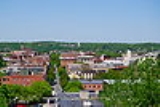
Troy is a city in the US State of New York
and the seat
of Rensselaer County
. Troy is located on the western edge of Rensselaer County and on the eastern bank of the Hudson River
. Troy has close ties to the nearby cities of Albany
and Schenectady
, forming a region popularly called the Capital District
. The city is one of the three major centers for the Albany-Schenectady-Troy Metropolitan Statistical Area (MSA), which has a population of 850,957. At the 2010 census, the population of Troy was 50,129. Troy's motto is Ilium fuit, Troja est, which means "Ilium was, Troy is".
Before European arrival, the area was settled by the Mahican
Indian tribe
. There were at least two settlements within today's city limits, Panhooseck and Paanpack. The Dutch began settling in the mid 17th century; the patroon
Kiliaen van Rensselaer called the area Pafraets Dael, after his mother. Control of New York passed to the English in 1664 and in 1707 Derick Van der Heyden purchased a farm near today's downtown area
. In 1771 Abraham Lansing had his farm in today's Lansingburgh
laid out into lots. Responding to Lansing's success to the north, in 1787, Van der Heyden's grandson Jacob had his extensive holdings surveyed and laid out into lots as well, calling the new village Vanderheyden.
In 1789, Troy got its current name after a vote of the people. In 1791, Troy was incorporated as a town and extended east across the county to the Vermont
line and included Petersburgh
. In 1796 Troy became a village and in 1816 it became a city. Lansingburgh, to the north, was still a separate village, the first to have ever been incorporated in the State. Lansingburgh became part of Troy in 1900, though it maintained a very separate identity and still does to this day.
Troy is known as the Collar City due to its history in shirt, collar, and other textile production. At one point Troy was also the second largest producer of iron in the country, surpassed only by the city of Pittsburgh
, Pennsylvania
. The Rensselaer School, which later became Rensselaer Polytechnic Institute
, was founded in 1824 with funding from Stephen Van Rensselaer, a descendant of the founding patroon, Kiliaen. In 1821, Emma Willard
founded the Troy Female Seminary on 2nd Street, which moved to its current location on Pawling Avenue in 1910. It was renamed Emma Willard School
in 1895. The former Female Seminary was later reopened (1916) as Russell Sage College
, thanks to funding from Olivia Slocum Sage, the widow of financier and Congressman
Russell Sage
. All of these institutions still exist today.
The city operates under a mayor-council government
; Harry Tutunjian
is the current mayor and Clement Campana is the council president.
, the Mohican Indians
had a number of settlements along the Hudson River
near the confluence with the Mohawk River
. The land comprising the Poesten Kill and Wynants Kill areas were owned by two Mohican groups. The land around the Poesten Kill was owned by Skiwias and was called Panhooseck. The area around the Wynants Kill, was known as Paanpack, was owned by Peyhaunet. The land between the creeks, which makes up most of downtown
and South Troy, was owned by Annape. South of the Wynants Kill and into present-day North Greenbush
, the land was owned by Pachquolapiet. These parcels of land were sold to the Dutch
between 1630 and 1657 and each purchase was overseen and signed by Skiwias, the sachem
at the time. In total, more than 75 individual Mohicans were involved in deed signings in the 17th century.
The site of the city was a part of Rensselaerswyck, a patroonship created by Kiliaen van Rensselaer. Dirck Van der Heyden was one of the first settlers. In 1707, he purchased a farm of 65 acres (26.3 ha) which in 1787 was laid out as a village.
A early local legend that a Dutch girl had been kidnapped by an Indian male who did not want her to marry someone else gained some credence when two skeletons were found in a cave under Poestenkill Falls in the 1950s. One skeleton was female and Caucasian with an iron ring. The other was Native-American and male.
The name Troy (after the legendary city of Troy
, made famous in Homer
's Iliad
) was adopted in 1789, and the region was formed into the Town of Troy in 1791 from part of the Manor of Rensselaerswyck. The township included the current city and the towns of Brunswick
and Grafton. Troy became a village in 1801 and was chartered as a city in 1816. In 1900, the city of Lansingburgh was merged into Troy.
In the post-Revolutionary War years, as central New York was first settled, there was a strong trend to classical names, and Troy's naming fits the same pattern as the New York cities of Syracuse, Rome, Utica, Ithaca, or the towns of Sempronius, Manlius, or dozens of other classically named towns to the west of Troy.
Northern and Western New York was a theater of the War of 1812
, and militia and regular army forces were led by Stephen Van Rensselaer
of Troy. Quartermaster supplies were shipped through Troy. A local butcher and meat-packer named Samuel Wilson
supplied the military, and, according to an unprovable legend, barrels stamped "U.S." were jokingly taken by the troops to stand for "Uncle Sam
" meaning Wilson. Troy has since claimed to be the historical home of Uncle Sam.
Through much of the 19th and into the early 20th century, Troy was not only one of the most prosperous cities in New York State, but one of the most prosperous cities in the entire country. Prior to its rise as an industrial center, Troy was the transshipment point for meat and vegetables from Vermont which were sent by the Hudson River to New York City. The Federal Dam at Troy is the head of the tides in the Hudson River and Hudson River sloops and steamboats plied the river on a regular basis. This trade was vastly increased after the construction of the Erie Canal
, with its eastern terminus directly across the Hudson from Troy at Cohoes in 1825.
Troy's one-time great wealth was produced in the steel industry, with the first American Bessemer converter
erected on the Wyantskill, a stream with a falls in a small valley at the south end of the city. The industry first used charcoal and iron ore from the Adirondacks. Later on, ore and coal from the Midwest was shipped on the Erie Canal
to Troy, and there processed before being sent on down the Hudson to New York City. The iron and steel was also used by the extensive federal arsenal across the Hudson at Watervliet, New York
, then called West Troy. After the American Civil War
, the steel production industry moved west to be closer to raw materials. The presence of iron and steel also made it possible for Troy to be an early site in the development of iron storefronts and steel structural supports in architecture, and there are some significant early examples still in the city.
The initial emphasis on heavier industry later spawned a wide variety of highly engineered mechanical and scientific equipment. Troy was the home of W. & L. E. Gurley, Co.
, makers of precision instruments. Gurley's theodolites were used to survey much of the American West after the Civil War and were highly regarded until laser and digital technology eclipsed the telescope and compass technology in the 1970s. Bells manufactured by Troy's Meneely Bell Company
ring all over the world. And Troy was also home to a manufacturer of racing shells that used impregnated paper in a process that presaged the later use of fiberglass, Kevlar and carbon fiber composites.
This scientific and technical proficiency was supported by the presence of Rensselaer Polytechnic Institute
, or RPI, one of the highest-ranked engineering schools in the country. RPI was originally sponsored by Stephen Van Rensselaer
, one of the most prominent members of that family. RPI was founded in 1824, and eventually absorbed the campus of the short-lived, liberal arts based Troy University
, which closed in 1862 during the Civil War. Rensselaer founded RPI for the "application of science to the common purposes of life", and it is the oldest technological university in the English-speaking world. The institute is known for its success in the transfer of technology from the laboratory to the marketplace.
On December 23, 1823, The Troy Sentinel was the first publisher of the world-famous Christmas poem "A Visit from St. Nicholas
" (also known as "The Night Before Christmas" or "Twas the Night Before Christmas"). The poem was published anonymously. Its author has long been believed to have been Clement Clarke Moore
, but its author is now regarded by a few to have been Henry Livingston, Jr.
Troy was an early home of professional baseball, and was the host of two major league teams. The first team to call Troy home was the Troy Haymakers
, a National Association
team in 1871 and 1872. One of their major players was Williams H. "Bill" Craver
, a noted catcher and Civil War veteran, who also managed the team. Their last manager was Jimmy Wood, reckoned the first Canadian in professional baseball. The Troy Haymakers folded, and Troy had no team for seven seasons. Then, for four seasons, 1879 to 1882, Troy was home to the National League
Troy Trojans. The Trojans were not competitive in the league, but they did have the biggest hitter in professional baseball, Dan Brouthers.http://www.baseball-almanac.com/teams/troy.shtml For the 1883 season, the Trojans were moved to New York City where they became the New York Gothams, better know later as the Giants. The Gothams had the same ownership as the New York Metropolitans
of the rival American Association. As a result classic Met players became Giants, including Hall of Fame Pitcher Tim Keefe. Troy was also the birthplace of the famous player Michael Joseph "King" Kelly
.
Troy has been nearly destroyed by fire three times. The Great Troy fire of 1862 burnt the W. & L. E. Gurley, Co. factory, which was later that year replaced by the new W. & L. E. Gurley Building
, now a National Historic Landmark
: Gurley & Sons remains a world-wide leader in precision instrumentation.
In 1892, there were election riots there during which Robert Ross was murdered. One of his alleged slayers, "Bat" Shea, was executed in 1896.
In 1900 Troy annexed Lansingburgh
, a former town and village whose standing dates back prior to the War of Independence, in Rensselaer County. Lansingburgh is thus often referred to as "North Troy". However, prior to the annexation, that portion of Troy north of Division Street was called North Troy and the neighborhood south of Washington Park is referred to as South Troy. To avoid confusion with streets in Troy following the annexation, Lansingburgh's numbered streets were renamed: its 1st Street, 2nd Street, 3rd Street, etc., became North Troy's 101st Street, 102nd Street, 103rd Street, etc. Lansingburgh was home to the Lansingburgh Academy
.
In addition to the strong presence of the early American steel industry, Troy was also a manufacturing center for shirts, shirtwaists, collars and cuffs. In 1825, a local resident Hannah Lord Montague
, was tired of cleaning her blacksmith husband's shirts. She cut off the collars of her husband's shirts, since only the collar was soiled, bound the edges and attached strings to hold them in place. (This also allowed the collars and cuffs to be starched separately.) Hannah Montague's idea caught on, and changed the fashion for American men's dress for a century. Her patented collars and cuffs were first manufactured by Maullin & Blanchard, which eventually was absorbed by Cluett, Peabody & Company
. Cluett's "Arrow shirts" are still worn by men across the country.http://www.arrowshirt.com/heritage.aspx The large labor force required by the shirt manufacturing industry also, in 1864, produced the nation's first female Labor Union, the Collar Laundry Union
, founded in Troy by Kate Mullany
. On February 23, 1864, 300 members of the union went on strike. After six days, the laundry owners gave in to their demands and raised wages 25 percent. There were further developments in the industry, when, in 1933, Sanford Cluett invented a process he called Sanforization
, a process which shrinks cotton
fabric
s thoroughly and permanently. Cluett, Peabody's last main plant in Troy was closed in the 1980s, but the industrial output of the plant had long been transferred to facilities in the South.
When the iron & steel industry moved to Pennsylvania and beyond, and with a similar downturn in the collar industry, Troy's prosperity began to fade. After the passage of Prohibition
, and given the strict control of Albany
by the Daniel P. O'Connell political machine, Troy became a way station for an illegal alcohol trade from Canada to New York City. Likewise, the stricter control of morality laws in the neighboring New England
states, left Troy with openly operating speakeasies and brothels. Gangsters such as Legs Diamond conducted business in Troy. This gave Troy a somewhat colorful reputation through World War II
. A few of the finer houses have since been converted to fine restaurants, such as the former Old Daly Inn. Like many old industrial cities, Troy has had to deal with not only the loss of its manufacturing base, but a drainage of population and wealth to suburbs and other parts of the country. Troy's population in 1910 was over 75,000, more than 50% higher than it is today. These factors have led to a sizable degree of dilapidation and disinvestment, although numerous efforts have been made to preserve Troy's architectural and cultural past.
Kurt Vonnegut
lived in Troy and the area, and many of his novels include mentions of Ilium, (Troy), or surrounding local references. Vonnegut wrote Player Piano in 1952, which is set in Ilium, New York, and is based on his experiences working as a public relations writer at General Electric
. His 1963 novel, Cat's Cradle, was written in the city, and mentions being in Ilium. His recurring main character, Kilgore Trout, is a resident of Cohoes
, on the opposite side of the Hudson from Troy.
, the city has a total area of 11 square miles (28.5 km²), of which 10.4 square miles (26.9 km²) is land and 0.6 square miles (1.6 km²) (5.44%) is water.
Troy is located several miles north of Albany near the junction of the Erie and Champlain canals, via the Hudson River
and is the terminus of the New York Barge Canal. It is the distributing center for a large area.
The city is on the central part of the western border of Rensselaer County. The Hudson River makes up the western border of the city and the county's border with Albany County. The city borders within Rensselaer County, Schaghticoke to the north, Brunswick
to the east, and North Greenbush
to the south; to the west the city borders the Albany County town of Colonie, the villages of Menands
and Green Island
, and the cities of Watervliet
and Cohoes
. To the northwest Troy borders the Saratoga County village of Waterford
within the town of Waterford
The western edge of the city is flat along the river, and then steeply slopes to higher terrain to the east. The average elevation is 50 feet, with the highest elevation being 500 feet in the eastern part of the city. The city is longer than it is wide, with the southern half wider than the northern section of the city often referred to as Lansingburgh, or North Troy. Several kills
(Dutch for creek) pass through Troy and empty into the Hudson. The Poesten Kill and Wynants Kill are the two largest and both have several small lakes and waterfalls along their routes in the city. There are several lakes and reservoirs within the city including Ida Lake, Burdens Pond, Lansingburgh Reservoir, Bradley Lake, Smarts Pond and Wright Lake.
, there were 49,170 people, 19,996 households and 10,737 families residing in the city. The population density
was 4,721.8 per square mile (1,823.7/km²). There were 23,093 housing units at an average density of 2,217.6 per square mile (856.5/km²). The racial makeup of the city was 80.22% White, 11.41% African American, 0.28% Native American, 3.49% Asian, 0.04% Pacific Islander, 2.20% from other races
, and 2.35% from two or more races. Hispanic or Latino of any race were 4.33% of the population. According the Census Bureau, the largest self-reported ethnic groups in Troy are: Irish (23%), Italian (13%), German (11%), French (8%), English (7%), and Polish (5%).
There were 19,996 households of which 27.0% had children under the age of 18 living with them, 32.6% were married couples
living together, 16.3% had a female householder with no husband present, and 46.3% were non-families. 36.6% of all households were made up of individuals and 12.6% had someone living alone who was 65 years of age or older. The average household size was 2.26 and the average family size was 2.97.
Age distribution was 22.1% under the age of 18, 17.6% from 18 to 24, 28.5% from 25 to 44, 18.1% from 45 to 64, and 13.7% who were 65 years of age or older. The median age was 32 years. For every 100 females there were 98.0 males. For every 100 females age 18 and over, there were 96.0 males.
The median household income
was $29,844, and the median family income was $38,631. Males had a median income of $30,495 versus $25,724 for females. The per capita income
for the city was $16,796. About 14.3% of families and 19.1% of the population were below the poverty line, including 25.0% of those under age 18 and 9.5% of those age 65 or over.
and Belle Epoch
architecture
, and encompasses the plethora of legacy styles and innovative designs incorporated into and emblematic of each era’s building disciplines and aesthetics.
The city’s architectural achievements rate inspirational and serve its citizens, visitors and onlookers as well as posterity, with as a veritable treasure chest set in masonry exteriors, as evidenced by the sheer variety of its building’s design vernacular, which includes specimens redolent of numerous ancient civilizations’ and later European edifice models. An apprehension of Troy’s breathtaking architectural heritage is foundational to ascertaining its cultural achievements and to a larger extent its unique place in the history of the United States of America.
Notably, the city's First and Second Industrial Revolution
s’ decades-long innovations and successes enabled commercial and residential builders the financial means and engineering knowledgebase to express themselves in highly-individualized, and most often, grand masonry buildings. That opportunity to build such wondrous structures is owed, in part, too, to the fact that two major fires had devastated much of Troy’s earlier wooden structures, availing large tracts for re-development.
Whether for industrial, mercantile, civic, educational, academic and/or for other purposes, building fine structures served as a much relished means to assert one's status, enlightenment or aesthetic whimsy. Over-blown displays of wealth-for-wealth-sake, as seen in other prosperous cities, such as Newport, Rhode Island
, were eschewed and deemed as in poor taste in Troy, and as such were little suffered … excessive, gaudy or poor manners, clothes and/or jewelry, likewise, carried over as socially established norms to architecture; tacking and grandiose building was frowned upon and did not take hold as it had in other cities. Troy has no over-sized mansions ie, over 11,000 square feet in town, and few historical homes much over that size in its outlaying areas, nor does it house other architectural "folly
" indulgences, which would have been deemed outrageously gosh or crass by Troy’s selective but practical leading citizenry and common-man alike. Trojans aspired to a refined and civil community standard, predicated upon great ancient civilizations and European municipal models.
Significantly, on a large and decidedly egalitarian demographic-scale, building in Troy occurred with that marked community consciousness. It guided determination of a building’s size, style and intended primary usage … helping to ensure well-balanced cultural activity and continuity among building initiatives. That is why buildings in Troy are often grand, yes — since many of the builders of industrial, civic and the large townhouses eg, around Washington Square Park, a private park, included very rich by any standard citizens eg, Russell Sage (for a time touted as the richest man in the United States) and the members of the Griswold and Warren families (of the world-wide sold cast iron Warren Stoves fame) — but, ostentatious, decidedly no. Elegant was the operative buzzword: Architectural elements were matched to a builder's design preferences and “purse”, used to convey one's, as far as one's means would afford it and education could engendered ideas, tastes. The results were often splendid, as seen today in the many extant sections of the city: high-quality masonry: townhouses, apartment buildings, multiple-dwelling and private dwelling buildings large or small, reflect that sentiment, as the builders’ culturally driven reality.
Whether ornate and/or austere, Troy’s buildings stand testament to a rich cultural heritage: one that elegantly embraces the disciplines defined by antecedents’ achievements; while, attained was its own imperative: buildings for an exemplar and prosperous city, wrought of a peer-pressure, induced social normative, via a well fostered sense of community, devotion and adherence to good taste, resulting in its builders’ derivative design dialog.
Akin to Ilium
, the gold-rich city-state
, its namesake, Troy evolved to a somewhat similar rich status — or as others contend, Troy, New York owes certain of its municipal design scheme eg, its world-renown Troy Music Hall aka Troy Savings Bank to its civil-leaders’ admiration of the similarly, exceedingly erudite and highly prosperous Venetian Republic model(s) ie, those cities of the terra-ferma aka Veneto
eg, Vicenza
.
Troy’s most distinguished buildings’ designs share in the design legacy of their antecedents, to whom they often bear sticking, if little known today, similarities to eg, Vicenza's Opera House aka Basilica Palladiana
and for that matter it closely resembles Brescia
's somewhat more ornate Opera House as well as for Troy’s other civic buildings’ decidedly Italianate ie, Italian Renaissance
design heritage: Troy Public Library
and Troy Court House.
That reflects a stalwart social consciousness held among Troy's citizens, wrought of the decades’ long industrial, scientific and mercantile innovation and prosperity, which led, too, in a like vein to those historical achievements facilitated by and realized by the Maritime Republics aka Maritime republics along more ancient water trade routes. However, in Troy, New York's incarnation, the mighty Hudson and Mohawk rivers play their part, as does the Erie Canal
and its lesser tributary canal systems, and later the railroads that linked Troy to the rest of the Empire State
, New York City
to the south, and Utica, New York
, Syracuse, New York
, Rochester, New York
, Buffalo, New York
and the myriad of emergent Great Lakes
' cities of other states in the burgeoning United States … substituted analogously for the Adriatic Sea
and its Bosporus
waterways, for the ancient Spice Trade aka Spice trade
and Silk Trade routes: as detailed for the Economic History of Venice aka Economic history of Venice
.
It can be little wonder that Troy’s neo-classical and scores of other outstanding building styles represent a community’s culture that valued learned minds among its citizenry. Obvious is that Trojan’s held erudition and historical awareness, as to what comprises a great civilization, in the highest regard. Early on, indeed, Trojans had placed great emphasis on education. That predilection is witnessed in the numerous centers for higher learning and advanced degrees — for both men and women, and the civic leaders who were the drivers for those changes and institutions as well as the local citizenry that supported them — known today as these (all in one small city … along a the mighty Hudson River; several of the institutional names and their proprietary status, listed below, have changed over the years):
• Rensselaer Polytechnic Institute
• The Emma Willard School for Girls aka Emma Willard School
• Russell Sage College
• Troy Public Library
(to this day a private institution in service to the City of Troy)
• The original The Albany Academy
, was founded, too, in what is now known as North Troy, formerly the village of Lansingburg
• The Hudson River Valley Community College
Trojans’ dedication to education, as a cultural pillar, mark Troy’s population as well-read, many were versed in the classics. Education, hard work, prosperity and thrift manifest in a competitive desire to build a city worthy of its ancient namesake. That consciousness, resulted in an exuberant building spirit that propelled forward, seen incorporated into the citizens’ penchant for ancient civilizations’ and European designs.the city’s civil, commercial and private structures. Trojans expressed their passion for building, using the following materials, for an array building features:
• Iron: cast and structural iron works (facades, gates, railings, banisters, stairwells, rooftop crenellation, window grilles et cetera);
• Stone: carved hard and soft stone foundations, facades and decorative elements
• Glass: as well as in the vast array of ornate stained and etched glass works;
• Wood: fine wood work in found in many of Troy’s buildings. While few of its early structures have survived Troy's devastating fires, nonetheless, Trojans relished elaborate mechanically and/or hand-craved interior woodwork, extant today
As may well be expected, Troy is decorated by many beautiful and intact John La Farge and Tiffany
stained-glass, etched and frosted glass installations.
It should be noted that the same exuberance of spirit that egged on Troy’s many builders, resulted in fierce competition, too, for acclaim, of a more mercantile/commercial sort, however (un)subtly, for having achieved the “best of the best” status, by certain of its architects and designers. This was much in evidence by the competition between La Farge and Tiffany (no matter how unspeakable it may have been in polite company to the proper Victorian mindset). Their competition was fierce for contract engagements at Troy Ranked as one of the Top 100 two-year colleges in the nation by Community College Week in 2004.
Cassie Moss 1989 to present
Culture
History
Geography
New York
New York is a state in the Northeastern region of the United States. It is the nation's third most populous state. New York is bordered by New Jersey and Pennsylvania to the south, and by Connecticut, Massachusetts and Vermont to the east...
and the seat
County seat
A county seat is an administrative center, or seat of government, for a county or civil parish. The term is primarily used in the United States....
of Rensselaer County
Rensselaer County, New York
Rensselaer County is a county in the U.S. state of New York. As of the 2010 census, the population was 159,429. Its name is in honor of the family of Kiliaen van Rensselaer, the original Dutch owner of the land in the area. Its county seat is Troy...
. Troy is located on the western edge of Rensselaer County and on the eastern bank of the Hudson River
Hudson River
The Hudson is a river that flows from north to south through eastern New York. The highest official source is at Lake Tear of the Clouds, on the slopes of Mount Marcy in the Adirondack Mountains. The river itself officially begins in Henderson Lake in Newcomb, New York...
. Troy has close ties to the nearby cities of Albany
Albany, New York
Albany is the capital city of the U.S. state of New York, the seat of Albany County, and the central city of New York's Capital District. Roughly north of New York City, Albany sits on the west bank of the Hudson River, about south of its confluence with the Mohawk River...
and Schenectady
Schenectady, New York
Schenectady is a city in Schenectady County, New York, United States, of which it is the county seat. As of the 2010 census, the city had a population of 66,135...
, forming a region popularly called the Capital District
Capital District
New York's Capital District, also known as the Capital Region, is a region in upstate New York that generally refers to the four counties surrounding Albany, the capital of the state: Albany County, Schenectady County, Rensselaer County, and Saratoga County...
. The city is one of the three major centers for the Albany-Schenectady-Troy Metropolitan Statistical Area (MSA), which has a population of 850,957. At the 2010 census, the population of Troy was 50,129. Troy's motto is Ilium fuit, Troja est, which means "Ilium was, Troy is".
Before European arrival, the area was settled by the Mahican
Mahican
The Mahican are an Eastern Algonquian Native American tribe, originally settling in the Hudson River Valley . After 1680, many moved to Stockbridge, Massachusetts. During the early 1820s and 1830s, most of the Mahican descendants migrated westward to northeastern Wisconsin...
Indian tribe
Indian tribe
In the United States, a Native American tribe is any extant or historical tribe, band, nation, or other group or community of Indigenous peoples in the United States...
. There were at least two settlements within today's city limits, Panhooseck and Paanpack. The Dutch began settling in the mid 17th century; the patroon
Patroon
In the United States, a patroon was a landholder with manorial rights to large tracts of land in the 17th century Dutch colony of New Netherland in North America...
Kiliaen van Rensselaer called the area Pafraets Dael, after his mother. Control of New York passed to the English in 1664 and in 1707 Derick Van der Heyden purchased a farm near today's downtown area
Central Troy Historic District
The Central Troy Historic District is an irregularly-shaped, area of downtown Troy, New York, United States. It has been described as "one of the most perfectly preserved 19th-century downtowns in the [country]" with nearly 700 properties in a variety of architectural styles from the early 19th to...
. In 1771 Abraham Lansing had his farm in today's Lansingburgh
Lansingburgh, New York
Lansingburgh was the first chartered village in Rensselaer County, New York, USA and was settled around 1763. The name is from Abraham Lansing, an early settler, combined with the Scottish word burgh....
laid out into lots. Responding to Lansing's success to the north, in 1787, Van der Heyden's grandson Jacob had his extensive holdings surveyed and laid out into lots as well, calling the new village Vanderheyden.
In 1789, Troy got its current name after a vote of the people. In 1791, Troy was incorporated as a town and extended east across the county to the Vermont
Vermont
Vermont is a state in the New England region of the northeastern United States of America. The state ranks 43rd in land area, , and 45th in total area. Its population according to the 2010 census, 630,337, is the second smallest in the country, larger only than Wyoming. It is the only New England...
line and included Petersburgh
Petersburgh, New York
Petersburgh is a town located in the northeast section of Rensselaer County, New York, United States. The population was 1,563 at the 2000 census. The town was named after an early settler.- History :...
. In 1796 Troy became a village and in 1816 it became a city. Lansingburgh, to the north, was still a separate village, the first to have ever been incorporated in the State. Lansingburgh became part of Troy in 1900, though it maintained a very separate identity and still does to this day.
Troy is known as the Collar City due to its history in shirt, collar, and other textile production. At one point Troy was also the second largest producer of iron in the country, surpassed only by the city of Pittsburgh
Pittsburgh, Pennsylvania
Pittsburgh is the second-largest city in the US Commonwealth of Pennsylvania and the county seat of Allegheny County. Regionally, it anchors the largest urban area of Appalachia and the Ohio River Valley, and nationally, it is the 22nd-largest urban area in the United States...
, Pennsylvania
Pennsylvania
The Commonwealth of Pennsylvania is a U.S. state that is located in the Northeastern and Mid-Atlantic regions of the United States. The state borders Delaware and Maryland to the south, West Virginia to the southwest, Ohio to the west, New York and Ontario, Canada, to the north, and New Jersey to...
. The Rensselaer School, which later became Rensselaer Polytechnic Institute
Rensselaer Polytechnic Institute
Stephen Van Rensselaer established the Rensselaer School on November 5, 1824 with a letter to the Rev. Dr. Samuel Blatchford, in which van Rensselaer asked Blatchford to serve as the first president. Within the letter he set down several orders of business. He appointed Amos Eaton as the school's...
, was founded in 1824 with funding from Stephen Van Rensselaer, a descendant of the founding patroon, Kiliaen. In 1821, Emma Willard
Emma Willard
Emma Hart Willard was an American women’s rights activist who dedicated her life to education. She worked in several schools and founded the first school for women’s higher education, the Troy Female Seminary in Troy, New York...
founded the Troy Female Seminary on 2nd Street, which moved to its current location on Pawling Avenue in 1910. It was renamed Emma Willard School
Emma Willard School
The Emma Willard School, originally called Troy Female Seminary and often referred to simply as "Emma," is an independent university-preparatory day and boarding school for young women, located in Troy, New York on Mount Ida, offering grades 9-12 and postgraduate coursework...
in 1895. The former Female Seminary was later reopened (1916) as Russell Sage College
Russell Sage College
Russell Sage College is a women's college located in Troy, New York, approximately north of New York City in the Capital District. It is one of the three colleges that make up The Sage Colleges...
, thanks to funding from Olivia Slocum Sage, the widow of financier and Congressman
United States House of Representatives
The United States House of Representatives is one of the two Houses of the United States Congress, the bicameral legislature which also includes the Senate.The composition and powers of the House are established in Article One of the Constitution...
Russell Sage
Russell Sage
Russell Sage was a financier, railroad executive and Whig politician from New York, United States. As a frequent partner of Jay Gould in various transactions, he amassed a fortune, which passed to his second wife, Margaret Olivia Slocum Sage, when he died...
. All of these institutions still exist today.
The city operates under a mayor-council government
Mayor-council government
The mayor–council government system, sometimes called the mayor–commission government system, is one of the two most common forms of local government for municipalities...
; Harry Tutunjian
Harry Tutunjian
Harry J. Tutunjian is the Republican mayor of Troy, New York. He was elected in 2003 and re-elected in 2007. His term will end in 2012, when he cannot seek reelection due to term limits.He holds a degree from Hudson Valley Community College....
is the current mayor and Clement Campana is the council president.
History
Prior to the arrival of EuropeansEurope
Europe is, by convention, one of the world's seven continents. Comprising the westernmost peninsula of Eurasia, Europe is generally 'divided' from Asia to its east by the watershed divides of the Ural and Caucasus Mountains, the Ural River, the Caspian and Black Seas, and the waterways connecting...
, the Mohican Indians
Mohican
-Native Americans:* Mahican , a Native American tribe who lived in and around the Hudson Valley* Mohegan, a functional confederation of several branches of Native Americans during the 16th century and the beginning of the 17th century...
had a number of settlements along the Hudson River
Hudson River
The Hudson is a river that flows from north to south through eastern New York. The highest official source is at Lake Tear of the Clouds, on the slopes of Mount Marcy in the Adirondack Mountains. The river itself officially begins in Henderson Lake in Newcomb, New York...
near the confluence with the Mohawk River
Mohawk River
The Mohawk River is a river in the U.S. state of New York. It is the largest tributary of the Hudson River. The Mohawk flows into the Hudson in the Capital District, a few miles north of the city of Albany. The river is named for the Mohawk Nation of the Iroquois Confederacy...
. The land comprising the Poesten Kill and Wynants Kill areas were owned by two Mohican groups. The land around the Poesten Kill was owned by Skiwias and was called Panhooseck. The area around the Wynants Kill, was known as Paanpack, was owned by Peyhaunet. The land between the creeks, which makes up most of downtown
Central Troy Historic District
The Central Troy Historic District is an irregularly-shaped, area of downtown Troy, New York, United States. It has been described as "one of the most perfectly preserved 19th-century downtowns in the [country]" with nearly 700 properties in a variety of architectural styles from the early 19th to...
and South Troy, was owned by Annape. South of the Wynants Kill and into present-day North Greenbush
North Greenbush, New York
North Greenbush is a town in Rensselaer County, New York, United States. North Greenbush is located in the western part of the county. The population was 10,805 at the 2000 census....
, the land was owned by Pachquolapiet. These parcels of land were sold to the Dutch
United Netherlands
United Netherlands is an educational student-led organization that focuses on the theory and practice of international relations and diplomacy...
between 1630 and 1657 and each purchase was overseen and signed by Skiwias, the sachem
Sachem
A sachem[p] or sagamore is a paramount chief among the Algonquians or other northeast American tribes. The two words are anglicizations of cognate terms from different Eastern Algonquian languages...
at the time. In total, more than 75 individual Mohicans were involved in deed signings in the 17th century.
The site of the city was a part of Rensselaerswyck, a patroonship created by Kiliaen van Rensselaer. Dirck Van der Heyden was one of the first settlers. In 1707, he purchased a farm of 65 acres (26.3 ha) which in 1787 was laid out as a village.
A early local legend that a Dutch girl had been kidnapped by an Indian male who did not want her to marry someone else gained some credence when two skeletons were found in a cave under Poestenkill Falls in the 1950s. One skeleton was female and Caucasian with an iron ring. The other was Native-American and male.
The name Troy (after the legendary city of Troy
Troy
Troy was a city, both factual and legendary, located in northwest Anatolia in what is now Turkey, southeast of the Dardanelles and beside Mount Ida...
, made famous in Homer
Homer
In the Western classical tradition Homer , is the author of the Iliad and the Odyssey, and is revered as the greatest ancient Greek epic poet. These epics lie at the beginning of the Western canon of literature, and have had an enormous influence on the history of literature.When he lived is...
's Iliad
Iliad
The Iliad is an epic poem in dactylic hexameters, traditionally attributed to Homer. Set during the Trojan War, the ten-year siege of the city of Troy by a coalition of Greek states, it tells of the battles and events during the weeks of a quarrel between King Agamemnon and the warrior Achilles...
) was adopted in 1789, and the region was formed into the Town of Troy in 1791 from part of the Manor of Rensselaerswyck. The township included the current city and the towns of Brunswick
Brunswick, New York
Brunswick is a town in Rensselaer County, New York, United States that was originally settled in the early 18th century. During its history, it had been part of Albany County, Rensselaerswyck, and Troy, before its incorporation in 1807...
and Grafton. Troy became a village in 1801 and was chartered as a city in 1816. In 1900, the city of Lansingburgh was merged into Troy.
In the post-Revolutionary War years, as central New York was first settled, there was a strong trend to classical names, and Troy's naming fits the same pattern as the New York cities of Syracuse, Rome, Utica, Ithaca, or the towns of Sempronius, Manlius, or dozens of other classically named towns to the west of Troy.
Northern and Western New York was a theater of the War of 1812
War of 1812
The War of 1812 was a military conflict fought between the forces of the United States of America and those of the British Empire. The Americans declared war in 1812 for several reasons, including trade restrictions because of Britain's ongoing war with France, impressment of American merchant...
, and militia and regular army forces were led by Stephen Van Rensselaer
Stephen Van Rensselaer III
Stephen Van Rensselaer III was Lieutenant Governor of New York as well as a statesman, soldier, and land-owner, the heir to one of the largest estates in the New York region at the time, which made him the tenth richest American of all time, based on the ratio of his fortune to contemporary GDP...
of Troy. Quartermaster supplies were shipped through Troy. A local butcher and meat-packer named Samuel Wilson
Samuel Wilson
Samuel Wilson was a meat-packer from Troy, New York whose name is purportedly the source of the personification of the United States known as "Uncle Sam"....
supplied the military, and, according to an unprovable legend, barrels stamped "U.S." were jokingly taken by the troops to stand for "Uncle Sam
Uncle Sam
Uncle Sam is a common national personification of the American government originally used during the War of 1812. He is depicted as a stern elderly man with white hair and a goatee beard...
" meaning Wilson. Troy has since claimed to be the historical home of Uncle Sam.
Through much of the 19th and into the early 20th century, Troy was not only one of the most prosperous cities in New York State, but one of the most prosperous cities in the entire country. Prior to its rise as an industrial center, Troy was the transshipment point for meat and vegetables from Vermont which were sent by the Hudson River to New York City. The Federal Dam at Troy is the head of the tides in the Hudson River and Hudson River sloops and steamboats plied the river on a regular basis. This trade was vastly increased after the construction of the Erie Canal
Erie Canal
The Erie Canal is a waterway in New York that runs about from Albany, New York, on the Hudson River to Buffalo, New York, at Lake Erie, completing a navigable water route from the Atlantic Ocean to the Great Lakes. The canal contains 36 locks and encompasses a total elevation differential of...
, with its eastern terminus directly across the Hudson from Troy at Cohoes in 1825.
Troy's one-time great wealth was produced in the steel industry, with the first American Bessemer converter
Bessemer process
The Bessemer process was the first inexpensive industrial process for the mass-production of steel from molten pig iron. The process is named after its inventor, Henry Bessemer, who took out a patent on the process in 1855. The process was independently discovered in 1851 by William Kelly...
erected on the Wyantskill, a stream with a falls in a small valley at the south end of the city. The industry first used charcoal and iron ore from the Adirondacks. Later on, ore and coal from the Midwest was shipped on the Erie Canal
Erie Canal
The Erie Canal is a waterway in New York that runs about from Albany, New York, on the Hudson River to Buffalo, New York, at Lake Erie, completing a navigable water route from the Atlantic Ocean to the Great Lakes. The canal contains 36 locks and encompasses a total elevation differential of...
to Troy, and there processed before being sent on down the Hudson to New York City. The iron and steel was also used by the extensive federal arsenal across the Hudson at Watervliet, New York
Watervliet, New York
Watervliet is a city in Albany County in the US state of New York. The population was 10,254 as of the 2010 census. Watervliet is north of Albany, the capital of the state, and is bordered on the north, west, and south by the town of Colonie. The city is also known as "the Arsenal City".- History...
, then called West Troy. After the American Civil War
American Civil War
The American Civil War was a civil war fought in the United States of America. In response to the election of Abraham Lincoln as President of the United States, 11 southern slave states declared their secession from the United States and formed the Confederate States of America ; the other 25...
, the steel production industry moved west to be closer to raw materials. The presence of iron and steel also made it possible for Troy to be an early site in the development of iron storefronts and steel structural supports in architecture, and there are some significant early examples still in the city.
The initial emphasis on heavier industry later spawned a wide variety of highly engineered mechanical and scientific equipment. Troy was the home of W. & L. E. Gurley, Co.
Gurley Precision Instruments
Gurley Precision Instruments, or GPI, is an ISO-9001 certified U.S. manufacturing company based in Troy, New York.-History:Gurley Enterprise was established by William Gurley and Lewis E. Gurley in 1845, brothers who were both alumni of Rensselaer Polytechnic Institute...
, makers of precision instruments. Gurley's theodolites were used to survey much of the American West after the Civil War and were highly regarded until laser and digital technology eclipsed the telescope and compass technology in the 1970s. Bells manufactured by Troy's Meneely Bell Company
Meneely bell foundry
The Meneely Bell Foundry was a bell foundry established in 1826 in West Troy , New York, by Andrew Meneely. Two of Andrew's sons continued to operate the foundry after his death, while a third son, Clinton H. Meneely, opened a second foundry across the river with George H. Kimberly in Troy, New...
ring all over the world. And Troy was also home to a manufacturer of racing shells that used impregnated paper in a process that presaged the later use of fiberglass, Kevlar and carbon fiber composites.
This scientific and technical proficiency was supported by the presence of Rensselaer Polytechnic Institute
Rensselaer Polytechnic Institute
Stephen Van Rensselaer established the Rensselaer School on November 5, 1824 with a letter to the Rev. Dr. Samuel Blatchford, in which van Rensselaer asked Blatchford to serve as the first president. Within the letter he set down several orders of business. He appointed Amos Eaton as the school's...
, or RPI, one of the highest-ranked engineering schools in the country. RPI was originally sponsored by Stephen Van Rensselaer
Stephen Van Rensselaer III
Stephen Van Rensselaer III was Lieutenant Governor of New York as well as a statesman, soldier, and land-owner, the heir to one of the largest estates in the New York region at the time, which made him the tenth richest American of all time, based on the ratio of his fortune to contemporary GDP...
, one of the most prominent members of that family. RPI was founded in 1824, and eventually absorbed the campus of the short-lived, liberal arts based Troy University
Troy University (New York)
Troy University was a short-lived university established at Troy, New York in 1858 under the auspices of the Methodist Episcopal Church. The school closed in 1861. The building that housed the university remained a prominent Troy landmark until 1969...
, which closed in 1862 during the Civil War. Rensselaer founded RPI for the "application of science to the common purposes of life", and it is the oldest technological university in the English-speaking world. The institute is known for its success in the transfer of technology from the laboratory to the marketplace.
On December 23, 1823, The Troy Sentinel was the first publisher of the world-famous Christmas poem "A Visit from St. Nicholas
A Visit from St. Nicholas
"A Visit from St. Nicholas", also known as "The Night Before Christmas" and "'Twas the Night Before Christmas" from its first line, is a poem first published anonymously in 1823 and generally attributed to Clement Clarke Moore, although the claim has also been made that it was written by Henry...
" (also known as "The Night Before Christmas" or "Twas the Night Before Christmas"). The poem was published anonymously. Its author has long been believed to have been Clement Clarke Moore
Clement Clarke Moore
Clement Clarke Moore was an American professor of Oriental and Greek literature at Columbia College, now Columbia University. He donated land from his family estate for the foundation of the General Theological Seminary, where he was a professor of Biblical learning and compiled a two-volume...
, but its author is now regarded by a few to have been Henry Livingston, Jr.
Henry Livingston, Jr.
Henry Livingston, Jr. may have written the poem known as "A Visit from St. Nicholas", although more popularly as "The Night Before Christmas", which is generally attributed to Clement Clarke Moore....
Troy was an early home of professional baseball, and was the host of two major league teams. The first team to call Troy home was the Troy Haymakers
Troy Haymakers
The Troy Haymakers were an American professional baseball team.-History:Established in 1860 as the Union base ball club of neighboring Lansingburgh, New York, the Haymakers participated in the first professional pennant race of 1869 and joined the first professional league, the 1871 National...
, a National Association
National Association of Professional Base Ball Players
The National Association of Professional Base Ball Players , or simply the National Association , was founded in 1871 and continued through the 1875 season...
team in 1871 and 1872. One of their major players was Williams H. "Bill" Craver
Bill Craver
William H. Craver was an American Major League Baseball player from Troy, New York who played mainly as an infielder, but did play many games at catcher as well during his seven year career. He played for seven different teams, in two leagues...
, a noted catcher and Civil War veteran, who also managed the team. Their last manager was Jimmy Wood, reckoned the first Canadian in professional baseball. The Troy Haymakers folded, and Troy had no team for seven seasons. Then, for four seasons, 1879 to 1882, Troy was home to the National League
National League
The National League of Professional Baseball Clubs, known simply as the National League , is the older of two leagues constituting Major League Baseball, and the world's oldest extant professional team sports league. Founded on February 2, 1876, to replace the National Association of Professional...
Troy Trojans. The Trojans were not competitive in the league, but they did have the biggest hitter in professional baseball, Dan Brouthers.http://www.baseball-almanac.com/teams/troy.shtml For the 1883 season, the Trojans were moved to New York City where they became the New York Gothams, better know later as the Giants. The Gothams had the same ownership as the New York Metropolitans
New York Metropolitans
The Metropolitan Club was a 19th-century professional baseball team that played in New York City from 1880 to 1887...
of the rival American Association. As a result classic Met players became Giants, including Hall of Fame Pitcher Tim Keefe. Troy was also the birthplace of the famous player Michael Joseph "King" Kelly
King Kelly
Michael Joseph "King" Kelly was an American right fielder, catcher, and manager in various professional American baseball leagues including the National League, International Association, Players' League, and the American Association. He spent the majority of his 16-season playing career with the...
.
Troy has been nearly destroyed by fire three times. The Great Troy fire of 1862 burnt the W. & L. E. Gurley, Co. factory, which was later that year replaced by the new W. & L. E. Gurley Building
W. & L. E. Gurley Building
The W. & L. E. Gurley Building, in Troy, New York, United States, is a classical revival structure that housed the W. & L. E. Gurley Company, a maker of precision measuring instruments, from its construction in 1862. The company, run by William Gurley and his brother, Lewis Ephraim, was a leader in...
, now a National Historic Landmark
National Historic Landmark
A National Historic Landmark is a building, site, structure, object, or district, that is officially recognized by the United States government for its historical significance...
: Gurley & Sons remains a world-wide leader in precision instrumentation.
In 1892, there were election riots there during which Robert Ross was murdered. One of his alleged slayers, "Bat" Shea, was executed in 1896.
In 1900 Troy annexed Lansingburgh
Lansingburgh, New York
Lansingburgh was the first chartered village in Rensselaer County, New York, USA and was settled around 1763. The name is from Abraham Lansing, an early settler, combined with the Scottish word burgh....
, a former town and village whose standing dates back prior to the War of Independence, in Rensselaer County. Lansingburgh is thus often referred to as "North Troy". However, prior to the annexation, that portion of Troy north of Division Street was called North Troy and the neighborhood south of Washington Park is referred to as South Troy. To avoid confusion with streets in Troy following the annexation, Lansingburgh's numbered streets were renamed: its 1st Street, 2nd Street, 3rd Street, etc., became North Troy's 101st Street, 102nd Street, 103rd Street, etc. Lansingburgh was home to the Lansingburgh Academy
Lansingburgh Academy
The Lansingburgh Academy was a seminary in Lansingburgh in the U.S. state of New York just north of the city of Troy from the late 18th century to 1900, when the building was leased, and later sold, to the local public school district, used initially as a high school...
.
In addition to the strong presence of the early American steel industry, Troy was also a manufacturing center for shirts, shirtwaists, collars and cuffs. In 1825, a local resident Hannah Lord Montague
False-collar
A detachable collar is a shirt collar separate from the shirt, fastened to it by studs. The collar is usually made of a different fabric from the shirt, in which case it is almost always white, and, being unattached to the shirt, can be specially starched to a hard cardboard-like...
, was tired of cleaning her blacksmith husband's shirts. She cut off the collars of her husband's shirts, since only the collar was soiled, bound the edges and attached strings to hold them in place. (This also allowed the collars and cuffs to be starched separately.) Hannah Montague's idea caught on, and changed the fashion for American men's dress for a century. Her patented collars and cuffs were first manufactured by Maullin & Blanchard, which eventually was absorbed by Cluett, Peabody & Company
The Arrow Collar Man
The Arrow Collar Man was the name given to the various male models who appeared in advertisements for shirts and detachable shirt collars manufactured by Cluett Peabody & Company of Troy, New York...
. Cluett's "Arrow shirts" are still worn by men across the country.http://www.arrowshirt.com/heritage.aspx The large labor force required by the shirt manufacturing industry also, in 1864, produced the nation's first female Labor Union, the Collar Laundry Union
Collar Laundry Union
The Collar Laundry Union was the first all-female labor union in the United States. It was started in Troy, New York by Kate Mullany in 1864....
, founded in Troy by Kate Mullany
Kate Mullany
Kate Mullany was an early female labor leader who started the all-women Collar Laundry Union in Troy, New York in February 1864. It was one of the first women's unions that lasted longer than the resolution of a specific issue.-Biography:...
. On February 23, 1864, 300 members of the union went on strike. After six days, the laundry owners gave in to their demands and raised wages 25 percent. There were further developments in the industry, when, in 1933, Sanford Cluett invented a process he called Sanforization
Sanforization
Sanforization is a process of treatment used for cotton fabrics mainly and most textiles made from natural or chemical fibres, patented by Sanford Lockwood Cluett in 1930...
, a process which shrinks cotton
Cotton
Cotton is a soft, fluffy staple fiber that grows in a boll, or protective capsule, around the seeds of cotton plants of the genus Gossypium. The fiber is almost pure cellulose. The botanical purpose of cotton fiber is to aid in seed dispersal....
fabric
Textile
A textile or cloth is a flexible woven material consisting of a network of natural or artificial fibres often referred to as thread or yarn. Yarn is produced by spinning raw fibres of wool, flax, cotton, or other material to produce long strands...
s thoroughly and permanently. Cluett, Peabody's last main plant in Troy was closed in the 1980s, but the industrial output of the plant had long been transferred to facilities in the South.
When the iron & steel industry moved to Pennsylvania and beyond, and with a similar downturn in the collar industry, Troy's prosperity began to fade. After the passage of Prohibition
Prohibition
Prohibition of alcohol, often referred to simply as prohibition, is the practice of prohibiting the manufacture, transportation, import, export, sale, and consumption of alcohol and alcoholic beverages. The term can also apply to the periods in the histories of the countries during which the...
, and given the strict control of Albany
Albany, New York
Albany is the capital city of the U.S. state of New York, the seat of Albany County, and the central city of New York's Capital District. Roughly north of New York City, Albany sits on the west bank of the Hudson River, about south of its confluence with the Mohawk River...
by the Daniel P. O'Connell political machine, Troy became a way station for an illegal alcohol trade from Canada to New York City. Likewise, the stricter control of morality laws in the neighboring New England
New England
New England is a region in the northeastern corner of the United States consisting of the six states of Maine, New Hampshire, Vermont, Massachusetts, Rhode Island, and Connecticut...
states, left Troy with openly operating speakeasies and brothels. Gangsters such as Legs Diamond conducted business in Troy. This gave Troy a somewhat colorful reputation through World War II
World War II
World War II, or the Second World War , was a global conflict lasting from 1939 to 1945, involving most of the world's nations—including all of the great powers—eventually forming two opposing military alliances: the Allies and the Axis...
. A few of the finer houses have since been converted to fine restaurants, such as the former Old Daly Inn. Like many old industrial cities, Troy has had to deal with not only the loss of its manufacturing base, but a drainage of population and wealth to suburbs and other parts of the country. Troy's population in 1910 was over 75,000, more than 50% higher than it is today. These factors have led to a sizable degree of dilapidation and disinvestment, although numerous efforts have been made to preserve Troy's architectural and cultural past.
Kurt Vonnegut
Kurt Vonnegut
Kurt Vonnegut, Jr. was a 20th century American writer. His works such as Cat's Cradle , Slaughterhouse-Five and Breakfast of Champions blend satire, gallows humor and science fiction. He was known for his humanist beliefs and was honorary president of the American Humanist Association.-Early...
lived in Troy and the area, and many of his novels include mentions of Ilium, (Troy), or surrounding local references. Vonnegut wrote Player Piano in 1952, which is set in Ilium, New York, and is based on his experiences working as a public relations writer at General Electric
General Electric
General Electric Company , or GE, is an American multinational conglomerate corporation incorporated in Schenectady, New York and headquartered in Fairfield, Connecticut, United States...
. His 1963 novel, Cat's Cradle, was written in the city, and mentions being in Ilium. His recurring main character, Kilgore Trout, is a resident of Cohoes
Cohoes, New York
Cohoes is an incorporated city located at the northeast corner of Albany County in the US state of New York. It is called the "Spindle City" because of the importance of textile production to its growth. As of the 2010 census, the city population was 16,168...
, on the opposite side of the Hudson from Troy.
Geography
According to the United States Census BureauUnited States Census Bureau
The United States Census Bureau is the government agency that is responsible for the United States Census. It also gathers other national demographic and economic data...
, the city has a total area of 11 square miles (28.5 km²), of which 10.4 square miles (26.9 km²) is land and 0.6 square miles (1.6 km²) (5.44%) is water.
Troy is located several miles north of Albany near the junction of the Erie and Champlain canals, via the Hudson River
Hudson River
The Hudson is a river that flows from north to south through eastern New York. The highest official source is at Lake Tear of the Clouds, on the slopes of Mount Marcy in the Adirondack Mountains. The river itself officially begins in Henderson Lake in Newcomb, New York...
and is the terminus of the New York Barge Canal. It is the distributing center for a large area.
The city is on the central part of the western border of Rensselaer County. The Hudson River makes up the western border of the city and the county's border with Albany County. The city borders within Rensselaer County, Schaghticoke to the north, Brunswick
Brunswick, New York
Brunswick is a town in Rensselaer County, New York, United States that was originally settled in the early 18th century. During its history, it had been part of Albany County, Rensselaerswyck, and Troy, before its incorporation in 1807...
to the east, and North Greenbush
North Greenbush, New York
North Greenbush is a town in Rensselaer County, New York, United States. North Greenbush is located in the western part of the county. The population was 10,805 at the 2000 census....
to the south; to the west the city borders the Albany County town of Colonie, the villages of Menands
Menands, New York
Menands is a village in Albany County, New York, United States. The population was 3,990 at the 2010 census. The village is named after Louis Menand...
and Green Island
Green Island, New York
Green Island is a coterminous town and village in Albany County, New York, USA some 8 miles north of Albany, New York. Green Island is one of only five such town-village amalgams in New York. The population was 2,620 at the 2010 census...
, and the cities of Watervliet
Watervliet, New York
Watervliet is a city in Albany County in the US state of New York. The population was 10,254 as of the 2010 census. Watervliet is north of Albany, the capital of the state, and is bordered on the north, west, and south by the town of Colonie. The city is also known as "the Arsenal City".- History...
and Cohoes
Cohoes, New York
Cohoes is an incorporated city located at the northeast corner of Albany County in the US state of New York. It is called the "Spindle City" because of the importance of textile production to its growth. As of the 2010 census, the city population was 16,168...
. To the northwest Troy borders the Saratoga County village of Waterford
Waterford (village), New York
Waterford is a village in Saratoga County, New York, USA. The population was 2,204 at the 2000 census. The name derives from the ford between the mainland and Peebles Island....
within the town of Waterford
The western edge of the city is flat along the river, and then steeply slopes to higher terrain to the east. The average elevation is 50 feet, with the highest elevation being 500 feet in the eastern part of the city. The city is longer than it is wide, with the southern half wider than the northern section of the city often referred to as Lansingburgh, or North Troy. Several kills
Kill (body of water)
As a body of water, a kill is a creek. The word comes from the Middle Dutch kille, meaning "riverbed" or "water channel." The modern Dutch term is kil....
(Dutch for creek) pass through Troy and empty into the Hudson. The Poesten Kill and Wynants Kill are the two largest and both have several small lakes and waterfalls along their routes in the city. There are several lakes and reservoirs within the city including Ida Lake, Burdens Pond, Lansingburgh Reservoir, Bradley Lake, Smarts Pond and Wright Lake.
Demographics
At the 2000 censusCensus
A census is the procedure of systematically acquiring and recording information about the members of a given population. It is a regularly occurring and official count of a particular population. The term is used mostly in connection with national population and housing censuses; other common...
, there were 49,170 people, 19,996 households and 10,737 families residing in the city. The population density
Population density
Population density is a measurement of population per unit area or unit volume. It is frequently applied to living organisms, and particularly to humans...
was 4,721.8 per square mile (1,823.7/km²). There were 23,093 housing units at an average density of 2,217.6 per square mile (856.5/km²). The racial makeup of the city was 80.22% White, 11.41% African American, 0.28% Native American, 3.49% Asian, 0.04% Pacific Islander, 2.20% from other races
Race (United States Census)
Race and ethnicity in the United States Census, as defined by the Federal Office of Management and Budget and the United States Census Bureau, are self-identification data items in which residents choose the race or races with which they most closely identify, and indicate whether or not they are...
, and 2.35% from two or more races. Hispanic or Latino of any race were 4.33% of the population. According the Census Bureau, the largest self-reported ethnic groups in Troy are: Irish (23%), Italian (13%), German (11%), French (8%), English (7%), and Polish (5%).
There were 19,996 households of which 27.0% had children under the age of 18 living with them, 32.6% were married couples
Marriage
Marriage is a social union or legal contract between people that creates kinship. It is an institution in which interpersonal relationships, usually intimate and sexual, are acknowledged in a variety of ways, depending on the culture or subculture in which it is found...
living together, 16.3% had a female householder with no husband present, and 46.3% were non-families. 36.6% of all households were made up of individuals and 12.6% had someone living alone who was 65 years of age or older. The average household size was 2.26 and the average family size was 2.97.
Age distribution was 22.1% under the age of 18, 17.6% from 18 to 24, 28.5% from 25 to 44, 18.1% from 45 to 64, and 13.7% who were 65 years of age or older. The median age was 32 years. For every 100 females there were 98.0 males. For every 100 females age 18 and over, there were 96.0 males.
The median household income
Median household income
The median household income is commonly used to generate data about geographic areas and divides households into two equal segments with the first half of households earning less than the median household income and the other half earning more...
was $29,844, and the median family income was $38,631. Males had a median income of $30,495 versus $25,724 for females. The per capita income
Per capita income
Per capita income or income per person is a measure of mean income within an economic aggregate, such as a country or city. It is calculated by taking a measure of all sources of income in the aggregate and dividing it by the total population...
for the city was $16,796. About 14.3% of families and 19.1% of the population were below the poverty line, including 25.0% of those under age 18 and 9.5% of those age 65 or over.
Economy
Troy, like many older industrial cities, has been battered by industrial decline and the migration of jobs to the suburbs. Nevertheless, the presence of Rensselaer Polytechnic Institute has helped Troy develop a small high-technology sector, particularly in video game development. The downtown core also has a smattering of advertising and architecture firms, and other creative businesses attracted by the area's distinctive architecture. Rensselaer Polytechnic Institute is the city's largest private employer.Culture
Troy is home to tremendous examples of pre-Civil War, VictorianVictorian era
The Victorian era of British history was the period of Queen Victoria's reign from 20 June 1837 until her death on 22 January 1901. It was a long period of peace, prosperity, refined sensibilities and national self-confidence...
and Belle Epoch
Belle Epoch
Belle Epoch is an EP by the Brooklyn band Deadbeat Darling. It is the group's first official release.- Personnel :* Joseph King - Vocals, Guitar* Sanjay Jain - Bass, Keyboard, Vocals* Mohit Bhansali - Guitar* Alex Wong - Drums* Omar Akil - Trumpet...
architecture
Architecture
Architecture is both the process and product of planning, designing and construction. Architectural works, in the material form of buildings, are often perceived as cultural and political symbols and as works of art...
, and encompasses the plethora of legacy styles and innovative designs incorporated into and emblematic of each era’s building disciplines and aesthetics.
The city’s architectural achievements rate inspirational and serve its citizens, visitors and onlookers as well as posterity, with as a veritable treasure chest set in masonry exteriors, as evidenced by the sheer variety of its building’s design vernacular, which includes specimens redolent of numerous ancient civilizations’ and later European edifice models. An apprehension of Troy’s breathtaking architectural heritage is foundational to ascertaining its cultural achievements and to a larger extent its unique place in the history of the United States of America.
Notably, the city's First and Second Industrial Revolution
Industrial Revolution
The Industrial Revolution was a period from the 18th to the 19th century where major changes in agriculture, manufacturing, mining, transportation, and technology had a profound effect on the social, economic and cultural conditions of the times...
s’ decades-long innovations and successes enabled commercial and residential builders the financial means and engineering knowledgebase to express themselves in highly-individualized, and most often, grand masonry buildings. That opportunity to build such wondrous structures is owed, in part, too, to the fact that two major fires had devastated much of Troy’s earlier wooden structures, availing large tracts for re-development.
Whether for industrial, mercantile, civic, educational, academic and/or for other purposes, building fine structures served as a much relished means to assert one's status, enlightenment or aesthetic whimsy. Over-blown displays of wealth-for-wealth-sake, as seen in other prosperous cities, such as Newport, Rhode Island
Newport, Rhode Island
Newport is a city on Aquidneck Island in Newport County, Rhode Island, United States, about south of Providence. Known as a New England summer resort and for the famous Newport Mansions, it is the home of Salve Regina University and Naval Station Newport which houses the United States Naval War...
, were eschewed and deemed as in poor taste in Troy, and as such were little suffered … excessive, gaudy or poor manners, clothes and/or jewelry, likewise, carried over as socially established norms to architecture; tacking and grandiose building was frowned upon and did not take hold as it had in other cities. Troy has no over-sized mansions ie, over 11,000 square feet in town, and few historical homes much over that size in its outlaying areas, nor does it house other architectural "folly
Folly
In architecture, a folly is a building constructed primarily for decoration, but either suggesting by its appearance some other purpose, or merely so extravagant that it transcends the normal range of garden ornaments or other class of building to which it belongs...
" indulgences, which would have been deemed outrageously gosh or crass by Troy’s selective but practical leading citizenry and common-man alike. Trojans aspired to a refined and civil community standard, predicated upon great ancient civilizations and European municipal models.
Significantly, on a large and decidedly egalitarian demographic-scale, building in Troy occurred with that marked community consciousness. It guided determination of a building’s size, style and intended primary usage … helping to ensure well-balanced cultural activity and continuity among building initiatives. That is why buildings in Troy are often grand, yes — since many of the builders of industrial, civic and the large townhouses eg, around Washington Square Park, a private park, included very rich by any standard citizens eg, Russell Sage (for a time touted as the richest man in the United States) and the members of the Griswold and Warren families (of the world-wide sold cast iron Warren Stoves fame) — but, ostentatious, decidedly no. Elegant was the operative buzzword: Architectural elements were matched to a builder's design preferences and “purse”, used to convey one's, as far as one's means would afford it and education could engendered ideas, tastes. The results were often splendid, as seen today in the many extant sections of the city: high-quality masonry: townhouses, apartment buildings, multiple-dwelling and private dwelling buildings large or small, reflect that sentiment, as the builders’ culturally driven reality.
Whether ornate and/or austere, Troy’s buildings stand testament to a rich cultural heritage: one that elegantly embraces the disciplines defined by antecedents’ achievements; while, attained was its own imperative: buildings for an exemplar and prosperous city, wrought of a peer-pressure, induced social normative, via a well fostered sense of community, devotion and adherence to good taste, resulting in its builders’ derivative design dialog.
Akin to Ilium
Ilium
-Places:* Ilion or, Latinized, Ilium, another name for the legendary city of Troy, hence the title of Homer's Iliad*Ilium , an ancient city in Epirus...
, the gold-rich city-state
City-state
A city-state is an independent or autonomous entity whose territory consists of a city which is not administered as a part of another local government.-Historical city-states:...
, its namesake, Troy evolved to a somewhat similar rich status — or as others contend, Troy, New York owes certain of its municipal design scheme eg, its world-renown Troy Music Hall aka Troy Savings Bank to its civil-leaders’ admiration of the similarly, exceedingly erudite and highly prosperous Venetian Republic model(s) ie, those cities of the terra-ferma aka Veneto
Veneto
Veneto is one of the 20 regions of Italy. Its population is about 5 million, ranking 5th in Italy.Veneto had been for more than a millennium an independent state, the Republic of Venice, until it was eventually annexed by Italy in 1866 after brief Austrian and French rule...
eg, Vicenza
Vicenza
Vicenza , a city in north-eastern Italy, is the capital of the eponymous province in the Veneto region, at the northern base of the Monte Berico, straddling the Bacchiglione...
.
Troy’s most distinguished buildings’ designs share in the design legacy of their antecedents, to whom they often bear sticking, if little known today, similarities to eg, Vicenza's Opera House aka Basilica Palladiana
Basilica Palladiana
The Basilica Palladiana is a Renaissance building in the central Piazza dei Signori in Vicenza, north-eastern Italy. The most notable feature of the edifice is the loggia, which shows one of the first examples of the what came to be known as the Palladian window, designed by a young Andrea...
and for that matter it closely resembles Brescia
Brescia
Brescia is a city and comune in the region of Lombardy in northern Italy. It is situated at the foot of the Alps, between the Mella and the Naviglio, with a population of around 197,000. It is the second largest city in Lombardy, after the capital, Milan...
's somewhat more ornate Opera House
Italian Renaissance
The Italian Renaissance began the opening phase of the Renaissance, a period of great cultural change and achievement in Europe that spanned the period from the end of the 13th century to about 1600, marking the transition between Medieval and Early Modern Europe...
design heritage: Troy Public Library
Troy Public Library
The Troy Public library is the main public library building in the city of Troy, New York, and is located across the street from Russell Sage College in downtown Troy. It has two other branches, the Lansingburgh branch and the Sycaway branch. Both branches were temporarily closed in January 2009....
and Troy Court House.
That reflects a stalwart social consciousness held among Troy's citizens, wrought of the decades’ long industrial, scientific and mercantile innovation and prosperity, which led, too, in a like vein to those historical achievements facilitated by and realized by the Maritime Republics aka Maritime republics along more ancient water trade routes. However, in Troy, New York's incarnation, the mighty Hudson and Mohawk rivers play their part, as does the Erie Canal
Erie Canal
The Erie Canal is a waterway in New York that runs about from Albany, New York, on the Hudson River to Buffalo, New York, at Lake Erie, completing a navigable water route from the Atlantic Ocean to the Great Lakes. The canal contains 36 locks and encompasses a total elevation differential of...
and its lesser tributary canal systems, and later the railroads that linked Troy to the rest of the Empire State
Empire State
The Empire State is the official nickname of the U.S. state New York. It may also refer to:*Empire State Building, skyscraper in New York City, one of the tallest buildings in the world*Empire State Plaza, state office complex in Albany, New York...
, New York City
New York City
New York is the most populous city in the United States and the center of the New York Metropolitan Area, one of the most populous metropolitan areas in the world. New York exerts a significant impact upon global commerce, finance, media, art, fashion, research, technology, education, and...
to the south, and Utica, New York
Utica, New York
Utica is a city in and the county seat of Oneida County, New York, United States. The population was 62,235 at the 2010 census, an increase of 2.6% from the 2000 census....
, Syracuse, New York
Syracuse, New York
Syracuse is a city in and the county seat of Onondaga County, New York, United States, the largest U.S. city with the name "Syracuse", and the fifth most populous city in the state. At the 2010 census, the city population was 145,170, and its metropolitan area had a population of 742,603...
, Rochester, New York
Rochester, New York
Rochester is a city in Monroe County, New York, south of Lake Ontario in the United States. Known as The World's Image Centre, it was also once known as The Flour City, and more recently as The Flower City...
, Buffalo, New York
Buffalo, New York
Buffalo is the second most populous city in the state of New York, after New York City. Located in Western New York on the eastern shores of Lake Erie and at the head of the Niagara River across from Fort Erie, Ontario, Buffalo is the seat of Erie County and the principal city of the...
and the myriad of emergent Great Lakes
Great Lakes
The Great Lakes are a collection of freshwater lakes located in northeastern North America, on the Canada – United States border. Consisting of Lakes Superior, Michigan, Huron, Erie, and Ontario, they form the largest group of freshwater lakes on Earth by total surface, coming in second by volume...
' cities of other states in the burgeoning United States … substituted analogously for the Adriatic Sea
Adriatic Sea
The Adriatic Sea is a body of water separating the Italian Peninsula from the Balkan peninsula, and the system of the Apennine Mountains from that of the Dinaric Alps and adjacent ranges...
and its Bosporus
Bosporus
The Bosphorus or Bosporus , also known as the Istanbul Strait , is a strait that forms part of the boundary between Europe and Asia. It is one of the Turkish Straits, along with the Dardanelles...
waterways, for the ancient Spice Trade aka Spice trade
Spice trade
Civilizations of Asia were involved in spice trade from the ancient times, and the Greco-Roman world soon followed by trading along the Incense route and the Roman-India routes...
and Silk Trade routes: as detailed for the Economic History of Venice aka Economic history of Venice
Economic history of Venice
Venice, situated at the far end of the Adriatic Sea, gained large scale profit of the adjacent middle european markets. So did the fact that the town belonged to the Byzantine Empire. Along with increasing autonomy it gained far reaching privileges in both Empires...
.
It can be little wonder that Troy’s neo-classical and scores of other outstanding building styles represent a community’s culture that valued learned minds among its citizenry. Obvious is that Trojan’s held erudition and historical awareness, as to what comprises a great civilization, in the highest regard. Early on, indeed, Trojans had placed great emphasis on education. That predilection is witnessed in the numerous centers for higher learning and advanced degrees — for both men and women, and the civic leaders who were the drivers for those changes and institutions as well as the local citizenry that supported them — known today as these (all in one small city … along a the mighty Hudson River; several of the institutional names and their proprietary status, listed below, have changed over the years):
• Rensselaer Polytechnic Institute
Rensselaer Polytechnic Institute
Stephen Van Rensselaer established the Rensselaer School on November 5, 1824 with a letter to the Rev. Dr. Samuel Blatchford, in which van Rensselaer asked Blatchford to serve as the first president. Within the letter he set down several orders of business. He appointed Amos Eaton as the school's...
• The Emma Willard School for Girls aka Emma Willard School
Emma Willard School
The Emma Willard School, originally called Troy Female Seminary and often referred to simply as "Emma," is an independent university-preparatory day and boarding school for young women, located in Troy, New York on Mount Ida, offering grades 9-12 and postgraduate coursework...
• Russell Sage College
Russell Sage College
Russell Sage College is a women's college located in Troy, New York, approximately north of New York City in the Capital District. It is one of the three colleges that make up The Sage Colleges...
• Troy Public Library
Troy Public Library
The Troy Public library is the main public library building in the city of Troy, New York, and is located across the street from Russell Sage College in downtown Troy. It has two other branches, the Lansingburgh branch and the Sycaway branch. Both branches were temporarily closed in January 2009....
(to this day a private institution in service to the City of Troy)
• The original The Albany Academy
The Albany Academy
The Albany Academy is an independent college preparatory day school for boys in Albany, New York, USA, enrolling students from Preschool to Grade 12. It was established in 1813 by a charter signed by Mayor Philip Schuyler Van Rensselaer and the city council of Albany...
, was founded, too, in what is now known as North Troy, formerly the village of Lansingburg
• The Hudson River Valley Community College
Trojans’ dedication to education, as a cultural pillar, mark Troy’s population as well-read, many were versed in the classics. Education, hard work, prosperity and thrift manifest in a competitive desire to build a city worthy of its ancient namesake. That consciousness, resulted in an exuberant building spirit that propelled forward, seen incorporated into the citizens’ penchant for ancient civilizations’ and European designs.the city’s civil, commercial and private structures. Trojans expressed their passion for building, using the following materials, for an array building features:
• Iron: cast and structural iron works (facades, gates, railings, banisters, stairwells, rooftop crenellation, window grilles et cetera);
• Stone: carved hard and soft stone foundations, facades and decorative elements
• Glass: as well as in the vast array of ornate stained and etched glass works;
• Wood: fine wood work in found in many of Troy’s buildings. While few of its early structures have survived Troy's devastating fires, nonetheless, Trojans relished elaborate mechanically and/or hand-craved interior woodwork, extant today
As may well be expected, Troy is decorated by many beautiful and intact John La Farge and Tiffany
Louis Comfort Tiffany
Louis Comfort Tiffany was an American artist and designer who worked in the decorative arts and is best known for his work in stained glass. He is the American artist most associated with the Art Nouveau and Aesthetic movements...
stained-glass, etched and frosted glass installations.
It should be noted that the same exuberance of spirit that egged on Troy’s many builders, resulted in fierce competition, too, for acclaim, of a more mercantile/commercial sort, however (un)subtly, for having achieved the “best of the best” status, by certain of its architects and designers. This was much in evidence by the competition between La Farge and Tiffany (no matter how unspeakable it may have been in polite company to the proper Victorian mindset). Their competition was fierce for contract engagements at Troy Ranked as one of the Top 100 two-year colleges in the nation by Community College Week in 2004.
- Houston Field HouseHouston Field HouseHouston Field House is a multi-purpose arena on the campus of Rensselaer Polytechnic Institute in Troy, New York. It is the second oldest arena in the ECAC Hockey League behind Princeton University's Hobey Baker Memorial Rink.It is also the nations third oldest hockey rink behind Northeasterns...
- Hosts various concert events and RPIRensselaer Polytechnic InstituteStephen Van Rensselaer established the Rensselaer School on November 5, 1824 with a letter to the Rev. Dr. Samuel Blatchford, in which van Rensselaer asked Blatchford to serve as the first president. Within the letter he set down several orders of business. He appointed Amos Eaton as the school's...
Hockey. - Emma Willard SchoolEmma Willard SchoolThe Emma Willard School, originally called Troy Female Seminary and often referred to simply as "Emma," is an independent university-preparatory day and boarding school for young women, located in Troy, New York on Mount Ida, offering grades 9-12 and postgraduate coursework...
- Oldest secondary school for girls in the United States. - Frear Park
- Prospect Park
- Troy Savings Bank Music HallTroy Savings BankTroy Savings Bank, now owned by First Niagara Financial Group is a bank in Troy, Rensselaer County, New York, U.S.A.. It is notable for having a music hall constructed on the second floor above the bank itself, the Troy Savings Bank Music Hall, which is renowned for its acoustics and includes a...
- World renowned for being "an acoustic marvel." - Washington Street
- Troy Public LibraryTroy Public LibraryThe Troy Public library is the main public library building in the city of Troy, New York, and is located across the street from Russell Sage College in downtown Troy. It has two other branches, the Lansingburgh branch and the Sycaway branch. Both branches were temporarily closed in January 2009....
- St. Peter's Church
- Kennedy Towers, at 19 stories, is the tallest building in Troy. Part of the Troy Public Housing Authority, the plan originally called for two towers but only one was built. The name still remains towers despite this.
- Olde Judge Mansion - the only bed and breakfast in Troy (located in Lansingburgh)
- Troy Gas Light CompanyTroy Gas Light CompanyThe Troy Gas Light Company was a gas lighting company in Troy, New York, United States. The Troy Gasholder Building is one of only ten or so remaining examples of a type of building that was common in Northeastern urban areas during the 19th century. It was designed by Frederick A. Sabbaton who was...
Gasholder House - one of few remaining examples of telescoping two-lift gasholder houses. - Soldiers and Sailors Monument, Monument Square Downtown Troy
Notable Troy residents
- Henry Highland GarnetHenry Highland GarnetHenry Highland Garnet was an African American abolitionist and orator. An advocate of militant abolitionism, Garnet was a prominent member of the abolition movement that led against moral suasion toward more political action. Renowned for his skills as a public speaker, he urged blacks to take...
(1815–1882), African-American abolitionist, minister and orator; editor of The National Watchman and The Clarion - Mary Louise PeeblesMary Louise PeeblesMary Louise Peebles, née Parmelee , was an American author of children’s stories who wrote under the name Mrs. A. Lynde Palmer.-Early life:...
(1833–1915) author of children's books - Thomas Baker (Medal of Honor), received the Medal of Honor in the Battle of Saipan in World War II
- King KellyKing KellyMichael Joseph "King" Kelly was an American right fielder, catcher, and manager in various professional American baseball leagues including the National League, International Association, Players' League, and the American Association. He spent the majority of his 16-season playing career with the...
(1857–1894), professional baseball player, born in Troy. - William Marcy (1786–1857), governor, U.S. senator, U.S. Secretary of State.
- John MorrisseyJohn MorrisseyJohn Morrissey , also known as Old Smoke, was an Irish bare-knuckle boxer and a gang member in New York in the 1850s and later became a Democratic State Senator and U.S. Congressman from New York, backed by Tammany Hall...
(1831–1878), bare-knuckle boxer, U.S. representative, co-founder of Saratoga Race CourseSaratoga Race CourseSaratoga Race Course is a Thoroughbred horse racing track in Saratoga Springs, New York, United States. It opened on August 3, 1863, and is the oldest organized sporting venue of any kind in the United States. It is typically open for racing from late July through early September.-History:John...
. - Kate MullanyKate MullanyKate Mullany was an early female labor leader who started the all-women Collar Laundry Union in Troy, New York in February 1864. It was one of the first women's unions that lasted longer than the resolution of a specific issue.-Biography:...
(1845–1906), Irish-born labor organizer, founder of the first sustained female union in the country, the Collar Laundry UnionCollar Laundry UnionThe Collar Laundry Union was the first all-female labor union in the United States. It was started in Troy, New York by Kate Mullany in 1864....
, in 1864 - Edward Murphy, Jr. (1836–1911), mayor, U.S. senator
- Richard SelzerRichard SelzerRichard Selzer was a surgeon and author. He was born and raised in Troy, New York, United States. His father was Julius Selzer, M.D. a general practitioner who practiced from the ground floor of the family home at Fifth Avenue in Troy. His mother, Gertrude Selzer, was an amateur singer who...
, surgeon and author, was born in Troy. His memoir Down from Troy recounts his experiences there as the son of a physician. - Horatio SpaffordHoratio SpaffordHoratio Gates Spafford was a prominent American lawyer, best known for penning the Christian hymn It Is Well With My Soul, following a family tragedy in which four of his daughters died....
(1828–1888), composer of the well-known Christian hymn "It Is Well With My SoulIt Is Well with My SoulIt is well, with my soul,It is well, with my soul,It is well, it is well, with my soul.Though Satan should buffet, though trials should come,Let this blest assurance control,That Christ has regarded my helpless estate,And hath shed His own blood for my soul....
", was born in Lansingburgh (now Troy), New York. - Maureen StapletonMaureen StapletonMaureen Stapleton was an American actress in film, theater and television.-Early life:Stapleton was born Lois Maureen Stapleton in Troy, New York, the daughter of Irene and John P. Stapleton, and grew up in a strict Irish American Catholic family...
(1925–2006), Academy Award Winning film, stage and television actress. - Samuel WilsonSamuel WilsonSamuel Wilson was a meat-packer from Troy, New York whose name is purportedly the source of the personification of the United States known as "Uncle Sam"....
(1766–1854), a butcher and meatpacker during the time of the War of 1812War of 1812The War of 1812 was a military conflict fought between the forces of the United States of America and those of the British Empire. The Americans declared war in 1812 for several reasons, including trade restrictions because of Britain's ongoing war with France, impressment of American merchant...
, believed to be the inspiration for the personification of the United States known as Uncle SamUncle SamUncle Sam is a common national personification of the American government originally used during the War of 1812. He is depicted as a stern elderly man with white hair and a goatee beard... - James ConnollyJames ConnollyJames Connolly was an Irish republican and socialist leader. He was born in the Cowgate area of Edinburgh, Scotland, to Irish immigrant parents and spoke with a Scottish accent throughout his life. He left school for working life at the age of 11, but became one of the leading Marxist theorists of...
(1868–1916) One of the leaders of the Irish Easter Uprising. Emigrated to Troy in 1903 and lived there until returning to Ireland. A statue of Connolly was erected in Troy in 1986. - Robert FullerRobert Fuller (actor)Robert Fuller is an American former television Western actor and current rancher. In his five decades of television, he's best known for starring roles on the popular 1960s western series Laramie as Jess Harper, and Wagon Train as Cooper Smith, as well as his work for his lead role, Dr...
(born July 29, 1933) is a former American television actor and current rancher. He is best known for starring roles on the popular 1960s western series Laramie as Jess Harper, and Wagon Train as Cooper Smith, as well as for for his lead role as Dr. Kelly Brackett, on the popular 1970s medical drama Emergency!. - John Joseph Evers (July 21, 1883 – March 28, 1947) was a Major League Baseball player and manager who was elected to the Baseball Hall of Fame in 1946. He was the middleman of the famous double play combination Tinkers to Evers to Chance. He was on three World Series championship teams, the Chicago Cubs in 1907 and 1908, and the Boston Braves in 1914.
- Herman MelvilleHerman MelvilleHerman Melville was an American novelist, short story writer, essayist, and poet. He is best known for his novel Moby-Dick and the posthumous novella Billy Budd....
(August 1, 1819 – September 28, 1891) was an American novelist, short story writer, essayist, and poet. He is best known for his novel Moby-Dick. From 1838 to 1847, he resided at what is now known as the Herman Melville House in Lansingburgh (now Troy), New York
Cassie Moss 1989 to present
Location
External links
GovernmentCulture
- The Contemporary Artists Center at Woodside An Artists Residency Program located in the Historic Woodside Chapel
- The Curtis Priem Experimental Media & Performance Art Center A World Class New Media Art Cultural Center (Academia Non-Profit)
- The Sanctuary for Independent Media (Non-Profit) Alternative New Media Science & Technology and Activist events
- Visit Troy City Government Sponsored Events
- A review of The Antiques District by the New York Times
- Movies with Location Filming in Troy, NY
History
Geography