
All Topics  
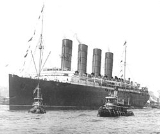
RMS Lusitania

 
RMS Lusitania

   Email Print
   Bookmark   Link


RMS Lusitania


RMS Lusitania was a Lusitania-Class British
Great Britain

Great Britain is an island lying to the northwest of Continental Europe. It is the List of islands by area, and the largest in Europe. With a population of 58.9 million people it is List of islands by population....
 luxury ocean liner
Ocean liner

An ocean liner is a passenger ship designed to transport people from one seaport to another along regular long-distance maritime routes according to a schedule....
 owned by the Cunard Line
Cunard Line

The Cunard Line is a United Kingdom shipping company that has been a leading operator of passenger ships on the North Atlantic since its beginning in 1840 to the present....
 and built by John Brown and Company of Clydebank
Clydebank

Clydebank is a town in West Dunbartonshire, in the Central Lowlands of Scotland. Situated on the north bank of the River Clyde, Clydebank borders Dumbarton, the town with which it was combined to form West Dunbartonshire, as well as the town of Milngavie in East Dunbartonshire, and the Yoker and Drumchapel districts of the adjacent City of G...
, Scotland
Scotland

conventional_long_name = ScotlandAlba|common_name= Scotland|image_flag = Flag of Scotland.svg|flag_width = 130px...
, torpedoed by a German U-boat
U-boat

U-boat is the anglicized#Loanwords version of the German language word , itself an abbreviation of Unterseeboot , and refers to military submarines operated by Germany, particularly in World War I and World War II....
 on May 7, 1915. The great ship sank in just 18 minutes, eight miles (15 km) off the Old Head of Kinsale
Old Head of Kinsale

The Old Head of Kinsale is a headland near Kinsale, County Cork, Republic of Ireland. It is notable for being the nearest land point to the site of the sinking of the RMS Lusitania in 1915....
, Ireland
Ireland

Ireland is the List of islands by area in Europe, and the twentieth-largest island in the world. It lies to the north-west of continental Europe and is surrounded by hundreds of islands and islet....
, killing 1,198 of the 1,959 people aboard. The sinking turned public opinion in many countries against Germany, and was probably a major factor in the eventual decision of the United States
United States

The United States of America is a Federal government constitutional republic comprising U.S. state and a federal district. The country is situated mostly in central North America, where its Contiguous United States and Washington, D.C., the Capital districts and territories, lie between the Pacific Ocean and Atlantic Oceans, Borders of the U...
 to join the war in 1917.


Discussion
Ask a question about 'RMS Lusitania'
Start a new discussion about 'RMS Lusitania'
Answer questions from other users
Full Discussion Forum


Encyclopedia


RMS Lusitania was a Lusitania-Class British
Great Britain

Great Britain is an island lying to the northwest of Continental Europe. It is the List of islands by area, and the largest in Europe. With a population of 58.9 million people it is List of islands by population....
 luxury ocean liner
Ocean liner

An ocean liner is a passenger ship designed to transport people from one seaport to another along regular long-distance maritime routes according to a schedule....
 owned by the Cunard Line
Cunard Line

The Cunard Line is a United Kingdom shipping company that has been a leading operator of passenger ships on the North Atlantic since its beginning in 1840 to the present....
 and built by John Brown and Company of Clydebank
Clydebank

Clydebank is a town in West Dunbartonshire, in the Central Lowlands of Scotland. Situated on the north bank of the River Clyde, Clydebank borders Dumbarton, the town with which it was combined to form West Dunbartonshire, as well as the town of Milngavie in East Dunbartonshire, and the Yoker and Drumchapel districts of the adjacent City of G...
, Scotland
Scotland

conventional_long_name = ScotlandAlba|common_name= Scotland|image_flag = Flag of Scotland.svg|flag_width = 130px...
, torpedoed by a German U-boat
U-boat

U-boat is the anglicized#Loanwords version of the German language word , itself an abbreviation of Unterseeboot , and refers to military submarines operated by Germany, particularly in World War I and World War II....
 on May 7, 1915. The great ship sank in just 18 minutes, eight miles (15 km) off the Old Head of Kinsale
Old Head of Kinsale

The Old Head of Kinsale is a headland near Kinsale, County Cork, Republic of Ireland. It is notable for being the nearest land point to the site of the sinking of the RMS Lusitania in 1915....
, Ireland
Ireland

Ireland is the List of islands by area in Europe, and the twentieth-largest island in the world. It lies to the north-west of continental Europe and is surrounded by hundreds of islands and islet....
, killing 1,198 of the 1,959 people aboard. The sinking turned public opinion in many countries against Germany, and was probably a major factor in the eventual decision of the United States
United States

The United States of America is a Federal government constitutional republic comprising U.S. state and a federal district. The country is situated mostly in central North America, where its Contiguous United States and Washington, D.C., the Capital districts and territories, lie between the Pacific Ocean and Atlantic Oceans, Borders of the U...
 to join the war in 1917. It is often considered by historians to be the second most famous civilian passenger liner disaster after the sinking of .

Overview

Owned by the Cunard Steamship Company and built by John Brown and Company,
Lusitania was named for the ancient Roman province
Roman province

In Ancient Rome, a province was the basic, and until the Tetrarchy , largest territorial and administrative unit of the empire's territorial possessions outside of the Italia ....
 of Lusitania
Lusitania

Lusitania was an ancient Ancient Rome Roman province including approximately all of modern Portugal south of the Douro river, and part of modern Spain ....
, in present day Portugal
Portugal

Portugal , officially the Portuguese Republic , is a country on the Iberian Peninsula. Located in southwestern Europe, Portugal is the westernmost country of mainland Europe and is bordered by the Atlantic Ocean to the west and south and by Spain to the north and east....
.
Lusitania sailed on her maiden voyage to New York City
New York City

The City of New York is the List of United States cities by population in the United States, while the New York metropolitan area ranks among the List of urban areas by population....
 on 7 September 1907, arriving on 13 September 1907, thus taking back from the
Deutschland
SS Deutschland (1900)

SS Deutschland was a passenger liner owned by the Hamburg America Line of Germany. She sailed for over twenty-five years under three different names....
 the Blue Riband
Blue Riband

The Blue Riband is an unofficial accolade given to the passenger liner with the record highest speed on a regular transatlantic crossing. The term was borrowed from horse racing and was not widely used until after 1910....
 record for the westbound crossing.

Lusitania and her sister, , were built during the time of a passenger liner race between shipping lines based in Germany and Great Britain, and were the fastest liners of their day. At the beginning of the twentieth century, the fastest Atlantic liners were German, and the British sought to win back the title. Simultaneously, American financier J.P. Morgan was planning to buy up all the North Atlantic shipping lines, including Britain's own White Star Line
White Star Line

The Oceanic Steam Navigation Company or White Star Line of Boston Packets, more commonly known as the White Star Line, was a prominent British shipping company, most famous for its ill-fated luxury flagship, the RMS Titanic, and the World War I loss of her sister ship, HMHS Britannic....
. In 1903, Cunard chairman Lord Inverclyde
Baron Inverclyde

Baron Inverclyde was a title created in the Peerage of the United Kingdom in 1897 for Sir John Burns of Castle Wemyss, Wemyss Bay, Inverclyde, Scotland....
 took these threats to his advantage and lobbied the Balfour
Arthur Balfour

Arthur James Balfour, 1st Earl of Balfour, Order of the Garter, Order of Merit , Privy Council of the United Kingdom was a United Kingdom Conservative Party politician and statesman....
 government for a loan of £2.6 million to construct the
Lusitania and the Mauritania; this was conceded, on condition that the ships met Admiralty
Admiralty

The Admiralty was formerly the authority in the United Kingdom responsible for the command of the Royal Navy. Originally exercised by a single person, the office of Lord High Admiral was from the 18th century onward almost invariably put "in commission", and was exercised by a Board of Admiralty....
 specifications and that Cunard remained a wholly British company. The British Government also agreed to pay Cunard an annual subsidy of £150,000 in order to maintain both ships in a state of war readiness, plus an additional £68,000 in exchange for carrying the Royal Mail
Royal Mail

Royal Mail is the national mail of the United Kingdom. Royal Mail Holdings plc owns Royal Mail Group Limited, which in turns operates the brands Royal Mail , Parcelforce and General Logistics Systems....
.

Design, Construction & Trials

The Lusitania Class ships were designed by Cunard's resident naval architect, Leon Peskett. Peskett built a large model of the proposed ships in 1902 showing a three-funnel design. A fourth funnel was implemented into the design in 1904 because it was needed to vent the exhaust from Parson's new turbines which had been settled on as a powerplant. Peskett also design this class of ship with a very narrow beam as Cunard wanted high speed. In so doing stability was sacrificed and the Lusitania & Mauretania had tendencies to roll through the ocean in high seas. Before installing the turbine powerplant in the ships, Cunard installed a smaller version of turbine in it's soon to be launched Carmania
RMS Carmania

RMS Carmania may refer to the following ocean liners: - in service with Cunard Line 1905-1932. - in service with Cunard Line 1962-1973....
, 1905, so as to get a stat report on the new technology's operation.

Lusitanias keel was laid at John Brown & Clydebank as Yard no. 367 on 16 June 1904. She was launched and christened by , on Thursday, 7 June 1906. Lord Inverclyde
Baron Inverclyde

Baron Inverclyde was a title created in the Peerage of the United Kingdom in 1897 for Sir John Burns of Castle Wemyss, Wemyss Bay, Inverclyde, Scotland....
(1861-1905) had died before this momentous occasion.

Much of the trim on
Lusitania was designed and constructed by the Bromsgrove Guild
Bromsgrove Guild

The Bromsgrove Guild of Applied Arts was a company of modern artists and designers associated with the Arts and Crafts Movement, founded by Walter Gilbert ....
.

Starting on 27 July 1907,
Lusitania underwent preliminary and formal acceptance trials. During these trials she smashed all speed records ever set in the history of the shipping industry. The shipbuilder's engineers and Cunard officials discovered that high speeds caused violent vibrations in the stern, and this led to the fitting of stronger bracing. After these modifications, the ship was finally delivered to Cunard on 26 August.

Comparison with the Olympic class

Chelsea Lusitania
The
Lusitania and the Mauritania were smaller than the White Star Line
White Star Line

The Oceanic Steam Navigation Company or White Star Line of Boston Packets, more commonly known as the White Star Line, was a prominent British shipping company, most famous for its ill-fated luxury flagship, the RMS Titanic, and the World War I loss of her sister ship, HMHS Britannic....
's Olympic class vessels (which in any case only entered service five years later). Although significantly faster than the
Olympics would be, the insufficient speed of these two vessels meant that Cunard could not guarantee a weekly transatlantic departure timetable. To achieve it, Cunard required a third ship and in response to White Star's announced plan to build the Olympics, Cunard ordered the third ship, the . Like the three White Star vessels, the Aquitania was slower than her two sisters, but larger and more luxurious.

The
Olympics also differed from the Lusitania and the Mauritania in the way in which they were compartmentalised below the waterline. The Olympics were divided by transverse watertight bulkheads
Bulkhead (partition)

A bulkhead is an upright wall within the hull of a ship. Other kinds of partition elements within a ship are deck and deckheads....
. The
Lusitania also had transverse bulkheads, but in addition had longitudinal bulkheads running along the ship on each side, between the boiler and engine rooms and the coal bunkers on the outside of the vessel. The British commission that had investigated the Titanic disaster in 1912 heard testimony on the flooding of coal bunkers lying outside longitudinal bulkheads. Being of considerable length, when flooded these could increase the ship's list and "make the lowering of the boats on the other side impracticable" — and this was precisely what later happened with the Lusitania.

Career

Image:Lusitania arriving in New York.jpg Image:Lusitania arriving in New York 2.jpg Image:Lusitania arriving in New York 3.jpg Image:Lusitania arriving in New York 4.jpg Image:Lusitania arriving in New York 5.jpg Image:Lusitania arriving in New York 6.jpg

Rms Luisitania
Lusitania departed Liverpool
Liverpool

Liverpool [] is a city and metropolitan borough of Merseyside, England, along the eastern side of the Mersey Estuary. It was founded as a History of borough status in England and Wales in 1207 and was granted City status in the United Kingdom in 1880....
 for her maiden voyage
Maiden Voyage

For the other meaning, see Maiden voyageMaiden Voyage is the fifth album led by jazz musician Herbie Hancock, and was recorded by Rudy Van Gelder in 1965 for Blue Note Records....
 on 7 September 1907 under the command of Commodore James Watt of the Cunard Line
Cunard Line

The Cunard Line is a United Kingdom shipping company that has been a leading operator of passenger ships on the North Atlantic since its beginning in 1840 to the present....
 and arrived in New York City
New York City

The City of New York is the List of United States cities by population in the United States, while the New York metropolitan area ranks among the List of urban areas by population....
 on 13 September. At the time she was the largest ocean liner in service and would continue to be until the introduction of her sister
Mauretania in November that year. During her eight-year service, she made a total of 202 crossings on the Cunard Line's Liverpool-New York Route.

In October 1907
Lusitania took the Blue Riband
Blue Riband

The Blue Riband is an unofficial accolade given to the passenger liner with the record highest speed on a regular transatlantic crossing. The term was borrowed from horse racing and was not widely used until after 1910....
 for eastbound crossing from of the North German Lloyd, ending Germany's 10-year dominance of the Atlantic.
Lusitania averaged 23.99 knot
Knot (speed)

The knot is a unit of speed equal to one nautical mile per hour. Its kn abbreviation is preferred by American and Canadian maritime authorities, and by the Institute of Electrical and Electronics Engineers; however, the kt and kts abbreviations also are used....
s (44.4 km/h) westbound and 23.61 knots (43.7 km/h) eastbound.

With the introduction of
Mauretania in November 1907, Lusitania and Mauretania continued to swap the Blue Riband. Lusitania made her fastest westbound crossing in 1909, averaging 25.85 knots (47.9 km/h). In September of that same year, she lost it permanently to Mauretania.

Hudson Fulton celebration

Lusitania 54


Lusitania and other ships participated in the Hudson-Fulton Celebration
Hudson-Fulton Celebration

From September 25 to October 11, 1909, New York City held an elaborate celebration commemorating the tercentennial anniversary of Henry Hudson?s discovery of the Hudson River, and the centennial anniversary of Robert Fulton?s first successful commercial application of the steamboat....
 in New York City from the end of September to early October 1909. This was in celebration of the 300th anniversary of Henry Hudson
Henry Hudson

Henry Hudson was an England sea explorer and navigator in the early 17th century. After several voyages on behalf of English merchants to explore a prospective Northeast Passage to China, Hudson explored the region around modern New York City while looking for a western route to the Orient under the auspices of the Dutch East India Company....
's trip up the river that bears his name and the 100th anniversary of Robert Fulton
Robert Fulton

Robert Fulton was an United States engineer and inventor who is widely credited with developing the first commercially successful steamboat. He also designed a new type of steam warship....
's steamboat,
Clermont. The celebration also was a display of the different modes of transportation then in existence, Lusitania representing the newest advancement in steamship technology. A newer mode of travel was the aeroplane
Fixed-wing aircraft

A fixed-wing aircraft is an aircraft capable of heavier-than-air flight whose Lift is generated not by wing motion relative to the aircraft, but by forward motion through the air....
. Wilbur Wright had brought a Flyer
Wright Flyer

The Wright Flyer was the first powered aircraft designed and built by the Wright brothers. The flight of the Wright Flyer is recognized by the F?d?ration A?ronautique Internationale, the standard setting and record-keeping body for aeronautics and astronautics, as "the first sustained and controlled heavier-than-air powered flight"....
 to Governors Island
Governors Island

Governors Island is a 172-acre island in Upper New York Bay, approximately one-half mile from the southern tip of Manhattan Island and separated from Brooklyn by Buttermilk Channel....
 and proceeded to make demonstration flights before millions of New Yorkers who had never seen an airplane. Some of Wright's trips were directly over
Lusitania; a few interesting photographs of Lusitania from that week still exist.

War

Lusitania, like a number of liners of the era, was part of a subsidy scheme meant to convert ships into armed merchant cruisers
Armed merchantmen

An Armed Merchantman has come to mean a merchant vessel equipped with guns, usually for defensive purposes, either by design or after the fact. In the days of sail, Maritime Piracy and privateers, many merchantmen would be routinely armed, especially those engaging in long distance and high value trade....
 if requisitioned by the government. This involved structural provisions for mounting deck guns. In 1913, during her annual overhaul,
Lusitania was fitted with gun mounts on her port and starboard bow sides, hidden from passengers under large coils of docking rope.

At the onset of World War I
World War I

World War I, or the First World War , was a global military conflict which involved the Great powers, organized into two opposing military alliances: the Allies of World War I and the Central Powers....
, the British Admiralty
Admiralty

The Admiralty was formerly the authority in the United Kingdom responsible for the command of the Royal Navy. Originally exercised by a single person, the office of Lord High Admiral was from the 18th century onward almost invariably put "in commission", and was exercised by a Board of Admiralty....
 considered
Lusitania for requisition as an armed merchant cruiser; however, large liners such as Lusitania consumed too much coal, presented too large a target, and put at risk large crews and were therefore deemed inappropriate for the role. They were also very distinctive; smaller liners were used as transports, instead.

Many of the large liners were used for troop transport or as hospital ship
Hospital ship

A hospital ship is a ship designated for primary function as a healthcare facility or hospital; most are operated by the military forces or navy of various countries around the world, as they are intended to be used in or near war zones....
s.
Mauretania became a troop transport while Lusitania continued in her Cunard service as a luxury liner ferrying people between Great Britain and the United States. The newer Aquitania was pressed into service as a hospital ship while White Star's Olympic joined the Mauretania trooping to the Mediterranean. Cunard however was kept on notice from the Admiralty that Lusitania could be taken at any time if hostilities increased and before the year 1915 was out. To reduce operating costs Lusitanias transatlantic crossings were reduced to monthly voyages, and boiler room Number 4 was shut down. Maximum speed was reduced to 21 knots (39 km/h), but even then, Lusitania was the fastest passenger liner on the North Atlantic in commercial service and 10 knots (18.5 km/h) faster than submarines. However, the Lusitania underwent many changes, several of which were a response to the war:

  1. The Lusitania's name was painted out to protect her identity from Germans.
  2. The compass platform was added at the top of the bridge.
  3. The Lusitania's funnels were painted all black instead of red with two or three narrow black bands and black top, to protect her identity from the Germans.
  4. Another compass platform was added between first and second funnels.
  5. A pair of luggage cranes were added on the aft deckhouse.
  6. The last change on the Lusitania, and once again to confuse the Germans about her identity, the Lusitania flew no flags during her last voyage.


On 4 February 1915 Germany declared the seas around the British Isles a war zone: from 18 February Allied ships in the area would be sunk without warning. This was not wholly unrestricted submarine warfare
Unrestricted submarine warfare

Unrestricted submarine warfare is a type of naval warfare in which submarines sink merchant ships without warning, as opposed to attacks per Prize regulations....
 since efforts would be taken to avoid sinking neutral ships.

Lusitania was scheduled to arrive in Liverpool on 6 March 1915. The Admiralty issued her specific instructions on how to avoid submarines. Despite a severe shortage of destroyers, Admiral Henry Oliver
Henry Oliver

Sir Henry Francis Oliver, Order of the Bath served as Admiral of the Fleet from 1928 to 1929.He entered the Royal Navy in 1878 and established a reputation as an outstanding navigator.In 1913 he became the Director of Naval Intelligence.Later that year, Oliver took up the position of Chief of the Naval War Staff that he held until 1919....
 ordered HMS and to escort
Lusitania, and took the further precaution of sending the Q ship to patrol Liverpool Bay . Captain Dow of Lusitania, not knowing whether Laverock and Louis were actual Admiralty escorts or a trap by the German navy, evaded the escorts and arrived in Liverpool without incident.

On 17 April 1915
Lusitania left Liverpool on her 201st transatlantic voyage, arriving in New York on 24 April. A group of German–Americans, hoping to avoid controversy if Lusitania were attacked by a U-boat, discussed their concerns with a representative of the German embassy. The embassy decided to warn passengers before her next crossing not to sail aboard Lusitania.

The Imperial German embassy placed a warning advertisement in 50 American newspapers, including those in New York.

Last voyage and sinking


Last departure

Lusitania departed Pier 54
Pier 54

Pier 54 in New York City is a former Cunard Line pier that is associated with the 1912 RMS Titanic and 1915 RMS Lusitania maritime disasters....
 in New York on 1 May 1915. The German Embassy in Washington had issued this warning on 22 April.

NOTICE!
TRAVELLERS intending to embark on the Atlantic voyage are reminded that a state of war exists between Germany and her allies and Great Britain and her allies; that the zone of war includes the waters adjacent to the British Isles; that, in accordance with formal notice given by the Imperial German Government, vessels flying the flag of Britain, or any of her allies, are liable to destruction in those waters and that travellers sailing in the war zone on the ships of Great Britain or her allies do so at their own risk.
IMPERIAL GERMAN EMBASSY,
Washington, D.C.
Washington, D.C.

Washington, D.C. , formally the District of Columbia and commonly referred to as Washington, the District, or simply D.C., is the Capital of the United States, founded on July 16, 1790....
 22 April 1915


This warning was printed right next to an advertisement for Lusitanias return voyage. The warning led to some agitation in the press and worried the ship's passengers and crew.

Captain William Thomas Turner, known as "Bowler Bill", had returned to his old command of Lusitania. He was commodore of the Cunard Line and a highly experienced master mariner, and had recently relieved Daniel Dow, the ship's regular captain. Dow had been instructed by his chairman, Alfred Booth, to take some leave, following his protestations that the ship should not become an armed merchant cruiser, making it a prime target for German forces.. Captain Turner tried to calm the passengers by explaining that the ship's speed made her safe from attack by submarine.

Lusitania steamed out of New York at noon that day, two hours behind schedule due to a transfer of passengers and crew from the recently requisitioned Cameronia. Shortly after departure, three blind passengers (evidently stowaways) were found on board and detained below decks.

Passengers

Lusitania carried 1,959 people on her last voyage, with 1,257 passengers and 702 crew aboard. Those aboard included a large number of illustrious and renowned people such as:
  • Canadian businessman Sir Frederick Orr Lewis
    Frederick Orr Lewis

    Sir Frederick Orr Lewis, 1st Baronet was a Canada businessman.Orr Lewis was born in Montreal, son of William Thomas Lewis, a Wales immigrant....
    , 1st Baronet (survived)
  • William R. G. Holt, son and heir of Canadian banker Sir Herbert Samuel Holt
    Herbert Samuel Holt

    Sir Herbert Samuel Holt was an Ireland-born Canada civil engineer who became a businessman, banker, and corporate director.He was born in Ballycrystal, Geashill, County Offaly, Ireland and emigrated to Canada in 1875, settling in the city of Montreal....
     (survived)
  • Montreal socialite Frances McIntosh Stephens, wife of politician George Washington Stephens
    George Washington Stephens (senior)

    George Washington Stephens was a Canada businessman, lawyer, and politician.Born in Swanton, Vermont, the son of Harrison Stephens and Sarah Jackson, his father was a wealthy Montreal merchant who was from Vermont and Stephens was born there when his mother was visiting....
     (died)
  • Mary Crowther Ryerson of Toronto, wife of George Sterling Ryerson
    George Sterling Ansel Ryerson

    George Sterling Ansel Ryerson was an Ontario physician, businessman and political figure. He represented Toronto in the Legislative Assembly of Ontario from 1893 to 1898 as a Progressive Conservative Party of Ontario and then Protestant Protective Association member....
    , founder of the Canadian Red Cross
    Canadian Red Cross

    The Canadian Red Cross Society is a Canada humanitarian charitable organization and one of 186 national Red Cross and Red Crescent societies.It was established in the fall of 1896 as an affiliate of the British Red Cross ....
     (died)
  • Lindon W. Bates, Jr., New York engineer, economist and political figure (died)
  • British MP David Alfred Thomas
    David Alfred Thomas

    David Alfred Thomas, 1st Viscount Rhondda , sometimes known as D. A. Thomas, was a Wales industrialist and Liberal Party politician.Thomas was UK Member of Parliament for Merthyr Tydfil from 1888 until the United Kingdom general election, January 1910, then MP for Cardiff until the United Kingdom general election, December 1910,...
     (survived)
  • His daughter Margaret, Lady Mackworth
    Margaret Mackworth, 2nd Viscountess Rhondda

    Margaret Haig Mackworth, 2nd Viscountess Rhondda was a Wales peerage and active suffragette.Born Margaret Haig Thomas, she was the only daughter of David Alfred Thomas and his wife Sybil Thomas, Viscountess Rhondda....
    , British suffragist (survived)
  • Theodate Pope Riddle
    Theodate Pope Riddle

    Theodate Pope Riddle was a well-known American architect.Born Effie Brooks Pope in Salem, Ohio, she was the only child of industrialist and art collector Alfred Atmore Pope and his wife Ada Lunette Brooks....
    , American architect and philanthropist (survived)
  • Edwin W. Friend, professor of philosophy at Harvard University
    Harvard University

    Harvard University is a private university in Cambridge, Massachusetts, Massachusetts, United States, and a member of the Ivy League. Founded in 1636 by the colonial Massachusetts legislature, Harvard is the Colonial Colleges institution of higher learning in the United States....
     and co-founder of the American Society for Psychical Research (ASPR) (died) (left a wife five months pregnant behind)
  • Oxford professor and writer Ian Holbourn (survived)
  • H. Montagu Allan
    H. Montagu Allan

    Sir H. Montagu Allan Royal Victoria Order was a Canada banker, ship owner, and a sportsman who donated the Allan Cup, the trophy symbolic of men's amateur ice hockey supremacy in Canada....
    's wife Marguerite (survived) and daughters Anna (died) and Gwendolyn (died)
  • Actresses Rita Jolivet
    Rita Jolivet

    Rita Jolivet was an England actress of French people descent in theater and silent movies in the early twentieth century. She was known in private life as the Countess Marguerita de Cippico....
     (survived), Josephine Brandell (survived) and Amelia Herbert (died)
  • Belgian diplomat Marie Depage (died), wife of surgeon Antoine Depage
    Antoine Depage

    Dr. Antoine Depage , was the Belgium royal surgeon, the founder and president of the Belgian Red Cross, and one of the founders of Scouting in Belgium....
  • New York fashion designer Carrie Kennedy (died) and her sister, Kathryn Hickson (died)
  • American building contractor and hotel proprietor Albert Bilicke (died)
  • Renowned chemist Anne Justice Shymer, president of the United States Chemical Company (died)
  • Playwright Charles Klein
    Charles Klein

    Charles Klein was an English-born playwright who emigrated to America....
     (died)
  • American writer Justus Miles Forman
    Justus Miles Forman

    Justus Miles Forman was an American novelist and playwright. His only play, The Hyphen, appeared in 1915, but it did not receive the success Forman expected....
     (died)
  • American theatre impresario Charles Frohman
    Charles Frohman

    Charles Frohman was a Jewish United States of America theatrical producer.One of three Frohman brothers, he was born in Sandusky, Ohio. He was the youngest, his older brothers being: Daniel Frohman and Gustave Frohman ....
     (died)
  • American philosopher, writer and Roycroft
    Roycroft

    Roycroft was a reformist community of craft workers and artists which formed part of the Arts and Crafts movement in the USA. Elbert Hubbard founded the community in 1895 in the village of East Aurora, New York, Erie County, New York, near Buffalo, New York....
     founder Elbert Hubbard
    Elbert Hubbard

    Elbert Green Hubbard was an United States writer, publisher, artist, and philosopher. He was an influential exponent of the Arts and Crafts movement and is, perhaps, most famous for his essay A Message to Garcia....
     (died)
  • His wife Alice Moore Hubbard
    Alice Moore Hubbard

    Alice Moore Hubbard was a noted American feminist, writer, and, with her husband, Elbert Hubbard was a leading figure in the Roycroft movement- a branch of the Arts and Crafts Movement in England with which it was contemporary....
    , author and woman's rights activist (died)
  • Wine merchant and philanthropist George Kessler (survived)
  • American pianist Charles Knight (died) and sister, Elaine Knight (died)
  • Renowned Irish art collector and founder of the Hugh Lane Municipal Gallery
    Hugh Lane Municipal Gallery

    Dublin City Gallery The Hugh Lane is an art gallery funded by Dublin City Council and located in Charlemont House in Dublin, Republic of Ireland....
     in Dublin Sir Hugh Lane
    Hugh Lane

    Sir Hugh Percy Lane is best known for establishing Dublin's Hugh Lane Municipal Gallery and for his remarkable contribution to the visual arts in Ireland....
     (died)
  • American socialite Beatrice Witherbee (survived), wife of Alfred S. Witherbee, president of the Mexican Petroleum Solid Fuel Company
  • Her son Alfred Scott Witherbee, Jr. (died) and her mother, Mary Cummings Brown (died)
  • American engineer and entrepreneur Frederick Stark Pearson
    Frederick Stark Pearson

    Frederick Stark Pearson was an United States electrical engineer and entrepreneur.Dr. Frederick Stark Pearson graduated from Tufts University in 1883 and went on to develop the electric transportation system in Boston and, with electric powered streetcars of major importance, in 1894 he was appointed the head engineer for Metropolitan Stre...
     (died) and his wife Mabel (died)
  • Genealogist Lothrop Withington
    Lothrop Withington

    Lothrop Withington was a well-known United States genealogy, historian, and editing who was killed in the sinking of the RMS Lusitania.Born in Newburyport, Massachusetts to Nathan Noyes Withington and Elizabeth Withington , he was involved with research and editing of publications on certain aspects of the American Revolutionary War but...
     (died)
  • Sportsman, millionaire, member of the Vanderbilt family
    Vanderbilt family

    The Vanderbilt family is a significant international family with Dutch people origins, who were highly prominent during the 1800s because of the family patriarch Cornelius Vanderbilt, Wealthy historical figures 2008, who created railroad and shipping empires....
    , Alfred Gwynne Vanderbilt
    Alfred Gwynne Vanderbilt

    Alfred Gwynne Vanderbilt was a sportsman and a member of the prominent United States Vanderbilt family....
     (died) -- last seen fastening a life vest onto a woman holding a baby.
  • Scenic designer Oliver P. Bernard (survived), whose sketches of the sinking were published in the Illustrated London News
    Illustrated London News

    File:Illustrated London News - front page - first edition.jpgThe Illustrated London News was a magazine founded by Herbert Ingram and his friend Mark Lemon, the editor of Punch ....
  • Politician and future United States
    United States

    The United States of America is a Federal government constitutional republic comprising U.S. state and a federal district. The country is situated mostly in central North America, where its Contiguous United States and Washington, D.C., the Capital districts and territories, lie between the Pacific Ocean and Atlantic Oceans, Borders of the U...
    ' ambassador
    Ambassador

    An ambassador is the highest ranking diplomat who represents their country. They are usually accredited to a Sovereignty or government, or to an international organization, to serve as the official representative of their country....
     to Spain
    Spain

    Spain or the Kingdom of Spain , is a country located in Southern Europe on the Iberian Peninsula.The Spanish constitution does not establish any official denomination of the country, even though Espa?a , Estado espa?ol and Naci?n espa?ola are used interchangeably....
    , Ogden Haggerty Hammond of Louisville, Kentucky
    Louisville, Kentucky

    Louisville is Kentucky's largest city and county seat of Jefferson County, Kentucky. The city's estimated population as of 2006 is listed as 557,789, with a population of 1,233,733 in the Louisville-Jefferson County, KY-IN Metropolitan Statistical Area....
     (survived) and his first wife, Mary Picton Stevens of Hoboken, New Jersey
    Hoboken, New Jersey

    Hoboken is a City in Hudson County, New Jersey, New Jersey, United States. As of the 2000 United States Census, the city's population was 38,577....
     (died), a descendant of John Stevens and Robert Livingston Stevens
    Robert Livingston Stevens

    Colonel Robert Livingston Stevens was the son of Colonel John Stevens . In 1807, the father and son built the Phoenix , a steamship which became the first steamship to navigate the ocean successfully when she traveled from New York City to the Delaware River in 1809....
      (parents of former New Jersey
    New Jersey

    New Jersey is a state in the Mid-Atlantic States and Northeastern United States regions of the United States. It is bordered on the north by New York, on the east by the Hudson River and the Atlantic Ocean, on the southwest by Delaware, and on the west by Pennsylvania....
     Congresswoman Millicent Fenwick
    Millicent Fenwick

    Millicent Hammond Fenwick was an United States fashion editor, politician and diplomat. A four-term Republican Party member of the United States House of Representatives from New Jersey, she entered politics late in life and was renowned for her energy and colorful enthusiasm....
    )
  • Dr. Howard L. Fisher, brother of Walter L. Fisher
    Walter L. Fisher

    Walter Lowrie Fisher was United States Secretary of the Interior under President William Howard Taft from 1911 to 1913.Fisher was born July 4, 1862 in Wheeling, West Virginia to Daniel Webster Fisher , a presbyterian minister, and his wife Amanda D....
    , former United States Secretary of the Interior
    United States Secretary of the Interior

    The United States Secretary of the Interior is the head of the United States Department of the Interior.The US Department of the Interior should not be confused with the concept of Interior Ministry as used in other countries....
     (survived)
  • Herbert S. Stone, New York newspaper editor and publisher, creator of magazines The Chap Book and The House Beautiful, son of Melville Elijah Stone (died)
  • Rev. Dr. Basil W. Maturin, British theologist, author and rector of St. Clement's Church in Philadelphia, Pennsylvania
    Philadelphia, Pennsylvania

    Philadelphia is the largest city in Pennsylvania and the List of United States cities by population city in the United States. It is the fifth-largest metropolitan area and fourth-largest urban area by population in the United States, the nation's fourth-largest consumer media market as ranked by the Nielsen Media Research, and the 49th-most...
     (died)
  • Debutant Miss Phyllis Hutchinson, 20-year-old niece of businessman Robert A. Franks of West Orange, New Jersey
    West Orange, New Jersey

    West Orange is a Township in central Essex County, New Jersey, New Jersey, United States. As of the United States 2000 Census, the township population was 44,943....
    , financial agent for Andrew Carnegie
    Andrew Carnegie

    Andrew Carnegie was a Scotland-born United States industrialist, List of business people, and a major philanthropist. He was an immigrant as a child with his parents....
     (died)
  • Irish composer and conductor Thomas Whitwell Butler, better known by his pen name T. O'Brien Butler (died)
  • Arthur H. Adams, president of the United States Rubber Company
    United States Rubber Company

    The United States Rubber Company was founded in Naugatuck, Connecticut in 1892. It was one of the original 12 stocks in the Dow Jones Industrial Average, and became Uniroyal Inc....
     (died)
  • James A. Dunsmuir, of Toronto, Canadian soldier, younger son of James Dunsmuir
    James Dunsmuir

    James Dunsmuir was a British Columbian industrialist and politician. Son of Robert Dunsmuir, he was heir to his family's coal fortune. The Dunsmuir family dominated the province's economy in the late nineteenth century and were a leading force in opposing Labor movement....
     (died)
  • Charles T. Jeffery
    Charles T. Jeffery

    Charles Thomas Jeffery was an United States businessman. He was the son of Thomas B. Jeffery, founder of Thomas B. Jeffery Company, an automobile manufacturer....
    , automobile manufacturer who became head of the Thomas B. Jeffery Company
    Thomas B. Jeffery Company

    The Thomas B. Jeffery Company was an American automobile manufacturer in Kenosha, Wisconsin from 1902 until 1916. The company manufactured the Rambler and Jeffery brand motorcars....
     after his father's death (survived)
  • Paul Crompton, director of Booth Steamship Company Ltd.
    Alfred Booth and Company

    Alfred Booth and Company was founded in 1863 by Alfred Booth and his more famous brother, the England philanthropist and poverty reformer, Charles Booth and grew from being a small merchant house into a large international concern....
     (died), and his wife Gladys (died), six children (died), and nanny (died)
  • Elisabeth Antill Lassetter, wife of Major General Harry B. Lassetter and sister of Major General John M. Antill (survived)
  • Josephine Eaton Burnside, daughter of Canadian department store founder Timothy Eaton
    Timothy Eaton

    Timothy Eaton was a Canada businessman who founded the Eaton's department store, one of the most important retail businesses in Canada's history....
     (survived), and her daughter Iris Burnside (died)
  • Albert L. Hopkins, president of Newport News Shipbuilding and Drydock Company (died)


Eastbound

Lusitanias landfall on the return leg of her transatlantic circuit was Fastnet Rock
Fastnet Rock

Fastnet Rock is a small clay-slate island with quartz veins and the most southerly point of Republic of Ireland, 6.5 km southwest of Cape Clear Island in County Cork, which is itself 13 km from the mainland....
, off the southern tip of Ireland. As the liner steamed across the ocean, the British Admiralty, by means of wireless intercepts, was tracking the movements of U-20, commanded by Kapitänleutnant Walther Schwieger
Walther Schwieger

Lieutenant Walther Schwieger was a Germany U-boat commander during the First World War.In the year 1903 he joined the Kaiserliche Marine and from 1911 onwards he served with the U-boatwaffe....
 and operating along the west coast of Ireland and moving south.

On 5 and 6 May U-20 sank three vessels, The Candidate, The Centurion and Miss Morris, a merchant schooner, in the area of Fastnet Rock, and the Royal Navy sent a warning to all British ships: "Submarines active off the south coast of Ireland". Captain Turner of Lusitania was given the message twice on the evening of the 6th, and took what he felt were prudent precautions. He closed watertight doors, posted double lookouts, ordered a black-out, and had the lifeboats swung out on their davits so that they could be launched quickly if necessary. That evening a Seamen's Charities fund concert took place in the first class lounge.

At about 11:00, on Friday, 7 May, the Admiralty radioed another warning, and Turner adjusted his heading northeast, apparently thinking submarines would be more likely to keep to the open sea, so that Lusitania would be safer close to land.

U-20 was low on fuel and only had three torpedoes left, and Schwieger had decided to head for home. She was moving at top speed on the surface at 13:00 when Schwieger spotted a vessel on the horizon. He ordered U-20 to dive and to take battle stations. The previous week, U-20 had encountered a small cargo vessel and allowed the crew to escape in the boats before sinking it; Schweiger could have allowed the crew and passengers of the Lusitania to take to the boats, but due to the Q-ship
Q-ship

Q-ships, also known as Q-boats, Decoy Vessels, Special Service Ships or Mystery Ships, were heavily armed merchantmen with concealed weaponry, designed to lure submarines into making surface attacks....
 program, he considered the danger of being rammed or fired upon by deck guns too great. The Lusitania's captain had, in fact, been ordered to ram any U-boat that surfaced; a cash bonus had been offered for successful ramming.

Sinking

Lusitania was approximately from Cape Clear Island when she encountered fog
Fog

Fog is a cloud bank that is in contact with the ground. A cloud may be considered partly fog; for example, the part of a cloud that is suspended in the air above the ground is not considered fog, whereas the part of the cloud that comes in contact with higher ground is considered fog....
 and reduced speed to 18 knots
Knot (speed)

The knot is a unit of speed equal to one nautical mile per hour. Its kn abbreviation is preferred by American and Canadian maritime authorities, and by the Institute of Electrical and Electronics Engineers; however, the kt and kts abbreviations also are used....
. She was making for the port of Queenstown (now Cobh
Cobh

Cobh is a sheltered seaport town on the south coast of County Cork, Republic of Ireland with a population of around 13,000 inhabitants.The locality, which had had several different Irish-language names, was first referred to as Cove in 1750....
), Ireland, 70 kilometres (43.5 miles) from the Old Head of Kinsale when the liner crossed in front of U-20 at 14:10.

One story states that when Kapitänleutnant Schwieger of the U-20 gave the order to fire, his quartermaster, Charles Voegele, would not take part in an attack on women and children, and refused to pass on the order to the torpedo room — a decision for which he was court-martial
Court-martial

A court-martial is a military court. These military courts can determine punishments for members of the military subject to military law who are found guilty or may dismiss the charges based on the evidence and the case presented....
ed and served three years in prison at Kiel
Kiel

Kiel is the Capital and most populous city of the northern Germany state Schleswig-Holstein.Kiel is approximately 90 km to the north of Hamburg....
. However, the story may be apocryphal; Diana Preston writes in Lusitania: An Epic Tragedy that Voegele was an electrician on board U-20 and not a quartermaster.

The torpedo struck Lusitania under the bridge, sending a plume of debris, steel plating and water upward and knocking Lifeboat #5 off its davits, and was followed by a much larger secondary explosion in the starboard bow. Schwieger's log entries attest that he only fired one torpedo, but some doubt the validity of this claim, contending that the German government subsequently doctored Schwieger's log, but accounts from other U-20 crew members corroborate it.

Lusitanias wireless operator sent out an immediate SOS
SOS

SOS is the commonly used description for the international Morse code distress signal . This distress signal was first adopted by the German government in radio regulations effective April 1, 1905, and became the worldwide standard under the second International Radiotelegraphic Convention, which was signed on November 3, 1906 and became eff...
 and Captain Turner gave the order to abandon ship. Water had flooded the ship's starboard longitudinal compartments, causing a 15-degree list to starboard. Captain Turner tried turning the ship toward the Irish coast in the hope of beaching her, but the helm would not respond as the torpedo had knocked out the steam lines to the steering motor. Meanwhile, the ship's propellers continued to drive the ship at , forcing more water into her hull.

Within six minutes, Lusitanias forecastle
Forecastle

Forecastle, also spelled fo'c's'le , originally meant the upper deck of a sailing ship, forward of the foremast. The syncope of the word is common among nautical terms due to the nature of their pronunciation during the age of sail by sailors with strong accents and varying language skills....
 began to go under water. Lusitanias severe starboard list complicated the launch of her lifeboats. 10 minutes after the torpedoing, when she had slowed enough to start putting boats in the water the lifeboats on the starboard side swung out too far to step aboard safely. While it was still possible to board the lifeboats on the port side, lowering them presented a different problem. As was typical for the period, the hull plates of the Lusitania were riveted, and as the lifeboats were lowered they dragged on the rivets, which threatened to seriously damage the boats before they landed in the water.

Many lifeboats overturned while loading or lowering, spilling passengers into the sea; others were overturned by the ship's motion when they hit the water. It has been claimed that some boats, due to the negligence of some officers, crashed down onto the deck, crushing other passengers, and sliding down towards the bridge. This has been refuted in various articles and by passenger and crew testimony. Crewmen would lose their grip on the falls—ropes used to lower the lifeboats—while trying to lower the boats into the ocean, and this caused the passengers from the boat to "spill into the sea like rag dolls." Others would tip on launch as some panicking people jumped into the boat. Lusitania had 48 lifeboats, more than enough for all the crew and passengers, but only six were successfully lowered, all from the starboard side. A few of her collapsible lifeboats washed off her decks as she sank and provided refuge for many of those in the water.

Despite Turner's efforts to beach the liner and reduce her speed, Lusitania no longer answered the helm. There was panic and disorder on the decks. Schwieger had been observing this through U-20s periscope, and by 14:25, he dropped the periscope
Periscope

A periscope is an instrument for observation from a concealed position. In its simplest form it is a tube in each end of which are mirrors set parallel to each other and at an angle of 45 with a line between them....
 and headed out to sea.

Captain Turner remained on the bridge until the water rushed upward and destroyed the sliding door, washing him overboard into the sea. He took the ship's logbook
Logbook

A logbook was originally a book for recording readings from the Chip_log, and is used to determine the distance a ship traveled within a certain amount of time....
 and chart
Nautical chart

A nautical chart is a graphic representation of a Sea area and adjacent coastal regions. Depending on the scale of the chart, it may show depths of water and heights of land , natural features of the seabed, details of the coastline, navigational hazards, locations of natural and man-made aids to navigation, information on tides and Current...
s with him. He managed to escape the rapidly sinking Lusitania
Lusitania

Lusitania was an ancient Ancient Rome Roman province including approximately all of modern Portugal south of the Douro river, and part of modern Spain ....
 and find a chair floating in the water which he clung to. He was pulled unconscious from the water, and survived despite having spent 3 hours in the water.
Lusitanias bow slammed into the bottom about 100 m (300 ft) below at a shallow angle due to her forward momentum as she sank. Along the way, some boiler
Boiler

A boiler is a closed Pressure vessel in which water or other fluid is heated. The heated or vaporized fluid exits the boiler for use in various processes or heating applications....
s exploded, including one that caused the third funnel to collapse; the remaining funnels snapped off soon after. Turner's last navigational fix had been only two minutes before the torpedoing, and he was able to remember the ship's speed
Speed

Speed is the rate of Motion , or equivalently the rate of change of distance.Speed is a Scalar quantity with dimensions length/time; the equivalent Vector quantity to speed is velocity....
 and bearing
Bearing (navigation)

In marine navigation, a bearing is the direction of one object in relation to another object, the other object usually being one's own vessel....
 at the moment of sinking. This was accurate enough to locate the wreck after the war. The ship travelled about two miles (3 km) from the time of the torpedoing to her final resting place, leaving a trail of debris and people behind. After her bow sank completely, the
Lusitanias stern rose out of the water, enough for her propellers to be seen, and went down.

Lusitania sank in 18 minutes, off the Old Head of Kinsale. 1,198 people died with her, including almost a hundred children. Afterwards, the Cunard line offered local fishermen and sea merchants a cash reward for the bodies floating all throughout the Irish Sea, some floating as far away as the Welsh coast. In all, only 289 bodies were recovered, 65 of which were never identified. The Cunard Steamship Company announced the official death toll of 1,195 on 1 March 1916. The bodies of many of the victims were buried at either Lusitanias destination, Queenstown, or the Church of St. Multose in Kinsale, but the bodies of the remaining 885 victims were never recovered.

Aftermath

On 8 May Dr. Bernhard Dernburg, the former German Colonial Secretary, made a statement in Cleveland, Ohio, in which he attempted to justify the sinking of the
Lusitania. At the time Dernburg was recognized as the official US spokesman of the Imperial German government. Dernburg said that because the Lusitania "carried contraband of war" and also because "she was classed as an auxiliary cruiser" Germany had had a right to destroy her regardless of any passengers aboard. Dernburg further said that the warnings given by the German Embassy prior to her sailing plus the 18 February note declaring the existence of "war zones" relieved Germany of any responsibility for the deaths of the American citizens aboard. He referred to the ammunition and military goods declared on the Lusitania's manifest and said that "vessels of that kind" could be seized and destroyed under the Hague rules without any respect to a war zone.

The following day the German government issued an official communication regarding the sinking in which it said that the Cunard liner
Lusitania "was yesterday torpedoed by a German submarine and sank", that the Lusitania "was naturally armed with guns, as were recently most of the English mercantile steamers" and that "as is well known here, she had large quantities of war material in her cargo".

Schwieger was condemned in the Allied press as a war criminal.

Of the 139 US citizens aboard the
Lusitania, 128 lost their lives, and there was massive outrage in Britain and America, The Nation
The Nation

The Nation is a weekly United States periodical devoted to politics and culture, self-described as "the flagship of the left-wing politics." Founded on July 6, 1865 at the start of Reconstruction era of the United States as a supporter of the victorious North in the American Civil War, it is the oldest continuously published weekly magaz...
calling it "a deed for which a Hun would blush, a Turk be ashamed, and a Barbary pirate apologize" and the British felt that the Americans had to declare war on Germany. However, US President Woodrow Wilson
Woodrow Wilson

Thomas Woodrow Wilson was the List of Presidents of the United States President of the United States. A devout Presbyterianism and leading intellectual of the Progressive Era, he served as President of Princeton University of Princeton University from 1902 to 1910, and then as the Governor of New Jersey from 1911 to 1913....
 refused to over-react. He said at Philadelphia on 10 May 1915:

The massive loss of life caused by the sinking of
Lusitania required a definitive response from the US. When Germany began its submarine campaign against Britain, Wilson had warned that the US would hold the German government strictly accountable for any violations of American rights.

During the weeks after the sinking, the issue was hotly debated within the administration. Secretary of State William Jennings Bryan
William Jennings Bryan

William Jennings Bryan was the Democratic Party nominee for President of the United States in 1896, 1900 and 1908, a lawyer, and the 41st United States Secretary of State under President Woodrow Wilson....
 urged compromise and restraint. The US, he believed, should try to persuade the British to abandon their interdiction of foodstuffs and limit their mine-laying operations at the same time as the Germans were persuaded to curtail their submarine campaign. He also suggested that the US government issue an explicit warning against US citizens travelling on any belligerent ships. Despite being sympathetic to Bryan's antiwar feelings, Wilson insisted that the German government must apologise for the sinking, compensate US victims, and promise to avoid any similar occurrence in the future.

Wilson notes

Backed by State Department second-in-command Robert Lansing
Robert Lansing

Robert Lansing served in the position of Legal Advisor to the State Department at the outbreak of World War I where he vigorously advocated against Britain's policy of blockade and in favor of the principles of freedom of the seas and the rights of neutral nations....
, Wilson made his position clear in three notes to the German government issued on 13 May, 9 June, and 21 July.

The first note affirmed the right of Americans to travel as passengers on merchant ships and called for the Germans to abandon submarine warfare against commercial vessels, whatever flag they sailed under.

In the second note Wilson rejected the German arguments that the British blockade was illegal, and was a cruel and deadly attack on innocent civilians, and their charge that the
Lusitania had been carrying munitions. William Jennings Bryan considered Wilson's second note too provocative and resigned in protest after failing to moderate it, to be replaced by Robert Lansing
Robert Lansing

Robert Lansing served in the position of Legal Advisor to the State Department at the outbreak of World War I where he vigorously advocated against Britain's policy of blockade and in favor of the principles of freedom of the seas and the rights of neutral nations....
 who later said in his memoirs that following the tragedy he always had the "conviction that we would ultimately become the ally of Britain".

The third note, of 21 July, issued an ultimatum, to the effect that the US would regard any subsequent sinkings as "deliberately unfriendly".

On 19 August
U-24 sank the White Star liner SS Arabic, with the loss of 44 passengers and crew, three of whom were American. The German government, while insisting on the legitimacy of its campaign against Allied shipping, disavowed the sinking of the Arabic; it offered an indemnity and pledged to order submarine commanders to abandon unannounced attacks on merchant and passenger vessels.

German Chancellor Theobald von Bethmann-Hollweg
Theobald von Bethmann-Hollweg

Theobald von Bethmann-Hollweg was a German politician and statesman who served as Chancellor of the German Empire from 1909 to 1917....
 persuaded the Kaiser to forbid action against ships flying neutral flags and the U-boat war was postponed once again on 27 August, as it was realised that British ships could easily fly neutral flags.

There was disagreement over this move between the navy's admirals (headed by Alfred von Tirpitz
Alfred von Tirpitz

Alfred von Tirpitz was a Germany Admiral, Secretary of State of the Imperial Naval Office, the powerful administrative branch of the Kaiserliche Marine from 1897 until 1916....
) and Bethman-Hollweg. The Kaiser decided in favour of the Chancellor, backed by Army Chief of Staff Erich von Falkenhayn
Erich von Falkenhayn

Erich von Falkenhayn was a Germany soldier and German General Staff during World War I. He became a military history after the war....
, and Tirpitz and the head of the admiralty backed down. The German restriction order of 9 September 1915 stated that attacks were only allowed on ships that were definitely British, while neutral ships were to be treated under the Prize Law
Prize (law)

Prize is a term used in admiralty law to refer to equipment, vehicles, and vessels captured during armed conflict. The most common use of prize in this sense is the capture of an enemy ship and its cargo....
 rules, and no attacks on passenger liners were to be permitted at all. The war situation demanded that there could be no possibility of orders being misinterpreted, and on 18 September Henning von Holtzendorff
Henning von Holtzendorff

Henning von Holtzendorff was a Germany admiral during World War I who became famous for his memo to Kaiser Wilhelm II about unrestricted submarine warfare against the United Kingdom....
, the new head of the German Admiralty, issued a secret order: all U-boats operating in the English Channel and off the west coast of the United Kingdom were recalled, and the U-boat war would continue only in the North sea, where it would be conducted under the Prize Law rules.

British propaganda

It was in the interests of the British to keep US passions inflamed, and a fabricated story was circulated that in some regions of Germany, schoolchildren were given a holiday to celebrate the sinking of the
Lusitania. This story was so effective that James W. Gerard
James W. Gerard

James Watson Gerard was a United States lawyer and diplomat.Gerard was born in Geneseo , New York, New York He graduated from Columbia University in 1890 and from New York Law School....
, the US ambassador to Germany, recounted it in his memoir of his time in Germany,
Face to Face with Kaiserism (1918), though without substantiating its validity.

Goetz medal


In August 1915, Munich
Munich

Munich is the capital city of Bavaria, Germany. Munich is located on the River Isar north of the Northern Limestone Alps. Munich is the third largest city in Germany, after Berlin and Hamburg....
 medalist and sculptor Karl X. Goetz (1875-1950), who had produced a series of propagandist and satirical medals as a running commentary on the war, privately struck a small run of medals as a limited-circulation satirical attack (fewer than 500 were struck) on the Cunard Line for trying to continue business as usual during wartime. Goetz blamed both the British government and the Cunard Line for allowing the
Lusitania to sail despite the German embassy's warnings.

One side of the medal showed the
Lusitania sinking laden with guns (incorrectly depicted sinking stern first) with the motto "KEINE BANNWARE!" ("NO CONTRABAND!"), while the reverse showed a skeleton
Skeleton (undead)

A Skeleton is a type of physically manifested undead often found in fantasy, Gothic fiction and horror fiction, and mythology art. Most are human skeletons, but they can also be from any creature or race found on Earth or in the fantasy world....
 selling Cunard tickets with the motto
"Geschäft Über Alles" ("Business Above All").

Goetz had put an incorrect date for the sinking on the medal, an error he later blamed on a mistake in a newspaper story about the sinking: instead of 7 May, he had put 5 May, two days before the actual sinking. Not realizing his error, Goetz made copies of the medal and sold them in Munich and also to some numismatic dealers with whom he conducted business.

The British Foreign Office obtained a copy of the medal, photographed it, and sent copies to the United States where it was published in the
New York Times on 5 May 1916, the anniversary of the sinking. Many popular magazines ran photographs of the medal, and it was falsely claimed that it had been awarded to the crew of the U-boat.

British replica

Lusitania Medal
The Goetz medal attracted so much attention that Lord Newton
Thomas Legh, 2nd Baron Newton

Thomas Wodehouse Legh, 2nd Baron Newton, Privy Council of the United Kingdom, Deputy Lieutenant , was a United Kingdom of Great Britain and Ireland diplomat and Conservative Party politician who served as Paymaster-General during the First World War....
, who was in charge of Propaganda at the Foreign Office in 1916, decided to exploit the anti-German feelings aroused by it for propaganda purposes and asked department store entrepreneur Harry Gordon Selfridge
Harry Gordon Selfridge

Harry Gordon Selfridge, Sr. was an American-born retail magnate, who founded the Great Britain department store Selfridges....
 to reproduce the medal. The replica medals were produced in an attractive case claiming to be an exact copy of the German medal, and were sold for a shilling apiece. On the cases it was stated that the medals had been distributed in Germany "to commemorate the sinking of the
Lusitania" and they came with a propaganda leaflet which strongly denounced the Germans and used the medal's incorrect date to claim that the sinking of the Lusitania was premeditated. The head of the Lusitania Souvenir Medal Committee later estimated that 250,000 were sold, proceeds being given to the Red Cross and St. Dunstan's Blinded Soldiers and Sailors Hostel. Unlike the original Goetz medals which were stamped from bronze
Bronze

Bronze is a metal alloy consisting primarily of copper, usually with tin as the main additive, but sometimes with other chemical element such as phosphorus, manganese, aluminium, or silicon....
, the British copies were of diecast iron and were of poorer quality.

Belatedly realizing his mistake, Goetz issued a corrected medal with the date of 7 May. The Bavarian government suppressed the medal and ordered their confiscation in April 1917. The original German medals can easily be distinguished from the English copies because the date is in German; the English version was altered to read 'May' rather than 'Mai'. After the war Goetz expressed his regret his work had been the cause of increasing anti-German feelings, but it remains one of the most celebrated propaganda acts of all time.

While the American public and leadership were not ready for war, the path to an eventual declaration of war had been set as a result of the sinking of the Lusitania.

Engineering consequences

One of the major causes of death to passengers after the ship was hit by the torpedo was that the captain had no way to slow or stop the ship, and consequently the lifeboats were battered on the sides of the fast-moving ship and the lifeboats overturned when they touched the ocean at high speed. The torpedo strike had either killed the ship's engineers or cut off contact with them, and there was no means for anyone else to shut down the engines.

In December 1918, Popular Science
Popular science

Popular science, sometimes called literature of science, is interpretation of science intended for a general audience. While science journalism focuses on recent scientific developments, popular science is broad-ranging, often written by scientists as well as journalists, and is presented in many formats, which can include books, televi...
 Monthly reported that this problem had occurred so many times to other ships after the sinking of the Lusitania, that the British Board of Trade suggested that every passenger-carrying ship be provided with some means of of stopping the engines from the deck or skylight hatchway. The magazine illustrated several such possible remote valve control methods to cut off engine steam from multiple locations.

Last living survivor

Audrey Lawson-Johnston (née Pearl)
Audrey Pearl

Audrey Lawson-Johnston, born Audrey Warren Pearl , is the last living survivor of the sinking of the RMS Lusitania on May 7, 1915.Born in New York City, she is the fourth of six children born to Major Frederic Warren Pearl and Amy Lea Duncan....
 (born 1915) is the last living survivor of the RMS Lusitania sinking. She is widowed and resides in Bedfordshire, England. Audrey became the last living survivor following the death of Barbara McDermott (née Anderson)
Barbara McDermott

Barbara McDermott was the last United States survivor of the sinking of the RMS Lusitania on May 7, 1915, and one of the last two survivors....
 on 12 April 2008 and Ida Cantley on 31 December 2006.

Cultural Influence

Charles Ives
Charles Ives

Charles Edward Ives was an American musical modernism composer. He is widely regarded as one of the first American composers of international significance....
's
Orchestral Set No. 2 concludes with a movement entitled, From Hanover Square North, at the End of a Tragic Day, the Voice of the People Again Arose. It recounts Ives's experience waiting for an elevated train in New York City
New York City

The City of New York is the List of United States cities by population in the United States, while the New York metropolitan area ranks among the List of urban areas by population....
 as the news of the sinking of the
Lusitania came through. The passengers assembled on the platform began singing In The Sweet By and By
In the Sweet By and By

"The Sweet By and By" is a Christian hymn with lyrics by S. Fillmore Bennett and music by Joseph P. Webster. It is recognizable by its chorus:Mr....
in time to a barrel organ
Barrel organ

A barrel organ is a mechanical musical instrument consisting of bellows and one or more ranks of organ pipe housed in a case, usually of wood, and often highly decorated....
 which was playing the tune. Echoes of their voices can be heard at the start of the music, and the hymn tune itself appears at the end.

Controversies


Contraband and second explosion

Lusitania Wreck Telegraph
Under the "cruiser rules", the Germans could sink a civilian vessel only after guaranteeing the safety of all the passengers. Since
Lusitania (like all British merchantmen) was under instructions from the British Admiralty to report the sighting of a German submarine, and indeed to attempt to ram the ship if it surfaced to board and inspect her, she was acting as a naval auxiliary, and was thus exempt from this requirement and a legitimate military target. By international law, the presence (or absence) of military cargo was irrelevant.

Lusitania was in fact carrying small arms ammunition, which would not have been explosive. Included in this cargo were 4,200,000 rounds of Remington 0.303 rifle cartridges, 1250 cases of 3 inch (76 mm) fragmentation
Fragmentation

Fragmentation may refer to:In biology* Fragmentation , a form of asexual reproduction* Fragmentation * Habitat fragmentationOther...
 shells, and eighteen cases of fuses. (All were listed on the ship's two-page manifest, filed with U.S. Customs after she departed New York on 1 May.) However, the materials listed on the cargo manifest were small arms and the physical size of this cargo would have been quite small. These munitions were also proven to be non-explosive in bulk, and were clearly marked as such. It was perfectly legal under American shipping regulations for her to carry these; experts agreed they were not to blame for the second explosion. Allegations the ship was carrying more controversial cargo, such as fine aluminium powder, concealed as cheese on her cargo manifests, have never been proven. Recent expeditions to the wreck have shown her holds are intact and show no evidence of internal explosion.

In 1993, Dr Robert Ballard
Robert Ballard

Robert Duane Ballard is a former Commander in the United States Navy and an oceanography who is most noted for his work in underwater archaeology....
, the famous explorer who discovered
Titanic, conducted an in-depth exploration of the wreck of Lusitania. Ballard found Light had been mistaken in his identification of a gaping hole in the ship's side. To explain the second explosion, Ballard advanced the theory of a coal-dust explosion. He believed dust in the bunkers would have been thrown into the air by the vibration from the explosion; the resulting cloud would have been ignited by a spark, causing the second explosion. In the years since he first advanced this theory, it has been argued that this is nearly impossible. Critics of the theory say coal dust
Coal dust

Coal dust is a fine Powder form of coal, which is created by the crushing, grinding, or pulverizing of coal. Because of the brittle nature of coal, coal dust can be created during mining, transportation, or by mechanically handling coal....
 would have been too damp to have been stirred into the air by the torpedo impact in explosive concentrations; additionally, the coal bunker where the torpedo struck would have been flooded almost immediately by seawater flowing through the damaged hull plates.

More recently, marine forensic investigators have become convinced an explosion in the ship's steam-generating plant is a far more plausible explanation for the second explosion. There were very few survivors from the forward two boiler rooms, but they did report the ship's boilers did not explode; they were also under extreme duress in those moments after the torpedo's impact, however. Leading Fireman Albert Martin later testified he thought the torpedo actually entered the boiler room and exploded between a group of boilers, which was a physical impossibility. It is also known the forward boiler room filled with steam, and steam pressure feeding the turbines dropped dramatically following the second explosion. These point toward a failure, of one sort or another, in the ship's steam-generating plant. It is possible the failure came, not directly from one of the boilers in boiler room no. 1, but rather in the high-pressure steam lines to the turbines. Most researchers and historians agree that a steam explosion is a far more likely cause than clandestine high explosives for the second explosion.

The original torpedo damage alone, striking the ship on the starboard coal bunker of boiler room no. 1, would probably have sunk the ship without a second explosion. This first blast was enough to cause, on its own, serious off-centre flooding. The deficiencies of the ship's original watertight bulkhead design exacerbated the situation, as did the many portholes which had been left open for ventilation.

Recent developments

The wreck of
Lusitania is currently owned by New Mexico diver and businessman F. Gregg Bemis Jr.

In 1967 the wreck was sold by the Liverpool & London War Risks Insurance Association to former US Navy diver John Light, for £1,000. Bemis became a co-owner of the wreck in 1968, and by 1982 Bemis had bought out his partners to become sole owner. He subsequently went to court in England in 1986, the US in 1995, and Ireland in 1996 to ensure his ownership was legally watertight.

None of the jurisdictions objected to his ownership of the vessel but in 1995 the Irish Government declared it a heritage site under the National Monuments Act
National Monument (Ireland)

A National Monument in the Republic of Ireland is a monument considered by the State to be of "national importance". Such monuments are therefore preserved by the State....
, which prohibited him from in any way interfering with it or its contents. After a protracted legal wrangle, the Supreme Court in Dublin overturned the Arts and Heritage Ministry's previous refusal to issue Bemis with a five year exploration licence in 2007, ruling that the then minister for Arts and Heritage had misconstrued the law when he refused Bemis's 2001 application. Bemis planned to dive and recover and analyse whatever artifacts and evidence can help piece together the story of what happened to the ship. He says that any items found will be given to museums following analysis. Any fine art recovered, such as the Rubens
Peter Paul Rubens

Peter Paul Rubens was a prolific seventeenth-century Flemish Baroque painter, and a proponent of an exuberant Baroque style that emphasized movement, color, and sensuality....
 rumoured to be on board, will remain in the ownership of the Irish Government.

In late July 2008 Gregg Bemis was granted an "imaging" license by the Department of the Environment, which allows him to photograph and film the entire wreck, and should allow him to produce the first high-resolution pictures of it. Bemis plans to use the data gathered to assess the wreck's deterioration and to plan a strategy for a forensic examination of the ship, which he estimated would cost $5m. Florida-based Odyssey Marine Exploration (OME) have been contracted by Bemis to conduct the survey. The Department of the Environment's Underwater Archaeology Unit will join the survey team to ensure that research is carried out in a non-invasive manner. A film crew from the Discovery Channel will also be on hand. A documentary will be shown on the network in the next year.

A dive team from Cork Sub Aqua Club, under license, made the first known discovery of munitions aboard in 2006. These include 15,000 rounds of .303
.303 British

.303 British, or 7.7mmx56R, is a .311 inch calibre rifle and machine gun Cartridge first developed in United Kingdom in the 1880s as a blackpowder round, later adapted to use cordite and then smokeless powder propellant....
 (7.7×56mmR) caliber rifle ammunition in boxes in the bow section of the ship. The .303 round was used by the British army in all of their battlefield rifles and machine guns. The find was photographed but left
in situ
In situ

In situ is a Latin phrase meaning in the place. It is used in many different contexts....
under the terms of the license. In December 2008, Gregg Bemis discovered a further four million rounds of .303 ammunition and announced plans to commission further dives next year for a full-scale forensic examination of the wreck. The new discovery bolsters the Germans' case that the Lusitania was a military ship.

In 2007, an English - German coproduction, the ninety-minute docu-drama "The Sinking of the Lusitania: Terror at Sea
The Sinking of the Lusitania: Terror at Sea

The Sinking of the Lusitania: Terror at Sea is an English-German Docu-drama produced in 2007. This ninety minute film is a dramatization of the sinking of the RMS Lusitania on May 7, 1915 by a German U-boat, SM U-20....
", was made.

1950s damage from depth charges

In February 2009 the Discovery Channel
Discovery Channel

The Discovery Channel is an United States satellite and cable TV channel , founded by John Hendricks and distributed by Discovery Communications....
 TV series Treasure Quest
Treasure Quest

Treasure Quest was a puzzle game created by Soggy in Seattle Productions and sold to Sirius Entertainment. It was released April 10, 1996.In the CD-ROM scavenger hunt game Treasure Quest, the player moves from room to room in the mansion of Professor Jonathon William Faulkner, who has bequeathed $1 million dollars to any student who can...
 aired an episode titled "Lusitania Revisited", in which Gregg Bemis and a team of shipwreck experts explore the wreck via remote control unmanned submersible. Several people on the team had also been involved with the RMS Titanic
RMS Titanic

The Royal Mail Ship Titanic was an Olympic class ocean liner superliner owned by the White Star Line and built at the Harland and Wolff shipyard in Belfast, United Kingdom of Great Britain and Ireland....
 wreck site. At one point in the show it is mentioned that Cobh locals have believed for years that in the 1950s during a two week period, the Royal Navy dropped depth charges on the wreck, greatly worsening its condition. It was stated that numerous Cobh residents on shore heard the blasting and saw navy ships hovering over the area of the wreck. At one point in the show an unexploded depth charge was found in the wreckage, in plain sight, clearly seen by the remote control submersible's video camera. Gregg Bemis, as well as other people on the team, believe the British Royal Navy deliberately bombed the Lusitania site to "make the wreck as unattractive as possible, to prevent further salvage" and to "prevent divers from going in and finding that there was contraband cargo". No government has ever admitted to the depth charging. The narrator says the depth charges probably crushed the upper decks of the ship, and further scattered the debris field.

Further reading

  • Thomas A. Bailey, "German Documents Relating to the 'Lusitania'", The Journal of Modern History, Vol. 8, No. 3 (Sep., 1936), pp. 320–37
  • Linda and Gary Cargill "Those Who Dream By Day"
  • , The Lusitania Resource.
  • , The Lusitania Resource.


External links

  • Original reports from The Times
  • Moving Passenger's Stories from the Lusitania
  • The tragic story of Lusitania victim Thoms Silva.