

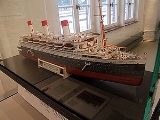
SS Cap Arcona

Encyclopedia
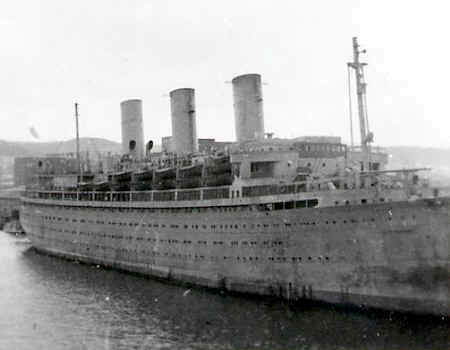
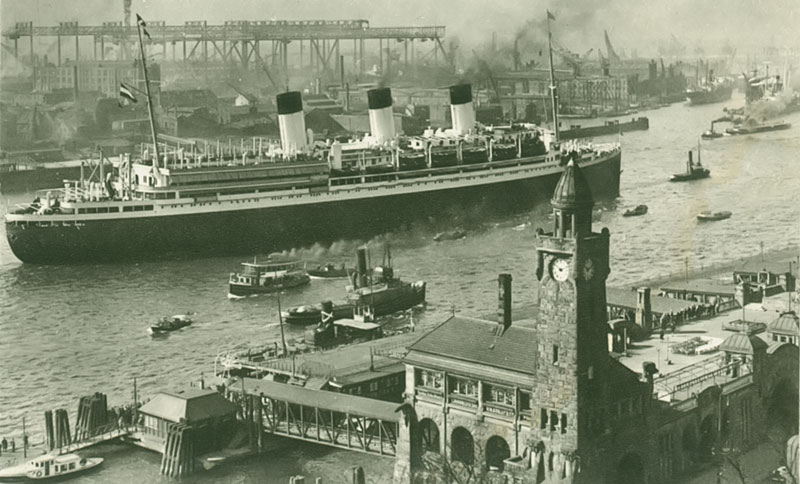
The Cap Arcona was a large German luxury ocean liner
, formerly of the Hamburg-South America line
. It transported passengers between Germany and South America up until 1940 when it was taken over by the German Navy.
Late in the war it was used for the evacuation of Germans from East Prussia
.
While heavily-laden with prisoners from Nazi concentration camps, she was sunk in 1945 by the Royal Air Force
. Most of the passengers died, and the sinking of the Сap Arcona was one of the biggest single-incident maritime losses of life of the war, and as such one of the largest maritime losses of life in history, with about 5,000 victims.
Cap Arcona, named after Cape Arkona
on the island of Rügen
in Mecklenburg-Vorpommern, was launched in 1927. She was considered one of the most beautiful ships of the time, was the largest German ship on the South American run, and carried upper-class travelers and steerage
-class emigrants, mostly to South America.
(German Navy) and used in the Baltic Sea
as an accommodation ship. In 1942, she was used as a stand-in for the doomed in the German film version of the disaster
. In early 1945, the Kriegsmarine reactivated her for Operation Hannibal
, and she was used to transport 25,795 German soldiers and civilians from East Prussia
to western Germany.
, comprising the liners Cap Arcona and SS Deutschland
, and the smaller vessels Thielbek and Athen. The Athen was used to transfer prisoners from Lübeck
to the larger ships and between ships. By the end of the month, these ships held more than 10,000 prisoners from the Neuengamme concentration camp and its subcamps, and two barges came from Stutthof
and Mittelbau-Dora
camps.
The order to transfer the prisoners from the camps to the prison ships came from Gauleiter
Karl Kaufmann
in Hamburg
, who was himself acting on orders from Berlin. Later, during a war crimes tribunal, Kaufmann claimed that the prisoners were destined for Sweden. However, at the same trial, Bassewitz-Behr, head of the Hamburg Gestapo
, said that the prisoners were in fact slated to be killed in compliance with Himmler's orders, and it has been suggested that the plan called for scuttling the ships with the prisoners alive and aboard.
On April 30, 1945, two Swedish ships, Magdalena and Lillie Matthiessen, sailed from Lübeck
, the first with 223 western European prisoners, for the most part French-speakingamong them was the Michel Hollard
who had set up an intelligence network to feed information to the Allies before he was captured, who were transferred from the Thielbek to the Magdalena, and the second with 225 women from Ravensbrück on board for transportation to hospitals in Sweden
.
On May 2, 1945, the British Second Army reached the towns of Lübeck and Wismar
. No. 6 Commando
, 1st Special Service Brigade commanded by Brigadier
Derek Mills-Roberts
, and
11th Armoured Division
, commanded by Major-General George P. B. Roberts
, entered Lübeck without resistance. The International Red Cross informed Major-General Roberts that 7,000-8,000 prisoners were aboard ships in the Bay of Lübeck.

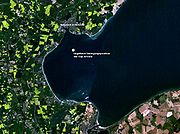 On May 3, 1945, four days after Hitler's suicide and only one day before the unconditional surrender of the German troops in Northwestern Germany at Lüneburg Heath
to Field Marshal Montgomery
, the Cap Arcona, the Thielbek, and the passenger liner Deutschland (possibly converted to a hospital ship
but not marked as such), were attacked as part of general attacks on shipping in the Baltic
by RAF
Typhoons of 83 Group
of the 2nd Tactical Air Force.
The aircraft were from No. 184 Squadron
, No. 193 Squadron
, No. 263 Squadron
, No. 197 Squadron RAF
, and No. 198 Squadron
. These Hawker Typhoon
Mark 1B fighter-bombers used High Explosive "60 lb" rocket projectiles
, bombs, and 20 mm cannon
.
Pilots of the attacking force stated that they were unaware that the ships were laden with prisoners who had survived the camps. Some sources suggest elements of British command knew of the occupants, but failed to pass the information on.
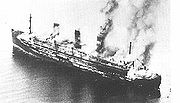 The RAF commanders ordering the strike reportedly thought that the ships carried escaping SS officers, possibly fleeing to German-controlled Norway with a dilapidated and completely rusted ship.http://www.wlb-stuttgart.de/seekrieg/4505-bilder/cap-ohne-bug.jpg
Equipped with lifejackets from locked storage compartments, most of the SS guards were able to jump overboard from the Cap Arcona, and there appear to be rumours that despite the water temperature of only 7°C, they were busy shooting any prisoners who tried to escape. German trawlers sent to rescue Cap Arconas crew members and guards managed to save 16 sailors, 400 SS men, and 20 SS women. Most of the prisoners who tried to board the trawlers were beaten back, while those who reached shore were shot down. The prisoners that managed to swim ashore were mainly gunned by the SS. Only 350 of the 4,500 former concentration camp inmates who had been aboard the Cap Arcona survived.
RAF Pilot Allan Wyse of No. 193 Squadron later recalled, "We used our cannon fire at the chaps in the water . . . we shot them up with 20mm cannons in the water. Horrible thing, but we were told to do it and we did it. That's war."
Severely damaged and set on fire, the Cap Arcona eventually capsized. The death toll was estimated at 5,000 people.
Photos of the burning ships, listed as Deutschland, Thielbek, and Cap Arcona, and of emaciated survivors swimming in the very cold Baltic Sea
, around 7 °C
(44.6 °F
), were taken on a reconnaissance mission over the Bay of Lübeck by F-6 Mustang (the photo-reconnaissance
version of the P-51) of the USAAF's 161st Tactical Reconnaissance Squadron
around 5:00 pm, shortly after the attack.
On May 4, 1945, a British reconnaissance plane took photos of the two laid wrecks: Thielbek, Cap Arcona, the Bay of Neustadt being shallow.
The capsized hulk of the Cap Arcona later drifted ashore, and the beached wreck was broken up in 1949. It was the second worst seafaring incident in history.
For weeks after the attack, the bodies of victims washed ashore, where they were collected and buried in mass graves at Neustadt in Holstein
, Scharbeutz and Timmendorfer Strand. Parts of skeletons washed ashore over the next thirty years, until the last find in 1971.
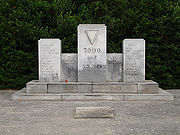 The prisoners were from 28 different nationalities: American, Belarussian, Belgian, Canadian, Czechoslovakian, Danish, Dutch, Estonian, Finnish, French, German, Greek, Hungarian, Italian, Latvian, Lithuanian, Luxembourger, Norwegian, Polish, Romanian, Russian, Spanish, Swiss, Ukrainian, Yugoslavian and others.
Images
Videos
Ocean liner
An ocean liner is a ship designed to transport people from one seaport to another along regular long-distance maritime routes according to a schedule. Liners may also carry cargo or mail, and may sometimes be used for other purposes .Cargo vessels running to a schedule are sometimes referred to as...
, formerly of the Hamburg-South America line
Hamburg Süd
Hamburg Süd is one of the key carriers on the North-South trade routes by ocean transportation. It is part of the Oetker Group, a family-owned German conglomerate.-History:...
. It transported passengers between Germany and South America up until 1940 when it was taken over by the German Navy.
Late in the war it was used for the evacuation of Germans from East Prussia
East Prussia
East Prussia is the main part of the region of Prussia along the southeastern Baltic Coast from the 13th century to the end of World War II in May 1945. From 1772–1829 and 1878–1945, the Province of East Prussia was part of the German state of Prussia. The capital city was Königsberg.East Prussia...
.
While heavily-laden with prisoners from Nazi concentration camps, she was sunk in 1945 by the Royal Air Force
Royal Air Force
The Royal Air Force is the aerial warfare service branch of the British Armed Forces. Formed on 1 April 1918, it is the oldest independent air force in the world...
. Most of the passengers died, and the sinking of the Сap Arcona was one of the biggest single-incident maritime losses of life of the war, and as such one of the largest maritime losses of life in history, with about 5,000 victims.
History
The 27,561 gross tonTon
The ton is a unit of measure. It has a long history and has acquired a number of meanings and uses over the years. It is used principally as a unit of weight, and as a unit of volume. It can also be used as a measure of energy, for truck classification, or as a colloquial term.It is derived from...
Cap Arcona, named after Cape Arkona
Cape Arkona
Cape Arkona is a cape on the island of Rügen in Mecklenburg-Vorpommern, Germany. Cape Arkona is the tip of the Wittow peninsula, just a few kilometres north of the Jasmund National Park....
on the island of Rügen
Rügen
Rügen is Germany's largest island. Located in the Baltic Sea, it is part of the Vorpommern-Rügen district of Mecklenburg-Vorpommern.- Geography :Rügen is located off the north-eastern coast of Germany in the Baltic Sea...
in Mecklenburg-Vorpommern, was launched in 1927. She was considered one of the most beautiful ships of the time, was the largest German ship on the South American run, and carried upper-class travelers and steerage
Steerage
Steerage is the act of steering a ship. "Steerage" also refers to the lowest decks of a ship.-Steerage and steerage way:The rudder of a vessel can only steer the ship when water is passing over it...
-class emigrants, mostly to South America.
Naval service
In 1940, the Cap Arcona was taken over by the KriegsmarineKriegsmarine
The Kriegsmarine was the name of the German Navy during the Nazi regime . It superseded the Kaiserliche Marine of World War I and the post-war Reichsmarine. The Kriegsmarine was one of three official branches of the Wehrmacht, the unified armed forces of Nazi Germany.The Kriegsmarine grew rapidly...
(German Navy) and used in the Baltic Sea
Baltic Sea
The Baltic Sea is a brackish mediterranean sea located in Northern Europe, from 53°N to 66°N latitude and from 20°E to 26°E longitude. It is bounded by the Scandinavian Peninsula, the mainland of Europe, and the Danish islands. It drains into the Kattegat by way of the Øresund, the Great Belt and...
as an accommodation ship. In 1942, she was used as a stand-in for the doomed in the German film version of the disaster
Titanic (1943 film)
Titanic was a 1943 Nazi propaganda film made during World War II in Berlin by Tobis Productions for UFA, which was later banned from Nazi Germany by Propaganda Minister Joseph Goebbels. The film used the sinking of the RMS Titanic as a setting for an attempt to discredit British and American...
. In early 1945, the Kriegsmarine reactivated her for Operation Hannibal
Operation Hannibal
Operation Hannibal was a German military operation involving the evacuation by sea of German troops and civilians from Courland, East Prussia, and the Polish Corridor from mid-January to May, 1945 as the Red Army advanced during the East Prussian and East Pomeranian Offensives and subsidiary...
, and she was used to transport 25,795 German soldiers and civilians from East Prussia
East Prussia
East Prussia is the main part of the region of Prussia along the southeastern Baltic Coast from the 13th century to the end of World War II in May 1945. From 1772–1829 and 1878–1945, the Province of East Prussia was part of the German state of Prussia. The capital city was Königsberg.East Prussia...
to western Germany.
As a prison ship
Towards the end of April 1945, the Nazis assembled a small fleet of ships in the Bay of LübeckBay of Lübeck
The Bay of Lübeck is a basin in the southwestern Baltic Sea, off the shores of German lands of Mecklenburg-Vorpommern and Schleswig-Holstein. It forms the southwestern part of the Bay of Mecklenburg....
, comprising the liners Cap Arcona and SS Deutschland
SS Deutschland (1923)
SS Deutschland Sometimes called Deutschland IV to distinguish from others of the name was a 21,046 gross registered ton German HAPAG ocean liner which was sunk in a British air attack in 1945, with great loss of life....
, and the smaller vessels Thielbek and Athen. The Athen was used to transfer prisoners from Lübeck
Lübeck
The Hanseatic City of Lübeck is the second-largest city in Schleswig-Holstein, in northern Germany, and one of the major ports of Germany. It was for several centuries the "capital" of the Hanseatic League and, because of its Brick Gothic architectural heritage, is listed by UNESCO as a World...
to the larger ships and between ships. By the end of the month, these ships held more than 10,000 prisoners from the Neuengamme concentration camp and its subcamps, and two barges came from Stutthof
Stutthof concentration camp
Stutthof was the first Nazi concentration camp built outside of 1937 German borders.Completed on September 2, 1939, it was located in a secluded, wet, and wooded area west of the small town of Sztutowo . The town is located in the former territory of the Free City of Danzig, 34 km east of...
and Mittelbau-Dora
Mittelbau-Dora
Mittelbau-Dora was a Nazi Germany labour camp that provided workers for the Mittelwerk V-2 rocket factory in the Kohnstein, situated near Nordhausen, Germany....
camps.
The order to transfer the prisoners from the camps to the prison ships came from Gauleiter
Gauleiter
A Gauleiter was the party leader of a regional branch of the NSDAP or the head of a Gau or of a Reichsgau.-Creation and Early Usage:...
Karl Kaufmann
Karl Kaufmann
- External links :* in Der Deutsche Reichstag, Wahlperiode nach d. 30. Jan. 1933, Bd.: 1938, Berlin, 1938...
in Hamburg
Hamburg
-History:The first historic name for the city was, according to Claudius Ptolemy's reports, Treva.But the city takes its modern name, Hamburg, from the first permanent building on the site, a castle whose construction was ordered by the Emperor Charlemagne in AD 808...
, who was himself acting on orders from Berlin. Later, during a war crimes tribunal, Kaufmann claimed that the prisoners were destined for Sweden. However, at the same trial, Bassewitz-Behr, head of the Hamburg Gestapo
Gestapo
The Gestapo was the official secret police of Nazi Germany. Beginning on 20 April 1934, it was under the administration of the SS leader Heinrich Himmler in his position as Chief of German Police...
, said that the prisoners were in fact slated to be killed in compliance with Himmler's orders, and it has been suggested that the plan called for scuttling the ships with the prisoners alive and aboard.
On April 30, 1945, two Swedish ships, Magdalena and Lillie Matthiessen, sailed from Lübeck
Lübeck
The Hanseatic City of Lübeck is the second-largest city in Schleswig-Holstein, in northern Germany, and one of the major ports of Germany. It was for several centuries the "capital" of the Hanseatic League and, because of its Brick Gothic architectural heritage, is listed by UNESCO as a World...
, the first with 223 western European prisoners, for the most part French-speakingamong them was the Michel Hollard
Michel Hollard
Michel Hollard is a French wartime resister and engineer that founded the espionage group Réseau AGIR during World War II.His contribution was recognised by the British with the award of the Distinguished Service Order having "reconnoitered a number of heavily guarded V1 sites and reported on them"...
who had set up an intelligence network to feed information to the Allies before he was captured, who were transferred from the Thielbek to the Magdalena, and the second with 225 women from Ravensbrück on board for transportation to hospitals in Sweden
Sweden
Sweden , officially the Kingdom of Sweden , is a Nordic country on the Scandinavian Peninsula in Northern Europe. Sweden borders with Norway and Finland and is connected to Denmark by a bridge-tunnel across the Öresund....
.
On May 2, 1945, the British Second Army reached the towns of Lübeck and Wismar
Wismar
Wismar , is a small port and Hanseatic League town in northern Germany on the Baltic Sea, in the state of Mecklenburg-Vorpommern,about 45 km due east of Lübeck, and 30 km due north of Schwerin. Its natural harbour, located in the Bay of Wismar is well-protected by a promontory. The...
. No. 6 Commando
No. 6 Commando
No. 6 Commando was a battalion-sized British Army commando unit of the Second World War. Although it was raised to conduct small-scale raids and harass garrisons along the coast of German-occupied France, it was mainly employed as a highly-trained infantry assault unit.Formed in July 1940, No...
, 1st Special Service Brigade commanded by Brigadier
Brigadier General
Brigadier general is a senior rank in the armed forces. It is the lowest ranking general officer in some countries, usually sitting between the ranks of colonel and major general. When appointed to a field command, a brigadier general is typically in command of a brigade consisting of around 4,000...
Derek Mills-Roberts
Derek Mills - Roberts
Brigadier Derek Mills-Roberts was a British commando who fought with the 1st Special Service Brigade during World War II.-Early life:...
, and
11th Armoured Division
British 11th Armoured Division
The 11th Armoured Division, known as The Black Bull, was a British Army division formed in 1941 during the Second World War. The Division was formed in response to the unanticipated success of German panzer divisions...
, commanded by Major-General George P. B. Roberts
George Philip Bradley Roberts
Major-General George Philip Bradley Roberts CB, DSO, MC, , better known as "Pip", was a British commander of an armoured division during the Second World War.-Military career:...
, entered Lübeck without resistance. The International Red Cross informed Major-General Roberts that 7,000-8,000 prisoners were aboard ships in the Bay of Lübeck.
Sinking
Lüneburg Heath
The Lüneburg Heath is a large area of heath, geest and woodland in northeastern part of the state of Lower Saxony in northern Germany. It forms part of the hinterland for the cities of Hamburg, Hanover, and Bremen and is named after the town of Lüneburg. Most of the area is a nature reserve...
to Field Marshal Montgomery
Bernard Montgomery, 1st Viscount Montgomery of Alamein
Field Marshal Bernard Law Montgomery, 1st Viscount Montgomery of Alamein, KG, GCB, DSO, PC , nicknamed "Monty" and the "Spartan General" was a British Army officer. He saw action in the First World War, when he was seriously wounded, and during the Second World War he commanded the 8th Army from...
, the Cap Arcona, the Thielbek, and the passenger liner Deutschland (possibly converted to a hospital ship
Hospital ship
A hospital ship is a ship designated for primary function as a floating medical treatment facility or hospital; most are operated by the military forces of various countries, as they are intended to be used in or near war zones....
but not marked as such), were attacked as part of general attacks on shipping in the Baltic
Baltic
-Northern Europe:* The Baltic Sea* Baltic states : Lithuania, Latvia, Estonia* The Baltic region, an ambiguous term referring to the general area surrounding the Baltic Sea...
by RAF
Royal Air Force
The Royal Air Force is the aerial warfare service branch of the British Armed Forces. Formed on 1 April 1918, it is the oldest independent air force in the world...
Typhoons of 83 Group
No. 83 Group RAF
No. 83 Group was a group within the Royal Air Force's 2nd Tactical Air Force during the Second World War and the post-war era. In 2006, the group was re-established as No. 83 Expeditionary Air Group.-History:...
of the 2nd Tactical Air Force.
The aircraft were from No. 184 Squadron
No. 184 Squadron RAF
-History:No.184 Squadron was formed at RAF Colerne on 1 December 1942, as a fighter bomber unit equipped with the Hawker Hurricane. Initially, Mark IIDs with 40 mm anti-tank cannon were received and the squadron trained with the Army in ground attack practice guns, bombs and rockets, replaced...
, No. 193 Squadron
No. 193 Squadron RAF
No. 193 Squadron RAF was a fighter squadron of the Royal Air Force during World War II.-History:No. 193 Squadron was formed at RAF Harrowbeer, Devon on 18 December 1942 as a fighter/ground attack unit...
, No. 263 Squadron
No. 263 Squadron RAF
No 263 Squadron was an Royal Air Force fighter squadron formed in Italy towards the end of World War I. After being disbanded in 1919 it reformed in 1939 flying mainly strike and heavy fighter aircraft until becoming No 1 Squadron in 1958.-First World War:...
, No. 197 Squadron RAF
No. 197 Squadron RAF
No. 197 Squadron RAF was a Royal Air Force Squadron formed in World War I and reformed as a fighter-bomber unit in World War II.-Formation and World War I:No...
, and No. 198 Squadron
No. 198 Squadron RAF
No. 198 Squadron was a Royal Air Force aircraft squadron that operated during the Second World War particularly in the ground attack role as the allies advanced through continental Europe.-History:...
. These Hawker Typhoon
Hawker Typhoon
The Hawker Typhoon was a British single-seat fighter-bomber, produced by Hawker Aircraft. While the Typhoon was designed to be a medium-high altitude interceptor, and a direct replacement for the Hawker Hurricane, several design problems were encountered, and the Typhoon never completely satisfied...
Mark 1B fighter-bombers used High Explosive "60 lb" rocket projectiles
RP-3
The RP-3 , was a British rocket used in the Second World War. Though primarily an air-to-ground weapon, it saw limited use in other roles. Its 60 lb warhead gave rise to the alternative name of the "60 lb rocket"; the 25 lb solid-shot armour piercing variant was referred to as the "25 lb rocket"...
, bombs, and 20 mm cannon
Hispano-Suiza HS.404
The Hispano-Suiza HS.404 was an autocannon widely used as both an aircraft and land weapon in the 20th century by British, American, French, and numerous other military services. The cannon is also referred to as Birkigt type 404, after its designer. Firing a 20 mm caliber projectile, it delivered...
.
Pilots of the attacking force stated that they were unaware that the ships were laden with prisoners who had survived the camps. Some sources suggest elements of British command knew of the occupants, but failed to pass the information on.
Equipped with lifejackets from locked storage compartments, most of the SS guards were able to jump overboard from the Cap Arcona, and there appear to be rumours that despite the water temperature of only 7°C, they were busy shooting any prisoners who tried to escape. German trawlers sent to rescue Cap Arconas crew members and guards managed to save 16 sailors, 400 SS men, and 20 SS women. Most of the prisoners who tried to board the trawlers were beaten back, while those who reached shore were shot down. The prisoners that managed to swim ashore were mainly gunned by the SS. Only 350 of the 4,500 former concentration camp inmates who had been aboard the Cap Arcona survived.
RAF Pilot Allan Wyse of No. 193 Squadron later recalled, "We used our cannon fire at the chaps in the water . . . we shot them up with 20mm cannons in the water. Horrible thing, but we were told to do it and we did it. That's war."
Severely damaged and set on fire, the Cap Arcona eventually capsized. The death toll was estimated at 5,000 people.
Photos of the burning ships, listed as Deutschland, Thielbek, and Cap Arcona, and of emaciated survivors swimming in the very cold Baltic Sea
Baltic Sea
The Baltic Sea is a brackish mediterranean sea located in Northern Europe, from 53°N to 66°N latitude and from 20°E to 26°E longitude. It is bounded by the Scandinavian Peninsula, the mainland of Europe, and the Danish islands. It drains into the Kattegat by way of the Øresund, the Great Belt and...
, around 7 °C
Celsius
Celsius is a scale and unit of measurement for temperature. It is named after the Swedish astronomer Anders Celsius , who developed a similar temperature scale two years before his death...
(44.6 °F
Fahrenheit
Fahrenheit is the temperature scale proposed in 1724 by, and named after, the German physicist Daniel Gabriel Fahrenheit . Within this scale, the freezing of water into ice is defined at 32 degrees, while the boiling point of water is defined to be 212 degrees...
), were taken on a reconnaissance mission over the Bay of Lübeck by F-6 Mustang (the photo-reconnaissance
Reconnaissance
Reconnaissance is the military term for exploring beyond the area occupied by friendly forces to gain information about enemy forces or features of the environment....
version of the P-51) of the USAAF's 161st Tactical Reconnaissance Squadron
18th Reconnaissance Squadron
The 18th Reconnaissance Squadron is a squadron of the United States Air Force. It is assigned to the 432d Operations Group, and stationed at Creech Air Force Base Nevada.-Mission:...
around 5:00 pm, shortly after the attack.
On May 4, 1945, a British reconnaissance plane took photos of the two laid wrecks: Thielbek, Cap Arcona, the Bay of Neustadt being shallow.
The capsized hulk of the Cap Arcona later drifted ashore, and the beached wreck was broken up in 1949. It was the second worst seafaring incident in history.
For weeks after the attack, the bodies of victims washed ashore, where they were collected and buried in mass graves at Neustadt in Holstein
Neustadt in Holstein
Neustadt in Holstein is a town in the district of Ostholstein, in Schleswig-Holstein, Germany. It is situated on the Bay of Lübeck , approx...
, Scharbeutz and Timmendorfer Strand. Parts of skeletons washed ashore over the next thirty years, until the last find in 1971.
Notable survivors
- Erwin GeschonneckErwin GeschonneckErwin Geschonneck was a German actor. His biggest success occurred in the German Democratic Republic, where he was considered one of the most famous actors of the time.-Early life:...
, who later became a notable German actor, and whose story was made into a film in 1982. - Emil František BurianEmil František BurianEmil František Burian was a Czech poet, journalist, singer, actor, musician, composer, dramatic adviser, playwright and director. He was also active in Communist Party of Czechoslovakia politics.- Life :...
, a musician and theatrical director, founder of Theater D, a leading avant-garde theater in interwar Europe. - Sam PivnikSam PivnikSam Pivnik is a Holocaust survivor born on 1 September 1926 in Bedzin, in South-western Poland near the border with Germany, the second son of Lajb Piwnik, a tailor, and Feigel Piwnik....
, an art dealer and lecturer on the Holocaust. - Ernst GoldenbaumErnst GoldenbaumErnst Goldenbaum was an East German politician.-Biography:Goldenbaum was born in Parchim. During World War I he served as a military and he participated in the German November Revolution...
, an East German politician. - Heinz LordHeinz LordHeinz Lord was a German-American surgeon. A survivor of Nazi concentration camp, Lord was elected Secretary-General of the World Medical Association shortly before his death in 1961....
, a German-American surgeon.
Locations
- Cap Arcona: 54°3.9′N 10°50.45′E
- Thielbek: 54°4.3′N 10°50.40′E
- Deutschland: 54°7.5′N 10°48.25′E
See also
Documentaries, TV movie
- Typhoons' Last Storm, Lawrence Bond, 2000.
- The Cap Arcona case, Günther Klaucke, Karl Hermann, 1995.
- Der Mann von der Cap Arcona, GDR TV movie, the Erwin GeschonneckErwin GeschonneckErwin Geschonneck was a German actor. His biggest success occurred in the German Democratic Republic, where he was considered one of the most famous actors of the time.-Early life:...
's story by the theme of the sinking of the Cap Arcona, 1981/82. - De ramp met de Cap Arcona, 2011.
External links
- History of the tragedy
- Disaster on the Baltic Sea
- Inferno
- Appendix A
- Cap Arcona Wrecksite
- Lucien Revert
- Scuba diving around the wreck
Images
- Photo of the Cap Arcona (1938)
- Photos of the Cap Arcona
- Album photos
- Photo of the Cap Arcona (1945)
- Photo of the Cap Arcona (1949)
- Postcard of the Memorial
- Cap Arcona, etching, Alfred Hrdlicka (1986)
- Drawing of the burning ships. Unknown author.



Videos