


SS Normandie

Encyclopedia
SS Normandie was an ocean liner
Ocean liner
An ocean liner is a ship designed to transport people from one seaport to another along regular long-distance maritime routes according to a schedule. Liners may also carry cargo or mail, and may sometimes be used for other purposes .Cargo vessels running to a schedule are sometimes referred to as...
built in Saint-Nazaire
Saint-Nazaire
Saint-Nazaire , is a commune in the Loire-Atlantique department in western France.The town has a major harbour, on the right bank of the Loire River estuary, near the Atlantic Ocean. The town is at the south of the second-largest swamp in France, called "la Brière"...
, France for the French Line Compagnie Générale Transatlantique
Compagnie Générale Transatlantique
The Compagnie Générale Transatlantique , typically known overseas as the French Line, was a shipping company established during 1861 as an attempt to revive the French merchant marine, the poor state of which was indicated during the Crimean War of 1856...
. She entered service in 1935 as the largest and fastest passenger ship afloat; she is still the most powerful steam turbo-electric
Turbo-electric
A turbo-electric transmission uses electric generators to convert the mechanical energy of a turbine into electric energy and electric motors to convert it back into mechanical energy to power the driveshafts....
-propelled passenger ship ever built.
Her novel design and lavish interiors led many to consider her the greatest of ocean liners. Despite this, she was not a commercial success and relied partly on government subsidy to operate. During service as the flagship
Flagship
A flagship is a vessel used by the commanding officer of a group of naval ships, reflecting the custom of its commander, characteristically a flag officer, flying a distinguishing flag...
of the CGT, she made 139 transatlantic crossings westbound from her home port of Le Havre
Le Havre
Le Havre is a city in the Seine-Maritime department of the Haute-Normandie region in France. It is situated in north-western France, on the right bank of the mouth of the river Seine on the English Channel. Le Havre is the most populous commune in the Haute-Normandie region, although the total...
to New York
New York City
New York is the most populous city in the United States and the center of the New York Metropolitan Area, one of the most populous metropolitan areas in the world. New York exerts a significant impact upon global commerce, finance, media, art, fashion, research, technology, education, and...
and one fewer return. Normandie held the Blue Riband
Blue Riband
The Blue Riband is an unofficial accolade given to the passenger liner crossing the Atlantic Ocean in regular service with the record highest speed. The term was borrowed from horse racing and was not widely used until after 1910. Under the unwritten rules, the record is based on average speed...
for the fastest transatlantic crossing at several points during her service career, during which the RMS Queen Mary
RMS Queen Mary
RMS Queen Mary is a retired ocean liner that sailed primarily in the North Atlantic Ocean from 1936 to 1967 for the Cunard Line...
was her chief rival.
During World War II
World War II
World War II, or the Second World War , was a global conflict lasting from 1939 to 1945, involving most of the world's nations—including all of the great powers—eventually forming two opposing military alliances: the Allies and the Axis...
, Normandie was seized by the United States authorities at New York and renamed USS Lafayette
USS Lafayette (AP-53)
USS Lafayette was the French luxury liner following the latter's seizure under the maritime right of angary in New York by the United States after the Fall of France....
. In 1942, the liner caught fire while being converted to a troopship
Troopship
A troopship is a ship used to carry soldiers, either in peacetime or wartime...
, capsized and sank at the New York Passenger Ship Terminal
New York Passenger Ship Terminal
The New York Passenger Ship Terminal is a terminal for ocean-going passenger ships on Manhattan's west side....
. Although salvaged at great expense, restoration was deemed too costly and she was scrapped in October 1946.
Origin
The beginnings of Normandie can be traced to the Roaring TwentiesRoaring Twenties
The Roaring Twenties is a phrase used to describe the 1920s, principally in North America, but also in London, Berlin and Paris for a period of sustained economic prosperity. The phrase was meant to emphasize the period's social, artistic, and cultural dynamism...
when shipping companies began looking to replace veterans such as the which had first sailed in 1907. Those earlier ships had been designed around the huge numbers of steerage-class immigrants from Europe to the United States. When the U.S. closed the door on most immigration in the early 1920s, steamship companies ordered vessels built to serve upper-class tourists instead, particularly Americans who traveled to Europe for alcohol-fueled fun during Prohibition
Prohibition
Prohibition of alcohol, often referred to simply as prohibition, is the practice of prohibiting the manufacture, transportation, import, export, sale, and consumption of alcohol and alcoholic beverages. The term can also apply to the periods in the histories of the countries during which the...
. Companies like Cunard
Cunard Line
Cunard Line is a British-American owned shipping company based at Carnival House in Southampton, England and operated by Carnival UK. It has been a leading operator of passenger ships on the North Atlantic for over a century...
and the White Star Line
White Star Line
The Oceanic Steam Navigation Company or White Star Line of Boston Packets, more commonly known as the White Star Line, was a prominent British shipping company, today most famous for its ill-fated vessel, the RMS Titanic, and the World War I loss of Titanics sister ship Britannic...
planned to build their own superliners
Superliner (passenger ship)
A superliner is an ocean liner of over 10,000 gross tons. The term was coined in the late 19th century, when ocean liners were rapidly increasing in size and speed...
to rival newer ships on the scene; such vessels included the record-breaking and , both German. The French Line
Compagnie Générale Transatlantique
The Compagnie Générale Transatlantique , typically known overseas as the French Line, was a shipping company established during 1861 as an attempt to revive the French merchant marine, the poor state of which was indicated during the Crimean War of 1856...
began to plan its own superliner.
Art Deco
Art deco , or deco, is an eclectic artistic and design style that began in Paris in the 1920s and flourished internationally throughout the 1930s, into the World War II era. The style influenced all areas of design, including architecture and interior design, industrial design, fashion and...
interiors but conservative hull design. The designers of the new French superliner intended to construct their new ship similar to French Line ships of the past but then they were approached by Vladimir Yourkevitch
Vladimir Yourkevitch
Vladimir Ivanovich Yourkevitch was a Russian naval engineer, developer of the modern design of ship hulls, and designer of the famous ocean liner SS Normandie. He worked in Russia, France and the United States.-Biography:...
, a former ship architect for the Imperial Russian Navy
Imperial Russian Navy
The Imperial Russian Navy refers to the Tsarist fleets prior to the February Revolution.-First Romanovs:Under Tsar Mikhail Feodorovich, construction of the first three-masted ship, actually built within Russia, was completed in 1636. It was built in Balakhna by Danish shipbuilders from Holstein...
, who had emigrated to France before the revolution. His ideas included a slanting clipper-like bow and a bulbous forefoot
Bulbous bow
A bulbous bow is a protruding bulb at the bow of a ship just below the waterline. The bulb modifies the way the water flows around the hull, reducing drag and thus increasing speed, range, fuel efficiency, and stability...
beneath the waterline, in combination with a slim hull. Yourkevitch's concepts worked wonderfully in scale models which supported his design's performance advantages. The French engineers were impressed and asked Yourkevitch to join their project. Reportedly, he also approached the Cunard Line
Cunard Line
Cunard Line is a British-American owned shipping company based at Carnival House in Southampton, England and operated by Carnival UK. It has been a leading operator of passenger ships on the North Atlantic for over a century...
with his ideas but was rejected because the bow was deemed too radical.
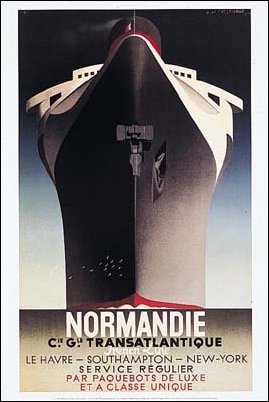
The French Line commissioned artists to create posters and publicity for the liner. One of the most famous posters was by Adolphe Mouron Cassandre
Adolphe Mouron Cassandre
Adolphe Mouron Cassandre was a Ukrainian-French painter, commercial poster artist, and typeface designer.-Early Life and Career:...
, who was also a Russian emigrant to France. Another cutaway diagram by Albert Sébille, 15 feet long, detailed the interior layout and is displayed in the Musée national de la Marine
Musée national de la Marine
The Musée national de la Marine is a maritime museum located in the Palais de Chaillot, Trocadéro, in the XVIe arrondissement of Paris. It has annexes at Brest, Port-Louis, Rochefort , Toulon and Saint-Tropez...
in Paris.
Construction and launch
Work began on the unnamed flagship in January 1931, soon after the stock market crashStock market crash
A stock market crash is a sudden dramatic decline of stock prices across a significant cross-section of a stock market, resulting in a significant loss of paper wealth. Crashes are driven by panic as much as by underlying economic factors...
of 1929. While the French continued construction, the competing White Star Line
White Star Line
The Oceanic Steam Navigation Company or White Star Line of Boston Packets, more commonly known as the White Star Line, was a prominent British shipping company, today most famous for its ill-fated vessel, the RMS Titanic, and the World War I loss of Titanics sister ship Britannic...
's ship (intended as Oceanic
Oceanic (unfinished ship)
Oceanic was the planned name of an unfinished ocean liner that was partially built by Harland and Wolff for the White Star Line. The ship was to have been the first -long ocean liner....
) – started before the crash – was cancelled and the Cunard ship
RMS Queen Mary
RMS Queen Mary is a retired ocean liner that sailed primarily in the North Atlantic Ocean from 1936 to 1967 for the Cunard Line...
put on hold. French builders also ran into difficulty and had to ask for government money; this subsidy was questioned in the press. Still, building was followed by newspapers and national interest was deep, as she was designed to represent France in the nation-state contest of the great liners and was built in a French shipyard using French parts.
The growing hull in Saint-Nazaire
Saint-Nazaire
Saint-Nazaire , is a commune in the Loire-Atlantique department in western France.The town has a major harbour, on the right bank of the Loire River estuary, near the Atlantic Ocean. The town is at the south of the second-largest swamp in France, called "la Brière"...
had no formal designation except "T-6" (with "6" for "6th" and "T" for "Transat
Compagnie Générale Transatlantique
The Compagnie Générale Transatlantique , typically known overseas as the French Line, was a shipping company established during 1861 as an attempt to revive the French merchant marine, the poor state of which was indicated during the Crimean War of 1856...
", short for "CIE. GLE. TRANSATLANTIQUE
Compagnie Générale Transatlantique
The Compagnie Générale Transatlantique , typically known overseas as the French Line, was a shipping company established during 1861 as an attempt to revive the French merchant marine, the poor state of which was indicated during the Crimean War of 1856...
" aka the "French Line"), the contract name. Many names were suggested including Doumer, after the recently assassinated president
President
A president is a leader of an organization, company, trade union, university, or country.Etymologically, a president is one who presides, who sits in leadership...
Paul Doumer
Paul Doumer
Joseph Athanase Paul Doumer, commonly known as Paul Doumer was the President of France from 13 June 1931 until his assassination.-Biography:...
, and originally, La Belle France. Finally Normandie was chosen. In France, ship prefixes are customarily masculine, inherited from the French terms for ship, which can be "paquebot", "navire", "bateau", "bâtiment", but English speakers refer to ships as feminine ("she's a beauty"), and the French Line carried many rich American customers. French Line wrote that their ship was to be called simply "Normandie," preceded by neither "le" nor "la" (French masculine/feminine for "the") to avoid any confusion.
Stock market crash
A stock market crash is a sudden dramatic decline of stock prices across a significant cross-section of a stock market, resulting in a significant loss of paper wealth. Crashes are driven by panic as much as by underlying economic factors...
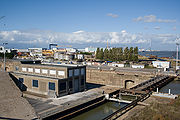
– Normandie was launched in front of 200,000 spectators. The 27,567 ton hull that slid into the Loire River was the largest launched and the wave crashed into a few hundred people, but with no injury. Normandie was outfitted
Fitting-out
Fitting-out, or "outfitting”, is the process in modern shipbuilding that follows the float-out of a vessel and precedes sea trials. It is the period when all the remaining construction of the ship is completed and readied for delivery to her owners...
until early 1935, her interiors, funnels, engines, and other fittings put in to make her into a working vessel. Finally, in May 1935, Normandie was ready for trials, which were watched by reporters. The superiority of Vladimir Yourkevitch
Vladimir Yourkevitch
Vladimir Ivanovich Yourkevitch was a Russian naval engineer, developer of the modern design of ship hulls, and designer of the famous ocean liner SS Normandie. He worked in Russia, France and the United States.-Biography:...
's hull was visible: hardly a wave was created off the bulbous bow. The ship reached a top speed of 32.125 knots (63 km/h) and performed an emergency stop from that speed in 1,700 meters.
In addition to a novel hull which let her attain her speed at far less power than other big liners, Normandie was filled with technical feats. She had turbo-electric engines, chosen for their ability to allow full reverse power, and, according to French Line officials, which were quieter and more easily controlled and maintained. The engine installation was heavier than conventional turbines and slightly less efficient at high speed but allowed all propellers to operate even if one engine was not running. This system also made it possible to do away with astern turbines. An early form of radar
Radar
Radar is an object-detection system which uses radio waves to determine the range, altitude, direction, or speed of objects. It can be used to detect aircraft, ships, spacecraft, guided missiles, motor vehicles, weather formations, and terrain. The radar dish or antenna transmits pulses of radio...
was installed to prevent collisions like the Titanic had.
Interior
The luxurious interiors were designed in Art DécoArt Deco
Art deco , or deco, is an eclectic artistic and design style that began in Paris in the 1920s and flourished internationally throughout the 1930s, into the World War II era. The style influenced all areas of design, including architecture and interior design, industrial design, fashion and...
and Streamline Moderne
Streamline Moderne
Streamline Moderne, sometimes referred to by either name alone or as Art Moderne, was a late type of the Art Deco design style which emerged during the 1930s...
style. Many sculptures and wall paintings made allusions to Normandy
Normandy
Normandy is a geographical region corresponding to the former Duchy of Normandy. It is in France.The continental territory covers 30,627 km² and forms the preponderant part of Normandy and roughly 5% of the territory of France. It is divided for administrative purposes into two régions:...
, the province of France for which Normandie was named. Drawings and photographs show a series of vast public rooms of great elegance. Normandies voluminous interior spaces were made possible by having the funnel intakes split to pass along the sides of the ship, rather than straight upward. French architect Roger-Henri Expert
Roger-Henri Expert
Roger-Henri Expert was a French architect.- Life :The son of a merchant, Expert first studied painting at the École des beaux-arts in Bordeaux, then from 1906 attended the Ecole des Beaux-Arts in Paris, where he studied under Gaston Redon and Gustave Umbdenstock. In 1912 he won the second Prix de...
was in charge of the overall decorative scheme.
Most of the public space was devoted to first-class passengers, including the dining room, first-class lounge, grille room, first class swimming pool
Swimming pool
A swimming pool, swimming bath, wading pool, or simply a pool, is a container filled with water intended for swimming or water-based recreation. There are many standard sizes; the largest is the Olympic-size swimming pool...
, theatre
Theatre
Theatre is a collaborative form of fine art that uses live performers to present the experience of a real or imagined event before a live audience in a specific place. The performers may communicate this experience to the audience through combinations of gesture, speech, song, music or dance...
and winter garden
Winter garden
The origin of the winter garden dates back to the 17th to 19th centuries where European nobility would construct large conservatories that would house tropical and subtropical plants and would act as an extension of their living space. Many of these would be attached to their main palaces...
. The first class swimming pool featured staggered depths, with a shallow training beach for children. The children's dining room was decorated by Jean de Brunhoff
Jean de Brunhoff
Jean de Brunhoff was a French writer and illustrator known for creating the Babar books, the first of which appeared in 1931. He was the fourth and youngest child of Maurice de Brunhoff, a publisher, and his wife Marguerite. He attended Protestant schools, including the prestigious Ecole Alsacienne...
, who covered the walls with Babar the Elephant
Babar the Elephant
Babar the Elephant is a French children's fictional character who first appeared in Histoire de Babar by Jean de Brunhoff in 1931 and enjoyed immediate success. An English language version, entitled The Story of Babar, appeared in 1933 in Britain and also in the United States. The book is based on...
and his entourage.
The interiors were filled with grand perspectives, spectacular entryways, and long, wide staircases. First-class suites were given unique designs by select designers. The most luxurious accommodations were the Deauville and Trouville apartments, featuring dining rooms, baby grand pianos, multiple bedrooms, and private decks.
The first class dining hall was the largest room afloat. At three hundred and five feet (93 m) it was longer than the Hall of Mirrors
Hall of Mirrors (Palace of Versailles)
The Hall of Mirrors is the central gallery of the Palace of Versailles and is renowned as being one of the most famous rooms in the world.As the principal and most remarkable feature of King Louis XIV of France's third building campaign of the Palace of Versailles , construction of the Hall of...
at Versailles
Versailles
Versailles , a city renowned for its château, the Palace of Versailles, was the de facto capital of the kingdom of France for over a century, from 1682 to 1789. It is now a wealthy suburb of Paris and remains an important administrative and judicial centre...
, stood 46 feet (14 m) wide, and towered 28 feet (8.5 m) high. Passengers entered through 20 feet (6.1 m) tall doors adorned with bronze medallions by artist Raymond Subes. The room could seat 700 at 157 tables, with Normandie serving as a floating promotion for the most sophisticated French cuisine
French cuisine
French cuisine is a style of food preparation originating from France that has developed from centuries of social change. In the Middle Ages, Guillaume Tirel , a court chef, authored Le Viandier, one of the earliest recipe collections of Medieval France...
of the period. As no natural light could enter it was illuminated by 12 tall pillars of Lalique glass flanked by 38 matching columns along the walls. These, with chandeliers hung at each end of the room, earned the Normandie the nickname "Ship of Light" (similar to Paris
Paris
Paris is the capital and largest city in France, situated on the river Seine, in northern France, at the heart of the Île-de-France region...
as the '"City of Light").
A popular feature was the café grill, which would be transformed into a nightclub. Adjoining the cafe grill was the first class smoking room, which was paneled in large murals depicting ancient Egyptian life. Normandie also had indoor and outdoor pools, a chapel, and a theatre which could double as a stage and cinema.
The machinery of the top deck and forecastle
Forecastle
Forecastle refers to the upper deck of a sailing ship forward of the foremast, or the forward part of a ship with the sailors' living quarters...
was integrated within the ship, concealing it and releasing nearly all the exposed deck space for passengers. The air conditioner units were concealed along with the kennels inside the third, dummy, funnel.
Career
Normandies maiden voyageMaiden voyage
The maiden voyage of a ship, aircraft or other craft is the first journey made by the craft after shakedown. A number of traditions and superstitions are associated with it....
was on 29 May 1935. Fifty thousand saw her off at Le Havre
Le Havre
Le Havre is a city in the Seine-Maritime department of the Haute-Normandie region in France. It is situated in north-western France, on the right bank of the mouth of the river Seine on the English Channel. Le Havre is the most populous commune in the Haute-Normandie region, although the total...
on what was hoped would be a record-breaking crossing. Normandie reached New York after four days, three hours and 14 minutes, taking away the Blue Riband
Blue Riband
The Blue Riband is an unofficial accolade given to the passenger liner crossing the Atlantic Ocean in regular service with the record highest speed. The term was borrowed from horse racing and was not widely used until after 1910. Under the unwritten rules, the record is based on average speed...
from the Italian liner, . This brought great pride for the French, who had not won the distinction before. Under the command of master, Captain René Pugnet, her average on the maiden voyage was around 30 knots (58.8 km/h) and on the eastbound crossing to France
France
The French Republic , The French Republic , The French Republic , (commonly known as France , is a unitary semi-presidential republic in Western Europe with several overseas territories and islands located on other continents and in the Indian, Pacific, and Atlantic oceans. Metropolitan France...
she averaged over 30 knots (58.8 km/h), breaking records .
During the maiden voyage, French Line refused to predict that their ship would win the Blue Riband. However, by New York, medallions of the Blue Riband victory, made in France, were delivered to passengers and the ship was flying a 30 feet (9.1 m) long blue pennant
Pennant (commissioning)
The commissioning pennant is a pennant flown from the masthead of a warship. The history of flying a commissioning pennant dates back to the days of chivalry with their trail pendants being flown from the mastheads of ships they commanded...
. An estimated 100,000 spectators lined New York Harbor
New York Harbor
New York Harbor refers to the waterways of the estuary near the mouth of the Hudson River that empty into New York Bay. It is one of the largest natural harbors in the world. Although the U.S. Board of Geographic Names does not use the term, New York Harbor has important historical, governmental,...
for Normandies arrival.
Normandie had a successful year but , Cunard White Star Line
Cunard Line
Cunard Line is a British-American owned shipping company based at Carnival House in Southampton, England and operated by Carnival UK. It has been a leading operator of passenger ships on the North Atlantic for over a century...
's superliner, entered service in the summer of 1936. Cunard White Star said the Queen Mary would surpass 80,000 tons. At 79,280 tons, Normandie would no longer be the world’s largest. French Line increased Normandie’s size, mainly through the addition of an enclosed tourist lounge on the aft boat deck. Following these and other alterations, Normandie was 83,423 gross tons. Exceeding the Queen Mary by 2,000 tons, she would remain the world’s largest in terms of overall measured gross tonnage and length.
On 22 June 1936, a Blackburn Baffin
Blackburn Baffin
-See also:-External links:* * http://avia.russian.ee/air/england/black_baffin.php...
, S5162 of A Flight, RAF Gosport, flown by Lt Guy Kennedy Horsey on torpedo-dropping practice, buzzed Normandie a mile (2 km) off Ryde Pier
Ryde Pier
Ryde Pier is an early 19th century pier serving the town of Ryde, on the Isle of Wight, off the south coast of England.- Before the pier :Before the pier was built, passengers to Ryde had the uncomfortable experience of coming ashore on the back of a porter and then, depending on the state of the...
and collided with a derrick which was transferring a motor car belonging to Arthur Evans, MP
Member of Parliament
A Member of Parliament is a representative of the voters to a :parliament. In many countries with bicameral parliaments, the term applies specifically to members of the lower house, as upper houses often have a different title, such as senate, and thus also have different titles for its members,...
, onto a barge alongside the ship. The aircraft crashed onto Normandies stern. The pilot was taken off by tender, but the wreckage of the aircraft remained on board Normandie as she had to sail due to the tide. It was carried to Le Havre
Le Havre
Le Havre is a city in the Seine-Maritime department of the Haute-Normandie region in France. It is situated in north-western France, on the right bank of the mouth of the river Seine on the English Channel. Le Havre is the most populous commune in the Haute-Normandie region, although the total...
, France
France
The French Republic , The French Republic , The French Republic , (commonly known as France , is a unitary semi-presidential republic in Western Europe with several overseas territories and islands located on other continents and in the Indian, Pacific, and Atlantic oceans. Metropolitan France...
. A salvage team from the Royal Air Force
Royal Air Force
The Royal Air Force is the aerial warfare service branch of the British Armed Forces. Formed on 1 April 1918, it is the oldest independent air force in the world...
later removed the wreckage. The pilot was Court-martial
Court-martial
A court-martial is a military court. A court-martial is empowered to determine the guilt of members of the armed forces subject to military law, and, if the defendant is found guilty, to decide upon punishment.Most militaries maintain a court-martial system to try cases in which a breach of...
led and found guilty on two charges. Evans' car was wrecked in the accident, which was brought up in Parliament
Parliament of the United Kingdom
The Parliament of the United Kingdom of Great Britain and Northern Ireland is the supreme legislative body in the United Kingdom, British Crown dependencies and British overseas territories, located in London...
.
In August 1936, Queen Mary captured the Blue Riband
Blue Riband
The Blue Riband is an unofficial accolade given to the passenger liner crossing the Atlantic Ocean in regular service with the record highest speed. The term was borrowed from horse racing and was not widely used until after 1910. Under the unwritten rules, the record is based on average speed...
, averaging 30.14 knots (59.1 km/h), starting fierce rivalry. The Normandie held the size record until the arrival of RMS Queen Elizabeth
RMS Queen Elizabeth
RMS Queen Elizabeth was an ocean liner operated by the Cunard Line. Plying with her running mate Queen Mary as a luxury liner between Southampton, UK and New York City, USA via Cherbourg, France, she was also contracted for over twenty years to carry the Royal Mail as the second half of the two...
(83,673 gross tons) in 1940.
During refit, Normandie was also modified to address vibration. Her triple-bladed screws were replaced with quadruple-bladed ones, and structural modifications were made to her lower aft section. These modifications reduced vibration at speed.
In July 1937 Normandie regained the Blue Riband, but the Queen Mary took it back next year. After this the captain of Normandie sent a message saying "Bravo to the Queen Mary until next time!" This rivalry could have gone on into the 1940s but was ended by World War II
World War II
World War II, or the Second World War , was a global conflict lasting from 1939 to 1945, involving most of the world's nations—including all of the great powers—eventually forming two opposing military alliances: the Allies and the Axis...
.
Normandie carried distinguished passengers, including the authors Colette
Colette
Colette was the surname of the French novelist and performer Sidonie-Gabrielle Colette . She is best known for her novel Gigi, upon which Lerner and Loewe based the stage and film musical comedies of the same title.-Early life and marriage:Colette was born to retired military officer Jules-Joseph...
and Ernest Hemingway
Ernest Hemingway
Ernest Miller Hemingway was an American author and journalist. His economic and understated style had a strong influence on 20th-century fiction, while his life of adventure and his public image influenced later generations. Hemingway produced most of his work between the mid-1920s and the...
, the wife of French President Albert Lebrun
Albert Lebrun
Albert François Lebrun was a French politician, President of France from 1932 to 1940. He was the last president of the Third Republic. He was a member of the center-right Democratic Republican Alliance .-Biography:...
, songwriters Noël Coward
Noël Coward
Sir Noël Peirce Coward was an English playwright, composer, director, actor and singer, known for his wit, flamboyance, and what Time magazine called "a sense of personal style, a combination of cheek and chic, pose and poise".Born in Teddington, a suburb of London, Coward attended a dance academy...
and Irving Berlin
Irving Berlin
Irving Berlin was an American composer and lyricist of Jewish heritage, widely considered one of the greatest songwriters in American history.His first hit song, "Alexander's Ragtime Band", became world famous...
, and Hollywood celebrities such as Fred Astaire
Fred Astaire
Fred Astaire was an American film and Broadway stage dancer, choreographer, singer and actor. His stage and subsequent film career spanned a total of 76 years, during which he made 31 musical films. He was named the fifth Greatest Male Star of All Time by the American Film Institute...
, Marlene Dietrich
Marlene Dietrich
Marlene Dietrich was a German-American actress and singer.Dietrich remained popular throughout her long career by continually re-inventing herself, professionally and characteristically. In the Berlin of the 1920s, she acted on the stage and in silent films...
, Walt Disney
Walt Disney
Walter Elias "Walt" Disney was an American film producer, director, screenwriter, voice actor, animator, entrepreneur, entertainer, international icon, and philanthropist, well-known for his influence in the field of entertainment during the 20th century. Along with his brother Roy O...
, Douglas Fairbanks, Jr, and James Stewart
James Stewart (actor)
James Maitland Stewart was an American film and stage actor, known for his distinctive voice and his everyman persona. Over the course of his career, he starred in many films widely considered classics and was nominated for five Academy Awards, winning one in competition and receiving one Lifetime...
. Normandie also carried the von Trapp family Singers of The Sound of Music
The Sound of Music
The Sound of Music is a musical by Richard Rodgers, lyrics by Oscar Hammerstein II and a book by Howard Lindsay and Russel Crouse. It is based on the memoir of Maria von Trapp, The Story of the Trapp Family Singers...
from New York to Southampton in 1938, and from Southampton, the family went to Scandinavia for a tour before returning to America.
French Line considered a sister ship, the SS Bretagne, which was to be longer and larger, but war and limited finances prevented it.
Popularity
Although a critical success in her design and decour, the Normandie ultimately proved to be unpopular with North Atlantic passengers. Two of the ship's greatest attributes, in reality, turned out to be two of her biggest faults.Part of the ship's problem lay in the fact that the majority of her passenger space was devoted solely to first class, which could carry up to 848 people. Less space and consideration were given to second and tourist class, which only numbered 670 and 454 passengers respectively. As a result the general consensus among North Atlantic passengers was that she was primarily a ship for the rich and famous. In contrast, Cunard White Star had placed just as much emphasis on decor, space, and accommodations in second and tourist class on the Queen Mary as it had in first, thus accommodating a travel trend that had become popular during the 20's and the 30's, the American tourist. Many of these passengers could not afford first class passage yet wanted to travel with much of the same comfort as those in first. Thus second and tourist class became a major cash cow for shipping companies at that time. The Mary would accommodate this and thus she had great popularity among North Atlantic travelers in the late thirties.
Another of the French Liner's greatest triumphs also turned out to be one of her greatest flaws: her decor. The Normandies slick and modern art deco interiors proved to be somewhat intimidating and uncomfortable for her travelers. It was also here that Queen Mary triumphed over her French rival. Although decorated in an art deco style, the Queen Mary was more reserved in her appointments and was not as radical as her French counterpart, which ultimately proved to be popular with her passengers.
As a result throughout her service history the Normandie rarely topped more than sixty percent occupancy, and at many times traveled with less than half a complement of passengers. Her German rivals the Bremen, and the Europa, Italian rivals the Rex and Conte de Savioa also suffered from this problem; despite their innovative designs and luxurious interiors, they never made a profit for their respective companies, relying on heavy government subsidies. In contrast the Queen Mary, and Cunard White Star's Britannic III, Georgic II, Mauretania II, and much older Aquitania, along with the Holland America Line
Holland America Line
The Holland America Line is a cruise shipping company. It was founded in 1873 as the Netherlands-America Steamship Company , a shipping and passenger line. Headquartered in Rotterdam and providing service to the Americas, it became known as Holland America Line...
's were among the few ships on the North Atlantic to make a profit, carrying the lion's share of North Atlantic passengers in the years preceding the Second World War.
Demise
The war found Normandie in New York. Soon the Queen Mary, later refitted as a troop ship, docked nearby. Then the joined the Queen Mary. For two weeks the three largest liners in the world floated side by side. In 1940, after the Fall of France, the United StatesUnited States
The United States of America is a federal constitutional republic comprising fifty states and a federal district...
seized the Normandie under the right of angary
Angary
Angary , the name given to the right of a belligerent to seize and apply for the purposes of war any kind of property on belligerent territory, including that...
. By 1941, the U.S. Navy decided to convert Normandie into a troopship
Troopship
A troopship is a ship used to carry soldiers, either in peacetime or wartime...
, and renamed her , in honor both of Marquis de la Fayette the French general who fought on the Colonies' behalf in the American Revolution
American Revolution
The American Revolution was the political upheaval during the last half of the 18th century in which thirteen colonies in North America joined together to break free from the British Empire, combining to become the United States of America...
and the alliance with France that made American independence possible.
Earlier proposals included turning the vessel into an aircraft carrier, but this was dropped in favor of immediate troop transport. The ship was moored at Manhattan's Pier 88
New York Passenger Ship Terminal
The New York Passenger Ship Terminal is a terminal for ocean-going passenger ships on Manhattan's west side....
for the conversion. On 9 February 1942 sparks from a welding torch ignited a stack of thousands of life vests filled with kapok
Kapok
Ceiba pentandra is a tropical tree of the order Malvales and the family Malvaceae , native to Mexico, Central America and the Caribbean, northern South America, and to tropical west Africa...
, a highly flammable material, that had been stored in the first-class lounge. The woodwork had not yet been removed, and the fire spread rapidly. The ship had a very efficient fire protection system but it had been disconnected during the conversion and its internal pumping system was deactivated. The New York City fire department's hoses also did not fit the ship's French inlets. All on board fled the vessel.
As firefighters on shore and in fire boats poured water on the blaze, the ship developed a dangerous list to port due to water pumped into the seaward side by fireboats. About 2:45am on February 10, Lafayette capsize
Capsize
Capsizing is an act of tipping over a boat or ship to disable it. The act of reversing a capsized vessel is called righting.If a capsized vessel has sufficient flotation to prevent sinking, it may recover on its own if the stability is such that it is not stable inverted...
d, nearly crushing a fire boat.
The ship's designer Vladimir Yourkevitch
Vladimir Yourkevitch
Vladimir Ivanovich Yourkevitch was a Russian naval engineer, developer of the modern design of ship hulls, and designer of the famous ocean liner SS Normandie. He worked in Russia, France and the United States.-Biography:...
arrived at the scene and offered expertise, but he was barred by harbor police. His suggestion was to enter the vessel and open the sea-cocks. This would flood the lower decks and make her settle the few feet to the bottom. With the ship stabilised, water could be pumped into burning areas without the risk of capsize. However, the suggestion was denied by port director Admiral Adolphus Andrews.
Enemy sabotage was widely suspected, but a federal investigation in the wake of the sinking concluded that the fire was completely accidental. It has later been alleged that it was indeed sabotage, organized by mobster Anthony Anastasio
Anthony Anastasio
Anthony "Tough Tony" Anastasio was a New York City mobster and labor racketeer for the Gambino crime family who controlled the Brooklyn dockyards for over thirty years...
, who was a power in the local longshoreman's union. The alleged purpose was to provide a pretext for the release from prison of mob boss Charles "Lucky" Luciano. Luciano's end of the bargain would be that he would ensure that there would be no further "enemy" sabotage in the ports where the mob had strong influence with the unions.
The ship was stripped of superstructure and righted in 1943 in the world's most expensive salvage operation. But the cost of restoring her was subsequently determined to be too great. After neither the US Navy nor French Line offered, Yourkevitch proposed to cut the ship down and restore her as a mid-sized liner. This plan also failed to draw backing and the hulk was sold for US$161,680 to Lipsett Inc., an American salvage
Marine salvage
Marine salvage is the process of rescuing a ship, its cargo, or other property from peril. Salvage encompasses rescue towing, refloating a sunken or grounded vessel, or patching or repairing a ship...
company. She was scrapped in October 1946.
Legacy
Designer Marin-Marie gave an innovative line to Normandie, a silhouette which influenced ocean liners over the decades, including the Queen Mary 2. The ambience of classic transatlantic liners like the Normandie (and her chief rival, the Queen Mary) was the source of inspiration for Disney Cruise LineDisney Cruise Line
Disney Cruise Line is an American cruise line company owned and operated by Walt Disney Parks and Resorts, a division of The Walt Disney Company and is headquartered in Celebration, Florida. The business is run by President Karl Holz. Disney Cruise Line operates the Disney Cruise Line Terminal,...
's matching vessels, the Disney Magic
Disney Magic
The Disney Magic is a cruise ship operated by the Disney Cruise Line, a subsidiary of The Walt Disney Company. Its sister, the Disney Wonder, was launched in 1999....
and Disney Wonder
Disney Wonder
Disney Wonder is the second cruise ship operated by Disney Cruise Line; it was launched in 1999. It is nearly identical in construction to its sister ship, Disney Magic. Both ships have 11 public decks, can accommodate 2,400 passengers in 875 staterooms, and have a crew of approximately 950. ...
.
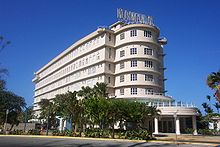
Normandie Hotel
The Normandie Hotel is a hotel located in San Juan, Puerto Rico. The hotel originally opened on October 10, 1942. Its design was inspired by the ocean liner SS Normandie. It features the same art deco design as the ship that inspired it, and the hotel's roof sign is one of the two signs that...
in San Juan, Puerto Rico
San Juan, Puerto Rico
San Juan , officially Municipio de la Ciudad Capital San Juan Bautista , is the capital and most populous municipality in Puerto Rico, an unincorporated territory of the United States. As of the 2010 census, it had a population of 395,326 making it the 46th-largest city under the jurisdiction of...
. It also said to have inspired the nickname 'The Normandie' given to the International Savings Society Apartments in Shanghai, one of the most fashionable residential buildings in the city's 20s and 30s heyday and home to many stars of China's pre-Communist film industry.
Items from Normandie were sold at a series of auctions after her demise, and many pieces are considered valuable Art Deco
Art Deco
Art deco , or deco, is an eclectic artistic and design style that began in Paris in the 1920s and flourished internationally throughout the 1930s, into the World War II era. The style influenced all areas of design, including architecture and interior design, industrial design, fashion and...
treasures today. The rescued items include the ten large dining room door medallions and fittings, and some of the individual Jean Dupas
Jean Dupas
Jean Théodore Dupas was a French painter, designer, poster artist, and decorator whose work is considered the utmost example of Art Nouveau and Art Deco visual arts.- Life :He won the prix de Rome in 1910...
glass panels that formed the large murals mounted at the four corners of her Grand Salon. Also surviving are some examples of the 24,000 pieces of crystal, some from the massive Lalique torchères, that adorned her Dining Salon. Also some of the room's table silverware, chairs, and gold-plated bronze table bases. Custom-designed suite and cabin furniture as well as original artwork and statues that decorated the ship, or were built for use by the French Line aboard Normandie, also survive today. Pieces from the Normandie occasionally appear on the BBC
BBC
The British Broadcasting Corporation is a British public service broadcaster. Its headquarters is at Broadcasting House in the City of Westminster, London. It is the largest broadcaster in the world, with about 23,000 staff...
TV series Antiques Roadshow
Antiques Roadshow
Antiques Roadshow is a British television show in which antiques appraisers travel to various regions of the United Kingdom to appraise antiques brought in by local people. It has been running since 1979...
. A public lounge and promenade was created from some of the panels and furniture from the SS Normandie in the Hilton Chicago
Hilton Chicago
The Hilton Chicago is a famous luxury hotel in Chicago, United States. The hotel is a Chicago landmark that overlooks Grant Park, Lake Michigan, and the Museum Campus. It is the third-largest hotel in Chicago by number of guest rooms; however, it has the largest total meeting and event space of any...
.
Profile views
See also
LibertéSS Europa (1930)
The SS Europa was a German built ocean liner constructed for the Norddeutsche Lloyd line to work the transatlantic sea route...
Compagnie Générale Transatlantique
The Compagnie Générale Transatlantique , typically known overseas as the French Line, was a shipping company established during 1861 as an attempt to revive the French merchant marine, the poor state of which was indicated during the Crimean War of 1856...
RMS Queen Mary
RMS Queen Mary is a retired ocean liner that sailed primarily in the North Atlantic Ocean from 1936 to 1967 for the Cunard Line...
RMS Queen Elizabeth
RMS Queen Elizabeth was an ocean liner operated by the Cunard Line. Plying with her running mate Queen Mary as a luxury liner between Southampton, UK and New York City, USA via Cherbourg, France, she was also contracted for over twenty years to carry the Royal Mail as the second half of the two...
Further reading
- Ardman, Harvey. "Normandie, Her Life and Times," New York, Franklin Watts, 1985
- Brinnin, John Malcolm. The Sway of the Grand Saloon : a Social History of the North Atlantic. New York : Delacorte Press, 1971
- Coleman, Terry. The liners : a history of the North Atlantic crossing. Harmondsworth, England : Penguin Books, 1977
- Fox, Robert. Liners: The Golden Age. Die Grosse Zeit der Ozeanriesen. L'Âge d'or des paquebots. [trilingual text] Cologne: Konneman, 1999.
- Kludas, Arnold. Record breakers of the North Atlantic - Blue Riband Liners 1838-1952, Chatham Publishing, London, 2000.
- Maddocks, Melvin The Great Liners. Alexandria, Virginia: Time-Life Books, 1978.
- Maxtone-Graham, John. The Only Way to Cross. New York: Collier Books, 1972.
- Boks, W. Holland: photo of the model boat SS Normandie 1935.
- Lange Eric & Villers Claude (directed by, original footages by Jean Vivié) A Bord Du Normandie (on board Normandy). Produced by Lobster. France 2005.
- Streater, L. 5 volume series of books from construction to salvage, Marpubs, 2007
Daniella Ohad Smith
Daniella Ohad Smith
Daniella Ohad Smith is a design historian, educator, writer, and critic on 20th-century and contemporary design culture and design history, living in New York City. She publishes in various publications on interior design, such as Journal of Interior Design and Interiors: Design, Architecture,...
, "Legendary Interiors and Illustrious Travelers aboard the SS Normandie, Interior: Design, Architecture, Culture 2 (1) (March, 2011): 128-131
External links
- "T-6 The Latest Giant Of The Sea", December 1932, Popular Mechanics early article on beginning of construction of what became the SS Normandie
- How Biggest Ship Was Safely Launched, February 1933, Popular Science slipway and launching of French passenger liner Normandie in 1933 -- excellent drawing and illustrations showing basics of process
- "The Queen Of The Seven Seas" Popular Mechanics, June 1935
- "Normandie a Marvel in Speed and Comfort" Popular Mechanics, August 1935 detailed drawings on steam-electric drive system
- "Across the Atlantic in a Blue Ribbon Winner" Popular Mechanics, October 1935
- Smoke Over Manhattan: The Fate of the SS Normandie
- SS Normandie – Magnificent Voyage - Miottel Collection
- Normandie: A Photographic Portrait
- The Normandie - A Dream of Giant
- The Normandie - virtual reality tour of the Art Deco masterpiece
- SS Normandie - photos and details of books
- French Lines Archives - the liner Normandie
- Pictures in the official French Lines Archives : SS Normandie (French captions)
- The Great Ocean Liners: Normandie
|-
|-