
Home      Discussion      Topics      Dictionary      Almanac
Signup       Login
Clipper

Clipper

Overview

Discussion
Ask a question about 'Clipper'
Start a new discussion about 'Clipper'
Answer questions from other users
Full Discussion Forum
 
Unanswered Questions
Encyclopedia

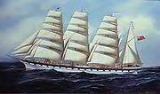
A clipper was a very fast sailing ship
Sailing ship
The term sailing ship is now used to refer to any large wind-powered vessel. In technical terms, a ship was a sailing vessel with a specific rig of at least three masts, square rigged on all of them, making the sailing adjective redundant. In popular usage "ship" became associated with all large...

 of the 19th century that had three or more masts
Mast (sailing)
The mast of a sailing vessel is a tall, vertical, or near vertical, spar, or arrangement of spars, which supports the sails. Large ships have several masts, with the size and configuration depending on the style of ship...

 and a square rig
Square rig
Square rig is a generic type of sail and rigging arrangement in which the primary driving sails are carried on horizontal spars which are perpendicular, or square, to the keel of the vessel and to the masts. These spars are called yards and their tips, beyond the last stay, are called the yardarms...

. They were generally narrow for their length, could carry limited bulk freight, small by later 19th century standards, and had a large total sail
Sail
A sail is any type of surface intended to move a vessel, vehicle or rotor by being placed in a wind—in essence a propulsion wing. Sails are used in sailing.-History of sails:...

 area. Clipper ships were mostly made in British and American shipyard
Shipyard
Shipyards and dockyards are places which repair and build ships. These can be yachts, military vessels, cruise liners or other cargo or passenger ships. Dockyards are sometimes more associated with maintenance and basing activities than shipyards, which are sometimes associated more with initial...

s, though France
France
The French Republic , The French Republic , The French Republic , (commonly known as France , is a unitary semi-presidential republic in Western Europe with several overseas territories and islands located on other continents and in the Indian, Pacific, and Atlantic oceans. Metropolitan France...

, the Netherlands
Netherlands
The Netherlands is a constituent country of the Kingdom of the Netherlands, located mainly in North-West Europe and with several islands in the Caribbean. Mainland Netherlands borders the North Sea to the north and west, Belgium to the south, and Germany to the east, and shares maritime borders...

 and other nations also produced some. Clippers sailed all over the world, primarily on the trade routes between the United Kingdom and its colonies
Colony
In politics and history, a colony is a territory under the immediate political control of a state. For colonies in antiquity, city-states would often found their own colonies. Some colonies were historically countries, while others were territories without definite statehood from their inception....

 in the east, in trans-Atlantic trade, and the New York
New York
New York is a state in the Northeastern region of the United States. It is the nation's third most populous state. New York is bordered by New Jersey and Pennsylvania to the south, and by Connecticut, Massachusetts and Vermont to the east...

-to-San Francisco route round Cape Horn
Cape Horn
Cape Horn is the southernmost headland of the Tierra del Fuego archipelago of southern Chile, and is located on the small Hornos Island...

 during the California Gold Rush
California Gold Rush
The California Gold Rush began on January 24, 1848, when gold was found by James W. Marshall at Sutter's Mill in Coloma, California. The first to hear confirmed information of the gold rush were the people in Oregon, the Sandwich Islands , and Latin America, who were the first to start flocking to...

. Dutch clipper
Dutch clipper
While the majority of the clipper ships sailed under British and American flags, more than a hundred clippers were built in the Netherlands. They were medium clippers rather than the larger extreme clipper....

s were built beginning in 1850s for the tea trade and passenger service to Java
Java
Java is an island of Indonesia. With a population of 135 million , it is the world's most populous island, and one of the most densely populated regions in the world. It is home to 60% of Indonesia's population. The Indonesian capital city, Jakarta, is in west Java...

.

The boom years of the Clipper Ship Era began in 1843 as a result of the growing demand for a more rapid delivery of tea from China. It continued under the stimulating influence of the discovery of gold in California and Australia in 1848 and 1851, and ended with the opening of the Suez Canal in 1869.

Origin of the nautical term "clipper"


The term "clipper" most likely derives from the verb "clip", which in former times meant, among other things, to run or fly swiftly. Dryden
John Dryden
John Dryden was an influential English poet, literary critic, translator, and playwright who dominated the literary life of Restoration England to such a point that the period came to be known in literary circles as the Age of Dryden.Walter Scott called him "Glorious John." He was made Poet...

, the English poet, used the word "clip" to describe the swift flight of a falcon in the 17th century when he said "And, with her eagerness the quarry missed, Straight flies at check, and clips it down the wind." The ships appeared to clip along the ocean water. The term "clip" became synonymous with "speed" and was also applied to fast horse
Horse
The horse is one of two extant subspecies of Equus ferus, or the wild horse. It is a single-hooved mammal belonging to the taxonomic family Equidae. The horse has evolved over the past 45 to 55 million years from a small multi-toed creature into the large, single-toed animal of today...

s and sailing ships. "To clip it," and "going at a good clip," are familiar expressions to this day.

While the first application of the term "clipper" in a nautical sense is by no means certain, it seems to have had an American origin when applied to the Baltimore clipper
Baltimore Clipper
Baltimore Clipper is the colloquial name for fast sailing ships built on the south-eastern seaboard of the United States of America, especially at the port of Baltimore, Maryland...

s of the late 18th century. When these vessels of a new model were built, which were intended to "clip" over the waves rather than plough through them, the improved type of craft became known as "clippers" because of their speed.

In England the nautical term "clipper" appeared a little later. The Oxford English Dictionary
Oxford English Dictionary
The Oxford English Dictionary , published by the Oxford University Press, is the self-styled premier dictionary of the English language. Two fully bound print editions of the OED have been published under its current name, in 1928 and 1989. The first edition was published in twelve volumes , and...

says its earliest quotation for "clipper" is from 1830. This does not mean, however, that little British opium clippers from prior to 1830 were not called "opium clippers" just as they are today. Cutler reports the first newspaper appearance was in 1835, and by then the term was apparently familiar. An undated painting of the British Water Witch built in 1831 is labeled OPIUM CLIPPER "WATER WITCH" so the term had at least passed into common usage during the time that this ship sailed.

Brief history


The first ships to which the term "clipper" appears to have been applied were the Baltimore clipper
Baltimore Clipper
Baltimore Clipper is the colloquial name for fast sailing ships built on the south-eastern seaboard of the United States of America, especially at the port of Baltimore, Maryland...

s. Baltimore clippers were topsail
Topsail
A topsail is a sail set above another sail; on square-rigged vessels further sails may be set above topsails.- Square rig :On a square rigged vessel, a topsail is a square sail rigged above the course sail and below the topgallant sail where carried...

 schooner
Schooner
A schooner is a type of sailing vessel characterized by the use of fore-and-aft sails on two or more masts with the forward mast being no taller than the rear masts....

s developed in Chesapeake Bay
Chesapeake Bay
The Chesapeake Bay is the largest estuary in the United States. It lies off the Atlantic Ocean, surrounded by Maryland and Virginia. The Chesapeake Bay's drainage basin covers in the District of Columbia and parts of six states: New York, Pennsylvania, Delaware, Maryland, Virginia, and West...

 before the American Revolution
American Revolution
The American Revolution was the political upheaval during the last half of the 18th century in which thirteen colonies in North America joined together to break free from the British Empire, combining to become the United States of America...

, and which reached their zenith between 1795 and 1815. They were small, rarely exceeding 200 tons OM
Builder's Old Measurement
Builder's Old Measurement is the method of calculating the size or cargo capacity of a ship used in England from approximately 1720 to 1849. It estimated the tonnage of a ship based on length and maximum beam...

, and modelled after French luggers. Some were lightly armed in the War of 1812
War of 1812
The War of 1812 was a military conflict fought between the forces of the United States of America and those of the British Empire. The Americans declared war in 1812 for several reasons, including trade restrictions because of Britain's ongoing war with France, impressment of American merchant...

, sailing under Letters of Marque and Reprisal
Letter of marque
In the days of fighting sail, a Letter of Marque and Reprisal was a government licence authorizing a person to attack and capture enemy vessels, and bring them before admiralty courts for condemnation and sale...

, when the type—exemplified by Chasseur, launched at Fells Point, Baltimore in 1814 became known for her incredible speed; the deep draft
Draft (hull)
The draft of a ship's hull is the vertical distance between the waterline and the bottom of the hull , with the thickness of the hull included; in the case of not being included the draft outline would be obtained...

 enabled the Baltimore clipper to sail close to the wind. Clippers, running the British blockade of Baltimore, came to be recognized for speed rather than cargo space.

Fast speed was required for the Chinese opium trade between England, India and China. Small, sharp-bowed British vessels were the result. An early example, which is today known as an opium clipper, was the Transit of 1819. She was followed by many more.

Meanwhile Baltimore Clippers still continued to be built, and were built specifically for the China opium trade running opium between India and China, a trade that only became unprofitable for American shipowners in 1849.

The first attempt at building a larger swift vessel was in America with the Ann McKim, 494 tons OM
Builder's Old Measurement
Builder's Old Measurement is the method of calculating the size or cargo capacity of a ship used in England from approximately 1720 to 1849. It estimated the tonnage of a ship based on length and maximum beam...

, built on the enlarged lines of a Baltimore clipper, with sharply raked stem
Stem (ship)
The stem is the very most forward part of a boat or ship's bow and is an extension of the keel itself and curves up to the wale of the boat. The stem is more often found on wooden boats or ships, but not exclusively...

, counter stern
Transom (nautical)
In naval architecture, a transom is the surface that forms the stern of a vessel. Transoms may be flat or curved and they may be vertical, raked forward, also known as a retroussé or reverse transom, angling forward from the waterline to the deck, or raked aft, often simply called "raked", angling...

 and square rig. She was built in Baltimore in 1833 by Kennard & Williamson. Although the Ann McKim was the first large clipper ship ever constructed, it cannot be said that she founded the clipper ship era, or even that she directly influenced shipbuilders, since no other ship was built like her; but she may have suggested the clipper design in vessels of ship rig. She did, however, influence the building of the Rainbow
Rainbow (clipper)
The Rainbow, launched in New York in 1845 to sail in the China trade for the firm Howland & Aspinwall, was the first extreme clipper ship.-The first extreme clipper ship:...

in 1845, the first extreme clipper
Extreme clipper
An extreme clipper is a clipper designed to sacrifice cargo capacity for speed. They had a bow lengthened above the water, a drawing out and sharpening of the forward body, and the greatest breadth further aft. Extreme clippers were built in the period 1845 to 1855.-Medium and extreme clippers:From...

 ship.

In Aberdeen
Aberdeen
Aberdeen is Scotland's third most populous city, one of Scotland's 32 local government council areas and the United Kingdom's 25th most populous city, with an official population estimate of ....

, Scotland
Scotland
Scotland is a country that is part of the United Kingdom. Occupying the northern third of the island of Great Britain, it shares a border with England to the south and is bounded by the North Sea to the east, the Atlantic Ocean to the north and west, and the North Channel and Irish Sea to the...

, the shipbuilders Alexander Hall and Sons
Alexander Hall and Sons
Alexander Hall and Sons built ships in Aberdeen from 1797 to 1957.Alexander Hall took over his father-in-law’s shipbuilding business Cochar and Gibbon in 1790 to found Alexander Hall and Company. Their first ships were wooden sailing vessels...

 developed the "Aberdeen" clipper bow in the late 1830s: the first was the Scottish Maid launched in 1839. The Scottish Maid, 150 tons OM, was the first British clipper ship. "Scottish Maid was intended for the Aberdeen-London trade, where speed was crucial to compete with steamships. The Hall brothers tested various hulls in a water tank and found the clipper design most effective. The design was influenced by tonnage regulations. Tonnage measured a ship's cargo capacity and was used to calculate tax and harbour dues. The new 1836 regulations measured depth and breadth with length measured at half midship depth. Extra length above this level was tax-free and became a feature of clippers. Scottish Maid proved swift and reliable and the design was widely copied." The earliest British clipper ships were built for trade amongst the British Isles. Then followed the vast clipper trade of tea, opium, spices and other goods from the Far East to Europe, and the ships became known as "tea clippers".

From 1839, larger American clipper ships started to be built beginning with the Akbar, 650 tons OM, in 1839, and including the 1844-built Houqua
Houqua (clipper)
The Houqua was an early clipper ship with an innovative hull design, built for A.A. Low & Brother in 1844. She sailed in the China trade.-Name:...

, 581 tons OM. These larger vessels were built predominantly for use in the China tea trade and known as "tea clippers". Smaller clipper vessels also continued to be built predominantly for the China opium trade and known as "opium clippers" such as the 1842 built Ariel
Ariel (clipper)
Ariel was a clipper ship famous for making fast voyages between China and England in the late 1860s.Ariel was a full rigged ship of 853 tons net register, measuring x 33.9 feet x . She was designed by William Rennie, and built in 1865 by Robert Steele & Co., Greenock for Shaw, Lowther & Maxton of...

, 100 tons OM.

Then in 1845 the Rainbow
Rainbow (clipper)
The Rainbow, launched in New York in 1845 to sail in the China trade for the firm Howland & Aspinwall, was the first extreme clipper ship.-The first extreme clipper ship:...

, 757 tons OM, the first extreme clipper
Extreme clipper
An extreme clipper is a clipper designed to sacrifice cargo capacity for speed. They had a bow lengthened above the water, a drawing out and sharpening of the forward body, and the greatest breadth further aft. Extreme clippers were built in the period 1845 to 1855.-Medium and extreme clippers:From...

 was launched in New York. These American clippers were larger vessels designed to sacrifice cargo capacity for speed. They had a bow lengthened above the water, a drawing out and sharpening of the forward body, and the greatest breadth further aft. Extreme clippers were built in the period 1845 to 1855. From 1851 or earlier another type of clipper ship was also being built in American shipyards, the medium clipper
Medium clipper
A Medium clipper is a type of clipper designed for both cargo carrying capacity and speed. An evolutionary adaptation of the extreme clipper, the medium clipper had been invented by 1851, when the hull type appeared in U.S. shipyards...

. The medium clipper, though still very fast, had comparatively more allowance for cargo. After 1854 extreme clippers were replaced in American shipbuilding yards by medium clippers.

Clipper ships largely ceased being built in American shipyards in 1859 when, unlike the earlier boom years, only 4 clipper ships were built. That is except for a small number built in the 1860s, and the last American clipper ship from the East Boston shipyard of Donald McKay
Donald McKay
Donald McKay was a Canadian-born American designer and builder of sailing ships.He was born in Jordan Falls, Shelburne County on Nova Scotia's South Shore. In 1826 he moved to New York, working for shipbuilders Brown & Bell and Isaac Webb...

 in 1869, the Glory of the Seas.

During the time from 1859 British clipper ships continued to be built. Earlier British clipper ships had become known as extreme clippers, and were considered to be "as sharp as the American" built ships. From 1859 a new design was developed for British clipper ships that was nothing like the American clippers. These ships built from 1859 continued to be called extreme clippers. The new design had a sleek graceful appearance, less sheer, less freeboard, lower bulwarks, and smaller breadth. They were built for the China tea trade and began with the Falcon in 1859, and finished with the last ships built in 1870. It is estimated that 25 to 30 of these ships were built, and no more than 4-5 per year. The earlier ships were made from wood, though some were made from iron, just as some British clippers had been made from iron prior to 1859. In 1863 the first tea clippers of composite construction were brought out, combining the best of both worlds. Composite clippers had the strength of iron spars with wooden hulls, and copper sheathing
Copper sheathing
Copper sheathing was the practice of protecting the under-water hull of a ship or boat through the use of copper plates affixed to the outside of the hull. It was pioneered and developed by the Royal Navy during the 18th century.-Development:...

 could be added to prevent the fouling that occurred on iron hulls.

After 1869 with the opening of the Suez Canal
Suez Canal
The Suez Canal , also known by the nickname "The Highway to India", is an artificial sea-level waterway in Egypt, connecting the Mediterranean Sea and the Red Sea. Opened in November 1869 after 10 years of construction work, it allows water transportation between Europe and Asia without navigation...

 that allowed competition with steam vessels, the tea trade then collapsed for clippers. From 1870 the clipper trade increasingly focused on trade and the carrying of immigrants between England and Australia and New Zealand, a trade that had begun earlier with the Australian Gold Rush in the 1850s. British-built clipper ships were used for this trade, as were many American-built ships which were sold to British owners. Even in the 1880s, sailing ships were still the main carriers of cargoes to and from Australia and New Zealand. Eventually, however, even this trade became unprofitable, and the aging clipper fleet became unseaworthy.

China clippers and the epitome of sail


The most significant clippers were the China clippers, also called Tea clippers or Opium clippers, designed to ply the trade routes between Europe
Europe
Europe is, by convention, one of the world's seven continents. Comprising the westernmost peninsula of Eurasia, Europe is generally 'divided' from Asia to its east by the watershed divides of the Ural and Caucasus Mountains, the Ural River, the Caspian and Black Seas, and the waterways connecting...

 and the East Indies
East Indies
East Indies is a term used by Europeans from the 16th century onwards to identify what is now known as Indian subcontinent or South Asia, Southeastern Asia, and the islands of Oceania, including the Malay Archipelago and the Philippines...

. The last example of these still in reasonable condition was Cutty Sark
Cutty Sark
The Cutty Sark is a clipper ship. Built in 1869, she served as a merchant vessel , and then as a training ship until being put on public display in 1954...

, preserved in dry dock
Dry dock
A drydock is a narrow basin or vessel that can be flooded to allow a load to be floated in, then drained to allow that load to come to rest on a dry platform...

 at Greenwich
Greenwich
Greenwich is a district of south London, England, located in the London Borough of Greenwich.Greenwich is best known for its maritime history and for giving its name to the Greenwich Meridian and Greenwich Mean Time...

, United Kingdom
United Kingdom
The United Kingdom of Great Britain and Northern IrelandIn the United Kingdom and Dependencies, other languages have been officially recognised as legitimate autochthonous languages under the European Charter for Regional or Minority Languages...

. Damaged by fire on 21 May 2007 while undergoing conservation, the ship was permanently elevated three meters above the dry dock floor in 2011 as part a plan for long-term preservation.

Before the early 18th century, the East India Company paid for its tea mainly in silver. However, when the price of silver rose, the East India Company began to manufacture a product that was desired by the Chinese as much as tea was by the British: opium. This had a significant influence on both India and China. Opium was also imported into Britain and was not prohibited because it was thought to be medically beneficial. Laudanum, which was made from opium was also used as a pain killer, to induce sleep and to suppress anxiety. The famous literary opium addicts Thomas De Quincey
Thomas de Quincey
Thomas Penson de Quincey was an English esssayist, best known for his Confessions of an English Opium-Eater .-Child and student:...

, Samuel Taylor Coleridge
Samuel Taylor Coleridge
Samuel Taylor Coleridge was an English poet, Romantic, literary critic and philosopher who, with his friend William Wordsworth, was a founder of the Romantic Movement in England and a member of the Lake Poets. He is probably best known for his poems The Rime of the Ancient Mariner and Kubla...

 and Wilkie Collins
Wilkie Collins
William Wilkie Collins was an English novelist, playwright, and author of short stories. He was very popular during the Victorian era and wrote 30 novels, more than 60 short stories, 14 plays, and over 100 non-fiction pieces...

 also took it for its pleasurable effects. The Limehouse area in London was notorious for its opium dens, many of which catered for Chinese sailors as well as English addicts.

Clippers were built for seasonal trades such as tea, where an early cargo was more valuable, or for passenger routes. The small, fast ships were ideally suited to low-volume, high-profit goods, such as tea
Tea
Tea is an aromatic beverage prepared by adding cured leaves of the Camellia sinensis plant to hot water. The term also refers to the plant itself. After water, tea is the most widely consumed beverage in the world...

, opium
Opium
Opium is the dried latex obtained from the opium poppy . Opium contains up to 12% morphine, an alkaloid, which is frequently processed chemically to produce heroin for the illegal drug trade. The latex also includes codeine and non-narcotic alkaloids such as papaverine, thebaine and noscapine...

, spice
Spice
A spice is a dried seed, fruit, root, bark, or vegetative substance used in nutritionally insignificant quantities as a food additive for flavor, color, or as a preservative that kills harmful bacteria or prevents their growth. It may be used to flavour a dish or to hide other flavours...

s, people, and mail. The return could be spectacular. The Challenger
Challenger (clipper)
Challenger was a wooden clipper ship built in 1852 by Richard & Henry Green, Blackwall Yard for Hugh Hamilton Lindsay, London.From "The Copartnership Herald", Vol. I, no...

returned from Shanghai
Shanghai
Shanghai is the largest city by population in China and the largest city proper in the world. It is one of the four province-level municipalities in the People's Republic of China, with a total population of over 23 million as of 2010...

 with "the most valuable cargo of tea and silk ever to be laden in one bottom". Competition among the clippers was public and fierce, with their times recorded in the newspapers. The ships had short-expected lifetimes and rarely outlasted two decades of use before they were broken up for salvage. Given their speed and maneuverability, clippers frequently mounted cannon
Cannon
A cannon is any piece of artillery that uses gunpowder or other usually explosive-based propellents to launch a projectile. Cannon vary in caliber, range, mobility, rate of fire, angle of fire, and firepower; different forms of cannon combine and balance these attributes in varying degrees,...

 or carronade
Carronade
The carronade was a short smoothbore, cast iron cannon, developed for the Royal Navy by the Carron Company, an ironworks in Falkirk, Scotland, UK. It was used from the 1770s to the 1850s. Its main function was to serve as a powerful, short-range anti-ship and anti-crew weapon...

s and were used for piracy, privateer
Privateer
A privateer is a private person or ship authorized by a government by letters of marque to attack foreign shipping during wartime. Privateering was a way of mobilizing armed ships and sailors without having to spend public money or commit naval officers...

ing, smuggling
Smuggling
Smuggling is the clandestine transportation of goods or persons, such as out of a building, into a prison, or across an international border, in violation of applicable laws or other regulations.There are various motivations to smuggle...

, or interdiction service.

The last China clippers were acknowledged as the fastest sail vessels. When fully rigged and riding a tradewind, they had peak average speeds over 16 knots (31.4 km/h). The Great Tea Race of 1866
The Great Tea Race of 1866
The Great Tea Race of 1866 was an unofficial competition between the fastest clipper ships of the China tea trade to bring the season's first crop of tea to London in 1866....

 showcased their speed. China clippers are also the fastest commercial sailing vessels ever made. Their speeds have been exceeded many times by modern yacht
Yacht
A yacht is a recreational boat or ship. The term originated from the Dutch Jacht meaning "hunt". It was originally defined as a light fast sailing vessel used by the Dutch navy to pursue pirates and other transgressors around and into the shallow waters of the Low Countries...

s, but never by a commercial sail vessel. Only the fastest windjammer
Windjammer
A windjammer is the ultimate type of large sailing ship with an iron or for the most part steel hull, built to carry cargo in the late nineteenth and early twentieth century...

s could attain similar speeds.
The 24h record of the Champion of the Seas wasn't broken until 1984 (by a multihull), or 2001 (by another monohull).

American clippers


This article is missing details about the history of the American clippers (also known as California Clippers) and the influence of the Californian gold rush.

Clipper ship trading cards


Departures of American clipper ships, mostly from New York City
New York City
New York is the most populous city in the United States and the center of the New York Metropolitan Area, one of the most populous metropolitan areas in the world. New York exerts a significant impact upon global commerce, finance, media, art, fashion, research, technology, education, and...

 and Boston
Boston
Boston is the capital of and largest city in Massachusetts, and is one of the oldest cities in the United States. The largest city in New England, Boston is regarded as the unofficial "Capital of New England" for its economic and cultural impact on the entire New England region. The city proper had...

, Massachusetts
Massachusetts
The Commonwealth of Massachusetts is a state in the New England region of the northeastern United States of America. It is bordered by Rhode Island and Connecticut to the south, New York to the west, and Vermont and New Hampshire to the north; at its east lies the Atlantic Ocean. As of the 2010...

 to San Francisco, California
California
California is a state located on the West Coast of the United States. It is by far the most populous U.S. state, and the third-largest by land area...

, were advertised by clipper ship sailing cards, and represented the first pronounced use of color in American advertising art.

Decline


Decline in the use of clippers started with the economic slump following the Panic of 1857
Panic of 1857
The Panic of 1857 was a financial panic in the United States caused by the declining international economy and over-expansion of the domestic economy. Indeed, because of the interconnectedness of the world economy by the time of the 1850s, the financial crisis which began in the autumn of 1857 was...

 and continued with the gradual introduction of the steamship. Although clippers could be much faster than early steamships, they depended on the vagaries of the wind, while steamers could keep to a schedule. The steam clipper was developed around this time, and had auxiliary steam engines which could be used in the absence of wind. An example was Royal Charter
Royal Charter (ship)
The Royal Charter was a steam clipper which was wrecked off the beach of Porth Alerth in Dulas Bay on the north-east coast of Anglesey on 26 October 1859. The precise number of dead is uncertain as the passenger list was lost in the wreck but about 459 lives were lost, the highest death toll of any...

, built in 1857 and wrecked on the coast of Anglesey
Anglesey
Anglesey , also known by its Welsh name Ynys Môn , is an island and, as Isle of Anglesey, a county off the north west coast of Wales...

 in 1859. The final blow was the Suez Canal
Suez Canal
The Suez Canal , also known by the nickname "The Highway to India", is an artificial sea-level waterway in Egypt, connecting the Mediterranean Sea and the Red Sea. Opened in November 1869 after 10 years of construction work, it allows water transportation between Europe and Asia without navigation...

, opened in 1869, which provided a great shortcut for steamships between Europe
Europe
Europe is, by convention, one of the world's seven continents. Comprising the westernmost peninsula of Eurasia, Europe is generally 'divided' from Asia to its east by the watershed divides of the Ural and Caucasus Mountains, the Ural River, the Caspian and Black Seas, and the waterways connecting...

 and Asia
Asia
Asia is the world's largest and most populous continent, located primarily in the eastern and northern hemispheres. It covers 8.7% of the Earth's total surface area and with approximately 3.879 billion people, it hosts 60% of the world's current human population...

, but was difficult for sailing ships to use. With the absence of the tea trade, some clippers began operating in the wool trade, between Britain and Australia.

Although many clipper ships were built in the mid-19th century, Cutty Sark
Cutty Sark
The Cutty Sark is a clipper ship. Built in 1869, she served as a merchant vessel , and then as a training ship until being put on public display in 1954...

was, perhaps until recently, the only survivor. Falls of Clyde is a well-preserved example of a more conservatively designed, slower contemporary of the clippers, which was built for general freight in 1878. Other surviving examples of clippers of the era are less well preserved, for example the oldest surviving clipper City of Adelaide
City of Adelaide (1864)
The City of Adelaide was built in 1864 by William Pile, Hay and Co. in Sunderland, England, and was launched on 7 May 1864. The ship was commissioned in the Royal Navy as HMS Carrick between 1923 and 1948 and, after decommissioning, was known as Carrick until 2001...

(a.k.a. S.V. Carrick).

During the first and second World Wars, several battleship
Battleship
A battleship is a large armored warship with a main battery consisting of heavy caliber guns. Battleships were larger, better armed and armored than cruisers and destroyers. As the largest armed ships in a fleet, battleships were used to attain command of the sea and represented the apex of a...

s and aircraft carrier
Aircraft carrier
An aircraft carrier is a warship designed with a primary mission of deploying and recovering aircraft, acting as a seagoing airbase. Aircraft carriers thus allow a naval force to project air power worldwide without having to depend on local bases for staging aircraft operations...

s were built with a "clipper bow" for improved hydrodynamic efficiency. The clipper bow on carriers was an American peculiarity, Japanese ships did not feature it and British ships had the similar but differently-shaped "hurricane bow," whose purpose was, like the clipper bow, to improve hydrodynamic efficiency and, unlike the clipper bow, protect the hangar deck from spray.

Modern clipper ships


In 2000, two new clippers were built: Stad Amsterdam
Stad Amsterdam
The Stad Amsterdam is a three-masted clipper that was built in Amsterdam, the Netherlands, in 2000 at the Damen Oranjewerf....

and Cisne Branco
Cisne Branco
Cisne Branco is a tall ship of the Brazilian Navy hailing out of Rio de Janeiro, Brazil, though she travels worldwide.Cisne Branco is a full-rigged ship built in Amsterdam, Netherlands by Damen Shipyard...

 (Brazilian Navy). They are not replicas of any one ship, but an attempt to combine what their builders consider the "best" qualities of clipper ships.

Notable clipper ships


Three famous clipper ships which can be seen as models are Comet, Snow Squall, and Flying Cloud.

People associated with clipper ships

  • List of people who sailed on clipper ships
  • Joseph Warren Holmes
    Joseph Warren Holmes
    Captain Joseph Warren Holmes was an American sea captain noted for sailing around Cape Horn 84 times and Cape of Good Hope 14 times without a shipwreck or loss of a crewman...

  • Samuel Hartt Pook
    Samuel Hartt Pook
    Samuel Hartt Pook was a Boston-based American naval architect noted for designing very fast clipper ships.-Clipper ships:...

  • William Jardine
    William Jardine (surgeon)
    William Jardine was a Scottish physician and merchant. He co-founded the Hong Kong conglomerate Jardine, Matheson and Company. From 1841 to 1843, he was Member of Parliament for Ashburton as a Whig....


Similar ships

  • Blackwall Frigate
    Blackwall Frigate
    Blackwall Frigate was the colloquial name for a type of three-masted full-rigged ship built between the late 1830s and the mid 1870s. They were originally intended as replacements for the British East Indiaman in the trade between England, the Cape of Good Hope, India and China, but from the 1850s...

  • East Indiaman
  • Packet ship
    Packet ship
    A "packet ship" was originally a vessel employed to carry post office mail packets to and from British embassies, colonies and outposts. In sea transport, a packet service is a regular, scheduled service, carrying freight and passengers...

  • Russian navy steam clippers
  • Windjammer
    Windjammer
    A windjammer is the ultimate type of large sailing ship with an iron or for the most part steel hull, built to carry cargo in the late nineteenth and early twentieth century...


Overview and introduction

-- Beautifully illustrated introduction, by a member of Donald McKay
Donald McKay
Donald McKay was a Canadian-born American designer and builder of sailing ships.He was born in Jordan Falls, Shelburne County on Nova Scotia's South Shore. In 1826 he moved to New York, working for shipbuilders Brown & Bell and Isaac Webb...

's family -- Basic reading, a favorite of Franklin Delano Roosevelt

American clipper ships

-- The definitive narrative history, useful for checking discrepancies between sources -- The comprehensive reference for design and construction of American-built clipper ships, with numerous drawings, diagrams, and charts. Gives examples of how each design feature varies in different ships. Articles on individual ships, broader coverage than Crothers

Clipper ships by type

-- British and Australian clippers -- One of the few comprehensive books on these ships

External links