

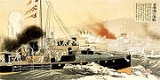
Naval tactics in the Age of Steam

Encyclopedia
The development of the steam ironclad firing explosive shells
in the mid 19th century rendered sailing tactics obsolete. New tactics were developed for the big-gun Dreadnought
battleship
s. The mine
, torpedo
, submarine
and aircraft
posed new threats, each of which had to be countered, leading to tactical developments such as anti-submarine warfare
and the use of dazzle camouflage
. By the end of the steam age, aircraft carriers had replaced battleship
s as the principal unit of the fleet
.
in 1815 and the beginning of the Russo-Japanese War
in 1904 was marked by no major naval war. There was fighting at sea, and there were prolonged blockade
s, but there were no campaigns
between large and well-appointed navies.
During this period an entire revolution took place in the means of propulsion, armament and construction of ships. Steam was applied to warships, at first as an auxiliary force, in the second quarter of the 19th century. The Crimean War
gave a great stimulus to the development of the guns. It also brought about the application of iron to ships as a cuirass. Very soon metal was adopted as the material out of which ships were made. The extended use of shells
, by immensely increasing the danger of fire, rendered wood so inflammable that it was too dangerous for employment in a warship
. Changes so sweeping as these could not take place without affecting all the established ideas as to propulsion, armament and construction.
in 1866 seemed to give force to this supposition. Accidental collisions such as those between the British warships Vanguard and Iron Duke, Victoria and Camperdown showed how fatal a wound could be given by the ram of a steam warship. But even the sinking of the Re d’Italia was largely an accident, and steam-powered ramming turned out to be impractical.
Between vessels both under full control, a collision was easily avoided where there was space to move. In a mêlée, or pell-mell battle, opportunities would occur for the use of the ram, but the torpedo
and the mine
soon made it very dangerous for one fleet to rush at another. The torpedo may be said therefore to have excluded the pell-mell battle and the use of the ram except on rare occasions.
Ramming as a tactic also invalidated the former need to concentrate guns on the broadside, which in any case was being made obsolete by the larger guns developed as a consequence of the Industrial Revolution
and made necessary by the iron or steel armour now being used. Fewer of the large guns could be carried or mounted, and a wider arc of fire was required to compensate.
Since ships would be required to fight "end-on" when attempting to ram (or to rush into a pell-mell battle), many ships were designed to give as much fire ahead (and sometimes astern) as on the broadside. This was usually at the expense of seaworthiness, and in many cases firing directly ahead caused blast damage to superstructure, decks and fittings. This was another factor which made ramming invalid as a tactic.
Furthermore, a ship designed to have a ramming capability typically had a tumble-home hull design which would allow the ram to strike below the waterline. This design of hull is inherently slower than almost any other hull design, giving an additional disadvantage to ships employing rams.
. A weapon which is a floating and moving mine, capable up to a certain point of being directed on its course, invisible or very hard to trace, and able to deliver its blow beneath the water-line, was so complete a novelty that its action was hard to foresee. The new weapon scored its first success in the Chilean Civil War
, when the old Congressional battleship "Blanco Encalada" was sunk at anchor by the Balmacedist torpedo gunboat "Almirante Lynch".
The question arose whether the torpedo itself would not become the decisive weapon in naval warfare. It was undoubtedly capable of producing a great effect when its power could be fully exerted. A school arose, having its most convinced partisans in France
, which argued that, as a small vessel could destroy a great battleship
with a single torpedo, the first would drive the second off the sea. The battleship
was to give place to the torpedo boat
or torpedo-boat destroyer
, which was itself only a torpedo boat of larger size.
But the torpedo was subject to close restrictions. It could not be used with effect at more than 2,000 yards. Water resistance rendered its course uncertain and comparatively slow, so that a moving opponent could avoid it, which was comparatively easy given that most early torpedoes leftbehind a tell-tale trail of bubbles in their wake. Torpedo boats were small and could easily be sunk by gunfire. By night the risk from gunfire was less, but the invention of the searchlight made it possible to keep the waters round a ship under observation all night.
From the torpedo sprang too the submarine
, which aimed at striking below the surface, where it itself was, like its weapon, invisible, or nearly so.
was the first test of the new concepts. The war was a stunning victory for Japan
, opening with the blockade and gradual immobilization of the Russian Pacific Fleet at Port Arthur
and culminating in the destruction of the Russian Baltic Fleet at the Battle of Tsushima
in 1905.
and Japan
the torpedo
was at first used with success, but the injury it produced fell below expectations, even when allowance is made for the fact that the Russian squadron
at Port Arthur
had the means of repair close at hand. In the sea fights of the war it was of subordinate use, and indeed was not employed except to give the final stroke to, or force the surrender of, an already crippled ship.
as an offensive, rather than purely defensive, weapon when the Japanese laid a minefield outside Port Arthur. On April 12, 1904, the Russian flagship Petropavlovsk ran into the minefield off Port Arthur and was sunk, while the battleship Pobieda was badly damaged. The Russians turned the same tactic on the Japanese who lost two of their six battleships, the Yashima
and the Hatsuse
, in a newly laid Russian minefield off Port Arthur a month later.
(and as much may be said for the war between the United States and Spain) confirmed an old experience. A resolute attempt was made by the Americans to block the entrance to Santiago de Cuba
by sinking a ship in it. The Japanese renewed the attempt on a great scale, and with the utmost intrepidity, at Port Arthur
; but though a steamship can move with a speed and precision impossible to a sailing ship, and can therefore be sunk more surely at a chosen spot, the experiment failed. Neither Americans nor Japanese succeeded in preventing their enemy from coming out when he wished to come.
began to emerge; a steel-armoured ship, entirely dependent on steam and carrying a relatively small number of large guns mounted in turrets, typically arranged along the centreline of the main deck. The revolutionary Dreadnought
of 1906 was the first battleship to entirely dispense with smaller guns and used steam turbine
s for her main propulsion. The Dreadnought rendered all existing battleships obsolete, because she was larger, faster, more powerfully armed and more strongly protected than existing battleships, which came to be known as pre-Dreadnoughts. This sudden levelling of the field led to a naval arms race as Britain and Germany and, to a lesser extent, other powers like the United States
, France
, Russia
, Japan
, Italy
, Austria-Hungary
, Turkey
, Brazil
, Argentina
and Chile
all rushed to build or acquire Dreadnoughts.
s changed the nature of naval tactics. While concentration remained a fundamental objective of tactics, the increased range and field of fire of naval guns meant that admirals now sought to achieve concentration of fire, rather than concentration of ships. The aim of a skilful officer was to concentrate a superior force on a part of his opponent’s formation.
In the age of sail
, when the range of effective fire was a thousand or twelve hundred yards and guns could only be trained over a small arc because they were fired out of ports, concentration could only be effected by bringing a larger number of ships into close action with a smaller. By the early 20th century, when gunfire was effective at 7,000 yards or more, and when guns fired from turret
s and barbette
s had a far wider sweep, concentration could be effected from a distance. The power to effect it had to be sought by a judicious choice of position.
The "line ahead" had been imposed on sailing fleets by the need to bring each ship’s broadsides into action. Experiments made during manoeuvres by steam navies, combined with the experience gained in the war of 1904-05 in the Far East, showed that no material change had taken place in this respect. It was still as necessary as ever that all the guns should be so placed as to be capable of being brought to bear, and it was still a condition imposed by the physical necessities of the case that this freedom could only be obtained when ships followed one another in a line. This allowed each ship to fire over wide arcs without firing over friendly ships. Steaming with the enemy off to the side enabled a ship to fire salvoes with both the forward and rear turrets, maximizing the chances for a hit.
When in pursuit or flight, or when steaming on the look-out for a still unseen enemy, a fleet may be arranged in the "line abreast". A pursuing fleet would have to run the risk of being struck by torpedoes dropped by a retreating enemy. But it would have the advantage of being able to bring all its guns which can fire ahead to bear on the rear ship of the enemy. When an opponent was prepared to give battle, and turns his broadside so as to bring the maximum of his gunfire to bear, he must be answered by a similar display of force – in other words, the line ahead must be formed to meet the line ahead. Each ship in the line generally engaged its opposite number in the enemy battle line.
was intended to make it difficult to estimate a ship’s speed and heading and thus prevent submarines from effectively firing torpedoes. This was accomplished by painting striking designs along the ship, with long, bold lines frequently cutting across the hull and thus rendering the bow of the ship indistinct, which in turn prevented submarines from determining the heading or speed of the ships. This innovation was briefly lived however, as the stark lines intended to confuse submarines only made ships into more visible targets for aircraft. The final evolution of camouflage was into the now prevalent gray shades which almost all warships since WWII have been painted. In the US Navy this is known as "Haze Gray."
s of the First World War were similar to privateer
s in the age of sail
, because they were employed primarily to destroy the enemy's merchant traffic in an extremely opportunistic sense rather than engage in battle with enemy naval vessels. Individually, submarines were only capable of sinking a small number of ships because of their limited supply of torpedo
es and shells
.
Anti-submarine
tactics were in their infancy at the outbreak of the First World War. Surface warship
s lacked the means to detect submerged submarines or the weapons to attack them. Surface warships were reduced to hoping to sight the periscope
of a submerged submarine or the wake of its torpedoes. Other than gunfire, the only way to sink a submarine was by ramming. Defensive anti-submarine tactics largely consisted of turning ships end-on to the submarine, to reduce the size of the target, by turning towards a submarine sighted off the bows and away from a submarine sighted off the stern.
By the end of 1914, German cruiser
s had largely been cleared from the oceans and the main threat to shipping came from U-boats. The British Admiralty
was slow to respond to the change. Only in 1917, at the urging of the British Prime Minister, David Lloyd George
, did the British institute a convoy
system. Losses to U-boat
s dropped to a fraction of their former level.
 During WWI, the German forces occasionally employed Zeppelin
s to attack enemy shipping, but this never inflicted serious losses.
Towards the end of the war, the British began to develop the first aircraft carrier
s by adding flying off and then flying on decks to the large light cruiser Furious.
and scrapped some of their battleships and cruisers while still on the slipways. In addition to this, the Washington Naval Treaty established limits on the total tonnage of the fleets of America, Japan and Britain. It was decided in negotiations that a ration of power would be established of 5:5:3, corresponding to America, Britain and Japan in that order. This meant that the Japanese fleet would only be allowed a fraction of the power that was given to the American and British fleets, a fact which lead directly to the Japanese construction of super battleships. It should be noted that, while this treaty was extremely explicit in its governance of battleship and cruiser tonnage, it was lax in the area of carriers, a fact which all of the participants failed to take advantage of.
The growing tensions of the 1930s and the rise of aggressive nationalist governments in Japan, Italy and Germany restarted the building programs, with even larger ships than before; Yamato
, the largest battleship ever, displaced 72,000 tons, and mounted 18.1-inch guns.
Under the terms of the Washington Treaty, Britain, America and Japan were allowed to convert two ships that were due to scrap under the treaty into aircraft carrier
s. By luck as much as planning, the Americans and Japanese both developed large carriers that were capable of handling up to 90 aircraft, based on the hulls of battlecruiser
s due to be scrapped under the Washington Treaty. Both navies gradually began to develop new tactics for employing aircraft carrier
s in battle, although these tactics did not come into full fruition until the middle of the pacific campaign of WWII.
The oxygen Long lance torpedo, which used pure oxygen instead of air for the oxidizer, was developed by the Japanese just prior to their full involvement in WWII. Despite having more than twice the effective range of the best allied torpedoes and lacking the tell-tale torpedo wake, the oxygen torpedo was not used to its best capacity by the Japanese Imperial Navy, mostly because of inefficient submarine deployment.
(or ASDIC
) and radar
, and the development of new technologies such as high-frequency direction finding (HF/DF)
.
In the North Sea and Atlantic, Germany lacked the strength to challenge the Allies for command of the sea. Instead, German naval strategy relied on commerce raiding using capital ships, armed merchant cruisers, submarines and aircraft. The Allies immediately introduced a convoy system for the protection of trade that gradually extended out from the British Isles, eventually reaching as far as Panama, Bombay and Singapore.
In the Mediterranean, Britain and Italy fought a conventional naval war for command of the sea.
The need to provide capital ships with the anti-submarine protection of a destroyer
screen and air cover from an aircraft carrier
led to the increasing use of ad hoc task force
s, composed of whichever ships were available for a particular operation. Later in the war however, anti-submarine warfare was perfected to a large degree by the allies, meaning that much more specialized ships and equipment were deployed in convoys with the express purpose of detecting and destroying German (and later Japanese) submarines.
s and the development of naval air fleets. The employment of land-based and carrier-based aircraft during the Second World War showed that command of the sea
s rested in great part on control of the air above it.
Off Norway
in the spring of 1940 and in the English Channel
in the summer of that year, the German Luftwaffe
demonstrated that the British could not maintain command of the sea
in daytime without command of the air. In the following year, the arrival of Luftwaffe
squadrons in the Mediterranean reversed the British ascendancy in the theatre by neutralizing the British dominance at sea.
by the Allies at the start of the Second World War, the German submarine
s (known as U-boats) operating against Allied trade in the Atlantic were driven to adopt new tactics.
Until the last year of the war, almost all U-boats were diesel
-powered, relying on electric motors for propulsion while underwater. This design had important tactical implications. The electric motors were far less powerful than the diesel engines and had a short battery life. When submerged, most submarines were capable of about 10 knots, little more than the slowest merchantman. So a submerged submarine was not only much slower than when on the surface, but also unable to proceed at its maximum submerged speed for any length of time. Submarines of the Second World War were more submersibles than true submarines.
Under Admiral
Karl Dönitz
the U-boats further developed the tactics of surface night attacks that had first been used in the First World War and then refined in exercises in the Baltic before the Second World War. Rather than attacking in daylight while submerged, the German U-boat commanders developed a tactic for operating more like torpedo boat
s than submarine
s, attacking on the surface at night where they could use their higher surfaced speed. Approaching the convoys at night on the surface, they found that they could pass quite close to the escorts and yet remain undetected. Look outs high up on the bridges of the escort ships found it all but impossible to spot the low shape of the U-boat with the tiny silhouette of the boat’s conning tower against the darkness of the water. But for the U-boats, the escorts and the merchantmen stood out starkly against the lightness of the sky.
The convoy battles of the First World War had taught the Germans that a single submarine had little prospect of success against a well defended convoy. Instead of attacking the Allied convoys singly, the German U-boats now began to work in packs co-ordinated centrally by radio. The boats spread out into a long patrol line that bisected the path of the Allied convoy routes. Once in position the boats used hydrophone
s to pick up the propeller noises of the convoys, or used binoculars to try to spot the tell-tale smoke of a convoy on the horizon. When one boat sighted a convoy, it followed it, broadcasting the convoy’s position and waiting for other boats to come up before attacking. So instead of being faced by a single submarine, the convoy escorts had to cope with a group of U-boats attacking in a single night. The most daring commanders, like Otto Kretschmer
, not only penetrated the convoy’s screen but attacked from within the columns of merchantmen in the convoy. The escort vessels, which were too few in number and often lacking in endurance, had no answer to the lone submarine attacking on the surface at night as their ASDIC
detection apparatus only worked against underwater targets.
Pack tactics were first used successfully in October 1940, to devastating effect in the battles of Convoys SC-7
and HX-79
. Convoy SC-7, with a weak escort of two sloops and two corvettes, was overwhelmed, losing 59% of its ships. The battle for Convoy HX-79 was in many ways worse than SC-7. The loss of a quarter of the convoy without any loss to the U-boats despite a strong escort of two destroyer
s, four corvette
s, three naval trawler
s and a minesweeper
demonstrated the utter inadequacy of the contemporary British anti-submarine tactics. The success of pack tactics against these two convoys encouraged Admiral Dönitz to adopt the wolf pack as his standard tactics.
The change in British tactics included the introduction of permanent escort groups to improve the co-ordination and effectiveness of ships and men in battle. Initially, the escort groups consisted of two or three destroyer
s and half a dozen corvette
s. Since two or three of the group would usually be in dock repairing weather or battle damage, the groups typically sailed with about six ships.
The Germans also made use of long-range patrol aircraft to find convoys for the U-boat packs to attack, though this tactic rarely succeeded.
Towards the end of the war the Germans introduced homing-torpedo
es that aimed for the noise made by a target’s propellers. Although devastatingly effective at first, the Allied scientists soon developed countermeasures.
The American submarine
campaign in the Pacific
contains many parallels with the German submarine campaign in the Atlantic. Like the Germans, the Americans began the war with a flawed weapon – faulty torpedoes – that undermined morale and took more than a year to fix. American submariners developed the same preference for attacking on the surface at night and similar pack tactics, although American wolf packs rarely exceeded three boats. But in the Pacific, it was the submarines, not the escorts, that benefited from the introduction of new technologies like radar. By 1943 many US submarines were fitted with radar
, which American submarines were routinely using to find convoys and track the positions of escorts at night.
, armed with sonar
(or Asdic) and depth charge
s.
The capture of U-570 in July 1941 gave the British a much greater understanding of the capabilities of the German U-boats. In particular, the British were astonished by the maximum safe diving depth of the U-boats, which was far below the deepest setting on Allied depth charges.
In the Pacific, the Japanese Navy
failed to get a grip on the problems of convoy defence and failed to evolve effective anti-submarine
tactics. With fewer escorts and many small convoys, the average number of escorts for a Japanese convoy was inevitably small and many were easily outmanoeuvred by the attacking submarines.
off Malaya on 10 December 1941 by Japanese aircraft marked the end of the era of the battleship.
By the end of the Pacific War
, the tactical role of battleship
s and cruiser
s had been reduced to providing anti-aircraft fire to protect the vulnerable carriers and bombarding shore positions. The Japanese battleships Yamato
and Musashi
were both sunk by aircraft long before they could come within striking range of the American fleet.
in November 1940, in which three Italian battleship
s were sunk, first demonstrated the full potential of the aircraft carrier. But the successful attack on ships in harbour did not convince advocates of the battleship
that their day was over.
It was the Japanese
who really developed the tactical and strategic potential of aircraft carriers. Learning from their experiences in operations off the Chinese coast from 1937 onwards, the Japanese began to combine their carriers into permanent squadrons. While the British and Americans were still operating carriers on their own or sometimes in pairs, by 1941 the Japanese had organized a naval air fleet containing as many as six aircraft carriers.
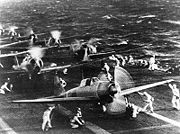 It was this force that struck the opening blow of the Pacific War
at Pearl Harbor
. The same carrier force then worked its way across the Pacific, attacking Allied forces at Rabaul
, in the Netherlands East Indies, at Darwin and finally at Colombo
and Trincomalee
in Ceylon. The Allied forces in the East Indies were overwhelmed and the old battleships of the British Eastern Fleet
forced to retreat as far as Kilindini on the African coast.
Despite these successes, many Japanese admirals still failed to grasp the tactical implications of the dominance of the aircraft carrier. Instead of using its battleships to escort the carriers, the Japanese Navy
continued to husband its battleships for the decisive fleet action, which never came.
The Japanese success in sinking or damaging almost all the US Pacific Fleet’s battleships at Pearl Harbor
forced the Americans to base their tactics on the aircraft carrier (though they would possibly have developed such tactics anyway). The Americans quickly assembled a group of task force
s, each based around a single carrier. Through a series of raids on Japanese-held islands, the American gradually grew more confident in their handling of aircraft carrier
s, learning that the right place for the task force commander was aboard a carrier, not one of the escorting cruisers, and developing tactics like having a single fighter direction officer for task forces operating in company. The four great carrier battles of 1942 – Coral Sea
, Midway
, Eastern Solomons
and Santa Cruz
– were all fought by aircraft without the ships on either side actually coming in sight of one another. The Japanese carriers were caught time and again by American aircraft with a light screen of cruisers and destroyers, contributing to the loss of six Japanese carriers in the four battles.
When the new American fast battleship
s began to arrive in the Pacific in the summer of 1942, they were allocated to the carrier task forces where their heavy anti-aircraft batteries could defend the vulnerable carriers, rather than being formed into separate battle squadrons. By 1943, as growing numbers of new carriers, battleship
s, cruiser
s and destroyer
s began to reach the Pacific, the Americans developed a fleet of fast carrier task force
s that swept across the Pacific over the next two years, isolating, overwhelming and then destroying the Japanese island bases.
Shell (projectile)
A shell is a payload-carrying projectile, which, as opposed to shot, contains an explosive or other filling, though modern usage sometimes includes large solid projectiles properly termed shot . Solid shot may contain a pyrotechnic compound if a tracer or spotting charge is used...
in the mid 19th century rendered sailing tactics obsolete. New tactics were developed for the big-gun Dreadnought
HMS Dreadnought (1906)
HMS Dreadnought was a battleship of the British Royal Navy that revolutionised naval power. Her entry into service in 1906 represented such a marked advance in naval technology that her name came to be associated with an entire generation of battleships, the "dreadnoughts", as well as the class of...
battleship
Battleship
A battleship is a large armored warship with a main battery consisting of heavy caliber guns. Battleships were larger, better armed and armored than cruisers and destroyers. As the largest armed ships in a fleet, battleships were used to attain command of the sea and represented the apex of a...
s. The mine
Naval mine
A naval mine is a self-contained explosive device placed in water to destroy surface ships or submarines. Unlike depth charges, mines are deposited and left to wait until they are triggered by the approach of, or contact with, an enemy vessel...
, torpedo
Torpedo
The modern torpedo is a self-propelled missile weapon with an explosive warhead, launched above or below the water surface, propelled underwater towards a target, and designed to detonate either on contact with it or in proximity to it.The term torpedo was originally employed for...
, submarine
Submarine
A submarine is a watercraft capable of independent operation below the surface of the water. It differs from a submersible, which has more limited underwater capability...
and aircraft
Aircraft
An aircraft is a vehicle that is able to fly by gaining support from the air, or, in general, the atmosphere of a planet. An aircraft counters the force of gravity by using either static lift or by using the dynamic lift of an airfoil, or in a few cases the downward thrust from jet engines.Although...
posed new threats, each of which had to be countered, leading to tactical developments such as anti-submarine warfare
Anti-submarine warfare
Anti-submarine warfare is a branch of naval warfare that uses surface warships, aircraft, or other submarines to find, track and deter, damage or destroy enemy submarines....
and the use of dazzle camouflage
Dazzle camouflage
Dazzle camouflage, also known as Razzle Dazzle or Dazzle painting, was a camouflage paint scheme used on ships, extensively during World War I and to a lesser extent in World War II...
. By the end of the steam age, aircraft carriers had replaced battleship
Battleship
A battleship is a large armored warship with a main battery consisting of heavy caliber guns. Battleships were larger, better armed and armored than cruisers and destroyers. As the largest armed ships in a fleet, battleships were used to attain command of the sea and represented the apex of a...
s as the principal unit of the fleet
Naval fleet
A fleet, or naval fleet, is a large formation of warships, and the largest formation in any navy. A fleet at sea is the direct equivalent of an army on land....
.
The development of tactics in the 19th Century
The interval of ninety years between the end of the Napoleonic WarsNapoleonic Wars
The Napoleonic Wars were a series of wars declared against Napoleon's French Empire by opposing coalitions that ran from 1803 to 1815. As a continuation of the wars sparked by the French Revolution of 1789, they revolutionised European armies and played out on an unprecedented scale, mainly due to...
in 1815 and the beginning of the Russo-Japanese War
Russo-Japanese War
The Russo-Japanese War was "the first great war of the 20th century." It grew out of rival imperial ambitions of the Russian Empire and Japanese Empire over Manchuria and Korea...
in 1904 was marked by no major naval war. There was fighting at sea, and there were prolonged blockade
Blockade
A blockade is an effort to cut off food, supplies, war material or communications from a particular area by force, either in part or totally. A blockade should not be confused with an embargo or sanctions, which are legal barriers to trade, and is distinct from a siege in that a blockade is usually...
s, but there were no campaigns
Military campaign
In the military sciences, the term military campaign applies to large scale, long duration, significant military strategy plan incorporating a series of inter-related military operations or battles forming a distinct part of a larger conflict often called a war...
between large and well-appointed navies.
During this period an entire revolution took place in the means of propulsion, armament and construction of ships. Steam was applied to warships, at first as an auxiliary force, in the second quarter of the 19th century. The Crimean War
Crimean War
The Crimean War was a conflict fought between the Russian Empire and an alliance of the French Empire, the British Empire, the Ottoman Empire, and the Kingdom of Sardinia. The war was part of a long-running contest between the major European powers for influence over territories of the declining...
gave a great stimulus to the development of the guns. It also brought about the application of iron to ships as a cuirass. Very soon metal was adopted as the material out of which ships were made. The extended use of shells
Shell (projectile)
A shell is a payload-carrying projectile, which, as opposed to shot, contains an explosive or other filling, though modern usage sometimes includes large solid projectiles properly termed shot . Solid shot may contain a pyrotechnic compound if a tracer or spotting charge is used...
, by immensely increasing the danger of fire, rendered wood so inflammable that it was too dangerous for employment in a warship
Warship
A warship is a ship that is built and primarily intended for combat. Warships are usually built in a completely different way from merchant ships. As well as being armed, warships are designed to withstand damage and are usually faster and more maneuvrable than merchant ships...
. Changes so sweeping as these could not take place without affecting all the established ideas as to propulsion, armament and construction.
Revival of ramming
Steam allowed the ship herself to be used as a projectile. Many thought that the use of the ram would again become common and the sinking of the Re d’Italia by the Austrian ironclad Erzherzog Ferdinand Max at the battle of LissaBattle of Lissa (1866)
The Battle of Lissa took place on 20 July 1866 in the Adriatic Sea near the Dalmatian island of Lissa and was a decisive victory for an outnumbered Austrian Empire force over a superior Italian force...
in 1866 seemed to give force to this supposition. Accidental collisions such as those between the British warships Vanguard and Iron Duke, Victoria and Camperdown showed how fatal a wound could be given by the ram of a steam warship. But even the sinking of the Re d’Italia was largely an accident, and steam-powered ramming turned out to be impractical.
Between vessels both under full control, a collision was easily avoided where there was space to move. In a mêlée, or pell-mell battle, opportunities would occur for the use of the ram, but the torpedo
Torpedo
The modern torpedo is a self-propelled missile weapon with an explosive warhead, launched above or below the water surface, propelled underwater towards a target, and designed to detonate either on contact with it or in proximity to it.The term torpedo was originally employed for...
and the mine
Naval mine
A naval mine is a self-contained explosive device placed in water to destroy surface ships or submarines. Unlike depth charges, mines are deposited and left to wait until they are triggered by the approach of, or contact with, an enemy vessel...
soon made it very dangerous for one fleet to rush at another. The torpedo may be said therefore to have excluded the pell-mell battle and the use of the ram except on rare occasions.
Ramming as a tactic also invalidated the former need to concentrate guns on the broadside, which in any case was being made obsolete by the larger guns developed as a consequence of the Industrial Revolution
Industrial Revolution
The Industrial Revolution was a period from the 18th to the 19th century where major changes in agriculture, manufacturing, mining, transportation, and technology had a profound effect on the social, economic and cultural conditions of the times...
and made necessary by the iron or steel armour now being used. Fewer of the large guns could be carried or mounted, and a wider arc of fire was required to compensate.
Since ships would be required to fight "end-on" when attempting to ram (or to rush into a pell-mell battle), many ships were designed to give as much fire ahead (and sometimes astern) as on the broadside. This was usually at the expense of seaworthiness, and in many cases firing directly ahead caused blast damage to superstructure, decks and fittings. This was another factor which made ramming invalid as a tactic.
Furthermore, a ship designed to have a ramming capability typically had a tumble-home hull design which would allow the ram to strike below the waterline. This design of hull is inherently slower than almost any other hull design, giving an additional disadvantage to ships employing rams.
Development of the torpedo
As the 19th century drew to a close, another element of uncertainty was introduced by the development of the torpedoTorpedo
The modern torpedo is a self-propelled missile weapon with an explosive warhead, launched above or below the water surface, propelled underwater towards a target, and designed to detonate either on contact with it or in proximity to it.The term torpedo was originally employed for...
. A weapon which is a floating and moving mine, capable up to a certain point of being directed on its course, invisible or very hard to trace, and able to deliver its blow beneath the water-line, was so complete a novelty that its action was hard to foresee. The new weapon scored its first success in the Chilean Civil War
Chilean Civil War
The Chilean Civil War of 1891 was an armed conflict between forces supporting Congress and forces supporting the sitting President, José Manuel Balmaceda. The war saw a confrontation between the Chilean Army and the Chilean Navy, which had sided with the president and the congress, respectively...
, when the old Congressional battleship "Blanco Encalada" was sunk at anchor by the Balmacedist torpedo gunboat "Almirante Lynch".
The question arose whether the torpedo itself would not become the decisive weapon in naval warfare. It was undoubtedly capable of producing a great effect when its power could be fully exerted. A school arose, having its most convinced partisans in France
France
The French Republic , The French Republic , The French Republic , (commonly known as France , is a unitary semi-presidential republic in Western Europe with several overseas territories and islands located on other continents and in the Indian, Pacific, and Atlantic oceans. Metropolitan France...
, which argued that, as a small vessel could destroy a great battleship
Battleship
A battleship is a large armored warship with a main battery consisting of heavy caliber guns. Battleships were larger, better armed and armored than cruisers and destroyers. As the largest armed ships in a fleet, battleships were used to attain command of the sea and represented the apex of a...
with a single torpedo, the first would drive the second off the sea. The battleship
Battleship
A battleship is a large armored warship with a main battery consisting of heavy caliber guns. Battleships were larger, better armed and armored than cruisers and destroyers. As the largest armed ships in a fleet, battleships were used to attain command of the sea and represented the apex of a...
was to give place to the torpedo boat
Torpedo boat
A torpedo boat is a relatively small and fast naval vessel designed to carry torpedoes into battle. The first designs rammed enemy ships with explosive spar torpedoes, and later designs launched self-propelled Whitehead torpedoes. They were created to counter battleships and other large, slow and...
or torpedo-boat destroyer
Destroyer
In naval terminology, a destroyer is a fast and maneuverable yet long-endurance warship intended to escort larger vessels in a fleet, convoy or battle group and defend them against smaller, powerful, short-range attackers. Destroyers, originally called torpedo-boat destroyers in 1892, evolved from...
, which was itself only a torpedo boat of larger size.
But the torpedo was subject to close restrictions. It could not be used with effect at more than 2,000 yards. Water resistance rendered its course uncertain and comparatively slow, so that a moving opponent could avoid it, which was comparatively easy given that most early torpedoes leftbehind a tell-tale trail of bubbles in their wake. Torpedo boats were small and could easily be sunk by gunfire. By night the risk from gunfire was less, but the invention of the searchlight made it possible to keep the waters round a ship under observation all night.
From the torpedo sprang too the submarine
Submarine
A submarine is a watercraft capable of independent operation below the surface of the water. It differs from a submersible, which has more limited underwater capability...
, which aimed at striking below the surface, where it itself was, like its weapon, invisible, or nearly so.
The Russo-Japanese War
The Russo-Japanese WarRusso-Japanese War
The Russo-Japanese War was "the first great war of the 20th century." It grew out of rival imperial ambitions of the Russian Empire and Japanese Empire over Manchuria and Korea...
was the first test of the new concepts. The war was a stunning victory for Japan
Japan
Japan is an island nation in East Asia. Located in the Pacific Ocean, it lies to the east of the Sea of Japan, China, North Korea, South Korea and Russia, stretching from the Sea of Okhotsk in the north to the East China Sea and Taiwan in the south...
, opening with the blockade and gradual immobilization of the Russian Pacific Fleet at Port Arthur
Lüshunkou
Lüshunkou is a district in the municipality of Dalian, Liaoning province, China. Also called Lüshun City or Lüshun Port, it was formerly known as both Port Arthur and Ryojun....
and culminating in the destruction of the Russian Baltic Fleet at the Battle of Tsushima
Battle of Tsushima
The Battle of Tsushima , commonly known as the “Sea of Japan Naval Battle” in Japan and the “Battle of Tsushima Strait”, was the major naval battle fought between Russia and Japan during the Russo-Japanese War...
in 1905.
First use of torpedoes in battle
In the war between RussiaRussia
Russia or , officially known as both Russia and the Russian Federation , is a country in northern Eurasia. It is a federal semi-presidential republic, comprising 83 federal subjects...
and Japan
Japan
Japan is an island nation in East Asia. Located in the Pacific Ocean, it lies to the east of the Sea of Japan, China, North Korea, South Korea and Russia, stretching from the Sea of Okhotsk in the north to the East China Sea and Taiwan in the south...
the torpedo
Torpedo
The modern torpedo is a self-propelled missile weapon with an explosive warhead, launched above or below the water surface, propelled underwater towards a target, and designed to detonate either on contact with it or in proximity to it.The term torpedo was originally employed for...
was at first used with success, but the injury it produced fell below expectations, even when allowance is made for the fact that the Russian squadron
Squadron (naval)
A squadron, or naval squadron, is a unit of 3-4 major warships, transport ships, submarines, or sometimes small craft that may be part of a larger task force or a fleet...
at Port Arthur
Lüshunkou
Lüshunkou is a district in the municipality of Dalian, Liaoning province, China. Also called Lüshun City or Lüshun Port, it was formerly known as both Port Arthur and Ryojun....
had the means of repair close at hand. In the sea fights of the war it was of subordinate use, and indeed was not employed except to give the final stroke to, or force the surrender of, an already crippled ship.
Effectiveness of mines
The war also saw the first use of minesNaval mine
A naval mine is a self-contained explosive device placed in water to destroy surface ships or submarines. Unlike depth charges, mines are deposited and left to wait until they are triggered by the approach of, or contact with, an enemy vessel...
as an offensive, rather than purely defensive, weapon when the Japanese laid a minefield outside Port Arthur. On April 12, 1904, the Russian flagship Petropavlovsk ran into the minefield off Port Arthur and was sunk, while the battleship Pobieda was badly damaged. The Russians turned the same tactic on the Japanese who lost two of their six battleships, the Yashima
Japanese battleship Yashima
|-External links:** The New York Times, June 2, 1905....
and the Hatsuse
Japanese battleship Hatsuse
|-External links:**...
, in a newly laid Russian minefield off Port Arthur a month later.
Lessons of the war
The Russo-Japanese WarRusso-Japanese War
The Russo-Japanese War was "the first great war of the 20th century." It grew out of rival imperial ambitions of the Russian Empire and Japanese Empire over Manchuria and Korea...
(and as much may be said for the war between the United States and Spain) confirmed an old experience. A resolute attempt was made by the Americans to block the entrance to Santiago de Cuba
Santiago de Cuba
Santiago de Cuba is the second largest city of Cuba and capital city of Santiago de Cuba Province in the south-eastern area of the island, some south-east of the Cuban capital of Havana....
by sinking a ship in it. The Japanese renewed the attempt on a great scale, and with the utmost intrepidity, at Port Arthur
Lüshunkou
Lüshunkou is a district in the municipality of Dalian, Liaoning province, China. Also called Lüshun City or Lüshun Port, it was formerly known as both Port Arthur and Ryojun....
; but though a steamship can move with a speed and precision impossible to a sailing ship, and can therefore be sunk more surely at a chosen spot, the experiment failed. Neither Americans nor Japanese succeeded in preventing their enemy from coming out when he wished to come.
Development of Dreadnoughts
As the 19th century came to a close, the familiar modern battleshipBattleship
A battleship is a large armored warship with a main battery consisting of heavy caliber guns. Battleships were larger, better armed and armored than cruisers and destroyers. As the largest armed ships in a fleet, battleships were used to attain command of the sea and represented the apex of a...
began to emerge; a steel-armoured ship, entirely dependent on steam and carrying a relatively small number of large guns mounted in turrets, typically arranged along the centreline of the main deck. The revolutionary Dreadnought
HMS Dreadnought (1906)
HMS Dreadnought was a battleship of the British Royal Navy that revolutionised naval power. Her entry into service in 1906 represented such a marked advance in naval technology that her name came to be associated with an entire generation of battleships, the "dreadnoughts", as well as the class of...
of 1906 was the first battleship to entirely dispense with smaller guns and used steam turbine
Steam turbine
A steam turbine is a mechanical device that extracts thermal energy from pressurized steam, and converts it into rotary motion. Its modern manifestation was invented by Sir Charles Parsons in 1884....
s for her main propulsion. The Dreadnought rendered all existing battleships obsolete, because she was larger, faster, more powerfully armed and more strongly protected than existing battleships, which came to be known as pre-Dreadnoughts. This sudden levelling of the field led to a naval arms race as Britain and Germany and, to a lesser extent, other powers like the United States
United States
The United States of America is a federal constitutional republic comprising fifty states and a federal district...
, France
France
The French Republic , The French Republic , The French Republic , (commonly known as France , is a unitary semi-presidential republic in Western Europe with several overseas territories and islands located on other continents and in the Indian, Pacific, and Atlantic oceans. Metropolitan France...
, Russia
Russia
Russia or , officially known as both Russia and the Russian Federation , is a country in northern Eurasia. It is a federal semi-presidential republic, comprising 83 federal subjects...
, Japan
Japan
Japan is an island nation in East Asia. Located in the Pacific Ocean, it lies to the east of the Sea of Japan, China, North Korea, South Korea and Russia, stretching from the Sea of Okhotsk in the north to the East China Sea and Taiwan in the south...
, Italy
Italy
Italy , officially the Italian Republic languages]] under the European Charter for Regional or Minority Languages. In each of these, Italy's official name is as follows:;;;;;;;;), is a unitary parliamentary republic in South-Central Europe. To the north it borders France, Switzerland, Austria and...
, Austria-Hungary
Austria-Hungary
Austria-Hungary , more formally known as the Kingdoms and Lands Represented in the Imperial Council and the Lands of the Holy Hungarian Crown of Saint Stephen, was a constitutional monarchic union between the crowns of the Austrian Empire and the Kingdom of Hungary in...
, Turkey
Turkey
Turkey , known officially as the Republic of Turkey , is a Eurasian country located in Western Asia and in East Thrace in Southeastern Europe...
, Brazil
Brazil
Brazil , officially the Federative Republic of Brazil , is the largest country in South America. It is the world's fifth largest country, both by geographical area and by population with over 192 million people...
, Argentina
Argentina
Argentina , officially the Argentine Republic , is the second largest country in South America by land area, after Brazil. It is constituted as a federation of 23 provinces and an autonomous city, Buenos Aires...
and Chile
Chile
Chile ,officially the Republic of Chile , is a country in South America occupying a long, narrow coastal strip between the Andes mountains to the east and the Pacific Ocean to the west. It borders Peru to the north, Bolivia to the northeast, Argentina to the east, and the Drake Passage in the far...
all rushed to build or acquire Dreadnoughts.
The First World War
The introduction of mines, torpedoes and submarines greatly increased the complexity of naval tactics during the First World War. Even so, the gun remained the principal naval weapon. It could still deliver its blows at the greatest distance in the greatest variety of circumstances.Fleet tactics
The development of long-range guns mounted in turretGun turret
A gun turret is a weapon mount that protects the crew or mechanism of a projectile-firing weapon and at the same time lets the weapon be aimed and fired in many directions.The turret is also a rotating weapon platform...
s changed the nature of naval tactics. While concentration remained a fundamental objective of tactics, the increased range and field of fire of naval guns meant that admirals now sought to achieve concentration of fire, rather than concentration of ships. The aim of a skilful officer was to concentrate a superior force on a part of his opponent’s formation.
In the age of sail
Naval tactics in the Age of Sail
Naval tactics in the Age of Sail were used from the early 17th century onward when sailing ships replaced oared galleys. These were used until the 1860s when steam-powered ironclad warships rendered sailing line of battle ships obsolete.-Early history:...
, when the range of effective fire was a thousand or twelve hundred yards and guns could only be trained over a small arc because they were fired out of ports, concentration could only be effected by bringing a larger number of ships into close action with a smaller. By the early 20th century, when gunfire was effective at 7,000 yards or more, and when guns fired from turret
Turret
In architecture, a turret is a small tower that projects vertically from the wall of a building such as a medieval castle. Turrets were used to provide a projecting defensive position allowing covering fire to the adjacent wall in the days of military fortification...
s and barbette
Barbette
A barbette is a protective circular armour feature around a cannon or heavy artillery gun. The name comes from the French phrase en barbette referring to the practice of firing a field gun over a parapet rather than through an opening . The former gives better angles of fire but less protection...
s had a far wider sweep, concentration could be effected from a distance. The power to effect it had to be sought by a judicious choice of position.
The "line ahead" had been imposed on sailing fleets by the need to bring each ship’s broadsides into action. Experiments made during manoeuvres by steam navies, combined with the experience gained in the war of 1904-05 in the Far East, showed that no material change had taken place in this respect. It was still as necessary as ever that all the guns should be so placed as to be capable of being brought to bear, and it was still a condition imposed by the physical necessities of the case that this freedom could only be obtained when ships followed one another in a line. This allowed each ship to fire over wide arcs without firing over friendly ships. Steaming with the enemy off to the side enabled a ship to fire salvoes with both the forward and rear turrets, maximizing the chances for a hit.
When in pursuit or flight, or when steaming on the look-out for a still unseen enemy, a fleet may be arranged in the "line abreast". A pursuing fleet would have to run the risk of being struck by torpedoes dropped by a retreating enemy. But it would have the advantage of being able to bring all its guns which can fire ahead to bear on the rear ship of the enemy. When an opponent was prepared to give battle, and turns his broadside so as to bring the maximum of his gunfire to bear, he must be answered by a similar display of force – in other words, the line ahead must be formed to meet the line ahead. Each ship in the line generally engaged its opposite number in the enemy battle line.
Introduction of camouflage
Dazzle camouflageDazzle camouflage
Dazzle camouflage, also known as Razzle Dazzle or Dazzle painting, was a camouflage paint scheme used on ships, extensively during World War I and to a lesser extent in World War II...
was intended to make it difficult to estimate a ship’s speed and heading and thus prevent submarines from effectively firing torpedoes. This was accomplished by painting striking designs along the ship, with long, bold lines frequently cutting across the hull and thus rendering the bow of the ship indistinct, which in turn prevented submarines from determining the heading or speed of the ships. This innovation was briefly lived however, as the stark lines intended to confuse submarines only made ships into more visible targets for aircraft. The final evolution of camouflage was into the now prevalent gray shades which almost all warships since WWII have been painted. In the US Navy this is known as "Haze Gray."
Development of the submarine
Tactically, submarineSubmarine
A submarine is a watercraft capable of independent operation below the surface of the water. It differs from a submersible, which has more limited underwater capability...
s of the First World War were similar to privateer
Privateer
A privateer is a private person or ship authorized by a government by letters of marque to attack foreign shipping during wartime. Privateering was a way of mobilizing armed ships and sailors without having to spend public money or commit naval officers...
s in the age of sail
Age of Sail
The Age of Sail was the period in which international trade and naval warfare were dominated by sailing ships, lasting from the 16th to the mid 19th century...
, because they were employed primarily to destroy the enemy's merchant traffic in an extremely opportunistic sense rather than engage in battle with enemy naval vessels. Individually, submarines were only capable of sinking a small number of ships because of their limited supply of torpedo
Torpedo
The modern torpedo is a self-propelled missile weapon with an explosive warhead, launched above or below the water surface, propelled underwater towards a target, and designed to detonate either on contact with it or in proximity to it.The term torpedo was originally employed for...
es and shells
Shell (projectile)
A shell is a payload-carrying projectile, which, as opposed to shot, contains an explosive or other filling, though modern usage sometimes includes large solid projectiles properly termed shot . Solid shot may contain a pyrotechnic compound if a tracer or spotting charge is used...
.
Anti-submarine
Anti-submarine warfare
Anti-submarine warfare is a branch of naval warfare that uses surface warships, aircraft, or other submarines to find, track and deter, damage or destroy enemy submarines....
tactics were in their infancy at the outbreak of the First World War. Surface warship
Warship
A warship is a ship that is built and primarily intended for combat. Warships are usually built in a completely different way from merchant ships. As well as being armed, warships are designed to withstand damage and are usually faster and more maneuvrable than merchant ships...
s lacked the means to detect submerged submarines or the weapons to attack them. Surface warships were reduced to hoping to sight the periscope
Periscope
A periscope is an instrument for observation from a concealed position. In its simplest form it consists of a tube with mirrors at each end set parallel to each other at a 45-degree angle....
of a submerged submarine or the wake of its torpedoes. Other than gunfire, the only way to sink a submarine was by ramming. Defensive anti-submarine tactics largely consisted of turning ships end-on to the submarine, to reduce the size of the target, by turning towards a submarine sighted off the bows and away from a submarine sighted off the stern.
By the end of 1914, German cruiser
Cruiser
A cruiser is a type of warship. The term has been in use for several hundreds of years, and has had different meanings throughout this period...
s had largely been cleared from the oceans and the main threat to shipping came from U-boats. The British Admiralty
Admiralty
The Admiralty was formerly the authority in the Kingdom of England, and later in the United Kingdom, responsible for the command of the Royal Navy...
was slow to respond to the change. Only in 1917, at the urging of the British Prime Minister, David Lloyd George
David Lloyd George
David Lloyd George, 1st Earl Lloyd-George of Dwyfor OM, PC was a British Liberal politician and statesman...
, did the British institute a convoy
Convoy
A convoy is a group of vehicles, typically motor vehicles or ships, traveling together for mutual support and protection. Often, a convoy is organized with armed defensive support, though it may also be used in a non-military sense, for example when driving through remote areas.-Age of Sail:Naval...
system. Losses to U-boat
U-boat
U-boat is the anglicized version of the German word U-Boot , itself an abbreviation of Unterseeboot , and refers to military submarines operated by Germany, particularly in World War I and World War II...
s dropped to a fraction of their former level.
Development of aircraft
Zeppelin
A Zeppelin is a type of rigid airship pioneered by the German Count Ferdinand von Zeppelin in the early 20th century. It was based on designs he had outlined in 1874 and detailed in 1893. His plans were reviewed by committee in 1894 and patented in the United States on 14 March 1899...
s to attack enemy shipping, but this never inflicted serious losses.
Towards the end of the war, the British began to develop the first aircraft carrier
Aircraft carrier
An aircraft carrier is a warship designed with a primary mission of deploying and recovering aircraft, acting as a seagoing airbase. Aircraft carriers thus allow a naval force to project air power worldwide without having to depend on local bases for staging aircraft operations...
s by adding flying off and then flying on decks to the large light cruiser Furious.
The interwar years
Fearing another naval arms race, the big naval powers agreed to the Washington Naval TreatyWashington Naval Treaty
The Washington Naval Treaty, also known as the Five-Power Treaty, was an attempt to cap and limit, and "prevent 'further' costly escalation" of the naval arms race that had begun after World War I between various International powers, each of which had significant naval fleets. The treaty was...
and scrapped some of their battleships and cruisers while still on the slipways. In addition to this, the Washington Naval Treaty established limits on the total tonnage of the fleets of America, Japan and Britain. It was decided in negotiations that a ration of power would be established of 5:5:3, corresponding to America, Britain and Japan in that order. This meant that the Japanese fleet would only be allowed a fraction of the power that was given to the American and British fleets, a fact which lead directly to the Japanese construction of super battleships. It should be noted that, while this treaty was extremely explicit in its governance of battleship and cruiser tonnage, it was lax in the area of carriers, a fact which all of the participants failed to take advantage of.
The growing tensions of the 1930s and the rise of aggressive nationalist governments in Japan, Italy and Germany restarted the building programs, with even larger ships than before; Yamato
Japanese battleship Yamato
, named after the ancient Japanese Yamato Province, was the lead ship of the Yamato class of battleships that served with the Imperial Japanese Navy during World War II. She and her sister ship, Musashi, were the heaviest and most powerfully armed battleships ever constructed, displacing...
, the largest battleship ever, displaced 72,000 tons, and mounted 18.1-inch guns.
Emergence of the aircraft carrier
Shortly after the end of the war, the first aircraft carriers designed from the keel up were completed: the Japanese Hōshō and the British Hermes. Both ships were too small to be satisfactory.Under the terms of the Washington Treaty, Britain, America and Japan were allowed to convert two ships that were due to scrap under the treaty into aircraft carrier
Aircraft carrier
An aircraft carrier is a warship designed with a primary mission of deploying and recovering aircraft, acting as a seagoing airbase. Aircraft carriers thus allow a naval force to project air power worldwide without having to depend on local bases for staging aircraft operations...
s. By luck as much as planning, the Americans and Japanese both developed large carriers that were capable of handling up to 90 aircraft, based on the hulls of battlecruiser
Battlecruiser
Battlecruisers were large capital ships built in the first half of the 20th century. They were developed in the first decade of the century as the successor to the armoured cruiser, but their evolution was more closely linked to that of the dreadnought battleship...
s due to be scrapped under the Washington Treaty. Both navies gradually began to develop new tactics for employing aircraft carrier
Aircraft carrier
An aircraft carrier is a warship designed with a primary mission of deploying and recovering aircraft, acting as a seagoing airbase. Aircraft carriers thus allow a naval force to project air power worldwide without having to depend on local bases for staging aircraft operations...
s in battle, although these tactics did not come into full fruition until the middle of the pacific campaign of WWII.
Development of new weapons
The Magnetic mine was a German development that allowed naval mines to become more deadly than ever; by detecting the magnetic charge of a large ship a mine could detonate without ever having to make contact with the craft, and it would be completely harmless to smaller ships, whose lack of a strong magnetic field allowed them to pass safely, saving the mine for more valuable targets.The oxygen Long lance torpedo, which used pure oxygen instead of air for the oxidizer, was developed by the Japanese just prior to their full involvement in WWII. Despite having more than twice the effective range of the best allied torpedoes and lacking the tell-tale torpedo wake, the oxygen torpedo was not used to its best capacity by the Japanese Imperial Navy, mostly because of inefficient submarine deployment.
The Second World War
During the Second World War tactical developments became even more closely tied to the development of new weapons and technologies. The war saw the first large-scale tactical use of hydrophones, sonarSonar
Sonar is a technique that uses sound propagation to navigate, communicate with or detect other vessels...
(or ASDIC
Sonar
Sonar is a technique that uses sound propagation to navigate, communicate with or detect other vessels...
) and radar
Radar
Radar is an object-detection system which uses radio waves to determine the range, altitude, direction, or speed of objects. It can be used to detect aircraft, ships, spacecraft, guided missiles, motor vehicles, weather formations, and terrain. The radar dish or antenna transmits pulses of radio...
, and the development of new technologies such as high-frequency direction finding (HF/DF)
Huff-Duff
High-frequency direction finding, usually known by its abbreviation HF/DF is the common name for a type of radio direction finding employed especially during the two World Wars....
.
In the North Sea and Atlantic, Germany lacked the strength to challenge the Allies for command of the sea. Instead, German naval strategy relied on commerce raiding using capital ships, armed merchant cruisers, submarines and aircraft. The Allies immediately introduced a convoy system for the protection of trade that gradually extended out from the British Isles, eventually reaching as far as Panama, Bombay and Singapore.
In the Mediterranean, Britain and Italy fought a conventional naval war for command of the sea.
The need to provide capital ships with the anti-submarine protection of a destroyer
Destroyer
In naval terminology, a destroyer is a fast and maneuverable yet long-endurance warship intended to escort larger vessels in a fleet, convoy or battle group and defend them against smaller, powerful, short-range attackers. Destroyers, originally called torpedo-boat destroyers in 1892, evolved from...
screen and air cover from an aircraft carrier
Aircraft carrier
An aircraft carrier is a warship designed with a primary mission of deploying and recovering aircraft, acting as a seagoing airbase. Aircraft carriers thus allow a naval force to project air power worldwide without having to depend on local bases for staging aircraft operations...
led to the increasing use of ad hoc task force
Task force
A task force is a unit or formation established to work on a single defined task or activity. Originally introduced by the United States Navy, the term has now caught on for general usage and is a standard part of NATO terminology...
s, composed of whichever ships were available for a particular operation. Later in the war however, anti-submarine warfare was perfected to a large degree by the allies, meaning that much more specialized ships and equipment were deployed in convoys with the express purpose of detecting and destroying German (and later Japanese) submarines.
Impact of aircraft on tactics
The development of air power led to further tactical changes, including the emergence of aircraft carrierAircraft carrier
An aircraft carrier is a warship designed with a primary mission of deploying and recovering aircraft, acting as a seagoing airbase. Aircraft carriers thus allow a naval force to project air power worldwide without having to depend on local bases for staging aircraft operations...
s and the development of naval air fleets. The employment of land-based and carrier-based aircraft during the Second World War showed that command of the sea
Command of the sea
A naval force has command of the sea when it is so strong that its rivals cannot attack it directly. Also called sea control, this dominance may apply to its surrounding waters or may extend far into the oceans, meaning the country has a blue-water navy...
s rested in great part on control of the air above it.
Off Norway
Norwegian Campaign
The Norwegian Campaign was a military campaign that was fought in Norway during the Second World War between the Allies and Germany, after the latter's invasion of the country. In April 1940, the United Kingdom and France came to Norway's aid with an expeditionary force...
in the spring of 1940 and in the English Channel
English Channel
The English Channel , often referred to simply as the Channel, is an arm of the Atlantic Ocean that separates southern England from northern France, and joins the North Sea to the Atlantic. It is about long and varies in width from at its widest to in the Strait of Dover...
in the summer of that year, the German Luftwaffe
Luftwaffe
Luftwaffe is a generic German term for an air force. It is also the official name for two of the four historic German air forces, the Wehrmacht air arm founded in 1935 and disbanded in 1946; and the current Bundeswehr air arm founded in 1956....
demonstrated that the British could not maintain command of the sea
Command of the sea
A naval force has command of the sea when it is so strong that its rivals cannot attack it directly. Also called sea control, this dominance may apply to its surrounding waters or may extend far into the oceans, meaning the country has a blue-water navy...
in daytime without command of the air. In the following year, the arrival of Luftwaffe
Luftwaffe
Luftwaffe is a generic German term for an air force. It is also the official name for two of the four historic German air forces, the Wehrmacht air arm founded in 1935 and disbanded in 1946; and the current Bundeswehr air arm founded in 1956....
squadrons in the Mediterranean reversed the British ascendancy in the theatre by neutralizing the British dominance at sea.
Development of the wolf pack
With the immediate introduction of convoyConvoy
A convoy is a group of vehicles, typically motor vehicles or ships, traveling together for mutual support and protection. Often, a convoy is organized with armed defensive support, though it may also be used in a non-military sense, for example when driving through remote areas.-Age of Sail:Naval...
by the Allies at the start of the Second World War, the German submarine
Submarine
A submarine is a watercraft capable of independent operation below the surface of the water. It differs from a submersible, which has more limited underwater capability...
s (known as U-boats) operating against Allied trade in the Atlantic were driven to adopt new tactics.
Until the last year of the war, almost all U-boats were diesel
Diesel engine
A diesel engine is an internal combustion engine that uses the heat of compression to initiate ignition to burn the fuel, which is injected into the combustion chamber...
-powered, relying on electric motors for propulsion while underwater. This design had important tactical implications. The electric motors were far less powerful than the diesel engines and had a short battery life. When submerged, most submarines were capable of about 10 knots, little more than the slowest merchantman. So a submerged submarine was not only much slower than when on the surface, but also unable to proceed at its maximum submerged speed for any length of time. Submarines of the Second World War were more submersibles than true submarines.
Under Admiral
Admiral
Admiral is the rank, or part of the name of the ranks, of the highest naval officers. It is usually considered a full admiral and above vice admiral and below admiral of the fleet . It is usually abbreviated to "Adm" or "ADM"...
Karl Dönitz
Karl Dönitz
Karl Dönitz was a German naval commander during World War II. He started his career in the German Navy during World War I. In 1918, while he was in command of , the submarine was sunk by British forces and Dönitz was taken prisoner...
the U-boats further developed the tactics of surface night attacks that had first been used in the First World War and then refined in exercises in the Baltic before the Second World War. Rather than attacking in daylight while submerged, the German U-boat commanders developed a tactic for operating more like torpedo boat
Torpedo boat
A torpedo boat is a relatively small and fast naval vessel designed to carry torpedoes into battle. The first designs rammed enemy ships with explosive spar torpedoes, and later designs launched self-propelled Whitehead torpedoes. They were created to counter battleships and other large, slow and...
s than submarine
Submarine
A submarine is a watercraft capable of independent operation below the surface of the water. It differs from a submersible, which has more limited underwater capability...
s, attacking on the surface at night where they could use their higher surfaced speed. Approaching the convoys at night on the surface, they found that they could pass quite close to the escorts and yet remain undetected. Look outs high up on the bridges of the escort ships found it all but impossible to spot the low shape of the U-boat with the tiny silhouette of the boat’s conning tower against the darkness of the water. But for the U-boats, the escorts and the merchantmen stood out starkly against the lightness of the sky.
The convoy battles of the First World War had taught the Germans that a single submarine had little prospect of success against a well defended convoy. Instead of attacking the Allied convoys singly, the German U-boats now began to work in packs co-ordinated centrally by radio. The boats spread out into a long patrol line that bisected the path of the Allied convoy routes. Once in position the boats used hydrophone
Hydrophone
A hydrophone is a microphone designed to be used underwater for recording or listening to underwater sound. Most hydrophones are based on a piezoelectric transducer that generates electricity when subjected to a pressure change...
s to pick up the propeller noises of the convoys, or used binoculars to try to spot the tell-tale smoke of a convoy on the horizon. When one boat sighted a convoy, it followed it, broadcasting the convoy’s position and waiting for other boats to come up before attacking. So instead of being faced by a single submarine, the convoy escorts had to cope with a group of U-boats attacking in a single night. The most daring commanders, like Otto Kretschmer
Otto Kretschmer
Flotilla Admiral Otto Kretschmer was a German U-boat commander in the Second World War and later an admiral in the Bundesmarine. From September 1939 until being captured in March 1941, he sank 47 ships, a total of 274,333 tons. For this he received the Knight's Cross of the Iron Cross with Oak...
, not only penetrated the convoy’s screen but attacked from within the columns of merchantmen in the convoy. The escort vessels, which were too few in number and often lacking in endurance, had no answer to the lone submarine attacking on the surface at night as their ASDIC
Sonar
Sonar is a technique that uses sound propagation to navigate, communicate with or detect other vessels...
detection apparatus only worked against underwater targets.
Pack tactics were first used successfully in October 1940, to devastating effect in the battles of Convoys SC-7
Convoy SC-7
SC-7 was the code name for a large Allied World War II convoy of 35 merchant ships and six escorts which sailed eastbound from Sydney, Nova Scotia for Liverpool and other United Kingdom ports on 5 October 1940. While crossing the Atlantic, the convoy was intercepted by one of the German Navy's...
and HX-79
Convoy HX-79
HX 79 was a North Atlantic convoy of the HX series which ran during the battle of the Atlantic in World War II.It suffered major losses from a U-boat attack, and, with the attack on convoy SC 7 the previous day, represents the worst two days shipping losses in the entire Atlantic...
. Convoy SC-7, with a weak escort of two sloops and two corvettes, was overwhelmed, losing 59% of its ships. The battle for Convoy HX-79 was in many ways worse than SC-7. The loss of a quarter of the convoy without any loss to the U-boats despite a strong escort of two destroyer
Destroyer
In naval terminology, a destroyer is a fast and maneuverable yet long-endurance warship intended to escort larger vessels in a fleet, convoy or battle group and defend them against smaller, powerful, short-range attackers. Destroyers, originally called torpedo-boat destroyers in 1892, evolved from...
s, four corvette
Corvette
A corvette is a small, maneuverable, lightly armed warship, originally smaller than a frigate and larger than a coastal patrol craft or fast attack craft , although many recent designs resemble frigates in size and role...
s, three naval trawler
Naval trawler
A naval trawler is a vessel built along the lines of a fishing trawler but fitted out for naval purposes. Naval trawlers were widely used during the First and Second world wars. Fishing trawlers were particularly suited for many naval requirements because they were robust boats designed to work...
s and a minesweeper
Minesweeper (ship)
A minesweeper is a small naval warship designed to counter the threat posed by naval mines. Minesweepers generally detect then neutralize mines in advance of other naval operations.-History:...
demonstrated the utter inadequacy of the contemporary British anti-submarine tactics. The success of pack tactics against these two convoys encouraged Admiral Dönitz to adopt the wolf pack as his standard tactics.
The change in British tactics included the introduction of permanent escort groups to improve the co-ordination and effectiveness of ships and men in battle. Initially, the escort groups consisted of two or three destroyer
Destroyer
In naval terminology, a destroyer is a fast and maneuverable yet long-endurance warship intended to escort larger vessels in a fleet, convoy or battle group and defend them against smaller, powerful, short-range attackers. Destroyers, originally called torpedo-boat destroyers in 1892, evolved from...
s and half a dozen corvette
Corvette
A corvette is a small, maneuverable, lightly armed warship, originally smaller than a frigate and larger than a coastal patrol craft or fast attack craft , although many recent designs resemble frigates in size and role...
s. Since two or three of the group would usually be in dock repairing weather or battle damage, the groups typically sailed with about six ships.
The Germans also made use of long-range patrol aircraft to find convoys for the U-boat packs to attack, though this tactic rarely succeeded.
Towards the end of the war the Germans introduced homing-torpedo
Torpedo
The modern torpedo is a self-propelled missile weapon with an explosive warhead, launched above or below the water surface, propelled underwater towards a target, and designed to detonate either on contact with it or in proximity to it.The term torpedo was originally employed for...
es that aimed for the noise made by a target’s propellers. Although devastatingly effective at first, the Allied scientists soon developed countermeasures.
The American submarine
Submarine
A submarine is a watercraft capable of independent operation below the surface of the water. It differs from a submersible, which has more limited underwater capability...
campaign in the Pacific
Pacific War
The Pacific War, also sometimes called the Asia-Pacific War refers broadly to the parts of World War II that took place in the Pacific Ocean, its islands, and in East Asia, then called the Far East...
contains many parallels with the German submarine campaign in the Atlantic. Like the Germans, the Americans began the war with a flawed weapon – faulty torpedoes – that undermined morale and took more than a year to fix. American submariners developed the same preference for attacking on the surface at night and similar pack tactics, although American wolf packs rarely exceeded three boats. But in the Pacific, it was the submarines, not the escorts, that benefited from the introduction of new technologies like radar. By 1943 many US submarines were fitted with radar
Radar
Radar is an object-detection system which uses radio waves to determine the range, altitude, direction, or speed of objects. It can be used to detect aircraft, ships, spacecraft, guided missiles, motor vehicles, weather formations, and terrain. The radar dish or antenna transmits pulses of radio...
, which American submarines were routinely using to find convoys and track the positions of escorts at night.
Development of anti-submarine warfare
The primary anti-submarine weapon was the convoy escort, typically a destroyerDestroyer
In naval terminology, a destroyer is a fast and maneuverable yet long-endurance warship intended to escort larger vessels in a fleet, convoy or battle group and defend them against smaller, powerful, short-range attackers. Destroyers, originally called torpedo-boat destroyers in 1892, evolved from...
, armed with sonar
Sonar
Sonar is a technique that uses sound propagation to navigate, communicate with or detect other vessels...
(or Asdic) and depth charge
Depth charge
A depth charge is an anti-submarine warfare weapon intended to destroy or cripple a target submarine by the shock of exploding near it. Most use explosives and a fuze set to go off at a preselected depth in the ocean. Depth charges can be dropped by either surface ships, patrol aircraft, or from...
s.
The capture of U-570 in July 1941 gave the British a much greater understanding of the capabilities of the German U-boats. In particular, the British were astonished by the maximum safe diving depth of the U-boats, which was far below the deepest setting on Allied depth charges.
In the Pacific, the Japanese Navy
Imperial Japanese Navy
The Imperial Japanese Navy was the navy of the Empire of Japan from 1869 until 1947, when it was dissolved following Japan's constitutional renunciation of the use of force as a means of settling international disputes...
failed to get a grip on the problems of convoy defence and failed to evolve effective anti-submarine
Anti-submarine warfare
Anti-submarine warfare is a branch of naval warfare that uses surface warships, aircraft, or other submarines to find, track and deter, damage or destroy enemy submarines....
tactics. With fewer escorts and many small convoys, the average number of escorts for a Japanese convoy was inevitably small and many were easily outmanoeuvred by the attacking submarines.
Eclipse of the battleship
The sinking of the British Prince of Wales and RepulseHMS Repulse (1916)
HMS Repulse was a Renown-class battlecruiser of the Royal Navy built during the First World War. She was originally laid down as an improved version of the s. Her construction was suspended on the outbreak of war on the grounds she would not be ready in a timely manner...
off Malaya on 10 December 1941 by Japanese aircraft marked the end of the era of the battleship.
By the end of the Pacific War
Pacific War
The Pacific War, also sometimes called the Asia-Pacific War refers broadly to the parts of World War II that took place in the Pacific Ocean, its islands, and in East Asia, then called the Far East...
, the tactical role of battleship
Battleship
A battleship is a large armored warship with a main battery consisting of heavy caliber guns. Battleships were larger, better armed and armored than cruisers and destroyers. As the largest armed ships in a fleet, battleships were used to attain command of the sea and represented the apex of a...
s and cruiser
Cruiser
A cruiser is a type of warship. The term has been in use for several hundreds of years, and has had different meanings throughout this period...
s had been reduced to providing anti-aircraft fire to protect the vulnerable carriers and bombarding shore positions. The Japanese battleships Yamato
Japanese battleship Yamato
, named after the ancient Japanese Yamato Province, was the lead ship of the Yamato class of battleships that served with the Imperial Japanese Navy during World War II. She and her sister ship, Musashi, were the heaviest and most powerfully armed battleships ever constructed, displacing...
and Musashi
Japanese battleship Musashi
, named after the ancient Japanese Musashi Province, was a battleship of the Imperial Japanese Navy during World War II and flagship of the Japanese Combined Fleet. She was the second ship of the...
were both sunk by aircraft long before they could come within striking range of the American fleet.
Dominance of the aircraft carrier
The British attack on the Italian naval base at TarantoBattle of Taranto
The naval Battle of Taranto took place on the night of 11–12 November 1940 during the Second World War. The Royal Navy launched the first all-aircraft ship-to-ship naval attack in history, flying a small number of obsolescent biplane torpedo bombers from an aircraft carrier in the Mediterranean Sea...
in November 1940, in which three Italian battleship
Battleship
A battleship is a large armored warship with a main battery consisting of heavy caliber guns. Battleships were larger, better armed and armored than cruisers and destroyers. As the largest armed ships in a fleet, battleships were used to attain command of the sea and represented the apex of a...
s were sunk, first demonstrated the full potential of the aircraft carrier. But the successful attack on ships in harbour did not convince advocates of the battleship
Battleship
A battleship is a large armored warship with a main battery consisting of heavy caliber guns. Battleships were larger, better armed and armored than cruisers and destroyers. As the largest armed ships in a fleet, battleships were used to attain command of the sea and represented the apex of a...
that their day was over.
It was the Japanese
Imperial Japanese Navy
The Imperial Japanese Navy was the navy of the Empire of Japan from 1869 until 1947, when it was dissolved following Japan's constitutional renunciation of the use of force as a means of settling international disputes...
who really developed the tactical and strategic potential of aircraft carriers. Learning from their experiences in operations off the Chinese coast from 1937 onwards, the Japanese began to combine their carriers into permanent squadrons. While the British and Americans were still operating carriers on their own or sometimes in pairs, by 1941 the Japanese had organized a naval air fleet containing as many as six aircraft carriers.
Pacific War
The Pacific War, also sometimes called the Asia-Pacific War refers broadly to the parts of World War II that took place in the Pacific Ocean, its islands, and in East Asia, then called the Far East...
at Pearl Harbor
Attack on Pearl Harbor
The attack on Pearl Harbor was a surprise military strike conducted by the Imperial Japanese Navy against the United States naval base at Pearl Harbor, Hawaii, on the morning of December 7, 1941...
. The same carrier force then worked its way across the Pacific, attacking Allied forces at Rabaul
Rabaul
Rabaul is a township in East New Britain province, Papua New Guinea. The town was the provincial capital and most important settlement in the province until it was destroyed in 1994 by falling ash of a volcanic eruption. During the eruption, ash was sent thousands of metres into the air and the...
, in the Netherlands East Indies, at Darwin and finally at Colombo
Colombo
Colombo is the largest city of Sri Lanka. It is located on the west coast of the island and adjacent to Sri Jayawardenapura Kotte, the capital of Sri Lanka. Colombo is often referred to as the capital of the country, since Sri Jayawardenapura Kotte is a satellite city of Colombo...
and Trincomalee
Trincomalee
Trincomalee is a port city in Eastern Province, Sri Lanka and lies on the east coast of the island, about 113 miles south of Jaffna. It has a population of approximately 100,000 . The city is built on a peninsula, which divides the inner and outer harbours. Overlooking the Kottiyar Bay,...
in Ceylon. The Allied forces in the East Indies were overwhelmed and the old battleships of the British Eastern Fleet
British Eastern Fleet
The British Eastern Fleet was a fleet of the Royal Navy which existed from 1941 to 1971...
forced to retreat as far as Kilindini on the African coast.
Despite these successes, many Japanese admirals still failed to grasp the tactical implications of the dominance of the aircraft carrier. Instead of using its battleships to escort the carriers, the Japanese Navy
Imperial Japanese Navy
The Imperial Japanese Navy was the navy of the Empire of Japan from 1869 until 1947, when it was dissolved following Japan's constitutional renunciation of the use of force as a means of settling international disputes...
continued to husband its battleships for the decisive fleet action, which never came.
The Japanese success in sinking or damaging almost all the US Pacific Fleet’s battleships at Pearl Harbor
Pearl Harbor
Pearl Harbor, known to Hawaiians as Puuloa, is a lagoon harbor on the island of Oahu, Hawaii, west of Honolulu. Much of the harbor and surrounding lands is a United States Navy deep-water naval base. It is also the headquarters of the U.S. Pacific Fleet...
forced the Americans to base their tactics on the aircraft carrier (though they would possibly have developed such tactics anyway). The Americans quickly assembled a group of task force
Task force
A task force is a unit or formation established to work on a single defined task or activity. Originally introduced by the United States Navy, the term has now caught on for general usage and is a standard part of NATO terminology...
s, each based around a single carrier. Through a series of raids on Japanese-held islands, the American gradually grew more confident in their handling of aircraft carrier
Aircraft carrier
An aircraft carrier is a warship designed with a primary mission of deploying and recovering aircraft, acting as a seagoing airbase. Aircraft carriers thus allow a naval force to project air power worldwide without having to depend on local bases for staging aircraft operations...
s, learning that the right place for the task force commander was aboard a carrier, not one of the escorting cruisers, and developing tactics like having a single fighter direction officer for task forces operating in company. The four great carrier battles of 1942 – Coral Sea
Battle of the Coral Sea
The Battle of the Coral Sea, fought from 4–8 May 1942, was a major naval battle in the Pacific Theater of World War II between the Imperial Japanese Navy and Allied naval and air forces from the United States and Australia. The battle was the first fleet action in which aircraft carriers engaged...
, Midway
Battle of Midway
The Battle of Midway is widely regarded as the most important naval battle of the Pacific Campaign of World War II. Between 4 and 7 June 1942, approximately one month after the Battle of the Coral Sea and six months after Japan's attack on Pearl Harbor, the United States Navy decisively defeated...
, Eastern Solomons
Battle of the Eastern Solomons
The naval Battle of the Eastern Solomons The naval Battle of the Eastern Solomons The naval Battle of the Eastern Solomons (also known as the Battle of the Stewart Islands and, in Japanese sources, as the , took place on 24–25 August 1942, and was the third carrier battle of the Pacific campaign...
and Santa Cruz
Battle of the Santa Cruz Islands
The Battle of the Santa Cruz Islands, 26 October 1942, sometimes referred to as the Battle of Santa Cruz or in Japanese sources as the , was the fourth carrier battle of the Pacific campaign of World War II and the fourth major naval engagement fought between the United States Navy and the Imperial...
– were all fought by aircraft without the ships on either side actually coming in sight of one another. The Japanese carriers were caught time and again by American aircraft with a light screen of cruisers and destroyers, contributing to the loss of six Japanese carriers in the four battles.
When the new American fast battleship
Battleship
A battleship is a large armored warship with a main battery consisting of heavy caliber guns. Battleships were larger, better armed and armored than cruisers and destroyers. As the largest armed ships in a fleet, battleships were used to attain command of the sea and represented the apex of a...
s began to arrive in the Pacific in the summer of 1942, they were allocated to the carrier task forces where their heavy anti-aircraft batteries could defend the vulnerable carriers, rather than being formed into separate battle squadrons. By 1943, as growing numbers of new carriers, battleship
Battleship
A battleship is a large armored warship with a main battery consisting of heavy caliber guns. Battleships were larger, better armed and armored than cruisers and destroyers. As the largest armed ships in a fleet, battleships were used to attain command of the sea and represented the apex of a...
s, cruiser
Cruiser
A cruiser is a type of warship. The term has been in use for several hundreds of years, and has had different meanings throughout this period...
s and destroyer
Destroyer
In naval terminology, a destroyer is a fast and maneuverable yet long-endurance warship intended to escort larger vessels in a fleet, convoy or battle group and defend them against smaller, powerful, short-range attackers. Destroyers, originally called torpedo-boat destroyers in 1892, evolved from...
s began to reach the Pacific, the Americans developed a fleet of fast carrier task force
Task force
A task force is a unit or formation established to work on a single defined task or activity. Originally introduced by the United States Navy, the term has now caught on for general usage and is a standard part of NATO terminology...
s that swept across the Pacific over the next two years, isolating, overwhelming and then destroying the Japanese island bases.
Sources & references
The early parts of this article are loosely based on the 1911 Encyclopædia Britannica.- Bacon, Admiral Sir Reginald. The Jutland Scandal (London 1925).
- Conway's History of the Ship. Steam, Steel and Shellfire: The steam warship 1815-1905. ISBN 0-7858-1413-2
- Evans, David C & PeattieMark PeattieMark R. Peattie is an American academic and Japanologist. Peattie is a specialist in modern Japanese military, naval, and imperial history.-Career:...
, Mark R. Kaigun: strategy, tactics, and technology in the Imperial Japanese Navy, 1887–1941 (Annapolis: Naval Institute Press 1997) ISBN 0-87021-192-7 - Macintyre, Donald. The Battle of the Atlantic (London 1961).
- Rohwer, Dr. JürgenJürgen RohwerJürgen Rohwer is a German naval military historian and Professor of history at the University of Stuttgart. He is currently residing in Weinstadt, Germany...
. The Critical Convoy Battles of March 1943 (London: Ian Allan 1977). ISBN 0-7110-0749-7
See also
- Naval tacticsNaval tacticsNaval tactics is the collective name for methods of engaging and defeating an enemy ship or fleet in battle at sea during naval warfare, the naval equivalent of military tactics on land....
- Naval strategyNaval strategyNaval strategy is the planning and conduct of war at sea, the naval equivalent of military strategy on land.Naval strategy, and the related concept of maritime strategy, concerns the overall strategy for achieving victory at sea, including the planning and conduct of campaigns, the movement and...
- Naval tactics in the Age of SailNaval tactics in the Age of SailNaval tactics in the Age of Sail were used from the early 17th century onward when sailing ships replaced oared galleys. These were used until the 1860s when steam-powered ironclad warships rendered sailing line of battle ships obsolete.-Early history:...