

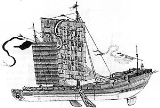
Naval history of China

Encyclopedia
The naval history of China dates back thousands of years, with archives existing since the late Spring and Autumn Period (722 BC – 481 BC
) about the ancient navy
of China
and the various ship types used in war. China was leading maritime power in the years 1405-1433, when Chinese shipbuilders began to build massive oceangoing junks
. In modern times, the current Mainland Chinese
and Taiwanese
governments continue to maintain standing navies with the People's Liberation Army Navy
and the Republic of China Navy
, respectively.
searching for mythical Fusang
, or the setting up of the maritime Silk Road
since the 2nd century BC from Hepu Commandery, drew the ancient Chinese naval maps.
Although numerous naval battles took place before the 12th century, such as the large-scale Three Kingdoms
Battle of Chibi in the year 208, it was during the Song Dynasty
(960–1279 AD) that the Chinese established a permanent, standing navy in 1132 AD. At its height by the late 12th century there were 20 squadron
s of some 52,000 marines, with the admiral's headquarters based at Dinghai, while the main base remained closer to modern Shanghai
in those days. The establishment of the permanent navy during the Song period came out of the need to defend against the Jurchens, who had overrun the northern half of China, and to escort merchant
fleets entering the South East Pacific and Indian Ocean
on long trade missions abroad to the Hindu
, Islamic, and East Africa
n spheres of the world. However, considering China
was a country which was longtime menaced by land-based nomad
ic tribes such as the Xiongnu
, Göktürks
, Mongols
and so on, the navy was always seen as an adjunct rather than an important military force. By the 15–16th centuries China's canal system and internal economy were sufficiently developed to nullify the need for the Pacific fleet, which was scuttled when conservative Confucianists gained power in the court and began the policy of inward perfection. With the Opium Wars
, which shook up the generals of the Qing Dynasty
, the navy
was once again attached greater importance.
 When the British fleet encountered the Chinese during the first Opium War, their officers noted the appearance of paddle-wheel boats among the Chinese fleet, which they took for a copy of the Western design. Paddle-wheel boats were actually developed by the Chinese independently in the 5th–6th centuries AD, only a century after their first surviving mention in Roman sources (see Paddle steamer), though that method of propulsion had been abandoned for many centuries and only recently reintroduced before the war. Numerous other innovations were present in Chinese vessels during the Middle Ages
that had not yet been adopted by the Western and Islamic worlds, some of which were documented by Marco Polo
but which did not enter into other navies until the 18th century, when the British successfully incorporated them into ship designs. For example, medieval Chinese hulls were split into bulkhead sections
so that a hull rupture only flooded a fraction of the ship and did not necessarily sink it (see Ship floodability
). This was described in the book of the Song Dynasty maritime author Zhu Yu
, the Pingzhou Table Talks of 1119 AD. Along with the innovations described in Zhu's book, there were many other improvements to nautical technology in the medieval Song period. These included crossbeams bracing the ribs of ships to strengthen them, rudders that could be raised or lowered to allow ships to travel in a wider range of water depths, and the teeth of anchor
s arranged circularly instead of in one direction, "making them more reliable". Junks
also had their sails staggered by wooden poles so that the crew could raise and lower them with ropes from the deck, like window blinds, without having to climb around and tie or untie various ropes every time the ship needed to turn or adjust speed.
A significant naval battle was the Battle of Lake Poyang
from August 30 to October 4 of the year 1363 AD, a battle which cemented the success of Zhu Yuanzhang in founding the Ming Dynasty
. However, the Chinese fleet shrank tremendously after its military/tributary/exploratory functions in the early 15th century were deemed too expensive and it became primarily a police force on routes like the Grand Canal
. Ships like the juggernauts of Zheng He
's "treasure fleet
," which dwarfed the largest Portuguese ships of the era by several times, were discontinued, and the junk
became the predominant Chinese vessel until the country's relatively recent (in terms of Chinese sailing history) naval revival.
 One of the oldest known Chinese books written on naval matters was the Yuejueshu (Lost Records of the State of Yue
) of 52 AD, attributed to the Han Dynasty
scholar Yuan Kang. Many passages of Yuan Kang's book were rewritten and published in Li Fang
's encyclopedia
of the Taiping Yulan (Imperial Readings of the Taiping Era
), compiled in 983 AD as one of the Four Great Books of Song
. The preserved written passages of Yuan Kang's book were again featured in the Yuanjian Leihan (Mirror of the Infinite, a Classified Treasure Chest) encyclopedia, edited and compiled by Zhang Ying in 1701 during the Qing Dynasty
.
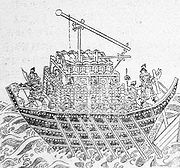
Yuan Kang's book listed various water crafts that were used for war, including one that was used primarily for ramming
like Greco-Roman trireme
s. These "classes" of ships were the great wing (da yi), the little wing (xiao yi), the stomach striker (tu wei), the castle
ship (lou chuan), and the bridge ship (qiao chuan). These were listed in the Yuejueshu as a written dialogue between King Helü of Wu
(r. 514 BC–496 BC
) and Wu Zixu
(526 BC–484 BC
), the latter of whom said:
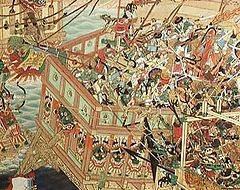 Ramming vessels were also attested to in other Chinese documents, including the Shi Ming dictionary of c. 100 AD written by Liu Xi. The Chinese also used a large iron t-shaped hook
connected to a spar
to pin retreating ships down, as described in the Mozi
book compiled in the 4th century BC. This was discussed in a dialogue between Mozi and Lu Ban
in 445 BC (when Lu traveled to the State of Chu
from the State of Lu
), as the hook-and-spar technique made standard on all Chu warship
s was given as the reason why the Yue navy lost in battle to Chu.
The rebellion of Gongsun Shu in Sichuan
province against the re-established Han Dynasty during the year 33 AD was recorded in the Book of Later Han
, compiled by Fan Ye in the 5th century. Gongsun sent a naval force of some twenty to thirty thousand troops down the Yangtze River to attack the position of the Han commander Cen Peng. After Cen Peng defeated several of Gongsun's officers, Gongsun had a long floating pontoon bridge
constructed across the Yangtze with fortified posts on it, protected further by a boom, as well as erecting forts on the river bank to provide further missile fire at another angle. Cen Peng was unable to break through this barrier and barrage of missile fire, until he equipped his navy with castle ships, rowed assault vessels, and 'colliding swoopers' used for ramming in a fleet of several thousand vessels and quelled Gongsun's rebellion.
 The 'castle ship
' design described by Yuan Kang saw continued use in Chinese naval battles after the Han period. Confronting the navy of the Chen Dynasty
on the Yangtze River, Emperor Wen of Sui
(r. 581–604) employed an enormous naval force of thousands of ships and 518,000 troops stationed along the Yangtze (from Sichuan
to the Pacific Ocean
). The largest of these ships had five layered decks, could hold 800 passengers, and each ship was fitted with six 50 ft. long boom
s that were used to swing and damage enemy ships, along with the ability of pinning them down.
(618–907 AD) there were some famous naval engagements, such as the Tang-Silla
victory over the Korean kingdom of Baekje
and Yamato
Japanese forces in the Battle of Baekgang
in 663. Tang Dynasty literature on naval warfare and ship design became more nuanced and complex. In his Taipai Yinjing (Canon of the White and Gloomy Planet of War) of 759 AD, Li Quan gave descriptions for several types of naval ships in his day (note: multiple-deck castle ships are referred to as tower ships below). Not represented here, of course, is the paddle-wheel crafts
innovated by the Tang Prince Li Gao more than a decade later in 784 AD. Paddle-wheel craft would continue to hold an important place in the Chinese navy. Along with gunpowder
bombs, paddle-wheel craft were a significant reason for the success in the later Song Dynasty naval victory of the Battle of Caishi
in the year 1161 AD.
Han Dynasty
Song Dynasty
Yuan Dynasty
Ming Dynasty
Qing Dynasty
Numerous modern ships equipped with Krupp guns, electricity, gatling guns, torpedoes, and other modern weapons were acquired by the Qing dynasty from western powers. They were manned by western trained Chinese officers.
Republic of China
People's Republic of China
481 BC
Year 481 BC was a year of the pre-Julian Roman calendar. At the time, it was known as the Year of the Consulship of Vibulanus and Fusus...
) about the ancient navy
Navy
A navy is the branch of a nation's armed forces principally designated for naval and amphibious warfare; namely, lake- or ocean-borne combat operations and related functions...
of China
China
Chinese civilization may refer to:* China for more general discussion of the country.* Chinese culture* Greater China, the transnational community of ethnic Chinese.* History of China* Sinosphere, the area historically affected by Chinese culture...
and the various ship types used in war. China was leading maritime power in the years 1405-1433, when Chinese shipbuilders began to build massive oceangoing junks
Treasure ship
A Treasure ship is the name for a type of large wooden vessel commanded by the Chinese admiral Zheng He on seven voyages in the early 15th century in Ming Dynasty...
. In modern times, the current Mainland Chinese
People's Republic of China
China , officially the People's Republic of China , is the most populous country in the world, with over 1.3 billion citizens. Located in East Asia, the country covers approximately 9.6 million square kilometres...
and Taiwanese
Republic of China
The Republic of China , commonly known as Taiwan , is a unitary sovereign state located in East Asia. Originally based in mainland China, the Republic of China currently governs the island of Taiwan , which forms over 99% of its current territory, as well as Penghu, Kinmen, Matsu and other minor...
governments continue to maintain standing navies with the People's Liberation Army Navy
People's Liberation Army Navy
The People's Liberation Army Navy is the naval branch of the People's Liberation Army , the military of the People's Republic of China. Until the early 1990s, the navy performed a subordinate role to the PLA Land Forces. Since then, it has undergone rapid modernisation...
and the Republic of China Navy
Republic of China Navy
The Republic of China Navy is the maritime branch of the Armed forces of the Republic of China . The ROC Navy's primary mission is to defend ROC territories and the sea lanes that surround Taiwan against a blockade, attack, or possible invasion by forces of the People's Republic of China...
, respectively.
Early coastal maritime endeavors
The legendary Xu FuXu Fu
Xú Fú ; was born in 255 BC in Qi, and served as a court sorcerer in Qin Dynasty China. He was sent by Qin Shi Huang to the eastern seas twice to look for the elixir of life. His two journeys occurred between 219 BC and 210 BC. It was believed that the fleet included 60 barques and around 5,000 crew...
searching for mythical Fusang
Fusang
Fusang or Fousang refers to several different entities in ancient Chinese literature, often either a mythological tree or a mysterious land to the East....
, or the setting up of the maritime Silk Road
Silk Road
The Silk Road or Silk Route refers to a historical network of interlinking trade routes across the Afro-Eurasian landmass that connected East, South, and Western Asia with the Mediterranean and European world, as well as parts of North and East Africa...
since the 2nd century BC from Hepu Commandery, drew the ancient Chinese naval maps.
Although numerous naval battles took place before the 12th century, such as the large-scale Three Kingdoms
Three Kingdoms
The Three Kingdoms period was a period in Chinese history, part of an era of disunity called the "Six Dynasties" following immediately the loss of de facto power of the Han Dynasty rulers. In a strict academic sense it refers to the period between the foundation of the state of Wei in 220 and the...
Battle of Chibi in the year 208, it was during the Song Dynasty
Song Dynasty
The Song Dynasty was a ruling dynasty in China between 960 and 1279; it succeeded the Five Dynasties and Ten Kingdoms Period, and was followed by the Yuan Dynasty. It was the first government in world history to issue banknotes or paper money, and the first Chinese government to establish a...
(960–1279 AD) that the Chinese established a permanent, standing navy in 1132 AD. At its height by the late 12th century there were 20 squadron
Squadron (naval)
A squadron, or naval squadron, is a unit of 3-4 major warships, transport ships, submarines, or sometimes small craft that may be part of a larger task force or a fleet...
s of some 52,000 marines, with the admiral's headquarters based at Dinghai, while the main base remained closer to modern Shanghai
Shanghai
Shanghai is the largest city by population in China and the largest city proper in the world. It is one of the four province-level municipalities in the People's Republic of China, with a total population of over 23 million as of 2010...
in those days. The establishment of the permanent navy during the Song period came out of the need to defend against the Jurchens, who had overrun the northern half of China, and to escort merchant
Merchant
A merchant is a businessperson who trades in commodities that were produced by others, in order to earn a profit.Merchants can be one of two types:# A wholesale merchant operates in the chain between producer and retail merchant...
fleets entering the South East Pacific and Indian Ocean
Indian Ocean
The Indian Ocean is the third largest of the world's oceanic divisions, covering approximately 20% of the water on the Earth's surface. It is bounded on the north by the Indian Subcontinent and Arabian Peninsula ; on the west by eastern Africa; on the east by Indochina, the Sunda Islands, and...
on long trade missions abroad to the Hindu
Hindu
Hindu refers to an identity associated with the philosophical, religious and cultural systems that are indigenous to the Indian subcontinent. As used in the Constitution of India, the word "Hindu" is also attributed to all persons professing any Indian religion...
, Islamic, and East Africa
East Africa
East Africa or Eastern Africa is the easterly region of the African continent, variably defined by geography or geopolitics. In the UN scheme of geographic regions, 19 territories constitute Eastern Africa:...
n spheres of the world. However, considering China
China
Chinese civilization may refer to:* China for more general discussion of the country.* Chinese culture* Greater China, the transnational community of ethnic Chinese.* History of China* Sinosphere, the area historically affected by Chinese culture...
was a country which was longtime menaced by land-based nomad
Nomad
Nomadic people , commonly known as itinerants in modern-day contexts, are communities of people who move from one place to another, rather than settling permanently in one location. There are an estimated 30-40 million nomads in the world. Many cultures have traditionally been nomadic, but...
ic tribes such as the Xiongnu
Xiongnu
The Xiongnu were ancient nomadic-based people that formed a state or confederation north of the agriculture-based empire of the Han Dynasty. Most of the information on the Xiongnu comes from Chinese sources...
, Göktürks
Göktürks
The Göktürks or Kök Türks, were a nomadic confederation of peoples in medieval Inner Asia. Known in Chinese sources as 突厥 , the Göktürks under the leadership of Bumin Qaghan The Göktürks or Kök Türks, (Old Turkic: Türük or Kök Türük or Türük; Celestial Turks) were a nomadic confederation of...
, Mongols
Mongols
Mongols ) are a Central-East Asian ethnic group that lives mainly in the countries of Mongolia, China, and Russia. In China, ethnic Mongols can be found mainly in the central north region of China such as Inner Mongolia...
and so on, the navy was always seen as an adjunct rather than an important military force. By the 15–16th centuries China's canal system and internal economy were sufficiently developed to nullify the need for the Pacific fleet, which was scuttled when conservative Confucianists gained power in the court and began the policy of inward perfection. With the Opium Wars
Opium Wars
The Opium Wars, also known as the Anglo-Chinese Wars, divided into the First Opium War from 1839 to 1842 and the Second Opium War from 1856 to 1860, were the climax of disputes over trade and diplomatic relations between China under the Qing Dynasty and the British Empire...
, which shook up the generals of the Qing Dynasty
Qing Dynasty
The Qing Dynasty was the last dynasty of China, ruling from 1644 to 1912 with a brief, abortive restoration in 1917. It was preceded by the Ming Dynasty and followed by the Republic of China....
, the navy
Navy
A navy is the branch of a nation's armed forces principally designated for naval and amphibious warfare; namely, lake- or ocean-borne combat operations and related functions...
was once again attached greater importance.
Middle Ages
The Middle Ages is a periodization of European history from the 5th century to the 15th century. The Middle Ages follows the fall of the Western Roman Empire in 476 and precedes the Early Modern Era. It is the middle period of a three-period division of Western history: Classic, Medieval and Modern...
that had not yet been adopted by the Western and Islamic worlds, some of which were documented by Marco Polo
Marco Polo
Marco Polo was a Venetian merchant traveler from the Venetian Republic whose travels are recorded in Il Milione, a book which did much to introduce Europeans to Central Asia and China. He learned about trading whilst his father and uncle, Niccolò and Maffeo, travelled through Asia and apparently...
but which did not enter into other navies until the 18th century, when the British successfully incorporated them into ship designs. For example, medieval Chinese hulls were split into bulkhead sections
Bulkhead (partition)
A bulkhead is an upright wall within the hull of a ship or within the fuselage of an airplane. Other kinds of partition elements within a ship are decks and deckheads.-Etymology:...
so that a hull rupture only flooded a fraction of the ship and did not necessarily sink it (see Ship floodability
Ship floodability
Floodability is a characteristic of the construction of a ship to resist flooding.Floodability is achieved by dividing the volume of the hull into watertight compartments with decks and bulkheads , use of double bottom, and by other means.Watertight bulkhead compartments were written of by the Song...
). This was described in the book of the Song Dynasty maritime author Zhu Yu
Zhu Yu (author)
Zhu Yu was an author of the Chinese Song Dynasty . He retired in Huang Gang of the Hubei province, bought a country house and named it "Pingzhou". He called himself "Expert Vegetable Grower of Pingzhou ". Between 1111 and 1117 AD, Zhu Yu wrote the book Pingzhou Ketan , published in 1119 AD...
, the Pingzhou Table Talks of 1119 AD. Along with the innovations described in Zhu's book, there were many other improvements to nautical technology in the medieval Song period. These included crossbeams bracing the ribs of ships to strengthen them, rudders that could be raised or lowered to allow ships to travel in a wider range of water depths, and the teeth of anchor
Anchor
An anchor is a device, normally made of metal, that is used to connect a vessel to the bed of a body of water to prevent the vessel from drifting due to wind or current. The word derives from Latin ancora, which itself comes from the Greek ἄγκυρα .Anchors can either be temporary or permanent...
s arranged circularly instead of in one direction, "making them more reliable". Junks
Junk (ship)
A junk is an ancient Chinese sailing vessel design still in use today. Junks were developed during the Han Dynasty and were used as sea-going vessels as early as the 2nd century AD. They evolved in the later dynasties, and were used throughout Asia for extensive ocean voyages...
also had their sails staggered by wooden poles so that the crew could raise and lower them with ropes from the deck, like window blinds, without having to climb around and tie or untie various ropes every time the ship needed to turn or adjust speed.
A significant naval battle was the Battle of Lake Poyang
Battle of Lake Poyang
The naval battle of Lake Poyang took place 30 August – 4 October AD 1363 and was one of the final battles fought in the fall of China's Mongol-led Yuan Dynasty...
from August 30 to October 4 of the year 1363 AD, a battle which cemented the success of Zhu Yuanzhang in founding the Ming Dynasty
Ming Dynasty
The Ming Dynasty, also Empire of the Great Ming, was the ruling dynasty of China from 1368 to 1644, following the collapse of the Mongol-led Yuan Dynasty. The Ming, "one of the greatest eras of orderly government and social stability in human history", was the last dynasty in China ruled by ethnic...
. However, the Chinese fleet shrank tremendously after its military/tributary/exploratory functions in the early 15th century were deemed too expensive and it became primarily a police force on routes like the Grand Canal
Grand Canal
Grand Canal can refer to multiple waterways:* Grand Canal in eastern China* Grand Canal in Venice, Italy* Grand Canal , between the river Shannon and Dublin in Ireland* Grand Canal d'Alsace in eastern France...
. Ships like the juggernauts of Zheng He
Zheng He
Zheng He , also known as Ma Sanbao and Hajji Mahmud Shamsuddin was a Hui-Chinese mariner, explorer, diplomat and fleet admiral, who commanded voyages to Southeast Asia, South Asia, the Middle East, and East Africa, collectively referred to as the Voyages of Zheng He or Voyages of Cheng Ho from...
's "treasure fleet
Treasure ship
A Treasure ship is the name for a type of large wooden vessel commanded by the Chinese admiral Zheng He on seven voyages in the early 15th century in Ming Dynasty...
," which dwarfed the largest Portuguese ships of the era by several times, were discontinued, and the junk
Junk (ship)
A junk is an ancient Chinese sailing vessel design still in use today. Junks were developed during the Han Dynasty and were used as sea-going vessels as early as the 2nd century AD. They evolved in the later dynasties, and were used throughout Asia for extensive ocean voyages...
became the predominant Chinese vessel until the country's relatively recent (in terms of Chinese sailing history) naval revival.
Early literature
Yue (state)
Yue was a state in China which existed during the Spring and Autumn Period and the Warring States Period , in the modern province of Zhejiang. During the Spring and Autumn Period, its capital was in Guiji , near the modern city of Shaoxing...
) of 52 AD, attributed to the Han Dynasty
Han Dynasty
The Han Dynasty was the second imperial dynasty of China, preceded by the Qin Dynasty and succeeded by the Three Kingdoms . It was founded by the rebel leader Liu Bang, known posthumously as Emperor Gaozu of Han. It was briefly interrupted by the Xin Dynasty of the former regent Wang Mang...
scholar Yuan Kang. Many passages of Yuan Kang's book were rewritten and published in Li Fang
Li Fang
Li Fang , courtesy name Mingyuan , was a Chinese scholar, compiler and prime minister from the Song Dynasty known for his leading in the compilation for the three of the Four Great Books of Song. He was born in what is now Hengshui, Hebei and once served the Later Han and Later Zhou....
's encyclopedia
Encyclopedia
An encyclopedia is a type of reference work, a compendium holding a summary of information from either all branches of knowledge or a particular branch of knowledge....
of the Taiping Yulan (Imperial Readings of the Taiping Era
Imperial Readings of the Taiping Era
The Imperial Readings of the Taiping Era is a massive encyclopedia compiled by a number of officers commissioned by the imperial court of the Song Dynasty with the lead editor being Li Fang from 977 to 983 during the era of Taiping Xingguo. It is divided into 1,000 volumes and 55 sections, which...
), compiled in 983 AD as one of the Four Great Books of Song
Four Great Books of Song
The Four Great Books of Song was compiled by Li Fang and others during the Song Dynasty . The term was coined after the last book was finished during the 11th century...
. The preserved written passages of Yuan Kang's book were again featured in the Yuanjian Leihan (Mirror of the Infinite, a Classified Treasure Chest) encyclopedia, edited and compiled by Zhang Ying in 1701 during the Qing Dynasty
Qing Dynasty
The Qing Dynasty was the last dynasty of China, ruling from 1644 to 1912 with a brief, abortive restoration in 1917. It was preceded by the Ming Dynasty and followed by the Republic of China....
.
Yuan Kang's book listed various water crafts that were used for war, including one that was used primarily for ramming
Ramming
In warfare, ramming is a technique that was used in air, sea and land combat. The term originated from battering ram, a siege weapon used to bring down fortifications by hitting it with the force of the ram's momentum...
like Greco-Roman trireme
Trireme
A trireme was a type of galley, a Hellenistic-era warship that was used by the ancient maritime civilizations of the Mediterranean, especially the Phoenicians, ancient Greeks and Romans.The trireme derives its name from its three rows of oars on each side, manned with one man per oar...
s. These "classes" of ships were the great wing (da yi), the little wing (xiao yi), the stomach striker (tu wei), the castle
Castle
A castle is a type of fortified structure built in Europe and the Middle East during the Middle Ages by European nobility. Scholars debate the scope of the word castle, but usually consider it to be the private fortified residence of a lord or noble...
ship (lou chuan), and the bridge ship (qiao chuan). These were listed in the Yuejueshu as a written dialogue between King Helü of Wu
King Helü of Wu
King Helü of the state of Wu , a state in ancient China, was initially known as Prince Guang . He reigned towards the end of the Spring and Autumn Period.-Biography:...
(r. 514 BC–496 BC
496 BC
Year 496 BC was a year of the pre-Julian Roman calendar. At the time, it was known as the Year of the Consulship of Albus and Tricostus...
) and Wu Zixu
Wu Zixu
Wu Yun , better known by his style name Zixu , is the most famous ancestor of people with the surname of Wu . All branches of the Wu clans claim him as their "first ancestor"...
(526 BC–484 BC
484 BC
Year 484 BC was a year of the pre-Julian Roman calendar. At the time, it was known as the Year of the Consulship of Mamercus and Vibulanus...
), the latter of whom said:
Nowadays in training naval forces we use the tactics of land forces for the best effect. Thus great wing ships correspond to the army's heavy chariotChariotThe chariot is a type of horse carriage used in both peace and war as the chief vehicle of many ancient peoples. Ox carts, proto-chariots, were built by the Proto-Indo-Europeans and also built in Mesopotamia as early as 3000 BC. The original horse chariot was a fast, light, open, two wheeled...
s, little wing ships to light chariots, stomach strikers to battering ramBattering ramA battering ram is a siege engine originating in ancient times and designed to break open the masonry walls of fortifications or splinter their wooden gates...
s, castle ships to mobile assault towersSiege towerA siege tower is a specialized siege engine, constructed to protect assailants and ladders while approaching the defensive walls of a fortification. The tower was often rectangular with four wheels with its height roughly equal to that of the wall or sometimes higher to allow archers to stand on...
, and bridge ships to light cavalryCavalryCavalry or horsemen were soldiers or warriors who fought mounted on horseback. Cavalry were historically the third oldest and the most mobile of the combat arms...
.
Grappling hook
A grappling hook is an anchor with multiple hooks , attached to a rope; it is thrown, dropped, sunk, projected, or fastened directly by hand to where at least one hook may catch and hold. Generally, grappling hooks are used to temporarily secure one end of a rope. They may also be used to dredge...
connected to a spar
Spar
In sailing, a spar is a pole of wood, metal or lightweight materials such as carbon fiber used on a sailing vessel. Spars of all types In sailing, a spar is a pole of wood, metal or lightweight materials such as carbon fiber used on a sailing vessel. Spars of all types In sailing, a spar is a...
to pin retreating ships down, as described in the Mozi
Mozi
Mozi |Lat.]] as Micius, ca. 470 BC – ca. 391 BC), original name Mo Di , was a Chinese philosopher during the Hundred Schools of Thought period . Born in Tengzhou, Shandong Province, China, he founded the school of Mohism, and argued strongly against Confucianism and Daoism...
book compiled in the 4th century BC. This was discussed in a dialogue between Mozi and Lu Ban
Lu Ban
Lu Ban was a Chinese carpenter, engineer, philosopher, inventor, military thinker, statesman and contemporary of Mozi, born in the State of Lu, and is the patron Saint of Chinese builders and contractors. He was born in a renowned family during the Spring and Autumn Period when China was...
in 445 BC (when Lu traveled to the State of Chu
Chu (state)
The State of Chu was a Zhou Dynasty vassal state in present-day central and southern China during the Spring and Autumn period and Warring States Period . Its ruling house had the surname Nai , and clan name Yan , later evolved to surname Mi , and clan name Xiong...
from the State of Lu
Lu (state)
The State of Lu, was a Zhou Dynasty ducal vassal state before and during the Spring and Autumn Period of Chinese history. Founded in the 10th century BC, its dukes used Ji as their family name. The first duke was Boqin |Qi]] and to the south by the powerful state of Chu...
), as the hook-and-spar technique made standard on all Chu warship
Warship
A warship is a ship that is built and primarily intended for combat. Warships are usually built in a completely different way from merchant ships. As well as being armed, warships are designed to withstand damage and are usually faster and more maneuvrable than merchant ships...
s was given as the reason why the Yue navy lost in battle to Chu.
The rebellion of Gongsun Shu in Sichuan
Sichuan
' , known formerly in the West by its postal map spellings of Szechwan or Szechuan is a province in Southwest China with its capital in Chengdu...
province against the re-established Han Dynasty during the year 33 AD was recorded in the Book of Later Han
Book of Later Han
The Book of the Later Han or the History of the Later Han is one of the official Chinese historical works which was compiled by Fan Ye in the 5th century, using a number of earlier histories and documents as sources...
, compiled by Fan Ye in the 5th century. Gongsun sent a naval force of some twenty to thirty thousand troops down the Yangtze River to attack the position of the Han commander Cen Peng. After Cen Peng defeated several of Gongsun's officers, Gongsun had a long floating pontoon bridge
Pontoon bridge
A pontoon bridge or floating bridge is a bridge that floats on water and in which barge- or boat-like pontoons support the bridge deck and its dynamic loads. While pontoon bridges are usually temporary structures, some are used for long periods of time...
constructed across the Yangtze with fortified posts on it, protected further by a boom, as well as erecting forts on the river bank to provide further missile fire at another angle. Cen Peng was unable to break through this barrier and barrage of missile fire, until he equipped his navy with castle ships, rowed assault vessels, and 'colliding swoopers' used for ramming in a fleet of several thousand vessels and quelled Gongsun's rebellion.
Lou chuan
Lóu chuán were a type of naval vessel, primarily a floating fortress, which has seen use in China since the Han Dynasty...
' design described by Yuan Kang saw continued use in Chinese naval battles after the Han period. Confronting the navy of the Chen Dynasty
Chen Dynasty
The Chen Dynasty , also known as the Southern Chen Dynasty, was the fourth and last of the Southern dynasties in China, eventually destroyed by the Sui Dynasty....
on the Yangtze River, Emperor Wen of Sui
Emperor Wen of Sui
Emperor Wen of Sui — personal name Yang Jian , Xianbei name Puliuru Jian , nickname Naluoyan — was the founder and first emperor of China's Sui Dynasty . He was a hard-working administrator and a micromanager. As a Buddhist, he encouraged the spread of Buddhism through the state...
(r. 581–604) employed an enormous naval force of thousands of ships and 518,000 troops stationed along the Yangtze (from Sichuan
Sichuan
' , known formerly in the West by its postal map spellings of Szechwan or Szechuan is a province in Southwest China with its capital in Chengdu...
to the Pacific Ocean
Pacific Ocean
The Pacific Ocean is the largest of the Earth's oceanic divisions. It extends from the Arctic in the north to the Southern Ocean in the south, bounded by Asia and Australia in the west, and the Americas in the east.At 165.2 million square kilometres in area, this largest division of the World...
). The largest of these ships had five layered decks, could hold 800 passengers, and each ship was fitted with six 50 ft. long boom
Boom (sailing)
In sailing, a boom is a spar , along the foot of a fore and aft rigged sail, that greatly improves control of the angle and shape of the sail. The primary action of the boom is to keep the foot of the sail flatter when the sail angle is away from the centerline of the boat. The boom also serves...
s that were used to swing and damage enemy ships, along with the ability of pinning them down.
Tang era
During the Chinese Tang DynastyTang Dynasty
The Tang Dynasty was an imperial dynasty of China preceded by the Sui Dynasty and followed by the Five Dynasties and Ten Kingdoms Period. It was founded by the Li family, who seized power during the decline and collapse of the Sui Empire...
(618–907 AD) there were some famous naval engagements, such as the Tang-Silla
Silla
Silla was one of the Three Kingdoms of Korea, and one of the longest sustained dynasties in...
victory over the Korean kingdom of Baekje
Baekje
Baekje or Paekche was a kingdom located in southwest Korea. It was one of the Three Kingdoms of Korea, together with Goguryeo and Silla....
and Yamato
Yamato period
The is the period of Japanese history when the Japanese Imperial court ruled from modern-day Nara Prefecture, then known as Yamato Province.While conventionally assigned to the period 250–710 , the actual start of Yamato rule is disputed...
Japanese forces in the Battle of Baekgang
Battle of Baekgang
The Battle of Baekgang, also known as Battle of Baekgang-gu or by the Japanese name Battle of Hakusukinoe , was a battle between Baekje restoration forces and their ally, Yamato Japan, against the allied forces of Silla and the Tang Dynasty of ancient China...
in 663. Tang Dynasty literature on naval warfare and ship design became more nuanced and complex. In his Taipai Yinjing (Canon of the White and Gloomy Planet of War) of 759 AD, Li Quan gave descriptions for several types of naval ships in his day (note: multiple-deck castle ships are referred to as tower ships below). Not represented here, of course, is the paddle-wheel crafts
Paddle steamer
A paddle steamer is a steamship or riverboat, powered by a steam engine, using paddle wheels to propel it through the water. In antiquity, Paddle wheelers followed the development of poles, oars and sails, where the first uses were wheelers driven by animals or humans...
innovated by the Tang Prince Li Gao more than a decade later in 784 AD. Paddle-wheel craft would continue to hold an important place in the Chinese navy. Along with gunpowder
Gunpowder
Gunpowder, also known since in the late 19th century as black powder, was the first chemical explosive and the only one known until the mid 1800s. It is a mixture of sulfur, charcoal, and potassium nitrate - with the sulfur and charcoal acting as fuels, while the saltpeter works as an oxidizer...
bombs, paddle-wheel craft were a significant reason for the success in the later Song Dynasty naval victory of the Battle of Caishi
Battle of Caishi
The naval Battle of Caishi took place in 1161 and was the result of an attempt by forces of the Jurchen Jin to cross the Yangtze River, thus beginning an invasion of Southern Song China...
in the year 1161 AD.
Covered swoopers
Combat junks
Flying barques
Patrol boats
Sea hawks
Han DynastyHan DynastyThe Han Dynasty was the second imperial dynasty of China, preceded by the Qin Dynasty and succeeded by the Three Kingdoms . It was founded by the rebel leader Liu Bang, known posthumously as Emperor Gaozu of Han. It was briefly interrupted by the Xin Dynasty of the former regent Wang Mang...
- 111 BCE, the delegates of Emperor Wu of HanEmperor Wu of HanEmperor Wu of Han , , personal name Liu Che , was the seventh emperor of the Han Dynasty of China, ruling from 141 BC to 87 BC. Emperor Wu is best remembered for the vast territorial expansion that occurred under his reign, as well as the strong and centralized Confucian state he organized...
explored Southeast Asia and India from the Gulf of TonkinGulf of TonkinThe Gulf of Tonkin is an arm of the South China Sea, lying off the coast of northeastern Vietnam.-Etymology:The name Tonkin, written "東京" in Hán tự and Đông Kinh in romanised Vietnamese, means "Eastern Capital", and is the former toponym for Hanoi, the capital of Vietnam...
to make contact with central Asia states, the Silk RoadSilk RoadThe Silk Road or Silk Route refers to a historical network of interlinking trade routes across the Afro-Eurasian landmass that connected East, South, and Western Asia with the Mediterranean and European world, as well as parts of North and East Africa...
of the Sea. - Rebellion of Gongsun Shu
Song DynastySong DynastyThe Song Dynasty was a ruling dynasty in China between 960 and 1279; it succeeded the Five Dynasties and Ten Kingdoms Period, and was followed by the Yuan Dynasty. It was the first government in world history to issue banknotes or paper money, and the first Chinese government to establish a...
- Battle of CaishiBattle of CaishiThe naval Battle of Caishi took place in 1161 and was the result of an attempt by forces of the Jurchen Jin to cross the Yangtze River, thus beginning an invasion of Southern Song China...
- Battle of TangdaoBattle of TangdaoThe naval Battle of Tangdao took place in 1161 between the Jurchen Jin and the Southern Song Dynasty of China on the East China Sea. It was an attempt by the Jin to invade and conquer the Southern Song Dynasty, yet resulted in failure and defeat for the Jurchens. The Jin Dynasty navy was set on...
- Battle of XiangyangBattle of XiangyangThe Battle of Xiangyang also known as the Battle of Xiangfan was a six-year battle between invading Yuan Dynasty armies founded by the Mongols and Southern Song forces between AD 1267 and 1273. After the battle, the victorious Yuan forces pushed farther into the Song heartland...
- Battle of YamenBattle of YamenThe naval Battle of Yamen took place on 19 March 1279 and is considered to be the last stand of the Song Dynasty against the invading Mongol-controlled Yuan Dynasty...
Yuan DynastyYuan DynastyThe Yuan Dynasty , or Great Yuan Empire was a ruling dynasty founded by the Mongol leader Kublai Khan, who ruled most of present-day China, all of modern Mongolia and its surrounding areas, lasting officially from 1271 to 1368. It is considered both as a division of the Mongol Empire and as an...
- First Battle of Hakata BayBattle of Bun'eiThe , also known as the First Battle of Hakata Bay was the first attempt by the Yuan Dynasty founded by the Mongols to invade Japan. After conquering the Tsushima Island and Iki, Kublai Khan's fleet moved on to Japan proper, landing at Hakata Bay, a short distance from Kyūshū's administrative...
- Battle of KōanBattle of KoanThe ', also known as the Second Battle of Hakata Bay, was the second attempt by the Yuan Dynasty founded by the Mongols to invade Japan...
- Java Expedition
Ming DynastyMing DynastyThe Ming Dynasty, also Empire of the Great Ming, was the ruling dynasty of China from 1368 to 1644, following the collapse of the Mongol-led Yuan Dynasty. The Ming, "one of the greatest eras of orderly government and social stability in human history", was the last dynasty in China ruled by ethnic...
- Battle of Lake PoyangBattle of Lake PoyangThe naval battle of Lake Poyang took place 30 August – 4 October AD 1363 and was one of the final battles fought in the fall of China's Mongol-led Yuan Dynasty...
- One naval battle in the Fourth Chinese domination (History of Vietnam)Fourth Chinese domination (History of Vietnam)The fourth Chinese domination was a period of the history of Vietnam, from 1407 to 1427 during which the country was ruled by Ming Dynasty administrators.-Sinicizing the country:...
, the Ming Navy destroyed the Vietnamese navy of 300 warships - Zheng HeZheng HeZheng He , also known as Ma Sanbao and Hajji Mahmud Shamsuddin was a Hui-Chinese mariner, explorer, diplomat and fleet admiral, who commanded voyages to Southeast Asia, South Asia, the Middle East, and East Africa, collectively referred to as the Voyages of Zheng He or Voyages of Cheng Ho from...
- WokouWokouWokou , which literally translates as "Japanese pirates" in English, were pirates of varying origins who raided the coastlines of China and Korea from the 13th century onwards...
- Imjin War
- Battle of Noryang
- First Battle of TamaoFirst Battle of Tamao (1521)The Battle of Tãmão was a naval battle when the Ming Dynasty Imperial Navy defeated a Portuguese navy led by Simão de Andrade in 1521.-Causes:...
- Second Battle of TamaoSecond Battle of Tamao (1522)The Battle of Tamao was a naval battle when the Ming Dynasty Imperial Navy defeated a Portuguese navy led by Martim Afonso in 1522.Tamao was the Portuguese name for Tunmen, also known as Tou-men.-Causes:...
- Battle of Penghu (1624)
- Battle of Liaoluo Bay
- Siege of Fort ZeelandiaSiege of Fort ZeelandiaThe Siege of Fort Zeelandia , which took place in 1661 and 1662, ended the Dutch East India Company's rule over Taiwan and began the Kingdom of Tungning's rule over the island...
Qing DynastyQing DynastyThe Qing Dynasty was the last dynasty of China, ruling from 1644 to 1912 with a brief, abortive restoration in 1917. It was preceded by the Ming Dynasty and followed by the Republic of China....
Numerous modern ships equipped with Krupp guns, electricity, gatling guns, torpedoes, and other modern weapons were acquired by the Qing dynasty from western powers. They were manned by western trained Chinese officers.
- Zheng Chengong
- Battle of PenghuBattle of PenghuThe Battle of Penghu of 1683 is where the admiral Shi Lang of Qing attacked the fleet of Kingdom of Tungning in Penghu. Both parties possessed more than 200 warships each. Liu Guoxuan was outmaneuvered by Shi Lang, whose forces outnumbered him three to one. Liu Guoxan surrendered when his flagship...
- Beiyang FleetBeiyang FleetThe Beiyang Fleet was one of the four modernised Chinese navies in the late Qing Dynasty. Among the four, the Beiyang Fleet was particularly sponsored by Li Hongzhang, one of the most trusted vassals of Empress Dowager Cixi and the principal patron of the "self-strengthening movement" in northern...
- Nanyang FleetNanyang FleetThe Nanyang Fleet was one of the four modernised Chinese navies in the late Qing Dynasty. Established in the 1870s, the fleet suffered losses in the Sino-French War, escaped intact in the Sino-Japanese War, and was formally abolished in 1909....
- Fujian FleetFujian FleetThe Fujian Fleet was one of China's four regional fleets during the closing decades of the nineteenth century. The fleet was almost annihilated on 23 August 1884 by Admiral Amédée Courbet's Far East Squadron at the Battle of Fuzhou, the opening engagement of the Sino-French War .-Composition:The...
- Guangdong FleetGuangdong FleetThe Guangdong Fleet was the smallest of China's four regional fleets during the second half of the nineteenth century. The fleet played virtually no part in the Sino-French War , but several of its ships saw action in the Sino-Japanese War .- Leadership :In the summer of 1882, when China began to...
- Opium WarsOpium WarsThe Opium Wars, also known as the Anglo-Chinese Wars, divided into the First Opium War from 1839 to 1842 and the Second Opium War from 1856 to 1860, were the climax of disputes over trade and diplomatic relations between China under the Qing Dynasty and the British Empire...
- Sino-French WarSino-French WarThe Sino–French War was a limited conflict fought between August 1884 and April 1885 to decide whether France should replace China in control of Tonkin . As the French achieved their war aims, they are usually considered to have won the war...
- Battle of FoochowBattle of FoochowThe Battle of Fuzhou, or Battle of Foochow, also known as the Battle of the Pagoda Anchorage , was the opening engagement of the 16-month Sino-French War...
- Battle of ShipuBattle of ShipuThe Battle of Shipu was a French naval victory during the Sino-French War . The battle took place on the night of 14 February 1885 in Shipu Bay , near Ningbo, China.- Background :...
- Battle of Foochow
- First Sino-Japanese WarFirst Sino-Japanese WarThe First Sino-Japanese War was fought between Qing Dynasty China and Meiji Japan, primarily over control of Korea...
- Battle of Yalu River (1894)Battle of Yalu River (1894)The Battle of the Yalu River , also called simply 'The Battle of Yalu' took place on September 17, 1894. It involved the Japanese and the Chinese navies, and was the largest naval engagement of the First Sino-Japanese War...
- Battle of WeihaiweiBattle of WeihaiweiThe Battle of Weihaiwei was a 23 day siege with a major land and naval component during the First Sino-Japanese War. It took place between 20 January and 12 February 1895 in Weihai, Shandong Province, China) between the forces of Meiji Japan and Qing China...
- Battle of Yalu River (1894)
Republic of ChinaRepublic of ChinaThe Republic of China , commonly known as Taiwan , is a unitary sovereign state located in East Asia. Originally based in mainland China, the Republic of China currently governs the island of Taiwan , which forms over 99% of its current territory, as well as Penghu, Kinmen, Matsu and other minor...
- Republic of China NavyRepublic of China NavyThe Republic of China Navy is the maritime branch of the Armed forces of the Republic of China . The ROC Navy's primary mission is to defend ROC territories and the sea lanes that surround Taiwan against a blockade, attack, or possible invasion by forces of the People's Republic of China...
- Second Sino-Japanese WarSecond Sino-Japanese WarThe Second Sino-Japanese War was a military conflict fought primarily between the Republic of China and the Empire of Japan. From 1937 to 1941, China fought Japan with some economic help from Germany , the Soviet Union and the United States...
- Battle of WuhanBattle of WuhanThe Battle of Wuhan, popularly known to the Chinese as the Defence of Wuhan, and to the Japanese as the Capture of Wuhan, was a large-scale battle of the Second Sino-Japanese War...
- Landing Operation on Hainan IslandLanding Operation on Hainan IslandLanding Operation on Hainan Island , also known as Hainan Island Campaign or Hainan Campaign for short, was a series of battles fought between the Kuomintang and the Communist Party of China during the Chinese Civil War in the post-World War II period, and resulted in a communist...
People's Republic of ChinaPeople's Republic of ChinaChina , officially the People's Republic of China , is the most populous country in the world, with over 1.3 billion citizens. Located in East Asia, the country covers approximately 9.6 million square kilometres...
- People's Liberation Army NavyPeople's Liberation Army NavyThe People's Liberation Army Navy is the naval branch of the People's Liberation Army , the military of the People's Republic of China. Until the early 1990s, the navy performed a subordinate role to the PLA Land Forces. Since then, it has undergone rapid modernisation...
- First Taiwan Strait CrisisFirst Taiwan Strait CrisisThe First Taiwan Strait Crisis was a short armed conflict that took place between the governments of the People's Republic of China and the Republic of China . The PRC seized the Yijiangshan Islands, forcing the ROC to abandon the Tachen Islands...
- Second Taiwan Strait CrisisSecond Taiwan Strait CrisisThe Second Taiwan Strait Crisis, also called the 1958 Taiwan Strait Crisis, was a conflict that took place between the People's Republic of China and the Republic of China governments in which the PRC shelled the islands of Matsu and Quemoy in the Taiwan Strait in an attempt to seize them from...
- Third Taiwan Strait CrisisThird Taiwan Strait CrisisThe Third Taiwan Strait Crisis, also called the 1995–1996 Taiwan Strait Crisis or the 1996 Taiwan Strait Crisis, was the effect of a series of missile tests conducted by the People's Republic of China in the waters surrounding Taiwan including the Taiwan Strait from July 21, 1995 to March 23, 1996...
- Battle of the Paracel Islands
- Spratly Island Skirmish (1988)
See also
- Military history of China (disambiguation)
- History of the Song DynastyHistory of the Song DynastyThe Song Dynasty of China was a ruling dynasty that controlled China proper and southern China from the middle of the 10th century into the last quarter of the 13th century...
- Technology of the Song DynastyTechnology of the Song DynastyThe Song Dynasty provided some of the most significant technological advances in Chinese history, many of which came from talented statesmen drafted by the government through imperial examinations....
- Chinese explorationChinese explorationChinese exploration includes exploratory Chinese travels abroad, on land and by sea, from the 2nd century BC until the 15th century.-Pamir Mountains and beyond:...
- Imperial Chinese NavyImperial Chinese NavyThe Chinese Imperial Navy came into existence from 1132 during the Song Dynasty to the end of the Qing period in 1912. Prior to 12th century, Chinese naval ships were not organized into a uniform force...
External links
- 中国海军史研究会
- http://www.cronab.demon.co.uk/china.htm
- http://www.battleships-cruisers.co.uk/chinese_navy.htm
- Chinese online warship museum