

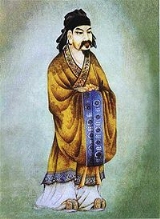
Wu Zixu

Encyclopedia
| Names Chinese name Personal names in Chinese culture follow a number of conventions different from those of personal names in Western cultures. Most noticeably, a Chinese name is written with the family name first and the given name next, therefore "John-Paul Smith" as a Chinese name would be "Smith John-Paul"... |
|
|---|---|
| Style Name: | Wŭ Zĭxū |
| Chinese Chinese language The Chinese language is a language or language family consisting of varieties which are mutually intelligible to varying degrees. Originally the indigenous languages spoken by the Han Chinese in China, it forms one of the branches of Sino-Tibetan family of languages... : |
伍子胥 |
| Family name: | Wu |
| Chinese Chinese language The Chinese language is a language or language family consisting of varieties which are mutually intelligible to varying degrees. Originally the indigenous languages spoken by the Han Chinese in China, it forms one of the branches of Sino-Tibetan family of languages... : |
伍 |
| Given name: | Yun |
| Traditional Chinese: | 員 |
| Simplified Chinese: | 员 |
| Wu 吳 Kingdom title: | Shenxu |
| Chinese Chinese language The Chinese language is a language or language family consisting of varieties which are mutually intelligible to varying degrees. Originally the indigenous languages spoken by the Han Chinese in China, it forms one of the branches of Sino-Tibetan family of languages... : |
申胥 |
| Tang 唐 Dynasty title: | Heroic and Upright King |
| Hanyu Pinyin: | Yingliewang |
| Chinese Chinese language The Chinese language is a language or language family consisting of varieties which are mutually intelligible to varying degrees. Originally the indigenous languages spoken by the Han Chinese in China, it forms one of the branches of Sino-Tibetan family of languages... : |
英烈王 |
| As river god: | "God of Waves" |
| Chinese Chinese language The Chinese language is a language or language family consisting of varieties which are mutually intelligible to varying degrees. Originally the indigenous languages spoken by the Han Chinese in China, it forms one of the branches of Sino-Tibetan family of languages... : |
濤神 |
- Note: names are in simplified characters followed by traditional and PinyinPinyinPinyin is the official system to transcribe Chinese characters into the Roman alphabet in China, Malaysia, Singapore and Taiwan. It is also often used to teach Mandarin Chinese and spell Chinese names in foreign publications and used as an input method to enter Chinese characters into...
transliteration.
Wu Yun , better known by his style name
Chinese style name
A Chinese style name, sometimes also known as a courtesy name , is a given name to be used later in life. After 20 years of age, the zì is assigned in place of one's given name as a symbol of adulthood and respect...
Zixu , is the most famous ancestor of people with the surname of Wu
Wu (surname)
Wu is the Pinyin transliteration of the Chinese surname 吳 , 吴 , which is the tenth most common surname in Mainland China. Several other, less common Chinese surnames with different pronunciations are also transliterated into English as "Wu": 武, 伍, 仵, 烏, 鄔 and 巫...
(伍). All branches of the Wu clans claim him as their "first ancestor". He lived in the Spring and Autumn era (722–481 BCE) of Chinese history.
Classical sources
The historical records of Wu are found in the famous Chinese classics: Historical Records (史記; Shǐjì) by Sima QianSima Qian
Sima Qian was a Prefect of the Grand Scribes of the Han Dynasty. He is regarded as the father of Chinese historiography for his highly praised work, Records of the Grand Historian , a "Jizhuanti"-style general history of China, covering more than two thousand years from the Yellow Emperor to...
, The Art of War
The Art of War
The Art of War is an ancient Chinese military treatise that is attributed to Sun Tzu , a high ranking military general and strategist during the late Spring and Autumn period...
by Sun Tzu
Sun Tzu
Sun Wu , style name Changqing , better known as Sun Tzu or Sunzi , was an ancient Chinese military general, strategist and philosopher who is traditionally believed, and who is most likely, to have authored The Art of War, an influential ancient Chinese book on military strategy...
and The Annals of Lü Buwei
Lüshi Chunqiu
The Lüshi Chunqiu is an encyclopedic Chinese classic text compiled around 239 BCE under the patronage of the Qin Dynasty Chancellor Lü Buwei...
. He is also mentioned in Guliang Zhuan
Guliang Zhuan
The Gǔliáng Zhuàn is considered one of the classic books of ancient Chinese history. It is traditionally attributed to a writer with the surname of Guliang in the disciple tradition of Zi-xia , but versions of his name vary and there is no definitive way to date the text...
and Gongyang Zhuan
Gongyang Zhuan
The Gōngyáng Zhuàn is a commentary on the Spring and Autumn Annals and one of the classic books of ancient Chinese history. It is believed to have been written by Zi-xia disciple Gongyang Gao of the State of Qi during the Warring States Period of Chinese history...
. The accounts differ, showing the high level of folklorization of the character.
Biography
Wu Zixu was a famous ChineseChina
Chinese civilization may refer to:* China for more general discussion of the country.* Chinese culture* Greater China, the transnational community of ethnic Chinese.* History of China* Sinosphere, the area historically affected by Chinese culture...
scholar and military general who fought for the state of Wu
Wu (state)
The State of Wu , also known as Gou Wu or Gong Wu , was one of the vassal states during the Western Zhou Dynasty and the Spring and Autumn Period. The State of Wu was located at the mouth of the Yangtze River east of the State of Chu. Considered a semi-barbarian state by ancient Chinese...
during the Spring and Autumn Period in China
China
Chinese civilization may refer to:* China for more general discussion of the country.* Chinese culture* Greater China, the transnational community of ethnic Chinese.* History of China* Sinosphere, the area historically affected by Chinese culture...
. Since his death, Wu Zixu has evolved into a model of loyalty
Loyalty
Loyalty is faithfulness or a devotion to a person, country, group, or cause There are many aspects to...
in the culture of China
Culture of China
Chinese culture is one of the world's oldest and most complex. The area in which the culture is dominant covers a large geographical region in eastern Asia with customs and traditions varying greatly between towns, cities and provinces...
.
Early life
Wu Zixu was the second son of Wu She (伍奢), the Grand Tutor of the crown princeCrown Prince
A crown prince or crown princess is the heir or heiress apparent to the throne in a royal or imperial monarchy. The wife of a crown prince is also titled crown princess....
Jian of the state of Chu
Chu (state)
The State of Chu was a Zhou Dynasty vassal state in present-day central and southern China during the Spring and Autumn period and Warring States Period . Its ruling house had the surname Nai , and clan name Yan , later evolved to surname Mi , and clan name Xiong...
(楚). In 522 BCE, Fei Wuji
Fei Wuji
Fei Wuji was a corrupt official of the state of Chu during the reign of King Ping whose persecution of Crown Prince Jian and the family of Wu Zixu led to the defeat and decline of Chu.-Life and death:...
, a corrupt official was sent to Qin to select a bride for the prince. King Ping of Chu received a princess from the state of Qin
Qin (state)
The State of Qin was a Chinese feudal state that existed during the Spring and Autumn and Warring States Periods of Chinese history...
(秦) as a bride for his son, but decided to keep her for himself upon seeing her beauty. Fei Wuji, having gained favor from the King, convinced King Ping that Wu She and the crown prince himself would start a rebellion due to the bride from Qin. Fei Wuji persuaded the king to execute him. Before his death, Wu She was forced under duress to send a letter to his sons, Wu Shang (伍尚) and Wu Zixu, that asked them to join him in capital. While both realized that this was a trap, Wu Shang decided to go to the capital to die with his father. Wu Zixu, promising revenge, fled to the state of Wu
Wu (state)
The State of Wu , also known as Gou Wu or Gong Wu , was one of the vassal states during the Western Zhou Dynasty and the Spring and Autumn Period. The State of Wu was located at the mouth of the Yangtze River east of the State of Chu. Considered a semi-barbarian state by ancient Chinese...
.
Escape
Wu Zixu, along with Prince Jian's son, Prince Sheng, hoped to flee to the state of WuWu (state)
The State of Wu , also known as Gou Wu or Gong Wu , was one of the vassal states during the Western Zhou Dynasty and the Spring and Autumn Period. The State of Wu was located at the mouth of the Yangtze River east of the State of Chu. Considered a semi-barbarian state by ancient Chinese...
. Wu Zixu, however, was a wanted man. He and the young prince were constantly pursued by soldiers. King Ping also ordered a very tight border control in hopes of catching Wu Zixu. As Wu Zixu approached Zhaoguan (昭关), the last pass to state of Wu
Wu (state)
The State of Wu , also known as Gou Wu or Gong Wu , was one of the vassal states during the Western Zhou Dynasty and the Spring and Autumn Period. The State of Wu was located at the mouth of the Yangtze River east of the State of Chu. Considered a semi-barbarian state by ancient Chinese...
(吳), he sought the help of the physician Donggao Gong (东皋公), who recognized him as Wu She's son. Donggao Gong felt deep sympathy for Wu Zixu's plight and offered his help in escaping across the border.
According to legend, Donggao Gong gave refuge to Wu Zixu in his home for a week. Under enormous stress, Wu Zixu's hair turned completely white and his facial features aged greatly. The change was a blessing in disguise and Wu Zixu was able to escape and head to the state of Wu
Wu (state)
The State of Wu , also known as Gou Wu or Gong Wu , was one of the vassal states during the Western Zhou Dynasty and the Spring and Autumn Period. The State of Wu was located at the mouth of the Yangtze River east of the State of Chu. Considered a semi-barbarian state by ancient Chinese...
(吳).
Campaign Against the State of Chu
In the state of Wu, Wu Zixu became a trusted advisor of Prince Guang and helped him assassinate his cousin King Liao of WuKing Liao of Wu
King Liao of Wu , also named Zhouyu, was king of the state of Wu in the Spring and Autumn Period.-Biography:...
. Prince Guang ascended the throne and was known as King Helü of Wu
King Helü of Wu
King Helü of the state of Wu , a state in ancient China, was initially known as Prince Guang . He reigned towards the end of the Spring and Autumn Period.-Biography:...
.
In 506 BCE, during the reign of King Zhao of Chu
King Zhao of Chu
King Zhao of Chu was from 515 – 489 BCE the king of the State of Chu during the Spring and Autumn Period of ancient China. Documents unearthed in the former state also show his title as King Shao. Born Xiong Zhen , King Zhao was the son of King Ping of Chu .-Life:In 506 BCE, King Helü of the...
, King Helü decided to invade Chu. The king personally led the army, along with his younger brother Fugai, Wu Zixu, as well as Sun Tzu
Sun Tzu
Sun Wu , style name Changqing , better known as Sun Tzu or Sunzi , was an ancient Chinese military general, strategist and philosopher who is traditionally believed, and who is most likely, to have authored The Art of War, an influential ancient Chinese book on military strategy...
, author of The Art of War
The Art of War
The Art of War is an ancient Chinese military treatise that is attributed to Sun Tzu , a high ranking military general and strategist during the late Spring and Autumn period...
. Although Chu had a strong army led by Nang Wa and Shen Yinshu, it suffered a heavy defeat at the Battle of Boju. King Zhao of Chu fled to Sui
Sui (state)
The State of Suí was a Zhou Dynasty vassal state located in Hubei Province, China during the Spring and Autumn and Warring States Periods located in the Han River Basin...
and the Wu army captured Ying
Ying (Chu)
Yǐng was a capital city of the State of Chu during the Spring and Autumn and Warring States Periods of Chinese History.In the early years of Chu’s development, the state capital was located at Danyang , near modern day Xichuan County in Henan Province...
, Chu's capital. After entering Ying, Wu Zixu exhumed King Ping's corpse, and gave it 300 lashes to exact vengeance.
The military victory led to Wu Zixu's elevation to Duke of Shen (申). subsequently, he was known by the name of Shen Xu (申胥).
Death
Bo PiBo Pi
Bo Pi was a bureaucrat in the state of Wu in the Spring and Autumn Period. His grandfather, Bo Zhouli, who was an official in the state of Chu, was executed, and Bo Pi fled to Wu, where he served as an advisor to the king of Wu...
, whose grandfather had also been unjustly killed in state of Chu
Chu (state)
The State of Chu was a Zhou Dynasty vassal state in present-day central and southern China during the Spring and Autumn period and Warring States Period . Its ruling house had the surname Nai , and clan name Yan , later evolved to surname Mi , and clan name Xiong...
(楚), came to the state of Wu
Wu (state)
The State of Wu , also known as Gou Wu or Gong Wu , was one of the vassal states during the Western Zhou Dynasty and the Spring and Autumn Period. The State of Wu was located at the mouth of the Yangtze River east of the State of Chu. Considered a semi-barbarian state by ancient Chinese...
. Against warnings about Bo Pi
Bo Pi
Bo Pi was a bureaucrat in the state of Wu in the Spring and Autumn Period. His grandfather, Bo Zhouli, who was an official in the state of Chu, was executed, and Bo Pi fled to Wu, where he served as an advisor to the king of Wu...
's character, Wu Zixu recommended him to the king of Wu
Wu (state)
The State of Wu , also known as Gou Wu or Gong Wu , was one of the vassal states during the Western Zhou Dynasty and the Spring and Autumn Period. The State of Wu was located at the mouth of the Yangtze River east of the State of Chu. Considered a semi-barbarian state by ancient Chinese...
, who made Bo Pi
Bo Pi
Bo Pi was a bureaucrat in the state of Wu in the Spring and Autumn Period. His grandfather, Bo Zhouli, who was an official in the state of Chu, was executed, and Bo Pi fled to Wu, where he served as an advisor to the king of Wu...
a minister.
After the passing of King Helü, Wu Zixu did not earn the trust of Fuchai (夫差), the new monarch of Wu
Wu (state)
The State of Wu , also known as Gou Wu or Gong Wu , was one of the vassal states during the Western Zhou Dynasty and the Spring and Autumn Period. The State of Wu was located at the mouth of the Yangtze River east of the State of Chu. Considered a semi-barbarian state by ancient Chinese...
. Wu Zixu saw the long-term danger of King Goujian (勾踐) of Yue
Yue (state)
Yue was a state in China which existed during the Spring and Autumn Period and the Warring States Period , in the modern province of Zhejiang. During the Spring and Autumn Period, its capital was in Guiji , near the modern city of Shaoxing...
(越) and advised the king to conquer that state. The King, however, listened instead to Bo Pi
Bo Pi
Bo Pi was a bureaucrat in the state of Wu in the Spring and Autumn Period. His grandfather, Bo Zhouli, who was an official in the state of Chu, was executed, and Bo Pi fled to Wu, where he served as an advisor to the king of Wu...
, who had been bribed by the Yue
Yue (state)
Yue was a state in China which existed during the Spring and Autumn Period and the Warring States Period , in the modern province of Zhejiang. During the Spring and Autumn Period, its capital was in Guiji , near the modern city of Shaoxing...
state. Concerned with the safety of the kingdom, Wu Zixu pleaded with the king to take action against Yue
Yue (state)
Yue was a state in China which existed during the Spring and Autumn Period and the Warring States Period , in the modern province of Zhejiang. During the Spring and Autumn Period, its capital was in Guiji , near the modern city of Shaoxing...
but was ignored. The King gave Wu Zixu a a sword and ordered him to commit suicide under the pretext of sabotage. Before he committed suicide, Wu Zixu asked King Fuchai to remove his eyes after his death and hang them on the city gate so that he could watch the capture of the Wu capital by the Yue army.
Ten years after Wu Zixu's death, as Wu Zixu had predicted, King Goujian (勾踐) of Yue
Yue (state)
Yue was a state in China which existed during the Spring and Autumn Period and the Warring States Period , in the modern province of Zhejiang. During the Spring and Autumn Period, its capital was in Guiji , near the modern city of Shaoxing...
(越) conquered the state of Wu
Wu (state)
The State of Wu , also known as Gou Wu or Gong Wu , was one of the vassal states during the Western Zhou Dynasty and the Spring and Autumn Period. The State of Wu was located at the mouth of the Yangtze River east of the State of Chu. Considered a semi-barbarian state by ancient Chinese...
. Faced with the demise of his state, King Fuchai committed suicide. He lamented that he did not heed the counsel of Wu Zixu and covered his face as he died because he dared not face Wu in the afterlife.
Cultural impact
Some Chinese believe that the Dragon Boat FestivalDragon Boat Festival
Duanwu Festival, also known as Dragon Boat Festival and the Double Fifth, is a traditional and statutory holiday originating in China and associated with a number of East Asian and Southeast Asian societies...
, celebrated on the fifth day of the fifth lunar month
Chinese calendar
The Chinese calendar is a lunisolar calendar, incorporating elements of a lunar calendar with those of a solar calendar. It is not exclusive to China, but followed by many other Asian cultures as well...
and usually associated with the poet Qu Yuan
Qu Yuan
Qu Yuan was a Chinese poet who lived during the Warring States Period in ancient China. He is famous for his contributions to the poetry collection known as the Chu-ci...
(屈原), actually commemorates the death of Wu Zixu, whose body was thrown into the river near Suzhou after his forced suicide.
After Wu She's imprisonment, the king ordered the executions of both Wu She and his eldest son, Wu Shang (伍尚). Although Wu Zixu's desire to avenge his father has often caused him to be seen as a filial son, his action was in fact ambiguous according to the morality of the times, as can be seen by the choice of his brother to accept his father's will and go to his death. This is an ambiguity that is used by Sima Qian in the Shi Ji in order to reflect on Sima Qian's own choice to accept castration for the sake of a greater goal rather than take the honorable path of suicide.
In some parts of China, Wu Zixu is worshiped as a river god, with the title of "God of Waves" (濤神).
A Memorial in honor of Wu Zixu was recently built in Suzhou.
Various plays exist in Peking Opera and other local operas based on Wu Zixu's story, among them Wen Zhaoguan (文昭关).
External links
- The Story of Ng Gee Sui
- Biography of Wu Zixu, Shiji Vol. 66, in Chinese (Wikisource)