


Michiel de Ruyter

Encyclopedia
Michiel Adriaenszoon de Ruyter (miˈχil ˈaˑdrijaˑnˌsoˑn də ˈrœy̆tər; 24 March 1607 – 29 April 1676) is the most famous and one of the most skilled admiral
s in Dutch history
. De Ruyter is most famous for his role in the Anglo-Dutch Wars
of the 17th century. He fought the English
and French
and scored several major victories against them, the best known probably being the Raid on the Medway
. The pious De Ruyter was very much loved by his sailors and soldiers; from them his most significant nickname derived: Bestevaêr (older Dutch for 'grandfather'.)
(Vlissingen) as the son of beer porter Adriaen Michielszoon and Aagje Jansdochter Little is known about De Ruyter's early life, but he probably became a sailor
at the age of 11. In 1622 he fought as a musketeer
in the Dutch army under Maurice of Nassau against the Spaniards during the relief of Bergen-op-Zoom. That same year he rejoined the Dutch merchant fleet and steadily worked his way up. According to English sources he was active in Dublin between 1623 and 1631 as an agent for the Vlissingen-based merchant house of the Lampsins brothers. Although Dutch sources have no data about his whereabouts in those years, it is known that De Ruyter spoke Irish
fluently. He would occasionally travel as supercargo to the Mediterranean or the Barbary Coast
. In those years he usually referred to himself as "Machgyel Adriensoon", his name in the Zealandic dialect he spoke, not having yet adopted the name "De Ruyter". "De Ruyter" most probably was a nickname given to him. An explanation might be found in the meaning of the older Dutch verb ruyten or ruiten which means "to raid", something De Ruyter was known to do as a privateer
with the Lampsins ship Den Graeuwen Heynst.
In 1631 he married a farmer's daughter named Maayke Velders. The marriage lasted until the end of the year 1631 when Maayke died after giving birth to a daughter who followed her mother in death three weeks later.
In 1633 and 1635 De Ruyter sailed as a navigating officer aboard the ship Groene Leeuw (Green Lion) on whaling
expeditions to Jan Mayen
. At this point he did not yet have a command of his own. In the summer of 1636 he remarried, this time to a daughter of a wealthy burgher
named Neeltje Engels, who would give him four children. One of these died shortly after birth, the others were named Adriaen (1637), Neeltje (1639) and Aelken (1642).
In the midst of this, in 1637, De Ruyter became captain of a private ship meant to hunt for raiders
operating from Dunkirk who were preying on Dutch merchant shipping. He fulfilled this task until 1640. After sailing for a while as schipper (skipper) of a merchant vessel named de Vlissinge, he was contacted again by the Zeeland
Admiralty to become captain of the Haze, a merchant ship turned man-of-war carrying 26 guns in a fleet under admiral Gijsels fighting the Spanish
, teaming up with the Portuguese
during their rebellion.
A Dutch fleet, with De Ruyter as third in command, beat back a Spanish-Dunkirker fleet in an action off Cape St Vincent on 4 November 1641. After returning he bought his own ship, the Salamander, and between 1642 and 1652, he mainly traded and travelled to Morocco
and the West Indies to amass wealth as a merchant. During this time his esteem grew among other Dutch captains as he would regularly free Christian slaves by redeeming them at his own expense.
In 1650 De Ruyter's wife, who in 1649 had given him a second son named Engel
, unexpectedly died. On 8 January 1652 he married the widow Anna van Gelder and decided the time had come to retire. He bought a house in Flushing, but his blissful family life would not last long.
(1652–1654), De Ruyter was asked to join the expanding fleet as a subcommander of a Zealandic squadron of "director's ships": privately financed warships. After initially refusing, De Ruyter proved his worth under supreme commander Lieutenant-Admiral (the nominal rank of Admiral-General was reserved for the stadtholder
but at the time none was appointed) Maarten Tromp
, winning the Battle of Plymouth
against Vice-Admiral George Ayscue
. He also fought at the Battle of Kentish Knock and the Battle of the Gabbard
. De Ruyter functioned as a squadron commander, being referred to as a Commodore
, which at the time was not an official rank in the Dutch navy.
Tromp's death during the Battle of Scheveningen
ended the war and De Ruyter declined an emphatic offer from Johan de Witt
for supreme command, because he considered himself 'unfit' and also feared that bypassing the seniority principle would bring him into conflict with Witte de With and Johan Evertsen
. Later De Ruyter and De Witt would become personal friends. Colonel Jacob van Wassenaer Obdam
then became the new Dutch supreme commander of the confederate fleet. De Ruyter – after refusing to become Obdam's naval 'advisor' – remained in service of the Dutch navy however and later accepted an offer from the admiralty of Amsterdam
to become their Vice-Admiral on 2 March 1654. He relocated with his family to the city in 1655.
along the way, he managed to avoid creating a new flag incident. Operating off the Barbary Coast
he captured several infamous corsairs and having negotiated a peace agreement with Salé
, De Ruyter returned home May 1656.
The same month the States-General
, becoming ever more wary of Swedish king Charles X
and his expansion plans, decided to intervene in the Northern Wars
by sending a fleet to the Baltic Sea
. The Swedes controlled this area after Charles had invaded Poland and made himself king there. De Ruyter once again embarked on the Tijdverdrijf arriving in the Sound
8 June; there he waited for Lieutenant-Admiral Jacob van Wassenaer Obdam
to arrive. After Obdam had assumed command De Ruyter and the Dutch fleet sailed to relieve the besieged city of Danzig/Gdańsk on 27 July, without any bloodshed. Peace was signed a month later. Before leaving the Baltic De Ruyter and other flag-officers were granted audience by Frederick III of Denmark
. De Ruyter took a liking to the Danish king who would later become a personal friend.
In 1658 the States-General under the advice of a leading member, (one of the) mayors of Amsterdam Cornelis de Graeff
decided to once again send a fleet to the Baltic Sea
to protect the important Baltic
trade and to aid the Danes against Swedish aggression, continued despite a peace settlement. In accordance with the States' balance of power politics a fleet under Lieutenant-Admiral Jacob van Wassenaer Obdam
was sent, without De Ruyter, who at the time was blockading Lisbon
. On 8 November a bloody melee took place: the Battle of the Sound
, which resulted in a Dutch victory, relieving Copenhagen
. Still the Swedes were far from defeated and the States decided to continue their support. De Ruyter took command of a new expeditionary fleet and managed to liberate Nyborg
in 1659. For this he was knighted by the Danish king Frederick III of Denmark
From 1661 until 1663 De Ruyter had convoy duty in the Mediterranean.
officially began, he clashed with the English off the West Africa
n coast, where both the English and Dutch had significant slave stations, retaking the Dutch possessions occupied by Robert Holmes
and then crossing the Atlantic to raid the English colonies in North America.
Arriving off Barbados
in the Caribbean
at the end of April 1665 aboard his flagship Spiegel, he led his fleet of thirteen vessels into Carlisle Bay, exchanging fire with the English batteries and destroying many of the vessels anchored there. Unable to silence the English guns and having sustained considerable damage to his own vessels, he retired to French Martinique
for repairs.
Sailing north from Martinique, de Ruyter captured several English vessels and delivered supplies to the Dutch colony at Sint Eustatius. Given the damage he had sustained, he decided against an assault on New York
(the former New Amsterdam
) to retake New Netherland
. He then took off to Newfoundland
, capturing some English merchant ships and temporarily taking St. John's
before proceeding to Europe.
 On his return to The Netherlands he learned that Van Wassenaer had been killed in the disastrous Battle of Lowestoft
. Many expected that Tromp's son Cornelis would now take command of the confederate fleet, especially Cornelis Tromp
himself, who had already been given a temporary commission. Tromp however was not acceptable to the regent regime of Johan de Witt because of his support of the Prince of Orange's cause. De Ruyter's popularity had grown after his heroic return and, most importantly, his affiliation lay with the States-General
and Johan de Witt
in particular. He therefore was made commander of the Dutch fleet on 11 August 1665, as Lieutenant-Admiral (a rank he at the time shared with six others) of the Amsterdam admiralty.
In this Second Anglo-Dutch War
(1665–1667) he won a hard-fought victory in the Four Days Battle
(June 1666) but narrowly escaped disaster in the St James's Day Battle (August 1666) which brought him into conflict with Cornelis Tromp, eventually leading to Tromp's dismissal. He then became seriously ill, recovering just in time to take nominal command of the fleet executing the Raid on the Medway
in 1667. The Medway raid was a costly and embarrassing defeat for the English, resulting in the loss of the English flagship HMS Royal Charles
and bringing the Dutch close to London
and the war to its end. Between 1667 and 1671 he was forbidden by De Witt to sail, in order not to endanger his life. In 1669 a failed attempt on his life was made by a Tromp supporter, trying to stab him with a bread knife in the entrance-hall of his house.
. His strategic victories over larger Anglo-French fleets at the Battles of Solebay
(1672), the double Schooneveld
(1673) and Texel
(1673) warded off invasion. The new rank of Lieutenant-Admiral-General was created especially for him in February 1673, when the new stadtholder
William III of Orange
became Admiral-General.
Again taking the battle to the Caribbean, this time against the French, De Ruyter arrived off Martinique aboard his flagship De Zeven Provinciën on 19 July 1674. He led a substantial force of eighteen warships, nine storeships, and fifteen troop transports bearing 3,400 soldiers. Attempting to assault Fort Royal
, his fleet was becalmed, allowing the greatly outnumbered French defenders time to solidify their defenses. The next day, newly-placed booms prevented de Ruyter from entering the harbor. Nonetheless, the Dutch soldiers went ashore without the support of the fleet's guns, and were badly mauled in their attempt to reach the French fortifications atop the steep cliffs. Within two hours, the soldiers were returning to the fleet, with 143 killed and 318 wounded, as compared to only fifteen French defenders lost. His ambitions thwarted and with the element of surprise lost, De Ruyter sailed north to Dominica
and Nevis
, then returned to Europe while disease spread aboard his ships.
In 1676 he took command of a combined Dutch-Spanish fleet to help the Spanish suppress the Messina Revolt and fought a French fleet under Duquesne
twice at the Battle of Stromboli
and the Battle of Agosta
, where he was fatally wounded when a cannonball hit him in the left leg. On 18 March 1677 De Ruyter was given an elaborate state funeral when his body was buried in the Nieuwe Kerk
(New Church) in Amsterdam
. He was succeeded as supreme commander by Cornelis Tromp in 1679.
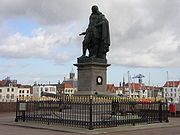
He is honoured by a statue in his birthplace Vlissingen, where he stands looking over the sea. Almost every town in the Netherlands has a street named after him.
Respect also extended far beyond the borders of the Republic. On his last journey home, the late Lieutenant-Admiral-General was saluted by cannon shots fired on the coasts of France by the direct orders of the French king Louis XIV. The town of Debrecen
erected a statue of him for his role in freeing 26 Protestant Hungarian
ministers from slavery
.
Six ships of the Royal Netherlands Navy
have been named HNLMS De Ruyter
and seven are named after his flagship HNLMS De Zeven Provinciën
De Ruyter has descendants still living in the United States, Britain, South Africa, Australia, New Zealand and Canada.
Admiral
Admiral is the rank, or part of the name of the ranks, of the highest naval officers. It is usually considered a full admiral and above vice admiral and below admiral of the fleet . It is usually abbreviated to "Adm" or "ADM"...
s in Dutch history
History of the Netherlands
The history of the Netherlands is the history of a maritime people thriving on a watery lowland river delta at the edge of northwestern Europe. When the Romans and written history arrived in 57 BC, the country was sparsely populated by various tribal groups at the periphery of the empire...
. De Ruyter is most famous for his role in the Anglo-Dutch Wars
Anglo-Dutch Wars
The Anglo–Dutch Wars were a series of wars fought between the English and the Dutch in the 17th and 18th centuries for control over the seas and trade routes. The first war took place during the English Interregnum, and was fought between the Commonwealth of England and the Dutch Republic...
of the 17th century. He fought the English
England
England is a country that is part of the United Kingdom. It shares land borders with Scotland to the north and Wales to the west; the Irish Sea is to the north west, the Celtic Sea to the south west, with the North Sea to the east and the English Channel to the south separating it from continental...
and French
France
The French Republic , The French Republic , The French Republic , (commonly known as France , is a unitary semi-presidential republic in Western Europe with several overseas territories and islands located on other continents and in the Indian, Pacific, and Atlantic oceans. Metropolitan France...
and scored several major victories against them, the best known probably being the Raid on the Medway
Raid on the Medway
The Raid on the Medway, sometimes called the Battle of the Medway, Raid on Chatham or the Battle of Chatham, was a successful Dutch attack on the largest English naval ships, laid up in the dockyards of their main naval base Chatham, that took place in June 1667 during the Second Anglo-Dutch War...
. The pious De Ruyter was very much loved by his sailors and soldiers; from them his most significant nickname derived: Bestevaêr (older Dutch for 'grandfather'.)
Early life
De Ruyter was born in 1607 in FlushingFlushing, Netherlands
Vlissingen is a municipality and a city in the southwestern Netherlands on the former island of Walcheren. With its strategic location between the Scheldt river and the North Sea, Vlissingen has been an important harbour for centuries. It was granted city rights in 1315. In the 17th century...
(Vlissingen) as the son of beer porter Adriaen Michielszoon and Aagje Jansdochter Little is known about De Ruyter's early life, but he probably became a sailor
Sailor
A sailor, mariner, or seaman is a person who navigates water-borne vessels or assists in their operation, maintenance, or service. The term can apply to professional mariners, military personnel, and recreational sailors as well as a plethora of other uses...
at the age of 11. In 1622 he fought as a musketeer
Musketeer
A musketeer was an early modern type of infantry soldier equipped with a musket. Musketeers were an important part of early modern armies, particularly in Europe. They sometimes could fight on horseback, like a dragoon or a cavalryman...
in the Dutch army under Maurice of Nassau against the Spaniards during the relief of Bergen-op-Zoom. That same year he rejoined the Dutch merchant fleet and steadily worked his way up. According to English sources he was active in Dublin between 1623 and 1631 as an agent for the Vlissingen-based merchant house of the Lampsins brothers. Although Dutch sources have no data about his whereabouts in those years, it is known that De Ruyter spoke Irish
Irish language
Irish , also known as Irish Gaelic, is a Goidelic language of the Indo-European language family, originating in Ireland and historically spoken by the Irish people. Irish is now spoken as a first language by a minority of Irish people, as well as being a second language of a larger proportion of...
fluently. He would occasionally travel as supercargo to the Mediterranean or the Barbary Coast
Barbary Coast
The Barbary Coast, or Barbary, was the term used by Europeans from the 16th until the 19th century to refer to much of the collective land of the Berber people. Today, the terms Maghreb and "Tamazgha" correspond roughly to "Barbary"...
. In those years he usually referred to himself as "Machgyel Adriensoon", his name in the Zealandic dialect he spoke, not having yet adopted the name "De Ruyter". "De Ruyter" most probably was a nickname given to him. An explanation might be found in the meaning of the older Dutch verb ruyten or ruiten which means "to raid", something De Ruyter was known to do as a privateer
Privateer
A privateer is a private person or ship authorized by a government by letters of marque to attack foreign shipping during wartime. Privateering was a way of mobilizing armed ships and sailors without having to spend public money or commit naval officers...
with the Lampsins ship Den Graeuwen Heynst.
In 1631 he married a farmer's daughter named Maayke Velders. The marriage lasted until the end of the year 1631 when Maayke died after giving birth to a daughter who followed her mother in death three weeks later.
In 1633 and 1635 De Ruyter sailed as a navigating officer aboard the ship Groene Leeuw (Green Lion) on whaling
Whaling
Whaling is the hunting of whales mainly for meat and oil. Its earliest forms date to at least 3000 BC. Various coastal communities have long histories of sustenance whaling and harvesting beached whales...
expeditions to Jan Mayen
Jan Mayen
Jan Mayen Island is a volcanic island in the Arctic Ocean and part of the Kingdom of Norway. It is long and 373 km2 in area, partly covered by glaciers . It has two parts: larger northeast Nord-Jan and smaller Sør-Jan, linked by an isthmus wide...
. At this point he did not yet have a command of his own. In the summer of 1636 he remarried, this time to a daughter of a wealthy burgher
Bourgeoisie
In sociology and political science, bourgeoisie describes a range of groups across history. In the Western world, between the late 18th century and the present day, the bourgeoisie is a social class "characterized by their ownership of capital and their related culture." A member of the...
named Neeltje Engels, who would give him four children. One of these died shortly after birth, the others were named Adriaen (1637), Neeltje (1639) and Aelken (1642).
In the midst of this, in 1637, De Ruyter became captain of a private ship meant to hunt for raiders
Raider (piracy)
A raider is a person who commits robbery at sea. With use of raid tactics, the raiders uses the naval strategy of attacking an opponent's commercial shipping rather than contending for command of the sea with its naval forces. The raiders destroy supplies of the enemy instead of engaging the...
operating from Dunkirk who were preying on Dutch merchant shipping. He fulfilled this task until 1640. After sailing for a while as schipper (skipper) of a merchant vessel named de Vlissinge, he was contacted again by the Zeeland
Zeeland
Zeeland , also called Zealand in English, is the westernmost province of the Netherlands. The province, located in the south-west of the country, consists of a number of islands and a strip bordering Belgium. Its capital is Middelburg. With a population of about 380,000, its area is about...
Admiralty to become captain of the Haze, a merchant ship turned man-of-war carrying 26 guns in a fleet under admiral Gijsels fighting the Spanish
Spain
Spain , officially the Kingdom of Spain languages]] under the European Charter for Regional or Minority Languages. In each of these, Spain's official name is as follows:;;;;;;), is a country and member state of the European Union located in southwestern Europe on the Iberian Peninsula...
, teaming up with the Portuguese
Portugal
Portugal , officially the Portuguese Republic is a country situated in southwestern Europe on the Iberian Peninsula. Portugal is the westernmost country of Europe, and is bordered by the Atlantic Ocean to the West and South and by Spain to the North and East. The Atlantic archipelagos of the...
during their rebellion.
A Dutch fleet, with De Ruyter as third in command, beat back a Spanish-Dunkirker fleet in an action off Cape St Vincent on 4 November 1641. After returning he bought his own ship, the Salamander, and between 1642 and 1652, he mainly traded and travelled to Morocco
Morocco
Morocco , officially the Kingdom of Morocco , is a country located in North Africa. It has a population of more than 32 million and an area of 710,850 km², and also primarily administers the disputed region of the Western Sahara...
and the West Indies to amass wealth as a merchant. During this time his esteem grew among other Dutch captains as he would regularly free Christian slaves by redeeming them at his own expense.
In 1650 De Ruyter's wife, who in 1649 had given him a second son named Engel
Engel de Ruyter
Engel Michielszoon de Ruyter was a Dutch vice-admiral.-Life:He was the son of lieutenant admiral Michiel de Ruyter and his second wife Cornelia Engels. He began his naval service on board his father's ship on his expeditions in 1664 and 1665...
, unexpectedly died. On 8 January 1652 he married the widow Anna van Gelder and decided the time had come to retire. He bought a house in Flushing, but his blissful family life would not last long.
First Anglo-Dutch War
During the First Anglo-Dutch WarFirst Anglo-Dutch War
The First Anglo–Dutch War was the first of the four Anglo–Dutch Wars. It was fought entirely at sea between the navies of the Commonwealth of England and the United Provinces of the Netherlands. Caused by disputes over trade, the war began with English attacks on Dutch merchant shipping, but...
(1652–1654), De Ruyter was asked to join the expanding fleet as a subcommander of a Zealandic squadron of "director's ships": privately financed warships. After initially refusing, De Ruyter proved his worth under supreme commander Lieutenant-Admiral (the nominal rank of Admiral-General was reserved for the stadtholder
Stadtholder
A Stadtholder A Stadtholder A Stadtholder (Dutch: stadhouder [], "steward" or "lieutenant", literally place holder, holding someones place, possibly a calque of German Statthalter, French lieutenant, or Middle Latin locum tenens...
but at the time none was appointed) Maarten Tromp
Maarten Tromp
Maarten Harpertszoon Tromp was an officer and later admiral in the Dutch navy. His first name is also spelled as Maerten.-Early life:...
, winning the Battle of Plymouth
Battle of Plymouth
The Battle of Plymouth was a naval battle in the First Anglo-Dutch War. It took place on 26 August 1652 and was a short battle, but had the unexpected outcome of a Dutch victory over England. General-at-Sea George Ayscue of the Commonwealth of England attacked an outward bound convoy of the Dutch...
against Vice-Admiral George Ayscue
George Ayscue
Admiral Sir George Ayscue was an English naval officer who served in the Civil War and the Anglo-Dutch Wars.In 1648, during the Civil War, while serving as a captain in the navy of the English Parliament, he prevented the fleet from defecting to the Royalists, and was promoted to General at Sea...
. He also fought at the Battle of Kentish Knock and the Battle of the Gabbard
Battle of the Gabbard
The naval Battle of the Gabbard, also known as the Battle of Gabbard Bank, the Battle of the North Foreland or the second Battle of Nieuwpoort took place on 2–3 June 1653 according to the Old Style of Julian calendar then used in England during the First Anglo-Dutch War near the Gabbard...
. De Ruyter functioned as a squadron commander, being referred to as a Commodore
Commodore (rank)
Commodore is a military rank used in many navies that is superior to a navy captain, but below a rear admiral. Non-English-speaking nations often use the rank of flotilla admiral or counter admiral as an equivalent .It is often regarded as a one-star rank with a NATO code of OF-6, but is not always...
, which at the time was not an official rank in the Dutch navy.
Tromp's death during the Battle of Scheveningen
Battle of Scheveningen
The Battle of Scheveningen was the final naval battle of the First Anglo-Dutch War...
ended the war and De Ruyter declined an emphatic offer from Johan de Witt
Johan de Witt
Johan de Witt, heer van Zuid- en Noord-Linschoten, Snelrewaard, Hekendorp and IJsselveere was a key figure in Dutch politics in the mid 17th century, when its flourishing sea trade in a period of globalization made the United Provinces a leading European power during the Dutch Golden Age...
for supreme command, because he considered himself 'unfit' and also feared that bypassing the seniority principle would bring him into conflict with Witte de With and Johan Evertsen
Johan Evertsen
Johan Evertsen was a Dutch admiral from the 17th century.- Biography :Johan was the eldest surviving son of Johan Evertsen, known as Captain Jan, who died in 1617 fighting near La Rochelle against a French corsair...
. Later De Ruyter and De Witt would become personal friends. Colonel Jacob van Wassenaer Obdam
Jacob van Wassenaer Obdam
Jacob, Banner Lord of Wassenaer, Lord Obdam, Hensbroek, Spanbroek, Opmeer, Zuidwijk and Kernhem was a Dutch Lieutenant-Admiral, and supreme commander of the confederate Dutch navy. The name Obdam was then also spelled as Opdam...
then became the new Dutch supreme commander of the confederate fleet. De Ruyter – after refusing to become Obdam's naval 'advisor' – remained in service of the Dutch navy however and later accepted an offer from the admiralty of Amsterdam
Amsterdam
Amsterdam is the largest city and the capital of the Netherlands. The current position of Amsterdam as capital city of the Kingdom of the Netherlands is governed by the constitution of August 24, 1815 and its successors. Amsterdam has a population of 783,364 within city limits, an urban population...
to become their Vice-Admiral on 2 March 1654. He relocated with his family to the city in 1655.
1655–1663
In July 1655 De Ruyter took command of a squadron of eight of which the Tijdverdrijf was his flagship and set out for the Mediterranean with 55 merchantmen in convoy. His orders were to protect Dutch trade. Meeting an English fleet under Robert BlakeRobert Blake (admiral)
Robert Blake was one of the most important military commanders of the Commonwealth of England and one of the most famous English admirals of the 17th century. Blake is recognised as the chief founder of England's naval supremacy, a dominance subsequently inherited by the British Royal Navy into...
along the way, he managed to avoid creating a new flag incident. Operating off the Barbary Coast
Barbary Coast
The Barbary Coast, or Barbary, was the term used by Europeans from the 16th until the 19th century to refer to much of the collective land of the Berber people. Today, the terms Maghreb and "Tamazgha" correspond roughly to "Barbary"...
he captured several infamous corsairs and having negotiated a peace agreement with Salé
Salé
Salé is a city in north-western Morocco, on the right bank of the Bou Regreg river, opposite the national capital Rabat, for which it serves as a commuter town...
, De Ruyter returned home May 1656.
The same month the States-General
States-General of the Netherlands
The States-General of the Netherlands is the bicameral legislature of the Netherlands, consisting of the Senate and the House of Representatives. The parliament meets in at the Binnenhof in The Hague. The archaic Dutch word "staten" originally related to the feudal classes in which medieval...
, becoming ever more wary of Swedish king Charles X
Charles X Gustav of Sweden
Charles X Gustav also Carl Gustav, was King of Sweden from 1654 until his death. He was the son of John Casimir, Count Palatine of Zweibrücken-Kleeburg and Catherine of Sweden. After his father's death he also succeeded him as Pfalzgraf. He was married to Hedwig Eleonora of Holstein-Gottorp, who...
and his expansion plans, decided to intervene in the Northern Wars
Northern Wars
Northern Wars is a term used for a series of wars fought in northern and northeastern Europe in the 16th and 17th century. An internationally agreed nomenclature for these wars has not yet been devised...
by sending a fleet to the Baltic Sea
Baltic Sea
The Baltic Sea is a brackish mediterranean sea located in Northern Europe, from 53°N to 66°N latitude and from 20°E to 26°E longitude. It is bounded by the Scandinavian Peninsula, the mainland of Europe, and the Danish islands. It drains into the Kattegat by way of the Øresund, the Great Belt and...
. The Swedes controlled this area after Charles had invaded Poland and made himself king there. De Ruyter once again embarked on the Tijdverdrijf arriving in the Sound
Sound
Sound is a mechanical wave that is an oscillation of pressure transmitted through a solid, liquid, or gas, composed of frequencies within the range of hearing and of a level sufficiently strong to be heard, or the sensation stimulated in organs of hearing by such vibrations.-Propagation of...
8 June; there he waited for Lieutenant-Admiral Jacob van Wassenaer Obdam
Jacob van Wassenaer Obdam
Jacob, Banner Lord of Wassenaer, Lord Obdam, Hensbroek, Spanbroek, Opmeer, Zuidwijk and Kernhem was a Dutch Lieutenant-Admiral, and supreme commander of the confederate Dutch navy. The name Obdam was then also spelled as Opdam...
to arrive. After Obdam had assumed command De Ruyter and the Dutch fleet sailed to relieve the besieged city of Danzig/Gdańsk on 27 July, without any bloodshed. Peace was signed a month later. Before leaving the Baltic De Ruyter and other flag-officers were granted audience by Frederick III of Denmark
Frederick III of Denmark
Frederick III was king of Denmark and Norway from 1648 until his death. He instituted absolute monarchy in Denmark and Norway in 1660, confirmed by law in 1665 as the first in western historiography. He was born the second-eldest son of Christian IV of Denmark and Anne Catherine of Brandenburg...
. De Ruyter took a liking to the Danish king who would later become a personal friend.
In 1658 the States-General under the advice of a leading member, (one of the) mayors of Amsterdam Cornelis de Graeff
Cornelis de Graeff
Cornelis de Graeff, also Cornelis de Graeff van Polsbroek was the most illustrious member of the De Graeff family. He was a mayor of Amsterdam from the Dutch Golden Age and a powerful Amsterdam regent after the sudden death of stadholder William II of Orange...
decided to once again send a fleet to the Baltic Sea
Baltic Sea
The Baltic Sea is a brackish mediterranean sea located in Northern Europe, from 53°N to 66°N latitude and from 20°E to 26°E longitude. It is bounded by the Scandinavian Peninsula, the mainland of Europe, and the Danish islands. It drains into the Kattegat by way of the Øresund, the Great Belt and...
to protect the important Baltic
Baltic region
The terms Baltic region, Baltic Rim countries, and Baltic Rim refer to slightly different combinations of countries in the general area surrounding the Baltic Sea.- Etymology :...
trade and to aid the Danes against Swedish aggression, continued despite a peace settlement. In accordance with the States' balance of power politics a fleet under Lieutenant-Admiral Jacob van Wassenaer Obdam
Jacob van Wassenaer Obdam
Jacob, Banner Lord of Wassenaer, Lord Obdam, Hensbroek, Spanbroek, Opmeer, Zuidwijk and Kernhem was a Dutch Lieutenant-Admiral, and supreme commander of the confederate Dutch navy. The name Obdam was then also spelled as Opdam...
was sent, without De Ruyter, who at the time was blockading Lisbon
Lisbon
Lisbon is the capital city and largest city of Portugal with a population of 545,245 within its administrative limits on a land area of . The urban area of Lisbon extends beyond the administrative city limits with a population of 3 million on an area of , making it the 9th most populous urban...
. On 8 November a bloody melee took place: the Battle of the Sound
Battle of the Sound
The naval Battle of the Sound took place on 8 November 1658 during the Second Northern War, near the Sound or Oresund, just north of the Danish capital, Copenhagen. Sweden had defeated Denmark and an army under Charles X of Sweden had Copenhagen itself under siege...
, which resulted in a Dutch victory, relieving Copenhagen
Copenhagen
Copenhagen is the capital and largest city of Denmark, with an urban population of 1,199,224 and a metropolitan population of 1,930,260 . With the completion of the transnational Øresund Bridge in 2000, Copenhagen has become the centre of the increasingly integrating Øresund Region...
. Still the Swedes were far from defeated and the States decided to continue their support. De Ruyter took command of a new expeditionary fleet and managed to liberate Nyborg
Nyborg
Nyborg is a city in central Denmark, located in Nyborg Municipality on the island of Funen and with a population of 16,492 . Nyborg is one of the 14 large municipalities created on 1 January 2007...
in 1659. For this he was knighted by the Danish king Frederick III of Denmark
Frederick III of Denmark
Frederick III was king of Denmark and Norway from 1648 until his death. He instituted absolute monarchy in Denmark and Norway in 1660, confirmed by law in 1665 as the first in western historiography. He was born the second-eldest son of Christian IV of Denmark and Anne Catherine of Brandenburg...
From 1661 until 1663 De Ruyter had convoy duty in the Mediterranean.
Second Anglo-Dutch War
In 1664, a year before the Second Anglo-Dutch WarSecond Anglo-Dutch War
The Second Anglo–Dutch War was part of a series of four Anglo–Dutch Wars fought between the English and the Dutch in the 17th and 18th centuries for control over the seas and trade routes....
officially began, he clashed with the English off the West Africa
West Africa
West Africa or Western Africa is the westernmost region of the African continent. Geopolitically, the UN definition of Western Africa includes the following 16 countries and an area of approximately 5 million square km:-Flags of West Africa:...
n coast, where both the English and Dutch had significant slave stations, retaking the Dutch possessions occupied by Robert Holmes
Robert Holmes (admiral)
Sir Robert Holmes was an English Admiral of the Restoration Navy. He took part in the second and third Anglo-Dutch wars, both of which he is, by some, credited with having started. He was made governor of the Isle of Wight, where he is buried in Yarmouth parish church...
and then crossing the Atlantic to raid the English colonies in North America.
Arriving off Barbados
Barbados
Barbados is an island country in the Lesser Antilles. It is in length and as much as in width, amounting to . It is situated in the western area of the North Atlantic and 100 kilometres east of the Windward Islands and the Caribbean Sea; therein, it is about east of the islands of Saint...
in the Caribbean
Caribbean
The Caribbean is a crescent-shaped group of islands more than 2,000 miles long separating the Gulf of Mexico and the Caribbean Sea, to the west and south, from the Atlantic Ocean, to the east and north...
at the end of April 1665 aboard his flagship Spiegel, he led his fleet of thirteen vessels into Carlisle Bay, exchanging fire with the English batteries and destroying many of the vessels anchored there. Unable to silence the English guns and having sustained considerable damage to his own vessels, he retired to French Martinique
Martinique
Martinique is an island in the eastern Caribbean Sea, with a land area of . Like Guadeloupe, it is an overseas region of France, consisting of a single overseas department. To the northwest lies Dominica, to the south St Lucia, and to the southeast Barbados...
for repairs.
Sailing north from Martinique, de Ruyter captured several English vessels and delivered supplies to the Dutch colony at Sint Eustatius. Given the damage he had sustained, he decided against an assault on New York
New York City
New York is the most populous city in the United States and the center of the New York Metropolitan Area, one of the most populous metropolitan areas in the world. New York exerts a significant impact upon global commerce, finance, media, art, fashion, research, technology, education, and...
(the former New Amsterdam
New Amsterdam
New Amsterdam was a 17th-century Dutch colonial settlement that served as the capital of New Netherland. It later became New York City....
) to retake New Netherland
New Netherland
New Netherland, or Nieuw-Nederland in Dutch, was the 17th-century colonial province of the Republic of the Seven United Netherlands on the East Coast of North America. The claimed territories were the lands from the Delmarva Peninsula to extreme southwestern Cape Cod...
. He then took off to Newfoundland
Newfoundland and Labrador
Newfoundland and Labrador is the easternmost province of Canada. Situated in the country's Atlantic region, it incorporates the island of Newfoundland and mainland Labrador with a combined area of . As of April 2011, the province's estimated population is 508,400...
, capturing some English merchant ships and temporarily taking St. John's
St. John's, Newfoundland and Labrador
St. John's is the capital and largest city in Newfoundland and Labrador, and is the oldest English-founded city in North America. It is located on the eastern tip of the Avalon Peninsula on the island of Newfoundland. With a population of 192,326 as of July 1, 2010, the St...
before proceeding to Europe.
Battle of Lowestoft
The naval Battle of Lowestoft took place on 13 June 1665 during the Second Anglo-Dutch War.A fleet of more than a hundred ships of the United Provinces commanded by Lieutenant-Admiral Jacob van Wassenaer Obdam attacked an English fleet of equal size commanded by James Stuart, Duke of York forty...
. Many expected that Tromp's son Cornelis would now take command of the confederate fleet, especially Cornelis Tromp
Cornelis Tromp
Sir Cornelis Maartenszoon Tromp, 1st Baronet was a Dutch naval officer. He was the son of Lieutenant Admiral Maarten Tromp. He became Lieutenant Admiral General in the Dutch Navy and briefly Admiral General in the Danish Navy...
himself, who had already been given a temporary commission. Tromp however was not acceptable to the regent regime of Johan de Witt because of his support of the Prince of Orange's cause. De Ruyter's popularity had grown after his heroic return and, most importantly, his affiliation lay with the States-General
States-General of the Netherlands
The States-General of the Netherlands is the bicameral legislature of the Netherlands, consisting of the Senate and the House of Representatives. The parliament meets in at the Binnenhof in The Hague. The archaic Dutch word "staten" originally related to the feudal classes in which medieval...
and Johan de Witt
Johan de Witt
Johan de Witt, heer van Zuid- en Noord-Linschoten, Snelrewaard, Hekendorp and IJsselveere was a key figure in Dutch politics in the mid 17th century, when its flourishing sea trade in a period of globalization made the United Provinces a leading European power during the Dutch Golden Age...
in particular. He therefore was made commander of the Dutch fleet on 11 August 1665, as Lieutenant-Admiral (a rank he at the time shared with six others) of the Amsterdam admiralty.
In this Second Anglo-Dutch War
Second Anglo-Dutch War
The Second Anglo–Dutch War was part of a series of four Anglo–Dutch Wars fought between the English and the Dutch in the 17th and 18th centuries for control over the seas and trade routes....
(1665–1667) he won a hard-fought victory in the Four Days Battle
Four Days Battle
The Four Days Battle was a naval battle of the Second Anglo–Dutch War. Fought from 1 June to 4 June 1666 in the Julian or Old Style calendar then used in England off the Flemish and English coast, it remains one of the longest naval engagements in history.In June 1665 the English had soundly...
(June 1666) but narrowly escaped disaster in the St James's Day Battle (August 1666) which brought him into conflict with Cornelis Tromp, eventually leading to Tromp's dismissal. He then became seriously ill, recovering just in time to take nominal command of the fleet executing the Raid on the Medway
Raid on the Medway
The Raid on the Medway, sometimes called the Battle of the Medway, Raid on Chatham or the Battle of Chatham, was a successful Dutch attack on the largest English naval ships, laid up in the dockyards of their main naval base Chatham, that took place in June 1667 during the Second Anglo-Dutch War...
in 1667. The Medway raid was a costly and embarrassing defeat for the English, resulting in the loss of the English flagship HMS Royal Charles
HMS Royal Charles (1655)
Royal Charles was an 80-gun first-rate three-decker ship of the line of the English Navy. She was originally called the Naseby, built by Peter Pett, and launched at Woolwich dockyard in 1655, for the navy of the Commonwealth of England, and named in honour of Oliver Cromwell's decisive 1645...
and bringing the Dutch close to London
London
London is the capital city of :England and the :United Kingdom, the largest metropolitan area in the United Kingdom, and the largest urban zone in the European Union by most measures. Located on the River Thames, London has been a major settlement for two millennia, its history going back to its...
and the war to its end. Between 1667 and 1671 he was forbidden by De Witt to sail, in order not to endanger his life. In 1669 a failed attempt on his life was made by a Tromp supporter, trying to stab him with a bread knife in the entrance-hall of his house.
Third Anglo-Dutch War and death
De Ruyter saved the situation for the Netherlands in the Third Anglo-Dutch WarThird Anglo-Dutch War
The Third Anglo–Dutch War or Third Dutch War was a military conflict between England and the Dutch Republic lasting from 1672 to 1674. It was part of the larger Franco-Dutch War...
. His strategic victories over larger Anglo-French fleets at the Battles of Solebay
Battle of Solebay
The naval Battle of Solebay took place on 28 May Old Style, 7 June New Style 1672 and was the first naval battle of the Third Anglo-Dutch War.-The battle:...
(1672), the double Schooneveld
Battle of Schooneveld
The Battles of Schooneveld were two naval battles of the Franco-Dutch War, fought off the coast of the Netherlands on 7 June and 14 June 1673 between an allied Anglo-French fleet commanded by Prince Rupert of the Rhine, and the fleet of the United Provinces, commanded by Michiel de Ruyter.The...
(1673) and Texel
Battle of Texel
The naval Battle of Texel or Battle of Kijkduin took place on 21 August 1673 between the Dutch and the combined English and French fleets and was the last major battle of the Third Anglo-Dutch War, which was itself part of the Franco-Dutch War , during which Louis XIV of France invaded the...
(1673) warded off invasion. The new rank of Lieutenant-Admiral-General was created especially for him in February 1673, when the new stadtholder
Stadtholder
A Stadtholder A Stadtholder A Stadtholder (Dutch: stadhouder [], "steward" or "lieutenant", literally place holder, holding someones place, possibly a calque of German Statthalter, French lieutenant, or Middle Latin locum tenens...
William III of Orange
William III of England
William III & II was a sovereign Prince of Orange of the House of Orange-Nassau by birth. From 1672 he governed as Stadtholder William III of Orange over Holland, Zeeland, Utrecht, Guelders, and Overijssel of the Dutch Republic. From 1689 he reigned as William III over England and Ireland...
became Admiral-General.
Again taking the battle to the Caribbean, this time against the French, De Ruyter arrived off Martinique aboard his flagship De Zeven Provinciën on 19 July 1674. He led a substantial force of eighteen warships, nine storeships, and fifteen troop transports bearing 3,400 soldiers. Attempting to assault Fort Royal
Fort-de-France
Fort-de-France is the capital of France's Caribbean overseas department of Martinique. It is also one of the major cities in the Caribbean. Exports include sugar, rum, tinned fruit, and cacao.-Geography:...
, his fleet was becalmed, allowing the greatly outnumbered French defenders time to solidify their defenses. The next day, newly-placed booms prevented de Ruyter from entering the harbor. Nonetheless, the Dutch soldiers went ashore without the support of the fleet's guns, and were badly mauled in their attempt to reach the French fortifications atop the steep cliffs. Within two hours, the soldiers were returning to the fleet, with 143 killed and 318 wounded, as compared to only fifteen French defenders lost. His ambitions thwarted and with the element of surprise lost, De Ruyter sailed north to Dominica
Dominica
Dominica , officially the Commonwealth of Dominica, is an island nation in the Lesser Antilles region of the Caribbean Sea, south-southeast of Guadeloupe and northwest of Martinique. Its size is and the highest point in the country is Morne Diablotins, which has an elevation of . The Commonwealth...
and Nevis
Nevis
Nevis is an island in the Caribbean Sea, located near the northern end of the Lesser Antilles archipelago, about 350 km east-southeast of Puerto Rico and 80 km west of Antigua. The 93 km² island is part of the inner arc of the Leeward Islands chain of the West Indies...
, then returned to Europe while disease spread aboard his ships.
In 1676 he took command of a combined Dutch-Spanish fleet to help the Spanish suppress the Messina Revolt and fought a French fleet under Duquesne
Duquesne
-Individuals:* Abraham de Bellebat, marquis du Quesne, governor of Martinique in 1716* Abraham Duquesne, French admiral* Calleigh Duquesne, a character in the television series CSI: Miami...
twice at the Battle of Stromboli
Battle of Stromboli
The naval Battle of Stromboli took place on 8 January 1676 during the Franco-Dutch War between a French fleet of 20 ships under Abraham Duquesne and a combined fleet of 19 Dutch and one Spanish ship under Lieutenant-Admiral-General Michiel de Ruyter that lasted eight hours and ended inconclusively...
and the Battle of Agosta
Battle of Agosta
The naval Battle of Augusta took place on 22 April 1676 during the Franco-Dutch War and was fought between a French fleet of 29 man-of-war, five frigates and eight fireships under Abraham Duquesne and a Dutch-Spanish fleet of 27 plus five fireships with Dutch Lieutenant-Admiral-General Michiel de...
, where he was fatally wounded when a cannonball hit him in the left leg. On 18 March 1677 De Ruyter was given an elaborate state funeral when his body was buried in the Nieuwe Kerk
Nieuwe Kerk (Amsterdam)
The Nieuwe Kerk is a 15th-century church in Amsterdam, located on Dam Square, next to the Royal Palace.-History:The bishop of Utrecht gave the city of Amsterdam permission to use a second the parish church in 1408 because the Oude Kerk had grown too small for the growing population of the city....
(New Church) in Amsterdam
Amsterdam
Amsterdam is the largest city and the capital of the Netherlands. The current position of Amsterdam as capital city of the Kingdom of the Netherlands is governed by the constitution of August 24, 1815 and its successors. Amsterdam has a population of 783,364 within city limits, an urban population...
. He was succeeded as supreme commander by Cornelis Tromp in 1679.
Legacy
De Ruyter was highly respected by his sailors and soldiers, who used the term of endearment Bestevaêr ("Granddad") for him, both because of his disregard for hierarchy (he was himself of humble origin) and his refusal to back away from risky and bold undertakings despite his usually cautious nature.He is honoured by a statue in his birthplace Vlissingen, where he stands looking over the sea. Almost every town in the Netherlands has a street named after him.
Respect also extended far beyond the borders of the Republic. On his last journey home, the late Lieutenant-Admiral-General was saluted by cannon shots fired on the coasts of France by the direct orders of the French king Louis XIV. The town of Debrecen
Debrecen
Debrecen , is the second largest city in Hungary after Budapest. Debrecen is the regional centre of the Northern Great Plain region and the seat of Hajdú-Bihar county.- Name :...
erected a statue of him for his role in freeing 26 Protestant Hungarian
Hungary
Hungary , officially the Republic of Hungary , is a landlocked country in Central Europe. It is situated in the Carpathian Basin and is bordered by Slovakia to the north, Ukraine and Romania to the east, Serbia and Croatia to the south, Slovenia to the southwest and Austria to the west. The...
ministers from slavery
Slavery
Slavery is a system under which people are treated as property to be bought and sold, and are forced to work. Slaves can be held against their will from the time of their capture, purchase or birth, and deprived of the right to leave, to refuse to work, or to demand compensation...
.
Six ships of the Royal Netherlands Navy
Royal Netherlands Navy
The Koninklijke Marine is the navy of the Netherlands. In the mid-17th century the Dutch Navy was the most powerful navy in the world and it played an active role in the wars of the Dutch Republic and later those of the Batavian Republic and the Kingdom of the Netherlands...
have been named HNLMS De Ruyter
HNLMS De Ruyter
HNLMS De Ruyter may refer to one of seven ships of the Royal Netherlands Navy named after Admiral Michiel Adriaenszoon de Ruyter :...
and seven are named after his flagship HNLMS De Zeven Provinciën
HNLMS De Zeven Provinciën
Eight ships of the Royal Netherlands Navy have been named HNLMS De Zeven Provinciën or similar, after the original seven provinces of the Netherlands forming the Union of Utrecht:*Zeven Provinciën , ship of the line of the Amsterdam Admiralty;...
De Ruyter has descendants still living in the United States, Britain, South Africa, Australia, New Zealand and Canada.
Modern reference
- In the 2004 election of De Grootste NederlanderDe Grootste NederlanderDe Grootste Nederlander was a public poll held in 2004 by the broadcasting company KRO of the Publieke Omroep. The series is based on the BBC's 100 Greatest Britons...
(The Greatest Dutchman) Michiel de Ruyter was the seventh-most voted. - 'Michiel de Ruyter' is the default name for the Dutch in Sid Meier's 1994 game, Colonization. He is also a great general in the Rise of Mankind mod to Civilization IV.
- He was buried in the Nieuwe KerkNieuwe Kerk (Amsterdam)The Nieuwe Kerk is a 15th-century church in Amsterdam, located on Dam Square, next to the Royal Palace.-History:The bishop of Utrecht gave the city of Amsterdam permission to use a second the parish church in 1408 because the Oude Kerk had grown too small for the growing population of the city....
(New Church) in AmsterdamAmsterdamAmsterdam is the largest city and the capital of the Netherlands. The current position of Amsterdam as capital city of the Kingdom of the Netherlands is governed by the constitution of August 24, 1815 and its successors. Amsterdam has a population of 783,364 within city limits, an urban population...
. De Ruyter's burial site has now turned into a tourist attraction. De Ruyter's mausoleumMausoleumA mausoleum is an external free-standing building constructed as a monument enclosing the interment space or burial chamber of a deceased person or persons. A monument without the interment is a cenotaph. A mausoleum may be considered a type of tomb or the tomb may be considered to be within the...
is visible, protected by a glass pane. However, descendants of the De Ruyter family are granted unrestricted access to his grave, and De Ruyter's descendant stated in a 2007 issue of Dutch newspaper Het ParoolHet ParoolHet Parool is an Amsterdam-based daily newspaper. It was founded as a resistance paper during World War II by Frans Van Heuven Goedhart and Jaap Nunes Vaz...
that he visited the coffin privately in 1948 with his own grandfather, and they decided to lift the coffin's lid. The grand-grand son was shocked with the sight and said: "it wasn't a pleasant sight. He (De Ruyter) was embalmed with great haste, and they didn't bother with his shot-off leg, they just dropped it in. It was just lying there. No, it wasn't pleasant, it was a shock actually ." - The small townDeRuyter, New YorkDeRuyter, New York may refer to either:*DeRuyter , New York, located in Madison County*DeRuyter , New York, located within the Town of DeRuyter...
and villageDeRuyter, New YorkDeRuyter, New York may refer to either:*DeRuyter , New York, located in Madison County*DeRuyter , New York, located within the Town of DeRuyter...
of DeRuyter, New YorkDeRuyter, New YorkDeRuyter, New York may refer to either:*DeRuyter , New York, located in Madison County*DeRuyter , New York, located within the Town of DeRuyter...
, southeast of SyracuseSyracuse, New YorkSyracuse is a city in and the county seat of Onondaga County, New York, United States, the largest U.S. city with the name "Syracuse", and the fifth most populous city in the state. At the 2010 census, the city population was 145,170, and its metropolitan area had a population of 742,603...
, are named after the admiral. - In the book "Captain Blood: his Odyssey" (Raphael Sabatini), the title character served in the Dutch Navy under de Ruyter.
Literature
- David Marley, Wars of the Americas: A Chronology of Armed Conflict in the New World, 1492 to the Present, ABC-CLIO, Santa Barbara, 1998 (pp. 159, 165, 177–179). ISBN 0-87436-837-5
- Roger Hainsworth and Christine Churches, The Anglo Dutch Naval Wars 1652–1674, Sutton Pub Ltd, 1998
- R. Prud’homme van Reine, Rechterhand van Nederland. Biografie van Michiel Adriaenszoon de Ruyter, (Amsterdam 1996)
- Oliver Warner, Great Sea Battles, Spring Books London, 1973
- Warnsinck, JCM, Twaalf doorluchtige zeehelden. PN van Kampen & Zoon NV, 1941
- Warnsinck, JCM, Van Vlootvoogden en Zeeslagen, PN van Kampen & Zoon, 1940
- Blok, PJ, Michiel Adriaansz. de Ruyter (1928)
- Moldova György, Negyven prédikátor (1973) (novel)
External links
- De Ruyters' flagship 'The Seven Provinces' is being rebuilt in Dutch town LelystadLelystadLelystad is a municipality and a city in the centre of the Netherlands, and it is the capital of the province of Flevoland. The city, built on reclaimed land, was founded in 1967 and was named after Cornelis Lely, who engineered the Afsluitdijk, making the reclamation possible...
. - Michiel de Ruyter foundation
- 400 years Michiel de Ruyter Foundation (theme year 2007)
- 400 years Michiel de Ruyter Portal (theme year 2007)