

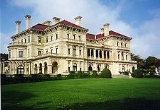
The Breakers

Encyclopedia
The Breakers is a Vanderbilt mansion located on Ochre Point Avenue, Newport
, Rhode Island
, United States
on the Atlantic Ocean
. It is a National Historic Landmark
, a contributing property
to the Bellevue Avenue Historic District
, and is owned and operated by the Preservation Society of Newport County
.
The Breakers was built as the Newport summer home of Cornelius Vanderbilt II
, a member of the wealthy United States Vanderbilt family
. It is built in a style often described as Goût Rothschild
. Designed by renowned architect
Richard Morris Hunt
and with interior decoration by Jules Allard and Sons
and Ogden Codman, Jr.
, the 70-room mansion has approximately 65000 sq ft (6,038.7 m²) of living space. The home was constructed between 1893 and 1895 at a cost of more than $12 million (approximately $ million in today's dollars adjusted for inflation). The Ochre Point Avenue entrance is marked by sculpted iron gates and the 30 feet (9.1 m) high walkway gates are part of a 12-foot-high limestone and iron fence that borders the property on all but the ocean side. The 250 by 120 ft (76.2 by 36.6 m) dimensions of the five-story mansion are aligned symmetrically around a central Great Hall.
Part of a 13-acre (53,000 m²) estate on the seagirt cliffs of Newport, it faces east overlooking the Atlantic Ocean.
on the property owned by Pierre Lorillard IV
burned during 1892, Cornelius Vanderbilt II insisted that the building be made as fireproof as possible and as such, the structure of the building used steel trusses and no wooden parts. He even required that the furnace be located away from the house, under Ochre Point Avenue; in winter there is an area in front of the main gate over the furnace where snow and ice always melt.
The designers created an interior using marble imported from Italy
and Africa
plus rare woods and mosaics from countries around the world. It also included architectural elements (such as the library mantel) purchased from chateau
x in France
.
The Breakers is the architectural and social archetype of the "Gilded Age
", a period when members of the Vanderbilt family were among the major industrialists of America. Indeed, "if the Gilded Age were to be summed up by a single house, that house would have to be The Breakers." During 1895, the year of its completion, The Breakers was the largest, most opulent house in the Newport area.
Vanderbilt died from a cerebral hemorrhage caused from a second stroke during 1899 at the age of 55, leaving the Breakers to his wife, Alice Gwynne Vanderbilt. She outlived her husband by 35 years and died at the age of 89 during 1934. In her will, The Breakers was given to her youngest daughter, Countess Gladys Széchenyi
(1886–1965), essentially because Gladys lacked American property. Also, none of Alice's other children were interested in the property while Gladys had always loved the estate.
The Breakers survived the great New England Hurricane of 1938
with minimal damage and minor flooding of the grounds.
During 1948, Gladys leased the high-maintenance property to the non-profit Preservation Society of Newport County for $1 a year. The Society bought the Breakers during 1972 for $365,000 from Countess Sylvia Szapary, the daughter of Gladys. However, the agreement with the Society allows the family to continue to live on the third floor, which is not open to the public. Countess Sylvia lived there part time until her death on March 1, 1998. Gladys and Paul Szapary, Sylvia's children, spend summers there to this day, hidden from the hundreds of thousands of tourists who explore below.
Although the mansion is owned by the Society, the original furnishings displayed throughout the house are still owned by the family.
It is now the most-visited attraction in Rhode Island
with approximately 300,000 visitors annually and is open year-round for tours.
During April 2009 the museum stopped offering personalized tours by tour guides due to a decision by management. Patrons now receive standard audio headsets.
, and dwarf hemlock
. The trees of The Breakers' grounds act as screens that increase the sense of distance between The Breakers and its Newport neighbors. Among the more unusual imported trees are two examples of the Blue Atlas Cedar, a native of North Africa. Clipped hedges of Japanese yew and Pfitzer juniper line the tree shaded foot paths that meander about the grounds. Informal plantings of arbor vitae, taxus, Chinese juniper, and dwarf hemlock provide attractive foregrounds for the walls that enclose the formally landscaped terrace. The grounds also contain several varieties of other rare trees, particularly copper and weeping beech
es. These were hand-selected by James Bowditch, a forester based in the Boston area. Bowditch’s original pattern for the south parterre garden was determined from old photographs and laid out in pink and white alyssum and blue ageratum. The wide borders paralleling the wrought iron fence are planted with rhododendron
, laurel
, dogwood
s, and many other flowering shrubs that effectively screen the grounds from street traffic and give visitors a feeling of seclusion.
A total of 30 bedrooms are located in the two third floor staff quarters. Three additional bedrooms for the Butler, Chef, and Visiting Valet are located on the Mezzanine "Entrasol" Floor located between the first and second floor just to the rear of the main kitchen.
Over the Grand Staircase is a stained glass skylight designed by artist John La Farge. Originally installed in the Vanderbilt's 1 West 57th Street townhouse dining room, the skylight was removed in 1894 during an expansion of the house.
. The Breakers is one of the few surviving works of Hunt that has not been demolished during the last century and is therefore valuable for its rarity as well as its architectural excellence. The Breakers was Hunt’s final work. The Breakers made Hunt the "dean of American architecture" as well as helping define the era in American life which Hunt helped to shape.
Newport, Rhode Island
Newport is a city on Aquidneck Island in Newport County, Rhode Island, United States, about south of Providence. Known as a New England summer resort and for the famous Newport Mansions, it is the home of Salve Regina University and Naval Station Newport which houses the United States Naval War...
, Rhode Island
Rhode Island
The state of Rhode Island and Providence Plantations, more commonly referred to as Rhode Island , is a state in the New England region of the United States. It is the smallest U.S. state by area...
, United States
United States
The United States of America is a federal constitutional republic comprising fifty states and a federal district...
on the Atlantic Ocean
Atlantic Ocean
The Atlantic Ocean is the second-largest of the world's oceanic divisions. With a total area of about , it covers approximately 20% of the Earth's surface and about 26% of its water surface area...
. It is a National Historic Landmark
National Historic Landmark
A National Historic Landmark is a building, site, structure, object, or district, that is officially recognized by the United States government for its historical significance...
, a contributing property
Contributing property
In the law regulating historic districts in the United States, a contributing resource or contributing property is any building, structure, or object which adds to the historical integrity or architectural qualities that make the historic district, listed locally or federally, significant...
to the Bellevue Avenue Historic District
Bellevue Avenue Historic District
The Bellevue Avenue Historic District is located along and around Bellevue Avenue in Newport, Rhode Island, United States. Its property is almost exclusively residential, including many of the mansions built by affluent summer vacationers in the city around the turn of the 20th century, including...
, and is owned and operated by the Preservation Society of Newport County
Preservation Society of Newport County
The Preservation Society of Newport County is a private, non-profit organization based in Newport, Rhode Island. It is Rhode Island's largest and most-visited cultural organization. The organization's mission is to preserve the architectural heritage of Newport County, Rhode Island, including...
.
The Breakers was built as the Newport summer home of Cornelius Vanderbilt II
Cornelius Vanderbilt II
Cornelius Vanderbilt II was an American socialite, heir, businessman, and a member of the prominent United States Vanderbilt family....
, a member of the wealthy United States Vanderbilt family
Vanderbilt family
The Vanderbilt family is an American family of Dutch origin prominent during the Gilded Age. It started off with the shipping and railroad empires of Cornelius Vanderbilt, and expanded into various other areas of industry and philanthropy...
. It is built in a style often described as Goût Rothschild
Goût Rothschild
Le Goût Rothschild, , describes a style of glamorous interior decoration and living which has its origin in France, Britain and Germany in the 19th century. It was the time when the fame, wealth and power of the Rothschild Dynasty was at its height...
. Designed by renowned architect
Architect
An architect is a person trained in the planning, design and oversight of the construction of buildings. To practice architecture means to offer or render services in connection with the design and construction of a building, or group of buildings and the space within the site surrounding the...
Richard Morris Hunt
Richard Morris Hunt
Richard Morris Hunt was an American architect of the nineteenth century and a preeminent figure in the history of American architecture...
and with interior decoration by Jules Allard and Sons
Jules Allard and Sons
The Parisian firm of Jules Allard and Sons , in business between 1878 and Allard's death in 1907, was one of the most notable interior decorating houses of the turn of the twentieth century. The firm opened a New York branch in 1885...
and Ogden Codman, Jr.
Ogden Codman, Jr.
Ogden Codman, Jr. was a noted American architect and interior decorator in the Beaux-Arts styles, and co-author with Edith Wharton of The Decoration of Houses , which became a standard in American interior design....
, the 70-room mansion has approximately 65000 sq ft (6,038.7 m²) of living space. The home was constructed between 1893 and 1895 at a cost of more than $12 million (approximately $ million in today's dollars adjusted for inflation). The Ochre Point Avenue entrance is marked by sculpted iron gates and the 30 feet (9.1 m) high walkway gates are part of a 12-foot-high limestone and iron fence that borders the property on all but the ocean side. The 250 by 120 ft (76.2 by 36.6 m) dimensions of the five-story mansion are aligned symmetrically around a central Great Hall.
Part of a 13-acre (53,000 m²) estate on the seagirt cliffs of Newport, it faces east overlooking the Atlantic Ocean.
History
As the previous mansionThe Breakers (1878)
The Breakers was located on Ochre Point Avenue, Newport, Rhode Island, United States.Designed by Peabody and Stearns for Pierre Lorillard IV in the Queen Anne style, construction began in 1877 and was completed in 1878. The landscaping was designed by Ernest Bowditch. The Breakers was notable...
on the property owned by Pierre Lorillard IV
Pierre Lorillard IV
Pierre Lorillard IV was an American tobacco manufacturer and thoroughbred race horse owner.-Biography:...
burned during 1892, Cornelius Vanderbilt II insisted that the building be made as fireproof as possible and as such, the structure of the building used steel trusses and no wooden parts. He even required that the furnace be located away from the house, under Ochre Point Avenue; in winter there is an area in front of the main gate over the furnace where snow and ice always melt.
The designers created an interior using marble imported from Italy
Italy
Italy , officially the Italian Republic languages]] under the European Charter for Regional or Minority Languages. In each of these, Italy's official name is as follows:;;;;;;;;), is a unitary parliamentary republic in South-Central Europe. To the north it borders France, Switzerland, Austria and...
and Africa
Africa
Africa is the world's second largest and second most populous continent, after Asia. At about 30.2 million km² including adjacent islands, it covers 6% of the Earth's total surface area and 20.4% of the total land area...
plus rare woods and mosaics from countries around the world. It also included architectural elements (such as the library mantel) purchased from chateau
Château
A château is a manor house or residence of the lord of the manor or a country house of nobility or gentry, with or without fortifications, originally—and still most frequently—in French-speaking regions...
x in France
France
The French Republic , The French Republic , The French Republic , (commonly known as France , is a unitary semi-presidential republic in Western Europe with several overseas territories and islands located on other continents and in the Indian, Pacific, and Atlantic oceans. Metropolitan France...
.
The Breakers is the architectural and social archetype of the "Gilded Age
Gilded Age
In United States history, the Gilded Age refers to the era of rapid economic and population growth in the United States during the post–Civil War and post-Reconstruction eras of the late 19th century. The term "Gilded Age" was coined by Mark Twain and Charles Dudley Warner in their book The Gilded...
", a period when members of the Vanderbilt family were among the major industrialists of America. Indeed, "if the Gilded Age were to be summed up by a single house, that house would have to be The Breakers." During 1895, the year of its completion, The Breakers was the largest, most opulent house in the Newport area.
Vanderbilt died from a cerebral hemorrhage caused from a second stroke during 1899 at the age of 55, leaving the Breakers to his wife, Alice Gwynne Vanderbilt. She outlived her husband by 35 years and died at the age of 89 during 1934. In her will, The Breakers was given to her youngest daughter, Countess Gladys Széchenyi
Gladys Vanderbilt Széchenyi
Gladys Vanderbilt Széchenyi was an American heiress from the prominent United States Vanderbilt family, and the wife of a Hungarian count.-Family background:...
(1886–1965), essentially because Gladys lacked American property. Also, none of Alice's other children were interested in the property while Gladys had always loved the estate.
The Breakers survived the great New England Hurricane of 1938
New England Hurricane of 1938
The New England Hurricane of 1938 was the first major hurricane to strike New England since 1869...
with minimal damage and minor flooding of the grounds.
During 1948, Gladys leased the high-maintenance property to the non-profit Preservation Society of Newport County for $1 a year. The Society bought the Breakers during 1972 for $365,000 from Countess Sylvia Szapary, the daughter of Gladys. However, the agreement with the Society allows the family to continue to live on the third floor, which is not open to the public. Countess Sylvia lived there part time until her death on March 1, 1998. Gladys and Paul Szapary, Sylvia's children, spend summers there to this day, hidden from the hundreds of thousands of tourists who explore below.
Although the mansion is owned by the Society, the original furnishings displayed throughout the house are still owned by the family.
It is now the most-visited attraction in Rhode Island
Rhode Island
The state of Rhode Island and Providence Plantations, more commonly referred to as Rhode Island , is a state in the New England region of the United States. It is the smallest U.S. state by area...
with approximately 300,000 visitors annually and is open year-round for tours.
During April 2009 the museum stopped offering personalized tours by tour guides due to a decision by management. Patrons now receive standard audio headsets.
Gardens
The pea-gravel driveway is lined with maturing pin oaks and red maples. The formally landscaped terrace is surrounded by Japanese yew, Chinese juniperJuniper
Junipers are coniferous plants in the genus Juniperus of the cypress family Cupressaceae. Depending on taxonomic viewpoint, there are between 50-67 species of juniper, widely distributed throughout the northern hemisphere, from the Arctic, south to tropical Africa in the Old World, and to the...
, and dwarf hemlock
Tsuga
Tsuga is a genus of conifers in the family Pinaceae. The common name hemlock is derived from a perceived similarity in the smell of its crushed foliage to that of the unrelated plant poison hemlock....
. The trees of The Breakers' grounds act as screens that increase the sense of distance between The Breakers and its Newport neighbors. Among the more unusual imported trees are two examples of the Blue Atlas Cedar, a native of North Africa. Clipped hedges of Japanese yew and Pfitzer juniper line the tree shaded foot paths that meander about the grounds. Informal plantings of arbor vitae, taxus, Chinese juniper, and dwarf hemlock provide attractive foregrounds for the walls that enclose the formally landscaped terrace. The grounds also contain several varieties of other rare trees, particularly copper and weeping beech
Weeping Beech
The Weeping Beech, Fagus sylvatica "pendula", is a cultured variety of the deciduous European Beech. It is considered the most picturesque of all the weeping trees....
es. These were hand-selected by James Bowditch, a forester based in the Boston area. Bowditch’s original pattern for the south parterre garden was determined from old photographs and laid out in pink and white alyssum and blue ageratum. The wide borders paralleling the wrought iron fence are planted with rhododendron
Rhododendron
Rhododendron is a genus of over 1 000 species of woody plants in the heath family, most with showy flowers...
, laurel
Laurel
-Botany:* Laurel family , a group of flowering plants** Azores laurel ** Bay Laurel , also called True Laurel** California Laurel ** Camphor Laurel...
, dogwood
Dogwood
The genus Cornus is a group of about 30-60 species of woody plants in the family Cornaceae, commonly known as dogwoods. Most dogwoods are deciduous trees or shrubs, but a few species are nearly herbaceous perennial subshrubs, and a few of the woody species are evergreen...
s, and many other flowering shrubs that effectively screen the grounds from street traffic and give visitors a feeling of seclusion.
First Floor
- Entrance Foyer
- Gentlemen’s Reception Room
- Ladies’ Reception Room
- Great Hall (50 ft x 50 ft (15.2 m) x 50 ft) – Over each of the six doors which lead from the Great Hall are limestone figure groups celebrating humanity's progress in art, science, and industry: Galileo, representing science; DanteDANTEDelivery of Advanced Network Technology to Europe is a not-for-profit organisation that plans, builds and operates the international networks that interconnect the various national research and education networks in Europe and surrounding regions...
, representing literature; ApolloApolloApollo is one of the most important and complex of the Olympian deities in Greek and Roman mythology...
, representing the arts; MercuryMercury (mythology)Mercury was a messenger who wore winged sandals, and a god of trade, the son of Maia Maiestas and Jupiter in Roman mythology. His name is related to the Latin word merx , mercari , and merces...
, representing speed and commerce; Richard Morris HuntRichard Morris HuntRichard Morris Hunt was an American architect of the nineteenth century and a preeminent figure in the history of American architecture...
, representing architecture; and Karl BitterKarl BitterKarl Theodore Francis Bitter was an Austrian-born United States sculptor best known for his architectural sculpture, memorials and residential work.- Life and career :...
, representing sculpture. - Main Staircase (though visitors may not use it).
- Arcade
- Library
- Music Room
- Morning Room
- Porch
- Lower Loggia
- Billiard Room
- Dining Room
- Marriage Chest
- Breakfast Room
- Pantry
- Kitchen
Second Floor
- Mr. Vanderbilt’s Bedroom
- Mrs. Vanderbilt’s Bedroom
- Miss Gertrude Vanderbilt’s Bedroom
- Upper Loggia
- Guest Bedroom
- Countess Szechenyi’s Bedroom
- There are also two other small bedrooms located on the second floor.
Third Floor
The third floor contains eight bedrooms and a sitting room decorated in Louis XVI style walnut paneling by Ogden Codman. The North Wing of the third floor quarters were reserved for domestic servants. With ceilings near 18 feet high, Richard Morris Hunt created two separate third floors to allow a mass congregation of servant bed chambers. This was all in part of the configuration of the house, built in Italian Renaissance style, that included a pitched roof. Flat roofed French classical houses in the area allowed a concealed wing for staffing at the time. The Breakers does not feature this luxury.A total of 30 bedrooms are located in the two third floor staff quarters. Three additional bedrooms for the Butler, Chef, and Visiting Valet are located on the Mezzanine "Entrasol" Floor located between the first and second floor just to the rear of the main kitchen.
Attic Floor
The Attic floor contained more staff quarters, general storage areas, and the innovative cisterns. One smaller cistern supplied hydraulic pressure for the 1895 Otis lift, still functioning in the house though wired for electricity in 1933. Two larger cisterns supplied fresh and salt water to the many bathrooms in the house.Over the Grand Staircase is a stained glass skylight designed by artist John La Farge. Originally installed in the Vanderbilt's 1 West 57th Street townhouse dining room, the skylight was removed in 1894 during an expansion of the house.
The Architect
The Breakers is also a definitive expression of Beaux-Arts architecture in American domestic design by one of the country's most influential architects, Richard Morris HuntRichard Morris Hunt
Richard Morris Hunt was an American architect of the nineteenth century and a preeminent figure in the history of American architecture...
. The Breakers is one of the few surviving works of Hunt that has not been demolished during the last century and is therefore valuable for its rarity as well as its architectural excellence. The Breakers was Hunt’s final work. The Breakers made Hunt the "dean of American architecture" as well as helping define the era in American life which Hunt helped to shape.
Materials
- Foundation: Brick, Concrete and LimestoneLimestoneLimestone is a sedimentary rock composed largely of the minerals calcite and aragonite, which are different crystal forms of calcium carbonate . Many limestones are composed from skeletal fragments of marine organisms such as coral or foraminifera....
- Trusses: Steel
- Walls: Indiana Limestone
- Roof: Terra cottaTerra cottaTerracotta, Terra cotta or Terra-cotta is a clay-based unglazed ceramic, although the term can also be applied to glazed ceramics where the fired body is porous and red in color...
Red Tile - Wall Panels: PlatinumPlatinumPlatinum is a chemical element with the chemical symbol Pt and an atomic number of 78. Its name is derived from the Spanish term platina del Pinto, which is literally translated into "little silver of the Pinto River." It is a dense, malleable, ductile, precious, gray-white transition metal...
leaf (eight reliefs of mythological figures only) - Other: marbleMarbleMarble is a metamorphic rock composed of recrystallized carbonate minerals, most commonly calcite or dolomite.Geologists use the term "marble" to refer to metamorphosed limestone; however stonemasons use the term more broadly to encompass unmetamorphosed limestone.Marble is commonly used for...
(plaques), wrought ironWrought ironthumb|The [[Eiffel tower]] is constructed from [[puddle iron]], a form of wrought ironWrought iron is an iron alloy with a very low carbon...
(gates & fences)
See also
- Largest Historic Homes in the United StatesLargest Historic Homes in the United States-Largest historic houses by square footage:-Largest privately owned houses by square footage:-References:*Loviglio, Joann. "ABC News." Regal Ruins: Palatial Mansion Near Philly Crumbles. Associated Press, 26 July 2010. Web. 13 Sep 2010. ....
- Goût RothschildGoût RothschildLe Goût Rothschild, , describes a style of glamorous interior decoration and living which has its origin in France, Britain and Germany in the 19th century. It was the time when the fame, wealth and power of the Rothschild Dynasty was at its height...
Further reading
- Wilson, Richard Guy, Diane Pilgrim, and Richard N. Murray. American Renaissance 1876–1917. New York: The Brooklyn Museum, 1979.
- Baker, Paul R. Richard Morris Hunt. Cambridge, MA: The MIT Press, 1980.
- Benway, Ann. A Guidebook to Newport Mansions. Preservation Society of Newport County, 1984.
- Croffut, William A. The Vanderbilts and the Story of their Fortune. Chicago and New York: Belford, Clarke and Company, 1886.
- Downing, Antoinette F. and Vincent J. Scully, Jr. The Architectural Heritage of Newport, Rhode Island. 2nd edition, New York: Clarkson N. Potter, Inc., 1967.
- Ferree, Barr. American Estates and Gardens. New York: Munn and Company, 1904.
- Gannon, Thomas. Newport Mansions: the Gilded Age. Fort Church Publishers, Inc., 1982.
- Jordy, William H., and Christopher P. Monkhouse. Buildings on Paper: Brown University, Rhode Island Historical Society and Rhode Island School of Design, 1982.
- Lints, Eric P. "The Breakers: A Construction and Technologies Report" Newport, RI: The Newport Preservation Society of Newport County, 1992.
- Metcalf, Pauline C., ed. Ogden Codman and the Decoration of Houses. Boston: The Boston Athenaeum, 1988.
- Patterson, Jerry E. The Vanderbilts. New York: Harry N. Abrams, Inc., 1989.
- Perschler, Martin. "Historic Landscapes Project" Newport, RI: The Preservation Society of Newport County, 1993.
- Schuyler, Montgomery. "The Works of the Late Richard M. Hunt," The Architectural Record, Vol. V., October–December, 1895: p. 180.
- Smales, Holbert T. "The Breakers" Newport, Rhode Island. Newport, RI: Remington Ward, 1951.
- Thorndike, Joseph J., ed. Three Centuries of Notable American Architects. New York: American Heritage Publishing Co., Inc., 1981.