


Leatherback Sea Turtle

Encyclopedia
The leatherback sea turtle (Dermochelys coriacea) is the largest of all living sea turtle
s and the fourth largest modern reptile
behind three crocodilia
ns. It is the only living species
in the genus Dermochelys. It can easily be differentiated from other modern sea turtles by its lack of a bony shell
. Instead, its carapace
is covered by skin and oily flesh. Dermochelys coriacea is the only extant member of the family
Dermochelyidae
.
, with a large, teardrop-shaped
body. A large pair of front flippers power the turtles through the water. Like other sea turtles, the leatherback's flattened forelimbs are adapted for swimming in the open ocean. Claws are absent from both pairs of flippers. The leatherback's flippers are the largest in proportion to its body among extant sea turtles. Leatherback's front flippers can grow up to 2.7 metres (8.9 ft) in large specimens, the largest flippers (even in comparison to its body) of any sea turtle.
The leatherback has several characteristics that distinguish it from other sea turtles. Its most notable feature is the lack of a bony carapace
. Instead of scute
s, it has thick, leathery skin with embedded minuscule osteoderm
s. Seven distinct ridges rise from the carapace, crossing from the anterior to posterior margin of the turtle's back. Leatherbacks are unique among reptile
s in that their scales lack β-keratin. The entire turtle's dorsal
surface is colored dark grey to black, with a scattering of white blotches and spots. Demonstrating countershading
, the turtle's underside is lightly colored.
Instead of teeth, the leatherback turtle has points on the tomium
of its upper lip, with backwards spines in its throat to help it swallow food.
Dermochelys coriacea adults average 1–1.75 m (3.3–5.7 ft) in carapace length, 1.83–2.2 m (6–7.2 ft) in total length and weigh 250 to 700 kg (551.2 to 1,543.2 lb). The largest ever found, however, was over 3 metres (9.8 ft) from head to tail, including a carapace length of over 2.2 metres (7.2 ft), and weighed 916 kilograms (2,019.4 lb). That specimen was found on a beach on the west coast of Wales.
Dermochelys coriacea exhibits a suite of anatomical characteristics believed to be associated with a life in cold waters, including an extensive covering of brown adipose tissue, temperature independent swimming muscles, counter-current heat exchangers
between the large front flippers and the core body, as well as an extensive network of counter-current heat exchangers surrounding the trachea.
generated heat, or endothermy
. Initial studies on leatherback metabolic rates found leatherbacks had resting metabolisms around three times higher than expected for a reptile of their size. However, recent studies using reptile representatives encompassing all the size ranges leatherbacks pass through during ontogeny
discovered the resting metabolic rate of a large Dermochelys coriacea is not significantly different from predicted results based on allometry.
Rather than use a high resting metabolism, leatherbacks appear to take advantages of a high activity rate. Studies on wild D.coriacea discovered individuals may spend as little as 0.1% of the day resting. This constant swimming creates muscle-derived heat. Coupled with their counter-current heat exchangers, insulative fat covering and large size, leatherbacks are able to maintain high temperature differentials compared to the surrounding water. Adult leatherbacks have been found with core body temperatures that were 18 C-change above the water they were swimming in.
Leatherback turtles are one of the deepest diving marine animals. Individuals have been recorded diving to depths as great as 1280 metres (4,199.5 ft).
Typical dive durations are between 3 and 8 minutes, with dives of 30–70 minutes occurring infrequently.
They are also the fastest-moving reptiles. The 1992 edition of the Guinness Book of World Records
lists the leatherback turtle moving at 35.28 kilometres per hour (21.9 mph) in the water.
More typically, they swim at 0.5–2.8 m/s (1.1–6.3 mph).
global range
. Of all the extant sea turtle species, D. coriacea has the widest distribution, reaching as far north as Alaska
and Norway and as far south as the Cape of Good Hope
in Africa and the southernmost tip of New Zealand. The leatherback is found in all tropical
and subtropical
oceans, and its range extends well into the Arctic Circle
.
There are three major, genetically distinct populations. The Atlantic
Dermochelys population is separate from the ones in the eastern and western Pacific
, which are also distinct from each other. A third possible Pacific subpopulation has been proposed, those that nest in Malaysia. This subpopulation, however, has been almost eradicated. The beach of Rantau Abang
in Terengganu, Malaysia, once had the largest nesting population in the world, hosting 10,000 nests per year. In 2008, though, only two nested at Rantau Abang, and unfortunately the eggs were infertile. The major cause for the decline is the eggs are collected for food. While nesting beaches have been identified in the region, leatherback populations in the Indian Ocean remain generally unassessed and unevaluated.
 Recent estimates of global nesting populations are that 26,000 to 43,000 females nest annually, which is a dramatic decline from the 115,000 estimated in 1980. These declining numbers have energized efforts to rebuild the species, which currently is critically endangered.
and to the Cape of Good Hope
in the south. Unlike other sea turtles, leatherback feeding areas are in colder waters, where there is an abundance of their jellyfish
prey, which broadens their range. However, only a few beaches on both sides of the Atlantic provide nesting sites.
Off the Atlantic coast of Canada, leatherback turtles feed in the Gulf of Saint Lawrence
near Quebec
and as far north as Newfoundland and Labrador
. The most significant Atlantic nesting sites are in Suriname, French Guiana
and Trinidad and Tobago in the Caribbean
and Gabon in Central Africa. The beaches of Mayumba National Park
in Mayumba, Gabon host the largest nesting population on the African continent and possibly worldwide, with nearly 30,000 turtles visiting its beaches each year in April. Off the northeastern coast of the South American continent, a few select beaches between French Guiana and Suriname are primary nesting sites of several species of sea turtles, the majority being leatherbacks. A few hundred nest annually on the eastern coast of Florida. In Costa Rica, the beaches of Gandoca and Parismina
provide nesting grounds.
, Indonesia and the Solomon Islands and forage across the Pacific in the Northern Hemisphere
, along the coasts of California
, Oregon
, and Washington in North America. The eastern Pacific population forages in the Southern Hemisphere
, in waters along the western coast of South America, nesting in Mexico and Costa Rica.
The continental United States offers two major leatherback feeding areas. One well-studied area is just off the northwestern coast near the mouth of the Columbia River
. The other American area is located in the state of California. Further north, off the Pacific coast of Canada, leatherbacks visit the beaches of British Columbia
.
. These turtles are proposed to form a separate, genetically distinct Indian Ocean subpopulation.
The Malaysian nesting population, reduced to less than a hundred individuals as of 2006, has been proposed as a third Pacific subpopulation.
. Scientists tracked a leatherback turtle that swam from Indonesia to the U.S. in an epic 20000 kilometres (12,427.5 mi) foraging journey over a period of 647 days. Leatherbacks follow their jellyfish prey throughout the day, resulting in turtles "preferring" deeper water in the daytime, and shallower water at night (when the jellyfish rise up the water column). This hunting strategy often places turtles in very frigid waters. One individual was found actively hunting in waters that had a surface temperature of 0.4 °C (32.7 °F).
Its favored breeding beaches are mainland sites facing deep water and they seem to avoid those sites protected by coral reef
s.
. Due to their obligate feeding nature, leatherback turtles help control
jellyfish populations. Leatherbacks also feed on other soft-bodied organisms, such as tunicate
s and cephalopod
s.
Pacific leatherbacks migrate about 6000 miles (9,656 km) across the Pacific from their nesting sites in Indonesia to eat California
jellyfish
. One cause for their endangered state is plastic bags floating in the ocean. Pacific leatherback sea turtles mistake these plastic bags for jellyfish; an estimated one third of adult leatherbacks have ingested plastic. Plastic enters the oceans along the west coast of urban areas, where leatherbacks forage; with Californians using upwards of 19 billion plastic bags every year. Several species of sea turtles commonly ingest plastic marine debris, and even small quantities of debris can kill sea turtles by obstructing their digestive tracts. Nutrient dilution, which occurs when plastics displace food in the gut, affects the nutrient gain and consequently the growth of sea turtles. Ingestion of marine debris and slowed nutrient gain leads to increased time for sexual maturation that may affect future reproductive behaviors. These turtles have the highest risk of encountering and ingesting plastic bags offshore of San Francisco Bay, the Columbia River mouth, and Puget Sound.
. In 1996, a drowned carcass held sarcophagid
and calliphorid
flies after being picked open by a pair of Coragyps atratus
vultures. Infestation by carrion
-eating beetles of the Scarabaeidae
, Carabidae
, and Tenebrionidae
families soon followed suit. After days of decomposition, beetles from the families Histeridae and Staphylinidae
and anthomyiid
flies invaded the corpse as well. Organisms from more than a dozen families took part in consuming the carcass.
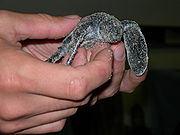 Like all sea turtles, leatherbacks start as hatchlings, climbing out of the sands of their nesting beaches. Bird
s, crustacean
s, various carnivorous mammal
s, other reptiles, and people prey on hatchlings before they reach the water. Once in the water, several varieties of fish
will also readily predate the small hatchlings. About 90% of the hatchlings die from predation. Once in the ocean, they are rarely seen before maturity. Dermochelys juveniles spend more of their time in tropical waters than do adults. Once they attain maturity few predators threaten the leatherback, although tiger shark
s and killer whales are potential predators.
Adults are prone to long-distance migration. Migration occurs between the cold waters where mature leatherbacks feed, to the tropical and subtropical beaches in the regions where they hatch. In the Atlantic, females tagged in French Guiana
have been recaptured on the other side of the ocean in Morocco and Spain.
Mating
takes place at sea. Males never leave the water once they enter it, unlike females which nest on land. After encountering a female (who possibly exudes a pheromone
to signal her reproductive status), the male uses head movements, nuzzling, biting, or flipper movements to determine her receptiveness. Females mate every two to three years. However, leatherbacks can breed annually. Fertilization
is internal, and multiple males usually mate with a single female. This polyandry
does not provide the offspring with any special advantages.
While other sea turtle species almost always return to their hatching beach, leatherbacks may choose another beach within the region. They choose beaches with soft sand because their softer shells
and plastrons are easily damaged by hard rocks. Nesting beaches also have shallower approach angles from the sea. This is a vulnerability for the turtles because such beaches easily erode.
Females excavate a nest above the high-tide
line with their flippers. One female may lay as many as nine clutch
es in one breeding season. About nine days pass between nesting events. Average clutch size is around 110 eggs, 85% of which are viable. After laying, the female carefully back-fills the nest, disguising it from predators with a scattering of sand.
Cleavage
of the cell begins within hours of fertilization, but development is suspended during the gastrulation
period of movements and infoldings of embryo
nic cells, while the eggs are being laid. Development then resumes, but embryos remain extremely susceptible to movement-induced mortality until the membranes fully develop after incubating for 20 to 25 days. The structural differentiation of body and organs (organogenesis
) soon follows. The eggs hatch in about sixty to seventy days. As with other reptiles, the nest's ambient temperature
determines the sex
of the hatchings. After nightfall, the hatchings dig to the surface and walk to the sea.
Leatherback nesting seasons vary by location; it occurs from February to July in Parismina
, Costa Rica. Farther east in French Guiana
, nesting is from March to August. Atlantic leatherbacks nest between February and July from South Carolina in the United States to the United States Virgin Islands
in the Caribbean
and to Suriname and Guyana.
in genus Dermochelys. The genus, in turn, contains the only extant member of the Dermochelyidae
family.
Domenico Agostino Vandelli named the species first in 1761 as Testudo coriacea after an animal captured at Ostia
and donated to the University of Padua
by Pope Clement XIII
. In 1816, French zoologist
Henri Blainville
coined the term Dermochelys. The leatherback was then reclassified as Dermochelys coriacea. In 1843, the zoologist Leopold Fitzinger
put the genus in its own family, Dermochelyidae . In 1884, the American
naturalist
Samuel Garman described the species as Sphargis coriacea schlegelii.
The two were then united in D. coriacea, with each given subspecies status as D. coriacea coriacea and D. coriacea schlegelii. The subspecies were later labeled invalid synonyms of D. coriacea.
The turtle's common name comes from the leathery texture
and appearance of its carapace. Older names include "leathery
turtle" and "trunk turtle".
period. The dermochelyids are close relatives of the family Cheloniidae
, which contains the other six extant sea turtle species. However, their sister taxon
is the extinct family Protostegidae
which included other species not having a hard carapace.
, the eggs are considered a delicacy. In the Caribbean, some cultures consider the eggs to be aphrodisiac
s. They are also a major jellyfish
predator which helps keep jellyfish populations in check.
once they mature; they are most vulnerable to predation in their early life stages. Birds, small mammal
s, and other opportunists dig up the nests of turtles and consume eggs. Shorebird
s and crustacean
s prey on the hatchings scrambling for the sea. Once they enter the water, they become prey to predatory fish and cephalopod
s. Very few survive to adulthood.
Leatherbacks have slightly fewer human-related threats than other sea turtle species. Their flesh contains too much oil and fat, reducing the demand. However, human activity still endangers leatherback turtles in direct and indirect ways. Directly, a few are caught for their meat by subsistence fisheries. Nests are raided by humans in places such as Southeast Asia.
Many human activities indirectly harm Dermochelys populations. As a pelagic species, D. coriacea is occasionally caught as bycatch
. As the largest living sea turtles, turtle excluder device
s can be ineffective with mature adults. A reported average of 1,500 mature females were accidentally caught annually in the 1990s. Pollution, both chemical and physical, can also be fatal. Many turtles die from malabsorption
and intestinal blockage
following the ingestion of balloons and plastic bags which resemble their jellyfish prey
. Chemical pollution also has an adverse effect on Dermochelys. A high level of phthalates has been measured in their eggs' yolk
s.
Conserving Pacific and Eastern Atlantic populations was included among the top ten issues in turtle conservation in the first State of the World's Sea Turtles report published in 2006. The report noted significant declines in the Mexican, Costa Rican and Malaysian populations. The eastern Atlantic nesting population was threatened by increased fishing pressures from eastern South American countries.
The Leatherback Trust was founded specifically to conserve sea turtles, specifically its namesake. The foundation established a sanctuary in Costa Rica, the Parque Marino Las Baulas.
The United States listed it as an endangered species
on 2 June 1970. The passing of the Endangered Species Act
three years later ratified its status. In Canada, the Species At Risk Act
made it illegal to exploit the species in Canadian waters. The Committee on the Status of Endangered Wildlife in Canada
classified it as endangered. Ireland and Wales initiated a joint leatherback conservation effort between Swansea University
and University College Cork. Funded by the European Regional Development Fund
, the Irish Sea Leatherback Turtle Project focuses on research such as tagging
and satellite tracking
of individuals.
Several Caribbean countries started conservation programs, such as The St. Kitts Sea Turtle Monitoring Network, focused on using ecotourism
to highlight the leatherback's plight. On the Atlantic coast of Costa Rica, the village of Parismina
has one such initiative. Parismina is an isolated sandbar where a large number of leatherbacks lay eggs, but poachers abound. Since 1998, the village has been assisting turtles with a hatchery program. The Parismina Social Club is a charitable organization backed by American tourists and expatriates, which collects donations to fund beach patrols.
Mayumba National Park
in Gabon, Central Africa was created to protect Africa's most important nesting beach. More than 30,000 turtles nest on Mayumba's beaches between September and April each year.
In mid-2007, the Malaysian Fisheries Department revealed a plan to clone
leatherback turtles to replenish the country's rapidly declining population. Some conservation biologists, however, are skeptical of the proposed plan because cloning has only succeeded on mammals such as dogs, sheep, cats, and cattle, and uncertainties persist about cloned animals' health and life spans. Leatherbacks used to nest in the thousands on Malaysian beaches, including those at Terengganu
, where more than 3,000 females nested in the late 1960s. The last official count of nesting leatherback females on that beach was recorded to be a mere two females in 1993.
In Brazil, reproduction of the leatherback turtle is being assisted by the IBAMA's "projeto TAMAR" (TAMAR project), which works to protect their nests and prevent accidental kills by fishing boats. The last official count of nesting leatherback females in Brazil yielded only seven females. In January 2010, one female at Pontal do Paraná
laid hundreds of eggs. Leatherback sea turtles had been reported to nest only at Espirito Santo
's shore, but never in the state of Paraná. This unusual act brought much attention to the area, so biologists have been protecting the nests and checking their eggs' temperature, although it might be that none of the eggs are fertile.
Australia's Environment Protection and Biodiversity Conservation Act 1999
, lists D. coriacea as Vulnerable, while Queensland's Nature Conservation Act 1992
lists it as Endangered.
Sea turtle
Sea turtles are marine reptiles that inhabit all of the world's oceans except the Arctic.-Distribution:...
s and the fourth largest modern reptile
Reptile
Reptiles are members of a class of air-breathing, ectothermic vertebrates which are characterized by laying shelled eggs , and having skin covered in scales and/or scutes. They are tetrapods, either having four limbs or being descended from four-limbed ancestors...
behind three crocodilia
Crocodilia
Crocodilia is an order of large reptiles that appeared about 84 million years ago in the late Cretaceous Period . They are the closest living relatives of birds, as the two groups are the only known survivors of the Archosauria...
ns. It is the only living species
Species
In biology, a species is one of the basic units of biological classification and a taxonomic rank. A species is often defined as a group of organisms capable of interbreeding and producing fertile offspring. While in many cases this definition is adequate, more precise or differing measures are...
in the genus Dermochelys. It can easily be differentiated from other modern sea turtles by its lack of a bony shell
Exoskeleton
An exoskeleton is the external skeleton that supports and protects an animal's body, in contrast to the internal skeleton of, for example, a human. In popular usage, some of the larger kinds of exoskeletons are known as "shells". Examples of exoskeleton animals include insects such as grasshoppers...
. Instead, its carapace
Carapace
A carapace is a dorsal section of the exoskeleton or shell in a number of animal groups, including arthropods such as crustaceans and arachnids, as well as vertebrates such as turtles and tortoises. In turtles and tortoises, the underside is called the plastron.-Crustaceans:In crustaceans, the...
is covered by skin and oily flesh. Dermochelys coriacea is the only extant member of the family
Family (biology)
In biological classification, family is* a taxonomic rank. Other well-known ranks are life, domain, kingdom, phylum, class, order, genus, and species, with family fitting between order and genus. As for the other well-known ranks, there is the option of an immediately lower rank, indicated by the...
Dermochelyidae
Dermochelyidae
Dermochelyidae is a family of turtles which has eight extinct and one extant genera.-Classification of known genera:*Subfamily Desmatochelyinae** Corochelys ** Desmatochelys *Subfamily Allopleuroninae ** Allopleuron ** Eosphargis...
.
Anatomy and physiology
Leatherback turtles have the most hydrodynamic body design of any sea turtleSea turtle
Sea turtles are marine reptiles that inhabit all of the world's oceans except the Arctic.-Distribution:...
, with a large, teardrop-shaped
Fluid dynamics
In physics, fluid dynamics is a sub-discipline of fluid mechanics that deals with fluid flow—the natural science of fluids in motion. It has several subdisciplines itself, including aerodynamics and hydrodynamics...
body. A large pair of front flippers power the turtles through the water. Like other sea turtles, the leatherback's flattened forelimbs are adapted for swimming in the open ocean. Claws are absent from both pairs of flippers. The leatherback's flippers are the largest in proportion to its body among extant sea turtles. Leatherback's front flippers can grow up to 2.7 metres (8.9 ft) in large specimens, the largest flippers (even in comparison to its body) of any sea turtle.
The leatherback has several characteristics that distinguish it from other sea turtles. Its most notable feature is the lack of a bony carapace
Carapace
A carapace is a dorsal section of the exoskeleton or shell in a number of animal groups, including arthropods such as crustaceans and arachnids, as well as vertebrates such as turtles and tortoises. In turtles and tortoises, the underside is called the plastron.-Crustaceans:In crustaceans, the...
. Instead of scute
Scute
A scute or scutum is a bony external plate or scale, as on the shell of a turtle, the skin of crocodilians, the feet of some birds or the anterior portion of the mesonotum in insects.-Properties:...
s, it has thick, leathery skin with embedded minuscule osteoderm
Osteoderm
Osteoderms are bony deposits forming scales, plates or other structures in the dermal layers of the skin. Osteoderms are found in many groups of extant and extinct reptiles, including lizards, various groups of dinosaurs , crocodilians, phytosaurs, aetosaurs, placodonts, and hupehsuchians...
s. Seven distinct ridges rise from the carapace, crossing from the anterior to posterior margin of the turtle's back. Leatherbacks are unique among reptile
Reptile
Reptiles are members of a class of air-breathing, ectothermic vertebrates which are characterized by laying shelled eggs , and having skin covered in scales and/or scutes. They are tetrapods, either having four limbs or being descended from four-limbed ancestors...
s in that their scales lack β-keratin. The entire turtle's dorsal
Dorsum (biology)
In anatomy, the dorsum is the upper side of animals that typically run, fly, or swim in a horizontal position, and the back side of animals that walk upright. In vertebrates the dorsum contains the backbone. The term dorsal refers to anatomical structures that are either situated toward or grow...
surface is colored dark grey to black, with a scattering of white blotches and spots. Demonstrating countershading
Countershading
Countershading, or Thayer's Law, is a form of camouflage. Countershading, in which an animal’s pigmentation is darker dorsally, is often thought to have an adaptive effect of reducing conspicuous shadows cast on the ventral region of an animal’s body...
, the turtle's underside is lightly colored.
Instead of teeth, the leatherback turtle has points on the tomium
Tomium
The tomium is the sharp cutting edge of the beak of a bird or turtle. Sometimes the edge is serrated for tearing through flesh or seaweed . Snapping turtle tomia can be dangerous because their bites are swift and powerful....
of its upper lip, with backwards spines in its throat to help it swallow food.
Dermochelys coriacea adults average 1–1.75 m (3.3–5.7 ft) in carapace length, 1.83–2.2 m (6–7.2 ft) in total length and weigh 250 to 700 kg (551.2 to 1,543.2 lb). The largest ever found, however, was over 3 metres (9.8 ft) from head to tail, including a carapace length of over 2.2 metres (7.2 ft), and weighed 916 kilograms (2,019.4 lb). That specimen was found on a beach on the west coast of Wales.
Dermochelys coriacea exhibits a suite of anatomical characteristics believed to be associated with a life in cold waters, including an extensive covering of brown adipose tissue, temperature independent swimming muscles, counter-current heat exchangers
Countercurrent exchange
Countercurrent exchange is a mechanism occurring in nature and mimicked in industry and engineering, in which there is a crossover of some property, usually heat or some component, between two flowing bodies flowing in opposite directions to each other. The flowing bodies can be liquids, gases, or...
between the large front flippers and the core body, as well as an extensive network of counter-current heat exchangers surrounding the trachea.
Physiology
Leatherbacks have been viewed as unique among reptiles for their ability to maintain high body temperatures using metabolicallyMetabolism
Metabolism is the set of chemical reactions that happen in the cells of living organisms to sustain life. These processes allow organisms to grow and reproduce, maintain their structures, and respond to their environments. Metabolism is usually divided into two categories...
generated heat, or endothermy
Endothermic
In thermodynamics, the word endothermic describes a process or reaction in which the system absorbs energy from the surroundings in the form of heat. Its etymology stems from the prefix endo- and the Greek word thermasi,...
. Initial studies on leatherback metabolic rates found leatherbacks had resting metabolisms around three times higher than expected for a reptile of their size. However, recent studies using reptile representatives encompassing all the size ranges leatherbacks pass through during ontogeny
Ontogeny
Ontogeny is the origin and the development of an organism – for example: from the fertilized egg to mature form. It covers in essence, the study of an organism's lifespan...
discovered the resting metabolic rate of a large Dermochelys coriacea is not significantly different from predicted results based on allometry.
Rather than use a high resting metabolism, leatherbacks appear to take advantages of a high activity rate. Studies on wild D.coriacea discovered individuals may spend as little as 0.1% of the day resting. This constant swimming creates muscle-derived heat. Coupled with their counter-current heat exchangers, insulative fat covering and large size, leatherbacks are able to maintain high temperature differentials compared to the surrounding water. Adult leatherbacks have been found with core body temperatures that were 18 C-change above the water they were swimming in.
Leatherback turtles are one of the deepest diving marine animals. Individuals have been recorded diving to depths as great as 1280 metres (4,199.5 ft).
Typical dive durations are between 3 and 8 minutes, with dives of 30–70 minutes occurring infrequently.
They are also the fastest-moving reptiles. The 1992 edition of the Guinness Book of World Records
Guinness World Records
Guinness World Records, known until 2000 as The Guinness Book of Records , is a reference book published annually, containing a collection of world records, both human achievements and the extremes of the natural world...
lists the leatherback turtle moving at 35.28 kilometres per hour (21.9 mph) in the water.
More typically, they swim at 0.5–2.8 m/s (1.1–6.3 mph).
Distribution
The leatherback turtle is a species with a cosmopolitanCosmopolitan distribution
In biogeography, a taxon is said to have a cosmopolitan distribution if its range extends across all or most of the world in appropriate habitats. For instance, the killer whale has a cosmopolitan distribution, extending over most of the world's oceans. Other examples include humans, the lichen...
global range
Range (biology)
In biology, the range or distribution of a species is the geographical area within which that species can be found. Within that range, dispersion is variation in local density.The term is often qualified:...
. Of all the extant sea turtle species, D. coriacea has the widest distribution, reaching as far north as Alaska
Alaska
Alaska is the largest state in the United States by area. It is situated in the northwest extremity of the North American continent, with Canada to the east, the Arctic Ocean to the north, and the Pacific Ocean to the west and south, with Russia further west across the Bering Strait...
and Norway and as far south as the Cape of Good Hope
Cape of Good Hope
The Cape of Good Hope is a rocky headland on the Atlantic coast of the Cape Peninsula, South Africa.There is a misconception that the Cape of Good Hope is the southern tip of Africa, because it was once believed to be the dividing point between the Atlantic and Indian Oceans. In fact, the...
in Africa and the southernmost tip of New Zealand. The leatherback is found in all tropical
Tropics
The tropics is a region of the Earth surrounding the Equator. It is limited in latitude by the Tropic of Cancer in the northern hemisphere at approximately N and the Tropic of Capricorn in the southern hemisphere at S; these latitudes correspond to the axial tilt of the Earth...
and subtropical
Subtropics
The subtropics are the geographical and climatical zone of the Earth immediately north and south of the tropical zone, which is bounded by the Tropic of Cancer and the Tropic of Capricorn, at latitudes 23.5°N and 23.5°S...
oceans, and its range extends well into the Arctic Circle
Arctic Circle
The Arctic Circle is one of the five major circles of latitude that mark maps of the Earth. For Epoch 2011, it is the parallel of latitude that runs north of the Equator....
.
There are three major, genetically distinct populations. The Atlantic
Atlantic Ocean
The Atlantic Ocean is the second-largest of the world's oceanic divisions. With a total area of about , it covers approximately 20% of the Earth's surface and about 26% of its water surface area...
Dermochelys population is separate from the ones in the eastern and western Pacific
Pacific Ocean
The Pacific Ocean is the largest of the Earth's oceanic divisions. It extends from the Arctic in the north to the Southern Ocean in the south, bounded by Asia and Australia in the west, and the Americas in the east.At 165.2 million square kilometres in area, this largest division of the World...
, which are also distinct from each other. A third possible Pacific subpopulation has been proposed, those that nest in Malaysia. This subpopulation, however, has been almost eradicated. The beach of Rantau Abang
Rantau Abang
Rantau Abang is a small village located in Terengganu, Malaysia. While itself a very small village, Rantau Abang is most noted for its Leatherback Sea Turtle nesting...
in Terengganu, Malaysia, once had the largest nesting population in the world, hosting 10,000 nests per year. In 2008, though, only two nested at Rantau Abang, and unfortunately the eggs were infertile. The major cause for the decline is the eggs are collected for food. While nesting beaches have been identified in the region, leatherback populations in the Indian Ocean remain generally unassessed and unevaluated.
Atlantic subpopulation
The leatherback turtle population in the Atlantic Ocean ranges across the entire region. They range as far north as the North SeaNorth Sea
In the southwest, beyond the Straits of Dover, the North Sea becomes the English Channel connecting to the Atlantic Ocean. In the east, it connects to the Baltic Sea via the Skagerrak and Kattegat, narrow straits that separate Denmark from Norway and Sweden respectively...
and to the Cape of Good Hope
Cape of Good Hope
The Cape of Good Hope is a rocky headland on the Atlantic coast of the Cape Peninsula, South Africa.There is a misconception that the Cape of Good Hope is the southern tip of Africa, because it was once believed to be the dividing point between the Atlantic and Indian Oceans. In fact, the...
in the south. Unlike other sea turtles, leatherback feeding areas are in colder waters, where there is an abundance of their jellyfish
Jellyfish
Jellyfish are free-swimming members of the phylum Cnidaria. Medusa is another word for jellyfish, and refers to any free-swimming jellyfish stages in the phylum Cnidaria...
prey, which broadens their range. However, only a few beaches on both sides of the Atlantic provide nesting sites.
Off the Atlantic coast of Canada, leatherback turtles feed in the Gulf of Saint Lawrence
Gulf of Saint Lawrence
The Gulf of Saint Lawrence , the world's largest estuary, is the outlet of North America's Great Lakes via the Saint Lawrence River into the Atlantic Ocean...
near Quebec
Quebec
Quebec or is a province in east-central Canada. It is the only Canadian province with a predominantly French-speaking population and the only one whose sole official language is French at the provincial level....
and as far north as Newfoundland and Labrador
Newfoundland and Labrador
Newfoundland and Labrador is the easternmost province of Canada. Situated in the country's Atlantic region, it incorporates the island of Newfoundland and mainland Labrador with a combined area of . As of April 2011, the province's estimated population is 508,400...
. The most significant Atlantic nesting sites are in Suriname, French Guiana
French Guiana
French Guiana is an overseas region of France, consisting of a single overseas department located on the northern Atlantic coast of South America. It has borders with two nations, Brazil to the east and south, and Suriname to the west...
and Trinidad and Tobago in the Caribbean
Caribbean
The Caribbean is a crescent-shaped group of islands more than 2,000 miles long separating the Gulf of Mexico and the Caribbean Sea, to the west and south, from the Atlantic Ocean, to the east and north...
and Gabon in Central Africa. The beaches of Mayumba National Park
Mayumba National Park
Mayumba National Park is a national park in southwestern Gabon. It is a thin tongue of beach, dunes, savanna, and rainforest in the extreme south of the country, between Mayumba and the Congo border...
in Mayumba, Gabon host the largest nesting population on the African continent and possibly worldwide, with nearly 30,000 turtles visiting its beaches each year in April. Off the northeastern coast of the South American continent, a few select beaches between French Guiana and Suriname are primary nesting sites of several species of sea turtles, the majority being leatherbacks. A few hundred nest annually on the eastern coast of Florida. In Costa Rica, the beaches of Gandoca and Parismina
Parismina
Barra del Parismina is a village of about 600 people located on the Caribbean coast of Costa Rica, at the mouth of the Reventazón River. Parismina is about half way between Tortuguero and Limon on the Tortuguero canals. There is no road to Parismina; it is accessible only by boat or plane...
provide nesting grounds.
Pacific subpopulation
Pacific leatherbacks divide into two populations. One population nests on beaches in PapuaPapua (Indonesian province)
Papua comprises most of the western half of the island of New Guinea and nearby islands. Its capital is Jayapura. It's the largest and easternmost province of Indonesia. The province originally covered the entire western half of New Guinea...
, Indonesia and the Solomon Islands and forage across the Pacific in the Northern Hemisphere
Northern Hemisphere
The Northern Hemisphere is the half of a planet that is north of its equator—the word hemisphere literally means “half sphere”. It is also that half of the celestial sphere north of the celestial equator...
, along the coasts of California
California
California is a state located on the West Coast of the United States. It is by far the most populous U.S. state, and the third-largest by land area...
, Oregon
Oregon
Oregon is a state in the Pacific Northwest region of the United States. It is located on the Pacific coast, with Washington to the north, California to the south, Nevada on the southeast and Idaho to the east. The Columbia and Snake rivers delineate much of Oregon's northern and eastern...
, and Washington in North America. The eastern Pacific population forages in the Southern Hemisphere
Southern Hemisphere
The Southern Hemisphere is the part of Earth that lies south of the equator. The word hemisphere literally means 'half ball' or "half sphere"...
, in waters along the western coast of South America, nesting in Mexico and Costa Rica.
The continental United States offers two major leatherback feeding areas. One well-studied area is just off the northwestern coast near the mouth of the Columbia River
Columbia River
The Columbia River is the largest river in the Pacific Northwest region of North America. The river rises in the Rocky Mountains of British Columbia, Canada, flows northwest and then south into the U.S. state of Washington, then turns west to form most of the border between Washington and the state...
. The other American area is located in the state of California. Further north, off the Pacific coast of Canada, leatherbacks visit the beaches of British Columbia
British Columbia
British Columbia is the westernmost of Canada's provinces and is known for its natural beauty, as reflected in its Latin motto, Splendor sine occasu . Its name was chosen by Queen Victoria in 1858...
.
Indian Ocean subpopulation
While little research has been done on Dermochelys populations in the Indian Ocean, nesting populations are known from Sri Lanka and the Nicobar IslandsNicobar Islands
The Nicobar Islands are an archipelagic island chain in the eastern Indian Ocean...
. These turtles are proposed to form a separate, genetically distinct Indian Ocean subpopulation.
The Malaysian nesting population, reduced to less than a hundred individuals as of 2006, has been proposed as a third Pacific subpopulation.
Habitat
Leatherback turtles can be found primarily in the open oceanPelagic zone
Any water in a sea or lake that is not close to the bottom or near to the shore can be said to be in the pelagic zone. The word pelagic comes from the Greek πέλαγος or pélagos, which means "open sea". The pelagic zone can be thought of in terms of an imaginary cylinder or water column that goes...
. Scientists tracked a leatherback turtle that swam from Indonesia to the U.S. in an epic 20000 kilometres (12,427.5 mi) foraging journey over a period of 647 days. Leatherbacks follow their jellyfish prey throughout the day, resulting in turtles "preferring" deeper water in the daytime, and shallower water at night (when the jellyfish rise up the water column). This hunting strategy often places turtles in very frigid waters. One individual was found actively hunting in waters that had a surface temperature of 0.4 °C (32.7 °F).
Its favored breeding beaches are mainland sites facing deep water and they seem to avoid those sites protected by coral reef
Coral reef
Coral reefs are underwater structures made from calcium carbonate secreted by corals. Coral reefs are colonies of tiny living animals found in marine waters that contain few nutrients. Most coral reefs are built from stony corals, which in turn consist of polyps that cluster in groups. The polyps...
s.
Feeding
Adult D. coriacea turtles subsist almost entirely on jellyfishJellyfish
Jellyfish are free-swimming members of the phylum Cnidaria. Medusa is another word for jellyfish, and refers to any free-swimming jellyfish stages in the phylum Cnidaria...
. Due to their obligate feeding nature, leatherback turtles help control
Population control
Human population control is the practice of artificially altering the rate of growth of a human population.Historically, human population control has been implemented by limiting the population's birth rate, usually by government mandate, and has been undertaken as a response to factors including...
jellyfish populations. Leatherbacks also feed on other soft-bodied organisms, such as tunicate
Tunicate
Tunicates, also known as urochordates, are members of the subphylum Tunicata, previously known as Urochordata, a group of underwater saclike filter feeders with incurrent and excurrent siphons that is classified within the phylum Chordata. While most tunicates live on the ocean floor, others such...
s and cephalopod
Cephalopod
A cephalopod is any member of the molluscan class Cephalopoda . These exclusively marine animals are characterized by bilateral body symmetry, a prominent head, and a set of arms or tentacles modified from the primitive molluscan foot...
s.
Pacific leatherbacks migrate about 6000 miles (9,656 km) across the Pacific from their nesting sites in Indonesia to eat California
California
California is a state located on the West Coast of the United States. It is by far the most populous U.S. state, and the third-largest by land area...
jellyfish
Jellyfish
Jellyfish are free-swimming members of the phylum Cnidaria. Medusa is another word for jellyfish, and refers to any free-swimming jellyfish stages in the phylum Cnidaria...
. One cause for their endangered state is plastic bags floating in the ocean. Pacific leatherback sea turtles mistake these plastic bags for jellyfish; an estimated one third of adult leatherbacks have ingested plastic. Plastic enters the oceans along the west coast of urban areas, where leatherbacks forage; with Californians using upwards of 19 billion plastic bags every year. Several species of sea turtles commonly ingest plastic marine debris, and even small quantities of debris can kill sea turtles by obstructing their digestive tracts. Nutrient dilution, which occurs when plastics displace food in the gut, affects the nutrient gain and consequently the growth of sea turtles. Ingestion of marine debris and slowed nutrient gain leads to increased time for sexual maturation that may affect future reproductive behaviors. These turtles have the highest risk of encountering and ingesting plastic bags offshore of San Francisco Bay, the Columbia River mouth, and Puget Sound.
Death and decomposition
Dead leatherbacks that wash ashore are micro-ecosystems on their own while decomposingDecomposition
Decomposition is the process by which organic material is broken down into simpler forms of matter. The process is essential for recycling the finite matter that occupies physical space in the biome. Bodies of living organisms begin to decompose shortly after death...
. In 1996, a drowned carcass held sarcophagid
Flesh-fly
Flies of the Diptera family Sarcophagidae are commonly known as flesh flies. Most flesh flies breed in carrion, dung, or decaying material, but a few species lay their eggs in the open wounds of mammals; hence their common name...
and calliphorid
Blow-fly
Calliphoridae are insects in the Order Diptera, family Calliphoridae...
flies after being picked open by a pair of Coragyps atratus
American Black Vulture
The Black Vulture also known as the American Black Vulture, is a bird in the New World vulture family whose range extends from the southeastern United States to Central Chile and Uruguay in South America...
vultures. Infestation by carrion
Carrion
Carrion refers to the carcass of a dead animal. Carrion is an important food source for large carnivores and omnivores in most ecosystems. Examples of carrion-eaters include vultures, hawks, eagles, hyenas, Virginia Opossum, Tasmanian Devils, coyotes, Komodo dragons, and burying beetles...
-eating beetles of the Scarabaeidae
Scarabaeidae
The family Scarabaeidae as currently defined consists of over 30,000 species of beetles worldwide. The species in this large family are often called scarabs or scarab beetles. The classification of this family is fairly unstable, with numerous competing theories, and new proposals appearing quite...
, Carabidae
Ground beetle
Ground beetles are a large, cosmopolitan family of beetles, Carabidae, with more than 40,000 species worldwide, approximately 2,000 of which are found in North America and 2,700 in Europe.-Description and ecology:...
, and Tenebrionidae
Darkling beetle
Darkling beetles are a family of beetles found worldwide, estimated at more than 20,000 species. Many of the beetles have black elytra, leading to their common name...
families soon followed suit. After days of decomposition, beetles from the families Histeridae and Staphylinidae
Rove beetle
The rove beetles are a large family of beetles, primarily distinguished by their short elytra that leave more than half of their abdomens exposed. With over 46,000 species in thousands of genera, the group is the second largest family of beetles after the Curculionidae...
and anthomyiid
Anthomyiidae
Anthomyiidae is a large and diverse family of Muscoidea flies. Name came from Greek "anthos" + "myia" . Some species are commonly called "root-maggots", as the larvae are found in the stems and roots of various plants...
flies invaded the corpse as well. Organisms from more than a dozen families took part in consuming the carcass.
Life history
Bird
Birds are feathered, winged, bipedal, endothermic , egg-laying, vertebrate animals. Around 10,000 living species and 188 families makes them the most speciose class of tetrapod vertebrates. They inhabit ecosystems across the globe, from the Arctic to the Antarctic. Extant birds range in size from...
s, crustacean
Crustacean
Crustaceans form a very large group of arthropods, usually treated as a subphylum, which includes such familiar animals as crabs, lobsters, crayfish, shrimp, krill and barnacles. The 50,000 described species range in size from Stygotantulus stocki at , to the Japanese spider crab with a leg span...
s, various carnivorous mammal
Mammal
Mammals are members of a class of air-breathing vertebrate animals characterised by the possession of endothermy, hair, three middle ear bones, and mammary glands functional in mothers with young...
s, other reptiles, and people prey on hatchlings before they reach the water. Once in the water, several varieties of fish
Fish
Fish are a paraphyletic group of organisms that consist of all gill-bearing aquatic vertebrate animals that lack limbs with digits. Included in this definition are the living hagfish, lampreys, and cartilaginous and bony fish, as well as various extinct related groups...
will also readily predate the small hatchlings. About 90% of the hatchlings die from predation. Once in the ocean, they are rarely seen before maturity. Dermochelys juveniles spend more of their time in tropical waters than do adults. Once they attain maturity few predators threaten the leatherback, although tiger shark
Tiger shark
The tiger sharks, Galeocerdo cuvier, is a species of requiem shark and the only member of the genus Galeocerdo. Commonly known as sea tigers, tiger sharks are relatively large macropredators, capable of attaining a length of over . It is found in many tropical and temperate waters, and is...
s and killer whales are potential predators.
Adults are prone to long-distance migration. Migration occurs between the cold waters where mature leatherbacks feed, to the tropical and subtropical beaches in the regions where they hatch. In the Atlantic, females tagged in French Guiana
French Guiana
French Guiana is an overseas region of France, consisting of a single overseas department located on the northern Atlantic coast of South America. It has borders with two nations, Brazil to the east and south, and Suriname to the west...
have been recaptured on the other side of the ocean in Morocco and Spain.
Mating
Mating
In biology, mating is the pairing of opposite-sex or hermaphroditic organisms for copulation. In social animals, it also includes the raising of their offspring. Copulation is the union of the sex organs of two sexually reproducing animals for insemination and subsequent internal fertilization...
takes place at sea. Males never leave the water once they enter it, unlike females which nest on land. After encountering a female (who possibly exudes a pheromone
Pheromone
A pheromone is a secreted or excreted chemical factor that triggers a social response in members of the same species. Pheromones are chemicals capable of acting outside the body of the secreting individual to impact the behavior of the receiving individual...
to signal her reproductive status), the male uses head movements, nuzzling, biting, or flipper movements to determine her receptiveness. Females mate every two to three years. However, leatherbacks can breed annually. Fertilization
Fertilisation
Fertilisation is the fusion of gametes to produce a new organism. In animals, the process involves the fusion of an ovum with a sperm, which eventually leads to the development of an embryo...
is internal, and multiple males usually mate with a single female. This polyandry
Polyandry
Polyandry refers to a form of marriage in which a woman has two or more husbands at the same time. The form of polyandry in which a woman is married to two or more brothers is known as "fraternal polyandry", and it is believed by many anthropologists to be the most frequently encountered...
does not provide the offspring with any special advantages.
While other sea turtle species almost always return to their hatching beach, leatherbacks may choose another beach within the region. They choose beaches with soft sand because their softer shells
Carapace
A carapace is a dorsal section of the exoskeleton or shell in a number of animal groups, including arthropods such as crustaceans and arachnids, as well as vertebrates such as turtles and tortoises. In turtles and tortoises, the underside is called the plastron.-Crustaceans:In crustaceans, the...
and plastrons are easily damaged by hard rocks. Nesting beaches also have shallower approach angles from the sea. This is a vulnerability for the turtles because such beaches easily erode.
Females excavate a nest above the high-tide
Tide
Tides are the rise and fall of sea levels caused by the combined effects of the gravitational forces exerted by the moon and the sun and the rotation of the Earth....
line with their flippers. One female may lay as many as nine clutch
Clutch (eggs)
A clutch of eggs refers to all the eggs produced by birds or reptiles, often at a single time, particularly those laid in a nest.In birds, destruction of a clutch by predators, , results in double-clutching...
es in one breeding season. About nine days pass between nesting events. Average clutch size is around 110 eggs, 85% of which are viable. After laying, the female carefully back-fills the nest, disguising it from predators with a scattering of sand.
Cleavage
Cleavage (embryo)
In embryology, cleavage is the division of cells in the early embryo. The zygotes of many species undergo rapid cell cycles with no significant growth, producing a cluster of cells the same size as the original zygote. The different cells derived from cleavage are called blastomeres and form a...
of the cell begins within hours of fertilization, but development is suspended during the gastrulation
Gastrulation
Gastrulation is a phase early in the embryonic development of most animals, during which the single-layered blastula is reorganized into a trilaminar structure known as the gastrula. These three germ layers are known as the ectoderm, mesoderm, and endoderm.Gastrulation takes place after cleavage...
period of movements and infoldings of embryo
Embryo
An embryo is a multicellular diploid eukaryote in its earliest stage of development, from the time of first cell division until birth, hatching, or germination...
nic cells, while the eggs are being laid. Development then resumes, but embryos remain extremely susceptible to movement-induced mortality until the membranes fully develop after incubating for 20 to 25 days. The structural differentiation of body and organs (organogenesis
Organogenesis
In animal development, organogenesis is the process by which the ectoderm, endoderm, and mesoderm develop into the internal organs of the organism. Internal organs initiate development in humans within the 3rd to 8th weeks in utero...
) soon follows. The eggs hatch in about sixty to seventy days. As with other reptiles, the nest's ambient temperature
Room temperature
-Comfort levels:The American Society of Heating, Refrigerating and Air-Conditioning Engineers has listings for suggested temperatures and air flow rates in different types of buildings and different environmental circumstances. For example, a single office in a building has an occupancy ratio per...
determines the sex
Temperature-dependent sex determination
Temperature-dependent sex determination is type of environmental sex determination in which the temperatures experienced during embryonic development determine the sex of the offspring. It is most prevalent and common among amniote vertebrates that are classified under the reptile class, but is...
of the hatchings. After nightfall, the hatchings dig to the surface and walk to the sea.
Leatherback nesting seasons vary by location; it occurs from February to July in Parismina
Parismina
Barra del Parismina is a village of about 600 people located on the Caribbean coast of Costa Rica, at the mouth of the Reventazón River. Parismina is about half way between Tortuguero and Limon on the Tortuguero canals. There is no road to Parismina; it is accessible only by boat or plane...
, Costa Rica. Farther east in French Guiana
French Guiana
French Guiana is an overseas region of France, consisting of a single overseas department located on the northern Atlantic coast of South America. It has borders with two nations, Brazil to the east and south, and Suriname to the west...
, nesting is from March to August. Atlantic leatherbacks nest between February and July from South Carolina in the United States to the United States Virgin Islands
United States Virgin Islands
The Virgin Islands of the United States are a group of islands in the Caribbean that are an insular area of the United States. The islands are geographically part of the Virgin Islands archipelago and are located in the Leeward Islands of the Lesser Antilles.The U.S...
in the Caribbean
Caribbean
The Caribbean is a crescent-shaped group of islands more than 2,000 miles long separating the Gulf of Mexico and the Caribbean Sea, to the west and south, from the Atlantic Ocean, to the east and north...
and to Suriname and Guyana.
Taxonomy
Dermochelys coriacea is the only speciesSpecies
In biology, a species is one of the basic units of biological classification and a taxonomic rank. A species is often defined as a group of organisms capable of interbreeding and producing fertile offspring. While in many cases this definition is adequate, more precise or differing measures are...
in genus Dermochelys. The genus, in turn, contains the only extant member of the Dermochelyidae
Dermochelyidae
Dermochelyidae is a family of turtles which has eight extinct and one extant genera.-Classification of known genera:*Subfamily Desmatochelyinae** Corochelys ** Desmatochelys *Subfamily Allopleuroninae ** Allopleuron ** Eosphargis...
family.
Domenico Agostino Vandelli named the species first in 1761 as Testudo coriacea after an animal captured at Ostia
Ostia
Ostia may refer to:*Ostia , a municipio of Rome on the Tyrrhenian Sea coast*Ostia Antica, a township and port of ancient Rome*Ostia Antica , a district of the commune of Rome...
and donated to the University of Padua
University of Padua
The University of Padua is a premier Italian university located in the city of Padua, Italy. The University of Padua was founded in 1222 as a school of law and was one of the most prominent universities in early modern Europe. It is among the earliest universities of the world and the second...
by Pope Clement XIII
Pope Clement XIII
Pope Clement XIII , born Carlo della Torre di Rezzonico, was Pope from 16 July 1758 to 2 February 1769....
. In 1816, French zoologist
Zoology
Zoology |zoölogy]]), is the branch of biology that relates to the animal kingdom, including the structure, embryology, evolution, classification, habits, and distribution of all animals, both living and extinct...
Henri Blainville
Henri Marie Ducrotay de Blainville
Henri Marie Ducrotay de Blainville was a French zoologist and anatomist.Blainville was born at Arques, near Dieppe. In about 1796 he went to Paris to study painting, but he ultimately devoted himself to natural history, and attracted the attention of Georges Cuvier, for whom he occasionally...
coined the term Dermochelys. The leatherback was then reclassified as Dermochelys coriacea. In 1843, the zoologist Leopold Fitzinger
Leopold Fitzinger
Leopold Joseph Franz Johann Fitzinger was an Austrian zoologist.Fitzinger was born in Vienna and studied botany at the university of Vienna under Nikolaus Joseph von Jacquin...
put the genus in its own family, Dermochelyidae . In 1884, the American
naturalist
Natural history
Natural history is the scientific research of plants or animals, leaning more towards observational rather than experimental methods of study, and encompasses more research published in magazines than in academic journals. Grouped among the natural sciences, natural history is the systematic study...
Samuel Garman described the species as Sphargis coriacea schlegelii.
The two were then united in D. coriacea, with each given subspecies status as D. coriacea coriacea and D. coriacea schlegelii. The subspecies were later labeled invalid synonyms of D. coriacea.
The turtle's common name comes from the leathery texture
and appearance of its carapace. Older names include "leathery
turtle" and "trunk turtle".
Evolution
Leatherback turtles have existed in some form since the first true sea turtles evolved over 110 million years ago during the CretaceousCretaceous
The Cretaceous , derived from the Latin "creta" , usually abbreviated K for its German translation Kreide , is a geologic period and system from circa to million years ago. In the geologic timescale, the Cretaceous follows the Jurassic period and is followed by the Paleogene period of the...
period. The dermochelyids are close relatives of the family Cheloniidae
Sea turtle
Sea turtles are marine reptiles that inhabit all of the world's oceans except the Arctic.-Distribution:...
, which contains the other six extant sea turtle species. However, their sister taxon
Cladistics
Cladistics is a method of classifying species of organisms into groups called clades, which consist of an ancestor organism and all its descendants . For example, birds, dinosaurs, crocodiles, and all descendants of their most recent common ancestor form a clade...
is the extinct family Protostegidae
Protostegidae
Protostegidae is a family of extinct marine turtles that lived during the Mesozoic Era. The family includes some of the largest sea turtles that ever existed. The largest, Archelon, had a head a meter long...
which included other species not having a hard carapace.
Importance to humans
People around the world still harvest sea turtle eggs. Asian exploitation of turtle nests has been cited as the most significant factor for the species' global population decline. In Southeast Asia, egg harvesting in countries such as Thailand and Malaysia has led to a near-total collapse of local nesting populations. In Malaysia, where the turtle is practically locally extinctLocal extinction
Local extinction, also known as extirpation, is the condition of a species which ceases to exist in the chosen geographic area of study, though it still exists elsewhere...
, the eggs are considered a delicacy. In the Caribbean, some cultures consider the eggs to be aphrodisiac
Aphrodisiac
An aphrodisiac is a substance that increases sexual desire. The name comes from Aphrodite, the Greek goddess of sexuality and love. Throughout history, many foods, drinks, and behaviors have had a reputation for making sex more attainable and/or pleasurable...
s. They are also a major jellyfish
Jellyfish
Jellyfish are free-swimming members of the phylum Cnidaria. Medusa is another word for jellyfish, and refers to any free-swimming jellyfish stages in the phylum Cnidaria...
predator which helps keep jellyfish populations in check.
Conservation
Adult leatherback turtles have few natural predatorsPredation
In ecology, predation describes a biological interaction where a predator feeds on its prey . Predators may or may not kill their prey prior to feeding on them, but the act of predation always results in the death of its prey and the eventual absorption of the prey's tissue through consumption...
once they mature; they are most vulnerable to predation in their early life stages. Birds, small mammal
Mammal
Mammals are members of a class of air-breathing vertebrate animals characterised by the possession of endothermy, hair, three middle ear bones, and mammary glands functional in mothers with young...
s, and other opportunists dig up the nests of turtles and consume eggs. Shorebird
Wader
Waders, called shorebirds in North America , are members of the order Charadriiformes, excluding the more marine web-footed seabird groups. The latter are the skuas , gulls , terns , skimmers , and auks...
s and crustacean
Crustacean
Crustaceans form a very large group of arthropods, usually treated as a subphylum, which includes such familiar animals as crabs, lobsters, crayfish, shrimp, krill and barnacles. The 50,000 described species range in size from Stygotantulus stocki at , to the Japanese spider crab with a leg span...
s prey on the hatchings scrambling for the sea. Once they enter the water, they become prey to predatory fish and cephalopod
Cephalopod
A cephalopod is any member of the molluscan class Cephalopoda . These exclusively marine animals are characterized by bilateral body symmetry, a prominent head, and a set of arms or tentacles modified from the primitive molluscan foot...
s. Very few survive to adulthood.
Leatherbacks have slightly fewer human-related threats than other sea turtle species. Their flesh contains too much oil and fat, reducing the demand. However, human activity still endangers leatherback turtles in direct and indirect ways. Directly, a few are caught for their meat by subsistence fisheries. Nests are raided by humans in places such as Southeast Asia.
Many human activities indirectly harm Dermochelys populations. As a pelagic species, D. coriacea is occasionally caught as bycatch
Bycatch
The term “bycatch” is usually used for fish caught unintentionally in a fishery while intending to catch other fish. It may however also indicate untargeted catch in other forms of animal harvesting or collecting...
. As the largest living sea turtles, turtle excluder device
Turtle excluder device
A turtle excluder device or TED is a specialized device that allows a captured sea turtle to escape when caught in a fisherman's net.In particular, sea turtles can be caught when bottom trawling is used by the commercial shrimp fishing industry. In order to catch shrimp, a fine meshed trawl net is...
s can be ineffective with mature adults. A reported average of 1,500 mature females were accidentally caught annually in the 1990s. Pollution, both chemical and physical, can also be fatal. Many turtles die from malabsorption
Malabsorption
Malabsorption is a state arising from abnormality in absorption of food nutrients across the gastrointestinal tract.Impairment can be of single or multiple nutrients depending on the abnormality...
and intestinal blockage
Ileus
Ileus is a disruption of the normal propulsive ability of the gastrointestinal tract.Ileus is commonly defined simply as bowel obstruction. However, authoritative sources define it as decreased motor activity of the GI tract due to non-mechanical causes...
following the ingestion of balloons and plastic bags which resemble their jellyfish prey
Predation
In ecology, predation describes a biological interaction where a predator feeds on its prey . Predators may or may not kill their prey prior to feeding on them, but the act of predation always results in the death of its prey and the eventual absorption of the prey's tissue through consumption...
. Chemical pollution also has an adverse effect on Dermochelys. A high level of phthalates has been measured in their eggs' yolk
Egg yolk
An egg yolk is a part of an egg which feeds the developing embryo. The egg yolk is suspended in the egg white by one or two spiral bands of tissue called the chalazae...
s.
Global initiatives
D. coriacea is listed on Appendix I of CITES, which makes export/import of this species (including parts) illegal.Conserving Pacific and Eastern Atlantic populations was included among the top ten issues in turtle conservation in the first State of the World's Sea Turtles report published in 2006. The report noted significant declines in the Mexican, Costa Rican and Malaysian populations. The eastern Atlantic nesting population was threatened by increased fishing pressures from eastern South American countries.
The Leatherback Trust was founded specifically to conserve sea turtles, specifically its namesake. The foundation established a sanctuary in Costa Rica, the Parque Marino Las Baulas.
Country and local initiatives
The leatherback sea turtle is subject to differing conservation laws in various countries.The United States listed it as an endangered species
Endangered species
An endangered species is a population of organisms which is at risk of becoming extinct because it is either few in numbers, or threatened by changing environmental or predation parameters...
on 2 June 1970. The passing of the Endangered Species Act
Endangered Species Act
The Endangered Species Act of 1973 is one of the dozens of United States environmental laws passed in the 1970s. Signed into law by President Richard Nixon on December 28, 1973, it was designed to protect critically imperiled species from extinction as a "consequence of economic growth and...
three years later ratified its status. In Canada, the Species At Risk Act
Species at Risk Act
The Species at Risk Act is a piece of Canadian federal legislation which became law in Canada on December 12, 2002. It is designed to meet one of Canada's key commitments under the International Convention on Biological Diversity. The goal of the Act is to protect endangered or threatened...
made it illegal to exploit the species in Canadian waters. The Committee on the Status of Endangered Wildlife in Canada
Committee on the Status of Endangered Wildlife in Canada
The Committee on the Status of Endangered Wildlife in Canada ; French: Le Comité sur la situation des espèces en péril au Canada, is an independent committee of wildlife experts and scientists whose "raison d’être is to identify species at risk" in Canada...
classified it as endangered. Ireland and Wales initiated a joint leatherback conservation effort between Swansea University
Swansea University
Swansea University is a university located in Swansea, Wales, United Kingdom. Swansea University was chartered as University College of Swansea in 1920, as the fourth college of the University of Wales. In 1996, it changed its name to the University of Wales Swansea following structural changes...
and University College Cork. Funded by the European Regional Development Fund
European Regional Development Fund
The European Regional Development Fund is a fund allocated by the European Union.-History:During the 1960s, the European Commission occasionally tried to establish a regional fund. Only Italy ever supported this, however, and nothing came of it. Britain made it an issue for their accession in...
, the Irish Sea Leatherback Turtle Project focuses on research such as tagging
Tracking animal migration
For years scientists have been tracking animals and the ways they migrate. One of the many goals of animal migration research has been, of course, to determine where the animals are going; however, researchers also want to know why they are going "there"...
and satellite tracking
Tracking animal migration
For years scientists have been tracking animals and the ways they migrate. One of the many goals of animal migration research has been, of course, to determine where the animals are going; however, researchers also want to know why they are going "there"...
of individuals.
Several Caribbean countries started conservation programs, such as The St. Kitts Sea Turtle Monitoring Network, focused on using ecotourism
Ecotourism
Ecotourism is a form of tourism visiting fragile, pristine, and usually protected areas, intended as a low impact and often small scale alternative to standard commercial tourism...
to highlight the leatherback's plight. On the Atlantic coast of Costa Rica, the village of Parismina
Parismina
Barra del Parismina is a village of about 600 people located on the Caribbean coast of Costa Rica, at the mouth of the Reventazón River. Parismina is about half way between Tortuguero and Limon on the Tortuguero canals. There is no road to Parismina; it is accessible only by boat or plane...
has one such initiative. Parismina is an isolated sandbar where a large number of leatherbacks lay eggs, but poachers abound. Since 1998, the village has been assisting turtles with a hatchery program. The Parismina Social Club is a charitable organization backed by American tourists and expatriates, which collects donations to fund beach patrols.
Mayumba National Park
Mayumba National Park
Mayumba National Park is a national park in southwestern Gabon. It is a thin tongue of beach, dunes, savanna, and rainforest in the extreme south of the country, between Mayumba and the Congo border...
in Gabon, Central Africa was created to protect Africa's most important nesting beach. More than 30,000 turtles nest on Mayumba's beaches between September and April each year.
In mid-2007, the Malaysian Fisheries Department revealed a plan to clone
Cloning
Cloning in biology is the process of producing similar populations of genetically identical individuals that occurs in nature when organisms such as bacteria, insects or plants reproduce asexually. Cloning in biotechnology refers to processes used to create copies of DNA fragments , cells , or...
leatherback turtles to replenish the country's rapidly declining population. Some conservation biologists, however, are skeptical of the proposed plan because cloning has only succeeded on mammals such as dogs, sheep, cats, and cattle, and uncertainties persist about cloned animals' health and life spans. Leatherbacks used to nest in the thousands on Malaysian beaches, including those at Terengganu
Terengganu
Terengganu is a sultanate and constitutive state of federal Malaysia. The state is also known by its Arabic honorific, Darul Iman...
, where more than 3,000 females nested in the late 1960s. The last official count of nesting leatherback females on that beach was recorded to be a mere two females in 1993.
In Brazil, reproduction of the leatherback turtle is being assisted by the IBAMA's "projeto TAMAR" (TAMAR project), which works to protect their nests and prevent accidental kills by fishing boats. The last official count of nesting leatherback females in Brazil yielded only seven females. In January 2010, one female at Pontal do Paraná
Pontal do Paraná
Pontal do Paraná is a town and municipality in the state of Paraná in the Southern Region of Brazil.-References:...
laid hundreds of eggs. Leatherback sea turtles had been reported to nest only at Espirito Santo
Espírito Santo
Espírito Santo is one of the states of southeastern Brazil, often referred to by the abbreviation "ES". Its capital is Vitória and the largest city is Vila Velha. The name of the state means literally "holy spirit" after the Holy Ghost of Christianity...
's shore, but never in the state of Paraná. This unusual act brought much attention to the area, so biologists have been protecting the nests and checking their eggs' temperature, although it might be that none of the eggs are fertile.
Australia's Environment Protection and Biodiversity Conservation Act 1999
Environment Protection and Biodiversity Conservation Act 1999
The Environment Protection and Biodiversity Conservation Act 1999 is an Act of the Parliament of Australia that provides a framework for protection of the Australian environment, including its biodiversity and its natural and culturally significant places...
, lists D. coriacea as Vulnerable, while Queensland's Nature Conservation Act 1992
Nature Conservation Act 1992
The Nature Conservation Act 1992 is an act of the Parliament of Queensland that provides for the legislative protection of Queensland's threatened biota. As originally published, it provided for biota to be declared presumed extinct, endangered, vulnerable, rare or common...
lists it as Endangered.
External links
- The Reptipage: Leatherbacks break all the rules Detailed literature review of current leatherback knowledge.
- Mayumba National Park Turtles Online Information about and photos of sea turtles and the world's most important leatherback nesting beach.
- ARKive Photographs, Video
- The Oceanic Resource Foundation
- NOAA Office of Protected Resources leatherback turtle page
- Leatherback Sea Turtle at CRESLI
- The Great Turtle Race, a conservation group that monitors Leatherbacks as the swim from Costa Rica, where they've just laid their eggs, back to their natural territory of the Galápagos IslandsGalápagos IslandsThe Galápagos Islands are an archipelago of volcanic islands distributed around the equator in the Pacific Ocean, west of continental Ecuador, of which they are a part.The Galápagos Islands and its surrounding waters form an Ecuadorian province, a national park, and a...
. - Tagging Of Pacific Predators, a contributor to The Great Turtle Race, this research group continues to tag and monitor Leatherbacks around the world, including the turtles from the race.
- Video of a leatherback turtle laying eggs Filmed in Tamarindo, Costa Rica
- Ocean Spirits, a Grenadian turtle research NGO.
- Leatherback turtle research at Juno Beach, Florida
- NPWS Leatherback Turtle in Irish waters.