

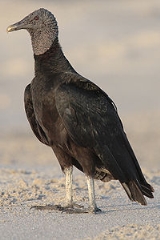
American Black Vulture

Encyclopedia
The Black Vulture also known as the American Black Vulture, is a bird
in the New World vulture
family whose range extends from the southeastern United States to Central Chile and Uruguay
in South America. Although a common and widespread species, it has a somewhat more restricted distribution than its compatriot, the Turkey Vulture
, which breeds well into Canada and south to Tierra del Fuego
. Despite the similar name and appearance, this species is unrelated to the Eurasian Black Vulture
. The latter species is an Old World vulture
in the family Accipitridae
(which includes eagle
s, hawk
s, kite
s and harrier
s), whereas the American species is a New World vulture. It is the only extant member of the genus Coragyps, which is in the family Cathartidae. It inhabits relatively open areas which provide scattered forests or shrublands. With a wingspan
of 1.5 m (5 ft) the Black Vulture is a large bird though relatively small for a vulture. It has black plumage
, a featherless, grayish-black head and neck, and a short, hooked beak.
The Black Vulture is a scavenger
and feeds on carrion
, but will also eat eggs
or kill newborn animals. In areas populated by humans, it also feeds at garbage dumps. It finds its meals either by using its keen eyesight or by following other (New World) vultures, which possess a keen sense of smell. Lacking a syrinx
—the vocal organ of birds—its only vocalizations are grunts or low hisses. It lays its eggs in caves or hollow trees or on the bare ground, and generally raises two chicks each year, which it feeds by regurgitation
. In the United States, the vulture receives legal protection under the Migratory Bird Treaty Act of 1918
. This vulture also appeared in Mayan codices.
"vulture" is derived from the Latin
word vulturus, which means "tearer" and is a reference to its feeding habits. The species name, atratus, means "clothed in black," from the Latin ater 'black'. The genus name, Coragyps means "raven-vulture", from a contraction of the Greek
corax/κόραξ and gyps/γὺψ for the respective birds. The family name, Cathartidae, means "purifier" and is also derived from the Greek kathartēs/καθαρτης.
The exact taxonomic placement of the Black Vulture and the remaining six species of New World vulture
s remains unclear. Though both are similar in appearance and have similar ecological roles
, the New World and Old World vulture
s evolved from different ancestors in different parts of the world. Just how different the two are is currently under debate, with some earlier authorities suggesting that the New World vultures are more closely related to stork
s. More recent authorities maintain their overall position in the order Falconiformes
along with the Old World vultures, or place them in their own order, Cathartiformes. The South American Classification Committee has removed the New World vultures from Ciconiiformes
and instead placed them in Incertae sedis
, but notes that a move to Falconiformes or Cathartiformes is possible.
There are three subspecies of Black Vulture:
to the Late Pleistocene
, a prehistoric species of Black Vulture, Coragyps occidentalis, known as the Pleistocene Black Vulture or – somewhat in error – the "Western Black Vulture", occurred across the present species' range. This bird did not differ much from the Black Vulture of today except in size; it was some 10-15% larger, and had a relatively flatter and wider bill. It filled the same ecological niche as the living form, and indeed seems to have evolved into it by decreasing in size during the last ice age. Well documented from fossil
bones, the genus Coragyps gives a rare glimpse in the evolution
ary dynamics of two chronospecies
. The final stages of this evolutionary transformation must have been witnessed by humans: a subfossil
bone of the extinct species was found in an Paleo Indian to Early Archaic (9000–8000 years BCE) midden
at Five Mile Rapids near The Dalles, Oregon
.
Fossil (or subfossil) Black Vultures cannot necessarily be attributed to the Pleistocene or the recent species without further information: the same size variation found in the living bird was also present in its larger prehistoric relative. Thus, in 1968, Hildegarde Howard separated the Mexican birds as Coragyps occidentalis mexicanus as opposed to the birds from locations farther north (such as Rancho La Brea
) which constituted the nominate subspecies C. o. occidentalis. The southern birds were of the same size as present-day North Black Vultures and can only be distinguished by their somewhat stouter tarsometatarsus
and the flatter and wider bills, and even then only with any certainty if the location where the fossils were found is known. As the Pleistocene and current Black Vultures form an evolutionary continuum rather than splitting into two or more lineages, some include the Pleistocene taxa in C. atratus.
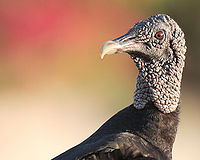 The Black Vulture is a fairly large bird of prey, measuring 56-68 centimeters (22–27 in) in length, with a 1.37–1.67 meter (4.5–5.5 ft) wingspan. Weight for Black Vultures from North America
and the Andes
ranges from 1.6 to 2.75 kilograms (3.5–6 lb) but in the smaller vultures of the tropical lowlands it is 1.18–1.94 kg (2.6–4.3 lbs). Its plumage is mainly glossy black. The head and neck are featherless and the skin is dark gray and wrinkled. The iris of the eye is brown and has a single incomplete row of eyelash
es on the upper lid and two rows on the lower lid. The legs are grayish white, while the two front toes of the foot are long and have small webs at their bases. The feet are flat, relatively weak, and are poorly adapted to grasping; the talon
s are also not designed for grasping, as they are relatively blunt.
The nostrils are not divided by a septum
, but rather are perforate; from the side one can see through the beak. The wings are broad but relatively short. The bases of the primary feathers are white, producing a white patch on the underside of the wing's edge, which is visible in flight. The tail is short and square, barely reaching past the edge of the folded wings. The subspecies
differ in size according to Bergmann's Rule
, and the amount of white underwing coloration also varies. As it probably forms a cline over its entire range, the species is often considered monotypic
.
A leucistic
Coragyps atratus brasiliensis was observed in Piñas
, Ecuador
in 2005. It had white plumage overall, with only the tarsus
and tail as well as some undertail feathers being black. It was not an albino as its skin seemed to have had the normal, dark color and it was part of a flock of some twenty normally plumaged individuals.
and Neotropic
distribution.
Its range includes the southern United States
, Mexico, Central America and most of South America. It is usually a permanent resident throughout its range, although birds at the extreme north of its range may migrate
short distances, and others across their range may undergo local movements in unfavourable conditions. In South America, its range stretches to central Chile
and Argentina. It also is found on the islands of the Caribbean
. It prefers open land interspersed with areas of woods or brush. It is also found in moist lowland forests, shrublands and grasslands, wetlands and swamps, pastures, and heavily degraded former forests. Preferring lowlands, it is rarely seen in mountainous areas. It is usually seen soaring or perched on fence posts or dead trees.
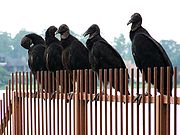 It soars high while searching for food, holding its wings horizontally when gliding. It flaps in short bursts which are followed by short periods of gliding. Its flight is less efficient than that of other vultures, as the wings are not as long, forming a smaller wing area. In comparison with the Turkey Vulture
, the Black Vulture flaps its wings more frequently during flight. It is known to regurgitate
when approached or disturbed, which assists in predator deterrence and taking flight by decreasing its takeoff weight. Like all New World Vultures, the Black Vulture often defecates on its own legs, using the evaporation of the water in the feces and/or urine to cool itself, a process known as urohidrosis
. It cools the blood vessels in the unfeathered tarsi
and feet, and causes white uric acid
to streak the legs. Because it lacks a syrinx
, the Black Vulture, like other New World Vultures, has very few vocalization capabilities. It is generally silent, but can make soft hisses and grunts. The Black Vulture is gregarious, and roosts in large groups. In areas where their ranges overlap, the Black Vulture will roost on the bare branches of dead trees with groups of Turkey Vulture
s. The Black Vulture generally forages in groups; a flock of Black Vultures can easily drive a Turkey Vulture, which is generally solitary while foraging, from a carcass.
Like the Turkey Vulture, this vulture is often seen standing in a spread-winged stance. The stance is believed to serve multiple functions: drying the wings, warming the body, and baking off bacteria. This same behavior is displayed by other New World vulture
s, Old World vulture
s, and stork
s.
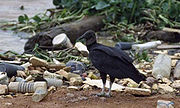
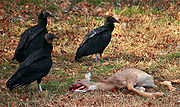 In natural settings, the Black Vulture eats mainly carrion
. In areas populated by humans, it may scavenge at garbage dumps, but also takes eggs and decomposing plant material and can kill or injure new-born or incapacitated mammals. Like other vultures, it plays an important role in the ecosystem
by disposing of carrion which would otherwise be a breeding ground for disease. The Black Vulture locates food either by sight or by following New World Vultures of the genus Cathartes
to carcasses. These vultures—the Turkey Vulture
, the Lesser Yellow-headed Vulture
, and the Greater Yellow-headed Vulture
— forage by smell, an ability which is uncommon in the avian world. They fly low to the ground to pick up the scent of ethyl mercaptan
, a gas produced by the beginnings of decay in dead animals. Their heightened ability to detect odors allows them to search for carrion below the forest
canopy. King Vulture
s and Black Vultures, which lack the ability to smell carrion, follow them to carcasses. It is aggressive when feeding, and may chase the slightly larger Turkey Vulture from carcasses.
The Black Vulture also occasionally feeds on livestock
or deer
. It is the only species of New World vulture which preys on cattle
. It occasionally harasses cows which are giving birth, but primarily preys on new-born calves. In its first few weeks, a calf will allow vultures to approach it. The vultures swarm the calf in a group, then peck at the calf's eyes, or at the nose or the tongue. The calf then goes into shock and is killed by the vultures.
Black Vultures have sometimes been seen to pick ticks off resting Capybara
s.
generally do not start before March. In South America, Argentinian and Chilean birds begin egg-laying as early as September, while those further north on the continent typically wait until October. Some in South America breed even later than that—Black Vultures in Trinidad
typically do not start until November, for example, and those in Ecuador may wait until February. Pairs are formed following a courtship ritual which is performed on the ground: several males circle a female with their wings partially open as they strut and bob their heads. They sometimes perform courtship flights, diving or chasing each other over their chosen nest site.
The Black Vulture lays its eggs on the ground in a wooded area, a hollow log, or some other cavity, seldom more than 3 metres (9.8 ft) above the ground. While it generally does not use any nesting materials, it may decorate the area around the nest with bits of brightly colored plastic, shards of glass, or metal items such as bottle caps. Clutch
size is generally two eggs, though this can vary from one to three. The egg is oval and on average measures 7.56 by 5.09 centimeters (3 by 2 in). The smooth, gray-green, bluish, or white shell is variably blotched or spotted with lavender or pale brown around the larger end. Both parents incubate
the eggs, which hatch after 28 to 41 days. Upon hatching, the young are covered with white down. Both parents feed the nestlings, regurgitating food at the nest site. The young remain in the nest for two months, and after 75 to 80 days they are able to fly skillfully.
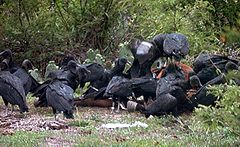 The Black Vulture is considered a threat by cattle ranchers due to its predation on newborn cattle. The droppings produced by Black Vultures and other vultures can harm or kill trees and other vegetation. The bird is also considered a threat to the safety of aerial traffic, especially when it congregates in large numbers in the vicinity of garbage dumps — as is the case in the Rio de Janeiro Tom Jobim International Airport.
The Black Vulture can be held in captivity, though the Migratory Bird Treaty Act
only allows this in the case of animals which are injured or unable to return to the wild. It receives special legal protections under the Migratory Bird Treaty Act of 1918
in the United States, by the Convention for the Protection of Migratory Birds in Canada, and by the Convention for the Protection of Migratory Birds and Game Mammals in Mexico. In the United States it is illegal to take, kill, or possess Black Vultures and violation of the law is punishable by a fine of up to US$15,000 and imprisonment of up to six months. It is listed as a species of Least Concern by the IUCN Red List
. Populations appear to remain stable, and it has not reached the threshold of inclusion as a threatened species, which requires a decline of more than 30 percent in ten years or three generations.
The Black Vulture appears in a variety of Maya
hieroglyphics in Mayan codices. It is normally connected with either death or as a bird of prey. The vulture's glyph is often shown attacking humans. This species lacks the religious connections that the King Vulture
has. While some of the glyphs clearly show the Black Vulture's open nostril and hooked beak, some are assumed to be this species because they are vulture-like but lack the King Vulture's knob and are painted black.
This vulture has appeared on two stamps: those of Guyana
in 1990 and Nicaragua
in 1994.
Bird
Birds are feathered, winged, bipedal, endothermic , egg-laying, vertebrate animals. Around 10,000 living species and 188 families makes them the most speciose class of tetrapod vertebrates. They inhabit ecosystems across the globe, from the Arctic to the Antarctic. Extant birds range in size from...
in the New World vulture
New World vulture
The New World Vulture or Condor family Cathartidae contains seven species in fivegenera, all but one of which are monotypic. It includes five vultures and two condors found in warm and temperate areas of the Americas....
family whose range extends from the southeastern United States to Central Chile and Uruguay
Uruguay
Uruguay ,officially the Oriental Republic of Uruguay,sometimes the Eastern Republic of Uruguay; ) is a country in the southeastern part of South America. It is home to some 3.5 million people, of whom 1.8 million live in the capital Montevideo and its metropolitan area...
in South America. Although a common and widespread species, it has a somewhat more restricted distribution than its compatriot, the Turkey Vulture
Turkey Vulture
The Turkey Vulture is a bird found throughout most of the Americas. It is also known in some North American regions as the Turkey Buzzard , and in some areas of the Caribbean as the John Crow or Carrion Crow...
, which breeds well into Canada and south to Tierra del Fuego
Tierra del Fuego
Tierra del Fuego is an archipelago off the southernmost tip of the South American mainland, across the Strait of Magellan. The archipelago consists of a main island Isla Grande de Tierra del Fuego divided between Chile and Argentina with an area of , and a group of smaller islands including Cape...
. Despite the similar name and appearance, this species is unrelated to the Eurasian Black Vulture
Eurasian Black Vulture
The Cinereous Vulture is also known as the Black Vulture, Monk Vulture, or Eurasian Black Vulture. It is a member of the family Accipitridae, which also includes many other diurnal raptors such as kites, buzzards and harriers.This bird is an Old World vulture, and is only distantly related to the...
. The latter species is an Old World vulture
Old World vulture
Old World vultures belong to the family Accipitridae, which also includes eagles, buzzards, kites, and hawks.Old World vultures are not closely related to the superficially similar New World vultures and condors, and do not share that group's good sense of smell. The similarities between the two...
in the family Accipitridae
Accipitridae
The Accipitridae, one of the two major families within the order Accipitriformes , are a family of small to large birds with strongly hooked bills and variable morphology based on diet. They feed on a range of prey items from insects to medium-sized mammals, with a number feeding on carrion and a...
(which includes eagle
Eagle
Eagles are members of the bird family Accipitridae, and belong to several genera which are not necessarily closely related to each other. Most of the more than 60 species occur in Eurasia and Africa. Outside this area, just two species can be found in the United States and Canada, nine more in...
s, hawk
Hawk
The term hawk can be used in several ways:* In strict usage in Australia and Africa, to mean any of the species in the subfamily Accipitrinae, which comprises the genera Accipiter, Micronisus, Melierax, Urotriorchis and Megatriorchis. The large and widespread Accipiter genus includes goshawks,...
s, kite
Kite (bird)
Kites are raptors with long wings and weak legs which spend a great deal of time soaring. Most feed mainly on carrion but some take various amounts of live prey.They are birds of prey which, along with hawks and eagles, are from the family Accipitridae....
s and harrier
Harrier (bird)
A harrier is any of the several species of diurnal hawks forming the Circinae sub-family of the Accipitridae family of birds of prey. Harriers characteristically hunt by flying low over open ground, feeding on small mammals, reptiles, or birds....
s), whereas the American species is a New World vulture. It is the only extant member of the genus Coragyps, which is in the family Cathartidae. It inhabits relatively open areas which provide scattered forests or shrublands. With a wingspan
Wingspan
The wingspan of an airplane or a bird, is the distance from one wingtip to the other wingtip. For example, the Boeing 777 has a wingspan of about ; and a Wandering Albatross caught in 1965 had a wingspan of , the official record for a living bird.The term wingspan, more technically extent, is...
of 1.5 m (5 ft) the Black Vulture is a large bird though relatively small for a vulture. It has black plumage
Plumage
Plumage refers both to the layer of feathers that cover a bird and the pattern, colour, and arrangement of those feathers. The pattern and colours of plumage vary between species and subspecies and can also vary between different age classes, sexes, and season. Within species there can also be a...
, a featherless, grayish-black head and neck, and a short, hooked beak.
The Black Vulture is a scavenger
Scavenger
Scavenging is both a carnivorous and herbivorous feeding behavior in which individual scavengers search out dead animal and dead plant biomass on which to feed. The eating of carrion from the same species is referred to as cannibalism. Scavengers play an important role in the ecosystem by...
and feeds on carrion
Carrion
Carrion refers to the carcass of a dead animal. Carrion is an important food source for large carnivores and omnivores in most ecosystems. Examples of carrion-eaters include vultures, hawks, eagles, hyenas, Virginia Opossum, Tasmanian Devils, coyotes, Komodo dragons, and burying beetles...
, but will also eat eggs
Egg (biology)
An egg is an organic vessel in which an embryo first begins to develop. In most birds, reptiles, insects, molluscs, fish, and monotremes, an egg is the zygote, resulting from fertilization of the ovum, which is expelled from the body and permitted to develop outside the body until the developing...
or kill newborn animals. In areas populated by humans, it also feeds at garbage dumps. It finds its meals either by using its keen eyesight or by following other (New World) vultures, which possess a keen sense of smell. Lacking a syrinx
Syrinx (biology)
Syrinx is the name for the vocal organ of birds. Located at the base of a bird's trachea, it produces sounds without the vocal cords of mammals. The sound is produced by vibrations of some or all of the membrana tympaniformis and the pessulus caused by air flowing through the syrinx...
—the vocal organ of birds—its only vocalizations are grunts or low hisses. It lays its eggs in caves or hollow trees or on the bare ground, and generally raises two chicks each year, which it feeds by regurgitation
Regurgitation (digestion)
Regurgitation is the expulsion of material from the mouth, pharynx, or esophagus, usually characterized by the presence of undigested food or blood.Regurgitation is used by a number of species to feed their young...
. In the United States, the vulture receives legal protection under the Migratory Bird Treaty Act of 1918
Migratory Bird Treaty Act of 1918
The Migratory Bird Treaty Act of 1918 , codified at , is a United States federal law, at first enacted in 1916 in order to implement the convention for the protection of migratory birds between the United States and Great Britain...
. This vulture also appeared in Mayan codices.
Taxonomy
The common nameCommon name
A common name of a taxon or organism is a name in general use within a community; it is often contrasted with the scientific name for the same organism...
"vulture" is derived from the Latin
Latin
Latin is an Italic language originally spoken in Latium and Ancient Rome. It, along with most European languages, is a descendant of the ancient Proto-Indo-European language. Although it is considered a dead language, a number of scholars and members of the Christian clergy speak it fluently, and...
word vulturus, which means "tearer" and is a reference to its feeding habits. The species name, atratus, means "clothed in black," from the Latin ater 'black'. The genus name, Coragyps means "raven-vulture", from a contraction of the Greek
Ancient Greek
Ancient Greek is the stage of the Greek language in the periods spanning the times c. 9th–6th centuries BC, , c. 5th–4th centuries BC , and the c. 3rd century BC – 6th century AD of ancient Greece and the ancient world; being predated in the 2nd millennium BC by Mycenaean Greek...
corax/κόραξ and gyps/γὺψ for the respective birds. The family name, Cathartidae, means "purifier" and is also derived from the Greek kathartēs/καθαρτης.
The exact taxonomic placement of the Black Vulture and the remaining six species of New World vulture
New World vulture
The New World Vulture or Condor family Cathartidae contains seven species in fivegenera, all but one of which are monotypic. It includes five vultures and two condors found in warm and temperate areas of the Americas....
s remains unclear. Though both are similar in appearance and have similar ecological roles
Ecological niche
In ecology, a niche is a term describing the relational position of a species or population in its ecosystem to each other; e.g. a dolphin could potentially be in another ecological niche from one that travels in a different pod if the members of these pods utilize significantly different food...
, the New World and Old World vulture
Old World vulture
Old World vultures belong to the family Accipitridae, which also includes eagles, buzzards, kites, and hawks.Old World vultures are not closely related to the superficially similar New World vultures and condors, and do not share that group's good sense of smell. The similarities between the two...
s evolved from different ancestors in different parts of the world. Just how different the two are is currently under debate, with some earlier authorities suggesting that the New World vultures are more closely related to stork
Stork
Storks are large, long-legged, long-necked wading birds with long, stout bills. They belong to the family Ciconiidae. They are the only family in the biological order Ciconiiformes, which was once much larger and held a number of families....
s. More recent authorities maintain their overall position in the order Falconiformes
Falconiformes
The order Falconiformes is a group of about 290 species of birds that comprises the diurnal birds of prey. Raptor classification is difficult and the order is treated in several ways.- Classification problems :...
along with the Old World vultures, or place them in their own order, Cathartiformes. The South American Classification Committee has removed the New World vultures from Ciconiiformes
Ciconiiformes
Traditionally, the order Ciconiiformes has included a variety of large, long-legged wading birds with large bills: storks, herons, egrets, ibises, spoonbills, and several others. Ciconiiformes are known from the Late Eocene...
and instead placed them in Incertae sedis
Incertae sedis
, is a term used to define a taxonomic group where its broader relationships are unknown or undefined. Uncertainty at specific taxonomic levels is attributed by , , and similar terms.-Examples:*The fossil plant Paradinandra suecica could not be assigned to any...
, but notes that a move to Falconiformes or Cathartiformes is possible.
There are three subspecies of Black Vulture:
- C. a. atratus, named by the German ornithologist Johann Matthäus BechsteinJohann Matthäus BechsteinJohann Matthäus Bechstein was a German naturalist, forester, ornithologist and entomologist. In Great Britain, he was known for his treatise on singing birds .-Biography:Bechstein was born in Waltershausen in the district of Gotha in Thuringia...
in 1793, is known as the North American Black Vulture. It is the nominate subspecies. It is approximately the same size as C. a. foetens, but its plumage is not as dark. Its range stretches from northern Mexico through Texas and the southern United StatesSouthern United StatesThe Southern United States—commonly referred to as the American South, Dixie, or simply the South—constitutes a large distinctive area in the southeastern and south-central United States...
north to New JerseyNew JerseyNew Jersey is a state in the Northeastern and Middle Atlantic regions of the United States. , its population was 8,791,894. It is bordered on the north and east by the state of New York, on the southeast and south by the Atlantic Ocean, on the west by Pennsylvania and on the southwest by Delaware...
and PennsylvaniaPennsylvaniaThe Commonwealth of Pennsylvania is a U.S. state that is located in the Northeastern and Mid-Atlantic regions of the United States. The state borders Delaware and Maryland to the south, West Virginia to the southwest, Ohio to the west, New York and Ontario, Canada, to the north, and New Jersey to...
. - C. a. brasiliensis, named by Charles Lucien Jules Laurent Bonaparte in 1850, is known as the Southern American Black Vulture. It is smaller than C. a. atratus and C. a. foetens. The light markings on the undersides of the primaries are whiter and broader than those of the other subspecies, and the underwing coverts are lighter than those of C. a. foetens. It is found in Central America and northern South America. To the south, the range extends to the coastal regions of PeruPeruPeru , officially the Republic of Peru , is a country in western South America. It is bordered on the north by Ecuador and Colombia, on the east by Brazil, on the southeast by Bolivia, on the south by Chile, and on the west by the Pacific Ocean....
on the west and the lowlands of BoliviaBoliviaBolivia officially known as Plurinational State of Bolivia , is a landlocked country in central South America. It is the poorest country in South America...
on the east. To the north, it stretches to SonoraSonoraSonora officially Estado Libre y Soberano de Sonora is one of the 31 states which, with the Federal District, comprise the 32 Federal Entities of Mexico. It is divided into 72 municipalities; the capital city is Hermosillo....
in western Mexico and San Luis PotosíSan Luis PotosíSan Luis Potosí officially Estado Libre y Soberano de San Luis Potosí is one of the 31 states which, with the Federal District, comprise the 32 Federal Entities of Mexico. It is divided in 58 municipalities and its capital city is San Luis Potosí....
in eastern Mexico. It is not found in high-altitude regions. - C. a. foetens, named by Martin LichtensteinMartin LichtensteinMartin Hinrich Carl Lichtenstein was a German physician, explorer, zoologist, and herpetologist.-Biography:...
in 1817, is known as the Andean Black Vulture. It is approximately the same size as C. a. atratus. The markings on the undersides of the primaries are smaller than those of the other subspecies, and the underwing coverts are darker. It is found in the AndesAndesThe Andes is the world's longest continental mountain range. It is a continual range of highlands along the western coast of South America. This range is about long, about to wide , and of an average height of about .Along its length, the Andes is split into several ranges, which are separated...
range, from northern EcuadorEcuadorEcuador , officially the Republic of Ecuador is a representative democratic republic in South America, bordered by Colombia on the north, Peru on the east and south, and by the Pacific Ocean to the west. It is one of only two countries in South America, along with Chile, that do not have a border...
through Peru, northern Bolivia, ParaguayParaguayParaguay , officially the Republic of Paraguay , is a landlocked country in South America. It is bordered by Argentina to the south and southwest, Brazil to the east and northeast, and Bolivia to the northwest. Paraguay lies on both banks of the Paraguay River, which runs through the center of the...
, UruguayUruguayUruguay ,officially the Oriental Republic of Uruguay,sometimes the Eastern Republic of Uruguay; ) is a country in the southeastern part of South America. It is home to some 3.5 million people, of whom 1.8 million live in the capital Montevideo and its metropolitan area...
, and the lowlands of ChileChileChile ,officially the Republic of Chile , is a country in South America occupying a long, narrow coastal strip between the Andes mountains to the east and the Pacific Ocean to the west. It borders Peru to the north, Bolivia to the northeast, Argentina to the east, and the Drake Passage in the far...
.
Evolutionary history of Coragyps
From the EarlyEarly Pleistocene
Calabrian is a subdivision of the Pleistocene Epoch of the Geologic time scale. ~1.8 Ma.—781,000 years ago ± 5,000 years, a period of ~.The end of the stage is defined by the last magnetic pole reversal and plunge in to an ice age and global drying possibly colder and drier than the late Miocene ...
to the Late Pleistocene
Late Pleistocene
The Late Pleistocene is a stage of the Pleistocene Epoch. The beginning of the stage is defined by the base of the Eemian interglacial phase before the final glacial episode of the Pleistocene 126,000 ± 5,000 years ago. The end of the stage is defined exactly at 10,000 Carbon-14 years BP...
, a prehistoric species of Black Vulture, Coragyps occidentalis, known as the Pleistocene Black Vulture or – somewhat in error – the "Western Black Vulture", occurred across the present species' range. This bird did not differ much from the Black Vulture of today except in size; it was some 10-15% larger, and had a relatively flatter and wider bill. It filled the same ecological niche as the living form, and indeed seems to have evolved into it by decreasing in size during the last ice age. Well documented from fossil
Fossil
Fossils are the preserved remains or traces of animals , plants, and other organisms from the remote past...
bones, the genus Coragyps gives a rare glimpse in the evolution
Evolution
Evolution is any change across successive generations in the heritable characteristics of biological populations. Evolutionary processes give rise to diversity at every level of biological organisation, including species, individual organisms and molecules such as DNA and proteins.Life on Earth...
ary dynamics of two chronospecies
Chronospecies
A chronospecies describes a group of one or more species derived from a sequential development pattern which involves continual and uniform changes from an extinct ancestral form on an evolutionary scale. This sequence of alterations eventually produces a population which is physically,...
. The final stages of this evolutionary transformation must have been witnessed by humans: a subfossil
Subfossil
Subfossil refers to remains whose fossilization process is not complete, either for lack of time or because the conditions in which they were buried were not optimal for fossilization....
bone of the extinct species was found in an Paleo Indian to Early Archaic (9000–8000 years BCE) midden
Midden
A midden, is an old dump for domestic waste which may consist of animal bone, human excrement, botanical material, vermin, shells, sherds, lithics , and other artifacts and ecofacts associated with past human occupation...
at Five Mile Rapids near The Dalles, Oregon
The Dalles, Oregon
The Dalles is the largest city and county seat of Wasco County, Oregon, United States. The name of the city comes from the French word dalle The Dalles is the largest city and county seat of Wasco County, Oregon, United States. The name of the city comes from the French word dalle The Dalles is...
.
Fossil (or subfossil) Black Vultures cannot necessarily be attributed to the Pleistocene or the recent species without further information: the same size variation found in the living bird was also present in its larger prehistoric relative. Thus, in 1968, Hildegarde Howard separated the Mexican birds as Coragyps occidentalis mexicanus as opposed to the birds from locations farther north (such as Rancho La Brea
Rancho La Brea
Rancho La Brea was a Mexican land grant in present day Los Angeles County, California given in 1828 to Antonio Jose Rocha and Nemisio Dominguez by José Antonio Carrillo, the Alcalde of Los Angeles. Rancho La Brea consisted of one square league of land of what is now Wilshire's Miracle Mile, ...
) which constituted the nominate subspecies C. o. occidentalis. The southern birds were of the same size as present-day North Black Vultures and can only be distinguished by their somewhat stouter tarsometatarsus
Tarsometatarsus
The tarsometatarsus is a bone that is found in the lower leg of certain tetrapods, namely birds.It is formed from the fusion of several bones found in other types of animals, and homologous to the mammalian tarsal and metatarsal bones...
and the flatter and wider bills, and even then only with any certainty if the location where the fossils were found is known. As the Pleistocene and current Black Vultures form an evolutionary continuum rather than splitting into two or more lineages, some include the Pleistocene taxa in C. atratus.
Description
North America
North America is a continent wholly within the Northern Hemisphere and almost wholly within the Western Hemisphere. It is also considered a northern subcontinent of the Americas...
and the Andes
Andes
The Andes is the world's longest continental mountain range. It is a continual range of highlands along the western coast of South America. This range is about long, about to wide , and of an average height of about .Along its length, the Andes is split into several ranges, which are separated...
ranges from 1.6 to 2.75 kilograms (3.5–6 lb) but in the smaller vultures of the tropical lowlands it is 1.18–1.94 kg (2.6–4.3 lbs). Its plumage is mainly glossy black. The head and neck are featherless and the skin is dark gray and wrinkled. The iris of the eye is brown and has a single incomplete row of eyelash
Eyelash
An eyelash or simply lash is one of the hairs that grow at the edge of the eyelid. Eyelashes protect the eye from debris and perform some of the same function as whiskers do on a cat or a mouse in the sense that they are sensitive to being touched, thus providing a warning that an object is near...
es on the upper lid and two rows on the lower lid. The legs are grayish white, while the two front toes of the foot are long and have small webs at their bases. The feet are flat, relatively weak, and are poorly adapted to grasping; the talon
Talon
A talon is a sharp claw of an animal, especially a bird of prey, such as the eagle, hawk, falcon, owl, or buzzard. It may also refer to:Places:* Talon, Nièvre, a commune in the Nièvre département in France...
s are also not designed for grasping, as they are relatively blunt.
The nostrils are not divided by a septum
Nasal septum
The nasal septum separates the left and right airways in the nose, dividing the two nostrils.It is depressed by the Depressor septi nasi muscle.-Composition:The fleshy external end of the nasal septum is sometimes also called columella....
, but rather are perforate; from the side one can see through the beak. The wings are broad but relatively short. The bases of the primary feathers are white, producing a white patch on the underside of the wing's edge, which is visible in flight. The tail is short and square, barely reaching past the edge of the folded wings. The subspecies
Subspecies
Subspecies in biological classification, is either a taxonomic rank subordinate to species, ora taxonomic unit in that rank . A subspecies cannot be recognized in isolation: a species will either be recognized as having no subspecies at all or two or more, never just one...
differ in size according to Bergmann's Rule
Bergmann's Rule
Bergmann's rule is an ecogeographic principle that states that within a broadly distributed genus, species of larger size are found in colder environments, and species of smaller size are found in warmer regions. Although originally formulated in terms of species within a genus, it has often been...
, and the amount of white underwing coloration also varies. As it probably forms a cline over its entire range, the species is often considered monotypic
Monotypic
In biology, a monotypic taxon is a taxonomic group with only one biological type. The term's usage differs slightly between botany and zoology. The term monotypic has a separate use in conservation biology, monotypic habitat, regarding species habitat conversion eliminating biodiversity and...
.
A leucistic
Leucistic
Leucism is a condition characterized by reduced pigmentation in animals and humans. Unlike albinism, it is caused by a reduction in all types of skin pigment, not just melanin.- Details :...
Coragyps atratus brasiliensis was observed in Piñas
Piñas
Piñas is a canton in the El Oro Province, Ecuador. Its seat is Piñas. It is also known as the "Orchid of The Andes" because of the many orchids grown nearby. The town was named Piñas by Juan de Loayza, in honor of his homeland Piñas in Spain. It is located 1,126 metres above sea-level.The canton...
, Ecuador
Ecuador
Ecuador , officially the Republic of Ecuador is a representative democratic republic in South America, bordered by Colombia on the north, Peru on the east and south, and by the Pacific Ocean to the west. It is one of only two countries in South America, along with Chile, that do not have a border...
in 2005. It had white plumage overall, with only the tarsus
Tarsus (skeleton)
In tetrapods, the tarsus is a cluster of articulating bones in each foot situated between the lower end of tibia and fibula of the lower leg and the metatarsus. In the foot the tarsus articulates with the bones of the metatarsus, which in turn articulate with the bones of the individual toes...
and tail as well as some undertail feathers being black. It was not an albino as its skin seemed to have had the normal, dark color and it was part of a flock of some twenty normally plumaged individuals.
Distribution and habitat
The Black Vulture has a NearcticNearctic
The Nearctic is one of the eight terrestrial ecozones dividing the Earth's land surface.The Nearctic ecozone covers most of North America, including Greenland and the highlands of Mexico...
and Neotropic
Neotropic
In biogeography, the Neotropic or Neotropical zone is one of the eight terrestrial ecozones. This ecozone includes South and Central America, the Mexican lowlands, the Caribbean islands, and southern Florida, because these regions share a large number of plant and animal groups.It is sometimes used...
distribution.
Its range includes the southern United States
Southern United States
The Southern United States—commonly referred to as the American South, Dixie, or simply the South—constitutes a large distinctive area in the southeastern and south-central United States...
, Mexico, Central America and most of South America. It is usually a permanent resident throughout its range, although birds at the extreme north of its range may migrate
Bird migration
Bird migration is the regular seasonal journey undertaken by many species of birds. Bird movements include those made in response to changes in food availability, habitat or weather. Sometimes, journeys are not termed "true migration" because they are irregular or in only one direction...
short distances, and others across their range may undergo local movements in unfavourable conditions. In South America, its range stretches to central Chile
Chile
Chile ,officially the Republic of Chile , is a country in South America occupying a long, narrow coastal strip between the Andes mountains to the east and the Pacific Ocean to the west. It borders Peru to the north, Bolivia to the northeast, Argentina to the east, and the Drake Passage in the far...
and Argentina. It also is found on the islands of the Caribbean
Caribbean
The Caribbean is a crescent-shaped group of islands more than 2,000 miles long separating the Gulf of Mexico and the Caribbean Sea, to the west and south, from the Atlantic Ocean, to the east and north...
. It prefers open land interspersed with areas of woods or brush. It is also found in moist lowland forests, shrublands and grasslands, wetlands and swamps, pastures, and heavily degraded former forests. Preferring lowlands, it is rarely seen in mountainous areas. It is usually seen soaring or perched on fence posts or dead trees.
Ecology and behavior
Turkey Vulture
The Turkey Vulture is a bird found throughout most of the Americas. It is also known in some North American regions as the Turkey Buzzard , and in some areas of the Caribbean as the John Crow or Carrion Crow...
, the Black Vulture flaps its wings more frequently during flight. It is known to regurgitate
Regurgitation (digestion)
Regurgitation is the expulsion of material from the mouth, pharynx, or esophagus, usually characterized by the presence of undigested food or blood.Regurgitation is used by a number of species to feed their young...
when approached or disturbed, which assists in predator deterrence and taking flight by decreasing its takeoff weight. Like all New World Vultures, the Black Vulture often defecates on its own legs, using the evaporation of the water in the feces and/or urine to cool itself, a process known as urohidrosis
Urohidrosis
Urohidrosis is the habit in some birds of defecating onto the scaly portions of the legs as a cooling mechanism, using evaporative cooling of the fluids. Several species of storks and New World vultures exhibit this behaviour. Birds' droppings consist of faeces and urine, which are excreted...
. It cools the blood vessels in the unfeathered tarsi
Tarsus (skeleton)
In tetrapods, the tarsus is a cluster of articulating bones in each foot situated between the lower end of tibia and fibula of the lower leg and the metatarsus. In the foot the tarsus articulates with the bones of the metatarsus, which in turn articulate with the bones of the individual toes...
and feet, and causes white uric acid
Uric acid
Uric acid is a heterocyclic compound of carbon, nitrogen, oxygen, and hydrogen with the formula C5H4N4O3. It forms ions and salts known as urates and acid urates such as ammonium acid urate. Uric acid is created when the body breaks down purine nucleotides. High blood concentrations of uric acid...
to streak the legs. Because it lacks a syrinx
Syrinx (biology)
Syrinx is the name for the vocal organ of birds. Located at the base of a bird's trachea, it produces sounds without the vocal cords of mammals. The sound is produced by vibrations of some or all of the membrana tympaniformis and the pessulus caused by air flowing through the syrinx...
, the Black Vulture, like other New World Vultures, has very few vocalization capabilities. It is generally silent, but can make soft hisses and grunts. The Black Vulture is gregarious, and roosts in large groups. In areas where their ranges overlap, the Black Vulture will roost on the bare branches of dead trees with groups of Turkey Vulture
Turkey Vulture
The Turkey Vulture is a bird found throughout most of the Americas. It is also known in some North American regions as the Turkey Buzzard , and in some areas of the Caribbean as the John Crow or Carrion Crow...
s. The Black Vulture generally forages in groups; a flock of Black Vultures can easily drive a Turkey Vulture, which is generally solitary while foraging, from a carcass.
Like the Turkey Vulture, this vulture is often seen standing in a spread-winged stance. The stance is believed to serve multiple functions: drying the wings, warming the body, and baking off bacteria. This same behavior is displayed by other New World vulture
New World vulture
The New World Vulture or Condor family Cathartidae contains seven species in fivegenera, all but one of which are monotypic. It includes five vultures and two condors found in warm and temperate areas of the Americas....
s, Old World vulture
Old World vulture
Old World vultures belong to the family Accipitridae, which also includes eagles, buzzards, kites, and hawks.Old World vultures are not closely related to the superficially similar New World vultures and condors, and do not share that group's good sense of smell. The similarities between the two...
s, and stork
Stork
Storks are large, long-legged, long-necked wading birds with long, stout bills. They belong to the family Ciconiidae. They are the only family in the biological order Ciconiiformes, which was once much larger and held a number of families....
s.
Diet
Carrion
Carrion refers to the carcass of a dead animal. Carrion is an important food source for large carnivores and omnivores in most ecosystems. Examples of carrion-eaters include vultures, hawks, eagles, hyenas, Virginia Opossum, Tasmanian Devils, coyotes, Komodo dragons, and burying beetles...
. In areas populated by humans, it may scavenge at garbage dumps, but also takes eggs and decomposing plant material and can kill or injure new-born or incapacitated mammals. Like other vultures, it plays an important role in the ecosystem
Ecosystem
An ecosystem is a biological environment consisting of all the organisms living in a particular area, as well as all the nonliving , physical components of the environment with which the organisms interact, such as air, soil, water and sunlight....
by disposing of carrion which would otherwise be a breeding ground for disease. The Black Vulture locates food either by sight or by following New World Vultures of the genus Cathartes
Cathartes
The genus Cathartes includes medium-sized to large carrion-feeding birds in the New World vulture family. The three species currently classified in this genus occur widely in the Americas.- Description :...
to carcasses. These vultures—the Turkey Vulture
Turkey Vulture
The Turkey Vulture is a bird found throughout most of the Americas. It is also known in some North American regions as the Turkey Buzzard , and in some areas of the Caribbean as the John Crow or Carrion Crow...
, the Lesser Yellow-headed Vulture
Lesser Yellow-headed Vulture
The Lesser Yellow-headed Vulture, Cathartes burrovianus, also known as the Savannah Vulture, is a species of bird in the New World Vulture family Cathartidae. It was considered to be the same species as the Greater Yellow-headed Vulture until they were split in 1964...
, and the Greater Yellow-headed Vulture
Greater Yellow-headed Vulture
The Greater Yellow-headed Vulture, Cathartes melambrotus, also known as the Forest Vulture, is a species of bird in the New World Vulture family Cathartidae. It was considered to be the same species as the Lesser Yellow-headed Vulture until they were split in 1964. It is found in South America in...
— forage by smell, an ability which is uncommon in the avian world. They fly low to the ground to pick up the scent of ethyl mercaptan
Ethanethiol
Ethanethiol is an organic compound with the formula CH3CH2SH. It consists of an ethyl group, CH3CH2, attached to a thiol group, SH. Its structure parallels that of ethanol, but with S instead of O. The presence of S leads to many different properties, most notably the infamous odour of EtSH...
, a gas produced by the beginnings of decay in dead animals. Their heightened ability to detect odors allows them to search for carrion below the forest
Forest
A forest, also referred to as a wood or the woods, is an area with a high density of trees. As with cities, depending where you are in the world, what is considered a forest may vary significantly in size and have various classification according to how and what of the forest is composed...
canopy. King Vulture
King Vulture
The King Vulture is a large bird found in Central and South America. It is a member of the New World vulture family Cathartidae. This vulture lives predominantly in tropical lowland forests stretching from southern Mexico to northern Argentina, though some believe that William Bartram's Painted...
s and Black Vultures, which lack the ability to smell carrion, follow them to carcasses. It is aggressive when feeding, and may chase the slightly larger Turkey Vulture from carcasses.
The Black Vulture also occasionally feeds on livestock
Livestock
Livestock refers to one or more domesticated animals raised in an agricultural setting to produce commodities such as food, fiber and labor. The term "livestock" as used in this article does not include poultry or farmed fish; however the inclusion of these, especially poultry, within the meaning...
or deer
Deer
Deer are the ruminant mammals forming the family Cervidae. Species in the Cervidae family include white-tailed deer, elk, moose, red deer, reindeer, fallow deer, roe deer and chital. Male deer of all species and female reindeer grow and shed new antlers each year...
. It is the only species of New World vulture which preys on cattle
Cattle
Cattle are the most common type of large domesticated ungulates. They are a prominent modern member of the subfamily Bovinae, are the most widespread species of the genus Bos, and are most commonly classified collectively as Bos primigenius...
. It occasionally harasses cows which are giving birth, but primarily preys on new-born calves. In its first few weeks, a calf will allow vultures to approach it. The vultures swarm the calf in a group, then peck at the calf's eyes, or at the nose or the tongue. The calf then goes into shock and is killed by the vultures.
Black Vultures have sometimes been seen to pick ticks off resting Capybara
Capybara
The capybara , also known as capivara in Portuguese, and capibara, chigüire in Venezuela, Colombia, and Ecuador ronsoco in Peru, chigüiro, and carpincho in Spanish, is the largest living rodent in the world. Its closest relatives are agouti, chinchillas, coyphillas, and guinea pigs...
s.
Reproduction
The timing of Black Vultures' breeding season varies with the latitude at which they live. In the United States, birds in Florida begin breeding as early as January, for example, while those in OhioOhio
Ohio is a Midwestern state in the United States. The 34th largest state by area in the U.S.,it is the 7th‑most populous with over 11.5 million residents, containing several major American cities and seven metropolitan areas with populations of 500,000 or more.The state's capital is Columbus...
generally do not start before March. In South America, Argentinian and Chilean birds begin egg-laying as early as September, while those further north on the continent typically wait until October. Some in South America breed even later than that—Black Vultures in Trinidad
Trinidad
Trinidad is the larger and more populous of the two major islands and numerous landforms which make up the island nation of Trinidad and Tobago. It is the southernmost island in the Caribbean and lies just off the northeastern coast of Venezuela. With an area of it is also the fifth largest in...
typically do not start until November, for example, and those in Ecuador may wait until February. Pairs are formed following a courtship ritual which is performed on the ground: several males circle a female with their wings partially open as they strut and bob their heads. They sometimes perform courtship flights, diving or chasing each other over their chosen nest site.
The Black Vulture lays its eggs on the ground in a wooded area, a hollow log, or some other cavity, seldom more than 3 metres (9.8 ft) above the ground. While it generally does not use any nesting materials, it may decorate the area around the nest with bits of brightly colored plastic, shards of glass, or metal items such as bottle caps. Clutch
Clutch (eggs)
A clutch of eggs refers to all the eggs produced by birds or reptiles, often at a single time, particularly those laid in a nest.In birds, destruction of a clutch by predators, , results in double-clutching...
size is generally two eggs, though this can vary from one to three. The egg is oval and on average measures 7.56 by 5.09 centimeters (3 by 2 in). The smooth, gray-green, bluish, or white shell is variably blotched or spotted with lavender or pale brown around the larger end. Both parents incubate
Avian incubation
Incubation refers to the process by which certain oviparous animals hatch their eggs, and to the development of the embryo within the egg. The most vital factor of incubation is the constant temperature required for its development over a specific period. Especially in domestic fowl, the act of...
the eggs, which hatch after 28 to 41 days. Upon hatching, the young are covered with white down. Both parents feed the nestlings, regurgitating food at the nest site. The young remain in the nest for two months, and after 75 to 80 days they are able to fly skillfully.
Relationship with humans
The Black Vulture can be held in captivity, though the Migratory Bird Treaty Act
Migratory Bird Treaty Act of 1918
The Migratory Bird Treaty Act of 1918 , codified at , is a United States federal law, at first enacted in 1916 in order to implement the convention for the protection of migratory birds between the United States and Great Britain...
only allows this in the case of animals which are injured or unable to return to the wild. It receives special legal protections under the Migratory Bird Treaty Act of 1918
Migratory Bird Treaty Act of 1918
The Migratory Bird Treaty Act of 1918 , codified at , is a United States federal law, at first enacted in 1916 in order to implement the convention for the protection of migratory birds between the United States and Great Britain...
in the United States, by the Convention for the Protection of Migratory Birds in Canada, and by the Convention for the Protection of Migratory Birds and Game Mammals in Mexico. In the United States it is illegal to take, kill, or possess Black Vultures and violation of the law is punishable by a fine of up to US$15,000 and imprisonment of up to six months. It is listed as a species of Least Concern by the IUCN Red List
IUCN Red List
The IUCN Red List of Threatened Species , founded in 1963, is the world's most comprehensive inventory of the global conservation status of biological species. The International Union for Conservation of Nature is the world's main authority on the conservation status of species...
. Populations appear to remain stable, and it has not reached the threshold of inclusion as a threatened species, which requires a decline of more than 30 percent in ten years or three generations.
The Black Vulture appears in a variety of Maya
Maya peoples
The Maya people constitute a diverse range of the Native American people of southern Mexico and northern Central America. The overarching term "Maya" is a collective designation to include the peoples of the region who share some degree of cultural and linguistic heritage; however, the term...
hieroglyphics in Mayan codices. It is normally connected with either death or as a bird of prey. The vulture's glyph is often shown attacking humans. This species lacks the religious connections that the King Vulture
King Vulture
The King Vulture is a large bird found in Central and South America. It is a member of the New World vulture family Cathartidae. This vulture lives predominantly in tropical lowland forests stretching from southern Mexico to northern Argentina, though some believe that William Bartram's Painted...
has. While some of the glyphs clearly show the Black Vulture's open nostril and hooked beak, some are assumed to be this species because they are vulture-like but lack the King Vulture's knob and are painted black.
This vulture has appeared on two stamps: those of Guyana
Guyana
Guyana , officially the Co-operative Republic of Guyana, previously the colony of British Guiana, is a sovereign state on the northern coast of South America that is culturally part of the Anglophone Caribbean. Guyana was a former colony of the Dutch and of the British...
in 1990 and Nicaragua
Nicaragua
Nicaragua is the largest country in the Central American American isthmus, bordered by Honduras to the north and Costa Rica to the south. The country is situated between 11 and 14 degrees north of the Equator in the Northern Hemisphere, which places it entirely within the tropics. The Pacific Ocean...
in 1994.