

Countercurrent exchange

Encyclopedia
Countercurrent exchange is a mechanism occurring in nature and mimicked in industry and engineering, in which there is a crossover of some property, usually heat or some component, between two flowing bodies flowing in opposite directions to each other. The flowing bodies can be liquids, gases, or even solid powders, or any combination of those. For example, in a distillation
column, the vapors bubble up through the downward flowing liquid while exchanging both heat and mass.
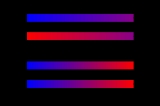
The maximum amount of heat or mass transfer that can be obtained is higher with countercurrent than cocurrent (parallel) exchange because countercurrent maintains a slowly declining difference or gradient
(usually temperature or concentration difference). In cocurrent exchange the initial gradient is higher but falls off quickly, leading to wasted potential. For example, in the diagram at the right, the fluid being heated (exiting top) has a higher exiting temperature than the cooled fluid (exiting bottom) that was used for heating. With cocurrent or parallel exchange the heated and cooled fluids can only approach one another. The result is that countercurrent exchange can achieve a greater amount of heat or mass transfer than parallel under otherwise similar conditions. See: Heat exchanger#Flow arrangement
Countercurrent exchange when set up in a circuit or loop can be used for building up concentrations, heat, or other properties of flowing liquids. Specifically when set up in a loop with a buffering liquid between the incoming and outgoing fluid running in a circuit, and with active transport
pumps on the outgoing fluid's tubes, the system is called a Countercurrent multiplier, enabling a multiplied effect of many small pumps to gradually build up a large concentration in the buffer liquid.
Other countercurrent exchange circuits where the incoming and outgoing fluids touch each other are used for retaining a high concentration of a dissolved substance or for retaining heat, or for allowing the external buildup of the heat or concentration at one point in the system.
Countercurrent exchange circuits or loops are found extensively in nature
, specifically in biologic systems
. In vertebrates, they are called a Rete mirabile
, originally the name of an organ in fish Gills for absorbing oxygen from the water. It is mimicked in industrial systems
. Countercurrent exchange is a key concept in chemical engineering
thermodynamics
and manufacturing processes, for example in extracting sucrose
from sugar beet
roots.
Countercurrent multiplication which is a similar but different concept where liquid moves in a loop followed by a long length of movement in opposite directions with an intermediate zone, the tube leading to the loop passively building up a gradient of heat (or cooling) or solvent concentration while the returning tube has a constant small pumping action all along it, so that a gradual intensification of the heat or concentration is created towards the loop. Countercurrent multiplication has been found in the kidneys as well as in many other biological organs.
 Countercurrent exchange along with concurrent exchange and contra-current exchange comprise the mechanisms used to transfer some property of a fluid
from one flowing current of fluid to another across a barrier allowing one way flow of the property between them. The property transferred could be heat
, concentration
of a chemical substance
, or other properties of the flow.
When heat is transferred, a thermally-conductive membrane is used between the two tubes, and when the concentration of a chemical substance is transferred a semipermeable membrane
is used.
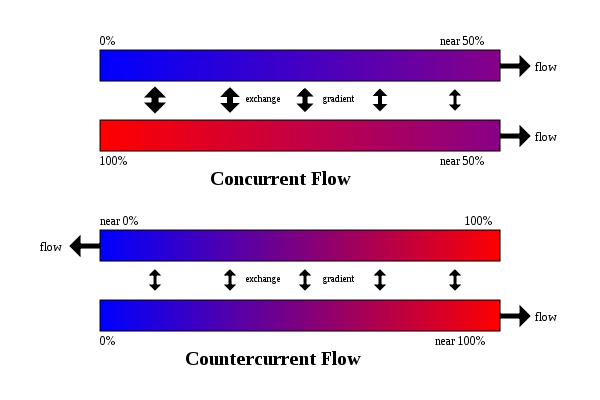 In the concurrent flow exchange mechanism, the two fluids flow in the same direction.
As the Concurrent and countercurrent exchange mechanisms diagram shows, a concurrent exchange system has a variable gradient over the length of the exchanger. With equal flows in the two tubes, this method of exchange is only capable of moving half of the property from one flow to the other, no matter how long the exchanger is.
If each stream changes its property to be 50% closer to that of the opposite stream's inlet condition, exchange will stop when the point of equilibrium is reached, and the gradient has declined to zero. In the case of unequal flows, the equilibrium condition will occur somewhat closer to the conditions of the stream with the higher flow.
 A concurrent heat exchanger is an example of a concurrent flow exchange mechanism.
Two tubes have a liquid flowing in the same direction. One starts off hot at 60oC, the second cold at 20oC. A thermoconductive membrane or an open section allows heat transfer between the two flows.
The hot fluid heats the cold one, and the cold fluid cools down the warm one. The result is thermal equilibrium: Both fluids end up at around the same temperature: 40oC, almost exactly between the two original temperatures (20oC and 60oC). At the input end, there is a large temperature difference of 40oC and much heat transfer; at the output end, there is a very small temperature difference (both are at the same temperature of 40oC or close to it), and very little heat transfer if any at all. If the equilibrium - where both tubes are at the same temperature - is reached before the exit of the liquid from the tubes, no further heat transfer will be achieved along the remaining length of the tubes.
A similar example is the concurrent concentration exchange. The system consists of two tubes, one with brine (concentrated saltwater), the other with freshwater (which has a low concentration of salt in it), and a semi permeable membrane which allows only water to pass between the two, in an osmotic process
. Many of the water molecules pass from the freshwater flow in order to dilute the brine, while the concentration of salt in the freshwater constantly grows (since the salt is not leaving this flow, while water is). This will continue, until both flows reach a similar dilution, with a concentration somewhere close to midway between the two original dilutions. Once that happens, there will be no more flow between the two tubes, since both are at a similar dilution and there is no more osmotic pressure
.
Two tubes have a liquid flowing in the opposite directions. The top tube starts off hot, the bottom cold.
The system can maintain a nearly constant gradient
between the two flows over their entire length.
With a sufficiently long length and a sufficiently low flow rate this can result in almost all of the property heat transferred.
Countercurrent flow examples:
In a countercurrent heat exchanger, the hot fluid becomes cold, and the cold fluid becomes hot.
In this example, hot water at 60oC enters the top pipe. It warms water in the bottom pipe which has been warmed up along the way, to almost 60oC. A minute but existing heat difference still exists, and a small amount of heat is transferred, so that the water leaving the bottom pipe is at close to 60oC. Because the hot input is at its maximum temperature of 60oC, and the exiting water at the bottom pipe is nearly at that temperature but not quite, the water in the top pipe can warm the one in the bottom pipe to nearly its own temperature. At the cold end - the water exit from the top pipe, because the cold water entering the bottom pipe is still cold at 20oC, it can extract the last of the heat from the now-cooled hot water in the top pipe, bringing its temperature down nearly to the level of the cold input fluid (21oC).
The result is that the top pipe which received hot water, now has cold water leaving it at 20oC, while the bottom pipe which received cold water, is now emitting hot water at close to 60oC. In effect, most of the heat was transferred.
For a maximum transfer of substance concentration, an equal flowrate of solvents and solutions is required. For maximum heat transfer, the average specific heat capacity and the mass flow rate must be the same for each stream. If the two flows are not equal, for example if heat is being transferred from water to air or vice-versa, then, similar to concurrent exchange systems, a variation in the gradient is expected because of a buildup of the property not being transferred properly.
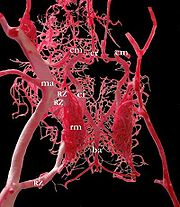 Countercurrent exchange in biological systems was discovered and studied following the discovery of Countercurrent multiplication systems by Werner Kuhn
).
Countercurrent exchange is used extensively in biological systems for a wide variety of purposes. For example, fish
use it in their gill
s to transfer oxygen from the surrounding water into their blood, and bird
s use a countercurrent heat exchanger
between blood vessels in their legs to keep heat concentrated within their bodies. In vertebrates this type of organ is referred to as a Rete mirabile
(originally the name of the organ in the fish gills). Mammalian kidney
s use countercurrent exchange to remove water from urine so the body can retain water used to move the nitrogenous waste products (see Countercurrent multiplier).
The system allows the buildup of a high concentration gradually, with the use of many active transport
pumps each pumping only against a very small gradient.
Theoretically a similar system could exist or be constructed for heat exchange.
The incoming flow starting at a low concentration has a semipermeable membrane
with water passing to the buffer liquid via osmosis
at a small gradient. There is a gradual buildup of concentration inside the loop until the loop tip where it reaches its maximum.
In the example image water enters at 299 mg/L (NaCL / H2O). Water passes because of a small osmotic pressure
to the buffer liquid in this example at 300 mg/L (NaCL / H2O). Further up the loop there is a continued flow of water out of the tube and into the buffer, gradually raising the concentration of NaCL in the tube until it reaches 1199 mg/L at the tip. The buffer liquid between the two tubes is at a gradually rising concentration, always a bit over the incoming fluid, in our example reaching 1200 mg/L. This is regulated by the pumping action on the returning tube as explained immediately.
The tip of the loop has the highest concentration of salt (NaCL) in the incoming tube - in the example 1199 mg/L, and in the buffer 1200 mg/L. The returning tube has active transport pumps, pumping salt out to the buffer liquid at a low difference of concentrations of up to 200 mg/L more than in the tube. Thus when opposite the 1000 mg/L in the buffer liquid, the concentration in the tube is 800 and only 200 mg/L are needed to be pumped out. But the same is true anywhere along the line, so that at exit of the loop also only 200 mg/L need to be pumped.
In effect, this can be seen as a gradually multiplying effect - hence the name of the phenomena: a 'countercurrent multiplier' or the mechanism: Countercurrent multiplication.
 A circuit of fluid in the Loop of Henle
- an important part of the kidneys allows for gradual buildup of the concentration of urine in the kidneys, by using active transport
on the exiting 'nephron
s' (tubules carrying liquid in the process of gradually concentrating the urea). The active transport pumps need only to overcome a constant and low gradient of concentration, because of the countercurrent multiplier mechanism
Various substances are passed from the liquid entering the Nephrons until exiting the loop (See the Nephron flow diagram). The sequence of flow is as follows:
and two of his former students who called the mechanism found in the Loop of Henle
in mammalian kidneys a Countercurrent multiplier and confirmed by laboratory findings in 1958 by Professor Carl W. Gottschalk
. The theory was acknowledged a year later after a meticulous study showed that there is almost no osmotic difference between liquids on both sides of nephrons. Ever since, many similar mechanisms have been found in biologic systems, the most notable of these: the Rete mirable in fish.
CCHE is used in animals living in extreme conditions of cold or hot weather have a mechanism for retaining the heat in (or out of) the body. These are countercurrent exchange systems with the same fluid, usually blood, in a circuit, used for both directions of flow.
When animals like the leatherback turtle
and dolphins are in colder water to which they are not acclimatized, they use this CCHE mechanism. Such CCHE systems are made up of a complex network of peri-arterial venous plexuses that run from the heart and through the blubber to peripheral sites (i.e. the tail flukes, dorsal fin
and pectoral fins).
Each plexus consists of a singular artery containing warm blood from the heart surrounded by a bundle of veins containing cool blood from the body surface. As these fluids flow past each other, they create a heat gradient in which heat is transferred and retained inside the body. The warm arterial blood transfers most of its heat to the cool venous blood now coming in from the outside. This conserves heat by recirculating it back to the body core. Since the arteries give up a good deal of their heat in this exchange, there is less heat lost through convection
at the periphery surface.
Another example is found in the legs of an arctic fox treading on snow. The paws are necessarily cold, but blood can circulate to bring nutrients to the paws without losing much heat from the body. Proximity of arteries and veins in the leg results in heat exchange, so that as the blood flows down it becomes cooler, and doesn't lose much heat to the snow. As the (cold) blood flows back up from the paws through the veins, it picks up heat from the blood flowing in the opposite direction, so that it returns to the torso in a warm state, allowing the fox to maintain a comfortable temperature, without losing it to the snow.
near the nostrils which concentrates brine, later to be "sneezed" out to the sea, in effect allowing these birds to drink seawater without the need to find freshwater resources. It also enables the seabirds to remove the excess salt entering the body when eating, swimming or diving in the sea for food. The kidney cannot remove these quantities and concentrations of salt.
The salt secreting gland has been found in seabirds like pelican
s, petrel
s, albatross
es, gull
s, tern
s and poss
ess. It has also been found in Namibian ostriches and other desert birds, where a buildup of salt concentration is due to dehydration and scarcity of drink water.
In seabirds the salt gland with its countercurrent exchange mechanism work as follows:
The anatomy of the countercurrent exchange mechanism in the salt gland is as follows:
The gland has an area where salt is pumped into its tubules using active transport reaching extremely high concentrations. at the end of the gland there is an area with tubules with low salt concentration. The fluid moves in a counter-current exchange circuit so that although high concentrations leave the gland, they are constantly returned to it.
Tiny arteries carrying salty blood enter the gland and are very closely juxtaposed to the tubules with low concentration, slightly adding to its concentration in the exiting tubules. This extra concentration is retrieved to the returning tubules, so that there is a continued buildup of concentration at the gland 'top', but a constant low concentration at the gland 'end', where the arteries are passing their salt to the gland. 'Veinules' (small veins) leave the gland with a continued decreasing concentration of salt in the blood.
The salty liquid thus collected into the glands is periodically sneezed out from the nostrils.
The glands remove the salt efficiently and thus allow the birds to drink the salty water from their environment while they are hundreds of miles away from land.
Fractionating column
A fractionating column or fractionation column is an essential item used in the distillation of liquid mixtures so as to separate the mixture into its component parts, or fractions, based on the differences in their volatilities...
column, the vapors bubble up through the downward flowing liquid while exchanging both heat and mass.
The maximum amount of heat or mass transfer that can be obtained is higher with countercurrent than cocurrent (parallel) exchange because countercurrent maintains a slowly declining difference or gradient
Gradient
In vector calculus, the gradient of a scalar field is a vector field that points in the direction of the greatest rate of increase of the scalar field, and whose magnitude is the greatest rate of change....
(usually temperature or concentration difference). In cocurrent exchange the initial gradient is higher but falls off quickly, leading to wasted potential. For example, in the diagram at the right, the fluid being heated (exiting top) has a higher exiting temperature than the cooled fluid (exiting bottom) that was used for heating. With cocurrent or parallel exchange the heated and cooled fluids can only approach one another. The result is that countercurrent exchange can achieve a greater amount of heat or mass transfer than parallel under otherwise similar conditions. See: Heat exchanger#Flow arrangement
Countercurrent exchange when set up in a circuit or loop can be used for building up concentrations, heat, or other properties of flowing liquids. Specifically when set up in a loop with a buffering liquid between the incoming and outgoing fluid running in a circuit, and with active transport
Active transport
Active transport is the movement of a substance against its concentration gradient . In all cells, this is usually concerned with accumulating high concentrations of molecules that the cell needs, such as ions, glucose, and amino acids. If the process uses chemical energy, such as from adenosine...
pumps on the outgoing fluid's tubes, the system is called a Countercurrent multiplier, enabling a multiplied effect of many small pumps to gradually build up a large concentration in the buffer liquid.
Other countercurrent exchange circuits where the incoming and outgoing fluids touch each other are used for retaining a high concentration of a dissolved substance or for retaining heat, or for allowing the external buildup of the heat or concentration at one point in the system.
Countercurrent exchange circuits or loops are found extensively in nature
Nature
Nature, in the broadest sense, is equivalent to the natural world, physical world, or material world. "Nature" refers to the phenomena of the physical world, and also to life in general...
, specifically in biologic systems
Biology
Biology is a natural science concerned with the study of life and living organisms, including their structure, function, growth, origin, evolution, distribution, and taxonomy. Biology is a vast subject containing many subdivisions, topics, and disciplines...
. In vertebrates, they are called a Rete mirabile
Rete mirabile
A rete mirabile is a complex of arteries and veins lying very close to each other, found in some vertebrates. The rete mirabile utilizes countercurrent blood flow within the net...
, originally the name of an organ in fish Gills for absorbing oxygen from the water. It is mimicked in industrial systems
Industry
Industry refers to the production of an economic good or service within an economy.-Industrial sectors:There are four key industrial economic sectors: the primary sector, largely raw material extraction industries such as mining and farming; the secondary sector, involving refining, construction,...
. Countercurrent exchange is a key concept in chemical engineering
Chemical engineering
Chemical engineering is the branch of engineering that deals with physical science , and life sciences with mathematics and economics, to the process of converting raw materials or chemicals into more useful or valuable forms...
thermodynamics
Thermodynamics
Thermodynamics is a physical science that studies the effects on material bodies, and on radiation in regions of space, of transfer of heat and of work done on or by the bodies or radiation...
and manufacturing processes, for example in extracting sucrose
Sucrose
Sucrose is the organic compound commonly known as table sugar and sometimes called saccharose. A white, odorless, crystalline powder with a sweet taste, it is best known for its role in human nutrition. The molecule is a disaccharide composed of glucose and fructose with the molecular formula...
from sugar beet
Sugar beet
Sugar beet, a cultivated plant of Beta vulgaris, is a plant whose tuber contains a high concentration of sucrose. It is grown commercially for sugar production. Sugar beets and other B...
roots.
Countercurrent multiplication which is a similar but different concept where liquid moves in a loop followed by a long length of movement in opposite directions with an intermediate zone, the tube leading to the loop passively building up a gradient of heat (or cooling) or solvent concentration while the returning tube has a constant small pumping action all along it, so that a gradual intensification of the heat or concentration is created towards the loop. Countercurrent multiplication has been found in the kidneys as well as in many other biological organs.
The three current exchange systems
Fluid
In physics, a fluid is a substance that continually deforms under an applied shear stress. Fluids are a subset of the phases of matter and include liquids, gases, plasmas and, to some extent, plastic solids....
from one flowing current of fluid to another across a barrier allowing one way flow of the property between them. The property transferred could be heat
Heat
In physics and thermodynamics, heat is energy transferred from one body, region, or thermodynamic system to another due to thermal contact or thermal radiation when the systems are at different temperatures. It is often described as one of the fundamental processes of energy transfer between...
, concentration
Concentration
In chemistry, concentration is defined as the abundance of a constituent divided by the total volume of a mixture. Four types can be distinguished: mass concentration, molar concentration, number concentration, and volume concentration...
of a chemical substance
Chemical substance
In chemistry, a chemical substance is a form of matter that has constant chemical composition and characteristic properties. It cannot be separated into components by physical separation methods, i.e. without breaking chemical bonds. They can be solids, liquids or gases.Chemical substances are...
, or other properties of the flow.
When heat is transferred, a thermally-conductive membrane is used between the two tubes, and when the concentration of a chemical substance is transferred a semipermeable membrane
Semipermeable membrane
A semipermeable membrane, also termed a selectively permeable membrane, a partially permeable membrane or a differentially permeable membrane, is a membrane that will allow certain molecules or ions to pass through it by diffusion and occasionally specialized "facilitated diffusion".The rate of...
is used.
Concurrent flow - half transfer
As the Concurrent and countercurrent exchange mechanisms diagram shows, a concurrent exchange system has a variable gradient over the length of the exchanger. With equal flows in the two tubes, this method of exchange is only capable of moving half of the property from one flow to the other, no matter how long the exchanger is.
If each stream changes its property to be 50% closer to that of the opposite stream's inlet condition, exchange will stop when the point of equilibrium is reached, and the gradient has declined to zero. In the case of unequal flows, the equilibrium condition will occur somewhat closer to the conditions of the stream with the higher flow.
Concurrent flow examples
Two tubes have a liquid flowing in the same direction. One starts off hot at 60oC, the second cold at 20oC. A thermoconductive membrane or an open section allows heat transfer between the two flows.
The hot fluid heats the cold one, and the cold fluid cools down the warm one. The result is thermal equilibrium: Both fluids end up at around the same temperature: 40oC, almost exactly between the two original temperatures (20oC and 60oC). At the input end, there is a large temperature difference of 40oC and much heat transfer; at the output end, there is a very small temperature difference (both are at the same temperature of 40oC or close to it), and very little heat transfer if any at all. If the equilibrium - where both tubes are at the same temperature - is reached before the exit of the liquid from the tubes, no further heat transfer will be achieved along the remaining length of the tubes.
A similar example is the concurrent concentration exchange. The system consists of two tubes, one with brine (concentrated saltwater), the other with freshwater (which has a low concentration of salt in it), and a semi permeable membrane which allows only water to pass between the two, in an osmotic process
Osmosis
Osmosis is the movement of solvent molecules through a selectively permeable membrane into a region of higher solute concentration, aiming to equalize the solute concentrations on the two sides...
. Many of the water molecules pass from the freshwater flow in order to dilute the brine, while the concentration of salt in the freshwater constantly grows (since the salt is not leaving this flow, while water is). This will continue, until both flows reach a similar dilution, with a concentration somewhere close to midway between the two original dilutions. Once that happens, there will be no more flow between the two tubes, since both are at a similar dilution and there is no more osmotic pressure
Osmotic pressure
Osmotic pressure is the pressure which needs to be applied to a solution to prevent the inward flow of water across a semipermeable membrane....
.
Countercurrent flow - almost full transfer
In the Countercurrent flow - the two flows move in opposite directions.Two tubes have a liquid flowing in the opposite directions. The top tube starts off hot, the bottom cold.
The system can maintain a nearly constant gradient
Gradient
In vector calculus, the gradient of a scalar field is a vector field that points in the direction of the greatest rate of increase of the scalar field, and whose magnitude is the greatest rate of change....
between the two flows over their entire length.
With a sufficiently long length and a sufficiently low flow rate this can result in almost all of the property heat transferred.
Countercurrent flow examples:
In a countercurrent heat exchanger, the hot fluid becomes cold, and the cold fluid becomes hot.
In this example, hot water at 60oC enters the top pipe. It warms water in the bottom pipe which has been warmed up along the way, to almost 60oC. A minute but existing heat difference still exists, and a small amount of heat is transferred, so that the water leaving the bottom pipe is at close to 60oC. Because the hot input is at its maximum temperature of 60oC, and the exiting water at the bottom pipe is nearly at that temperature but not quite, the water in the top pipe can warm the one in the bottom pipe to nearly its own temperature. At the cold end - the water exit from the top pipe, because the cold water entering the bottom pipe is still cold at 20oC, it can extract the last of the heat from the now-cooled hot water in the top pipe, bringing its temperature down nearly to the level of the cold input fluid (21oC).
The result is that the top pipe which received hot water, now has cold water leaving it at 20oC, while the bottom pipe which received cold water, is now emitting hot water at close to 60oC. In effect, most of the heat was transferred.
Conditions for higher transfer results
It should be noted that nearly complete transfer in systems implementing countercurrent exchange, is only possible if the two flows are, in some sense, "equal".For a maximum transfer of substance concentration, an equal flowrate of solvents and solutions is required. For maximum heat transfer, the average specific heat capacity and the mass flow rate must be the same for each stream. If the two flows are not equal, for example if heat is being transferred from water to air or vice-versa, then, similar to concurrent exchange systems, a variation in the gradient is expected because of a buildup of the property not being transferred properly.
Countercurrent exchange in biological systems
Werner Kuhn
Werner Kuhn is a Swiss physical chemist who developed the first model of the viscosity of polymer solutions using statistical mechanics. He is known for being the first to apply Boltzmann's entropy formula:S = k \log W \!...
).
Countercurrent exchange is used extensively in biological systems for a wide variety of purposes. For example, fish
Fish
Fish are a paraphyletic group of organisms that consist of all gill-bearing aquatic vertebrate animals that lack limbs with digits. Included in this definition are the living hagfish, lampreys, and cartilaginous and bony fish, as well as various extinct related groups...
use it in their gill
Gill
A gill is a respiratory organ found in many aquatic organisms that extracts dissolved oxygen from water, afterward excreting carbon dioxide. The gills of some species such as hermit crabs have adapted to allow respiration on land provided they are kept moist...
s to transfer oxygen from the surrounding water into their blood, and bird
Bird
Birds are feathered, winged, bipedal, endothermic , egg-laying, vertebrate animals. Around 10,000 living species and 188 families makes them the most speciose class of tetrapod vertebrates. They inhabit ecosystems across the globe, from the Arctic to the Antarctic. Extant birds range in size from...
s use a countercurrent heat exchanger
Heat exchanger
A heat exchanger is a piece of equipment built for efficient heat transfer from one medium to another. The media may be separated by a solid wall, so that they never mix, or they may be in direct contact...
between blood vessels in their legs to keep heat concentrated within their bodies. In vertebrates this type of organ is referred to as a Rete mirabile
Rete mirabile
A rete mirabile is a complex of arteries and veins lying very close to each other, found in some vertebrates. The rete mirabile utilizes countercurrent blood flow within the net...
(originally the name of the organ in the fish gills). Mammalian kidney
Kidney
The kidneys, organs with several functions, serve essential regulatory roles in most animals, including vertebrates and some invertebrates. They are essential in the urinary system and also serve homeostatic functions such as the regulation of electrolytes, maintenance of acid–base balance, and...
s use countercurrent exchange to remove water from urine so the body can retain water used to move the nitrogenous waste products (see Countercurrent multiplier).
Countercurrent multiplier
A countercurrent multiplier is a system where fluid flows in a loop so that the entrance and exit are at similar low concentration of a dissolved substance but at the tip of the loop there is a very high concentration of that substance. A buffer liquid between the incoming and outgoing tubes receives the concentrated substance. The incoming and outgoing tubes do not touch each other.The system allows the buildup of a high concentration gradually, with the use of many active transport
Active transport
Active transport is the movement of a substance against its concentration gradient . In all cells, this is usually concerned with accumulating high concentrations of molecules that the cell needs, such as ions, glucose, and amino acids. If the process uses chemical energy, such as from adenosine...
pumps each pumping only against a very small gradient.
Theoretically a similar system could exist or be constructed for heat exchange.
The incoming flow starting at a low concentration has a semipermeable membrane
Semipermeable membrane
A semipermeable membrane, also termed a selectively permeable membrane, a partially permeable membrane or a differentially permeable membrane, is a membrane that will allow certain molecules or ions to pass through it by diffusion and occasionally specialized "facilitated diffusion".The rate of...
with water passing to the buffer liquid via osmosis
Osmosis
Osmosis is the movement of solvent molecules through a selectively permeable membrane into a region of higher solute concentration, aiming to equalize the solute concentrations on the two sides...
at a small gradient. There is a gradual buildup of concentration inside the loop until the loop tip where it reaches its maximum.
In the example image water enters at 299 mg/L (NaCL / H2O). Water passes because of a small osmotic pressure
Osmotic pressure
Osmotic pressure is the pressure which needs to be applied to a solution to prevent the inward flow of water across a semipermeable membrane....
to the buffer liquid in this example at 300 mg/L (NaCL / H2O). Further up the loop there is a continued flow of water out of the tube and into the buffer, gradually raising the concentration of NaCL in the tube until it reaches 1199 mg/L at the tip. The buffer liquid between the two tubes is at a gradually rising concentration, always a bit over the incoming fluid, in our example reaching 1200 mg/L. This is regulated by the pumping action on the returning tube as explained immediately.
The tip of the loop has the highest concentration of salt (NaCL) in the incoming tube - in the example 1199 mg/L, and in the buffer 1200 mg/L. The returning tube has active transport pumps, pumping salt out to the buffer liquid at a low difference of concentrations of up to 200 mg/L more than in the tube. Thus when opposite the 1000 mg/L in the buffer liquid, the concentration in the tube is 800 and only 200 mg/L are needed to be pumped out. But the same is true anywhere along the line, so that at exit of the loop also only 200 mg/L need to be pumped.
In effect, this can be seen as a gradually multiplying effect - hence the name of the phenomena: a 'countercurrent multiplier' or the mechanism: Countercurrent multiplication.
In the kidney
Loop of Henle
In the kidney, the loop of Henle is the portion of a nephron that leads from the proximal convoluted tubule to the distal convoluted tubule. Named after its discoverer F. G. J...
- an important part of the kidneys allows for gradual buildup of the concentration of urine in the kidneys, by using active transport
Active transport
Active transport is the movement of a substance against its concentration gradient . In all cells, this is usually concerned with accumulating high concentrations of molecules that the cell needs, such as ions, glucose, and amino acids. If the process uses chemical energy, such as from adenosine...
on the exiting 'nephron
Nephron
The renal tubule is the portion of the nephron containing the tubular fluid filtered through the glomerulus. After passing through the renal tubule, the filtrate continues to the collecting duct system, which is not part of the nephron....
s' (tubules carrying liquid in the process of gradually concentrating the urea). The active transport pumps need only to overcome a constant and low gradient of concentration, because of the countercurrent multiplier mechanism
Various substances are passed from the liquid entering the Nephrons until exiting the loop (See the Nephron flow diagram). The sequence of flow is as follows:
- Renal corpuscleRenal corpuscleIn the kidney, a renal corpuscle is the initial blood-filtering component of a nephron. It consists of two structures: a glomerulus and a Bowman's capsule. The glomerulus is a small tuft of capillaries containing two cell types. Endothelial cells, which have large fenestrae, are not covered by...
: Liquid enters the nephron system at the Bowman's capsule.
- Proximal convoluted tubule: It then may reabsorb urea in the thick descending limbDescending limb of loop of HenleThe descending limb of loop of Henle is the portion of the renal tubule constituting the first part of the loop of Henle.-Physiology:The permeability is as follows:...
. Water is removed from the nephrons by osmosisOsmosisOsmosis is the movement of solvent molecules through a selectively permeable membrane into a region of higher solute concentration, aiming to equalize the solute concentrations on the two sides...
(and Glucose and other ions are pumped out with active transportActive transportActive transport is the movement of a substance against its concentration gradient . In all cells, this is usually concerned with accumulating high concentrations of molecules that the cell needs, such as ions, glucose, and amino acids. If the process uses chemical energy, such as from adenosine...
), gradually raising the concentration in the nephrons.
- Loop of HenleLoop of HenleIn the kidney, the loop of Henle is the portion of a nephron that leads from the proximal convoluted tubule to the distal convoluted tubule. Named after its discoverer F. G. J...
Descending: The liquid passes from the thick descending limbDescending limb of loop of HenleThe descending limb of loop of Henle is the portion of the renal tubule constituting the first part of the loop of Henle.-Physiology:The permeability is as follows:...
to the thin one. Water is constantly released via osmosis. Gradually there is a buildup of osmotic concentration, until 1200 mOsm is reached at the loop tip, but the difference across the membrane is kept small and constant.
- For example, the liquid at one section inside the thin descending limb is at 401 mOsm while outside its 400. Further down the descending limb, the inside concentration is 501 while outside it is 500, so a constant difference of 1 mOsm is kept all across the membrane, although the concentration inside and outside are gradually increasing.
- Loop of HenleLoop of HenleIn the kidney, the loop of Henle is the portion of a nephron that leads from the proximal convoluted tubule to the distal convoluted tubule. Named after its discoverer F. G. J...
Ascending: after the tip (or 'bend') of the loop, the liquid flows in the thin ascending limbAscending limb of loop of HenleAscending limb of loop of Henle can refer to:* Thin ascending limb of loop of Henle* Thick ascending limb of loop of Henle...
. Salt - SodiumSodiumSodium is a chemical element with the symbol Na and atomic number 11. It is a soft, silvery-white, highly reactive metal and is a member of the alkali metals; its only stable isotope is 23Na. It is an abundant element that exists in numerous minerals, most commonly as sodium chloride...
Na+ and ChlorineChlorineChlorine is the chemical element with atomic number 17 and symbol Cl. It is the second lightest halogen, found in the periodic table in group 17. The element forms diatomic molecules under standard conditions, called dichlorine...
Cl- ions are pumped out of the liquid gradually lowering the concentration in the exiting liquid, but, using the countercurrent multiplier mechanism, always pumping against a constant and small osmotic difference.
- For example, the pumps at a section close to the bend, pump out from 1000 mOsm inside the ascending limb to 1200 mOsm outside it, with a 200 mOsm across. Pumps further up the thin ascending limb, pump out from 400 mOsm into liquid at 600 mOsm, so again the difference is retained at 200 mOsm from the inside to the outside, while the concentration both inside and outside are gradually decreasing as the liquid flow advances.
- The liquid finally reaches a low concentration of 100 mOsm when leaving the thin ascending limb and passing through the thick one
- Distal convoluted tubuleDistal convoluted tubuleThe distal convoluted tubule is a portion of kidney nephron between the loop of Henle and the collecting duct system.- Physiology :It is partly responsible for the regulation of potassium, sodium, calcium, and pH...
: Once leaving the loop of Henle the thick ascending limb can optionally reabsorb and re increase the concentration in the nephrons.
- Collecting duct: The collecting duct receives liquid between 100 mOsm if no re-absorption is done, to 300 or above if re-absorption was used. The collecting duct may continue raising the concentration if required, by gradually pumping out the same ions as the Distal convoluted tubule, using the same gradient as the ascending limbs in the loop of Henly, and reaching the same concentration.
- Ureter: The liquid urine leaves to the UreterUreterIn human anatomy, the ureters are muscular tubes that propel urine from the kidneys to the urinary bladder. In the adult, the ureters are usually long and ~3-4 mm in diameter....
.
History
Initially the countercurrent exchange mechanism and its properties were proposed in 1951 by professor Werner KuhnWerner Kuhn
Werner Kuhn is a Swiss physical chemist who developed the first model of the viscosity of polymer solutions using statistical mechanics. He is known for being the first to apply Boltzmann's entropy formula:S = k \log W \!...
and two of his former students who called the mechanism found in the Loop of Henle
Loop of Henle
In the kidney, the loop of Henle is the portion of a nephron that leads from the proximal convoluted tubule to the distal convoluted tubule. Named after its discoverer F. G. J...
in mammalian kidneys a Countercurrent multiplier and confirmed by laboratory findings in 1958 by Professor Carl W. Gottschalk
Carl W. Gottschalk
Carl William Gottschalk was the Kenan Professor and Distinguished Research Professor of Medicine at the University of North Carolina at Chapel Hill...
. The theory was acknowledged a year later after a meticulous study showed that there is almost no osmotic difference between liquids on both sides of nephrons. Ever since, many similar mechanisms have been found in biologic systems, the most notable of these: the Rete mirable in fish.
Countercurrent exchange of heat in organisms
Countercurrent heat exchange (CCHE) is a highly efficient means of minimizing heat loss through the skin's surface because heat is recycled instead of being dissipated. This way, the heart does not have to pump blood as rapidly in order to maintain a constant body core temperature and thus, metabolic rate.CCHE is used in animals living in extreme conditions of cold or hot weather have a mechanism for retaining the heat in (or out of) the body. These are countercurrent exchange systems with the same fluid, usually blood, in a circuit, used for both directions of flow.
When animals like the leatherback turtle
Leatherback Sea Turtle
The leatherback sea turtle is the largest of all living sea turtles and the fourth largest modern reptile behind three crocodilians. It is the only living species in the genus Dermochelys. It can easily be differentiated from other modern sea turtles by its lack of a bony shell. Instead, its...
and dolphins are in colder water to which they are not acclimatized, they use this CCHE mechanism. Such CCHE systems are made up of a complex network of peri-arterial venous plexuses that run from the heart and through the blubber to peripheral sites (i.e. the tail flukes, dorsal fin
Dorsal fin
A dorsal fin is a fin located on the backs of various unrelated marine and freshwater vertebrates, including most fishes, marine mammals , and the ichthyosaurs...
and pectoral fins).
Each plexus consists of a singular artery containing warm blood from the heart surrounded by a bundle of veins containing cool blood from the body surface. As these fluids flow past each other, they create a heat gradient in which heat is transferred and retained inside the body. The warm arterial blood transfers most of its heat to the cool venous blood now coming in from the outside. This conserves heat by recirculating it back to the body core. Since the arteries give up a good deal of their heat in this exchange, there is less heat lost through convection
Convection
Convection is the movement of molecules within fluids and rheids. It cannot take place in solids, since neither bulk current flows nor significant diffusion can take place in solids....
at the periphery surface.
Another example is found in the legs of an arctic fox treading on snow. The paws are necessarily cold, but blood can circulate to bring nutrients to the paws without losing much heat from the body. Proximity of arteries and veins in the leg results in heat exchange, so that as the blood flows down it becomes cooler, and doesn't lose much heat to the snow. As the (cold) blood flows back up from the paws through the veins, it picks up heat from the blood flowing in the opposite direction, so that it returns to the torso in a warm state, allowing the fox to maintain a comfortable temperature, without losing it to the snow.
Countercurrent exchange in sea and desert birds to distill seawater
Sea and desert birds have been found to have a salt glandSalt gland
The salt gland is an organ for excreting excess salts. It is found in elasmobranchs, seabirds, and some reptiles. In sharks, salt glands are found in the rectum, but in birds and reptiles, they are found in or on the skull, in the area of the eyes, nostrils or mouth. In crocodiles, the salt is...
near the nostrils which concentrates brine, later to be "sneezed" out to the sea, in effect allowing these birds to drink seawater without the need to find freshwater resources. It also enables the seabirds to remove the excess salt entering the body when eating, swimming or diving in the sea for food. The kidney cannot remove these quantities and concentrations of salt.
The salt secreting gland has been found in seabirds like pelican
Pelican
A pelican, derived from the Greek word πελεκυς pelekys is a large water bird with a large throat pouch, belonging to the bird family Pelecanidae....
s, petrel
Petrel
Petrels are tube-nosed seabirds in the bird order Procellariiformes. The common name does not indicate relationship beyond that point, as "petrels" occur in three of the four families within that group...
s, albatross
Albatross
Albatrosses, of the biological family Diomedeidae, are large seabirds allied to the procellariids, storm-petrels and diving-petrels in the order Procellariiformes . They range widely in the Southern Ocean and the North Pacific...
es, gull
Gull
Gulls are birds in the family Laridae. They are most closely related to the terns and only distantly related to auks, skimmers, and more distantly to the waders...
s, tern
Tern
Terns are seabirds in the family Sternidae, previously considered a subfamily of the gull family Laridae . They form a lineage with the gulls and skimmers which in turn is related to skuas and auks...
s and poss
Poss
Poss may refer to:* POSS, a major photographic survey of the night sky* An acronym for Professional Open-Source Software * Poss , a basketball statisticPeople with the surname Poss:...
ess. It has also been found in Namibian ostriches and other desert birds, where a buildup of salt concentration is due to dehydration and scarcity of drink water.
In seabirds the salt gland with its countercurrent exchange mechanism work as follows:
- a. Salt enters the blood plasma from the intestines, so it is initially at a high concentration (but less than the concentration in the sea water)
- b. Osmosis causes the extra-cellular fluid volume (ECFV) to rise, with large amounts of water exit the cells, while lowering the salt concentration of the extra-cellular fluid.
- c. A section of the salt gland further raises concentration of salt in the blood plasma. This is accomplished in a small area of the salt gland, by Active transport (moving the salt against its concentration gradient, using energy from ATP breakdown).
- d. In order to preserve the extremely high concentration of salt in the gland, blood plasma entering the gland and exiting it is passed through a counter current-exchange circuit, so that the high concentration of salt in plasma leaving the gland is returned to it in the incoming plasma. This system preserves the high concentration in the gland, without losing it to the body's blood system, allowing the gland to build up the salt concentration to ever higher concentrations, by pumping salt molecules in with active transportActive transportActive transport is the movement of a substance against its concentration gradient . In all cells, this is usually concerned with accumulating high concentrations of molecules that the cell needs, such as ions, glucose, and amino acids. If the process uses chemical energy, such as from adenosine...
.
The anatomy of the countercurrent exchange mechanism in the salt gland is as follows:
The gland has an area where salt is pumped into its tubules using active transport reaching extremely high concentrations. at the end of the gland there is an area with tubules with low salt concentration. The fluid moves in a counter-current exchange circuit so that although high concentrations leave the gland, they are constantly returned to it.
Tiny arteries carrying salty blood enter the gland and are very closely juxtaposed to the tubules with low concentration, slightly adding to its concentration in the exiting tubules. This extra concentration is retrieved to the returning tubules, so that there is a continued buildup of concentration at the gland 'top', but a constant low concentration at the gland 'end', where the arteries are passing their salt to the gland. 'Veinules' (small veins) leave the gland with a continued decreasing concentration of salt in the blood.
The salty liquid thus collected into the glands is periodically sneezed out from the nostrils.
The glands remove the salt efficiently and thus allow the birds to drink the salty water from their environment while they are hundreds of miles away from land.
Countercurrent exchange in industrial and scientific systems
Countercurrent Chromatography is a method of separation, that is based on the differential partitioning of analytes between two immiscible liquids using countercurrent or cocurrent flow. Evolving from Craig's Countercurrent Distribution (CCC), the most widely used term and abbreviation are CounterCurrent Chromatography or CCC, in particular when using hydrodynamic CCC instruments. The term partition chromatography is largely a synonymous and predominantly used for hydrostatic CCC instruments.- DistillationDistillationDistillation is a method of separating mixtures based on differences in volatilities of components in a boiling liquid mixture. Distillation is a unit operation, or a physical separation process, and not a chemical reaction....
of chemicals such as in petroleum refining is done towers or columns with perforated trays. Vapor from the low boiling fractions bubbles upward through the holes in the trays in contact with the down flowing high boiling fractions. The concentration of low boiling fraction increases in each tray up the tower as it is "stripped". The low boiling fraction is drawn off the top of the tower and the high boiling fraction drawn from the bottom. The process in the trays is a combination of heat transferHeat transferHeat transfer is a discipline of thermal engineering that concerns the exchange of thermal energy from one physical system to another. Heat transfer is classified into various mechanisms, such as heat conduction, convection, thermal radiation, and phase-change transfer...
and mass transferMass transferMass transfer is the net movement of mass from one location, usually meaning a stream, phase, fraction or component, to another. Mass transfer occurs in many processes, such as absorption, evaporation, adsorption, drying, precipitation, membrane filtration, and distillation. Mass transfer is used...
. Heat is supplied at the bottom, known as a "reboiler" and cooling is done at the with a condenser at the top.
- Liquid-liquid extractionLiquid-liquid extractionLiquid–liquid extraction, also known as solvent extraction and partitioning, is a method to separate compounds based on their relative solubilities in two different immiscible liquids, usually water and an organic solvent. It is an extraction of a substance from one liquid phase into another liquid...
(also called 'solvent extraction' or 'partitioning' is a common method for extracting a substance from one liquid into another liquid at a different 'phase' (such as "slurry"). This method, which implements a countercurrent mechanism, is used in nuclear reprocessingNuclear reprocessingNuclear reprocessing technology was developed to chemically separate and recover fissionable plutonium from irradiated nuclear fuel. Reprocessing serves multiple purposes, whose relative importance has changed over time. Originally reprocessing was used solely to extract plutonium for producing...
, oreOreAn ore is a type of rock that contains minerals with important elements including metals. The ores are extracted through mining; these are then refined to extract the valuable element....
processing, the production of fine organic compounds, the processing of perfumes, the production of vegetable oils and biodieselBiodieselBiodiesel refers to a vegetable oil- or animal fat-based diesel fuel consisting of long-chain alkyl esters. Biodiesel is typically made by chemically reacting lipids with an alcohol....
, and other industries.
- GoldGoldGold is a chemical element with the symbol Au and an atomic number of 79. Gold is a dense, soft, shiny, malleable and ductile metal. Pure gold has a bright yellow color and luster traditionally considered attractive, which it maintains without oxidizing in air or water. Chemically, gold is a...
can be separated from a cyanideCyanideA cyanide is a chemical compound that contains the cyano group, -C≡N, which consists of a carbon atom triple-bonded to a nitrogen atom. Cyanides most commonly refer to salts of the anion CN−. Most cyanides are highly toxic....
solutionSolutionIn chemistry, a solution is a homogeneous mixture composed of only one phase. In such a mixture, a solute is dissolved in another substance, known as a solvent. The solvent does the dissolving.- Types of solutions :...
with the Merrill-Crowe processMerrill-Crowe processThe Merrill-Crowe Process is a separation technique for removing gold from a cyanide solution.The solution is separated from the ore by methods such as filtration and counter current decantation and is then clarified in special filters, usually coated with diatomaceous earth to produce a clarified...
using Counter Current Decantation (CCD). In some mines, NickelNickelNickel is a chemical element with the chemical symbol Ni and atomic number 28. It is a silvery-white lustrous metal with a slight golden tinge. Nickel belongs to the transition metals and is hard and ductile...
and CobaltCobaltCobalt is a chemical element with symbol Co and atomic number 27. It is found naturally only in chemically combined form. The free element, produced by reductive smelting, is a hard, lustrous, silver-gray metal....
are treated with CCD, after the original ore was treated with concentrated Sulfuric acidSulfuric acidSulfuric acid is a strong mineral acid with the molecular formula . Its historical name is oil of vitriol. Pure sulfuric acid is a highly corrosive, colorless, viscous liquid. The salts of sulfuric acid are called sulfates...
and steam in TitaniumTitaniumTitanium is a chemical element with the symbol Ti and atomic number 22. It has a low density and is a strong, lustrous, corrosion-resistant transition metal with a silver color....
covered autoclaveAutoclaveAn autoclave is an instrument used to sterilize equipment and supplies by subjecting them to high pressure saturated steam at 121 °C for around 15–20 minutes depending on the size of the load and the contents. It was invented by Charles Chamberland in 1879, although a precursor known as the...
s, producing nickel cobalt slurry. The nickel and cobalt in the slurry are removed from it almost completely using a CCD system exchanging the cobalt and nickel with flash steam heated water.
- Lime can be manufactured in countercurrent furnaceFurnaceA furnace is a device used for heating. The name derives from Latin fornax, oven.In American English and Canadian English, the term furnace on its own is generally used to describe household heating systems based on a central furnace , and sometimes as a synonym for kiln, a device used in the...
s allowing the heat to reach high temperatures using low cost, low temperature burning fuel. Historically this was developed by the Japanese in certain types of the Anagama kilnAnagama kilnthumb|250px|right|Anagama kiln 1 Door about wide2 Firebox3 Stacking floor made of silica sand4 Dampers5 Flue6 Chimney7 Refractory archThe anagama kiln is an ancient type of pottery kiln brought to Japan from China via Korea in the 5th century.An anagama consists of a firing chamber with a...
. The kiln is built in stages, where fresh air coming to the fuel is passed downwards while the smoke and heat is pushed up and out. The heat does not leave the kiln, but is transferred back to the incoming air, and thus slowly builds up to 3000oC and more.
- CementCementIn the most general sense of the word, a cement is a binder, a substance that sets and hardens independently, and can bind other materials together. The word "cement" traces to the Romans, who used the term opus caementicium to describe masonry resembling modern concrete that was made from crushed...
may be created using a countercurrent kiln where the heat is passed in the cement and the exhaust combined, while the incoming air draft is passed along the two, absorbing the heat and retaining it inside the furnace, finally reaching high temperatures.
- GasificationGasificationGasification is a process that converts organic or fossil based carbonaceous materials into carbon monoxide, hydrogen, carbon dioxide and methane. This is achieved by reacting the material at high temperatures , without combustion, with a controlled amount of oxygen and/or steam...
- the process of creating methaneMethaneMethane is a chemical compound with the chemical formula . It is the simplest alkane, the principal component of natural gas, and probably the most abundant organic compound on earth. The relative abundance of methane makes it an attractive fuel...
and carbon monoxideCarbon monoxideCarbon monoxide , also called carbonous oxide, is a colorless, odorless, and tasteless gas that is slightly lighter than air. It is highly toxic to humans and animals in higher quantities, although it is also produced in normal animal metabolism in low quantities, and is thought to have some normal...
from organic or fossil matter, can be done using a Counter-current fixed bed ("up draft") gasifier which is built in a similar way to the Anagama kiln, and must therefore withstand more harsh conditions, but reaches better efficiency.
- In nuclear power plants, water leaving the plant must not contain even trace particles of Uranium. Counter Current Decantation CCDCCD-Science:*Carbonate compensation depth, a property of oceans*Colony collapse disorder, a phenomenon involving the abrupt disappearance of the worker bees in a beehive or Western honey bee colony...
is used in some facilities to extract water, totally clear of Uranium.
- Some Centrifugal extractorCentrifugal extractorA centrifugal extractor uses the rotation of the rotor inside a centrifuge to mix two immiscible liquids outside the rotor and to separate the liquids in the field of gravity inside the rotor...
s use counter current exchange mechanisms for extracting high rates of the desired material.
- Some protein skimmerProtein skimmerA protein skimmer or foam fractionator is a device used mostly in saltwater aquaria to remove organic compounds from the water before they break down into nitrogenous waste...
s - a device to clean saltwater pools and fish ponds of organic mater - use counter current technologies.
See also
- Anagama kilnAnagama kilnthumb|250px|right|Anagama kiln 1 Door about wide2 Firebox3 Stacking floor made of silica sand4 Dampers5 Flue6 Chimney7 Refractory archThe anagama kiln is an ancient type of pottery kiln brought to Japan from China via Korea in the 5th century.An anagama consists of a firing chamber with a...
- Bidirectional trafficBidirectional trafficIn transportation infrastructure, a bidirectional traffic system divides travelers into two streams of traffic that flow in opposite directions....
- EconomizerEconomizerEconomizers , or economisers , are mechanical devices intended to reduce energy consumption, or to perform another useful function such as preheating a fluid. The term economizer is used for other purposes as well. Boiler, powerplant, and heating, ventilating, and air-conditioning uses are...
- Regenerative heat exchangerRegenerative heat exchangerA regenerative heat exchanger, or more commonly a regenerator, is a type of heat exchanger where the flow through the heat exchanger is cyclical and periodically changes direction. It is similar to a countercurrent heat exchanger. However, a regenerator mixes the two fluid flows while a...
- Countercurrent multiplier
External links
- Countercurrent multiplier animation from Colorado University.
- Research about elephant seals using countercurrent heat exchange to keep heat from leaving their body while breathing out, during hibernationHibernationHibernation is a state of inactivity and metabolic depression in animals, characterized by lower body temperature, slower breathing, and lower metabolic rate. Hibernating animals conserve food, especially during winter when food supplies are limited, tapping energy reserves, body fat, at a slow rate...
. - Patent for a snow mask with a removable countercurrent exchange module which keeps the warmth from leaving the mask when breathing out.
- An industrial system for aerating waste water and sewageSewageSewage is water-carried waste, in solution or suspension, that is intended to be removed from a community. Also known as wastewater, it is more than 99% water and is characterized by volume or rate of flow, physical condition, chemical constituents and the bacteriological organisms that it contains...
which works on the countercurrent exchange principle, without pipes. Air bubbles floating upwards meet water in a down current, causing more of the air to dissolve.