


Udon

Encyclopedia
is a type of thick wheat
-flour
noodle
of Japanese cuisine
.
Udon is usually served hot as noodle soup
in its simplest form as kake udon, in a mildly flavoured broth called kakejiru which is made of dashi
, soy sauce
(shōyu), and mirin
. It is usually topped with thinly chopped scallion
s. Other common toppings include tempura
, often prawn
or kakiage (a type of mixed tempura fritter), or abura age, a type of deep-fried tofu
pockets seasoned with sugar, mirin
, and soy sauce
. A thin slice of kamaboko
, a halfmoon-shaped fish cake, is often added. Shichimi
can be added to taste.
The flavor of broth and topping vary from region to region. Usually, dark brown broth, made from dark soy sauce (koikuchi shōyu) is used in eastern Japan
, and light brown broth, made from light soy sauce (usukuchi shōyu) is used in western Japan. This is even noticeable in packaged instant noodles
, which are often sold in two different versions for east and west.
, similar thick wheat flour noodles are called cū miàn
(粗麵). This original udon was 2 to 3 cm in diameter, a flat pancake-shaped "noodle" added to miso
-based soup. The Japanese character 饂飩 is different from the modern Chinese
characters
餛飩, which refers to wonton
dumplings, not noodles. In Chinese, udon is called 烏冬 wūdōng or 烏冬麵 wūdōngmiàn, sometimes 烏龍麵 wūlóngmiàn, although it is unrelated to Oolong
tea, 烏龍茶 wūlóngchá.
Kūkai
, a Buddhist priest, traveled to China around the beginning of the 9th century to study. Sanuki Province
claimed to have been the first to adopt udon from Kūkai. Enni
, a Rinzai monk
, went to China in the 13th century; Hakata
claimed to have produced udon based on Enni's recipe. See Chinese noodles
.
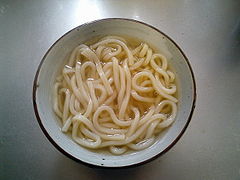
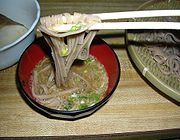
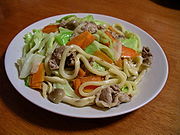 Like many Japanese noodles, udon noodles are served chilled in the summer and hot in the winter. Toppings are chosen to reflect the seasons. Most toppings are added without much cooking, although some are deep-fried. Many of these dishes may also be prepared with soba
.
Wheat
Wheat is a cereal grain, originally from the Levant region of the Near East, but now cultivated worldwide. In 2007 world production of wheat was 607 million tons, making it the third most-produced cereal after maize and rice...
-flour
Flour
Flour is a powder which is made by grinding cereal grains, other seeds or roots . It is the main ingredient of bread, which is a staple food for many cultures, making the availability of adequate supplies of flour a major economic and political issue at various times throughout history...
noodle
Noodle
The noodle is a type of food, made from any of a variety of doughs, formed into long thin ribbons, strips, curly-cues, waves, helices, pipes, tubes, strings, or other various shapes, sometimes folded. They are usually cooked in a mixture of boiling water and/or oil. Depending upon the type, noodles...
of Japanese cuisine
Japanese cuisine
Japanese cuisine has developed over the centuries as a result of many political and social changes throughout Japan. The cuisine eventually changed with the advent of the Medieval age which ushered in a shedding of elitism with the age of shogun rule...
.
Udon is usually served hot as noodle soup
Noodle soup
Noodle soup refers to a variety of soups with noodles and other ingredients served in a light broth. Noodle soup is an East and Southeast Asian staple. Less well known, a form of fresh noodle is used in soup in certain parts of Europe , and in northern China; usually, it is served for breakfast...
in its simplest form as kake udon, in a mildly flavoured broth called kakejiru which is made of dashi
Dashi
Dashi is a class of soup and cooking stock, considered fundamental to Japanese cooking. In 1980, Shizuo Tsuji wrote: "Many substitutes for dashi are possible, but without dashi, dishes are merely à la japonaise and lack the authentic flavor." Dashi forms the base for miso soup, clear broth, noodle...
, soy sauce
Soy sauce
Soy sauce is a condiment produced by fermenting soybeans with Aspergillus oryzae or Aspergillus sojae molds, along with water and salt...
(shōyu), and mirin
Mirin
is an essential condiment used in Japanese cuisine, consisting of 40%–50% sugar. It is a kind of rice wine similar to sake, but with a lower alcohol content—14% instead of 20%. There are three general types. The first is hon mirin , which contains alcohol. The second is shio mirin, which contains...
. It is usually topped with thinly chopped scallion
Scallion
Scallions , are the edible plants of various Allium species, all of which are "onion-like", having hollow green leaves and lacking a fully developed root bulb.-Etymology:The words...
s. Other common toppings include tempura
Tempura
], is a Japanese dish of seafood or vegetables that have been battered and deep fried.-Batter:A light batter is made of cold water and soft wheat flour . Eggs, baking soda or baking powder, starch, oil, and/or spices may also be added...
, often prawn
Prawn
Prawns are decapod crustaceans of the sub-order Dendrobranchiata. There are 540 extant species, in seven families, and a fossil record extending back to the Devonian...
or kakiage (a type of mixed tempura fritter), or abura age, a type of deep-fried tofu
Tofu
is a food made by coagulating soy milk and then pressing the resulting curds into soft white blocks. It is part of East Asian and Southeast Asian cuisine such as Chinese, Japanese, Korean, Indonesian, Vietnamese, and others. There are many different varieties of tofu, including fresh tofu and tofu...
pockets seasoned with sugar, mirin
Mirin
is an essential condiment used in Japanese cuisine, consisting of 40%–50% sugar. It is a kind of rice wine similar to sake, but with a lower alcohol content—14% instead of 20%. There are three general types. The first is hon mirin , which contains alcohol. The second is shio mirin, which contains...
, and soy sauce
Soy sauce
Soy sauce is a condiment produced by fermenting soybeans with Aspergillus oryzae or Aspergillus sojae molds, along with water and salt...
. A thin slice of kamaboko
Kamaboko
is a type of cured surimi, a Japanese processed seafood product, in which various white fish are pureed, combined with additives such as MSG, formed into distinctive loaves, and then steamed until fully cooked and firm. The steamed loaves are then sliced and served unheated with various dipping...
, a halfmoon-shaped fish cake, is often added. Shichimi
Shichimi
Shichimi tōgarashi , also known as , and simply shichimi, is a common Japanese spice mixture containing seven ingredients.A typical blend may contain:* coarsely ground red chili pepper...
can be added to taste.
The flavor of broth and topping vary from region to region. Usually, dark brown broth, made from dark soy sauce (koikuchi shōyu) is used in eastern Japan
Japan
Japan is an island nation in East Asia. Located in the Pacific Ocean, it lies to the east of the Sea of Japan, China, North Korea, South Korea and Russia, stretching from the Sea of Okhotsk in the north to the East China Sea and Taiwan in the south...
, and light brown broth, made from light soy sauce (usukuchi shōyu) is used in western Japan. This is even noticeable in packaged instant noodles
Instant noodles
Instant noodles are dried or precooked noodles and are often sold with packets of flavoring including seasoning oil. Dried noodles are usually eaten after being cooked or soaked in boiling water for 2 to 5 minutes, while precooked noodles can be reheated or eaten straight from the packet...
, which are often sold in two different versions for east and west.
Origin
In ChinaChina
Chinese civilization may refer to:* China for more general discussion of the country.* Chinese culture* Greater China, the transnational community of ethnic Chinese.* History of China* Sinosphere, the area historically affected by Chinese culture...
, similar thick wheat flour noodles are called cū miàn
Cu mian
Cu mian or thick noodles are a type of Chinese noodle commonly used in the cuisines of northern China. In addition, it may also be found in Hong Kong, as well as in restaurants specializing in northern Chinese cuisine in other parts of China....
(粗麵). This original udon was 2 to 3 cm in diameter, a flat pancake-shaped "noodle" added to miso
Miso
is a traditional Japanese seasoning produced by fermenting rice, barley and/or soybeans, with salt and the fungus , the most typical miso being made with soy. The result is a thick paste used for sauces and spreads, pickling vegetables or meats, and mixing with dashi soup stock to serve as miso...
-based soup. The Japanese character 饂飩 is different from the modern Chinese
Chinese language
The Chinese language is a language or language family consisting of varieties which are mutually intelligible to varying degrees. Originally the indigenous languages spoken by the Han Chinese in China, it forms one of the branches of Sino-Tibetan family of languages...
characters
Chinese character
Chinese characters are logograms used in the writing of Chinese and Japanese , less frequently Korean , formerly Vietnamese , or other languages...
餛飩, which refers to wonton
Wonton
Not to be confused with WantonA wonton is a type of dumpling commonly found in a number of Chinese cuisines.-Filling:...
dumplings, not noodles. In Chinese, udon is called 烏冬 wūdōng or 烏冬麵 wūdōngmiàn, sometimes 烏龍麵 wūlóngmiàn, although it is unrelated to Oolong
Oolong
Oolong is a traditional Chinese tea produced through a unique process including withering under the strong sun and oxidation before curling and twisting. Most oolong teas, especially those of fine quality, involve unique tea plant cultivars that are exclusively used for particular varieties...
tea, 烏龍茶 wūlóngchá.
Kūkai
Kukai
Kūkai , also known posthumously as , 774–835, was a Japanese monk, civil servant, scholar, poet, and artist, founder of the Shingon or "True Word" school of Buddhism. Shingon followers usually refer to him by the honorific titles of and ....
, a Buddhist priest, traveled to China around the beginning of the 9th century to study. Sanuki Province
Sanuki Province
was an old province of Japan on the island of Shikoku, with the same boundaries as modern Kagawa Prefecture. It was sometimes called .It faced the Inland Sea and bordered on Awa and Iyo Provinces. Across Naruto strait it bordered Awaji Province too. Administratively it was included as a part of...
claimed to have been the first to adopt udon from Kūkai. Enni
Enni
Enni Ben'en was a Japanese Buddhist monk who studied various forms of Mahayana under the Rinzai teacher Wuzhun Shifan in China. When he returned to Japan, he founded Tōfuku-ji monastery in Kyoto, and practiced zazen as well as other types of Buddhism. His disciples included Mujū.It is believed...
, a Rinzai monk
Monk
A monk is a person who practices religious asceticism, living either alone or with any number of monks, while always maintaining some degree of physical separation from those not sharing the same purpose...
, went to China in the 13th century; Hakata
Hakata
Hakata may refer to:*Hakata-ku, Fukuoka, a ward in Fukuoka Prefecture, Japan.**Hakata ningyō , traditional Japanese clay dolls, originally from Hakata*Hakata Station, a large train station in Fukuoka...
claimed to have produced udon based on Enni's recipe. See Chinese noodles
Chinese noodles
Noodles are an essential ingredient and staple in Chinese cuisine. There is a great variety of Chinese noodles, which vary according to their region of production, ingredients, shape or width, and manner of preparation...
.
Dishes
Soba
is the Japanese name for buckwheat. It is synonymous with a type of thin noodle made from buckwheat flour, and in Japan can refer to any thin noodle . Soba noodles are served either chilled with a dipping sauce, or in hot broth as a noodle soup...
.
Hot
- Kake udon (in KantōKanto regionThe is a geographical area of Honshu, the largest island of Japan. The region includes the Greater Tokyo Area and encompasses seven prefectures: Gunma, Tochigi, Ibaraki, Saitama, Tokyo, Chiba, and Kanagawa. Within its boundaries, slightly more than 40 percent of the land area is the Kantō Plain....
) or Su udon (in KansaiKansaiThe or the lies in the southern-central region of Japan's main island Honshū. The region includes the prefectures of Mie, Nara, Wakayama, Kyoto, Osaka, Hyōgo, and Shiga. Depending on who makes the distinction, Fukui, Tokushima and even Tottori Prefecture are also included...
): Hot udon in broth topped with thinly sliced green onionsScallionScallions , are the edible plants of various Allium species, all of which are "onion-like", having hollow green leaves and lacking a fully developed root bulb.-Etymology:The words...
, and perhaps a slice of kamaboko. - KitsuneKitsuneis the Japanese word for fox. Foxes are a common subject of Japanese folklore; in English, kitsune refers to them in this context. Stories depict them as intelligent beings and as possessing magical abilities that increase with their age and wisdom. Foremost among these is the ability to assume...
udon: "Fox udon". Topped with aburaage (sweetened deep-fried tofuTofuis a food made by coagulating soy milk and then pressing the resulting curds into soft white blocks. It is part of East Asian and Southeast Asian cuisine such as Chinese, Japanese, Korean, Indonesian, Vietnamese, and others. There are many different varieties of tofu, including fresh tofu and tofu...
pockets). - Tempura udon : Topped with tempuraTempura], is a Japanese dish of seafood or vegetables that have been battered and deep fried.-Batter:A light batter is made of cold water and soft wheat flour . Eggs, baking soda or baking powder, starch, oil, and/or spices may also be added...
, especially prawnPrawnPrawns are decapod crustaceans of the sub-order Dendrobranchiata. There are 540 extant species, in seven families, and a fossil record extending back to the Devonian...
, or kakiage, a type of mixed tempura fritterFritterA fritter is any kind of food coated in batter and deep fried. Although very similar to a doughnut it differs in the fact that it requires some base ingredient beyond the dough it is cooked with.-Anglo-American fritters:...
. - TanukiTanukiis the common Japanese name for the Japanese raccoon dog . They have been part of Japanese folklore since ancient times...
udon ("Raccoon-dogRaccoon DogThe raccoon dog , also known as the magnut or tanuki, is a canid indigenous to east Asia. It is the only extant species in the genus Nyctereutes...
udon") (in KantōKanto regionThe is a geographical area of Honshu, the largest island of Japan. The region includes the Greater Tokyo Area and encompasses seven prefectures: Gunma, Tochigi, Ibaraki, Saitama, Tokyo, Chiba, and Kanagawa. Within its boundaries, slightly more than 40 percent of the land area is the Kantō Plain....
) or Haikara udon (in KansaiKansaiThe or the lies in the southern-central region of Japan's main island Honshū. The region includes the prefectures of Mie, Nara, Wakayama, Kyoto, Osaka, Hyōgo, and Shiga. Depending on who makes the distinction, Fukui, Tokushima and even Tottori Prefecture are also included...
): Topped with tenkasu (deep-fried tempura batterBatterBatter may refer to:* Batter * Batter * Batter, * To hit or strike a person, as in committing the crime of battery* To hit or strike a person, as in committing the tort of battery, a common-law offense...
). - Tsukimi udon: "Moon-viewing udon". Topped with raw egg, which poaches in the hot soup.
- Wakame udon: Topped with wakameWakame, Undaria pinnatifida, or Miyeok in Korean, is a sea vegetable, or edible seaweed. It has a subtly sweet flavour and is most often served in soups and salads....
, a dark green sea vegetable. - Karē udon: "Curry udon". Udon in a soup made of Japanese curryJapanese curryis one of the most popular dishes in Japan. It is commonly served in three main forms: , karē udon and karē-pan . Curry rice is most commonly referred to simply as ....
. May also include meat or vegetables. - Chikara udon: "Power udon". Topped with toasted mochi rice cakes. A hearty dish.
- Stamina (sutamina) udon: "Stamina udon". Udon with various hearty ingredients, usually including meat, a raw egg, and vegetables.
- Nabeyaki udon: A sort of udon hot-pot, with seafood and vegetables cooked in a nabeNabemonoNabemono or simply called nabe, is a term referring to all varieties of Japanese steamboat dishes, also known as one pot dishes....
, or metal pot. The most common ingredients are tempura shrimp with mushrooms and an egg cracked on top. - Kamaage udon: Served in a communal hot-pot with hot water, and accompanied by a hot dipping sauce of dashiDashiDashi is a class of soup and cooking stock, considered fundamental to Japanese cooking. In 1980, Shizuo Tsuji wrote: "Many substitutes for dashi are possible, but without dashi, dishes are merely à la japonaise and lack the authentic flavor." Dashi forms the base for miso soup, clear broth, noodle...
and soy sauceSoy sauceSoy sauce is a condiment produced by fermenting soybeans with Aspergillus oryzae or Aspergillus sojae molds, along with water and salt...
. - Udon-suki: Udon cooked in the manner of sukiyakiSukiyakiSukiyaki is a Japanese dish in the nabemono style.It consists of meat which is slowly cooked or simmered at the table, alongside vegetables and other ingredients, in a shallow iron pot in a mixture of soy sauce, sugar, and mirin...
. - Yaki udon: Stir-fried udon in soy-based sauce, prepared in a similar manner to yakisobaYakisoba', literally "fried noodles", is a dish often sold at festivals in Japan, but originates in China. The dish was derived by the Chinese from the traditional chow mein, but has been more heavily integrated into Japanese cuisine like ramen...
. This originated in Kitakyushu of Fukuoka PrefectureFukuoka Prefectureis a prefecture of Japan located on Kyūshū Island. The capital is the city of Fukuoka.- History :Fukuoka Prefecture includes the former provinces of Chikugo, Chikuzen, and Buzen....
. (Note that while yakiudon is made with udon, yakisoba is not made from buckwheat sobaSobais the Japanese name for buckwheat. It is synonymous with a type of thin noodle made from buckwheat flour, and in Japan can refer to any thin noodle . Soba noodles are served either chilled with a dipping sauce, or in hot broth as a noodle soup...
, but with steamed Chinese-style ramenRamenis a Japanese noodle dish. It consists of Chinese-style wheat noodles served in a meat- or fish-based broth, often flavored with soy sauce or miso, and uses toppings such as , , kamaboko, green onions, and occasionally corn...
.) - Misonikomi udon: Hard udon noodles simmered in red misoMisois a traditional Japanese seasoning produced by fermenting rice, barley and/or soybeans, with salt and the fungus , the most typical miso being made with soy. The result is a thick paste used for sauces and spreads, pickling vegetables or meats, and mixing with dashi soup stock to serve as miso...
soup. The soup generally contains chicken, a floating cracked raw egg that is stirred in by the eater, kamaboko, vegetables and tubers. The noodles are extremely firm in order to stand up to the prolonged simmering in the soup; additionally, the noodles do not contain salt, so as to avoid over-salting from the salt in the miso. - Houtou udon: a local dish of Yamanashi PrefectureYamanashi Prefectureis a prefecture of Japan located in the Chūbu region of the island of Honshū. The capital is the city of Kōfu.-Pre-history to the 14th century:People have been living in the Yamanashi area for about 30,000 years...
, a type of miso soup with udon and plenty of vegetables. - NinjaNinjaA or was a covert agent or mercenary of feudal Japan specializing in unorthodox arts of war. The functions of the ninja included espionage, sabotage, infiltration, and assassination, as well as open combat in certain situations...
udon: a local dish of Iga-UenoIga, Miewas a town located in Ayama District, Mie Prefecture, Japan.On November 1, 2004 Iga absorbed the old city of Ueno, the towns of Ayama, the villages of Ōyamada and Shimagahara, all from Ayama District, and the town of Aoyama, from Naga District, to become the new city of Iga.-Geography:Located on...
in the Mie PrefectureMie Prefectureis a prefecture of Japan which is part of the Kansai regions on Honshū island. The capital is the city of Tsu.- History :Until the Meiji Restoration, Mie prefecture was known as Ise Province and Iga Province....
. Udon in soup, with a selection of meats (usually beef, tempura and aburaage) "hidden" in the noodles, like ninja.
Cold
- ZaruZaruA is a draining basket made from bamboo used in the preparation and presentation of Japanese cuisine. It can be used in a similar fashion to a sieve or colander, both of which are common in western cooking. Additionally, well-designed zaru are used to present food directly, as for example zarusoba...
udon: Chilled udon noodles topped with shredded noriNoriis the Japanese name for various edible seaweed species of the red alga Porphyra including most notably P. yezoensis and P. tenera, sometimes called laver. Finished products are made by a shredding and rack-drying process that resembles papermaking...
and served on a zaru (笊 or ざる), a sieve-like bamboo tray. Accompanied by a chilled dipping sauce, usually a strong mixture of dashi, mirin, and shoyu. Eaten with wasabiWasabi, also known as Japanese horseradish, is a member of the Brassicaceae family, which includes cabbages, horseradish, and mustard. Its root is used as a condiment and has an extremely strong flavor. Its hotness is more akin to that of a hot mustard rather than the capsaicin in a chili pepper,...
or grated gingerGingerGinger is the rhizome of the plant Zingiber officinale, consumed as a delicacy, medicine, or spice. It lends its name to its genus and family . Other notable members of this plant family are turmeric, cardamom, and galangal....
. - Bukkake udon: Cold udon served with various toppings liberally sprinkled on top. It may include:
- tororoYam (vegetable)Yam is the common name for some species in the genus Dioscorea . These are perennial herbaceous vines cultivated for the consumption of their starchy tubers in Africa, Asia, Latin America and Oceania...
: puree of, or grated yamaimo (a Japanese yam with a slimy texture) - oroshi: grated daikonDaikonDaikon , Raphanus sativus var. longipinnatus, also called White Radish, Japanese radish, Oriental radish, Chinese radish, lo bok and Mooli , is a mild flavoured, very large, white East Asian radish...
radish - nattoNattois a traditional Japanese food made from soybeans fermented with Bacillus subtilis. It is popular especially as a breakfast food. As a rich source of protein and probiotics, nattō and the soybean paste miso formed a vital source of nutrition in feudal Japan. Nattō can be an acquired taste because...
: sticky fermented soybeanSoybeanThe soybean or soya bean is a species of legume native to East Asia, widely grown for its edible bean which has numerous uses...
s - okraOkraOkra is a flowering plant in the mallow family. It is valued for its edible green seed pods. The geographical origin of okra is disputed, with supporters of South Asian, Ethiopian and West African origins...
: fresh sliced okra
- tororo
- kijoyu udon: served in a cold soup of raw (unpasteurized) soy sauce and sudachiSudachiSudachi is a small, round, green citrus fruit which belongs to the papeda subgroup of citrus plants....
(a type of citrus) juice, sometimes with a bit of grated daikonDaikonDaikon , Raphanus sativus var. longipinnatus, also called White Radish, Japanese radish, Oriental radish, Chinese radish, lo bok and Mooli , is a mild flavoured, very large, white East Asian radish...
Regional varieties
There are wide variations in both thickness and shape for udon noodles.- Biei-style Curry (カレー): udon from Biei, HokkaidoBiei, Hokkaidois a town located in Kamikawa District, Kamikawa, Hokkaidō, Japan.As of 2007, the town has an estimated population of 11,313 and a density of 16.7 persons per km². The total area is 677.16 km²....
. - Inaniwa (稲庭): a thin type from Akita PrefectureAkita Prefectureis a prefecture of Japan located in the Tōhoku Region of northern Honshu, the main island of Japan. The capital is the city of Akita.- History :The area of Akita has been created from the ancient provinces of Dewa and Mutsu....
. - Ise (伊勢): udon from Mie PrefectureMie Prefectureis a prefecture of Japan which is part of the Kansai regions on Honshū island. The capital is the city of Tsu.- History :Until the Meiji Restoration, Mie prefecture was known as Ise Province and Iga Province....
. - Kansai (関西): udon is a soft type of medium thickness from the KansaiKansaiThe or the lies in the southern-central region of Japan's main island Honshū. The region includes the prefectures of Mie, Nara, Wakayama, Kyoto, Osaka, Hyōgo, and Shiga. Depending on who makes the distinction, Fukui, Tokushima and even Tottori Prefecture are also included...
region. - Kishimen (棊子麺, or more commonly きし麺): is a flat type from the Nagoya area.
- Sanuki (讃岐): udon is a thick and rather stiff type from Kagawa PrefectureKagawa Prefectureis a prefecture of Japan located on Shikoku island. The capital is Takamatsu.- History :Kagawa was formerly known as Sanuki Province.For a brief period between August 1876 and December 1888, Kagawa was made a part of Ehime Prefecture.-Battle of Yashima:...
. - HōtōHotothumb|300px|A typical serving of Hōtō is a popular regional dish originating from Yamanashi, Japan made by stewing flat udon noodles and vegetables in miso soup...
(rarely 餺飥, commonly ほうとう): a flat and wide type, usually cooked with vegetables, particularly Japanese "kabocha" squash, from Yamanashi PrefectureYamanashi Prefectureis a prefecture of Japan located in the Chūbu region of the island of Honshū. The capital is the city of Kōfu.-Pre-history to the 14th century:People have been living in the Yamanashi area for about 30,000 years...
. - Dangojiru (団子汁): similar to the above Hohtoh, from Ōita PrefectureOita Prefectureis a prefecture of Japan on Kyūshū Island. The prefectural capital is the city of Ōita.- History :Around the 6th century Kyushu consisted of four regions: Tsukushi-no-kuni 筑紫国, Hi-no-kuni 肥国, and Toyo no kuni...
. Nominally a "dumpling soup", it resembles very thick, flat udon. - Okinawa sobaOkinawa sobais a type of noodle soup eaten in Okinawa. In Okinawa, it is sometimes simply called soba or suba, although it is different from buckwheat noodles known as soba in the rest of Japan...
(沖縄そば): also called suba, a regional Okinawan noodle made by adding some vegetal ash to the flour, similar to how ramen is made. However, it is very similar to udon. - Udon is also popular in South KoreaSouth KoreaThe Republic of Korea , , is a sovereign state in East Asia, located on the southern portion of the Korean Peninsula. It is neighbored by the People's Republic of China to the west, Japan to the east, North Korea to the north, and the East China Sea and Republic of China to the south...
, where it is called udong (우동) udoŋ. - There is also a dish called udon in PalauPalauPalau , officially the Republic of Palau , is an island nation in the Pacific Ocean, east of the Philippines and south of Tokyo. In 1978, after three decades as being part of the United Nations trusteeship, Palau chose independence instead of becoming part of the Federated States of Micronesia, a...
, because of the former Japanese administration. The broth is soy sauce–based like Japanese udon. However, as there were many immigrants from Okinawa, it uses less broth like Okinawa soba. Most notably, the noodle is that of spaghettiSpaghettiSpaghetti is a long, thin, cylindrical pasta of Italian origin. Spaghetti is made of semolina or flour and water. Italian dried spaghetti is made from durum wheat semolina, but outside of Italy it may be made with other kinds of flour...
, as it is easier to acquire there.
See also
- Cu mianCu mianCu mian or thick noodles are a type of Chinese noodle commonly used in the cuisines of northern China. In addition, it may also be found in Hong Kong, as well as in restaurants specializing in northern Chinese cuisine in other parts of China....
, a very similar variety of noodle from China - SobaSobais the Japanese name for buckwheat. It is synonymous with a type of thin noodle made from buckwheat flour, and in Japan can refer to any thin noodle . Soba noodles are served either chilled with a dipping sauce, or in hot broth as a noodle soup...
- SōmenSomenare very thin, white Japanese noodles made of wheat flour. The noodles are usually served cold and are less than 1.3 mm in diameter. The distinction between sōmen and the next thicker wheat noodles hiyamugi and even thicker Japanese wheat noodles udon is mostly the size of the noodle...
- RamenRamenis a Japanese noodle dish. It consists of Chinese-style wheat noodles served in a meat- or fish-based broth, often flavored with soy sauce or miso, and uses toppings such as , , kamaboko, green onions, and occasionally corn...
- Japanese noodlesJapanese noodlesNoodles are one of the main staples in Japanese cuisine. Many types are served chilled with dipping sauces in the summer, and in soups or hot dishes during the winter. Varieties include:...