


Ise Shrine

Encyclopedia
Amaterasu
, or is apart of the Japanese myth cycle and also a major deity of the Shinto religion. She is the goddess of the sun, but also of the universe. the name Amaterasu derived from Amateru meaning "shining in heaven." The meaning of her whole name, Amaterasu-ōmikami, is "the great August kami who...
, located in the city of Ise
Ise, Mie
, formerly called Ujiyamada , is a city located in eastern Mie Prefecture, on the island of Honshū, Japan.Ise is home to Ise Grand Shrine, the most sacred Shintō Shrine in Japan, and is thus a very popular destination for tourists. The city has a long-standing nickname—Shinto —that roughly means...
in Mie prefecture
Mie Prefecture
is a prefecture of Japan which is part of the Kansai regions on Honshū island. The capital is the city of Tsu.- History :Until the Meiji Restoration, Mie prefecture was known as Ise Province and Iga Province....
, Japan
Japan
Japan is an island nation in East Asia. Located in the Pacific Ocean, it lies to the east of the Sea of Japan, China, North Korea, South Korea and Russia, stretching from the Sea of Okhotsk in the north to the East China Sea and Taiwan in the south...
. Officially known simply as , Ise Jingū is in fact a shrine complex composed of a large number of Shinto
Shinto
or Shintoism, also kami-no-michi, is the indigenous spirituality of Japan and the Japanese people. It is a set of practices, to be carried out diligently, to establish a connection between present day Japan and its ancient past. Shinto practices were first recorded and codified in the written...
shrines centered on two main shrines, and .
The Inner Shrine, Naikū (also officially known as "Kotai Jingū"), is located in the town of Uji-tachi, south of central Ise City
Ise, Mie
, formerly called Ujiyamada , is a city located in eastern Mie Prefecture, on the island of Honshū, Japan.Ise is home to Ise Grand Shrine, the most sacred Shintō Shrine in Japan, and is thus a very popular destination for tourists. The city has a long-standing nickname—Shinto —that roughly means...
, and is dedicated to the worship of Amaterasu-ōmikami
Amaterasu
, or is apart of the Japanese myth cycle and also a major deity of the Shinto religion. She is the goddess of the sun, but also of the universe. the name Amaterasu derived from Amateru meaning "shining in heaven." The meaning of her whole name, Amaterasu-ōmikami, is "the great August kami who...
. The Outer Shrine, Gekū (also officially known as "Toyouke Daijingu"), is located about six kilometers from Naikū and dedicated to Toyouke no ōmikami, the deity of agriculture and industry. Besides Naikū and Gekū, there are an additional 123 Shinto shrines in Ise City and the surrounding areas, 91 of them connected to Naikū and 32 to Gekū.
Purportedly the home of the Sacred Mirror
Yata no kagami
is a sacred mirror that is part of the Imperial Regalia of Japan. It is said to be housed in Ise Shrine in Mie prefecture, Japan, although a lack of public access makes this difficult to verify. The Yata no Kagami represents "wisdom" or "honesty," depending on the source. Its name literally means...
, the shrine is arguably one of Shinto's holiest and most important sites. Access to both sites is strictly limited, with the common public allowed to see little more than the thatched roofs of the central structures, hidden behind four tall wooden fences. The high priest or priestess of Ise Shrine must come from the Japanese imperial family, and is responsible for watching over the Shrine.
The two main shrines of Ise are joined by a pilgrimage road that passes through the old entertainment district of Furuichi. The region around the shrines consists of the Ise-Shima National Park
Ise-Shima National Park
is a national park in Mie Prefecture, Japan. It is characterised by its ria coast and islands scattered around a number of bays. The interior is hilly with Mount Asamagatake the highest peak.-Natural Areas:* Ago Bay* Kamishima* Kashikojima* Kozukumijima...
and numerous other holy and historic sites including the 'wedded rocks' Meoto Iwa
Meoto Iwa
, or the Loved one-and-loved one Rocks, are a couple of small rocky stacks in the sea off Futami, Mie, Japan. They are joined by a shimenawa and are considered sacred by worshippers at the neighbouring Futami Okitama Shrine . According to Shinto, the rocks represent the union of the creator of...
, and the Saiku
Saiku
, also known as "Itsukinomiya" , was a village located approximately 10 kilometers north-west of Ise Shrine, arguably the most significant Shinto shrine in Japan...
(the site of the Heian period imperial residence).
The establishment of the Shrine
According to the Nihon ShokiNihon Shoki
The , sometimes translated as The Chronicles of Japan, is the second oldest book of classical Japanese history. It is more elaborate and detailed than the Kojiki, the oldest, and has proven to be an important tool for historians and archaeologists as it includes the most complete extant historical...
, around 2,000 years ago the divine Yamatohime-no-mikoto
Yamatohime-no-mikoto
is a Japanese deity figure that is said to have established Ise Shrine, where the Sun Goddess, Amaterasu Omikami is enshrined. Yamatohime-no-mikoto is recorded as being the daughter of Emperor Suinin, Japan's 11th Emperor.-Traditional historical view:...
, daughter of the Emperor Suinin, set out from Mt. Miwa in modern Nara Prefecture
Nara Prefecture
is a prefecture in the Kansai region on Honshū Island, Japan. The capital is the city of Nara.-History:The present-day Nara Prefecture was created in 1887, making it independent of Osaka Prefecture....
in search of a permanent location to worship the goddess Amaterasu-ōmikami
Amaterasu
, or is apart of the Japanese myth cycle and also a major deity of the Shinto religion. She is the goddess of the sun, but also of the universe. the name Amaterasu derived from Amateru meaning "shining in heaven." The meaning of her whole name, Amaterasu-ōmikami, is "the great August kami who...
, wandering for 20 years through the regions of Ohmi and Mino. Her search eventually brought her to Ise
Ise, Mie
, formerly called Ujiyamada , is a city located in eastern Mie Prefecture, on the island of Honshū, Japan.Ise is home to Ise Grand Shrine, the most sacred Shintō Shrine in Japan, and is thus a very popular destination for tourists. The city has a long-standing nickname—Shinto —that roughly means...
, in modern Mie Prefecture
Mie Prefecture
is a prefecture of Japan which is part of the Kansai regions on Honshū island. The capital is the city of Tsu.- History :Until the Meiji Restoration, Mie prefecture was known as Ise Province and Iga Province....
, where she is said to have established Naikū after hearing the voice of Amaterasu-ōmikami
Amaterasu
, or is apart of the Japanese myth cycle and also a major deity of the Shinto religion. She is the goddess of the sun, but also of the universe. the name Amaterasu derived from Amateru meaning "shining in heaven." The meaning of her whole name, Amaterasu-ōmikami, is "the great August kami who...
saying "(Ise) is a secluded and pleasant land. In this land I wish to dwell." Before Yamatohime-no-mikoto
Yamatohime-no-mikoto
is a Japanese deity figure that is said to have established Ise Shrine, where the Sun Goddess, Amaterasu Omikami is enshrined. Yamatohime-no-mikoto is recorded as being the daughter of Emperor Suinin, Japan's 11th Emperor.-Traditional historical view:...
's journey, Amaterasu-ōmikami
Amaterasu
, or is apart of the Japanese myth cycle and also a major deity of the Shinto religion. She is the goddess of the sun, but also of the universe. the name Amaterasu derived from Amateru meaning "shining in heaven." The meaning of her whole name, Amaterasu-ōmikami, is "the great August kami who...
had been worshiped at the imperial residence in Yamato
Yamato Province
was a province of Japan, located in Kinai, corresponding to present-day Nara Prefecture in Honshū. It was also called . At first, the name was written with one different character , and for about ten years after 737, this was revised to use more desirable characters . The final revision was made in...
, then briefly at Kasanui in the eastern Nara basin.
Besides the traditional establishment date of 4 BC, other dates of the 3rd and 5th centuries have been put forward for the establishment of Naikū and Gekū respectively. The first shrine building at Naikū was erected by Emperor Temmu (678-686), with the first ceremonial rebuilding being carried out by his wife, Empress Jito
Jito
were medieval land stewards in Japan, especially in the Kamakura and Muromachi Shogunates. Appointed by the shogun, jitō managed manors including national holdings governed by the provincial governor ....
, in 692.
The shrine was foremost among a group of shrines which became objects of imperial patronage in the early Heian period
Heian period
The is the last division of classical Japanese history, running from 794 to 1185. The period is named after the capital city of Heian-kyō, or modern Kyōto. It is the period in Japanese history when Buddhism, Taoism and other Chinese influences were at their height...
. In 965, Emperor Murakami
Emperor Murakami
was the 62nd emperor of Japan, according to the traditional order of succession.Murakami's reign spanned the years from 946 to his death in 967.-Traditional narrative:...
ordered imperial messengers to be sent to report important events to the guardian kami of Japan. These heihaku were initially presented to 16 shrines including the Ise Shrine.
High priestess / high priest
Saio
A , also known as "Itsuki no Miko", was an unmarried female relative of the Japanese emperor, sent to Ise to serve at Ise Grand Shrine from the late 7th century until the 14th century. The Saiō's residence, Saikū , was approximately 10 km north-west of the shrine...
. According to the Man'yōshū, The Anthology of Ten Thousand Leaves, the first Saiō to serve at the shrine was princess Okunohime-miko, daughter of Emperor Temmu, during the Asuka period
Asuka period
The , was a period in the history of Japan lasting from 538 to 710 , although its beginning could be said to overlap with the preceding Kofun period...
of Japanese history. Mention of Ise Shrine's Saiō is also made in the Aoi, Sakaki and Yugao chapters of The Tale of Genji
The Tale of Genji
is a classic work of Japanese literature attributed to the Japanese noblewoman Murasaki Shikibu in the early 11th century, around the peak of the Heian period. It is sometimes called the world's first novel, the first modern novel, the first psychological novel or the first novel still to be...
, as well as in the 69th chapter of The Tales of Ise
The Tales of Ise
is a Japanese collection of tanka poems and associated narratives, dating from the Heian period. The current version collects 125 sections, with each combining poems and prose, giving a total of 209 poems in most versions....
(Ise Monogatari). The Saiō
Saio
A , also known as "Itsuki no Miko", was an unmarried female relative of the Japanese emperor, sent to Ise to serve at Ise Grand Shrine from the late 7th century until the 14th century. The Saiō's residence, Saikū , was approximately 10 km north-west of the shrine...
system ended during the turmoil of the Nambokucho Period.
During the Empire of Japan
Empire of Japan
The Empire of Japan is the name of the state of Japan that existed from the Meiji Restoration on 3 January 1868 to the enactment of the post-World War II Constitution of...
period, and the establishment of State Shinto
State Shinto
has been called the state religion of the Empire of Japan, although it did not exist as a single institution and no "Shintō" was ever declared a state religion...
, the position of high priest of the Ise Shrine was fulfilled by the reigning Emperor, and Emperors Meiji, Taisho and Showa all played the role of high priest during their reigns.
Since the disestablishment of State Shinto during the Occupation of Japan, the offices of high priest and most sacred priestess have been held by former members of the imperial family or their descendants. The current high priest of the shrine is Takatsukasa Naotake, adoptive son of Takatsukasa Kazuko. He succeeeded Kitashirakawa Michihisa, a great grandson of the Meiji Emperor
Emperor Meiji
The or was the 122nd emperor of Japan according to the traditional order of succession, reigning from 3 February 1867 until his death...
, in 2007. Kitashirakawa Michihisa succeeded his cousin Kuni Kuniaki, the eldest son of former Prince Kuni Asaakira
Prince Kuni Asaakira
, was third head of the Kuni-no-miya, a collateral branch of the Japanese imperial family and vice admiral in the Japanese Imperial Navy during World War II...
(brother of Empress Kōjun
Empress Kojun
' was empress consort of Emperor Hirohito of Japan. Born , she was the mother of the present Emperor .Her posthumous name is Kōjun, which means "fragrant purity"...
), in 2001. Kitashirakawa's grandmother, Kitashirakawa Fusako, the seventh daughter of the Meiji Emperor, served as most sacred priestess of the Ise Shrine from 1947 until her death in 1974. She was succeeded in that post by Takatsukasa Kazuko, the third daughter of the Shōwa
Hirohito
, posthumously in Japan officially called Emperor Shōwa or , was the 124th Emperor of Japan according to the traditional order, reigning from December 25, 1926, until his death in 1989. Although better known outside of Japan by his personal name Hirohito, in Japan he is now referred to...
Emperor, who held the post until ill health forced her retirement in 1988. Takatsukasa was succeeded by her younger sister, Ikeda Atsuko
Atsuko Ikeda
, is the wife of Marquis Takamasa Ikeda and fourth daughter of Emperor Shōwa and Empress Kōjun. As such, she is the older sister to the present Emperor of Japan, Emperor Akihito.- Biography :...
.
Shrine architecture
Shinmei-zukuri
is an ancient Japanese architectural style typical of Ise Grand Shrine's honden, the holiest of Shinto shrines. It is most common in Mie prefecture.-History:...
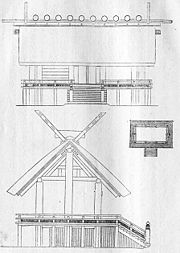
, characterized by extreme simplicity and antiquity: its basic principles date back to the Kofun era (250-538 C.E.). The shrine buildings use a special variant of this style called , which may not be used in the construction of any other shrine. The old shrines are dismantled and new ones built on an adjacent site to exacting specifications every 20 years at exorbitant expense, so that the buildings will be forever new and forever ancient and original. The present buildings, dating from 1993, are the 61st iteration to date and are scheduled for rebuilding in 2013.
The shrine at Naikū is constructed of Japanese cypress. Built on pillars set directly in the ground, the shrine building measures 10.9 by 5.5 meters and includes a raised floor, verandahs all the way around the building and a staircase leading to a single central doorway. The roof is made of thatched reed with ten billets (katsuogi
Katsuogi
or are short, decorative logs found on Japanese and Shinto architecture. They are placed at a right angle along the ridge of roofs, and are usually featured in religious or imperial architecture. Katsuogi predate Buddhist influence and is an architectural element endemic to Japan. They are...
) located on the ridge of the roof, the bargeboards of which project beyond the roof to form the distinctive forked finials (chigi
Chigi (architecture)
, or are forked roof finials found in Japanese and Shinto Architecture. Chigi predate Buddhist influence and are an architectural element endemic to Japan. They are an important aesthetic aspect of Shinto shrines, where they are often paired with katsuogi, another type of roof ornamentation...
) at the ends of the ridge. The roof ridge is supported by two free-standing columns called the munamochi-bashira. The katsuogi, chigi and munamochi-bashira are stylised forms of older storehouse building techniques that pre-date the introduction of Buddhist architecture in Japan.
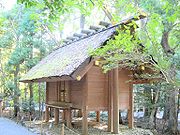
The empty site beside the shrine building, the site where the previous shrine once stood and where the next will be built, is called the kodenchi. This area is strewn with large white pebbles and is left totally empty apart from the oi-ya, a small wooden hut containing a wooden pole a little over 2 metres in height called the shin-no-mihashira (sacred central pole). When a new shrine is built, it is built around the sacred central pole before the removal of the oi-ya, so that the central pole is never seen. The central pole of the old shrine will then have a new oi-ya erected so that the shin-no-mihashira also remains unseen.
"The erection of a single post in the center of a sacred area strewn with stones represents the form taken by Japanese places of worship in very ancient times; the shin-no-mihashira would thus be the survival of a symbolism from a very primitive symbolism to the present day."
Rebuilding the Shrine
Wabi-sabi
represents a comprehensive Japanese world view or aesthetic centered on the acceptance of transience. The aesthetic is sometimes described as one of beauty that is "imperfect, impermanent, and incomplete"...
— and as a way of passing building techniques from one generation to the next. The rebuilding of the main shrine takes place on an adjacent site next to the old, and each rebuilding alternates between the two sites. The next scheduled rebuilding of Naikū is due in 2013 on the lower, northern site.
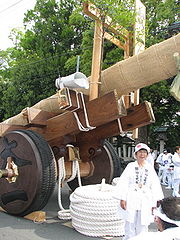
In the lead-up to the rebuilding of the shrines, a number of festivals are held to mark special events. The Okihiki Festival is held in the spring over two consecutive years and involves people from surrounding towns dragging huge wooden logs through the streets of Ise to Naikū and Gekū. In the lead-up to the 2013 rebuilding, the Okihiki festival was held in 2006 and 2007. A year after the completion of the Okihiki festival, carpenters begin preparing the wood for its eventual use in the Shrine.
Annual festivals
From the late 7th century, when the festivals and offerings of Ise Shrine became more formalised, a number of annual events have been performed at both Naikū and Gekū. The Tsukinamisai, which was held in June and December, as well as the Kannamesai in September, were the only three offerings performed by the SaioSaio
A , also known as "Itsuki no Miko", was an unmarried female relative of the Japanese emperor, sent to Ise to serve at Ise Grand Shrine from the late 7th century until the 14th century. The Saiō's residence, Saikū , was approximately 10 km north-west of the shrine...
, an imperial princess who served as high priestess of the shrine until the 14th century. These offerings are based on the cycle of the agricultural year and are still performed today.
The first important ceremony of the modern calendar year is the Kinensai, where prayers are offered for a bountiful harvest. Kannamesai, where prayers for fair weather and sufficient rains are made, is held twice a year in May and August at both Naikū and Gekū.
The most important annual festival held at Ise Shrine is the Kannamesai Festival 神嘗祭. Held in October each year, this ritual makes offerings of the first harvest of crops for the season to Amaterasu. An imperial envoy carries the offering of rice harvested by the Emperor himself to Ise, as well as five-coloured silk cloth and other materials, called heihaku.
Besides the agricultural ceremonies already mentioned, ceremonies and festivals are held throughout the year at both Naikū and Gekū to celebrate such things as the new year, the foundation of Japan, past emperors, purification rituals for priests and court musicians, good sake fermentation and for the Emperor's birthday. There are also daily food offerings to the shrine kami held both in the mornings and evenings.
Naikū - the inner shrine
The official name of the main shrine of Naikū is Kotaijingu and is the place of worship of the goddess Amaterasu-omikamiAmaterasu
, or is apart of the Japanese myth cycle and also a major deity of the Shinto religion. She is the goddess of the sun, but also of the universe. the name Amaterasu derived from Amateru meaning "shining in heaven." The meaning of her whole name, Amaterasu-ōmikami, is "the great August kami who...
. The grounds of Naikū contain a number of structures, including the following:
The Uji Bridge
This 100 meter wooden bridge in traditional Japanese style stretches across the Isuzu river at the entrance of Naikū. Like the shrine buildings of Naikū, it is rebuilt every 20 years as a part of the Shikinen Sengu ceremony. On crossing the bridge, the path turns to the right along the banks of the Isuzu river and passes through large landscaped gardens.Temizusha
Saikan and Anzaisho
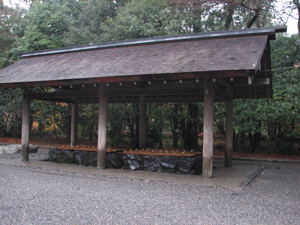
After passing the first large torii gate, the Purification Hall (Saikan), and the hall for visitors from the imperial household (Anzaisho) is located to the left. The Saikan is used by shrine priests to purify themselves before performing ceremonies at the shrine. They are required to spend one or two nights to free their minds of worldly issues, partaking in baths and eating meals cooked with the sacred fire.Kaguraden
This hall for special prayer, located just after the second large torii gate, is open to the public for the offering of individual prayers to the kami, the giving of donations and the purchase of special talisman of protection, amulets and hanging scrolls of Amaterasu Omikami.Imibiyaden
This hall contains the sacred fire used to cook all of the food offerings to the kami of Ise Shrine. Rice and other offerings cooked on the sacred fire are stored in a box made of Japanese cypress, then purified at the Haraedo immediately in front of the Imibiyaden before being offered to the kami.Kotaijingu - the main shrine
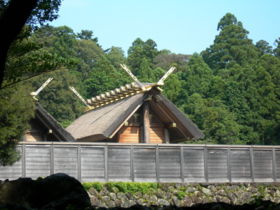
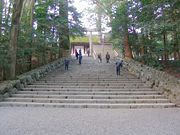
The pilgrimage path then approaches the main shrine of Naikū by a set of large stone steps. Though the actual shrine is hidden behind a large fence, pilgrims can approach the gate to offer their prayers. Photographs in this area are prohibited and this restriction is strictly policed.Kotaijingu is said to hold the Sacred Mirror, one of three sacred items given to the first emperor by the gods. From a path that follows the line of the outer wall, the distinctive roof of the shrine building can be seen through the trees. In front of the walled shrine compound can be seen an open area which will be the location of the next rebuilding of the shrine in 2013.
Shrines
There are 125 shrines within Ise Shrine.| name | kanji | enshrined | kanji | location |
|---|---|---|---|---|
| Kōtai Jingū (Naikū) | 皇大神宮 | Amaterasu Ōmikami Ameno Tajikarao no kami Yorozuhata-Toyoakitsuhime no mikoto |
天照大御神 天手力男神 万幡豊秋津姫命 |
Ujitachi, Ise city |
| Toyouke Daijingū (Gekū) | 豊受大神宮 | Toyouke no Ōmikami 3 Mitomo no kami |
豊受大御神 御伴神3座 |
Toyokawa, Ise city |
| name | kanji | enshrined | kanji | location | |
|---|---|---|---|---|---|
| 1 | Aramatsuri no miya | 荒祭宮 | Amaterasu Ōmikami no Aramitama Mitama The Japanese word refers to the spirit of a kami or the soul of a dead person. It is composed of two characters, the first of which, , is a simply a honorific. The second, means "spirit". The character pair 神霊, also read mitama, is used exclusively to refer to a kami's spirit... |
天照大御神荒御魂 | in Naikū |
| 2 | Tsukiyomi no miya | 月讀宮 | Tsukiyomi no mikoto | 月讀尊 | Nakamura, Ise city |
| 3 | Tsukiyomi no Aramitama no miya | 月讀荒御魂宮 | Tsukiyomi no mikoto no Aramitama | 月讀尊荒御魂 | in Tsukiyomi no miya |
| 4 | Izanagi no miya | 伊佐奈岐宮 | Izanagi no mikoto | 伊佐奈岐尊 | in Tsukiyomi no miya |
| 5 | Izanami no miya | 伊佐奈弥宮 | Izanami no miya | 伊佐奈弥尊 | in Tsukiyomi no miya |
| 6 | Takihara no miya | 瀧原宮 | Amaterasu Ōmikami no Mitama Mitama The Japanese word refers to the spirit of a kami or the soul of a dead person. It is composed of two characters, the first of which, , is a simply a honorific. The second, means "spirit". The character pair 神霊, also read mitama, is used exclusively to refer to a kami's spirit... |
天照大御神御魂 | Takihara, Taiki town, Watarai district |
| 7 | Takihara no narabi no miya | 瀧原竝宮 | Amaterasu Ōmikami no Mitama | 天照大御神御魂 | in Takihara no miya |
| 8 | Izawa no miya | 伊雑宮 | Amaterasu Ōmikami no Mitama | 天照大御神御魂 | Isobe-chō-Kaminogō, Shima city |
| 9 | Yamatohime no miya | 倭姫宮 | Yamatohime no miya | 倭姫命 | Kusube, Ise city |
| 10 | Kazahinomi no miya | 風日祈宮 | SInatsuhiko no mikoto Shinatobe no mikoto |
級長津彦命 級長戸辺命 |
in Naikū |
| name | kanji | enshrined | kanji | location | |
|---|---|---|---|---|---|
| 1 | Taka no miya | 多賀宮 | Toyouke no Ōmikami no Aramitama | 豊受大御神荒御魂 | in Gekū |
| 2 | Tsuchi no miya | 土宮 | Ōtsuchi no mioya no kami | 大土御祖神 | in Gekū |
| 3 | Tsukiyomi no miya | 月夜見宮 | Tsukiyomi no mikoto Tsukiyomi no mikoto no Aramitama |
月夜見尊 月夜見尊荒御魂 |
Miyajiri, Ise city |
| 4 | Kaze no miya | 風宮 | SInatsuhiko no mikoto Shinatobe no mikoto |
級長津彦命 級長戸辺命 |
in Gekū |
| name | kanji | enshrined | kanji | location | |
|---|---|---|---|---|---|
| 1 | Asakuma jinja | 朝熊神社 | Ōtoshi no kami Kokemushi no kami Asakuma no mizu no kami |
大歳神 苔虫神 朝熊水神 |
Asama, Ise city |
| 2 | Asakuma mimae jinja | 朝熊御前神社 | Asakuma no mimae no kami | 朝熊御前神 | in Asakuma jinja |
| 3 | Sonai (Sonō) jinja | 園相神社 | Sonahihiko no mikoto Mimae no kami |
曾奈比比古命 御前神 |
Tsumura, Ise city |
| 4 | Kamo jinja | 鴨神社 | Ishikorowake no mikoto Mimae no kami |
石己呂和居命 御前神 |
Yamagammi, Tamaki, Watarai district |
| 5 | Tanoe jinja | 田乃家神社 | Ōkami no samukawa no kami | 大神御滄川神 | Yano, Tamaki, Watarai district |
| 6 | Tanoe mimae jinja | 田乃家御前神社 | Mimae no kami | 御前神 | same as Tanoe jinja |
| 7 | Kano jinja | 蚊野神社 | Ōkami no mikage no- kawa no kami |
大神御蔭川神 | Kano, Tamaki, Watarai district |
| 8 | Kano mimae jinja | 蚊野御前神社 | Mimae no kami | 御前神 | same as Kano jinja |
| 9 | Yuta jinja | 湯田神社 | Ōtoshi no mioya no mikoto Mimae no kami |
大歳御祖命 御前神 |
Obata-chō-Yuta, Ise city |
| 10 | Ōtsuchi mioya jinja | 大土御祖神社 | Ōkunitama no mikoto Mizusasarahiko no mikoto Mizusasarahime no mikoto |
大国玉命 水佐佐良比古命 水佐佐良比賣命 |
Kusube, Ise city |
| 11 | Kunitsu mioya jinja | 国津御祖神社 | Ujihime no mikoto Tamurahime no mikoto |
宇治比賣命 田村比賣命 |
in Ōtoshi mioya jinja |
| 12 | Kuchira jinja | 朽羅神社 | Chiyorihime no mikoto Chiyorihiko no mikoto |
千依比賣命 千依比古命 |
Hara, Tamaki, Watarai district |
| 13 | Ujiyōda jinja | 宇治山田神社 | Yamatahime no mikoto | 山田姫命 | Nakamura, Ise city |
| 14 | Tsunaga jinja | 津長神社 | Sunagahime no mikoto | 栖長比賣命 | Uji-Imazaike, Ise city (in front of Kōtai Jingū) |
| 15 | Katada jinja | 堅田神社 | Samitsuhime no mikoto | 佐見都比女命 | Futami-chō-Chaya, Ise city |
| 16 | Ōmizu jinja | 大水神社 | Ōyamazumi no mioya no mikoto | 大山祇御祖命 | Uji-imazaike, Ise city (in front of Kōtai Jingū) |
| 17 | E jinja | 江神社 | Nagakuchime no mikoto Ōtoshi no mioya no mikoto Ukano mitama no mikoto |
長口女命 大歳御祖命 宇加乃御玉命 |
Futami-chō-E, Ise city |
| 18 | Kōzaki jinja | 神前神社 | Arasakihime no mikoto | 荒崎比賣命 | Futami-chō-Matsushita, Ise city |
| 19 | Awamiko jinja | 粟皇子神社 | Susanō no mikoto no Mitama no- michinushi no mikoto |
須佐乃乎命御玉道主命 | Futami-chō-Matsushita, Ise city |
| 20 | Kawara jinja | 川原神社 | Tsukiyomi no mikoto no Mitama | 月讀尊御魂 | Sōchi, Ise city |
| 21 | Kugutsuhime jinja | 久具都比賣神社 | kugutsuhime no mikoto kugutsuhiko no mikoto MImae no kami |
久具都比賣命 久具都比古命 御前神 |
Kamikugu, Watarai town, Watarai district |
| 22 | Narahara jinja | 奈良波良神社 | Naraharahime no mikoto | 那良原比女命 | Miyako, Tamaki town, Watarai district |
| 23 | Sugihara jinja | 棒原神社 | Ama no subarume no mikoto- no Mitama Mimae no kami |
天須婆留女命御魂 御前神 |
Kami-Tanui, Tamaki town, Watarai district |
| 24 | Mifune jinja | 御船神社 | Ōkami no mikage no- kawa no mikoto |
大神御蔭川神 | Toba, Taki town, Taki district |
| 25 | Sakatekunari jinja | 坂手国生神社 | Takaminakami no mikoto (Takaminakami no kami) |
高水上命 (高水上神) | Kami-Tanui, Tamaki town, Watarai district |
| 26 | Satakunari jinja | 狭田國生神社 | Hayakawahiko no mikoto Hayakawahime no mikoto Yamazue no Mitama |
速川比古命 速川比女命 山末御魂 |
Sata, Tamaki town, Watarai district |
| 27 | Takihara jinja | 多岐原神社 | Manako no Kami | 真奈胡の神 | Misegawa, Taiki town, Watarai district |
| name | kanji | enshrined | kanji | location | |
|---|---|---|---|---|---|
| 1 | Kusanagi jinja | 草奈伎神社 | Mishirushi no tsurugi no kami | 御剣仗神 (標劔仗神) | Tokiwa, Ise city |
| 2 | Ōmakunari jinja | 大間国生神社 | Ōwakako no mikoto Otowakako no mikoto |
大若子命 乙若子命 |
Tokiwa, Ise city |
| 3 | Watarai kuimii jinja | 度会国御神社 | Hikokunimigakitakeyotsuka no mikoto | 彦国見賀岐建與束命 | in Gekū |
| 4 | Watarai ōkunitamahime jinja | 度会大国玉比賣神社 | Ōkunitama no mikoto Mizusasarahime no mikoto |
大国玉姫命 弥豆佐佐良比賣命 |
in Gekū |
| 5 | Tanoe ōmizu jinja | 田上大水神社 | Ogoto kan-nushi | 小事神主 | Fujisato, Ise city |
| 6 | Tanoe ōmizu mimae jinja | 田上大水御前神社 | Miyako | 宮子 | in Tanoe ōmizu jinja |
| 7 | Shitomi jinja | 志等美神社 | Kukunochi no kami | 久久能智神 | Tsujikuru, Ise city |
| 8 | Ōkōchi jinja | 大河内神社 | Ōyamazumi no kami | 大山祇神 | in Shitomi jinja |
| 9 | Kiyonoiba jinja | 清野井庭神社 | Kayanohime no mikoto | 草野姫命 | Tokiwa, Ise city |
| 10 | Takagawara jinja | 高河原神社 | Tsukiyomi no mikoto no Mitama | 月夜見尊御魂 | in Tsukiyomi no miya (Gekū, 月夜見宮) |
| 11 | Kawara jinja | 河原神社 | Kawa no kami | 川神 | Misono-chō-Shingai, Ise city |
| 12 | Kawarabuchi jinja | 河原淵神社 | Sawahime no mikoto | 澤姫命 | Funae, Ise city |
| 13 | Yamazue jinja | 山末神社 | Ōyamatsuhime no mikoto | 大山津姫命 | in Gekū |
| 14 | Usunono jinja | 宇須乃野神社 | Usunome no mikoto | 宇須乃女命 | Misono-chō-Takabuku, Ise city |
| 15 | Mike jinja | 御食神社 | Minato no miketsu kami | 水戸御饗都 | Kamiyashiro, Ise city |
| 16 | Obata jinja | 小俣神社 | Uka no Mitama no kami | 宇賀御魂神 | Obata-chō-motomachi, Ise city |
| name | kanji | enshrined | kanji | location | |
|---|---|---|---|---|---|
| 1 | Kamoshimo jinja | 鴨下神社 | Ishikorowake no mikoto Kamohiko no mikoto Kamohime no mikoto |
石己呂和居命 鴨比古命 鴨比賣命 |
Katsuta, Tamaki, Watarai district |
| 2 | Tsubura jinja | 津布良神社 | Tsuburahiko no mikoto Tsuburahime no mikoto |
津布良比古命 津布良比賣命 |
Tsubura, Tamaki, Watarai district |
| 3 | Ashihara jinja | 葦原神社 | Sasatsuhiko no mikoto Ukano Mitama no mioya no mikoto Ikarihime no mikoto |
佐佐津比古命 宇加乃御魂御祖命 伊加利比売命 |
in Tsukiyomi no miya (Naikū, 月讀宮) |
| 4 | Ogoso jinja | 小社神社 | (>Takaminakami mikoto) | 高水上命 | Ogoso-Sone, Tamaki, Watarai district |
| 5 | Komori jinja | 許母利神社 | Awashima no kami no mitama | 粟嶋神御魂 | same as Kōzaki jinja |
| 6 | Niikawa jinja | 新川神社 | Niikawahime no mikoto | 新川比賣命 | same as Tsunaga jinja |
| 7 | Iwai jinja | 石井神社 | Takaminakami no mikoto | 高水上命 | same as Tsunaga jinja |
| 8 | Uji no nuki jinja | 宇治乃奴鬼 | Takaminakami no mikoto | 高水上命 | Ōtoshi mioya jinja |
| 9 | Kanumi jinja | 加努弥神社 | Inayorihime no mikoto | 稲依比女命 | Kanome (Kanomi), Ise city without building |
| 10 | Kawaai jinja | 川相神社 | Hosokawa no mizu no kami | 細川水神 | same as Ōmizu jinja |
| 11 | Kumabuchi jinja | 熊淵神社 | Takiōtoji no kami | 多支大刀自神 | same as Ōmizu jinja |
| 12 | Arasaki jinja | 荒前神社 | Arasakihime no mikoto | 荒前比賣命 | same as Kōzaki jinja |
| 13 | Najime jinja | 那自売神社 | Ōminakami no mioya no mikoto Mimonosusohime no mikoto |
大水上御祖命 御裳乃須蘇比賣命 |
same as Ujiyōda jinja |
| 14 | Ashidate jinja | 葦立弖神社 | Tamayarahime no mikoto | 玉移良比女命 | same as Kunitsu mioya jinja |
| 15 | Mumino jinja | 牟弥乃神社 | Samukawahiko no mikoto Samukawahime no mikoto |
寒川比古命 寒川比女命 |
same as Mifune jinja |
| 16 | Kagaminomiya jinja | 鏡宮神社 | Iwanoue no futatsu no mikagami no mitama | 岩上二面神鏡霊 | Asama, Ise city |
| name | kanji | enshrined | kanji | location | |
|---|---|---|---|---|---|
| 1 | Igari jinja | 伊我理神社 | Igarihime no mikoto | 伊我理比女命 | in Gekū |
| 2 | Agata jinja | 縣神社 | Agata no kami | 縣神 | same as Usuno no jinja |
| 3 | Inaka jinja | 井中神社 | Inaka no kami | 井中神 | same as Ikari jinja |
| 4 | Uchikake jinja | 打縣神社 | Uchikake myōjin | 打縣名神 | in Shitomi jinja |
| 5 | Akasaki jinja | 赤崎神社 | Arasakihime no mikoto | 荒崎姫命 | Toba, Toba city |
| 6 | Mori jinja | 毛理神社 | Ki no kami | 木神 | same as Kawara jinja (河原神社) |
| 7 | Ōtsu jinja | 大津神社 | Ashihara kami (Ashihara no kami) |
葦原神 | in Gekū |
| 8 | Shioya jinja | 志宝屋神社 | Shiotsuchi no oji | 塩土老翁 | Ōminato, Ise city |
| name | kanji | enshrined | kanji | location | |
|---|---|---|---|---|---|
| 1 | Takimatsuri no kami | 瀧祭神 | Takimatsuri no Ōkami | 瀧祭大神 | in Naikū without building |
| 2 | Okitama no Kami | 興玉神 | Okitama no Kami | 興玉神 | in Naikū Shogū without building |
| 3 | Miyabi no kami | 宮比神 | Miyabi no kami | 宮比神 | in Naikū Shogū without building |
| 4 | Yanohahiki no kami | 屋乃波比伎神 | Yanohahiki no kami | 屋乃波比伎神 | in Naikū Shogū without building |
| 5 | Misakadono | 御酒殿 | Misakadono no kami | 御酒殿神 | in Naikū |
| 6 | Mishine no mikura | 御稲御倉 | Mishine no mikura no kami | 御稲御倉神 | in Naikū |
| 7 | Yuki no mikura | 由貴御倉 | Yuki no mikura no kami | 由貴御倉神 | inNaikū |
| 8 | Miya no meguri no kami | 四至神 | Miya no meguri no kami | 四至神 | in Naikū without building |
| 9 | Kan-Hatori hatadono jinja | 神服織機殿神社 | Kan-hatori hatadono no- mamori no kami |
神服織機殿神社鎮守神 | Ōgaito, Matsusaka city |
| 10 | Massha of Kan-Hatori hatadono jinja; 8 shrines | 神服織機殿神社末社8所 | Kan-hatori hatadono no- mamori no mimae no kami |
神服織機殿神社鎮守御前神 | in Kan-Hatori hatadono jinja |
| 11 | Kan-Omi hatadono jinja | 神麻績機殿神社 | Kan-Omi hatadono no- mamori no kami |
神麻績機殿神社鎮守神 | Iguchinaka, Matsusaka city |
| 12 | Massha of Kan-Omi hatadono jinja; 8 shrines | 神麻績機殿神社末社8所 | Kan-Omi hatadono no mamori no- mimae no kami |
神麻績機殿神社鎮守御前神 | in Kan-Omi hatadono jinja |
| 13 | Mishiodono jinja | 御塩殿神社 | Mishiodono no mamori no kami | 御塩殿神社鎮守神 | Futami-chō-Shō, Ise city |
| 14 | Aedohashihime jinja | 饗土橋姫神社 | Ujibashi no mamori no kami | 宇治橋鎮守神 | Uji-Imazaike, Ise city (in front of Kōtai Jingū) |
| 15 | Ōyamatsumi jinja | 大山祇神社 | Ōyamazumi no kami | 大山祇神 | in Naikū |
| 16 | Koyasu jinja | 子安神社 | Konohanasakuyahime no mikoto | 木華開耶姫命 | in Naikū (side of Ōyamatsumi jinja) |
| name | kanji | enshrined | kanji | location | |
|---|---|---|---|---|---|
| 1 | Misakadono | 御酒殿 | Misakadono no kami | 御酒殿神 | in Gekū |
| 2 | Miya no meguri no kami | 四至神 | Miya no meguri no kami | 四至神 | in Gekū without building |
| 3 | Kami no mii no jinja | 上御井神社 | Kami no mii no mamori no kami | 上御井鎮守神 | in Gekū |
| 4 | Shimo no mii no jinja | 下御井神社 | Shimo no mii no mamori no kami | 下御井鎮守神 | in Gekū |
| name | kanji | enshrined | kanji | location | |
|---|---|---|---|---|---|
| 1 | Wakamiya jinja | 若宮神社 | Wakamiya no kami | 若宮神 | in Takihara no miya |
| 2 | Nagayuke jinja | 長由介神社 | Nagayuke no kami | 長由介神 | in Takihara no miya |
| 3 | Kawashima jinja | 川島神社 | Kawashima no kami | 川島神 | same as Nagayuke jinja |
| 4 | Saminaga jinja | 佐美長神社 | Shimonomii no mamori no kami | 大歳神 | Isobe-chō-Erihara, Shima city |
| 5 | Saminaga mimae jinja; 4 shrines | 佐美長御前神社 | Saminaga mimae no kami | 佐美長御前神 | in Saminaga jinja |
Facilities
| name | kanji | articles | kanji | location | |
|---|---|---|---|---|---|
| 1 | Yahirodono of Kan-Hatori hatadono jinja | 神服織機殿神社八尋殿 | Nigitae (silk) | 和妙 | in Kan-Hatori hatadono jinja |
| 2 | Yahirodono of Kan-Omi hatadono jinja | 神服麻績殿神社八尋殿 | Aratae (hemp) | 荒妙 | in Kan-Omi hatadono jinja |
| 3 | Jingu shinden (30,000 m²) |
神宮神田 | Goryō-mai (rice) | 御料米 | Kusube-chō, Ise city |
| 4 | Izawa no miya no omita (1,646 m²) |
伊雑宮の御神田 | Goryō-mai (rice) | 御料米 | Isobe-chō-Erihara, Shima city (side of Izawa no miya) |
| 5 | Mishiohama (6,609 m²) |
御塩浜 | brine | 御塩 | Futami-chō-Nishi, Ise city |
| 6 | Mishiodono Mishio kumiiresho Mishio yakisho (27,785 m²) |
御塩殿 御塩汲入所 御塩焼所 |
Mishio (salt) | 御塩 | in Mishiodono jinja |
| 7 | Jingū misono (19,751 m²) |
神宮御園 | vegetables and fruits | 野菜・果物 | Futami-chō-Mizoguchi, Ise city |
| 8 | Awabi chōseisho (5,946 m²) |
鰒調製所 | noshi awabi (dried abalone) | 熨斗鰒 | Kuzaki-chō, Toba city |
| 9 | Hidai chōseisho (11,242 m²) |
干鯛調製所 | Hidai (dried sea bream) | 干鯛 | Shinojima, Minamichita town Minamichita, Aichi is a town located in Chita District, Aichi, Japan.As of 2010, the town has an estimated population of 20,512 and a density of 536 persons per km². The total area is 38.24 km².This town administers the island of Himakajima.- External links :... , Chita District Chita District, Aichi is a district located in Aichi, Japan.As of 2003, the district has an estimated population of 160,310 and a density of 968.93 persons per km². The total area is 165.45 km².-Towns and villages:*Agui*Higashiura*Mihama*Minamichita*Taketoyo... , Aichi Prefecture Aichi Prefecture is a prefecture of Japan located in the Chūbu region. The region of Aichi is also known as the Tōkai region. The capital is Nagoya. It is the focus of the Chūkyō Metropolitan Area.- History :... |
| 10 | Doki chōseisho (2,878 m²) |
土器調製所 | earthenwares | 土器 | Minomura, Meiwa town, Taki District |
See also
- List of Shinto shrines
- Twenty-Two Shrines
- Modern system of ranked Shinto ShrinesModern system of ranked Shinto ShrinesThe The The (sometimes called simply , was an organizational aspect of the establishment of Japanese State Shinto. This system classified Shinto shrines as either official government shrines or "other" shrines...