

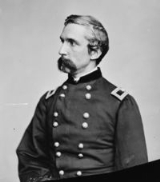
Joshua Chamberlain

Encyclopedia
Joshua Lawrence Chamberlain (September 8, 1828 February 24, 1914), born as Lawrence Joshua Chamberlain, was an American
college professor
from the State of Maine
, who volunteered during the American Civil War
to join the Union Army
. Although having no earlier education in military strategies, he became a highly respected and decorated Union officer
, reaching the rank of brigadier general
(and brevet
major general
). For his gallantry at Gettysburg
, he was awarded the Medal of Honor
. He was given the honor of commanding the Union troops at the surrender ceremony for the infantry of Robert E. Lee
's Army
at Appomattox
, Virginia. After the war, he entered politics as a Republican and served four one-year terms of office as the 32nd Governor of Maine
. He served on the faculty, and as president, of his alma mater
, Bowdoin College
.
, to Joshua and Sarah Dupee Chamberlain, the oldest of five children. He entered Bowdoin College
in Brunswick, Maine
, in 1848, after teaching himself to read Ancient Greek
in order to pass the entrance exam. While at Bowdoin he met many people who would influence his life, including Harriet Beecher Stowe
, the wife of a Bowdoin professor. Chamberlain would often go to listen to her read passages from what would later become her celebrated novel, Uncle Tom's Cabin
. He also joined the Peucinian Society, a group of students with Federalist
leanings. A member of the Phi Beta Kappa academic honor society and a brother of the Alpha Delta Phi
fraternity, Chamberlain graduated in 1852.
He married Fanny Adams
, adopted daughter of a local clergyman, in 1855, and they had five children, one of whom was born too prematurely to survive and two of whom died in infancy. Adams's father did not at first approve of the marriage, but later approved and shared a mutual respect with his son-in-law. Chamberlain studied for three additional years at Bangor Theological Seminary
in Bangor, Maine
, returned to Bowdoin, and began a career in education as a professor
of rhetoric
. He eventually went on to teach every subject in the curriculum with the exception of science and mathematics
. In 1861 he was appointed Professor of Modern Languages. He was fluent in nine languages other than English: Greek
, Latin
, Spanish
, German
, French
, Italian
, Arabic
, Hebrew
, and Syriac
.
Chamberlain's great-grandfathers were soldiers in the American Revolutionary War
. One, Franklin Chamberlain, was a sergeant in the battle of Yorktown. His grandfather, also named Joshua Chamberlain, was a colonel in the local militia during the War of 1812
and was court-martialed (but exonerated) for his part in the humiliating Battle of Hampden
, which led to the sacking of Bangor and Brewer by British forces. His father also had served during the abortive Aroostook War
of 1839. Chamberlain himself was not trained in military science, but felt a strong desire to serve his country.
). He then promptly enlisted unbeknownst to those at Bowdoin and his family. Offered the colonel
cy of the 20th Maine Regiment
, he declined, according to his biographer, John J. Pullen, preferring to "start a little lower and learn the business first." He was appointed lieutenant colonel
of the regiment on August 8, 1862, under the command of Col.
Adelbert Ames
. The 20th was part of the V Corps in the Union Army of the Potomac
. One of Chamberlain's younger brothers, Thomas Chamberlain
, was also an officer of the 20th Maine, and another, John Chamberlain, visited the regiment at Gettysburg as a member of the U.S. Christian Commission until appointed as a chaplain in another Maine Volunteer regiment.
, but did not participate in the fighting. The 20th Maine fought at the subsequent Battle of Fredericksburg
, suffering relatively small numbers of casualties in the assaults on Marye's Heights, but were forced to spend a miserable night on the freezing battlefield among the many wounded from other regiments. Chamberlain chronicled this night well in his diary and went to great length discussing his having to use bodies of the fallen for shelter and a pillow while listening to the bullets zip into the corpses.
due to an outbreak of smallpox
in their ranks (which was caused by an errant smallpox vaccine), which kept them on guard duty in the rear. Chamberlain was promoted to colonel
of the regiment in June 1863, upon the promotion of Ames.
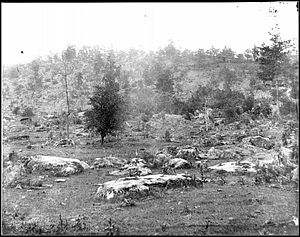 Chamberlain achieved fame at the Battle of Gettysburg
, where his valiant defense of a hill named Little Round Top
became the focus of many publications and stories, including the novel The Killer Angels
and the film Gettysburg.
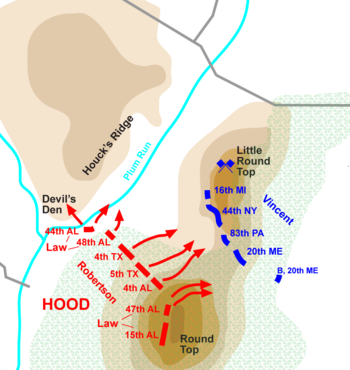 On the second day of the Battle of Gettysburg, Union forces were recovering from initial defeats and hastily regrouping into defensive positions on a line of hills south of the town. Sensing the momentary vulnerability of the Union forces, the Confederates began an attack against the Union left flank. Sent to defend the southern slope of Little Round Top by Col. Strong Vincent
, Chamberlain found himself and the 20th Maine at the far left end of the entire Union line. He quickly understood the strategic significance of the small hill, and the need for the 20th Maine to hold the Union left at all costs. The men from Maine waited until troops from the 15th Alabama Infantry regiment, under Col. William C. Oates
, charged up the hill, attempting to flank the Union position. Time and time again the Confederates struck, until the 20th Maine was almost doubled back upon itself. With many casualties and ammunition running low, Col. Chamberlain recognized the dire circumstances and ordered his left wing (which was now looking southeast, compared to the rest of the regiment, which was facing west) to initiate a bayonet charge. From his report of the day: "At that crisis, I ordered the bayonet. The word was enough." While battlefield conditions make it unlikely that many men heard Chamberlain's order, most historians believe he initiated the charge.
The 20th Maine charged down the hill, with the left wing wheeling continually to make the charging line swing like a hinge, thus creating a simultaneous frontal assault
and flanking maneuver
, capturing 101 of the Confederate soldiers and successfully saving the flank.This version of the battle was popularized by the book, "Killer Angels" and the movie, "Gettysburg" and there is a historical debate on the validity of this account. . Chamberlain sustained two slight wounds in the battle, one when a shot hit his sword scabbard and bruised his thigh, and another when his right foot was hit by a spent bullet or piece of shrapnel. For his tenacity at defending Little Round Top he was known by the sobriquet Lion of the Round Top. Prior to the Battle, Chamberlain was quite ill, developing malaria and dysentery. Later, due to this illness, he was taken off active duty until he recovered.
. There, in a major action on June 18, at Rives' Salient, Chamberlain was shot through the right hip and groin. Despite the injury, Chamberlain withdrew his sword and stuck it into the ground in order to keep himself upright to dissuade the growing resolve for retreat. He stood upright for several minutes until he collapsed and lay unconscious from loss of blood. The wound was considered mortal by the division's surgeon, who predicted he would perish; Chamberlain's incorrectly recorded death in battle was reported in the Maine newspapers, and Lt. Gen.
Ulysses S. Grant
gave Chamberlain a battlefield promotion to the rank of brigadier general
after receiving an urgent recommendation on June 19 from corps commander Maj. Gen. Gouverneur K. Warren
: "He has been recommended for promotion for gallant and efficient conduct on previous occasion and yesterday led his brigade against the enemy under most destructive fire. He expresses the wish that he may receive the recognition of his services by promotion before he dies for the gratification of his family and friends." Not expected to live, Chamberlain displayed surprising will and courage, and with the support of his brother Tom, was back in command by November. Although many, including his wife Fanny, urged Chamberlain to resign, he was determined to serve through the end of the war.
In early 1865, Chamberlain was given command of the 1st Brigade of the 1st Division of V Corps, and he continued to act with courage and resolve. On March 29, 1865, his brigade participated in a major skirmish on the Quaker Road
during Grant's final advance that would finish the war. Despite losses, another wound (in the left arm and chest), and nearly being captured, Chamberlain was successful and brevetted
to the rank of major general
by President Abraham Lincoln
.
In all, Chamberlain served in 20 battles and numerous skirmishes, was cited for bravery four times, had six horses shot from under him, and was wounded six times.
. General Lee desires a cessation of hostilities until he can hear from General Grant as to the proposed surrender." The next day, Chamberlain was summoned to Union headquarters where Maj. Gen. Charles Griffin
informed him that he had been selected to preside over the parade of the Confederate infantry as part of their formal surrender at Appomattox Court House
on April 12.
Thus Chamberlain was responsible for one of the most poignant scenes of the Civil War. As the Confederate soldiers marched down the road to surrender their arms and colors, Chamberlain, on his own initiative, ordered his men to come to attention and "carry arms" as a show of respect. Chamberlain described what happened next:
Chamberlain's salute
to the Confederate soldiers was unpopular with many in the North, but he defended his action in his memoirs, The Passing of the Armies
. Many years later, Gordon, in his own memoirs, called Chamberlain "one of the knightliest soldiers of the Federal Army." Gordon never mentioned the anecdote until after he read Chamberlain's account, more than 40 years later.
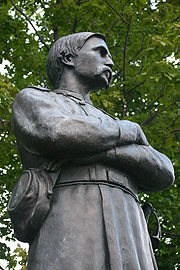 Chamberlain left the army soon after the war ended, going back to his home state of Maine. Due to his immense popularity he served as Governor of Maine
for four one-year terms after he won election as a Republican
. His victory in 1866 set the record for the most votes and the highest percentage for any Maine governor by that time. He would break his own record in 1868. During his time in office he was attacked by those angered by his support for capital punishment and by his refusal to create a special police force to enforce the prohibition of alcohol.
After leaving political office, he returned to Bowdoin College
. In 1871, he was appointed president of Bowdoin and remained in that position until 1883, when he was forced to resign due to ill health from his war wounds. He also served as an ex-officio trustee of nearby Bates College
from 1867 to 1871.
In January 1880, there was a dispute about who was the newly elected governor of Maine, and the Maine State House
was occupied by a band of armed men. The outgoing governor, Alonzo Garcelon
, summoned Chamberlain, the commander of the Maine Militia, to take charge. Chamberlain sent home the armed men, and arranged for the Augusta police to keep control. He stayed in the State House most of the twelve-day period until the Maine Supreme Judicial Court
's decision on the election results was known. During this time, there were threats of assassination and kidnapping, and on one occasion he went outside to face down a crowd of 25-30 men intending to kill him, and both sides offered bribes to appoint him a United States senator. Having gratified neither side in the dispute, he did not become a senator, and his career in state politics ended.
Chamberlain served as Surveyor of the Port of Portland, Maine
, a federal appointment, and engaged in business activities, including real estate dealings in Florida
and a college of art in New York, as well as hotels and railroads. He also wrote several books about Maine, education, and his Civil War memoir, The Passing of the Armies
. From the time of his serious wound in 1864 until his death, he was forced to wear an early form of a catheter
with a bag and underwent six operations to try to correct the original wound and stop the fevers and infections that plagued him, without success.
In 1893, 30 years after the battle that made the 20th Maine famous, Chamberlain was awarded the Medal of Honor
for his actions at Gettysburg. The citation commends him for his "Daring heroism and great tenacity in holding his position on the Little Round Top against repeated assaults, and carrying the advance position on the Great Round Top."
Beginning with his first election as governor of Maine, continuing to the end of his life, even as he suffered continual pain and discomfort from his wounds of 1864, Chamberlain was active in the Grand Army of the Republic
and made many return visits to Gettysburg, giving speeches at soldiers' reunions.
In 1898 at the age of 70, still in pain from his wounds, he volunteered for duty as an officer in the Spanish-American War
. Rejected for duty, he called it one of the major disappointments of his life.
As in many other Civil War actions, controversy arose when one of his subordinate officers stated that Chamberlain never actually ordered a charge at Gettysburg. The claim never seriously affected Chamberlain's fame or notoriety, however. In May 1913, he made his last known visit to Gettysburg while involved in planning the 50th anniversary reunion. Due to deteriorating health, he was unable to attend the reunion two months later.
Chamberlain became a founding member of the Maine Institution for the Blind, in Portland, now called The Iris Network. Chamberlain's wife herself was visually impaired, and he served on the first Board of Directors for the Agency.
Chamberlain died of his lingering wartime wounds in 1914 at Portland, Maine
, age 85, and is buried in Pine Grove Cemetery in Brunswick, Maine
. Beside him as he died was Dr. Abner Shaw of Portland, one of the two surgeons who had operated on him in Petersburg 50 years previously. He was the last Civil War veteran to die as a result of wounds from the war. A full study of his medical history strongly suggests that it was complications from the wound suffered at Petersburg that resulted in his death.
His home, located across Maine Street from the Bowdoin College campus, is now the Joshua L. Chamberlain Museum
and is owned by the Pejepscot Historical Society
, which also maintains an extensive research collection on Chamberlain. Memorabilia on display include the minié ball that almost ended his life at Petersburg and Don Troiani's original painting of the charge at Little Round Top. Tours of the home are conducted by knowledgeable volunteer docents from late May until mid-October.
US Route 1A is carried across the Penobscot River
between Bangor
and Brewer
, Maine by the Joshua Chamberlain Bridge, a four lane steel plate girder bridge opened in 1959.
's Pulitzer Prize
-winning historical novel
about Gettysburg, The Killer Angels
, and the movie based on that novel, Gettysburg (in which Chamberlain was played by actor Jeff Daniels
, who repeated that role in the Gods and Generals
prequel).
Tom Eishen's historical novel Courage on Little Round Top is a detailed look at Chamberlain as well as Robert Wicker, the young Confederate officer who fired his pistol at Chamberlain's head during the 20th Maine's historic charge down Little Round Top.
Ken Burns
's 1990 nine-part PBS film The Civil War featured Chamberlain prominently.
Steve Earle
's song Dixieland from his album The Mountain refers to Chamberlain and the Battle of Gettysburg:
Although his name is never said, Chamberlain's actions during the Battle of Gettysburg are popularized in the song Hold at All Costs featured on the CD The Glorious Burden
by the band Iced Earth
, in which singer Tim Owens takes the role of Chamberlain at the battle on Little Round Top.
Shipyard Brewing Company
named a pale ale
after Chamberlain, and decorated the label with his profile.
In the book The Traveler's Gift by Andy Andrews, Chamberlain is the main character in one of the chapters, giving a brief lesson on his history.
In the second of the Percy Jackson & The Olympians
series (The Sea of Monsters
), Joshua Lawrence Chamberlain is mentioned by the centaur Chiron
as single-handedly changing the course of the American Civil War
.
The book "The Lost Regiment
" and the subsequent series by author William R. Forstchen
chronicle the adventures of the "35th Maine", a Union regiment from Maine having been transported to an alien planet. The regiment was based on the 20th Maine, with the main character and commander of the regiment, Andrew Lawrence Keane, also being a college professor.
Citation:
United States
The United States of America is a federal constitutional republic comprising fifty states and a federal district...
college professor
Professor
A professor is a scholarly teacher; the precise meaning of the term varies by country. Literally, professor derives from Latin as a "person who professes" being usually an expert in arts or sciences; a teacher of high rank...
from the State of Maine
Maine
Maine is a state in the New England region of the northeastern United States, bordered by the Atlantic Ocean to the east and south, New Hampshire to the west, and the Canadian provinces of Quebec to the northwest and New Brunswick to the northeast. Maine is both the northernmost and easternmost...
, who volunteered during the American Civil War
American Civil War
The American Civil War was a civil war fought in the United States of America. In response to the election of Abraham Lincoln as President of the United States, 11 southern slave states declared their secession from the United States and formed the Confederate States of America ; the other 25...
to join the Union Army
Union Army
The Union Army was the land force that fought for the Union during the American Civil War. It was also known as the Federal Army, the U.S. Army, the Northern Army and the National Army...
. Although having no earlier education in military strategies, he became a highly respected and decorated Union officer
Officer (armed forces)
An officer is a member of an armed force or uniformed service who holds a position of authority. Commissioned officers derive authority directly from a sovereign power and, as such, hold a commission charging them with the duties and responsibilities of a specific office or position...
, reaching the rank of brigadier general
Brigadier general (United States)
A brigadier general in the United States Army, Air Force, and Marine Corps, is a one-star general officer, with the pay grade of O-7. Brigadier general ranks above a colonel and below major general. Brigadier general is equivalent to the rank of rear admiral in the other uniformed...
(and brevet
Brevet (military)
In many of the world's military establishments, brevet referred to a warrant authorizing a commissioned officer to hold a higher rank temporarily, but usually without receiving the pay of that higher rank except when actually serving in that role. An officer so promoted may be referred to as being...
major general
Major general (United States)
In the United States Army, United States Marine Corps, and United States Air Force, major general is a two-star general-officer rank, with the pay grade of O-8. Major general ranks above brigadier general and below lieutenant general...
). For his gallantry at Gettysburg
Battle of Gettysburg
The Battle of Gettysburg , was fought July 1–3, 1863, in and around the town of Gettysburg, Pennsylvania. The battle with the largest number of casualties in the American Civil War, it is often described as the war's turning point. Union Maj. Gen. George Gordon Meade's Army of the Potomac...
, he was awarded the Medal of Honor
Medal of Honor
The Medal of Honor is the highest military decoration awarded by the United States government. It is bestowed by the President, in the name of Congress, upon members of the United States Armed Forces who distinguish themselves through "conspicuous gallantry and intrepidity at the risk of his or her...
. He was given the honor of commanding the Union troops at the surrender ceremony for the infantry of Robert E. Lee
Robert E. Lee
Robert Edward Lee was a career military officer who is best known for having commanded the Confederate Army of Northern Virginia in the American Civil War....
's Army
Army of Northern Virginia
The Army of Northern Virginia was the primary military force of the Confederate States of America in the Eastern Theater of the American Civil War, as well as the primary command structure of the Department of Northern Virginia. It was most often arrayed against the Union Army of the Potomac...
at Appomattox
Appomattox Court House
The Appomattox Courthouse is the current courthouse in Appomattox, Virginia built in 1892. It is located in the middle of the state about three miles northwest of the Appomattox Court House National Historical Park, once known as Clover Hill - home of the original Old Appomattox Court House...
, Virginia. After the war, he entered politics as a Republican and served four one-year terms of office as the 32nd Governor of Maine
Governor of Maine
The governor of Maine is the chief executive of the State of Maine. Before Maine was admitted to the Union in 1820, Maine was part of Massachusetts and the governor of Massachusetts was chief executive....
. He served on the faculty, and as president, of his alma mater
Alma mater
Alma mater , pronounced ), was used in ancient Rome as a title for various mother goddesses, especially Ceres or Cybele, and in Christianity for the Virgin Mary.-General term:...
, Bowdoin College
Bowdoin College
Bowdoin College , founded in 1794, is an elite private liberal arts college located in the coastal Maine town of Brunswick, Maine. As of 2011, U.S. News and World Report ranks Bowdoin 6th among liberal arts colleges in the United States. At times, it was ranked as high as 4th in the country. It is...
.
Early life
Joshua Chamberlain was born in Brewer, MaineBrewer, Maine
Brewer is a city in Penobscot County, Maine, United States. It is part of the Bangor, Maine Metropolitan Statistical Area. The city is named after its first settler, Colonel John Brewer. The population was 9,482 at the 2010 census....
, to Joshua and Sarah Dupee Chamberlain, the oldest of five children. He entered Bowdoin College
Bowdoin College
Bowdoin College , founded in 1794, is an elite private liberal arts college located in the coastal Maine town of Brunswick, Maine. As of 2011, U.S. News and World Report ranks Bowdoin 6th among liberal arts colleges in the United States. At times, it was ranked as high as 4th in the country. It is...
in Brunswick, Maine
Brunswick, Maine
Brunswick is a town in Cumberland County, Maine, United States. The population was 20,278 at the 2010 census. It is part of the Portland-South Portland-Biddeford metropolitan area. Brunswick is home to Bowdoin College, the Bowdoin College Museum of Art, the Peary-MacMillan Arctic Museum, , and the...
, in 1848, after teaching himself to read Ancient Greek
Ancient Greek
Ancient Greek is the stage of the Greek language in the periods spanning the times c. 9th–6th centuries BC, , c. 5th–4th centuries BC , and the c. 3rd century BC – 6th century AD of ancient Greece and the ancient world; being predated in the 2nd millennium BC by Mycenaean Greek...
in order to pass the entrance exam. While at Bowdoin he met many people who would influence his life, including Harriet Beecher Stowe
Harriet Beecher Stowe
Harriet Beecher Stowe was an American abolitionist and author. Her novel Uncle Tom's Cabin was a depiction of life for African-Americans under slavery; it reached millions as a novel and play, and became influential in the United States and United Kingdom...
, the wife of a Bowdoin professor. Chamberlain would often go to listen to her read passages from what would later become her celebrated novel, Uncle Tom's Cabin
Uncle Tom's Cabin
Uncle Tom's Cabin; or, Life Among the Lowly is an anti-slavery novel by American author Harriet Beecher Stowe. Published in 1852, the novel "helped lay the groundwork for the Civil War", according to Will Kaufman....
. He also joined the Peucinian Society, a group of students with Federalist
Federalist Party (United States)
The Federalist Party was the first American political party, from the early 1790s to 1816, the era of the First Party System, with remnants lasting into the 1820s. The Federalists controlled the federal government until 1801...
leanings. A member of the Phi Beta Kappa academic honor society and a brother of the Alpha Delta Phi
Alpha Delta Phi
Alpha Delta Phi is a Greek-letter social college fraternity and the fourth-oldest continuous Greek-letter fraternity in the United States and Canada. Alpha Delta Phi was founded on October 29, 1832 by Samuel Eells at Hamilton College and includes former U.S. Presidents, Chief Justices of the U.S....
fraternity, Chamberlain graduated in 1852.
He married Fanny Adams
Fanny Chamberlain
Frances Caroline "Fanny" Chamberlain, née Adams was born in the Greater Boston area. She was shuffled to different family members until she settled with Rev. George Eliashib Adams, a nephew of her father, in Brunswick, Maine as a small child...
, adopted daughter of a local clergyman, in 1855, and they had five children, one of whom was born too prematurely to survive and two of whom died in infancy. Adams's father did not at first approve of the marriage, but later approved and shared a mutual respect with his son-in-law. Chamberlain studied for three additional years at Bangor Theological Seminary
Bangor Theological Seminary
Located in Bangor, Maine, and Portland, Maine, Bangor Theological Seminary is an ecumenical seminary, founded in 1814, in the Congregational tradition of the United Church of Christ. It is the only accredited graduate school of religion in Northern New England....
in Bangor, Maine
Bangor, Maine
Bangor is a city in and the county seat of Penobscot County, Maine, United States, and the major commercial and cultural center for eastern and northern Maine...
, returned to Bowdoin, and began a career in education as a professor
Professor
A professor is a scholarly teacher; the precise meaning of the term varies by country. Literally, professor derives from Latin as a "person who professes" being usually an expert in arts or sciences; a teacher of high rank...
of rhetoric
Rhetoric
Rhetoric is the art of discourse, an art that aims to improve the facility of speakers or writers who attempt to inform, persuade, or motivate particular audiences in specific situations. As a subject of formal study and a productive civic practice, rhetoric has played a central role in the Western...
. He eventually went on to teach every subject in the curriculum with the exception of science and mathematics
Mathematics
Mathematics is the study of quantity, space, structure, and change. Mathematicians seek out patterns and formulate new conjectures. Mathematicians resolve the truth or falsity of conjectures by mathematical proofs, which are arguments sufficient to convince other mathematicians of their validity...
. In 1861 he was appointed Professor of Modern Languages. He was fluent in nine languages other than English: Greek
Greek language
Greek is an independent branch of the Indo-European family of languages. Native to the southern Balkans, it has the longest documented history of any Indo-European language, spanning 34 centuries of written records. Its writing system has been the Greek alphabet for the majority of its history;...
, Latin
Latin
Latin is an Italic language originally spoken in Latium and Ancient Rome. It, along with most European languages, is a descendant of the ancient Proto-Indo-European language. Although it is considered a dead language, a number of scholars and members of the Christian clergy speak it fluently, and...
, Spanish
Spanish language
Spanish , also known as Castilian , is a Romance language in the Ibero-Romance group that evolved from several languages and dialects in central-northern Iberia around the 9th century and gradually spread with the expansion of the Kingdom of Castile into central and southern Iberia during the...
, German
German language
German is a West Germanic language, related to and classified alongside English and Dutch. With an estimated 90 – 98 million native speakers, German is one of the world's major languages and is the most widely-spoken first language in the European Union....
, French
French language
French is a Romance language spoken as a first language in France, the Romandy region in Switzerland, Wallonia and Brussels in Belgium, Monaco, the regions of Quebec and Acadia in Canada, and by various communities elsewhere. Second-language speakers of French are distributed throughout many parts...
, Italian
Italian language
Italian is a Romance language spoken mainly in Europe: Italy, Switzerland, San Marino, Vatican City, by minorities in Malta, Monaco, Croatia, Slovenia, France, Libya, Eritrea, and Somalia, and by immigrant communities in the Americas and Australia...
, Arabic
Arabic language
Arabic is a name applied to the descendants of the Classical Arabic language of the 6th century AD, used most prominently in the Quran, the Islamic Holy Book...
, Hebrew
Hebrew language
Hebrew is a Semitic language of the Afroasiatic language family. Culturally, is it considered by Jews and other religious groups as the language of the Jewish people, though other Jewish languages had originated among diaspora Jews, and the Hebrew language is also used by non-Jewish groups, such...
, and Syriac
Syriac language
Syriac is a dialect of Middle Aramaic that was once spoken across much of the Fertile Crescent. Having first appeared as a script in the 1st century AD after being spoken as an unwritten language for five centuries, Classical Syriac became a major literary language throughout the Middle East from...
.
Chamberlain's great-grandfathers were soldiers in the American Revolutionary War
American Revolutionary War
The American Revolutionary War , the American War of Independence, or simply the Revolutionary War, began as a war between the Kingdom of Great Britain and thirteen British colonies in North America, and ended in a global war between several European great powers.The war was the result of the...
. One, Franklin Chamberlain, was a sergeant in the battle of Yorktown. His grandfather, also named Joshua Chamberlain, was a colonel in the local militia during the War of 1812
War of 1812
The War of 1812 was a military conflict fought between the forces of the United States of America and those of the British Empire. The Americans declared war in 1812 for several reasons, including trade restrictions because of Britain's ongoing war with France, impressment of American merchant...
and was court-martialed (but exonerated) for his part in the humiliating Battle of Hampden
Battle of Hampden
The Battle of Hampden, though a minor action of the War of 1812, was the last significant clash of arms in New England, in this instance, in the District of Maine . It represented the end of two centuries of violent contest over Maine by surrounding political units...
, which led to the sacking of Bangor and Brewer by British forces. His father also had served during the abortive Aroostook War
Aroostook War
The Aroostook War was an undeclared nonviolent confrontation in 1838/1839 between the United States and Great Britain over the international boundary between British North America and Maine. The compromise resolution win a mutually accepted border between the state of Maine and the provinces of...
of 1839. Chamberlain himself was not trained in military science, but felt a strong desire to serve his country.
Civil War
Chamberlain believed the Union needed to be supported by all those willing against the Confederacy. On several occasions Chamberlain spoke freely of his beliefs during his class urging students to follow their hearts in regards to the war while issuing his own proclamation that the cause was just. Of his desire to serve in the War he wrote to the Governor of Maine, "I fear, this war, so costly of blood and treasure, will not cease until men of the North are willing to leave good positions, and sacrifice the dearest personal interests, to rescue our country from desolation, and defend the national existence against treachery." Many faculty at Bowdoin did not feel his enthusiasm for various reasons and Chamberlain was subsequently granted a leave of absence (supposedly to study languages for two years in EuropeEurope
Europe is, by convention, one of the world's seven continents. Comprising the westernmost peninsula of Eurasia, Europe is generally 'divided' from Asia to its east by the watershed divides of the Ural and Caucasus Mountains, the Ural River, the Caspian and Black Seas, and the waterways connecting...
). He then promptly enlisted unbeknownst to those at Bowdoin and his family. Offered the colonel
Colonel (United States)
In the United States Army, Air Force, and Marine Corps, colonel is a senior field grade military officer rank just above the rank of lieutenant colonel and just below the rank of brigadier general...
cy of the 20th Maine Regiment
20th Maine Volunteer Infantry Regiment
The 20th Maine Volunteer Infantry Regiment was a combat unit of the United States Army during the American Civil War, most famous for its defense of Little Round Top at the Battle of Gettysburg, July 1863.-Organization:...
, he declined, according to his biographer, John J. Pullen, preferring to "start a little lower and learn the business first." He was appointed lieutenant colonel
Lieutenant Colonel (United States)
In the United States Army, United States Air Force, and United States Marine Corps, a lieutenant colonel is a field grade military officer rank just above the rank of major and just below the rank of colonel. It is equivalent to the naval rank of commander in the other uniformed services.The pay...
of the regiment on August 8, 1862, under the command of Col.
Colonel (United States)
In the United States Army, Air Force, and Marine Corps, colonel is a senior field grade military officer rank just above the rank of lieutenant colonel and just below the rank of brigadier general...
Adelbert Ames
Adelbert Ames
Adelbert Ames was an American sailor, soldier, and politician. He served with distinction as a Union Army general during the American Civil War. As a Radical Republican and a Carpetbagger, he was military governor, Senator and civilian governor in Reconstruction-era Mississippi...
. The 20th was part of the V Corps in the Union Army of the Potomac
Army of the Potomac
The Army of the Potomac was the major Union Army in the Eastern Theater of the American Civil War.-History:The Army of the Potomac was created in 1861, but was then only the size of a corps . Its nucleus was called the Army of Northeastern Virginia, under Brig. Gen...
. One of Chamberlain's younger brothers, Thomas Chamberlain
Thomas Chamberlain
Thomas Davee Chamberlain was an officer in the 20th Maine Volunteer Infantry Regiment during the American Civil War, the brother of Union general Joshua L. Chamberlain, the commanding officer of the 20th Maine Infantry....
, was also an officer of the 20th Maine, and another, John Chamberlain, visited the regiment at Gettysburg as a member of the U.S. Christian Commission until appointed as a chaplain in another Maine Volunteer regiment.
Battle of Fredericksburg
Chamberlain's regiment marched to the Battle of AntietamBattle of Antietam
The Battle of Antietam , fought on September 17, 1862, near Sharpsburg, Maryland, and Antietam Creek, as part of the Maryland Campaign, was the first major battle in the American Civil War to take place on Northern soil. It was the bloodiest single-day battle in American history, with about 23,000...
, but did not participate in the fighting. The 20th Maine fought at the subsequent Battle of Fredericksburg
Battle of Fredericksburg
The Battle of Fredericksburg was fought December 11–15, 1862, in and around Fredericksburg, Virginia, between General Robert E. Lee's Confederate Army of Northern Virginia and the Union Army of the Potomac, commanded by Maj. Gen. Ambrose E. Burnside...
, suffering relatively small numbers of casualties in the assaults on Marye's Heights, but were forced to spend a miserable night on the freezing battlefield among the many wounded from other regiments. Chamberlain chronicled this night well in his diary and went to great length discussing his having to use bodies of the fallen for shelter and a pillow while listening to the bullets zip into the corpses.
Battle of Chancellorsville
The 20th missed May 1863 Battle of ChancellorsvilleBattle of Chancellorsville
The Battle of Chancellorsville was a major battle of the American Civil War, and the principal engagement of the Chancellorsville Campaign. It was fought from April 30 to May 6, 1863, in Spotsylvania County, Virginia, near the village of Chancellorsville. Two related battles were fought nearby on...
due to an outbreak of smallpox
Smallpox
Smallpox was an infectious disease unique to humans, caused by either of two virus variants, Variola major and Variola minor. The disease is also known by the Latin names Variola or Variola vera, which is a derivative of the Latin varius, meaning "spotted", or varus, meaning "pimple"...
in their ranks (which was caused by an errant smallpox vaccine), which kept them on guard duty in the rear. Chamberlain was promoted to colonel
Colonel (United States)
In the United States Army, Air Force, and Marine Corps, colonel is a senior field grade military officer rank just above the rank of lieutenant colonel and just below the rank of brigadier general...
of the regiment in June 1863, upon the promotion of Ames.
Battle of Gettysburg
Battle of Gettysburg
The Battle of Gettysburg , was fought July 1–3, 1863, in and around the town of Gettysburg, Pennsylvania. The battle with the largest number of casualties in the American Civil War, it is often described as the war's turning point. Union Maj. Gen. George Gordon Meade's Army of the Potomac...
, where his valiant defense of a hill named Little Round Top
Little Round Top
Little Round Top is the smaller of two rocky hills south of Gettysburg, Pennsylvania. It was the site of an unsuccessful assault by Confederate troops against the Union left flank on July 2, 1863, the second day of the Battle of Gettysburg....
became the focus of many publications and stories, including the novel The Killer Angels
The Killer Angels
The Killer Angels is a historical novel by Michael Shaara that was awarded the Pulitzer Prize for Fiction in 1975. The book tells the story of four days of the Battle of Gettysburg in the American Civil War: June 30, 1863, as the troops of both the Union and the Confederacy move into battle around...
and the film Gettysburg.
Strong Vincent
Strong Vincent was a lawyer who became famous as a U.S. Army officer during the fighting on Little Round Top at the American Civil War Battle of Gettysburg, where he was mortally wounded.-Early life:...
, Chamberlain found himself and the 20th Maine at the far left end of the entire Union line. He quickly understood the strategic significance of the small hill, and the need for the 20th Maine to hold the Union left at all costs. The men from Maine waited until troops from the 15th Alabama Infantry regiment, under Col. William C. Oates
William C. Oates
William Calvin Oates was a Confederate colonel during the American Civil War, the 29th Governor of Alabama from 1894 to 1896, and a brigadier general in the U.S. Army during the Spanish–American War....
, charged up the hill, attempting to flank the Union position. Time and time again the Confederates struck, until the 20th Maine was almost doubled back upon itself. With many casualties and ammunition running low, Col. Chamberlain recognized the dire circumstances and ordered his left wing (which was now looking southeast, compared to the rest of the regiment, which was facing west) to initiate a bayonet charge. From his report of the day: "At that crisis, I ordered the bayonet. The word was enough." While battlefield conditions make it unlikely that many men heard Chamberlain's order, most historians believe he initiated the charge.
The 20th Maine charged down the hill, with the left wing wheeling continually to make the charging line swing like a hinge, thus creating a simultaneous frontal assault
Frontal assault
The military tactic of frontal assault is a direct, hostile movement of forces toward the front of an enemy force . By targeting the enemy's front, the attackers are subjecting themselves to the maximum defensive power of the enemy...
and flanking maneuver
Flanking maneuver
In military tactics, a flanking maneuver, also called a flank attack, is an attack on the sides of an opposing force. If a flanking maneuver succeeds, the opposing force would be surrounded from two or more directions, which significantly reduces the maneuverability of the outflanked force and its...
, capturing 101 of the Confederate soldiers and successfully saving the flank.This version of the battle was popularized by the book, "Killer Angels" and the movie, "Gettysburg" and there is a historical debate on the validity of this account. . Chamberlain sustained two slight wounds in the battle, one when a shot hit his sword scabbard and bruised his thigh, and another when his right foot was hit by a spent bullet or piece of shrapnel. For his tenacity at defending Little Round Top he was known by the sobriquet Lion of the Round Top. Prior to the Battle, Chamberlain was quite ill, developing malaria and dysentery. Later, due to this illness, he was taken off active duty until he recovered.
Siege of Petersburg
In April 1864, Chamberlain returned to the Army of the Potomac and was promoted to brigade commander shortly before the Siege of PetersburgSiege of Petersburg
The Richmond–Petersburg Campaign was a series of battles around Petersburg, Virginia, fought from June 9, 1864, to March 25, 1865, during the American Civil War...
. There, in a major action on June 18, at Rives' Salient, Chamberlain was shot through the right hip and groin. Despite the injury, Chamberlain withdrew his sword and stuck it into the ground in order to keep himself upright to dissuade the growing resolve for retreat. He stood upright for several minutes until he collapsed and lay unconscious from loss of blood. The wound was considered mortal by the division's surgeon, who predicted he would perish; Chamberlain's incorrectly recorded death in battle was reported in the Maine newspapers, and Lt. Gen.
Lieutenant General (United States)
In the United States Army, the United States Air Force and the United States Marine Corps, lieutenant general is a three-star general officer rank, with the pay grade of O-9. Lieutenant general ranks above major general and below general...
Ulysses S. Grant
Ulysses S. Grant
Ulysses S. Grant was the 18th President of the United States as well as military commander during the Civil War and post-war Reconstruction periods. Under Grant's command, the Union Army defeated the Confederate military and ended the Confederate States of America...
gave Chamberlain a battlefield promotion to the rank of brigadier general
Brigadier general (United States)
A brigadier general in the United States Army, Air Force, and Marine Corps, is a one-star general officer, with the pay grade of O-7. Brigadier general ranks above a colonel and below major general. Brigadier general is equivalent to the rank of rear admiral in the other uniformed...
after receiving an urgent recommendation on June 19 from corps commander Maj. Gen. Gouverneur K. Warren
Gouverneur K. Warren
Gouverneur Kemble Warren was a civil engineer and prominent general in the Union Army during the American Civil War...
: "He has been recommended for promotion for gallant and efficient conduct on previous occasion and yesterday led his brigade against the enemy under most destructive fire. He expresses the wish that he may receive the recognition of his services by promotion before he dies for the gratification of his family and friends." Not expected to live, Chamberlain displayed surprising will and courage, and with the support of his brother Tom, was back in command by November. Although many, including his wife Fanny, urged Chamberlain to resign, he was determined to serve through the end of the war.
In early 1865, Chamberlain was given command of the 1st Brigade of the 1st Division of V Corps, and he continued to act with courage and resolve. On March 29, 1865, his brigade participated in a major skirmish on the Quaker Road
Battle of Lewis's Farm
-External links:*...
during Grant's final advance that would finish the war. Despite losses, another wound (in the left arm and chest), and nearly being captured, Chamberlain was successful and brevetted
Brevet (military)
In many of the world's military establishments, brevet referred to a warrant authorizing a commissioned officer to hold a higher rank temporarily, but usually without receiving the pay of that higher rank except when actually serving in that role. An officer so promoted may be referred to as being...
to the rank of major general
Major general (United States)
In the United States Army, United States Marine Corps, and United States Air Force, major general is a two-star general-officer rank, with the pay grade of O-8. Major general ranks above brigadier general and below lieutenant general...
by President Abraham Lincoln
Abraham Lincoln
Abraham Lincoln was the 16th President of the United States, serving from March 1861 until his assassination in April 1865. He successfully led his country through a great constitutional, military and moral crisis – the American Civil War – preserving the Union, while ending slavery, and...
.
In all, Chamberlain served in 20 battles and numerous skirmishes, was cited for bravery four times, had six horses shot from under him, and was wounded six times.
Appomattox
On the morning of April 9, 1865, Chamberlain learned of the desire by Lee to surrender the Army of Northern Virginia when a Confederate staff officer approached him under a flag of truce. "Sir," he reported to Chamberlain, "I am from General GordonJohn Brown Gordon
John Brown Gordon was one of Robert E. Lee's most trusted Confederate generals during the American Civil War. After the war, he was a strong opponent of Reconstruction and is thought by some to have been the titular leader of the Ku Klux Klan in Georgia during the late 1860s. A member of the...
. General Lee desires a cessation of hostilities until he can hear from General Grant as to the proposed surrender." The next day, Chamberlain was summoned to Union headquarters where Maj. Gen. Charles Griffin
Charles Griffin (general)
Charles Griffin was a career officer in the United States Army and a Union general in the American Civil War. He rose to command a corps in the Army of the Potomac and fought in many of the key campaigns in the Eastern Theater.After the war, he commanded the Department of Texas during Reconstruction...
informed him that he had been selected to preside over the parade of the Confederate infantry as part of their formal surrender at Appomattox Court House
Appomattox Court House
The Appomattox Courthouse is the current courthouse in Appomattox, Virginia built in 1892. It is located in the middle of the state about three miles northwest of the Appomattox Court House National Historical Park, once known as Clover Hill - home of the original Old Appomattox Court House...
on April 12.
Thus Chamberlain was responsible for one of the most poignant scenes of the Civil War. As the Confederate soldiers marched down the road to surrender their arms and colors, Chamberlain, on his own initiative, ordered his men to come to attention and "carry arms" as a show of respect. Chamberlain described what happened next:
Chamberlain's salute
Salute
A salute is a gesture or other action used to display respect. Salutes are primarily associated with armed forces, but other organizations and civil people also use salutes.-Military salutes:...
to the Confederate soldiers was unpopular with many in the North, but he defended his action in his memoirs, The Passing of the Armies
The Passing of the Armies
The Passing of the Armies is a Civil War memoir written by Joshua Lawrence Chamberlain, a renowned commander most famous for his actions on Little Round Top at the Battle of Gettysburg. It is an autobiographical account describing Chamberlain's experiences throughout the latter half of the Civil...
. Many years later, Gordon, in his own memoirs, called Chamberlain "one of the knightliest soldiers of the Federal Army." Gordon never mentioned the anecdote until after he read Chamberlain's account, more than 40 years later.
Post-war career
Governor of Maine
The governor of Maine is the chief executive of the State of Maine. Before Maine was admitted to the Union in 1820, Maine was part of Massachusetts and the governor of Massachusetts was chief executive....
for four one-year terms after he won election as a Republican
Republican Party (United States)
The Republican Party is one of the two major contemporary political parties in the United States, along with the Democratic Party. Founded by anti-slavery expansion activists in 1854, it is often called the GOP . The party's platform generally reflects American conservatism in the U.S...
. His victory in 1866 set the record for the most votes and the highest percentage for any Maine governor by that time. He would break his own record in 1868. During his time in office he was attacked by those angered by his support for capital punishment and by his refusal to create a special police force to enforce the prohibition of alcohol.
After leaving political office, he returned to Bowdoin College
Bowdoin College
Bowdoin College , founded in 1794, is an elite private liberal arts college located in the coastal Maine town of Brunswick, Maine. As of 2011, U.S. News and World Report ranks Bowdoin 6th among liberal arts colleges in the United States. At times, it was ranked as high as 4th in the country. It is...
. In 1871, he was appointed president of Bowdoin and remained in that position until 1883, when he was forced to resign due to ill health from his war wounds. He also served as an ex-officio trustee of nearby Bates College
Bates College
Bates College is a highly selective, private liberal arts college located in Lewiston, Maine, in the United States. and was most recently ranked 21st in the nation in the 2011 US News Best Liberal Arts Colleges rankings. The college was founded in 1855 by abolitionists...
from 1867 to 1871.
In January 1880, there was a dispute about who was the newly elected governor of Maine, and the Maine State House
Maine State House
The Maine State House in Augusta, Maine is the state capitol of the State of Maine. The building was completed in 1832, one year after Augusta became the capital of Maine...
was occupied by a band of armed men. The outgoing governor, Alonzo Garcelon
Alonzo Garcelon
Dr. Alonzo Garcelon was the 36th Governor of Maine, an American Civil War surgeon general, and a co-founder of Bates College in Lewiston, Maine.-Birth and early years:...
, summoned Chamberlain, the commander of the Maine Militia, to take charge. Chamberlain sent home the armed men, and arranged for the Augusta police to keep control. He stayed in the State House most of the twelve-day period until the Maine Supreme Judicial Court
Maine Supreme Judicial Court
The Maine Supreme Judicial Court is the highest court in Maine's judicial system. Known as the Law Court when sitting as an appellate court, it is composed of seven justices, who are appointed by the Governor and confirmed by the Maine Senate...
's decision on the election results was known. During this time, there were threats of assassination and kidnapping, and on one occasion he went outside to face down a crowd of 25-30 men intending to kill him, and both sides offered bribes to appoint him a United States senator. Having gratified neither side in the dispute, he did not become a senator, and his career in state politics ended.
Chamberlain served as Surveyor of the Port of Portland, Maine
Portland, Maine
Portland is the largest city in Maine and is the county seat of Cumberland County. The 2010 city population was 66,194, growing 3 percent since the census of 2000...
, a federal appointment, and engaged in business activities, including real estate dealings in Florida
Florida
Florida is a state in the southeastern United States, located on the nation's Atlantic and Gulf coasts. It is bordered to the west by the Gulf of Mexico, to the north by Alabama and Georgia and to the east by the Atlantic Ocean. With a population of 18,801,310 as measured by the 2010 census, it...
and a college of art in New York, as well as hotels and railroads. He also wrote several books about Maine, education, and his Civil War memoir, The Passing of the Armies
The Passing of the Armies
The Passing of the Armies is a Civil War memoir written by Joshua Lawrence Chamberlain, a renowned commander most famous for his actions on Little Round Top at the Battle of Gettysburg. It is an autobiographical account describing Chamberlain's experiences throughout the latter half of the Civil...
. From the time of his serious wound in 1864 until his death, he was forced to wear an early form of a catheter
Catheter
In medicine, a catheter is a tube that can be inserted into a body cavity, duct, or vessel. Catheters thereby allow drainage, administration of fluids or gases, or access by surgical instruments. The process of inserting a catheter is catheterization...
with a bag and underwent six operations to try to correct the original wound and stop the fevers and infections that plagued him, without success.
In 1893, 30 years after the battle that made the 20th Maine famous, Chamberlain was awarded the Medal of Honor
Medal of Honor
The Medal of Honor is the highest military decoration awarded by the United States government. It is bestowed by the President, in the name of Congress, upon members of the United States Armed Forces who distinguish themselves through "conspicuous gallantry and intrepidity at the risk of his or her...
for his actions at Gettysburg. The citation commends him for his "Daring heroism and great tenacity in holding his position on the Little Round Top against repeated assaults, and carrying the advance position on the Great Round Top."
Beginning with his first election as governor of Maine, continuing to the end of his life, even as he suffered continual pain and discomfort from his wounds of 1864, Chamberlain was active in the Grand Army of the Republic
Grand Army of the Republic
The Grand Army of the Republic was a fraternal organization composed of veterans of the Union Army, US Navy, US Marines and US Revenue Cutter Service who served in the American Civil War. Founded in 1866 in Decatur, Illinois, it was dissolved in 1956 when its last member died...
and made many return visits to Gettysburg, giving speeches at soldiers' reunions.
In 1898 at the age of 70, still in pain from his wounds, he volunteered for duty as an officer in the Spanish-American War
Spanish-American War
The Spanish–American War was a conflict in 1898 between Spain and the United States, effectively the result of American intervention in the ongoing Cuban War of Independence...
. Rejected for duty, he called it one of the major disappointments of his life.
As in many other Civil War actions, controversy arose when one of his subordinate officers stated that Chamberlain never actually ordered a charge at Gettysburg. The claim never seriously affected Chamberlain's fame or notoriety, however. In May 1913, he made his last known visit to Gettysburg while involved in planning the 50th anniversary reunion. Due to deteriorating health, he was unable to attend the reunion two months later.
Chamberlain became a founding member of the Maine Institution for the Blind, in Portland, now called The Iris Network. Chamberlain's wife herself was visually impaired, and he served on the first Board of Directors for the Agency.
Chamberlain died of his lingering wartime wounds in 1914 at Portland, Maine
Portland, Maine
Portland is the largest city in Maine and is the county seat of Cumberland County. The 2010 city population was 66,194, growing 3 percent since the census of 2000...
, age 85, and is buried in Pine Grove Cemetery in Brunswick, Maine
Brunswick, Maine
Brunswick is a town in Cumberland County, Maine, United States. The population was 20,278 at the 2010 census. It is part of the Portland-South Portland-Biddeford metropolitan area. Brunswick is home to Bowdoin College, the Bowdoin College Museum of Art, the Peary-MacMillan Arctic Museum, , and the...
. Beside him as he died was Dr. Abner Shaw of Portland, one of the two surgeons who had operated on him in Petersburg 50 years previously. He was the last Civil War veteran to die as a result of wounds from the war. A full study of his medical history strongly suggests that it was complications from the wound suffered at Petersburg that resulted in his death.
His home, located across Maine Street from the Bowdoin College campus, is now the Joshua L. Chamberlain Museum
Joshua L. Chamberlain Museum
The Joshua L. Chamberlain Museum was the home of American Civil War general, Bowdoin College president, and Maine Governor Joshua L. Chamberlain for over 50 years...
and is owned by the Pejepscot Historical Society
Pejepscot Historical Society
The Pejepscot Historical Society, located in Brunswick, is one of the oldest historical societies in the state of Maine. Founded in 1888, the Society's mission is to preserve and celebrate the history of the Pejepscot region, which includes the towns of Brunswick, Harpswell and...
, which also maintains an extensive research collection on Chamberlain. Memorabilia on display include the minié ball that almost ended his life at Petersburg and Don Troiani's original painting of the charge at Little Round Top. Tours of the home are conducted by knowledgeable volunteer docents from late May until mid-October.
US Route 1A is carried across the Penobscot River
Penobscot River
The Penobscot River is a river in the U.S. state of Maine. Including the river's West Branch and South Branch increases the Penobscot's length to , making it the second longest river system in Maine and the longest entirely in the state. Its drainage basin contains .It arises from four branches...
between Bangor
Bangor, Maine
Bangor is a city in and the county seat of Penobscot County, Maine, United States, and the major commercial and cultural center for eastern and northern Maine...
and Brewer
Brewer, Maine
Brewer is a city in Penobscot County, Maine, United States. It is part of the Bangor, Maine Metropolitan Statistical Area. The city is named after its first settler, Colonel John Brewer. The population was 9,482 at the 2010 census....
, Maine by the Joshua Chamberlain Bridge, a four lane steel plate girder bridge opened in 1959.
Command history
- Lieutenant ColonelLieutenant Colonel (United States)In the United States Army, United States Air Force, and United States Marine Corps, a lieutenant colonel is a field grade military officer rank just above the rank of major and just below the rank of colonel. It is equivalent to the naval rank of commander in the other uniformed services.The pay...
(second in commandSecond in CommandSecond in Command is a 2006 action film directed by Simon Fellows, starring Jean-Claude Van Damme. It was released direct-to-video in the United States, Belgium, and Germany on May 2, 2006. It has been rated R by the MPAA for violence and some language. The film was made in Bucharest, Romania.-Plot...
), 20th Maine (August 8, 1862) - ColonelColonel (United States)In the United States Army, Air Force, and Marine Corps, colonel is a senior field grade military officer rank just above the rank of lieutenant colonel and just below the rank of brigadier general...
, commanding 20th Maine (May 20, 1863) - Commanding 3rd Brigade, 1st Division, V Corps (August 26 – November 19, 1863)
- Commanding 1st Brigade (June 6–18, 1864)
- Brigadier GeneralBrigadier general (United States)A brigadier general in the United States Army, Air Force, and Marine Corps, is a one-star general officer, with the pay grade of O-7. Brigadier general ranks above a colonel and below major general. Brigadier general is equivalent to the rank of rear admiral in the other uniformed...
of Volunteers (June 18, 1864) - Commanding 1st Brigade (November 19, 1864 – January 5, 1865)
- Commanding 1st Brigade (February 27 – April 11, 1865)
- Brevet Major General of Volunteers (March 29, 1865)
- Commanding 1st Division (April 20 – June 28, 1865)
- Commanding 1st Brigade, 3rd Division, Wright'sHoratio WrightHoratio Gouverneur Wright was an engineer and general in the Union Army during the American Civil War. After the war, he was involved in a number of engineering projects, including the Brooklyn Bridge and the completion of the Washington Monument, and served as Chief of Engineers for the U.S...
Provisional Corps, Middle Department (June 28 – July, 1865) - Mustered out of volunteer service (January 15, 1866)
In popular media
Chamberlain is a key character in Michael ShaaraMichael Shaara
Michael Shaara was an American writer of science fiction, sports fiction, and historical fiction. He was born to Italian immigrant parents in Jersey City, New Jersey, graduated from Rutgers University in 1951, and served as a sergeant in the 82nd Airborne division...
's Pulitzer Prize
Pulitzer Prize
The Pulitzer Prize is a U.S. award for achievements in newspaper and online journalism, literature and musical composition. It was established by American publisher Joseph Pulitzer and is administered by Columbia University in New York City...
-winning historical novel
Historical novel
According to Encyclopædia Britannica, a historical novel is-Development:An early example of historical prose fiction is Luó Guànzhōng's 14th century Romance of the Three Kingdoms, which covers one of the most important periods of Chinese history and left a lasting impact on Chinese culture.The...
about Gettysburg, The Killer Angels
The Killer Angels
The Killer Angels is a historical novel by Michael Shaara that was awarded the Pulitzer Prize for Fiction in 1975. The book tells the story of four days of the Battle of Gettysburg in the American Civil War: June 30, 1863, as the troops of both the Union and the Confederacy move into battle around...
, and the movie based on that novel, Gettysburg (in which Chamberlain was played by actor Jeff Daniels
Jeff Daniels
Jeffrey Warren "Jeff" Daniels is an American actor, musician and playwright. He founded a non-profit theatre company, the Purple Rose Theatre Company, in his home state of Michigan...
, who repeated that role in the Gods and Generals
Gods and Generals (film)
Gods and Generals is a 2003 American film based on the novel Gods and Generals by Jeffrey Shaara. It depicts events that take place prior to those shown in the 1993 film Gettysburg, which was based on The Killer Angels, a novel by Shaara's father, Michael...
prequel).
Tom Eishen's historical novel Courage on Little Round Top is a detailed look at Chamberlain as well as Robert Wicker, the young Confederate officer who fired his pistol at Chamberlain's head during the 20th Maine's historic charge down Little Round Top.
Ken Burns
Ken Burns
Kenneth Lauren "Ken" Burns is an American director and producer of documentary films, known for his style of using archival footage and photographs...
's 1990 nine-part PBS film The Civil War featured Chamberlain prominently.
Steve Earle
Steve Earle
Stephen Fain "Steve" Earle is an American singer-songwriter known for his rock and Texas Country as well as his political views. He is also a producer, author, a political activist, and an actor, and has written and directed a play....
's song Dixieland from his album The Mountain refers to Chamberlain and the Battle of Gettysburg:
Although his name is never said, Chamberlain's actions during the Battle of Gettysburg are popularized in the song Hold at All Costs featured on the CD The Glorious Burden
The Glorious Burden
-Disc 2: Gettysburg :-American version:-European version:-Iced Earth:* Jon Schaffer − rhythm guitar, backing vocals* Tim 'Ripper' Owens − lead vocals* Ralph Santolla − lead guitar* James MacDonough − bass guitar* Richard Christy − drums...
by the band Iced Earth
Iced Earth
Iced Earth is an American heavy metal band from Tampa, Florida. Originally formed under the name "Purgatory" in 1984, Iced Earth has released a total of ten studio albums, one live album, three EP's, two compilations and boxsets...
, in which singer Tim Owens takes the role of Chamberlain at the battle on Little Round Top.
Shipyard Brewing Company
Shipyard Brewing Company
Shipyard Brewing Company is an American microbrewery and soft drink manufacturer based in Portland, Maine and founded in 1994. Maine ranks among the top five states in the U.S. for microbreweries, with Shipyard the largest brewer...
named a pale ale
Pale ale
Pale ale is a beer which uses a warm fermentation and predominantly pale malt. It is one of the world's major beer styles.The higher proportion of pale malts results in a lighter colour. The term "pale ale" was being applied around 1703 for beers made from malts dried with coke, which resulted in a...
after Chamberlain, and decorated the label with his profile.
In the book The Traveler's Gift by Andy Andrews, Chamberlain is the main character in one of the chapters, giving a brief lesson on his history.
In the second of the Percy Jackson & The Olympians
Percy Jackson & the Olympians
Percy Jackson & the Olympians is a pentalogy of adventure and fantasy fiction books authored by Rick Riordan. The series consists of five books, as well as spin-off titles such as The Demigod Files and Demigods and Monsters. Set in the United States, the books are predominantly based on Greek...
series (The Sea of Monsters
The Sea of Monsters
The Sea of Monsters is a fantasy-adventure novel based on Greek mythology written by Rick Riordan published in 2006. It is the second novel in the Percy Jackson & the Olympians series and the sequel to The Lightning Thief...
), Joshua Lawrence Chamberlain is mentioned by the centaur Chiron
Chiron
In Greek mythology, Chiron was held to be the superlative centaur among his brethren.-History:Like the satyrs, centaurs were notorious for being wild and lusty, overly indulgent drinkers and carousers, given to violence when intoxicated, and generally uncultured delinquents...
as single-handedly changing the course of the American Civil War
American Civil War
The American Civil War was a civil war fought in the United States of America. In response to the election of Abraham Lincoln as President of the United States, 11 southern slave states declared their secession from the United States and formed the Confederate States of America ; the other 25...
.
The book "The Lost Regiment
The Lost Regiment
The Lost Regiment is a series of science fiction novels written by William R. Forstchen.-Plot:The plot revolves around a Union Army regiment from the American Civil War which gets transported to an alien world. The 35th Maine Infantry is being transported by ship from Virginia late in the war when...
" and the subsequent series by author William R. Forstchen
William R. Forstchen
William R. Forstchen is an American author who began publishing in 1983 with the novel Ice Prophet. He is a Professor of History and Faculty Fellow at Montreat College, in Montreat, North Carolina...
chronicle the adventures of the "35th Maine", a Union regiment from Maine having been transported to an alien planet. The regiment was based on the 20th Maine, with the main character and commander of the regiment, Andrew Lawrence Keane, also being a college professor.
Medal of Honor citation
Rank and organization: Colonel, 20th Maine Infantry. Place and date: At Gettysburg, Pa., July 2, 1863. Entered service at: Brunswick, Maine. Born: September 8, 1828, Brewer Maine. Date of issue: August 11, 1893.Citation:
See also
- List of Medal of Honor recipients
- List of American Civil War Medal of Honor recipients: A–F
- List of American Civil War generals
External links
- Joshua Lawrence Chamberlain Digital Archive at Bowdoin College
- Chamberlain-Adams Family Papers.Schlesinger Library, Radcliffe Institute, Harvard University.
- Short Chamberlain bio and photos of his boyhood home in Brewer, his home in Brunswick, his gravesite, and the family plot in Brewer
- Index to Joshua Lawrence Chamberlain's Pages
- Joshua Lawrence Chamberlain Biography
- Joshua Chamberlain: Maine's Favorite Son
- Tribute to Major General Joshua Lawrence Chamberlain
- Joshua L. Chamberlain, a Biographical Essay
- Medal of Honor recipients on Film
- Joshua L. Chamberlain Museum in Brunswick, Maine Managed by the Pejepscot Historical Society
- The Iris Network (formerly the Maine Institution for the Blind)